Sample Category Title
BoC hikes 25bps, raises 2023 GDP and CPI forecasts
BoC raises overnight rate by 25bps to 5.00% as widely expected. Correspondingly, the Bank Rate and deposit rate are increased to 5.25% and 5.00% respectively. In the new economic projections, both GDP and CPI forecasts for 2023 are upgraded.
Nevertheless, the central bank didn't explicitly state a tightening bias in the statement. But the Governing Council will "continue to assess the dynamics of core inflation and the outlook for CPI inflation", and " remains resolute in its commitment to restoring price stability".
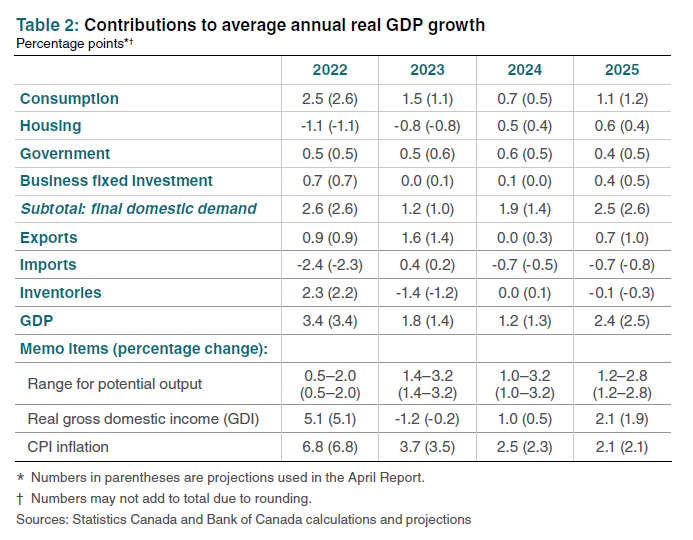
BoC said that "Canada's economy has been stronger than expected, with more momentum in demand". In the new economic projections, GDP is forecast to grow 1.8% in 2023 (raised from 1.4%), 1.2% in 2024 (lowered form 1.3%0, and then 2.4% in 2025 (lowered from 2.5%).
CPI is projected to have a "slower return to target than was forecast in the January and April projections". CPI is projected to slow to 3.7% in 2023 (raised from 3.5%), then 2.5% in 2024 (raised from 2.3%), and then 2.1% in 2025 (unchanged).
(BOC) Bank of Canada raises policy rate 25 basis points, continues quantitative tightening
The Bank of Canada today increased its target for the overnight rate to 5%, with the Bank Rate at 5¼% and the deposit rate at 5%. The Bank is also continuing its policy of quantitative tightening.
Global inflation is easing, with lower energy prices and a decline in goods price inflation. However, robust demand and tight labour markets are causing persistent inflationary pressures in services. Economic growth has been stronger than expected, especially in the United States, where consumer and business spending has been surprisingly resilient. After a surge in early 2023, China's economic growth is softening, with slowing exports and ongoing weakness in its property sector. Growth in the euro area is effectively stalled: while the service sector continues to grow, manufacturing is contracting. Global financial conditions have tightened, with bond yields up in North America and Europe as major central banks signal further interest rate increases may be needed to combat inflation.
The Bank's July Monetary Policy Report (MPR) projects the global economy will grow by around 2.8% this year and 2.4% in 2024, followed by 2.7% growth in 2025.
Canada's economy has been stronger than expected, with more momentum in demand. Consumption growth has been surprisingly strong at 5.8% in the first quarter. While the Bank expects consumer spending to slow in response to the cumulative increase in interest rates, recent retail trade and other data suggest more persistent excess demand in the economy. In addition, the housing market has seen some pickup. New construction and real estate listings are lagging demand, which is adding pressure to prices. In the labour market, there are signs of more availability of workers, but conditions remain tight, and wage growth has been around 4-5%. Strong population growth from immigration is adding both demand and supply to the economy: newcomers are helping to ease the shortage of workers while also boosting consumer spending and adding to demand for housing.
As higher interest rates continue to work their way through the economy, the Bank expects economic growth to slow, averaging around 1% through the second half of this year and the first half of next year. This implies real GDP growth of 1.8% in 2023 and 1.2% in 2024. The economy will move into modest excess supply early next year before growth picks up to 2.4% in 2025.
Inflation in Canada eased to 3.4% in May, a substantial and welcome drop from its peak of 8.1% last summer. While CPI inflation has come down largely as expected so far this year, the downward momentum has come more from lower energy prices, and less from easing underlying inflation. With the large price increases of last year out of the annual data, there will be less near-term downward momentum in CPI inflation. Moreover, with three-month rates of core inflation running around 3½-4% since last September, underlying price pressures appear to be more persistent than anticipated. This is reinforced by the Bank's business surveys, which find businesses are still increasing their prices more frequently than normal.
In the July MPR projection, CPI inflation is forecast to hover around 3% for the next year before gradually declining to 2% in the middle of 2025. This is a slower return to target than was forecast in the January and April projections. Governing Council remains concerned that progress towards the 2% target could stall, jeopardizing the return to price stability.
In light of the accumulation of evidence that excess demand and elevated core inflation are both proving more persistent, and taking into account its revised outlook for economic activity and inflation, Governing Council decided to increase the policy interest rate to 5%. Quantitative tightening is complementing the restrictive stance of monetary policy and normalizing the Bank's balance sheet. Governing Council will continue to assess the dynamics of core inflation and the outlook for CPI inflation. In particular, we will be evaluating whether the evolution of excess demand, inflation expectations, wage growth and corporate pricing behaviour are consistent with achieving the 2% inflation target. The Bank remains resolute in its commitment to restoring price stability for Canadians.
Information note
The next scheduled date for announcing the overnight rate target is September 6, 2023. The Bank will publish its next full outlook for the economy and inflation, including risks to the projection, in the Monetary Policy Report on October 25, 2023.
EUR/USD Mid-Day Outlook
Daily Pivots: (S1) 1.0981; (P) 1.1004; (R1) 1.1031; More...
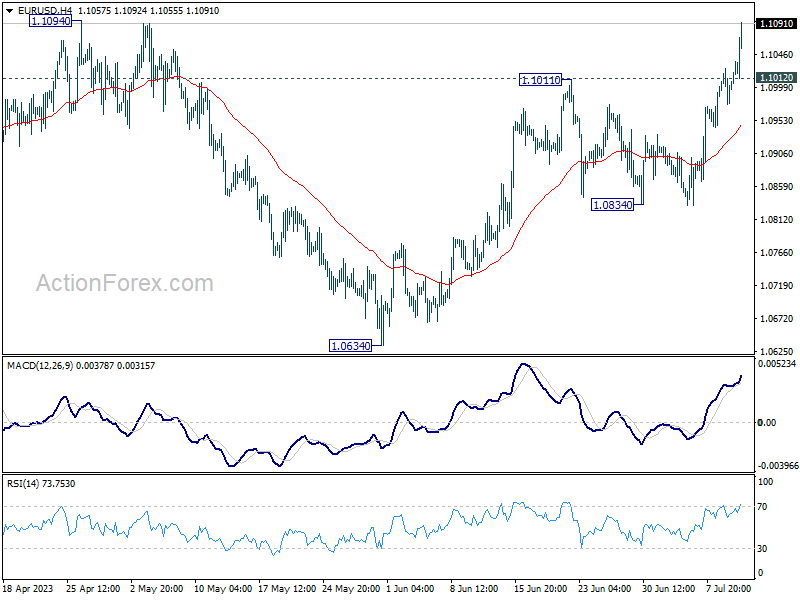
EUR/USD's rally is still in progress and intraday bias remains on the upside. Decisive break of 1.1094 will resume larger up trend from 0.9534 to 1.1273 fibonacci level. On the downside, below 1.1012 minor support will turn intraday bias neutral first. But further rally will remain in favor as long as 1.0834 support holds.
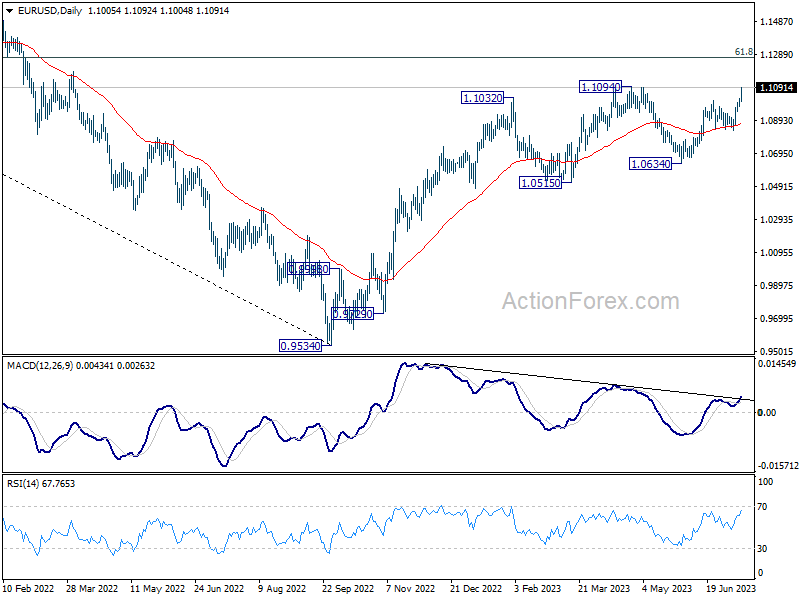
In the bigger picture, as long as 1.0515 support holds, rise from 0.9534 (2022 low) would still extend higher. Sustained break of 61.8% retracement of 1.2348 (2021 high) to 0.9534 at 1.1273 will solidify the case of bullish trend reversal and target 1.2348 resistance next (2021 high).
GBP/USD Mid-Day Outlook
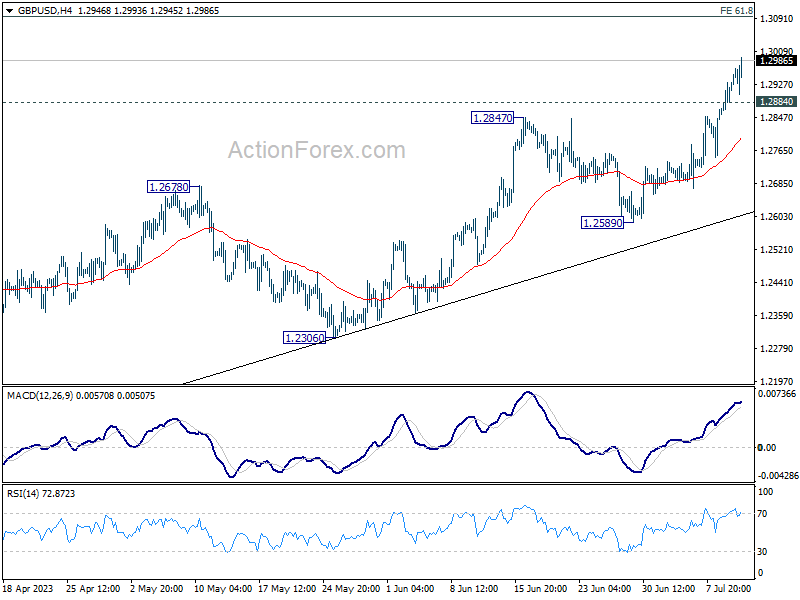
Daily Pivots: (S1) 1.2880; (P) 1.2907; (R1) 1.2960; More...
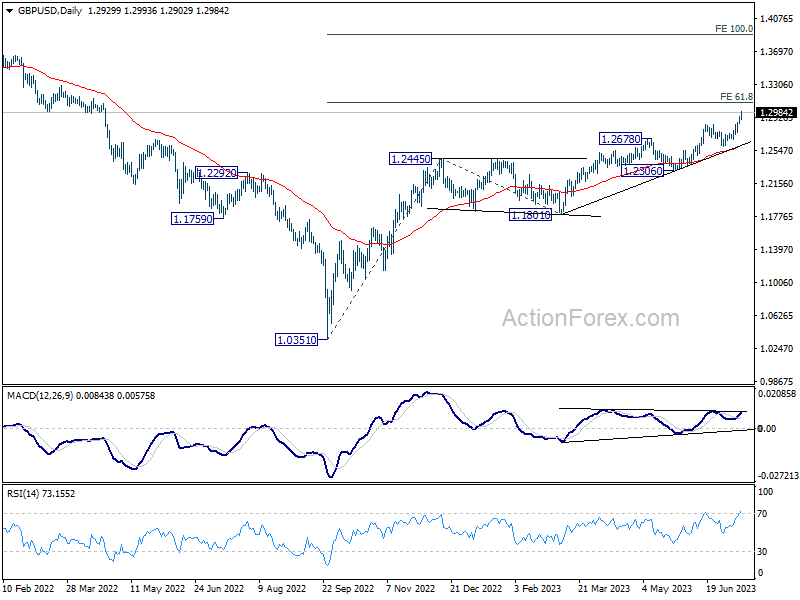
Intraday bias in GBP/USD stays on the upside for the moment. Current rally should target 61.8% projection of 1.0351 to 1.2445 from 1.1801 at 1.3095. On the downside, below 1.2884 minor support will turn intraday bias neutral and bring consolidations first, before staging another rally.
In the bigger picture, the strong support from 55 W EMA (now at 1.2341) is a medium term bullish sign. Outlook will stay bullish as long as 1.2306 support holds. Rise from 1.0351 medium term bottom (2022 low) is expected to extend further to retest 1.4248 key resistance (2021 high).
USD/CHF Mid-Day Outlook
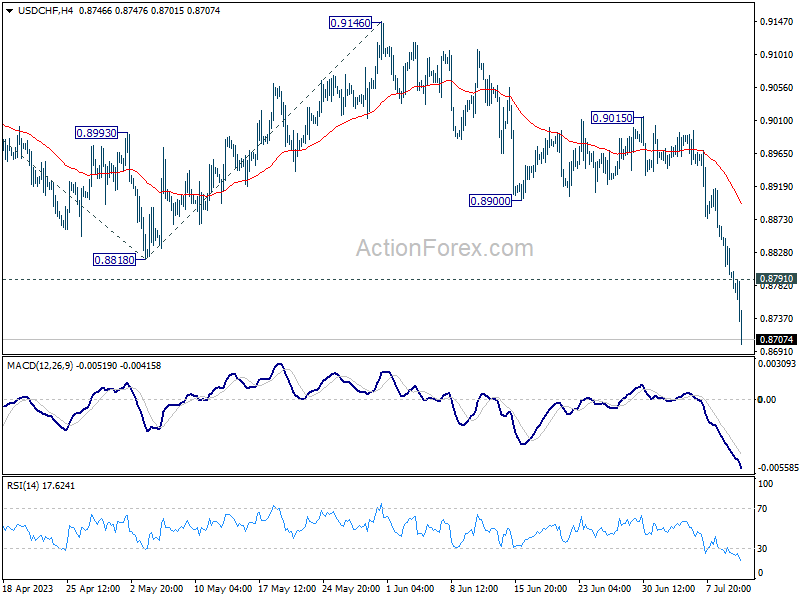
Daily Pivots: (S1) 0.8766; (P) 0.8822; (R1) 0.8851; More...
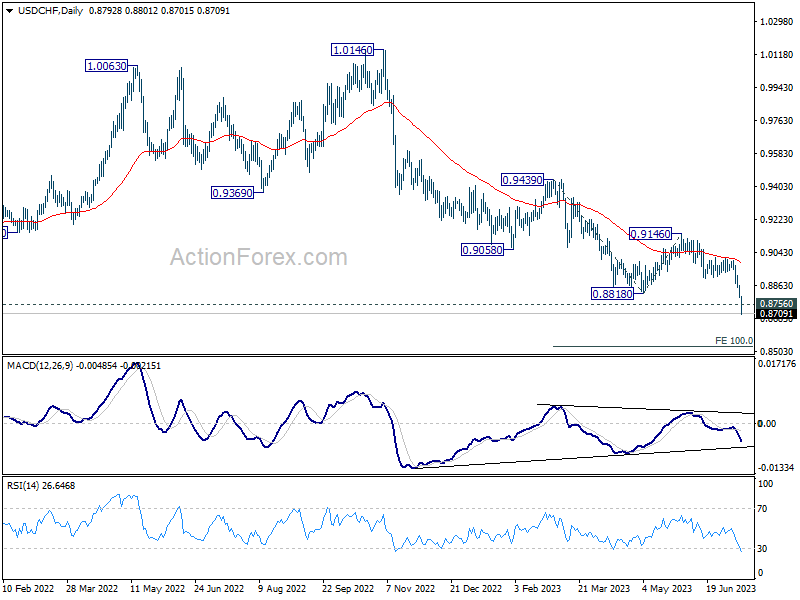
USD/CHF's decline accelerates today and breaks through 0.8756 key long term support decisively. There is no sign of bottoming and intraday bias on the downside. Next target is 100% projection of 0.9439 to 0.8818 from 0.9146 at 0.8525. On the upside, above 0.8791 minor resistance will turn intraday bias neutral first. But outlook will remain bearish as long as 0.8900 support turned resistance holds.
In the bigger picture, the break of 0.8756 (2021 low) indicates break out from the long term range pattern. For now, medium term outlook will stay bearish as long as 0.9146 resistance holds. Further fall would be seen back towards 0.7065 (2011 low).
US: Inflation Continues to Ease in June, But Remains Too Hot for FOMC
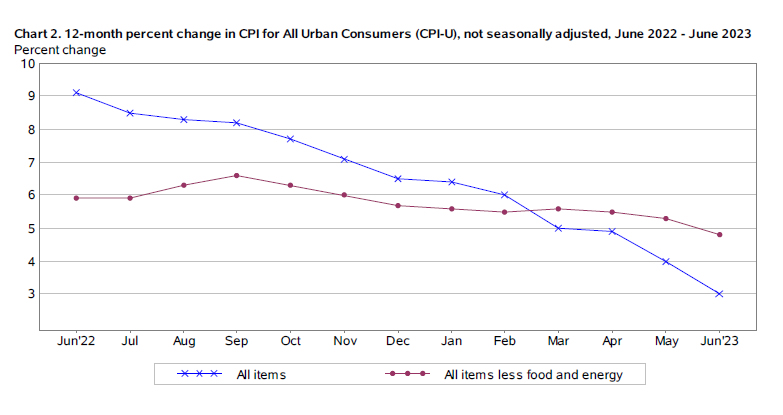
The Consumer Price Index (CPI) rose 0.2% month-on-month (m/m) in June, a tick below expectations. On a 12-month basis, CPI slipped to 3.0% – its slowest pace since March 2021 – and well off its peak of nearly 9% last June.
- The monthly uptick in headline inflation was driven by higher energy costs (+0.6% m/m), including an uptick in gasoline (+0.8% m/m) and energy services (+0.4% m/m). Food prices rose a modest 0.1% m/m and have slowed to 5.7% on a year-over-year (y/y) basis.
Excluding the direct effects of food and energy, core inflation rose 0.2% m/m – also coming in a hair below expectations. The 12-month change on core edged lower by 0.5%-pts on the month, falling to 4.8%, while the three-month annualized change slipped to 4.1%.
Price growth across services rose 0.3% m/m – a deceleration from the 0.4% m/m gains seen over the three-months prior. Core services are up 6.2% relative to June 2022.
- A major contributor to the price growth in services remains rent, with both owners' equivalent rent (OER) and rent of primary residence (RPR) notching sizeable gains of 0.5% m/m. That said, the much-anticipated slowing in shelter costs now appears firmly intact. Over the last three months, OER and RPR have averaged gains of 0.5% m/m, down from the 0.7% m/m increase seen over the 12 months ending in March.
- Price growth across non-housing services declined by 0.1% m/m, with the weakness concentrated in lodging away from home (-2.0% m/m) and education & communication services (-0.3% m/m). Recreational services (+0.5% m/m) was the only sub-category to report an acceleration last month.
Core goods prices (-0.1% m/m) also declined in June, snapping what had been three consecutive months of gains. Prices across household furnishings (-0.3% m/m), transportation (-0.2% m/m) recreational goods (-0.4% m/m) and education & communication goods (-0.1% m/m) were all lower last month.
Key Implications
Headline inflation has fallen sharply over the past year, with prices up just 3% (or roughly a third of the price growth) relative to June 2022. The core index has been much slower to come down, though encouraging signs are starting to emerge. Shelter costs – a key contributor to price growth through this cycle – have definitively rolled over, while goods have (again) become a source of deflation. We are even starting to see some easing in price pressures across the stickier and more labor-intensive service component of inflation, with the 12-month annualized change on non-housing services falling to 3.9% – the slowest pace of growth since December 2021.
Inflation is moving in the right direction, but progress should not be confused with mission accomplished. Core inflation is still running at a multiple of the Fed's 2% inflation target, while last week's employment data showed that the labor market continues to exude a surprising degree of resilience. Another 25 basis-point rate hike at FOMC's upcoming July 25-26th meeting seems inevitable, with policymakers likely to maintain a tightening bias over the near-term as they continue to monitor incoming data to determine the future path of the policy rate.
Has Oil Run its Upswing Potential?
Crude oil has rallied more than 10% from the lows two weeks ago. The price of a barrel of Brent rose above $79.50 on Wednesday, its highest level since early May. But the easy part of the journey for the bulls may be over, and a severe battle to stay within the year-long downtrend is now beginning.
The actions of the OPEC+ members since March have drawn a clear horizontal line of support for the price, as supply reduction interventions have almost always followed the price closer to $72.
Thanks to a relatively strong labour market and a weaker dollar since the beginning of the month, oil has climbed to levels it was reluctant to breach in May and June.
However, this rise is all within the downtrend that has been in place since last July, and the latest spike has taken the price to the upper boundary of this downtrend.
On the technical side, the most exciting part is now beginning, as we are about to witness a battle for the trend, which promises a surge in volatility.
A further rally and the ability to consolidate above $80 will be the first signal to break the downtrend. If the bears retreat quickly here, we could see a rapid rise to $82.50, close to the 200-day moving average. The final break of the year-long downtrend would only be a move above the previous highs at $87.
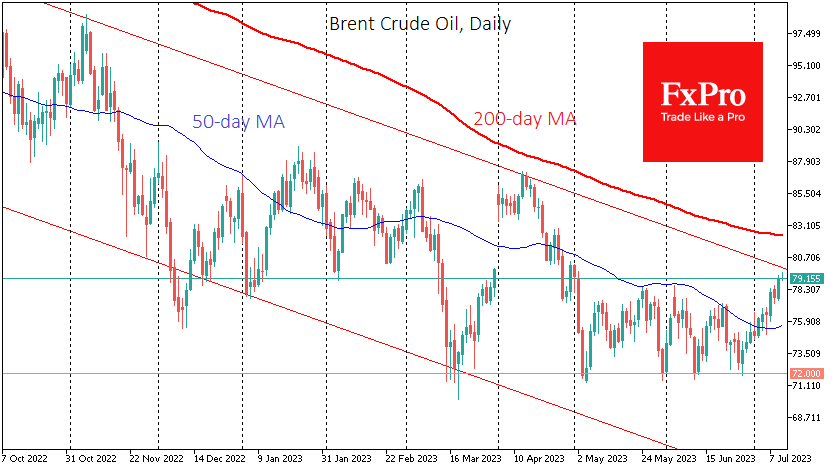
However, the more likely scenario is a pullback within the range and at least a retest of critical support. The maximum would be a break of this line and a move lower. On the side of this scenario are fundamental factors in the form of China’s slowdown, which has proved unresponsive to the announced stimulus measures, and growing signs of contraction in the major developed economies under interest rate pressure.
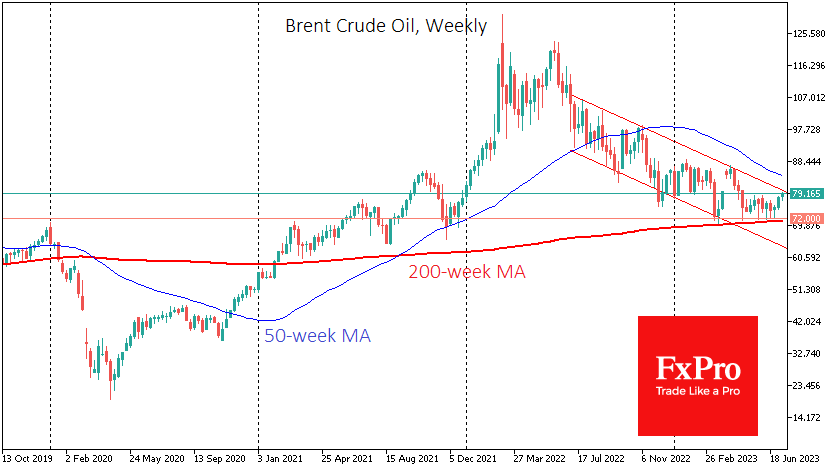
From a technical point of view, the downtrend remains in place until a reversal is confirmed. In this case, be prepared for Brent crude to return to $72 this month and for an attempt to storm this key OPEC+ support line next month. This is also where the 200-week moving average is, and a sharp break below it could have the effect of a dam bursting, as it did in 2020 or 2014.
USD/JPY Mid-Day Outlook
Daily Pivots: (S1) 139.86; (P) 140.66; (R1) 141.16; More...
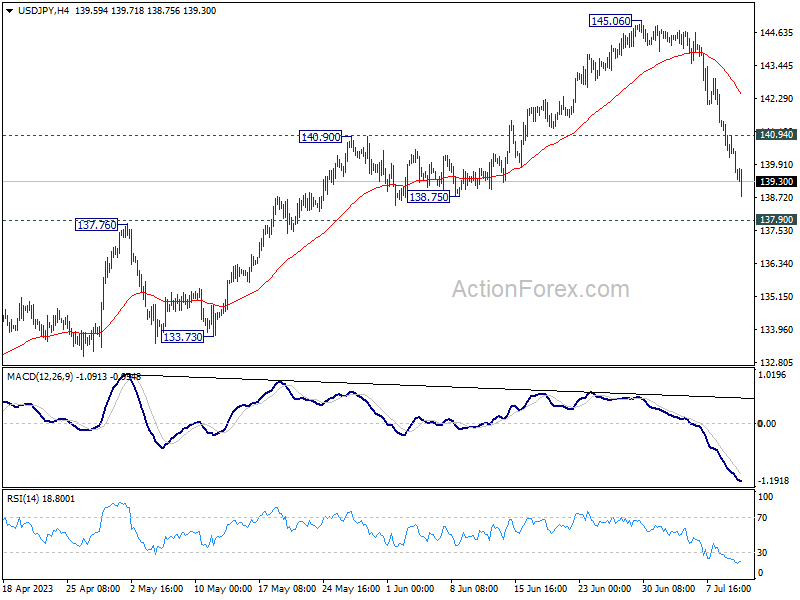
USD/JPY reaches as low as 138.75 so far today as fall from 145.06 continues today. Next target is 137.90 resistance turned support. Decisive break there will confirm the larger bearish case. On the upside, above 142.06 minor resistance will turn intraday bias neutral and bring consolidations first, before staging another fall.
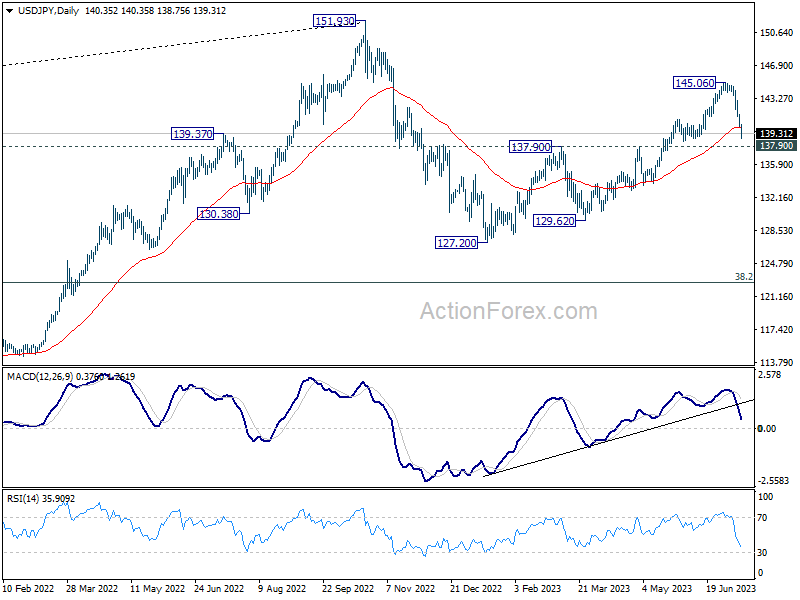
In the bigger picture, current downside acceleration, as seen in daily MACD, argues that fall from 145.06 is already the third leg of the corrective pattern from 151.93 (2022 high). Sustained break of 137.90 resistance turned support should confirm this case and target 127.20 (2023 low) and below. For now, this will remain the favored case as long as 145.06 resistance holds.
Dollar’s Plunge Deepens After Underwhelming Consumer Inflation Figures
Dollar's decline accelerates again following US inflation data that reflected a more substantial than anticipated slowing in both core and headline CPI for June. Although the underwhelming data might not deter Fed from delivering another rate hike later this month, it may alleviate pressure for subsequent increases.
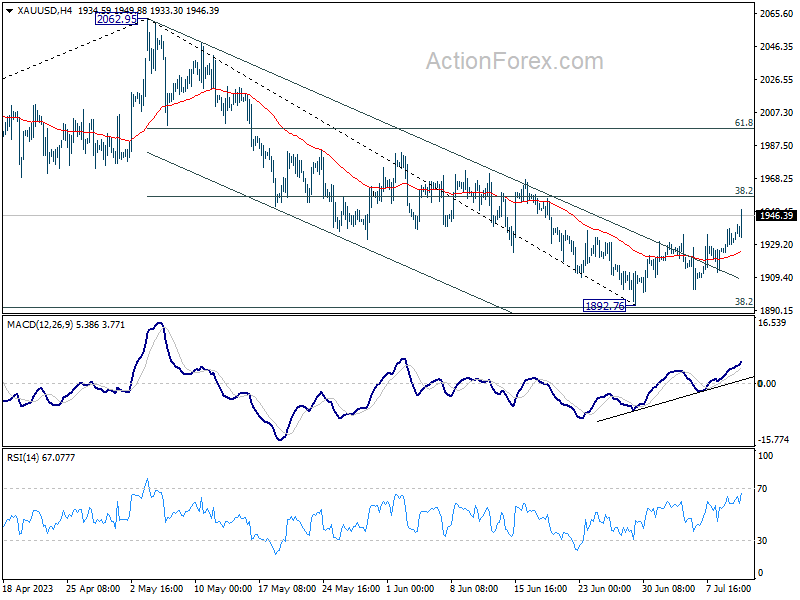
In response to the data, US stock futures appear to be on an upward trajectory, while 10-year yield is continuing its near term pull back. Correspondingly, gold is seeing a solid rally, propelled by greenback's weakness.
For now, Yen appears to be the biggest beneficiary, maintaining its position as the strongest currency. Hot on its heels is Euro, but Sterling is currently floundering, ranking as the second weakest next to Dollar. Australian and New Zealand Dollars have also gained strength following Euro, although Canadian Dollar remains steady as traders adopt a cautious approach in anticipation of BoC's imminent interest rate decision.
Technically, Gold's rebound is also accelerating as seen in 4H MACD. Next focus is 38.2% retracement of 2062.95 to 1892.76 at 1957.77. Firm break there will pave the way to 61.8% retracement at 1997.93, with prospect of at least a test on 2000 psychological level.
In Europe, at the time of writing, FTSE is up 1.62%. DAX is up 1.20%. CAC is up 1.08%. Germany 10-year yield is down -0.0459 at 2.607. Earlier in Asia, Nikkei dropped -0.81%. Hong Kong HSI rose 1.08%. China Shanghai SSE dropped -0.78%. Singapore Strait Times rose 0.36%. Japan 10-year JGB yield rose 0.0239 to 0.480.
US CPI slowed to 3% yoy in Jun, core CPI down to 4.8% yoy, both below exp
US CPI rose 0.2% mom in June, below expectation of 0.3% mom. CPI core (all items less food and energy) rose 0.2% mom, below expectation of 0.3% mom, the smallest 1-month increase since August 2021. Food index rose 0.1% mom while energy index rose 0.6% mom.
Over the last 12 months, CPI slowed from 4.0% yoy to 3.0% yoy, below expectation of 3.1% yoy. That's the lowest reading since March 2021. Core CPI slowed from 5.3% yoy to 4.8% yoy, below expectation of 5.0% yoy. Energy index was down -16.7% yoy while food index was up 5.7% yoy.
RBNZ holds OCR steady at 5.5%, expresses confidence in returning inflation to target range
In line with broad expectations, RBNZ keeps OCR unchanged at 5.5%, as tightening cycle has finally entered in to a pause phase.
RBNZ expressed its confidence in the current restrictive interest rate level, stating, "consumer price inflation will return to within its target range of 1 to 3% per annum, while supporting maximum sustainable employment."
When discussing their Remit objectives, the Committee noted that it still expects inflation to fall within the target band by the second half of 2024. Risks surrounding the inflation projection as being "broadly balanced". While employment remains above its maximum sustainable level, recent indicators suggest that "labour market conditions are easing."
RBNZ also acknowledged the slight contraction in economic activity in Q1. It added that "growth is likely to remain weak in the near term."
RBA Lowe: Further tightening possible, look into new forecasts in Aug
RBA Governor Philip Lowe noted the current economic outlook is a "complex picture" with significant uncertainties". He said in a speech today, "the Board decided that, having already increased rates substantially, it was appropriate to hold interest rates steady this month and re-examine the situation next month."
Looking ahead, Lowe noted, "It is possible that some further tightening will be required to return inflation to target within a reasonable timeframe," adding that requirement for further action will largely depend on evolution of the economy and inflation.
He highlighted that the Board will be provided with an updated set of economic forecasts, a revised risk assessment, and fresh data on inflation, the global economy, labour market, and household spending at the next meeting in August to inform its decision-making process.
He pointed to recent forecasts in May which saw inflation returning to top of target band in "mid-2025:. But he acknowledge, Data received since then had suggested that the inflation risks had shifted somewhat to the upside."
USD/JPY Mid-Day Outlook
Daily Pivots: (S1) 139.86; (P) 140.66; (R1) 141.16; More...
USD/JPY reaches as low as 138.75 so far today as fall from 145.06 continues today. Next target is 137.90 resistance turned support. Decisive break there will confirm the larger bearish case. On the upside, above 142.06 minor resistance will turn intraday bias neutral and bring consolidations first, before staging another fall.
In the bigger picture, current downside acceleration, as seen in daily MACD, argues that fall from 145.06 is already the third leg of the corrective pattern from 151.93 (2022 high). Sustained break of 137.90 resistance turned support should confirm this case and target 127.20 (2023 low) and below. For now, this will remain the favored case as long as 145.06 resistance holds.
Economic Indicators Update
| GMT | Ccy | Events | Actual | Forecast | Previous | Revised |
|---|---|---|---|---|---|---|
| 23:50 | JPY | PPI Y/Y Jun | 4.10% | 4.50% | 5.10% | 5.20% |
| 23:50 | JPY | Machinery Orders M/M May | -7.60% | 1.20% | 5.50% | |
| 02:00 | NZD | RBNZ Interest Rate Decision | 5.50% | 5.50% | 5.50% | |
| 12:30 | USD | CPI M/M Jun | 0.20% | 0.30% | 0.10% | |
| 12:30 | USD | CPI Y/Y Jun | 3.00% | 3.10% | 4.00% | |
| 12:30 | USD | CPI Core M/M Jun | 0.20% | 0.30% | 0.40% | |
| 12:30 | USD | CPI Core Y/Y Jun | 4.80% | 5.00% | 5.30% | |
| 14:00 | CAD | BoC Interest Rate Decision | 5.00% | 4.75% | ||
| 14:30 | USD | Crude Oil Inventories | -1.1M | -1.5M | ||
| 15:00 | CAD | BoC Press Conference | ||||
| 18:00 | USD | Fed's Beige Book |
US CPI slowed to 3% yoy in Jun, core CPI down to 4.8% yoy, both below exp
US CPI rose 0.2% mom in June, below expectation of 0.3% mom. CPI core (all items less food and energy) rose 0.2% mom, below expectation of 0.3% mom, the smallest 1-month increase since August 2021. Food index rose 0.1% mom while energy index rose 0.6% mom.
Over the last 12 months, CPI slowed from 4.0% yoy to 3.0% yoy, below expectation of 3.1% yoy. That's the lowest reading since March 2021. Core CPI slowed from 5.3% yoy to 4.8% yoy, below expectation of 5.0% yoy. Energy index was down -16.7% yoy while food index was up 5.7% yoy.