

Sample Category Title
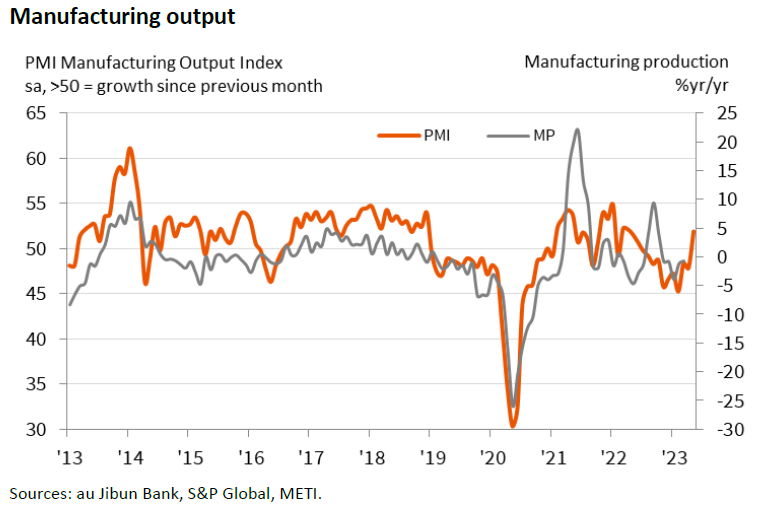
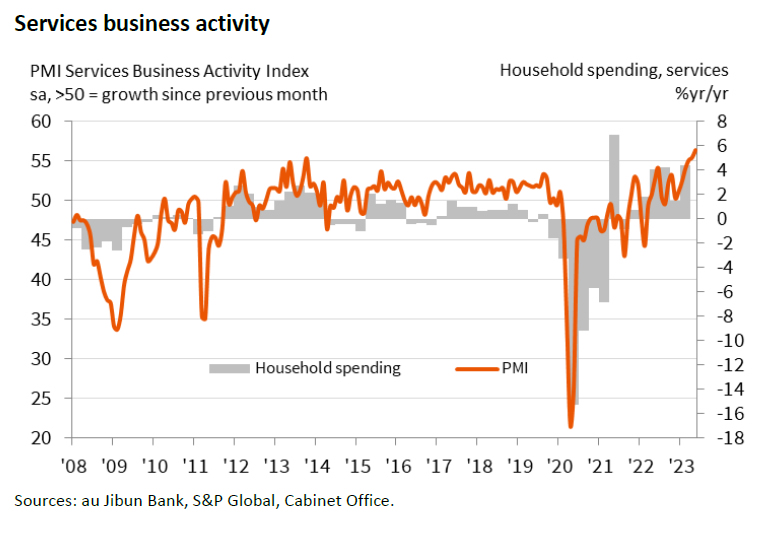
Japan PMI manufacturing rose to 50.8, services rose to 56.3
Japan PMI Manufacturing rose from 49.5 to 50.8 in April, signalling the first improvement in operating conditions since October 2022. PMI Manufacturing Output rose from 47.9 to 51.9. PMI Services rose from 55.4 to 56.3. PMI Composite Output rose from 52.9 to 54.9.
Usamah Bhatti, Economist at S&P Global Market Intelligence, said:
"The Japanese private sector economy continued on an upward trajectory, as signalled by a further expansion in May. The rate of growth quickened from April to reach the strongest since October 2013 and the second-strongest in the survey history (since September 2007).
"Service providers continued to report strong growth momentum with a renewed record increase in business activity, while manufacturers indicated an improvement in operating conditions for the first time in seven months, with output and new orders returning to expansion territory for the first time since last June."
Australia PMI composite dropped to 51.2, still early to call an end to RBA tightening
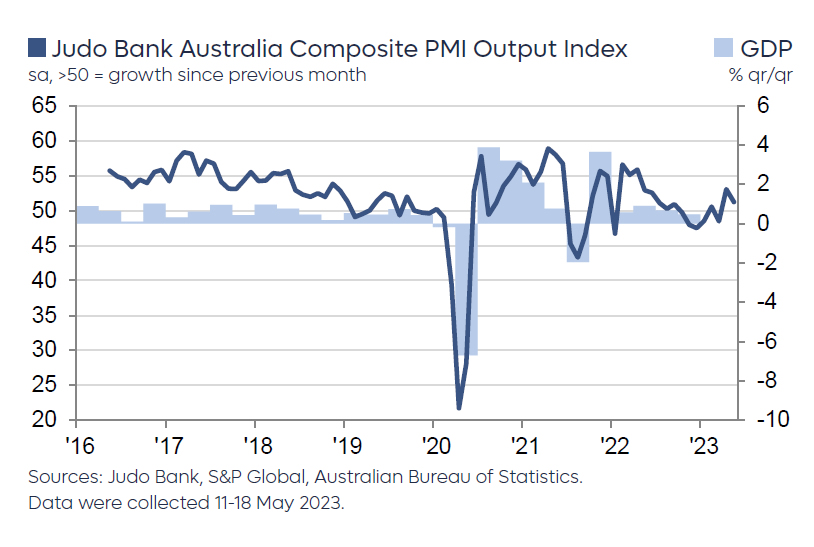
Australia's PMI Manufacturing index stayed put at 48.0 in May, marking the joint-lowest reading since May 2020. On the other hand, PMI Services fell from 53.7 to 51.8, causing Composite PMI to decrease from 53.0 to 51.2.
Warren Hogan, Chief Economic Advisor at Judo Bank, said, "The May Flash result shows a small retracement from the strong April outcome reinforcing the view that overall economic activity in Australia is holding up well as we enter the winter months."
Despite the manufacturing sector's continuous slowdown, Hogan emphasized that this does not signal a recession. In contrast to manufacturing, the services sector has shown recent strength, and was "far from the risk of recession:.
However, he warned of the implications of better economic conditions in terms of inflation. "The RBA is trying to engineer a soft landing to rid the economy of inflation. But if they don't lean hard enough on monetary policy, we could see a more stubborn inflation emerge which will ultimately require a bigger lift in interest rates," Hogan cautioned.
Highlighting the strong correlation between the pick-up in the services PMI, housing market, rising population growth, and job advertising, he concluded, "Last week's labour market data on employment and wages have bought the RBA some time, but the Flash PMIs highlight that it is still too early to call an end to the monetary policy tightening cycle."
ECB’s De Cos: Monetary tightening process well advanced but still have some way to go
During an event in Barcelona yesterday, ECB Governing Council Pablo Hernandez de Cos, said, "The process of monetary tightening is already well advanced, although, with the information currently available to us, we still have some way to go."
He further explained, "We also anticipate that interest rates will have to remain in restrictive territory for a long time to reach our target in a sustained manner."
Acknowledging the potential impact of this strategy on economic activity, de Cos pointed out, "The tightening process is having and will have short-term costs in terms of lower economic activity."
However, he underscored the necessity of this process in maintaining price stability, which he deemed crucial for promoting long-term economic growth.
"Keeping price stability is the main contribution that the central bank can make to ensure economic growth solid long term," he concluded.
Some Fed officials not prejudging June meeting
Fed Presidents Thomas Barkin of Richmond and Raphael Bostic of Atlanta shared their perspectives during an event hosted by the Richmond Fed.
Barkin didn't provide any conclusive hints about the June meeting, stating, "I'm not going to prejudge June. I'd like to be convinced of that and I'm still looking to be convinced of that."
Bostic emphasized the lag effect of the policy, adding, "Our policy works with a lag. And we're just at the very beginning of this time when that lag is starting to play out and you're starting to see tightness emerge. Right now, absent a big change, I think I will be comfortable saying let's just look and see how things play out."
Separately, San Francisco Fed President Mary Daly shared a similar sentiment of cautious observation, saying, "I really think, at this point in our tightening cycle, it is prudent to resist the temptation to say what we are going to do for the rest of the year."
The collective view indicates an element of uncertainty and data-dependency in Fed's next moves.
GBP/USD Turns At Risk Below 1.2550
Key Highlights
- GBP/USD started a fresh decline below the 1.2550 support.
- A major declining channel is forming with resistance near 1.2455 on the 4-hour chart.
- EUR/USD is struggling to recover above the 1.0840 resistance.
- The US Manufacturing PMI could decline from 50.2 to 50.0 in May 2023 (Preliminary).
GBP/USD Technical Analysis
The British started a fresh decline from well above 1.2620 against the US Dollar. GBP/USD traded below the 1.2550 support to move into a bearish zone.
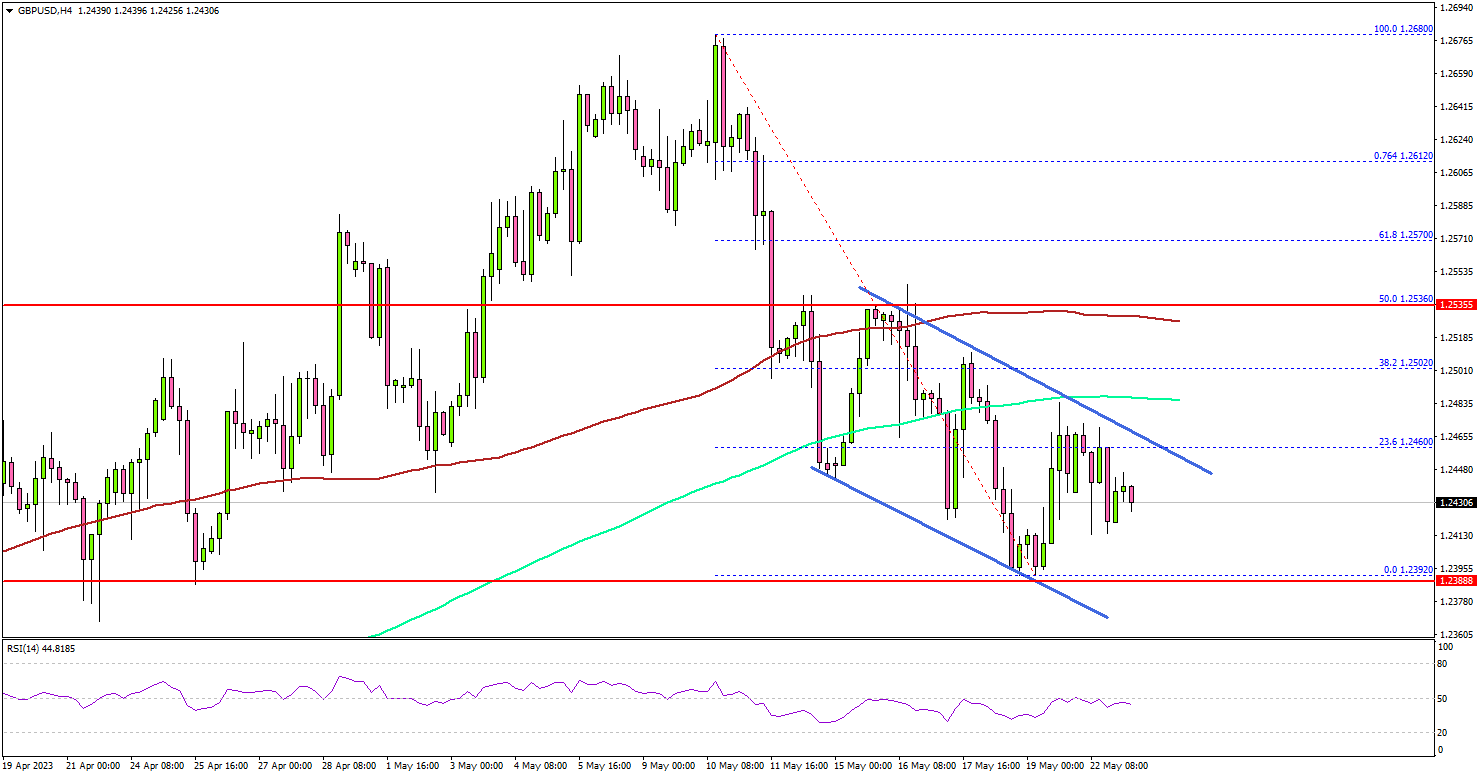
Looking at the 4-hour chart, the pair settled below the 1.2500 level, the 100 simple moving average (red, 4 hours), and the 200 simple moving average (green, 4 hours).
It even traded below the 1.2440 support level. A low is formed near 1.2392 and the pair is now consolidating losses. Immediate resistance is near the 1.2440 level. There is also a major declining channel forming with resistance near 1.2455 on the same chart.
The next major resistance is near 1.2485 and the 200 simple moving average (green, 4 hours), above which the pair could rise toward the 1.2520 level.
The main resistance is now near 1.2500 and the 100 simple moving average (red, 4 hours), above which GBP/USD could gain bullish momentum. On the downside, the pair might find support near 1.2390.
The next major support is near the 1.2360 level. If there is a downside break below the 1.2360 level, the pair could decline toward the 1.2300 support level. The next major support sits near the 1.2250 level.
Looking at EUR/USD, the pair is still struggling to recover above 1.0840 and remains at risk of more losses in the near term.
Economic Releases
- Germany’s Manufacturing PMI for May 2023 (Preliminary) - Forecast 45.0, versus 44.5 previous.
- Germany’s Services PMI for May 2023 (Preliminary) - Forecast 55.5, versus 56.0 previous.
- Euro Zone Manufacturing PMI for May 2023 (Preliminary) – Forecast 46.2, versus 45.8 previous.
- Euro Zone Services PMI for May 2023 (Preliminary) – Forecast 55.6, versus 56.2 previous.
- US Manufacturing PMI for May 2023 (Preliminary) – Forecast 50.0, versus 50.2 previous.
- US Services PMI for May 2023 (Preliminary) – Forecast 53.6, versus 53.6 previous.
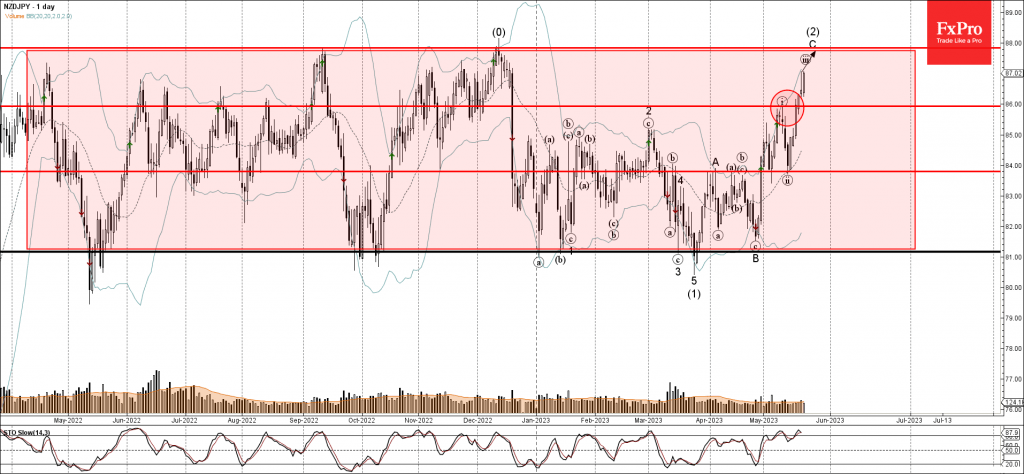
NZDJPY Wave Analysis
- NZDJPY broke key resistance level 86.00
- Likely to rise to resistance level 87.85
NZDJPY rising strongly after the price broke the key resistance level 86.00 (which stopped the previous short-term impulse wave (i) at the start of May).
The breakout of the resistance level 86.00 accelerated the minor C-wave of the active ABC correction (2) from the end of March.
NZDJPY can be expected to rise further toward the next resistance level 87.85 (target price for the completion of the active impulse wave C, top of the wide weekly sideways price range from 2022).
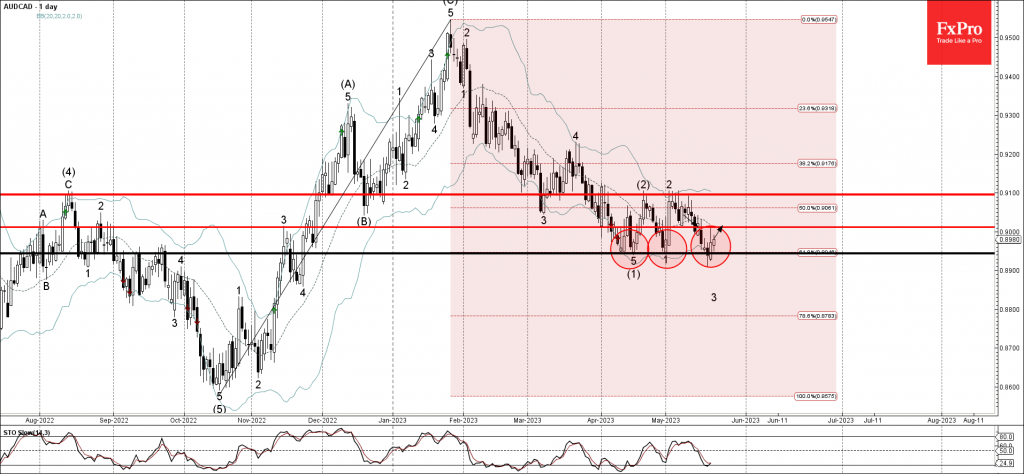
AUDCAD Wave Analysis
- AUDCAD reversed from support level 0.8945
- Likely to rise to resistance level 0.9010
AUDCAD recently reversed up from the key support level 0.8945 (which stopped the previous impulse wave (1) and 1), standing near the lower daily Bollinger Band.
The support level 0.8945 was further strengthened by the 61.8% Fibonacci correction of the previous sharp upward impulse from last October.
Given the strong AUD gains across the FX markets, AUDCAD can be expected to rise further toward the next resistance level 0.9010.
ECB’s Villeroy de Galhau: Terminal rate expected by summer, focus on monitoring past hikes’ effects
ECB Governing Council member Francois Villeroy de Galhau reiterated that the central bank's policy rate is expected to reach its peak "not later than by summer". He hinted at the possibility of either rate hikes or pauses in the three upcoming Governing Council meetings, but advised against making assumptions about future policy decisions based on this.
"Our primary focus right now isn't how much further we need to raise rates, but the extent of the impact of the decisions we've already made," he said. He further suggested that the policy changes may take 1 to 2 years to fully manifest, possibly leaning towards the upper end of this range given the current cycle of tightening.
Villeroy de Galhau praised the recent deceleration in rate hikes from 50 basis points to 25, referring to the move as "wise and cautious." He emphasized the need to closely monitor the effects of their past aggressive hikes and stated that "How long we maintain rates high is now more important than the precise terminal level."
He concluded by affirming the ECB's commitment to a data-driven approach, carefully assessing the inflation outlook and the effectiveness of monetary policy transmission on a meeting-by-meeting basis.
Debt Ceiling Update: A Big Week Ahead
Summary
- The debt ceiling drama has reached a fever pitch in recent weeks. As of May 17, the U.S. Treasury had roughly $68 billion of cash on hand and another $92 billion of untapped extraordinary measures. Taken together, Treasury had just $160 billion of additional borrowing capacity remaining under the debt ceiling.
- How long will that borrowing capacity keep the U.S. government afloat? During a May 21 appearance on NBC's "Meet the Press", Treasury Secretary Janet Yellen said the odds of reaching June 15 and being able to pay all the government's bills are "quite low", while noting there is always uncertainty about future tax receipts and spending.
- Our own internal tracking is a bit more optimistic, but the forecasting misses in recent weeks and months have been towards a greater financing need/bigger budget deficits, which does not inspire much confidence. It has become increasingly clear that, even in the best case scenario, the Treasury's General Account will be extremely low (<$50 billion) in the first half of June if the debt ceiling is not raised. Put another way, a fifty-fifty chance of an early June default in the absence of a debt ceiling increase is still very concerning and highlights the clear risk of hitting the X date in early June.
- As we have written previously, if Treasury can manage to stretch its funds to June 15, an infusion of corporate tax revenue and the unlocking of a new extraordinary measure on June 30 would likely keep the U.S. government afloat until the beginning of August.
- While the Treasury's cash balance and extraordinary measure balances continue to dwindle, lawmakers are attempting to negotiate a deal that would increase or suspend the debt ceiling. So far, negotiations between the two sides have not yielded a deal. This is not to say no progress has been made. But there remain major outstanding questions that still need answers to close a deal.
- So what happens next? In our view, there are three possibilities. First, Republicans in Congress could strike a sweeping deal with President Biden and Democrats in Congress to increase or suspend the debt ceiling for 1-2 years. For a deal to be reached and turned into law before early June, a breakthrough in the negotiations will need to occur this week.
- Another possibility is policymakers agree to a short-term debt ceiling increase that buys more time for negotiations. In this scenario, we envision a debt ceiling suspension for a very short period of time, perhaps one or two months.
- The third possibility is that the standoff continues, and we venture into the early June danger zone with Treasury perilously close to exhausting its borrowing capacity.
- We believe a short-term debt ceiling increase that gives negotiators a bit more time to reach a broader agreement is the most likely outcome, but the situation remains very uncertain and precarious, and we would not be shocked if any of these three possibilities are realized.
- We have continued to field numerous questions about the various contingency plans available to policymakers in the event the debt ceiling X date is breached. Although we are not entirely dismissive of such "break the glass" options, we do not view any of them as painless silver bullets. Ultimately, if any of these numerous plans are adopted, they would be entirely experimental and would come with a litany of legal, technical, economic and political challenges.
Debt Ceiling Crunch Time Draws Near
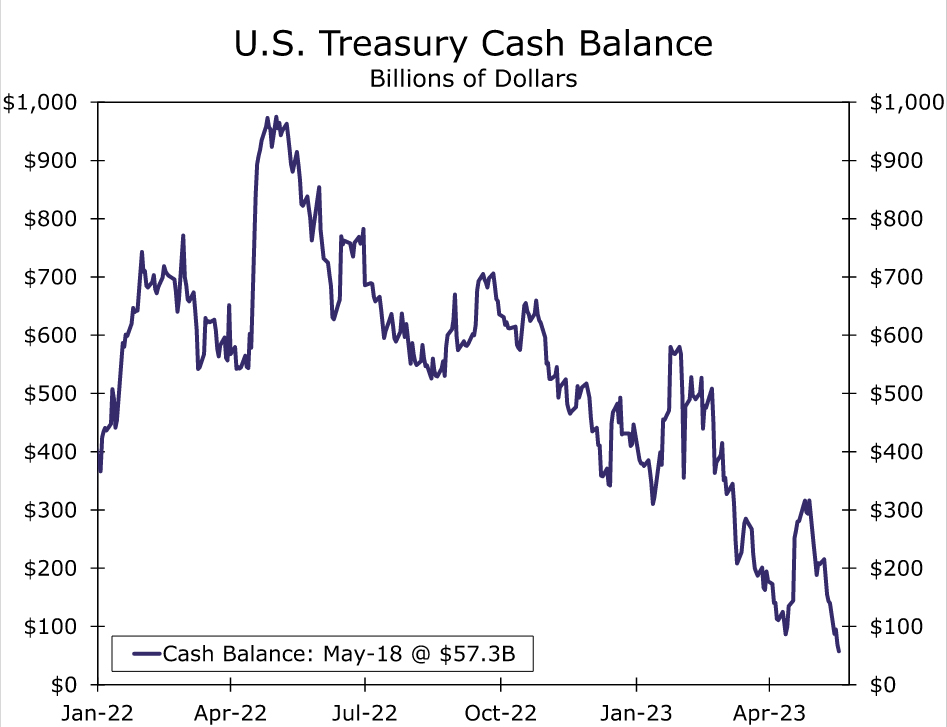
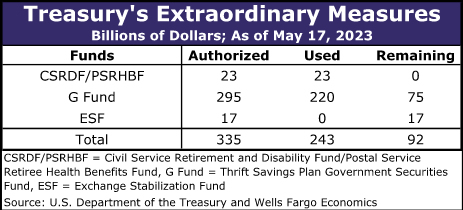
The debt ceiling drama has reached a fever pitch in recent weeks. The escalating showdown has occurred even though the issue has been coming to a slow boil for months. On January 19, the outstanding debt of the United States government hit its limit of $31.38 trillion. Since then, the U.S. Treasury has been relying on its cash balance and "extraordinary measures" to make up the difference between tax revenues and outlays. However, these two sources of wiggle room have begun to run dry. The Treasury's General Account (TGA) at the Federal Reserve was down to just $57.3 billion on May 18 (Figure 1). Absent debt ceiling constraints, the TGA would probably be around $600 billion, so a balance of just $57 billion is unusually low. Treasury's available extraordinary measures amounted to $92 billion as of May 17, the latest data available (Figure 2). When these extraordinary measures are added to the TGA balance on that day, Treasury had just $160 billion of additional borrowing capacity remaining as of May 17.
How long will that remaining borrowing capacity keep the U.S. government afloat? As we have written previously, June 15 is an important date in the timeline. If Treasury can stretch its funds through to June 15, a quarterly deadline for corporate tax payments should bring another revenue infusion of $75 billion or so. That should be enough money to remain solvent for at least another couple of weeks, at which point a new $133 billion one-time extraordinary measure will become available on June 30.1 Our federal budget deficit forecast for July is in the ballpark of $130 billion, and from there it becomes more clear how the X date, or the date on which the Treasury would be unable to meet all of its obligations on time due to the debt limit, could be as far away as the beginning of August (Figure 3).
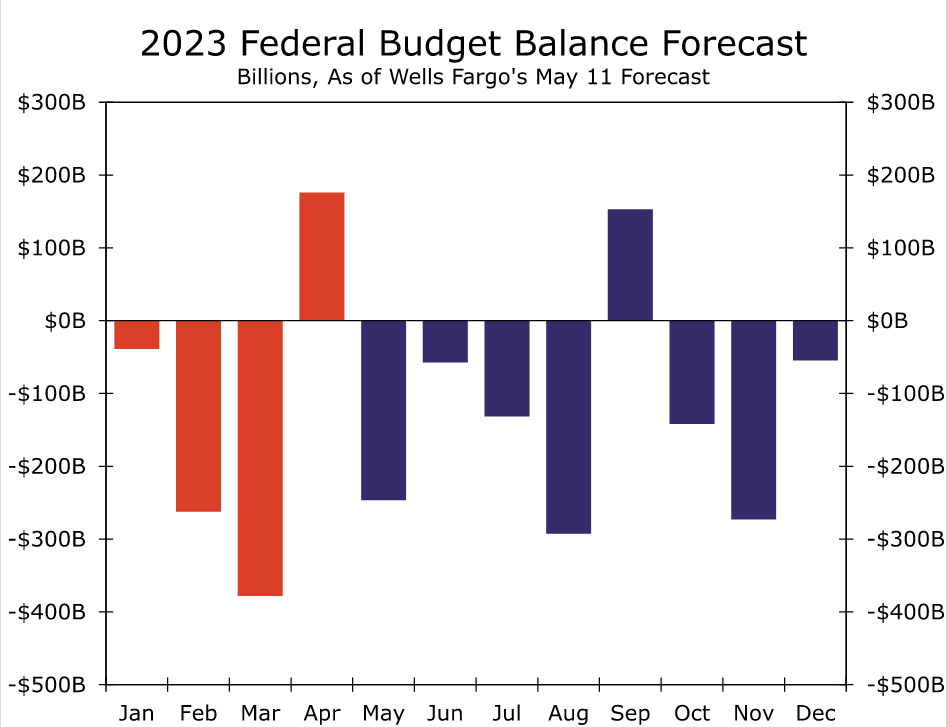
But getting to June 15 is far from a guarantee. It has become increasingly clear that, even in the best case scenario, the TGA will be extremely low (<$50 billion) in the first half of June if the debt ceiling is not raised. For context, the average daily non-debt cash outflow from the TGA this year has been about $30 billion, and daily withdrawals of more than $50 billion are not uncommon. On May 15, Treasury Secretary Janet Yellen sent another letter to Congressional leaders reiterating that Treasury will likely no longer be able to satisfy all of the government's obligations if Congress has not acted to raise or suspend the debt limit by early June.2 During a May 21 appearance on NBC's "Meet the Press", Yellen said the odds of reaching June 15 and being able to pay all the government's bills are "quite low", while noting there's always uncertainty about future tax receipts and spending. Our own internal tracking is a bit more optimistic, but the forecasting misses in recent weeks and months have been towards a greater financing need/bigger budget deficits, which does not inspire much confidence. Put another way, a fifty-fifty chance of an early June default in the absence of a debt ceiling increase is still very concerning and highlights the clear risk of hitting the X date in early June.
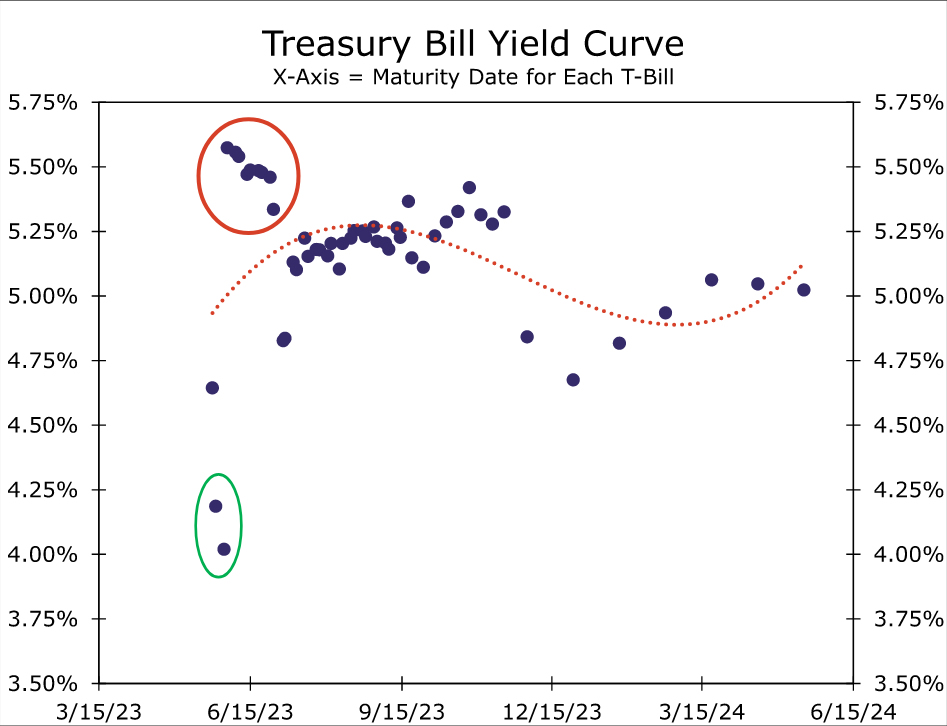
Yields on Treasury bills signal that investors are taking Treasury's guidance seriously. As we go to print, the yield on the T-bill maturing on May 30 is 4.02%. The yield on the T-bill maturing just two days later on June 1 is a whopping 5.57%, 155 bps higher for two very similar securities with one important difference. Figure 4 illustrates that investors are paying a healthy premium to own bills that mature in May while demanding hefty compensation to hold T-bills that are maturing in the first half of June.
Deal or No Deal?
While the TGA and extraordinary measure balances continue to dwindle, lawmakers are attempting to negotiate a deal that would increase or suspend the debt ceiling. So far, negotiations between the two sides have not yielded a deal. This is not to say no progress has been made. Active negotiations are forward progress relative to the standstill that prevailed for much of the year, and some areas of compromise might be within reach. For example, the two sides appear to be moving closer to rescinding about $50 billion of COVID relief funds that have gone unspent. But there remain major outstanding questions that still need answers to close a deal. Will budget caps on discretionary spending be put in place for just the next one or two years, or will they be implemented for a much longer period of time, such as the next decade? Will the budget caps lead to outright discretionary spending cuts as House Republicans have proposed, a spending freeze, or just slower growth in future outlays? Will lawmakers enact tougher work requirements for some social assistance programs such as Temporary Assistance for Needy Families (TANF) and the Supplement Nutritional Assistance Program (SNAP)? Will energy production permitting reform find its way into the final bill?
The policy disagreements among lawmakers appear wide as we enter crunch time. So what happens next? In our view, there are three possibilities. First, Republicans in Congress could strike a sweeping deal with President Biden and Democrats in Congress to increase or suspend the debt ceiling for 1-2 years. For a deal to be reached and turned into law before early June, a breakthrough in the negotiations will need to occur this week. Another possibility is policymakers agree to a short-term debt ceiling increase that buys more time for negotiations. In this scenario, we envision a debt ceiling suspension for a very short period of time, perhaps one or two months. The third possibility is that the political standoff continues, and we venture into the early June danger zone with Treasury perilously close to exhausting its remaining borrowing capacity. We believe a short-term debt ceiling increase that gives negotiators a bit more time to reach a broader agreement is the most likely outcome, but the situation remains very uncertain and precarious, and we would not be shocked if any of these three possibilities are realized.
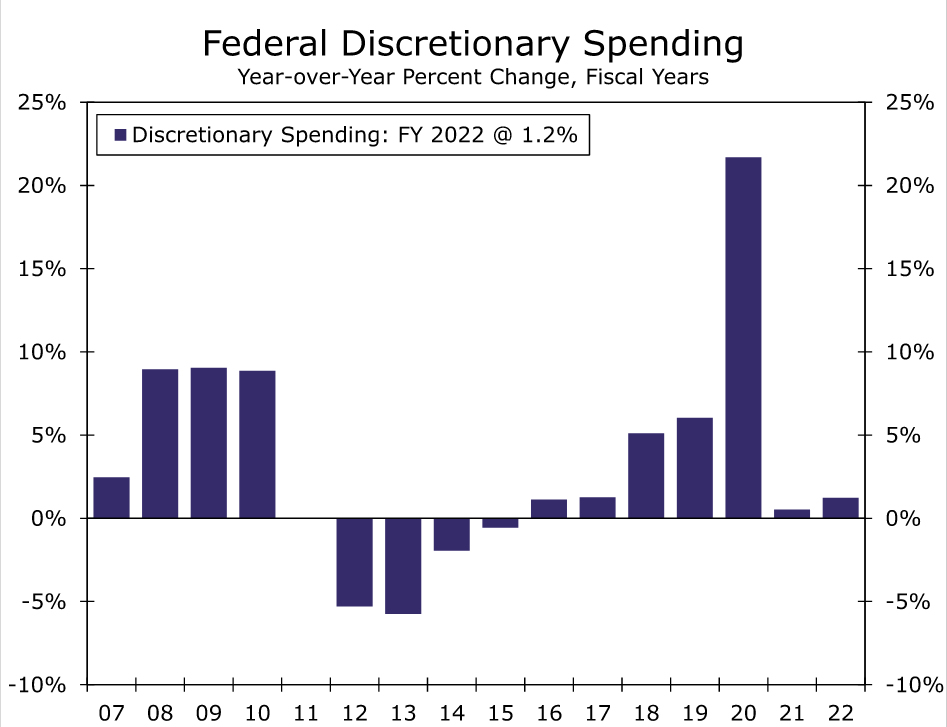
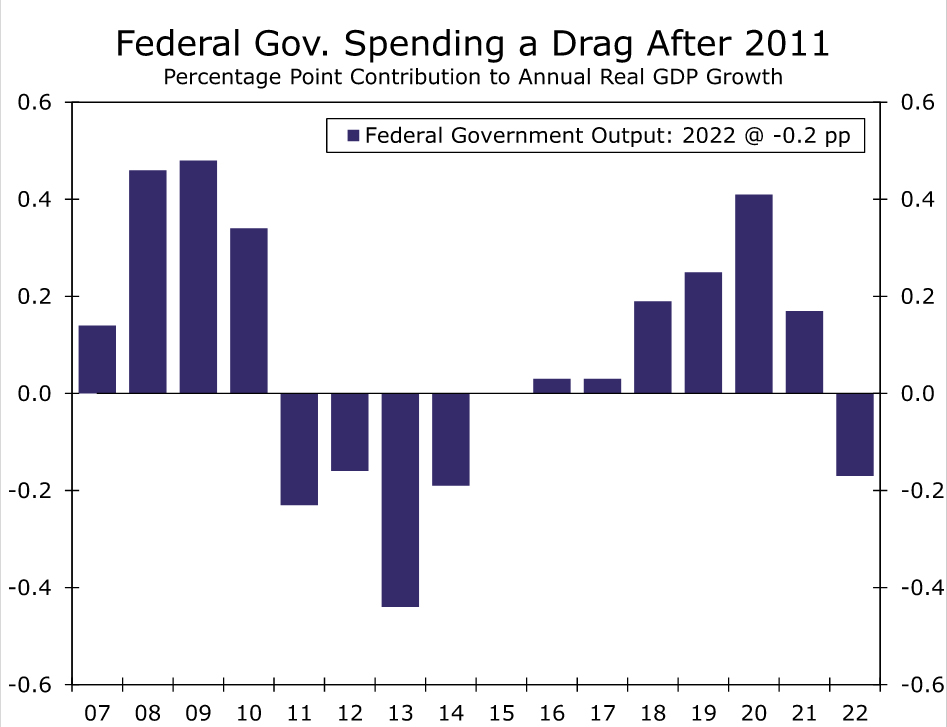
The substance of a debt ceiling deal remains just as fluid as its prospects. We think it is important to keep in mind that any major changes in the fiscal policy outlook could have a material impact on the broader economic outlook. The fiscal austerity that flowed from the 2011 debt ceiling showdown imparted a significant drag on economic growth in the years that followed (Figures 5 and 6). Our baseline economic forecast assumes federal discretionary spending is modestly additive to economic growth in 2024 as most annual appropriations grow roughly with inflation and the 2021 infrastructure bill and other previously-enacted spending boosts continue to flow. However, spending cuts much closer to what was in the House Republican debt limit bill would create downside risk to this forecast. For example, returning total discretionary spending in FY 2024 to FY 2022 levels would amount to roughly a $130 billion spending cut (~0.5% of GDP) relative to the Congressional Budget Office's baseline. If realized, federal fiscal policy could shift from neutral or somewhat accommodative to restrictive. A pending Supreme Court ruling on President Biden's student loan forgiveness program also looms in the near future as an important swing factor in the outlook for the federal fiscal policy growth impulse.
Fallback Options, but No Silver Bullet
We have continued to field numerous questions about the various contingency plans available to policymakers in the event the debt ceiling X date is breached. We would encourage our readers to review the debt ceiling guide we published in January, which can be found here, for further reading on Treasury prioritization plans and Federal Reserve options. The Congressional Research Service also has written extensively on various hypothetical escape hatches, such as minting a high denomination platinum coin or invoking the 14th amendment.3
Although we are not entirely dismissive of such "break the glass" options, we do not view any of them as painless silver bullets. Treasury may be able to prioritize principal and interest payments on the national debt, but choosing to pay bondholders would still delay payments due to other recipients of federal spending, such as military salaries, health care providers or Social Security beneficiaries. Furthermore, financial markets may still face serious stress in such a scenario, not caring to differentiate between a de jure or de facto default. The Federal Reserve could attempt to soothe financial markets with repurchase agreements or bond purchases for defaulted securities, but this would still not fix the fundamental problem of not enough tax revenue to cover existing obligations, and transcripts from past debt ceiling showdowns suggest the bar for such FOMC actions would be extremely high.4 Financial system stress could also emerge if markets are forced to await a Supreme Court ruling on unilateral executive action to bypass the debt limit. Ultimately, if any of these numerous plans are adopted, they would be entirely experimental and would come with a litany of legal, technical, economic and political challenges.
Our economic forecast is predicated on the assumption that the debt ceiling is eventually increased or suspended with minimal collateral damage on the real economy. However, past brushes with default have tightened financial conditions, occasionally in a significant way, such as the summer of 2011. The economic impact of a default is highly uncertain since that has never happened previously, but economic modeling suggests the fallout could be quite severe.5 For now, we will continue to monitor developments closely, and we will keep our readers updated on our latest thinking. Stay tuned.
Endnotes
1 U.S. Department of the Treasury. "Description of the Extraordinary Measures" January 19, 2023. (Return)
2 Yellen, Janet. "Debt Limit Letter to Congress Members" U.S. Department of the Treasury. May 15, 2023. (Return)
3 Austin, D. Andrew; Stiff, Sean. "Clearing the Air on the Debt Limit" Congressional Research Service, CRS Report 45011. November 10, 2021. (Return)
4 "Conference Call of the Federal Open Market Committee on August 1, 2011" Federal Reserve. August 8, 2011. (Return)
5 Engen, Eric; Follette, Glenn; Laforte, Jean-Philippe. "Possible Macroeconomic Effects of a Temporary Federal Debt Default" Federal Reserve. October 4, 2013. (Return)