

Sample Category Title
US Debt Ceiling Drama Begins to Weigh on Markets
US markets made an impressive surge last week, taking the S&P500 to 4200, a crucial turning point. It is worth preparing for an upside stop or correction before the index steadily moves to the next level.
The S&P500 index has stopped near the 4200 level many times in the last two years. There was a pause on the way up from April to June 2021; then, it became significant support in March and May 2022; and over the last twelve months, it has been the resistance level.
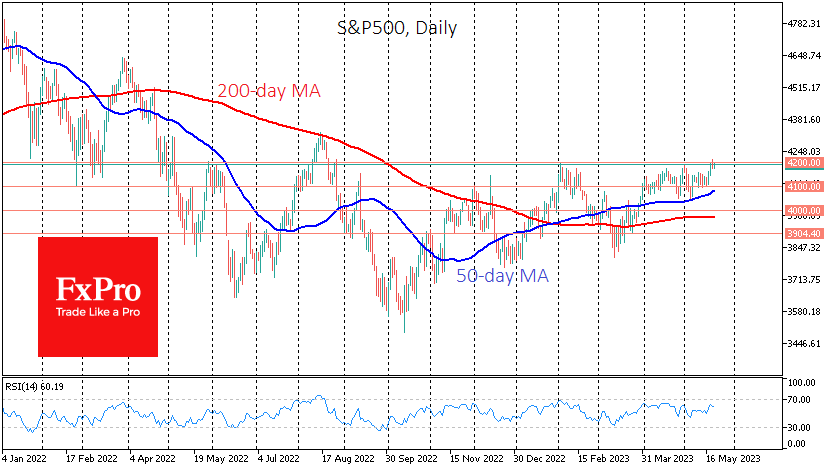
At the start of May and in trading on Friday, the S&P500 retreated from this level again. The appropriate info trigger is required to take a major tactical level, but the lack of progress in the debt ceiling negotiations on Friday formed the mood for profit-taking.
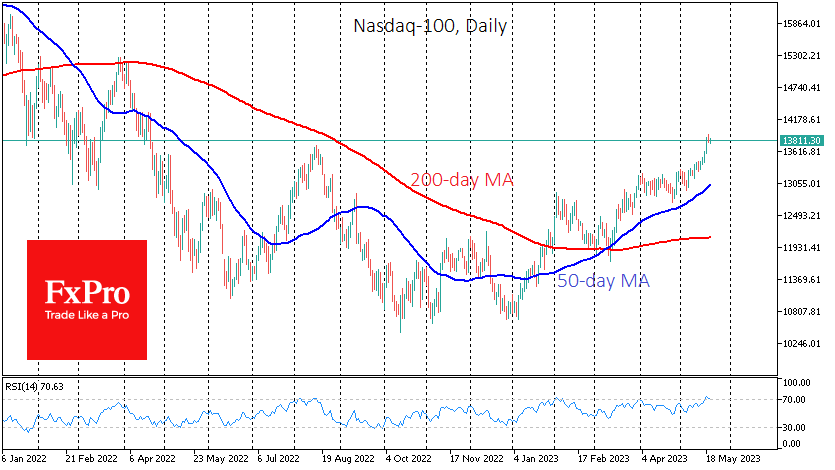
Although S&P500 doesn’t look overbought after last week’s rise, on the daily timeframes, the Nasdaq100 reversed on Friday just after touching the overbought zone in RSI. The high-tech index was experiencing a rally on the AI theme, but even more, investors were attracted by the financial performance of technology heavyweights. They have been vulnerable to rate hikes in previous years but have performed impressively during the current reporting season. But that rally is ending, and profit-taking in the Nasdaq100 looks to be reason enough for a local correction in the broad market.
The US debt ceiling drama is starting to look more and more like the most dramatic scenario we saw in 2011, where the market lost around 20% from the peak to the bottom. Interestingly, it peaked near the original ceiling date (now 1 June). However, investors and traders should be aware that due to tax receipts and other measures of the US Treasury, there is time for discussions until mid-August. And lawmakers appeared to get the most out of this time, trying to score points before next year’s presidential election.
On the technical analysis side, the S&P500 index has the potential to correct to the 4100 area without breaking its medium-term rising trend. The 50-day moving average passes through here. In a more extreme case, the pullback might occur towards the area of 4000, where the 200-day MA is located. In addition, this level carries a specific psychological load. The level of 3800 is achievable if the economy experiences a sharp decline in addition to the debt ceiling drama.
It is doubtful that the S&P500 would lose 20% and bounce back to 3350 on the sovereign debt story, as this level would not have the same devastating effect again.
Sunset Market Commentary
Markets
Markets struggled for direction. A backloaded calendar is at least part of the reason. First up are European, British and US PMI business confidence indicators. They’ll gain much attention as the May edition will have captured the effect, if any, of the financial turbulence in full. For all three regions, they are expected to come in at solid levels (for the services sector at least). The Fed will release its policy meeting minutes on Wednesday and the UK publishes April inflation figures. US PCE inflation, a price gauge watched closely by the Fed, is scheduled on Friday. The New Zealand and Hungarian central bank as well as a flurry of central bank speeches fill in the remaining gaps. Voting FOMC member Kashkari was the latest one to weigh in. He said today that hiking or pausing in June is a close call, adding that if they were to “skip a meeting”, it doesn’t mean the Fed is done tightening. Kashkari hasn’t seen any evidence of bank stress tightening credit conditions. He also said rates could possibly need to go north of 6% though added that if banking stress does bring inflation down, the central bank is maybe getting closer to being done. Non-voting member Bullard in a speech later said US recession worries are overstated. He expects rates to be lifted by an additional 50 bps later this year. Kashkari and Bullard are the two most outspoken hawks. Yet their comments did not go unnoticed. US bond yields swapped a few bps of losses for minor gains in the 1-3 bps area. Both the 2-y and the 10-y yield are trying to escape the sideways trading range in place since mid-March. German Bunds slightly underperform with yields adding 2.5-3.7 bps across the curve. European stocks inch lower. The EuroStoxx50 eases 0.3% after failing to take out resistance from the April 2023 high/Nov 2021 post-pandemic recovery high. WS opens with small gains. Japan’s yen on currency markets is the underperformer but all is within tight ranges. USD/JPY rises to 138.40, EUR/JPY to 149.79. EUR/USD and EUR/GBP are going nowhere near 1.081 and 0.868 respectively.
News & Views
According to the consumer survey published by the National Bank of Belgium today, consumer confidence declined in May from -6 to -9 after reaching the best level since early February 2022 in April. The loss of confidence affected al components in the indicator. The outlook on the economic situation was revised downwards (-20 from -15), to its lowest level since the beginning of the year. Fears of rising unemployment have increased (18 from 14), offsetting the favourable development observed last month. On a personal level, households expect to save less in the coming months (2 from 6). They are also slightly less optimistic about their financial situation for the next twelve months (-3 from -2).
A series of April activity and price data published by Statistics Poland showed a mixed picture. Sold production (constant prices not seasonally adjusted) of industry in April declined 14,8% M/M to be 6.4% lower compared to the same month last year, the biggest decline since the start of the pandemic in spring 2020. Yearly declines were registered in 25 out of 34 industry divisions. Among the main industrial groupings there was a significant decrease in production of energy (14.5% Y/Y), durable consumer goods (13.5%), intermediate goods (10.8% ) and non-durable consumer goods (5.3%). Sales of capital goods increased (7.2%). Compared to March 2023 volumes of sold production declined in 33 out of 34 industry divisions. PPI inflation also declined more than expected at -0.7% M/M and 6.8% Y/Y, the third consecutive monthly decline. Monthly price declines were registered for manufacturing (-0.5% M/M) and electricity and gas (-2.1%). Average gross wages in April (-1.0% M/M and 12.1 % Y/Y) were close to expectations. Employment unexpectedly rose 0.1% M/M and 0.4% Y/Y.(-0.1% M/M was expected). Polish central bankers recently pushed back against calls for rate cuts as both headline (14.7% y/y) and core inflation (12.2%) stayed elevated. Additional fiscal spending is also a source of concern for inflation. The zloty is holding strong (EUR/PLN 4.5075 currently) after testing the strongest level in 2 years last week.
EUR/USD Mid-Day Outlook
Daily Pivots: (S1) 1.0768; (P) 1.0798; (R1) 1.0837; More...
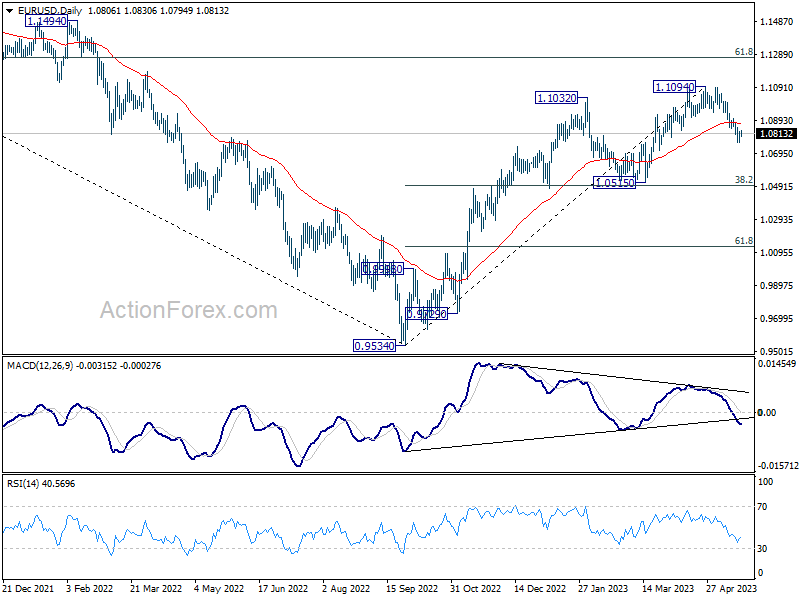
EUR/USD is staying in consolidation above 1.0759 temporary low and intraday bias stays neutral. Deeper decline is expected as long as 1.0903 resistance holds. Fall from 1.1094 is seen as correcting whole up trend from 0.9534. Below 1.0759 will target 1.0515 cluster support, 38.2% retracement of 0.9534 to 1.1094 at 1.0498. On the upside, though, firm break of 1.0903 will bring stronger rebound back to retest 1.1094 high instead.
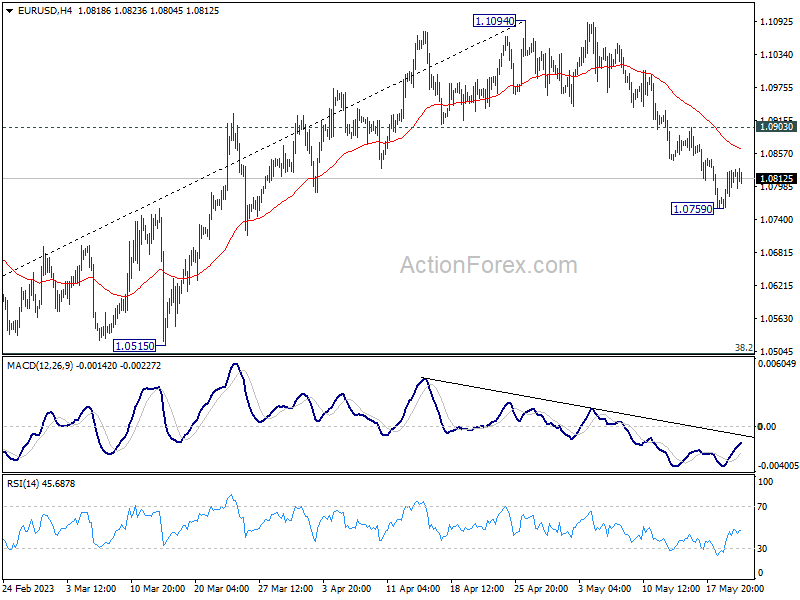
In the bigger picture, as long as 1.0515 support holds, rise from 0.9534 (2022 low) would still extend higher. Sustained break of 61.8% retracement of 1.2348 (2021 high) to 0.9534 at 1.1273 will solidify the case of bullish trend reversal and target 1.2348 resistance next (2021 high).
GBP/USD Mid-Day Outlook
Daily Pivots: (S1) 1.2396; (P) 1.2440; (R1) 1.2488; More...
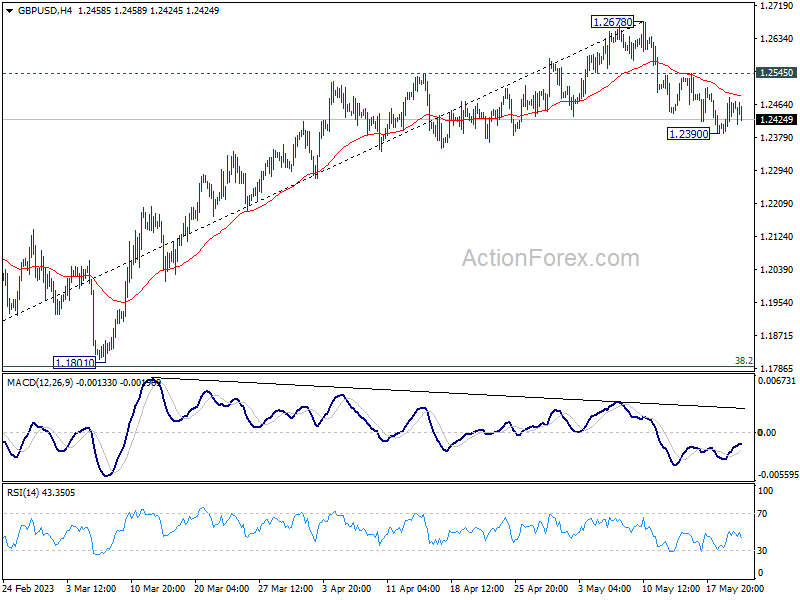
GBP/USD is staying in tight range above 1.2390 and intraday bias stays neutral. Decline from 1.2678 short term top is expected to continue as long as 1.2545 resistance holds. On the downside, sustained trading below 55 D EMA (now at 1.2394) should confirm that it's already in correction to whole up trend form 1.0351. Deeper fall should then be seen to 1.1801 cluster support (38.2% retracement of 1.0351 to 1.2678 at 1.1789). On the upside, however, break of 1.2545 will bring stronger rebound back to retest 1.2678 high.
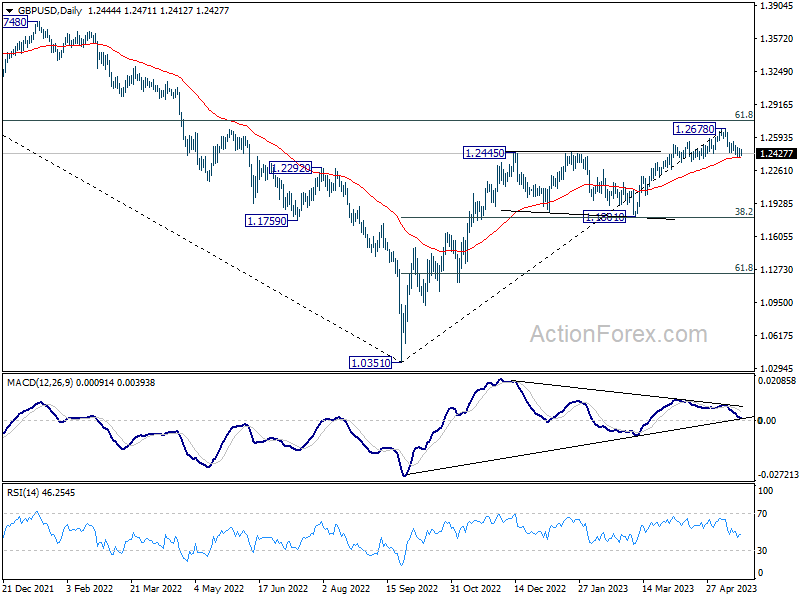
In the bigger picture, as long as 1.1801 support holds, rise from 1.0351 medium term bottom (2022 low) is expected to extend further. Sustained break of 61.8% retracement of 1.4248 (2021 high) to 1.0351 at 1.2759 will add to the case of long term bullish trend reversal. However, firm break of 1.1801 will indicate rejection by 1.2759, and bring deeper decline, even as a correction.
USD/JPY Mid-Day Outlook
Daily Pivots: (S1) 137.34; (P) 138.04; (R1) 138.65; More...
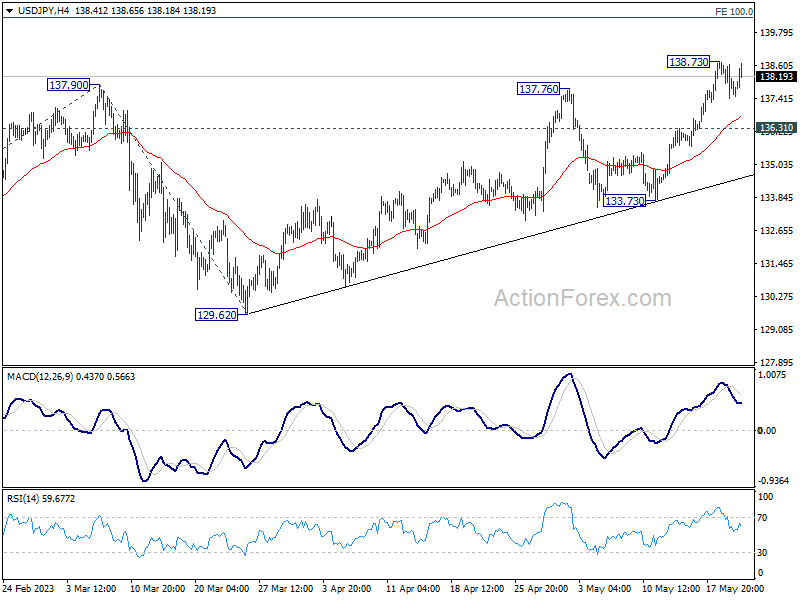
USD/JPY rebounds notably today but stays below 138.73 temporary top. Intraday bias remains neutral and another retreat cannot be ruled out. but downside should be contained by 136.31 support to bring another rally. Break of 138.73 will turn bias back to the upside for 100% projection of 127.20 to 137.90 from 129.62 at 140.32. Break there will target 142.48 fibonacci level.
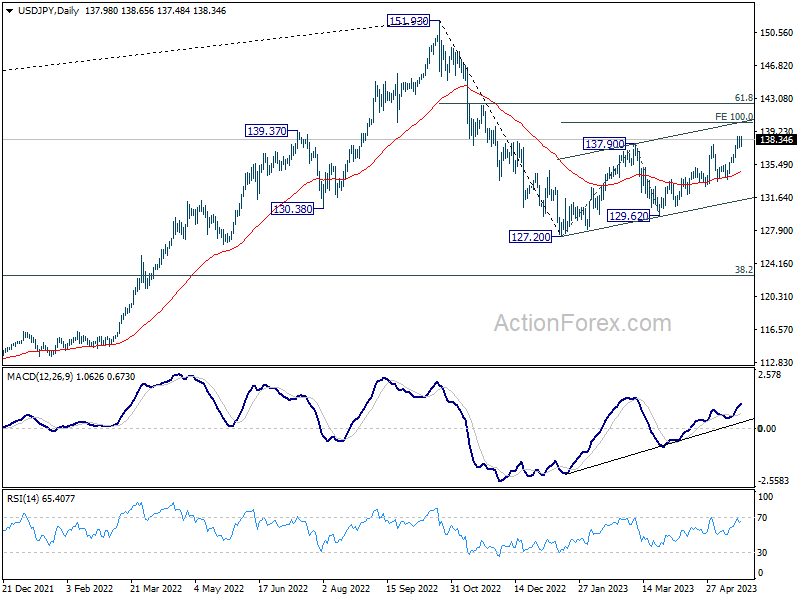
In the bigger picture, rise from 127.20 is seen as the second leg of the corrective pattern from 151.93 high. Stronger rally would be seen to 61.8% retracement of 151.93 to 127.20 at 136.34. Sustained break there will pave the way back to retest 151.93. On the downside, however, break of 133.73 support will argue that the pattern could have started the third leg through 127.20 low.
Fed Bullard: I’m thinking two more moves this year
St. Louis Fed President James Bullard reiterated the need for more rate hikes to combat persistent inflationary pressures. He stated, "I think we're going to have to grind higher with the policy rate in order to put enough downward pressure on inflation and to return inflation to target in a timely manner."
"I'm thinking two more moves this year – exactly where those would be this year I don't know – but I've often advocated sooner rather than later," he added.
According to Bullard, Fed's March median forecast, which suggested rates peaking at 5.1%, was predicated on a slowing U.S. economy and rapidly falling inflation. Instead, he noted, the economy has exhibited robust growth and inflation has not been abating as swiftly as hoped.
With this unexpected scenario in play, Bullard cautioned about the risks of inflation not subsiding to lower levels. Referring to the buoyant labor market, he emphasized, "As long as the labor market is so good it is a great time to get this problem behind us and not replay the 1970s."
USD/CHF Mid-Day Outlook
Daily Pivots: (S1) 0.8960; (P) 0.9010; (R1) 0.9044; More...
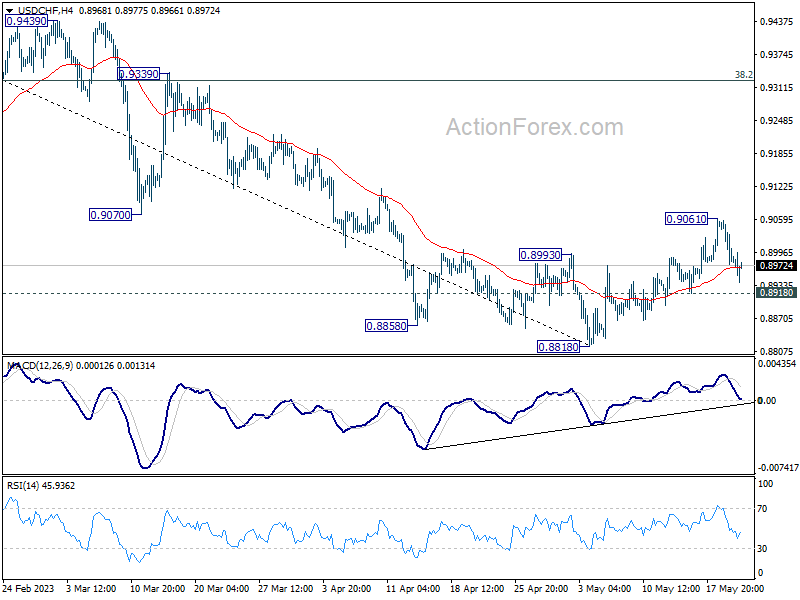
USD/CHF's retreat from 0.9061 extends lower today but stays above 0.8918 support. Intraday bias remains neutral first and outlook is unchanged. Rebound from 0.8818 short term bottom is expected to continue as long as 0.8918 minor support holds. On the upside, sustained trading above 55 D EMA (now at 0.9039) should confirm that current rally is at least correcting whole down trend from 1.0146. Further rise should then be seen to 38.2% retracement of 1.0146 to 0.8818 at 0.9325. On the downside, though, break of 0.8918 will bring retest of 0.8818 low instead.
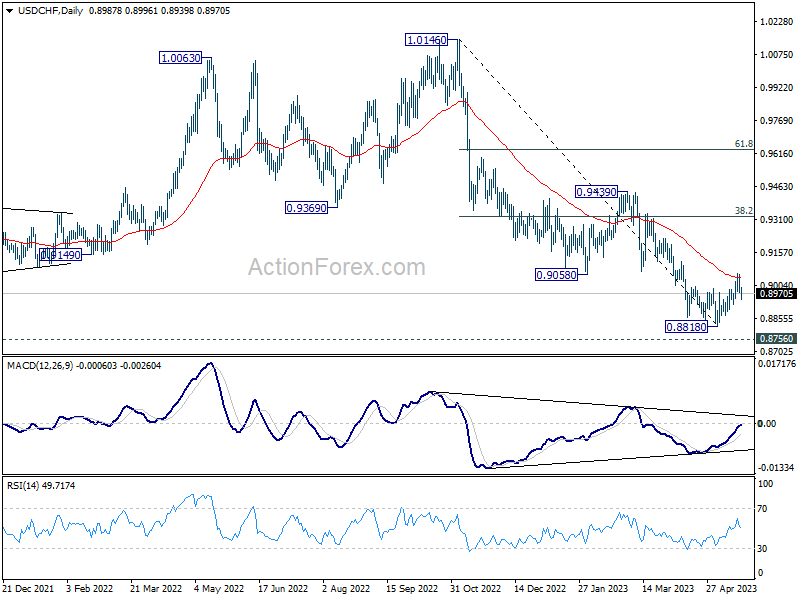
In the bigger picture, fall from 1.1046 (2022 high) is seen as a leg in the long term range pattern from 1.0342 (2016 high). So, downside should be contained by 0.8756 to bring reversal. Sustained break of 0.9058 support turned resistance will be the first sign of medium term bottoming. However, decisive break of 0.8756 will carry larger bearish implications.
Swiss Franc Surges, Yen Under Pressure, Aussie Looking at Copper
Yen is once again back under selling pressure today, with the selloff mainly concentrated against Swiss Franc, and to a lesser extent Euro. Risk-on sentiment, rising benchmark treasury yields, and the expectation of BoJ keeping policy ultra-loose will likely keep Yen weak for the time being. The only question is whether selling would intensify again. That might depend on market reactions to the development regarding US debt ceiling negotiations. Meanwhile, Australian and Canadian Dollar are following Yen as the next weakest. On the other hand, New Zealand Dollar is following Swiss Franc and Euro as the next strongest. Dollar and Sterling are mixed in the middle.
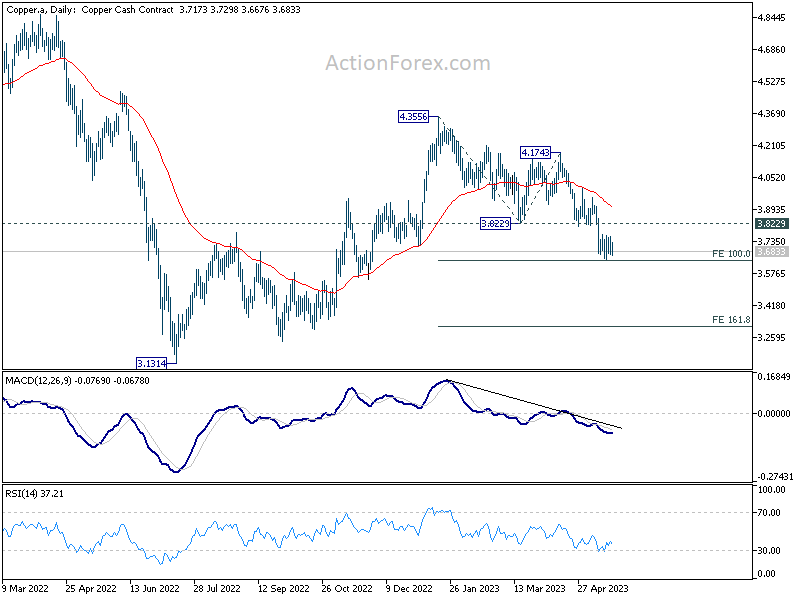
Technically, AUD/USD might be ready to breakout from established range of 0.6563/6817 this week. The direction could very much depend on the next move in Copper. While Copper stabilized just ahead of 100% projection of 4.3556 to 3.8229 from 4.1743 at 3.6416, there is no sign for a sustainable bounce yet. Indeed, decisive break of 3.6416 could prompt downside acceleration towards 161.8% projection at 3.3124. That should most likely drag AUD/USD through 0.6563. However, firm break of 3.8229 would indicate near term bullish reversal, and help lift AUD/USD for a test on 0.6817 resistance at least.
In Europe, at the time of writing, FTSE is up 0.03%. DAX is down -0.38%. CAC is down -0.32%. Germany 10-year yield is up 0.0270 at 2.452. Earlier in Asia, Nikkei rose 0.90%. Hong Kong HSI rose 1.17%. China Shanghai SSE rose 0.39%. Singapore Strait Times rose 0.27%. Japan 10-year JGB yield dropped -0.0197 to 0.387.
CHF/JPY resumes up trend, heading to 156 next
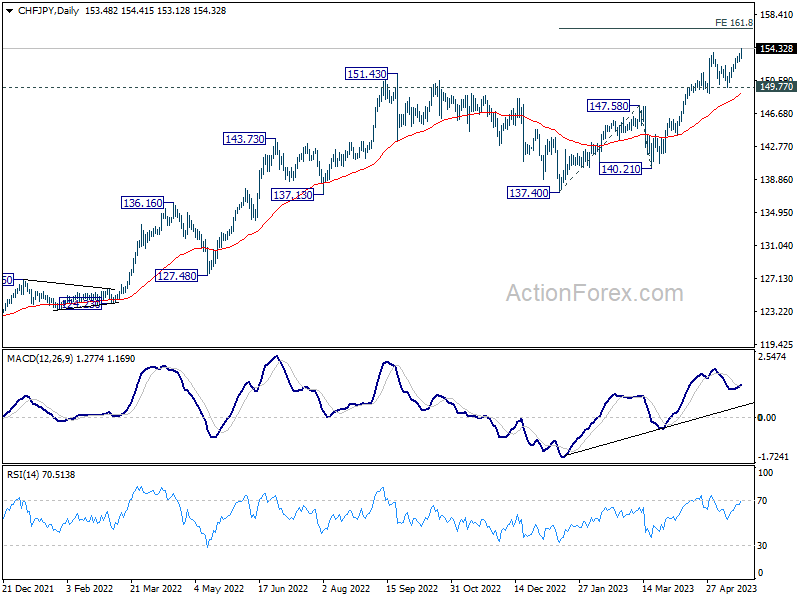
CHF/JPY resumes recent up trend today by breaking through 153.93 resistance, and reaches as high as 154.38 so far. The move is firstly driven but return to weakness in Yen, following extended rally in US and European benchmark treasury yields. Nikkei also ended up for another day and closed above 31k handle, extending the run for the highest level in more than 30 years. Secondly, Swiss Franc is also rising against European majors, even though it's starting to hesitate.
Near term outlook in CHF/JPY will now stay bullish as long as 149.77 support holds even in case of retreat. Next target is 161.8% projection of 137.40 to 147.58 from 140.21 at 156.68.
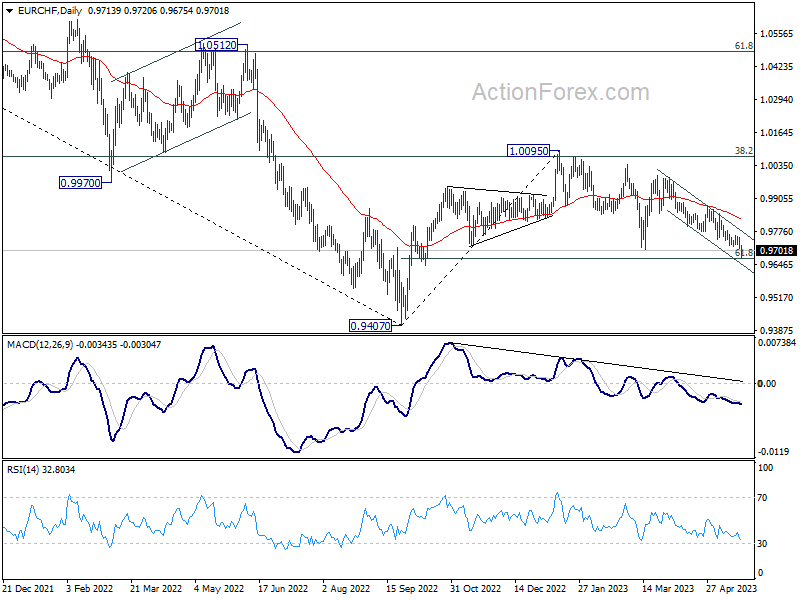
The momentum of CHF/JPY will very much depend on the performance of Swiss Franc elsewhere. In particular, if EUR/CHF could break through 61.8% retracement of 0.9407 to 1.0095 at 0.9670 decisively towards 0.9407 low, CHF/JPY could accelerate up in tandem. However, bottoming and rebound in EUR/CHF from current level could cap CHF/JPY's upside momentum.
Fed Kashkari: It's a close call for June, but we're not done
In an interview with CNBC, Minneapolis Fed President Neel Kashkari acknowledged the uncertainty surrounding the decision whether to raise rates further in June. He highlighted, "I think right now it's a close call, either way, versus raising another time in June or skipping. What's important to me is not signaling that we're done."
Kashkari clarified that even if the Federal Reserve opted not to hike rates in June, it wouldn't signal the end of the current tightening cycle. Instead, it would be a strategic move to gather more information and potentially reinitiate the raise in July.
Considering his tenure on the committee, which spans "seven or eight years", Kashkari conceded that this period marks the highest degree of uncertainty they've faced in terms of comprehending the underlying inflationary dynamics. Consequently, he is placing a greater emphasis on inflation to guide his decisions.
He speculated, "It may be that we need to go north of 6%, let's see what happens in the underlying services economy." Yet, Kashkari is mindful of the potential impact of banking stress on inflation rates.
"But if the banking stresses start to bring inflation down for us, then maybe we're getting closer to being done. I just don't know right now," he added.
RBNZ shadow board divided on rate hike this week
NZIER disclosed that its RBNZ Shadow Board is in disagreement over whether RBNZ should raise OCR the Official Cash Rate (OCR) this week. A "large number" of the Shadow Board members viewed a 25bps to 5.50% as "warranted". But "the rest" recommended to hold at 5.25%.
This discord was extended to future projections, as NZIER noted a divergence of opinion regarding where OCR should stand in twelve months.
The Shadow Board acknowledged several recent economic developments that indicated a slowing pace in New Zealand economy, including weaker government tax revenue, decreased consumer spending, and ongoing declines in business profitability.
However, members also recognized potential inflation risks from rising net migration inflows and any new fiscal stimulus in the new Budget.
USD/CHF Mid-Day Outlook
Daily Pivots: (S1) 0.8960; (P) 0.9010; (R1) 0.9044; More...
USD/CHF's retreat from 0.9061 extends lower today but stays above 0.8918 support. Intraday bias remains neutral first and outlook is unchanged. Rebound from 0.8818 short term bottom is expected to continue as long as 0.8918 minor support holds. On the upside, sustained trading above 55 D EMA (now at 0.9039) should confirm that current rally is at least correcting whole down trend from 1.0146. Further rise should then be seen to 38.2% retracement of 1.0146 to 0.8818 at 0.9325. On the downside, though, break of 0.8918 will bring retest of 0.8818 low instead.
In the bigger picture, fall from 1.1046 (2022 high) is seen as a leg in the long term range pattern from 1.0342 (2016 high). So, downside should be contained by 0.8756 to bring reversal. Sustained break of 0.9058 support turned resistance will be the first sign of medium term bottoming. However, decisive break of 0.8756 will carry larger bearish implications.
Economic Indicators Update
| GMT | Ccy | Events | Actual | Forecast | Previous | Revised |
|---|---|---|---|---|---|---|
| 23:50 | JPY | Machinery Orders M/M Mar | -3.90% | 0.70% | -4.50% | |
| 14:00 | EUR | Eurozone Consumer Confidence May P | -17 | -18 |
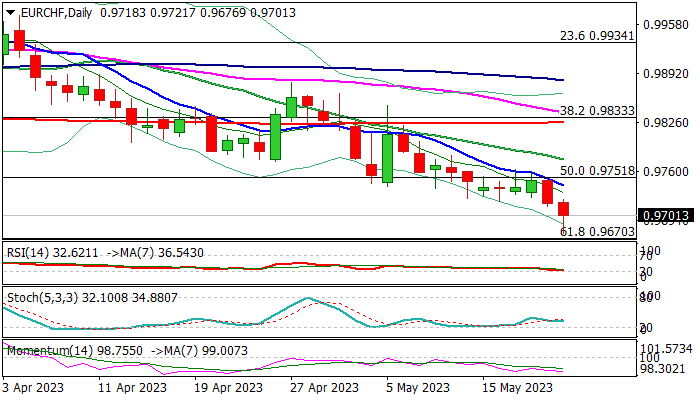
EUR/CHF: Safe Haven Swiss Franc Rises to Seven-month High vs Euro
The EURCHF pair fell to the lowest in over seven month on Monday, in fresh acceleration of larger downtrend from double- rejection at parity level in late March, during past two sessions.
Growing uncertainty over US debt ceiling talks prompted investors into safe-haven Swiss franc, which gained across the board.
Fresh bearish acceleration cracked 0.9700 round-figure level but faced strong headwinds on approach to more significant support at 0.9670 (Fibo 61.8% of 0.9406/1.0097 rally.
Bears are likely to take a breather on partial profit-taking of 0.7% fall in past two days, with upticks to face solid resistance at 0.9740/50 zone (falling 10DMA / broken 50% retracement of 0.9406/1.0097).
Consolidation should be ideally capped here to keep bears intact and offer better levels to re-enter larger downtrend for probe through 0.9670 pivot which would unmask targets at 0.9569/52 (Fibo 76.4%/low of 23 Aug 2022).
Res: 0.9705; 0.9750; 0.9776; 0.9799.
Sup: 0.9670; 0.9600; 0.9570; 0.9550.
CHF/JPY resumes up trend, heading to 156 next
CHF/JPY resumes recent up trend today by breaking through 153.93 resistance, and reaches as high as 154.38 so far. The move is firstly driven but return to weakness in Yen, following extended rally in US and European benchmark treasury yields. Nikkei also ended up for another day and closed above 31k handle, extending the run for the highest level in more than 30 years. Secondly, Swiss Franc is also rising against European majors, even though it's starting to hesitate.
Near term outlook in CHF/JPY will now stay bullish as long as 149.77 support holds even in case of retreat. Next target is 161.8% projection of 137.40 to 147.58 from 140.21 at 156.68.
The momentum of CHF/JPY will very much depend on the performance of Swiss Franc elsewhere. In particular, if EUR/CHF could break through 61.8% retracement of 0.9407 to 1.0095 at 0.9670 decisively towards 0.9407 low, CHF/JPY could accelerate up in tandem. However, bottoming and rebound in EUR/CHF from current level could cap CHF/JPY's upside momentum.