

Sample Category Title
GBP/USD Mid-Day Outlook
Daily Pivots: (S1) 1.2410; (P) 1.2441; (R1) 1.2469; More...
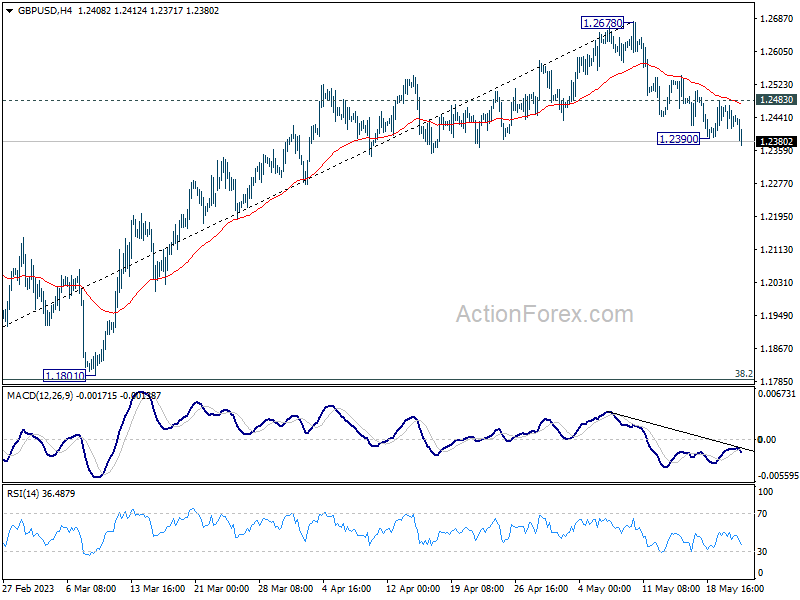
GBP/USD's decline from 1.2678 resumed by taking out 1.2390 temporary low and intraday bias is back on the downside. Current fall is seen as a correction to whole up trend form 1.0351. Deeper fall should then be seen to 1.1801 cluster support (38.2% retracement of 1.0351 to 1.2678 at 1.1789). On the upside, however, break of 1.2483 resistance will bring stronger rebound back to retest 1.2678 high instead.
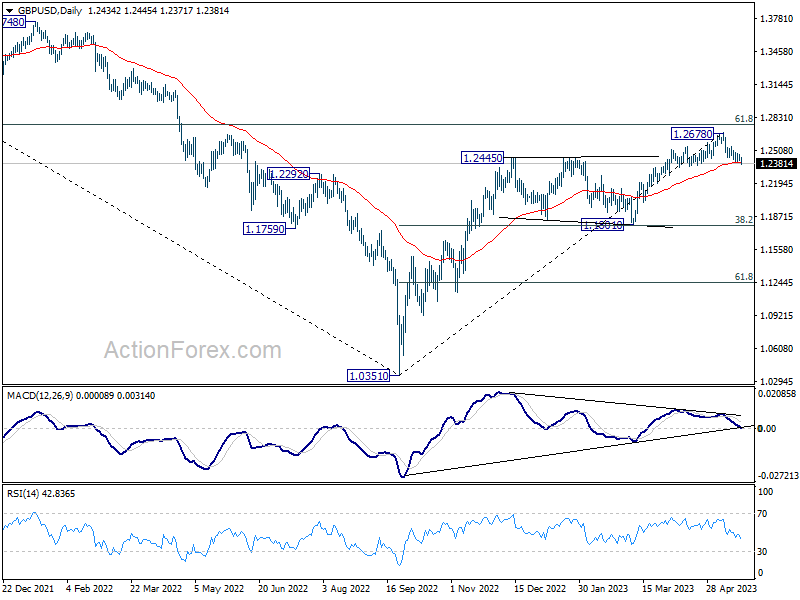
In the bigger picture, as long as 1.1801 support holds, rise from 1.0351 medium term bottom (2022 low) is expected to extend further. Sustained break of 61.8% retracement of 1.4248 (2021 high) to 1.0351 at 1.2759 will add to the case of long term bullish trend reversal. However, firm break of 1.1801 will indicate rejection by 1.2759, and bring deeper decline, even as a correction.
Forex Markets Turn Risk-Averse, Sterling Lower after PMI
Forex markets have turned noticeably risk-off today, with Aussie and Kiwi showing broad-based declines. Despite Loonie holding strong, it is being outperformed by both Dollar and Yen. Meanwhile, European majors present a mixed picture, with Sterling lagging behind Euro and Swiss Franc.
Today's PMI data illustrated a 'two-track' economy in Europe, marked by robust services and weak manufacturing. Despite the resilience of services sector helping to stave off recession, questions linger about the longevity of this support given the prevailing high inflation. Furthermore, in countries like UK where services sector is a large portion of the economy, it is likely that BoE will be compelled to persist with tightening measures in order to suppress demand.
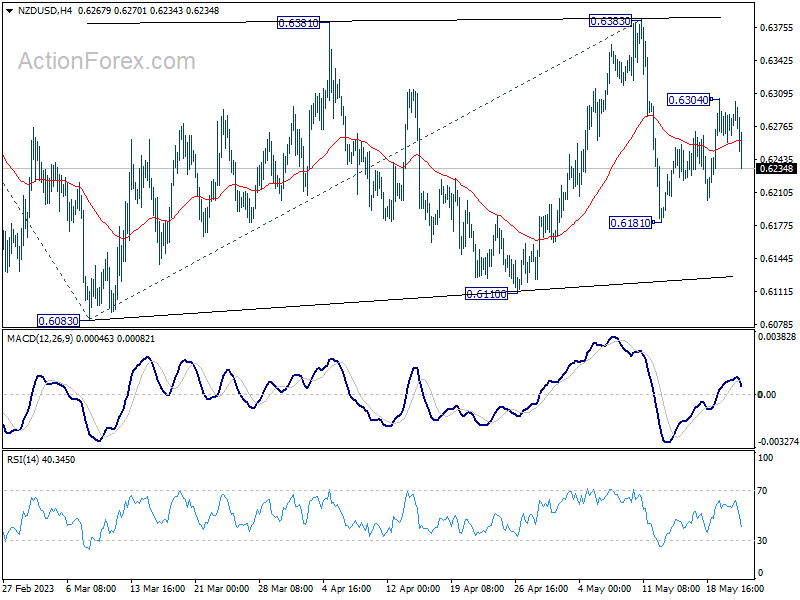
Attention now turns to the upcoming Asian session featuring an anticipated rate hike by RBNZ, placing NZD/USD in the spotlight. Recovery of NZD/USD from 0.6181 appears to be corrective so far, suggesting potential for further downside. Break below 0.6181 could trigger a rapid descent towards 0.6083 low. While a break above the 0.6304 resistance would extend the recovery, near-term outlook will continue to be bearish as long as 0.6383 resistance holds, just that downside breakout is delayed.
In Europe, at the time of writing, FTSE is up 0.31%. DAX is down -0.33%. CAC is down -0.97%, Germany 10-year yield is up 0.0328 at 2.492. Earlier in Asia, Nikkei dropped -0.42%. Hong Kong HSI dropped -1.25%. China Shanghai SSE dropped -1.52%. Singapore Strait Times rose 0.22%. Japan 10-year JGB yield rose 0.0167 to 0.404.
UK PMI composite dropped to 53.9, but BoE has more work to do
UK PMI Manufacturing dropped from 47.8 to 46.9 in May, a 5-month low. PMI Services dropped from 55.9 to 55.1. PMI Composite dropped from 54.9 to 53.9.
Chris Williamson, Chief Business Economist at S&P Global Market Intelligence said:
"The UK economy enjoyed another month of strong growth in May, with the expansion continuing to be driven by surging post-pandemic demand in the service sector, notably from consumers and for financial services, with hospitality activities buoyed further by the Coronation. The surveys are consistent with GDP rising 0.4% in the second quarter after a 0.1% rise in the first quarter...
"The UK is therefore seeing a tale of two economies, with the divergence between manufacturing and services posing difficulties for policymakers. However, it's the far larger service sector that will typically dictate policy, meaning these survey results are nothing but hawkish in suggesting the Bank of England has more work to do to quash stubbornly high inflationary pressures in the services economy."
Eurozone PMI manufacturing fell to 36-mth low, services dipped
Eurozone PMI Manufacturing fell from 45.8 to 44.6 in May, a 36-month low. PMI Services fell from 56.2 to 55.9. PMI Composite decreased from 54.1 to 53.3.
Cyrus de la Rubia, Chief Economist at Hamburg Commercial Bank said: Eurozone GDP is likely to have grown in the second quarter thanks to the healthy state of the services sector. However, the manufacturing sector is a powerful drag on the momentum of the economy as a whole.
He added that ECB will have a "headache" with the PMI price data, as "selling prices in the services sector actually rose more than in the previous month".
Also released, Germany PMI manufacturing dropped from 44.5 to 42.9 in May, a 36-month low. PMI Services rose from 56.0 to 57.8, a 21-month high. PMI Composite rose from 54.2 to 54.3, a 13-month high.
France PMI Manufacturing rose from 45.6 to 46.1. PMI Services dropped from 54.6 to 52.8. PMI Composite dropped from 52.4 to 51.4.
Australia PMI composite dropped to 51.2, still early to call an end to RBA tightening
Australia's PMI Manufacturing index stayed put at 48.0 in May, marking the joint-lowest reading since May 2020. On the other hand, PMI Services fell from 53.7 to 51.8, causing Composite PMI to decrease from 53.0 to 51.2.
Warren Hogan, Chief Economic Advisor at Judo Bank, said, "The May Flash result shows a small retracement from the strong April outcome reinforcing the view that overall economic activity in Australia is holding up well as we enter the winter months."
Despite the manufacturing sector's continuous slowdown, Hogan emphasized that this does not signal a recession. In contrast to manufacturing, the services sector has shown recent strength, and was "far from the risk of recession:.
However, he warned of the implications of better economic conditions in terms of inflation. "The RBA is trying to engineer a soft landing to rid the economy of inflation. But if they don't lean hard enough on monetary policy, we could see a more stubborn inflation emerge which will ultimately require a bigger lift in interest rates," Hogan cautioned.
Highlighting the strong correlation between the pick-up in the services PMI, housing market, rising population growth, and job advertising, he concluded, "Last week's labour market data on employment and wages have bought the RBA some time, but the Flash PMIs highlight that it is still too early to call an end to the monetary policy tightening cycle."
Japan PMI manufacturing rose to 50.8, services rose to 56.3
Japan PMI Manufacturing rose from 49.5 to 50.8 in April, signalling the first improvement in operating conditions since October 2022. PMI Manufacturing Output rose from 47.9 to 51.9. PMI Services rose from 55.4 to 56.3. PMI Composite Output rose from 52.9 to 54.9.
Usamah Bhatti, Economist at S&P Global Market Intelligence, said:
"The Japanese private sector economy continued on an upward trajectory, as signalled by a further expansion in May. The rate of growth quickened from April to reach the strongest since October 2013 and the second-strongest in the survey history (since September 2007).
"Service providers continued to report strong growth momentum with a renewed record increase in business activity, while manufacturers indicated an improvement in operating conditions for the first time in seven months, with output and new orders returning to expansion territory for the first time since last June."
GBP/USD Mid-Day Outlook
Daily Pivots: (S1) 1.2410; (P) 1.2441; (R1) 1.2469; More...
GBP/USD's decline from 1.2678 resumed by taking out 1.2390 temporary low and intraday bias is back on the downside. Current fall is seen as a correction to whole up trend form 1.0351. Deeper fall should then be seen to 1.1801 cluster support (38.2% retracement of 1.0351 to 1.2678 at 1.1789). On the upside, however, break of 1.2483 resistance will bring stronger rebound back to retest 1.2678 high instead.
In the bigger picture, as long as 1.1801 support holds, rise from 1.0351 medium term bottom (2022 low) is expected to extend further. Sustained break of 61.8% retracement of 1.4248 (2021 high) to 1.0351 at 1.2759 will add to the case of long term bullish trend reversal. However, firm break of 1.1801 will indicate rejection by 1.2759, and bring deeper decline, even as a correction.
Economic Indicators Update
| GMT | Ccy | Events | Actual | Forecast | Previous | Revised |
|---|---|---|---|---|---|---|
| 23:00 | AUD | Manufacturing PMI May P | 48 | 48 | ||
| 23:00 | AUD | Services PMI May P | 51.8 | 53.7 | ||
| 00:30 | JPY | Manufacturing PMI May P | 50.8 | 49.5 | ||
| 06:00 | GBP | Public Sector Net Borrowing (GBP) Apr | 24.7B | 17.5B | 20.7B | 20.0B |
| 07:15 | EUR | France Manufacturing PMI May P | 46.1 | 46.1 | 45.6 | |
| 07:15 | EUR | France Services PMI May P | 52.8 | 54.3 | 54.6 | |
| 07:30 | EUR | Germany Manufacturing PMI May P | 42.9 | 45.2 | 44.5 | |
| 07:30 | EUR | Germany Services PMI May P | 57.8 | 55.5 | 56 | |
| 08:00 | EUR | Eurozone Manufacturing PMI May P | 44.6 | 46.2 | 45.8 | |
| 08:00 | EUR | Eurozone Services PMI May P | 55.9 | 55.6 | 56.2 | |
| 08:00 | EUR | Current Account (EUR) Mar | 31.2B | 20.2B | 24.3B | |
| 08:30 | GBP | Manufacturing PMI May P | 46.9 | 48.2 | 47.8 | |
| 08:30 | GBP | Services PMI May P | 55.1 | 55.5 | 55.9 | |
| 12:30 | CAD | Industrial Product Price M/M Apr | -0.20% | 0.20% | 0.10% | |
| 12:30 | CAD | Raw Material Price Index Apr | 2.90% | 0.70% | -1.70% | |
| 13:45 | USD | Manufacturing PMI May P | 50 | 50.2 | ||
| 13:45 | USD | Services PMI May P | 53.6 | 53.6 | ||
| 14:00 | USD | New Home Sales Apr | 665K | 683K |
UK CPI to Drop, But Will It Change BoE?
UK CPI will finally fall below double digits when the April report is issued tomorrow. Unless there is an unprecedented catastrophe, that is. While policymakers and politicians might cheer the results, the components are likely to keep the BOE on track to hike at the next meeting.
Why will UK inflation drop?
Usually, analysts are cautious about making forecasts for economic data, because surprises are very common. But this time around, the math is pretty certain. What isn't certain, as usual, is the market reaction. So, let's first address the math.
Back in April of 2022, between March and April, inflation jumped a whopping 2.5%. That was due to an adjustment in energy prices made by Ofgem, as gas and crude prices spiked following the imposition of sanctions on Russia over the war in Ukraine. That's the highest monthly increase recorded, ever. It is, therefore, very, very unlikely to be repeated.
Accounting for the base effect
For the inflation rate to come in in the double digits this month, it would have to have a similar monthly increase as April of last year. Over the last few months, the median monthly inflation change has been around 0.5%. In order for annual inflation to stay at or above 10%, then monthly inflation would have to have jumped by five times the median. March inflation was 0.8%, which means that for inflation to come in at 10% (to maintain double digits), April 2023 monthly inflation would have to be 1.8%. It is currently forecast to be 0.8%. Analysts would have to be wrong by more than double in order for inflation to stay in the double digits.
But, how far below double digits is still an open question. The current average of economists' forecasts is 8.5% for annual headline inflation, compared to 10.1% reported for last March. In other words, inflation is expected to remain quite high. The drop is thanks to technical reasons, which would likely not change monetary policy outlook.
The market movers
What the market is mostly focused on now is how the BOE will react, and it is more interested in the core inflation rate. Excluding the volatile elements of energy and food, UK inflation is expected to tick down just slightly to 6.1% compared to 6.2% prior. Over triple the BOE's target. A one decimal decline is very unlikely to change the view of the 7 MPC members who voted last time to hike.
Meanwhile, inflation might be getting out of the BOE's hands. In a recent presentation before the British Chamber of Commerce, BOE Governor Bailey said that core inflation was now due to "secondary effects". Translated into English, this means that in his estimation, there are signs of the dreaded wage-price spiral that could signal inflation will remain high for a long time. That, at least in the market's estimation, implies that even more tightening will be needed.
But, the pound might not gain so much strength, because the division in the BOE's MPC leaves many market participants with doubts that the BOE is sufficiently committed to bring inflation down. The IMF's new report says that the UK is likely to avoid a recession this year, which could allow room for more hiking. But whether the BOE will deliver is still an open question.
XAU/USD: Gold Comes Under Renewed Pressure on Hawkish Fed/Debt Ceiling Deal Hopes
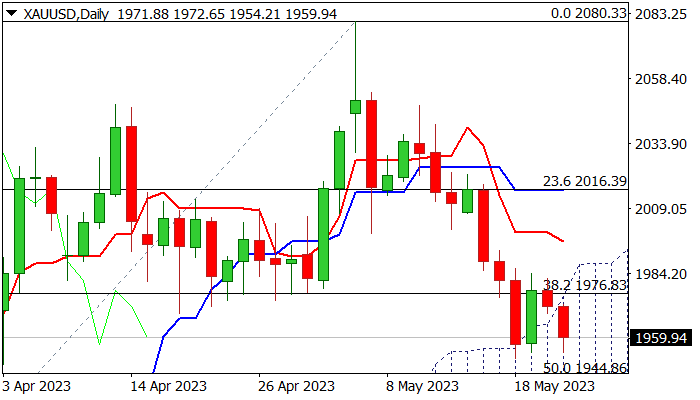
Gold dips further on Tuesday, as renewed hawkish stance from Fed and optimism about debt ceiling deal improve risk sentiment and inflate dollar.
Fresh weakness eyes pivotal $1950 zone (lows of last Thu/Fri) and Fibo support at $1944 (50% retracement of $1809/$2080 rally), violation of which would add to reversal signals risk deeper fall towards targets at $1931 (100DMA) and $1926 (daily cloud base).
Weakening daily studies (rising negative momentum / daily Tenkan/Kijun-sen bear-cross) maintain near-term bearish outlook.
The price penetrated thick rising daily Ichimoku cloud and needs close within the cloud to confirm signal.
Strong resistance at $1975 (daily cloud top / former higher base) should cap upticks to keep bears in play.
Res: 1975; 1986; 1990; 2000.
Sup: 1951; 1944; 1931; 1926.
USD/JPY Hits 6-mth High as BoJ Core CPI Accelerates
- BoJ Core CPI rises to 3.0%
- USD/JPY hits 6-mth high
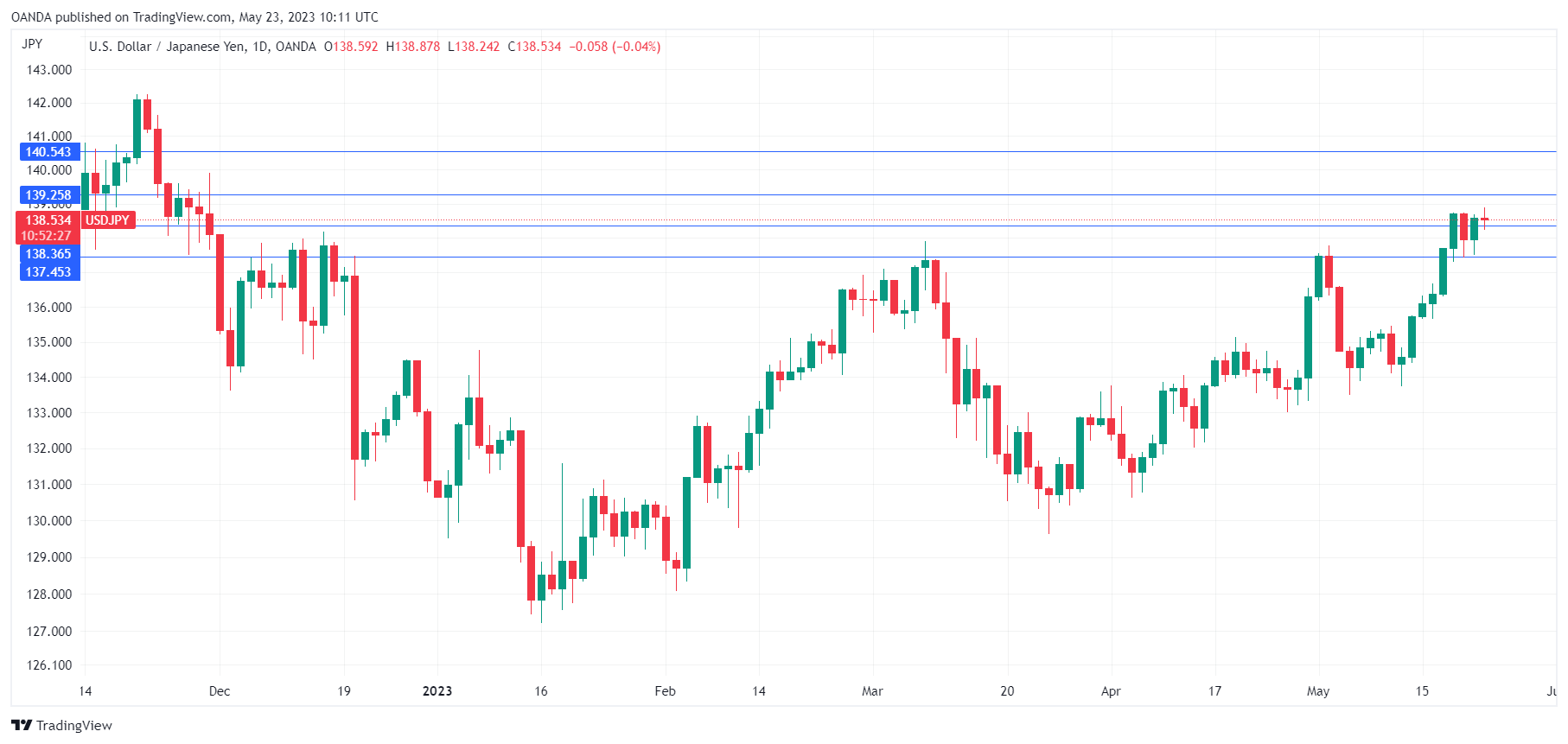
USD/JPY climbed as high as 138.87 earlier on Tuesday, its highest level since May 28th. The yen has edged lower and is trading at 138.43 in the European session, down 0.17%.
BoJ Core CPI surprises to the upside
Japan released BoJ Core CPI earlier in the day. The March reading rose to 3.0%, up from 2.9% in February and above the estimate of 2.8%. This is the BoJ’s preferred inflation gauge and is another indication that inflation remains sticky and above the Bank’s target of 2%.
There is a widespread feeling in the markets that change is coming to the Bank of Japan, after years of deflation and an ultra-loose policy. The new Governor, Kazuo Ueda has kept a fairly low profile, perhaps to keep market volatility at a minimum during a sensitive time for the central bank. Ueda has indicated that he would consider tightening policy if it was evident that inflation was sustainable at 2%. The BoJ insists that inflation is still temporary but this argument will start to ring hollow if inflation indicators continue to point to inflation hovering around 3%.
If the BoJ were to tighten, it would likely adjust or phase out its yield control curve policy, rather than raise interest rates. The BoJ widened the target band for 10-year Japanese government bonds in December, which sent the yen sharply higher. Another widening of the target band would likely send the yen higher, and speculators are betting that the Ueda will eventually shift policy which will boost the yen.
We’ll get another inflation reading on Thursday, with Tokyo Core CPI expected to ease to 3.3% in May, following a 3.5% gain in April.
USD/JPY Technical
- USD/JPY tested support at 138.37 earlier in the day. Below, there is support at 137.45
- There is resistance at 139.25 and 140.55
Will GBP Recover Now?
The Bank of England (BoE) has dramatically shifted its economic forecasts. They no longer expect a recession in the UK and have upgraded their growth projections. This year, the BoE predicts GDP growth of +0.25%, a significant improvement from previous expectations. Next year's forecast is even more optimistic, with a projected growth of 0.75%. However, let's not get too carried away—the outlook remains subdued, with growth below 1% until 2025. The UK economy is still fragile, as evidenced by lackluster performance in the first quarter of 2023. On the inflation front, the BoE expects a decline over the year but at a slower pace than previously anticipated. Inflation is now projected to be around 5% by the end of this year and is not expected to fall below the 2% target until 2025. The recent interest rate hike suggests that further tightening may be on the horizon, especially considering the upgraded growth and inflation forecasts. So, keep your eyes peeled for potential developments in monetary policy.
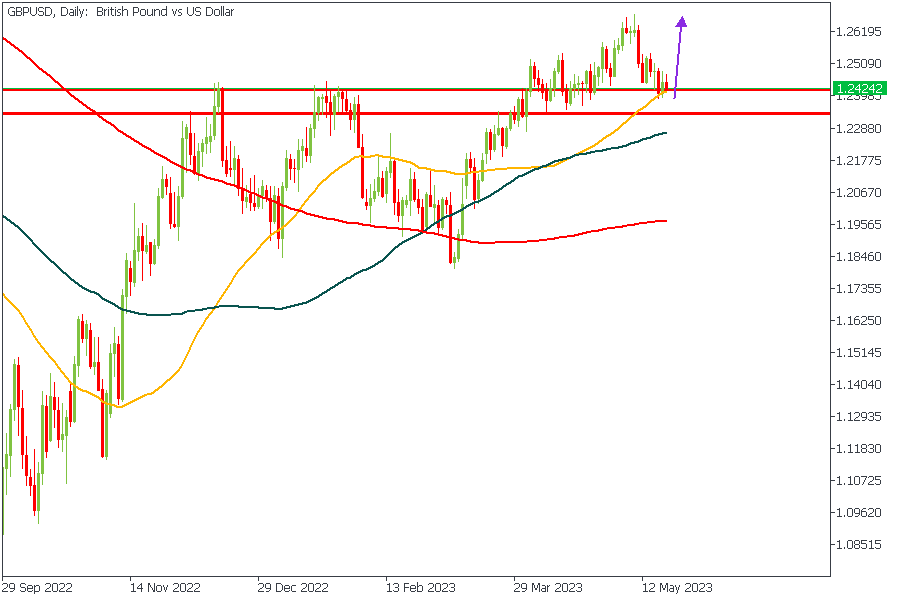
GBPUSD - Daily Timeframe
From the chart above, it is clear that the price is at a key level - a pivot zone. Considering the break above the previous high, the support from the 50-Day moving average, and the arrangement of the moving averages in increasing order, I will maintain a bullish sentiment on this commodity until the price breaks below the pivot zone.
Analyst’s Expectations:
- Direction: Bullish
- Target: 1.25873
- Invalidation: 1.23420
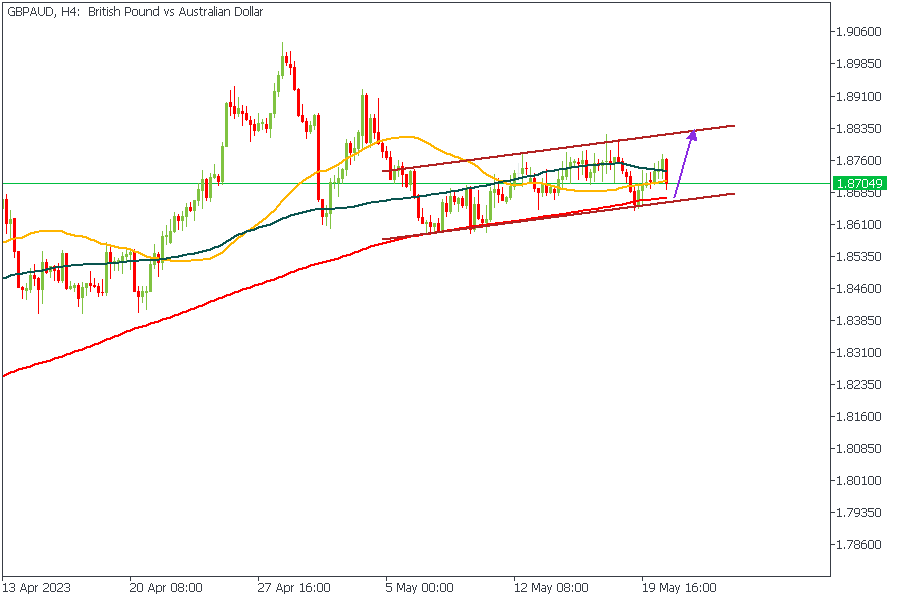
GBPAUD - H4 Timeframe
GBPAUD presents a very tricky case. We see price trading within the consolidation channel while pulling a dance between the 50-period and 100-period moving averages. We haven’t seen a touch of the resistance trendline of the channel. Hence, my argument is in favor of bullish price action. Combine that with the confluence from the trendline support and the 200-period moving average, and you will see why I expect a bullish price action.
Analyst’s Expectations:
- Direction: Bullish
- Target: 1.87952
- Invalidation: 1.86353
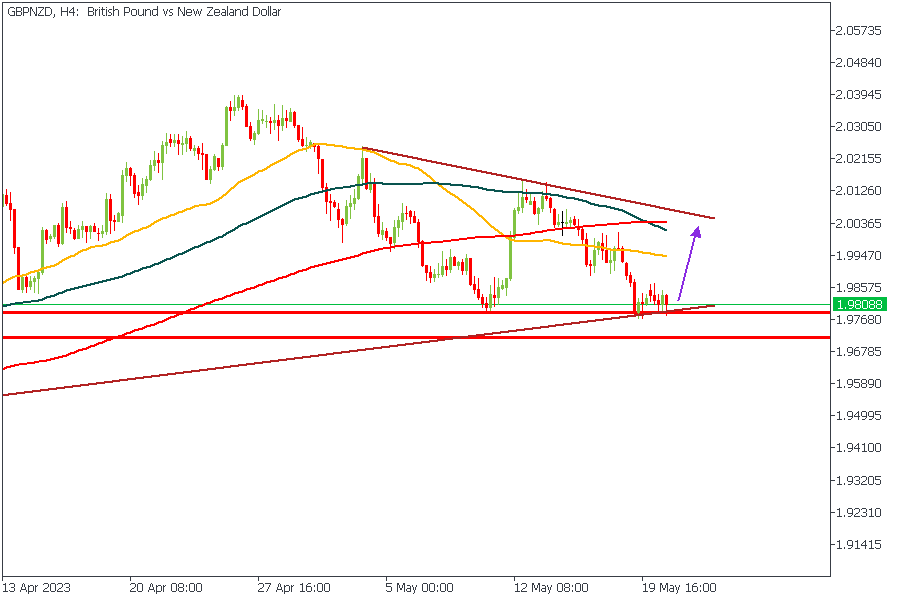
GBPNZD - H4 Timeframe
The moving averages on GBPNZD signal an overall bearish market, but it is good to scalp a few bullish pips in between. My bullish sentiment is based on the confluence of the trendline support and the pivot zone - maybe not be a strong argument, but I will be watching for a clear reaction from the pivot zone as my entry cue.
Analyst’s Expectations:
- Direction: Bullish
- Target: 1.99571
- Invalidation: 1.97104
GBPJPY - Daily Timeframe
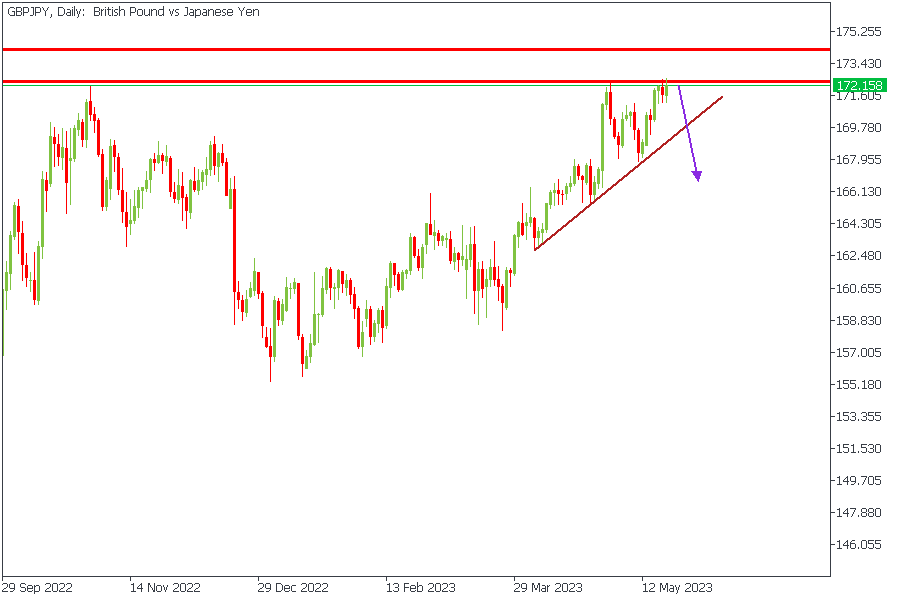
This pivot zone on GBPJPY can be traced to the Monthly timeframe. The zone has also been retested a few times - serving as an area of liquidity grab from the previous high. In this scenario, as in the case of GBPNZD, the confluences seem scanty - making it a daring trade. That is why my entry will be timed to follow a notable reversal candlestick pattern, without which I wouldn’t bother taking a trade on GBPJPY at all!
Analyst’s Expectations:
- Direction: Bearish
- Target: 169.349
- Invalidation: 174.048
CONCLUSION
The trading of CFDs comes at a risk. Thus, to succeed, you have to manage risks properly. To avoid costly mistakes while you look to trade these opportunities, be sure to do your due diligence and manage your risk appropriately.
Crypto Attracts Buyer Interest, But Reversal Needs Proof
Market picture
Crypto market capitalisation rose 1.4% over the last 24 hours to $1.138 trillion. After quiet trading on Monday, most gains came on Tuesday morning. The timing of the move is due to news on the US debt ceiling, where there is no deal yet, but Biden notes progress in negotiations. Ether is up 2.3% at $1856, with the top altcoins gaining between 0.3% (Solana) and 3% (Polygon).
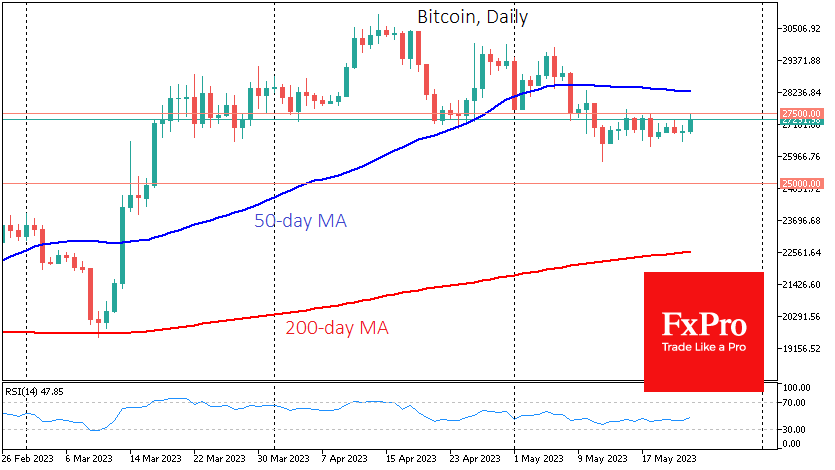
Bitcoin is up 1.6% over the past day to $27.3K and earlier today climbed close to $27.5K, the upper end of the range since the 15th. Despite the positive momentum, the daily timeframes remain bearish, with Bitcoin trading below $27.5K.
According to CoinShares, investments in cryptocurrency funds fell for the fifth consecutive week to $32 million last week, with bitcoin investments down $33 million and Ethereum investments down $1 million. Investment in funds that allow shorts on Bitcoin fell by $1.3 million.
According to Santiment, the number of BTC and ETH on exchanges has fallen to its lowest level in several years, which is seen as a sign of an attitude towards long-term holding.
News background
Mott Capital Management founder Michael Kramer warned that Bitcoin could fall to $20K. According to him, BTC is a leading indicator for all risky assets, so its decline would be negative for the stock market.
Anthony Scaramucci, founder of hedge fund SkyBridge Capital, believes that the actual value of Bitcoin should now be $40K. According to him, we are now witnessing a global proliferation of BTCs, similar to what happened in the late 1990s with the rise of the internet.
Cryptocurrency platform Bakkt is considering expanding its business in Europe in light of the Crypto Asset Market Regulation Act (MiCA) passed in April. Bakkt currently only offers services in the US.
US lawmakers have drafted a bipartisan bill prohibiting the Fed from issuing the digital dollar (CBDC). Lawmakers cited Americans’ right to financial privacy.
UK PMI composite dropped to 53.9, but BoE has more work to do
UK PMI Manufacturing dropped from 47.8 to 46.9 in May, a 5-month low. PMI Services dropped from 55.9 to 55.1. PMI Composite dropped from 54.9 to 53.9.
Chris Williamson, Chief Business Economist at S&P Global Market Intelligence said:
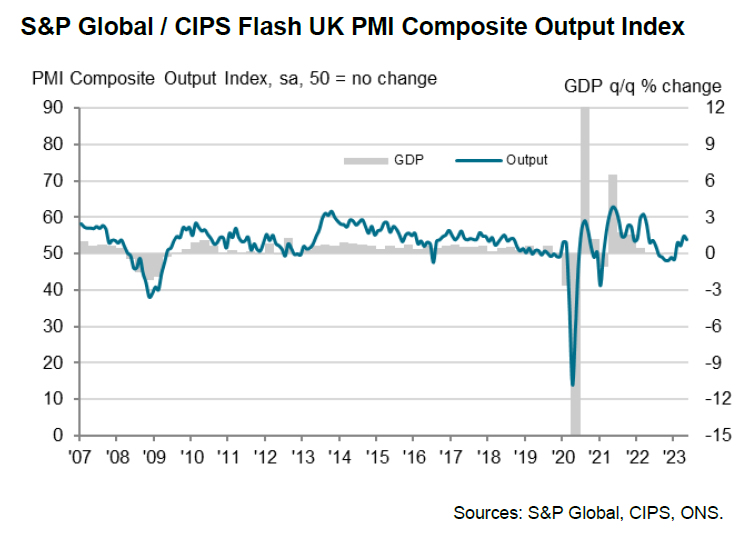
"The UK economy enjoyed another month of strong growth in May, with the expansion continuing to be driven by surging post-pandemic demand in the service sector, notably from consumers and for financial services, with hospitality activities buoyed further by the Coronation. The surveys are consistent with GDP rising 0.4% in the second quarter after a 0.1% rise in the first quarter...
"The UK is therefore seeing a tale of two economies, with the divergence between manufacturing and services posing difficulties for policymakers. However, it's the far larger service sector that will typically dictate policy, meaning these survey results are nothing but hawkish in suggesting the Bank of England has more work to do to quash stubbornly high inflationary pressures in the services economy."
EURJPY Regains Traction, Eyeing Multi-Year Highs
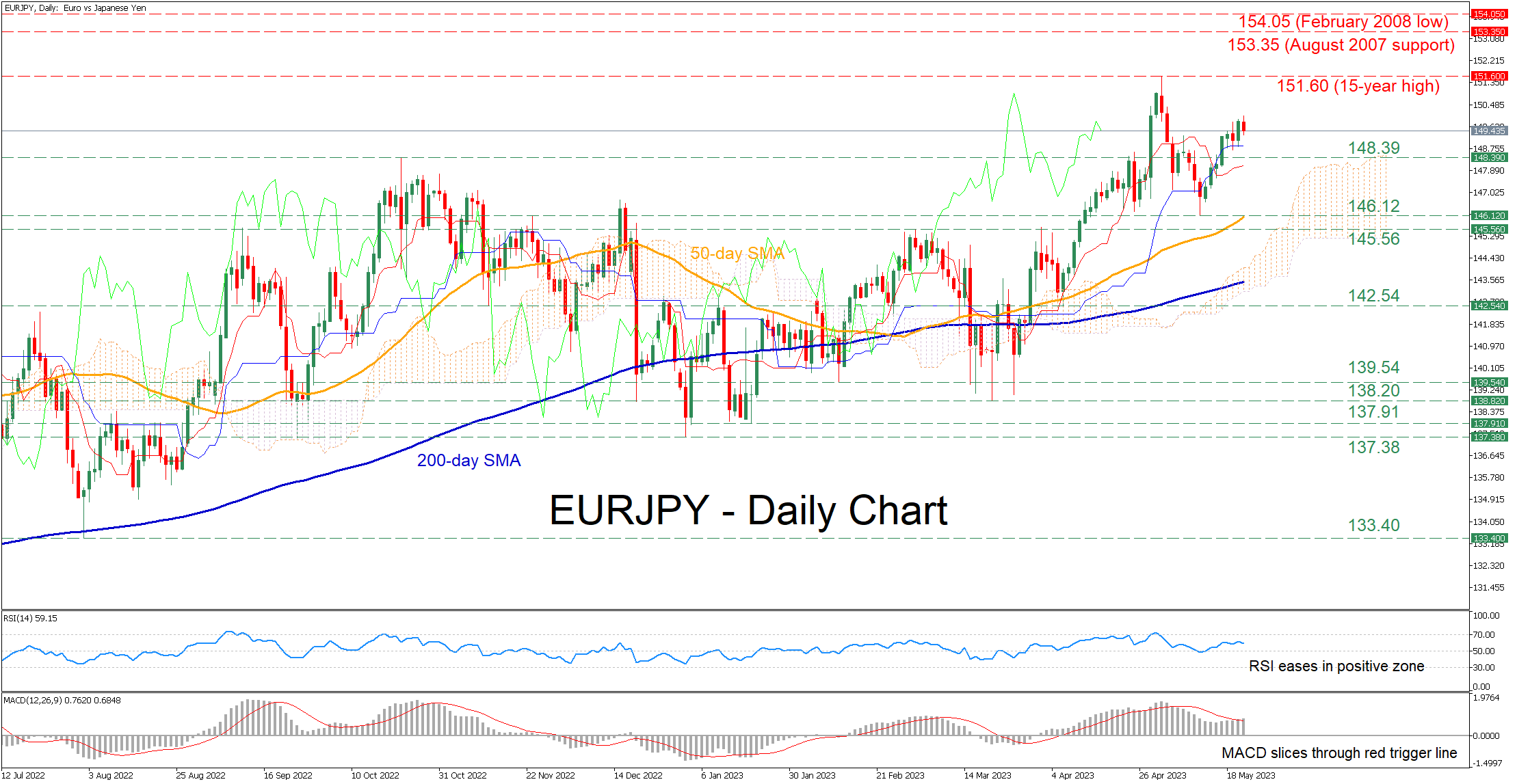
EURJPY had been in a prolonged uptrend, which ceased at a fresh 15-year high of 151.60 in early May. Even though the pair experienced a mild pullback from its recent peak, it quickly found its feet and stormed back higher in an effort to extend its bullish medium-term structure.
The momentum indicators are endorsing this latest advance, with the RSI flatlining way above its 50-neutral mark and the MACD crossing above its red signal line in the positive region.
If the recent upside trajectory resumes, the bulls could attack the 15-year peak of 151.60. Breaking above that zone, the pair might ascend to form fresh multi-year highs, where the August 2007 support of 153.35 may provide upside protection. A violation of that territory could set the stage for the February 2008 low of 154.05.
Alternatively, a potential downside correction could come to a halt at the October 2022 high of 148.39, which could serve as support in the future. Diving beneath that region, the pair could challenge the 146.12 congested region that includes the May low and the 50-day simple moving average (SMA). Should that barricade fail, the 145.56 obstacle could prove to be a tough one for the bears to overcome.
Overall, EURJPY has staged a massive comeback following the recent retreat from its multi-year peaks. However, a failure to create a fresh higher high may open the door for a moderate downside correction.
Eurozone PMI manufacturing fell to 36-mth low, services dipped
Eurozone PMI Manufacturing fell from 45.8 to 44.6 in May, a 36-month low. PMI Services fell from 56.2 to 55.9. PMI Composite decreased from 54.1 to 53.3.
Cyrus de la Rubia, Chief Economist at Hamburg Commercial Bank said: Eurozone GDP is likely to have grown in the second quarter thanks to the healthy state of the services sector. However, the manufacturing sector is a powerful drag on the momentum of the economy as a whole.
He added that ECB will have a "headache" with the PMI price data, as "selling prices in the services sector actually rose more than in the previous month".
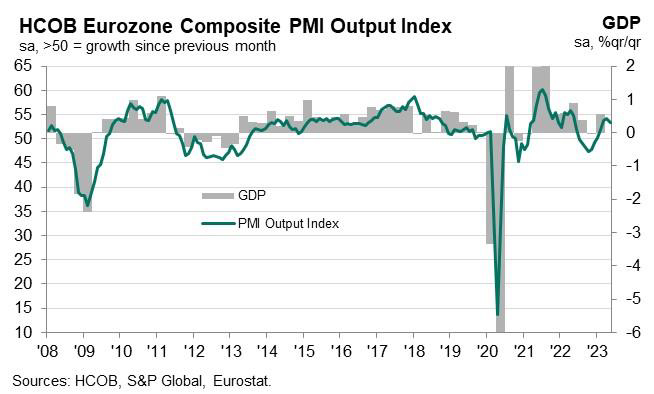
Full Eurozone PMI release here.
Also released, Germany PMI manufacturing dropped from 44.5 to 42.9 in May, a 36-month low. PMI Services rose from 56.0 to 57.8, a 21-month high. PMI Composite rose from 54.2 to 54.3, a 13-month high.
France PMI Manufacturing rose from 45.6 to 46.1. PMI Services dropped from 54.6 to 52.8. PMI Composite dropped from 52.4 to 51.4.