

Sample Category Title
Fed Mester: The point of policy hold not reached yet
Cleveland Fed President Loretta Mester signaled her cautious approach towards interest rate adjustments. She emphasized her desire for the policy rate to reach a level where the next policy change could be equally a potential increase or decrease.
Mester stated at a conference today, "The approach I'm taking is that I would like the policy rate to get to a point where, when I'm thinking about what would the next policy change be, I want it to be equally a potential increase versus a decrease."
Mester further clarified her stance, indicating that once the desired policy rate is achieved, she envisions a period of stability. "When we get the policy to that rate, I think we're going to be holding for a while in order to make sure that the interest rate is coming back down. So I don't put it in terms of a pause, I put it in terms of a hold."
However, she noted that current data doesn't suggest that this rate has been reached yet. Expressing a need for more evidence of inflation trending downwards, Mester insisted on the importance of adhering to the current policy strategy. She said, "I need to see more evidence that inflation is still moving down. I think that we just have to stick with what we're doing."
Pound Ignores Lousy News, Including Labour Market
The UK labour market is deteriorating at an increasing rate. Data released this morning showed that jobless claims rose by 46.7k in April, following a 26.5k increase in March. Analysts had, on average, expected a rise of 31.2k.
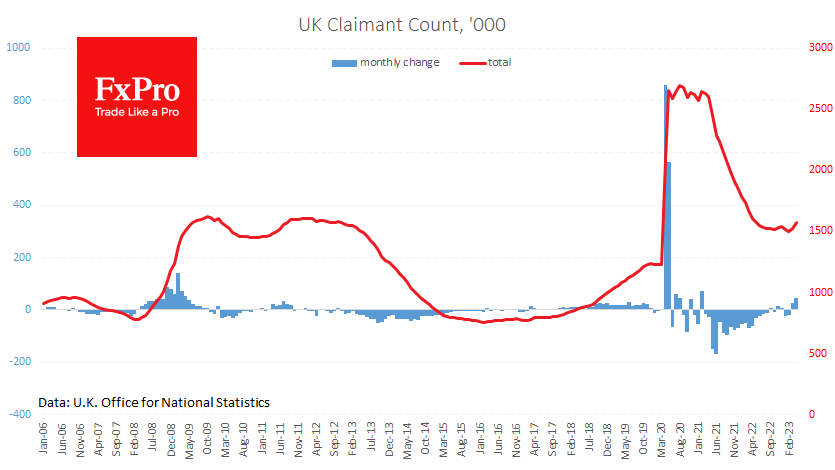
The unemployment rate rose to 3.9% (the highest since January 2022) from a low of 3.5% in August. This turnaround in employment trends has yet to lead to significant wage pressures. Average weekly earnings in the three months to March were up 5.8% year-on-year total pay and 6.7% excluding bonuses. Although this is slightly below expectations, it is difficult to see a reversal of the weakening trend.
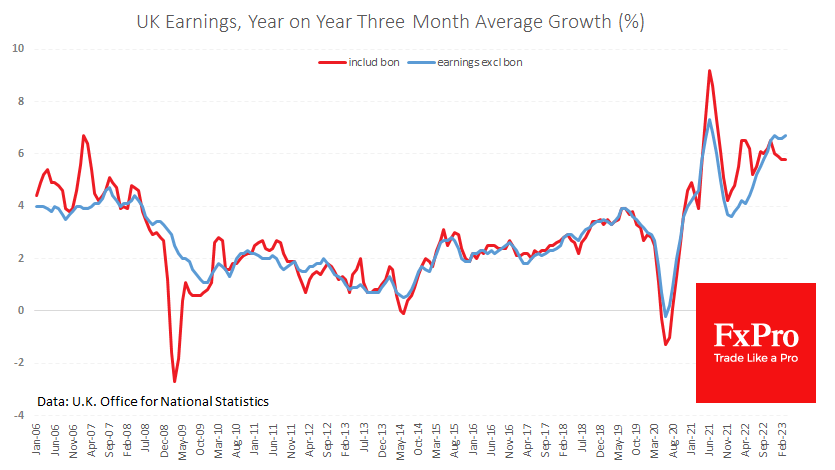
The juxtaposition of two trends – falling employment and rising wages – does not make things any easier for the Bank of England. On the one hand, increasing wages when inflation is already falling is a worrying signal, forcing a further tightening of policy. On the other hand, rising wages create the conditions for an inflationary spiral to take hold despite falling employment.
The GBPUSD reacted to the weak employment figures by falling 0.4% to 1.2465. However, the pair quickly digested the negativity and climbed out of the hole over the next few hours to reach 1.2545. Interestingly, the GBPUSD has rallied on relatively negative economic news this week. On Monday, the IMF said that the UK was the only G7 country facing a recession this year, but that didn’t stop GBPUSD from gaining 0.7%. Too much negativity may be already in prices.
US: Retail Sales Rise in April for the First Time in 3 Months
Retail sales rose 0.4% month-on-month (m/m) in April, roughly half the consensus forecast calling for an increase of 0.8% m/m. March's reading was revised up, changing last month's decline to -0.7% (previously -1.0%). Most of these revisions were due to the release of the 2021 Annual Retail Trade Survey on April 24th which is used as a benchmark for the monthly data.
Sales in the auto sector increased for the first time in three months, largely driven by strength in automotive parts & tire stores (+3.8). Motor vehicle sales rose by slightly less (+0.4%), up from March's upwardly revised decline of -1.4% (previously -1.6%). Excluding autos, retail sales were unchanged at 0.4% m/m.
Sales in other more volatile categories were mixed in April. The building materials and equipment category rose 0.5% m/m while sales at gasoline stations declined 0.8% m/m.
Retail sales in the "control group", which excludes the above categories and is used to estimate personal consumption expenditures (PCE), rose 0.7% m/m, up from a downwardly revised -0.4% m/m reading in March.
The largest gains by spending category were seen by miscellaneous retailers (+2.4% m/m), non-store retailers (+1.2% m/m), and general merchandise stores (+0.9% m/m). Spending at health & personal care stores also saw a 0.9% m/m increase after previously slowing in March.
Categories which continued to see losses in April include sporting goods, hobby, book, & music stores (-3.3% m/m), clothing & accessory stores (-0.3% m/m), and food & beverage stores (-0.2% m/m).
Food services & drinking places – the only services category in today's report – was up by 0.6% m/m in nominal terms but was flat after adjusting for inflation.
Key Implications
The arrival of warmer weather ushered in a moderate rebound in retail spending in April, marking the first increase in three months. However, there were notable downward revisions to 2023Q1, with annualized growth for the first three months of the year now sitting at 4.8% (previously 7%). April's rebound was underpinned by strength in auto spending, building materials & equipment, and general good products. Looking ahead we expect consumer spending to slow over the course of this year as past rate hikes continue to filter through the economy.
Last week we received the second quarter results of the Federal Reserve's Senior Loan Officer Opinion Survey which showed that consumer credit continued to tighten but remained relatively accessible despite recent regional bank stress. While the survey does not track the extent to which commercial banks are tightening credit standards, it did show that consumer demand for financing rose in April relative to January. As many consumers have exhausted their pandemic savings, there is an increasing reliance on financing to deal with elevated prices.
Sunset Market Commentary
Markets
There was a mild risk-off vibe at the European start this morning. Stocks slid 0.4% and core bond yields eased several bps in the US and Germany. But sentiment improved gradually and equities turned flat. Core bond yields bottomed and even show minimal daily gains in the US after the April retail sales. Considering the upward March revisions, the broadest (headline) gauge was more or less in line with expectations. Core measures including the control group (a solid 0.7% m/m) even topped analyst estimates. Seven out of 13 retail categories rose last month. US yields currently add 2.4-3.2 bps across the curve, helped higher by some Fed Mester quotes as well. The non-voting FOMC member said she needs more evidence that inflation is moving down, adding that data shows that rates are not sufficiently restrictive. The 2-y yield is seeking a return above 4%. German yields recouped 4 bps of losses. The dollar is going nowhere. EUR/USD trades unchanged near opening levels of around 1.088. DXY is fillings bids in the 102.4 area. A slew of Fed and ECB speeches due after wrapping up this report as well as the high-level debt ceiling talks may still influence trading later today.
The UK labour market report displayed strength in the first quarter by adding 182k jobs (160k expected) compared to the 2022Q4. The unemployment rate unexpectedly edged up, from 3.8% to a still historically low level of 3.9%. Wage growth accelerated slightly to 6.7% y/y in Q1. This news suggesting a very tight labour market was counterbalanced by the accompanying preliminary job growth estimate for April. The number of payrolled employees fell 136000. This figure is notorious for its often huge revisions but the fact that it was the first drop since February 2021 did not go unnoticed. It also added flavour to yesterday’s Bank of England Pill’s speech. The chief economist said he hoped last week’s 25 bps policy rate rise to 4.5% was the last one. Among the variables whether or not supporting his case for a pause is labour market tightness. UK money markets pared odds for a 5% terminal rate to 20% after the release. UK gilt yields lost up to 10 bps at the front end of the curve. Current changes vary between -2.2 (30-y) and 5 bps (2-y). Sterling lost in a kneejerk reaction but clawed back later. EUR/GBP went from 0.868 at the open towards the 0.8721 resistance after the release and back to (sub) 0.87 at the time of writing.
The Kingdom of Belgium successfully auctioned a €4bn 20y (OLO99, maturing June 22, 2043) bond. Final terms were set at MS+54 bps compared to +55 bps area guidance. Books ran above €19bn. Today’s syndication – the third once this year – included, the debt agency has completed about 58% of its €45bn OLO funding need for this year.
News & Views
The Hungarian Statistical Office (KSH) reported a first estimate of Q1 GDP growth. Economic activity in the country was 0.9% y/y. According to KSH, the industry was the largest contributor to the decrease. The good performance of agriculture and of services moderated the decline. The main contributor to the growth in services was health activities, approximating the level before the coronavirus pandemic. Activity shrank 0.2% Q/Q, after a decline of 0.6% and 0.8% in Q4 2022 and Q3 2022 respectively. Even so, it was less than the -0.7% feared. The forint remains well bid. At EUR/HUF 369, the Hungarian currency trades near the strongest level since April last year. This gives the MNB a chance to start reducing the emergency 18% O/N depo rate, probably already at next week’s policy meeting.
Poland also reported better than expected Q1 growth. Activity rebounded 3.9% Q/Q after a 2.3% contraction in the 2022Q4. A regular first estimate with details on growth composition will only be published May 31. The National Bank of Poland also published April core CPI. Inflation less food and energy was reported at 1.2% M/M and 12.3% Y/Y (1.3% M/M and 12.3 % Y/Y in March). Underlying dynamics thus remain elevated. Other core measures eased slightly more (ex. administered prices 0.7% M/M and 14.0% Y/Y from 15.7%, ex. most volatile prices 0.8% M/M and 15.3% Y/Y from 16%). Earlier this month, headline CPI was reported at 0.7% M/M and 14.7% Y/Y. At its May 10 policy meeting the NBP kept a wait-and-see approach. However, Polish interest rate markets this week underperformed the region as the government announced additional 2024 fiscal/social spending in the run-up to the election expected in autumn. This might further fuel inflation and delay future NBP rate cuts. The zloty this week extended its impressive rally. EUR/PLN is extensively testing the February 2022 low (4.4826).
Canada: Inflation Takes a Breather from its Downward Trek in April
Consumer price inflation surprised in April, ticking up to 4.4% year-on-year (y/y), from 4.3% in March. That was against market expectations for a slight deceleration.
Prices at the pump were a key part of the surprise, rising 6.3% on the month. Even with that steep monthly increase, gasoline prices were 7.7% below year ago levels when oil prices spiked in the early days of Russia's invasion of Ukraine.
Consumers did get some good news on their grocery bills, as inflation there cooled to 9.1% y/y in April from 9.7% in March.
Thankfully, shelter inflation moved in the right direction in April, up 4.9% y/y, down from 5.4% y/y in March. Homeowners' replacement costs continued to slow to 0.2% y/y in April reflecting a general cooling in the housing market. However, mortgage interest cost inflation keeps getting worse – up 28.5% versus a year ago in April.
Switching gears from March, core goods inflation ticked up a bit to 3.5% y/y in April from 3.3% in March. However, the good news is that "supercore" inflation – a measure of core services inflation – decelerated to 5.7% in April from 6.3% in March.
The Bank of Canada's underlying inflation pressures cooled modestly in April. CPI-trim eased to 4.2% y/y (4.4% in Mar.) and CPI-median at 4.2% y/y (4.5% in Mar.). However, looking at the recent monthly trends, there has been a slight heating up recently with CPI- trim on a three-month annualized basis at 3.7% and median at 3.8%, up from 3.3% and 3.6% in March.
Key Implications
Headline inflation took a breather on it's trek down the mountain in April thanks to surging gasoline prices. We expect the pause will be temporary and inflation will resume heading lower in the months ahead. As outlined in our March forecast, we expect core inflation to continue to decelerate below 3% y/y in the second half of the year, as does the Bank of Canada.
Cooler inflation for demand-sensitive services inflation, or "supercore" was the most encouraging development of the report, even though it was somewhat offset by hotter inflation for goods. This reinforces the challenge Governor Macklem has talked about in bringing inflation all the way back to 2%. This suggests that the BoC needs to remain vigilant to inflation pressures, and may need to hike again if momentum in the domestic economy does not cool as expected.
EUR/USD Mid-Day Outlook
Daily Pivots: (S1) 1.0850; (P) 1.0870; (R1) 1.0870; More...
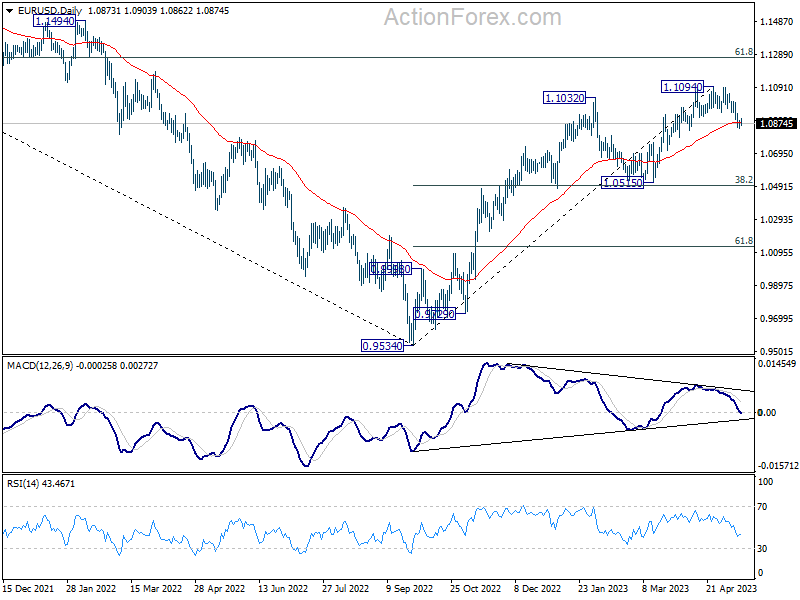
Intraday bias in EUR/USD is turned neutral first as consolidation from 1.0844 temporary low is extending. Further decline is expected as long as 1.0941 resistance holds. Fall from 1.1094 short term top is seen as correcting whole up trend from 0.9534. Below 1.0844 will target 1.0515 cluster support, 38.2% retracement of 0.9534 to 1.1094 at 1.0498. On the upside, though, above 1.0941 resistance will turn bias back to the upside for retesting 1.1094 high.
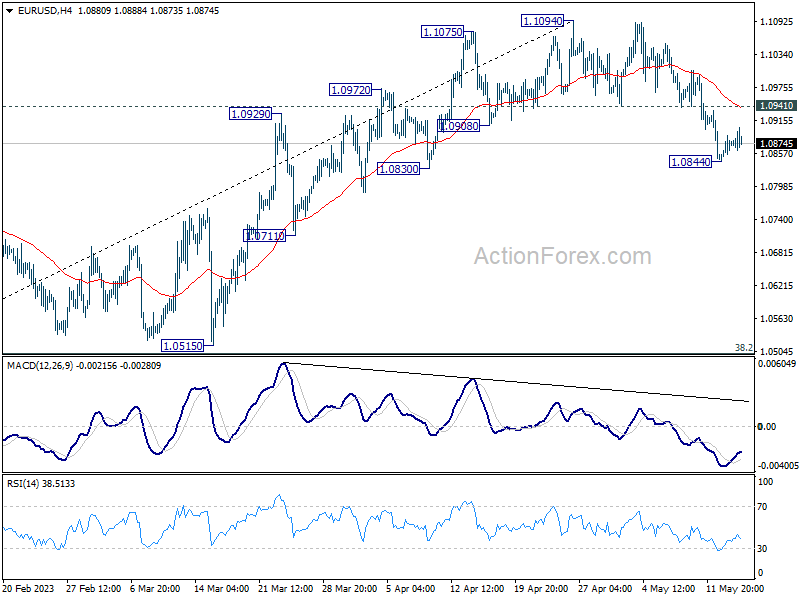
In the bigger picture, as long as 1.0515 support holds, rise from 0.9534 (2022 low) would still extend higher. Sustained break of 61.8% retracement of 1.2348 (2021 high) to 0.9534 at 1.1273 will solidify the case of bullish trend reversal and target 1.2348 resistance next (2021 high).
GBP/USD Mid-Day Outlook
Daily Pivots: (S1) 1.2470; (P) 1.2503; (R1) 1.2560; More...
Intraday bias in GBP/USD stays neutral as range trading continues. On the downside, firm break of 1.2434 will confirm short term topping at 1.2678, on bearish divergence condition in 4H MACD. Intraday bias will be back on the downside for 1.1801 cluster support (38.2% retracement of 1.0351 to 1.2678 at 1.1789), as correction to whole up trend from 1.0351. On the upside, however, break of 1.2678 will resume larger up trend from 1.0351 instead.
In the bigger picture, as long as 1.1801 support holds, rise from 1.0351 medium term bottom (2022 low) is expected to extend further. Sustained break of 61.8% retracement of 1.4248 (2021 high) to 1.0351 at 1.2759 will add to the case of long term bullish trend reversal. However, firm break of 1.1801 will indicate rejection by 1.2759, and bring deeper decline, even as a correction.
USD/CHF Mid-Day Outlook
Daily Pivots: (S1) 0.8937; (P) 0.8962; (R1) 0.8982; More...
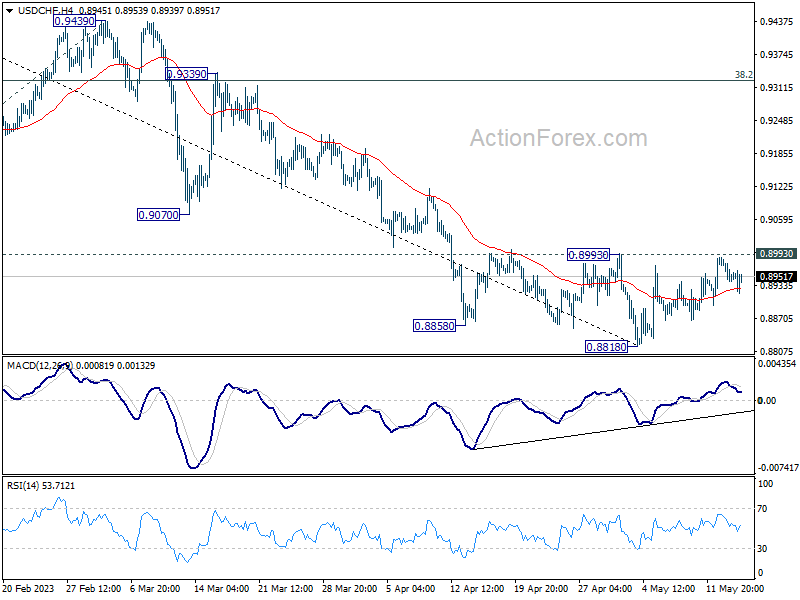
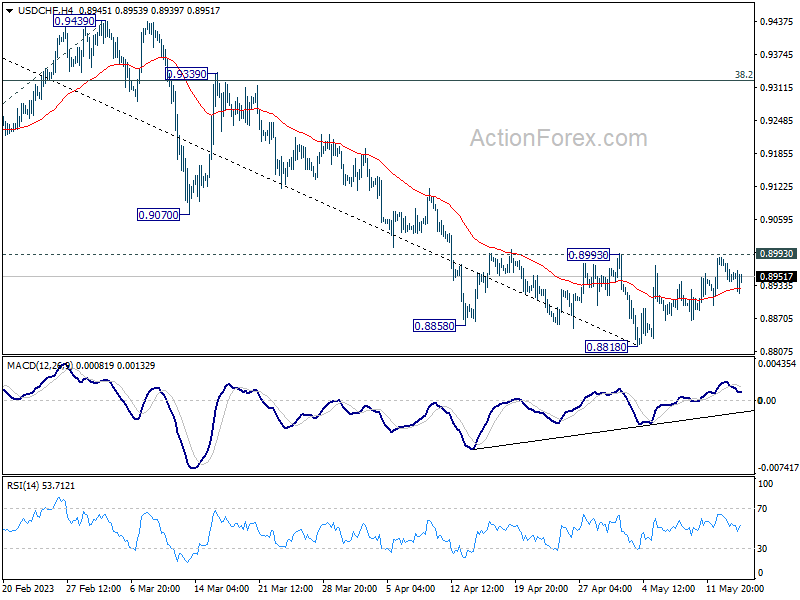
Intraday bias in USD/CHF remains neutral for the moment and outlook is unchanged. On the upside, decisive break of 0.8993 resistance will confirm short term bottoming at 0.8818, on bullish convergence condition in 4H MACD. Intraday bias will be turned back to the upside for 55 D EMA (now at 0.9040) and possibly above. In case of another fall, strong support should be seen from 61.8% projection of 1.0146 to 0.9058 from 0.9439 at 0.8767, which is close to 0.8756 long term support, to bring rebound.
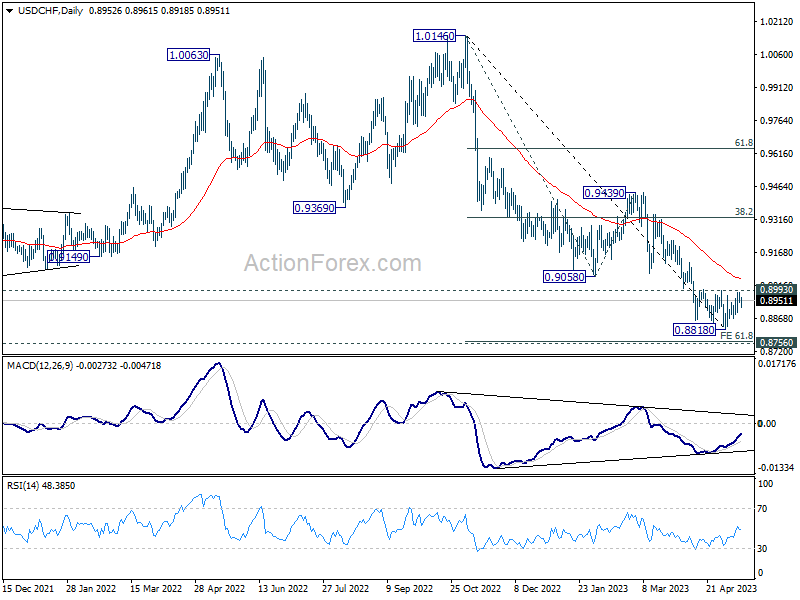
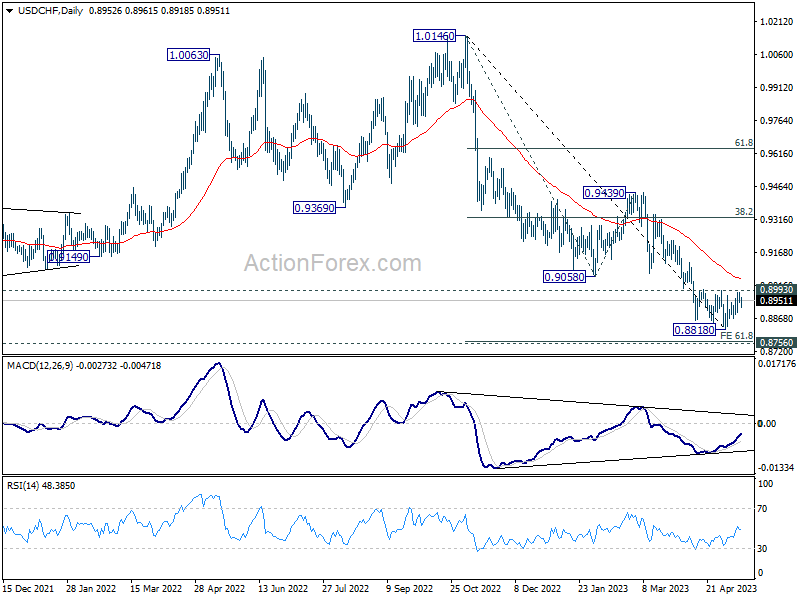
In the bigger picture, fall from 1.1046 (2022 high) is seen as a leg in the long term range pattern from 1.0342 (2016 high). So, downside should be contained by 0.8756 to bring reversal. Sustained break of 0.9058 support turned resistance will be the first sign of medium term bottoming. However, decisive break of 0.8756 will carry larger bearish implications.
USD/JPY Mid-Day Outlook
Daily Pivots: (S1) 135.73; (P) 136.02; (R1) 136.40; More...
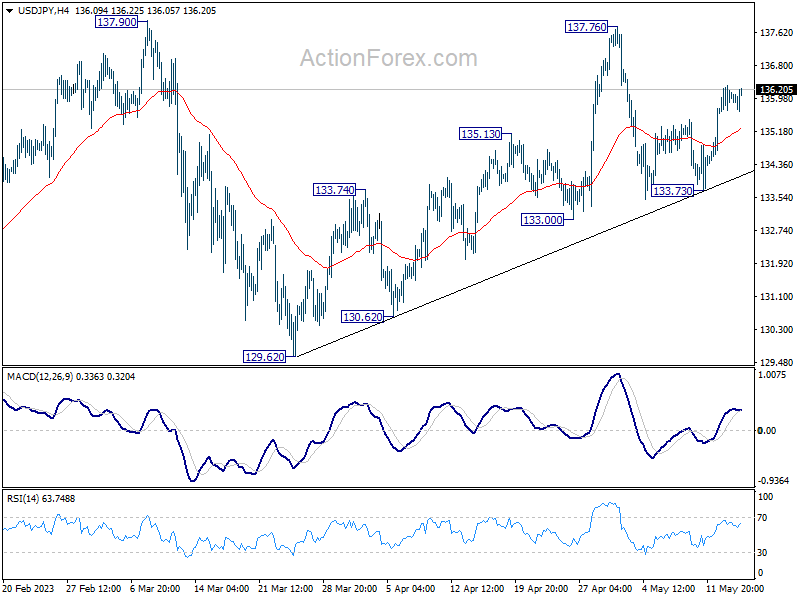
No change in USD/JPY's outlook as rise from 133.73 is still in progress. Intraday bias stays on the upside for 137.76/90 resistance zone. Decisive break there will resume whole rebound from 127.20. On the downside, break of 133.73 will resume the fall from 137.76 through 133.00 instead.
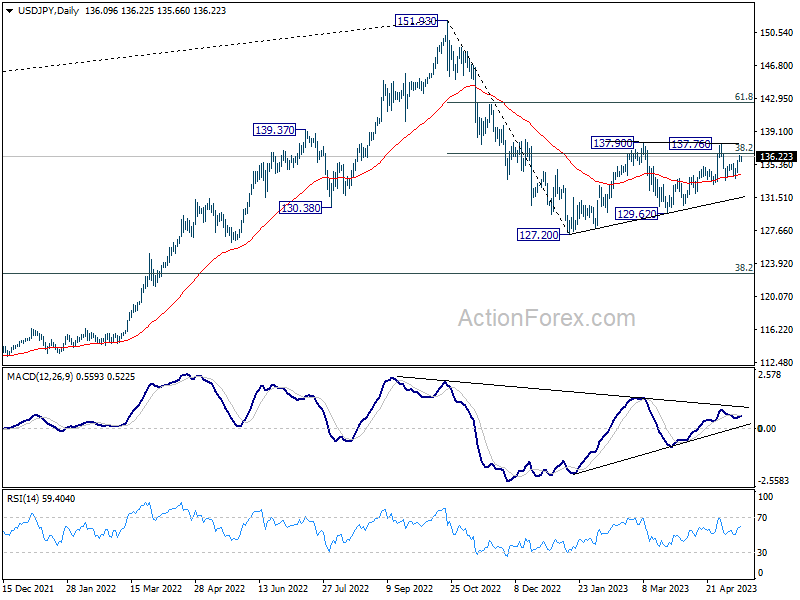
In the bigger picture, price actions from 151.93 high are currently seen as a corrective pattern to the long term up trend. The first leg should have completed at 127.20. Rebound from there is seen as the second leg. Sustained break of 38.2% retracement of 151.93 to 127.20 at 136.34 will bring stronger rise to 61.8% retracement at 142.48. Meanwhile, break of 129.62 will argue that the third leg is starting through 127.20 low.
Canadian Dollar Rises on Unexpected Inflation Uptick; Australian Dollar Continues to Struggle
Canadian Dollar is enjoying a broad rally in early US trading session, fueled by data that revealed unexpected reacceleration in Canadian consumer inflation for April. The evidence for BoC to resume tightening measures is steadily accumulating. Amid slight risk-off sentiment in US markets, due to persistent uncertainties over debt ceiling negotiations, Swiss Franc and Japanese Yen are also seeing gains.
On the other hand, Australian Dollar remains the day's weakest performer, hamstrung by a sharp drop in consumer sentiment and a string of disappointing data from China. Hot on its heels is British Pound, which is feeling the pinch from poor employment data that underlines the economy's rapidly slowing momentum. Both Euro and Dollar are exhibiting mixed performances, although the greenback seems to have a minor advantage in extending its near-term rebound.
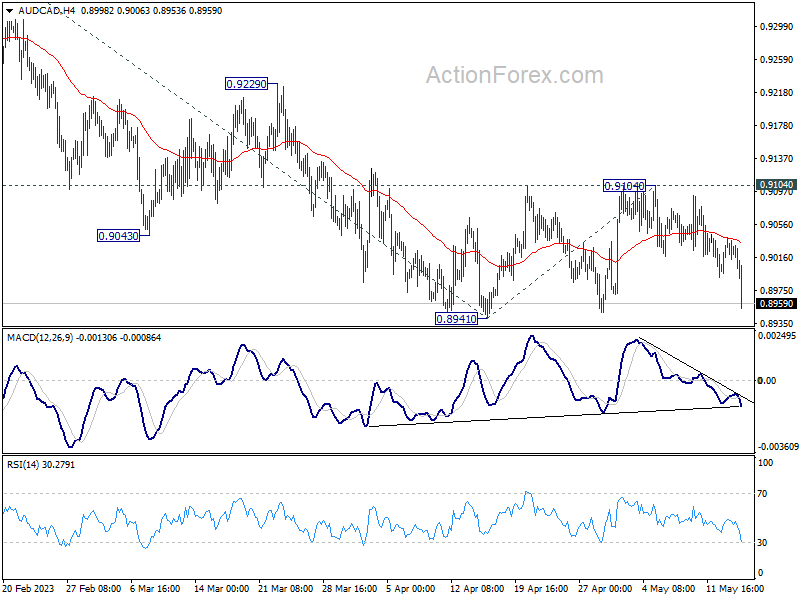
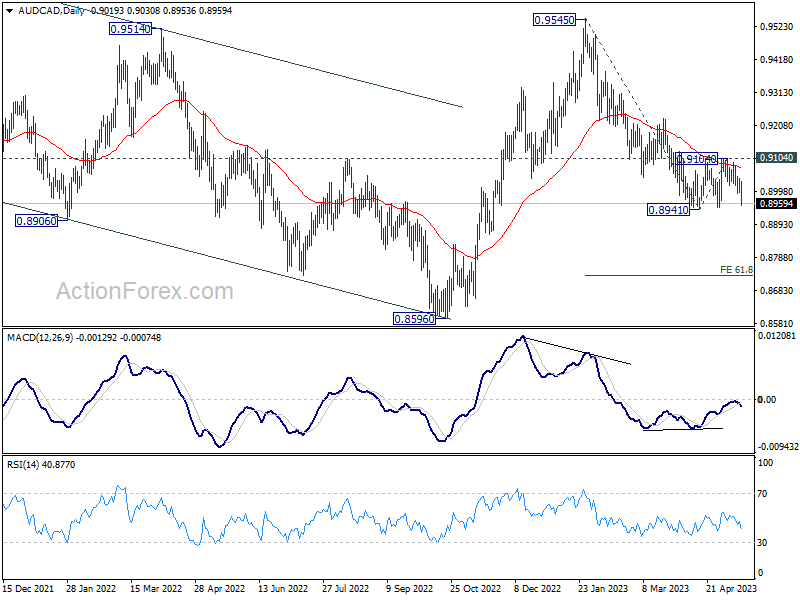
From a technical perspective, AUD/CAD appears finally ready to resume its downtrend from 0.9545. Immediate attention is now on 0.8941 low, and decisive break of this level would see fall from 0.9545 resume to 61.8% projection of 0.9545 to 0.8941 from 0.9104 at 0.8731. Regardless, outlook will remain bearish as long as the 0.9104 resistance holds, even in the event of a recovery.
In Europe, at the time of writing, FTSE is up 0.05%. DAX is up 0.15%. CAC is up 0.02%. Germany 10-year yield is up 0.0002 at 2.313. Earlier in Asia, Nikkei rose 0.73%. Hong Kong HSI rose 0.04%. China Shanghai SSE dropped -0.60%. Singapore Strait Times dropped -0.02%. Japan 10-year JGB yield dropped -0.0123 to 0.396.
Canada CPI rose to 4.4% yoy in Apr, first acceleration since June 2022
Canada CPI rose 0.7% mom in April, above expectation of 0.5% mom. Prices for gasoline (+6.3%) contributed the most to the headline month-over-month movement. Excluding gasoline, the monthly CPI rose 0.5%.
Over the 12-month period, CPI accelerated from 4.3% yoy to 4.4% yoy, above expectation of 4.1% yoy. That's the first acceleration in headline CPI since June 2022. Statistics Canada said that higher rent prices and mortgage interest costs contributed the most to the all-items CPI increase.
CPI median slowed from 4.5% yoy to 4.2% yoy, below expectation of 4.3% yoy. CPI trimmed dropped from 4.4% yoy to 4.2% yoy, above expectation of 4.1% yoy. CPI common slowed from 6.0% yoy to 5.7% yoy, above expectation of 5.5% yoy.
US retail sales up 0.4% mom in Apr, ex-auto sales up 0.4% mom
US retail sales rose 0.4% mom in USD 686.1B in April, below expectation of 0.8% mom. Ex-auto sales rose 0.4% mom to USD 556.1B, below expectation of 0.5% mom. Ex-gasoline sales rose 0.5% mom to USD 631.4B. Ex-auto, gasoline sales rose 0.6% mom to USD 501.4B. Total sales for the February through April period were up 3.1% yoy.
Germany ZEW dived to -10.7, economy could slip into recession
Germany ZEW Economic Sentiment recorded in significantly decline from 4.1 to -10.7 in May, even worse than expectation of -5.0%. Current Situation Index dropped from -32.5 to -34.8.
Eurozone ZEW Economic Sentiment fell form 6.4 to -9.4. Current Situation Index rose 2.7 pts to -27.5.
ZEW President Professor Achim Wambach said:
"The ZEW Indicator of Economic Sentiment has once again fallen sharply. The financial market experts anticipate a worsening of the already unfavourable economic situation in the next six months. As a result, the German economy could slip into a recession, albeit a mild one.
"The sentiment indicator decline is partly due to expectations of further interest rate hikes by the ECB. Additionally, the potential default by the United States in the coming weeks adds uncertainty to global economic prospects".
Eurozone imports fell -10% yoy in Mar, exports rose 7.5% yoy
Eurozone goods exports to the rest of the world rose 7.5% yoy to EUR 269.2B in March. Imports fell -10.0% yoy to EUR 243.5B. Trade surplus came in at EUR 25.6B. Intra-Eurozone trade rose 0.6% yoy to EUR 246.4B.
In seasonally adjusted term, goods exports dropped -0.1% mom to EUR 243.3B. Imports dropped -7.1% mom to EUR 226.2B. Trade balanced turned into EUR 17.0B surplus, above expectation of EUR 5.6B. Intra-Eurozone trade dropped from EUR 230.9B to EUR 223.2B.
UK payrolled employees dropped -136k in Apr, unemployment rate rose to 3.9% in Mar
UK payrolled employees dropped -0.5% mom, or -136k in April, comparing with March. That is the first decline in total payrolled employees since the COVID pandemic. Comparing with April 2022, payrolled employees rose 1.0% yoy or 297k. Claimant counts rose 46.7k, above expectation of 31.2k. Median monthly pay rose 7.4% yoy.
In the three months to March, unemployment rate rose 0.1% to 3.9%, comparing to the previous quarter. Employment rate rose 0.2% to 75.9%. Average earnings including bonus rose 5.8% 3moy. Average earnings excluding bonus rose 6.7% 3moy.
RBA Minutes: Further hikes may still be required
Minutes of RBA's May meeting revealed a detailed discussion where Board members weighed the pros and cons of keeping cash rate unchanged or increasing it by 25 basis points. Despite the fine balance of arguments, the Board saw it fit to raise the interest rates by 25bps to 3.85%, due to upside risks in inflation and tight labour market.
Data available in the month leading up to the meeting confirmed significant inflationary pressures and highlighted upside risks to the inflation outlook. The Board was concerned that if these risks materialised, it would "further delay the return of inflation to target levels" and potentially trigger a "damaging shift in inflation expectations".
While acknowledging considerable uncertainties surrounding the economic outlook, particularly with respect to household consumption, the Board's strong commitment to price stability and the necessity of anchoring inflation expectations tipped the scales in favour of a rate hike.
Looking forward, the Board indicated that "further increases in interest rates may still be required", depending on the evolution of the economy and inflation.
Australian consumer sentiment plunges in May following unexpected RBA rate hike
Australia Westpac Consumer Sentiment Index dropping sharpy by -7.9% from 85.8 to 79.0 in May. This decline brings the index close to the grim levels observed in March, which were the lowest since COVID-19 outbreak in 2020 and, prior to that, since the severe recession of early 1990s.
The unexpected decision by RBA to raise the cash rate by an additional 0.25% in May, as well as the Federal Budget, were cited by Westpac as the two main factors impacting consumer sentiment over the last month.
Westpac stated, "Interest rates were again a key driver of the May survey. The RBA raised the official cash rate by a further 0.25% at its May meeting in the week before the survey. The move came as a major surprise to markets and most commentators, clearly stoking consumer fears of more increases to come."
Looking ahead, Westpac predicts that RBA will likely pause in June, awaiting further data on inflation and the state of the economy. While the bank's central view anticipates the current cash rate will remain at its peak due to economic weakness and clear progress toward the Board's inflation target, it acknowledges that the risks are still "evenly balanced".
China's industrial production, retail sales miss expectations; youth unemployment hits record high
China's industrial production growth fell short of expectations in April, with a year-on-year increase of 5.6% yoy, significantly under expectation of 10.1% growth. Despite missing the mark, the growth rate outpaced March's 3.9% yoy rise and marked the fastest expansion since September 2022.
Retail sales also grew less than expected, posting 18.4% yoy rise, which fell short of anticipated 20.1% yoy growth. The figure was largely inflated due to a low comparison base, as retail sales plummeted by -11.1% yoy in April of the previous year due to severe lockdowns. On a monthly basis, retail sales contracted by -7.8% mom from March.
Fixed asset investment growth also came in below expectations 4.7% ytd yoy growth, underperforming expectation of 5.2%.
Urban jobless rate ticked down from 5.3% to 5.2%. However, unemployment among 16-24 age group spiked to a record high of 20.4%, up from 19.6% in the previous month. This exceeded the previous record of 19.9% set in July 2022.
The National Bureau of Statistics (NBS) stated, "In general, in April, the national economy continued to recover, and positive factors accumulated and increased. But we must also see that the international environment is still complex and severe, domestic demand is still insufficient, and the endogenous driving force for economic recovery is not yet strong."
USD/CAD Mid-Day Outlook
Daily Pivots: (S1) 1.3504; (P) 1.3534; (R1) 1.3589; More....
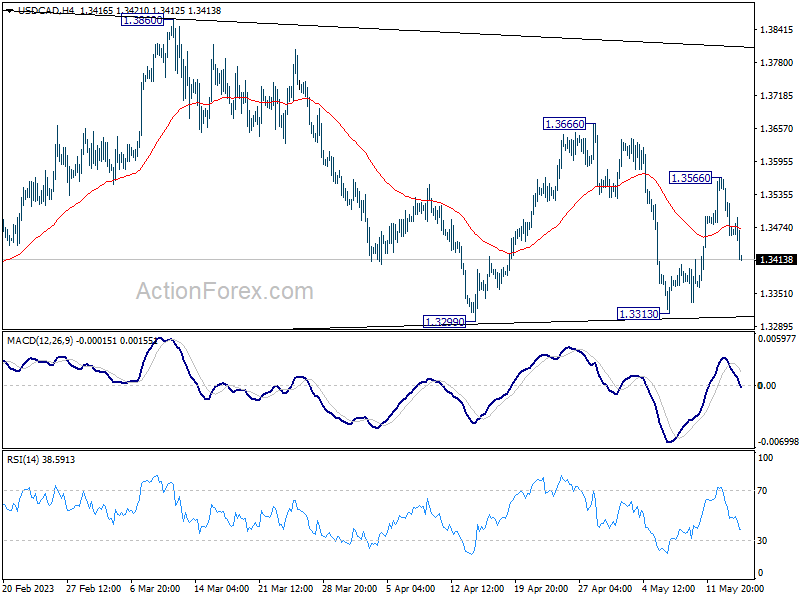
USD/CAD's fall from 1.3566 extends lower today but stays well above 1.3313 support. Intraday bias remains neutral first. Overall, it's seen as extending the triangle consolidation pattern from 1.3976. Above 1.3566 will resume the rebound towards 1.3666 resistance and then 1.3860. However, firm break of 1.3313 support will invalidate this view and indicate that deeper correction is underway.
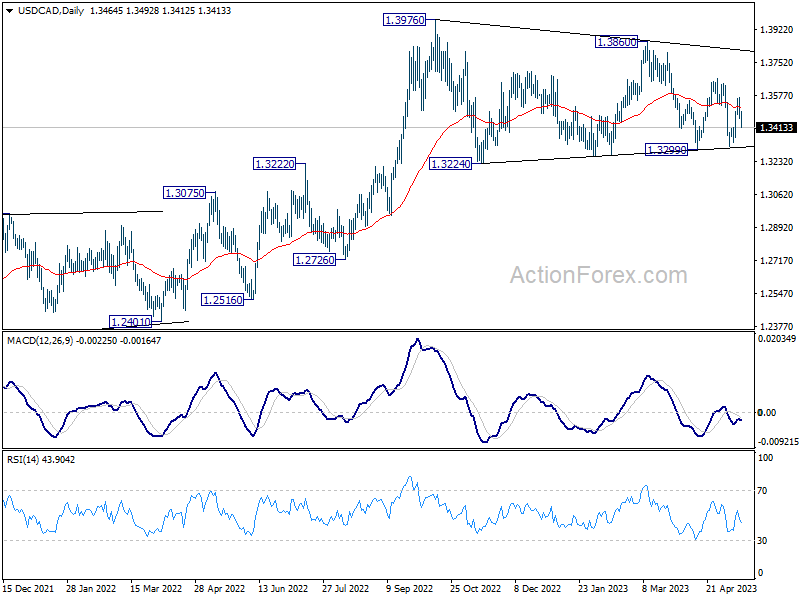
In the bigger picture, as long as 55 W EMA (now at 1.3321) holds, up trend from 1.2005 (2021 low) is still in favor to resume through 1.3976 at a later stage. However, sustained trading below the EMA and 38.2% retracement of 1.2005 to 1.3976 at 1.3233 will raise the chance of bearish reversal. Deeper should then be seen to 61.8% retracement at 1.2758 next.
Economic Indicators Update
| GMT | Ccy | Events | Actual | Forecast | Previous | Revised |
|---|---|---|---|---|---|---|
| 01:30 | AUD | RBA Meeting Minutes | ||||
| 02:00 | CNY | Industrial Production Y/Y Apr | 5.60% | 10.10% | 3.90% | |
| 02:00 | CNY | Fixed Asset Investment YTD Y/Y Apr | 4.70% | 5.20% | 5.10% | |
| 02:00 | CNY | Retail Sales Y/Y Apr | 18.40% | 20.10% | 10.60% | |
| 06:00 | GBP | Claimant Count Change Apr | 46.7K | 31.2K | 28.2K | |
| 06:00 | GBP | ILO Unemployment Rate (3M) Mar | 3.90% | 3.80% | 3.80% | |
| 06:00 | GBP | Average Earnings Including Bonus 3M/Y Mar | 5.80% | 5.10% | 5.90% | |
| 06:00 | GBP | Average Earnings Excluding Bonus 3M/Y Mar | 6.70% | 6.80% | 6.60% | |
| 09:00 | EUR | Eurozone Trade Balance (EUR) Mar | 17.0B | 5.6B | -0.1B | |
| 09:00 | EUR | Eurozone GDP Q/Q Q1 P | 0.10% | 0.10% | 0.10% | |
| 09:00 | EUR | Germany ZEW Economic Sentiment May | -10.7 | -5 | 4.1 | |
| 09:00 | EUR | Germany ZEW Current Situation May | -34.8 | -35.3 | -32.5 | |
| 09:00 | EUR | Eurozone ZEW Economic Sentiment May | -9.4 | 2.3 | 6.4 | |
| 09:00 | EUR | Eurozone Employment Change Q/Q Q1 P | 0.60% | 0.30% | 0.30% | |
| 12:30 | CAD | Manufacturing Sales M/M Mar | 0.70% | 0.70% | -3.60% | |
| 12:30 | CAD | CPI M/M Apr | 0.70% | 0.50% | 0.50% | |
| 12:30 | CAD | CPI Y/Y Apr | 4.40% | 4.10% | 4.30% | |
| 12:30 | CAD | CPI Median Y/Y Apr | 4.20% | 4.30% | 4.60% | 4.50% |
| 12:30 | CAD | CPI Trimmed Y/Y Apr | 4.20% | 4.10% | 4.40% | |
| 12:30 | CAD | CPI Common Y/Y Apr | 5.70% | 5.50% | 5.90% | 6.00% |
| 12:30 | USD | Retail Sales M/M Apr | 0.40% | 0.80% | -0.60% | -0.70% |
| 12:30 | USD | Retail Sales ex Autos M/M Apr | 0.40% | 0.50% | -0.40% | -0.50% |
| 13:15 | USD | Industrial Production M/M Apr | 0.00% | 0.40% | ||
| 13:15 | USD | Capacity Utilization Apr | 79.70% | 79.80% | ||
| 14:00 | USD | Business Inventories Mar | 0.10% | 0.20% | ||
| 14:00 | USD | NAHB Housing Market Index May | 45 | 45 |