Sample Category Title
Sunset Market Commentary
Markets
After a brief rebound yesterday, yields again turned south today. Growth and inflation data published in several EMU member states understandably painted somewhat of a diffuse picture. Growth rebounded more than expected in Spain (0.5% Q/Q, 3.8% Y/Y), Italy (0.5% Q/Q, 1.8% Y/Y) and Portugal (1.6% Q/Q and 2.5% Y/Y). French growth printed as expected (0.2% Q/Q, 0.8% Y/Y). Germany (0.0% Q/Q and -0.2% Y/Y WDA) and Austria (-0.3% Q/Q) disappointed. In the end, EMU growth only reached 0.1% Q/Q and 1.3% Y/Y vs 0.2% Q/Q expected. Aside from a slightly disappointing growth performance, markets were even more focused on members states’ inflation data. Spanish HICP inflation reaccelerated (0.6% M/M and 4.1% Y/Y from 3.3%). Still the rise was less than expected and core inflation eased from 7.5% to 6.6%. French HICP inflation printed marginally stronger than expected at 0.7%M/M and 6.9%. German inflation slowed more than anticipated (HICP 0.6% M/M and 7.6% Y/Y). The monthly rise in most countries still suggests that the inflationary dynamics is far from eradicated. However, markets concluded that today’s data might help tilt the debate at next week’s ECB meeting more towards a 25 rather than a 50 bps hike. The final word in this debate is for the EMU (core) CPI estimate and the Euro Area bank lending survey, both scheduled for release next Tuesday. Still German yields after the morning data ease up to 10+ bps across the curve. US data, brought no big surprise. The US Q1 Employment cost index rose 1.2%, slightly more than expected. March spending and income data, annex the March core inflation deflator (0.3% M/M 4.6% Y/Y) were too close to expectations to change the bond friendly market sentiment. US yields currently are ceding between 2 bp (2-y) and 7 bps (10 & 30-y). Bunds outperform with yields declining between 10.5 bps (5- 10-y) and 8.5 bps (30-y). Markets now only see chances of about 10-15% for a 50 bps ECB rate hike next week. We think that this is quite a ‘minimalistic’ assessment. The combination of the EMU avoiding a recession and the easing yields this time didn’t help European equites, even after strong WS gains yesterday evening, as a negative guidance from Amazon (amongst others) dented sentiment. The Eurostoxx 50 is ceding about 0.5%. US indices opened marginally lower (0.1-0.3% lower). Oil stabilize/gains marginally after steep decline earlier this week ($ 79.2 p/b).
A sharp decline in European yields, persistent uncertainty on future (global) growth and a risk-off sentiment, initially looked as turning out USD positive. DXY tried to break out of a downtrend channel, but a part of the initial gains evaporated as the US session evolves (currently 101.85 from 101.50 area). EUR/USD slipped temporarily below the 1.10 but returned to the big figure level. Cycle/commodity related currencies (EUR/NOK 1.1078 (also cf infra), AUD 0.658, USD/CAD 1.364) mostly trade in the defensive. The yen is losing heavily as market don’t expect a BOJ policy change anytime soon after the first policy meeting under new BOJ governor Ueda. USD/JPY jumped two big figures, north of 136(05). EUR/JPY (149.60) nears the end 2014 top (149.78). Sterling trades marginally stronger against the dollar (1.25) and outperforms the euro with EUR/GBP extensively testing the 0.88 handle.
News & Views
The Norwegian central bank said that it will purchase FX on behalf of the government equivalent to NOK 1400 mn per day in May 2023. That’s down from 1500mn/day in April and the lowest amount of monthly FX purchases since March 2022. However, from 2014 until early 2022, the Norges Bank was a net seller of FX/buyer of NOK. Investors hoped that the amount of FX purchases would fall faster with EUR/NOK spiking from 11.70 to nearly 11.85 on the release. It’s the weakest NOK-level since the height of pandemic early 2020. The krone is the worst performing G10 currency against both the euro and the dollar YTD. The Norges Bank FX transactions are conducted as the Norwegian government receives revenues from petroleum activities in both NOK and FX. Part is used to finance the budget deficit and part is saved in FX in the Government Pension Fund Global.
USD/JPY Mid-Day Outlook
Daily Pivots: (S1) 133.42; (P) 133.81; (R1) 134.38; More...
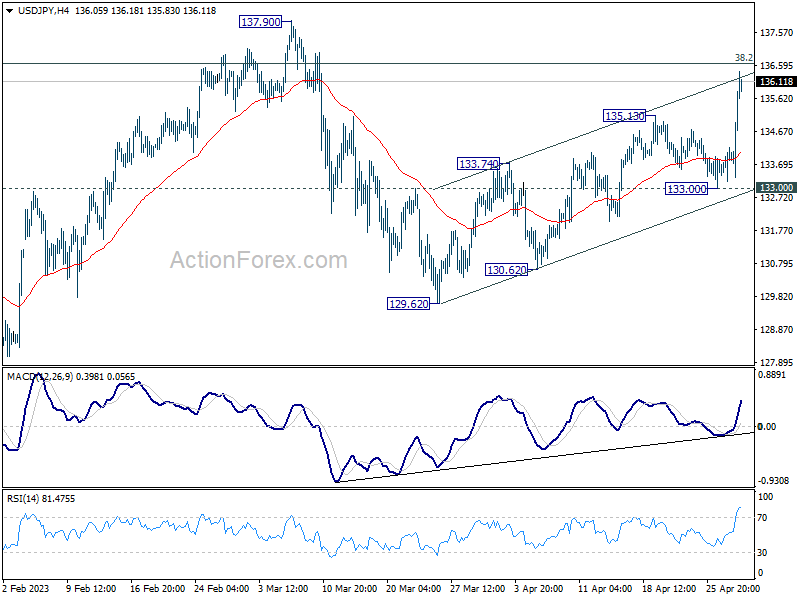
Intraday bias in USD/JPY remains on the upside for the moment. Decisive break of channel resistance, (now at 136.26). will raise the chance of resumption of whole rise from 127.20, and target 137.90 resistance and above. For now, further rally will remain in favor as long as 133.00 support holds, in case of retreat.
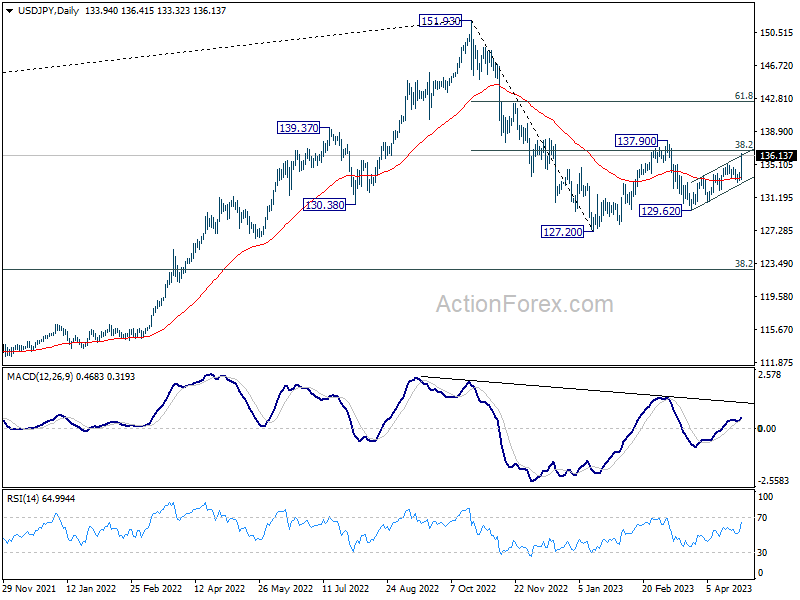
In the bigger picture, price actions from 151.93 high are currently seen as a corrective pattern to the long term up trend. The first leg should have completed at 127.20. Rebound from there is seen as the second leg. Sustained break of 31.8% retracement of 151.93 to 127.20 at 136.34 will bring stronger rebound to 142.48. Meanwhile, break of 129.62 will argue that the third leg is starting to 61.8% projection of 151.93 to 127.20 from 137.90 at 122.61.
USD/CHF Mid-Day Outlook
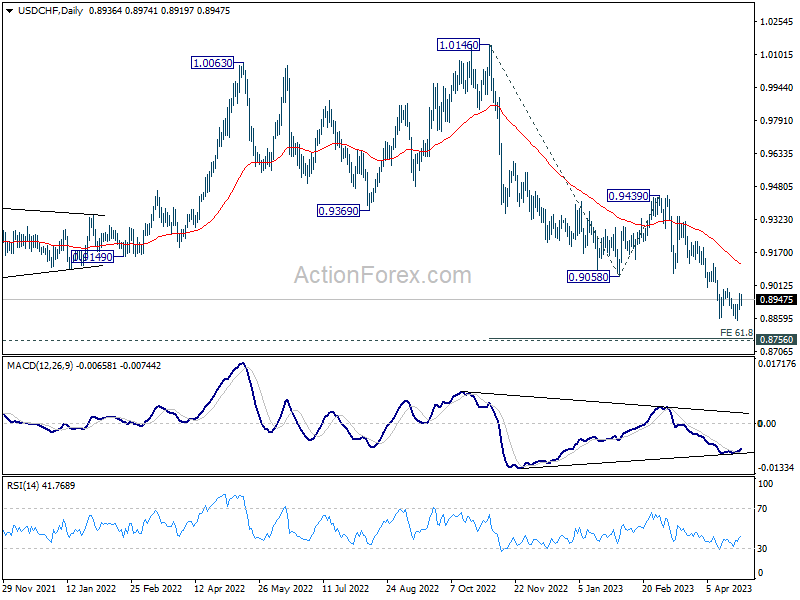
Daily Pivots: (S1) 0.8905; (P) 0.8941; (R1) 0.8978; More...
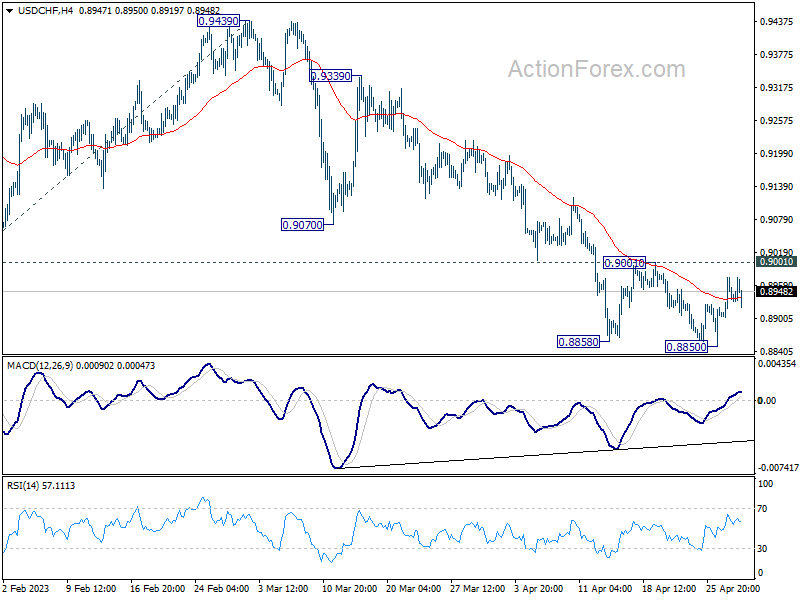
USD/CHF is still bounded in range of 0.8850/9001 and intraday bias stays neutral. On the upside, decisive break of 0.9001 resistance should confirm short term bottoming at 0.8850. Intraday bias will be back on the upside 55 D EMA (now at 0.9120). Sustained break there will be a strong sign of bullish reversal. On the downside, break of 0.8850 will resume larger fall from 1.0146, to 61.8% projection of 1.0146 to 0.9058 from 0.9439 at 0.8767, which is close to 0.8756 long term support. Strong support is expected there to bring rebound, at least on first attempt.
In the bigger picture, fall from 1.1046 (2022 high) is in progress for 0.8756 support (2021 low). But overall, this fall is still seen as a leg in the long term range pattern from 1.0342 (2016 high). So, downside should be contained by 0.8756 to bring reversal. Sustained break of 0.9058 support turned resistance will be the first sign of medium term bottoming. However, decisive break of 0.8756 will carry larger bearish implications.
EUR/USD Mid-Day Outlook
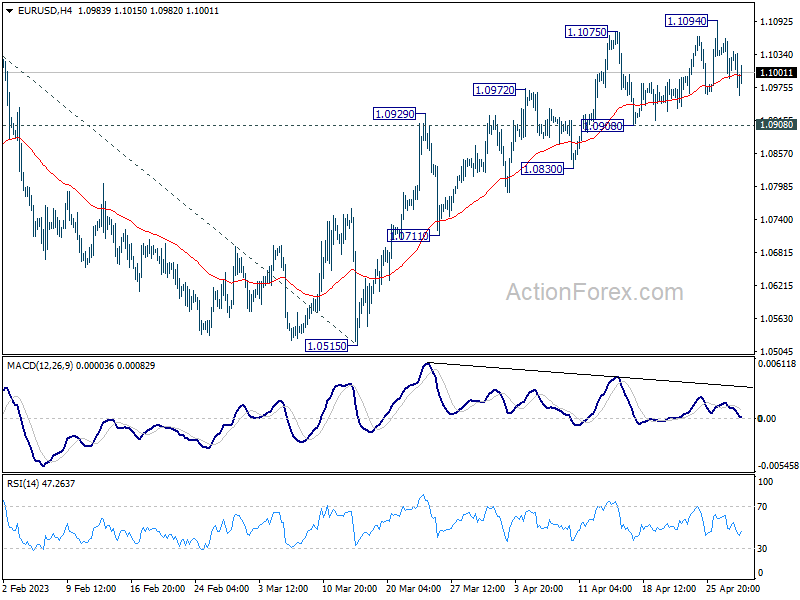
Daily Pivots: (S1) 1.0993; (P) 1.1028; (R1) 1.1064; More...
Intraday bias in EUR/USD remains neutral for consolidation below 1.1094. But further rally is expected as long as 1.0908 support holds. Break of 1.1094 will resume larger up trend to 1.1273 fibonacci level. Break there will target 61.8% projection of 0.9534 to 1.1032 from 1.0515 at 1.1441.
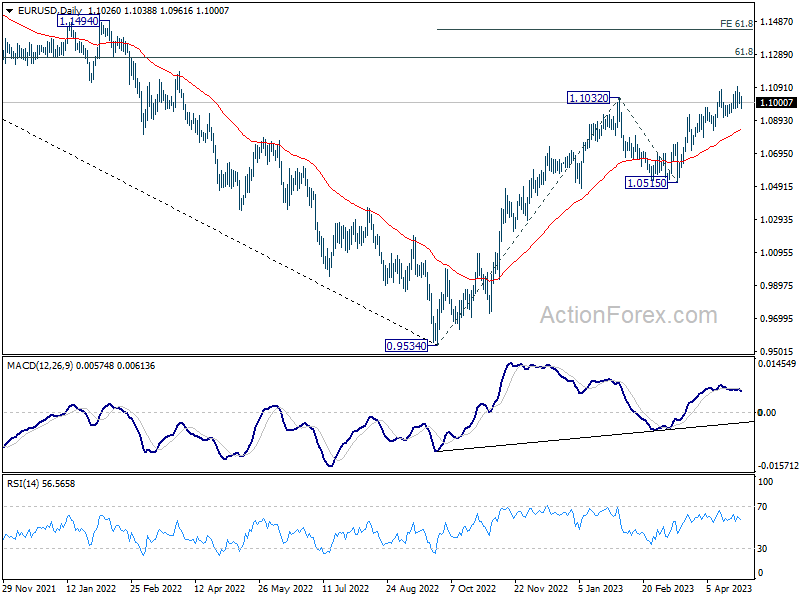
In the bigger picture, rise from 0.9534 (2022 low) is in progress for 61.8% retracement of 1.2348 (2021 high) to 0.9534 at 1.1273. Sustained break there will solidify the case of bullish trend reversal and target 1.2348 resistance next (2021 high). This will now remain the favored case as long as 1.0515 support holds, even in case of deeper pull back.
GBP/USD Mid-Day Outlook
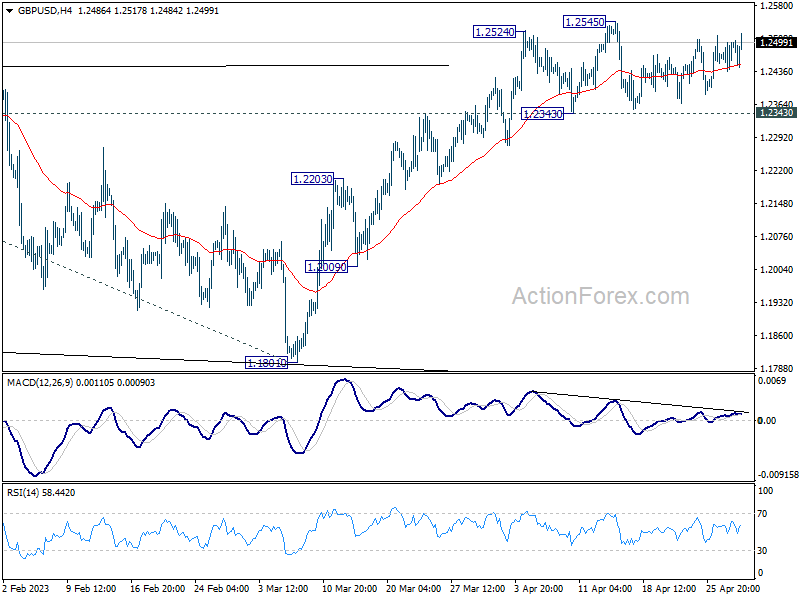
Daily Pivots: (S1) 1.2456; (P) 1.2479; (R1) 1.2520; More...
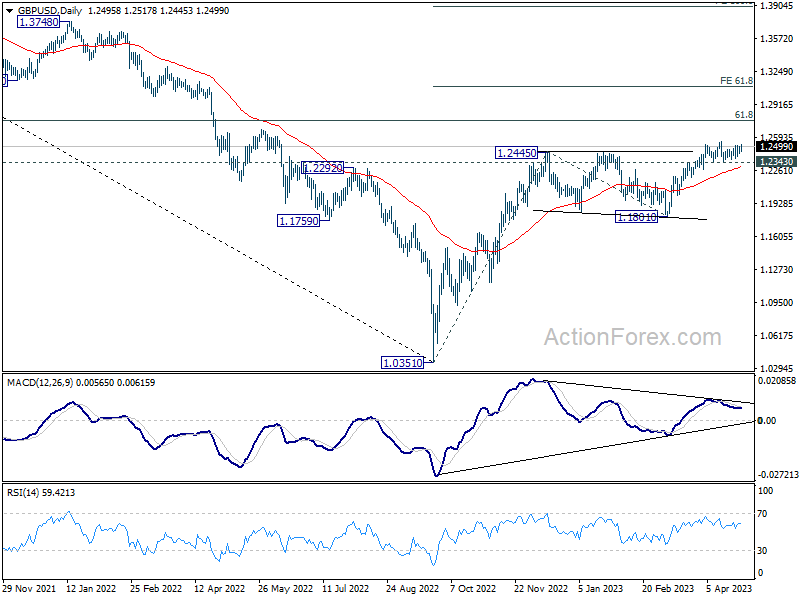
GBP/USD extends the near term choppy recovery but stays below 1.2545 resistance. Intraday bias remains neutral at this point. Outlook remains bullish with 1.2343 support intact. On the upside, above 1.2545 will target 1.2759 fibonacci level first. Firm break there will target 61.8% projection of 1.0351 to 1.2445 from 1.1801 at 1.3095. However, considering bearish divergence condition in 4H MACD, firm break of 1.2343 will confirm short term topping, and turn bias back to the downside for deeper pullback.
In the bigger picture, the rise from 1.0351 medium term term bottom (2022 low) is in progress for 61.8% retracement of 1.4248 (2021 high) to 1.0351 at 1.2759. Sustained break there will add to the case of long term bullish trend reversal. Further break of 61.8% projection of 1.0351 to 1.2445 from 1.1801 at 1.3095 could prompt upside acceleration to 100% projection at 1.3895. For now, this will remain the favored case as long as 1.1801 support holds, even in case of deep pull back.
Dollar Weakens Against Europeans Following Inflation Data, Yen Continues Post-BoJ Selloff
Dollar is facing renewed pressure against European majors in early US trading sessions due to faster-than-expected declines in headline inflation. However, it continues to hold strong against Japanese Yen, which remains the worst performer for both the day and the week. Yen is continuing the post-BoJ selloff, with no signs of stopping as of yet. Euro is weaker compared to British Pound the Swiss Franc after mixed GDP data, while the Australian and Canadian dollars are not faring much better.
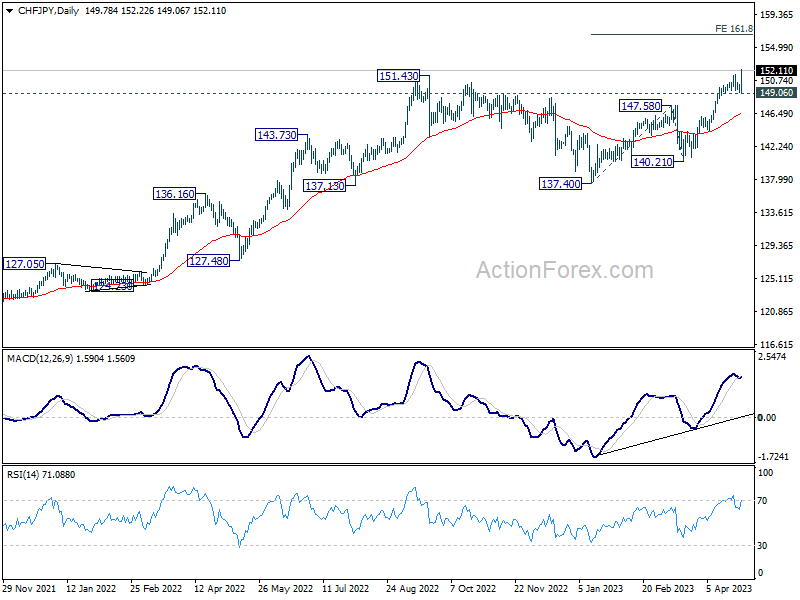
On the technical side, CHF/JPY broke through 151.43 high convincingly today, a resumption of the long-term uptrend. Near-term outlook will remain bullish as long as 149.06 support level holds. The cross could now enter acceleration phase, targeting 161.8% projection of 137.40 to 147.58 from 140.21 at 156.68.
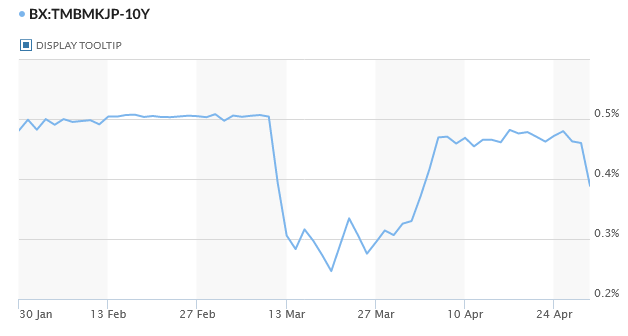
In Europe at the time of writing, FTSE is up 0.13%. DAX is up 0.20%. CAC is down -0.42%. Germany 10-year yield is down -0.1117 at 2.350. Earlier in Asia, Nikkei surged 1.40%. Hong Kong HSI rose 0.27%. China Shanghai SSE rose 1.14%. Singapore Strait Times dropped -0.35%. Japan 10-year JGB yield tumbled sharply by -0.0713 to 0.389.
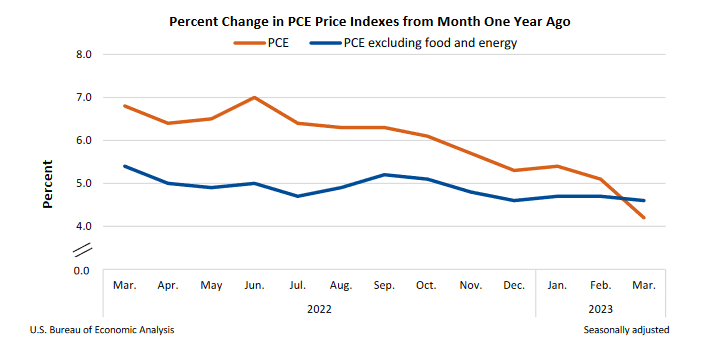
US PCE inflation slowed to 4.2% yoy, core PCE slightly down to 4.6% yoy
US personal income rose 0.3% mom or USD 67.9B in March, above expectation of 0.2% mom. The increase in income primarily reflected increases in compensation, personal income receipts on assets, and rental income of persons that were partly offset by decreases in proprietors' income and personal current transfer receipts
Personal spending rose less than 0.1% mom or USD 8.2B, better than expectation of -0.1% mom contraction. The increase reflected a USD 44.9 billion increase in spending for services that was partly offset by a USD 36.7 billion decrease in spending for goods
For the month PCE price index increased 0.1% mom. Excluding food and energy, PCE price index increased 0.3% mom. Prices for goods decreased -0.2% mom and prices for services increased 0.2%. Food prices decreased -0.2% and energy prices decreased -3.7% mom.
From the same month one year ago, PCE price index March slowed from 5.1% yoy to 4.2% yoy, below expectation of 4.6% yoy. Excluding food and energy, PCE price index ticked down from 4.7% yoy to 4.6% yoy, above expectation of 4.6% yoy. Prices for goods increased 1.6 yoy and prices for services increased 5.5% yoy. Food prices increased 8.0% yoy and energy prices decreased 9.8% yoy.
Canada GDP grew 0.1% mom in Feb, but down -0.1% in Mar
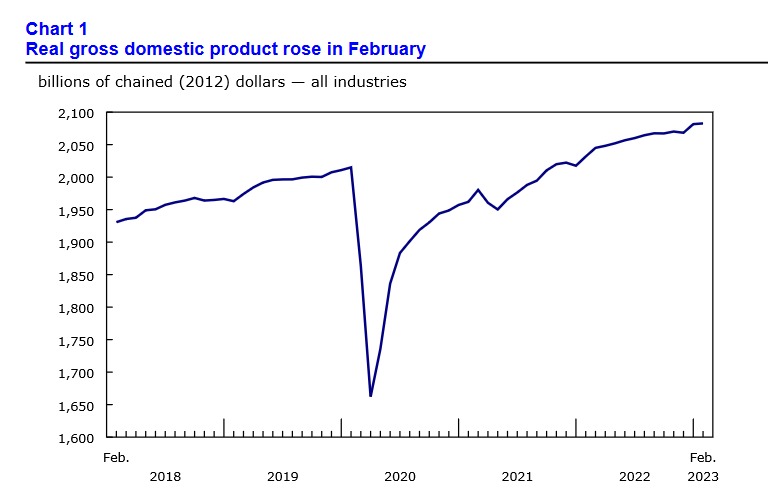
Canada GDP grew 0.1% mom in February, below expectation of 0.2% mom. Both services-producing industries and goods-producing industries edged up 0.1%. Overall, 12 of 20 subsectors increased.
Advance information indicates that real GDP edged down -0.1% in March. This advance information indicates a 0.6% increase in real GDP by industry in the first quarter of 2023.
Eurozone GDP rose 0.1% qoq in Q1, EU up 0.3 qoq
Eurozone GDP grew 0.1% qoq in Q1, matched expectations. EU GDP rose 0.3% qoq. Germany GDP stalled in Q1 (price, seasonally and calendar adjusted), below expectation of 0.1% qoq growth. France's Q1 GDP growth came in at a modest 0.2% qoq, slightly outperforming market expectations of 0.1% qoq.
Swiss KOF dropped to 96.4, the economy cannot find its footing
Swiss KOF Economic Barometer dropped from 99.2 to 96.4 in April, dipping slightly lower under its medium-term average value. KOF said, "at the moment, the Swiss economy cannot really find its footing."
The majority of the indicator bundles are affected by the softening. In particular, the indicators for manufacturing, services, hospitality and private consumption. In contrast, the outlook for foreign demand is stable and that for financial and insurance services is brightening.
BoJ stands pat, to take 1-1.5 yrs to review monetary policy
BoJ keeps monetary policy unchanged as widely expected, by unanimous vote. Under the yield curve control, short-term policy interest rate is held at -0.10%. 10-year JGB yield will be kept at around 0% with bond purchases without upper limit. 10-year JGB yield will continue to be allowed to fluctuate in range of around plus and minus 0.50% from 0% level.
The central bank maintained the pledge to continue with Quantitative and Qualitative Monetary Easing with Yield Curve Control for "as long as it is necessary" for meeting inflation target in a "stable manner". It "will not hesitate to take additional easing measures if necessary". BoJ will conduct a "broad-perspective review of monetary policy", with a planned time frame of around 12 to 18 months.
In the new economic projections, while core inflation forecasts were upgraded, it's not expected to sustain at the 2% level throughout the horizon.
- Real GDP forecasts (versus January estimates):
- Fiscal 2023 at 1.4% (down from 1.7%).
- Fiscal 2024 at 1.2% (up from 1.1%).
- Fiscal 2025 at 1.0% (new)
- CPI Core forecasts (versus January estimates):
- Fiscal 2023 at 1.8% (up from 1.6%).
- Fiscal 2024 at 2.0% (up from 1.8%).
- Fiscal 2025 at 1.6% (new).
- CPI Core-Core forecasts (versus January estimates):
- Fiscal 2023 at 2.5% (up from 1.8%).
- Fiscal 2024 at 1.7% (up from 1.6%).
- Fiscal 2025 at 1.8% (new).
Japan industrial production rose 0.8% mom, with signs of moderate pick up
Japan's industrial production expanded for the second consecutive month, recording a 0.8% mom growth in March, surpassing the expected 0.4% mom increase. The growth was driven by output in eight sectors, led by motor vehicles, while declines were observed in seven sectors, including electronic components and devices.
The Ministry of Economy, Trade and Industry upgraded its basic assessment for the month, stating that industrial production was "showing signs of moderately picking up" as parts supply shortages continued to ease. This is a marked improvement from the previous month's assessment of "weakening." The ministry also projects a further 4.1% growth in industrial production for April and a -2.0% decline in May.
Other economic indicators released include 7.2% yoy increase in retail sales for March, surpassing expectations of 6.5% yoy. However, unemployment rate rose for the second month in a row, reaching 2.8%, above expectation of 2.5%.
April, Tokyo core CPI, which excludes fresh food, accelerated from 3.2% to 3.5% yoy, exceeding expectations of 3.2% yoy. Core-core CPI, which excludes fresh food and fuel costs, accelerated from 3.4% to 3.8% year-on-year, marking the highest rate since April 1982.
GBP/USD Mid-Day Outlook
Daily Pivots: (S1) 1.2456; (P) 1.2479; (R1) 1.2520; More...
GBP/USD extends the near term choppy recovery but stays below 1.2545 resistance. Intraday bias remains neutral at this point. Outlook remains bullish with 1.2343 support intact. On the upside, above 1.2545 will target 1.2759 fibonacci level first. Firm break there will target 61.8% projection of 1.0351 to 1.2445 from 1.1801 at 1.3095. However, considering bearish divergence condition in 4H MACD, firm break of 1.2343 will confirm short term topping, and turn bias back to the downside for deeper pullback.
In the bigger picture, the rise from 1.0351 medium term term bottom (2022 low) is in progress for 61.8% retracement of 1.4248 (2021 high) to 1.0351 at 1.2759. Sustained break there will add to the case of long term bullish trend reversal. Further break of 61.8% projection of 1.0351 to 1.2445 from 1.1801 at 1.3095 could prompt upside acceleration to 100% projection at 1.3895. For now, this will remain the favored case as long as 1.1801 support holds, even in case of deep pull back.
Economic Indicators Update
| GMT | Ccy | Events | Actual | Forecast | Previous | Revised |
|---|---|---|---|---|---|---|
| 23:30 | JPY | Tokyo CPI Core Y/Y Apr | 3.50% | 3.20% | 3.20% | |
| 23:50 | JPY | Industrial Production M/M Mar P | 0.80% | 0.40% | 4.60% | |
| 23:50 | JPY | Retail Trade Y/Y Mar | 7.20% | 6.50% | 6.60% | 7.30% |
| 23:30 | JPY | Unemployment Rate Mar | 2.80% | 2.50% | 2.60% | |
| 01:30 | AUD | Private Sector Credit M/M Mar | 0.30% | 0.30% | 0.30% | |
| 01:30 | AUD | PPI Q/Q Q1 | 1.00% | 1.50% | 0.70% | |
| 01:30 | AUD | PPI Y/Y Q1 | 5.20% | 5.80% | 5.80% | |
| 04:00 | JPY | BoJ Interest Rate Decision | -0.10% | -0.10% | -0.10% | |
| 05:00 | JPY | Housing Starts Y/Y Mar | -3.20% | -3.70% | -0.30% | |
| 05:30 | EUR | France GDP Q/Q Q1 P | 0.20% | 0.10% | 0.10% | |
| 06:00 | EUR | Germany Import Price Index M/M Mar | -1.10% | -0.90% | -2.40% | |
| 06:30 | CHF | Real Retail Sales Y/Y Mar | -1.90% | 0.40% | 0.30% | -0.50% |
| 07:00 | CHF | KOF Leading Indicator Apr | 96.4 | 98 | 98.2 | 99.2 |
| 07:55 | EUR | Germany Unemployment Change Mar | 24K | 10K | 16K | |
| 07:55 | EUR | Germany Unemployment Rate Mar | 5.60% | 5.60% | 5.60% | |
| 08:00 | EUR | Germany GDP Q/Q Q1 P | 0.00% | 0.10% | -0.40% | |
| 08:00 | EUR | Italy GDP Q/Q Q1 P | 0.50% | 0.20% | -0.10% | |
| 09:00 | EUR | Eurozone GDP Q/Q Q1 P | 0.10% | 0.10% | 0.00% | |
| 12:00 | EUR | Germany CPI M/M Apr P | 0.40% | 0.60% | 0.80% | |
| 12:00 | EUR | Germany CPI Y/Y Apr P | 7.20% | 7.30% | 7.40% | |
| 12:30 | CAD | GDP M/M Feb | 0.10% | 0.20% | 0.50% | |
| 12:30 | USD | Personal Income M/M Mar | 0.30% | 0.20% | 0.30% | |
| 12:30 | USD | Personal Spending Mar | 0.00% | -0.10% | 0.20% | 0.10% |
| 12:30 | USD | PCE Price Index M/M Mar | 0.10% | 0.30% | 0.30% | |
| 12:30 | USD | PCE Price Index Y/Y Mar | 4.20% | 4.60% | 5.00% | 5.10% |
| 12:30 | USD | Core PCE Price Index M/M Mar | 0.30% | 0.30% | 0.30% | |
| 12:30 | USD | Core PCE Price Index Y/Y Mar | 4.60% | 4.50% | 4.60% | 4.70% |
| 12:30 | USD | Employment Cost Index Q1 | 1.20% | 1.10% | 1.00% | |
| 13:45 | USD | Chicago PMI Apr | 43.7 | 43.8 | ||
| 14:00 | USD | Michigan Consumer Sentiment Index Apr F | 63.5 | 63.5 |
Canada GDP grew 0.1% mom in Feb, but down -0.1% in Mar
Canada GDP grew 0.1% mom in February, below expectation of 0.2% mom. Both services-producing industries and goods-producing industries edged up 0.1%. Overall, 12 of 20 subsectors increased.
Advance information indicates that real GDP edged down -0.1% in March. This advance information indicates a 0.6% increase in real GDP by industry in the first quarter of 2023.
US PCE inflation slowed to 4.2% yoy, core PCE slightly down to 4.6% yoy
US personal income rose 0.3% mom or USD 67.9B in March, above expectation of 0.2% mom. The increase in income primarily reflected increases in compensation, personal income receipts on assets, and rental income of persons that were partly offset by decreases in proprietors' income and personal current transfer receipts
Personal spending rose less than 0.1% mom or USD 8.2B, better than expectation of -0.1% mom contraction. The increase reflected a USD 44.9 billion increase in spending for services that was partly offset by a USD 36.7 billion decrease in spending for goods
For the month PCE price index increased 0.1% mom. Excluding food and energy, PCE price index increased 0.3% mom. Prices for goods decreased -0.2% mom and prices for services increased 0.2%. Food prices decreased -0.2% and energy prices decreased -3.7% mom.
From the same month one year ago, PCE price index March slowed from 5.1% yoy to 4.2% yoy, below expectation of 4.6% yoy. Excluding food and energy, PCE price index ticked down from 4.7% yoy to 4.6% yoy, above expectation of 4.6% yoy. Prices for goods increased 1.6 yoy and prices for services increased 5.5% yoy. Food prices increased 8.0% yoy and energy prices decreased 9.8% yoy.
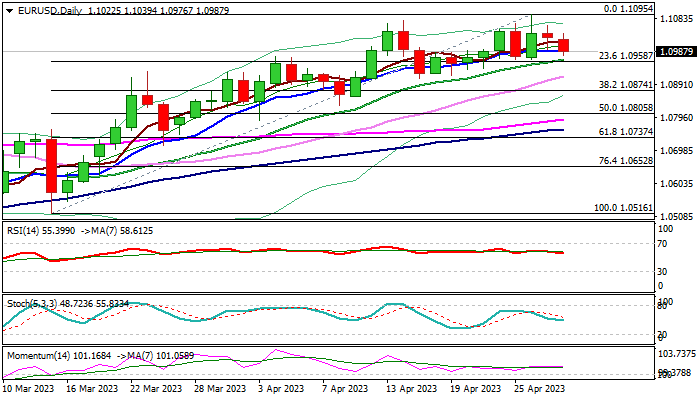
EUR/USD: Larger Bulls Likely to Regain Traction after a Shallow Pullback
The Euro dips below 1.10 support on Friday, extending pullback from new 2023 high (1.1095) into second consecutive day.
Stronger dollar on Friday morning pressured the single currency, along with weak EU / German GDP data for Q1, though markets remain cautious ahead of today’s key event – US PCE data, closely watched by Fed.
The pullback was so far seen as a healthy correction of a larger uptrend, as daily studies are bullish, with dips expected to find firm ground at 1.0960 zone (rising 20DMA / Fibo 23.6% of 1.0516/1.1095 rally) which would offer better levels to re-join bullish market for fresh push higher.
Fundamentals are likely to be a key market driver on Friday, with core US PCE at / below forecasts to signal that inflation is losing traction,
This scenario will be supportive for Euro as weaker inflation would make the dollar less attractive for traders.
On the other hand, stronger than expected PCE figures would signal that inflationary pressure is rising again and lift the dollar.
Caution on break below 1.0960 zone as this would increase downside risk of testing pivotal supports at 1.0909 (Apr 17 trough) and 1.0874 (Fibo 38.2% of 1.0516/1.1095), loss of which would signal deeper correction.
Res: 1.1015; 1.1039; 1.1075; 1.1095.
Sup: 1.0960; 1.0909; 1.0874; 1.0831.
Dollar Advances on Dovish BOJ, Weaker Euro – Markets Await Release of Key US PCE Report
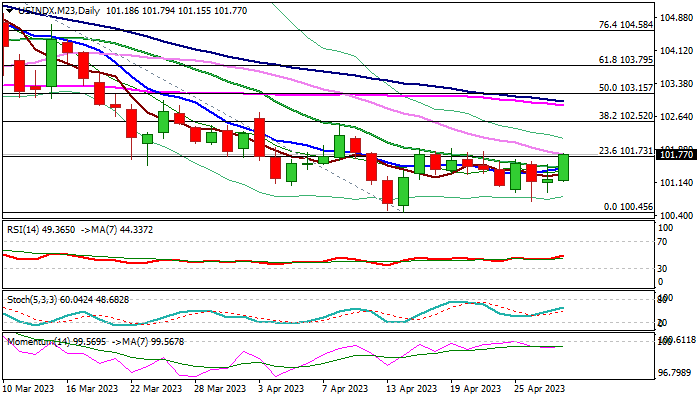
The US dollar index rose to one-week high in European session on Friday, lifted by dovish BOJ, after the currency escaped from stronger negative consequences from much weaker than expected US Q1 GDP, as consumer spending accelerated on rising inflation, partially offsetting negative impact.
Expectations that the Fed would opt for another 25 basis points hike before putting its tightening cycle on hold for the rest of the year contributed to keeping the greenback afloat.
Technical picture on daily chart shows signs of improvement but remains bearish overall, with negative signals from weakening monthly studies and the index being on track for the second consecutive monthly loss.
Fresh advance needs a sustained break of the lower platform at 101.90 zone (Apr 17/21 tops) to sideline persisting downside risk and generate initial bullish signal for continuation of recovery leg from 100.45 (new 2023 low posted on Apr 14).
The dollar was also underpinned by weaker Euro, as data released today showed that inflation in in the euro bloc remains elevated, German economy stagnated in the first three months of the year, while Eurozone economy grew at a slower pace than expected.
Traders await release of US Core PCE price index, Fed’s preferred inflation gauge, which is expected to show unchanged rise of 0.3% m/m in March and annualized figure is expected to tick to 4.5% from 4.6%.
Initial signs that inflation is easing would put the greenback under pressure, while stronger drop could be expected on downside surprise in March.
Conversely, the greenback would rise on signals that inflation is gaining pace again.
Res: 101.53; 101.88; 102.22; 102.46.
Sup: 101.07; 100.66; 100.00; 99.30.