

Sample Category Title
USD/CAD Weekly Outlook
USD/CAD's rose to 1.3668 last week but retreated since then. Initial bias is turned neutral this week first. Further rally is in favor as long as 1.3521 minor support holds. Corrective pattern from 1.3976 could have completed with three waves to 1.3299. On the upside, above 1.3668 will target 1.3860/3976 resistance zone. However, firm break of 1.3521 will dampen this bullish view and bring deeper fall back towards 1.3299 support instead.
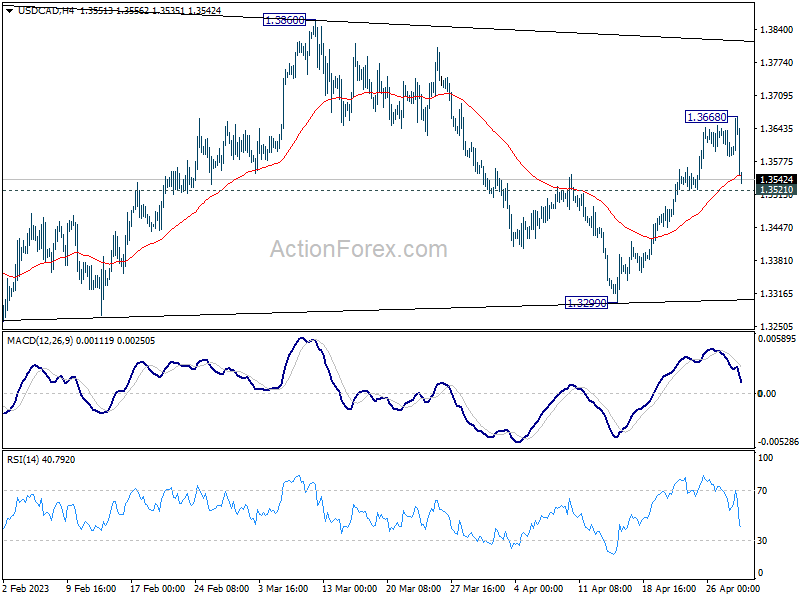
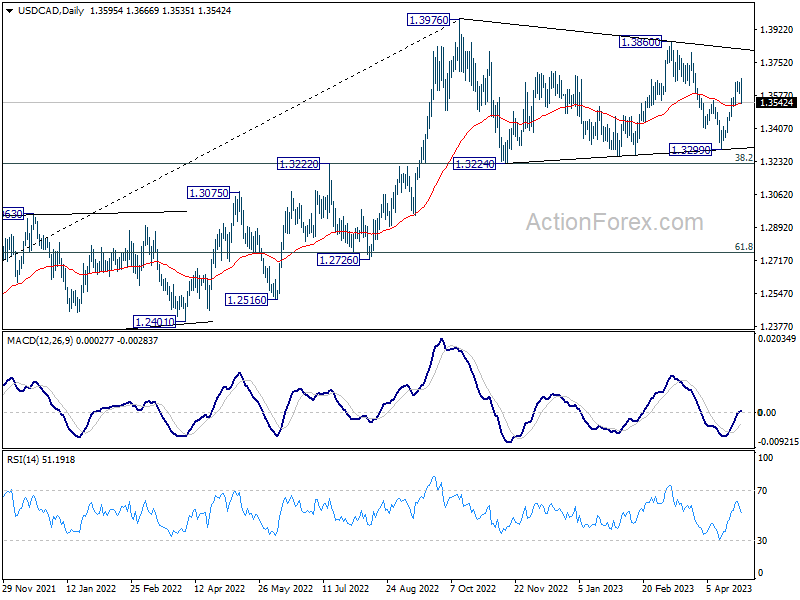
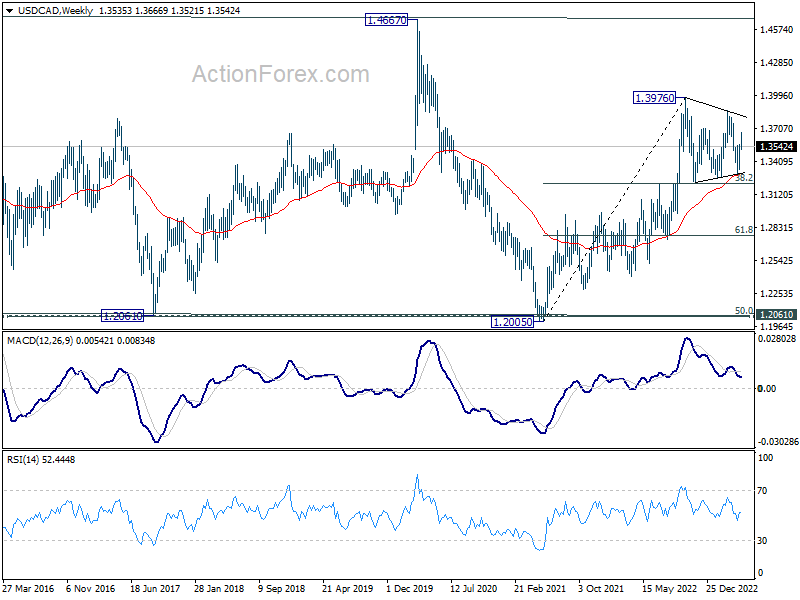
In the bigger picture, the up trend from 1.2005 (2021 low) is still in progress. Break of 1.3976 will confirm resumption and target 61.8% projection of 1.2401 to 1.3976 from 1.3261 at 1.4234. Firm break there will pave the way to long term resistance zone at 1.4667/89 (2016, 2020 highs). On the downside, sustained break of 55 W EMA (now at 1.3302) is needed to confirm medium term topping. Otherwise, outlook will remain bullish even in case of deep pull back.
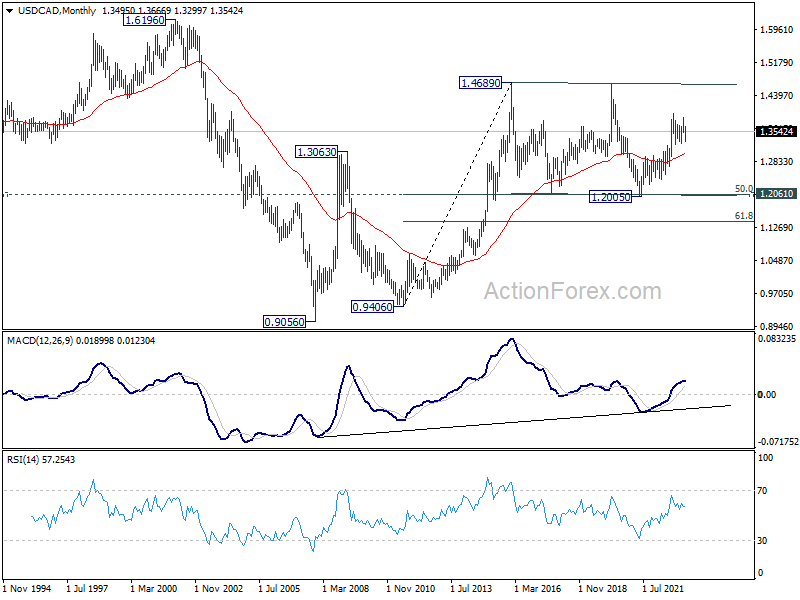
In the longer term picture, price actions from 1.4689 (2016 high) are seen as a consolidation pattern only, which might have completed at 1.2005. That is, up trend from 0.9506 (2007 low) is expected to resume at a later stage. This will remain the favored case as 55 M EMA (now at 1.3012) holds.
Yen and Aussie Down after Volatile Week, Risk-On Sentiment to Continue
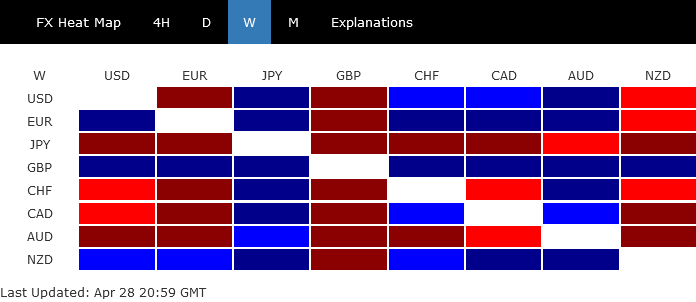
The markets experienced surprisingly high volatility in the last week of April, with central bank expectations as the primary driver. Japanese Yen emerged as the worst performer following BoJ's dovish stance, leading bond traders to abandon hopes for any changes to yield curve control. Australian Dollar was the second-worst performer, as economists now lean towards another RBA hold at the next meeting. Swiss Franc and Canadian Dollar also closed lower. On the other hand, British Pound was the strongest performer, followed by the New Zealand Dollar. US Dollar and Euro were mixed, leaning more towards the firmer side.
Trading activity is expected to remain high this week, with Fed, ECB, and RBA rate decisions featuring prominently, along with several important economic data releases in the first week of May. Technically, stocks in the US and Europe appear set for an extended rally in the near term. Pound, and to a lesser the Euro, will likely maintain an advantage against commodity currencies. Meanwhile, last week's Yen selloff could be just the beginning of a significant downward move.
Kazuo Ueda's Inaugural BoJ Meeting Exceeds Dovish Expectations, Yen Bears and Stock Investors Rejoice
Kazuo Ueda's first meeting as BoJ Governor proved more dovish than anticipated, delighting stock investors and Yen bears. Yield curve control parameters remained unaltered, and new economic projections indicated that the CPI core will decline again after reaching 2% target in 2024.
Forward guidance was modified, removing the statement, "it also expects short- and long-term policy interest rates to remain at their present or lower levels." However, the pledge to "not hesitate to take additional easing measures if necessary" was retained.
BoJ will carry out a "broad-perspective review of monetary policy" over the next 12 to 18 months, disappointing those who anticipated immediate changes as early as at last week's meeting.
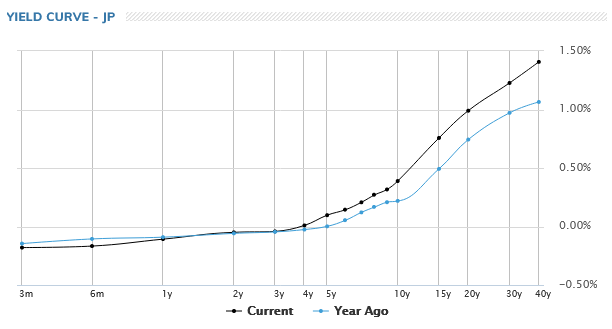
10-year JGB closed significantly lower at 0.389%, as traders abandoned hopes of a change in the 0.50% cap in the near future. Yield curve appears smooth, without any dips around the 10-year range.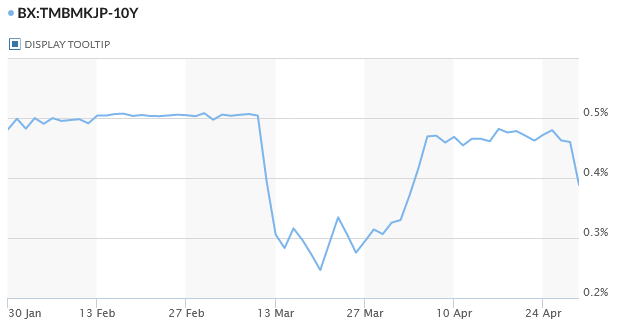
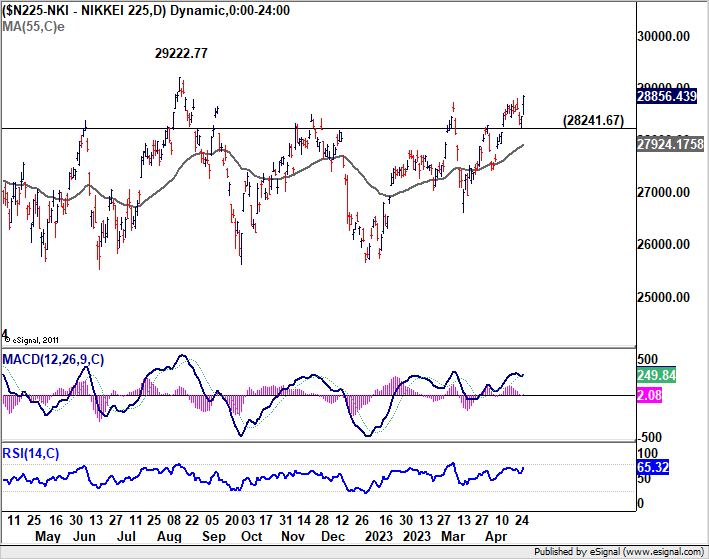
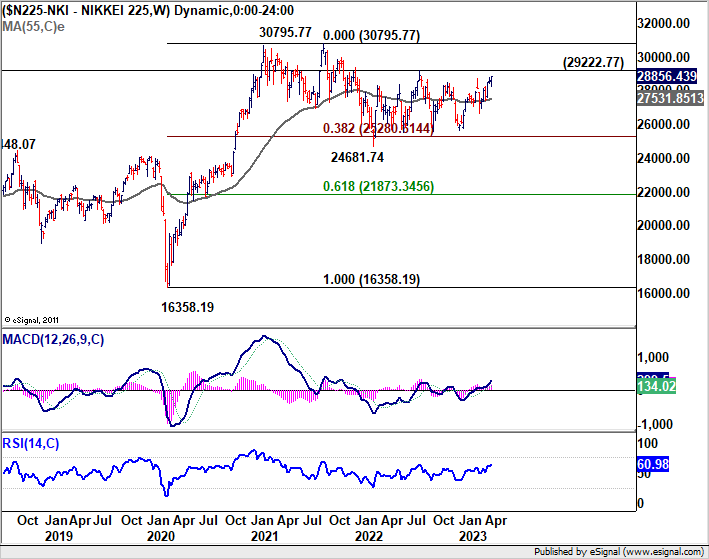
Nikkei made notable progress in resuming its near-term rally, closing at 28856.43. Outlook will remain bullish as long as 28241.67 support holds. Key near-term resistance of 29,222.77 should be tested soon. Firm break there will pave the way back to 30795.77 high and increase the likelihood of larger uptrend resumption.
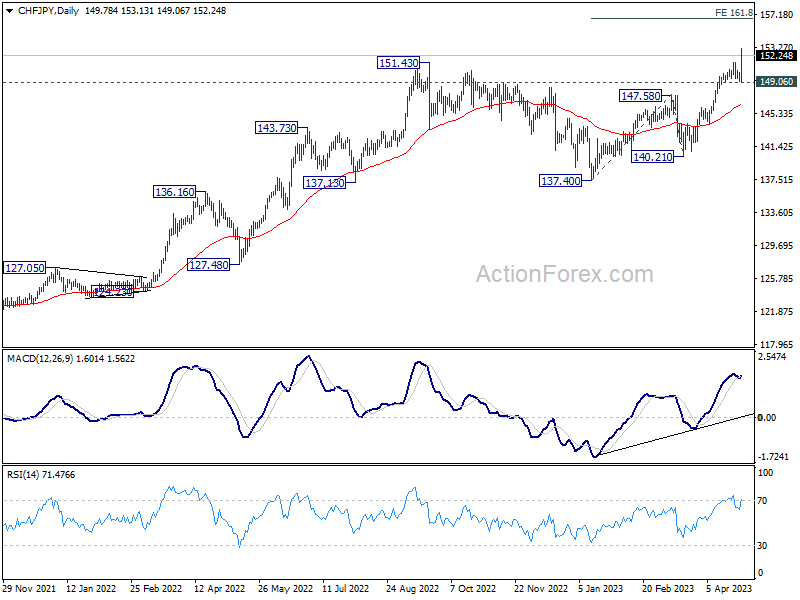
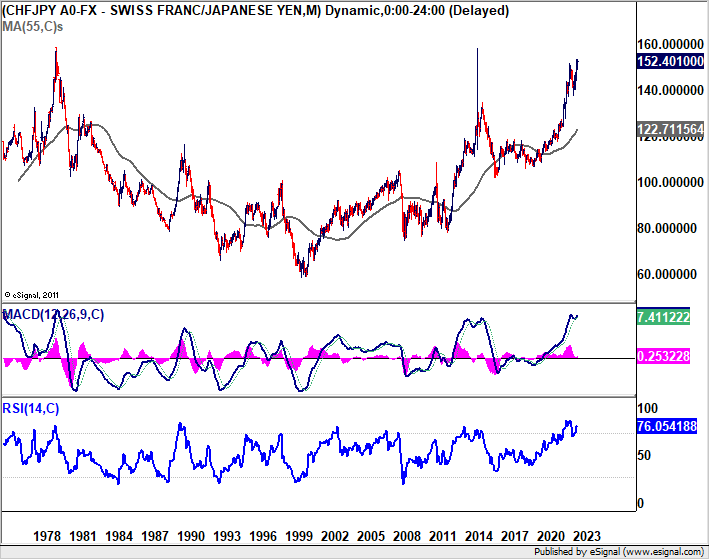
Following post-BoJ selloff, Yen finished as the week's worst performer. CHF/JPY has finally surpassed 151.43 resistance to resume its long-term uptrend. Near-term outlook will remain bullish as long as 149.06 support holds. Next target the 161.8% projection of 137.40 to 147.58 from 140.21 at 156.68. There is now a realistic chance of breaking the 158.45 (made in 1979/80) to reach a new all-time high.
Aussie Struggles as RBA Pause Expectations Grow; GBP/AUD on the Move
Australian Dollar was the second worst performer last week, on growing expectation that RBA would pause for the second time at the upcoming meeting on May 2, Tuesday. The shift in expectation came after release of Q1 CPI report, which showed a lower path of headline inflation as RBA projected, and a path for trimmed mean CPI inline with the forecast. Thus, RBA would now have more room to continue to wait and assess the impact of prior hikes. Indeed, the current 3.60% cash rate target is now seen by some as the terminal one for the current cycle.
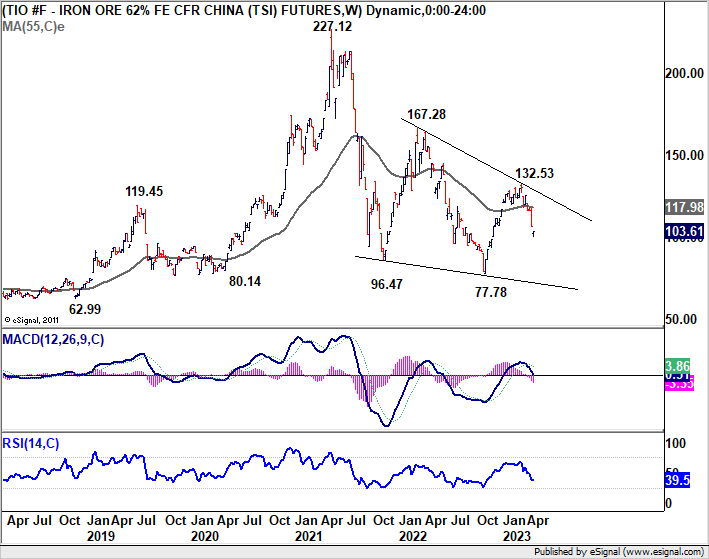
Additionally, commodity prices also weighed on the Aussie, with Copper falling to new 2023 low last week. Iron ore prices also had the worst month since October, on concern of weaker-than-expected peak construction season in China.
GBP/AUD was one the the top movers last week, gaining more than 2.1%. Near term outlook will now stay bullish as long as 1.8393 support holds. Current rally from 1.5925 should extend through 1.9218 resistance to 100% projection of 1.5925 to 1.8272 from 1.7218 at 1.9565.
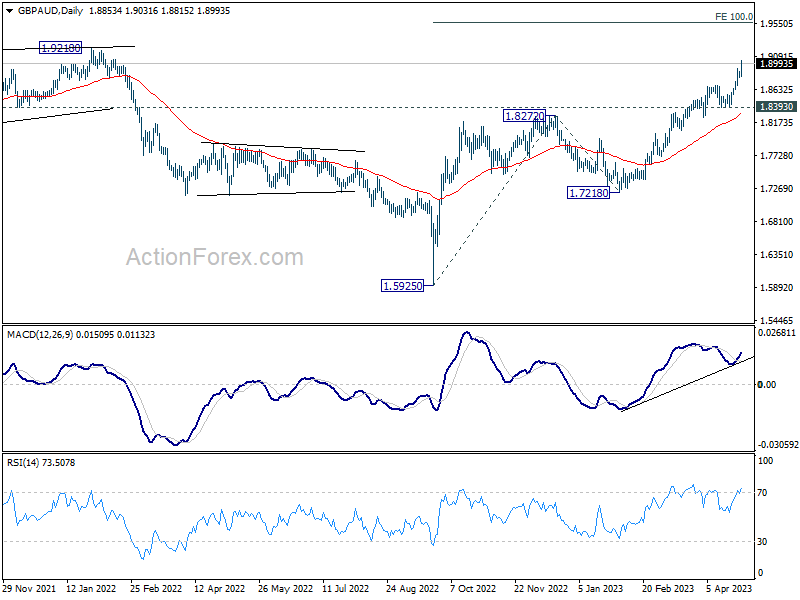
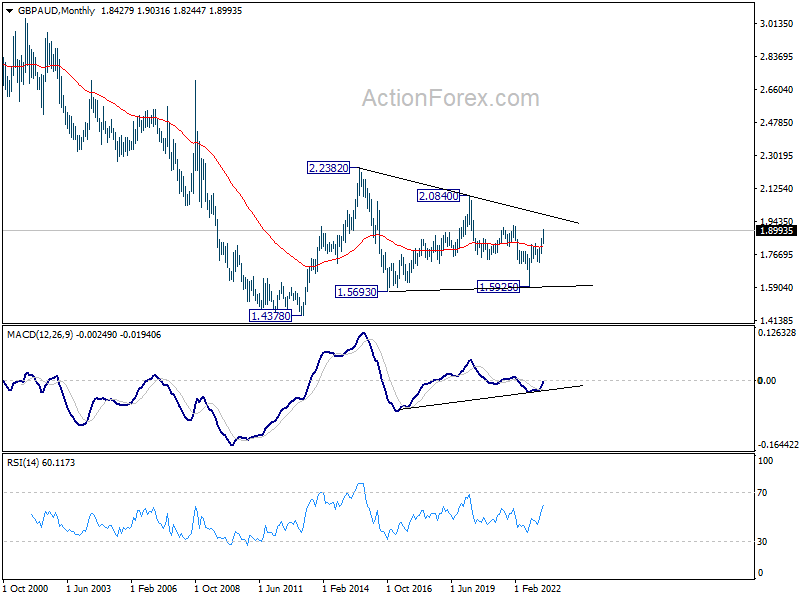
It's still too early to conclude for now. But current development raises the chance that long term consolidation pattern from 2.2382 (2015 high) has completed with three waves to 1.5925). Rise from 1.4378 (2013 low) might be ready to resume. A key hurdle to overcome is the resistance zone between trend line resistance (now at around 1.9923 level), and 2.0840. This is the level to watch in the second half of the year.
Sterling Outperforms on Rate Expectations; GBP/CHF in Focus
Taking about Sterling, it emerged as the best performer of the week, closing even above March highs against all but Euro and Swiss Franc. Interest rate expectations are driving Pound's gains as UK remains the only major economy grappling with stubbornly high double-digit inflation. Without clear signs of increasing disinflation momentum, BoE will have little choice but to continue tightening.
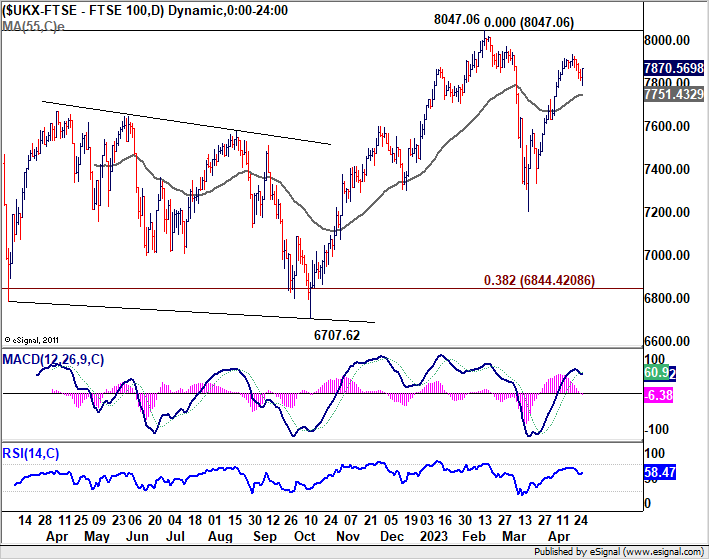
Meanwhile, the overall economy appears to have weathered inflation pressures, led by robust growth in the services sector. As reflected in FTSE developments, investors do not seem too nervous at the moment. The near-term pullback may have completed well ahead of 55 Day EMA, and another rise to retest the record high of 8047.06 could occur within the quarter.
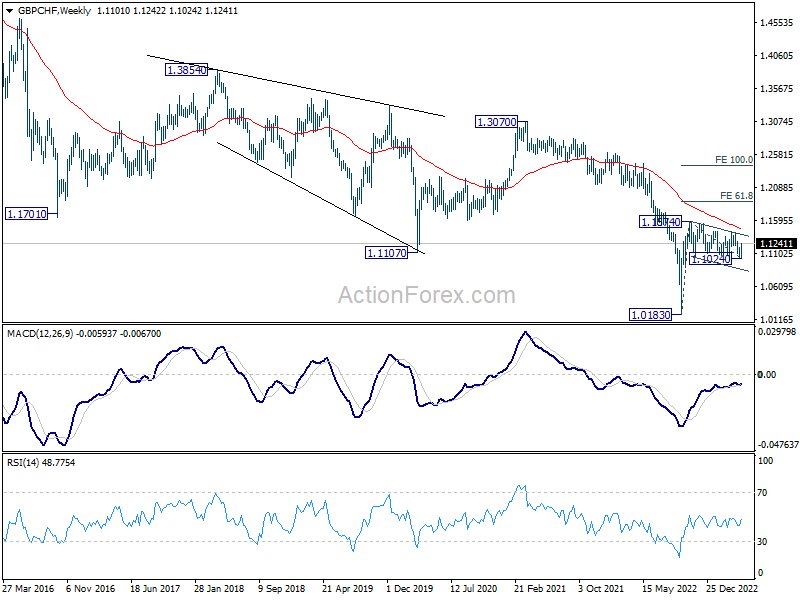
Developments in GBP/CHF leading up to BoE meeting on May 11 and its aftermath are worth watching. Price actions from 1.1574 (2022 high) are clearly corrective in nature. 38.2% retracement of 1.0183 to 1.1574 at 1.1043 was defended well despite breakthrough attempts. A short-term bottom may have formed at 1.1024 with last week's rebound, and further rise back to 1.1412 resistance is now favored.
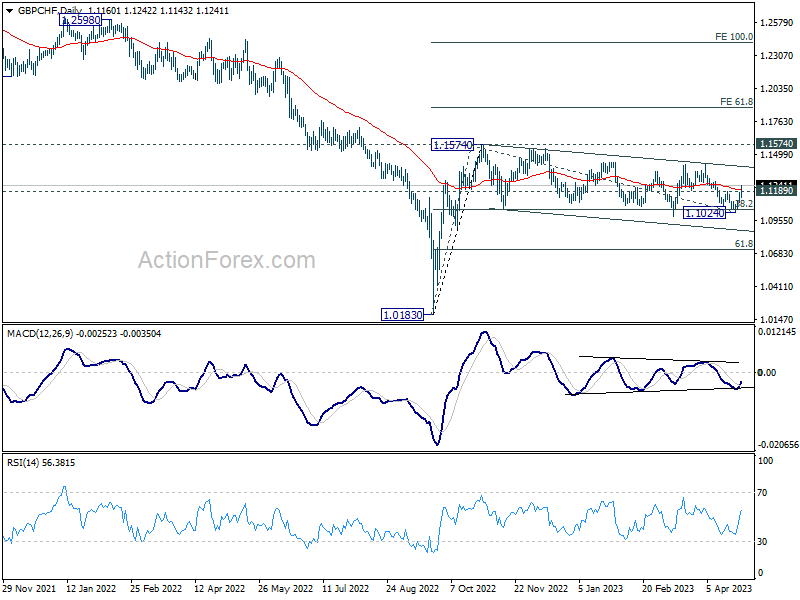
It may also be time for an upside breakout. Break of 1.1024 would be the first sign a resumption of the rally from 1.0183 (2022 spike low). Further break of 1.1574 would also decisively surpass 55 W EMA (now at 1.1469). Subsequent medium-term rise should then be seen to 61.8% projection of 1.0183 to 1.1574 from 1.1024 at 1.1884.
We'll see if BoE provides the needed push for GBP/CHF later in the month.
Fed Likely to Continue Tightening but May Pause After Next Hike
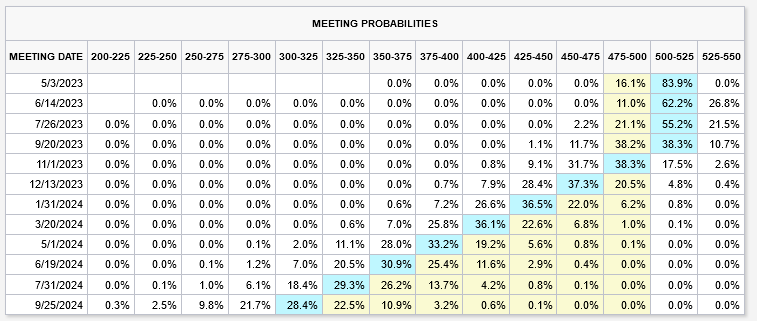
Turning over to the US, with core PCE price index remaining high at 4.6% yoy in March, Fed is expected to maintain its tightening stance by implementing another 25 bps hike on May 3rd, the coming Wednesday. However, as headline PCE slowed more quickly than expected to 4.2%, Fed should have more confidence in pausing the cycle after this hike. This expectation is further supported by weaker-than-anticipated Q1 GDP growth, registering a modest 1.1% annualized rate.
Fed fund futures are now pricing in 83.9% probability of a 25 bps hike to 5.00-5.25% on Wednesday, with a near 50% chance that the rate will remain unchanged after September, and a 79.9% chance of a cut in November. The pricings are now more "rational". Naturally, future developments will influence these projections, including Fed's new economic projections to be published in June.
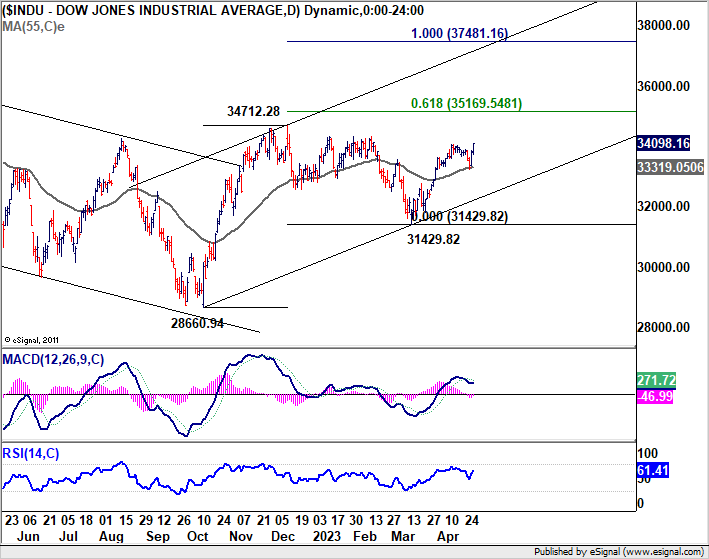
US stocks rebounded significantly late in the week, with DOW closing on a strong note at 34098.16, above the near-term resistance at 34082.94. The strong support from the 55 D EMA also affirms near-term bullishness. Further rallies are anticipated to 34712.28 resistance and beyond. A key hurdle will be 61.8% projection of 28660.94 to 34712.28 from 31429.82 at 35169.54, which could be tested later in the quarter.
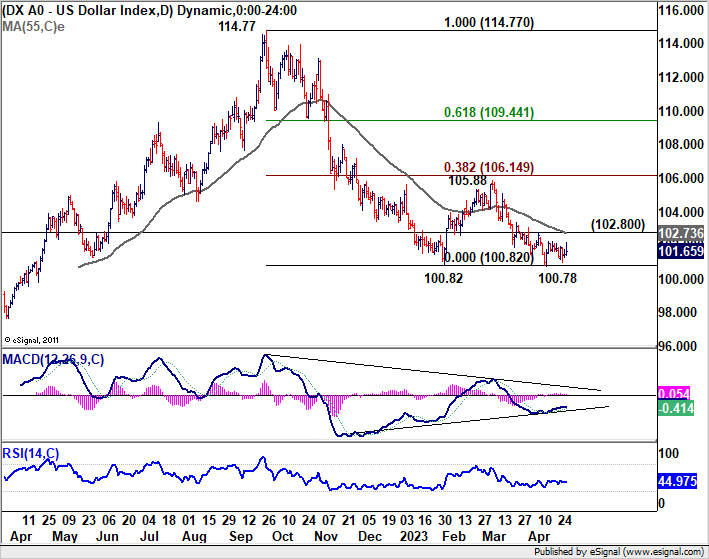
Dollar Index remained within tight range last week, showing no significant progress. The favored view is that fall from 105.88 is the second leg of the corrective pattern from 100.82, completed at 100.78. Break of 102.80 resistance would support this view, and bring stronger rally back to 105.88 resistance as the third leg of the pattern. However, a decisive break below 100.82 would dampen this outlook, resuming the overall downtrend from 114.77.
EUR/JPY Weekly Outlook
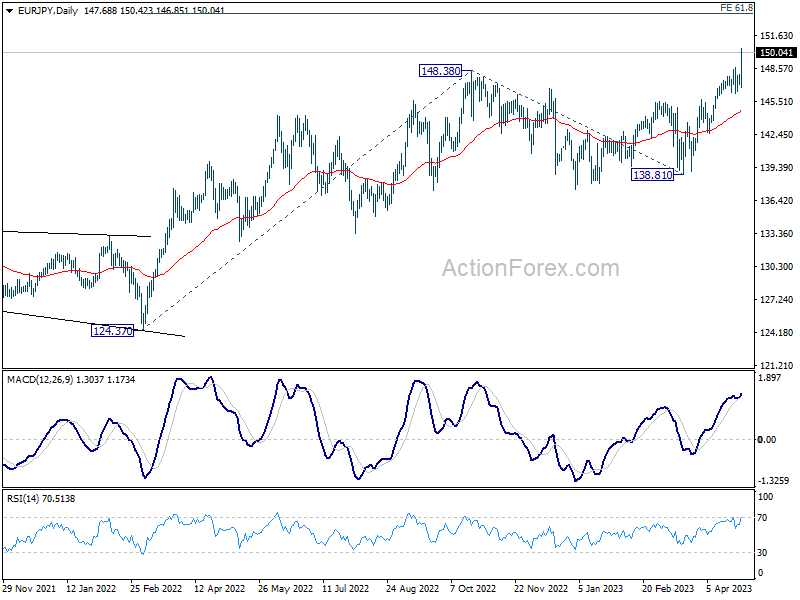
EUR/JPY's up trend continued last week, surged through 148.38, and closed above 149.76 long term resistance. Initial bias stays on the upside this week. Next target is 153.64 projection level. On the downside, below 148.61 minor support will turn intraday bias neutral and bring consolidations first, before staging another rally.
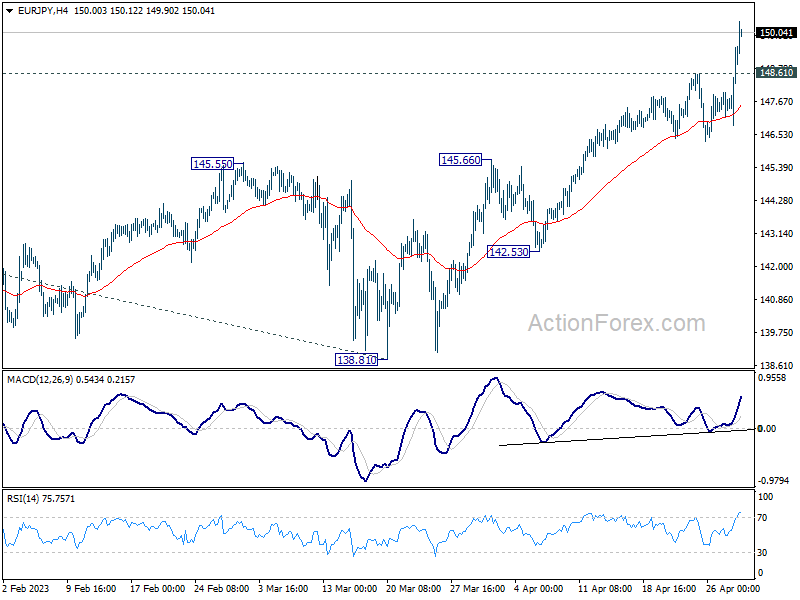
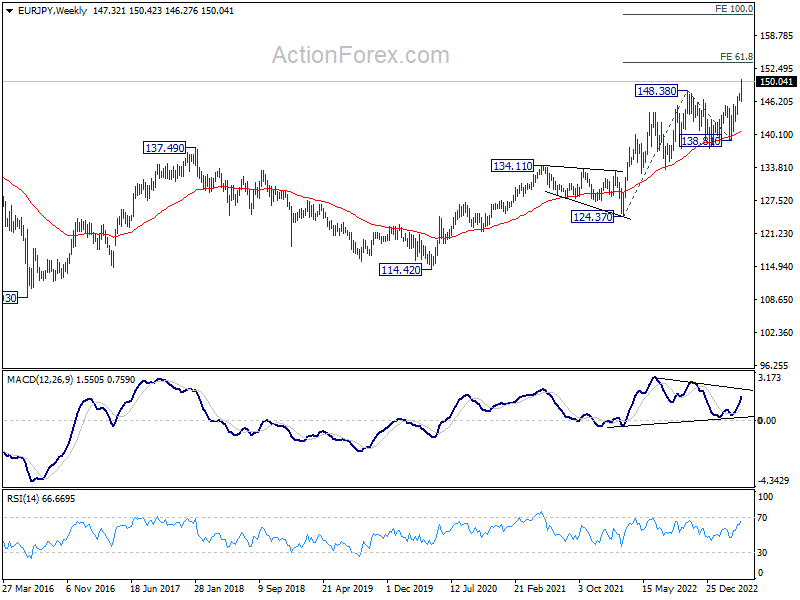
In the bigger picture, current development indicates that rise from 114.42 (2020 low) is in progress. Next target is 61.8% projection of 124.37 to 148.38 from 138.81 at 153.64. Sustained break there will pave the way to 100% projection at 162.82. For now, medium term outlook will remain bullish as long as 138.81 support holds, even in case of deep pull back.
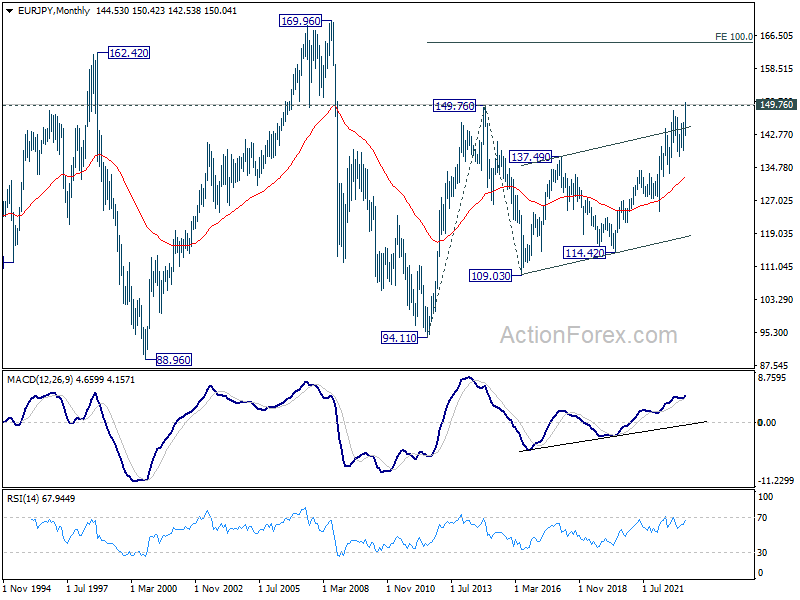
In the long term picture, break of 149.76 (2014 high) argues that whole up trend form 94.11 (2012 low) is resuming. Sustained trading above 149.76 will pave the way to 100% projection of 94.11 to 149.76 from 109.03 at 164.68, which is close to 169.96 (2008 high).
GBP/JPY Weekly Outlook
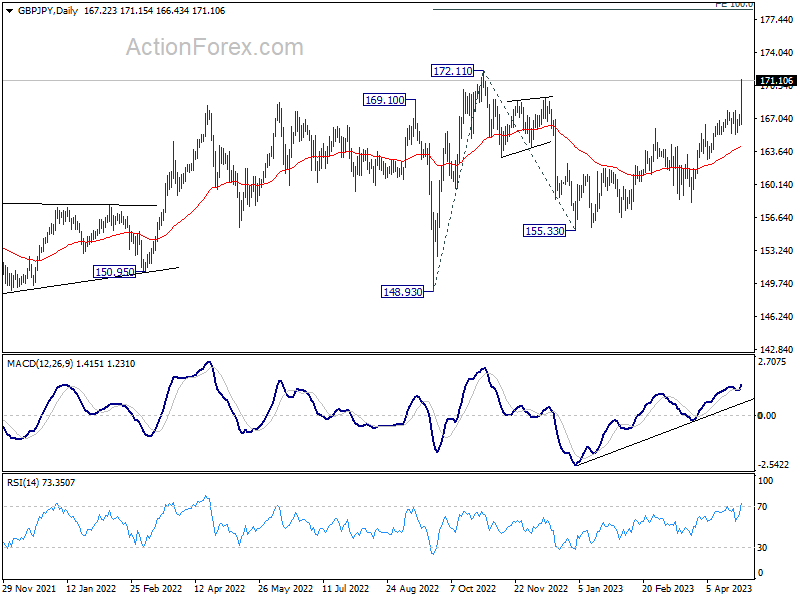
GBP/JPY's rally from 155.33 continued last week and accelerated to as high as 171.15. Initial bias remains on the upside this week for retesting 172.11 high. Firm break there will resume larger up trend and target 100% projection of 148.93 to 172.11 from 155.33 at 178.51. On the downside, below 167.95 support will turn intraday bias neutral and bring consolidations first, before staging another rally.
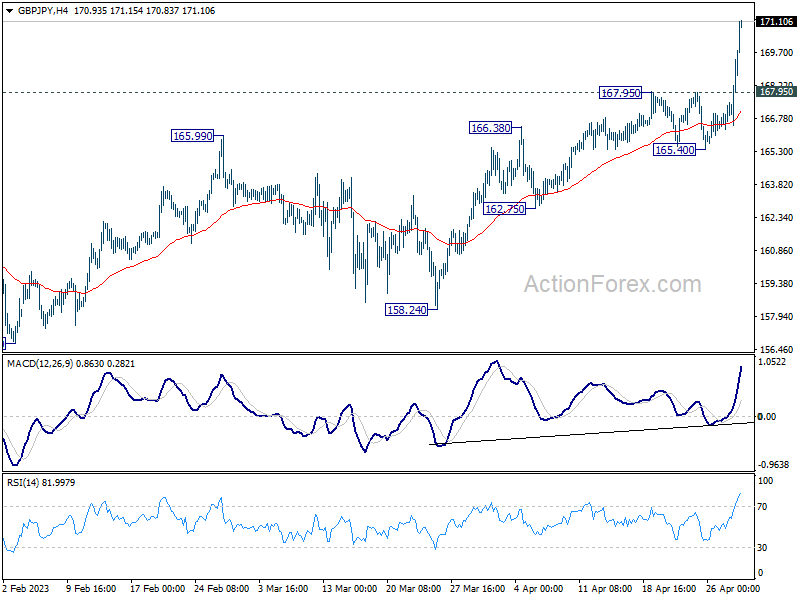
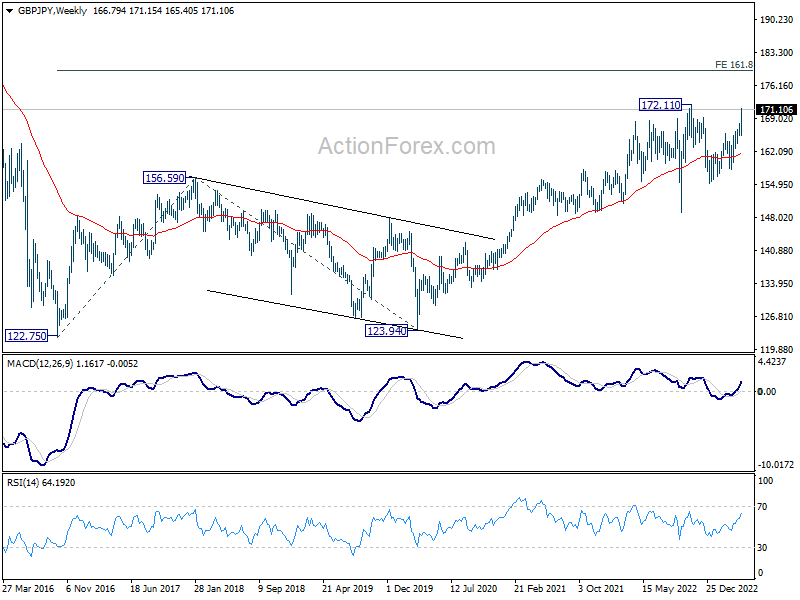
In the bigger picture, based on current momentum, up trend from 123.94 (2020 low) is likely ready to resume. Next target is 161.8% projection of 122.75 (2016 low) to 156.59 (2018 high) from 123.94 at 178.69. This will now remain the favored case as long as 165.40 support holds, in case of retreat.
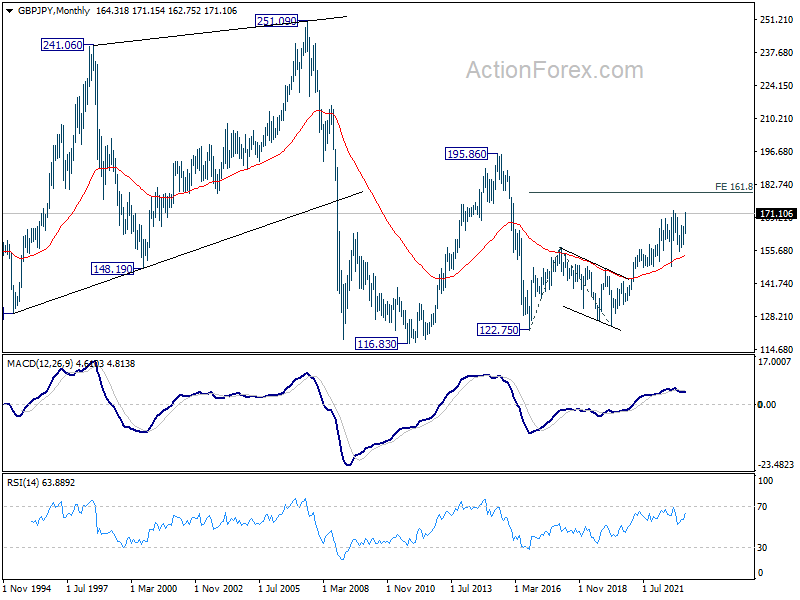
In the longer term picture, as long as 55 M EMA (now at 153.82) holds, rise from 122.75 (2016 low) could still extend higher at a later stage to 195.86 (2015 high).
EUR/JPY Weekly Outlook
EUR/JPY's up trend continued last week, surged through 148.38, and closed above 149.76 long term resistance. Initial bias stays on the upside this week. Next target is 153.64 projection level. On the downside, below 148.61 minor support will turn intraday bias neutral and bring consolidations first, before staging another rally.
In the bigger picture, current development indicates that rise from 114.42 (2020 low) is in progress. Next target is 61.8% projection of 124.37 to 148.38 from 138.81 at 153.64. Sustained break there will pave the way to 100% projection at 162.82. For now, medium term outlook will remain bullish as long as 138.81 support holds, even in case of deep pull back.
In the long term picture, break of 149.76 (2014 high) argues that whole up trend form 94.11 (2012 low) is resuming. Sustained trading above 149.76 will pave the way to 100% projection of 94.11 to 149.76 from 109.03 at 164.68, which is close to 169.96 (2008 high).
EUR/GBP Weekly Outlook
EUR/GBP reversed after hitting 0.8874 and fell sharply since then. Initial bias is now mildly on the downside this week for retesting 0.8717 support. Decisive break there will resume whole choppy decline from 0.8977. On the upside, break of 0.8874 will resume the rebound from 0.8717 instead.
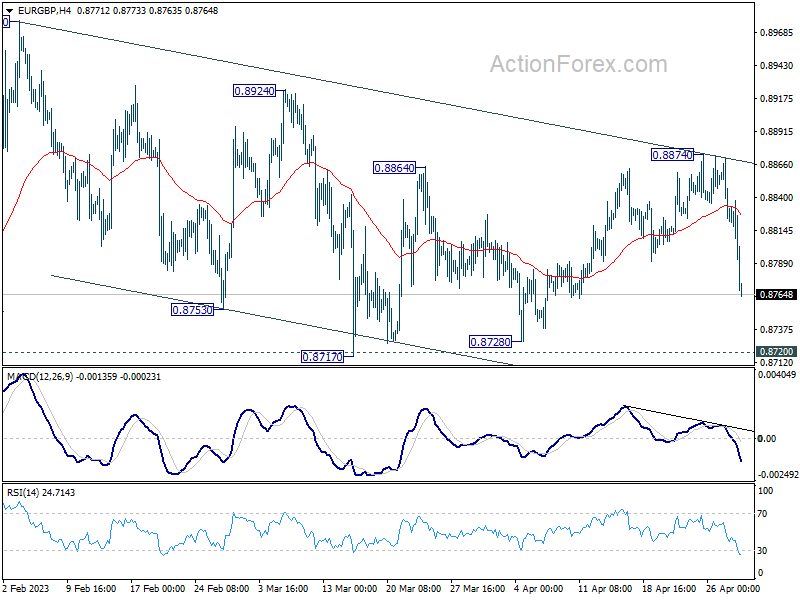
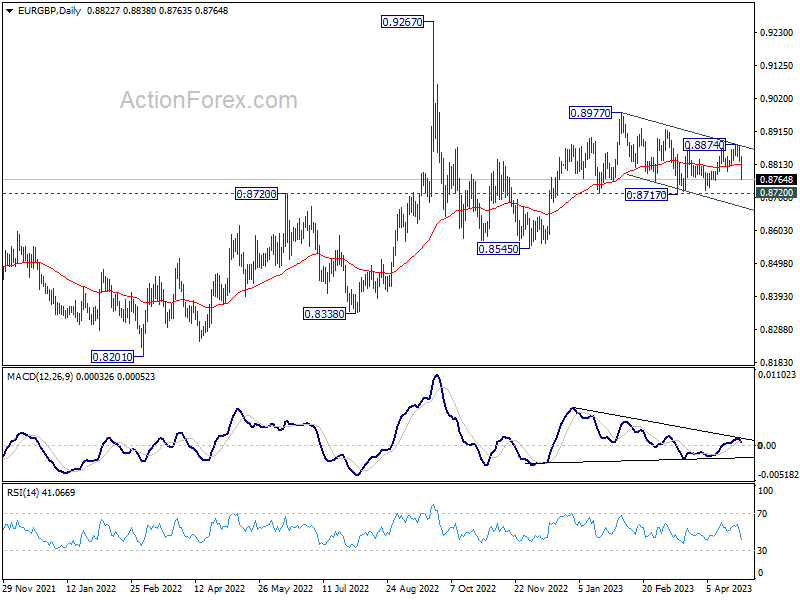
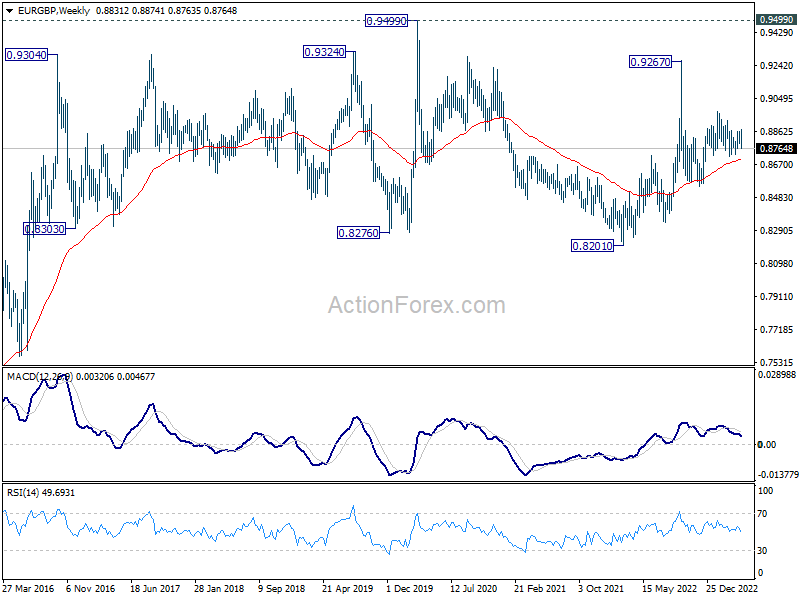
In the bigger picture, outlook remains rather mixed for now, except that price actions from 0.9267 (2022 high) are part of the long term range pattern from 0.9499 (2020 high). With 0.8720 support intact, rise from 0.8545 is in favor to continue through 0.8977. However, firm break of 0.8720 will argue that such rebound has completed, and open up deeper fall through this support level.
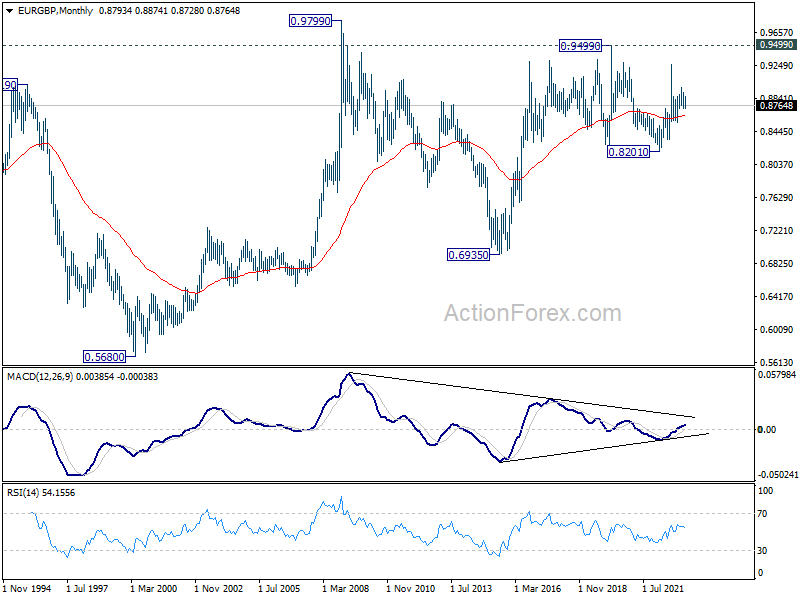
In the long term picture, long term range pattern is extending. But rise from 0.6935 (2015 low) is expected to extend at a later stage, to 0.9799 (2009 high).
EUR/AUD Weekly Outlook
EUR/AUD's up trend resumed last week and surged to as high as 1.6783. But as a temporary top was formed there. Initial bias remains neutral for consolidations. Downside of retreat should be contained by 1.6444 resistance turned support to bring rally resumption. On the upside, break of 1.6785 will resume larger up trend from 1.4281 to 100% projection of 1.4281 to 1.5976 from 1.5254 at 1.6949.
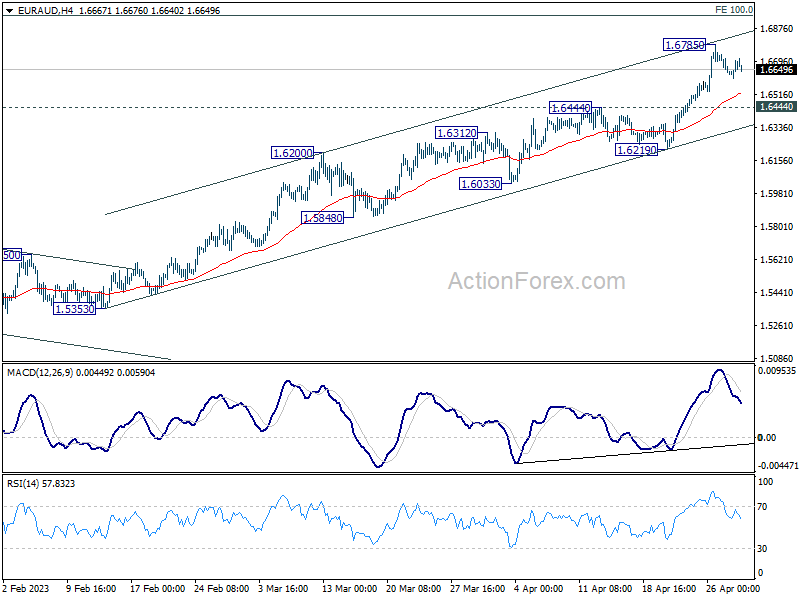
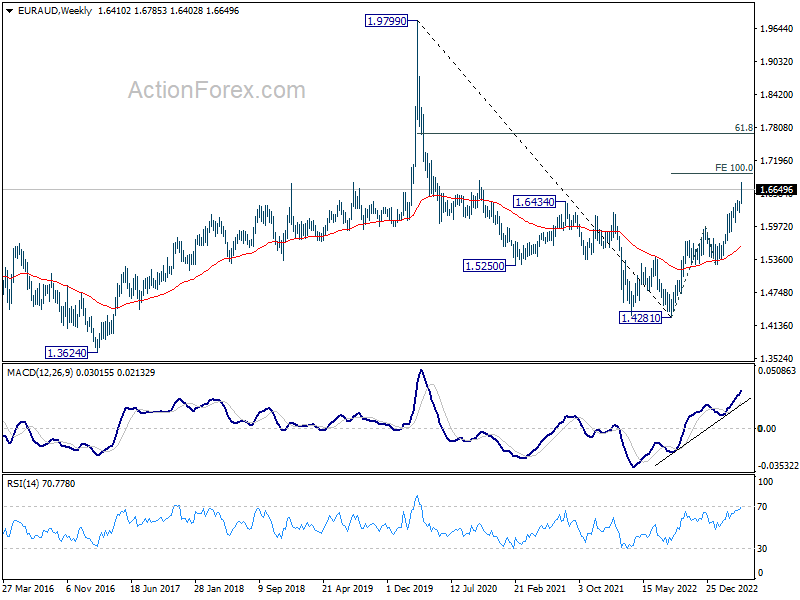
In the bigger picture, the solid break of 1.6434 resistance argues that whole down trend from 1.9799 (2020 high) has completed at 1.4281 (2022 low). Further rise should be seen to 61.8% retracement of 1.9799 to 1.4281 at 1.7691 next. For now, outlook will stay bullish as long as 1.5976 resistance turned support holds, even in case of deep pull back.
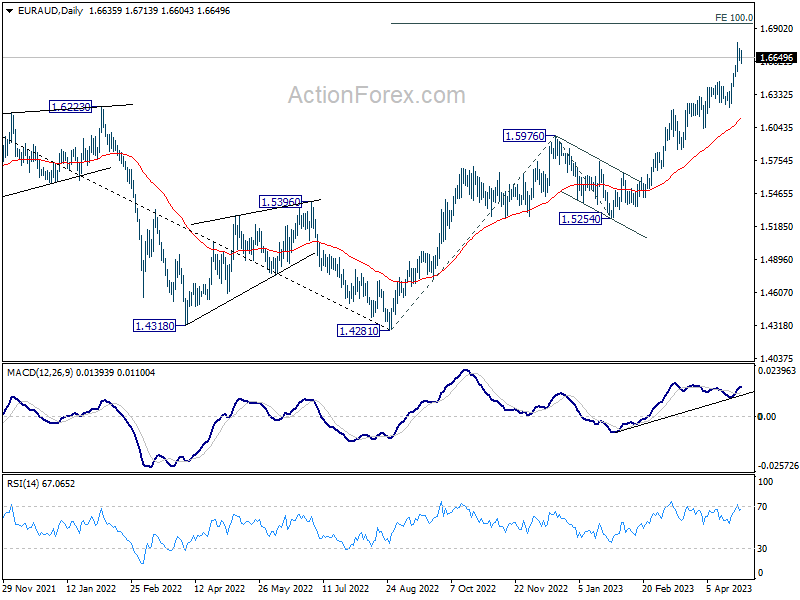
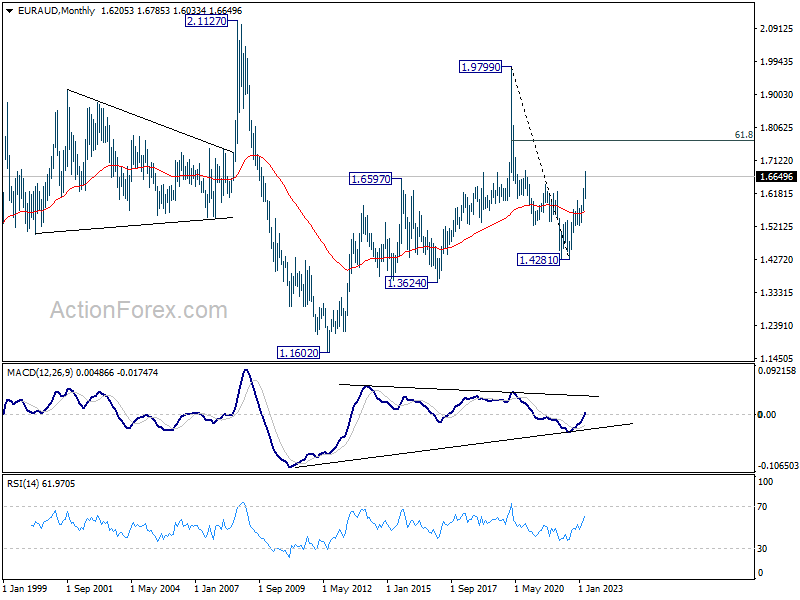
In the longer term picture, it's still early to decide if rise from 1.4281 is resuming whole up trend from 1.1602 (2012 low). Attention will be paid on the structure on the current rally to make an assessment later.
EUR/CHF Weekly Outlook
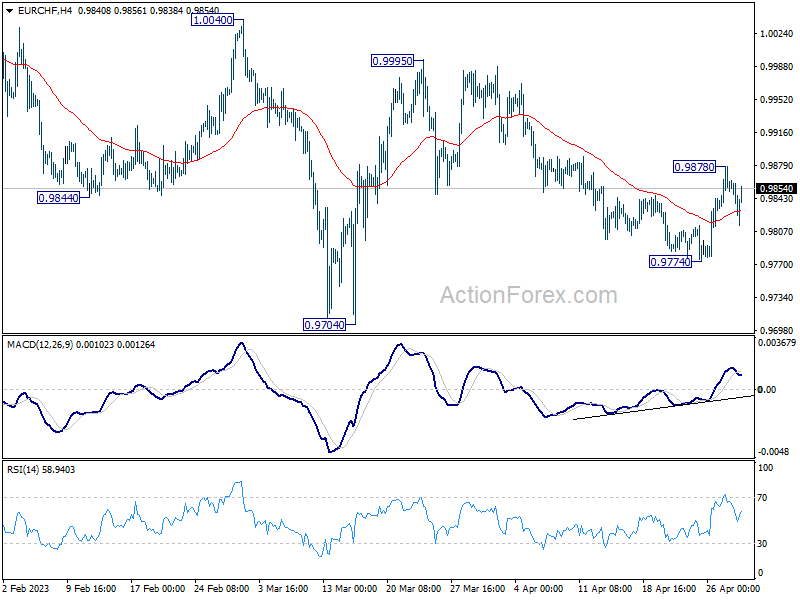
EUR/CHF rebounded to 0.9878 last week but retreated since then. Initial bias is turned neutral this week for consolidations first. A short term bottoming should be in place at 0.9774 on bullish convergence condition in 4H MACD. Hence, risk will stay on the upside as long as 0.9774 holds. Also, the development revived the case that whole correction from 1.0095 has completed at 0.9704. Break of 0.9878, and sustained trading above 55 D EMA (now at 0.9875) will affirm this bullish case, and target 0.9995 resistance next.
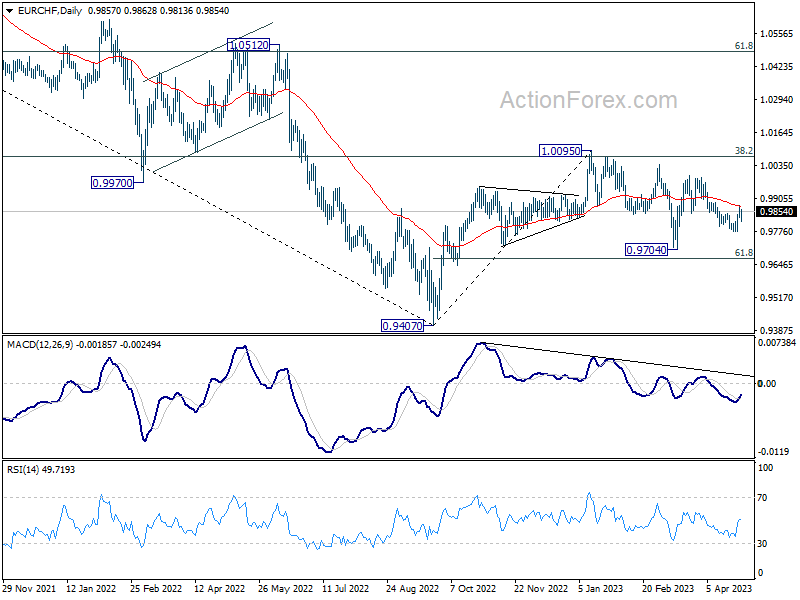
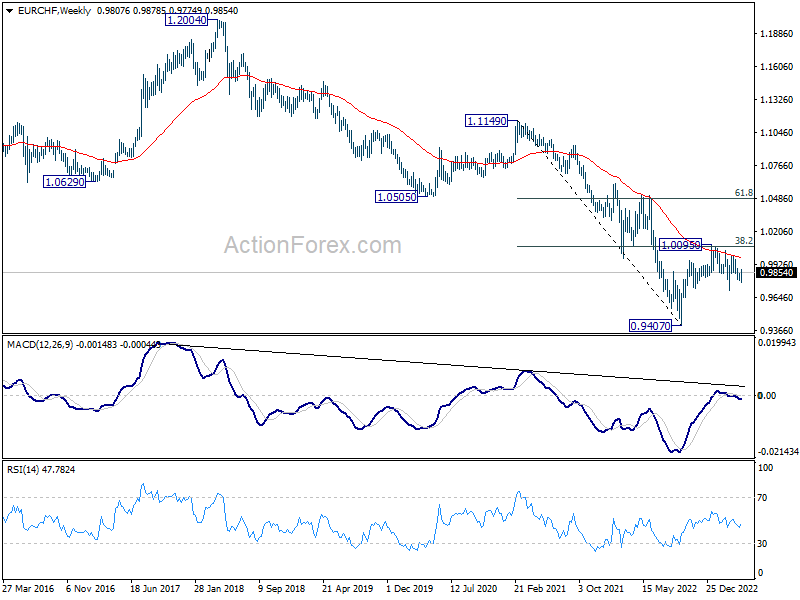
In the bigger picture, prior rejection by 55 W EMA (now at 0.9989) and 38.2% retracement of 1.1149 to 0.9407 at 1.0072 suggests that medium term outlook is staying bearish. That is, down trend from 1.2004 is not completed yet and is in favor to resume through 0.9407 at a later stage. However, decisive break of 1.0095 resistance will raise the chance of bullish trend reversal. Rise from 0.9407 should then target 1.0505 cluster resistance (2020 low at 1.0505, 61.8% retracement of 1.1149 to 0.9407 at 1.1484).
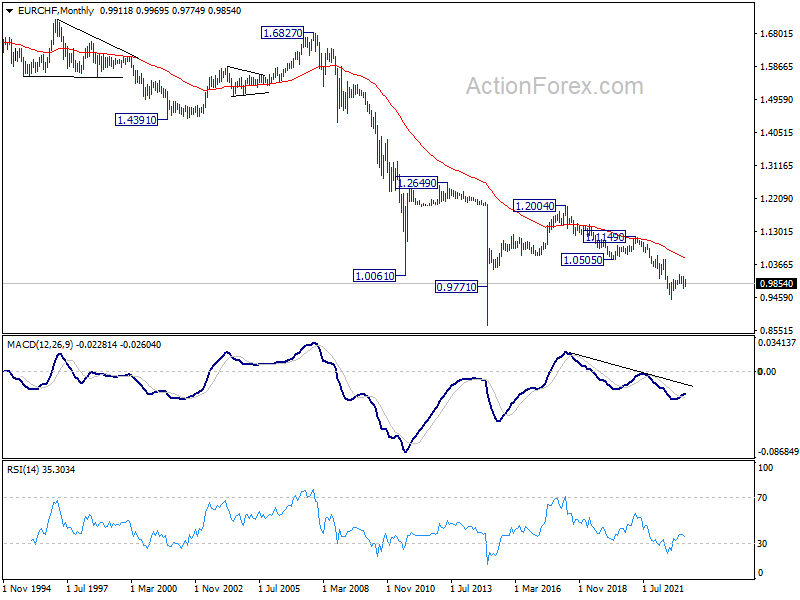
In the long term picture, it's still way too early too call for bullish trend reversal with upside capped well below 55 M EMA (now at 1.0566) and 1.0505 support turned resistance (2020 low). The multi-decade down trend could still continue.
Summary 5/1 – 5/5
Monday, May 1, 2023
| GMT | Ccy | Events | Consensus | Previous |
|---|---|---|---|---|
| 00:30 | JPY | Manufacturing PMI Apr F | 49.5 | 49.5 |
| 01:00 | AUD | TD Securities Inflation M/M Apr | 0.30% | |
| 05:00 | JPY | Consumer Confidence Apr | 35 | 33.9 |
| 13:30 | CAD | Manufacturing PMI Apr | 50.5 | 48.6 |
| 13:45 | USD | Manufacturing PMI Apr F | 50.4 | 50.4 |
| 14:00 | USD | ISM Manufacturing PMI Apr | 46.6 | 46.3 |
| 14:00 | USD | ISM Manufacturing Prices Paid Apr | 50.4 | 49.2 |
| 14:00 | USD | ISM Manufacturing Employment Index Apr | 46.9 | |
| 14:00 | USD | Construction Spending M/M Mar | 0.20% | -0.10% |
| 23:50 | JPY | Monetary Base Y/Y Apr | -1.50% | -1.00% |
| GMT | Ccy | Events | |
|---|---|---|---|
| 00:30 | JPY | Manufacturing PMI Apr F | |
| Forecast: 49.5 | Previous: 49.5 | ||
| 01:00 | AUD | TD Securities Inflation M/M Apr | |
| Forecast: | Previous: 0.30% | ||
| 05:00 | JPY | Consumer Confidence Apr | |
| Forecast: 35 | Previous: 33.9 | ||
| 13:30 | CAD | Manufacturing PMI Apr | |
| Forecast: 50.5 | Previous: 48.6 | ||
| 13:45 | USD | Manufacturing PMI Apr F | |
| Forecast: 50.4 | Previous: 50.4 | ||
| 14:00 | USD | ISM Manufacturing PMI Apr | |
| Forecast: 46.6 | Previous: 46.3 | ||
| 14:00 | USD | ISM Manufacturing Prices Paid Apr | |
| Forecast: 50.4 | Previous: 49.2 | ||
| 14:00 | USD | ISM Manufacturing Employment Index Apr | |
| Forecast: | Previous: 46.9 | ||
| 14:00 | USD | Construction Spending M/M Mar | |
| Forecast: 0.20% | Previous: -0.10% | ||
| 23:50 | JPY | Monetary Base Y/Y Apr | |
| Forecast: -1.50% | Previous: -1.00% | ||
Tuesday, May 2, 2023
| GMT | Ccy | Events | Consensus | Previous |
|---|---|---|---|---|
| 04:30 | AUD | RBA Interest Rate Decision | 3.60% | 3.60% |
| 06:00 | EUR | Germany Retail Sales M/M Mar | 0.40% | -1.30% |
| 07:00 | CHF | SECO Consumer Climate Q2 | -22 | -30 |
| 07:30 | CHF | Manufacturing PMI Apr | 50 | 47 |
| 07:45 | EUR | Italy Manufacturing PMI Apr | 49 | 51.1 |
| 07:50 | EUR | France Manufacturing PMI Apr F | 45.5 | 45.5 |
| 07:55 | EUR | Germany Manufacturing PMI Apr F | 44 | 44 |
| 08:00 | EUR | Eurozone Manufacturing PMI Apr F | 45.5 | 45.5 |
| 08:00 | EUR | Eurozone M3 Money Supply Y/Y Mar | 3.10% | 2.90% |
| 08:30 | GBP | Manufacturing PMI Apr | 46.6 | 46.6 |
| 09:00 | EUR | Eurozone CPI Y/Y Apr P | 6.90% | 6.90% |
| 09:00 | EUR | Eurozone CPI Core Y/Y Apr P | 5.70% | 5.70% |
| 14:00 | USD | Factory Orders M/M Mar | 0.80% | -0.70% |
| 22:45 | NZD | Employment Change Q1 | 0.40% | 0.20% |
| 22:45 | NZD | Unemployment Rate Q1 | 3.50% | 3.40% |
| 22:45 | NZD | Labour Cost Index Q/Q Q1 | 1.10% | 1.10% |
| GMT | Ccy | Events | |
|---|---|---|---|
| 04:30 | AUD | RBA Interest Rate Decision | |
| Forecast: 3.60% | Previous: 3.60% | ||
| 06:00 | EUR | Germany Retail Sales M/M Mar | |
| Forecast: 0.40% | Previous: -1.30% | ||
| 07:00 | CHF | SECO Consumer Climate Q2 | |
| Forecast: -22 | Previous: -30 | ||
| 07:30 | CHF | Manufacturing PMI Apr | |
| Forecast: 50 | Previous: 47 | ||
| 07:45 | EUR | Italy Manufacturing PMI Apr | |
| Forecast: 49 | Previous: 51.1 | ||
| 07:50 | EUR | France Manufacturing PMI Apr F | |
| Forecast: 45.5 | Previous: 45.5 | ||
| 07:55 | EUR | Germany Manufacturing PMI Apr F | |
| Forecast: 44 | Previous: 44 | ||
| 08:00 | EUR | Eurozone Manufacturing PMI Apr F | |
| Forecast: 45.5 | Previous: 45.5 | ||
| 08:00 | EUR | Eurozone M3 Money Supply Y/Y Mar | |
| Forecast: 3.10% | Previous: 2.90% | ||
| 08:30 | GBP | Manufacturing PMI Apr | |
| Forecast: 46.6 | Previous: 46.6 | ||
| 09:00 | EUR | Eurozone CPI Y/Y Apr P | |
| Forecast: 6.90% | Previous: 6.90% | ||
| 09:00 | EUR | Eurozone CPI Core Y/Y Apr P | |
| Forecast: 5.70% | Previous: 5.70% | ||
| 14:00 | USD | Factory Orders M/M Mar | |
| Forecast: 0.80% | Previous: -0.70% | ||
| 22:45 | NZD | Employment Change Q1 | |
| Forecast: 0.40% | Previous: 0.20% | ||
| 22:45 | NZD | Unemployment Rate Q1 | |
| Forecast: 3.50% | Previous: 3.40% | ||
| 22:45 | NZD | Labour Cost Index Q/Q Q1 | |
| Forecast: 1.10% | Previous: 1.10% | ||
Wednesday, May 3, 2023
| GMT | Ccy | Events | Consensus | Previous |
|---|---|---|---|---|
| 01:30 | AUD | Retail Sales M/M Mar | 0.20% | 0.20% |
| 08:00 | EUR | Italy Unemployment Rate Mar | 8.10% | 8.00% |
| 09:00 | EUR | Eurozone Unemployment Rate Mar | 6.60% | 6.60% |
| 12:15 | USD | ADP Employment Change Apr | 150K | 145K |
| 13:45 | USD | Services PMI Apr F | 53.7 | 53.7 |
| 14:00 | USD | ISM Services PMI Apr | 53.1 | 51.2 |
| 14:30 | USD | Crude Oil Inventories | -5.1M | |
| 18:00 | USD | Fed Interest Rate Decision | 5.25% | 5.00% |
| 18:30 | USD | FOMC Press Conference | ||
| 22:45 | NZD | Building Permits M/M Mar | -9.00% |
| GMT | Ccy | Events | |
|---|---|---|---|
| 01:30 | AUD | Retail Sales M/M Mar | |
| Forecast: 0.20% | Previous: 0.20% | ||
| 08:00 | EUR | Italy Unemployment Rate Mar | |
| Forecast: 8.10% | Previous: 8.00% | ||
| 09:00 | EUR | Eurozone Unemployment Rate Mar | |
| Forecast: 6.60% | Previous: 6.60% | ||
| 12:15 | USD | ADP Employment Change Apr | |
| Forecast: 150K | Previous: 145K | ||
| 13:45 | USD | Services PMI Apr F | |
| Forecast: 53.7 | Previous: 53.7 | ||
| 14:00 | USD | ISM Services PMI Apr | |
| Forecast: 53.1 | Previous: 51.2 | ||
| 14:30 | USD | Crude Oil Inventories | |
| Forecast: | Previous: -5.1M | ||
| 18:00 | USD | Fed Interest Rate Decision | |
| Forecast: 5.25% | Previous: 5.00% | ||
| 18:30 | USD | FOMC Press Conference | |
| Forecast: | Previous: | ||
| 22:45 | NZD | Building Permits M/M Mar | |
| Forecast: | Previous: -9.00% | ||
Thursday, May 4, 2023
| GMT | Ccy | Events | Consensus | Previous |
|---|---|---|---|---|
| 01:30 | AUD | Trade Balance (AUD) Mar | 13.00B | 13.87B |
| 01:45 | CNY | Caixin Manufacturing PMI Apr | 50.8 | 50 |
| 06:00 | EUR | Germany Trade Balance (EUR) Mar | 17.1B | 16.0B |
| 07:45 | EUR | Italy Services PMI Apr | 56 | 55.7 |
| 07:50 | EUR | France Services PMI Apr F | 56.3 | 56.3 |
| 07:55 | EUR | Germany Services PMI Apr F | 55.7 | 55.7 |
| 08:00 | EUR | Eurozone Services PMI Apr F | 56.6 | 56.6 |
| 08:30 | GBP | Mortgage Approvals Mar | 46K | 44K |
| 08:30 | GBP | Services PMI Apr F | 54.9 | 54.9 |
| 08:30 | GBP | M4 Money Supply M/M Mar | 0.10% | -0.40% |
| 09:00 | EUR | Eurozone PPI M/M Mar | -0.50% | |
| 09:00 | EUR | Eurozone PPI Y/Y Mar | 13.20% | |
| 12:15 | EUR | ECB Main Refinancing Rate | 4.00% | 3.50% |
| 12:30 | CAD | Trade Balance (CAD) Mar | 1.0B | 0.4B |
| 12:30 | USD | Initial Jobless Claims (Apr 28) | 235K | 230K |
| 12:30 | USD | Trade Balance (USD) Mar | -68.9B | -70.5B |
| 12:30 | USD | Nonfarm Productivity Q1 P | -0.70% | 1.70% |
| 12:30 | USD | Unit Labor Costs Q1 P | 8.40% | 3.20% |
| 12:45 | EUR | ECB Press Conference | ||
| 14:00 | CAD | Ivey PMI Apr | 59 | 58.2 |
| 14:00 | CAD | Ivey Purchasing Managers Index s.a Apr | 58.2 | |
| 14:30 | USD | Natural Gas Storage | 79B |
| GMT | Ccy | Events | |
|---|---|---|---|
| 01:30 | AUD | Trade Balance (AUD) Mar | |
| Forecast: 13.00B | Previous: 13.87B | ||
| 01:45 | CNY | Caixin Manufacturing PMI Apr | |
| Forecast: 50.8 | Previous: 50 | ||
| 06:00 | EUR | Germany Trade Balance (EUR) Mar | |
| Forecast: 17.1B | Previous: 16.0B | ||
| 07:45 | EUR | Italy Services PMI Apr | |
| Forecast: 56 | Previous: 55.7 | ||
| 07:50 | EUR | France Services PMI Apr F | |
| Forecast: 56.3 | Previous: 56.3 | ||
| 07:55 | EUR | Germany Services PMI Apr F | |
| Forecast: 55.7 | Previous: 55.7 | ||
| 08:00 | EUR | Eurozone Services PMI Apr F | |
| Forecast: 56.6 | Previous: 56.6 | ||
| 08:30 | GBP | Mortgage Approvals Mar | |
| Forecast: 46K | Previous: 44K | ||
| 08:30 | GBP | Services PMI Apr F | |
| Forecast: 54.9 | Previous: 54.9 | ||
| 08:30 | GBP | M4 Money Supply M/M Mar | |
| Forecast: 0.10% | Previous: -0.40% | ||
| 09:00 | EUR | Eurozone PPI M/M Mar | |
| Forecast: | Previous: -0.50% | ||
| 09:00 | EUR | Eurozone PPI Y/Y Mar | |
| Forecast: | Previous: 13.20% | ||
| 12:15 | EUR | ECB Main Refinancing Rate | |
| Forecast: 4.00% | Previous: 3.50% | ||
| 12:30 | CAD | Trade Balance (CAD) Mar | |
| Forecast: 1.0B | Previous: 0.4B | ||
| 12:30 | USD | Initial Jobless Claims (Apr 28) | |
| Forecast: 235K | Previous: 230K | ||
| 12:30 | USD | Trade Balance (USD) Mar | |
| Forecast: -68.9B | Previous: -70.5B | ||
| 12:30 | USD | Nonfarm Productivity Q1 P | |
| Forecast: -0.70% | Previous: 1.70% | ||
| 12:30 | USD | Unit Labor Costs Q1 P | |
| Forecast: 8.40% | Previous: 3.20% | ||
| 12:45 | EUR | ECB Press Conference | |
| Forecast: | Previous: | ||
| 14:00 | CAD | Ivey PMI Apr | |
| Forecast: 59 | Previous: 58.2 | ||
| 14:00 | CAD | Ivey Purchasing Managers Index s.a Apr | |
| Forecast: | Previous: 58.2 | ||
| 14:30 | USD | Natural Gas Storage | |
| Forecast: | Previous: 79B | ||
Friday, May 5, 2023
| GMT | Ccy | Events | Consensus | Previous |
|---|---|---|---|---|
| 01:30 | AUD | RBA Monetary Policy Statement | ||
| 01:45 | CNY | Caixin Services PMI Apr | 56.5 | 57.8 |
| 05:45 | CHF | Unemployment Rate Apr | 1.90% | 1.90% |
| 06:00 | EUR | Germany Factory Orders M/M Mar | -2.00% | 4.80% |
| 06:30 | CHF | CPI M/M Apr | 0.20% | 0.20% |
| 06:30 | CHF | CPI Y/Y Apr | 2.80% | 2.90% |
| 06:45 | EUR | France Industrial Output M/M Mar | -0.30% | 1.20% |
| 07:00 | CHF | Foreign Currency Reserves (CHF) Apr | 743B | |
| 08:00 | EUR | Italy Retail Sales M/M Mar | 0.00% | -0.10% |
| 08:30 | GBP | Construction PMI Apr | 51.1 | 50.7 |
| 09:00 | EUR | Eurozone Retail Sales M/M Apr | -0.20% | -0.80% |
| 12:30 | USD | Nonfarm Payrolls Apr | 181K | 236K |
| 12:30 | USD | Unemployment Rate Apr | 3.50% | 3.50% |
| 12:30 | USD | Average Hourly Earnings M/M Apr | 0.30% | 0.30% |
| 12:30 | CAD | Net Change in Employment Apr | 34.7K | |
| 12:30 | CAD | Unemployment Rate Apr | 5% |
| GMT | Ccy | Events | |
|---|---|---|---|
| 01:30 | AUD | RBA Monetary Policy Statement | |
| Forecast: | Previous: | ||
| 01:45 | CNY | Caixin Services PMI Apr | |
| Forecast: 56.5 | Previous: 57.8 | ||
| 05:45 | CHF | Unemployment Rate Apr | |
| Forecast: 1.90% | Previous: 1.90% | ||
| 06:00 | EUR | Germany Factory Orders M/M Mar | |
| Forecast: -2.00% | Previous: 4.80% | ||
| 06:30 | CHF | CPI M/M Apr | |
| Forecast: 0.20% | Previous: 0.20% | ||
| 06:30 | CHF | CPI Y/Y Apr | |
| Forecast: 2.80% | Previous: 2.90% | ||
| 06:45 | EUR | France Industrial Output M/M Mar | |
| Forecast: -0.30% | Previous: 1.20% | ||
| 07:00 | CHF | Foreign Currency Reserves (CHF) Apr | |
| Forecast: | Previous: 743B | ||
| 08:00 | EUR | Italy Retail Sales M/M Mar | |
| Forecast: 0.00% | Previous: -0.10% | ||
| 08:30 | GBP | Construction PMI Apr | |
| Forecast: 51.1 | Previous: 50.7 | ||
| 09:00 | EUR | Eurozone Retail Sales M/M Apr | |
| Forecast: -0.20% | Previous: -0.80% | ||
| 12:30 | USD | Nonfarm Payrolls Apr | |
| Forecast: 181K | Previous: 236K | ||
| 12:30 | USD | Unemployment Rate Apr | |
| Forecast: 3.50% | Previous: 3.50% | ||
| 12:30 | USD | Average Hourly Earnings M/M Apr | |
| Forecast: 0.30% | Previous: 0.30% | ||
| 12:30 | CAD | Net Change in Employment Apr | |
| Forecast: | Previous: 34.7K | ||
| 12:30 | CAD | Unemployment Rate Apr | |
| Forecast: | Previous: 5% | ||
Weekly Economic & Financial Commentary: Eurozone Avoids Recession, Bank of Japan Keeps Policy Unchanged
Summary
United States: Labor Costs Complicate the Ride Back to 2% Inflation
- The U.S. economy expanded at a weaker-than-expected pace in Q1; real GDP grew at a 1.1% annualized rate. The ECI increased a hotter-than-expected 1.2% in Q1, suggesting compensation costs are not cooling as much as the average hourly earnings data indicate.
- Next week: Construction Spending (Mon), ISM PMIs (Mon & Wed), Employment (Fri)
International: Eurozone Avoids Recession, Bank of Japan Keeps Policy Unchanged
- The Eurozone's Q1 GDP data revealed that the economy narrowly avoided recession to start the year, with the economy expanding 0.1% quarter-over-quarter in Q1 after contracting 0.1% in Q4-2022. Elsewhere, the Bank of Japan (BoJ) held its first monetary policy meeting under Governor Ueda and decided unanimously to keep policy settings unchanged. While Ueda's commentary leaned dovish, he did not rule out the possibility of an eventual shift in policy.
- Next week: China PMIs (Sun), Reserve Bank of Australia (Tue), Eurozone CPI & European Central Bank (Tue/Thu)
Credit Market Insights: Corporate Bond Spreads Hanging In
- Investment grade bond spreads began widening in 2022 as monetary policy tightening ramped up and the probability of a recession began to rise. More recent, spreads again widened in the wake of the two regional bank failures that occurred in March. However, spreads have retraced about half of that widening since mid-March and are again back to roughly the same level they were a year ago.
Topic of the Week: Up Close on SNAP
- This week, House Republicans passed a bill that would require substantive spending cuts in exchange for raising the federal debt ceiling. Included within the bill was a proposed change to the eligibility guidelines for the Supplemental Nutrition Assistance Program. With decreasing nominal benefits and still rising food prices, the real benefit received by households could continue to decline and have broader implications for the economy.
The Weekly Bottom Line: Core Inflation Remains Elevated, Fed to Hike Next Week
U.S. Highlights
- U.S. real GDP growth slowed to 1.1% quarter-over-quarter (q/q) annualized in 2023 Q1, from 2.6% q/q in the previous quarter. A measure of underlying domestic demand accelerated to 2.9% q/q, supported by a strong gain in consumer spending, although the monthly pattern revealed that the spending gain was entirely concentrated in January.
- New home sales grew by 9.6% month-on-month in March. While this series is volatile, it has been trending up since the end of last year.
- Core PCE inflation remained elevated in March, easing modestly to 4.6% year-on-year from 4.7% in February.
Canadian Highlights
- February’s GDP print came in weaker than Statistics Canada’s estimate. Accounting for a decline in the flash estimate for March, first quarter GDP growth is tracking at an annualized rate of 2.5%.
- Looking ahead, growth is expected to slow as higher rates continue to work their way through the economy. April’s release of the CFIB small business barometer showed that rising costs of borrowing are a growing concern for entrepreneurs.
- This week was also marked by a continuation of the federal public workers strike. We expect the strike to weigh on GDP growth in the near term, with offsetting growth in subsequent periods, resulting in an overall neutral impact.
U.S. - Core Inflation Remains Elevated, Fed to Hike Next Week
U.S. real GDP growth slowed to a 1.1% quarter-over-quarter (q/q) annualized pace in the first quarter of 2023, from 2.6% q/q at the end of 2022. While consensus expectations were looking for a better print, a slowdown in growth was always in the cards as a reversal of the prior quarter’s inventory built-up was expected. That reversal materialized. Government spending, meanwhile, provided an offset, delivering a 0.8 percentage point (pp) contribution to growth. With the combined impact of inventories and government spending adding volatility to the data, we typically look past these items and focus on ‘final sales to private domestic purchasers’ to get a clearer reading of underlying domestic demand. After several quarters of slow growth, this measure accelerated to 2.9% q/q, supported by a strong gain in consumer spending (+3.7%).
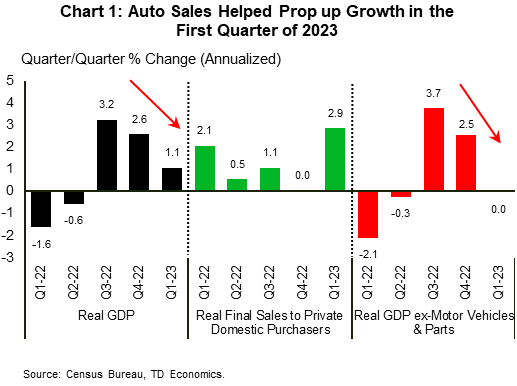
At face value, the acceleration in underlying domestic demand is good news. However, monthly spending data shows that the strength was concentrated in January, with growth flatlining over the next two months. Much of the quarter’s strength came from auto sales. Unit auto sales grew from 14.3 million (annualized) at the end of 2022, to 15.3 million in 2023 Q1, resulting in a 1.1 (pp) contribution to GDP. If we remove that impact, the rest of the economy recorded zero growth (Chart 1). While our forecast calls for motor vehicles sales to remain at a high level over the near-term, as pent-up demand is satiated by improved production (see here), this channel is unlikely to offer the same level of support in 2023 Q2.
Residential investment remained a growth detractor for the eight consecutive quarter, but its negative impact moderated noticeably as average declines of 26% q/q in the second half of 2022 eased to 4.2% q/q in 2023 Q1. We expect residential investment to be less of a drag this year, a message echoed by some moderate positive signals out of the housing market. New home sales, a volatile series, continue to trend up since the end of last year, rising 9.6% month-on-month in March. This is happening as tight supply conditions on the existing home market look to be driving some more action towards the new home market. That said, with housing affordability still exceptionally low, buyers are showing increased sensitivity to mortgage rates (though with the typical lag). An index tracking the number of contracts signed to purchase existing homes, a reliable indicator of closed sales, fell 5.2% in March amidst an uptrend in mortgage rates earlier in the month. The stress in regional banking is also likely to have contributed to the hesitation among buyers to sign housing contracts.
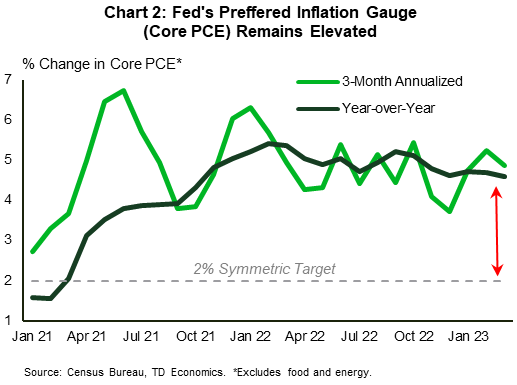
In weighing the Fed’s next interest rate decision, the latest PCE report showed that the Fed’s preferred inflation gauge remained elevated in March. While overall PCE slowed noticeably to 4.2% year-on-year (y/y), from 5.1% in the month prior, core PCE eased only modestly to 4.6% y/y (Chart 2). In our view, core PCE inflation has a long way to return to target (see here). As such, we expect the Fed to hike by 25 basis points next week and keep the policy rate at that high level through the end of the year.
Canada – Prepare for Landing
In anticipation of this week's marquee release of industry-based GDP, Canadian financial markets were largely occupied with first quarter corporate earnings reports. The S&P/TSX Composite remained 0.6% weaker on the week at the time of writing, despite a sizeable end of week rebound.
Meanwhile, February's GDP print came in at 0.1% month-on-month (m/m) – weaker than 0.2% m/m expected by the consensus and Statistics Canada's own flash estimate of 0.3% m/m. With today's reading and the flash estimate of -0.1% m/m for March, first quarter GDP is tracking at a rate of 2.5% quarter-on-quarter (q/q) annualized. This is a touch stronger than 2.3% q/q pace the BoC was expecting in its April Monetary Policy Report. Underneath the surface, the major contributor to growth came from residential building construction, which expanded by 0.3% on the month (Chart 1). The public sector, which includes health care and social assistance, public administration, and educational services, was 0.2% higher on the month, clocking in its impressive thirteenth consecutive month of growth.
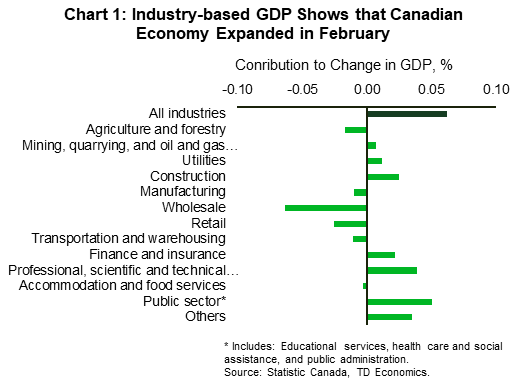
Offsetting these gains was a decline in manufacturing, transportation & warehousing, as well as retail and wholesale trade. The contraction in trade alone shaved one tens of a percentage points off the headline number, which reiterates our expectation of slowing in household consumption expenditure. According to our internal spend data, services spending growth already shows early signs of moderation, which should help bring down consumption growth to around 1% in 2023 Q2, as higher financing costs continue to work their way through the economy.
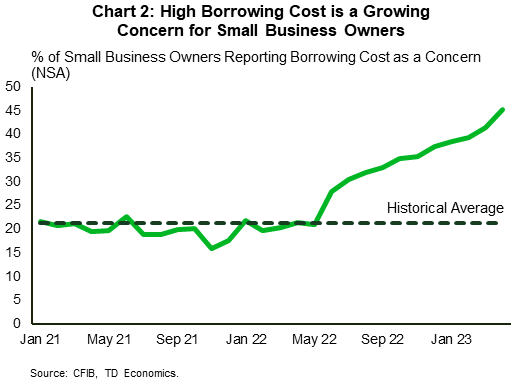
That said, continued fiscal support and robust population growth could buttress demand beyond our current expectations. We estimate that combined new federal and provincial fiscal measures amount to 0.9% of Canadian GDP this year. Notably, government capital spending could boost business investment as private enterprises pull back on investment intentions due to rising costs of borrowing and tighter credit standards. According to April's CFIB small business barometer, 44% of business owners report this as a concern – more than twice the historical average (Chart 2). Another area of concern is rising wage costs, with 68% of business owners identifying it as an impediment to their business and 44% expecting average wage growth to be higher than 3%.
Private enterprises are not the only ones facing wage pressures. This week was marked by a continuation of one of the largest job actions in Canadian history, with more than 100k federal employees on strike. Depending on its duration, we expect it to shave between 0.2 and 0.9 percentage points off monthly GDP growth. But this decline will be reversed in the subsequent periods, with the overall impact being neutral. All in all, "slow but positive growth" remains the most likely scenario for the Canadian economy. Still, we recommend remaining seated with your seat belt fastened as the economy prepares for a soft landing.