Sample Category Title
AUD/USD Daily Report
Daily Pivots: (S1) 0.6653; (P) 0.6688; (R1) 0.6728; More...
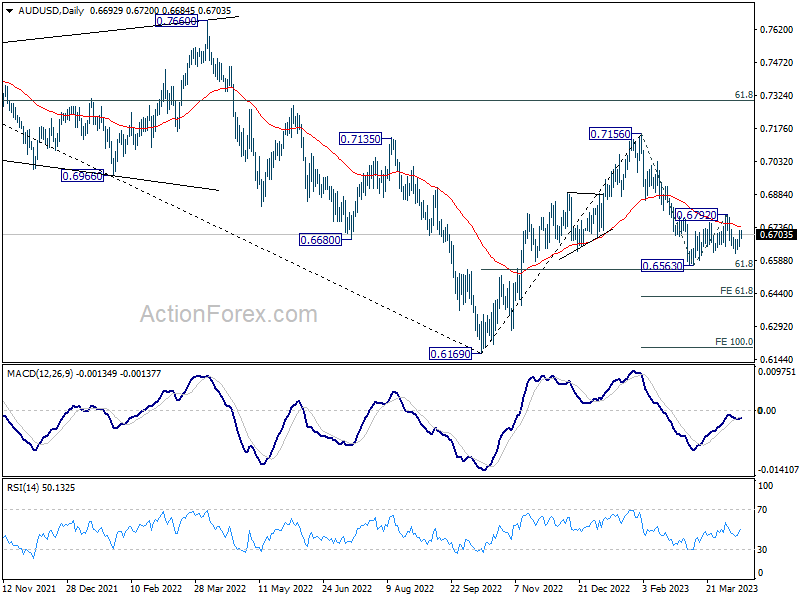
AUD/USD's recovery from 0.6619 continues today but stays well below 0.6792 resistance. Intraday bias remains neutral for the moment. Risk stays on the downside with 0.6792 resistance intact. Below 0.6619 will bring retest of 0.6563 low first. sustained break of 0.6563 support will resume the decline from 0.7156 to 61.8% projection of 0.7156 to 0.6563 from 0.6792 at 0.6426.
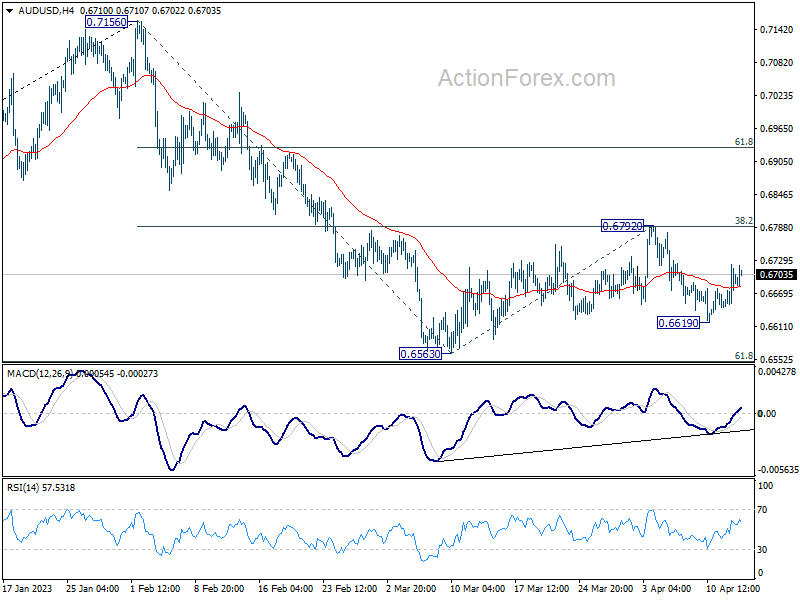
In the bigger picture, as long as 61.8% retracement of 0.6169 to 0.7156 at 0.6546 holds, the decline from 0.7156 is seen as a correction to rally from 0.6169 (2022 low) only. Another rise should still be seen through 0.7156 at a later stage. However, sustained break of 0.6546 will raise the chance of long term down trend resumption through 0.6169 low.
Aussie Lifted Slightly by Job Data, Dollar Loss Limited by Hawkish FOMC Minutes
Dollar remains somewhat soft in the Asian trading session, though it hasn't seen any follow-through selling. Hawkish FOMC minutes have partially offset the impact of consumer inflation data on the currency. The broader financial markets also lack a clear direction, as US stock indexes closed lower after initial rally. Benchmark treasury yields mostly reversed their initial losses, while gold remains above 2000 level but struggles to break through recent high. Market participants will look for further guidance from upcoming data to adjust their expectations of Fed rate path, as Fed fund futures continue to suggest a near 70% chance of another 25 basis point hike in May.
In the currency markets, Australian Dollar is slightly buoyed by stronger-than-expected job data, while Canadian Dollar appears unfazed by BoC's decision to keep interest rates unchanged. Japanese Ten, Swiss Franc, and Euro are today's weaker currencies so far, but most major pairs and crosses are currently confined within yesterday's trading range. For the week, Yen is the worst performer, followed by New Zealand Dollar and US Dollar, while Swiss franc leads, followed by the Euro and Canadian dollar.
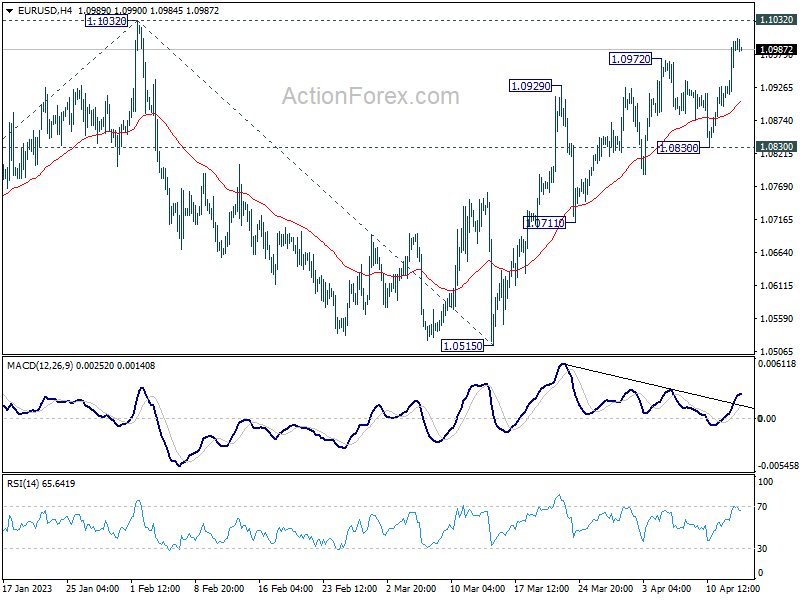
Technically, a key focus remains on the EUR/USD pair's reaction to the 1.1032 resistance level. The currency pair is building upside momentum, as evidenced by the 4H MACD. However, it remains uncertain if this momentum is enough to break through the resistance and resume the larger uptrend from 2022 low at 0.9534. A rejection by 1.1032 followed by break of 1.0830 would signal that the correction pattern from 1.1032 is set to extend with another falling leg, back towards the 1.0515 support level, before eventually staging an upside breakout.
In Asia, at the time of writing, Nikkei is up 0.22%. Hong Kong HSI is down -0.46%. China Shanghai SSE is up 0.02%. Singapore Strait Times is up 0.02%. Japan 10-year JGB yield is up 0.0011 at 0.467. Overnight, DOW dropped -0.11%. S&P 500 dropped -0.41%. NASDAQ dropped -0.85%. 10-year yield dropped -0.013 to 3.421.
FOMC minutes reveal larger rate hike considered, banking developments held back aggressive action
FOMC minutes from the March 21-22 meeting revealed that committee members acknowledged inflation remaining significantly above the 2% target and a tight labor market, suggesting that "additional policy firming may be appropriate." Some participants even considered a 50 basis point increase in the target range, but due to potential banking-sector developments impacting financial conditions and economic activity, they opted for a smaller increment.
The minutes note that several participants contemplated keeping the target range steady to allow more time to assess the economic effects of recent banking-sector developments and the cumulative tightening of monetary policy. However, due to Fed's actions in coordination with other government agencies, which helped stabilize the banking sector, they deemed a 25 basis point increase appropriate in order to address elevated inflation and stay committed to the 2% longer-run goal.
The Committee agreed to consider recent banking developments in future monetary policy decisions, focusing on how they may affect employment, inflation, and the risks surrounding the outlook.
BoJ Ueda emphasizes divergent inflation path in Japan, pledges continued monetary easing
In the G7 central bank chief briefing in Japan, BoJ Governor Kazuo Ueda underscored the unique inflation situation in Japan compared to other countries. While elevated inflation rates are affecting many countries, Japan's price gains are expected to slow down to below 2%, prompting the BoJ to continue its monetary easing policies.
Ueda acknowledged the possibility of Japan falling behind the curve in addressing the risk of high inflation. However, he emphasized the importance of being more focused on the risk of inflation falling short of the 2% target. He stated, "As we guide monetary policy, it is appropriate to pay more attention to the risk of inflation undershooting 2 percent and thus moving away from the goal."
Ueda is set to have his first policy meeting on April 27-28, where he will likely further discuss Japan's distinct inflation trajectory and the country's monetary policy approach.
Australian employment grew solidly by 53k, bolstering case for more RBA tightening
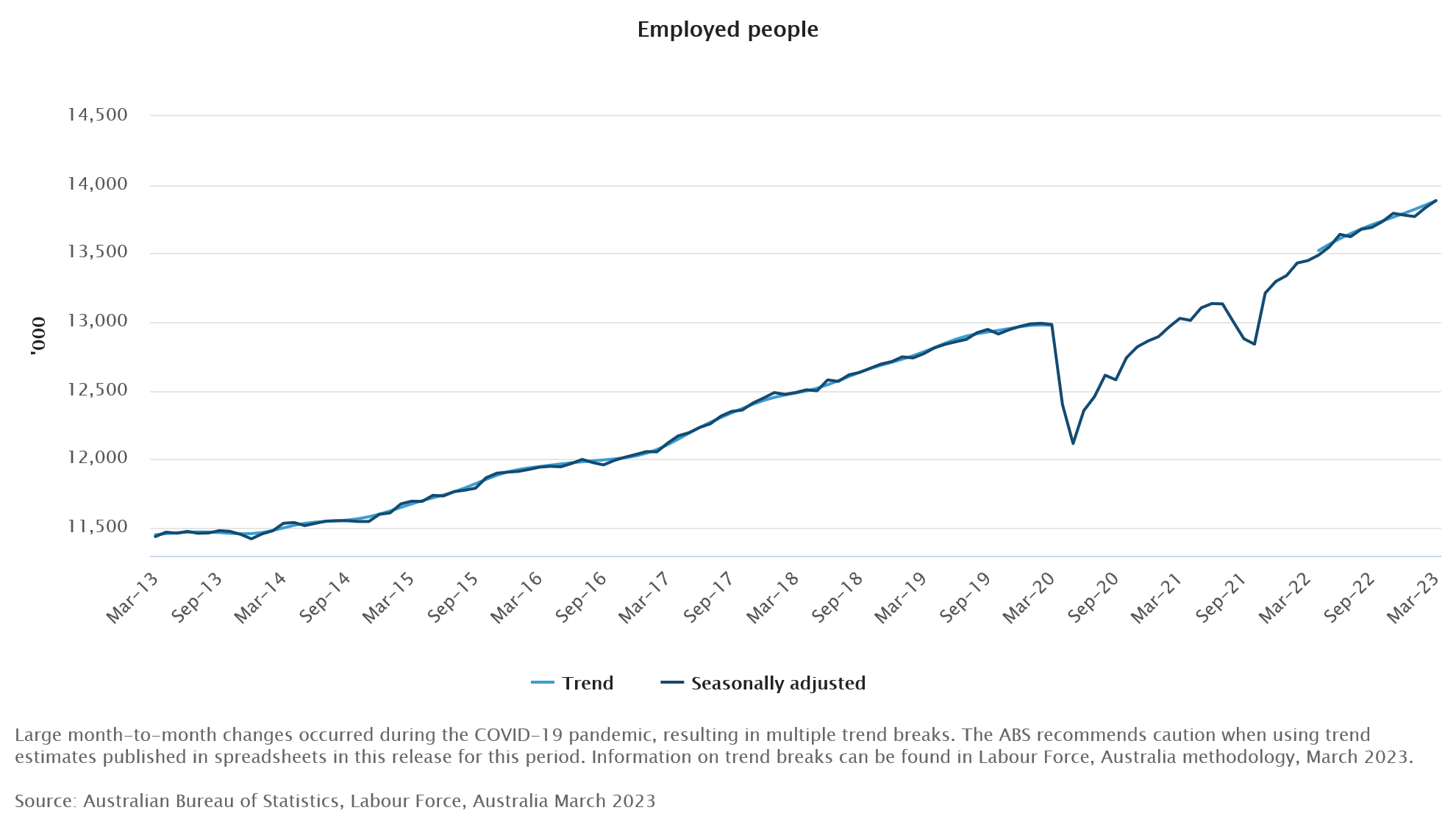
Australian labor market continued to show strength in March, with employment growth significantly outperforming expectations. The strong employment data shows very few signs of weakness in the labor market, suggesting that RBA may need to resume tightening in May.
According to the today's data, employment increased by 53k in seasonally adjusted terms, well above expectation of 20k gain. Full-time jobs saw an increase of 72.2k, while part-time employment declined by -19.2k.
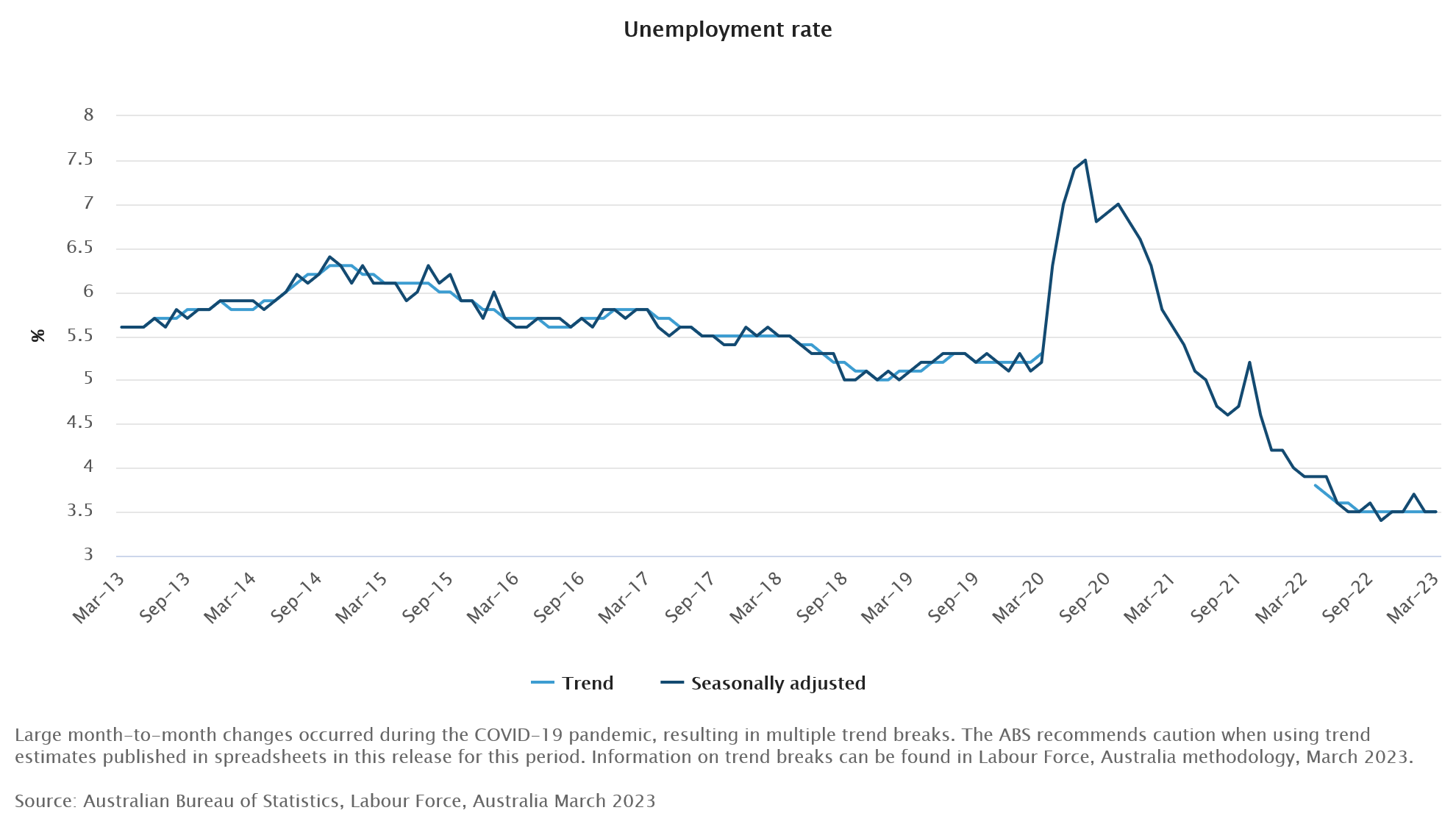
Despite expectations of a rise to 3.6%, unemployment rate remained unchanged at 3.5%. Additionally, the participation rate held steady at 66.7%, and monthly hours worked decreased by -0.2%. Lauren Ford, the ABS head of labor statistics, highlighted that the unemployment rate stayed at a near 50-year low of 3.5%.
Ford also noted that the employment-to-population ratio increased by 0.1 percentage point to 64.4%, with the participation rate remaining at 66.7%. Both indicators were close to their historical highs in November 2022, reflecting a tight labor market that has made it challenging for employers to fill the high number of job vacancies.
Looking ahead
UK GDP is the main feature in European session while production and trade balance will be released too. Eurozone too publish industrial production. Later in the day, US will release PPI and jobless claims.
AUD/USD Daily Report
Daily Pivots: (S1) 0.6653; (P) 0.6688; (R1) 0.6728; More...
AUD/USD's recovery from 0.6619 continues today but stays well below 0.6792 resistance. Intraday bias remains neutral for the moment. Risk stays on the downside with 0.6792 resistance intact. Below 0.6619 will bring retest of 0.6563 low first. sustained break of 0.6563 support will resume the decline from 0.7156 to 61.8% projection of 0.7156 to 0.6563 from 0.6792 at 0.6426.
In the bigger picture, as long as 61.8% retracement of 0.6169 to 0.7156 at 0.6546 holds, the decline from 0.7156 is seen as a correction to rally from 0.6169 (2022 low) only. Another rise should still be seen through 0.7156 at a later stage. However, sustained break of 0.6546 will raise the chance of long term down trend resumption through 0.6169 low.
Economic Indicators Update
| GMT | Ccy | Events | Actual | Forecast | Previous | Revised |
|---|---|---|---|---|---|---|
| 23:50 | JPY | Money Supply M2+CD Y/Y Mar | 2.60% | 2.50% | 2.60% | |
| 01:30 | AUD | Employment Change Mar | 53.0K | 20.0K | 64.6K | 63.6K |
| 01:30 | AUD | Unemployment Rate Mar | 3.50% | 3.60% | 3.50% | |
| 03:00 | CNY | Trade Balance (USD) Mar | 88.2B | 40.0B | 116.9B | |
| 03:00 | CNY | Exports Y/Y Mar | 14.80% | 3.10% | -6.80% | |
| 03:00 | CNY | Imports Y/Y Mar | -1.40% | 3.90% | -10.20% | |
| 06:00 | EUR | Germany CPI M/M Mar F | 0.80% | 0.80% | ||
| 06:00 | EUR | Germany CPI Y/Y Mar F | 7.40% | 7.40% | ||
| 06:00 | GBP | GDP M/M Feb | 0.10% | 0.30% | ||
| 06:00 | GBP | Index of Services 3M/3M Feb | -0.20% | 0.00% | ||
| 06:00 | GBP | Industrial Production M/M Feb | 0.30% | -0.30% | ||
| 06:00 | GBP | Industrial Production Y/Y Feb | -3.70% | -4.30% | ||
| 06:00 | GBP | Manufacturing Production M/M Feb | 0.30% | -0.40% | ||
| 06:00 | GBP | Manufacturing Production Y/Y Feb | -4.70% | -5.20% | ||
| 06:00 | GBP | Goods Trade Balance (GBP) Feb | -17.0B | -17.9B | ||
| 08:00 | EUR | Italy Industrial Output M/M Feb | 0.50% | -0.70% | ||
| 09:00 | EUR | Eurozone Industrial Production M/M Feb | 1.00% | 0.70% | ||
| 11:00 | GBP | NIESR GDP Estimate (3M) Mar | -0.10% | -0.10% | ||
| 12:30 | USD | PPI M/M Mar | 0.10% | -0.10% | ||
| 12:30 | USD | PPI Y/Y Mar | 3.10% | 4.60% | ||
| 12:30 | USD | PPI Core M/M Mar | 0.20% | 0.00% | ||
| 12:30 | USD | PPI Core Y/Y Mar | 3.30% | 4.40% | ||
| 12:30 | USD | Initial Jobless Claims (Apr 7) | 235K | 228K | ||
| 14:30 | USD | Natural Gas Storage | 25B | -23B |
Australia March Labour Force: A Sound Update Reflecting the Strength of Labour Supply
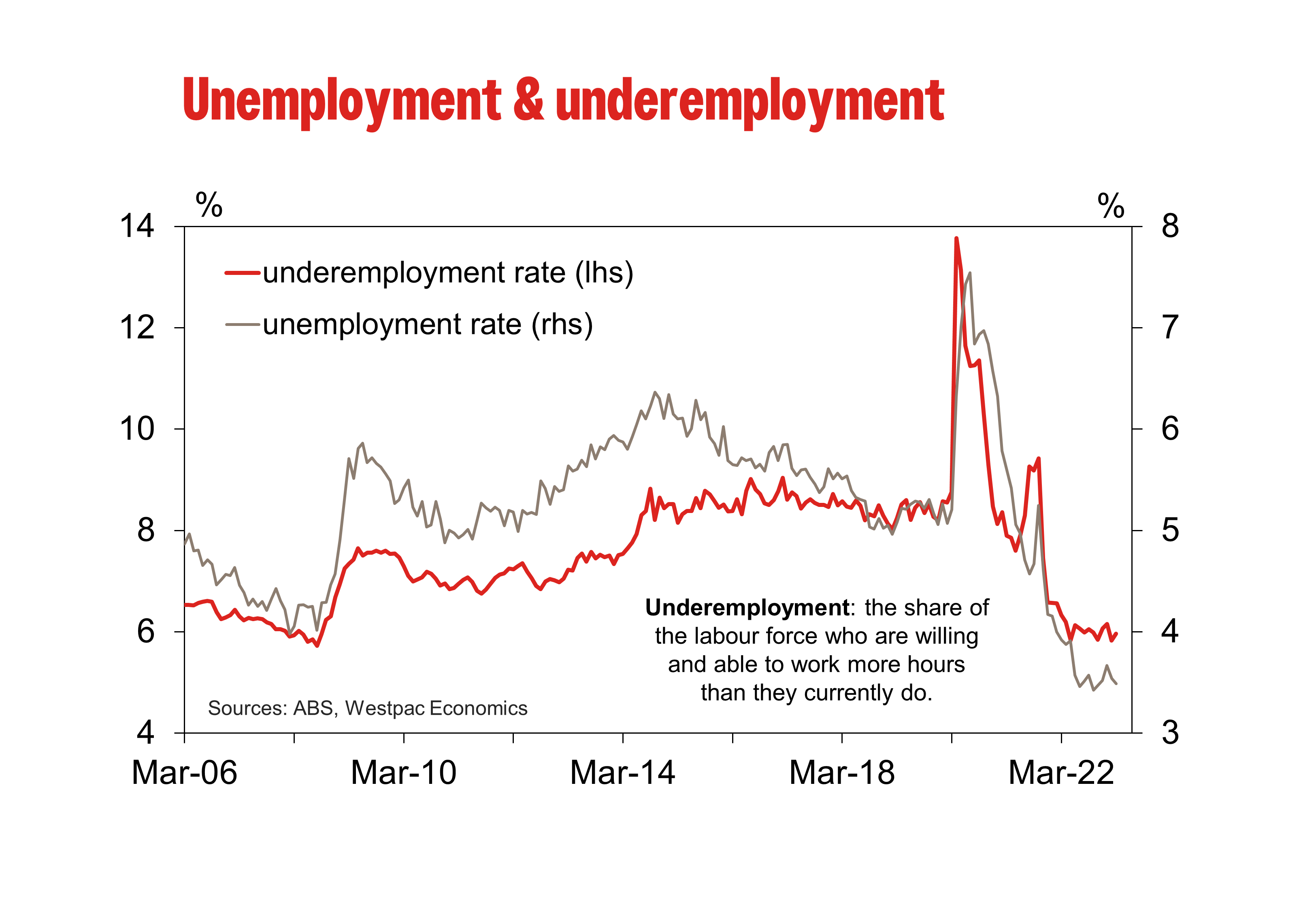
Total employment: +53.0k from +63.6k (revised from +64.6k); unemployment rate: 3.5% from 3.5% (unrevised 3.5%); participation rate: 66.7% from 66.7% (revised from 66.6%). The labour market continues to weather the headwinds facing the broader economy, remaining in robust health.
Total employment gained 53.0k or 0.4% in March following on from a 63.6k gain in February, shifting the three-month average change in employment from 13.3k/mth up to 35.4k/mth. The size of the lift in employment was also enough to lift the employment-to-population ratio to 64.4%, only 0.1ppt shy of the record high that was reached back in November 2022.
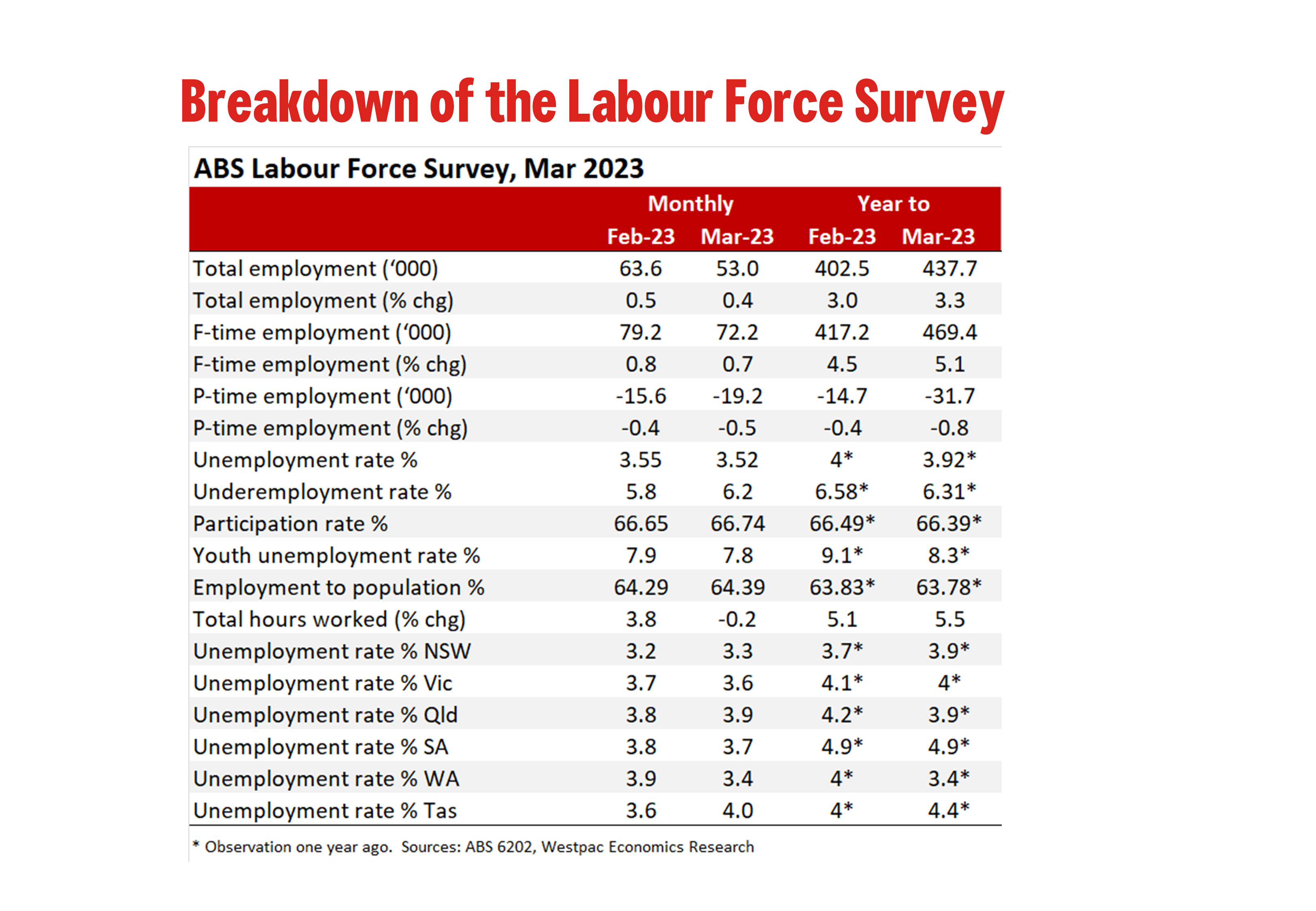
Seasonally adjusted monthly hours worked declined by 0.2% in March, but following on from the 3.8% surge in February – associated with a larger-than-usual number of people returning to work from summer holidays – the gains in hours worked still outstrip that of employment.
While the participation rate held flat at one decimal place (66.7%), it rose 0.9ppt at two decimal places, from 66.65% in February to 66.74% in March, just below November’s historic high of 66.8%. Underemployment – those who are employed and are willing and able to work more hours if offered to them – returned back to 6.2% in March after temporarily dipping in February.
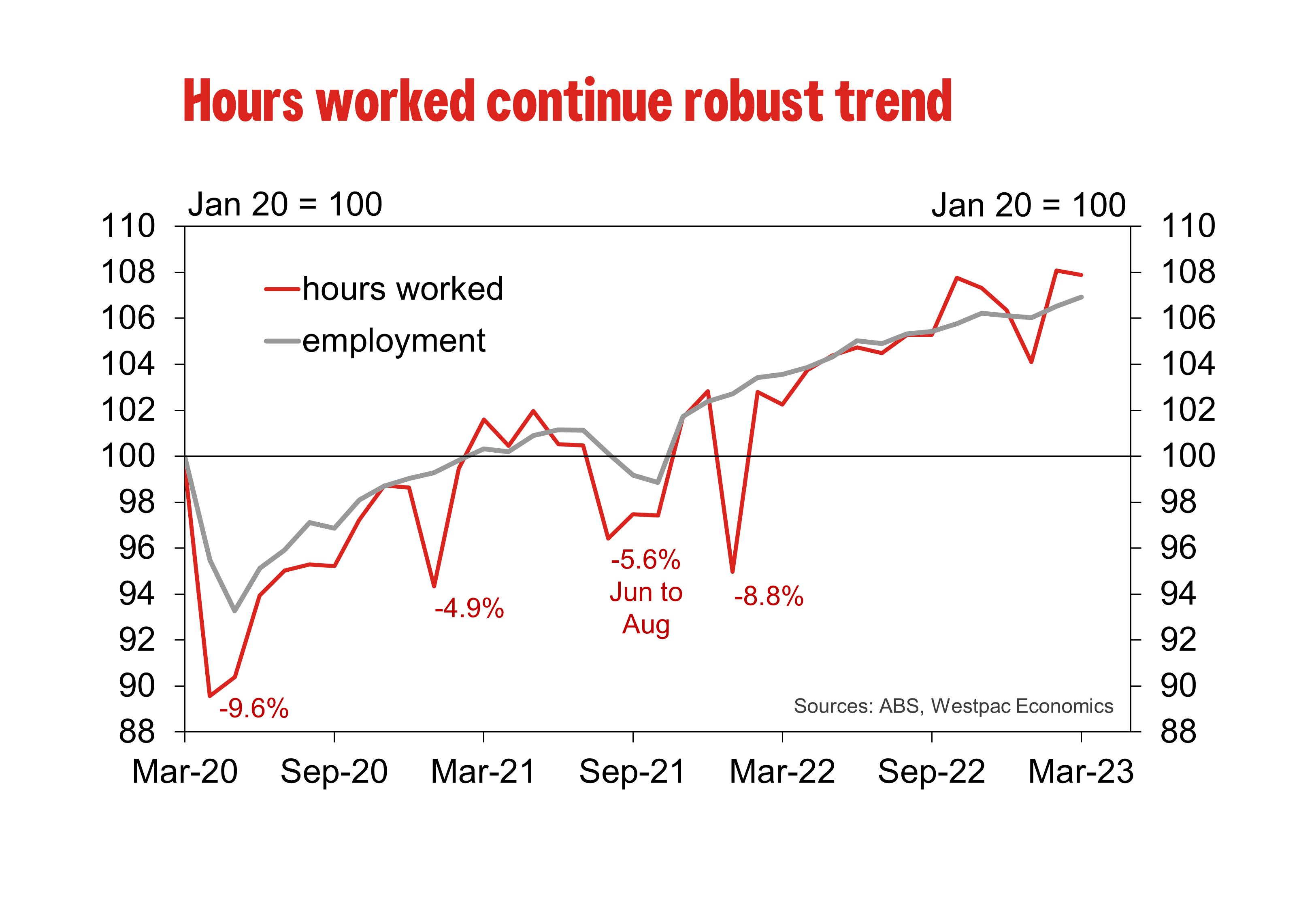
Together, these results suggest that the supply side of the labour market – captured by the strength in labour force participation and individuals’ willingness to work more hours – will remain a supportive factor for the near-term. Indeed, the lift in participation saw the labour force grow by 51.4k, slightly lower than the gain in employment, resulting in the unemployment rate holding at 3.5%, near the cycle-low of 3.4% observed back in October 2022. At two decimal places, the unemployment rate fell by 0.03ppts from 3.55% to 3.52%.
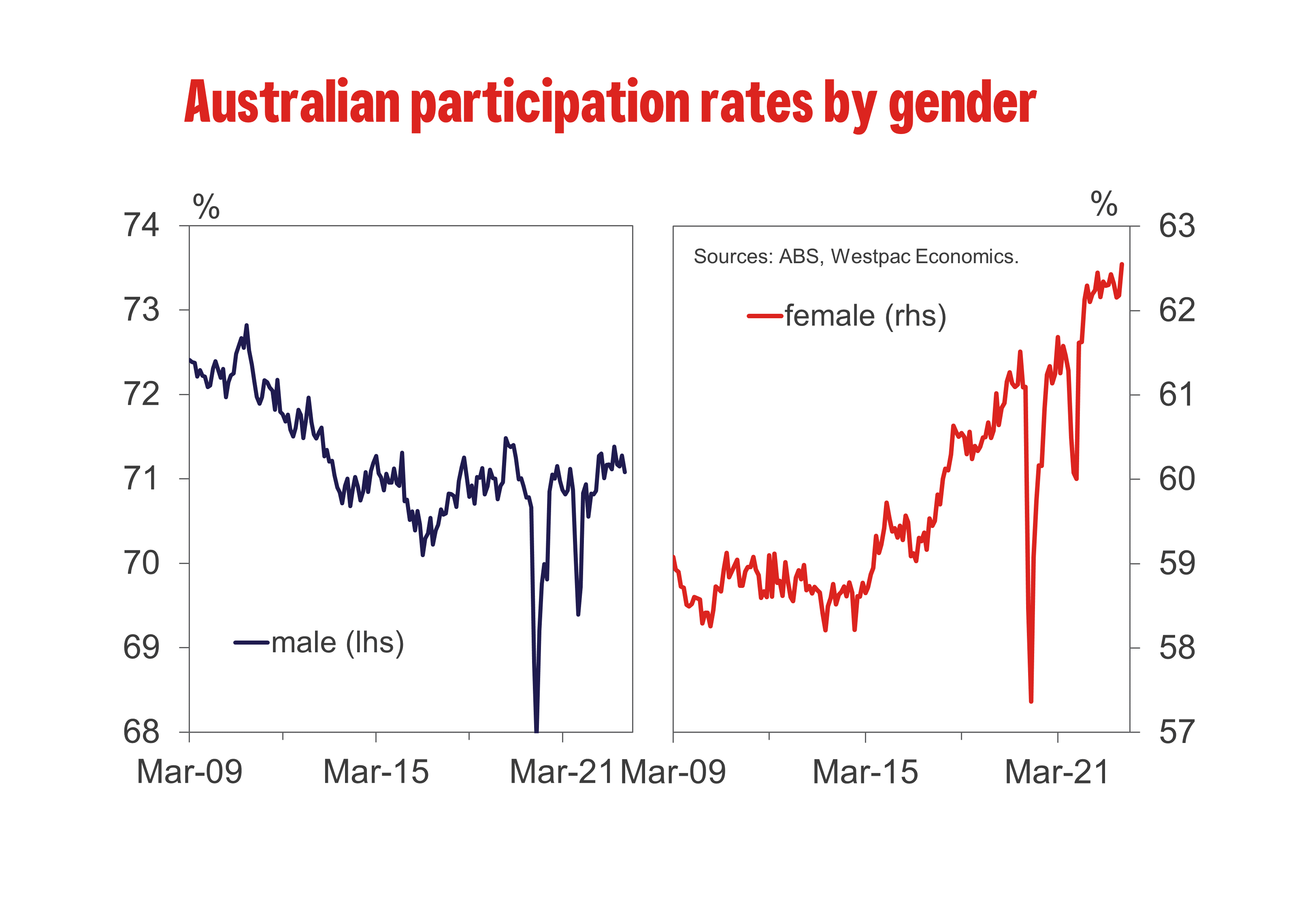
Underlying these results has been a continued outperformance by females in broader labour market outcomes. In March, female participation rose a record high of 62.5%, and with continued strength in employment gains – a lift of 56.3k for females while male employment was effectively flat at –3.3k – the female employment-to-population ratio also rose to a historical high of 60.4%.
As noted above, this reflects a strong supply-side story, with labour force growth for females (+55.6k) clearly outperforming that of males (–4.2k). Consequently, the downtrend in the female unemployment rate remains firmly entrenched, even falling to a fresh record low of 3.4%, while the male unemployment rate remains well off its cycle-low from October.
It is also interesting to note that employment lifted in all states except NSW, which reported a 0.5% decline in the month. Despite lifting 0.1ppts to 3.3%, the unemployment rate in NSW remains well below the national average. Qld also saw a lift in the unemployment rate (+0.1ppt to 3.9%), but declines were evident across Vic (3.6%), SA (3.7%) and WA (3.4%).
Overall, the March report presented a sound update on the labour market. Businesses’ appetite for new workers remains robust, in line with the growth in labour supply, but we continue to expect labour market outcomes will soften more clearly into the second half of this year.
Australian employment grew solidly by 53k, bolstering case for more RBA tightening
Australian labor market continued to show strength in March, with employment growth significantly outperforming expectations. The strong employment data shows very few signs of weakness in the labor market, suggesting that RBA may need to resume tightening in May.
According to the today's data, employment increased by 53k in seasonally adjusted terms, well above expectation of 20k gain. Full-time jobs saw an increase of 72.2k, while part-time employment declined by -19.2k.
Despite expectations of a rise to 3.6%, unemployment rate remained unchanged at 3.5%. Additionally, the participation rate held steady at 66.7%, and monthly hours worked decreased by -0.2%. Lauren Ford, the ABS head of labor statistics, highlighted that the unemployment rate stayed at a near 50-year low of 3.5%.
Ford also noted that the employment-to-population ratio increased by 0.1 percentage point to 64.4%, with the participation rate remaining at 66.7%. Both indicators were close to their historical highs in November 2022, reflecting a tight labor market that has made it challenging for employers to fill the high number of job vacancies.
BoJ Ueda emphasizes divergent inflation path in Japan, pledges continued monetary easing
In the G7 central bank chief briefing in Japan, BoJ Governor Kazuo Ueda underscored the unique inflation situation in Japan compared to other countries. While elevated inflation rates are affecting many countries, Japan's price gains are expected to slow down to below 2%, prompting the BoJ to continue its monetary easing policies.
Ueda acknowledged the possibility of Japan falling behind the curve in addressing the risk of high inflation. However, he emphasized the importance of being more focused on the risk of inflation falling short of the 2% target. He stated, "As we guide monetary policy, it is appropriate to pay more attention to the risk of inflation undershooting 2 percent and thus moving away from the goal."
Ueda is set to have his first policy meeting on April 27-28, where he will likely further discuss Japan's distinct inflation trajectory and the country's monetary policy approach.
FOMC minutes reveal larger rate hike considered, banking developments held back aggressive action
FOMC minutes from the March 21-22 meeting revealed that committee members acknowledged inflation remaining significantly above the 2% target and a tight labor market, suggesting that "additional policy firming may be appropriate." Some participants even considered a 50 basis point increase in the target range, but due to potential banking-sector developments impacting financial conditions and economic activity, they opted for a smaller increment.
The minutes note that several participants contemplated keeping the target range steady to allow more time to assess the economic effects of recent banking-sector developments and the cumulative tightening of monetary policy. However, due to Fed's actions in coordination with other government agencies, which helped stabilize the banking sector, they deemed a 25 basis point increase appropriate in order to address elevated inflation and stay committed to the 2% longer-run goal.
The Committee agreed to consider recent banking developments in future monetary policy decisions, focusing on how they may affect employment, inflation, and the risks surrounding the outlook.
USD/CHF Nosedives As US CPI Cools Down To 5%
Key Highlights
- USD/CHF declined heavily from the 0.9120 resistance zone.
- It traded below a key bullish trend line with support near 0.9050 on the 4-hour chart.
- EUR/USD gained bullish momentum and traded to a new monthly high above 1.0975.
- Crude oil prices also broke the $81.60 resistance and climbed further higher.
USD/CHF Technical Analysis
The US Dollar started a fresh decline after it failed to surpass 0.9120 against the Swiss Franc. USD/CHF declined heavily below the 0.9080 and 0.9050 support levels.
Looking at the 4-hour chart, the pair traded gained bearish momentum below the 0.9020 support zone, the 1.0900 resistance, the 100 simple moving average (red, 4 hours), and the 200 simple moving average (green, 4 hours).
Yesterday, the US CPI report was released. There was a drop in the CPI from 6% to 5% in March 2023 (YoY). It sparked bearish moves in USD/CHF and pushed the pair below the 0.8965 support.
The next major support is near the 0.8920 level, below which the pair might test the 0.8900 zone. Any more losses might send the pair toward the 0.8880 level.
On the upside, the pair is now facing resistance near the 0.8980 level. The next key resistance is near the 0.9020 zone. A clear move above the 0.9020 resistance might send the pair toward the 0.9050 zone. Any more gains might send the pair toward 0.9120.
Looking at crude oil prices, there was an upside break above the $81.60 resistance and the price might rise further in the near term.
Economic Releases
- UK GDP for Feb 2023 (MoM) - Forecast +0.1%, versus +0.3% previous.
- German Consumer Price Index for March 2023 (YoY) – Forecast +7.4%, versus +7.4% previous.
- German Consumer Price Index for March 2023 (MoM) – Forecast +0.8%, versus +0.8% previous.
- US Initial Jobless Claims - Forecast 232K, versus 228K previous.
Bitcoin: On the Nature Of Breakdown of Psychological $30K Level
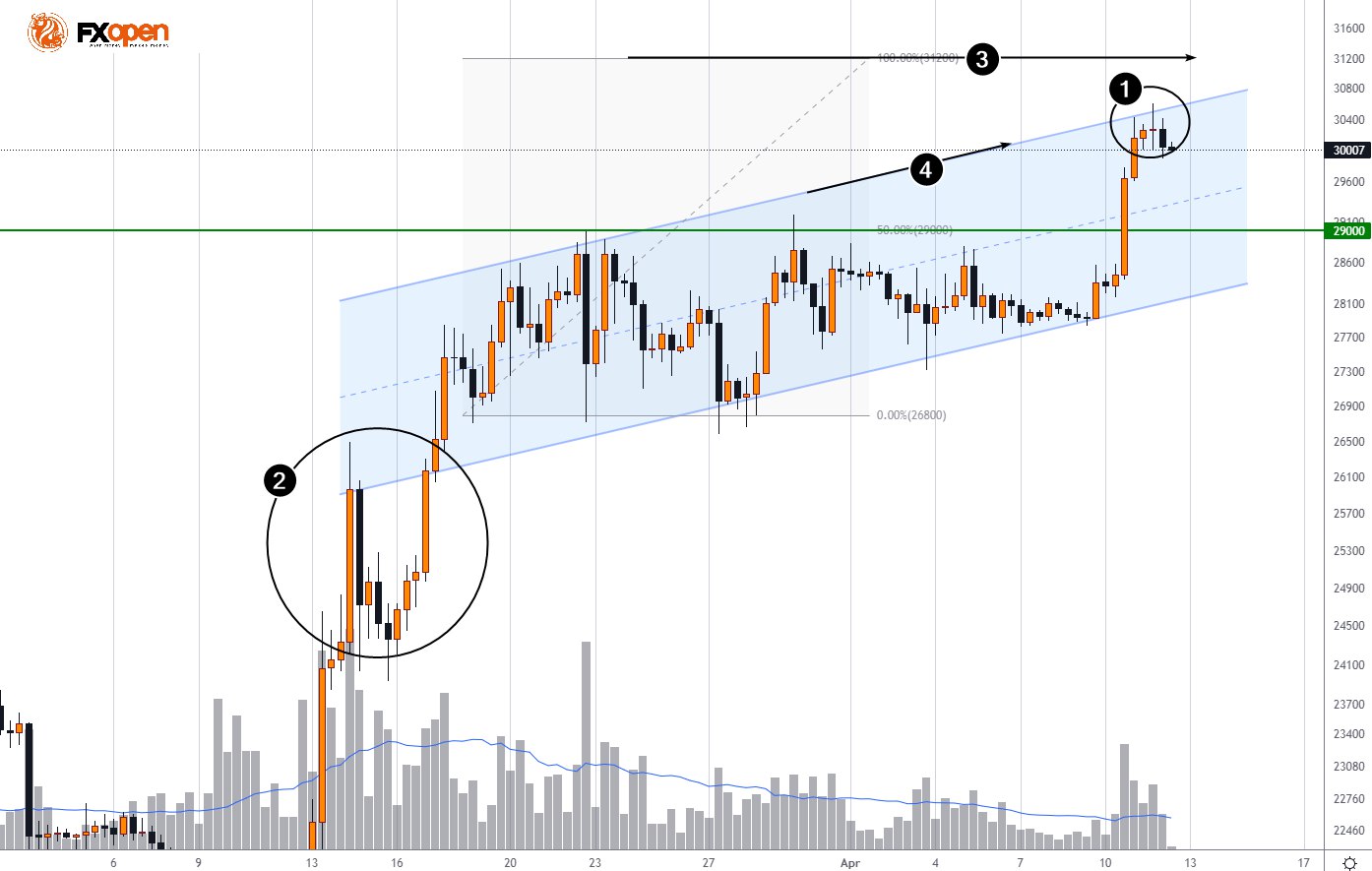
On Tuesday, the price of Bitcoin exceeded $30,000 per coin for the first time since June 2022. The news has become a trend in the media and social networks, community members express opinions that in the future the price of BTC will reach $50,000 and 100,000. How optimistic is the $30,000 breakout?
Judging by its nature (1), buyers are unsure as the length of the candles decreases while the price rises above the psychological level – quite unlike the more aggressive nature of the bullish breakout (2) of the $25k level.
In this regard, the role of resistance levels increases:
3→ is built on the height of the range $26,800-29,000;
4→ is built as the border of the ascending channel.
By the ability to stay on the achieved heights against the backdrop of today's session full of important news, it will be possible to judge the true strength of the bulls.
EURUSD Wave Analysis
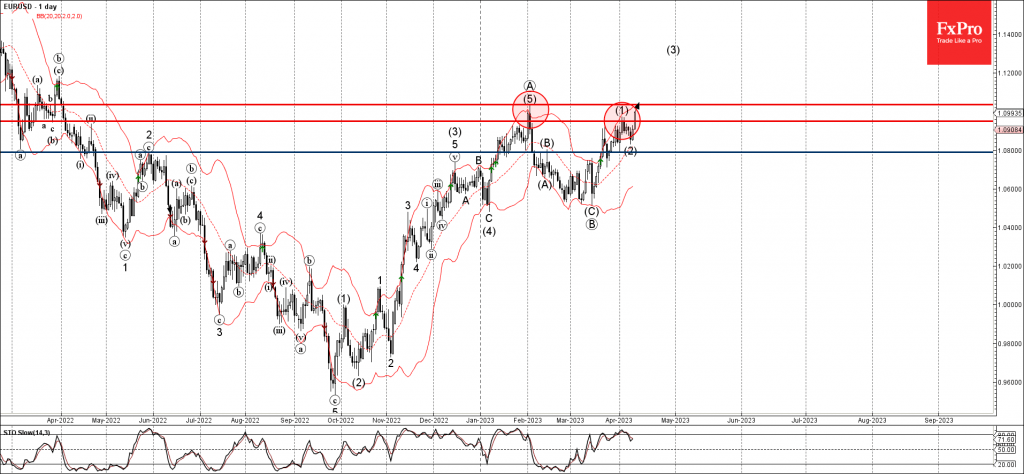
- EURUSD under bullish pressure
- Likely to rise to resistance level 1.1035
EURUSD currency pair under the bullish pressure after the earlier breakout of the resistance level 1.0950 (former top of the previous impulse wave (1) from the end of March).
The breakout of the resistance level continues the active medium-term impulse wave (3) from the start of April.
Given the strong daily uptrend, EURUSD can then be expected to rise further toward the next resistance level 1.1035 (former multi-month high from February).
EURJPY Wave Analysis
- EURJPY broke resistance area
- Likely to rise to resistance level 147.00
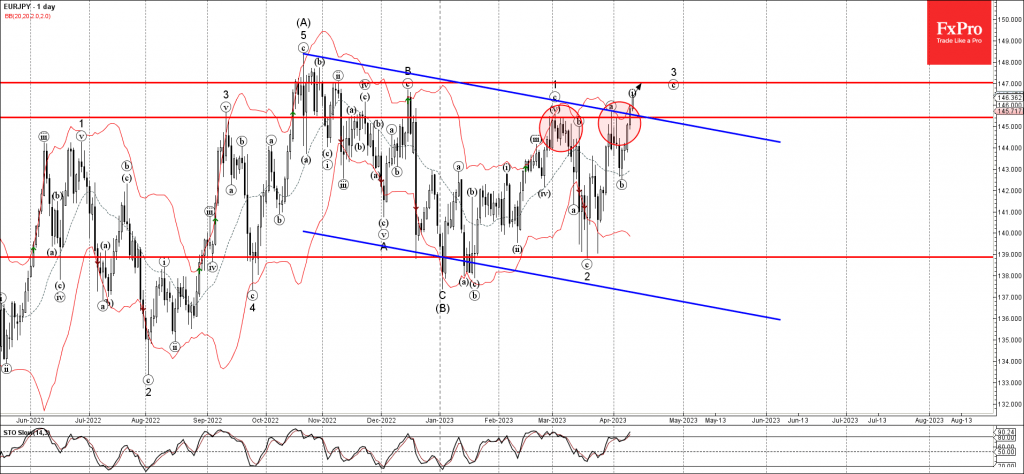
EURJPY recently broke the resistance area located at the intersection of the resistance level 145.40 (former monthly high from March) and the resistance trendline of the wide down channel from October.
The breakout of the resistance area accelerated the active short-term impulse wave 3 of the intermediate impulse wave (C) from January.
EURJPY can then be expected to rise further toward the next resistance level 147.00 (target for the completion of the active impulse wave 3).