

Sample Category Title
Sunset Market Commentary
Markets
FX trading was extremely subdued in the run up to today’s US CPI release. Core bonds continued their post-payrolls drift south with the front end of the curve underperforming. Headline March US CPI eventually slowed from 0.4% M/M to 0.1% M/M (vs 0.2% M/M expected) with the annual figure falling from 6% Y/Y to 5% Y/Y (vs 5.1% Y/Y and lowest since May 2021). Core inflation printed exactly in line with consensus at 0.4% M/M (from 0.5%) and 5.6% Y/Y (from 5.5%; first increase since September 2022). Diving into the numbers shows core services rising by 0.4% M/M to be up 7.1% Y/Y with shelter costs increasing by 0.8% M/M and 8.2% Y/Y. The bigger inflation picture was thus by and large in line with forecasts. However, the market reaction was again quite large. Markets have become extremely sensitive to deviations from consensus, especially to the downside, since the collapse of some regional banks. We’ve seen the same reaction function last week following ISM’s, JOLTS and ADP employment. It led the Fed to drop forward guidance on ongoing rate increases with the March dot plot penciling in a final 25 bps move before pausing to watch how the fallout from the collapse of the likes of SVB would affect the economy. Several Fed governors expect a credit crunch to slow growth and help tackle inflation. Their guestimate is that it could have the effect of 1 to 3 additional 25 bps rate hikes. Tonight’s FOMC Minutes of that meeting could provide more insight on the issue. Our view is still that stubborn core inflation won’t allow the Fed to put its guard down in the inflation battle. Pausing too soon risks becoming the bigger policy mistake, allowing inflation to re-accelerate later on. Anyway, that’s not how markets look at it and we fear the current reaction function will remain the default one in coming weeks/months. US Treasury yields currently lose up to 4 bps at the front end of the curve (2-yr), but they are recovering from intraday lows (>-15 bps). US Treasuries in the process massively outperform German Bunds with Bund yields rising 5.9 bps (30-yr) to 7.8 bps (2-yr). The dollar spiked lower on the release with EUR/USD currently testing the March high at 1.0973. The YTD high at 1.1033 remains out of reach for the moment. The trade-weighted dollar (DXY) changes hands at 101.60, just above the March low at 101.41. EUR/GBP (0.8814) followed the move higher in EUR/USD, exiting the narrow 0.8750-0.88 range for the first time since April. The YTD low at 100.82 is still further away. European stock markets gain around 0.5% with key US indices opening 0.6%-0.8% stronger.
News Headlines
Hungarian inflation barely eased in March, coming down from a 27-year high of 25.4% to 25.2% Y/Y. Monthly dynamics remain very strong, coming in at 0.8% M/M. Food inflation is once again a key driver, registering a 1.5% M/M increase. But excluding that component (amongst other ones) shows no improvement, on the contrary. Core inflation even accelerated from 25.2% to 25.7% with sticky services inflation rising 1.9% M/M or 13% Y/Y. The latter combined with a 16% Y/Y wage dynamic could slow the disinflationary process in coming months. Today’s inflation print gives the central bank no room to cut rates anytime soon. KBC Economics expects the hawkish stance from the NBH to remain with us in the following weeks, making a cut in April unlikely and in May at the very least uncertain. Once started, the O/N tender rate (currently 18%) may be cut at a 100 bps/meeting pace. The Hungarian forint reacted stoic with EUR/HUF trading unchanged at around 375.70. In a broader perspective, the currency had a good run since mid-March, bringing it to around the strongest levels in a year.
Fewer German companies plan to increase prices in the next three months, the ifo Institute’s latest survey finds. For the economy as a whole, price expectations balance fell for a sixth month straight from 29.2 points to 27.2. This compares to a peak/series high of 60.6 points set in April 2022. The current reading is nevertheless markedly higher than the long-term average of 14.3. The easing was broad-based across sectors, with construction and manufacturing taking the lead, trade followed at a distance. Companies in the services sector on the other hand marginally strengthened their price plans again, from 31.7 to 34.7 points.
BoC stands pat, returning inflation to 2% could prove to be more difficult
As widely expected, BoC kept overnight rate unchanged at 4.50%, with Bank Rate and deposit rate held at 4.75% and 4.50% respectively. In the statement, the BoC mentioned that the "Governing Council continues to assess whether monetary policy is sufficiently restrictive to relieve price pressures and remains prepared to raise the policy rate further if needed."
The central bank projects weak GDP growth through the remainder of this year, with a gradual strengthening next year. BoC now expects Canada's economy to grow by 1.4% this year and 1.3% in 2024 before picking up to 2.5% in 2025.
The bank anticipates CPI inflation to fall quickly to around 3% in the middle of this year and then decline more gradually to the 2% target by the end of 2024. "Recent data is reinforcing Governing Council's confidence that inflation will continue to decline in the next few months," the statement noted.
However, BoC also highlighted that returning inflation to 2% "could prove to be more difficult", as inflation expectations are coming down slowly, service price inflation and wage growth remain elevated, and corporate pricing behavior has yet to normalize.
(BOC) Bank of Canada maintains policy rate, continues quantitative tightening
The Bank of Canada today held its target for the overnight rate at 4½%, with the Bank Rate at 4¾% and the deposit rate at 4½%. The Bank is also continuing its policy of quantitative tightening.
Inflation in many countries is easing in the face of lower energy prices, normalizing global supply chains, and tighter monetary policy. At the same time, labour markets remain tight and measures of core inflation in many advanced economies suggest persistent price pressures, especially for services.
Global economic growth has been stronger than anticipated. Growth in the United States and Europe has surprised on the upside, but is expected to weaken as tighter monetary policy continues to feed through those economies. In the United States, recent stress in the banking sector has tightened credit conditions further. US growth is expected to slow considerably in the coming months, with particular weakness in sectors that are important for Canadian exports. Meanwhile, activity in China's economy has rebounded, particularly in services. Overall, commodity prices are close to their January levels. The Bank's April Monetary Policy Report (MPR) projects global growth of 2.6% this year, 2.1% in 2024, and 2.8% in 2025.
In Canada, demand is still exceeding supply and the labour market remains tight. Economic growth in the first quarter looks to be stronger than was projected in January, with a bounce in exports and solid consumption growth. While the Bank's Business Outlook Survey suggests acute labour shortages are starting to ease, wage growth is still elevated relative to productivity growth. Strong population gains are adding to labour supply and supporting employment growth while also boosting aggregate consumption. Housing market activity remains subdued.
As more households renew their mortgages at higher rates and restrictive monetary policy works its way through the economy more broadly, consumption is expected to moderate this year. Softening foreign demand is expected to restrain exports and business investment. Overall, GDP growth is projected to be weak through the remainder of this year before strengthening gradually next year. This implies the economy will move into excess supply in the second half of this year. The Bank now projects Canada's economy to grow by 1.4% this year and 1.3% in 2024 before picking up to 2.5% in 2025.
CPI inflation eased to 5.2% in February, and the Bank's preferred measures of core inflation were just under 5%. The Bank expects CPI inflation to fall quickly to around 3% in the middle of this year and then decline more gradually to the 2% target by the end of 2024. Recent data is reinforcing Governing Council's confidence that inflation will continue to decline in the next few months. However, getting inflation the rest of the way back to 2% could prove to be more difficult because inflation expectations are coming down slowly, service price inflation and wage growth remain elevated, and corporate pricing behaviour has yet to normalize. As it sets monetary policy, Governing Council will be particularly focused on these indicators, and the evolution of core inflation, to gauge the progress of CPI inflation back to target.
In light of its outlook for growth and inflation, Governing Council decided to maintain the policy rate at 4½%. Quantitative tightening continues to complement this restrictive stance. Governing Council continues to assess whether monetary policy is sufficiently restrictive to relieve price pressures and remains prepared to raise the policy rate further if needed to return inflation to the 2% target. The Bank remains resolute in its commitment to restoring price stability for Canadians.
Information note
The next scheduled date for announcing the overnight rate target is June 7, 2023. The Bank will publish its next full outlook for the economy and inflation, including risks to the projection, in the MPR on July 12, 2023.
EUR/USD Mid-Day Outlook
Daily Pivots: (S1) 1.0868; (P) 1.0898; (R1) 1.0943; More...
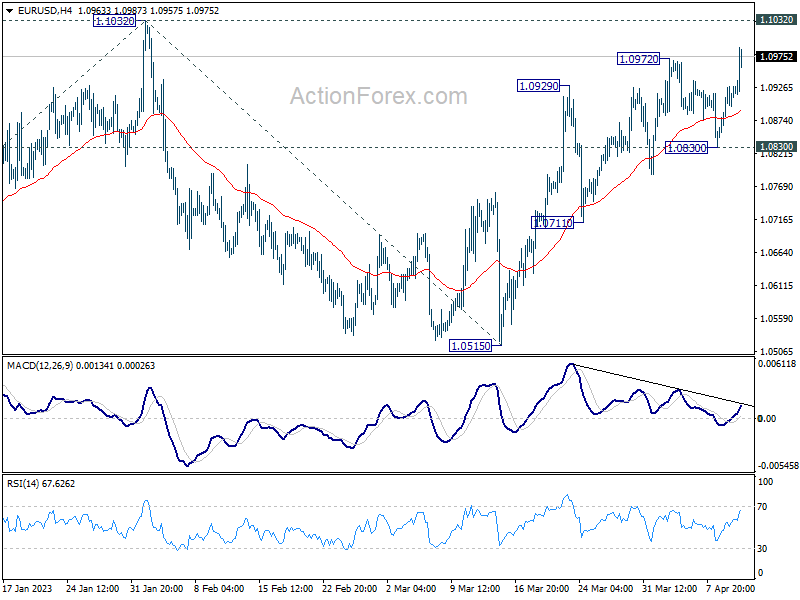
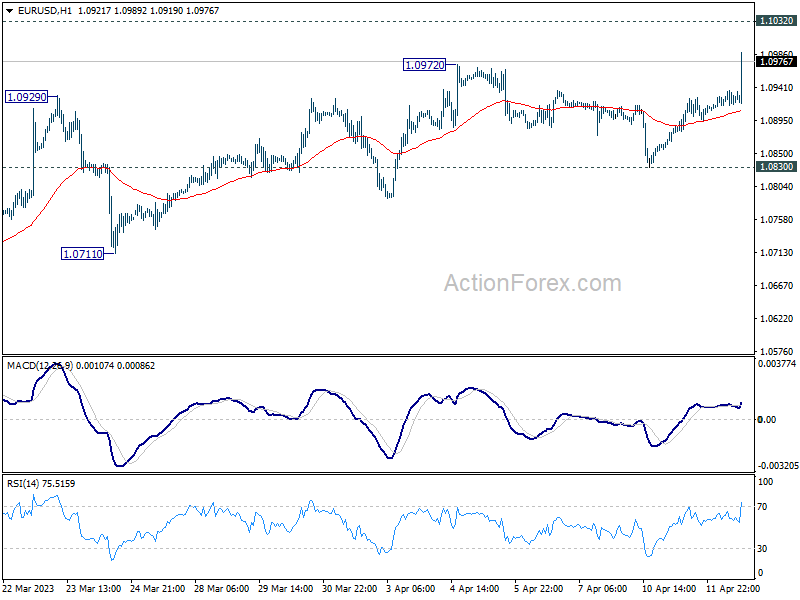
Intraday bias in EUR/USD is back on the upside as rise from 1.0525 resumes by breaking through 1.0972. Further rally should be seen to 1.1032 high. Decisive break there resume larger up trend from 0.9534 to 1.1273 fibonacci level. Nevertheless, break of 1.0830 support will now indicate rejection by 1.1032, and turn bias back to the downside for 1.0711 support and below.
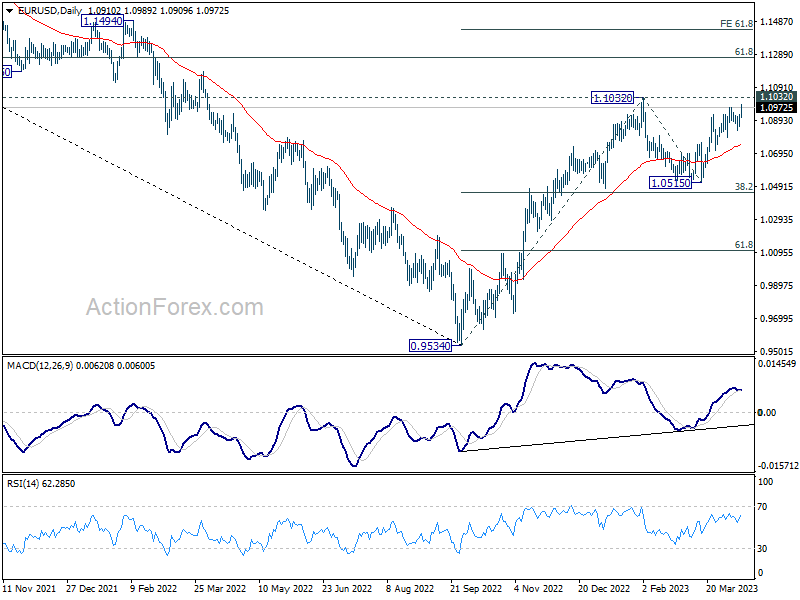
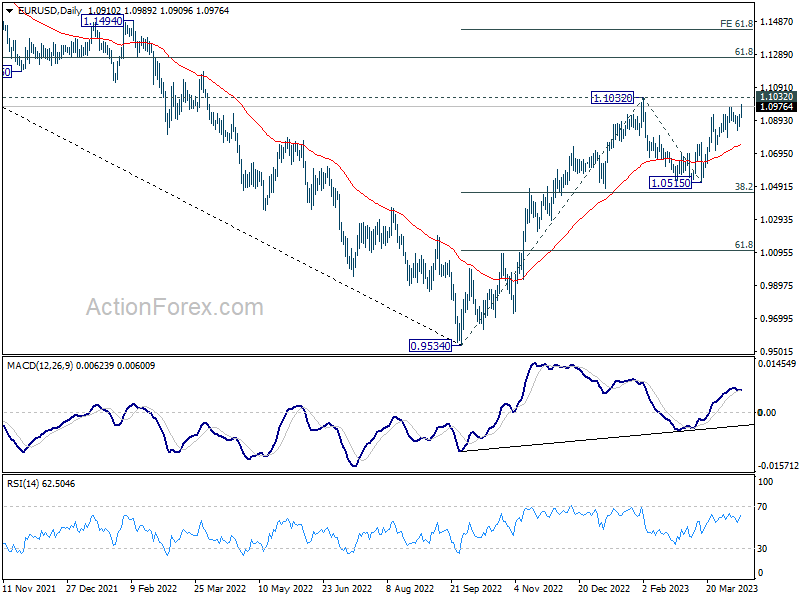
In the bigger picture, rise from 0.9534 (2022 low) is in progress with 38.2% retracement of 0.9534 to 1.1032 at 1.0460 intact. The strong support from 55 week EMA (now at 1.0625) was also a medium term bullish sign. Next target is 61.8% retracement of 1.2348 (2021 high) to 0.9534 at 1.1273. Sustained break there will solidify the case of bullish trend reversal and target 1.2348 resistance next (2021 high).
GBP/USD Mid-Day Outlook
Daily Pivots: (S1) 1.2385; (P) 1.2420; (R1) 1.2461; More...
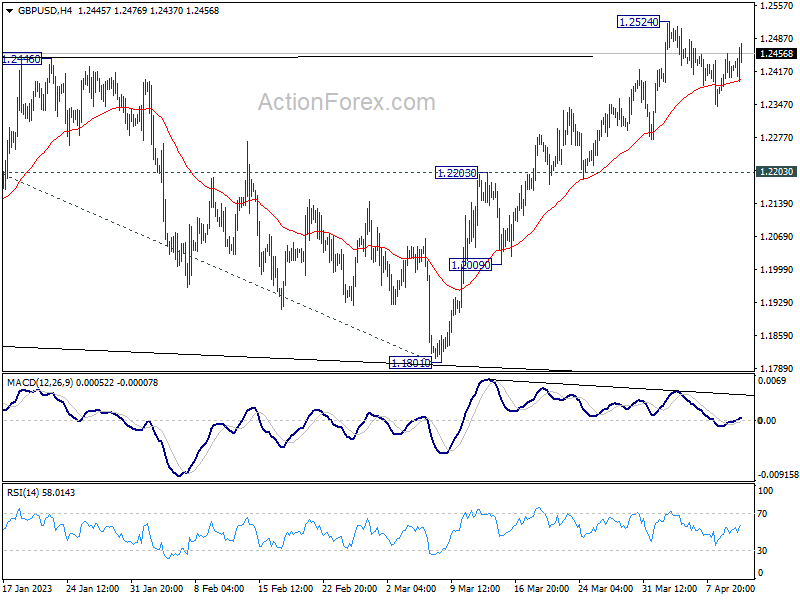
GBP/USD is still bounded in sideway consolidation from 1.2425. Intraday bias stays neutral for the moment. Further rally is expected with 1.2203 resistance turned support intact. On the upside, break of 1.2524 will target 1.2759 fibonacci level first. Firm break there will target 61.8% projection of 1.0351 to 1.2445 from 1.1801 at 1.3095.
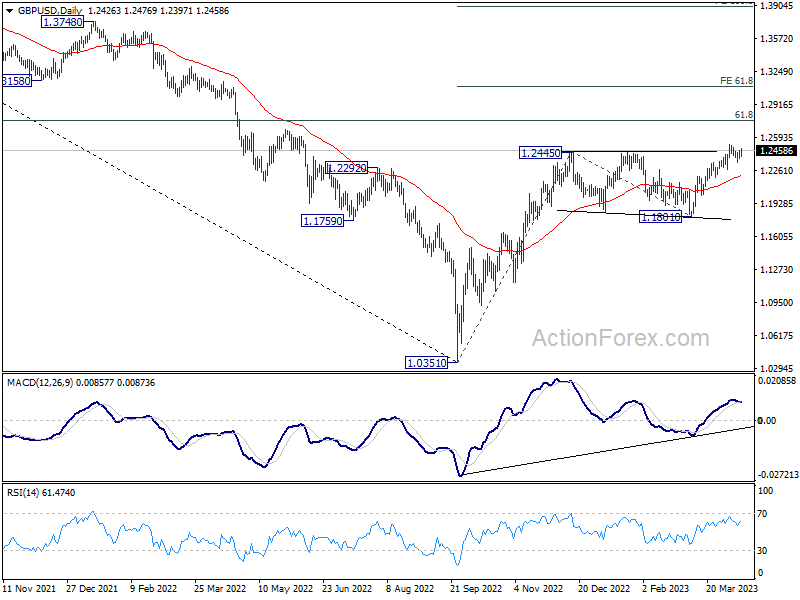
In the bigger picture, the rise from 1.0351 medium term term bottom (2022 low) is in progress for 61.8% retracement of 1.4248 (2021 high) to 1.0351 at 1.2759. Sustained break there will add to the case of long term bullish trend reversal. Further break of 61.8% projection of 1.0351 to 1.2445 from 1.1801 at 1.3095 could prompt upside acceleration to 100% projection at 1.3895. For now, this will remain the favored case as long as 1.1801 support holds, even in case of deep pull back.
USD/JPY Mid-Day Outlook
Daily Pivots: (S1) 133.18; (P) 133.50; (R1) 134.01; More...
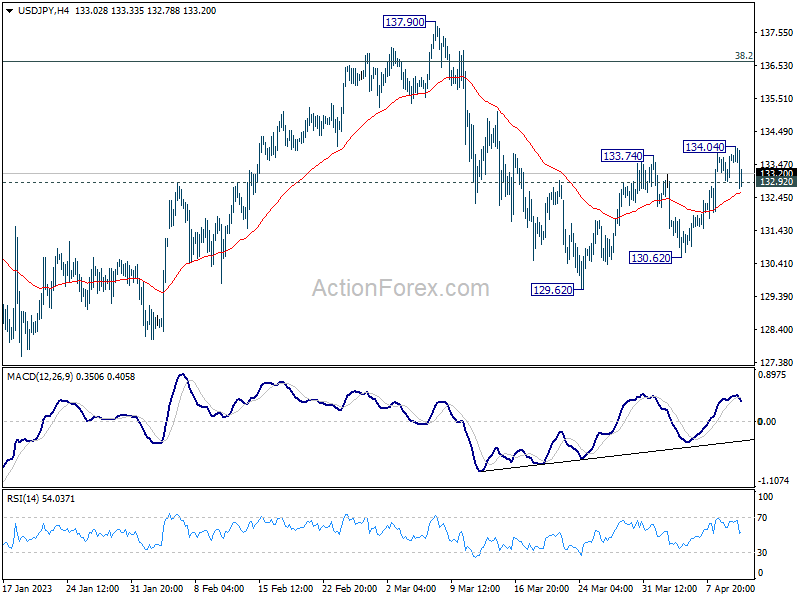
With break of 132.92 minor support, intraday bias in USD/JPY turned neutral again. On the upside, break of 134.04 will resume the rebound from 129.62 towards 137.90 resistance again. On the downside, further break of 130.62 should resume the fall from 137.90 through 129.62 to retest 127.20 low.
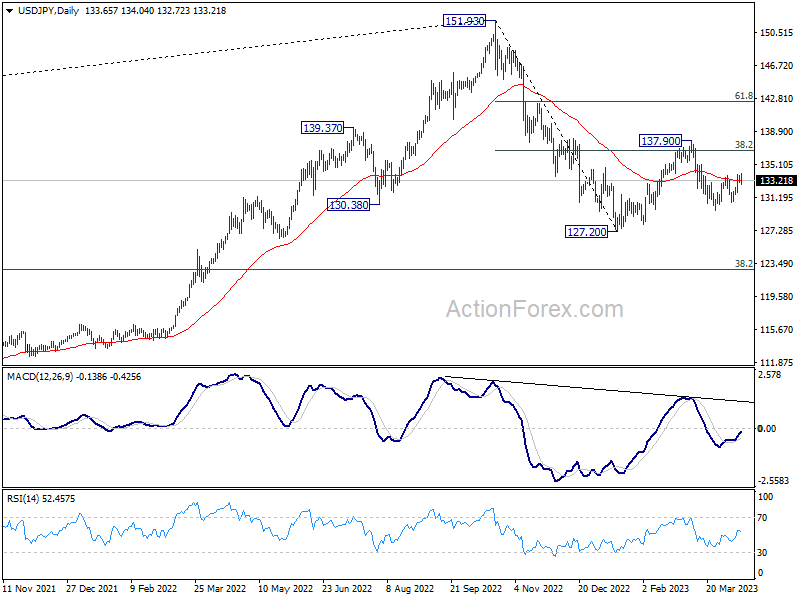
In the bigger picture, corrective pattern from 127.20 might be extending. But after all, down trend from 151.93 is expected to resume at a later stage. Break of 127.20 will resume this down trend and target 61.8% projection of 151.93 to 127.20 from 137.90 at 122.61. This will now be the favored case as long as 137.90 resistance holds.
US March CPI: Glass Half Something
Summary
For the inflation optimists out there, the March CPI report delivered good news with total prices rising by the smallest amount in nine months and hints that core services inflation is starting to moderate. However, for the inflation pessimists, the latest CPI report shows the recent underlying trend in price growth remains far too high, with the core CPI increasing at more than a 5% annualized pace the past three months.
Consumer prices increased just 0.1% in March. Falling prices for energy and flat prices for food helped restrain the increase in the headline index. Excluding food and energy, core consumer prices rose 0.4% in March and 5.6% over the past year.
Core consumer prices continue to grow much faster than the Federal Reserve's target, but we believe slower inflation is coming in the months ahead as the economy cools and finds better balance in a post-pandemic world. We do not think today's report materially changes the outlook for U.S. monetary policy. We still expect a 25 bps rate hike from the FOMC at the conclusion of its next meeting on May 3. Past May, the outlook is increasingly uncertain, but we think the most likely outcome is for the FOMC to keep the federal funds rate steady for an extended period of time.
CPI Posts a Modest Increase in March
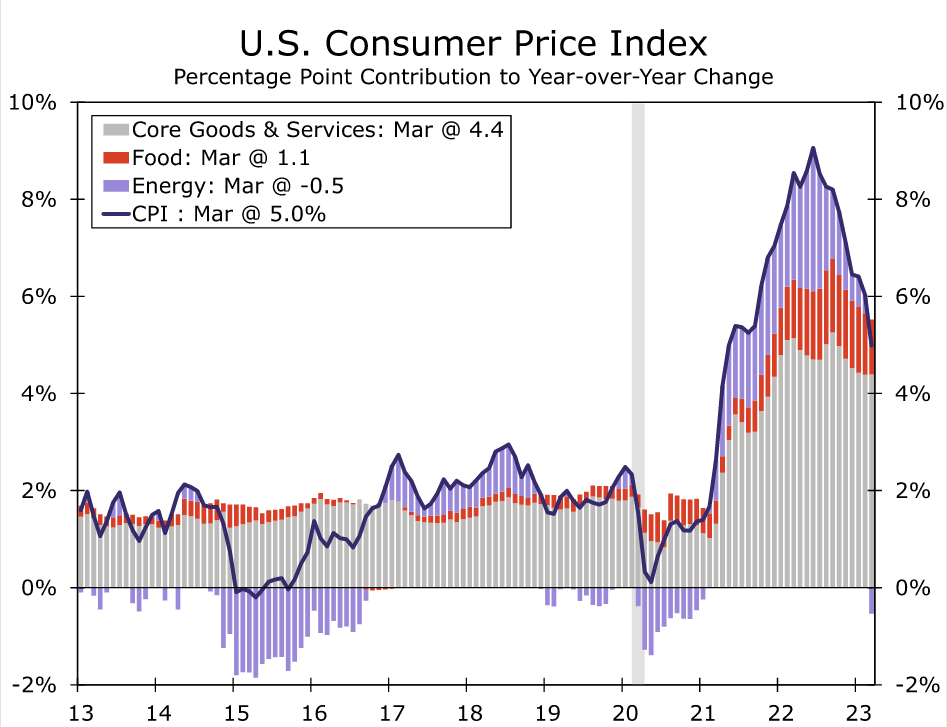
The consumer price index increased just 0.1% (0.05% before rounding) in March, the smallest increase since last July. A reprieve in price growth for frequently purchased necessities—energy and food—held the headline CPI to a more palatable gain and provided consumers a little more wiggle-room in their March budgets. Prices for gasoline declined 4.6% while energy services fell 2.3% last month. With the initial surge in oil prices related to Russia's invasion of Ukraine a full year behind us, energy prices have turned to a drag on the year-over-year rate of inflation (chart). Food inflation also continued to moderate, with a flat reading in March pushing the year-ago rate down to a still burdensome 8.5%. Yet, while there is likely some further scope for energy services and food inflation to ease on a monthly basis in the near-term, the benefit to real incomes from lower gasoline prices is unlikely to carry over to April, as prices at the pump have rebounded in recent weeks. Declining inflation for food and energy have helped push the year-over-year rate of CPI inflation down to 5.0%, the lowest reading since May 2021.
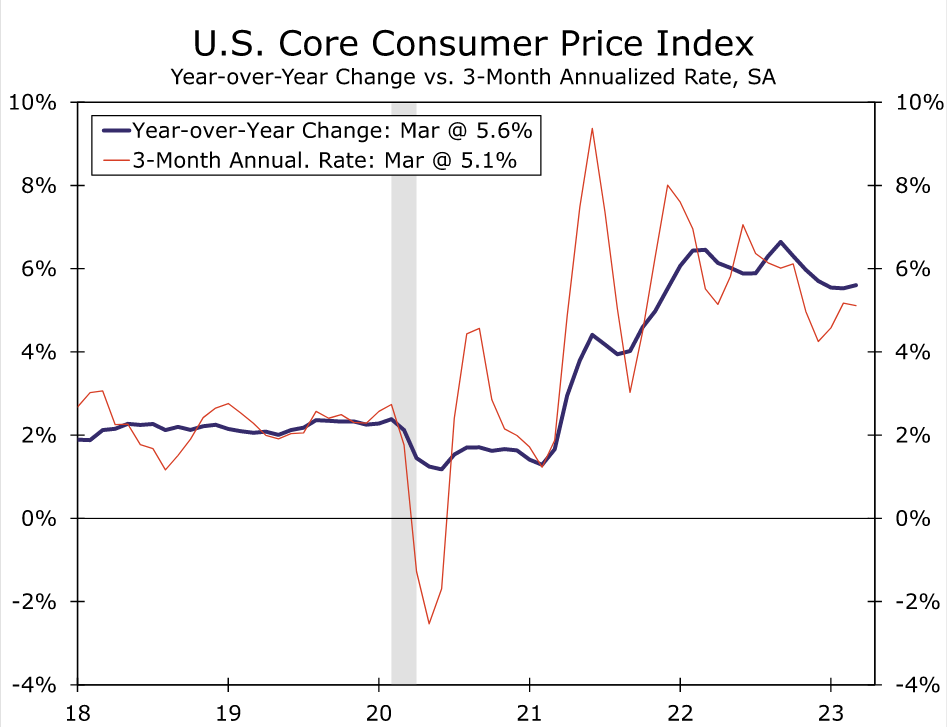
Excluding food and energy, however, inflation remains stubbornly high. Core CPI rose 0.4% in March and ticked up to 5.6% on a year-over-year basis (chart). In a sign that the path to quelling inflation will have some bumps along the way, goods prices, which have been leading the charge on core CPI disinflation, rebounded to 0.2% in March—its largest monthly gain since August. The pop was traced to somewhat firmer vehicle pricing; new vehicles rose by the most in three months, while the 0.9% drop in used vehicle prices was the smallest decline in seven months. Prices for core goods excluding vehicles continued its recent string of strong 0.5% monthly increases.
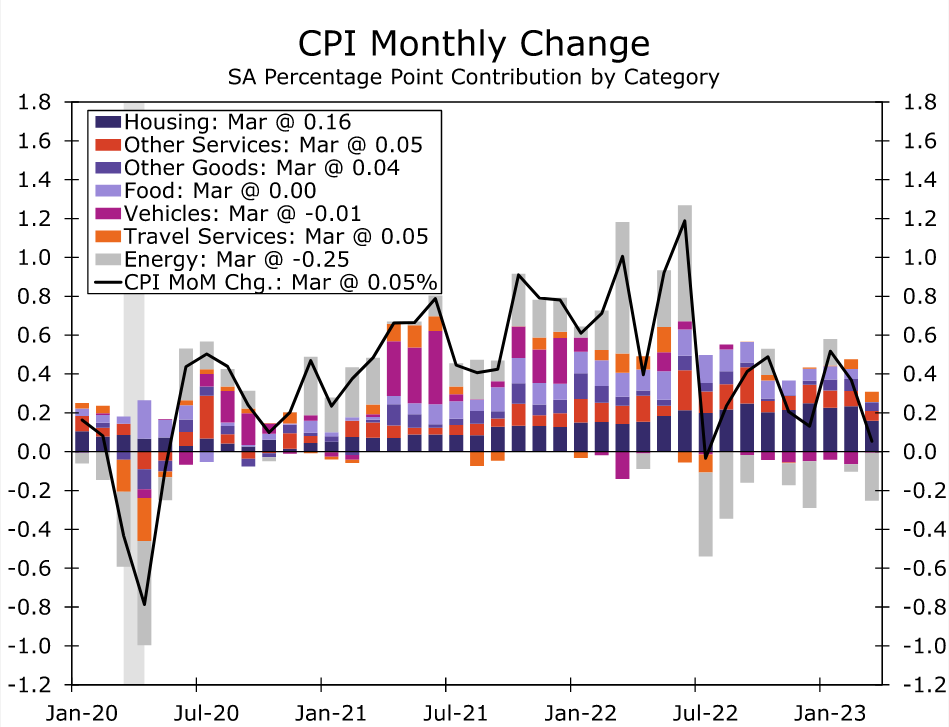
Yet there is a whiff of relief coming on the services side of inflation. Core services prices advanced 0.4% in March, the smallest increase since last July. The much-awaited downward trend in shelter inflation has finally seemed to arrive. Both owners' equivalent rent (OER) and primary rent, which together account for 41% of the core, rose 0.5% after bouncing between monthly gains of 0.6%-0.8% for nearly a year. But softer services prices extended beyond shelter. The CPI equivalent of the Fed's now closely watched "super core", which we define as core services less OER and primary rent, rose 0.3% after 0.5% gains in January and February. Driving the softer print was another decline in medical services along with flat prices for recreational services. In contrast, prices for travel related services climbed 2.5% for a second straight month, fueled by strength in hotel prices (+2.7%) and airfares (+4.0%) in a sign that consumers are still willing to shell out for select discretionary purchases.
One More Rate Hike Coming
The bottom line is that inflation still remains too hot for the Fed's liking. The core CPI has been above 5% on a year-over-year basis for 16 consecutive months, and over the first three months of 2023, core consumer prices have risen at an equally hot 5.1% annualized rate. This is not to say there has been no progress towards taming inflation. Energy prices have outright fallen over the past year, food inflation is slowing and prices for certain goods that surged during the pandemic, such as used vehicles, have declined. But, directional progress should not be confused with mission accomplished. As a result, we expect another 25 bps rate hike from the FOMC at the conclusion of its next meeting on May 3.
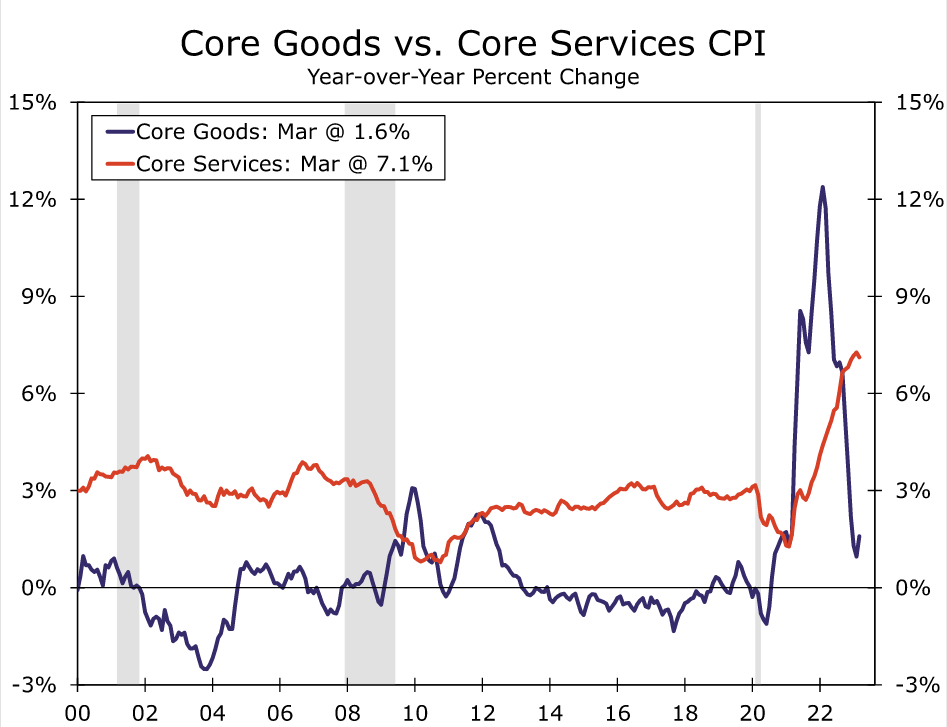
That said, there are forward-looking signs that suggest inflation will slow further in the coming months. Inventories of goods continue to normalize, and the ongoing contraction in the manufacturing sector suggests further softening in goods inflation could be in the offing. Shelter inflation as measured by the CPI has now started to rollover following the sharp deceleration in home prices and rents over the past year. Consequently, shelter's contribution to CPI inflation should retreat as the year progresses. More generally, aggregate demand growth appears to be weakening, and wage growth has moved in a similar direction. Altogether, we think the May 3 rate hike will be the last of the tightening cycle. Our view is that the FOMC will hold the target range for the federal funds rate at 5.00%-5.25% for the foreseeable future in order to assess the effectiveness of their accumulated policy tightening.
USD/CHF Mid-Day Outlook
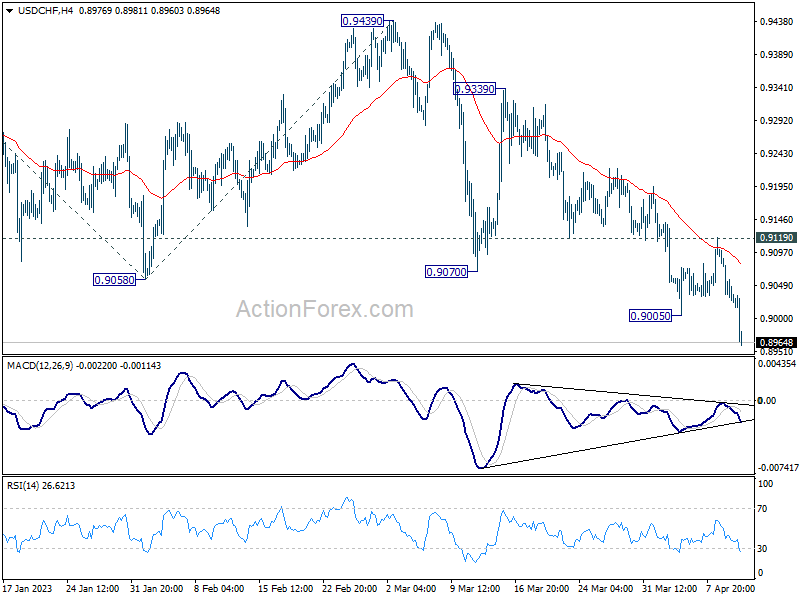
Daily Pivots: (S1) 0.9006; (P) 0.9055; (R1) 0.9081; More...
USD/CHF's strong break of 0.9005 confirms resumption of whole down trend from 1.0146. Intraday bias is back on the downside. Next target is 61.8% projection of 1.0146 to 0.9058 from 0.9439 at 0.8767, which is close to 0.8756 long term support. On the upside, break of 0.9119 resistance is needed to indicate short term bottoming. Otherwise, outlook will remain bearish in case of recovery.
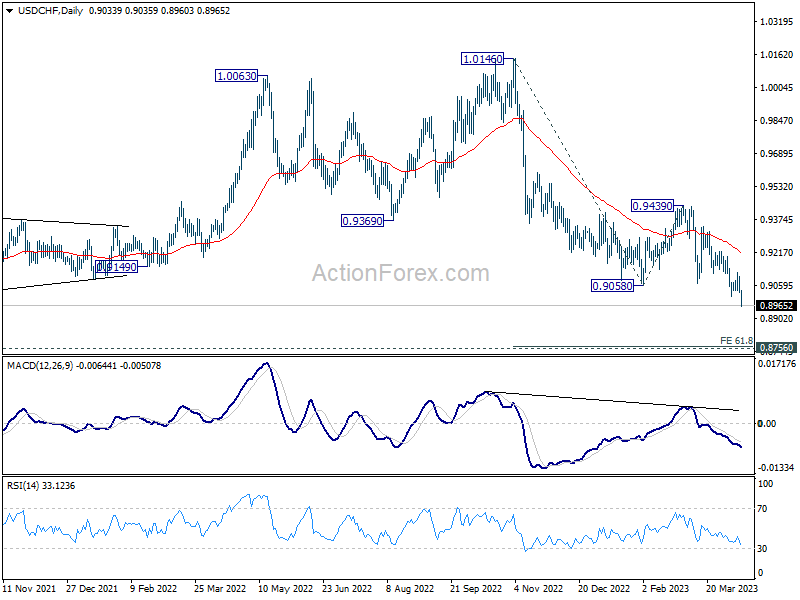
In the bigger picture, outlook will stay bearish as long as 0.9439 resistance holds, and fall from 1.1046 (2022 high) is still in progress. Prior rejection by 55 week EMA was a medium term bearish sign. Sustained of 0.9058 will resume such decline towards 0.8756 support (2021 low). But overall, this fall is still as a leg in the long term range pattern from 1.0342 (2016 high). So, downside should be contained by 0.8756 to bring reversal.
US Inflation Data Spurs Market Optimism, Dollar Falls Broadly
The overall set of US consumer inflation reports appears to have been well received by investors. DOW futures jumped over 200 points following the release and maintained most of the gains before open, while treasury yields tumbled at both short and long ends. Although Fed is still on track to deliver another rate hike in May as core inflation rebounds, there is hope that disinflation is progressing smoothly and may even accelerate, potentially opening the door for Fed to reverse tightening earlier.
In the currency markets, Dollar is clearly under pressure after CPI release, breaking out to the downside against both the Euro and Swiss Franc. However, the situation is not disastrous for the greenback yet, as it's still holding within range against Sterling, Loonie, and Aussie. Elsewhere, Gold has yet to break through the 2032 high, but WTI crude oil is making small progress in reaching 82 handle.
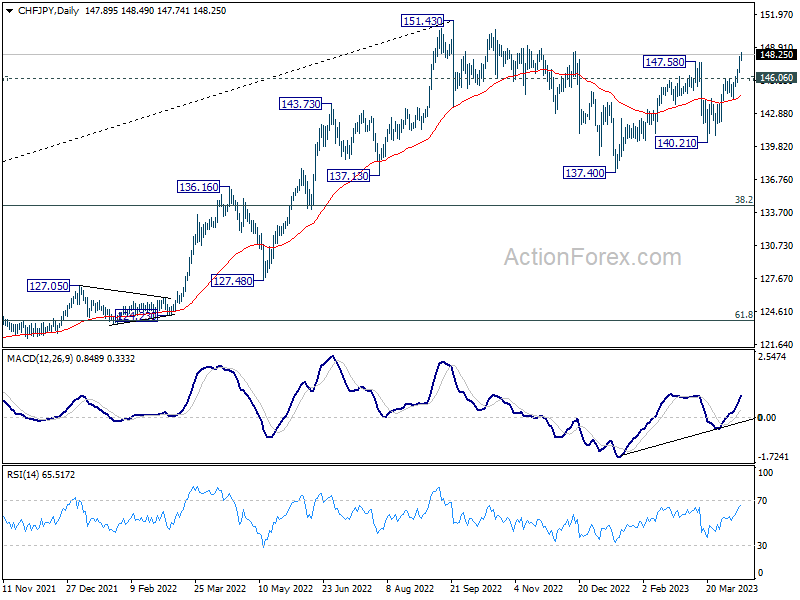
Technically, while the focus remains on Dollar, some attention is worth paying to the Swiss Franc as well. CHF/JPY broke through 147.58 resistance yesterday to resume the rise from 137.40. Further rally is now favored as long as the 146.06 resistance-turned-support holds. The next target is the 151.43 high. A decisive break there will resume the long-term uptrend and would signal more upside for the Swiss Franc or downside for the Yen elsewhere, or both.
In Europe, at the time of writing, FTSE is up 0.74%. DAX is up 0.54%. CAC is up 0.50%. Germany 10-year yield is down -0.0059 at 2.307. Earlier in Asia, Nikkei rose 0.57%. Hong Kong HSI dropped -0.86%. China Shanghai SSE rose 0.41%. Singapore Strait Times dropped -0.36%. Japan 10-year JGB yield rose 0.0111 to 0.466.
US CPI slowed to 5% yoy and missed expectations, core CPI ticked up to 5.6% yoy
US CPI rose 0.1% mom in March, below expectation of 0.3% mom. CPI core (all items less food and energy) rose 0.4% mom, matched expectations. Energy index decreased -3.5% mom while food index was unchanged.
Over the last 12 months, CPI slowed from 6.0% yoy to 5.0% yoy, below expectation of 5.2% yoy, marked the lowest level since June 2021. CPI core (all items less food and energy) accelerated from 5.5% yoy to 5.6% yoy, matched expectations. Energy index for down -6.4% yoy while food index rose 8.5% yoy.
EUR/USD upside breakout, to target this year's high
EUR/USD has broken out to the upside following a lower-than-expected headline inflation reading in the US. While the uptick in core CPI still supports another rate hike by Fed in May, the overall data set raises hopes that the disinflation process is ongoing and perhaps even gathering momentum. This development bolsters the confidence of those betting on a Fed rate cut later this year.
Technically, EUR/USD is expected to face resistance at 1.1032 shortly. A decisive break above this level would resume the overall uptrend from the 2022 low of 0.9534. Next target is the 61.8% retracement of 1.2348 (2021 high) to 0.9534, which stands at 1.1273.
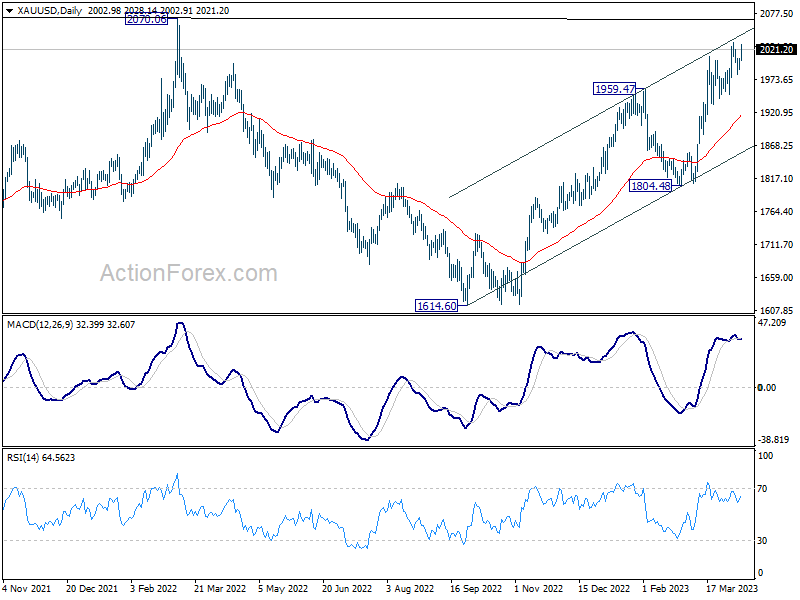
Can gold ride on Dollar selloff to extend near term rally?
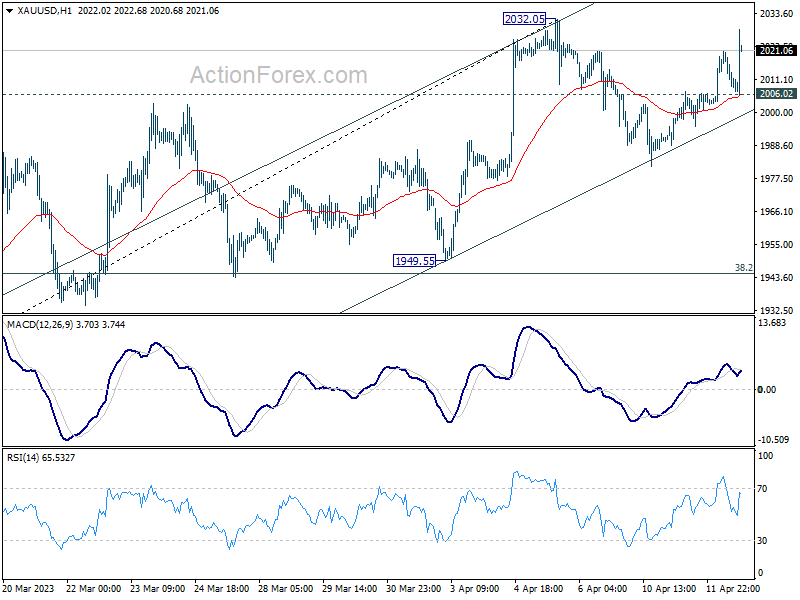
As Dollar is sold off broadly after CPI release, a focus is now on Gold, which also jumps higher. The first hurdle is 2032.05 near term resistance. Rejection by this level, followed by break of 2006.02 support, will extend the corrective pattern from 2032.05 with another falling leg. However, firm break of 2023.05 will resume whole rally from 2022 low at 1614.60 and target 2070.06/2073.84 key resistance zone. If realized, an upside break should confirm underlying downside momentum in Dollar elsewhere.
Meanwhile, next hurdle would be 2070.06/2073.84 key resistance zone. Sustained break there will confirm long term up trend resumption for new record highs.
USD/CHF Mid-Day Outlook
Daily Pivots: (S1) 0.9006; (P) 0.9055; (R1) 0.9081; More...
USD/CHF's strong break of 0.9005 confirms resumption of whole down trend from 1.0146. Intraday bias is back on the downside. Next target is 61.8% projection of 1.0146 to 0.9058 from 0.9439 at 0.8767, which is close to 0.8756 long term support. On the upside, break of 0.9119 resistance is needed to indicate short term bottoming. Otherwise, outlook will remain bearish in case of recovery.
In the bigger picture, outlook will stay bearish as long as 0.9439 resistance holds, and fall from 1.1046 (2022 high) is still in progress. Prior rejection by 55 week EMA was a medium term bearish sign. Sustained of 0.9058 will resume such decline towards 0.8756 support (2021 low). But overall, this fall is still as a leg in the long term range pattern from 1.0342 (2016 high). So, downside should be contained by 0.8756 to bring reversal.
Economic Indicators Update
| GMT | Ccy | Events | Actual | Forecast | Previous | Revised |
|---|---|---|---|---|---|---|
| 23:50 | JPY | Bank Lending Y/Y Mar | 3.00% | 3.60% | 3.30% | |
| 23:50 | JPY | PPI Y/Y Mar | 7.20% | 7.10% | 8.20% | |
| 23:50 | JPY | Machinery Orders M/M Feb | -4.50% | -7.80% | 9.50% | |
| 12:30 | USD | CPI M/M Mar | 0.10% | 0.30% | 0.40% | |
| 12:30 | USD | CPI Y/Y Mar | 5.00% | 5.20% | 6.00% | |
| 12:30 | USD | CPI Core M/M Mar | 0.40% | 0.40% | 0.50% | |
| 12:30 | USD | CPI Core Y/Y Mar | 5.60% | 5.60% | 5.50% | |
| 14:00 | CAD | BoC Interest Rate Decision | 4.50% | 4.50% | ||
| 14:30 | USD | Crude Oil Inventories | -1.0M | -3.7M | ||
| 15:00 | CAD | BoC Press Conference | ||||
| 18:00 | USD | FOMC Minutes |
Can gold ride on Dollar selloff to extend near term rally?
As Dollar is sold off broadly after CPI release, a focus is now on Gold, which also jumps higher. The first hurdle is 2032.05 near term resistance. Rejection by this level, followed by break of 2006.02 support, will extend the corrective pattern from 2032.05 with another falling leg. However, firm break of 2023.05 will resume whole rally from 2022 low at 1614.60 and target 2070.06/2073.84 key resistance zone. If realized, an upside break should confirm underlying downside momentum in Dollar elsewhere.
Meanwhile, next hurdle would be 2070.06/2073.84 key resistance zone. Sustained break there will confirm long term up trend resumption for new record highs.