Sample Category Title
EUR/USD Mid-Day Outlook
Daily Pivots: (S1) 1.0702; (P) 1.0771; (R1) 1.0828; More...
EUR/USD is gyrating in tight range today and intraday bias remains neutral. Strong rebound from current level, followed by break of 1.0929 will reaffirm near term bullishness, and extend the rise from to retest 1.1032 high. Firm break there will resume larger up trend from 0.9534 to 1.1273 fibonacci level next. However, sustained trading below 4 hour 55 EMA (now at 1.0742) will likely extend the corrective pattern from 1.1032 and bring deeper decline back towards 1.0515.
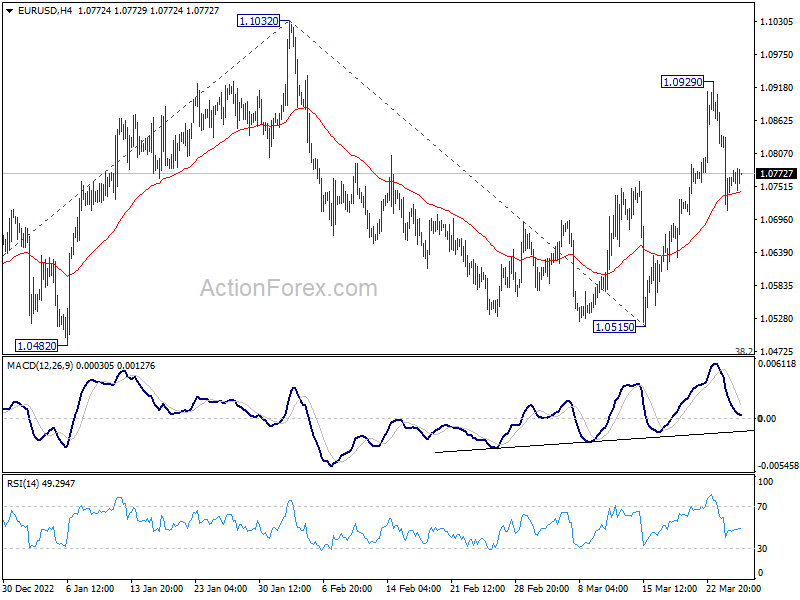
In the bigger picture, rise from 0.9534 (2022 low) is in progress with 38.2% retracement of 0.9534 to 1.1032 at 1.0460 intact. The strong support from 55 week EMA (now at 1.0623) was also a medium term bullish sign. Next target is 61.8% retracement of 1.2348 (2021 high) to 0.9534 at 1.1273. Sustained break there will solidity the case of bullish trend reversal and target 1.2348 resistance next (2021 high).
Gold Struggles Below 2000, Euro Shrugs German Ifo
The financial markets are sending mixed messages today, with risk sentiment seemingly improving as European indexes and US futures trade higher. US and German 10-year yields are also recovering. However, the currency markets paint a different picture, with Swiss Franc leading as the best performer, followed by Canadian Dollar and Sterling. In contrast, Yen is the worst, trailed by New Zealand and US Dollars. Euro is mixed, disregarding the improved German business climate. Trading could stay subdued due to an empty US economic calendar.
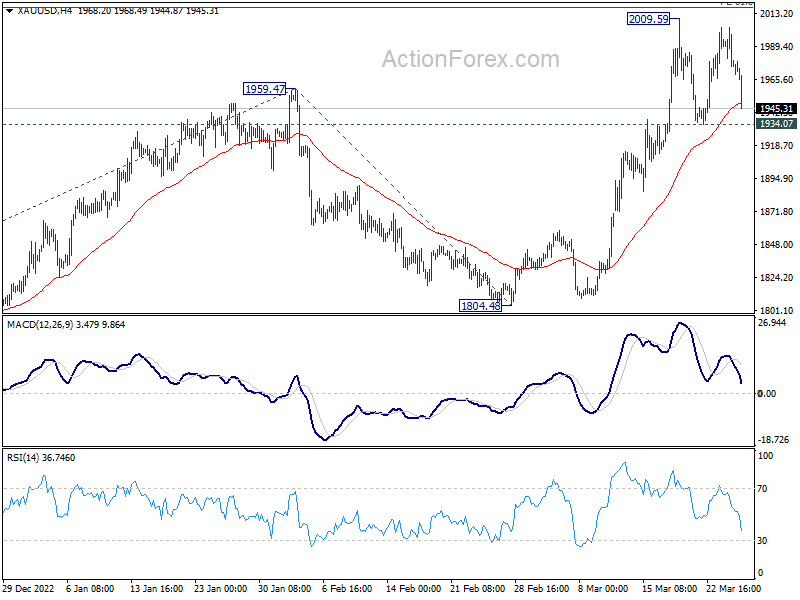
From a technical perspective, Gold's performance may hint at the direction of risk sentiment. Today's decline suggests another rejection by 2000 handle. For now, further gains are anticipated as long as 1934.07 support level holds, potentially pushing through 2009.59 to resume the larger uptrend. However, decisive break below 1934.07 would indicate a deeper pullback is underway, possibly coinciding with a further recovery in risk markets.
In Europe, at the time of writing, FTSE is up 1.05%. DAX is up 1.35%. CAC is up 1.14%. Germany 10-year yield is up 0.124 at 2.253. Earlier in Asia, Nikkei rose 0.33%. Hong Kong HSI dropped -1.75%. China Shanghai SSE dropped -0.44%. Singapore Strait Times rose 0.82%. Japan 10-year JGB yield rose 0.0189 to 0.295.
ECB Nagel: Balance reduction could accelerate from summer
Bundesbank President Joachim Nagel emphasized the growing importance of determining future monetary policy steps on a meeting-to-meeting basis, taking into account economic and financial developments.
Meanwhile, he assured that the central bank will "continue to move forward resolutely on the path of monetary normalization until inflation is contained and price stability is restored."
he pointed out that the cumulative 350 basis points in rate hikes since last July have yet to fully impact the economy. Given the persistently high inflation rates and the considerable distance from the 2% medium-term target, he suggested that it's time for policymakers to expedite the reduction of the ECB's bond holdings, which commenced this month.
"In my view, it can be accelerated from the summer," Nagel said. "Markets will be able to handle it well, and in terms of monetary policy, it's necessary to reduce the balance sheet of the Eurosystem more quickly."
ECB de Cos: Future policy dependent on various sources of risks
ECB Governing Council member Pablo Hernandez de Cos has emphasized that the central bank's future monetary policy decisions will be highly dependent on the development of various risk sources, including recent financial market turmoil.
De Cos also noted that the intensity of monetary policy transmission will be taken into account in policy decisions. He observed that the ongoing tensions in financial markets have led to a further tightening of financial conditions, impacting the outlook for economic activity and inflation.
As the ECB prepares for its next meetings, De Cos highlighted that all these factors must be considered.
Regarding inflation, he warned, "over the medium term, the main risk for inflation comes from a persistent rise in price expectations above our inflation target."
However, "the disinflation process could be accelerated further if the high tensions in financial markets were to be prolonged,"he added.
Germany Ifo rose to 93.3, economy stabilizing despite banking turbulence
Germany Ifo Business Climate rose form 91.1 to 93.3 in March, above expectation of 92.0. That's also the fifth consecutive rise. Current Assessment index rose from 93.9 to 95.4, above expectation of 94.0. Expectations index rose from 88.4 to 91.2, above expectation of 87.4.
By sector, manufacturing rose from 1.5 to 6.6. Services rose from 1.3 to 8.9. Trade ticked up from -10.6 to -10.0. Construction also improved from -19.0 to -17.9.
Ifo said, the upward development in business climate was "driven primarily by business expectations". "Despite turbulence at some international banks, the German economy is stabilizing," it added.
EUR/USD Mid-Day Outlook
Daily Pivots: (S1) 1.0702; (P) 1.0771; (R1) 1.0828; More...
EUR/USD is gyrating in tight range today and intraday bias remains neutral. Strong rebound from current level, followed by break of 1.0929 will reaffirm near term bullishness, and extend the rise from to retest 1.1032 high. Firm break there will resume larger up trend from 0.9534 to 1.1273 fibonacci level next. However, sustained trading below 4 hour 55 EMA (now at 1.0742) will likely extend the corrective pattern from 1.1032 and bring deeper decline back towards 1.0515.
In the bigger picture, rise from 0.9534 (2022 low) is in progress with 38.2% retracement of 0.9534 to 1.1032 at 1.0460 intact. The strong support from 55 week EMA (now at 1.0623) was also a medium term bullish sign. Next target is 61.8% retracement of 1.2348 (2021 high) to 0.9534 at 1.1273. Sustained break there will solidity the case of bullish trend reversal and target 1.2348 resistance next (2021 high).
Economic Indicators Update
| GMT | Ccy | Events | Actual | Forecast | Previous | Revised |
|---|---|---|---|---|---|---|
| 23:50 | JPY | Corporate Service Price Index Y/Y Feb | 1.80% | 1.80% | 1.60% | |
| 08:00 | EUR | Germany IFO Business Climate Mar | 93.3 | 92 | 91.1 | |
| 08:00 | EUR | Germany IFO Current Assessment Mar | 95.4 | 94 | 93.9 | |
| 08:00 | EUR | Germany IFO Expectations Mar | 91.2 | 87.4 | 88.5 | 88.4 |
| 08:00 | EUR | Eurozone M3 Money Supply Y/Y Feb | 2.90% | 3.30% | 3.50% |
EURUSD Pulls Back But 50-day SMA Caps Downside
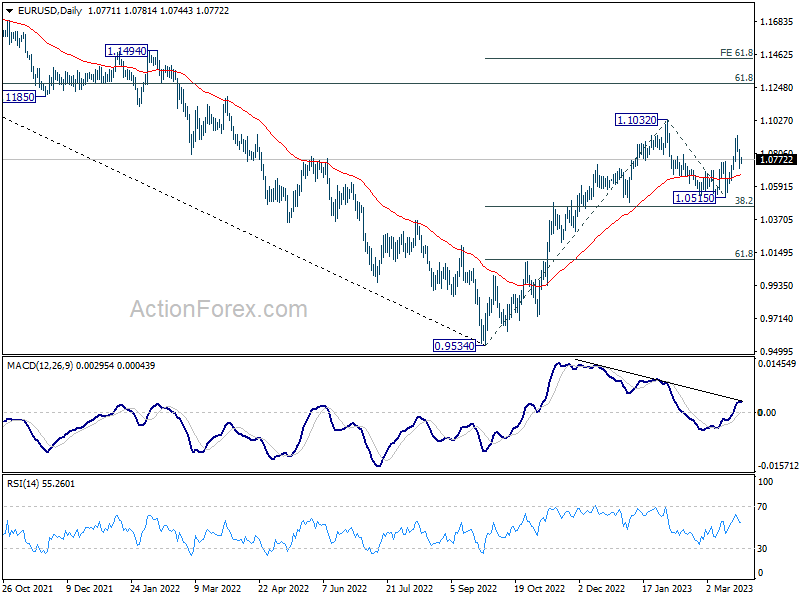
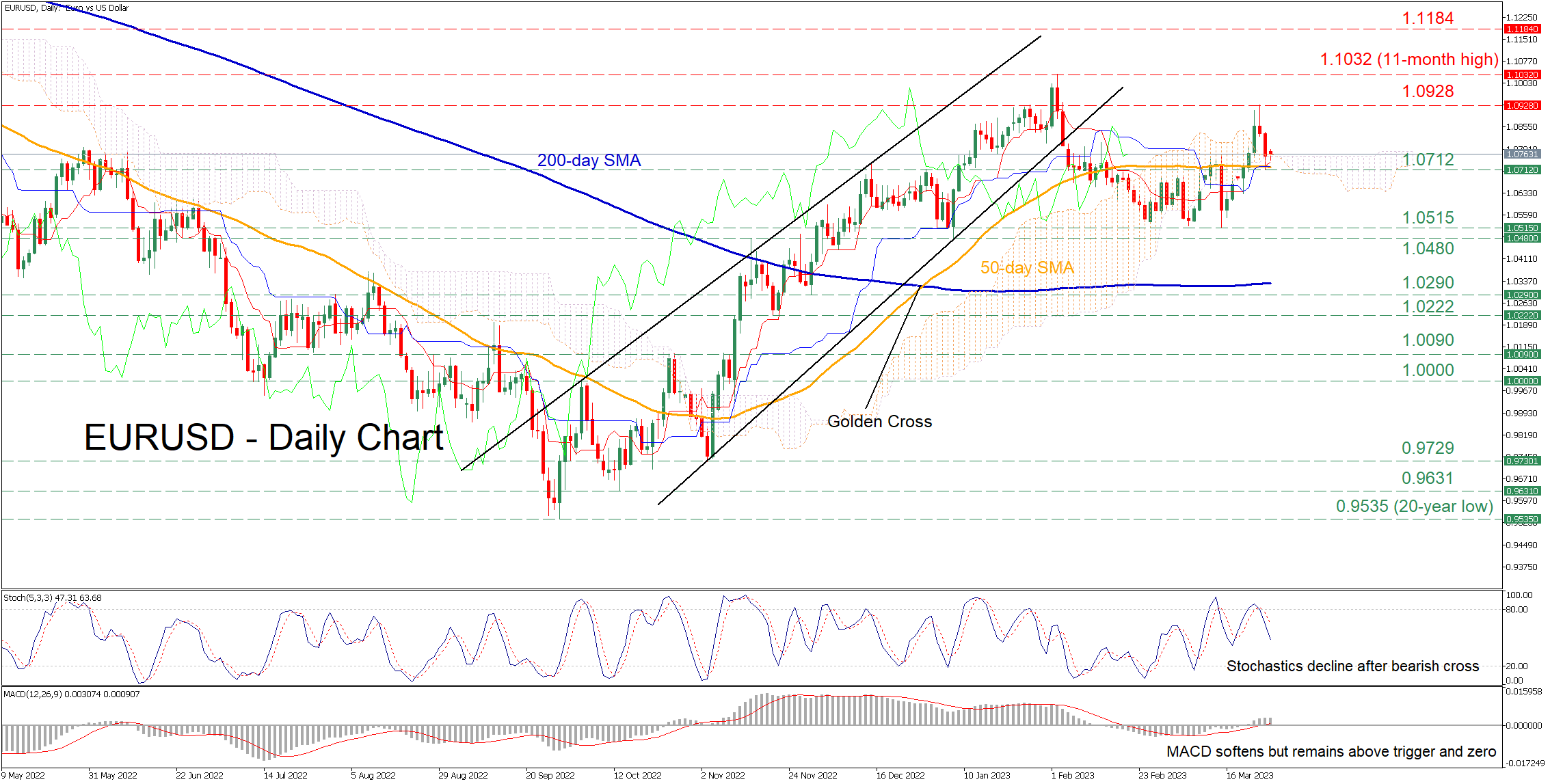
EURUSD had been steadily gaining ground after finding its feet at the March low of 1.0515. Nevertheless, the pair encountered strong resistance and pared a part of its gains before the 50-day simple moving average (SMA) curbed further retreats.
The momentum indicators currently suggest that the bullish near-term bias is waning. Specifically, the stochastic oscillator is descending after posting a bearish cross, while the MACD histogram is softening but remains above both zero and its red signal line.
If the negative tendency persists, the price could dive lower to test the 1.0712 congested region that includes the 50-day SMA and the lower boundary of the Ichimoku cloud. Violating that zone, the pair could descend towards the March low of 1.0515 before the spotlight turns to the 2023 bottom of 1.0480. Even lower, the 1.0290 hurdle could provide downside protection.
On the flipside, bullish actions could propel the price towards the recent rejection territory of 1.0928. A successful break above that region might pave the way for the 2023 peak of 1.1032, which is also an eleven-month high. Failing to halt there, the price could then test the March 2022 peak of 1.1184.
In brief, EURUSD corrected to the downside after its latest advance got rejected at the 1.0928 area but the 50-day SMA acted as a strong floor. If that barricade fails, the pair’s retreat is likely to accelerate.
Bitcoin Stuck at $28K
Market picture
Bitcoin is down 1.3% over the past week, finishing around $27,800. Ethereum lost 2.7% to $1760. Other leading altcoins from the top 10 showed mixed dynamics: from a decline of 8.2% (Polkadot) to a growth of 13.6% (XRP).
Total crypto market capitalisation, according to CoinMarketCap, fell 1.4% to $1.16 trillion over the week.
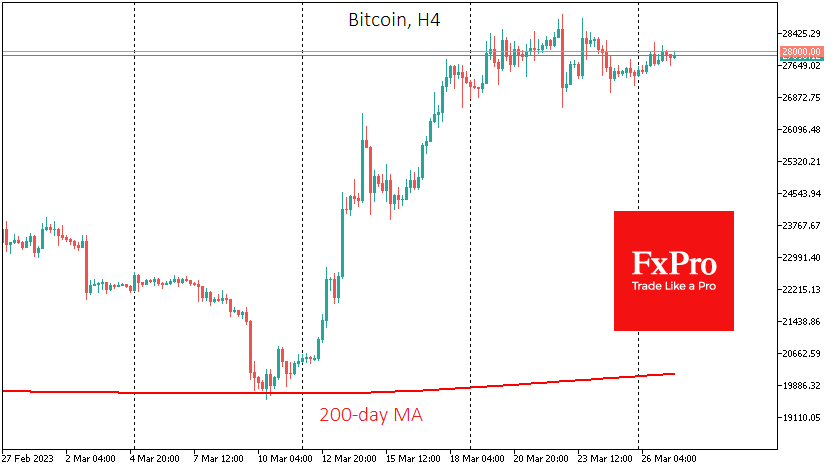
Bitcoin had updated 9-month highs to around $28,900 but corrected in the second half of the week.
As a result of another recalculation, bitcoin’s mining difficulty rose by 7.56%. The figure renewed its all-time high at 46.84 T. The average hash rate was 335.23 EH/s. Correlated metrics have increased by more than 30% since the beginning of the year.
News background
Tether technical director Paolo Ardoino said the company has about $1.6 billion in excess reserves to support its stablecoin USDT. In his view, amid the banking crisis and global economic uncertainty, bitcoin may well surpass its previous record high of $68,000.
The Fed’s board of directors has once again rejected Custodia Bank’s application for membership, indicating that the bank’s business model does not meet the goals set out in the Federal Reserve Act.
JPMorgan bank said the US banking crisis has opened up opportunities to increase market share for some crypto exchanges by offering banking services to cryptocurrency firms and investors.
German securities processing giant Deutsche Wertpapier Service Bank AG (dwpbank), which manages 5.3 million customer accounts for various banks, has launched wpNex, a bitcoin trading platform.
Nasdaq, the operator of the stock exchange of the same name, has announced plans to launch cryptocurrency storage services by the end of the second quarter of 2023.
ECB Nagel: Balance reduction could accelerate from summer
Bundesbank President Joachim Nagel emphasized the growing importance of determining future monetary policy steps on a meeting-to-meeting basis, taking into account economic and financial developments.
Meanwhile, he assured that the central bank will "continue to move forward resolutely on the path of monetary normalization until inflation is contained and price stability is restored."
he pointed out that the cumulative 350 basis points in rate hikes since last July have yet to fully impact the economy. Given the persistently high inflation rates and the considerable distance from the 2% medium-term target, he suggested that it's time for policymakers to expedite the reduction of the ECB's bond holdings, which commenced this month.
"In my view, it can be accelerated from the summer," Nagel said. "Markets will be able to handle it well, and in terms of monetary policy, it's necessary to reduce the balance sheet of the Eurosystem more quickly."
AUD/USD: Aussie Likely to Remain in Red as Banking Crisis Weighs on Risk Sentiment
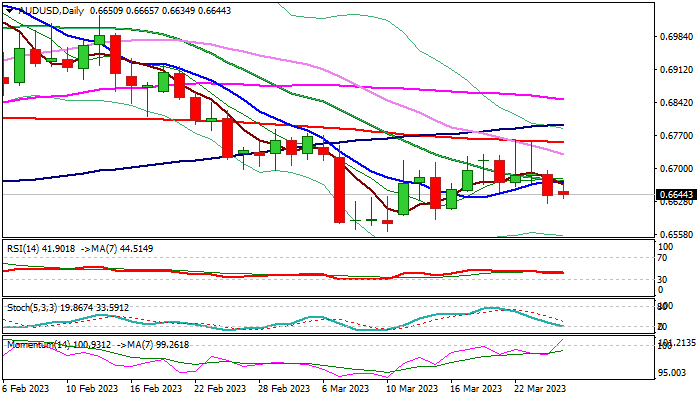
The AUDUSD is consolidating above one-week low (0.6625, hit last Friday after 0.7% daily fall), but keeps near-term bearish bias while the action is capped by converged 10/20 DMA’s (0.6668/70).
Repeated strong rejections under 200DMA (0.6755) last week, left two daily candles with long upper shadows, signaling that recovery from 0.6565 base lost traction, with subsequent drop on Friday, generating fresh bearish signals.
The Aussie is unlikely to make stronger gains as long as persisting fears about banking crisis continue to fuel risk aversion, despite daily indicators show opposite signals (rising 14-d momentum emerged into positive territory and stochastic is breaking into oversold zone).
We look for initial direction signals on break of 0.6625 (Friday’s low – bearish) or 0.6670 (20DMA – bullish).
Bearish scenario would risk retest of 2023 low (0.6563, Mar 10) and 0.6547 (61.8% retracement of larger 0.6170/0.7157 rally) loss of which would open way for continuation of the downtrend from 0.7157 (2023 high).
Conversely, break of 10/20DMA’s would ease immediate downside risk, but sustained break of 200DMA pivot remains a key requirement for bulls to regain full control.
Res: 0.6670; 0.6703; 0.6729; 0.6755.
Sup: 0.6625; 0.6589; 0.6563; 0.6547.
GBP/USD: Near-term Action Remains Directionless But Bullishly Aligned Above Key Supports at 1.2200 Zone
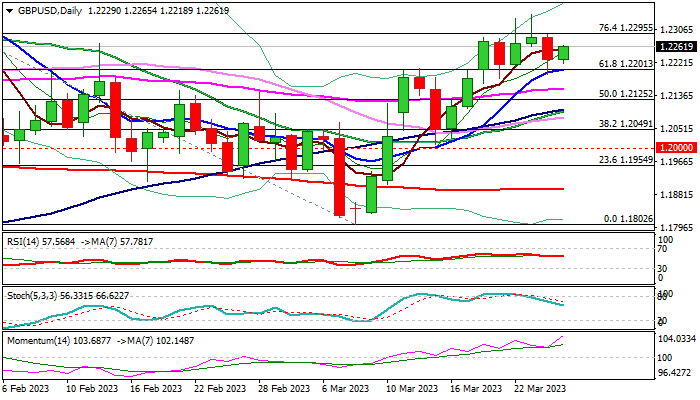
Cable regained traction after 0.5% drop last Friday, pushing the price into the upper part of prolonged consolidation range, which extends into sixth straight day.
Friday’s pullback was again contained by strong supports at 1.2200 zone (broken Fibo 61.8% of 1.2447/1.1802, reinforced by rising 10DMA), keeping overall bullish structure intact.
Several dips below 1.2200 handle, seen last week, failed to register close below, adding to the significance of this support.
However, near-term action is expected to remain in sideways mode while holding within the range boundaries, but with slight bullish bias, as long as holding above 1.2200 zone and daily indicators are in bullish configuration.
Firm break of pivotal barriers at 1.2295/1.2343 (Fibo 76.4% / Mar 23 spike high/range top) is needed to signal bullish continuation and expose targets at 1.2402/47 (Feb 2 lower top / 2023 high of Jan 23).
Caution on loss of 1.2200 pivot, which would dent larger bulls and risk deeper fall.
Res: 1.2295; 1.2343; 1.2402; 1.2447.
Sup: 1.2200; 1.2166; 1.2151; 1.2099.
AUD/USD Pair Moved into a Bearish Zone Below 0.6700
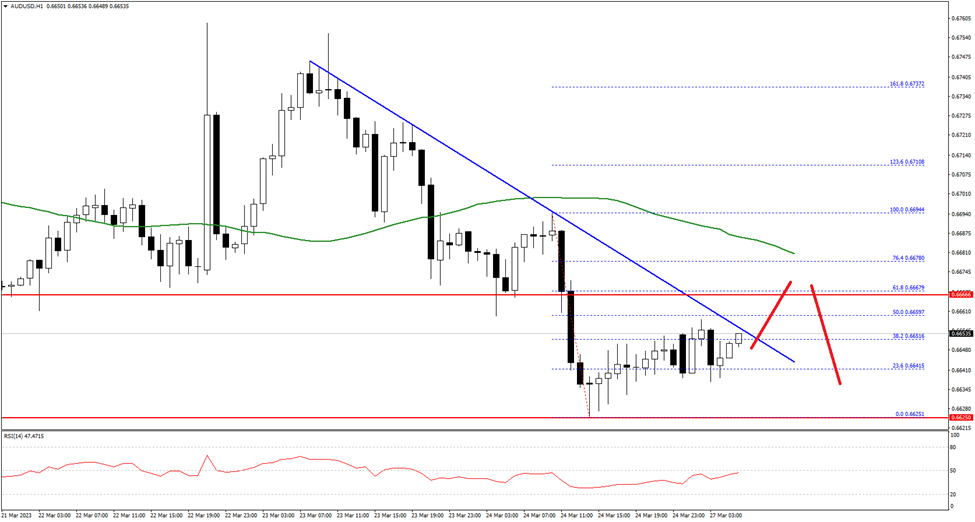
The Aussie Dollar started a fresh decline from well above 0.6740 against the US Dollar. The AUD/USD pair declined below the 0.6700 level to move into a bearish zone.
The pair even traded below the 0.6650 level and settled below the 50 hourly simple moving average. A low is formed near 0.6625 and the pair is now consolidating losses. An immediate resistance is near the 0.6655 level and a connecting bearish trend line on the hourly chart.
The next major resistance is near 0.6675 on FXOpen. If there is an upside break above the 0.6675 zone, the pair could rise steadily towards the 0.6700 level in the near term. The next major resistance sits near the 0.6740 level.
An immediate support is near the 0.6625 level. The next key support is near the 0.6600 level. A downside break below the 0.6600 support could lead the pair towards the 0.6565 support.
ECB de Cos: Future policy dependent on various sources of risks
ECB Governing Council member Pablo Hernandez de Cos has emphasized that the central bank's future monetary policy decisions will be highly dependent on the development of various risk sources, including recent financial market turmoil.
De Cos also noted that the intensity of monetary policy transmission will be taken into account in policy decisions. He observed that the ongoing tensions in financial markets have led to a further tightening of financial conditions, impacting the outlook for economic activity and inflation.
As the ECB prepares for its next meetings, De Cos highlighted that all these factors must be considered.
Reagrading inflation, he wared, "over the medium term, the main risk for inflation comes from a persistent rise in price expectations above our inflation target."
Howveer, "the disinflation process could be accelerated further if the high tensions in financial markets were to be prolonged,"he added.
GBP/USD – Will BoE’s Bailey Shake Up the British Pound?
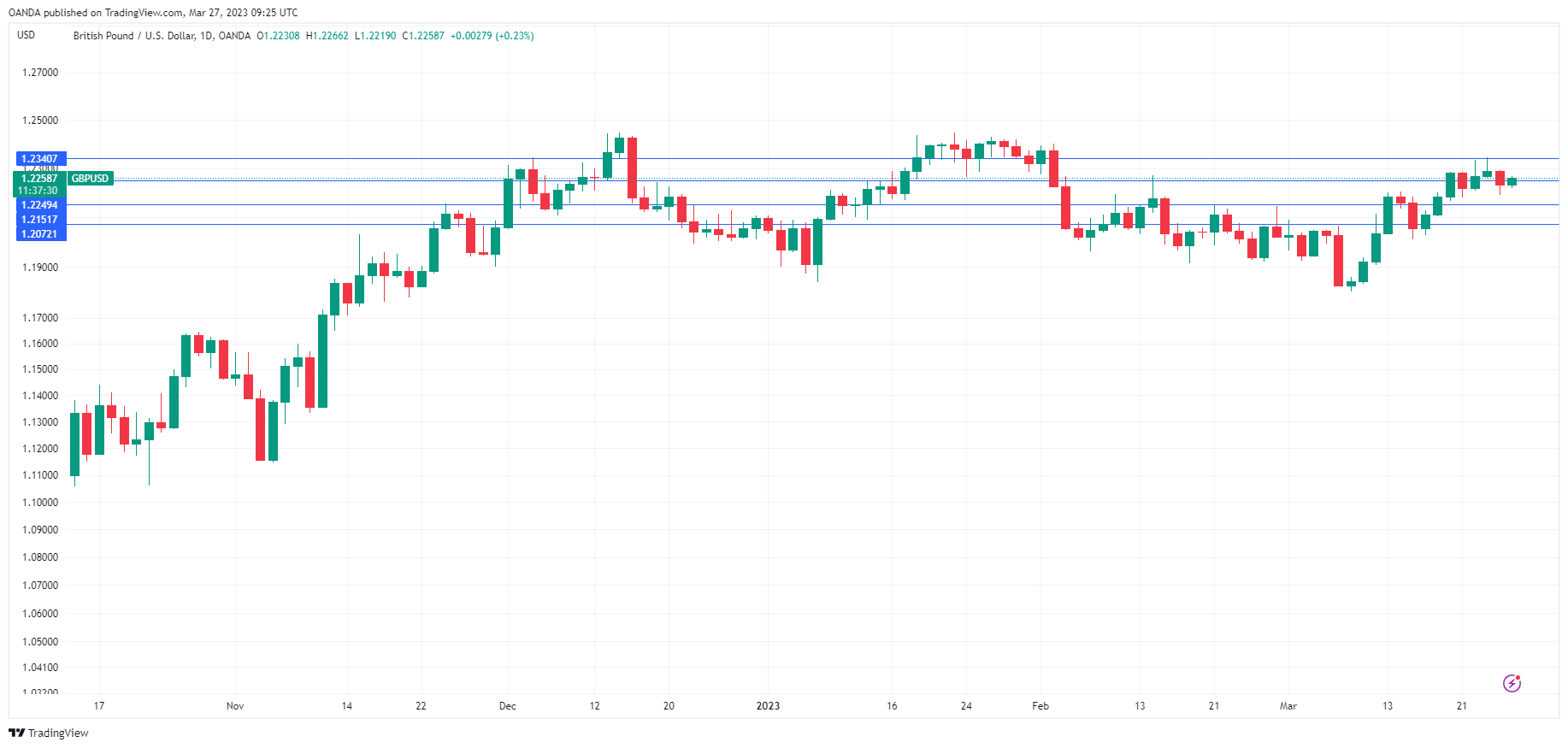
The British pound is trading quietly on Monday. In the European session, GBP/USD is trading at 122.49, up 0.15%. The pound has looked sharp of late, and last it touched a high of 1.2343, its highest level since late January.
In the UK, there are no tier-1 releases this week, but that doesn’t mean it will be a quiet week for the pound. Investors will be listening closely as BoE Governor Bailey speaks at public engagements today and on Tuesday. The latter should be especially interesting, as Bailey will testify before the Treasury Select Committee about the Silicon Valley collapse.
Bailey to testify on SVB collapse
Bailey has sounded surprisingly optimistic, given that inflation remains in double digits despite the BoE raising rates 11 consecutive times. After the 25-bp rate hike earlier this month, Bailey said that he expected inflation to fall “quite rapidly” in the next few months. On Friday, Bailey said that the prospects for growth were better and there was a “pretty strong likelihood” that the country would avoid a recession this year. I’m not at all sure that lawmakers share the Governor’s optimism, and they will likely grill Bailey on the Bank’s rate policy, which has failed to reign in high inflation.
Sticky inflation is not the only headache that Bailey needs to deal with. The banking crisis has caused stress in the financial markets, and investors remain concerned about the stability of the banking sector. Authorities in Switzerland and the US have acted quickly and decisively, which has helped calm down the markets. President Biden and Treasury Secretary have said that the banking system is safe, and on Friday, the Financial Stability Oversight Council, a group of financial regulators, said that the US banking system remains “sound and resilient”.
The stresses on the banking system are being closely watched by central banks, which are fearful of the contagion spreading as well as a credit crunch, which could slow the economy. ECB President Lagarde said last week that the bank crisis could help lower inflation, and UK lawmakers might ask Bailey if the crisis could dampen inflation in the UK.
GBP/USD Technical
- GBP/USD is testing resistance at 1.2248. The next resistance line is 1.2341
- There is support at 1.2152 and 1.2071