

Sample Category Title
Currencies Down Under Miss Out On the Rally
Markets
Risk-on following the Credit Suisse take-over entered its second day. Sentiment got an additional boost by reports of the US considering to temporarily guarantee all deposits (including those above the $250k threshold) if tensions rise again. And new proposals emerged to help out a fourth US bank in trouble, First Republic Bank, suggesting all parties involved are keen on finding a solution. European shares rise 1.5% with the Euro Stoxx 50 taking out lost neckline support-turned-into-resistance at around 4172. Just yesterday, the index risked breaking below the symbolic 4k barrier. US stocks add about 0.75%. Core bonds tumble. US yields add 4.2 (30y) to 14.6 bps (2y), yet money markets are still not sure whether the Fed’s going to hike tomorrow by 25 bps (4/5) or not (1/5). And if it does, it is probably the last one according to current pricing. German yields advance 6.1 (30y) to 15.0 bps (2y) with European swap yields following at a distance (3.9-9.1 bps). In both core countries, important support for the 10y yield at respectively 3.319% (previous 2023 correction low) and 1.92% (June 2022 interim high) survived thanks to a sharp U-turn yesterday and today’s follow-through rebound. Short-term yields experienced a huge amount of volatility, but there too support areas around 4% and 2.5% resp. have held. UK gilt yields rise 0.5-4.5 bps as investors count down to the Bank of England meeting on Thursday.
Currency markets do not correspond to a typical risk-on trading session. Especially the currencies Down Under miss out on the rally. The move was Aussie driven, with the publication of the minutes of the previous monetary policy meeting weighing down on the currency. They were more tilted towards a pause (or more) at the next meeting than the policy statement hinted at. AUD/USD drops from 0.6726 to 0.667. NOK and SEK outperform but both trade at still very weak levels historically (EUR/NOK 11.32, EUR/SEK 11.11). Central-European currencies are doing well. The forint is taking the lead (EUR/HUF tested 390). EUR/CZK drops sharply from around 24 to 23.81 currently while the zloty, as often has been the case lately, is trading stoic-to-slightly-stronger around 4.70. Of late risk-sensitive GBP held up well, strengthened even when market tensions were running high. Today, EUR/GBP soars past 0.88(1) again. A relative to Bunds (and Treasuries) underperformance followed by outperformance of UK gilts explain some of those counterintuitive moves. Among the larger currencies, the euro tops the dollar. EUR/USD rises beyond 1.0735 resistance to change hands at 1.0766. The yen loses out against both.
News & Views
Polish real retail sales remained sluggish at the start of the year. After declining 23% M/M in January, the volume of sales contracted another 3.6% M/M in February. The monthly decline put the level of sales 5.0% below the level during the same month last year. In a monthly perspective only the subcategory motor vehicles and parts (+8.0%) succeeded positive growth. Negative growth figures amongst others were recorded for household goods (-12.2%), textiles (-14.9%), newspapers and books (-6.6%) and food and drinks (-3.9%). The data published today and softer production data published earlier this week suggest that final demand in the economy is slowing. Even so, with both headline (18.4 Y/Y) and core inflation (12.0% Y/Y) holding at cycle peak levels, it’s too early for the National Bank of Poland to already open the debate on a specific timing of rate cuts. In line with a better risk sentiment, the zloty today strengthened back below the EUR/PLN 4.70 area.
February inflation in Canada printed close to expectations. Headline inflation slowed slightly more than expected to 0.4% M/M and 5.2% Y/Y (was 0.5% M/M and 5.9% in January, 5.4% was expected). Core inflation measures which are closely monitored by the Bank of Canada (median 4.9% from 5.0%, trimmed 4.8% from 5.1%) also slowed. Looking at the details, the decline was mainly driven by energy costs (-1.2% M/M). Overall goods prices still rose 0.4% M/M as was the case for services (0.4% M/M, 5.3% Y/Y). Price rises for shelter slowed to 0.2% M/M. Even as inflation remains well above the 1-3% target range of the Bank of Canada, the report didn’t cause a big repositioning in Canadian FI and FX markets. Money markets still hold to the scenario that the Bank of Canada probably won’t hike rates any further, especially given recent uncertainty on financial stability. The Canadian dollar even lost a few ticks with CAD/USD trading near 1.367.
BoE Rate Decision: One Last Hike Before Hitting Pause?
The latest bank turmoil cast a dark cloud over the central bank community, forcing investors to downsize their rate projections just a week before the March policy announcements. In the UK, the Bank of England will probably deliver a softer quarter percentage point rate hike on Thursday at 12:00 GMT, and while that could theoretically help the British pound to recoup some lost ground, a potential pause to the hiking cycle could easily put a break on any sterling rallies.
Investors dial down rate expectations
The UK is not a stranger to financial stability threats. It was actually the first country to spook markets when the Bank of England (BoE) urgently stepped in to buy 65 billion pounds of long-dated government bonds at the end of September after an extensive sell-off in bonds sparked insolvency risks in pension schemes. The chancellor’s mini budget was blamed then for pressing investors’ confidence and slashing the value of government loans, but that instantly made investors wonder how transparent the risk management is and how close financial markets are to a cliff edge.
Two bank failures in the US and the panic created over a potential fallout of the systemically important Credit Suisse revived fears for a domino effect in the UK, squeezing the FTSE 100 stock index by 7.7% from a record high to a relatively lower post-pandemic level. On the other hand, the British pound managed to escape the freefall, although futures markets immediately dialed down their rate projections to price a 50-50 tossup between a pause and a 25 bps rate hike.
Inflation calls for additional rate hikes
The next test for the British currency will be the central bank’s policy announcement, with CPI inflation figures likely influencing rate hike expectations a day earlier on Wednesday. Forecasts expect the headline CPI to ease to 9.9% y/y from 10.1% previously and the core measure to inch down from 5.8% y/y to 5.7% y/y, both remaining well above the central bank’s 2.0% target for more than a year now. Under other circumstances, that alone could be enough reason to vote for a bold 50 bps rate hike, but policymakers will probably move forward with a smaller 25 bps rate increase to 4.25% even as inflation remains the elephant in the room.
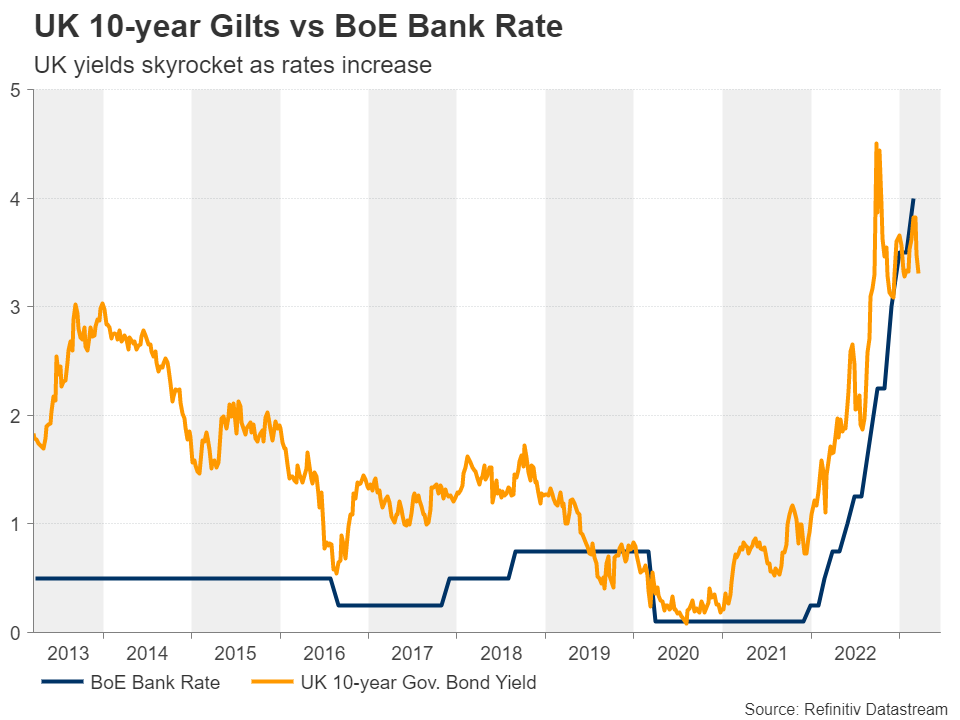
During its previous policy meeting, the central bank highlighted that additional rate increases might be required if price pressures persist, but it dropped its language for a forceful response to inflation, raising speculation that the hiking cycle might be near to a peak. Apparently, the BoE is still far from declaring victory on inflation and abandoning its inflation mission would not be policy-wise at the moment. Therefore, a little more tightening would not violate the central bank’s guidance, while it would also restore some market confidence if policymakers avoid cautious signals.
It might be the last rate hike before a pause
Still, a call for a pause in monetary tightening could be on a knife edge as the global battered bond values threaten additional financial shocks. The UK could be among the victims too. Although the chancellor insisted that the UK banking system remains sound and well capitalized, and exposure to SVB and Credit Suisse is minimal, the latest financial stability report that was released in December underlined that the “UK’s foreign liabilities are significantly higher than for other G7 economies”. That could still make the economy materially vulnerable to external liquidity crunches under tighter global conditions, especially as the interconnection with non-traditional decentralized finance markets has become more complex.
Fundamentally, the economic picture is not great either, but it could still excuse another gentle rate hike before a period of rate stability starts. The economy narrowly avoided a technical recession at the end of 2022, while creating more jobs than analysts expected, with the unemployment rate remaining steady at 3.7% in January versus August’s 3.5% record low. Average hourly earnings remained stable near pre-pandemic highs, but bleak retail sales, which continued to contract for the tenth consecutive month in January, suggested that households are still feeling the squeeze in living standards.
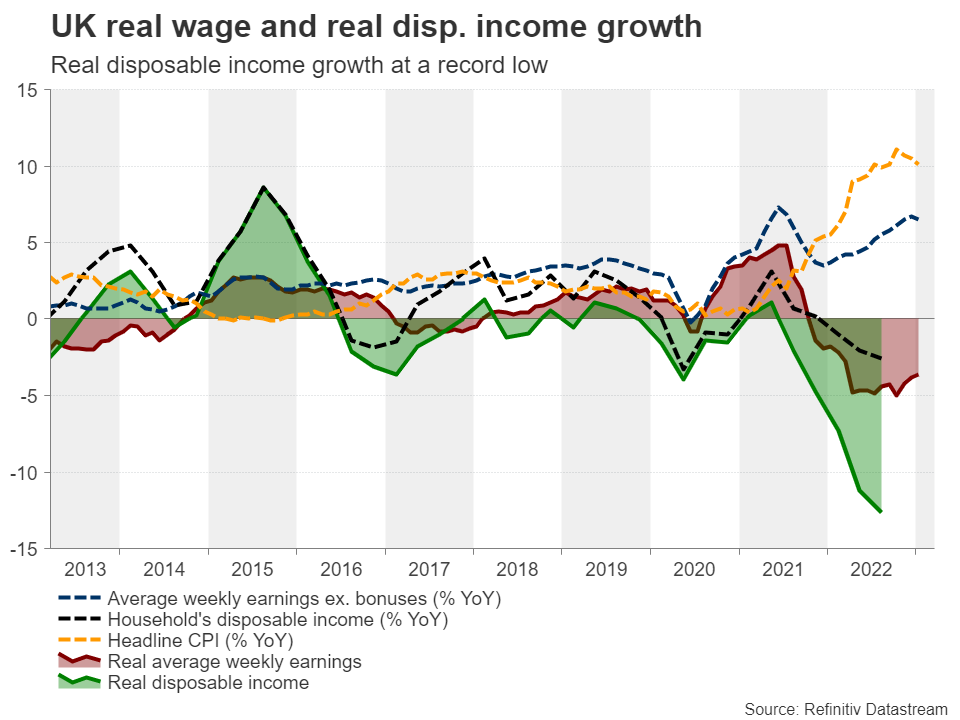
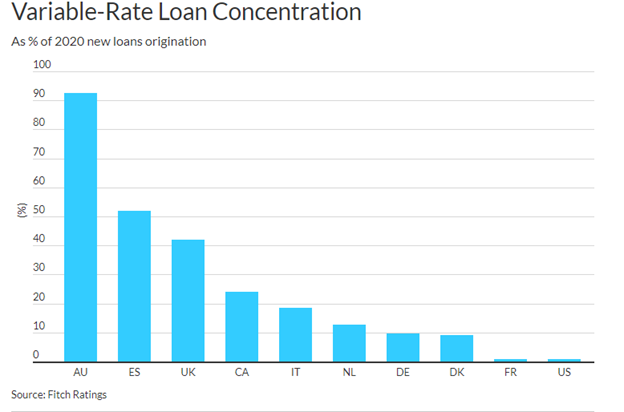
Moreover, the UK’s property market is relatively more sensitive to rate increases after Australia and Spain, according to the Fitch rating agency, as it has the highest proportion of loans with variable or fixed rates that expire or reset within 24 months. Note that household-debt-to-disposable income has been trending down since 2008 but is still comfortably above 100%.
GBP/USD levels to watch
Turning to FX markets, a 25bps rate hike could extend the pound’s latest rebound, though perhaps temporarily if the BoE announces a pause in the hiking cycle, letting previous rate increases take their effect on the economy. Specifically, the BoE could argue that there are other tools which are responsible for maintaining financial stability as the ECB chief Christine Lagarde tried to convey when she said that there was no trade-off between financial and price stability last week.
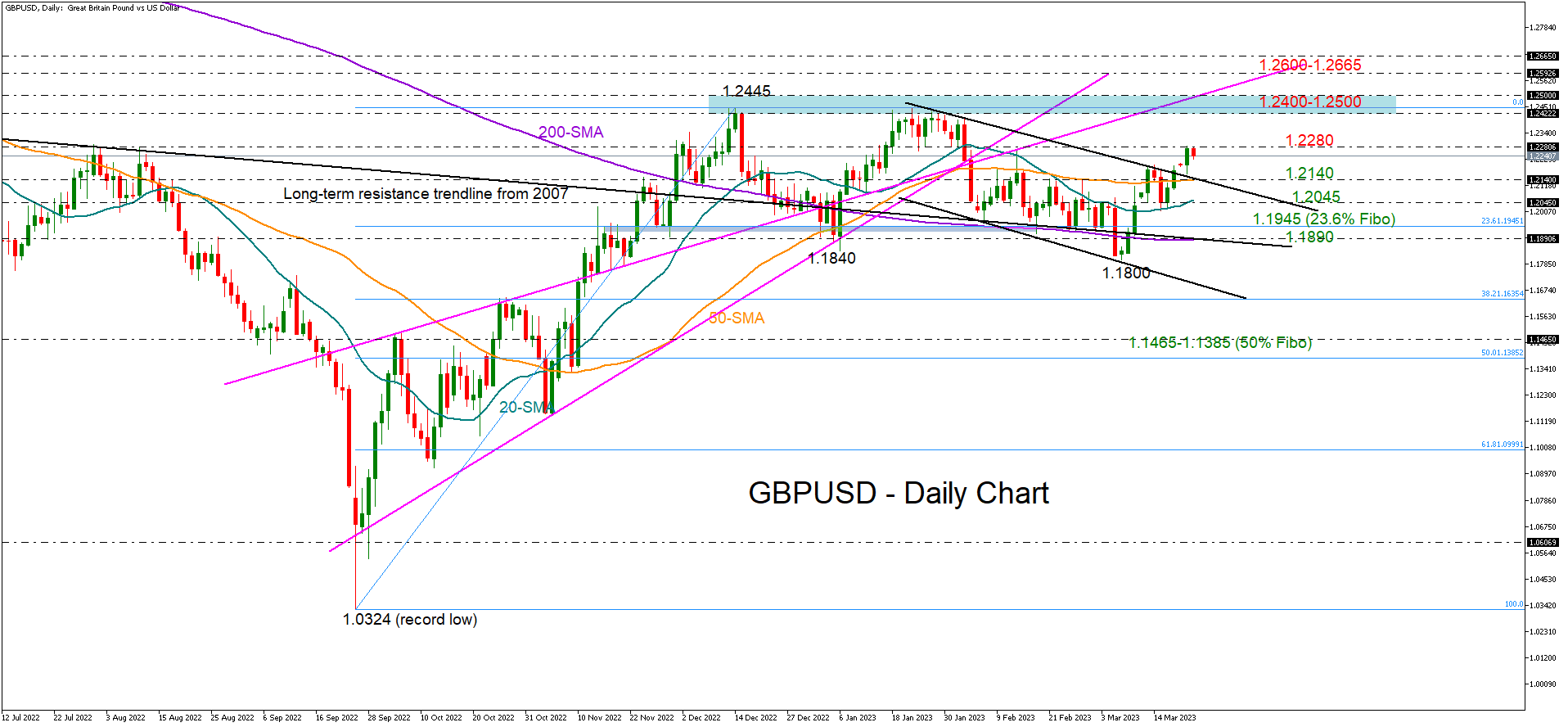
Technically, pound/dollar will need to overcome the 1.2280 resistance for the bulls to speed up towards the crucial 1.2445 -1.2500 ceiling. A 25bps rate hike and a warning of possible additional rate hikes could assist cable to reach that point.
Otherwise, a cautious tone by the BoE and signals that the hiking cycle may not resume unless economic conditions allow, could press the pair back to the 1.2140 territory. Even lower, the pair may head for the 20-day simple moving average (SMA) at 1.2045. Failure to pivot here could shift the spotlight to the 1.1945-1.1890 region.
Note that the FOMC policy announcement and a vote on Rishi Sunak’s post-Brexit trade agreement are on the agenda on Wednesday before the BoE meets.
USD/JPY Mid-Day Outlook
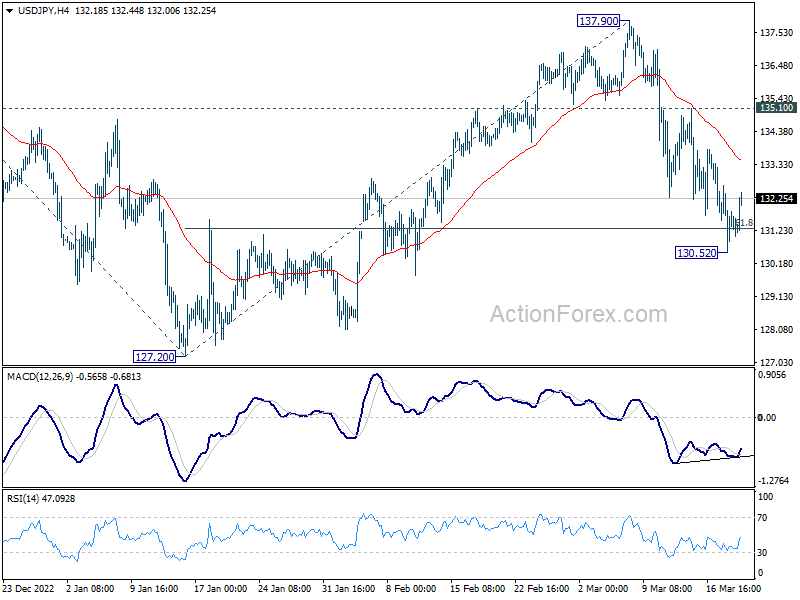
Daily Pivots: (S1) 130.35; (P) 131.50; (R1) 132.46; More...
A temporary low should be in place at 130.52 in USD/JPY. Intraday bias is turned neutral first. But further decline is expected as long as 135.10 resistance holds. The current favored is that rebound from 127.20 has completed at 137.90 already. Sustained trading below 61.8% retracement of 127.20 to 137.90 at 131.28 will pave the way to retest 127.20 low next. However, break of 135.10 will turn bias back to the upside for 137.90 instead.
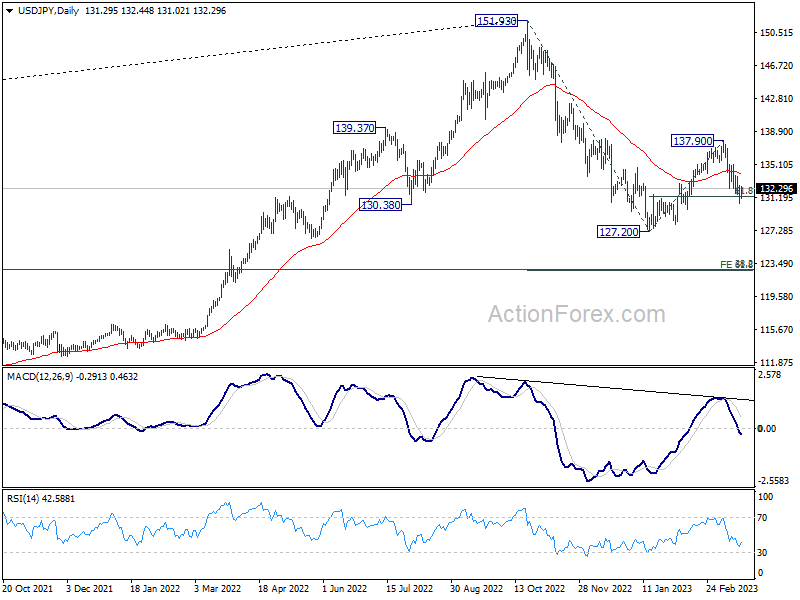
In the bigger picture, rebound from 127.20 should have completed at 137.90 as a corrective move, with strong break of 55 day EMA. The down trend from 151.93 (2022 high) is not over yet. Break of 127.20 will resume this down trend and target 61.8% projection of 151.93 to 127.20 from 137.90 at 122.61. This will now be the favored case as long as 137.90 resistance holds.
USD/CHF Mid-Day Outlook
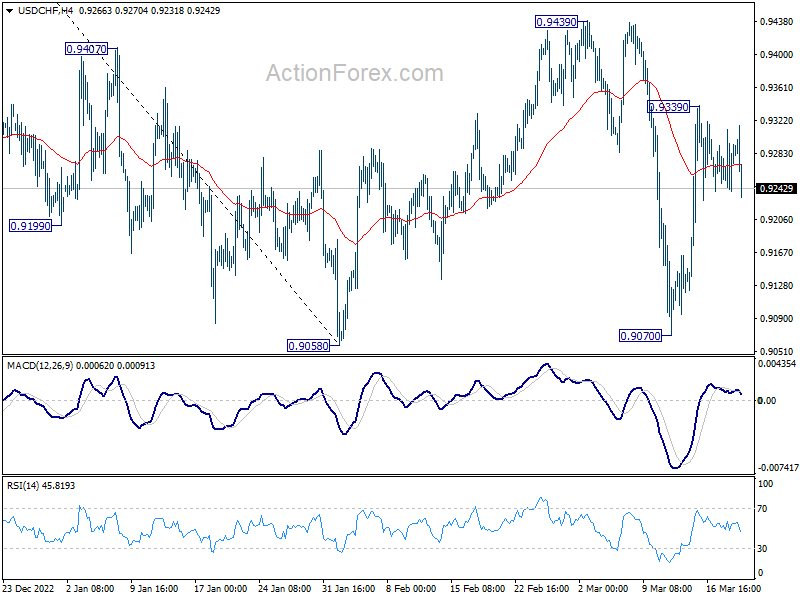
Daily Pivots: (S1) 0.9251; (P) 0.9281; (R1) 0.9323; More...
USD/CHF is staying in tight range below 0.9339 and intraday bias remains neutral. Corrective pattern from 0.9058 low should still be in progress with rise from 0.9070 as the third leg. Above 0.9339 will target 0.9439 resistance and possibly above. But overall, outlook will stay bearish as long as 0.9474 fibonacci level holds, and another decline through 0.9058 is expected at a later stage.
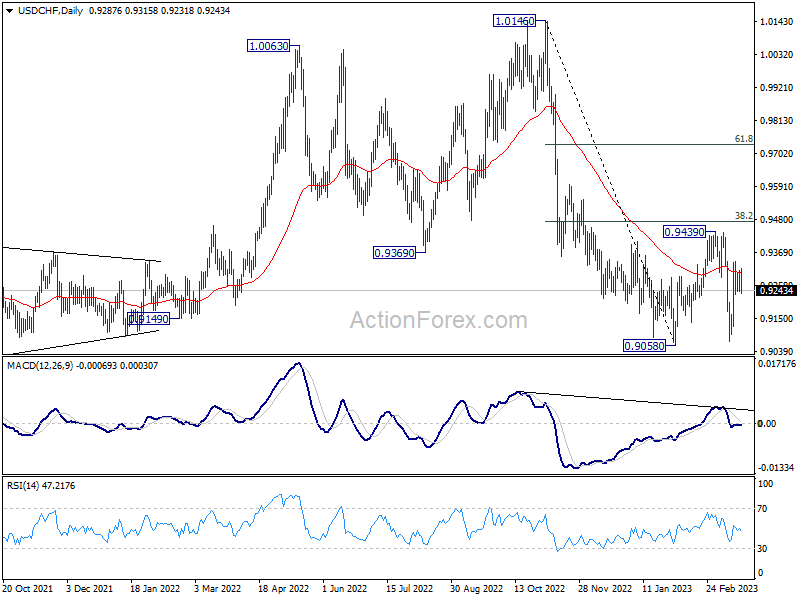
In the bigger picture, fall from 1.1046 (2022 high) should still be in progress with 38.2% retracement of 1.0146 to 0.9058 at 0.9474 intact. Rejection by 55 week EMA was a medium term bearish sign. Break of 0.9058 will resume such decline towards 0.8756 support (2021 low). But overall, such fall is still as a leg in the long term range pattern from 1.0342 (2016 high). So, downside should be contained by 0.8756 to bring reversal.
GBP/USD Mid-Day Outlook
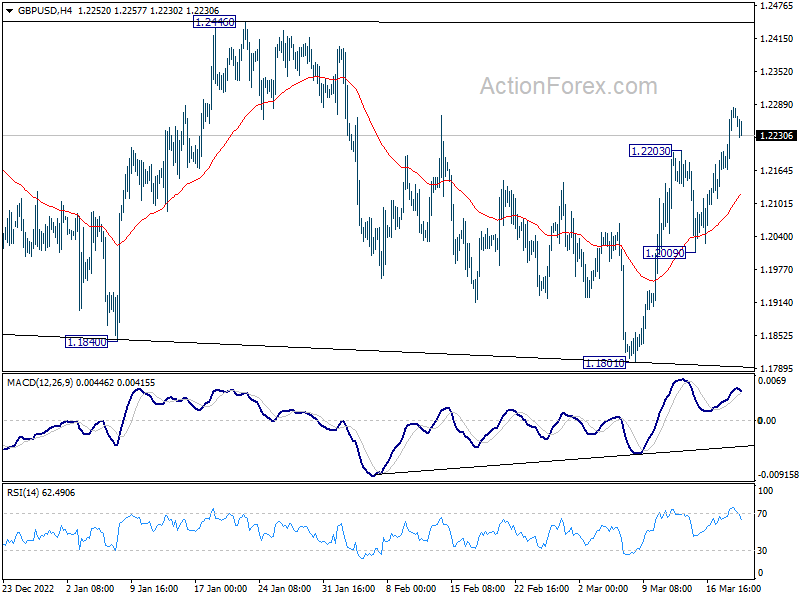
Daily Pivots: (S1) 1.2202; (P) 1.2244; (R1) 1.2320; More...
GBP/USD's rise from 1.1801 should be in progress and intraday bias stays on the upside for 1.2445/6 resistance zone. As noted before, corrective pattern from 1.2445 could have completed with three waves to 1.1801 already. Firm break of 1.2445/6 will resume larger rise from 1.0351, and target 1.2759 fibonacci level. For now, outlook will stay cautiously bullish as long as 1.2009 support holds, in case of retreat.
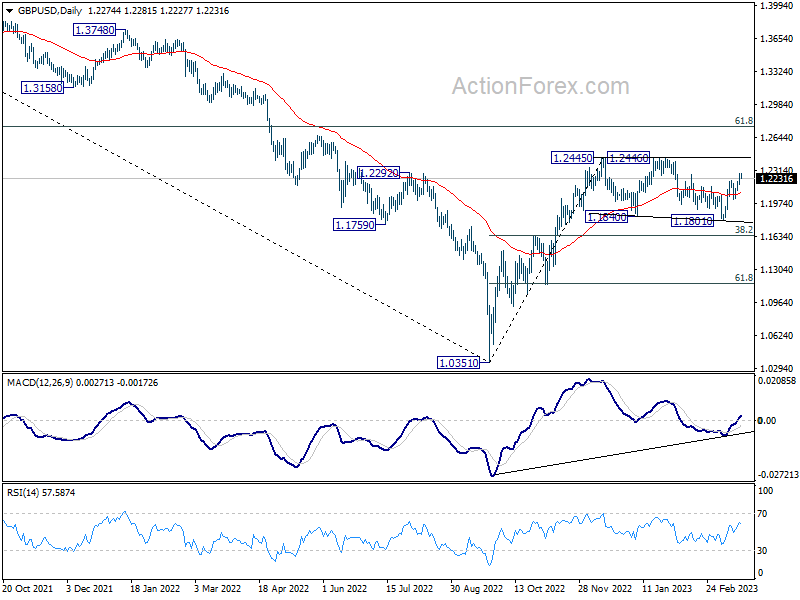
In the bigger picture, price action from 1.2445 are seen as a corrective pattern to rise from 1.0351 medium term bottom (2022 low). Resumption is expected as a later stage and firm break of 1.2446 will target 61.8% retracement of 1.4248 (2021 high) to 1.0351 at 1.2759. This will remain the favored case as long as 38.2% retracement of 1.0351 to 1.2445 at 1.1645 holds.
Crude Oil Finds Support
By the start of European trading on Monday, WTI had lost over 20% from its high of $80.96 on 7 March to a low of $64.36. The sell-off that intensified last week may well be giving way to a new buying impulse in oil. Oil is broadly back in long-term equilibrium, and it would take a significant shift in the supply/demand balance to trigger a further sell-off or a new round of growth.
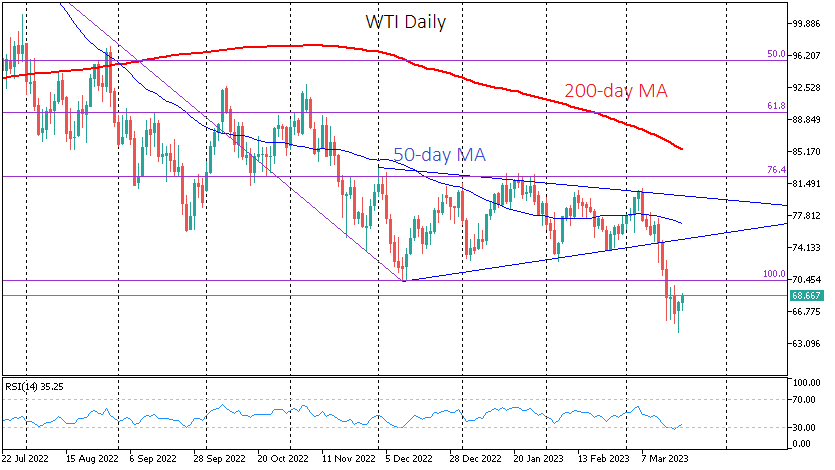
Between December and early March, prices consolidated in a narrowing range with an equilibrium point near $77/bbl. This pattern had a good chance of breaking the lower end of the spectrum.
Powell’s speech to Congress sent oil out of risky assets on fears of a sharp rate hike. However, the lower boundary of the triangle was stormed by WTI on the contrary, on fears that the banking crisis would slow economic growth and dampen demand.
Technical factors played an equally important role in the bearish move: a break of the three-month range triggered a capitulation by medium-term speculators, reinforcing the downward movement.
The March sell-off took oil into the over-bought territory on the daily RSI. Yesterday’s intraday reversal, complemented by today’s buying, brought the index back into neutral territory, signalling at least a corrective bounce.
Moving to higher timeframes, after a short-term dip, oil buyers yesterday came back below the 200-week moving average, which acts as a long-term trend indicator. Yesterday’s approach to the $64 level has also been a turning point for oil over the past four years, working as resistance until April 2021 and support after that.
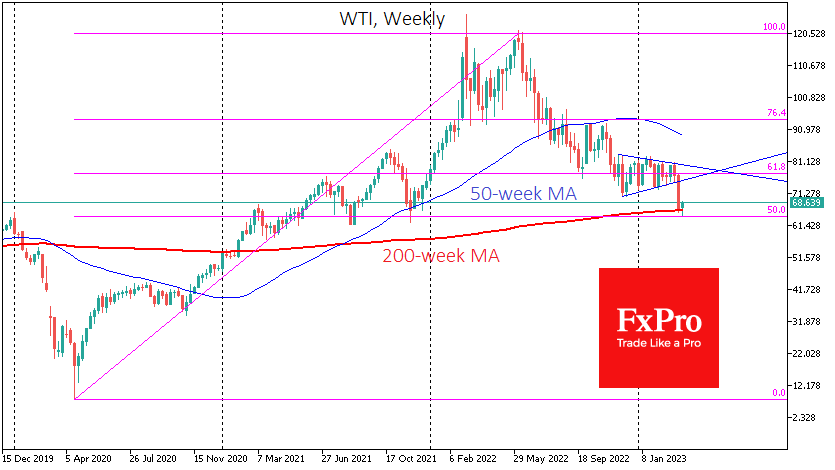
Yesterday’s lows were also close to 50% of the entire spot trading range from the lows of April 2020 to the highs of June last year.
A change in fundamentals would be needed for oil to go permanently lower. For now, we are seeing attempts by central banks to stabilise banks, bringing back demand for risky assets. At the very least, this buys time for the oil to recover in the short term.
A pullback from meaningful levels could see WTI bounce back to $71.50 or even $74 in the coming weeks. However, a sustained rally above oil would require more than a technical shake-out but a change in the fundamental backdrop.
Canada: Inflation Cools Further in February
Consumer price inflation continued to ease up in February, at 5.2% versus a year ago (y/y), from 5.9% in January. That is a couple of ticks lower than forecasters were expecting.
For the first time in over two years, energy prices declined on a year-on-year basis – 0.6% y/y. Gasoline prices led the drop, and are down 4.7% versus a year ago.
Food inflation also cooled in February, but remained at an eye-popping 9.7% y/y, versus 10.4% in January.
Shelter inflation continued to cool, but was still up 6.1% y/y in February. Homeowners' replacement costs slowed to 3.3% y/y, however the mortgage interest cost index continued to rise at a faster year-over-year pace amid the higher interest rate environment, rising 23.9% in February, the largest increase since July 1982.
There were a couple of areas where price pressures picked up on a monthly basis. Clothing and footwear inflation rose 0.7% m/m, after a 0.3% m/m decline in January and household operations, furnishings and equipment rose 0.9% m/m after a 0.4% decline in January.
Underlying inflation pressures cooled modestly in February. CPI ex-food and energy eased one tick to 4.8% y/y from 4.9% in January. The BoC's core inflation gauges also eased in February, with CPI-trim at 4.8% y/y (5.1% in Jan.) and CPI-median at 4.9% y/y (5.0% in Jan.).
Year-on-year changes can be heavily influence by base effects, and zeroing in on inflation trends over the past three months shows that the BoC core measures are running at 3.8% on an annualized basis for median and 3.3% for trim. This suggests that underlying inflation pressures will head lower on a year-on-year basis in the coming month.
Key Implications
Inflation in Canada continues to cool from it's peak pace last year. However, with the core measures just below 5% y/y, they still have a way to go before they are comfortably within the Bank of Canada's target 1-3% range. As outlined in our recent forecast, we expect that to be achieved in the second half of the year.
There was nothing in today's inflation report that would move the Bank of Canada off of its pause on interest rate moves. Unlike the Federal Reserve, domestic inflation trends mean the BoC can ride out the current volatility in financial markets driven by stresses in the banking sector internationally
USD/CHF – Swiss Franc Climbs Higher, SNB Meeting Eyed
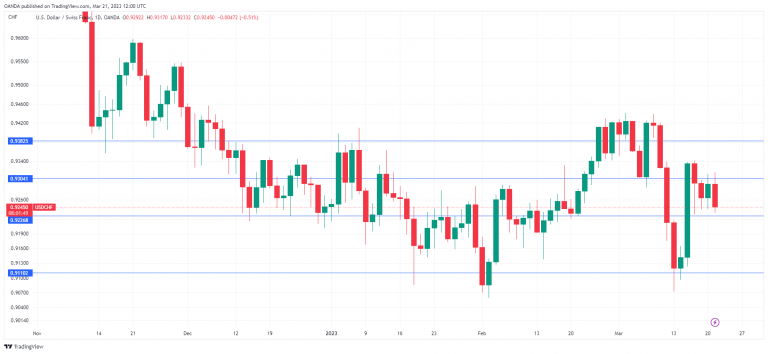
The Swiss franc is showing some strength on Tuesday. In the European session, USD/CHF is trading at 0.9238, down 0.58%.
SNB expected to hike but by how much?
The turmoil which has roiled the financial markets over the past week has eased today. European stock markets are steady, and shares of UBS and Credit Suisse are both higher. The extraordinary measures taken on the weekend, namely, the emergency takeover of Credit Suisse by UBS and the coordinated move by six major central banks to boost liquidity appear to have had a calming effect on jittery investors. These moves may have achieved the critical goal of containing the contagion in the banking system and avoiding a full-scale financial crisis.
The bank crisis has shocked investors, as Credit Suisse, the second largest bank in Switzerland, has toppled like a deck of cards, with its share price plunging to below one Swiss franc. The consolidated Swiss banking sector has lost a key player in a matter of days, and the stellar reputation of the Swiss banking system has been dealt a huge blow. One analyst went as far as stating that the demise of Credit Suisse has turned Switzerland into a “financial banana republic”.
The volatility in the foreign exchange markets has paled in comparison to the turmoil in the equity and commodity markets. Still, the Swiss franc has lost ground against the US dollar and the euro since last week, when Credit Suisse collapsed. This points to the Swissie losing some of its attraction as a safe-haven asset.
In the midst of the bank crisis, the Swiss National Bank (SNB) holds a policy meeting on Thursday. The markets have priced at 50/50 the odds of a 25 or 50 basis point increase. Like the ECB, SNB policymakers face a dilemma of whether to remain aggressive in the fight against inflation or to ease up due to concerns over the turmoil in the Swiss banking sector. The ECB opted for the 50-bp move and we’ll have to wait and see if the SNB follows suit.
USD/CHF Technical
- USD/CHF faces resistance at 0.9304 and 0.9382
- 0.9226 and 0.9110 are providing support
EUR/USD Mid-Day Outlook
Daily Pivots: (S1) 1.0660; (P) 1.0696; (R1) 1.0759; More...
EUR/USD's break of 1.0759 resistance suggests that correction from 1.1032 has completed at 1.0515 already. That came after defending both 1.0482 support and 38.2% retracement of 0.9534 to 1.1032 at 1.0258. Intraday bias is back on the upside for retesting 1.1032 high next. On the downside, below 1.0703 minor support will turn intraday bias neutral again first.
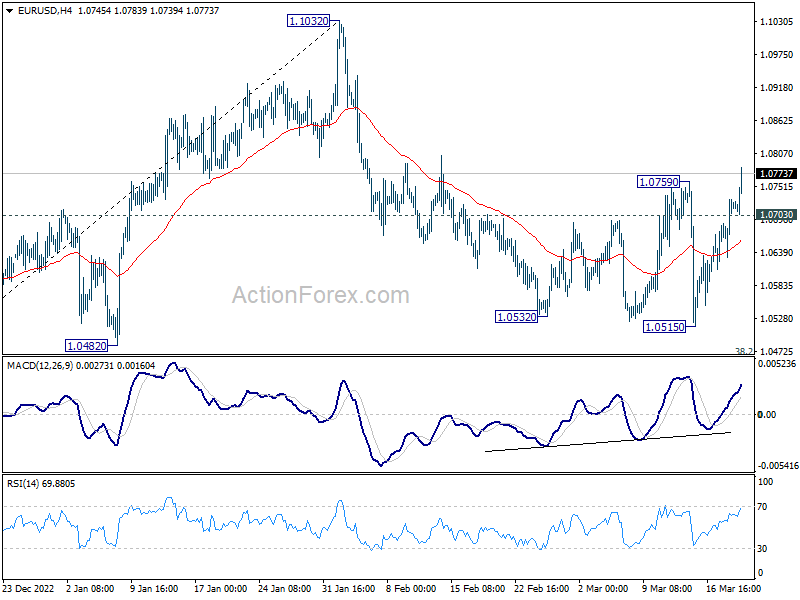
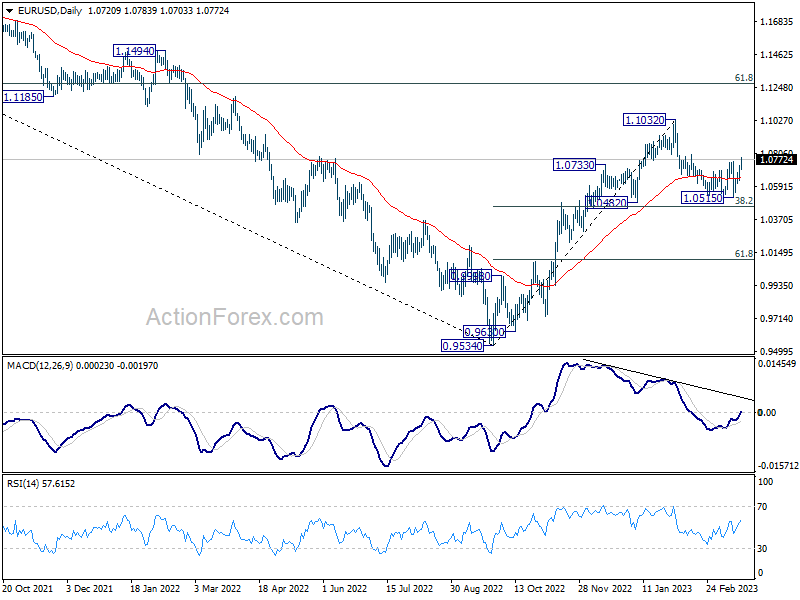
In the bigger picture, as long as 1.0482 support holds, rise from 0.9534 (2022 low) should continue to 61.8% retracement of 1.2348 (2021 high) to 0.9534 at 1.1273. However, sustained break of 1.0482 will bring deeper fall to 61.8% retracement of 0.9534 to 1.1032 at 1.0106, with risk of breaking through 0.9534 eventually.
Euro Strengthens Despite Poor German Economic Sentiment
Euro rises broadly today partly as overall sentiment stabilized. Technical also play a role as the common currency defended near term support levels against both Sterling and Aussie. Poor Germany economic sentiment data was basically ignored by the markets. Market participants appeared to dismiss the poor economic sentiment data from Germany, with the belief that the decline could be temporary
Simultaneously, Swiss Franc and Dollar are making recoveries against other currencies. Canadian Dollar showed little response to lower-than-anticipated CPI readings, which essentially reinforced BoC's decision to maintain the current interest rate levels, at least for the near future. Other commodity currencies, however, are exhibiting weakness. Australian Dollar, for instance, is facing pressure following the RBA minutes, suggesting a potential pause in their next meeting.
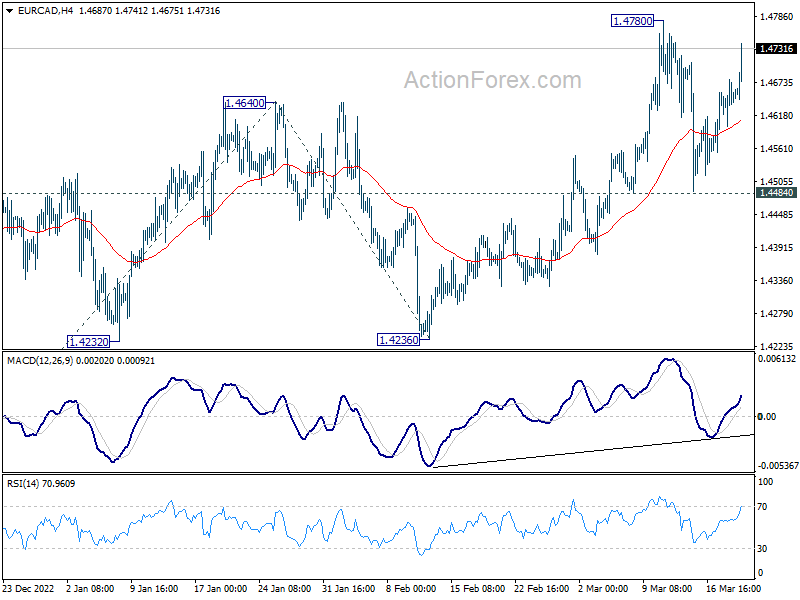
Technically, EUR/USD's break of 1.0759 resistance is taken as an indication of near term reversal. That is, further rise is now likely to be seen back to retest 1.1032 high. Two focuses will now be on 1.4780 resistance in EUR/CAD and 1.6200 resistance in EUR/AUD. Break of these two levels should solidify Euro's upside momentum.
In Europe, at the time of writing, FTSE is up 1.81%. DAX is up 1.87%. CAC is up 1.82%. Germany 10-year yield is up 0.1525 at 0.273. Earlier in Asia, Hong Kong HSI rose 1.36%. China Shanghai SSE rose 0.64%. Singapore Strait Times rose 1.09%. Japan was on holiday.
Canada CPI slowed to 5.2% yoy in Feb, below expectation of 5.4% yoy
Canada CPI slowed from 5.9% yoy to 5.2% yoy in February, below expectation of 5.4% yoy. Excluding food and energy, CPI slowed slightly from 4.9% yoy to 4.8% yoy. All-items CPI excluding mortgage interest costs slowed from 5.4% yoy to 4.7% yoy.
On a monthly basis, CPI rose 0.4% mom, slowed from January's 0.5% mom, and below expectation of 0.5% mom. Decline in energy prices were offset by rise in mortgage interest costs.
Meanwhile, CPI median decreased from 5.0% yoy to 4.9% yoy above expectation of 4.8% yoy. CPI trimmed fell from 5.1% yoy to 4.8% yoy, below expectation of 4.9% yoy. CPI common declined from 6.6% yoy to 6.4% yoy, below expectation of 6.5% yoy.
German ZEW fell sharply to 13 in Mar, reflecting financial markets pressure
German ZEW Economic Sentiment deteriorated sharply from 28.1 to 13.0 in March, below expectation of 14.9. Current Situation index also dropped from -45.1 to -46.5, below expectation of -44.3.
Eurozone ZEW Economic Sentiment dropped from 29.7 to 10.0, below expectation of 16.0. Eurozone Current Situation dropped -3 pts to -44.6.
ZEW President Professor Achim Wambach said: "The international financial markets are under strong pressure. This high level of uncertainty is also reflected in the ZEW Indicator of Economic Sentiment.
"The assessment of the earnings development of banks has deteriorated considerably, although it still remains slightly positive. The estimates for the insurance industry have also declined significantly."
RBA Minutes: To reconsider a pause at next meeting
The minutes of RBA's meeting on March 7 indicate that the central bank is considering a more cautious approach in tightening monetary policy, as uncertainty surrounding the economic outlook persists. The RBA members observed that "further tightening of monetary policy would likely be required to ensure that inflation returns to target." However, they also noted the restrictive nature of current monetary policy and the economic uncertainty, stating that "it would be appropriate at some point to hold the cash rate steady."
During the meeting, RBA members agreed to "reconsider the case for a pause at the following meeting, recognizing that pausing would allow additional time to reassess the outlook for the economy." The decision on when to pause will be determined by incoming data and the board's assessment of the economic situation.
The RBA acknowledges that "the outlook for consumption remained a key source of uncertainty." The central bank will closely monitor upcoming data releases on employment, inflation, retail trade, and business surveys, as well as developments in the global economy, to inform their decision-making.
EUR/USD Mid-Day Outlook
Daily Pivots: (S1) 1.0660; (P) 1.0696; (R1) 1.0759; More...
EUR/USD's break of 1.0759 resistance suggests that correction from 1.1032 has completed at 1.0515 already. That came after defending both 1.0482 support and 38.2% retracement of 0.9534 to 1.1032 at 1.0258. Intraday bias is back on the upside for retesting 1.1032 high next. On the downside, below 1.0703 minor support will turn intraday bias neutral again first.
In the bigger picture, as long as 1.0482 support holds, rise from 0.9534 (2022 low) should continue to 61.8% retracement of 1.2348 (2021 high) to 0.9534 at 1.1273. However, sustained break of 1.0482 will bring deeper fall to 61.8% retracement of 0.9534 to 1.1032 at 1.0106, with risk of breaking through 0.9534 eventually.
Economic Indicators Update
| GMT | Ccy | Events | Actual | Forecast | Previous | Revised |
|---|---|---|---|---|---|---|
| 21:45 | NZD | Trade Balance (NZD) Feb | -714M | -1800M | -1954M | -2113M |
| 00:30 | AUD | RBA Minutes | ||||
| 07:00 | CHF | Trade Balance (CHF) Feb | 3.31B | 3.45B | 5.08B | 4.85B |
| 07:00 | GBP | Public Sector Net Borrowing (GBP) Feb | 15.9B | 10.5B | -6.2B | -9.1B |
| 10:00 | EUR | Germany ZEW Economic Sentiment Mar | 13 | 14.9 | 28.1 | |
| 10:00 | EUR | Germany ZEW Current Situation Mar | -46.5 | -44.3 | -45.1 | |
| 10:00 | EUR | Eurozone ZEW Economic Sentiment Mar | 10 | 16 | 29.7 | |
| 12:30 | CAD | CPI M/M Feb | 0.40% | 0.50% | 0.50% | |
| 12:30 | CAD | CPI Y/Y Feb | 5.20% | 5.40% | 5.90% | |
| 12:30 | CAD | CPI - Core M/M Feb | 0.30% | 0.10% | ||
| 12:30 | CAD | CPI Median Y/Y Feb | 4.90% | 4.80% | 5.00% | |
| 12:30 | CAD | CPI Trimmed Y/Y Feb | 4.80% | 4.90% | 5.10% | |
| 12:30 | CAD | CPI Common Y/Y Feb | 6.40% | 6.50% | 6.60% | |
| 14:00 | USD | Existing Home Sales Feb | 4.17M | 4.00M |