Sample Category Title
Financial Markets Exude Optimism, Awaiting Crucial FOMC Rate Decisions
As the mood in the financial markets seems to be rather upbeat, Asian markets are riding the wave of positivity, tracing the upward trajectory set by their US counterparts. All eyes are on FOMC rate decision today, with most expecting a 25 basis point increase. However, uncertainty lingers as opinions within the market remain divided on what next for Fed. Market participants are eager to hear from Fed Chair Jerome Powell during today's press conference, hoping for clarity on future policy direction, though doubts persist about how much reassurance he can provide.
The currency markets have witnessed Euro taking the lead as the week's strongest performer, followed closely by Swiss Franc and British Pound. Sterling's performance will hinge on the release of today's CPI data and BoE rate decision tomorrow. Meanwhile, the Swiss Franc will turn its attention to SNB rate decision scheduled prior to the BoE's announcement. Although commodity currencies show signs of recovery, they remain at the bottom of the performance chart. Dollar is currently exhibiting mixed results, faring slightly only better than Yen, Aussie, and Kiwi.
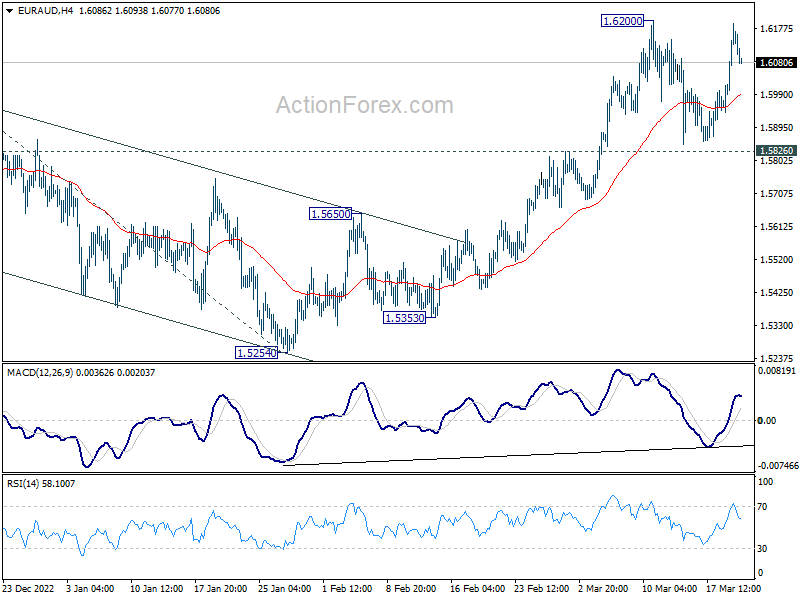
On the technical front, market-watchers are keen to see if Euro can maintain its momentum and extend this week's robust rally. The surges past 1.0759 resistance in EUR/USD and break of 1.4780 resistance in EUR/CAD were bullish indicators. However, EUR/AUD encountered resistance at 1.6200, and EUR/GBP is grappling to surpass the 0.8842 minor resistance. Euro's strength will be put to the test as it seeks to solidify its position in the markets.
In Asia, at the time of writing, Nikkei is up 1.93%. Hong Kong HSI is up 1.88%. China Shanghai SSE is up 0.08%. Singapore Strait Times is up 1.50%. Japan 10-year JGB yield is up 0.319 at 0.724. Overnight, DOW rose 0.98%. S&P 500 rose 1.30%. NASDAQ rose 1.58%. 10-year yield rose 0.125 to 3.606.
Fed expected to hike 25bps, divided opinion on future path
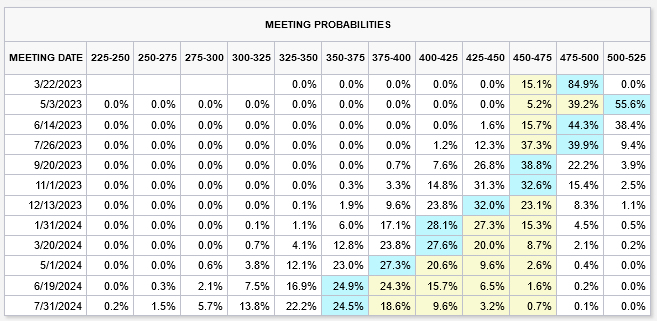
Today marks a significant moment as Fed is expected to continue with its tightening policy. Amid the recent banking crisis and market turmoil, it is widely anticipated that Fed will raise interest rates by 25bps to the 4.75-5.00% range, with around 85% probability. Fed Chair Jerome Powell is likely to stress the importance of bringing inflation back on target during the post-meeting conference, while acknowledging the current market turbulence.
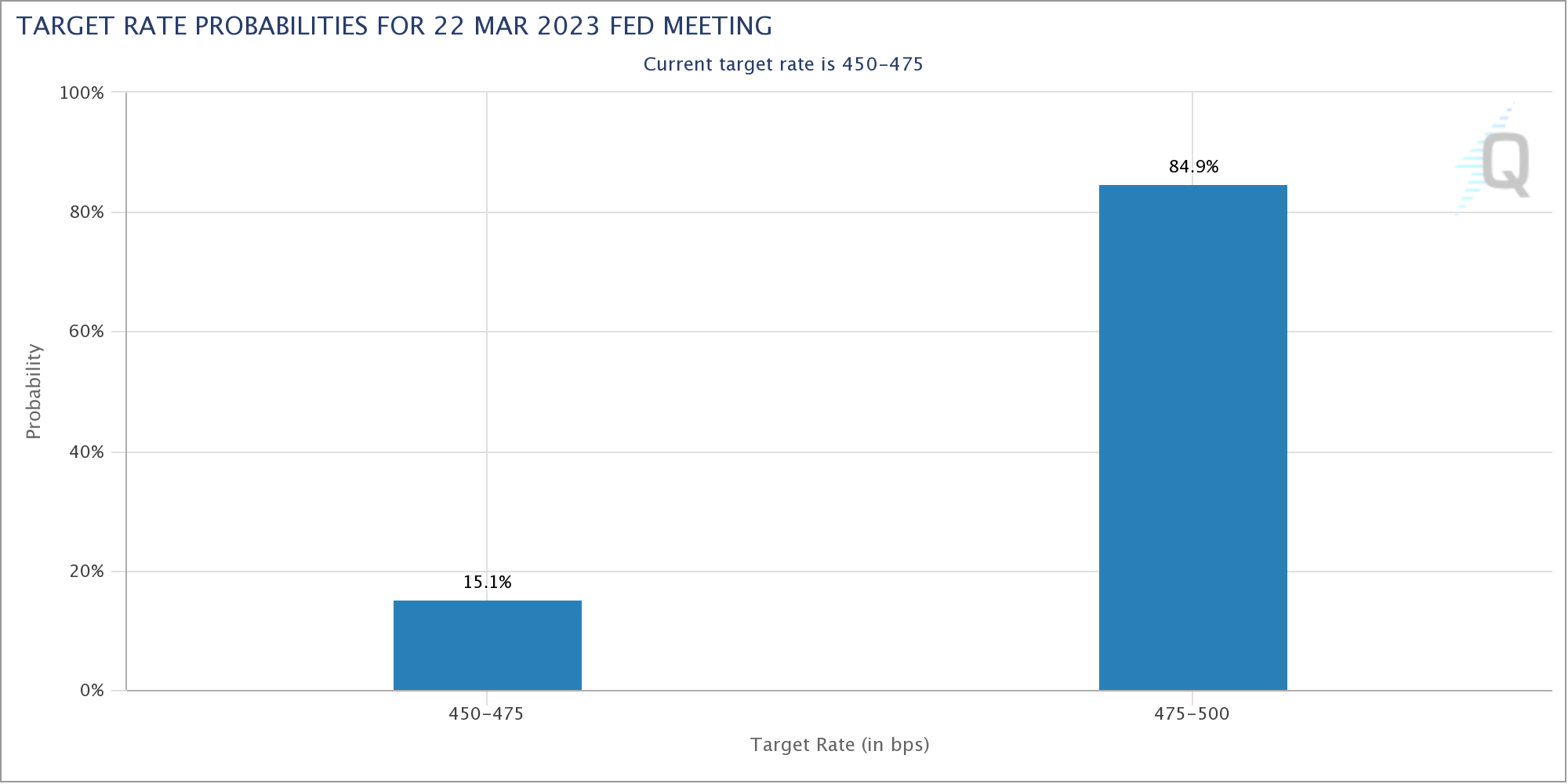
The Fed's future rate path remains a hot topic of debate. According to Fed fund futures pricing, there is over 55% chance of an additional 25 basis point hike in May, bringing the interest rate to 5.00-5.25%. However, this is followed by a over 62% probability of a -25 basis point cut in June, reverting the rate back to 4.75-5.00%. This apparent contradiction reflects the divided opinions on whether there will be another rate move in May. But in more certainty, traders seem to be leaning more towards a rate cut in September, with around 75% chance of interest rate falling back into the 4.50-4.75% range.
The new staff economic projections scheduled for release today were initially expected to provide some clarity on the future rate path. However, it is speculated that the Fed might choose to delay or suspend these projections, as it did in March 2020 during the onset of the pandemic, to avoid creating further confusion. As a result, a clear answer to the future rate path may remain elusive for now.
Here are some previews:
- Suderman Says: To Raise Rates or Not, Fed Walks a Tightrope
- Fed Faces Dilemma, Hit Pause or Keep Raising Rates?
- Fed Meeting Preview: Dollar Index at 1-month Low ahead of Tight Decision
- Fed to Go Ahead with 25 bp Hike; Canadian CPI Growth to Slow
- Fed Preview – Rate Hikes Continue Despite the Volatility
- March Flashlight for the FOMC Blackout Period: The Flashlight Needs Fresh Batteries
Australia Westpac leading index remains negative, indicating further slowdown
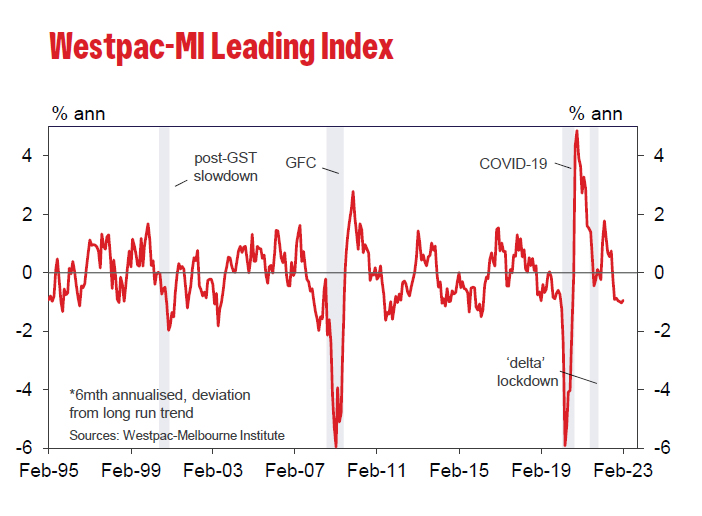
Australia's Westpac Leading Index rose slightly from -1.04% to -0.94% in February, but it still marks the seventh consecutive month of negative growth rate, pointing to below-trend growth over the next 3-9 months. This is in line with Westpac's forecast that growth in the Australian economy will be only 1% in 2023.
The slowdown reflects the lagged effects of rising interest rates, a deep shock to real wages, a bottoming out of the savings rate, and falling house prices. Westpac also expects the weakness to extend into 2024, with more negative readings likely.
RBA indicated in its March minutes that the board intends to consider a pause at its April meeting. However, Westpac does not expect that a decision to pause in April will mark the end of the cycle. It expects new information for the May meeting to indicate the need for a further response from the board, with a final 0.25% increase in the cash rate in May marking the end of the tightening cycle.
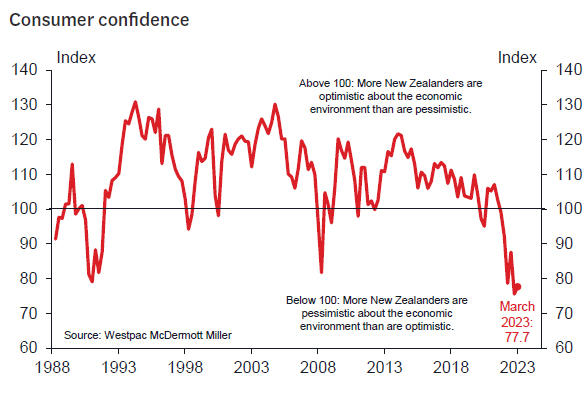
NZ consumer confidence rose slightly to 77.7, but well below long-term average
New Zealand's Westpac McDermott Miller Consumer Confidence Index rose slightly by 2.1 points to 77.7 in March, but still remains well below the long-term average of 108.8. The President Conditions Index and the Expected Conditions Index also increased, but are still far below their long-term averages of 106.1 and 100.6, respectively.
Despite the slight uptick in confidence, Westpac notes that households across the country continue to grapple with the increasing costs of living, higher mortgage rates, and a downturn in the housing market. The Expected financial situation has improved, but remains negative at -3.8, while the 1-year economic outlook has only slightly improved to -41.1, and the 5-year economic outlook has dropped to -10.8.
The mounting financial pressures are already affecting household spending, and as they become more pronounced, Westpac expects to see an increasing number of households winding back their spending over the next year. This weakness in consumer confidence could have significant implications for the overall economy, as household spending is a major driver of economic growth.
Elsewhere
UK inflation data will also be watched closely in European session, with CPI, RPI and PPI featured. Eurozone will release current account. Canada will publish new housing price index.
GBP/USD Daily Outlook
Daily Pivots: (S1) 1.2170; (P) 1.2226; (R1) 1.2274; More...
Intraday bias in GBP/USD is turned neutral first with current retreat. Some consolidations could be seen below 1.2283 temporary low. But outlook will stay cautiously bullish as long as 1.2009 support hold. As noted before, corrective pattern from 1.2445 could have completed with three waves to 1.1801 already. Above 1.2283 will extend the rise from 1.1801 to retest 1.2445/6 resistance. Firm break of 1.2445/6 will resume larger rise from 1.0351, and target 1.2759 fibonacci level.
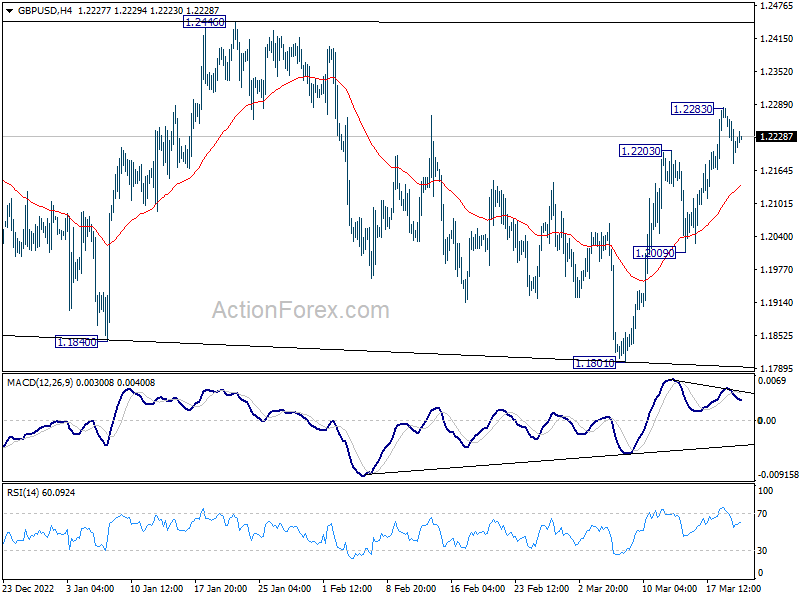
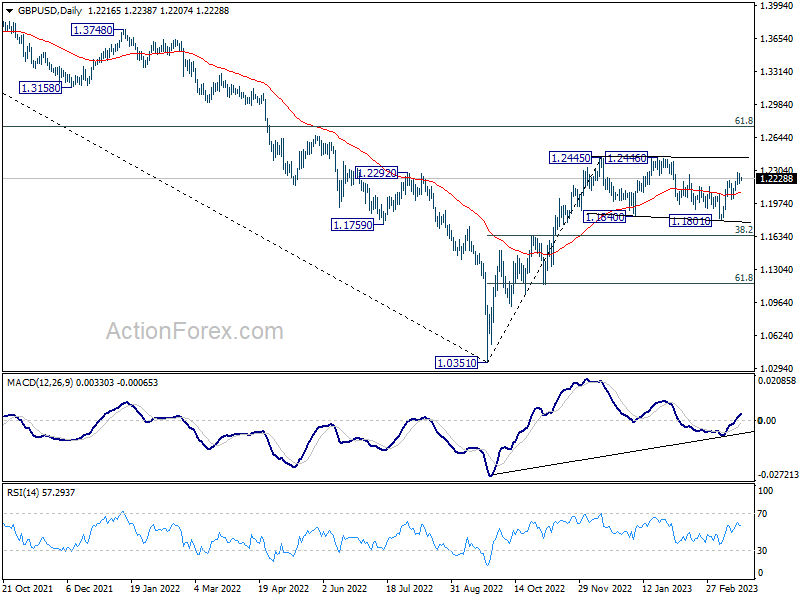
In the bigger picture, price action from 1.2445 are seen as a corrective pattern to rise from 1.0351 medium term bottom (2022 low). Resumption is expected as a later stage and firm break of 1.2446 will target 61.8% retracement of 1.4248 (2021 high) to 1.0351 at 1.2759. This will remain the favored case as long as 38.2% retracement of 1.0351 to 1.2445 at 1.1645 holds.
Economic Indicators Update
| GMT | Ccy | Events | Actual | Forecast | Previous | Revised |
|---|---|---|---|---|---|---|
| 23:30 | AUD | Westpac Leading Index M/M Feb | -0.10% | -0.10% | ||
| 07:00 | GBP | CPI M/M Feb | 0.20% | -0.60% | ||
| 07:00 | GBP | CPI Y/Y Feb | 9.80% | 10.10% | ||
| 07:00 | GBP | Core CPI Y/Y Feb | 5.70% | 5.80% | ||
| 07:00 | GBP | RPI M/M Feb | 0.80% | 0.00% | ||
| 07:00 | GBP | RPI Y/Y Feb | 13.20% | 13.40% | ||
| 07:00 | GBP | PPI Input M/M Feb | 0.70% | -0.10% | ||
| 07:00 | GBP | PPI Input Y/Y Feb | 10.80% | 14.10% | ||
| 07:00 | GBP | PPI Output M/M Feb | 0.80% | 0.50% | ||
| 07:00 | GBP | PPI Output Y/Y Feb | 12.50% | 13.50% | ||
| 07:00 | GBP | PPI Core Output M/M Feb | 0.40% | 0.60% | ||
| 07:00 | GBP | PPI Core Output Y/Y Feb | 9.90% | 11.10% | ||
| 09:00 | EUR | Eurozone Current Account (EUR) Jan | 16.5B | 15.9B | ||
| 12:30 | CAD | New Housing Price Index M/M Feb | -0.10% | -0.20% | ||
| 14:30 | USD | Crude Oil Inventories | -1.7M | 1.6M | ||
| 18:00 | USD | Fed Interest Rate Decision | 5.00% | 4.75% | ||
| 18:30 | USD | FOMC Press Conference |
Fed expected to hike 25bps, divided opinion on future path
Today marks a significant moment as Fed is expected to continue with its tightening policy. Amid the recent banking crisis and market turmoil, it is widely anticipated that Fed will raise interest rates by 25bps to the 4.75-5.00% range, with around 85% probability. Fed Chair Jerome Powell is likely to stress the importance of bringing inflation back on target during the post-meeting conference, while acknowledging the current market turbulence.
The Fed's future rate path remains a hot topic of debate. According to Fed fund futures pricing, there is over 55% chance of an additional 25 basis point hike in May, bringing the interest rate to 5.00-5.25%. However, this is followed by a over 62% probability of a -25 basis point cut in June, reverting the rate back to 4.75-5.00%. This apparent contradiction reflects the divided opinions on whether there will be another rate move in May. But in more certainty, traders seem to be leaning more towards a rate cut in September, with around 75% chance of interest rate falling back into the 4.50-4.75% range.
The new staff economic projections scheduled for release today were initially expected to provide some clarity on the future rate path. However, it is speculated that the Fed might choose to delay or suspend these projections, as it did in March 2020 during the onset of the pandemic, to avoid creating further confusion. As a result, a clear answer to the future rate path may remain elusive for now.
Here are some previews:
- Suderman Says: To Raise Rates or Not, Fed Walks a Tightrope
- Fed Faces Dilemma, Hit Pause or Keep Raising Rates?
- Fed Meeting Preview: Dollar Index at 1-month Low ahead of Tight Decision
- Fed to Go Ahead with 25 bp Hike; Canadian CPI Growth to Slow
- Fed Preview – Rate Hikes Continue Despite the Volatility
- March Flashlight for the FOMC Blackout Period: The Flashlight Needs Fresh Batteries
Australia Westpac leading index remains negative, indicating further slowdown
Australia's Westpac Leading Index rose slightly from -1.04% to -0.94% in February, but it still marks the seventh consecutive month of negative growth rate, pointing to below-trend growth over the next 3-9 months. This is in line with Westpac's forecast that growth in the Australian economy will be only 1% in 2023.
The slowdown reflects the lagged effects of rising interest rates, a deep shock to real wages, a bottoming out of the savings rate, and falling house prices. Westpac also expects the weakness to extend into 2024, with more negative readings likely.
RBA indicated in its March minutes that the board intends to consider a pause at its April meeting. However, Westpac does not expect that a decision to pause in April will mark the end of the cycle. It expects new information for the May meeting to indicate the need for a further response from the board, with a final 0.25% increase in the cash rate in May marking the end of the tightening cycle.
Crude Oil Price Could Struggle To Recover, Fed Decision Next
Key Highlights
- Crude oil price is attempting an upside correction from the $64.20 zone.
- A major bearish trend line is forming with resistance near $70.50 on the 4-hours chart.
- Gold price started a sharp downside correction from the $2,000 zone.
- The Fed interest rate decision is scheduled today (forecast 5%, versus 4.75% previous).
Crude Oil Price Technical Analysis
Crude oil price started a fresh decline from the $80.80 resistance against the US Dollar. The price declined below the $75.00 support to move into a bearish zone.
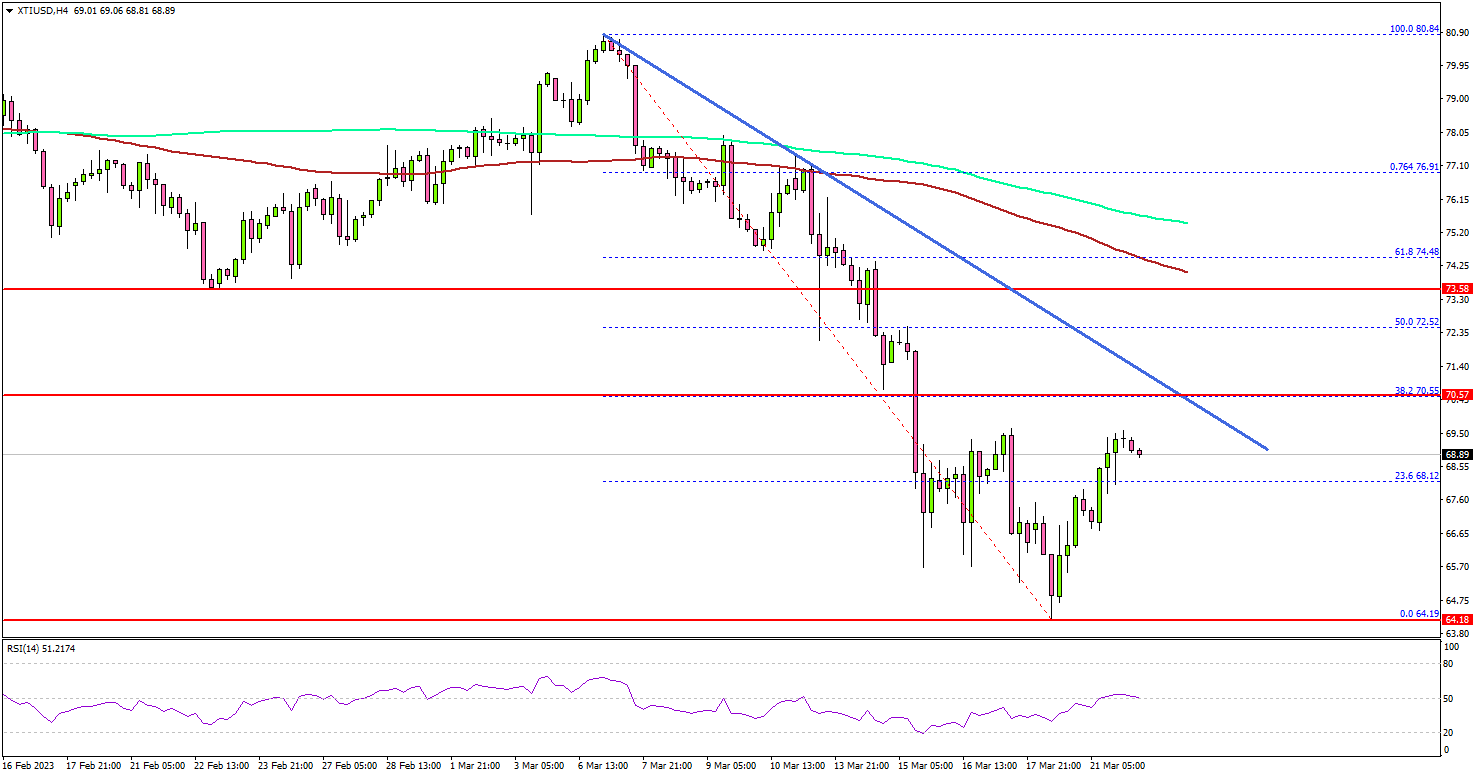
Looking at the 4-hours chart of XTI/USD, the price settled below the $72.00 support, the 100 simple moving average (red, 4-hours) and the 200 simple moving average (green, 4-hours).
The price even spiked below the $65.00 support and tested the $64.20 zone. A low was formed near $64.19 and the price started an upside correction. There was a move above the 23.6% Fib retracement level of the downward move from the $80.84 swing high to $64.19 low.
On the upside, the price is facing resistance near the $70.50 zone. There is also a major bearish trend line forming with resistance near $70.50 on the same chart.
The next major resistance is near the $72.50 zone or the 50% Fib retracement level of the downward move from the $80.84 swing high to $64.19 low. A clear move above the $72.50 resistance could open the doors for another steady increase towards $75 or even $78.
An immediate support is now forming near the $66.50 zone. The next major support sits near the $64.20 level. Any more losses might call for a test of the $62.00 support zone in the coming days.
Looking at gold price, there was a sharp bearish reaction from the $2,000 zone and the price declined below the $1,965 support.
Economic Releases to Watch Today
- UK Consumer Price Index for Feb 2023 (YoY) – Forecast +9.8%, versus +10.1% previous.
- UK Core Consumer Price Index for Feb 2023 (YoY) – Forecast +5.8%, versus +5.8% previous.
- Fed Interest Rate Decision - Forecast 5%, versus 4.75% previous.
NZ consumer confidence rose slightly to 77.7, but well below long-term average
New Zealand's Westpac McDermott Miller Consumer Confidence Index rose slightly by 2.1 points to 77.7 in March, but still remains well below the long-term average of 108.8. The President Conditions Index and the Expected Conditions Index also increased, but are still far below their long-term averages of 106.1 and 100.6, respectively.
Despite the slight uptick in confidence, Westpac notes that households across the country continue to grapple with the increasing costs of living, higher mortgage rates, and a downturn in the housing market. The Expected financial situation has improved, but remains negative at -3.8, while the 1-year economic outlook has only slightly improved to -41.1, and the 5-year economic outlook has dropped to -10.8.
The mounting financial pressures are already affecting household spending, and as they become more pronounced, Westpac expects to see an increasing number of households winding back their spending over the next year. This weakness in consumer confidence could have significant implications for the overall economy, as household spending is a major driver of economic growth.
Is JPY Ready to Reclaim All-Year High?
Between October 2022, and January 2023, the Japanese Yen outperformed several other currency pairs, resulting in over a thousand pips move on pairs like EURJPY, GBPJPY, and 2000-plus pips on USDJPY. Considering that the BOJ has recently experienced a leadership change, and the JPY is at a pivotal zone on most charts, it seems a good time to analyze the charts for trading opportunities.
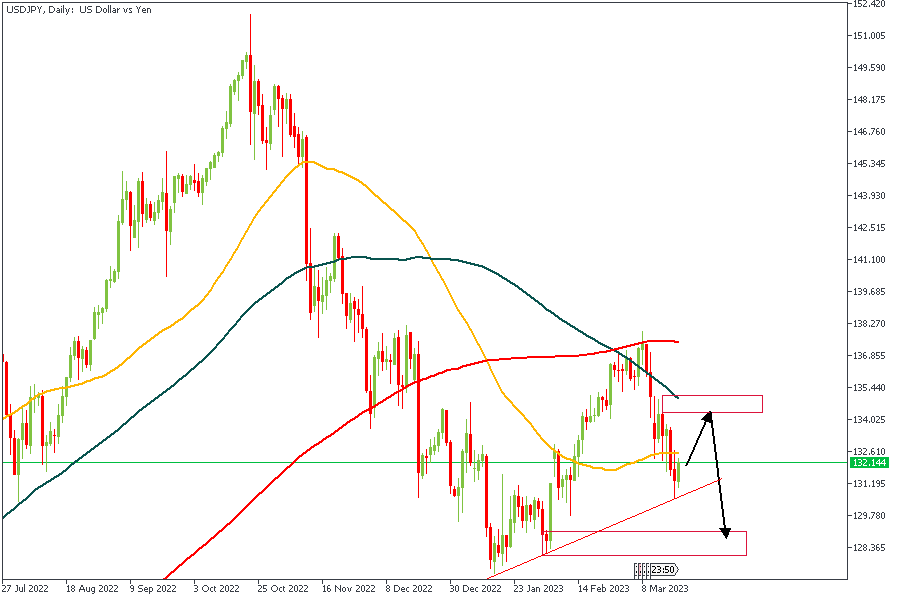
USDJPY
USDJPY seems to be reacting from the trendline support on the daily already. However, as we can see from the chart based on the bearish alignment of the Moving averages, it confirms the possibility of a bearish movement.
Analysts’ Expectations:
- Direction: Bearish
- Target: 129.410
- Invalidation: 135.470
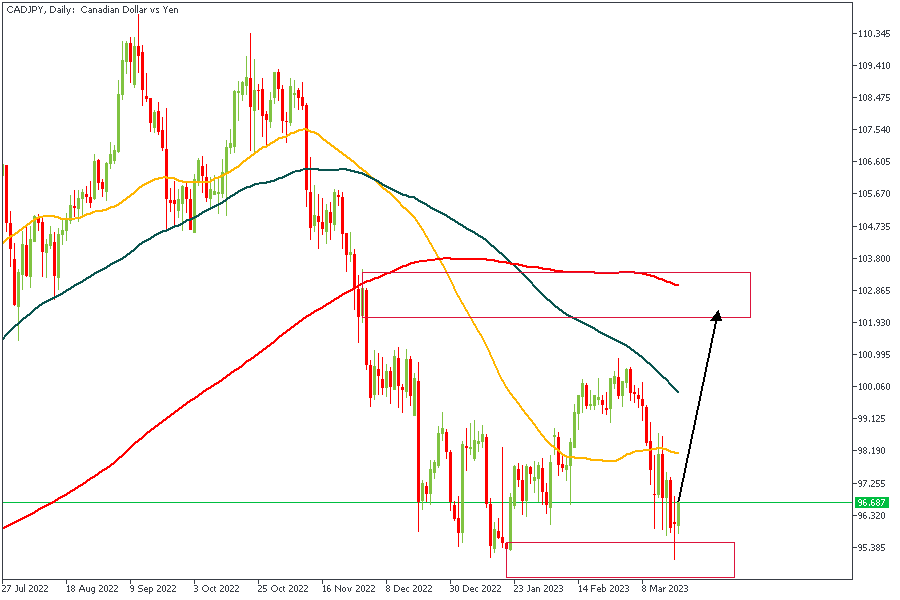
CADJPY
CADJPY initially reacted to a demand zone even though the MAs are inclined in a bearish array. The break of structure, demand zone, and Fibonacci levels point to the possibility of price returning to the supply zone at the 200-Day MA before heading back down.
Analysts’ Expectations:
- Direction: Bullish
- Target: 100.060
- Invalidation: 95.70
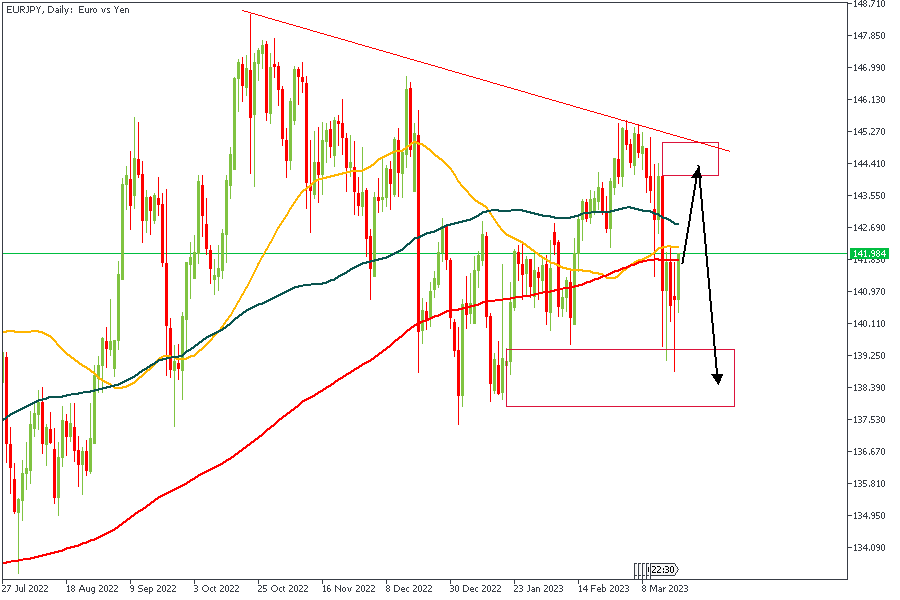
EURJPY
I believe the price intends to react from a trendline resistance on the daily timeframe of EURJPY. The fact that the resistance trendline falls in line with the supply zone and 88% Fibonacci retracement zone gives me a reason to believe it would be a great point of entry for a sell order.
Analysts’ Expectations:
- Direction: Bearish
- Target: 145.430
- Invalidation: 137.30
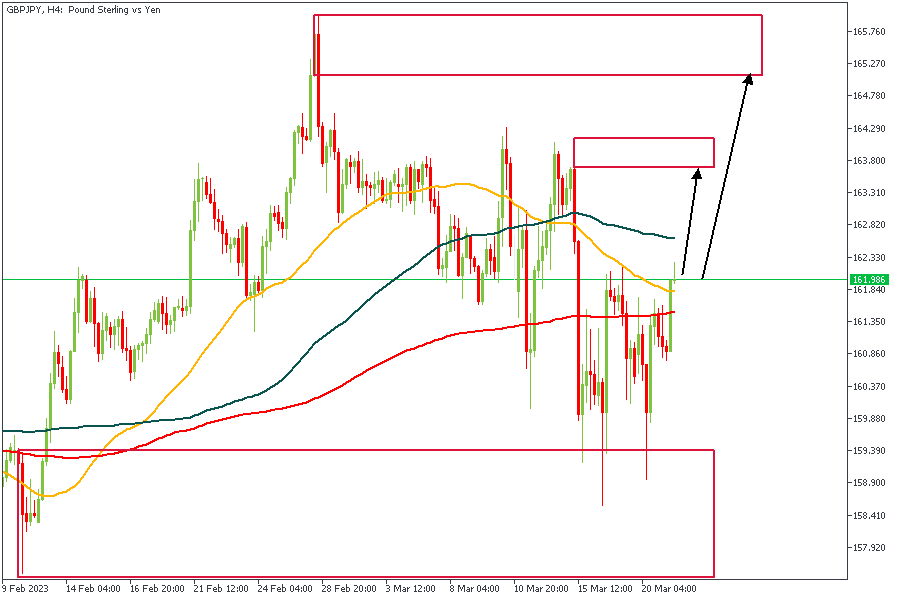
GBPJPY
GBPJPY looks very similar to EURJPY. I see the price heading towards and reacting from either of the two zones I have already marked out. Based on the alignment of the MAs, I will be opting for a sell order from either supply zone.
Analysts’ Expectations:
- Direction: Bullish
- Target: 161.000
- Invalidation: 164.520
CONCLUSION
The trading of CFDs comes at a risk. Thus, to succeed, you have to manage risks properly. To avoid costly mistakes while you look to trade these opportunities, be sure to do your due diligence and manage your risk appropriately.
GBPNZD Wave Analysis
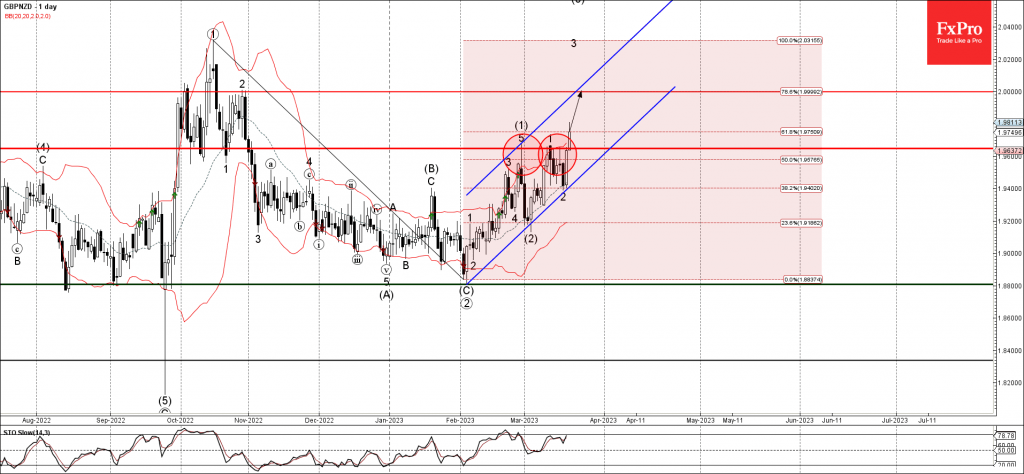
- GBPNZD broke resistance level 1.9650
- Likely to rise to resistance level 2.0000
GBPNZD recently broke the resistance level 1.9650 (earlier strong resistance from February) standing close to the 50% Fibonacci correction of the downward ABC correction from the start of October.
The breakout of the resistance level 1.9650 accelerated the active short-term impulse wave 3, which belongs to the intermediate impulse wave (3) from the start of this month. GBPNZD currency pair can then be expected to rise further toward the next round resistance level 2.0000.
Gold Wave Analysis
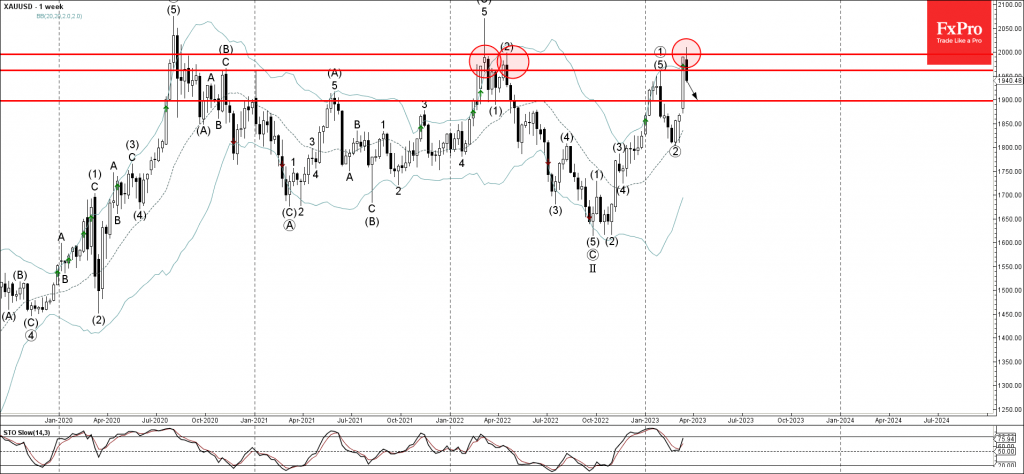
- Gold under bearish pressure
- Likely to fall to support level 1900.00
Gold under the bearish pressure after the earlier downward reversal from the round resistance level 2000.00 (likely upward target set in our previous forecast for this precious metal) standing close to the upper weekly Bollinger Band.
The active downward reversal from the resistance level 2000.00 is similar to the earlier times when the initial contact with this price level is followed by the sharp downward correction.
Given the clear bearish divergence on the weekly Stochastic, Gold can then be expected to fall further toward the next support level 1900.00.
Canadian Dollar Shrugs as Inflation Falls
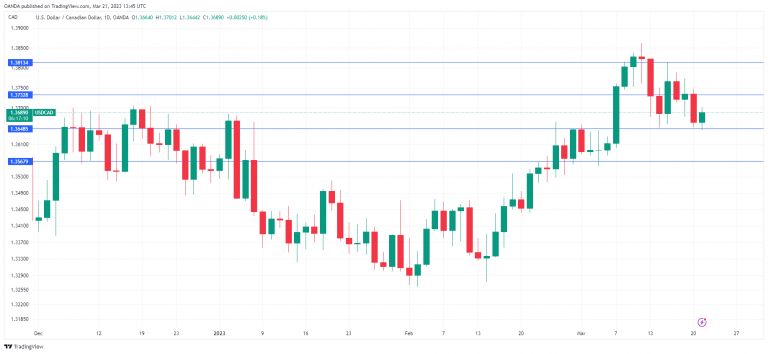
The Canadian dollar is slightly lower on Tuesday. In the North American session, USD/CAD is trading at 1.3687, up 0.17%.
Canada’s CPI continues to ease
Canada’s headline inflation fell to 5.2% y/y in February, down from 5.9% y/y in January and beating the consensus estimate of 5.4%. This was the largest deceleration since April 2020 and the lowest inflation rate since January 2021. This is clearly good news, but it’s still premature for the Bank of Canada to pat itself on the bank for a job well done. Food prices continue to outpace overall inflation and jumped 10.6% y/y, a grim reminder that consumers are feeling the price pain every time they go to the supermarket. Core inflation remains sticky, with the three core rate measures coming in at 5.3%, slightly better than the 5.5% gain in January.
The Bank of Canada left rates unchanged at 4.5% at its meeting earlier this month, the first time it has paused during the current rate-tightening cycle which began last year. Governor Macklem has made clear that the Bank will remain in pause mode only if the data supports such a move, and today’s inflation data appears to support another pause at the April 8th meeting.
The BoC was one of six major central banks to announce on the weekend that they would coordinate to boost US dollar liquidity in order to head off further contagion of the global banking system. The financial markets were in a near-panic last week as three US banks collapsed and Swiss banking giant Credit Suisse had to be rescued by UBS in an emergency merger. The BoC had telegraphed today’s rate pause well in advance and there really wasn’t any uncertainty ahead of the decision. Still, like other central banks, the BoC will have to tread carefully with its rate path in the current unstable financial environment.
USD/CAD Technical
- 1.3648 was tested in support earlier in the North American session. 1.3567 is the next support line
- 1.3732 and 1.3813 are the next resistance lines