Sample Category Title
USD/CHF: Sideways Correction Completion May Indicate a Further Fall
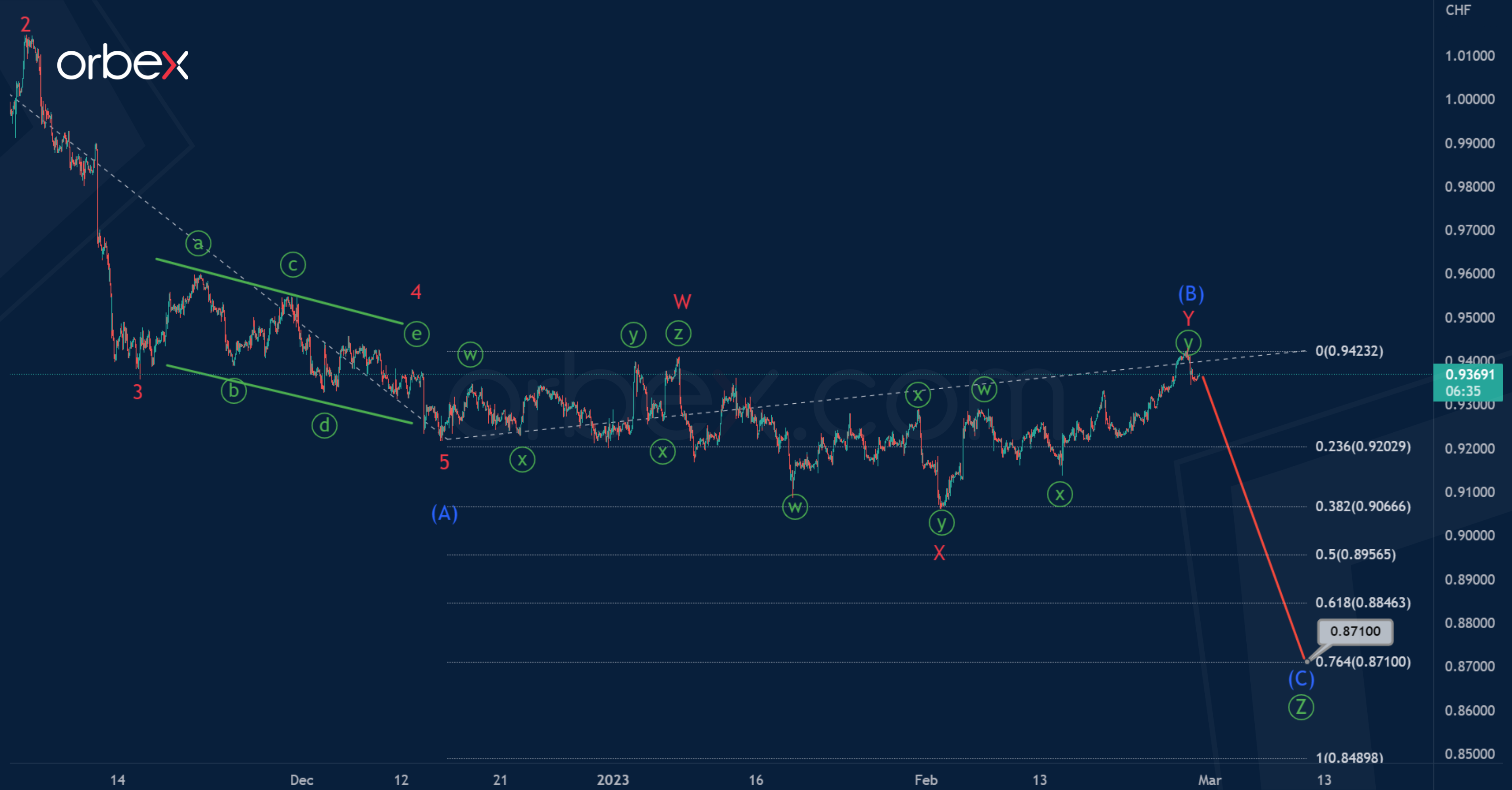
The USDCHF pair seems to be forming a triple zigzag Ⓦ-Ⓧ-Ⓨ-Ⓧ-Ⓩ. Its final part, wave Ⓩ, is under development.
It is assumed that the wave Ⓩ can end in the form of a standard intermediate zigzag (A)-(B)-(C). Wave (A) is a 5-wave bearish impulse, wave (B) has a horizontal internal structure of a double three W-X-Y.
Thus, the formation of the final intermediate wave (C) can be expected in the near future. It is possible that it will be at 76.4% of impulse (A), and will end near 0.871.
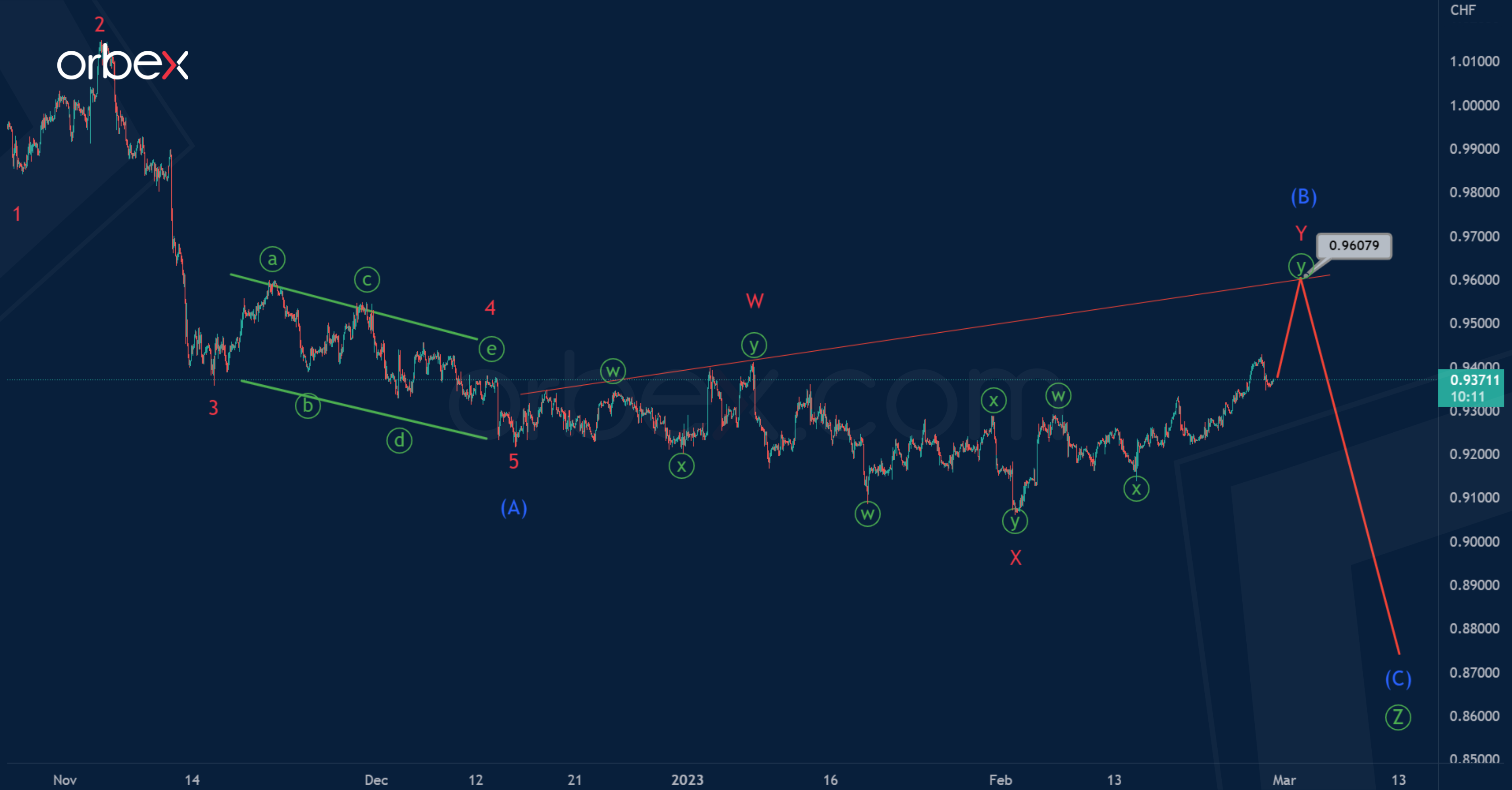
Alternatively, the development of correction (B) may continue. Its structure is similar to the double three W-X-Y.
At the moment, two parts have been completed in it - the minor sub-waves W and X. Both of these sub-waves are similar to double zigzags of the minute degree ⓦ-ⓧ-ⓨ.
To confirm this scenario, the last minor wave Y is needed, it can also be a minute double zigzag.
It is likely that the bulls will send the market to the level of 0.960, which is on the resistance line.
EU and UK Struck a Deal to Reform Northern Irish Protocol
Markets
The EU and the UK struck a deal to reform the Northern Irish Protocol. Dubbed the Windsor Framework, the agreement entails a so-called green lane in the Irish Sea with significantly reduced checks for goods coming from the UK mainland and destined to stay in Northern Ireland. Goods continuing into Ireland, part of the European single market, need to follow a red lane. The pound profited though strengthened already in the run-up on rumours that an announcement was coming. EUR/GBP fell from 0.883 to 0.8795. In core bond markets, US Treasuries and German Bunds parted ways. While both headed south initially, UST’s found a bid going into US dealings, leading to yield losses of -3.1 to -4.7 bps in the 2y-10y bucket. That’s despite some strong US data (core capital goods orders & shipments and pending home sales). German yields across the curve meanwhile all hit new cycle highs with gains ranging from 3.3 bps to 7.5 bps with the 10y yield heavily testing critical resistance at 2.56% (62% recovery on the 2007-2020 decline). The same tenor in swap yields is hitting an important reference at around 3.2%. That didn’t stop European equities from staging a forceful comeback after Friday’s sell-off. The Euro Stoxx 50 rebounded at some point 2% to close with gains of 1.66%. Wall Street rose 1.5% only to pare gains as the US session evolved. The most important indices eventually finished between 0.22%-0.63% higher. The dollar was pressured, lifting EUR/USD back above 1.06 and DXY below 105.
A Reuters interview with ECB chief economist Lane published this morning grabs some headlines in an otherwise uneventful Asian session. The Irishman said forward-looking indicators suggest inflation will slow down, but that the case for a 50 bps rate hike in March remains solid. He added that when rates hit their plateau, they will probably stay there for “quite a long-lasting period, a fair number of quarters”. Barring a few exceptions, regional stocks eke out a slight gain. The dollar appreciates with EUR/USD struggling to keep the 1.06. US cash yields advance a few bps.
Today’s economic calendar contains some US regional business confidence indicators and Conference Board consumer confidence for February. The latter is expected to improve slightly from 107.1 to 108.5. EU member states France and Spain publish February inflation numbers, seen at 7% (vs. 7% in January) and 5.7% (vs 5.9%) respectively. As a precursor for the European number due on Thursday, they will set the tone on markets in early European dealings. With European yields at important technical crossroads, just imagine what an upward inflation surprise could do. EUR/USD’s daily fate depends on whether a sustained core bond yield advance spills over to equity markets (eg. Friday’s market moves). Support in the pair is located at 1.0461/1.0479. For sterling we think the NI protocol boost will be short-lived. The currency wasn’t really bothered with the issue anyway while there are more important things at hand in mainland UK, including a cost-of-living crisis.
News and views
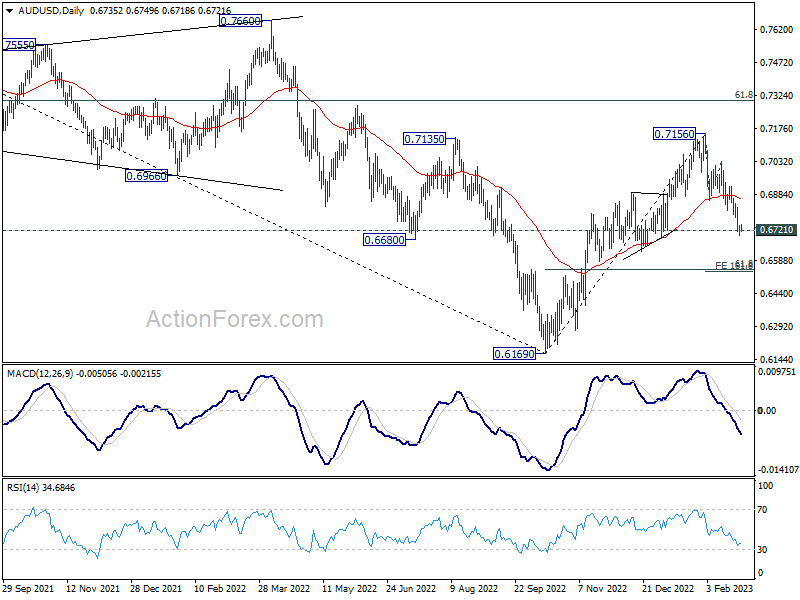
Australia’s current account surplus increased by $13.4bn to $14.1bn in Q4 2022. The increase is mainly due to the second highest on record trade surplus of $40.9bn. Exports of goods and services increased 3%, driven by rises in metal ores and minerals as constraints eased and travel services as the number of international students and visitors arriving in Australia increased. Imports of goods and services declined 3.1%. The rise in the trade surplus of $6.1bn is expected to contribute 1.1 percentage point to Q4 GDP growth. The Australian net primary income deficit (2nd component of current account balance) declined from a record $30.4bn in Q3 to $26.4bn in Q4. It remains historically high though due to high operating profits on direct investment off the back of continued strength in commodity prices, according to the Australian Bureau of Statistics. In a separate release, Australian retail sales rose slightly more than expected in January (1.9% M/M). AUD/USD this month lost out against an overall strong dollar, with the pair falling from 0.7150 towards 0.67. Next support kicks in around 0.6547.
Polish President Duda yesterday accused the EU of using various legal loopholes and questionable interpretations just to show that it can influence the legal order of a member state. The aggressive rhetoric follow’s the President’s decision not to sign into law the government’s plan to change Poland’s court system to unlock €35bn of EU funds. Instead, Duda sent the legislation to Poland’s top court – part of the EU’s complaints – for a review. The maneuvering suggests that the stalemate might only be solved after Polish elections in October.
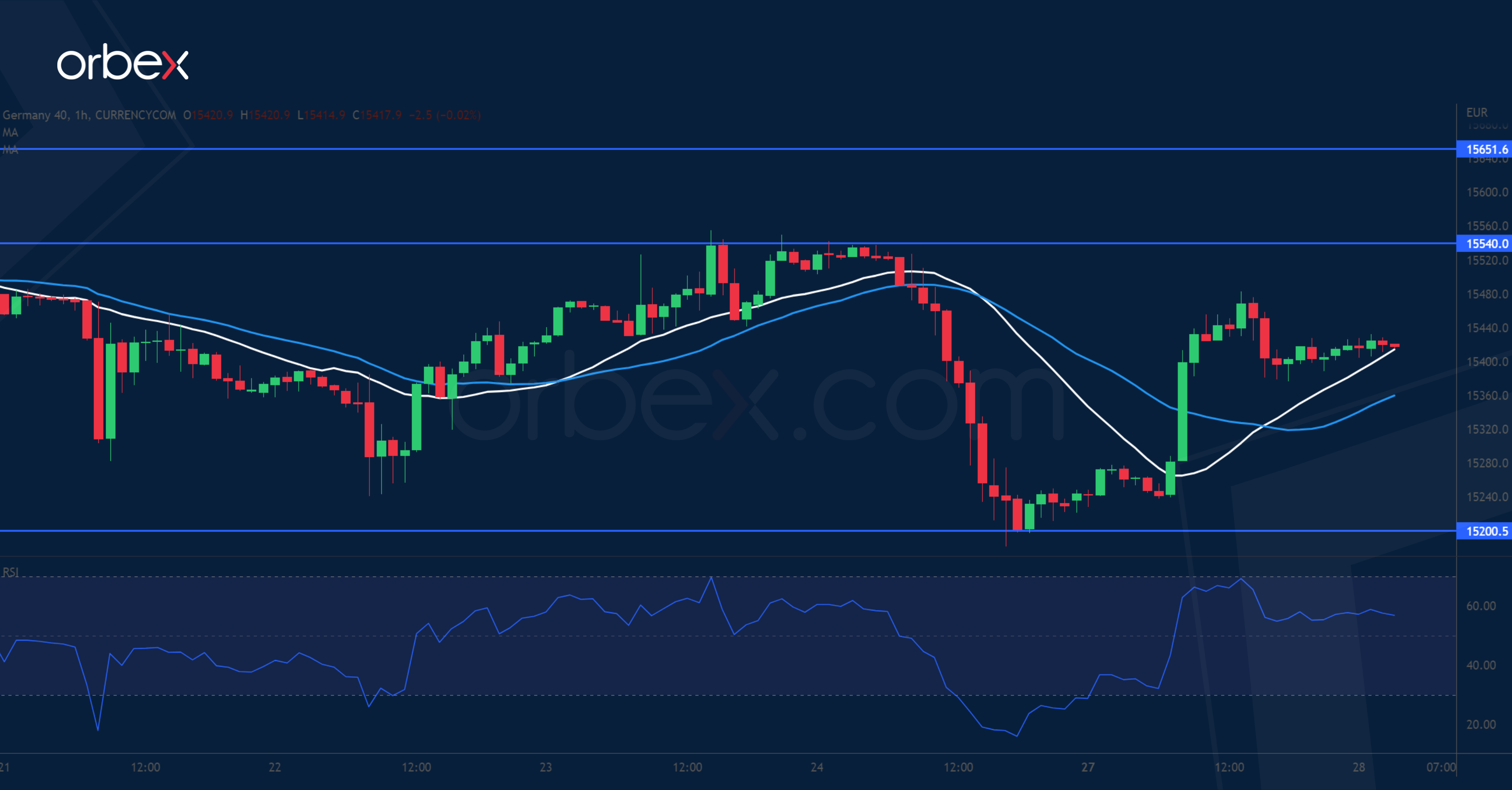
Dax 40 Recoups Losses
The Dax 40 bounced back helped by the optimism from a EU-UK trade deal on Northern Ireland. On the daily chart, the trajectory remains up and the latest sharp fall in a shorter time frame may only have shaken out the weak hands. A bounce off 15200 at the base of a breakout rally in early February suggests that the bulls have enough firepower to defend their positions. 15540 is the closest resistance and its breach would put the recent peak at 15650 in the crosshairs, which would be a step closer to a bullish continuation.
NZD/USD Sees Limited Rebound
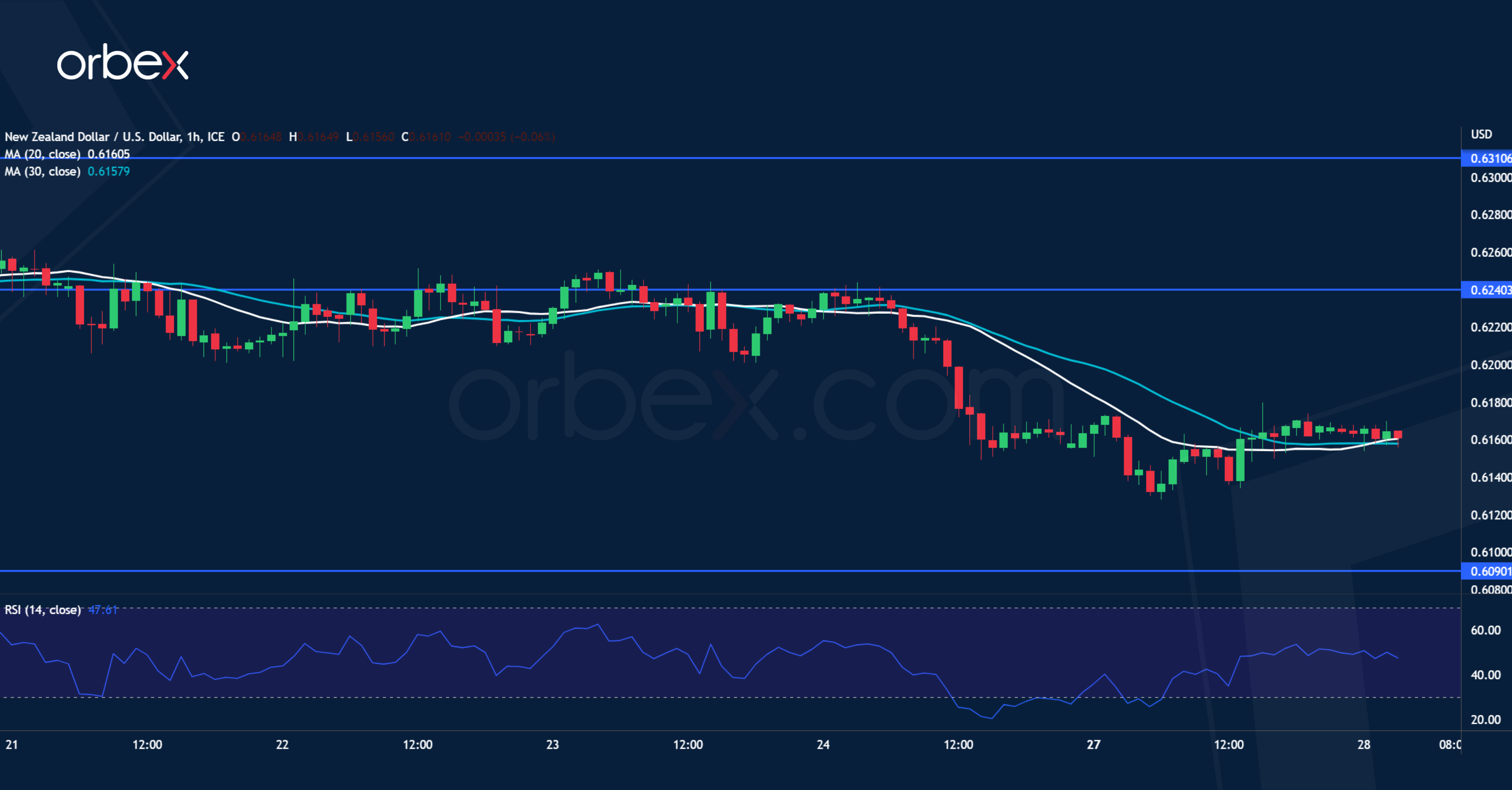
The New Zealand dollar continues to struggle after downbeat retail sales in Q4. A break below January’s low of 0.6200 on the daily chart confirms the bearish MA cross and signals more room on the downside in the medium-term. The RSI’s oversold condition attracted some buying interests but the bears are expected to sell into strength as sentiment sank along with the price action. The 0.6200-0.6240 range has become a fresh supply area. 0.6090 would be the next target when the downward momentum returns.
EUR/USD Tests Resistance
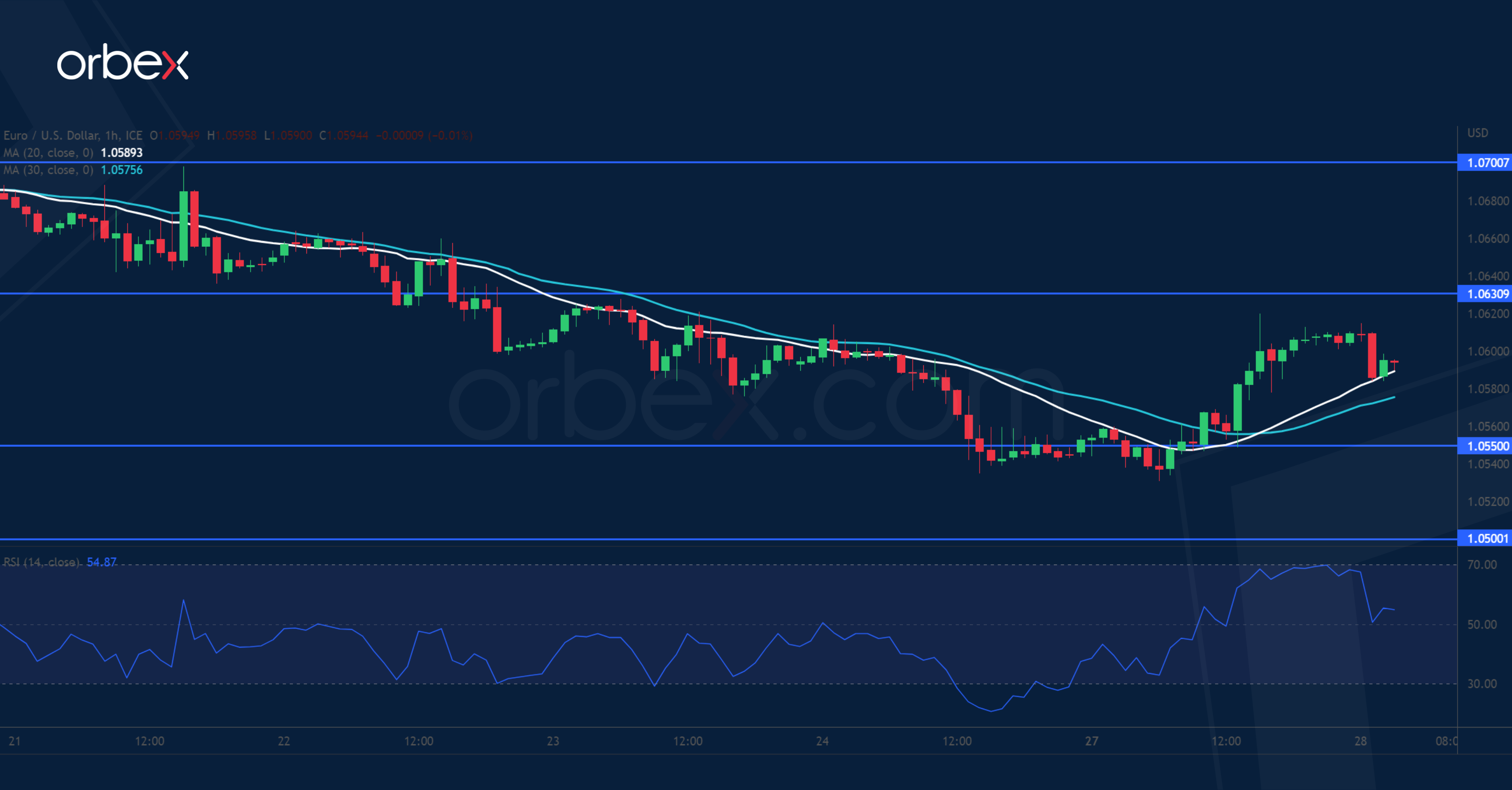
The US dollar retreats as traders pull some chips off the table ahead of jobs data. On the daily chart, the pair is testing the critical level at the January low of 1.0500, where a bearish breakout would cause a deeper correction and dent the recovery mood. Solid buying pressure has emerged in the demand zone due to a combination of short-covering and renewed buying, driving the price up and leaving 1.0550 as a fresh support. 1.0630 is next and the bulls must lift 1.0700 on the 20-day SMA to turn the situation around.
USD/JPY Daily Outlook
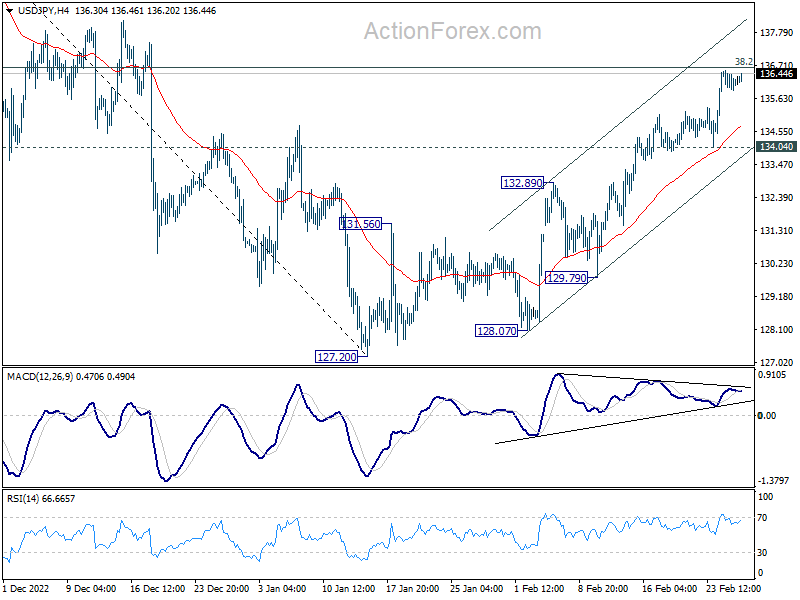
Daily Pivots: (S1) 135.92; (P) 136.23; (R1) 136.55; More...
Immediate focus stays on 38.2% retracement of 151.93 to 127.20 at 136.64. Rejection by this fibonacci level, followed by break of 134.04 support, will argue that such rebound from 127.20 has completed, and turn bias back to the downside. However, sustained trading above 136.64 will indicate that fall from 151.93 has completed, and bring further rally to 61.8% retracement at 142.48.
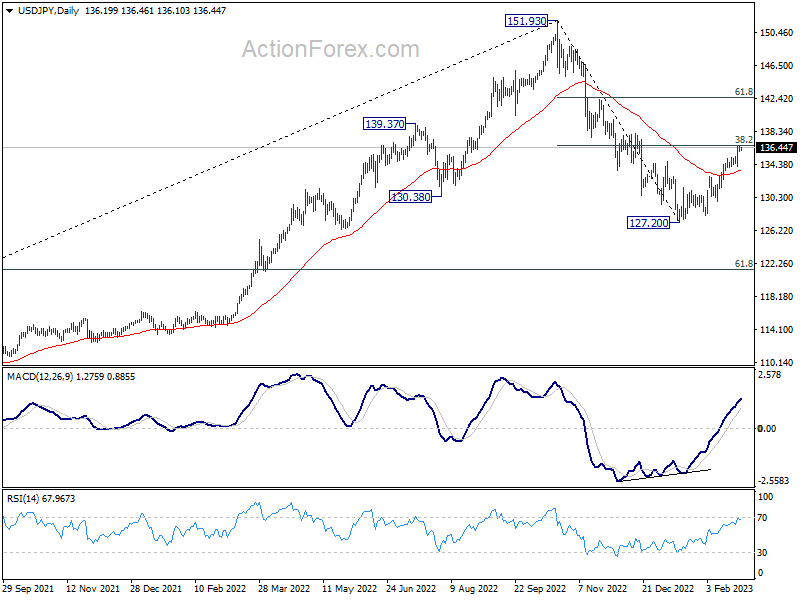
In the bigger picture, focus is now on 38.2% retracement of 151.93 to 127.20 at 136.64. Sustained break there will indicate that price actions from 151.93 medium term are merely a corrective pattern. Such development will maintain long term bullishness. Rejection by 136.64 will, on the downside, extend the fall from 151.93 to 61.8% retracement of 102.58 to 151.93 at 121.43 at a later stage.
USD/CHF Daily Outlook
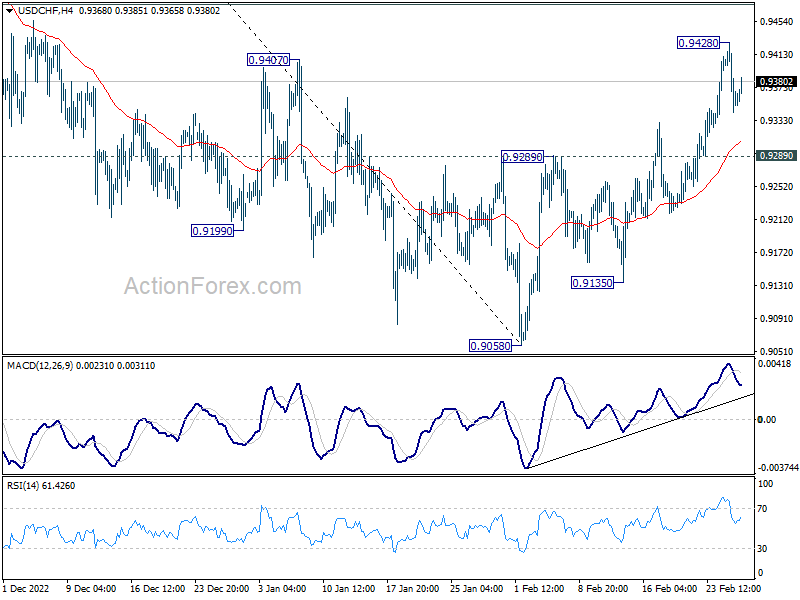
Daily Pivots: (S1) 0.9325; (P) 0.9377; (R1) 0.9410; More...
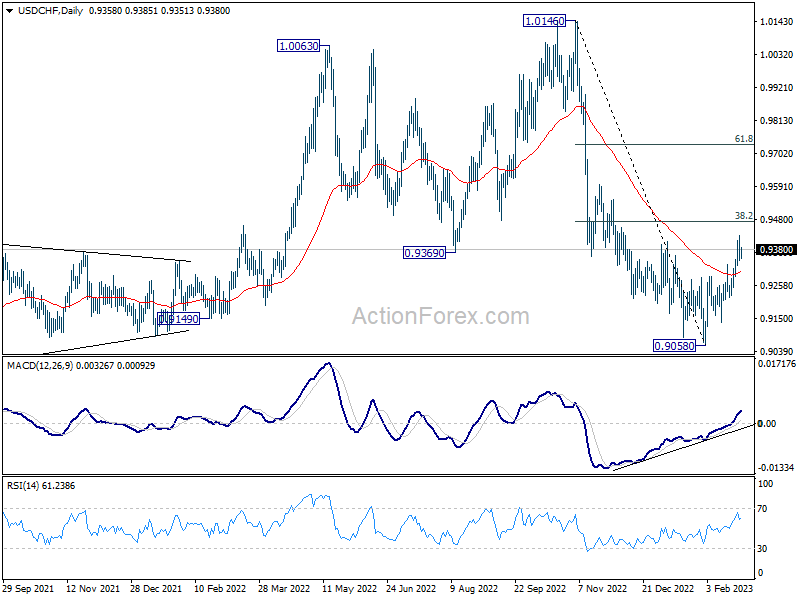
Intraday bias in USD/CHF remains neutral for consolidation below 0.9428 temporary top. Break of 0.9428 will resume the rebound form 0.9058. But strong resistance could be seen at 38.2% retracement of 1.0146 to 0.9058 at 0.9474 to limit upside. Break of 0.9289 resistance turned support will indicate completion of the rebound and turn bias back to the downside. however, decisive break of 0.9474 will carry larger bullish implications and target 61.8% retracement at 0.9730.
In the bigger picture, decline from 1.0146 is seen as part of a long term sideway pattern. As long as 38.2% retracement of 1.0146 to 0.9058 at 0.9474 holds, another fall is in favor through 0.9058. However, sustained trading above 0.9474 will indicate that the medium term trend has reversed, and open up further rally to 61.8% retracement at 0.9730 and above.
GBP/USD Daily Outlook
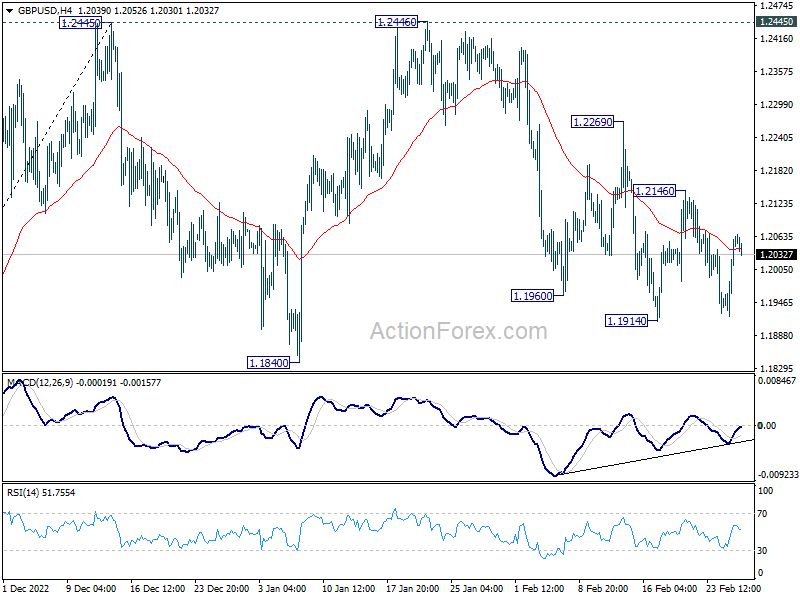
Daily Pivots: (S1) 1.1969; (P) 1.2017; (R1) 1.2112; More...
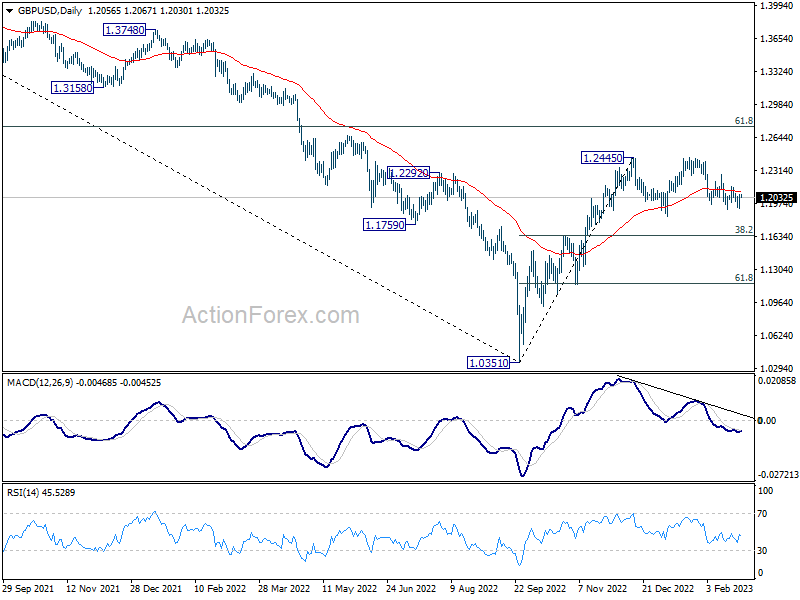
Intraday bias in GBP/USD remains neutral for the moment. Another fall is in favor with 1.2146 resistance intact. Break of 1.1914 will resume the decline from 1.2446 for 1.1840 support and possibly below. On the upside, break of 1.2146 resistance will turn bias back to the upside for further rebound to 1.2269 and above.
In the bigger picture,as long as 1.1840 support holds, rise from 1.0351 medium term bottom (2022 low) should still continue to 61.8% retracement of 1.4248 (2021 high) to 1.0351 at 1.2759. However, decisive break of 1.1840 will complete a double top pattern (1.2445, 1.2446) after rejection by 55 week EMA (now at 1.2251). Deeper decline should be seen back to 38.2% retracement of 1.0351 to 1.2445 at 1.1645.
EUR/USD Daily Outlook
Daily Pivots: (S1) 1.0555; (P) 1.0587; (R1) 1.0642; More...
Intraday bias in EUR/USD remains neutral for consolidation above 1.0532 temporary low. The decline from 1.1032 might still extend lower, but strong support could be seen around 38.2% retracement of 0.9534 to 1.1032 at 1.0463 to bring rebound, at least on first attempt. Break of 1.0668 support turned resistance will turn bias back to the upside for 1.0803 resistance and above. However, sustained break of 1.0463 will carry larger bearish implications.
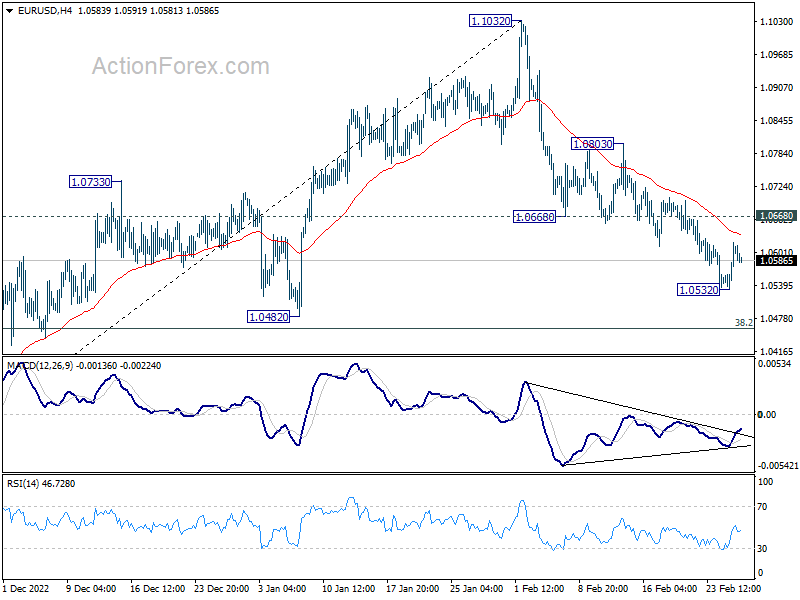
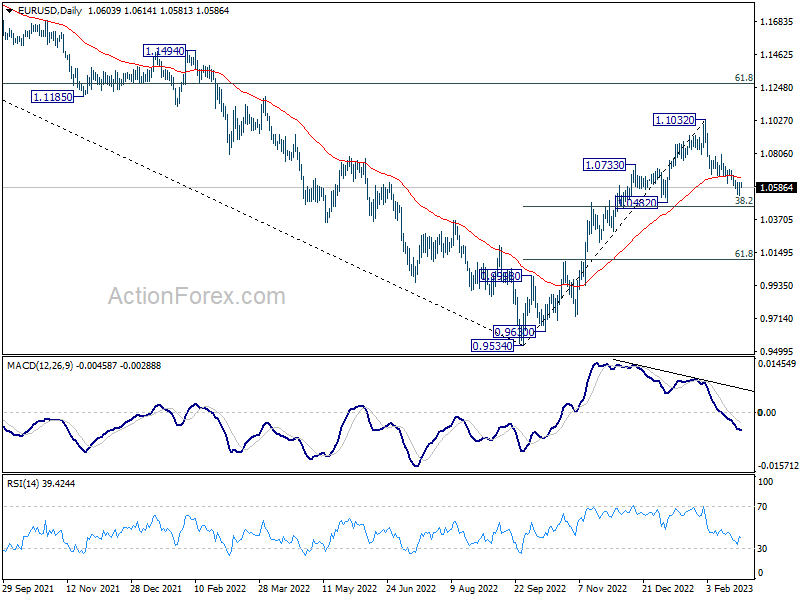
In the bigger picture, as long as 1.0482 support holds, rise from 0.9534 (2022 low) should continue to 61.8% retracement of 1.2348 (2021 high) to 0.9534 at 1.1273. However, sustained break of 1.0482 will bring deeper fall to 61.8% retracement of 0.9534 to 1.1032 at 1.0106, even as a corrective pull back.
AUD/USD Daily Report
Daily Pivots: (S1) 0.6710; (P) 0.6727; (R1) 0.6757; More...
Intraday bias in AUD/USD remains on the downside at this point. Current development argues that near term trend could be reversing. Deeper decline would be seen to 161.8% projection of of 0.6854 to 0.7028 from 0.6854 at 0.6539. On the upside, break of 0.6854 support turned resistance is needed to indicate completion of the fall, or risk will stay on the downside in case of recovery.
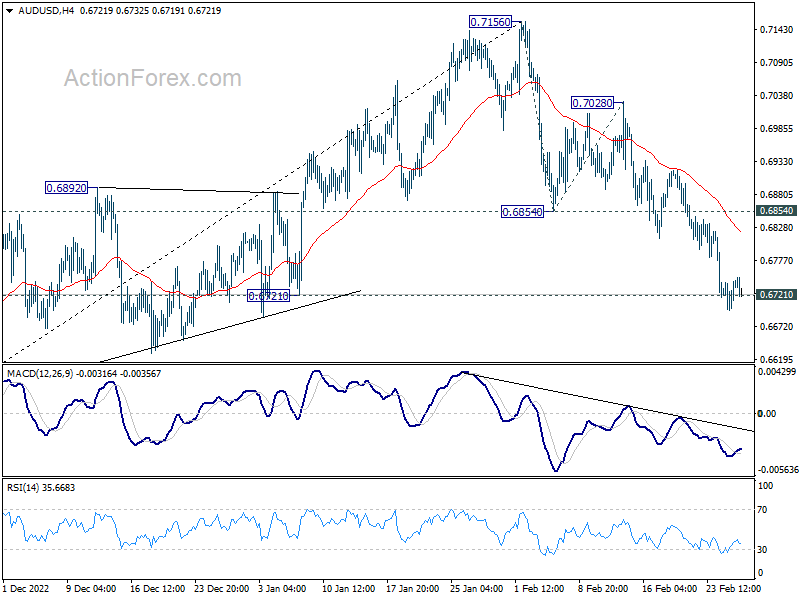
In the bigger picture, focus is now on 0.6721 structural support. Sustained break there will argue that whole rise from 0.6169 (2022 low) has completed at 0.7156, after rejection by 55 month EMA (now at 0.7179). Deeper decline would then be see back to 61.8% retracement of 0.6169 to 0.7156 at 0.6546, even as a corrective fall. Nevertheless, strong rebound from current level will retain medium term bullishness for another rise through 0.7156 later.