

Sample Category Title
Canada GDP down -0.1% mom in Dec, but expected to rebound in Jan
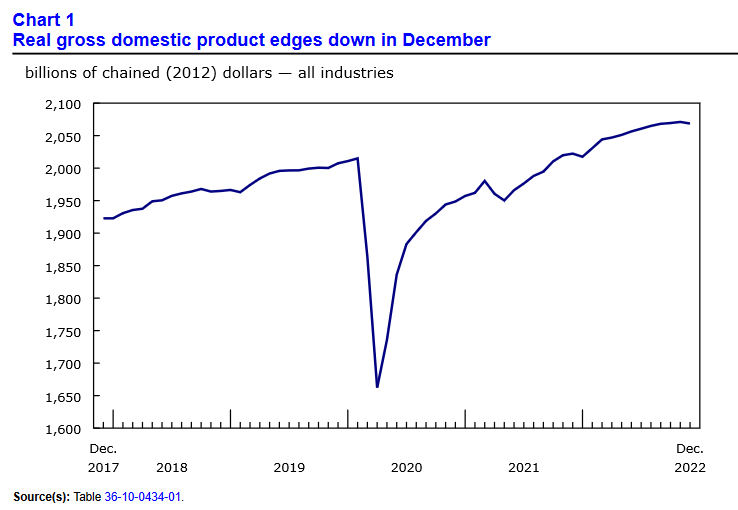
Canada GDP contracted -0.1% mom in December, worse than expectation of 0.2% mom expansion. Goods-producing industries declined -0.6% while service-producing industries were essentially unchanged.
For Q4, GDP grew 0.2% qoq, slowest pace since Q2, 2021. Services producing industries rose 0.5% qoq while goods-producing industries contracted -0.6% qoq.
Advance information indicates that real GDP grew 0.3% mom in January. Increases in the mining, quarrying, and oil and gas extraction, wholesale trade, professional, scientific and technical services, and transportation and warehousing sectors were slightly offset by decreases in construction and retail trade.
Canadian Dollar Drifting as GDP Looms
Canadian GDP expected to slow in Q4
It’s a very light data calendar for Canadian releases this week, with today’s GDP report the sole tier-1 event. Canada’s economy is expected to slow to 1.5% y/y in the fourth quarter, following a solid 2.9% gain in Q3.
A slowdown in economic activity is what the Bank of Canada is looking for, as inflation remains public enemy number one. CPI is moving in the right direction as it fell to 5.9% in January, down from 6.3% in December. The BoC is optimistic that the downturn will continue, with a forecast that inflation will fall to 3% by mid-2023 and hit the 2% target by the end of the year.
The BoC will have to tread carefully in this tricky economic landscape. The economy is cooling and while inflation is easing, it remains much higher than the 2% target and will require additional rate hikes which will make a soft landing a difficult endeavour. If growth continues to weaken in 2023, there is a strong chance of the economy tipping into a recession by mid-2023. The Bank meets next on March 8 and the markets are expecting a 0.25% hike for the second straight time. The Bank would like to take a pause in its tightening cycle but this will require a substantial drop in inflation.
In the US, strong employment and consumer data and stubborn inflation have supported the Fed’s hawkish stance and there is talk of the Fed raising rates as high as 6%. It was only a few weeks ago that the markets were talking about a ‘one and done’ rate hike in March, followed by a long pause and perhaps some cuts by year’s end. This has all changed as the US economy has proven to be surprisingly resilient, despite rising rates and high inflation. The markets are currently pricing in three more rate hikes this year, but that could change in a hurry if key releases in February show that the economy is slowing down.
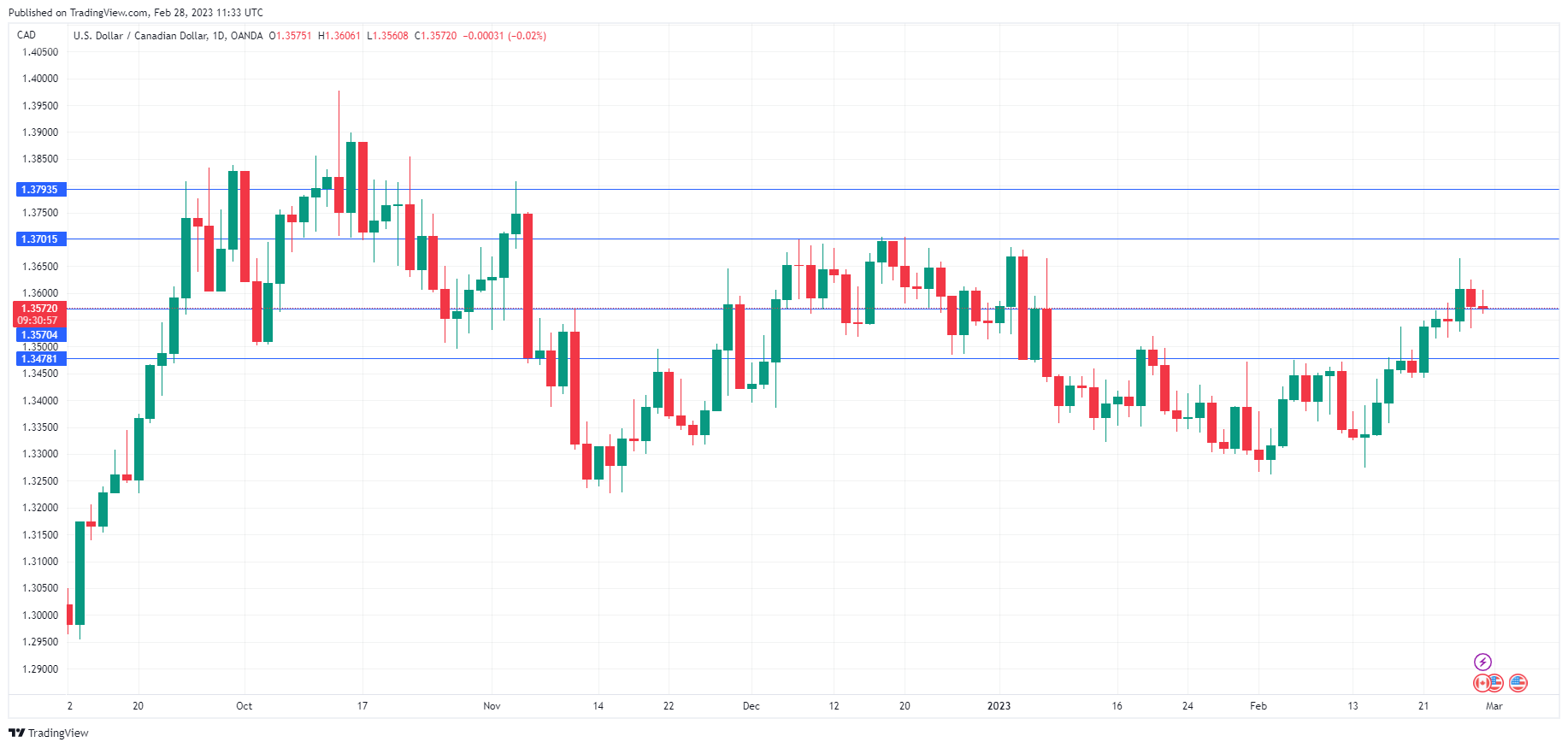
USD/CAD Technical
- There is resistance at 1.3701 and 1.3794
- 1.3570 is under strong pressure in support. 1.3478 is the next support line
EUR/GBP Mid-Day Outlook
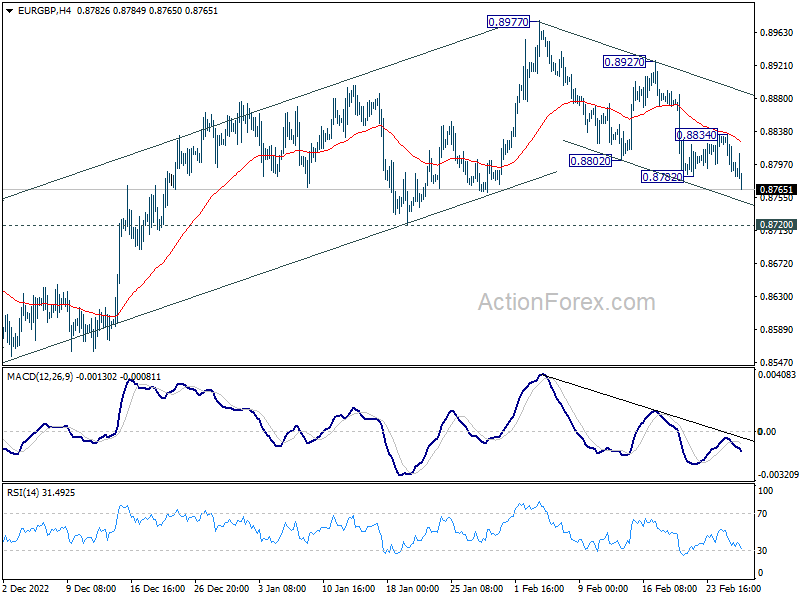
Daily Pivots: (S1) 0.8778; (P) 0.8807; (R1) 0.8824; More...
EUR/GBP's fall from 0.8977 resumed today by breaking through 0.8782. Intraday bias is back on the downside for 0.8270 support. Firm break there should confirm completion of whole rebound from 0.8545, and turn near term outlook bearish for this support. For now, outlook will stay cautiously bearish as long as 0.8834 resistance holds, in case of recovery.
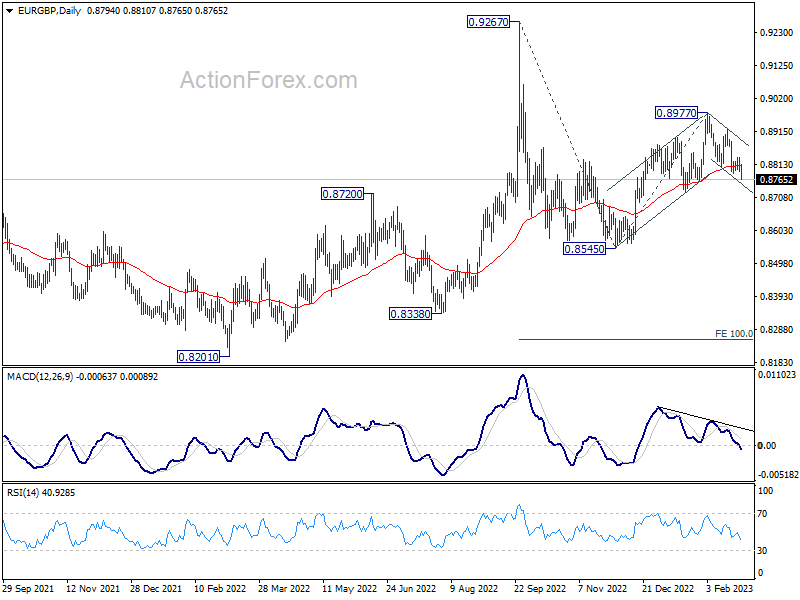
In the bigger picture, current development suggests that fall from 0.9267 (2022 high) is still in progress. Such decline is seen as a leg inside long term range pattern from 0.9499 (2020 high). Break of 0.8545 will target 100% projection of 0.9267 to 0.8545 from 0.8977 at 0.8255. On the other hand, strong rebound from current level will extend the rise from 0.8545 through 0.8977 at a later stage.
EUR/JPY Mid-Day Outlook
Daily Pivots: (S1) 143.88; (P) 144.22; (R1) 144.86; More....
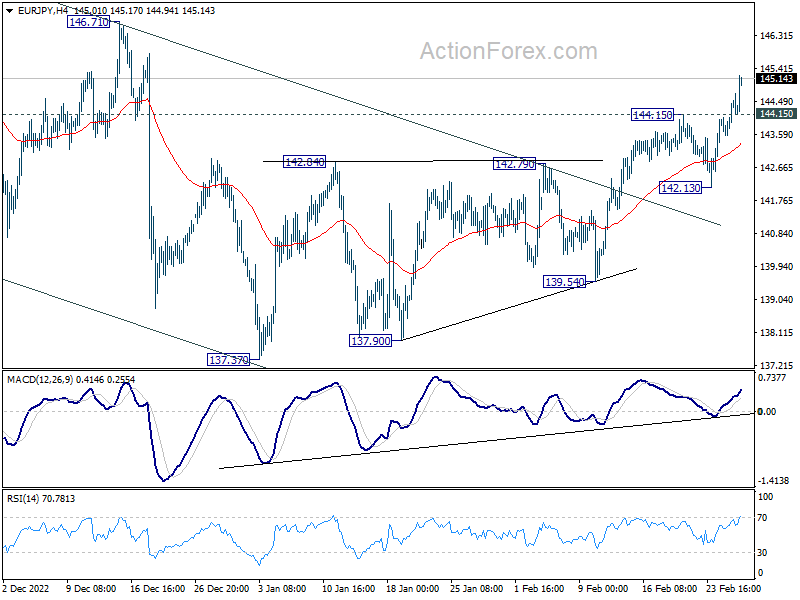
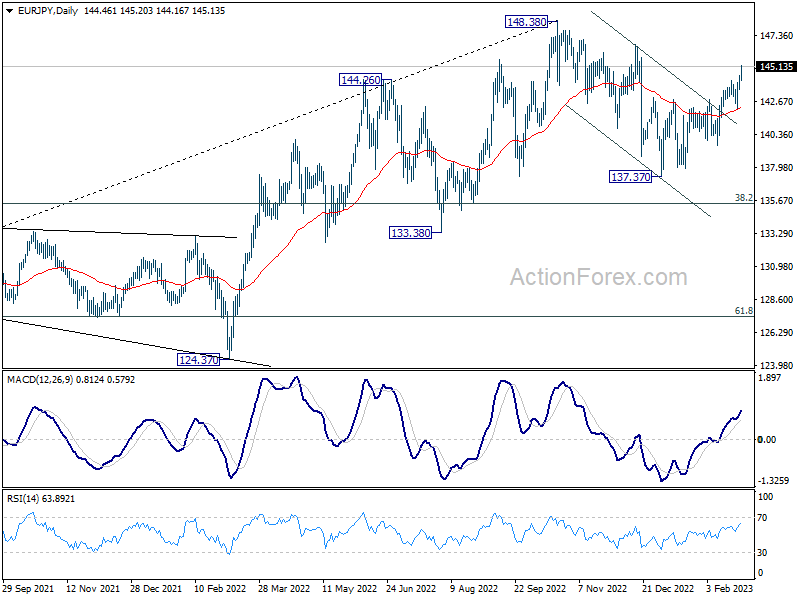
EUR/JPY's rally continues to as high as 145.20 so far and intraday bias remains on the upside. Corrective fall from 148.38 has completed at 137.37 already. Rise from 137.37 should target 146.71 resistance and then 148.38 high. On the downside, below 144.15 minor support will turn intraday bias neutral and bring consolidations. But outlook will stay cautiously bullish as long as 142.13 support holds.
In the bigger picture, as long as 55 week EMA (now at 139.42) holds, larger up trend from 114.42 (2020 low) is still in progress for 149.76 long term resistance. However, firm break of 55 week EMA will bring deeper fall to 38.2% retracement of 114.42 to 148.38 at 135.40. Sustained break there will raise the chance of trend reversal, and target 61.8% retracement at 127.39.
GBP/JPY Mid-Day Outlook
Daily Pivots: (S1) 163.18; (P) 163.76; (R1) 164.92; More...
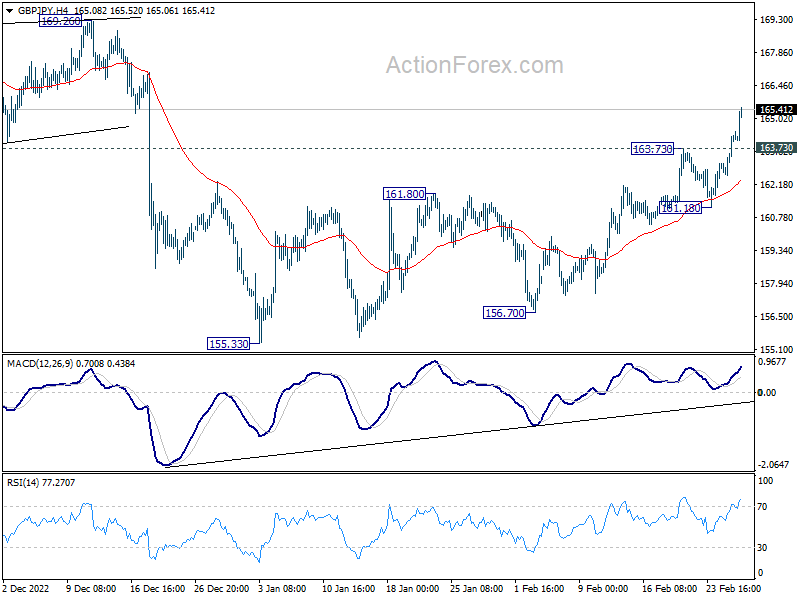
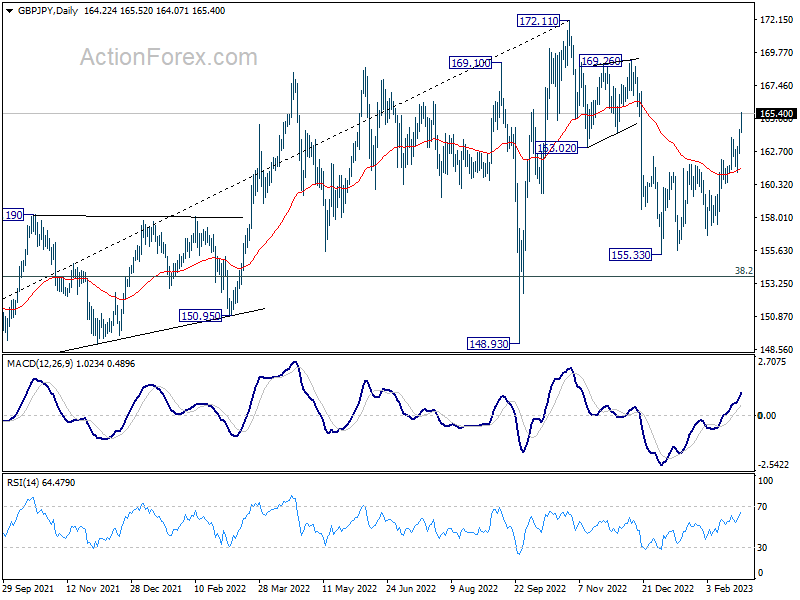
GBP/JPY rises to as high as 165.52 so far and intraday bias remains on the upside. As noted before, corrective fall from 172.11 should have completed at 155.33 already. Rise from 155.33 should target 169.26 resistance first, and then 172.11 high. On the downside, below 163.73 minor support will turn intraday bias neutral and bring consolidations. But outlook will stay cautiously bullish as long as 161.18 support holds.
In the bigger picture, corrective decline from 172.11 medium term should have completed at 155.33. With 38.2% retracement of 123.94 (2020 low) to 172.11 (2022 high) at 153.70 intact, medium term bullishness is retained. That is, larger up trend from 123.94 (2020 low) is still in progress. Break of 172.11 high to resume such up trend is expected at a later stage.
GBP/CHF accelerate on UK/EU agreement, ready for medium term range breakout
Sterling's rally is accelerating today with sentiment lifted by the Windsor Framework as agreed between the UK and EU regarding the handling of Ireland/Northern Ireland.
GBP/CHF's rise from 1.1072 accelerated to as high as 1.1353 so far. Further rally is expected as long as 1.1243 support holds, to 1.1433 resistance next.
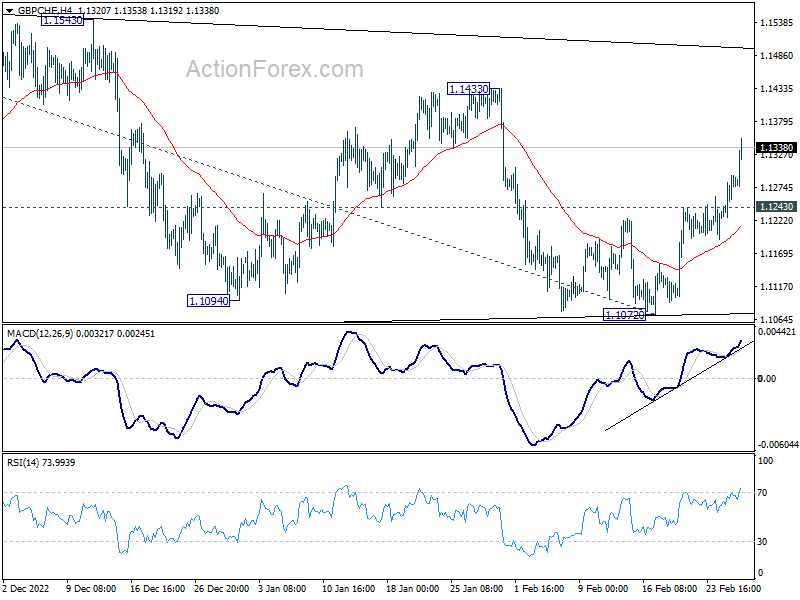
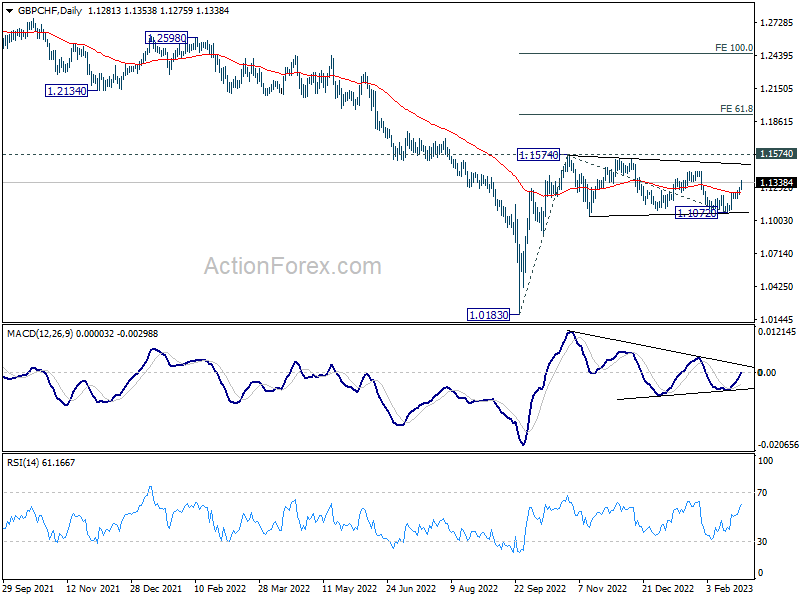
Current development is also inline with the view that the sideway consolidation pattern from 1.1574 has completed at 1.1072. That is, rise from 1.0183 is ready to resume. Firm break of 1.1143 will add to this bullish case, and send GBP/CHF through 1.1574 key resistance. In this case, next target will be 61.8% projection of 1.0183 to 1.1574 from 1.1072 at 1.1932.
AUD/USD Eyes CPI, GDP
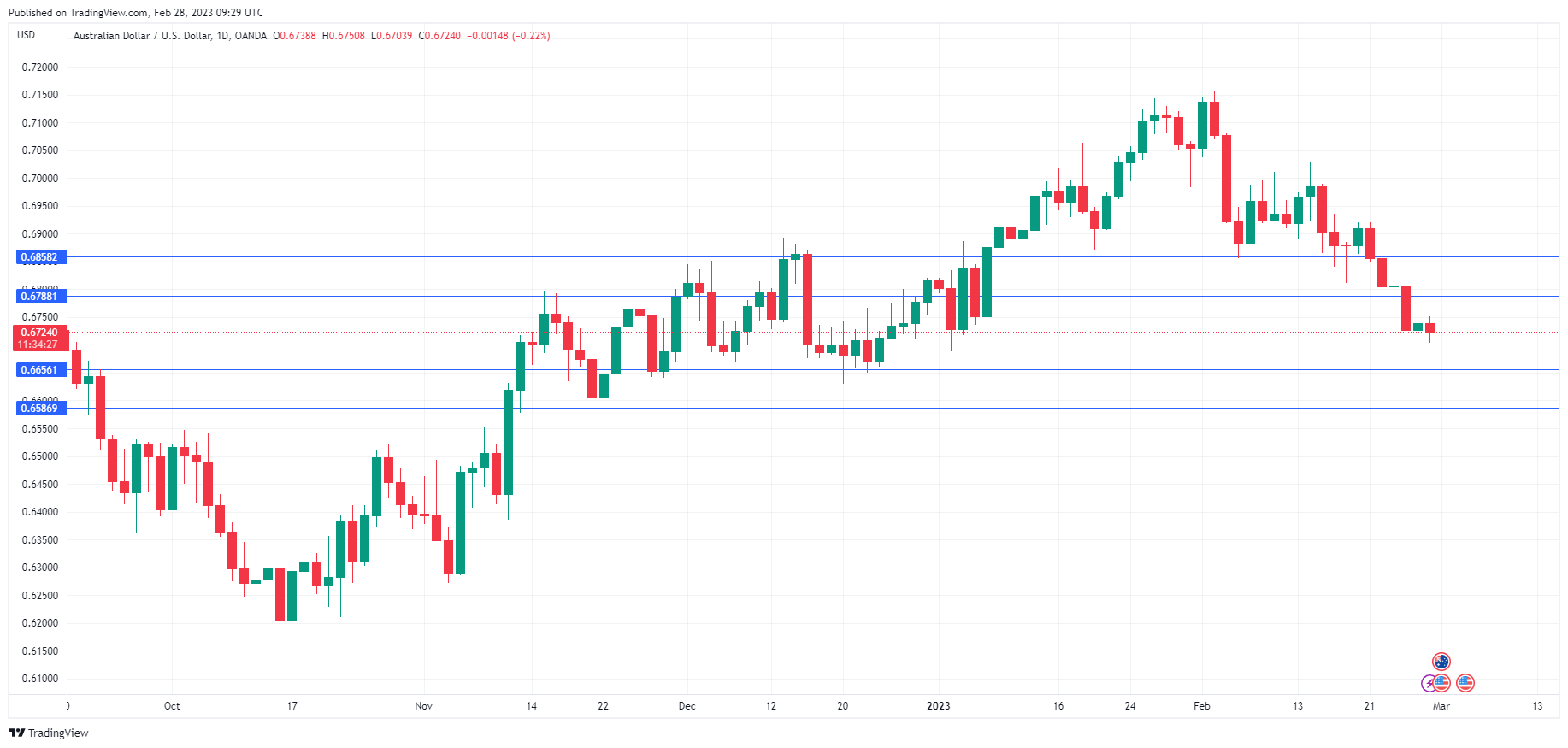
The Australian dollar remains under pressure and has edged lower on Tuesday. AUD/USD dropped below the 0.67 line on Monday for the first time since Jan. 3.
Australian retail sales bounce back
Australian retail sales jumped 1.9% m/m in January, following an upwardly revised 4% decline in December and beating the consensus of 1.5%. The data indicates that consumer demand remains resilient despite rising interest rates and higher inflation.
For the RBA, the upswing in consumer spending is a sign that the economy can continue to bear higher rates. The central bank has hiked some 325 basis points since May 2022 in a bid to curb inflation. The cash rate is currently at 3.35% and the markets have priced in a peak rate of 4.3%, with four rate hikes expected before the end of the year – one more than what is expected for the Fed. The RBA meets on March 7 and is widely expected to raise rates by 25 basis points.
Wednesday could be a busy day for the Australian dollar, as Australia releases inflation and GDP reports. Inflation for January is expected to ease to 7.9% y/y, following an 8.4% gain in December. GDP for the fourth quarter is projected to slow to 2.7% y/y, after a robust gain of 5.9% in Q3. A decline in inflation and in GDP would indicate that high interest rates are having their intended effect and slowing economic activity. The question is whether the RBA will be able to guide the slowing economy to a soft landing and avoid a recession.
In the US, a recent string of strong numbers has raised speculation that the Fed could raise interest rates as high as 6%. The unseasonably warm weather in January may have played a part in the better-than-expected numbers and we’ll have to see if the positive data repeats itself in February. The markets have shifted their stance from a final rate hike in March with rate cuts late in the year to pricing in three more rate hikes in 2023. If upcoming inflation, employment and consumer spending reports point to a weaker economy, we can expect the markets to revert to pricing in a dovish pivot by the Federal Reserve.
AUD/USD Technical
- AUD/USD has support at 0.6656 and 0.6586
- There is resistance at 0.6788 and 0.6858
EUR/GBP: Bears Accelerate and Look for Test of 2023 Low
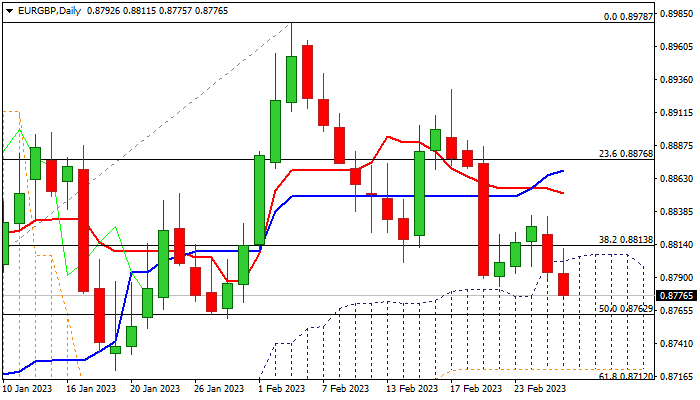
The cross remains firmly in red on Tuesday and extends weakness into second straight day, falling deeper into thick daily cloud (spanned between 0.8805 and 0.8722).
Fresh dip cracked initial support at 0.8783 (Feb 22 low), with firm break here to open way for test of pivotal support at 0.8760 zone (50% retracement of 0.8547/0.8978 / Jan 27/30 higher base), loss of which would risk test of key levels at 0.8721/12 (Jan low / Fibo 61.8%).
Bears also broke below the neckline of the Head and Shoulders pattern on daily chart, as daily moving averages (10/20/30/55) turned to bearish setup and 14-d momentum remains in the negative territory.
Broken daily cloud top reverted to solid resistance, which should keep the upside protected and maintain bearish near-term structure.
Res: 0.8805; 0.8835; 0.8852; 0.8869.
Sup: 0.8760; 0.8721; 0.8712; 0.8661.
Elliott Wave Forecast: USD/JPY Approaching Resistance
There were some BOJ comments in Asia regarding inflation but nothing significant. However, they have to plan different scenarios regarding policy, so we clearly should not be shocked if they change their actions after April if inflation will keep rising. I still think that USDJPY will hit resistance, but for now that's not visible on the charts yet. We see new intraday five-wave cycle in a bullish mode that can be targeting 137.50. However, big level goes back to 138; that goes back to mid December where we see big gap when looking at JPY futures. For more details on this one check our video below in which we also covered other assets.
https://www.youtube.com/watch?v=hMKTCECQvJ8&t=2230s
Risk Sentiment Wavers On Fed Fears
Asian shares were a mixed bag on Tuesday as fears over rising U.S. interest rates hit overall sentiment in the region. European futures are pointing to a positive open this morning, tracking the modest gains on Wall Street overnight. However, a sense of caution continues to linger across financial markets as concerns over further interest rate hikes cap risk appetite. In the FX space, the dollar stabilised during earlier trade appreciating against every single G10 currency. Gold remains shaky, vulnerable, and heading for its worst month since mid-2021 thanks to a hawkish Fed. After sliding roughly 1% in the previous session, oil prices have inched up today amid hopes of a strong economic rebound in China brightening the demand outlook.
Overnight, Australian retail sales rebounded in January, growing 1.9% which beat market expectations of a 1.5% rise. The data suggests that households are still spending despite rising interest rates and soaring inflation. Such a development could place more pressure on the RBA to remain hawkish, fuelling fears around the growth outlook. It is worth keeping in mind that concerns remain elevated over strong price pressures and slowing economic growth in the face of rising interest rates. The aussie has weakened against every G10 currency this month, shedding over 5% against the dollar. Prices in AUDUSD are under pressure with a breakdown below 0.6700 opening the doors to lower levels.
Dollar dominates in February
It has been a positive month for the dollar, halting a run of four straight months of declines.
Incredibly positive jobs data, sticky inflation figures, and hawkish comments from Fed officials have injected the dollar with renewed confidence. As market expectations intensified over US rates remaining higher for longer, this boosted buying sentiment towards the dollar. The peak, terminal rate for Fed funds is now near 5.40%, up from around 4.90% in January. The key question is whether the positive momentum will roll over into the new month when we get fresh rate decisions from all the major central banks, including the FOMC meeting on March 22. Given how the dollar remains highly data dependent, there could be more volatility in the coming weeks.
Looking at the technical picture, the Dollar Index (DXY) remains bullish on the daily charts as there have been a series of higher highs and higher lows, giving us a bullish price channel. Should 104.30 prove to be reliable support, prices could test the next key level of interest at 105.50.
Commodity spotlight - Gold
It has been a rough month for gold with the precious metal losing over 6% of its value, as at the time of writing. This would be its worst month since mid-2021.
Gold has stood little chance against an appreciating dollar and rising Treasury yields as expectations have intensified over the Fed keeping rates higher for longer. With Fed hawks currently in a position of power, this could signal further downside for gold in the short to medium term.
Looking at the precious metal from a technical view, the bearish engulfing candlestick pattern on the monthly timeframe could signal a decline below $1800. It is worth keeping in mind that the 200-day Simple Moving Average can be found just below this psychological support level at $1776.