

Sample Category Title
BoE Mann: No automatic relationship between recessions and bringing inflation down
BoE MPC member Catherine Mann said, "falling natural gas and electricity costs "might be good from the standpoint of making households feel more comfortable."
But, "on the other hand, what they aren't going to spend on energy, they're going to spend on something else... That translates something that I do not control, which is external energy prices, into something that looks a whole lot more like what I'm supposed to control, which is domestically generated inflation."
"A recession is a particularly dramatic way of disciplining the pricing structure of firms, but it's not the only way," Mann said. "I would like to see more on the supply side in order to give us a faster speed limit to work with as a central bank. It's not like there's an automatic relationship between recessions and bringing inflation down."
Sunset Market Commentary
Markets
Today’s trading session started with a bang: national European inflation numbers triggered a fresh sell-off on bond markets. French inflation (EU harmonized) accelerated to 1% m/m with the y/y-reading printing at a new high of 7.2% (vs 7% in January). Details showed positive contribution from all categories, with food prices (1.4% m/m & 14.5% y/y) and energy prices (1.6% m/m & 14% y/y) standing out. Services inflation rose to 0.7% m/m (2.9% y/y). Spanish inflation increased by 1% m/m as well with the y/y-reading picking up from 5.9% to 6.1% (vs 5.7% expected). Underlying core inflation printed at a new high of 7.7% Y/Y. Belgian inflation yesterday also showed record high core inflation (8.28% y/y). Stubbornly high inflation won’t allow central banks to end policy tightening cycles any time soon. On the contrary. ECB chief economist Lane this morning elaborated on the topic. He didn’t zoom in on how high the ECB policy rate peak eventually will be, but said that rates will remain at that level for quite a long-lasting period, adding “a fair number of quarters”. Combining with ECB Villeroy’s earlier (and later downplayed) comments that policy rates would only peak in September, and assuming a continuous tightening pace this implies a policy rate peak of at least 4% which would still be in place by mid-2024. Despite markets’ hawkish repositioning already done of late, that strengthens our view that moves could go further. Guidelines at March Fed & ECB policy meetings (including new forecasts) will be crucial here. German Bunds significantly underperform US Treasuries with yields adding 7 to 8 bps across the curve. The German 10-yr yield breaks above key 2.55%/2.57% resistance (previous cycle peak & 62% retracement on decline between 2008 & 2020). If confirmed, the break in first instance implies more upward potential to 3% (2005 low). 76% retracement (3.38%) and the 2011 top (3.5%) are the next references. US Treasury yields increase by up to 2.5 bps ahead of the US morning releases (including consumer confidence). The fierce bond sell-off pushed European stock markets around 0.5% lower at the start, but equities/risk sentiment again showed resilience. They currently record small gains. The single currency tries to benefit from the situation (yield advantage & risk climate), but its performance is disappointing. EUR/USD changes hands around 1.0620, coming from an intraday low just above 1.0580. Sterling outperformed after EC President von der Leyen and UK PM Sunak presented the Windsor Framework, as solution to fix the Northern-Ireland Protocol in the brexit deal. Sunak now needs to sell the deal to the Northern Irish DUP party. We retain hawkish comments by BoE Mann as well who warns that cheaper energy prices risks pushing up core inflation as households have more income disposable for non-energy spending. EUR/GBP drops from the 0.88 area to currently 0.8760. Next support stands at 0.8722.
News Headlines
Swedish GDP decreased 0.9% Q/Q in Q4 2022. The decline was mainly driven by a decline of capital formation in fixed assets (-0.8%). Household consumption decreased 0.2% Q.Q. Changes in inventories contributed negatively to GDP growth by 0.7% ppts. Government consumption rose a 0.2%. Exports decreased 1% and the contribution of net exports to growth was negligible. Weaker growth figures might complicate the Riksbank policy. The Swedish central bank raised its policy rate by 50 bps to 3% earlier this month and indicated further tightening will be needed as inflation remains unacceptably high. Markets expect another 50 bps increase in April. The weak krone became a factor of importance in the RB’s policy assessment. The krone rebounded from a cycle peak near EUR/SEK 11.40 after the February decision, but cedes ground after the GDP data (11.08 from 11.01).
The National Bank of Hungary left its policy rate unchanged at 13%. The key overnight rate deposit rate stays at 18%. Ahead of the meeting, markets were looking for guidance on when the MNB might start reducing the gap between the overnight rate and the Base rate. The MNB didn’t give any concrete hints but the statement was different from last month. The MPC indicates that ‘maintaining market stability and strengthening monetary policy transmission are also key to achieving price stability. The MNB continues to focus on trend-like developments in financial market conditions. Therefore, the Bank takes into account the persistence of the recent improvement in risk perceptions when setting the conditions of overnight instruments introduced in mid-October’. The forint temporary lost marginal ground on the publication of the policy statement but currently trades little changed near EUR/HUF 378.
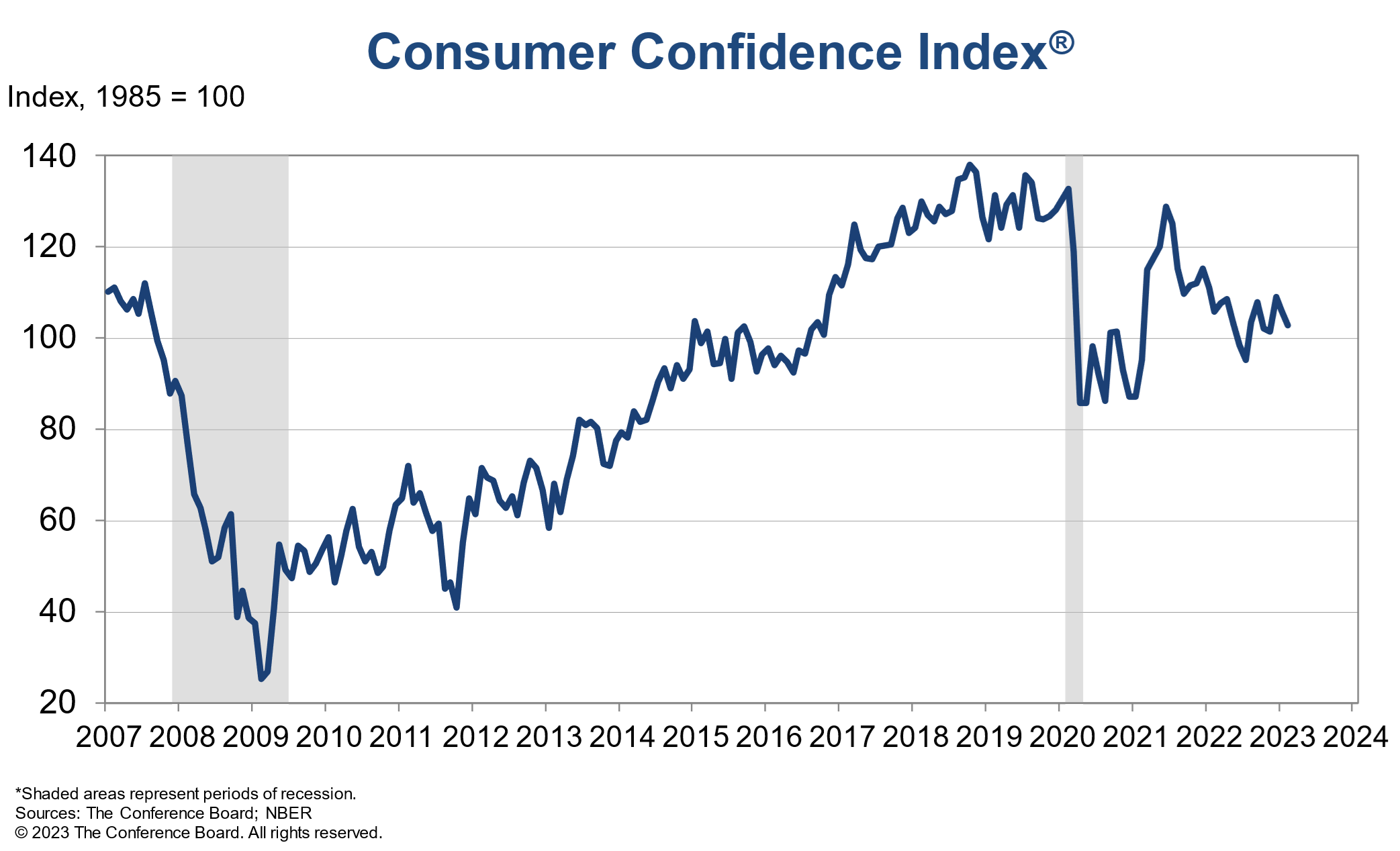
US consumer confidence dropped to 102.0, outlook appears considerably more pessimistic
US Conference Board Consumer Confidence dropped from 106.0 to 102.0 in February, below expectation of 108.5. Present Situation Index rose from 151.1 to 152.8. Expectations Index dropped from 76.0 to 69.7.
"Consumer confidence declined again in February. The decrease reflected large drops in confidence for households aged 35 to 54 and for households earning $35,000 or more," said Ataman Ozyildirim, Senior Director, Economics at The Conference Board.
"While consumers' view of current business conditions worsened in February, the Present Situation Index still ticked up slightly based on a more favorable view of the availability of jobs. In fact, the proportion of consumers saying jobs are 'plentiful' climbed to 52.0 percent—back to levels seen in the spring of last year. However, the outlook appears considerably more pessimistic when looking ahead. Expectations for where jobs, incomes, and business conditions are headed over the next six months all fell sharply in February."
"And, while 12-month inflation expectations improved—falling to 6.3 percent from 6.7 percent last month—consumers may be showing early signs of pulling back spending in the face of high prices and rising interest rates. Fewer consumers are planning to purchase homes or autos and they also appear to be scaling back plans to buy major appliances. Vacation intentions also declined in February."
USD/JPY Mid-Day Outlook
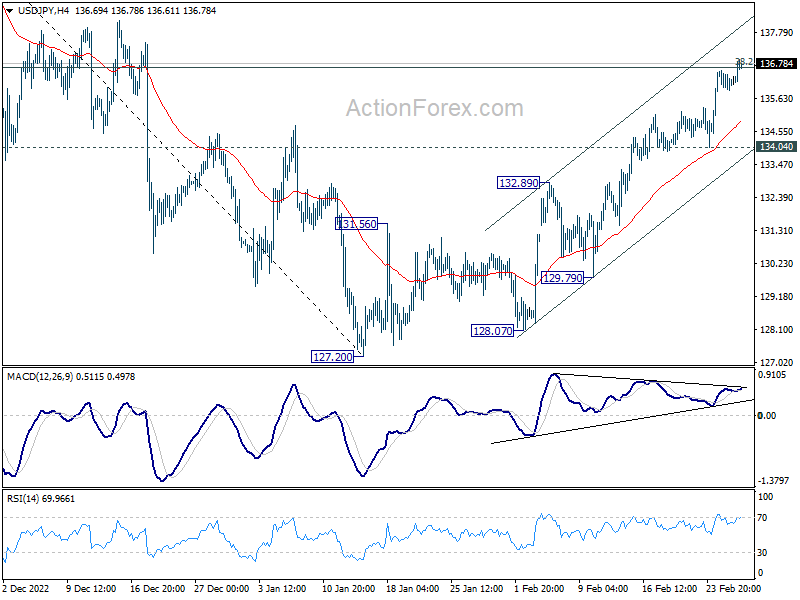
Daily Pivots: (S1) 135.92; (P) 136.23; (R1) 136.55; More...
No change in USD/JPY's outlook as focus stays on 38.2% retracement of 151.93 to 127.20 at 136.64. Rejection by this fibonacci level, followed by break of 134.04 support, will argue that such rebound from 127.20 has completed, and turn bias back to the downside. However, sustained trading above 136.64 will indicate that fall from 151.93 has completed, and bring further rally to 61.8% retracement at 142.48.
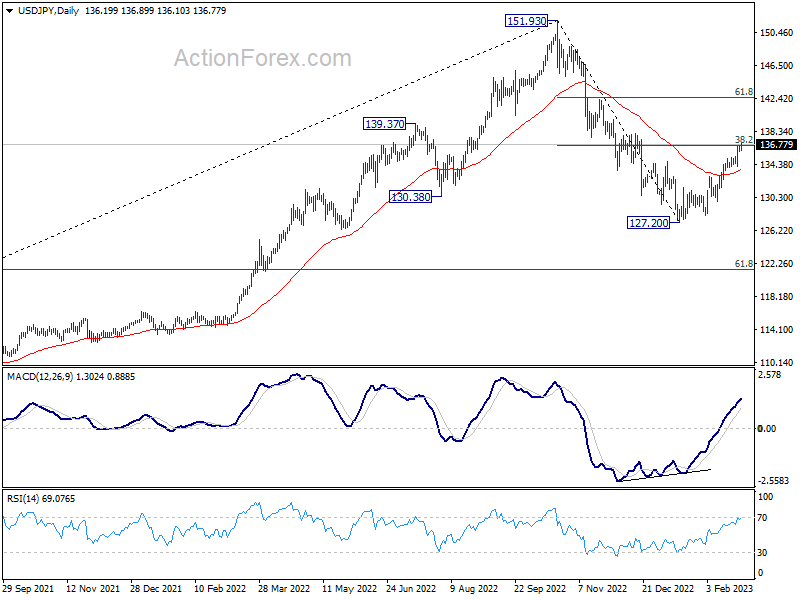
In the bigger picture, focus is now on 38.2% retracement of 151.93 to 127.20 at 136.64. Sustained break there will indicate that price actions from 151.93 medium term are merely a corrective pattern. Such development will maintain long term bullishness. Rejection by 136.64 will, on the downside, extend the fall from 151.93 to 61.8% retracement of 102.58 to 151.93 at 121.43 at a later stage.
USD/CHF Mid-Day Outlook
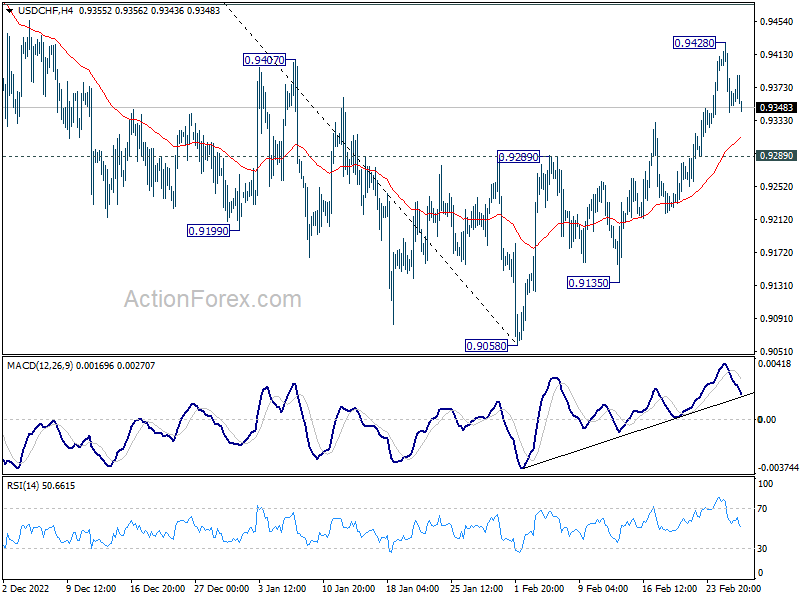
Daily Pivots: (S1) 0.9325; (P) 0.9377; (R1) 0.9410; More...
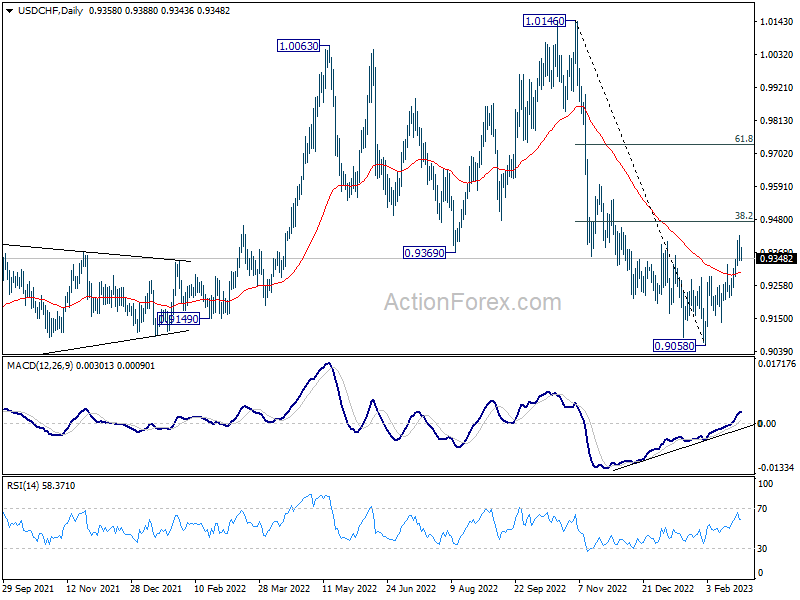
USD/CHF is staying in consolidation below 0.9428 and intraday bias remains neutral. Break of 0.9428 will resume the rebound form 0.9058. But strong resistance could be seen at 38.2% retracement of 1.0146 to 0.9058 at 0.9474 to limit upside. Break of 0.9289 resistance turned support will indicate completion of the rebound and turn bias back to the downside. However, decisive break of 0.9474 will carry larger bullish implications and target 61.8% retracement at 0.9730.
In the bigger picture, decline from 1.0146 is seen as part of a long term sideway pattern. As long as 38.2% retracement of 1.0146 to 0.9058 at 0.9474 holds, another fall is in favor through 0.9058. However, sustained trading above 0.9474 will indicate that the medium term trend has reversed, and open up further rally to 61.8% retracement at 0.9730 and above.
EUR/USD Mid-Day Outlook
Daily Pivots: (S1) 1.0555; (P) 1.0587; (R1) 1.0642; More...
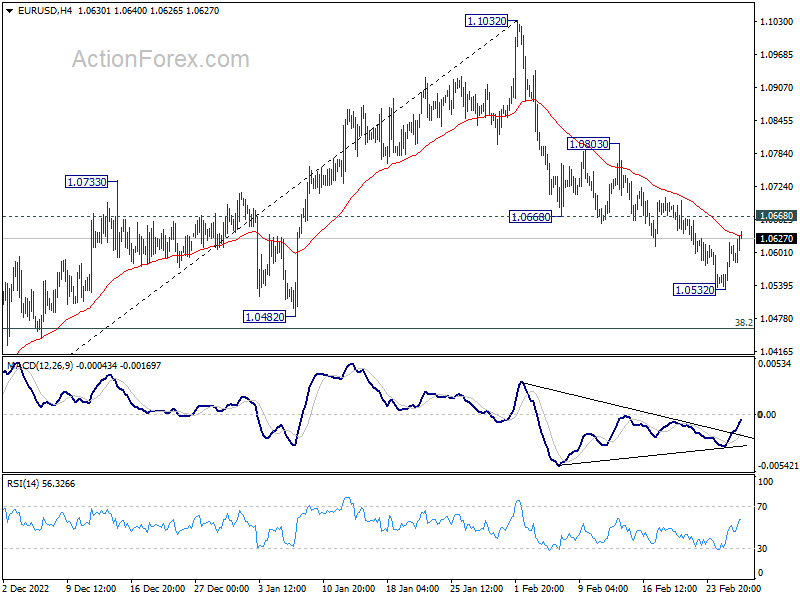
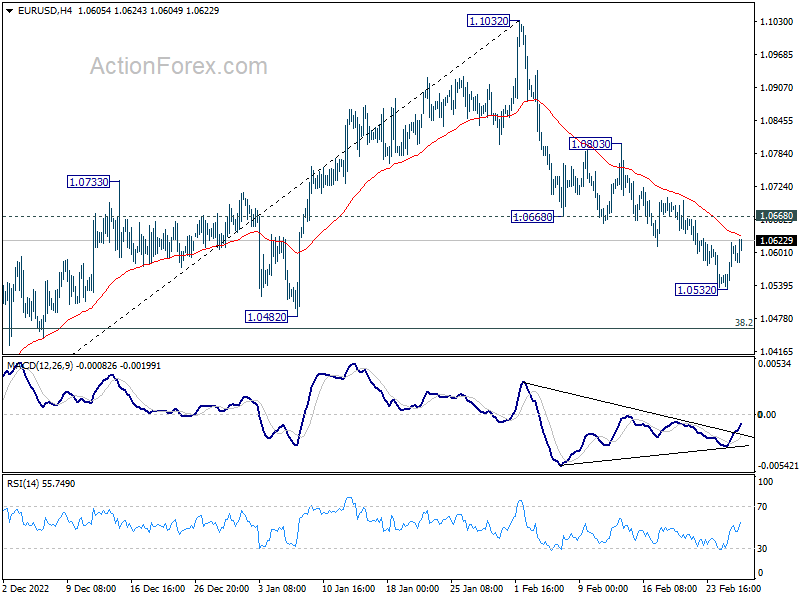
Intraday bias in EUR/USD stays neutral for the moment. The decline from 1.1032 might still extend lower, but strong support could be seen around 38.2% retracement of 0.9534 to 1.1032 at 1.0463 to bring rebound, at least on first attempt. Break of 1.0668 support turned resistance will turn bias back to the upside for 1.0803 resistance and above. However, sustained break of 1.0463 will carry larger bearish implications.
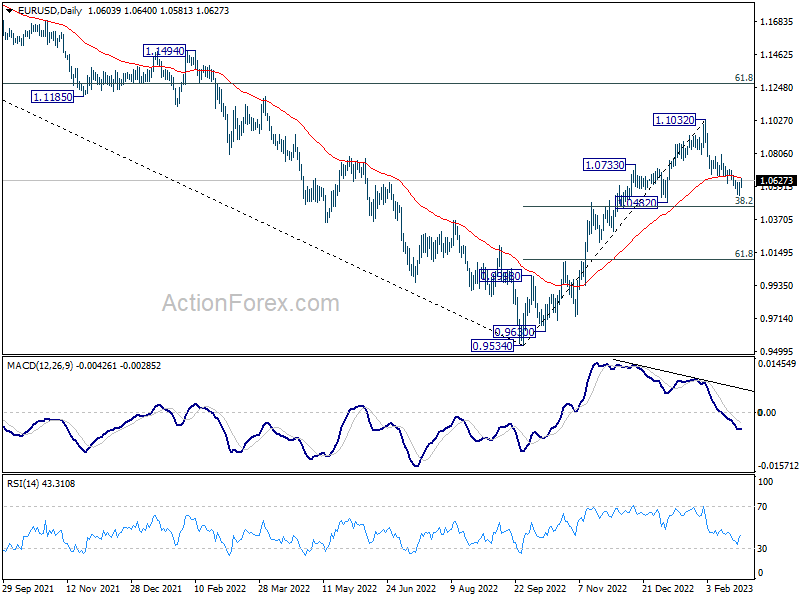
In the bigger picture, as long as 1.0482 support holds, rise from 0.9534 (2022 low) should continue to 61.8% retracement of 1.2348 (2021 high) to 0.9534 at 1.1273. However, sustained break of 1.0482 will bring deeper fall to 61.8% retracement of 0.9534 to 1.1032 at 1.0106, even as a corrective pull back.
Gold and Silver Have Room to Fall
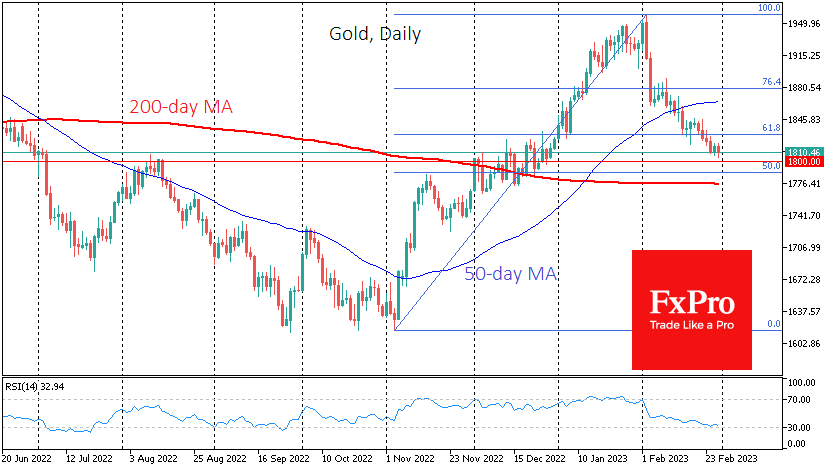
Gold continues to test the bottom and today fell back below $1810. Since the beginning of February, the dynamics suggest an almost perfect reversal of the uptrend, where the initial sharp pullback on the 2nd and 3rd was followed by a downtrend with nearly daily updates of intraday lows.
Until the middle of last week, gold’s decline fit into a typical technical correction, but it is now trading below the 61.8% level of the rally from $1617 in early November to a high of $1960 on the 2nd.
Gold’s reversal began after touching the overbought region on the weekly RSI, and the latest pullback has brought the index back into the mid-range.
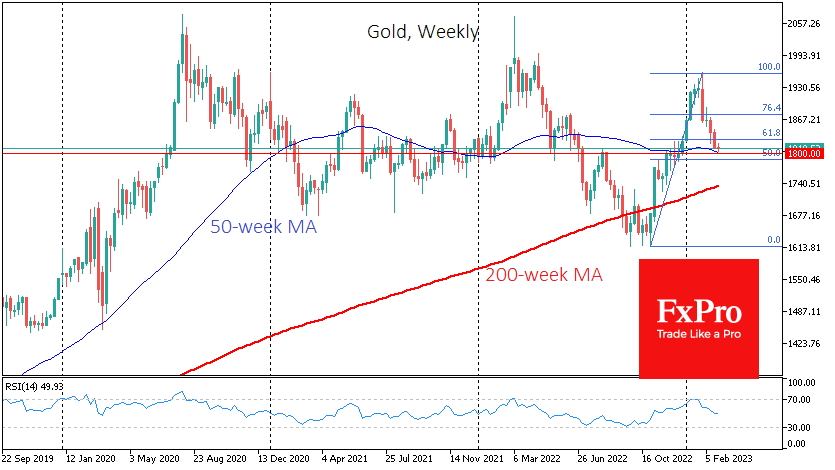
Technically, gold’s sustained decline could continue to the $1775-1787 area for some time. The lower boundary is the 200-day moving average, while the upper boundary is the 50% retracement of the last few months’ gains. The RSI on the daily timeframe has yet to enter the oversold territory, suggesting that there is room for further declines.
Although the $1800 level looks like a nice round level, there were no meaningful stops and reversals near it in December, increasing the chances that there will not be this time around.
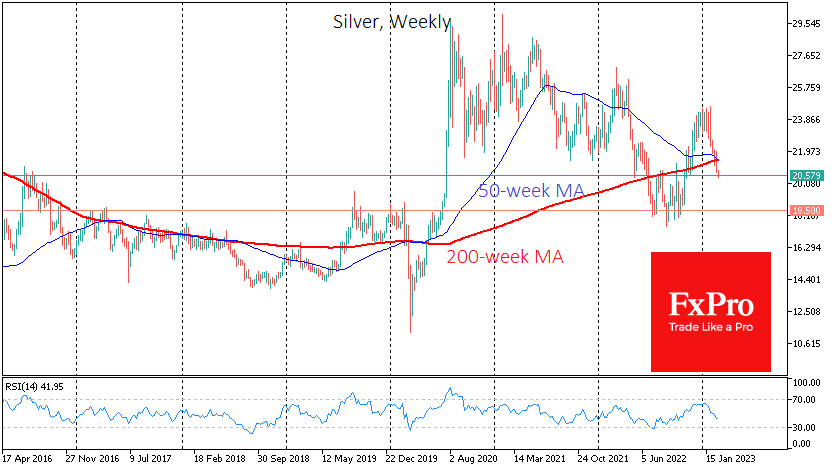
A key indicator for the gold market is silver. The pullback towards $20.60 has brought the price back below the 200 SMA, which could put additional pressure on the market. A death cross has formed on the weekly timeframe as the 50-week moving average is below the 200-week moving average.
This technical picture suggests the possibility of a decline to $18.50. This is where silver could find support from buyers, as it did last August. It is also the former multi-year resistance that turned into support last year.
GBP/USD Mid-Day Outlook
Daily Pivots: (S1) 1.1969; (P) 1.2017; (R1) 1.2112; More...
Focus in GBP/USD is now back on 1.2146 resistance as rebound form 1.1921 extends. Firm break there will turn bias back to the upside for 1.2269 resistance. In such case, whole corrective pattern from 1.2445 might have completed at 1.1914. Break of 1.2269 will bring retest of 1.2445/6 high.
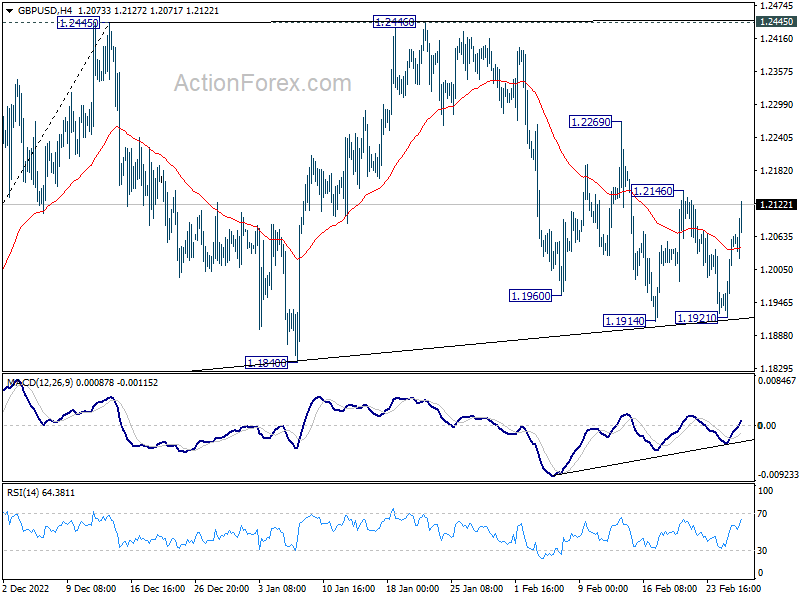
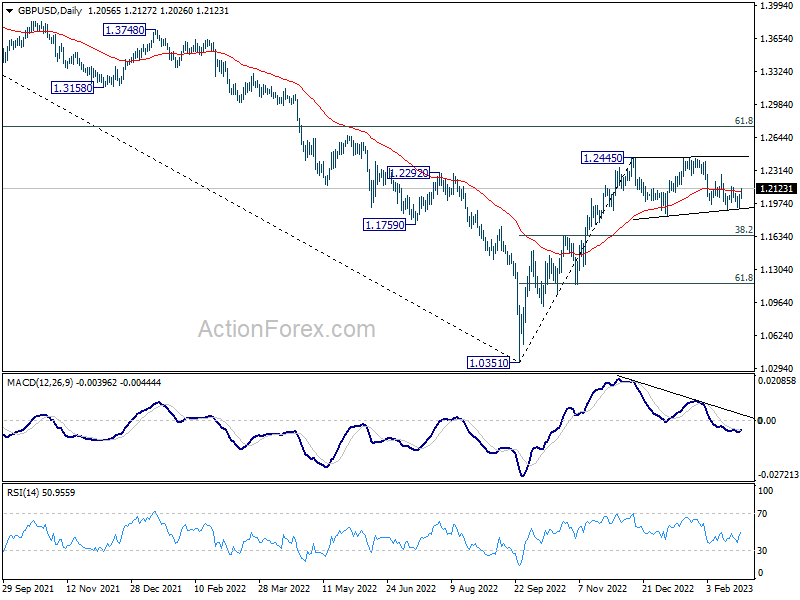
In the bigger picture,as long as 1.1840 support holds, rise from 1.0351 medium term bottom (2022 low) should still continue to 61.8% retracement of 1.4248 (2021 high) to 1.0351 at 1.2759. However, decisive break of 1.1840 will complete a double top pattern (1.2445, 1.2446) after rejection by 55 week EMA (now at 1.2251). Deeper decline should be seen back to 38.2% retracement of 1.0351 to 1.2445 at 1.1645.
Sterling Extends Broad-Based Rally, Yen Stays Pressured
Sterling's broad-based rally continues today and shows sign of upside acceleration. The Pound is additionally added by selloff in Swiss Franc, which is also seen against Euro. Dollar is currently the third strongest for the day as supported by resilience in benchmark treasury yields. Meanwhile, Yen and Swiss Franc are the worst performers, while commodity currencies are mixed.
Technically, EUR/USD will be a focus in the next few sessions. Recovery from 1.0532 is picking up some momentum in 4 hour MACD. Firm break of 1.0668 support turned resistance will argue that whole corrective fall from 1.1032 has completed with three waves down to 1.0532, ahead of 1.0482 key structural support. In the case, stronger rise should be seen through 1.0803 towards 1.1032 high. If happens, that should be accompanied by GBP/USD's rally through 1.2269 resistance towards 1.2446 high.
In Europe, at the time of writing, FTSE is down -0.52%. DAX is up 0.26%. CAC is up 0.20%. Germany 10-year yield is up 0.090 at 2.670. Earlier in Asia, Nikkei rose 0.08%. Hong Kong HSI dropped -0.79%. China Shanghai SSE rose 0.66%. Singapore Strait Times dropped -0.02%. Japan 10-year JGB yield dropped -0.0017 to 0.503.
Canada GDP down -0.1% mom in Dec, but expected to rebound in Jan
Canada GDP contracted -0.1% mom in December, worse than expectation of 0.2% mom expansion. Goods-producing industries declined -0.6% while service-producing industries were essentially unchanged.
For Q4, GDP grew 0.2% qoq, slowest pace since Q2, 2021. Services producing industries rose 0.5% qoq while goods-producing industries contracted -0.6% qoq.
Advance information indicates that real GDP grew 0.3% mom in January. Increases in the mining, quarrying, and oil and gas extraction, wholesale trade, professional, scientific and technical services, and transportation and warehousing sectors were slightly offset by decreases in construction and retail trade.
ECB Lane: We need another 50 basis points in March
ECB Chief Economist Philip Lane said in an interview, "our assessment of December remains solid, that we needed a sequence of 50 basis point hikes to bring us inside a zone where we would need to think harder about whether rates are sufficiently restrictive to deliver the return of inflation to 2%.
"The data flow since then suggests that the assessment is solid, that we need another 50 basis points in March," he said.
Beyond March, "the overall philosophy is that we will bring rates to a level that is sufficiently restrictive, which depends on where the inflation forecast is, where we are with underlying inflation and where we are with the monetary transmission mechanism."
"There is a zone of interest rate paths that the Governing Council will have to assess in March, in May and thereafter, and determine where in that zone we want to be," he added.
Without commenting on whether rate will stay at a significantly long plateau, Lane said "I absolutely sign up to the monetary policy philosophy that wherever we get to, we should be slow to come down until we have very strong evidence – not just in the forecast but also in our ongoing assessment of underlying inflation – that we are returning inflation to target."
Swiss KOF rose to 100, an encouraging upward trend
Swiss KOF Economic Barometer rose for the third month in a row, from 97.4 to 100 in February, hitting the long-term average. It's also above expectation of 98.0.
KOF said, "Since the last low in November 2022 (89.3), we are now observing an encouraging upward trend lasting for already three months."
"The indicators from the manufacturing sector are primarily responsible for the increase, but the indicators for the consumer-related sectors and the export economy as well as, albeit somewhat less clearly, the financial sector are also sending positive signals.
"The other indicators included in the barometer show hardly any change, with the exception of the hotel and restaurant industry, where sentiment has deteriorated slightly."
Swiss GDP stagnated in Q4, challenging international environment curbed manufacturing and exports
Swiss GDP stagnated in Q4, worse than expectation of 0.3% qoq. Looking at some details by production approach, manufacturing contracted -0.3% qoq. Construction was down -0.2% qoq. Trade rose 0.4% qoq. By expenditure approach, private consumption rose 0.3% qoq, government consumption rose 0.3% qoq, construction investment dropped -0.5% qoq, exports of goods dropped -1.7% qoq.
SECO said, "The challenging international environment curbed manufacturing output and also exports. Domestic demand showed robust growth."
BoJ Wakatabe: Dangers of secular stagnation and Japanification not yet passed
Deputy Governor Masazumi Wakatabe said, "the mild-inflation regime has not come to an end, and we should say that the potential dangers of secular stagnation and Japanification have not yet passed."
"When an exogenous shock occurs, there is an adjustment from the old to a new price system. After adjustment, the rising inflation rate is likely to return to the steady-state inflation rate," he said.
"So the important point is how this rate is affected. Of course, it is possible that cost-push factors will remain, but whether they will push up the steady-state inflation rate is uncertain," Wakatabe said, adding that it was "well known that cost-push inflation does not last long.".
BoJ Uchida: Shouldn't modify easy policy just because there are side-effects
Incoming BoJ Deputy Governor Shinichi Uchida told an upper house confirmation hearing, "BOJ must maintain monetary easing. It shouldn't modify easy policy just because there are side-effects. Rather, it must come up with ideas" to mitigate the costs and help sustain stimulus.
He also noted it's premature to discuss an exit from the ultra-loose monetary policy. Any exit would involve adjustments in the interest targets and the balance sheet. "In what order and at what timing the BOJ will make these adjustments will depend on economic and financial developments at the time," Uchida said.
Japan industrial production down -4.6% mom in Jan, expected to rebound in Feb
Japan industrial production declined -4.6% mom in January, much worse than expectation of -2.6% mom.
Upon the release of the data, the METI downgraded its assessment of industrial production, saying that it has weakened. Never the less, the ministry forecast industrial production to bounce back by 8.0% in February, and then a further 0.7% in March.
Retail sales rose 6.3% yoy, above expectation of 4.0% yoy.
Australia retail sales rose 1.9% mom in Jan, flat on average over the past few months
Australia retail sales turnover rose 1.9% mom to AUD 35.09B in January, above expectation of 1.6% mom. Compared with January 2022, sales turnover was up 7.5% yoy.
Ben Dorber, ABS head of retail statistics, said: "The rebound in retail turnover in January followed a substantial fall of 4.0 per cent in December and a large rise of 1.7 per cent in November.
"Looking through this volatility shows that turnover is at a similar level to September 2022, and on average, growth has been flat over the past few months."
NZ ANZ business confidence rose to -43.3, firms wary but getting on with the job
New Zealand ANZ Business Confidence improved form -52.0 to -43.3 in February. Own Activity Outlook rose from -15.8 to -9.2.
Looking at some details, export intentions ticked up from -5.4 to -5.2. Investment intentions rose from -13.7 to -4.9. Employment intentions jumped from -11.1 to -3.4. Pricing intentions dropped from 62.4 to 58.8. Cost expectations dropped from 91.3 to 88.3. Inflation expectations ticked down from 5.99 to 5.94.
ANZ said: "The shock value of the November Monetary Policy Statement appears to have faded into the rear-vision mirror as firms focus on the risks and opportunities that are front and centre.... Opportunity is clearly still knocking. That said, the level of most indicators remain subdued – firms are still very wary, and understandably so. But they are getting on with the job."
GBP/USD Mid-Day Outlook
Daily Pivots: (S1) 1.1969; (P) 1.2017; (R1) 1.2112; More...
Focus in GBP/USD is now back on 1.2146 resistance as rebound form 1.1921 extends. Firm break there will turn bias back to the upside for 1.2269 resistance. In such case, whole corrective pattern from 1.2445 might have completed at 1.1914. Break of 1.2269 will bring retest of 1.2445/6 high.
In the bigger picture,as long as 1.1840 support holds, rise from 1.0351 medium term bottom (2022 low) should still continue to 61.8% retracement of 1.4248 (2021 high) to 1.0351 at 1.2759. However, decisive break of 1.1840 will complete a double top pattern (1.2445, 1.2446) after rejection by 55 week EMA (now at 1.2251). Deeper decline should be seen back to 38.2% retracement of 1.0351 to 1.2445 at 1.1645.
Economic Indicators Update
| GMT | Ccy | Events | Actual | Forecast | Previous | Revised |
|---|---|---|---|---|---|---|
| 23:50 | JPY | Industrial Production M/M Jan P | -4.60% | -2.60% | 0.30% | |
| 23:50 | JPY | Retail Trade Y/Y Jan | 6.30% | 4.00% | 3.80% | |
| 00:00 | NZD | ANZ Business Confidence Feb | -43.3 | -52 | ||
| 00:30 | AUD | Current Account Balance (AUD) Q4 | 14.1B | 6.8B | -2.3B | 0.8B |
| 00:30 | AUD | Private Sector Credit M/M Jan | 0.40% | 0.40% | 0.30% | |
| 00:30 | AUD | Retail Sales M/M Jan | 1.90% | 1.60% | -3.90% | -4.00% |
| 05:00 | JPY | Housing Starts Y/Y Jan | 6.60% | -1.20% | -1.70% | |
| 07:00 | EUR | Germany Import Price Index M/M Jan | -1.20% | 0.40% | -1.60% | |
| 07:45 | EUR | France GDP Q/Q Q4 F | 0.10% | 0.10% | 0.10% | |
| 08:00 | CHF | KOF Economic Barometer Feb | 100 | 98 | 97.2 | 97.4 |
| 08:00 | CHF | GDP Q/Q Q4 | 0.00% | 0.30% | 0.20% | |
| 13:30 | CAD | GDP M/M Dec | -0.10% | 0.20% | 0.10% | |
| 13:30 | USD | Goods Trade Balance (USD) Jan P | -91.5B | -91.0B | -90.3B | |
| 13:30 | USD | Wholesale Inventories Jan P | -0.40% | 0.10% | 0.10% | |
| 14:00 | USD | Housing Price Index M/M Dec | -0.20% | -0.10% | ||
| 14:00 | USD | S&P/CS Composite-20 HPI Y/Y Dec | 6.80% | 6.80% | ||
| 14:45 | USD | Chicago PMI Feb | 45 | 44.3 | ||
| 15:00 | USD | Consumer Confidence Feb | 108.5 | 107.1 |