

Sample Category Title
USD/CAD Consolidates Gains
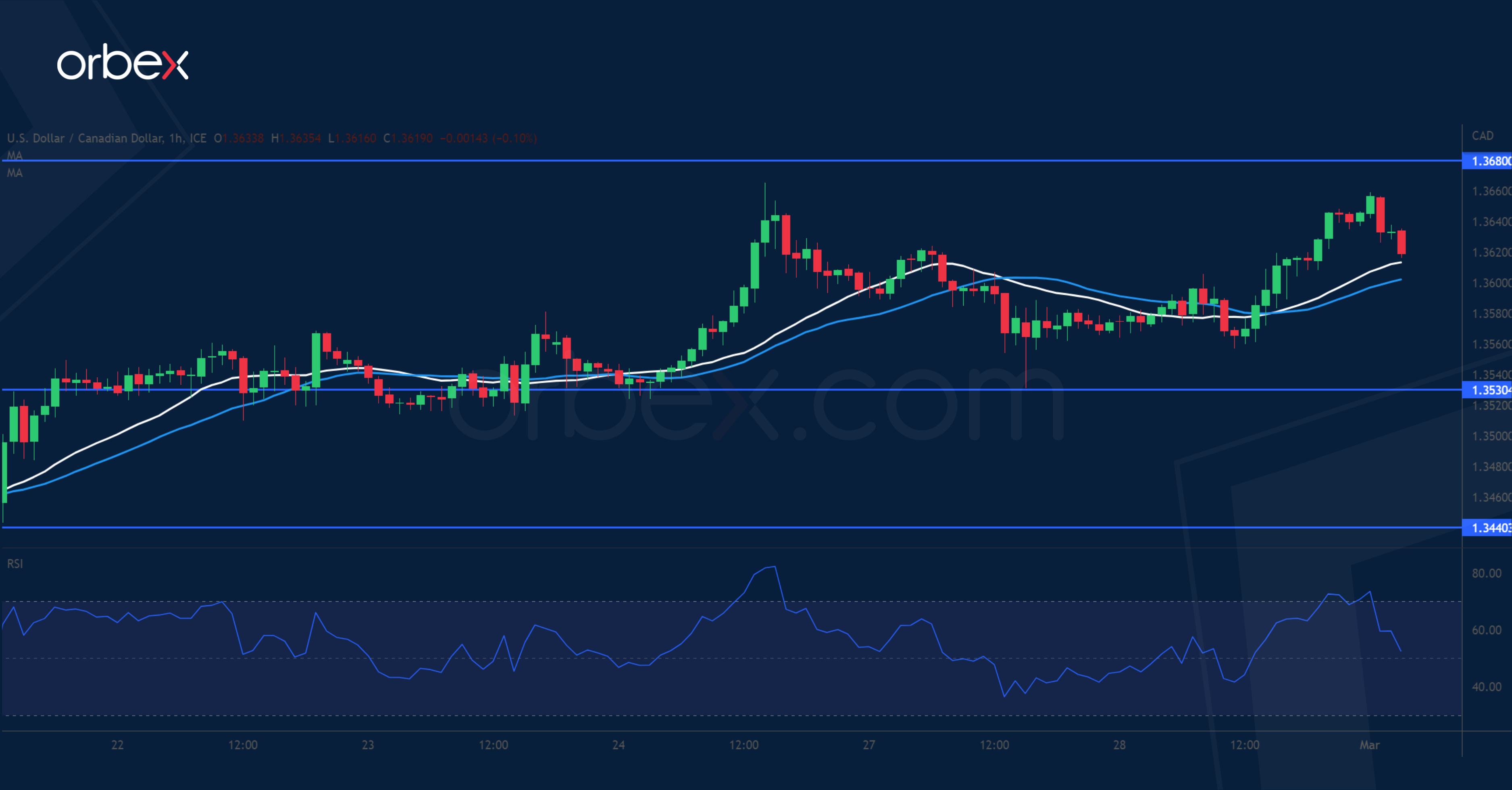
The Canadian dollar softened after the economy unexpectedly stalled in Q4. On the daily chart, the pair is looking to come out of its five-month long consolidation, but stiff selling pressure has kept the price below the top band and January’s peak of 1.3680. A bounce off 1.3530 is a sign of follow-up interest. Further down, the confluence of the previous swing low of 1.3440 and the 20-day SMA is a significant support. A decisive break above 1.3680 would trigger a runaway rally and resume the uptrend in the medium-term.
USD/CHF Finds Support
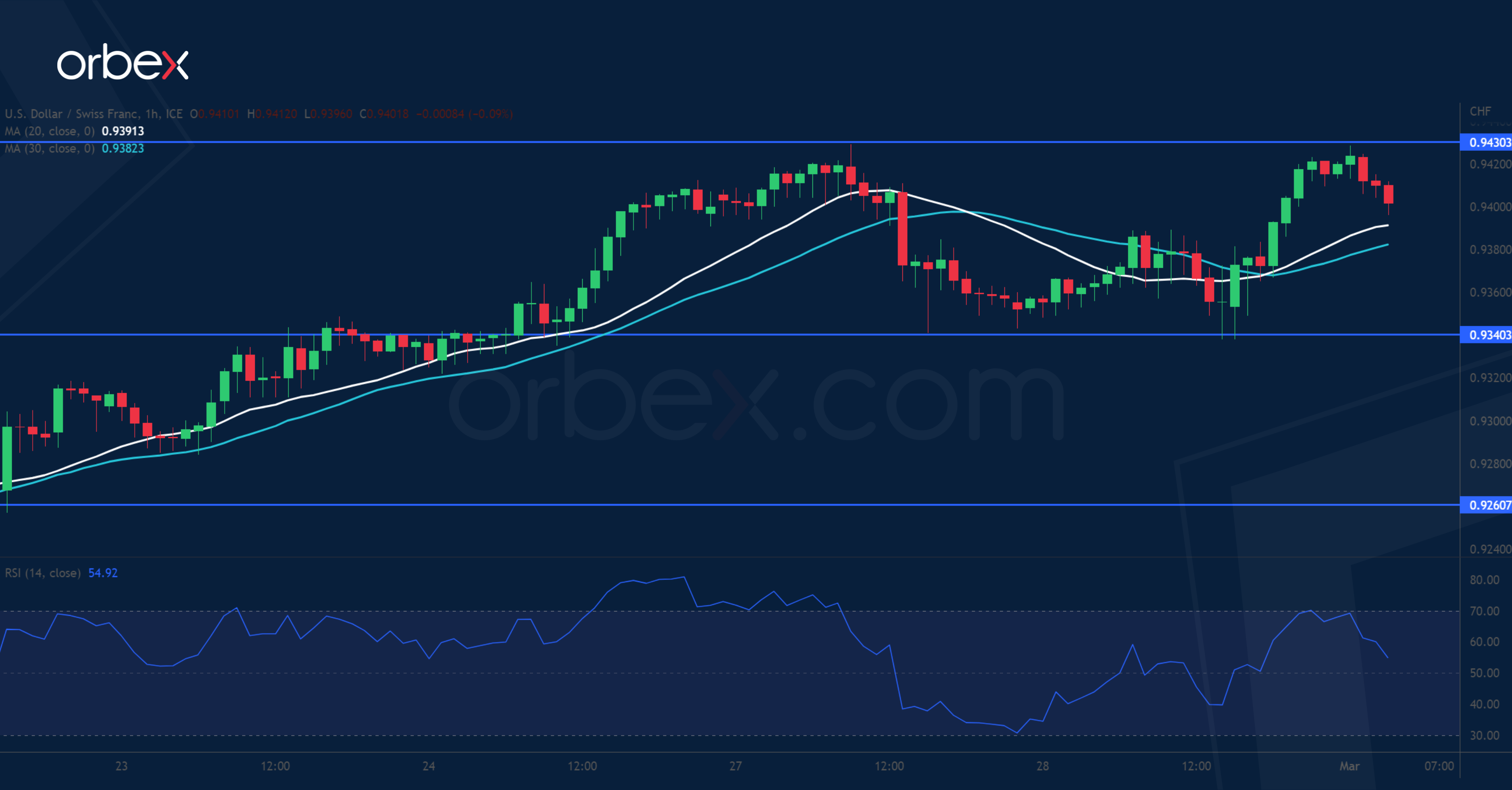
The Swiss franc fell after the annual GDP barely avoided a contraction in Q4. On the daily chart, a close above January’s high of 0.9400 and a bullish MA cross show that sentiment is turning around. Now that the direction is skewed to the upside, traders see pullbacks as opportunities to buy at a discount. The latest retracement came to a halt at 0.9340 and 0.9260 over the 20-day SMA is the second layer of defence. A close back above 0.9430 would pave the way for an extended rally towards the supply area around 0.9500.
Hawkish Central Bank Policy to Remain in Place for Longer
Markets
Unexpectedly accelerating inflation in France and Spain set the tone right at the start of European dealings. Core bonds slid with European bonds evidently underperforming US Treasuries. German yields rose 6.2-7.6 bps across the curve with a slight underperformance at the belly. The 10y yield closed above 2.57% resistance to set a new cycle high. US yields added 2.5-3.9 bps at the front end and less than 2 bps elsewhere (excluding the 30y; -1 bps). The 10y yield over there continues to test important resistance around 3.95%. Both European and US bond yields finished off intraday highs though, following an unexpected decline in US Conference Board consumer confidence (from a downwardly revised 106 to 102.9), on the back of a worsened expectations component. But that doesn’t change the evolving market narrative towards hawkish central bank policy to remain in place for longer. In the EA, money markets are gradually pricing in a peak policy rate of 4%, the US is shifting towards 5.5-5.75% with a rate cut no longer fully priced in at the end of the year. Equities, both in Europe and the US, tried a comeback after initially being whipped by the yield rise but in the end finished with some losses still. The dollar took the lead on currency markets. EUR/USD closed near recent lows below 1.06, the trade-weighted DXY (104.869) erased about half of the losses incurred on Tuesday. Sterling’s Windsor Framework boost already faded, as sentiment on equity markets took a turn for the worst. EUR/GBP rebounded from an intraday low at 0.8755 to 0.8798.
Asian stocks this morning get a boost from the ongoing Chinese PMI rebound. The non-manufacturing gauge rose well into expansion territory (56.3). The manufacturing PMI came in at 52.6, lifting the composite figure to 56.4. Details were strong. The Chinese yuan’s comeback enters its third day. USD/CNY falls to 6.90 with some sentiment-driven dollar weakness at play too. Strong Chinese data also supports currencies Down Under (AUD, NZD). EUR/USD oscillates around 1.06. US yields add less than 2 bps across the curve. German yields face a higher opening as well.
German CPI numbers are key to watch in European dealings today. A first regional publication came in at 0.1% m/m and 8.5% y/y (North Rine Westphalia). With the recent methodology change it’s tricky to draw firm conclusions for the national number though (expected at 0.7% m/m and 9% for the harmonized figure). In any case we look out for the German 10y yield to confirm yesterday’s break higher. That would improve the technical picture, opening the way towards 3%. The focus shifts to the US in the afternoon with the publication of the manufacturing ISM, seen bottoming out from 47.4 to 48. While we see some upward surprise risks, the leap higher in the 10y yield here might be tricky with the services gauge still due on Friday. As ever, EUR/USD’s daily momentum depends on the overall risk sentiment. The likes of stocks have been proven resilient recently, especially in Europe, providing a bottom for the euro while it lasts. 1.068 is a first resistance.
News and views
Australian GDP grew by 0.5% Q/Q in the final quarter of 2022, down from 0.7% growth in Q3 and below 0.8% consensus. Y/Y-growth slowed to 2.7%. Total consumption (0.4% Q/Q) and exports (1.1% Q/Q) were the main growth engines. Changes in inventories subtracted 0.5 percentage points from GDP growth while private gross fixed capital formation fell 1.7% Q/Q. The Bureau of Statistics said that continued growth in household and government spending drove the rise in consumption, while increased exports of travel services and continued overseas demand for coal and mineral ores drove exports. The contribution from households is losing momentum though, with a 4.3% Q/Q decline in imports adding to that picture. On top, the household saving ratio fell from 7.1% to 4.5%, the lowest level since Q3 2017. Compensation of employees increased 2.1% Q/Q, pointing to the tight labour market. The GDP implicit price deflator rose by 1.6% Q/Q and 9.1% Y/Y. Monthly January CPI inflation, released as well this morning, slowed in Y/Y-terms from 8.4% to 7.4%. The Aussie dollar initially dipped to the recent lows against the greenback (AUD/USD 0.67), but soon rebounded on strong Chinese PMI’s and the ebullient risk sentiment.
UK shop price inflation rose to another record high (8.4% Y/Y from 8%) in February as retail prices across the board continued to react to the impact of soaring energy bills, higher running costs and tougher trading conditions brought about by the war in Ukraine. Details from the British Retail Consortium’s indicator showed overall prices rising by 0.8% M/M, with both food (1% M/M; 14.5% Y/Y) and non-food (0.7% M/M; 5.3% Y/Y) contributing.
GBP/JPY Daily Outlook
Daily Pivots: (S1) 163.18; (P) 163.76; (R1) 164.92; More...
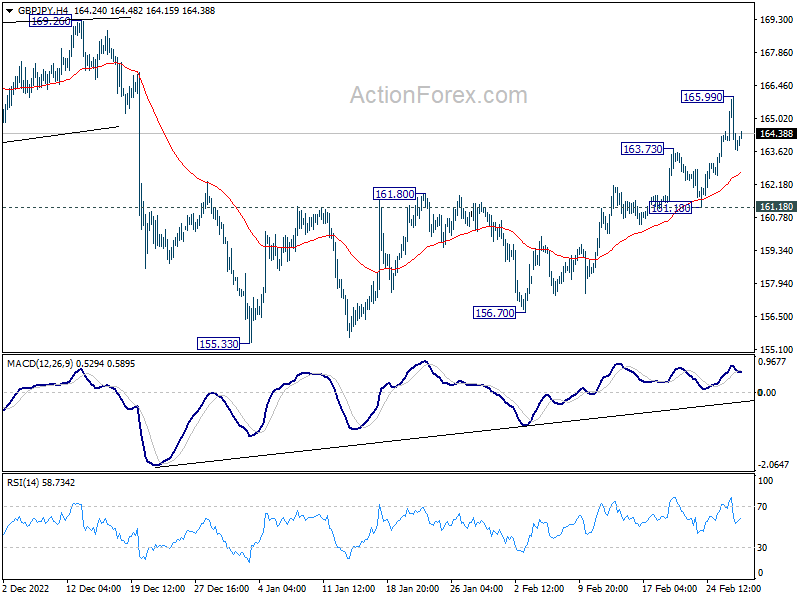
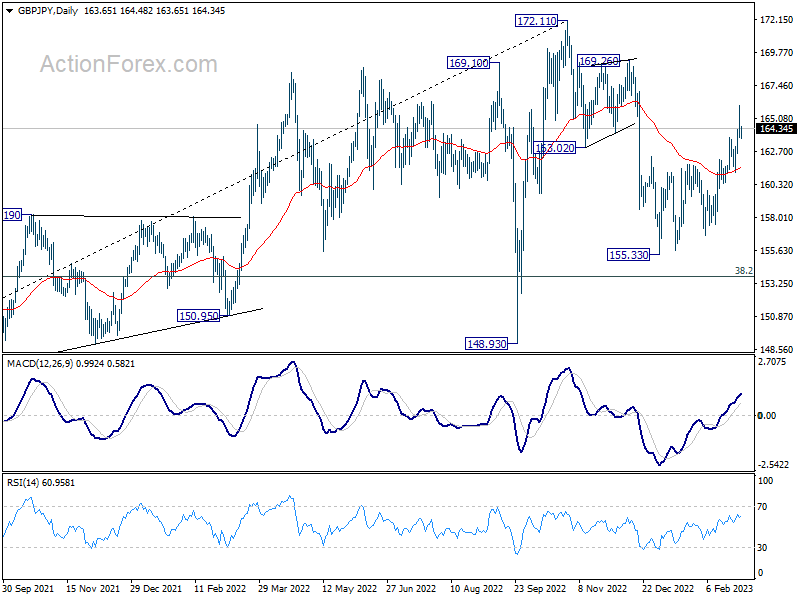
Intraday bias in GBP/JPY is turned neutral as it retreated after hitting 165.99. Some consolidations would be seen but further rally is expected as long as 161.18 support holds. As noted before, corrective fall from 172.11 should have completed at 155.33 already. Break of 165.99 will target 169.26 resistance first, and then 172.11 high.
In the bigger picture, corrective decline from 172.11 medium term should have completed at 155.33. With 38.2% retracement of 123.94 (2020 low) to 172.11 (2022 high) at 153.70 intact, medium term bullishness is retained. That is, larger up trend from 123.94 (2020 low) is still in progress. Break of 172.11 high to resume such up trend is expected at a later stage.
EUR/JPY Daily Outlook
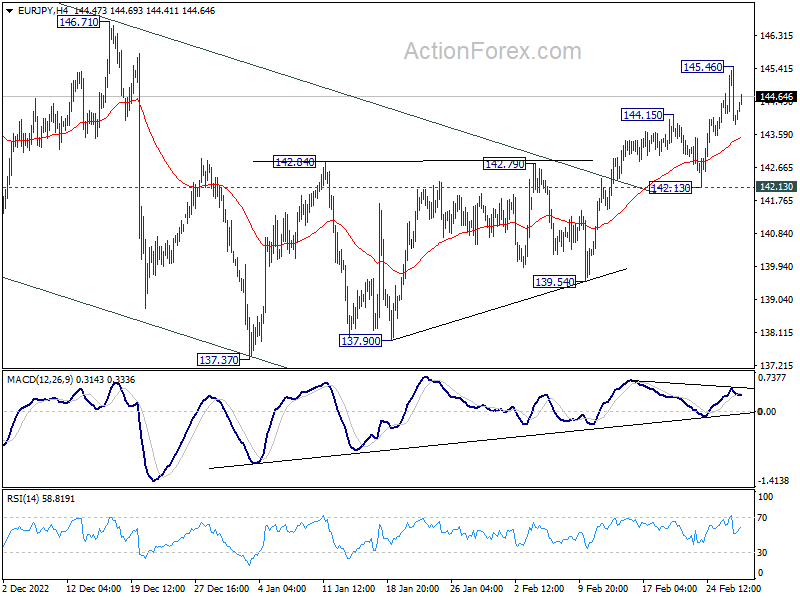
Daily Pivots: (S1) 143.48; (P) 144.48; (R1) 145.07; More....
EUR/JPY retreated after rising to 145.46 and intraday bias is turned neutral first. But further rally is expected as long as 142.13 support holds. Corrective fall from 148.38 has completed at 137.37 already. Break of 145.46 will resume the rally from 137.37 to 146.71 resistance and then 148.38 high.
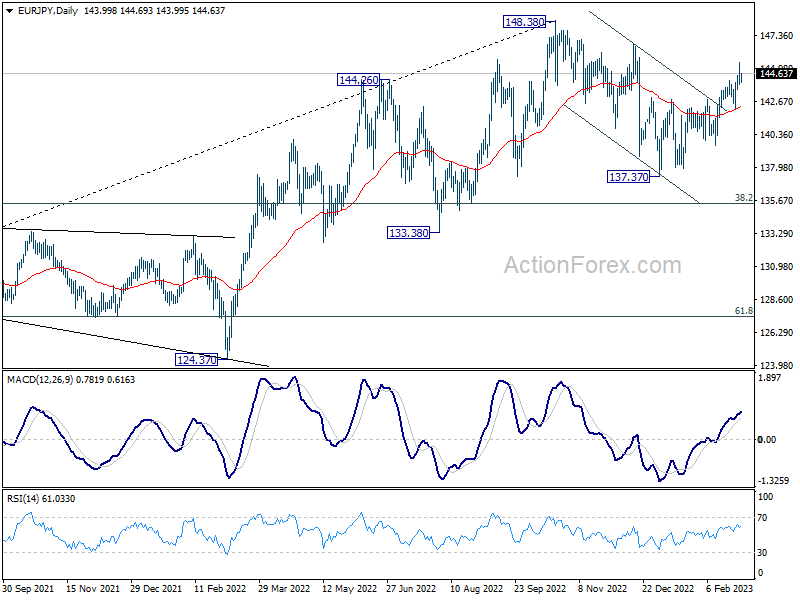
In the bigger picture, as long as 55 week EMA (now at 139.42) holds, larger up trend from 114.42 (2020 low) is still in progress for 149.76 long term resistance. However, firm break of 55 week EMA will bring deeper fall to 38.2% retracement of 114.42 to 148.38 at 135.40. Sustained break there will raise the chance of trend reversal, and target 61.8% retracement at 127.39.
EUR/GBP Daily Outlook
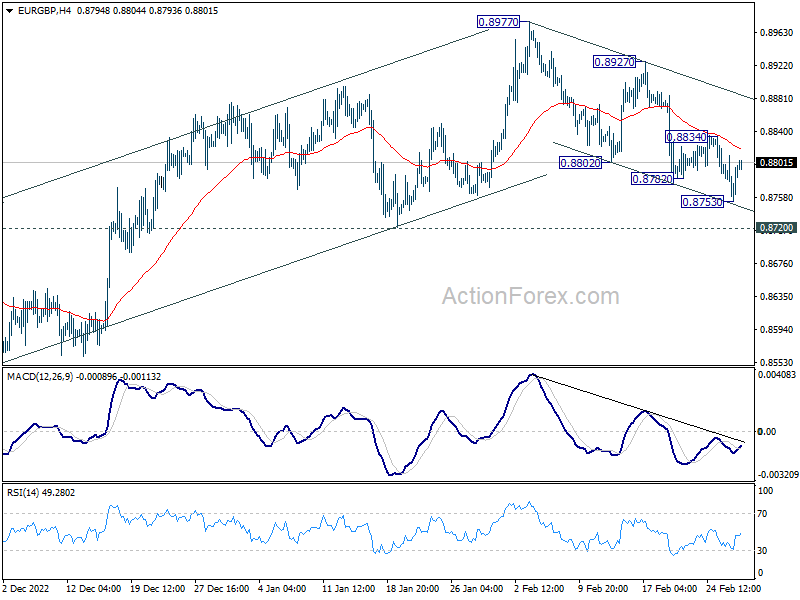
Daily Pivots: (S1) 0.8763; (P) 0.8788; (R1) 0.8820; More...
Intraday bias in EUR/GBP is turned neutral again as it recovered after dipping to 0.8753. Further decline is expected with 0.8834 resistance intact. Below 0.8753 will resume the fall form 0.8977 to 0.8720 support. Firm break there should confirm completion of whole rebound from 0.8545, and turn near term outlook bearish for this support. However, break of 0.8834 will dampen this bearish view and turn bias back to the upside for stronger rebound.
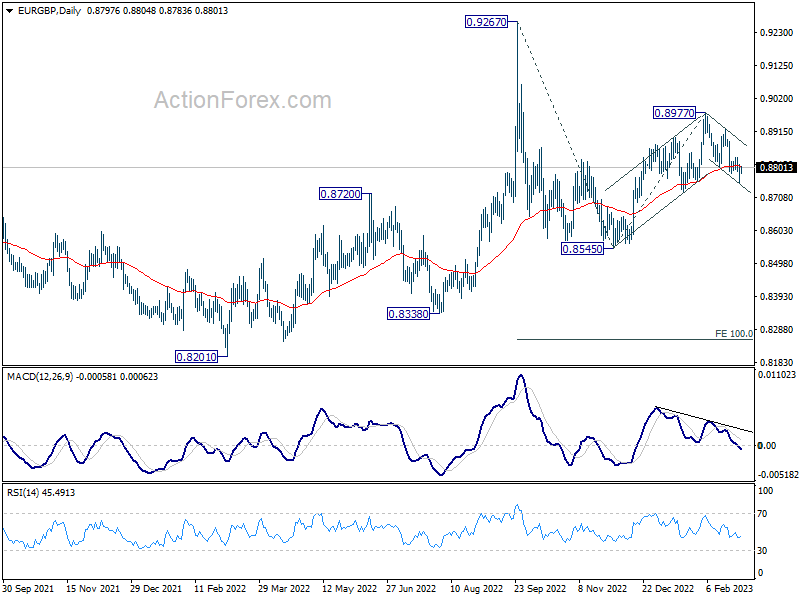
In the bigger picture, current development suggests that fall from 0.9267 (2022 high) is still in progress. Such decline is seen as a leg inside long term range pattern from 0.9499 (2020 high). Break of 0.8545 will target 100% projection of 0.9267 to 0.8545 from 0.8977 at 0.8255. On the other hand, strong rebound from current level will extend the rise from 0.8545 through 0.8977 at a later stage.
EUR/AUD Daily Outlook
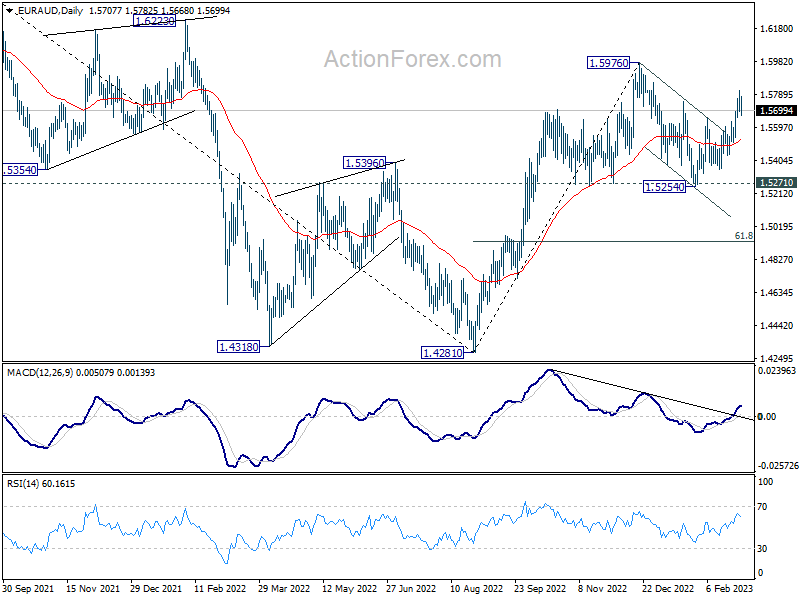
Daily Pivots: (S1) 1.5670; (P) 1.5743; (R1) 1.5790; More...
Intraday bias in EUR/AUD is turned neutral first as it retreated after hitting 1.5813. Outlook is unchanged that corrective fall form 1.5976 has completed at 1.5254. Further rally is expected as long as 1.5605 support holds. Above 1.5813 will resume the rebound from 1.5254 to retest 1.5976 high.
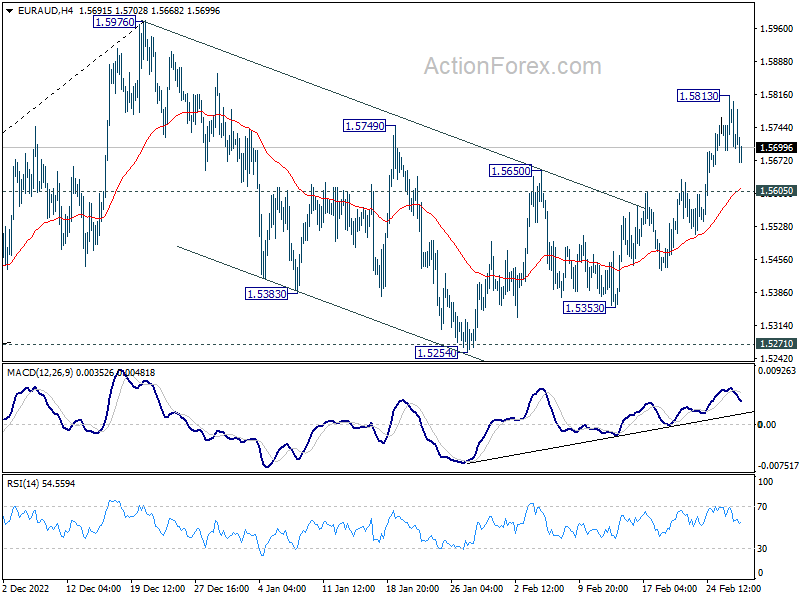
In the bigger picture, it's still early to confirm if rise from 1.4281 represents bullish trend reversal. But as long as 1.5271 support holds, such rally is in favor to continue. Break of 1.5976 will target 1.6434 key resistance next. On the other hand, firm break of 1.5271 will retain medium term bearishness instead.
EUR/CHF Daily Outlook
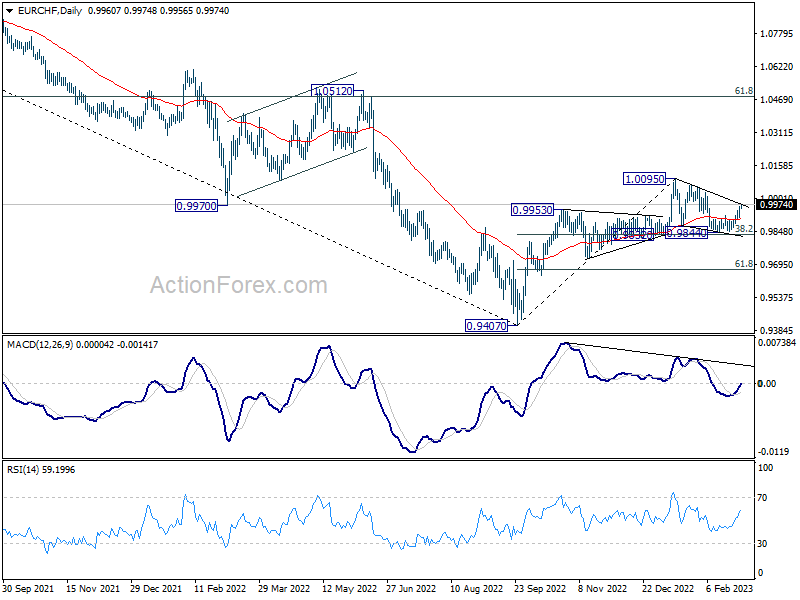
Daily Pivots: (S1) 0.9931; (P) 0.9948; (R1) 0.9982; More....
EUR/CHF's rebound from 0.9844 is still in progress and intraday bias stays on the upside. As noted before, corrective pattern from 1.0095 should have completed with three waves down to 0.9844. Sustained break of the falling rend line resistance (now at 0.9974) will add to this bullish cas and bring retest of 1.0095 high. On the downside, below 0.9923 minor support will mix up the outlook and turn intraday bias neutral first.
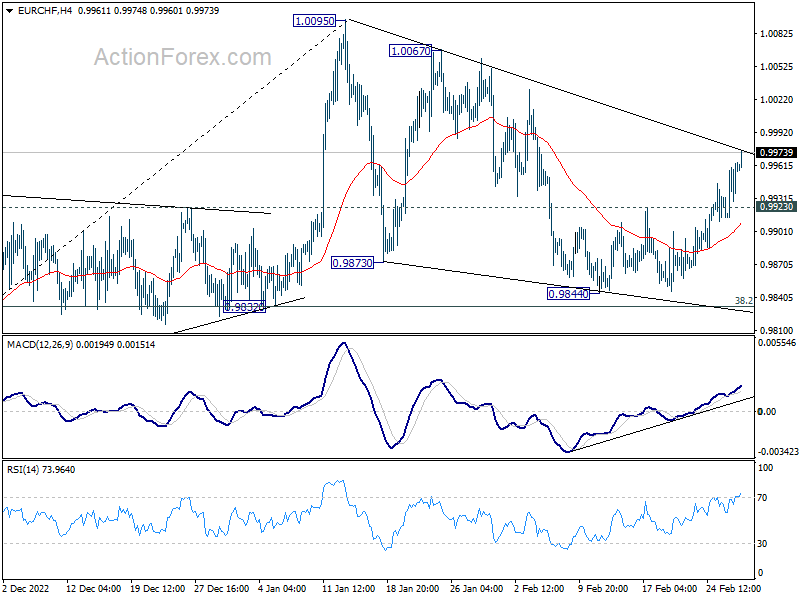
In the bigger picture, with 0.9832 support intact, rise from 0.9407 (2022 low) is still expected to continue. Break of 1.0095 and sustained trading above 55 week EMA (now at 1.0021) will be a medium term bullish signal, and bring further rally to 1.0505 cluster resistance (2020 low at 1.0505, 61.8% retracement of 1.1149 to 0.9407 at 1.1484). However, firm break of 0.9832 support will revive medium term bearishness and bring retest of 0.9407 low instead.
Hot Inflation Boosts ECB Rate Hike Bets
Uh oh! Inflation in Europe took the wrong direction in February. The data released yesterday printed a record inflation of 7.2% in France and ticked higher to 6.1% in Spain. Both were higher than expected, of course, and cranked up the hawkish European Central Bank (ECB) rate expectations.
For the first time, the market pricing pointed out that the ECB’s deposit rate would reach 4%, 150bp higher than where it stands right now. That means more 50bp hike will be on the mene after the next ECB meeting’s almost certain 50bp hike.
What does that mean for investors?
First, it means higher bond yields, as the hawkish ECB expectations directly impact the bond yields, sending them higher. As such, German, French, Italian and Spanish 10-year yields are now at the highest levels in more than a decade. They are at levels reached during the European debt crisis at the start of 2010s.
Higher yields are good for the euro - even if it won’t necessarily reverse the negative trend against the dollar, it should at least slow the selloff.
But hotter-than-expected inflation is not necessarily good for the European stocks, as higher inflation means higher ECB rates, higher ECB rates mean higher bond yields, higher bond yields mean more expensive financing for companies, more expensive financing for companies means less projects, less manufacturing, less services, and that, in return, means lower revenues for companies.
Though a stronger euro helps companies eke out better profits as a stronger currency makes raw material and energy costs more affordable for European businesses, higher yields could weigh more on the balance than a stronger euro. Therefore, what’s probably next for the Stoxx 600 is a downside correction, following a 23% rally between last October and this February.
Today, we will get hold of the German inflation figures along with the final manufacturing PMI data for the Eurozone countries, and tomorrow morning, the Italian CPI numbers will fall in before the Eurozone flash CPI estimate for February. The expectation is that inflation in the Eurozone may have slowed to 8.2% from 8.6% printed a month ago. Or it may have not slowed as much.
Higher inflation combined with soft growth is the worst possible scenario for stocks.
Slower Aussie inflation, stronger China PMI
Inflation in Australia eased more than expected in January, from last month’s record 8.4% to 7.4% versus 8% expected by analysts. But growth also slowed in Q4.
The Aussie-dollar first dipped then rebounded. The better-than-expected PMI data from China boosted iron ore prices, and helped throw a floor under the Aussie’s selloff, at around the 100-DMA, 0.6740. But clearing support at this level would only take another wave of hawkish Federal Reserve (Fed) pricing, which would boost the dollar appetite and send the pair below the 100-DMA. The downside risks prevail.
Speaking of the Fed expectations
Cooling US house prices for a seventh straight month, and ugly Richmond manufacturing index cooled the hawkish Fed pressures yesterday, but the S&P500 couldn’t hold on to its gains above the 50-DMA, and closed yesterday’s session below this level. As a result, the month of February ended with a 2.7% loss for the S&P500, and with mounting pressure from the bears.
The key support to watch in S&P500 is the 200-DMA, near 3940. There are warnings that a fall below this level could trigger a $50 billion selloff, according to JP Morgan.
Elsewhere, well crude oil jumped yesterday, although the latest API data showed another 6.2 million barrel build last week in the US crude inventories. The strong PMI data from China certainly helped keeping the oil bulls alert, but the 50-DMA offers, a touch below the $78pb, may be hard to clear defying the massive builds in US crude inventories week after week. The more official EIA data is due today, and remember last week, the EIA data was even bigger than the API.
China is Back to Work
Market movers today
German CPI for February will be in focus this morning as CPI for German länder rolls over the screens before the countrywide CPI is released at 14.00CET. Both France and Spain saw upside surprises in CPI inflation yesterday.
In the US it is time for ISM manufacturing for February, which we expect to tick higher following stronger-than-expected US manufacturing PMI released 1½ week ago.
It is PMI day in many European countries, not least the UK and Norway and Sweden. We could see a small pick-up in the numbers as witnessed in many countries in early 2023. It follows a decent decline in energy prices and a lift in Chinese activity after the re-opening of the economy.
The 60 second overview
China: PMI indices rose across the board in China in February and rose by more than expected by consensus. Reopening of the economy has led to a rise in economic activity. The manufacturing gauge increase to 52.6 from 50.1 and thus well into expansionary territory. The non-manufacturing index rose to 56.3 from 54.4 and finally the composite measure was 56.4 - a big increase from 52.9. The Caixin manufacturing PMI confirmed the picture above. It rise to 51.6 from 49.2.
US: Consumer confidence dropped in the US in February after consumers turned sour about their expectations for the future. They remain upbeat about their view on the current situation though.
Equities: Equities lower yesterday in a remarkable cyclical outperformance. This is very interesting as it illustrates quite well the battle between a soft-landing and overheating. On the one side the challenge coming from too high inflation (yesterday France and Spain), lifting yields, hurting the equity risk premia. On the other side the improving macro-outlook lifting the chance of better earnings outlook benefitting the cyclicals the sector the most. Despite the drop in almost all major indices yesterday, materials and financials (driven by banks) outperformed, while utilities were underperforming. We expect the battle between overheating and soft-landing to continue for a while as the job market is still strong, growth will improve from a very low level while this is countered by massive monetary tightening.
In US yesterday, Dow -0.7%, S&P 500 -0.3%, Nasdaq -0.1% and Russell 2000 +0.04%.
Asian markets are higher this morning led by a rally in Chinese H-shares. Optimism was boosted overnight from strong PMI releases, not just in China. The strong macro data from Asia have also resulted in a turnaround in European and US futures, meaning they are now higher after being lower very early morning.
FI: It was again a volatile day in the global bond markets, where the sell-off continued on the back of stronger than expected inflation data from France and Spain. Today, we will get inflation data out of Germany before the aggregate data is released from the Eurozone on Thursday. If inflation data continue to surprise on the upside the repricing of the ECB should continue and thus put more pressure on bond markets.
FX: Yesterday, EUR/USD moved back below 1.06, as USD increased in late trading after EUR initially broadly strengthened on the back of stronger-than-expected inflation prints from Spain and France, which could indicate a relatively strong Euro Area inflation print in the pipeline tomorrow. For the whole of February, USD has appreciated against all G10 peers except SEK. EUR/GBP is hovering around the 0.88 mark, and both SEK and NOK weakened against the EUR trading at 11.07 and 10.98, respectively.
Nordic macro
Norway. We reckon the Norwegian PMI will hold around 50 in February, with continued weak growth in European manufacturing sector probably counteracting optimism in the oil supply sector. Statistics Norway's Q4 confidence survey suggests some downside risk to our forecast.
Sweden. While Swedish manufacturing PMI has dropped a lot alongside global dittos and was down at 46.8 in January, it has moved sideways in recent months. Also of great interest is the subcomponents, where on the positive side price plans and delivery times have moved lower and on the negative side employment has moved lower as well and seems to be on the verge of dropping below the 50 mark.