Sample Category Title
GBP/USD Pair Moved into a Short-Term Positive Zone Above 1.2080
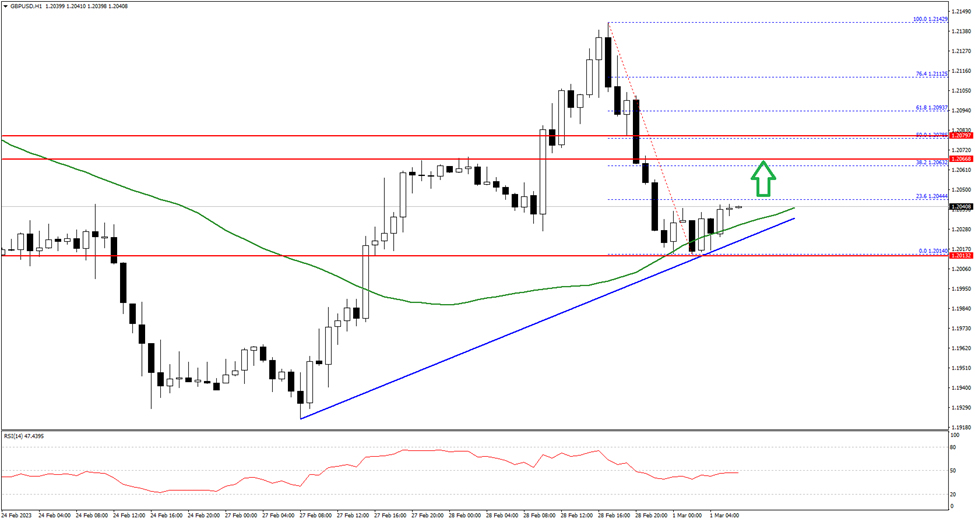
The British Pound started a decent increase above the 1.2000 resistance zone against the US Dollar. The GBP/USD pair climbed above the 1.2080 level and moved into a short-term positive zone.
The pair traded as high as 1.2142 before it corrected lower. It is now trading above the 1.2000 level and the 50 hourly simple moving average. An immediate resistance is near the 1.2060 level.
The first major resistance is near the 1.2075 level. If there is a clear upside break above the 1.2075 resistance, the pair could rise steadily towards the 1.2120 level in the near term. The next major resistance sits near 1.2150 on FXOpen.
On the downside, the first major support is near the 1.2020 level and a connecting bullish trend line on the hourly chart. The main support is forming near the 1.2000 level. A break below the 1.2000 support could push the pair towards the 1.1940 support.
UK PMI manufacturing finalized at 49.3 in Feb, showed encouraging signs of resilience
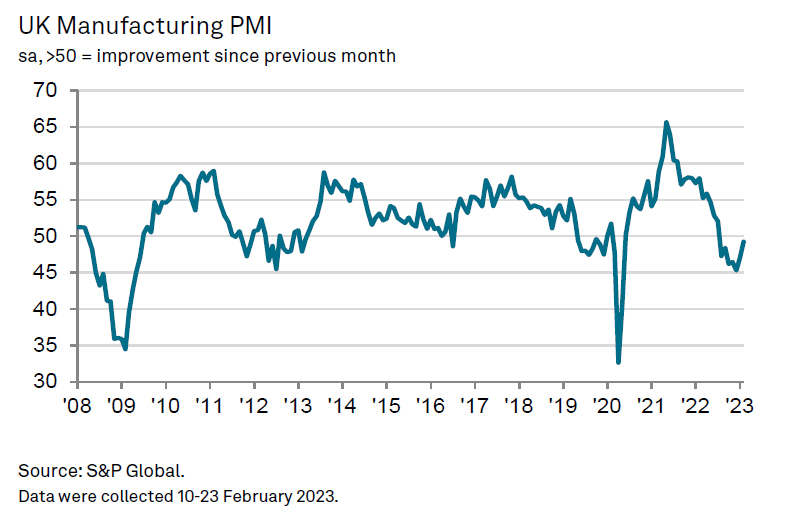
UK PMI Manufacturing was finalized at 49.3 in February, up from January's 47.0. That's the highest level in 7 months even though it's stuck in contraction territory. New orders fell but showed signs of stabilizing. Input cost and output price inflation eased.
Rob Dobson, Director at S&P Global Market Intelligence, said:
"UK manufacturing showed encouraging signs of resilience in February. Output rose for the first time in eight months, boosted by weaker cost inflation and reduced supply chain disruptions. Input prices increased at the slowest pace since July 2020 and supplier performance improved for the first time in three-and-a-half years. This offset some of the ongoing negative impacts from strikes, the cost of living crisis and lower order intakes.
"Manufacturers' confidence also strengthened, with 60% of companies forecasting production will expand during the coming year. Part of the reason for renewed optimism was a near-stabilisation of new order inflows in February, with total new orders and new export business both falling only slightly and to much lesser extents than in recent months. Manufacturers benefited from growing signs of a global economic recovery and the easing of COVID restrictions by China. This process of economic revival, alongside signs of inflation peaking and reduced recession fears, should hopefully help UK manufacturers eke out further growth in the coming months."
EURJPY Hits Fresh 2-Month High as Rebound Strengthens
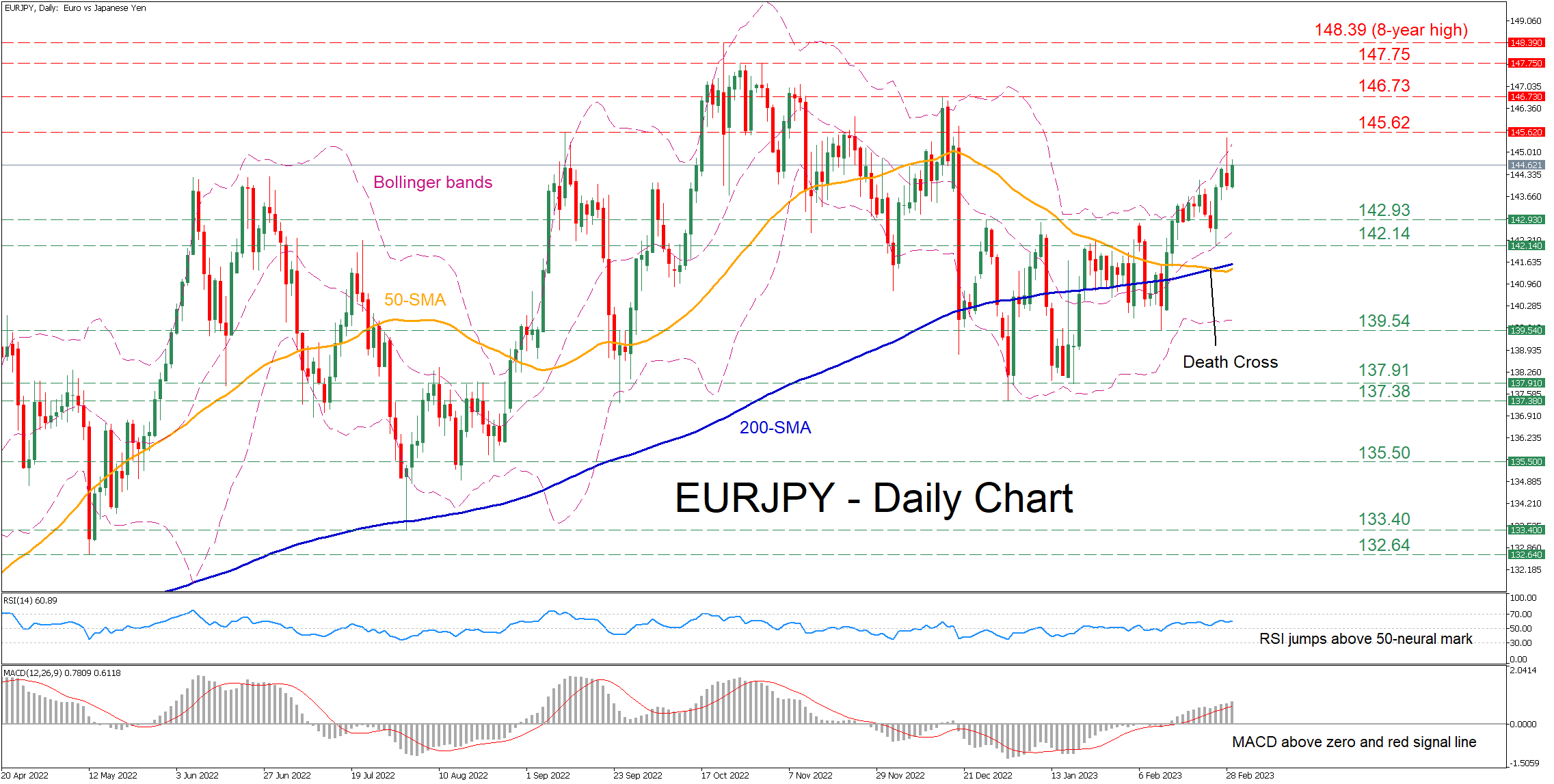
EURJPY has been in a downtrend since mid-October when the price peaked at the eight-year high of 148.39. In the short-term, however, the pair has staged a moderate rebound despite the completion of a death cross between its 50- and 200-day simple moving averages (SMAs).
The momentum indicators currently suggest that bullish forces are intensifying. Specifically, the RSI is ticking upwards in the positive zone, while the MACD histogram is strengthening above both zero and its red signal line.
If buying pressures persist, the price could extend its advance towards the September peak of 145.62. Jumping above that barrier, the bulls could aim for the December high of 146.73 before the spotlight turns to 147.75. A break above the latter may set the stage for the eight-year high of 148.39.
On the flipside, if the price reverses lower, initial support could be found at the 142.93 hurdle, which has acted both as support and resistance multiple times in the past four months. Should that floor collapse, further declines could come to a halt at the 142.14 support region. Even lower, the February bottom of 139.54 could provide downside protection.
In brief, EURJPY seems ready to extend its pattern of higher highs as near-term risks remain predominantly to the upside. However, the pair is trading near its upper Bollinger band, hinting that this latest advance could be overstretched.
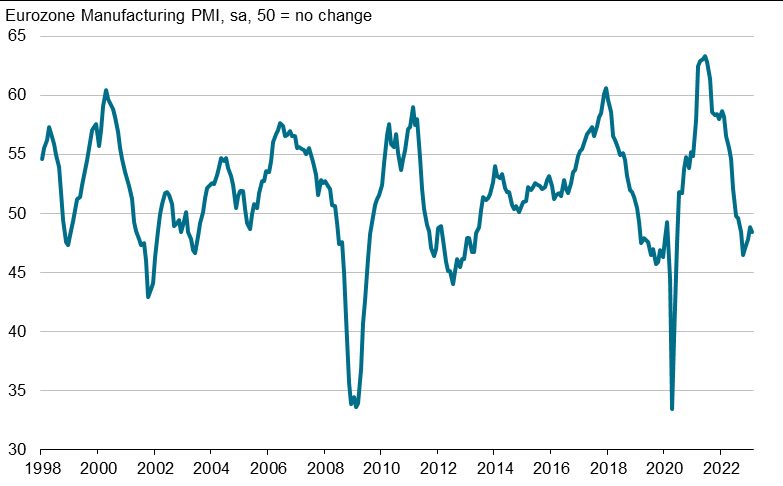
Eurozone PMI manufacturing finalized at 48.5, output at 50.1
Eurozone PMI Manufacturing was finalized at 48.5 in February, down from January's 48.8. Manufacturing output was finalized at 50.1, up from 48.9, a 9-month high.
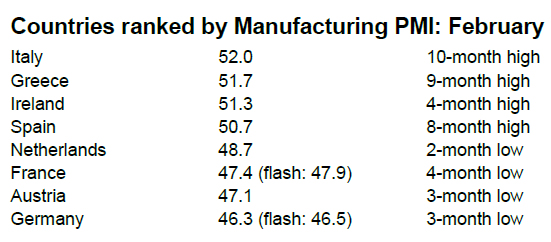
Looking a some member states, readings for Italy (52.0, 10-mont high), Greece (51.7, 9-month high), Ireland (51.3, 4-month high), and Spain (50.7, 8-month high) improved. The Netherlands (48.7, 2-month low), France (47.4, 4-month low), Austria (47.1, 3-month low), and Germany (46.3, 3-month low) deteriorated.
Chris Williamson, Chief Business Economist at S&P Global Market Intelligence said:
"A marginal expansion of output reported by Eurozone manufacturers in February is welcome news in representing the first increase since last May... Unfortunately, inflows of new orders continued to fall at a marked rate, reflecting persistent weak demand... In the meantime, the combination of improved supply and sustained weak demand – as well as lower energy prices – is helping bring inflationary pressures down sharply".
Challenging March for Bitcoin
Market picture
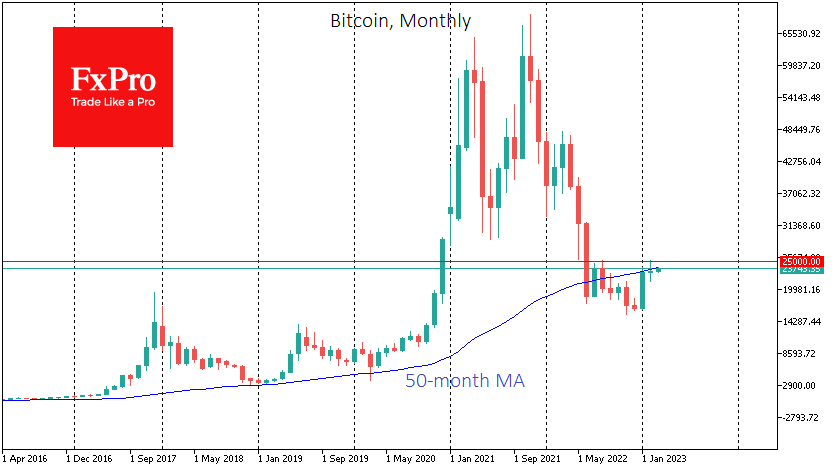
Bitcoin ended February slightly higher (+0.9%, to $23,200). March is off to a buying start, pushing the price up to $23.7K at the time of writing.
March is considered an unpromising month of the year for the top cryptocurrency, having fallen in eight of the last 12 years with an average decline of about 15%, an average gain of 16%.
The strong growth momentum in January and the renewal of local highs in February suggest that the bulls prevail. At the same time, the technical picture on the weekly timeframe suggests that only a consolidation above $25K will strengthen the bullish view of the market.
Bernstein noted that cryptocurrencies’ correlation with the US stock market and macroeconomic events is weakening amid BTC’s current flat move, which is a bullish signal.
News background
Ethereum developers have completed the Shanghai-Capella (Shapella) hard fork on the Sepolia test network. An update to the second cryptocurrency’s main network should occur as early as March. The main change after the update will be the ability to withdraw ETH from stakes.
Reuters reported that payment giants Visa and MasterCard had put plans for cryptocurrency integration on hold after a series of bankruptcies rocked the industry in 2022. The payment companies want to wait for market conditions and the regulatory environment to improve.
Coinbase, the largest US cryptocurrency exchange by trading volume, issued a notice of impending delisting of the Binance USD stablecoin. Investors began withdrawing funds from BUSD in early February after Paxos announced it would stop issuing the stablecoin under pressure from US authorities.
The Tel Aviv Stock Exchange is set to launch cryptocurrency trading. One of the largest local banks, Leumi Bank, has also agreed to start trading digital assets.
Successfully Transitioning
Equity markets in Asia are enjoying some decent gains overnight, with China and Hong Kong the obvious outperformers, while Europe is also enjoying a positive start on Wednesday.
Choppy trading conditions are still evident this week although the latest Chinese PMIs have provided some cause for more optimism. It was already believed that the transition from zero-Covid to living with it was going smoothly but this survey data suggests businesses are now extremely optimistic about the future.
That bodes well not just for China but regionally as well, as strong demand boost trade and a resurgence in tourism restores the battered industry. There's still a long way to go and there could be setbacks along the way but investors will no doubt be encouraged by these early signs.
Those with close economic links with China have seen their currencies perform well in the aftermath of the releases, while the yuan is also trading much stronger on the day. While the initial reopening data may be noisy, a strong rebound will be very welcome after a very challenging 2022.
PMIs a big positive for oil
It's not just equities that have been lifted by the PMIs, oil is also rallying today on the prospect of a stronger Chinese recovery and resilient global demand. While this was just one survey, the breakdown of the surveys was undoubtedly encouraging and that's lifting Brent and WTI in early trade.
All we need to see now are signs of cooling price pressures and perhaps less heat in the labour market in order for crude to potentially break higher. Higher interest rates forcing a hard landing remains the main downside risk for crude prices which has driven the consolidation we've seen in recent months, and recent data has only fed those fears.
But with China transitioning well and survey evidence indicating resilient demand, all we're missing is the removal of that downside growth risk. We may need to wait a little longer though as the data points traders will be most focused on for that are released over the next few weeks. A repeat of January could come as quite a shock.
Creeping higher
Gold is quietly heading for a third day of gains, boosted by a softer dollar today as other currencies react favourably to the Chinese survey data. The yellow metal fell almost 8% from its highs in February, coming close to key support around $1,780-$1,800. With momentum fading on approach, it would not come as a shock to see it pare those losses ahead of crucial US data over the coming weeks. Of course, it's reliant on yields not spiking again and some improvement in risk appetite wouldn't do it any harm either.
A timely boost
Not one to miss out on a bump in risk appetite, bitcoin is trading more than 2% higher this morning. It appears to have consolidated around late-February lows in recent days after failing to break key resistance - $24,500-$25,500 - in the middle of the month. That could be a sign of weakness, at least in the short-term, although ultimately it's hard to imagine that occurring if we do see risk appetite continue to improve.
Bearish EUR/NZD: Price Breaking Out of the Wedge
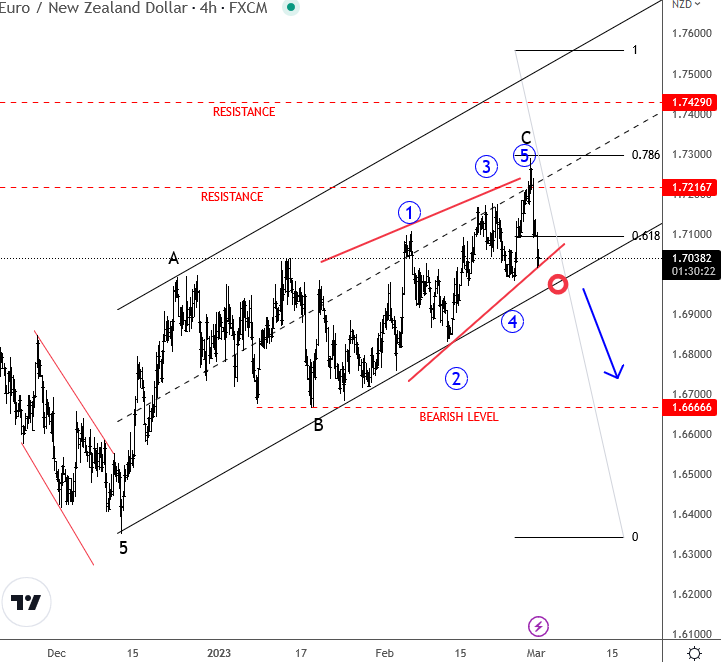
EURNZD is coming nicely down, a perfect reaction from the upper side of an ending diagonal pattern which suggests that wave C is done. In fact, a reaction lower is very strong and may not be over yet as normally wedges cause a reversal all the way back to starting point of that pattern. In our case that's near 1.6666. Intraday rally can be an opportunity to catch the weakness.
Euro Rebound Falters Despite Easing Recession Fears; Can it be Salvaged?
Things are looking up in the euro area with business activity ticking higher in the first two months of 2023, easing concerns about an imminent recession. Falling energy prices, improving supply chains and a relatively mild winter have all contributed to staving off a major economic downturn. However, the euro has been unable to break new ground in its uptrend and has been drifting lower since the beginning of February. Have the upside risks been already fully priced into the euro or is this just a waiting game until the March policy decisions when both the Federal Reserve and European Central Bank will update their policy outlooks.
Euro loses its shine
The euro rallied about 15% from its low point in September 2022 to its peak in February this year. The gains were driven mainly by the ECB taking an increasingly hawkish stance as well as speculation that the Fed is nearing the end of its tightening cycle. These expectations were supported by the comparative data on the two economies, as European indicators kept beating the forecasts, while the American economy displayed signs of a sharp slowdown towards the end of 2022.
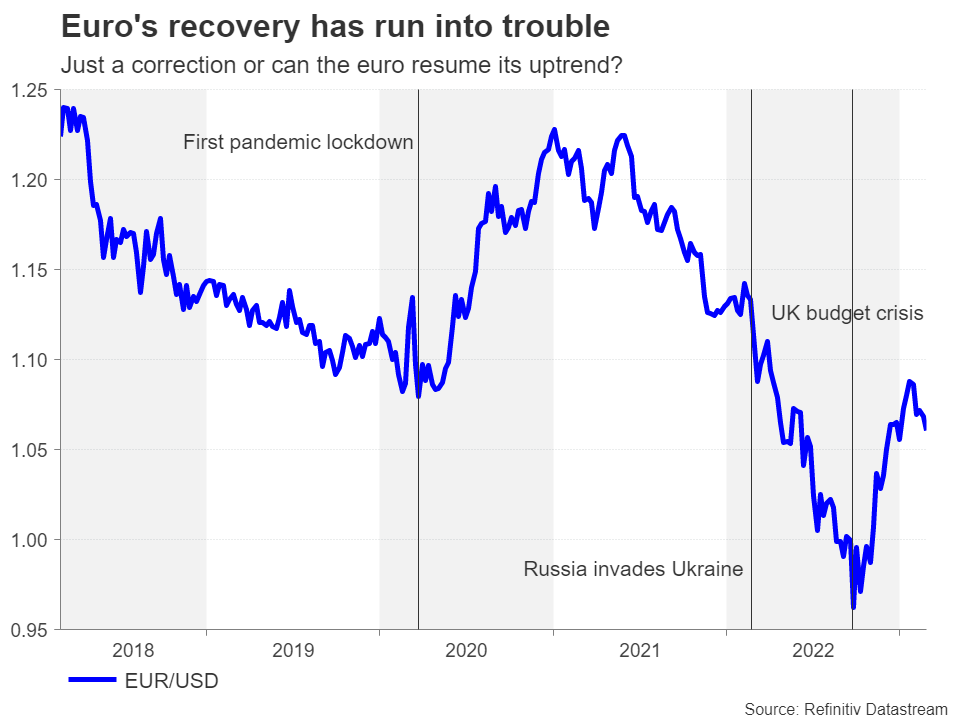
However, the tide seems to be shifting again as the US economy has not only regained some growth momentum, but also the rate of decline in inflation is moderating. Investors have had to price in at least two additional rate increases for this year since December as the Fed’s ‘higher for longer’ policy stance finally started to sink in. But expectations for the ECB’s terminal rate have risen too as the euro area outlook has brightened. Yet, even after the latest repricing, the euro has been unable to make much headway.
One way of looking at it is that the gap between the positive surprises in European data versus the US has narrowed and so the boost to the currency from this particular source has started to fade. At the same time, the spread between US and Eurozone yields has started to widen again, increasing the attractiveness of the US dollar over the euro.
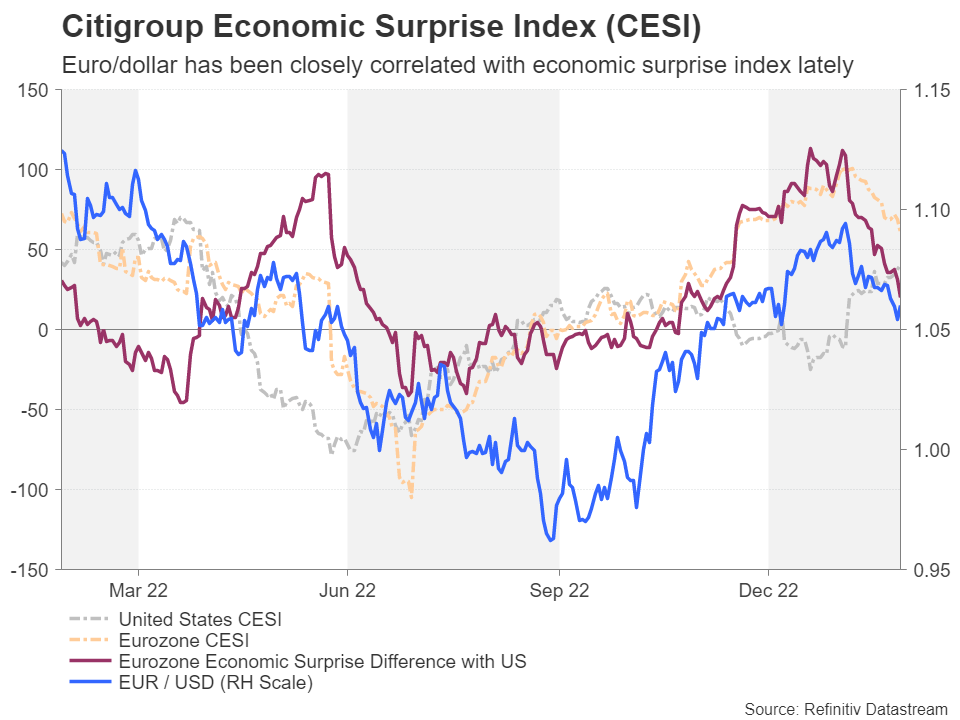
Battling it out in the economic league table
But what happens from hereon is not clear. Both economies have proved to be more resilient than anticipated against the backdrop of higher prices and rising borrowing costs and both the Fed and ECB have sent strong signals to investors that getting inflation down is their top priority. It could be argued therefore that euro/dollar’s performance will come down to which central bank pauses first and which economy emerges out of the tightening cycle in better shape.
So just how robust are the American and Eurozone economies? There can be no doubt that the US economy went into the energy crisis and broader inflation storm in a much stronger position as it made a swifter recovery from the pandemic. The labour market remains hot despite a cumulative 450 basis points of rate increases. Consumers have started spending again after tightening their purse strings towards the end of last year. Even the manufacturing sector is showing some signs of a rebound.
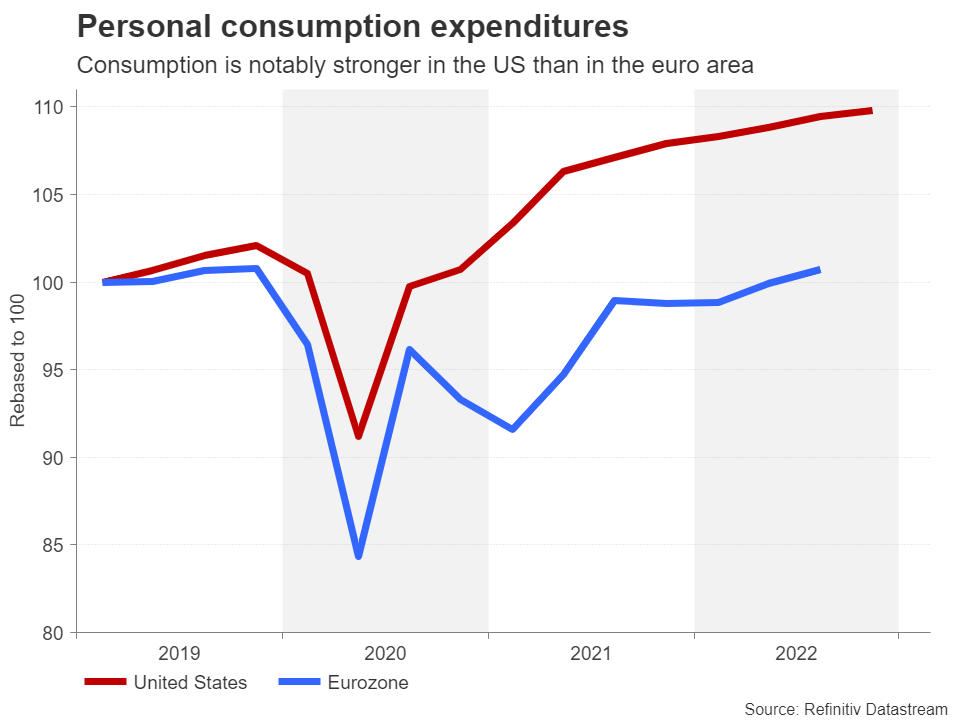
In comparison, consumption in the euro area has been notably weaker ever since higher energy bills began to bite. Businesses also took a more direct hit from the fallout of the war in Ukraine than their US counterparts. But confidence among both consumers and businesses is returning now that fuel costs have come down from sky-high levels. Moreover, European manufacturers are likely to benefit more from China’s reopening than US exporters.
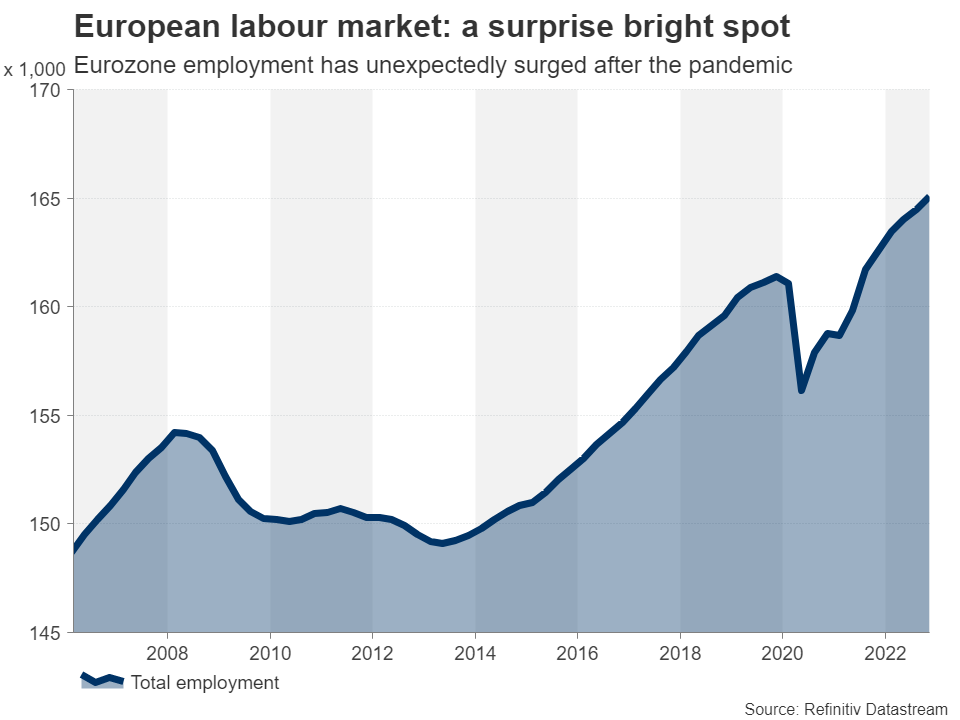
One less obvious positive about the Eurozone has been the labour market. Although it’s not anywhere near as tight as it is in America, the European jobs market has been booming since the post-pandemic recovery began, and combined with generally higher savings rate than across the Atlantic, this bodes well for future consumption.
The inflation fight is far from over
But what about inflation? In America, the consumer price index peaked lower and was falling faster until January when it appeared to stall. More worryingly, underlying inflation as measured by the core PCE price index crept up to 4.7%. This is still lower than the core metric in the euro area that strips out food, energy, alcohol and tobacco prices, which climbed to 5.3% in January.
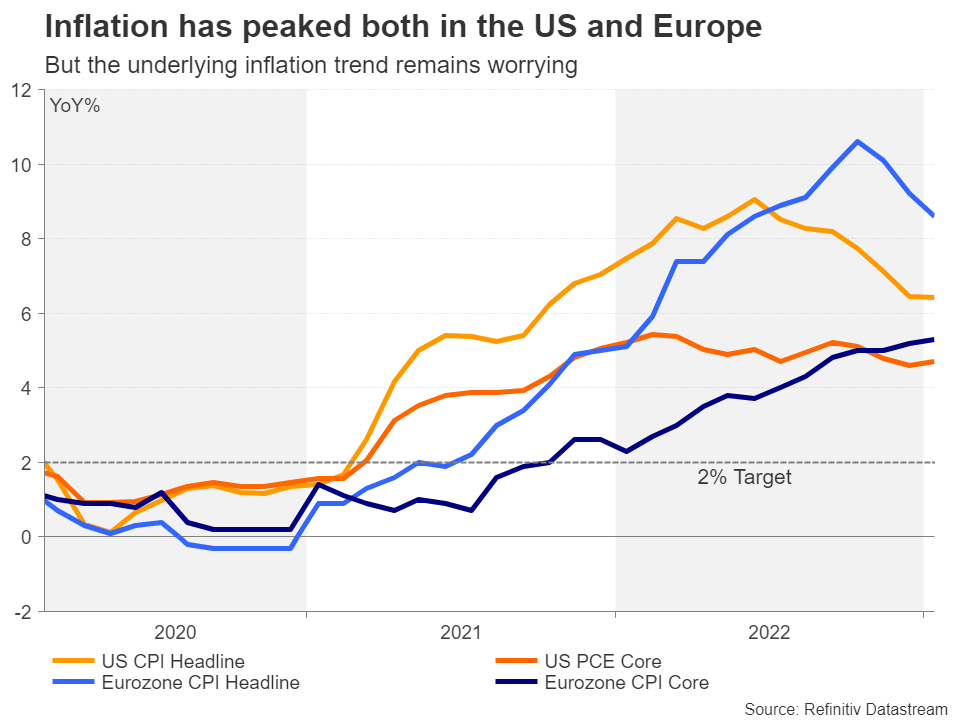
Based on the inflation data alone, the ECB has more work to do than the Fed. It’s hard to tell how much of the difference in inflation rates is to do with the Fed having been a lot more aggressive in 2022 and how much of it is because of the Eurozone’s greater exposure to the energy crisis, but the ECB’s more cautious approach to rate increases has left it further behind the curve than the Fed.
Markets are currently pricing in at least another 150-bps worth of rate hikes in the euro area versus another 75 bps in the US. For euro/dollar, however, this may not be much of a game changer. Even though it is very likely that rates in the US will peak higher than in the Eurozone and the latter’s lower tolerance threshold for elevated rates puts the euro at a major disadvantage, what may matter more in 2023 is not so much the end point but who makes the first dovish pivot.
Will the Fed pause before the ECB?
And on that, expectations that the Fed will call time on rate hikes before the ECB does haven’t changed. This provides the euro decent with odds to resume its uptrend at some stage over the coming weeks, potentially as early as the March policy meetings. The ECB meets on March 16 and the Fed on March 22.
As long as the Fed doesn’t sound the alarm bells over inflation taking longer than anticipated to drop back to 2% and the median projection of the terminal rate in the dot plot is revised higher by only 25 bps, this could work in the euro’s favour, especially if the ECB on its part keeps the door open to another 50-bps hike after March.
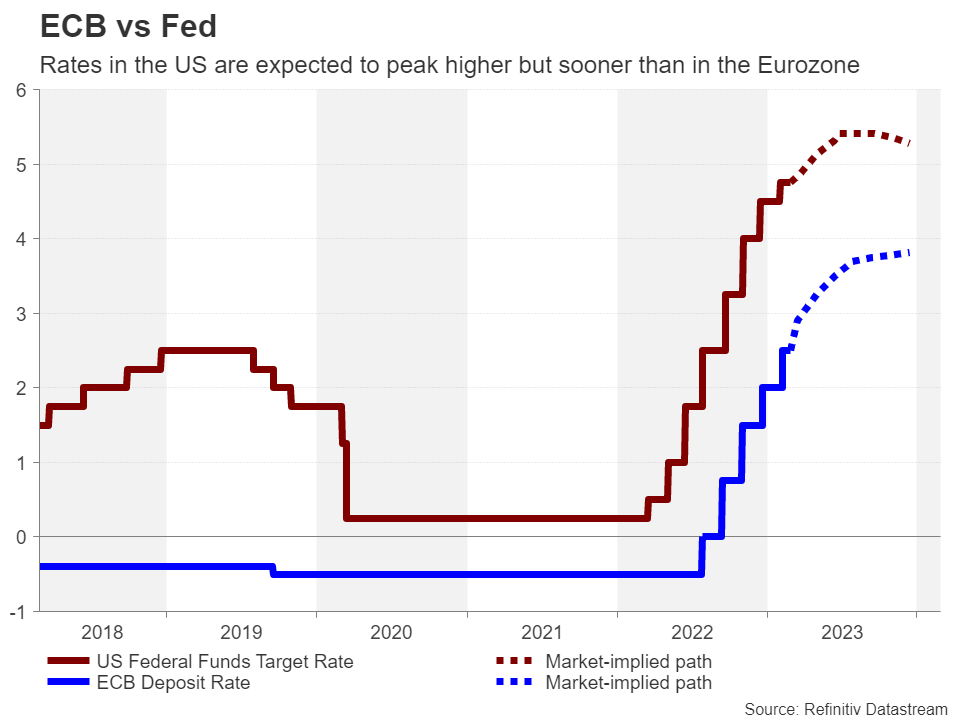
There is some risk that FOMC members might pencil in a much-higher-than-expected terminal rate to save face from having downshifted to 25 bps too soon. But perhaps the bigger danger is that the March decisions fail to offer significant clarity on how much further tightening is left to go, potentially leaving euro/dollar paralyzed at least until the summer.
The clouds have yet to fully clear over the outlook
By that point, policymakers will probably have a better idea on the amount of additional work needed to tame inflation and whether the major economies have indeed managed to dodge a recession or not. In the scenario that inflation turns out to be a lot stickier than is currently predicted, the dollar is likely to be the winner as the Fed would respond more forcefully than the ECB to persistent price pressures. In addition, the greenback’s safe haven attributes would attract increased flows from heightened uncertainty about an impending downturn.
However, if this setback with inflation’s climbdown slowing down proves to be temporary, there isn’t another wave of rate hike bets being pushed up by investors and policymakers are confident about a soft landing, the euro would be well placed to revisit the $1.10 handle, if not the $1.12 level. The dollar tends to depreciate at times of global risk appetite so even if both the US and Eurozone economies avoid a hard landing, the euro could still notch up fresh gains.
USDJPY Fights With 38.2% Fibo and 200-day SMA
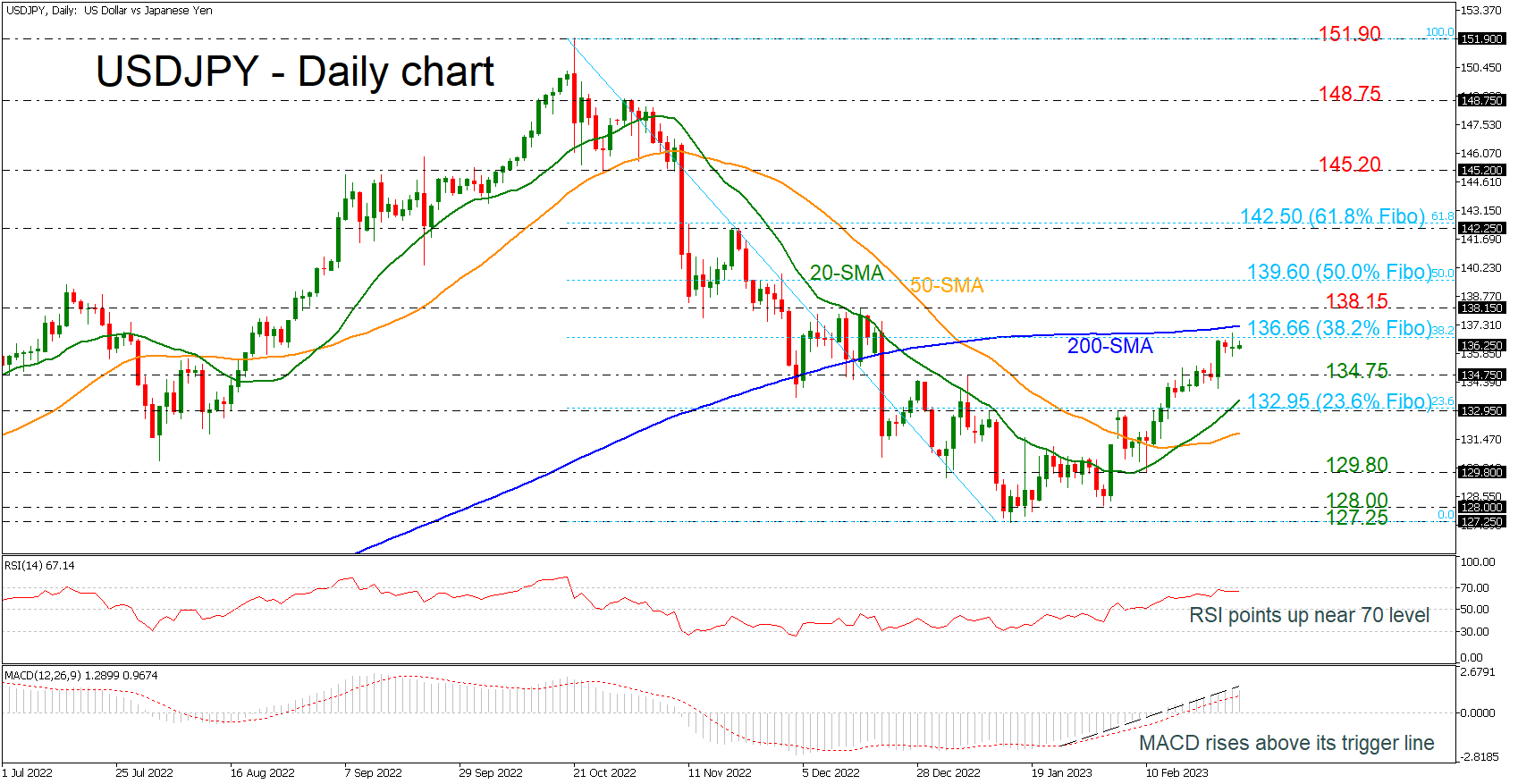
USDJPY is struggling to surpass the 38.2% Fibonacci retracement level of the downward wave from 151.90 to 127.25 at 136.66, where also the 200-day simple moving average (SMA) lies. Any movements above these obstacles could open the door for more positive actions.
Technically, the MACD oscillator is strengthening its momentum above its trigger and zero lines, while the RSI is flattening near the overbought region, suggesting that the market may be overstretched. In trend indicators, the 20- and the 50-day SMAs posted a bullish crossover in the preceding sessions.
If the price overcomes the aforementioned key levels, it may reach the 138.15 resistance and the 50.0% Fibonacci at 139.60. Any moves higher could shift the short-term outlook to a more bullish one, testing the 61.8% Fibonacci at 142.50.
Alternatively, the bears may take the market until the 134.75 immediate support before resting near the 23.6% Fibonacci at 132.95 and the 20-day SMA. Slightly lower, the 50-day SMA at 131.80 may be a turning point for traders. However, more losses could switch the outlook back to bearish, hitting the 129.80 support.
To sum up, USDJPY is looking bullish in the near term and any attempts above the 200-day SMA could endorse this view.
FTSE 100 Struggles to Bounce
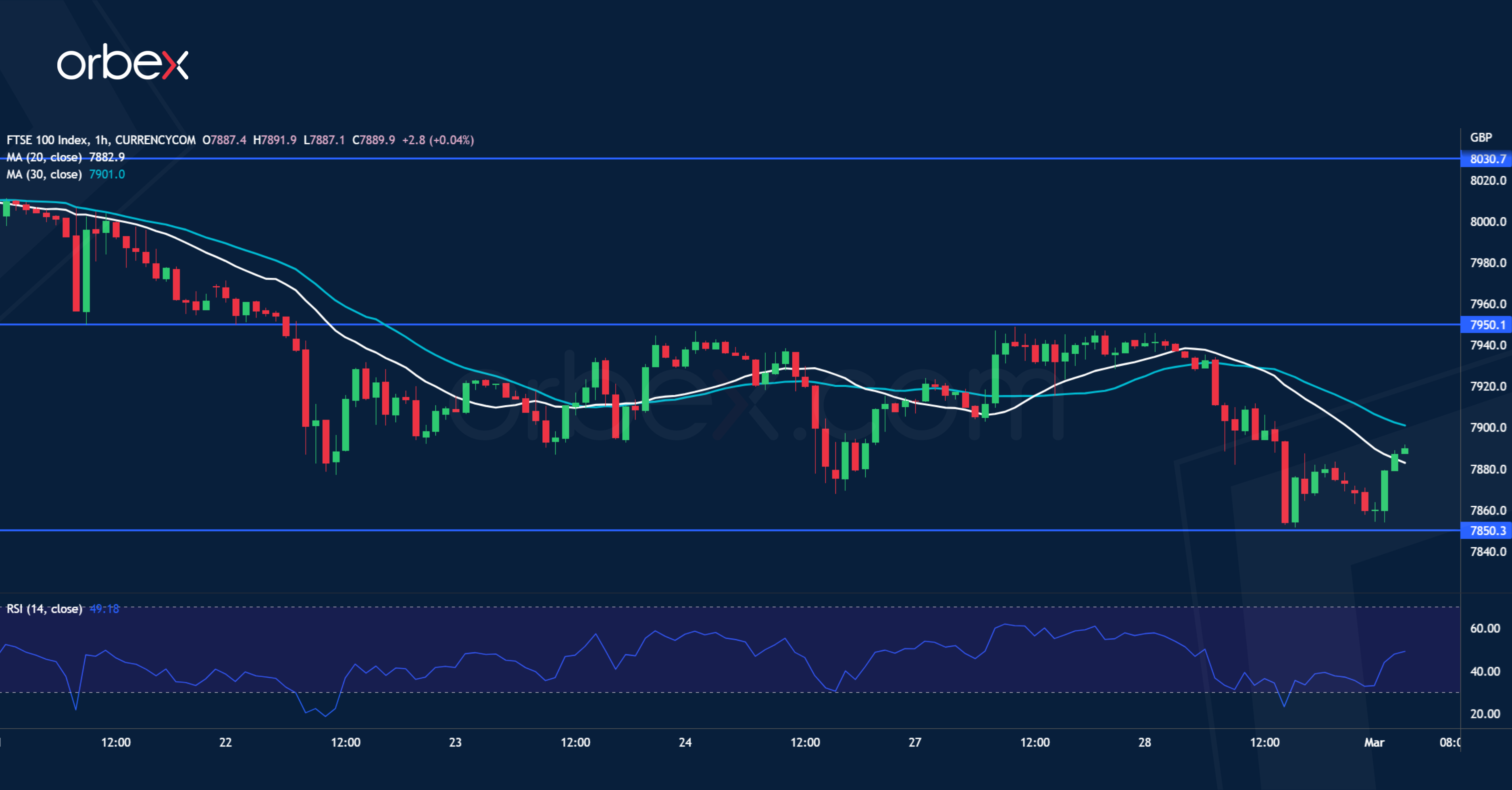
The FTSE 100 tumbles as record high grocery inflation in the UK fans fears of higher interest rates. The index failed to hold on to the 30-day SMA (7870) after hitting resistance at 7950. A correction could be taking shape following a stellar rise since the beginning of the year. The RSI’s oversold condition has brought in some bids but that may not be enough to stage a meaningful recovery in the short-term. Instead, a fall below 7850 may prompt more buyers to bail out, triggering a liquidation towards the daily support at 7710.