Sample Category Title
Australia retail sales rose 1.9% mom in Jan, flat on average over the past few months
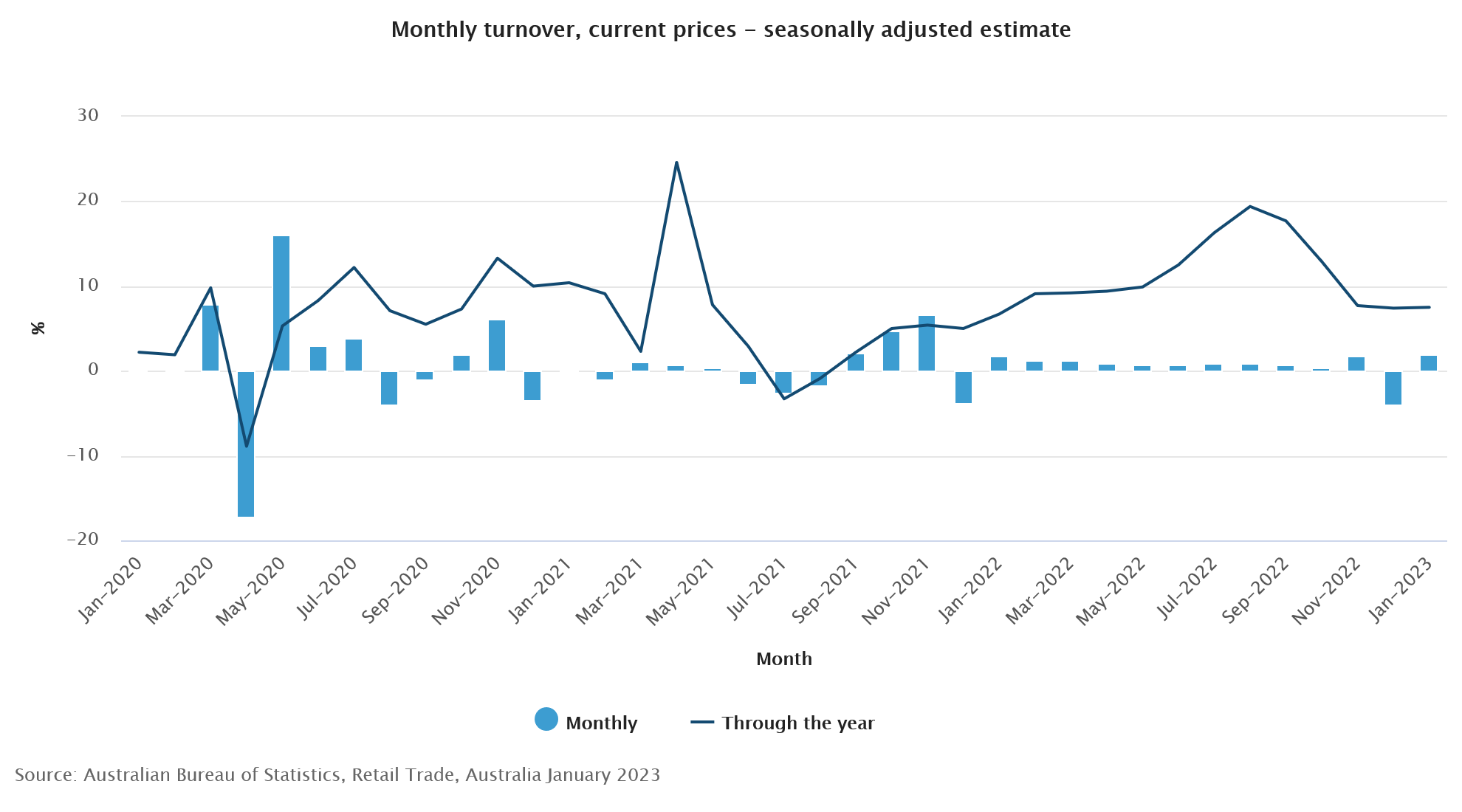
Australia retail sales turnover rose 1.9% mom to AUD 35.09B in January, above expectation of 1.6% mom. Compared with January 2022, sales turnover was up 7.5% yoy.
Ben Dorber, ABS head of retail statistics, said: "The rebound in retail turnover in January followed a substantial fall of 4.0 per cent in December and a large rise of 1.7 per cent in November.
"Looking through this volatility shows that turnover is at a similar level to September 2022, and on average, growth has been flat over the past few months."
NZ ANZ business confidence rose to -43.3, firms wary but getting on with the job
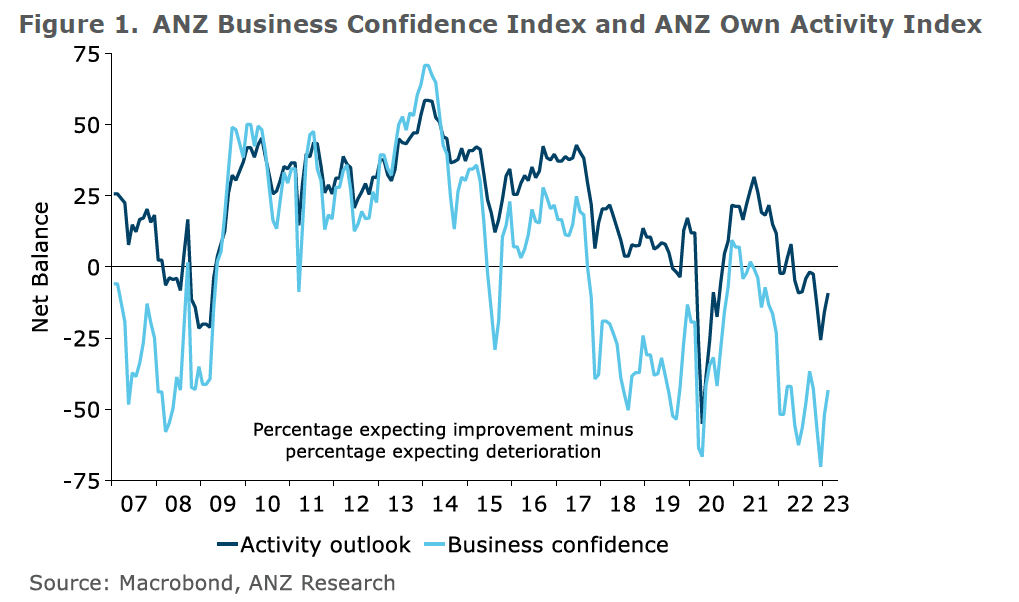
New Zealand ANZ Business Confidence improved form -52.0 to -43.3 in February. Own Activity Outlook rose from -15.8 to -9.2.
Looking at some details, export intentions ticked up from -5.4 to -5.2. Investment intentions rose from -13.7 to -4.9. Employment intentions jumped from -11.1 to -3.4. Pricing intentions dropped from 62.4 to 58.8. Cost expectations dropped from 91.3 to 88.3. Inflation expectations ticked down from 5.99 to 5.94.
ANZ said: "The shock value of the November Monetary Policy Statement appears to have faded into the rear-vision mirror as firms focus on the risks and opportunities that are front and centre.... Opportunity is clearly still knocking. That said, the level of most indicators remain subdued – firms are still very wary, and understandably so. But they are getting on with the job."
Japan industrial production down -4.6% mom in Jan, expected to rebound in Feb
Japan industrial production declined -4.6% mom in January, much worse than expectation of -2.6% mom.
Upon the release of the data, the METI downgraded its assessment of industrial production, saying that it has weakened. Never the less, the ministry forecast industrial production to bounce back by 8.0% in February, and then a further 0.7% in March.
Retail sales rose 6.3% yoy, above expectation of 4.0% yoy.
BoJ Uchida: Shouldn’t modify easy policy just because there are side-effects
Incoming BoJ Deputy Governor Shinichi Uchida told an upper house confirmation hearing, "BOJ must maintain monetary easing. It shouldn't modify easy policy just because there are side-effects. Rather, it must come up with ideas" to mitigate the costs and help sustain stimulus.
He also noted it's premature to discuss an exit from the ultra-loose monetary policy. Any exit would involve adjustments in the interest targets and the balance sheet. "In what order and at what timing the BOJ will make these adjustments will depend on economic and financial developments at the time," Uchida said.
BoJ Wakatabe: Dangers of secular stagnation and Japanification not yet passed
BoJ Deputy Governor Masazumi Wakatabe said, "the mild-inflation regime has not come to an end, and we should say that the potential dangers of secular stagnation and Japanification have not yet passed."
"When an exogenous shock occurs, there is an adjustment from the old to a new price system. After adjustment, the rising inflation rate is likely to return to the steady-state inflation rate," he said.
"So the important point is how this rate is affected. Of course, it is possible that cost-push factors will remain, but whether they will push up the steady-state inflation rate is uncertain," Wakatabe said, adding that it was "well known that cost-push inflation does not last long."
ECB Vujcic: We should persevere if core inflation persists
ECB Governing Council member Boris Vujcic told Bloomberg TV yesterday, "as long as core (inflation) persists at the levels we're talking about and this is significantly higher than our rates are and significantly higher than where are target is, we should persevere."
The markets have been raising their bets on higher interest rates and are betting tightening extending into 2024. Vujcic said, "I think this repricing in a way is what we did during our last projections, where we projected basically higher inflation for longer, core inflation which turns out to be stickier than most people probably expected."
"Probably markets are now repricing and saying 'OK, we might see higher rates for maybe longer,'" he said.
GBP/USD Could Recover If Bulls Clear This Hurdle
Key Highlights
- GBP/USD retested the key 1.1920 support zone.
- A major bearish trend line is forming with resistance near 1.2060 on the 4-hours chart.
- EUR/USD is attempting a recovery wave above the 1.0600 resistance zone.
- Gold price is struggling to stay above the $1,800 support.
GBP/USD Technical Analysis
The British Pound started a fresh decline from well above 1.2100 against the US Dollar. GBP/USD traded below the 1.2000 support to enter a bearish zone.
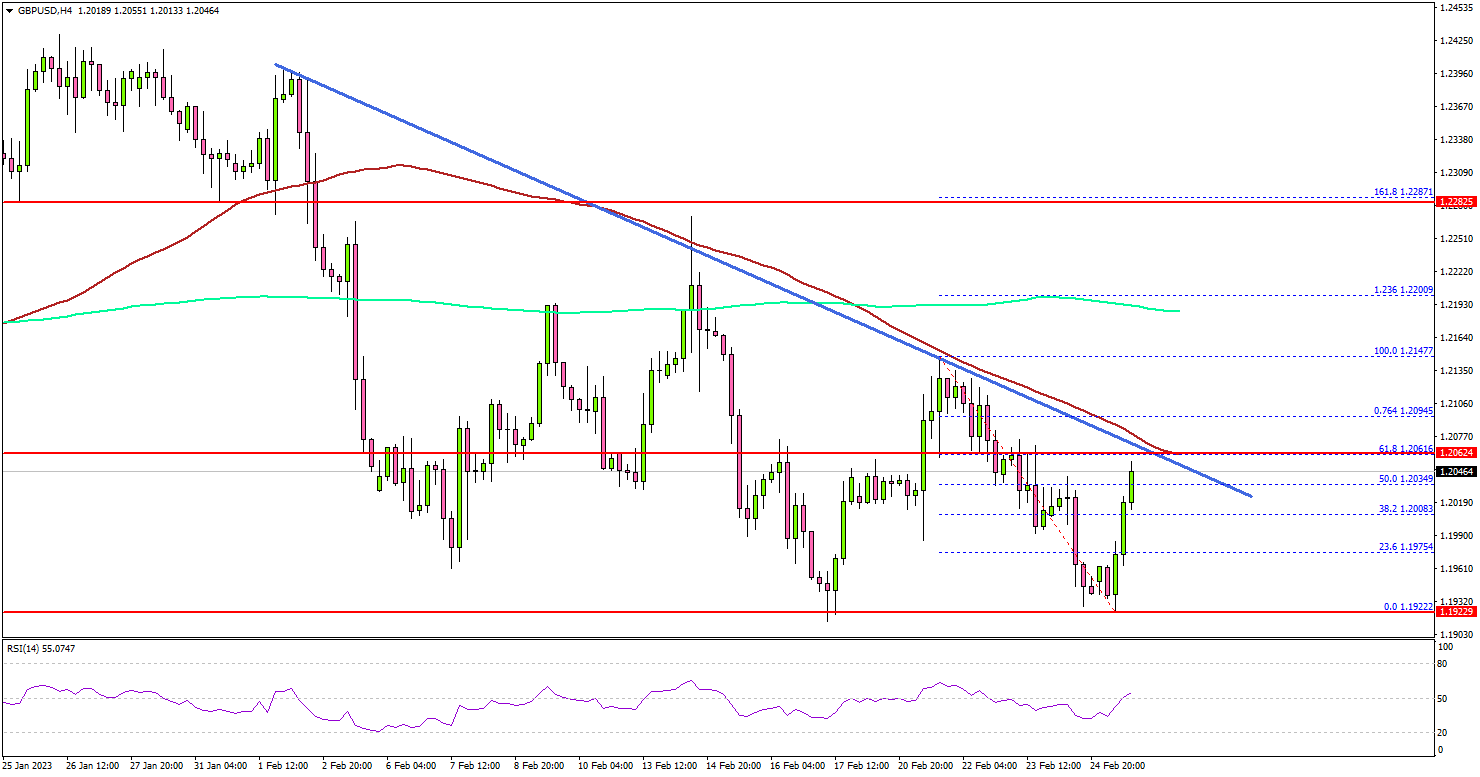
Looking at the 4-hours chart, the pair settled below the 1.2050 support level, the 100 simple moving average (red, 4-hours), and the 200 simple moving average (green, 4-hours).
Finally, it retested the key 1.1920 support zone. A low was formed near 1.1922 and the pair recently started an upside correction. There was a wave above the 1.1950 and 1.2000 resistance levels.
GBP/USD spiked above the 50% Fib retracement level of the downward move from the 1.2147 swing high to 1.1922 low. On the upside, an immediate resistance is near the 1.2060 level.
There is also a major bearish trend line forming with resistance near 1.2060 on the same chart. The next major resistance is near the 1.2100 level. A clear move above the 1.2100 resistance might start a steady increase.
The next target could be near the 1.2200 level and the 200 simple moving average (green, 4-hours). Any more gains could open the doors for a move towards the 1.2280 level.
On the downside, an immediate support is near the 1.1950 level. The next major support is near the 1.1920 level, below which there is a risk of a move towards the 1.1850. Any more losses could open the doors for a drop towards 1.1720.
Looking at EUR/USD, the pair tested the 1.0535 zone and recently corrected higher. It is now facing hurdles near the 1.0640 and 1.0650 levels.
Economic Releases
- US Housing Price Index for Dec 2023 (MoM) - Forecast -0.6%, versus -0.1% previous.
- Canadian Gross Domestic Product for Q4 2022 – Forecast -0.2%, versus +0.7% previous.
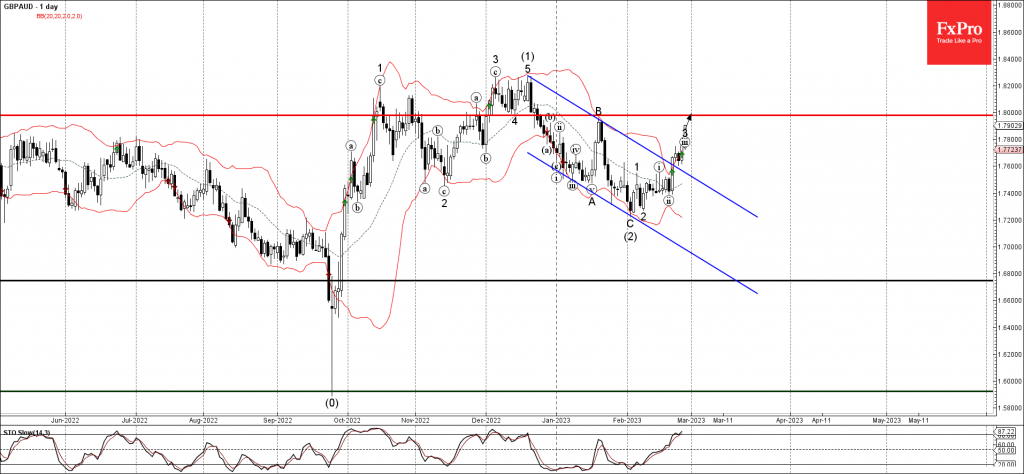
GBPAUD Wave Analysis
- GBPAUD broke daily down channel
- Likely to rise to resistance level 1.8000
GBPAUD previously broke the resistance trendline of the daily down channel from December (which enclosed the previous ABC correction (2)).
The breakout of this daily down channel accelerated the active impulse wave 3 of the intermediate impulse wave (3) from the start of February.
GBPAUD can be expected to rise further toward the next round resistance level 1.8000 (top of the B wave from last month).
GBPUSD Wave Analysis
- GBPUSD reversed from key support level 1.1915
- Likely to rise to resistance level 1.2200
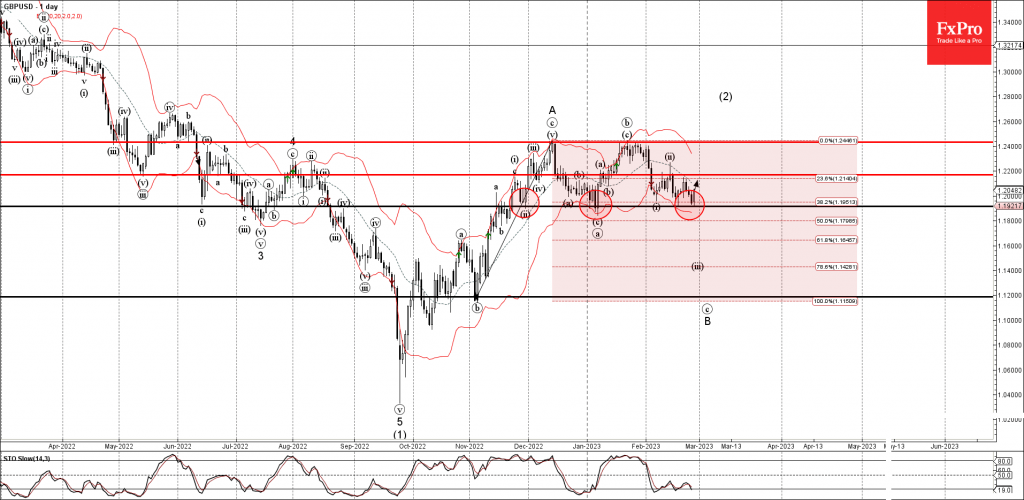
GBPUSD recently reversed up from the key support level 1.1915 (which has been reversing the pair from the end of November) intersecting with the lower daily Bollinger Band and the 38.2% Fibonacci correction of the previous upward impulse from November .
The upward reversal from the support level 1.1915 is likely to form the daily candlesticks reversal pattern Bullish Engulfing.
GBPUSD can be expected to rise further toward the next resistance level 1.2200 (which stopped the pervious wave (ii)).