

Sample Category Title
EUR/AUD Daily Outlook
Daily Pivots: (S1) 1.5582; (P) 1.5639; (R1) 1.5736; More...
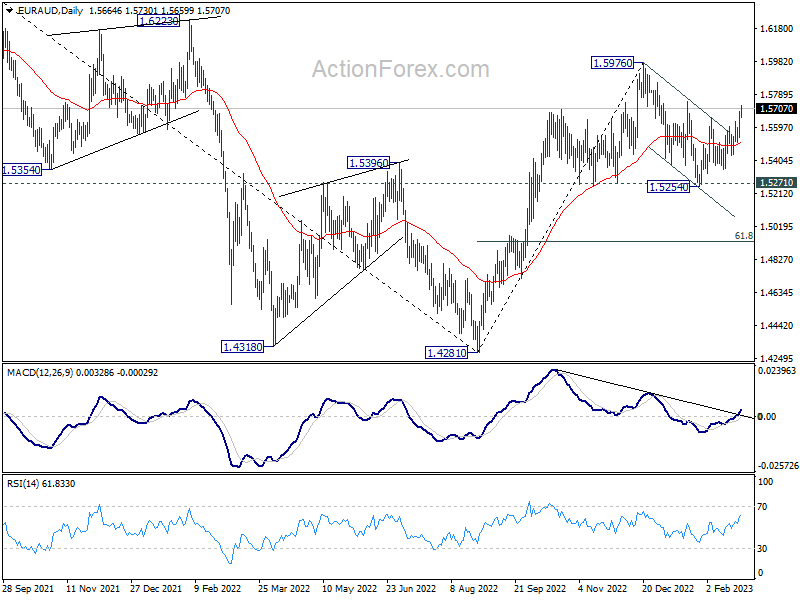
EUR/AUD's rally continues today and intraday bias remains on the upside for 1.5749 resistance. As noted before, corrective fall from 1.5976 has completed at 1.5254. Decisive break of 1.5749 should pave the way to retest 1.5976 high. On the downside, below 1.5605 minor support will turn intraday bias neutral first.
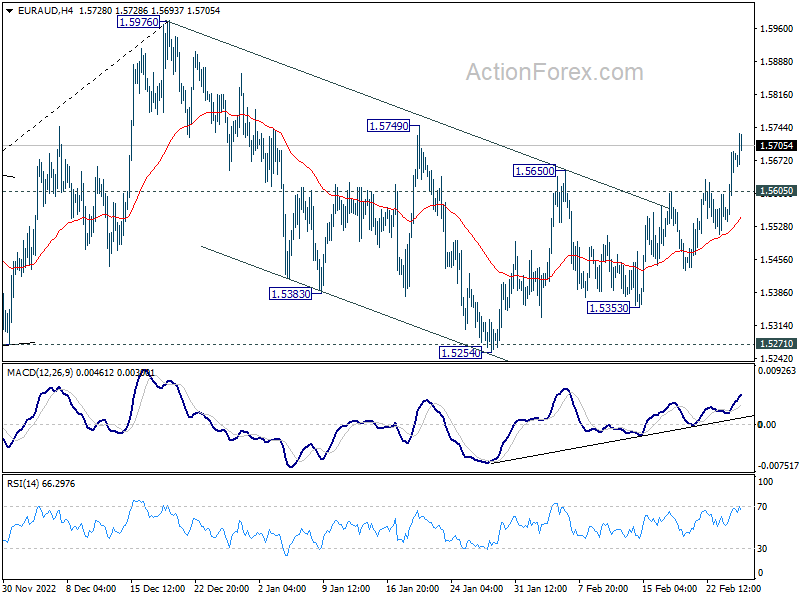
In the bigger picture, it's still early to confirm if rise from 1.4281 represents bullish trend reversal. But as long as 1.5271 support holds, such rally is in favor to continue. Break of 1.5976 will target 1.6434 key resistance next. On the other hand, firm break of 1.5271 will retain medium term bearishness instead.
EUR/CHF Daily Outlook
Daily Pivots: (S1) 0.9898; (P) 0.9912; (R1) 0.9938; More....
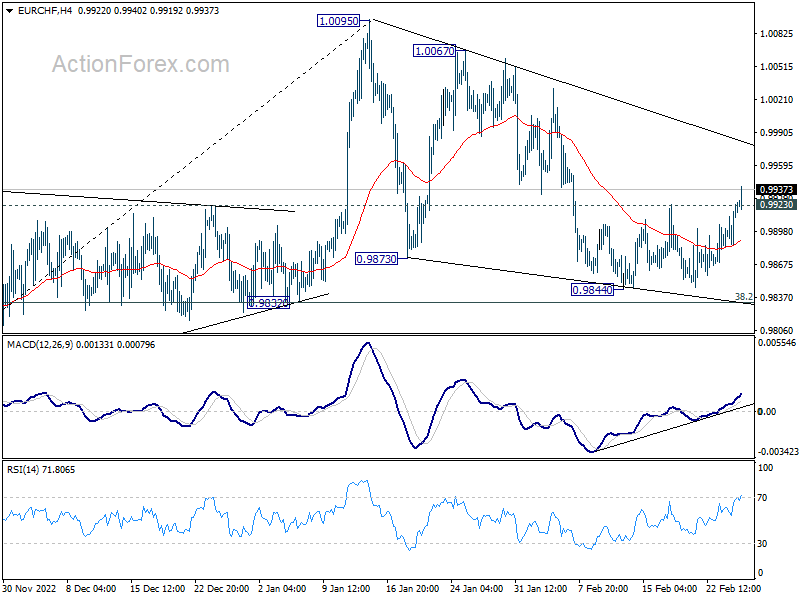
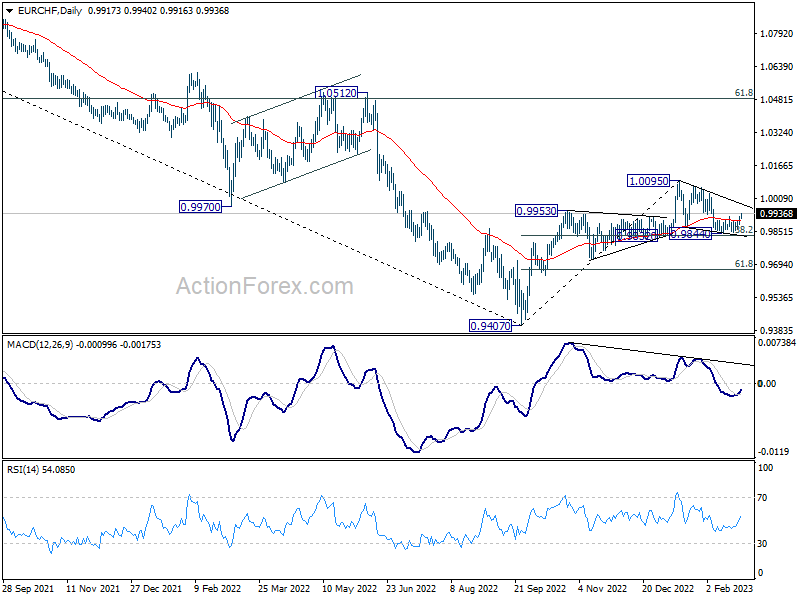
EUR/CHF's break of 0.9923 resistance suggests that whole corrective pattern from 1.0095 has completed with three waves down to 0.9844. Intraday bias is back on the upside for trend line resistance (now at 0.9981). Sustained break there will add to this bullish cas and bring retest of 1.0095 high. For now, risk will stay on the upside as long as 0.9844 support holds, in case of retreat.
In the bigger picture, with 0.9832 support intact, rise from 0.9407 (2022 low) is still expected to continue. Break of 1.0095 and sustained trading above 55 week EMA (now at 1.0021) will be a medium term bullish signal, and bring further rally to 1.0505 cluster resistance (2020 low at 1.0505, 61.8% retracement of 1.1149 to 0.9407 at 1.1484). However, firm break of 0.9832 support will revive medium term bearishness and bring retest of 0.9407 low instead.
ECB Lagarde: After March, we will see. We are data dependent
ECB President Christine Lagarde said in an interview, "Interest rates are the most efficient tool in the present circumstances. There is every reason to believe that we will do another 50 basis points in March. After that, we will see. We are data dependent."
"We will do more hikes if necessary to return inflation to our target of 2% in a timely manner. It will take what it will take," She added.
"I don't have a timeline. I have an objective, which is our target. We need to raise interest rates to a level that is sufficiently restrictive to return inflation to 2%, and to keep rates there for as long as necessary to be confident that inflation returns to 2% in a timely manner. That's the mantra." She said.
"Hiking rates inevitably dampens demand. And what we're trying to do is to adjust demand. That's the mechanical impact that we expect from what we are doing."
Dow Jones 30 Tests Critical Support
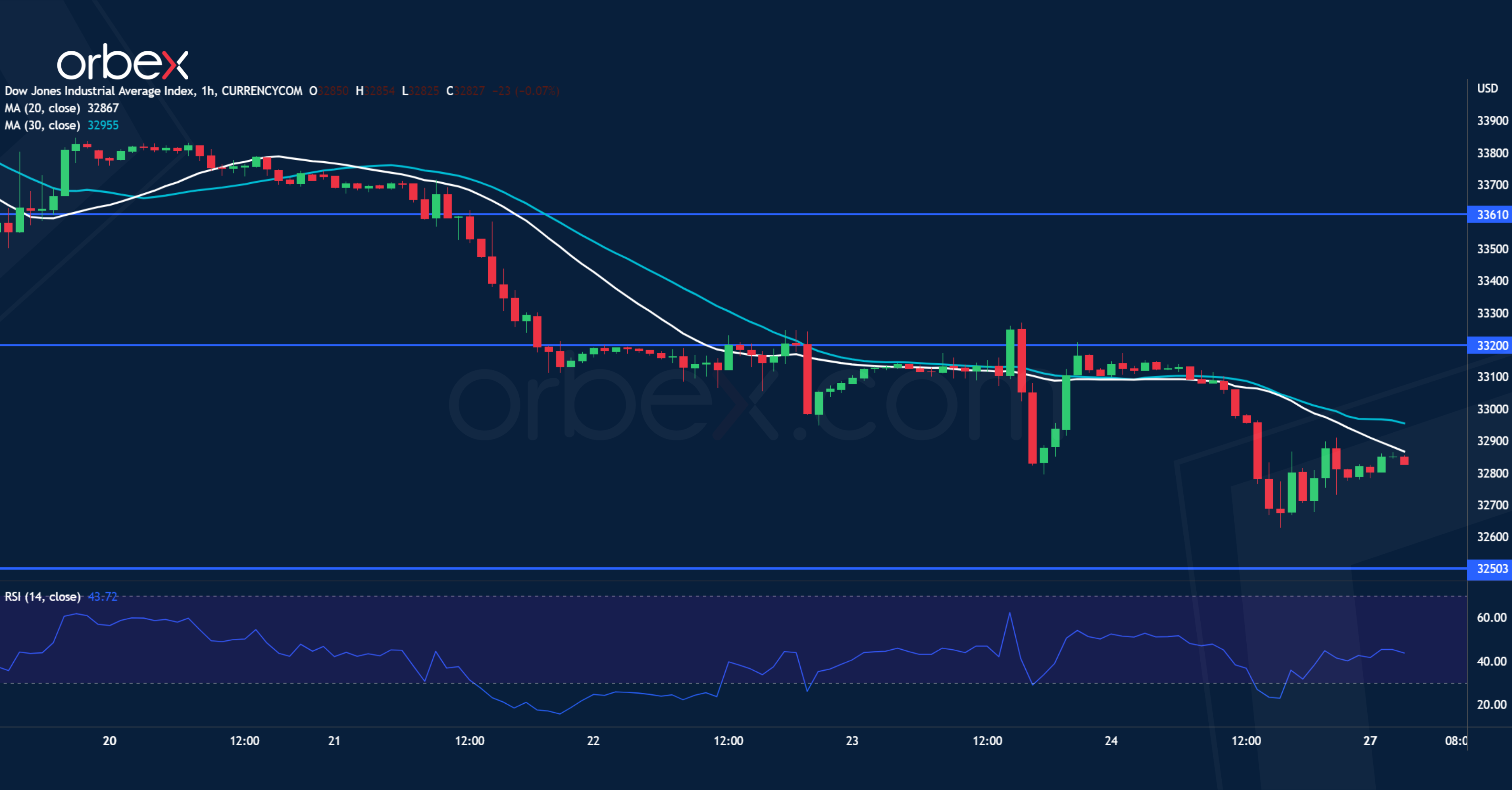
The Dow Jones 30 slips as strong economic data may allow the Fed to stick to its high rate policy. On the daily chart, the index is struggling to hold on to its gains from the past three months. A break below 33000 would cause a retest of the lower band of the current consolidation and December’s low of 32500. A break below this major floor would force more investors to unwind their positions, triggering a broader sell-off. 33200 is the immediate resistance should buyers start to make their way back.
EUR/JPY Bounces Back
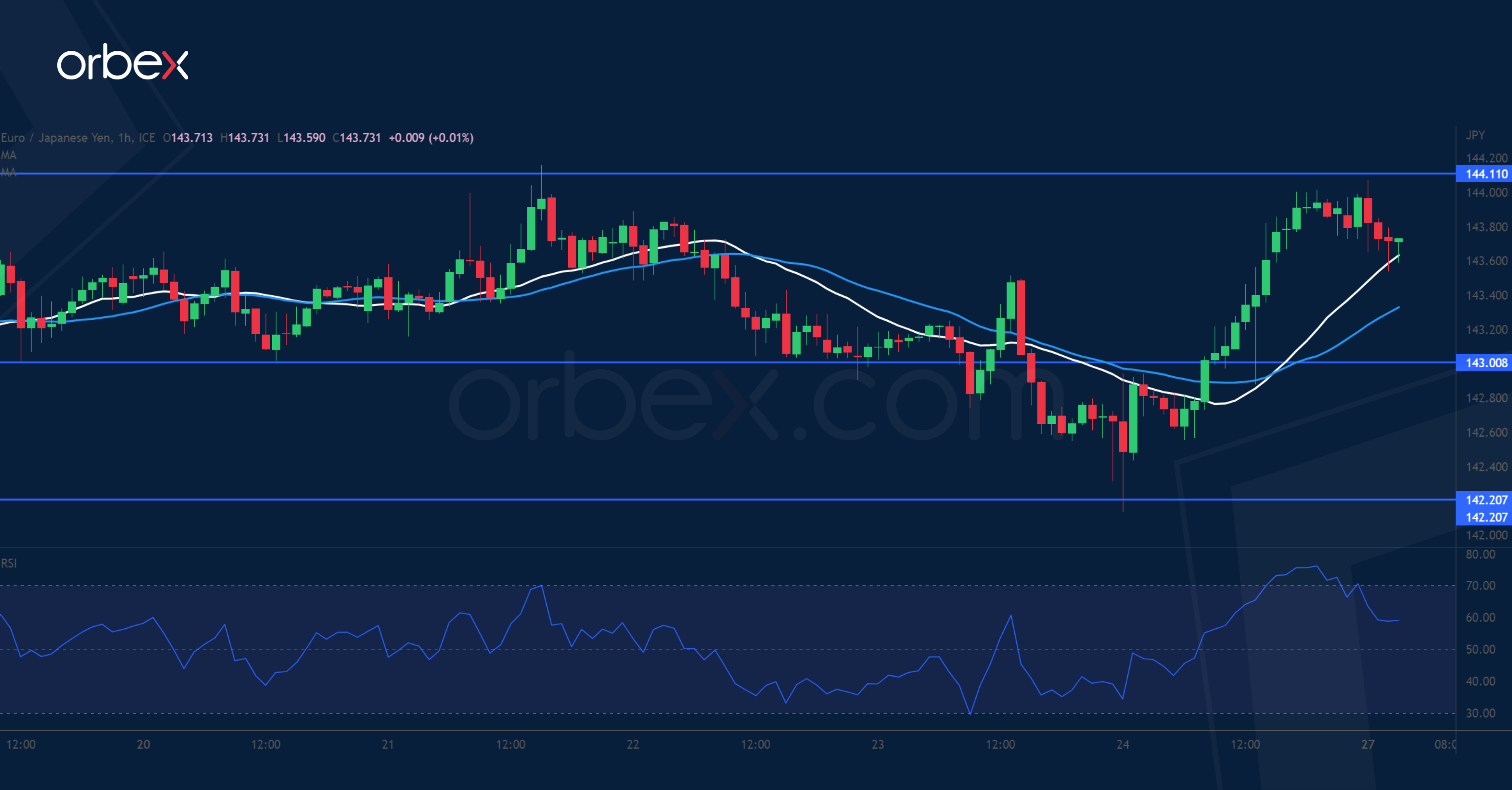
The Japanese yen fell after the BoJ governor nominee Kazuo Ueda said he may keep policy ultra-loose. The pair has previously met stiff selling pressure at 144.10 near the origin of the sharp December liquidation. But that did not deter the bulls as bids emerged on the 20-day SMA (142.20) which coincides with the base of a breakout rally in mid-February. This suggests that overall sentiment is still upbeat in the medium-term. 143.00 is a fresh support and a close above 144.10 would trigger a runaway rally towards 145.80.
GBP/USD Breaks Lower
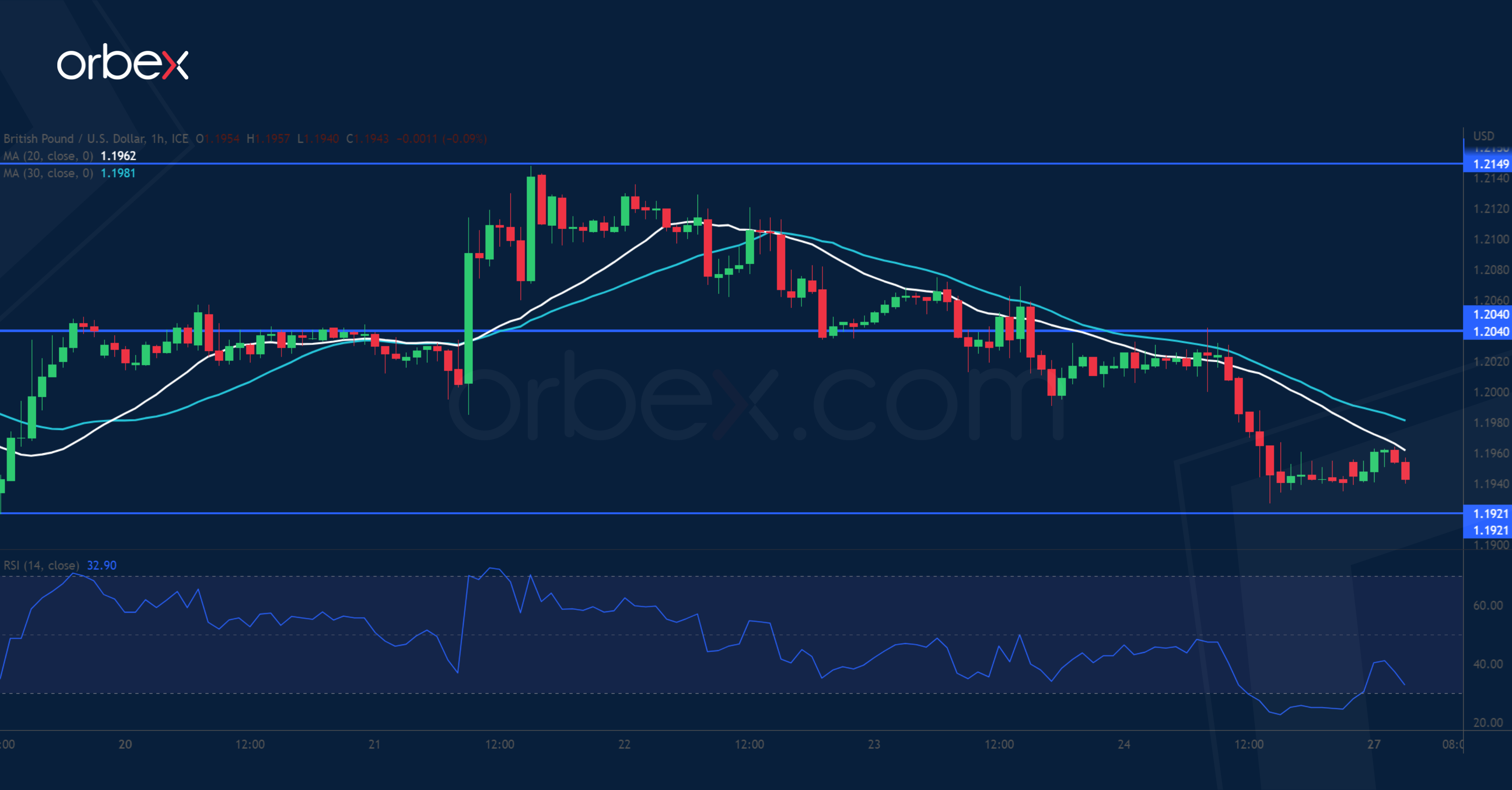
The US dollar climbed after the PCE accelerated in January. On the daily chart, the pair is still probing bids near January’s low of 1.1850. The latest bounce came to a halt in the supply zone 1.2150 from the sell-off in mid-February. Then a drop below the psychological level of 1.2000 at the base of a former bullish engulfing candle shows that the path of least resistance remains down. The recent swing low of 1.1920 is the next support and its breach would expose the critical floor at 1.1850. 1.2040 is the closest resistance.
Gold Tests Cloud Bottom as It Slumps to 2-Month Low
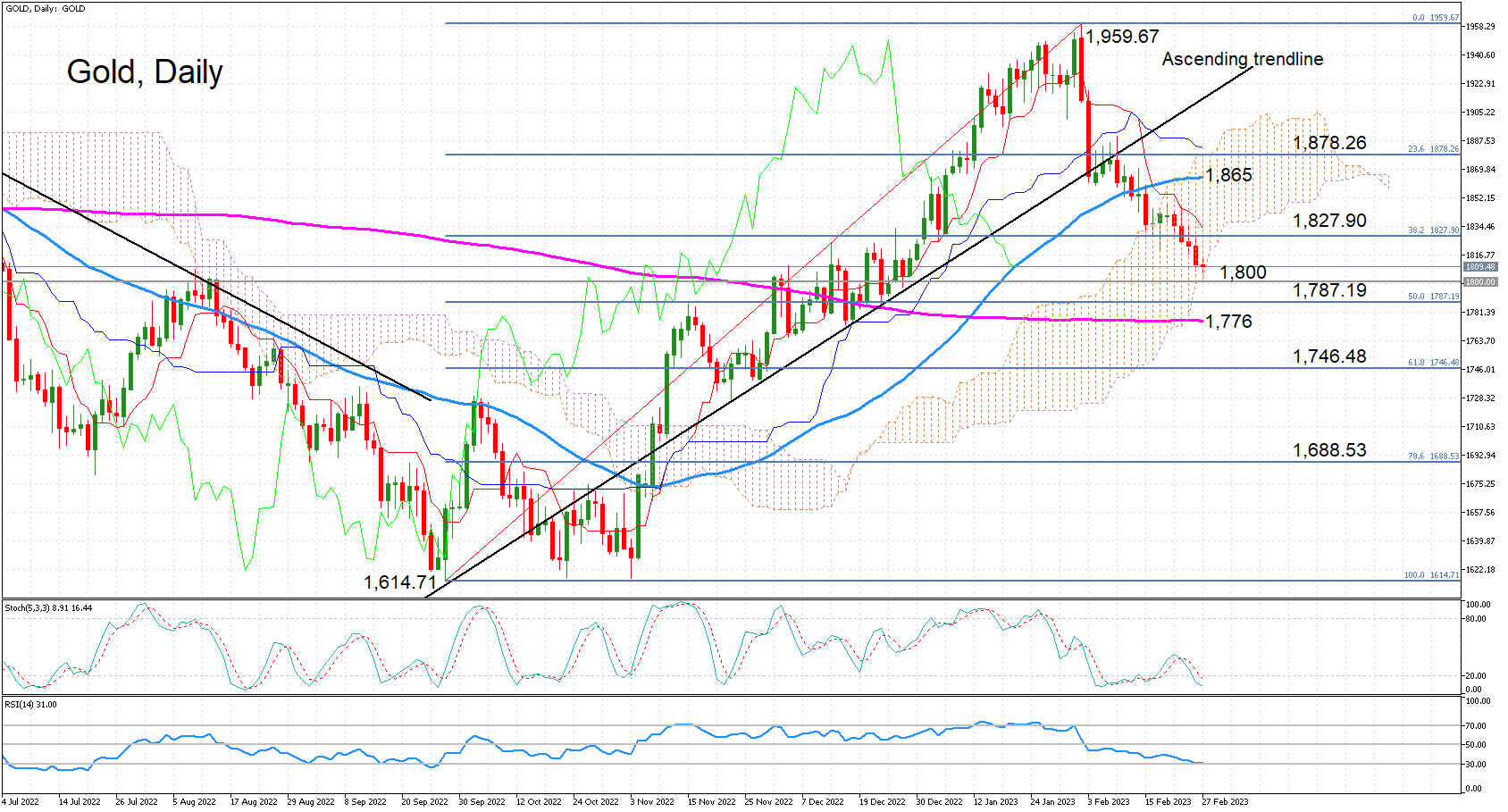
Gold is extending its decline on Monday, brushing a two-month low of 1,806.45 and testing the bottom of the Ichimoku cloud. The momentum indicators point to further losses in the near term. The RSI has just reached the 30 oversold level, while the %K and %D lines of the stochastic oscillator have both slipped into their respective oversold zone.
This could be an indication that the selloff has gone too far and a near-term upside correction is on the cards, though, the RSI still has some further downside scope and there is yet to be a bullish cross within the stochastics to confirm a reversal.
But should the cloud bottom in the 1,800 area hold as support, the price could turn upwards and head for the 38.2% Fibonacci retracement level of the September 2022-February 2023 uptrend at 1,827.90. A break higher would turn attention to the 50-day simple moving average (SMA) near 1,865, while not too far north is the 23.6% Fibonacci of 1,878.26, which overlaps with the cloud top.
Should the bulls manage to crack above the cloud top, they could then aim for the ascending trendline. Crossing above it would help restore the longer-term bullish structure.
However, if the price breaches the cloud bottom, this would likely increase the downside pressure, setting up a major battle zone for the bears between the 50% Fibonacci of 1,787.19 and the 200-day SMA at 1,776.
A drop lower would bring into view the next big test at the 61.8% Fibonacci of 1,746.48.
In brief, the bulls still stand a chance of restoring the uptrend if they’re able to bounce off the cloud bottom and rally back up towards the ascending trendline. But if gold suffers further losses and falls towards its 200-day SMA, the bullish longer-term outlook, which at the moment is on the verge of becoming neural, would be at further risk and could even turn negative.
Money Markets Raised Fed Terminal Rate to 5.4%
Markets
Core bonds tumbled on Friday. US yields soared 4.5 to 12.7 bps with the front end underperforming. The 2y yield (+11.7 bps) took out the November cycle high (4.799%) to close the week at a new one (4.81%). The 10y variant (3.942%) tested recent highs in an attempt to take out the 3.947% resistance level (61.8% recovery on the Oct ’22-Jan ’23 correction). German rates’ advance was similar: 4.9 bps to 11.7 bps across the curve with the 2y tenor surpassing the 3% barrier for the first time since 2008 and the 10y (2.537 close) flirting with the previous cycle high at 2.57%. Bonds came under pressure soon in the European session, pressured by ECB’s Nagel hawkish comments on the sidelines of the G20 summit. Much stronger-than-expected US PCE deflators, spending and housing data accelerated the downfall. Bullard reiterated the case for moving quickly to shield the Fed’s credibility in a panel interview later on. Money markets meanwhile raised the terminal rate to 5.4%. Their base case is 3x25 bps but odds for a 50 bps March rate hike are slowly increasing. The sell-off in core bonds spilled over into equity markets. European stocks dropped almost 2% (EuroStoxx50, losing the ST upward sloping trend channel and 4197 support) while Wall Street fell between 1.02-1.69%. The dollar gained. DXY rose from 104.59 to 105.21. EUR/USD fell deeper sub 1.06 to 1.0548, eying support at 1.0479/84. USD/JPY tackled resistance from recent highs around 135 to close at 136.48. EUR/GBP quickly aborted a test of 0.88 as sentiment deteriorated. Yet damage remained limited thanks to surging yields in the UK too, settling eventually at around 0.883. The pound tried another comeback in early Asian dealings this morning. It’s probably inspired on rumours that UK PM Sunak will announce a post-Brexit settlement for Northern Ireland Monday afternoon, three years after the withdrawal agreement was made. The moody sentiment is capping sterling’s potential though. Other currencies including the dollar and the yen are better bid. In his second confirmation hearing before parliament today, BoJ-governor nominee Ueda stuck to the balanced approach followed on Friday. Japan’s 10y yield meanwhile continues to trade above the 0.5% cap. US/German core bonds trade with a slight easing bias, keeping yields close to the technical resistance levels mentioned above. The US dollar continues on Friday’s path too as European stock futures pared marginal gains going into the European open. Today’s economic calendar contains US durable goods orders and the EC’s economic confidence for the euro area. That may not be enough to force technical breaks in yields and the dollar (yet) with more important data due later this week (US ISM’s, European CPI).
News and views
New Zealand volume-based retail sales fell by 4% in Q4 2022 compared with Q4 2021. Decreased volumes of retail sales were seen in the hardware, building, and garden supplies industry, down 15%, and in the motor vehicles and parts industry, down 10%. COVID-19 restrictions have influenced changes in sales patterns in many retail industries over the last few years. Building supplies and vehicle sales fell, but are reflective of a decline in peak sales during lockdowns (Q4 2021). On the other hand, sales volumes grew in the hospitality sector, with food and beverage services up 14%, while accommodation services were up 28% (lifting of border restrictions). Adjusted for inflation, retail sales fell by 0.6% Q/Q (vs +0.2% expected) following an upwardly revised 0.6% Q/Q growth in Q3. In other local news, Reserve Bank of New Zealand chief economist Conway delivered a rather hawkish speech, warning that higher interest rates are still needed to cool the economy (cash rate 5.5% from the middle of the year; suggesting 3 consecutive 25 bps rate hikes from now). The kiwi dollar is unable to fight a strong greenback with NZD/USD losing the neckline of a double top formation at 0.62.
Poland’s largest oil company (PKN Orlen) has unexpectedly stopped receiving Russian oil via the Northern Druzhba pipeline. Russian oil accounts for about 10% of Polish supplies after the country for a large part switched to alternatives last year. It’s the country’s aim to redirect these final flows as well. Orlen said that consumers won’t be impacted by the halt. The Southern Druzhba pipeline, running through Ukraine, Hungary, Slovakia and the Czech Republic was operating normally.
Bye Bye Stock Rally
The week starts on a cautious note, as the Federal Reserve (Fed) rate hike expectations intensify the selloff in global stocks and bonds, while pushing the US dollar higher against most majors.
Friday’s US PCE data was bad. We knew, from the earlier releases that US inflation wouldn’t slow as much as expected, but Friday’s PCE data showed that not only inflation didn’t slow in January, but headline figure ticked higher to 5.4% from 5.3% printed a month earlier, and core inflation ticked higher to 4.7% from 4.6% printed a month earlier. The latter fueled the Fed hike expectations, because a slower-than-expected easing in inflation is one thing, but rebound in inflation is another thing. And the latter is much less cool for the Fed, and the Fed expectations. A rebound in inflation is the worst nightmare for the Fed.
And if the PCE drama was not enough, personal spending surged 1.8% in January, the strongest burst since March 2021, and the University of Michigan’s consumer sentiment index hit a 13-month high this month. It’s still much lower than the pre-pandemic levels, yes, but it also means that it has ways to recover.
In summary, the tight US jobs data, strong spending and improved sentiment may sound nice to you, but it sounds horrendous to the Fed. A new study that was presented at a conference in New York on Friday now suggests that the Fed should maybe hike rates all the way up to 6.5% to win its battle against inflation in the US.
As a result, the US 2-year yield is pushing above the 4.80% mark, the 10-year yield is flirting with the 4% mark. Activity on Fed funds futures now assesses just slightly less than 30% probability for a 50bp hike at the FOMC’s March meeting. This probability is up from below 10% at the start of this month.
The S&P500 slipped below the 50-DMA (3980) and tested the 200-DMA (3940) to the downside, and closed what was the worst trading week since the start of the year 2.7% down, and below the 4000 psychological mark. Nasdaq, on the other hand, pulled out the major 38.2% Fibonacci support on the latest rally, tested its own 200-DMA to the downside, and closed the week in the bearish consolidation zone and below the 12’000 psychological mark.
And all indicators point at a deeper selloff as long as the higher Fed discussions remain heated.
FX and commo
It becomes increasingly clear that we will see a pause in the USD downside correction. The US dollar index is now clearly headed higher.
In EURUSD, a further fall to and below 1.05 is just a matter of time, and the last support to the September to February rally stands near 1.0470, if cleared will send the pair into the medium term bearish consolidation zone, with prospect of further fall to 1.02-1.03 range.
And a softer euro will then make the energy imports more expensive for the Europeans yet again, and spur the European Central Bank (ECB) rate hike expectations.
Hawkish ECB bets will certainly not do much to tame the strong-USD-led inflation, but a more aggressive policy rate response from the ECB would be bad for European businesses, and weigh on European stocks.
Rising US yields and the stronger US dollar hint at further decline in gold prices, as well. Gold cleared a key Fibonacci support, the 38.2% retracement on the November to February rally, and starts this week in the bearish consolidation zone, with the next natural target for the bears standing at $1775, the 200-DMA.
Crude oil continues struggling. Oil bulls never really bought the Chinese reopening story, nor the sharp decline in Russian output. But they might well play the rising recession odds that come along with the tighter central bank policies around the world. As such, sellers are certainly waiting to sell US crude into the 50-DMA, a touch below the $78 per barrel.
Copper futures, on the other hand, sank below their 50-DMA for the first time since November in COMEX, as the higher rate prospects weigh on copper appetite, which is a good gauge of global growth.
Finally?
In Europe, Britain’s Rishi Sunak and EU’s Ursula von der Leyen will meet today to finalize the Northern Ireland drama, which could soften barriers in a country that is willing to remain half seated in Europe and half seated in the United Kingdom, while the UK and Europe part ways. There is however little chance today's annoucement, if any, solves the problem entirely. DUP is expected to oppose.
Mr. Sunak was expected to make an announcement last week. He didn’t. And even if it did, I am not sure it would change the course of sterling. The pound is now below 1.20 against the US dollar as a result of a broadly stronger greenback, and is about to slip below the 200-DMA. Further retreat to 1.1650/1.17 band is on the cards.
Inflation Fears Linger
Market movers today
Focus this week will turn to euro area Flash HICP inflation for February on Thursday. US ISM manufacturing and Chinese PMI for February will provide more information on the turn higher of the global PMI cycle. We look for a lift in both.
Today, we'll get euro area sentiment indicators from the EU Commission as well US durable goods orders and pending home sales.
In the Nordics we get retail sales in both Norway and Sweden today.
The 60 second overview
US inflation: While the strong leading indicators eased recession fears last week, inflation risks remain elevated. According to some of Fed's favourite gauges, US inflation took off again last month, upending optimism that the peak has been reached. The headline PCE deflator rose 0.6% m/m, with the annual rate picking up to 5.4% from a revised 5.3%. More worrying, the core gauge accelerated to 4.7% from a revised 4.6%. The sources of the pick-up - income and spending growth - remained healthy last month. Equities dropped, treasury yields jumped and the dollar strengthened after the PCE report. The two-year yield rose to 4.8%, the highest since 2007, and Fed swaps are fully pricing in rate hikes in March, May and June. Bets on the peak rate rose to about 5.4% by July.
War in Ukraine: Russia's war on Ukraine reached the one-year mark. China called for a cease-fire between Russia and Ukraine in a position paper on ending the war that offered some reprieve to Moscow, but was quickly dismissed by Kyiv's allies. In our view, talks about peace are highly premature as neither of the sides of the conflict has shown any willingness to compromise on their original military objectives (read more in Research Russia-Ukraine: One year since Russia's invasion - Europe faces three changes as it settles into new reality, 17 February).
Germany: The German economy shrank 0.4% q/q in Q4 22, double the decline of the previous estimate. Falls in capital investment and private consumption were primarily to blame. The German two-year yield climbed above 3% for the first time since 2008. Meanwhile, Bundesbank President Nagel warned that ECB may need to deliver significant rate hikes in the second quarter as well.
Equities: Equities down on Friday as another set of inflation data fuelled the overheating fear. On the surface it could have looked like a classic defensive rotation but looking closer at the S&P500 performance, materials and banks were the two best performing sectors. As the stronger than expected inflation data comes with improving macro outlook, we see only a slightly defensive rotation. Please also note this comes after three months of massive cyclical outperformance. In US last Friday, Dow -1.0%, S&P 500 -1.1%, Nasdaq -1.7% and Russell 2000 -0.9%. Asian markets are lower this morning while European and US futures are slightly higher.
FI: European rates continue its volatile trading sessions as markets assess the monetary policy tightening needed. On Friday, Bunds sold off by 7bp, in what can largely be considered normal 1d change, amid US core PCE inflation coming in slightly higher than anticipated. Intra euro area spreads saw minor changes to Germany. The policy peak in ECB is now priced for a 3.81% deposit rate peak, which is setting new highs as markets have added 22bp in the past two weeks. On Friday, the 2y Schatz rose above 3% for the first time since 2008. Focus this week is on the euro area inflation data and the ECB minutes. ECB will commence its end to full APP reinvestments as of 1 March.
FX: Last week, rising US Treasury yields - especially in the front-end of the curve - set the tone generally in markets on the back of a re-acceleration in inflation data. The tightening of financial conditions favoured the USD, which broadly appreciated and sent EUR/USD below 1.05. GBP also had a strong week with EUR/GBP testing the 0.88 mark (however, edged higher since). On the other hand, rising yields had a negative impact on JPY and CHF, and deteriorating risk sentiment led to AUD depreciation against the USD.
Credit: iTraxx Main traded slightly tighter on Friday and closed 4bp tighter than the week before at 77bp, while Xover widened 14bp during the week to close at 420bp. Friday saw a bit of issuance in the low-beta segment with UK drug maker AstraZeneca placing a EUR dual tranche. Overall, however, last week was not too busy with EUR corporate issuance totalling EUR9.4bn and financial issuance (excluding covereds) at EUR3.0bn.
Nordic macro
Norwegian retail sales fell 3.6% in December, largely as a result of Black Week bringing some Christmas trading forward to November. Card data from BankAxept suggests that spending was relatively healthy in January, so we expect retail sales to climb at least 2.0% m/m (s.a.), but the underlying trend would still be down.
In Sweden, the week starts off with some interesting household-related data with household lending and retail sales, both for January. Swedish household mortgage lending came to a virtual standstill in December looking at seasonally adjusted monthly changes. Although there has been some recovery in property prices in January we doubt that that has pushed lending higher again as turnover remains very low. The plunge in retail sales may have decelerated in January as suggested by Swedbank card transactions data. That said, the same data suggests volume drop accelerated again in February. Hence, there is no obvious reason to assume the worst is passed yet.