Sample Category Title
EUR/AUD Daily Outlook
Daily Pivots: (S1) 1.5325; (P) 1.5400; (R1) 1.5443; More...
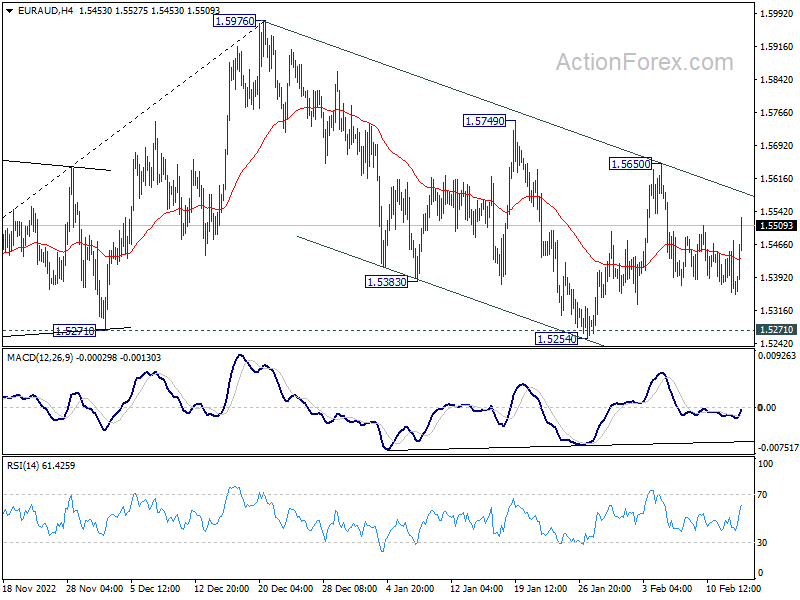
No change in EUR/AUD's outlook and intraday bias stays neutral. On the upside, above 1.5650 will revive that case that correction from 1.5976 has completed at 1.5254. Intraday bias will be back on the upside for 1.5749 resistance first. On the downside, firm break of 1.5254/71 will carry larger bearish implication and resume the fall from 1.5976.
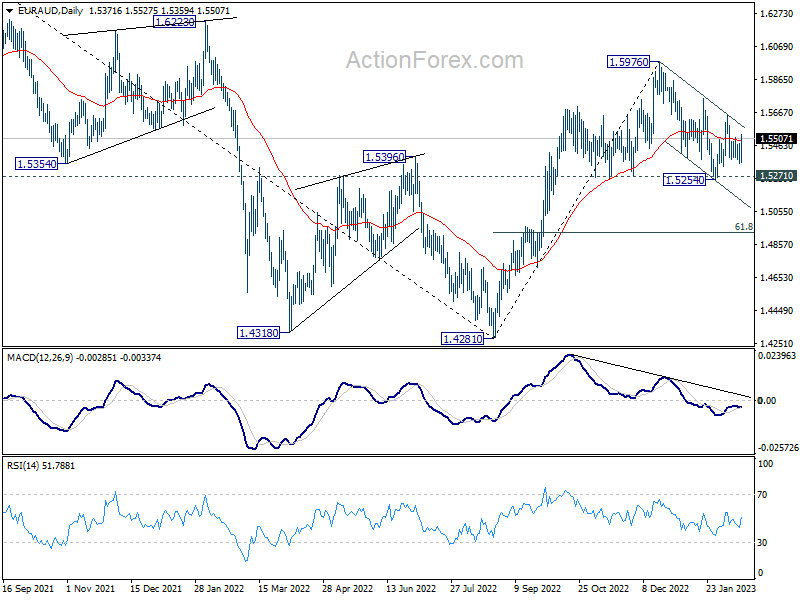
In the bigger picture, it's still early to confirm if rise from 1.4281 represents bullish trend reversal. But as long as 1.5271 support holds, such rally is in favor to continue. Break of 1.5976 will target 1.6434 key resistance next. On the other hand, firm break of 1.5271 will retain medium term bearishness instead.
EUR/CHF Daily Outlook
Daily Pivots: (S1) 0.9864; (P) 0.9880; (R1) 0.9912; More....
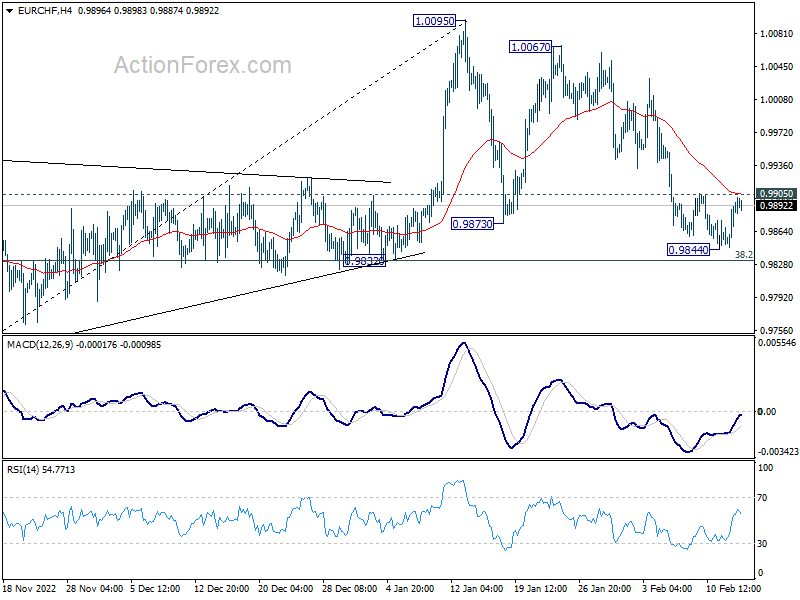
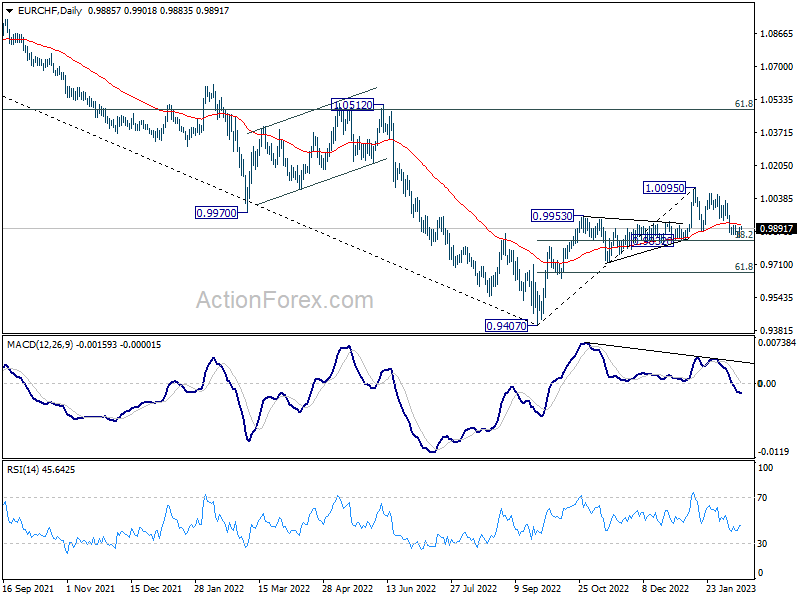
Intraday bias in EUR/CHF is neutral for the moment. On the upside, firm break of 0.9905 minor resistance will confirm short term bottoming. More importantly, corrective pattern from 1.0095 should have then completed. Bias will be flipped back to the upside for 1.0067/95 resistance zone. In case of another fall, downside should be contained by 38.2% retracement of 0.9407 to 1.0095 at 0.9832.
In the bigger picture, the rejection by 55 week EMA (now at 1.0025) mixed up the outlook. On the upside, sustained trading above 55 week EMA will raise the chance of bullish trend reversal. Rise from 0.9407 should then target 1.0505 cluster resistance (2020 low at 1.0505, 61.8% retracement of 1.1149 to 0.9407 at 1.1484). However, firm break of 0.9832 support will revive medium term bearishness and bring retest of 0.9407 low instead.
Market Caution Returns on Hot US CPI Data
Asian shares flashed red on Wednesday along with US futures as investors evaluated sticky American inflation data and remarks from Fed officials. European futures are pointing to a negative open this morning amid the cautious sentiment and this could find its way back to Wall Street later today.
In the currency arena, dollar bulls were injected with some renewed confidence as expectations intensified over interest rates remaining higher for longer than initially anticipated. Gold struggled to keep above $1850 during early trade and could extend losses as expectations shift towards a more hawkish Fed in the near term. Given how the latest red-hot US inflation figures are likely to create some uncertainty over the US economy, caution may remain the name of the game.
Sticky inflation data rekindles rate fears
Buying sentiment towards the dollar slightly improved after the latest US inflation figures printed higher than expected.
The headline consumer price index number climbed 6.4% in January from a year earlier, one-tenth lower than the 6.5% print in December. Although this was higher than the forecast of 6.2%, it was still the lowest reading since October 2021. The core reading, which excludes volatile items such as food and energy, cooled for the fourth consecutive month to 5.6%. This figure was above market expectations of 5.5% but still, the lowest witnessed since December 2021.
While inflation in the world’s largest economy continues to slow, it's not falling as quickly as investors anticipated – ultimately rekindling Fed rate hike bets. Given how these latest inflation figures add to January’s blowout jobs report, the dollar could edge higher in the short term. However, the bigger picture has not changed with the Fed closer to a peak in rates in the coming few months.
It will be wise to keep a close eye on the US retail sales and industrial production figures released later today. There has been a lot of hype and excitement around the US CPI but the retail sales data may provide fresh insight into consumer behaviour and health of the economy. A strong set of economic data will most likely stimulate expectations around US rates being higher for longer.
On the technical front, the DXY could be gearing up for a breakout above 104.00. Such a move could open the doors towards 105.00. Alternatively, sustained weakness below 104.00 may open a path back toward 102.00.
Commodity spotlight - Gold
After swinging between losses and gains in the previous session, gold kicked off Wednesday on a negative note.
The precious metal is trading below $1850 thanks to the sticky US inflation print and conflicting views from Fed officials. Given how the dollar is likely to draw strength from expectations around the Fed staying hawkish for longer, this could translate into more pain for zero-yielding gold down the road. Buying sentiment towards the precious metal could also take another hit this afternoon if the US retail sales and industrial production data exceed market forecasts.
Focusing on the technical picture, gold is under pressure on the daily charts. A solid daily close under $1850 may open the door toward $1815 and $1800, respectively.
Focus for Global Trading Remains on the US with January Retail Sales
Markets
In a first reaction, markets doubted how to react to US CPI release. US Headline consumer prices rose 0.5% M/M and 6.4% Y/Y (from 0.1%MM and 6.5% Y/Y). Core inflation printed at 0.4% M/M and 5.6% Y/Y (from 5.7%). Monthly moves were close to, but higher than, expectations. The report suggests that the disinflationary process might develop slower than the Fed and part of the market hoped for, reinforcing the ‘higher for longer case’. After some nervous swings immediately after the release, US yield ended the session higher with a further curve inversion. The 2-y yield gained 9.8 bps; the 30-y 0.2 bps. The 2-y-10-y spread reached a new cycle ‘peak’ of -87 bps. Markets now see a 50% chance of a third 25 bps additional Fed hike in early summer (after two other steps in March and May). Bets for a Fed rate cut in Q4 are scaled back. At least some Fed governors (Barkin, Williams, Logan) indicated that the Fed might raise rates further than initially anticipated if inflation stays too high. The US repositioning also spilled over to Europe with German yields gaining between 8.2 bps (5-y) and 5.6 bps (30-y). Worth mentioning, UK yields jumped an impressive 19 bps (2-y) to 7.6 bps (30-y) as market concluded that a strong job growth and higher than expected wage rises won’t allow the BoE to end its tightening cycle anytime soon. The impact from higher yields on equities remain modest. (EuroStoxx -0.06%, Dow -0.46%, Nasdaq +0.57%). The mild reaction of risk assets and yields also trending higher outside the US, limited USD gains. DXY closed the day little changed at 103.23. USD/JPY outperformed other USD cross rates as the yen corrected further after the nomination of Ueda as new BOJ governor (close 133.16). After some volatile intraday swings, EUR/USD closed marginally higher at 1.0738.
Asian markets are starting the session in risk-off modus with losses mostly between 0.5% and 1.75%. The dollar gains (EUR/USD 1.071; USD/JPY 133.25). (US) yields maintain yesterday’s post-CPI gains. The focus for global trading remains on the US with January retail sales (expected to rise 2% after -1.1% decline), the Empire manufacturing survey (expected -18.0 from -32.9), production data and the NAHB housing index. After yesterday’s CPI, data showing economic resilience might reinforce the view that the Fed will have to take further decisive action to slow demand. Also keep an eye at a $15bn 20-y US Treasury auction. The US 2-y yield (4.61%) nears the November cycle peak (4.799%). 2-year German and 2-y EMU swap yields are already setting new cycle peak levels. For now, the impact of higher yields on equites stayed modest. Even so, we still slightly favour the dollar over the euro. A break below EUR/USD 1.0656 would open the way to the 1.0484/61 area. This morning, UK January CPI data came out slightly softer than expected (headline -0.6% M/M and 10.1% Y/Y from 10.5%; core 5.8% Y/Y from 6.3%). Sterling in a first reaction returns most of yesterday’s gain with EUR/GBP jumping from the 0.882 area to the 0.8845 area.
News Headlines
UK PM Sunak and finance minister Hunt are considering to give workers at the National Health Service an additional lump sum pay by backdating next fiscal year’s pay rise (taking effect from April) to January 2023. The fear is that the room for wage increases within the existing health and education department’s budget is too little. Some estimate it at only 3% compared to an average inflation expected by the UK fiscal watchdog of 5.5% in 2023-2024. Such another year of a pay cut in real terms could infuriate unions and intensify the current biggest wave of strike in decades. But at the same time, the finance minister is keen on keeping pay under control, saying that it risks stoking and embedding high inflation in the economy.
French finance minister Le Maire will meet the country’s retailers to discuss price caps for essential goods amid surging inflation that’s eroding households’ purchasing power. France is already coping with large street protests over the president Macron’s plan to raise the retirement age from 62 to 64. The government seeks to avoid adding to people’s discontent and trigger cost-of-living strikes similar to those in the UK. Le Maire said he gives himself until March 15 to come up with a solution.
But Why?
Looking at the market pricing, you could’ve hardly guessed, but yesterday’s US inflation report was not brilliant.
On a monthly basis, the headline inflation ticked higher from 0.1% to 0.5% as expected.
But on a yearly basis, both headline and core inflation didn’t ease as much as expected. Core inflation fell from 5.7% to 5.6%, instead of the 5.5% expected by analysts, while headline inflation eased from 6.5% to 6.4%, versus 6.2% expected by analysts.
And if we take it to the decimal point, that easing was even less. In fact, US headline inflation barely eased from 6.45% to 6.41%.
On the contrary, over the past three months, core inflation for example rose from 4.3% to 4.6%. And valentines had to spend 17% more on a romantic dinner this year!
So, nothing in that inflation report was ok.
And hotter inflation is not the elephant in the room. It is very much in line with the abnormally tight US jobs market.
This suggests that the rate hikes from the Federal Reserve (Fed) don’t translate into a weaker jobs market just yet and inflation, which has been encouragingly trending lower since summer gives signs that we may be soon coming to a point where it will be harder to make progress.
Services and shelter are the areas that should show improvement, and for now, it doesn’t look promising.
Why equities rallied?
You certainly expected to see a bearish market reaction to a strong US CPI data, right?
Well, the reaction was… mixed. The US stocks opened the day higher, then the S&P500 fell, which was the normal reaction, but then it rebounded to close the session near flat.
Nasdaq also gapped higher at the open, sold off, but rebounded to close the session 0.70% higher.
It’s perhaps because there were so many red flags about the possibility that inflation ticked higher that investors were happy that the data wasn’t so bad after all.
And/or, optimism in the market is so strong that neither the Fed, nor the data couldn’t do anything to hammer it.
Either way, a few more Fed members made hawkish comments after the data, but all investors heard was ‘bla bla bla’.
Sometimes it takes markets some time to come back to their senses.
But it’s worth noting that the downside risks prevail, though there is no reason for the equity rally to stall. If a disappointing inflation print couldn’t reverse the rally, I don’t see what can.
This morning, US futures are in the negative.
FX and yields at the wake of the US CPI
Still, treasury markets seemed more down to earth, as the US 2-year yield ticked to the highest levels since last November, activity on Fed funds futures gave a little more than 12% probability for a 50bp hike at the next FOMC meeting, versus around 9% at the start of the week.
But the dollar index remained stuck below its 50-DMA.
Gold extended gains to $1843 on the back of stronger yields and firmer US dollar.
The EURUSD found support above the 50-DMA, which stands around the 1.0715 mark.
The dollar-yen cleared resistance near its own 50-DMA level, and is now testing the 133 offers, the minor 23.6% Fibonacci retracement, to the upside. I don’t see a particular reason for the dollar to soften given the latest inflation figures, but there is always a risk that the new BoJ governor Ueda says something like ‘we will scrap the YCC policy because it makes no sense’ and boom, the pair could go below 130 before you even know. So the risks are still tilted to the downside in USDJPY.
in the UK, inflation in January still eased more than expected to 10.1%. That’s not the sharp easing that Mr. Bailey was talking about, and with a 6.7% wages growth on average, we may never see inflation in Britain crash, but both headline and core inflation in Britain eased in January. Sterling took a dive post data.
Crude oil remains offered into the 100-DMA, near $81pb level, and the bears are in charge of the market this morning as the latest API data showed a massive 10 mio barrel build in US oil inventories last week, while Biden Administration announced there would be further releases from the strategic petroleum reserves of 26 million barrels earlier this week.
The more official EIA data is due today, and will show a similar surprise. So, US crude is certainly on its way to test the 50-DMA to the downside, near $77pb.
Hawkish Fed Talk after CPI Report
Market movers today
In the US, retail sales figures are the highlight today and it will be interesting to see whether consumer spending continued to cool at the start of 2023, despite the strong labour market. Empire manufacturing for February is also released.
After wage growth again surprised on the upside yesterday, the UK inflation report for January will reveal whether core inflation pressures are still on the rise, adding to the risk of more hikes from Bank of England.
The delayed Q4 2022 GDP figures are released in Norway.
The 60 second overview
US inflation push yields higher: US January CPI came out broadly in line with our expectations, as headline CPI grew 0.5% m/m and core CPI 0.4%. That said, the details continued to illustrate persistent underlying price pressures, and markets reacted by pricing in a larger probability of Fed continuing its hiking cycle beyond May and now pricing a peak rate around 5.25% in July. Core Services ex. Shelter inflation remained steady at 0.6% m/m, but the figure was pulled down by negative contribution from healthcare inflation, largely linked to negative base effects in health insurance prices. Excluding healthcare and shelter, core services inflation picked up to 0.65% m/m (from 0.35%), while core goods CPI also rose by 0.07% after three months of consecutive decline.
For now, we stick to our forecast of two more 25bp Fed hikes, and first rate cuts only in early 2024. Besides realized inflation and labour market data, we will keep a close eye out for how inflation expectations develop. Both market and consumer survey based expectations have ticked slightly higher recently, which supports the case for maintaining nominal rates higher for longer.
Fed officials signal risk of higher rate peak: In comments after the CPI print, Dallas Fed President said that "We must remain prepared to continue rate increases for a longer period than previously anticipated, if such a path is necessary to respond to changes in the economic outlook or to offset any undesired easing in conditions." Also talking after the CPI release, Richmond Fed President Thomas Barkin stated that "if inflation persists at levels well above our target, maybe we'll have to do more [than anticipated]". Another Fed member Patrick Harker from Philadelphia Fed said that "It's going to be above 5% in the Fed funds rate. How much above 5? It's going to depend a lot on what we're seeing."
US says three mystery objects likely private: US National Security Spokesman John Kirby said Tuesday, that the three unknown objects the US shot down in recent days were likely private and not linked to China. As we wrote yesterday, US Secretary of State Anthony Blinken and China's top foreign policy diplomat Wang Yi are weighing a meeting at the side lines of the Munich Security Conference starting Friday.
NATO has for the first time opened for Finland and Sweden joining separately. "So the main question is not whether Finland and Sweden are ratified together," Secretary-general Jens Stoltenberg told reporters on Tuesday. "The main question is that they are both ratified as full members as soon as possible. And I'm confident that both will be full members, and are working hard to get both ratified as soon as possible." Turkey is currently holding up Sweden's membership accusing Stockholm of holding Kurdish activists and over allowing the burning of the Koran in front of the Turkish embassy in Sweden.
Equities: Equities little changed yesterday after yoyo moving during the day. However, underneath the surface an interesting outperformance of growth stocks took place. This happened although the US CPI report came out hotter than expected and yields moved higher across the curve with further inversion. For us, this can only be explained by the classic FOMO reaction as investors have been missing out on the rally in growth stocks since October. However, we see this change in correlations as temporary and argue for growth stocks to suffer if we see further lift to yields. Some of this also visible in futures this morning. In US yesterday, Dow -0.5%, S&P 500 -0.03%, Nasdaq +0.6% and Russell 2000 -0.1%. Asian markets broadly lower this morning led by South Korea dropping 1.7%. Futures in Europe slightly negative while US down a bit lead by Nasdaq.
FI: Bond yields and interest rates rose on the back of the stronger than expected US inflation data released yesterday. 10Y US Treasury yields rose almost 10bp on the back of the US inflation numbers before falling 3-4bp by the end of the trading session. There was a spill-over effect to European bond yields and these also rose.
FX: Initial gyrations in G10 FX after US CPI, but soon the USD came out as a marginal winner with EUR/USD moving toward low 1.07 and USD/JPY testing the upper end of the 130-133 range. EUR/SEK made attempts toward year lows around 11.06 in the early part of the European session but then gradually edged higher during the day alongside EUR/NOK.
Credit: Credit markets tightened markedly during the day, but after the release of the US CPI figures, sentiment changed and both iTraxx Xover and Main closed more or less unchanged in 77bp and 401bp, respectively.
Nordic macro
Norwegian GDP is released today. Growth was much stronger than expected towards the end of last year. Although we expect it to slow in December, with mainland GDP falling 0.2% m/m, this would still give solid growth of 0.7% q/q for Q4. That said, it will be worth looking out for any revisions of previous data, as these can sometimes change the picture quite considerably.
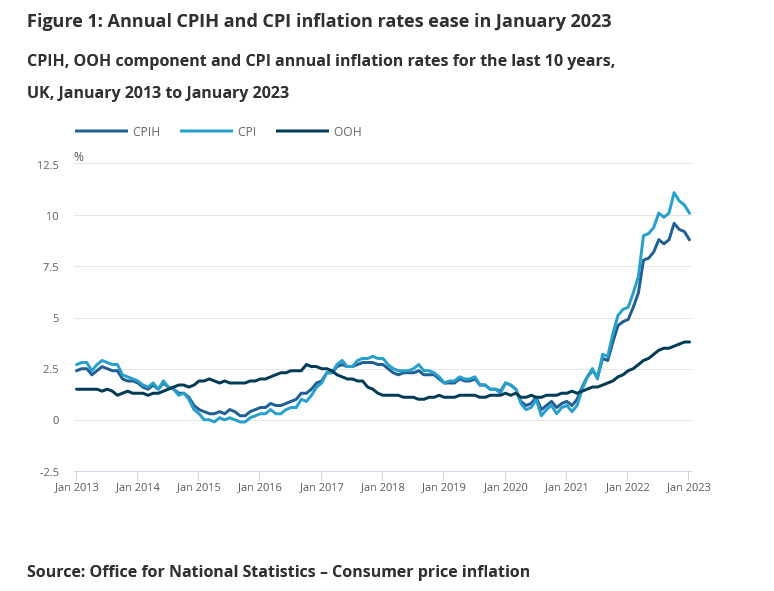
UK CPI slowed more than expected to 10.1% yoy in Jan
UK CPI slowed from 10.5% yoy to 10.1% yoy in January, below expectation of 10.3% yoy. CPI core slowed from 6.3% yoy to 5.8% yoy, below expectation of 6.2% yoy.
The largest downward contribution to annual inflation came from transport (particularly passenger transport and motor fuels), and restaurants and hotels, with rising prices in alcoholic beverages and tobacco making the largest partially offsetting upward contribution to the change.
Also released, RPI came in at 0.0% mom, 13.4% yoy, versus expectation of 0.1% mom, 13.2% yoy. PPI input was at -0.1% mom, 14.1% yoy, versus expectation of 0.2% mom, 14.7% yoy. PPI output was at 0.5% mom, 13.5% yoy, versus expectation of 0.1% mom, 14.4% yoy. PPI core output was at 0.6% mom, 11.1% yoy, versus expectation of 0.7% mom, 11.9% yoy.
Elliott Wave View: Ethereum (ETHUSD) 5 Waves Down Calling for More Downside
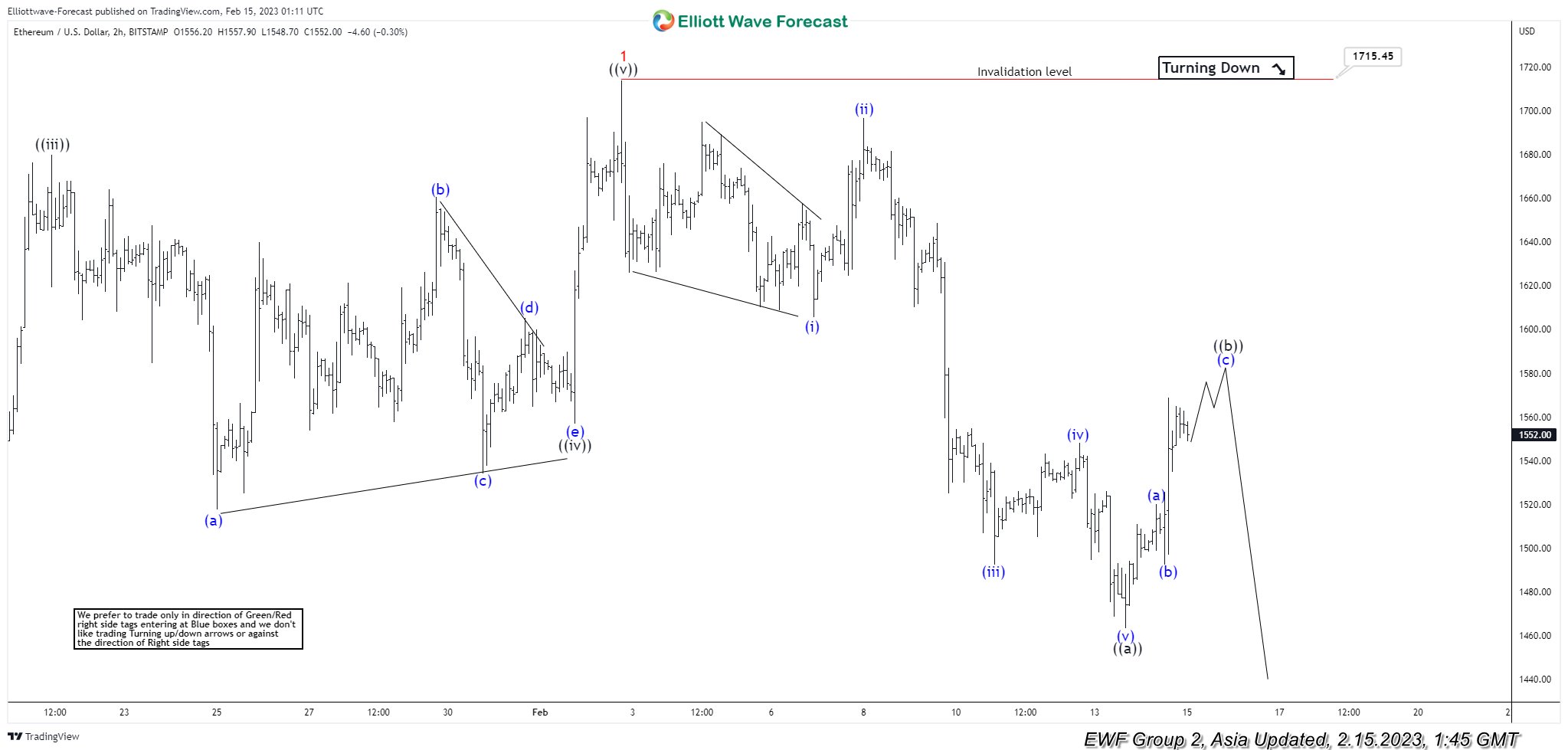
Cycle from 9.11.2022 low in Ethereum (ETHUSD) is in progress as a 5 waves impulse Elliott Wave structure. Up from 9.11.2022 low, wave 1 ended at 1714.10. Wave 2 dips is currently ongoing with internal subdivision as a zigzag Elliott Wave structure. Down from wave 1, wave (i) ended at 1605.6 and rally in wave (ii) ended at 1696.90. The crypto currency extends lower in wave (iii) towards 1492.30 and rally in wave (iv) ended at 1548. Final leg lower wave (v) ended at 1463.20 which completed wave ((a)) in higher degree.
Rally in wave ((b)) is now in progress to correct the cycle from 2.2.2023 high. Internal subdivision of wave ((b)) is unfolding as a zigzag Elliott Wave structure in lesser degree. Up from wave ((a)), wave (a) ended at 1520.20, and pullback in wave (b) ended at 1492.30. Expect wave (c) to extend higher and fail below 1715.45 for further downside. Near term, as far as pivot at 1715.45 high stays intact, expect short term rally to fail in 3, 7, or 11 swing for further downside in wave ((c)) of 2. Afterwards, Ethereum should resume higher again as far as 9.11.2022 low at 1071.5 holds.
Ethereum (ETHUSD) 2 Hour Elliott Wave Chart
USD/CAD Daily Outlook
Daily Pivots: (S1) 1.3277; (P) 1.3334; (R1) 1.3393; More....
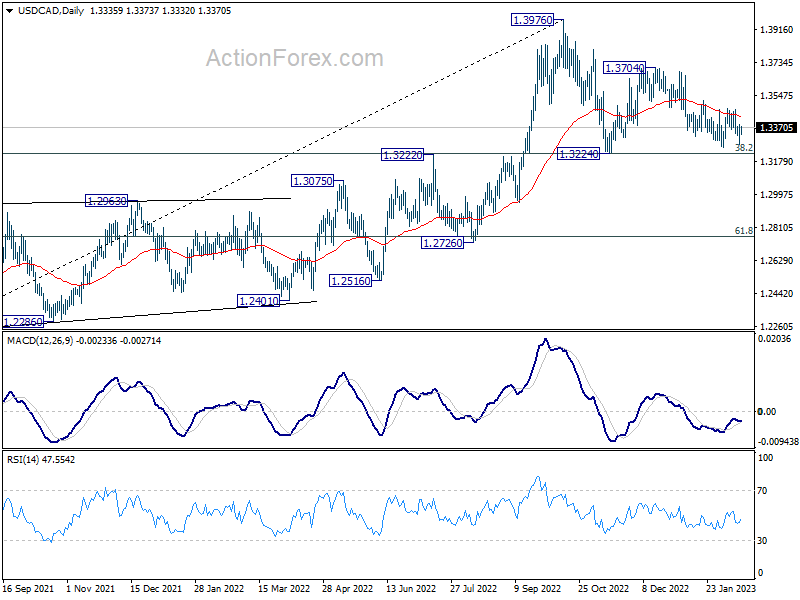
Intraday bias in USD/CAD stays neutral for the moment. Outlook is unchanged too. The choppy decline from 1.3704 might still extend lower, but strong support is expected to 1.3224 key support to bring rebound. On the upside, above 1.3519 resistance will confirm short term bottoming, and turn intraday bias back to the upside for retesting 1.3704 resistance. However, decisive break of 1.3224 would carry larger bearish implication.
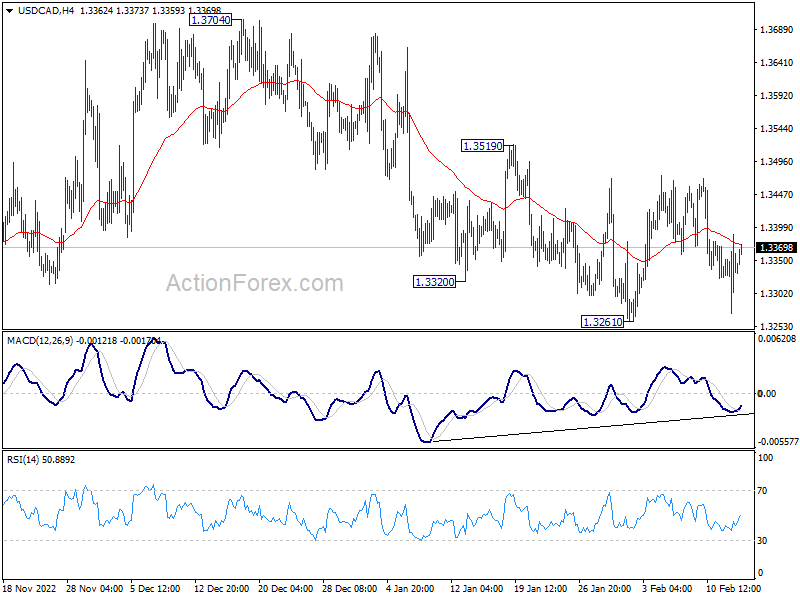
In the bigger picture, as long as 1.3222 cluster support (38.2% retracement of 1.2005 to 1.3976 at 1.3223) holds, larger up trend from 1.2005 (2021 low) is still expected to resume through 1.3976 high at a later stage. However, firm break of 1.3222/3 will indicate that the trend might have reversed. Deeper fall would be seen to next cluster support at 1.2726 (61.8% retracement at 1.2758).
AUD/USD Daily Report
Daily Pivots: (S1) 0.6929; (P) 0.6979; (R1) 0.7036; More...
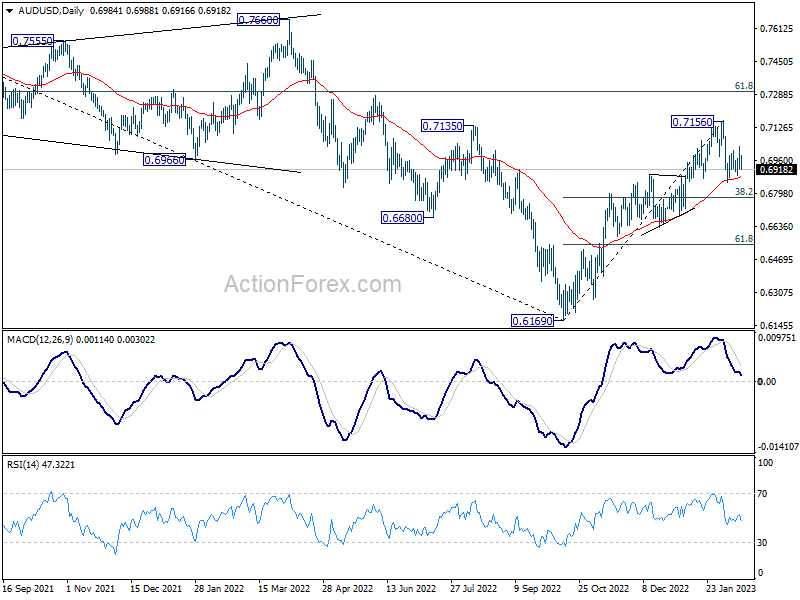
AUD/USD edged higher to 0.7028 but quickly retreated. Intraday bias remains neutral first. On the downside, break of 0.6854 will resume the correction from 0.7156 to 38.2% retracement of 0.6169 to 0.7156 at 0.6779. On the upside, break of 0.7028 will turn bias back to the upside for retesting 0.7156 high instead.
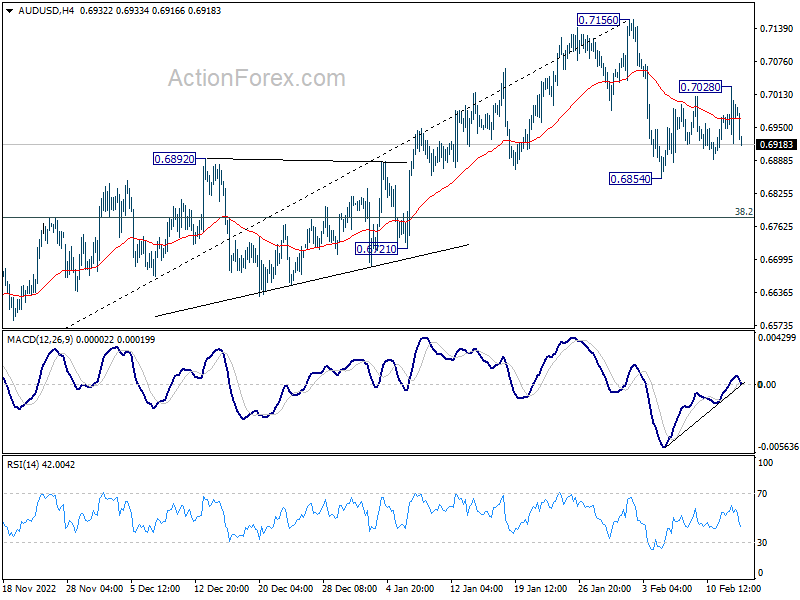
In the bigger picture, corrective decline from 0.8006 (2021 high) should have completed with three waves down to 0.6169 (2022 low). Further rally should be seen to 61.8% retracement of 0.8006 to 0.6169 at 0.7304. Sustained break there will pave the way to retest 0.8006. This will now remain the favored case as long as 0.6721 support holds.