Sample Category Title
Dollar Rises after Strong Retail Sales, Finally Committing to Rally?
Dollar might finally be committing to a rally after stronger than expected retail sales data. Consumer markets appeared to remain robust despite persistently high inflation. Talks of a higher terminal rate for Fed is also growing. On the other hand, Sterling was knocked down earlier today after lower than expected CPI reading, in particular against Euro and Swiss Franc, which were the second and third strongest for the day. Yen is not performing too well considering widening yield gap with US and Europe, but selloff someone slowed against others.
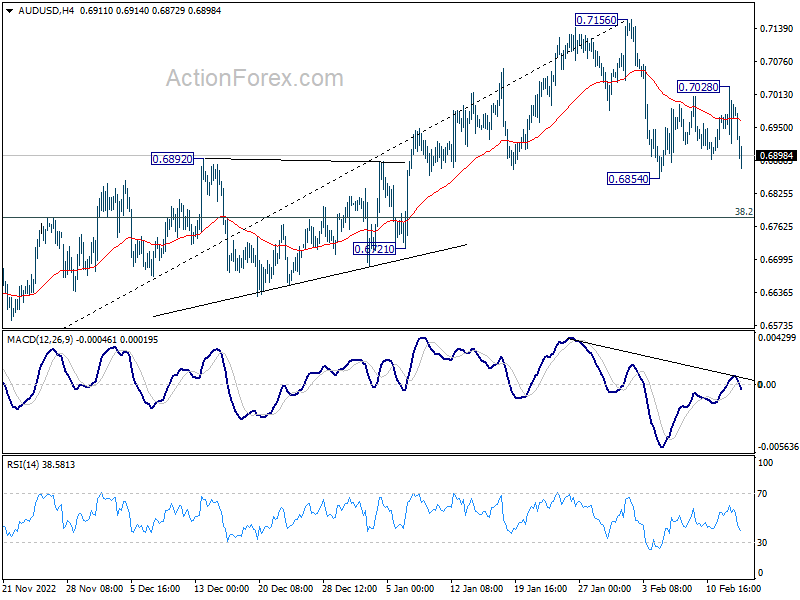
Technically, AUD/USD would be a focus leading up to tomorrow's Australia job data. Current development suggests that correction from 0.7156 is ready to resume. Break of 0.6854 will target 38.2% retracement of 0.6169 to 0.7156 at 0.6779. Strong support could be seen from 0.6721 to bring rebound. However, it might start to feel a bit vulnerable should tomorrow's data disappoints.
In Europe, at the time of writing, FTSE is up 0.09%. DAX is up 0.52%. CAC is up 0.99%. Germany 10-year yield is down -0.001 at 2.439. Earlier in Asia, Nikkei dropped -0.37%. Hong Kong HSI dropped -1.43%. China Shanghai SSE dropped -0.39%. Singapore Strait Times dropped -1.13%. Japan 10-year JGB yield rose 0.0027 to 0.507.
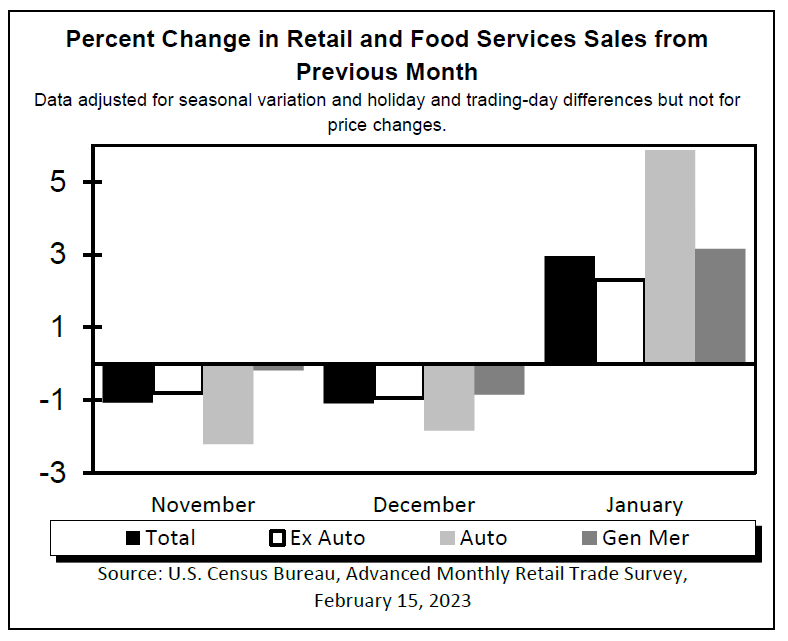
US retail sales up 3.0% mom in Jan, ex-auto sales rose 2.3% mom
US retail sales rose 3.0% mom to USD 697B in January, above expectation of 1.7% mom. Ex-auto sales rose 2.3% mom to USD 565B, above expectation of 0.9% mom. Ex-gasoline sales rose 3.2% mom to USD 637B. Ex-auto, gasoline sales rose 2.6% mom to USD 506B.
Total sales for the November through January period were up 6.1% yoy from the same period a year ago.
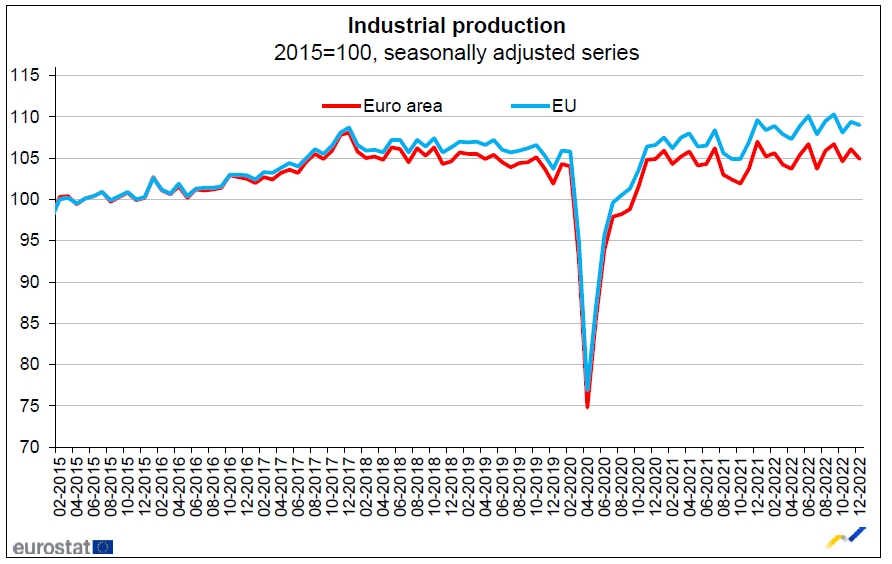
Eurozone industrial production down -1.1% mom in Dec, EU down -0.4% mom
Eurozone industrial production declined -1.1% mom in December, worse than expectation of -0.8% mom. Production of intermediate goods fell by -2.8%, durable consumer goods by -1.4%, non-durable consumer goods by -1.0% and capital goods by -0.4%, while production of energy grew by 1.3%.
EU industrial production dropped -0.4% mom. Among Member States for which data are available, the largest monthly decreases were registered in Ireland (-8.5%), Luxembourg (-5.2%) and Lithuania (-4.0%). The highest increases were observed in Denmark (+13.5%), Portugal (+4.1%) and Hungary (+3.8%).
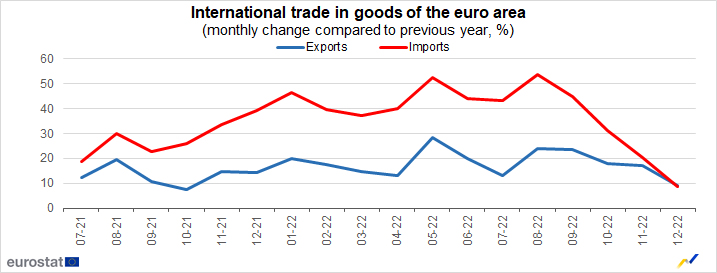
Eurozone goods exports rose 9.0% yoy in Dec, imports rose 8.7% yoy
Eurozone goods exports rose 9.0% yoy to EUR 238.7B in December. Goods imports rose 8.7% yoy to EUR 247.5B. Trade deficit came in at EUR -8.8B. Intra-Eurozone trade rose 9.4% yoy to EUR 212.8B.
In seasonally adjusted term, exports dropped -4.6% mom to EUR 239.7B. Imports dropped -2.9% to EUR 257.9B. Trade deficit widened from November's EUR -14.4B to EUR -18.1B, larger than expectation of EUR -16.0B. Intra-Eurozone trade dropped from EUR 233.5B to EUR 230.9B.
ECB de Cos: Recent inflation data are somewhat encouraging
ECB Governing Council member Pablo Hernandez de Cos said, "recent data on euro area inflation and some of its key determinants are somewhat encouraging, but the overall situation still requires caution".
But he added that the evidence so far was very preliminary. Careful monitoring is required in some areas, including residual pass-through of inflation shocks, and the symmetry of pass-through of energy price declines to core inflation and wages, as well ass the effects of Chinese reopening.
"All these will have to be assessed as part of the full projections exercise under way in the run-up to our March meeting," De Cos said.
UK CPI slowed more than expected to 10.1% yoy in Jan
UK CPI slowed from 10.5% yoy to 10.1% yoy in January, below expectation of 10.3% yoy. CPI core slowed from 6.3% yoy to 5.8% yoy, below expectation of 6.2% yoy.
The largest downward contribution to annual inflation came from transport (particularly passenger transport and motor fuels), and restaurants and hotels, with rising prices in alcoholic beverages and tobacco making the largest partially offsetting upward contribution to the change.
Also released, RPI came in at 0.0% mom, 13.4% yoy, versus expectation of 0.1% mom, 13.2% yoy. PPI input was at -0.1% mom, 14.1% yoy, versus expectation of 0.2% mom, 14.7% yoy. PPI output was at 0.5% mom, 13.5% yoy, versus expectation of 0.1% mom, 14.4% yoy. PPI core output was at 0.6% mom, 11.1% yoy, versus expectation of 0.7% mom, 11.9% yoy.
RBA Lowe: I don't think we're at the peak of interest rate yet
RBA Governor Philip Lowe said in a Senate hearing, "I don't think we're at the peak (on interest rate) yet, but how far we have to go up I don't know." He noted that inflation, which is currently sitting at 7.8%, was still "wage too high". Unemployment would need to rise before there were any major changes to inflation.
"I understand why some people focus on the risks on the one side, but we've got to be attentive to the risk from higher inflation," Lowe warned. "It's corrosive for the economy. And all the evidence is if inflation stays high for too long, expectations adjust and that leads to higher interest rates and more unemployment.."
"The risks are two sided, and we're trying to navigate our way through a narrow path."
EUR/USD Mid-Day Outlook
Daily Pivots: (S1) 1.0694; (P) 1.0749; (R1) 1.0791; More...
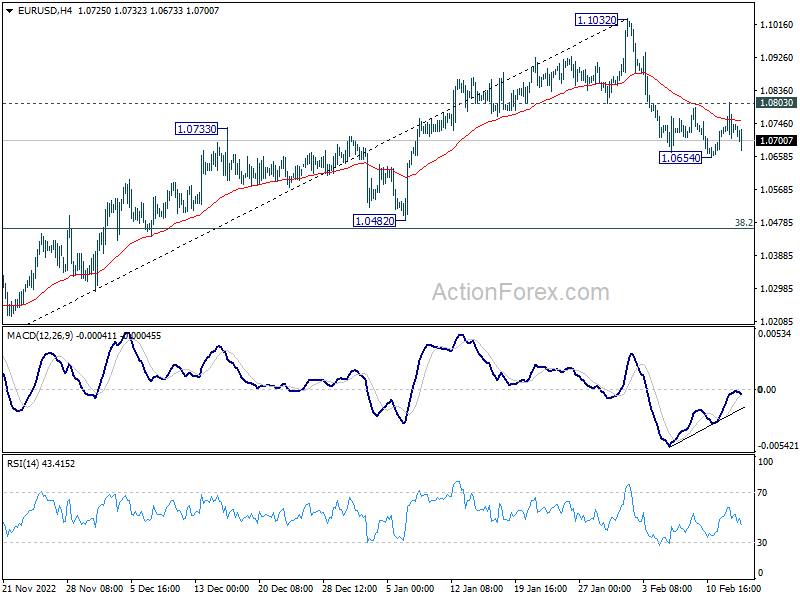
Focus is back on 1.0654 temporary low in EUR/USD with today's fall. Firm break there will resume the corrective fall from 1.1032 to 38.2% retracement of 0.9534 to 1.1032 at 1.0463. Strong support should be seen around there to bring rebound, at least on first attempt. On the upside, firm break of 1.0803 minor resistance will turn bias back to the upside for retesting 1.1032 high instead.
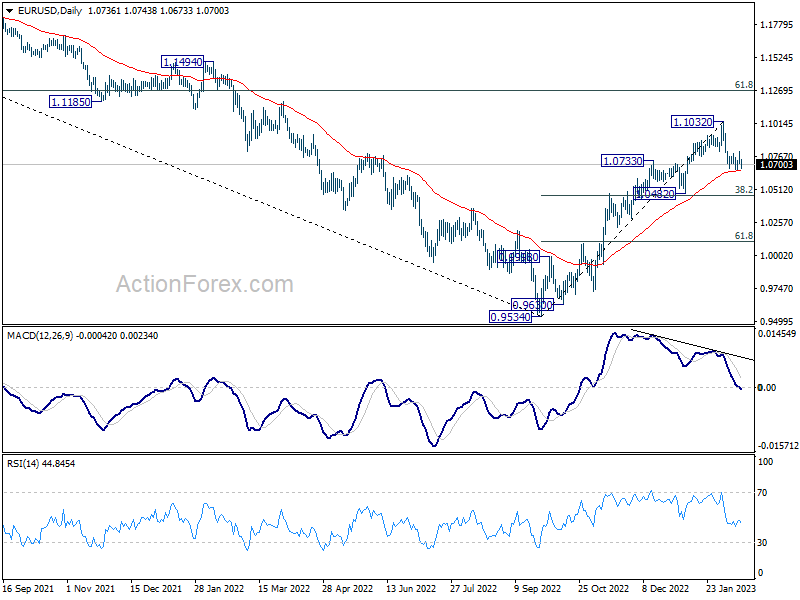
In the bigger picture, the rally from 0.9534 low (2022 low) is a medium term up trend rather than a correction. Further rise is in favor to 61.8% retracement of 1.2348 (2021 high) to 0.9534 at 1.1273 next. This will remain the favored case as long as 1.0482 support holds.
Economic Indicators Update
| GMT | Ccy | Events | Actual | Forecast | Previous | Revised |
|---|---|---|---|---|---|---|
| 04:30 | JPY | Tertiary Industry Index M/M Dec | -0.40% | 0.00% | -0.20% | 0.10% |
| 07:00 | GBP | CPI M/M Jan | -0.60% | -0.40% | 0.40% | |
| 07:00 | GBP | CPI Y/Y Jan | 10.10% | 10.30% | 10.50% | |
| 07:00 | GBP | Core CPI Y/Y Jan | 5.80% | 6.20% | 6.30% | |
| 07:00 | GBP | RPI M/M Jan | 0.00% | 0.10% | 0.60% | |
| 07:00 | GBP | RPI Y/Y Jan | 13.40% | 13.20% | 13.40% | |
| 07:00 | GBP | PPI Input M/M Jan | -0.10% | 0.20% | -1.10% | |
| 07:00 | GBP | PPI Input Y/Y Jan | 14.10% | 14.70% | 16.50% | 16.20% |
| 07:00 | GBP | PPI Output M/M Jan | 0.50% | 0.10% | -0.80% | |
| 07:00 | GBP | PPI Output Y/Y Jan | 13.50% | 14.40% | 14.70% | 14.60% |
| 07:00 | GBP | PPI Core Output M/M Jan | 0.60% | 0.70% | 0.10% | 0.00% |
| 07:00 | GBP | PPI Core Output Y/Y Jan | 11.10% | 11.90% | 12.40% | 12.00% |
| 10:00 | EUR | Eurozone Trade Balance (EUR) Dec | -18.1B | -16.0B | -15.2B | -14.4B |
| 10:00 | EUR | Eurozone Industrial Production M/M Dec | -1.10% | -0.80% | 1.00% | 1.40% |
| 13:15 | CAD | Housing Starts Jan | 215K | 252K | 249K | |
| 13:30 | CAD | Manufacturing Sales M/M Dec | -1.50% | -1.60% | 0.00% | |
| 13:30 | CAD | Wholesale Sales M/M Dec | -0.80% | -1.50% | 0.50% | |
| 13:30 | USD | Empire State Manufacturing Index Feb | -5.8 | -15.6 | -32.9 | |
| 13:30 | USD | Retail Sales M/M Jan | 3.00% | 1.70% | -1.10% | |
| 13:30 | USD | Retail Sales ex Autos M/M Jan | 2.30% | 0.90% | -1.10% | -0.90% |
| 14:15 | USD | Industrial Production M/M Jan | 0.40% | -0.70% | ||
| 14:15 | USD | Capacity Utilization Jan | 79.00% | 78.80% | ||
| 15:00 | USD | NAHB Housing Market Index Feb | 37 | 35 | ||
| 15:00 | USD | Business Inventories Dec | 0.40% | 0.40% | ||
| 15:30 | USD | Crude Oil Inventories | 1.5M | 2.4M |
US retail sales up 3.0% mom in Jan, ex-auto sales rose 2.3% mom
US retail sales rose 3.0% mom to USD 697B in January, above expectation of 1.7% mom. Ex-auto sales rose 2.3% mom to USD 565B, above expectation of 0.9% mom. Ex-gasoline sales rose 3.2% mom to USD 637B. Ex-auto, gasoline sales rose 2.6% mom to USD 506B.
Total sales for the November through January period were up 6.1% yoy from the same period a year ago.
AUD/USD Sinks on Hawkish Lowe
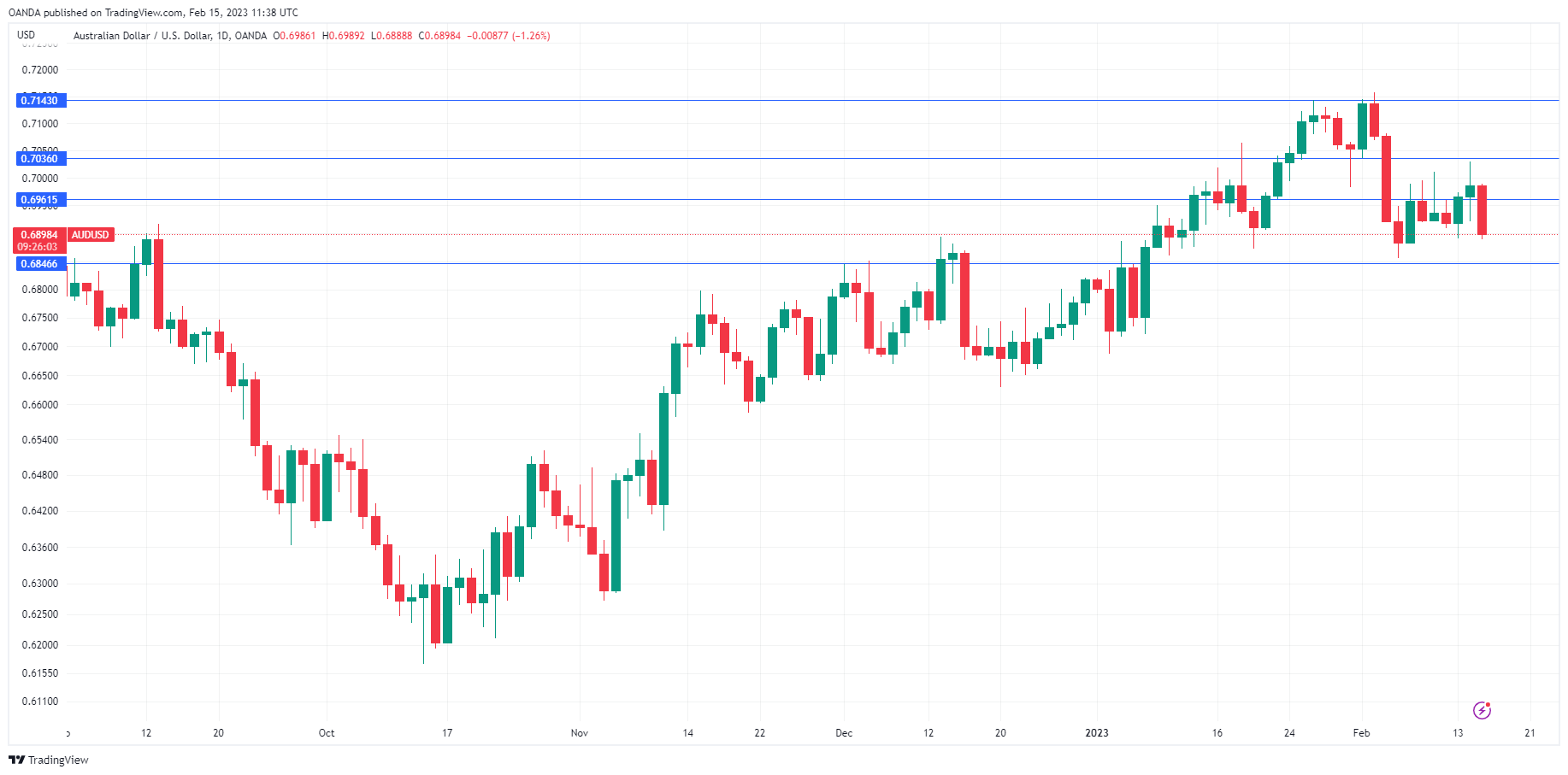
It has been a disastrous session for AUD/USD, which has plunged 1.26% and is trading at 0.6899.
Lowe says more hikes coming
RBA Governor Philip Lowe faced a grilling from Australian lawmakers earlier. Higher rates and high inflation have caused a cost-of-living crisis and the RBA has been heavily criticised for the sharp rate-tightening cycle.
Lowe confirmed that more rate hikes were on the way due to the need to curb inflation. Lowe warned that the battle against inflation was paramount, saying high inflation could lead to an increase in inflation expectations which would result in higher rates and more unemployment. Inflation is running at 7.8%, the highest level in over 40 years, which Lowe said was “way too high”. Australia will release employment data on Thursday. The economy is estimated to have created 20,000 new jobs in January, following a decline of 14,600.
The US will release January retail sales later today. Headline retail sales is expected to rebound with a 1.8% gain while core retail sales is forecast to rise 1.1%. Both releases came in at -1.1% in December, so a strong showing would be bullish for the US dollar. The markets have been dovish about the Fed’s rate policy on the assumption that the economy is weakening, but the blowout employment report and an inflation release that was higher than expected have forced investors to rethink expectations that the Fed will pivot and cut rates later this year. A strong retail sales report would support the Fed’s hawkish stance of “higher for lower” and possibly a higher terminal rate than previously expected.
AUD/USD Technical
- AUD/USD is testing support at 0.6962. Below, there is support at 0.6846
- 0.7036 and 0.7143 are the next resistance lines
Pound Sliding Despite Inflation Drop
UK inflation falls but remains above 10%
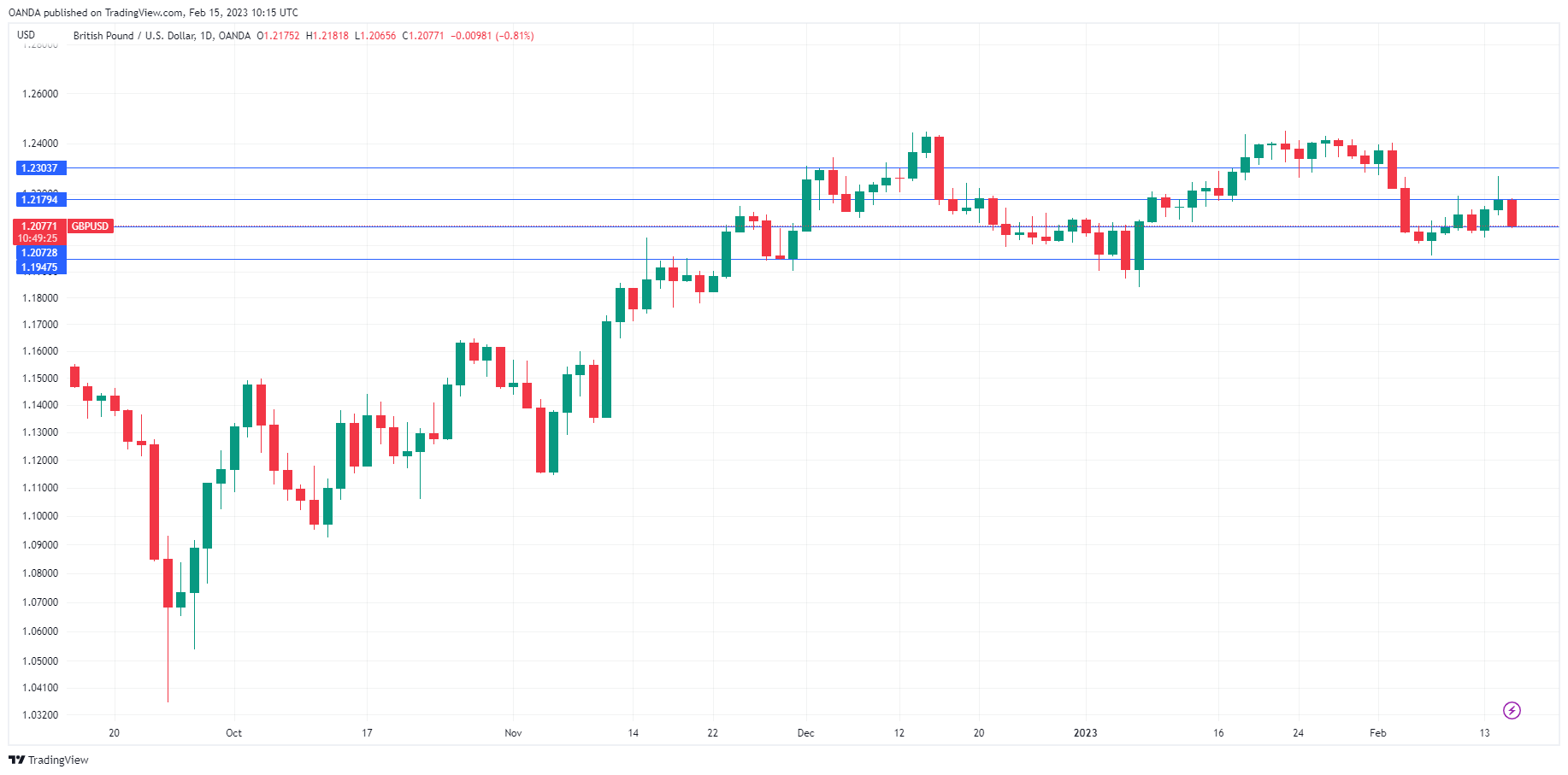
The British pound is sharply lower on Wednesday. In the European session, GBP/USD is trading at 1.2069, down 0.88%.
UK inflation continues to fall, although it clearly has a long way to go. January’s inflation dropped to 10.1%, down from 10.5% in December and below the consensus of 10.3%. The core rate dropped to 5.8%, down from 6.3% in December and lower than the consensus of 6.2%. These numbers offer room for a bit of optimism, as does the drop in wage growth on Tuesday. Still, inflation is a bumpy road that will feature highs and lows and market participants would be wise not to make decisions based on one release. With headline inflation still in double digits, the Bank of England will have to continue raising rates, with the most likely scenario being a 25-basis increase at the Mar. 22 meeting.
In the US, inflation in January ticked lower to 6.4%, down from 6.5% but higher than the forecast of 6.2%. It was a similar story for the core rate, which dropped from 5.7% to 5.6% and was above the forecast of 5.5%. Inflation is still falling but the trend may be stalling, which will provide support for the Federal Reserve’s hawkish stance.
After the US inflation release, several Fed members reiterated the “higher for longer” theme. Fed members Barkin, Logan and Harker all had a similar message that the Fed would likely raise rates if inflation did not fall fast enough. The Fed has projected a federal funds rate of 5% to 5.5% by the end of the year, but given the strong economy and high inflation levels, there have been forecasts of a terminal rate as high as 6%.
GBP/USD Technical
- 1.2180 has strengthened in resistance as GBP/USD is down sharply. 1.2304 is the next resistance line
- 1.2071 and 1.1947 are providing support
Eurozone goods exports rose 9.0% yoy in Dec, imports rose 8.7% yoy
Eurozone goods exports rose 9.0% yoy to EUR 238.7B in December. Goods imports rose 8.7% yoy to EUR 247.5B. Trade deficit came in at EUR -8.8B. Intra-Eurozone trade rose 9.4% yoy to EUR 212.8B.
In seasonally adjusted term, exports dropped -4.6% mom to EUR 239.7B. Imports dropped -2.9% to EUR 257.9B. Trade deficit widened from November's EUR -14.4B to EUR -18.1B, larger than expectation of EUR -16.0B. Intra-Eurozone trade dropped from EUR 233.5B to EUR 230.9B.
Eurozone industrial production down -1.1% mom in Dec, EU down -0.4% mom
Eurozone industrial production declined -1.1% mom in December, worse than expectation of -0.8% mom. Production of intermediate goods fell by -2.8%, durable consumer goods by -1.4%, non-durable consumer goods by -1.0% and capital goods by -0.4%, while production of energy grew by 1.3%.
EU industrial production dropped -0.4% mom. Among Member States for which data are available, the largest monthly decreases were registered in Ireland (-8.5%), Luxembourg (-5.2%) and Lithuania (-4.0%). The highest increases were observed in Denmark (+13.5%), Portugal (+4.1%) and Hungary (+3.8%).
Gold Plummets to Fresh 5-Week Low
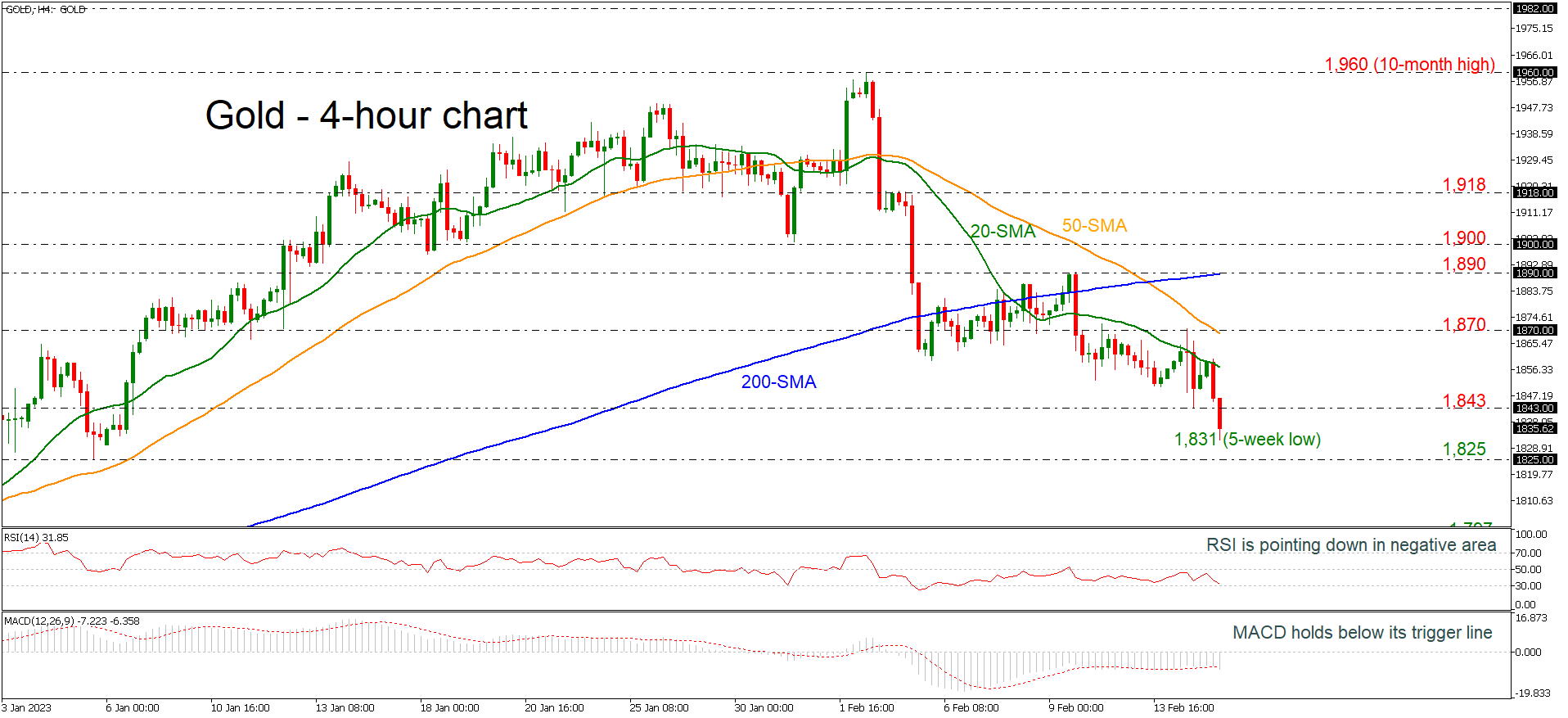
Gold plunged towards a fresh five-week low of 1,831, continuing the strong selling interest of the ten-month peak of 1,960. The RSI is diving towards the oversold territory with strong momentum and the MACD is losing ground beneath its trigger and zero lines. In trend indicators, the 20- and the 50-period simple moving averages (SMAs) are following the descending move in price action.
Further declines may meet support around 1,825, taken from the lows on January 15, while even lower the price may hit the end of December’s trough of 1,797, which could attract traders’ attention.
On the upside, resistance could occur around the 1,843 barrier before testing the 20- and the 50-period SMAs at 1,857 and 1,868 respectively, which stands near the previous peak of 1,870. Higher still, the 200-period SMA at 1,890 would increasingly come into scope, while just above this point lies the psychologically significant level of 1,900, a break of which could shift the bias to a positive one.
The medium-term picture continues to look predominantly bearish, with trading activity taking place below both the 50- and 200-period SMAs.
ECB de Cos: Recent inflation data are somewhat encouraging
ECB Governing Council member Pablo Hernandez de Cos said, "recent data on euro area inflation and some of its key determinants are somewhat encouraging, but the overall situation still requires caution".
But he added that the evidence so far was very preliminary. Careful monitoring is required in some areas, including residual pass-through of inflation shocks, and the symmetry of pass-through of energy price delcines to core inflation and wages, as well ass the effects of Chinese reopening.
"All these will have to be assessed as part of the full projections exercise under way in the run-up to our March meeting," De Cos said.
EURGBP Sees Strong Bullish Momentum after a Negative Week
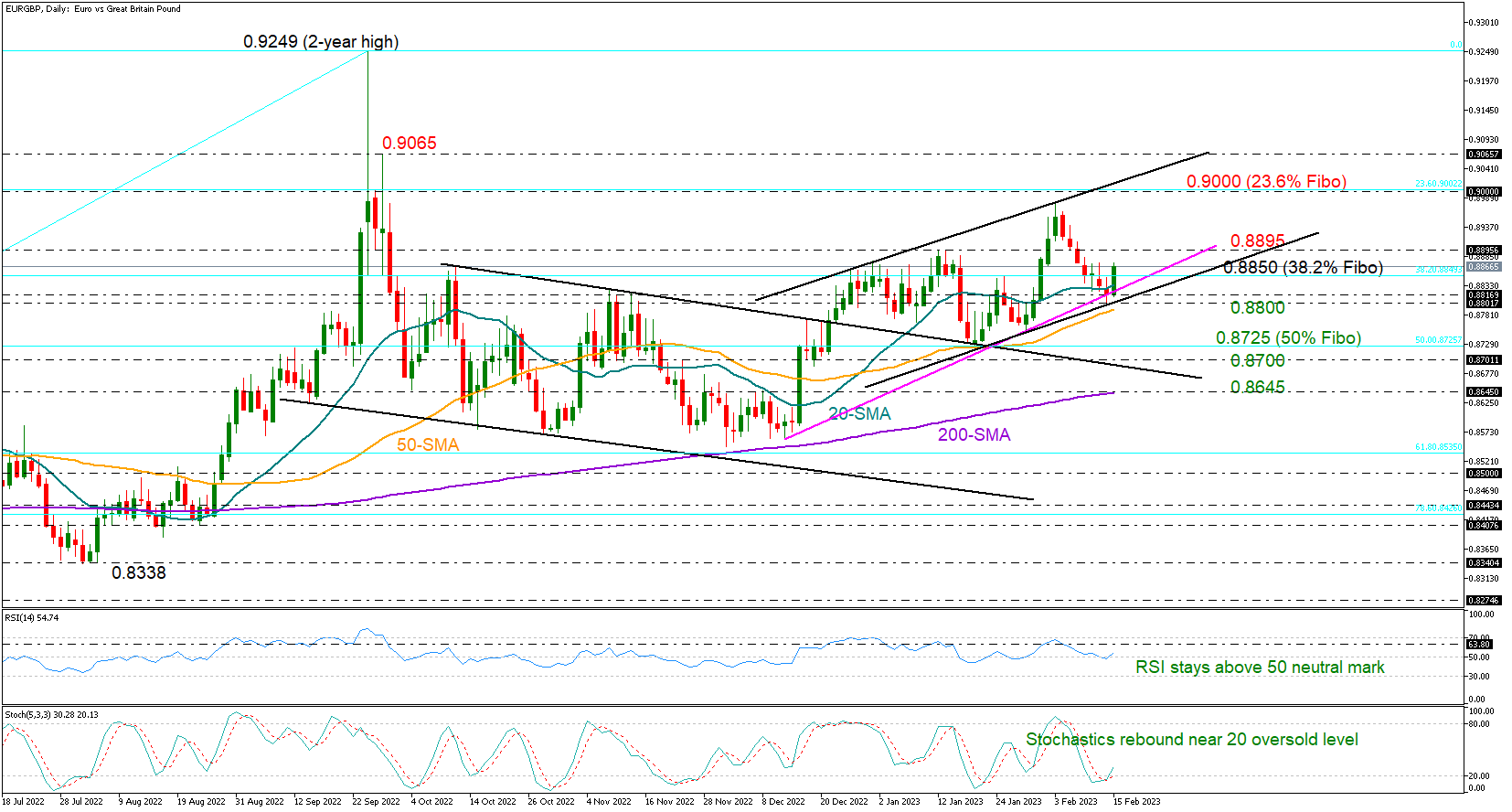
EURGBP revived its bullish momentum on Wednesday after a week of losses, which pressured the pair from February’s high of 0.8978 to the 0.8800 round level.
The pair is aiming to preserve strength above the short-term support trendline around 0.8820 and hold within the bullish channel. If it snaps the 38.2% Fibonacci retracement of the former 0.8201-0.9249 uptrend at 0.8850 too, the recovery may stretch towards the 23.6% Fibonacci of 0.9000 and the channel’s upper surface. Some consolidation around January’s resistance of 0.8895 cannot be excluded. Beyond 0.9000, the spotlight will fall on 0.9065, where the market faced strong rejection last September.
Technically, the market has not confirmed a bullish bias yet. The latest rebound in the RSI and the stochastic oscillator is still in progress, with the former remaining close to its 50 neutral mark and the latter barely increasing above its 30 oversold level.
A pullback below the 0.8800 number could prompt an aggressive decline towards the 50% Fibonacci of 0.8725, where January’s sharp downfall stalled. A continuation lower may immediately stabilize around the descending line from mid-December currently at 0.8700 before meeting the 200-day simple moving average (SMA) at 0.8645. Note that the line maintains a golden cross with the 50-day SMA, feeding hopes that the uptrend from August will resume.
In brief, EURGBP is setting a foothold for its next bullish wave. A close above 0.8895 could clear the way towards the 0.9000 level.
GBP/JPY Finishing an Upward Correction
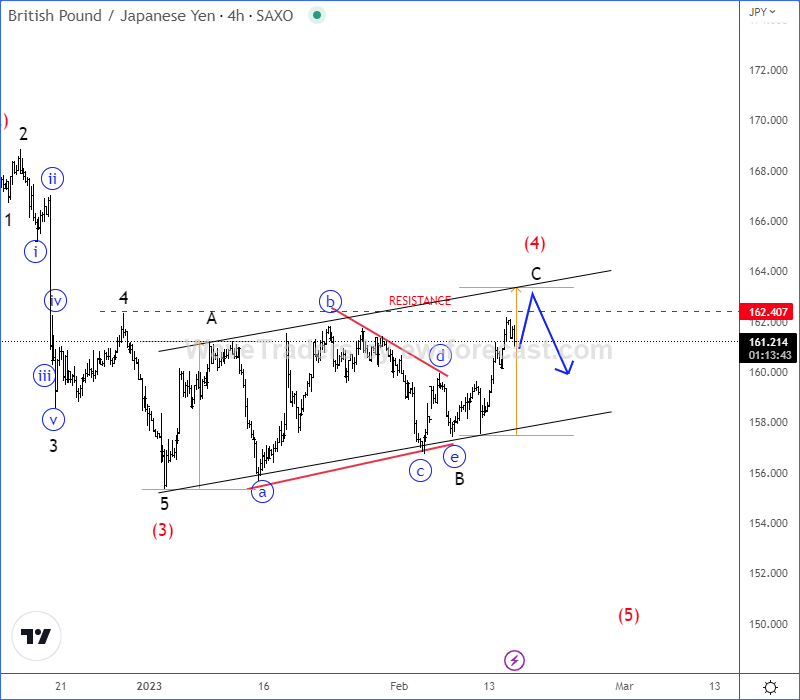
GBPJPY faced a massive decline recently which we see it as a higher degree wave (3) of a five-wave bearish impulse. So, current recovery should be an upward wave (4) correction within downtrend, especially if we respect slow price action and choppy + overlapped wave structure. We can actually see a three-wave A-B-C corrective rally within (4), but the main reason for a corrective movement is a potential triangle within wave B in the middle. We know that triangles cannot occur in wave 2, so it must be wave B as part of an A-B-C correction.