Sample Category Title
EUR/GBP Daily Outlook
Daily Pivots: (S1) 0.8735; (P) 0.8760; (R1) 0.0.8782; More...
Intraday bias in EUR/GBP remains neutral at this point. On the downside, below 0.8720 will resume the fall from 0.8896 to 61.8% retracement of 0.8545 to 0.8896 at 0.8679. Sustained break there will pave the way back to retest 0.8545 low. On the upside, though, above 0.8802 will bring retest of 0.8896 resistance.
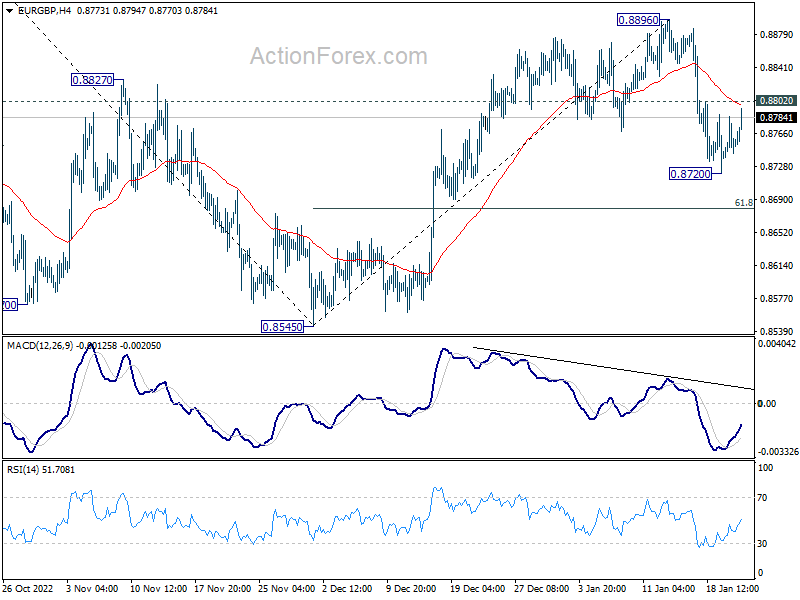
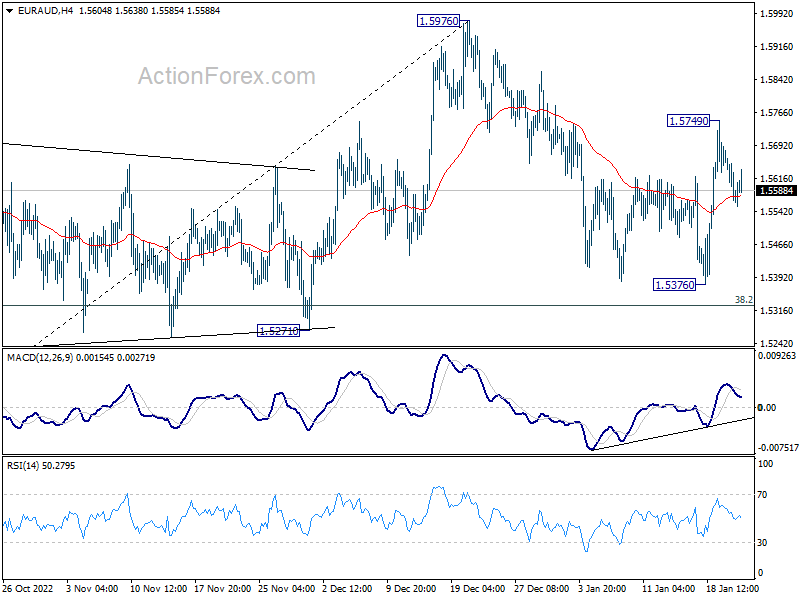
In the bigger picture, current development argues that rebound from 0.8545 is merely a correction to fall from 0.9267. Sustained trading below 55 day EMA (now at 0.8748) will affirm this bearish case and target 0.8545 and below. Nevertheless, strong rebound from current level will retain near term bullishness for another rise through 0.8896 later.
EUR/AUD Daily Outlook
Daily Pivots: (S1) 1.5536; (P) 1.5609; (R1) 1.5654; More...
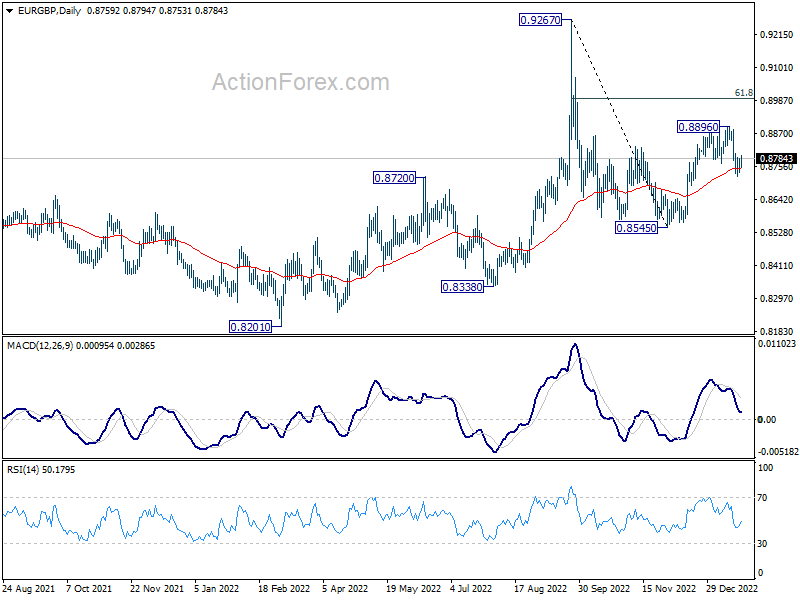
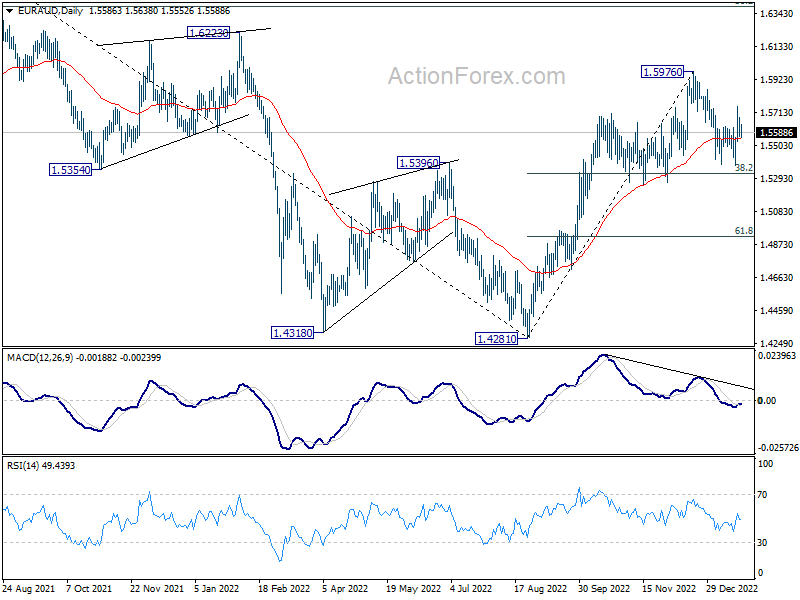
Intraday bias in EUR/AUD remains neutral for the moment. Corrective pattern from 1.5976 could still extend with another fall. But strong support could be seen from 38.2% retracement of 1.4281 to 1.5976 at 1.5329 to bring rebound. On the upside, above 1.5749 will resume the rise from 1.5376 for retesting 1.5976 high.
In the bigger picture, it's still early to confirm if rise from 1.4281 represents bullish trend reversal. But as long as 1.5271 support holds, such rally is in favor to continue. Break of 1.5976 will target 1.6434 key resistance next. On the other hand, firm break of 1.5271 will retain medium term bearishness instead.
EUR/CHF Daily Outlook
Daily Pivots: (S1) 0.9939; (P) 0.9969; (R1) 1.0021; More....
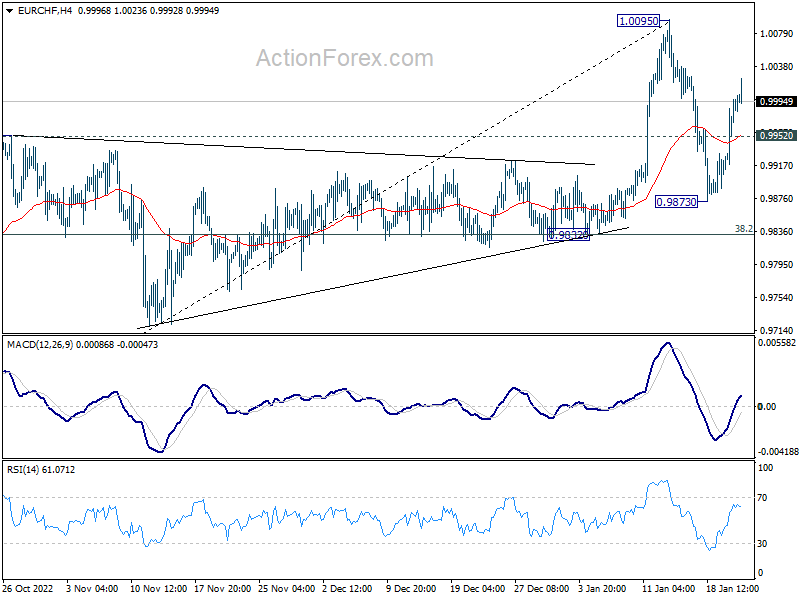
Intraday bias in EUR/CHF remains on the upside as rebound from 0.9873 extends higher today. Further rise would be seen to retest 1.0095 resistance. On the downside, though, break of 0.9952 minor support will turn bias back to the downside to resume the correction to 38.2% retracement of 0.9407 to 1.0095 at 0.9832.
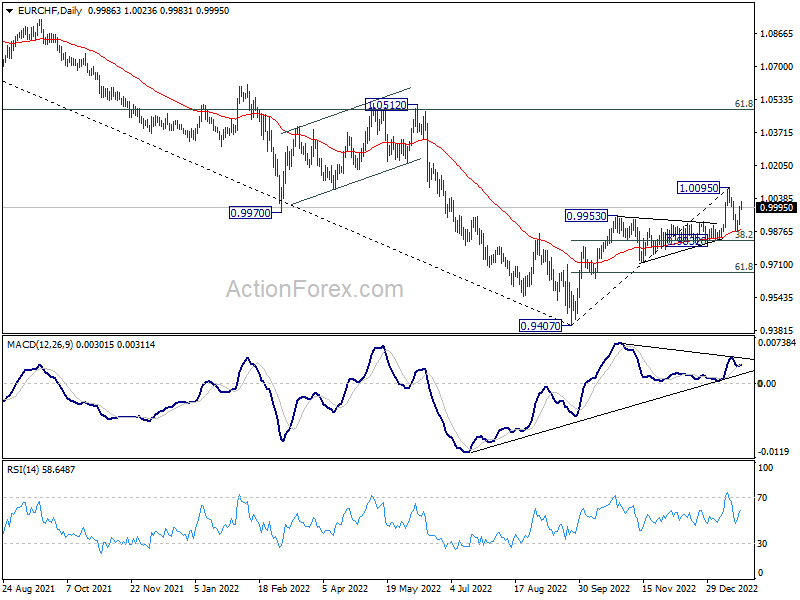
In the bigger picture, the initial rejection by 55 week EMA (now at 1.0039) mixed up the outlook. On the upside, sustained trading above 55 week EMA will raise the chance of bullish trend reversal. Rise form 0.9407 should then target 1.0505 cluster resistance (2020 low at 1.0505, 61.8% retracement of 1.1149 to 0.9407 at 1.1484). However, firm break of 0.9832 support will revive medium term bearishness and bring retest of 0.9407 low instead.
Gold Falls Slightly Below the 9-Month Gigh
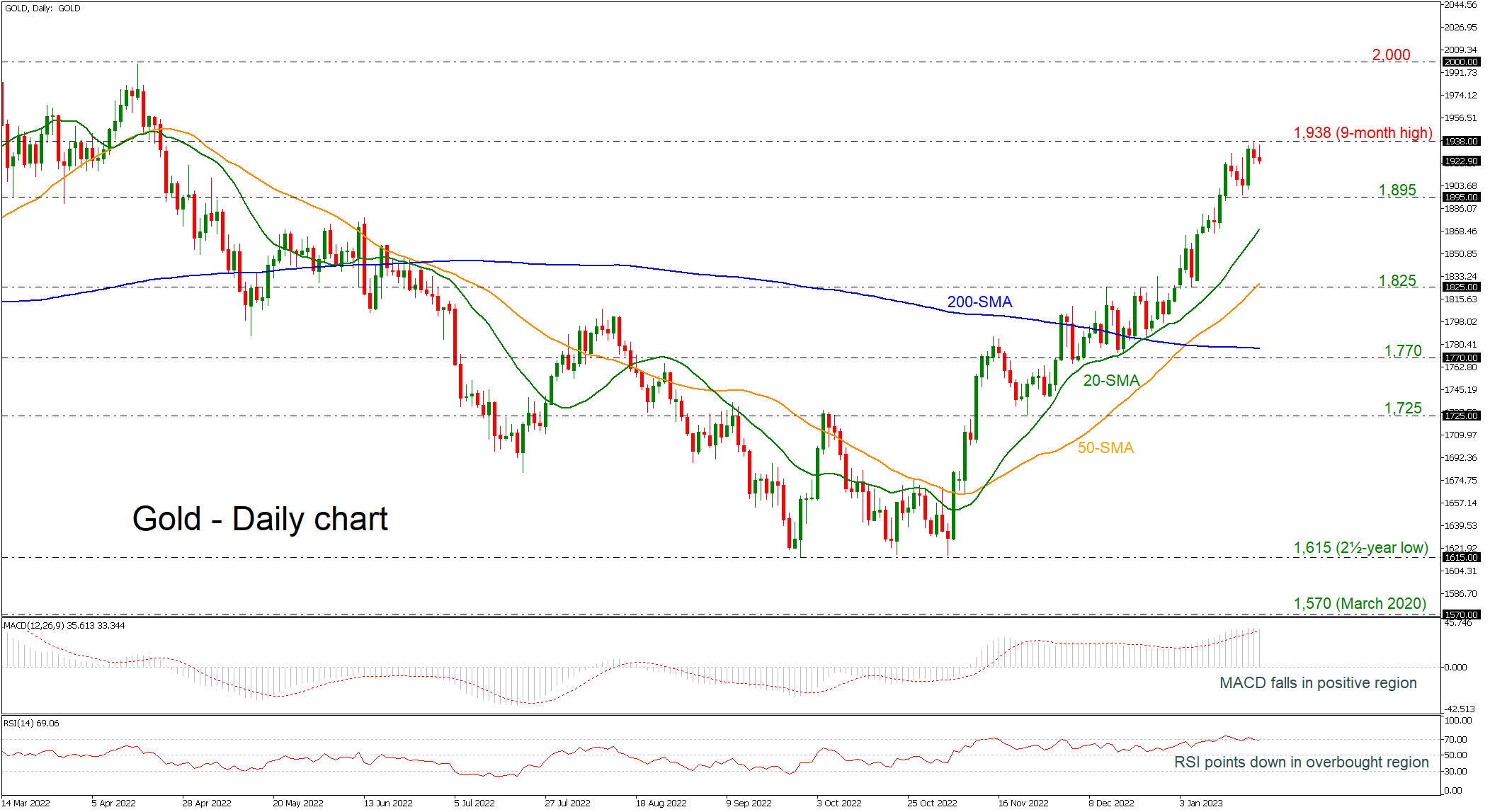
Gold rallied towards a fresh nine-month high of 1,938 in the preceding week, but quickly lost some ground and is currently moving slightly lower. The commodity added more than 20% from the two-and-a-half-year low of 1,615 and is holding well above the short-term simple moving averages (SMAs).
Technically, the MACD oscillator is moving marginally lower near its trigger line in the positive territory, while the RSI is easing after the pullback in the overbought region, suggesting that the momentum is weakening.
More downside pressures may open the door for the 1,895 barrier ahead of the 20-day SMA at 1,870 and the 50-day SMA, which overlaps with the 1,825 support. Any moves towards the 200-day SMA at 1,777 and below that at 1,770 could switch the outlook to neutral in the near-term timeframe.
In the positive scenario, a climb beyond the nine-month peak of 1,938 could drive the market towards the crucial 2,000 round number, reached in April 2022, before challenging the 20-month peak of 2,070.40.
Summarizing, gold is looking predominantly bullish in the medium-term timeframe, and only a decline beneath the 1,770 obstacle may change this view.
Dax 40 Holds on to Gains
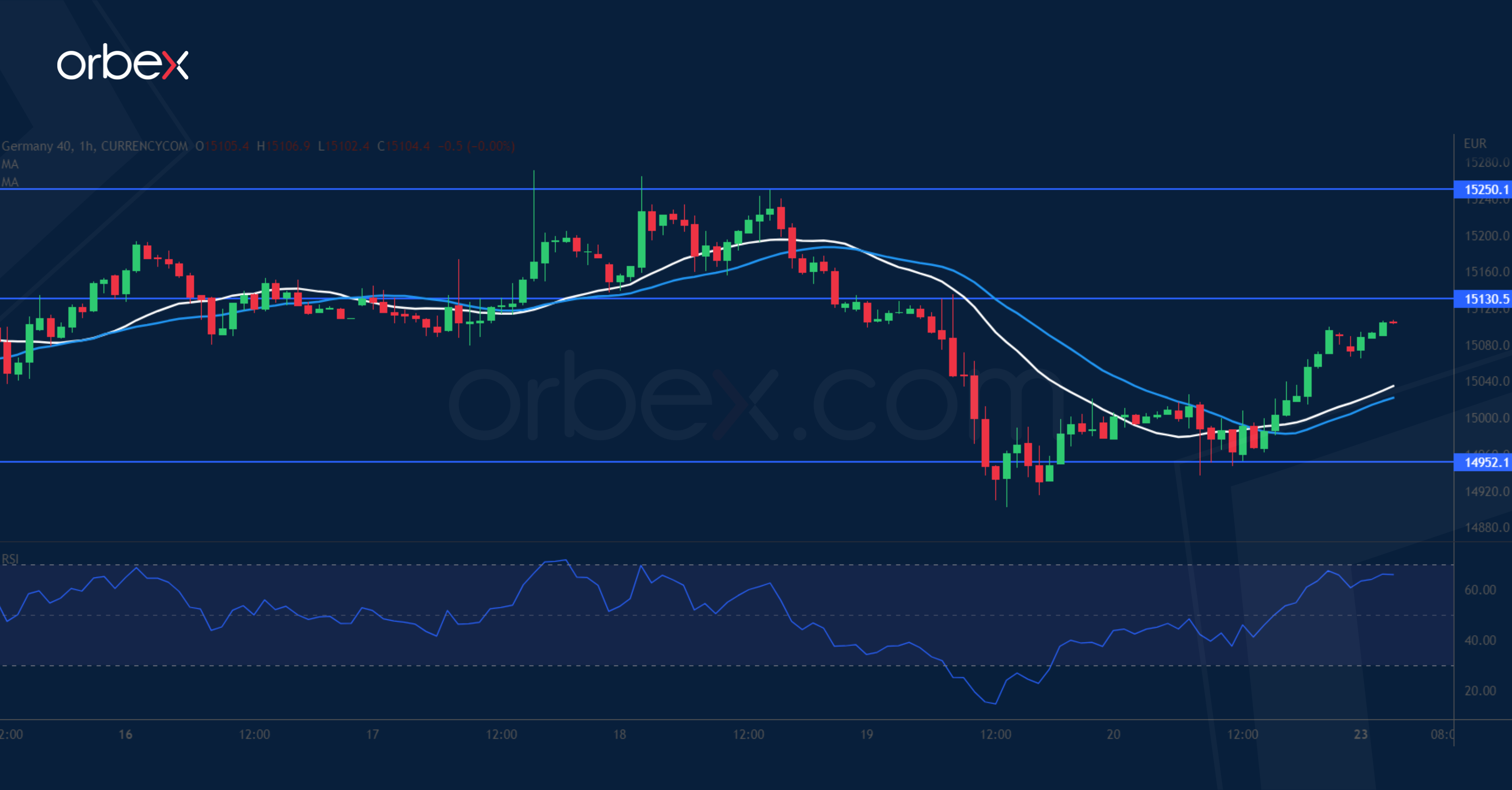
The Dax 40 recouped losses as investors saw a bargain hunting opportunity. On the daily chart, the RSI’s double top in the overbought area suggests overextension after the index recovered to a 11-month high. A break below 15100 then the psychological level of 15000 has prompted complacent buyers to look for the exit. The bounce may come under pressure at 15130 and only a close above 15250 would resume the uptrend. 14950 is a fresh support and 14800 further down is the next level to gauge buyers’ interest.
EUR/GBP Licks Wounds
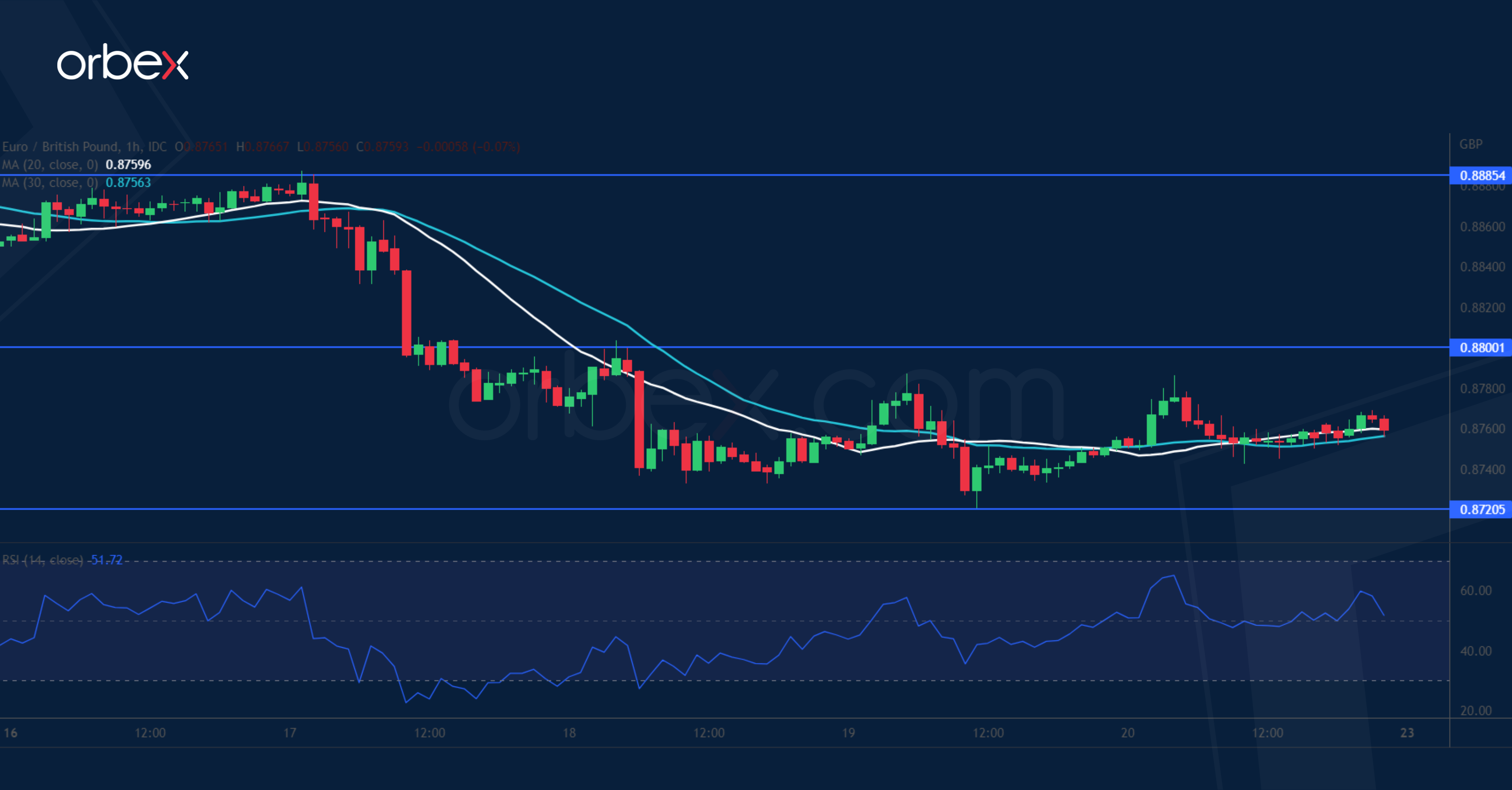
Sterling fell back over weak retail sales in December. A sharp fall below the previous swing low at 0.8770 has put the bulls on the defensive. The single currency is resting on 0.8720 at the base of the bullish breakout in late December. Sentiment has grown cautious and the sideways action may end soon in a breakout. A hold above this critical floor would challenge 0.8800 where a breakout could help the pair recover to 0.8880. Failing that, a bearish turn would trigger a new round of sell-off and send the pair to 0.8650.
USD/JPY Struggles to Rebound
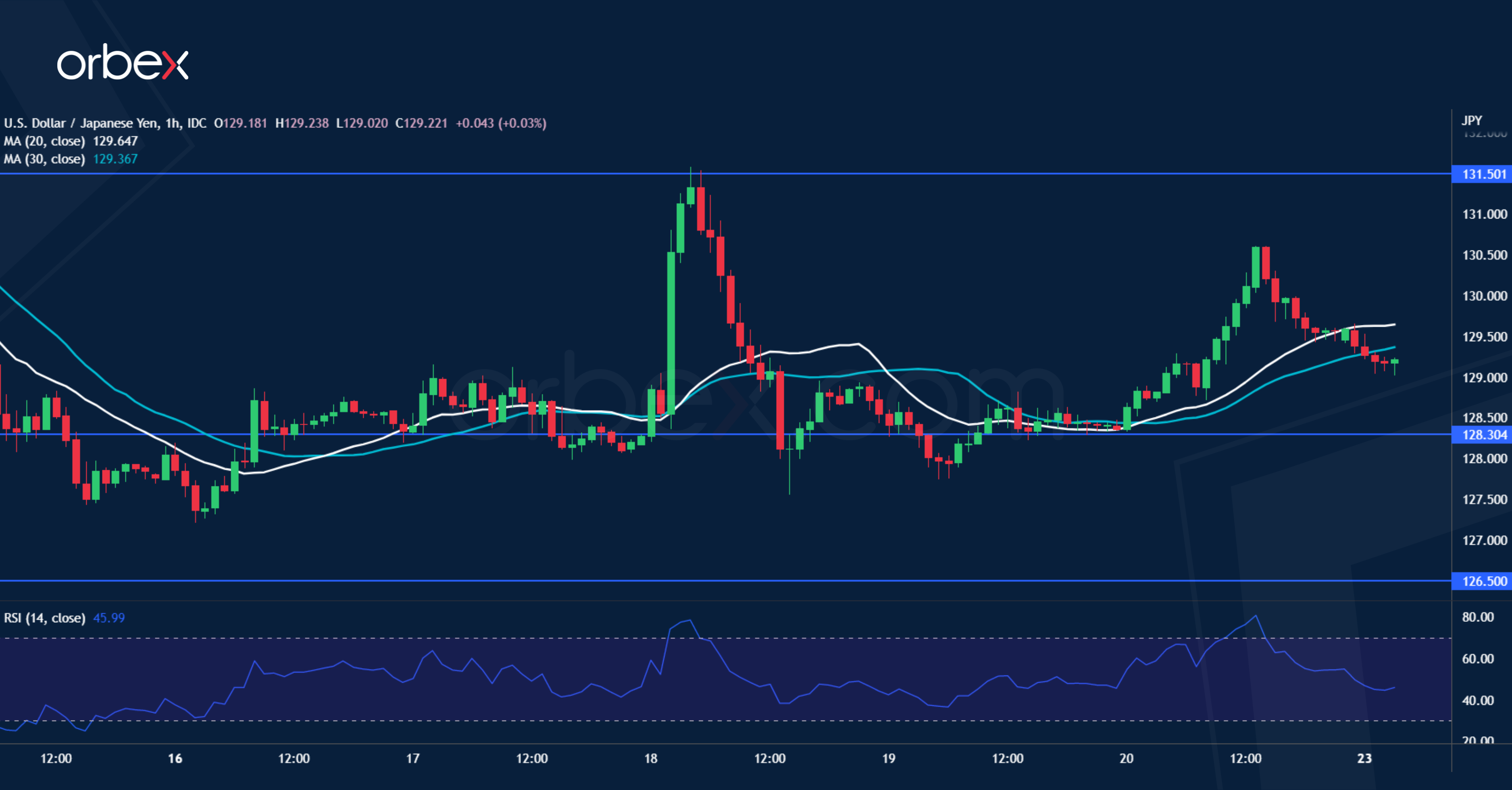
The US dollar edges lower due to bearish inertia across the board. On the daily chart, the pair is still hovering above last May’s lows of 126.50 as the bulls strive to keep the outlook rosy in the medium-term. The price action has stabilised above 127.80 with the latest bounce above 128.90 suggesting an improved mood. Still, the bulls will need to clear the faded peak at 131.50 before they could regain the upper hand. Otherwise, a drop below 128.30 could make the greenback walk on thin ice above 126.50.
EUR/USD Makes a First Attempt at 1.09
Markets
German Bunds extended their underperformance against US Treasuries as ECB protagonists keep hitting the same nail. 50 bps rate hikes seem granted at least in February and March with current consensus suggesting rate hikes in May and June as well. This hawkish path clinches with the drop in yields since the start of the year. It lasted until last Thursday before core bonds – and Bunds in particular – faced new selling pressure. German yields added 5.1 bps (2-yr) to 14.2 bps (30-yr) on a daily basis. A 10% rise in the reference European gas contract (TTF) played its role as well as colder/normal winter weather arrives. Daily changes on the US yield curve ranged between +4.5 bps (2-yr) and +9.3 bps (30-yr). The sell-off on bond markets unlike on Thursday didn’t spill into stock markets. Main European indices narrowly held on to small gains for most of the session while US benchmarks rallied into the weekend in a tech-driven move. Nasdaq rose by 2.6% with the S&P (1.9%) and Dow (1%) following. From a relative point of view, the US has been lagging Europe during the NY rally. The relative yield support in combination with positive risk vibes helped the euro to a weekly close above 1.08 (1.0856). The pair this morning in thin trading (lunar NY celebrations in China, Hong Kong, South-Korea,…) makes a first attempt at 1.09 with next resistance at 1.0942 (50% retracement on 2021-2022 decline). The trade-weighted dollar closed almost spot on the 102 big figure and is testing the sell-off low at 101.53 as well this morning. Sterling performed well last week with EUR/GBP failing to take out the resistance area roughly between 0.8850 and 0.89 as a batch of decent UK data (apart from Friday’s retail sales) suggested that the Bank of England won’t be able to drop its guard yet when comes to battling inflation. EUR/GBP this morning nevertheless joins the EUR/USD move higher with the pair changing hands around 0.8775.
Today’s eco calendar is thin with January EMU consumer confidence and some ECB speeches the sole events. We expect bonds to remain under (more modest) selling pressure while keeping a close eye on stock markets. Their strong start to they year is at odds with our market view (related to complacency around central banks’ reaction functions). On FX, a test of 1.0941 resistance is becoming unavoidable. Tomorrow will be more interesting with global PMI releases. Consensus expects a marginal improvement - though still sub 50 - from December levels which would reflect the less pessimistic vibe on growth since the start of the year. Other things to watch are the US Treasury’s end-of-month refinancing operation, the continuation of Q4 earnings season and the first estimate of US Q4 GDP on Thursday.
New Headlines
South America’s two biggest economies, Brazil and Argentina, will announce the start of preparatory works on a common currency. Dubbed the “sur” by Brazil, it would create the world’s second-largest currency bloc, after the euro, and reduce reliance on the USD. The plan is still at a very preliminary stage and will be discussed at a summit in Buenos Aires this week. Its initial focus is on Brazil and Argentina but both will invite other Latin American countries to join. A union that covers all of Latin America would represent about 5% of GDP compared to the euro area’s 14%. The idea is not new and there have been talks in the past but they often stranded on (usually rightwing) political opposition and persistent macroeconomic imbalances of both countries.
European Council President Charles Michel proposes several steps to strengthen European economies in a response to the US’s Inflation Reduction Act. In an interview with Handelsblatt published yesterday, he said a successor to the social bonds of the SURE program would allow governments short in cash to make more green investments. The SURE program was launched early in the pandemic to finance short-term employment schemes. Michel also said there was a need for a “sovereignty fund” with the participation of the European Investment Bank. As EU member states are shareholders in the EIB, they would have more say and benefit directly from the investments made. Michel considers this concept as a more realistic alternative than issuing bonds similar as those under the EU’s post-pandemic recovery fund.
No Free Lunch: Earnings May Reveal Cost of High Interest Rates
EURUSD steadies over inflation relief
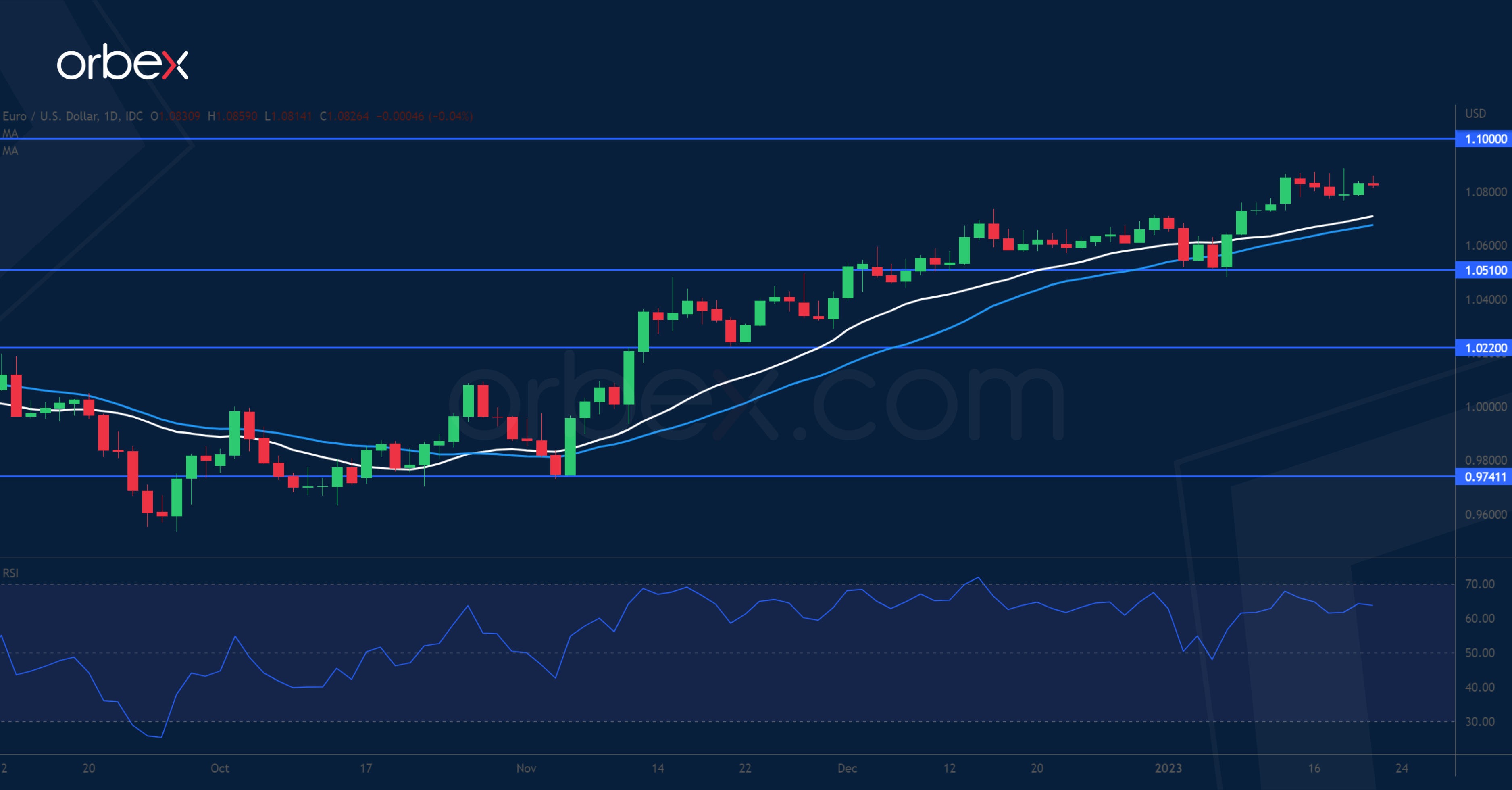
The euro holds steady as inflation slows down. With prices of oil and gas falling back, Europe could put the much-daunted winter behind. Inflation effectively decelerated in the Euro zone in December, which would give policymakers some relief. Easing pressures have triggered expectations that the ECB might reassess its tightening schedule. The prospect of a 25-bp increment in March following a 50-bp penciled in next month could drive the price action forward. The single currency has more upside should data suggest that economic fundamentals keep the recession at bay. The pair is to test 1.1100 with 1.0510 as a fresh support.
USDCAD awaits another BoC hike
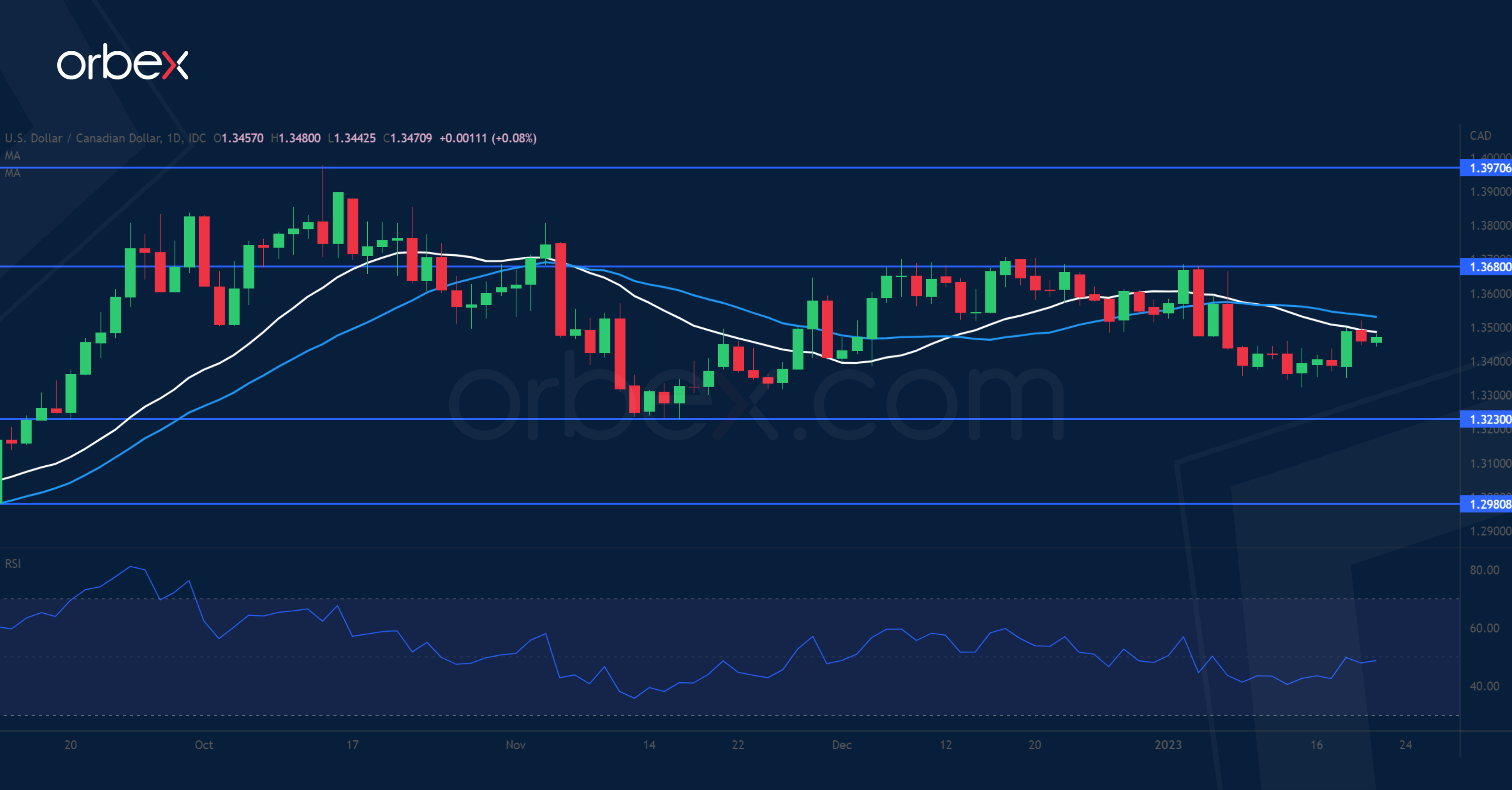
The Canadian dollar steadies as the market wagers on a 25-bp hike by the BoC. Inflation eased more than expected in December thanks to lower oil prices. But core components excluding food and energy remained high which shows that pressures notably from a tight job market still linger. The range bound price action suggests that traders expect both central banks to be near their peak rates. As their interest rates seemingly move in tandem, there is little opportunity for carry trades. What might set the US apart could be its resilience in case of a mild recession. The pair is testing the floor at 1.3230 and 1.3680 is a key resistance.
UKOIL struggles as global economy staggers
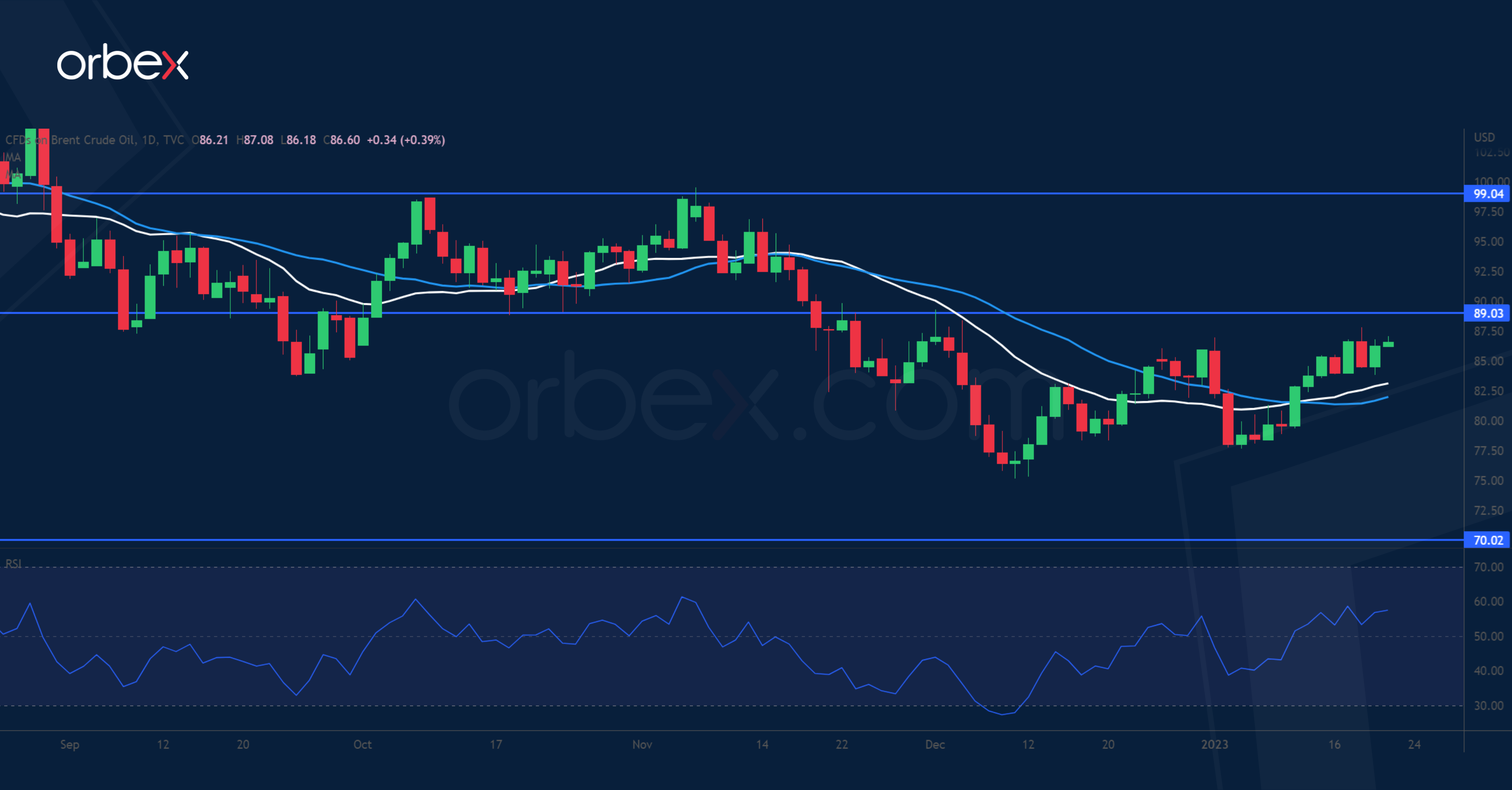
Brent crude softens as weak economic data rattle the market. Lacklustre performance across the commodity spectrum shows that traders still worry about the economic cost of the widespread policy tightening. Weak data out of the top consumers keep a lid on market sentiment. Disappointing US manufacturing output raises concerns of a hard-pushed soft-landing. While China recorded its worst growth since 1976 with GDP expanding by a mere 3.0% last year. Meanwhile, a surprise surge in US oil inventories tips the balance in favour of supply. The price is hovering between 70.00 and 89.00.
SPX 500 falls as earnings may disappoint
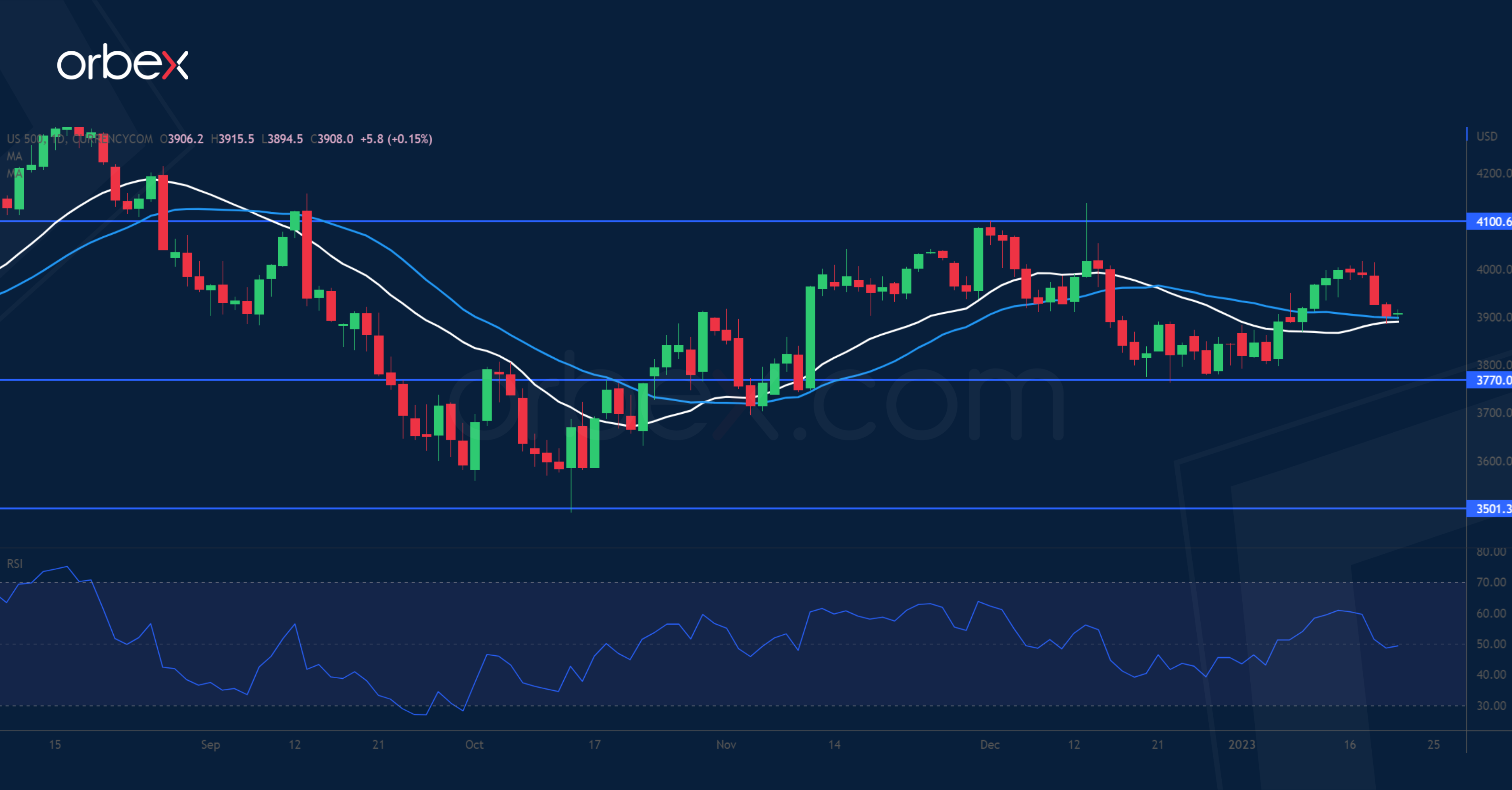
The S&P 500 slips as the market braces for a downtrend in earnings with the full impact of higher rates. The macroenvironment does not help with weak economic data and hawkish Fed comments being a rather bearish mix. The tightening has surely left its mark with producer prices and retail sales falling along the CPI. A feeble GDP reading could further fuel recession worries. Meanwhile, some officials’ insistence on pushing rates beyond 5% raises concerns of overshooting. After all, they were judged to be too slow to take the ‘transitory’ label off the inflation problem. The index is falling towards 3770. 4100 remains a key resistance.
USD/CAD Daily Outlook
Daily Pivots: (S1) 1.3337; (P) 1.3418; (R1) 1.3461; More....
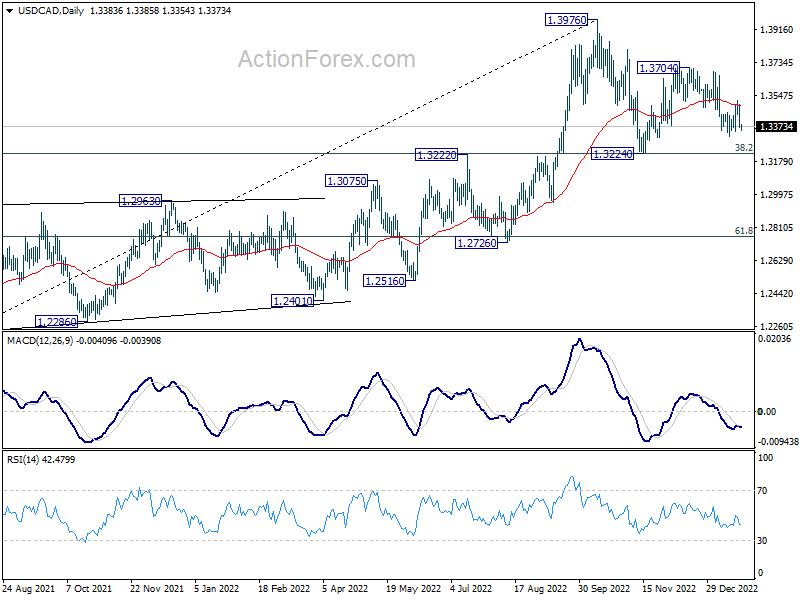
Intraday bias in USD/CAD remains neutral for the moment. On the downside, break of 1.3320 will resume the fall from 1.3704 to 1.3224 key support level. On the upside, though, above 1.3519 will turn bias back to the upside for 1.3704 resistance.
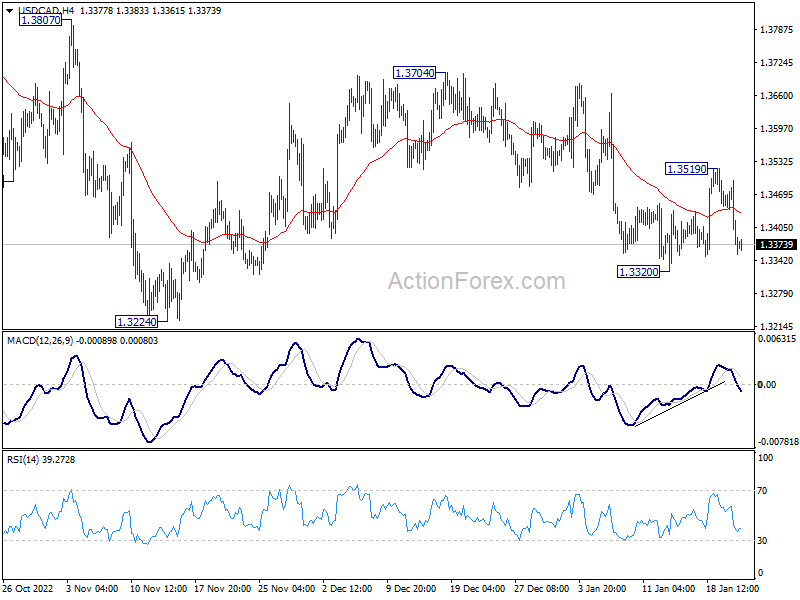
In the bigger picture, as long as 1.3222 cluster support (38.2% retracement of 1.2005 to 1.3976 at 1.3223) holds, larger up trend from 1.2005 (2021 low) is still expected to resume through 1.3976 high at a later stage. However, firm break of 1.3222/3 will indicate that the trend might have reversed. Deeper fall would be seen to next cluster support at 1.2726 (61.8% retracement at 1.2758).