Sample Category Title
ECB Kazimir: We need to deliver two more hikes by 50bps
ECB Governing Council member Peter Kazimir said, "An inflation drop in two consecutive months is good news. But it is not a reason to slow the tempo of raising interest rates... I am convinced that we need to deliver two more hikes by 50 basis points."
"For me, the most important is core inflation trend," Kazimir said. "We are halfway through. If it were up to me, I would enter summer holidays with the tightening cycle completed. But don't ask me today, how high we will go with the rates, and how long will they need to stay there to tame inflation as needed."
Euro Rally’s Last Ditch
The EURUSD reached 1.09 early Monday, its highest level since April last year. A strong uptrend has been in place for the past four months, during which time the pair has risen from lows just above 0.95 to the current level of 1.0915, or +14.5%. While the overall uptrend in the pair is probably a long-term story, signs of accumulated fatigue need to be recharged.
On the daily EURUSD chart, the Relative Strength Index has been flirting with the overbought territory since mid-November. However, shallow and short-lived (three days) corrections have erased local overbought conditions. Such corrections have given the market room to grow.
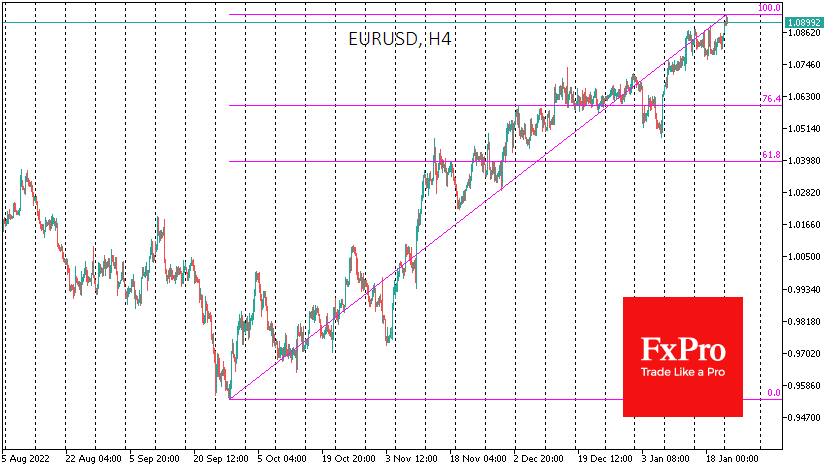
However, the market has now approached overbought conditions on the weekly chart. This often signals commodities and equity markets to prepare for a reversal. However, in the case of the EURUSD, touching the overbought/oversold area is just a strong enough signal for a correction in a couple of weeks, but not necessarily for a long-term reversal, so there is no point in looking too far ahead.
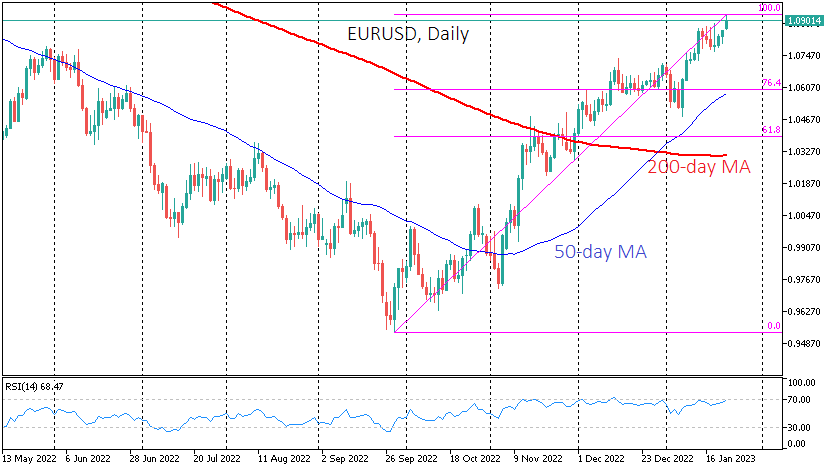
The market’s focus on better-than-expected Eurozone data was a significant driver for the pair. The chances of avoiding a recession have been boosted by the hawkish tone of ECB officials, who have signalled that they will raise interest rates in 50-point increments at the next two meetings. Consumer confidence is also expected to improve thanks to lower energy prices and signs of easing inflationary pressures.
However, in our view, markets have been too dismissive of the Fed’s signals that it is prepared for a prolonged fight against inflation rather than settling for a short-term victory. Fed officials have been saying for the past month that they are prepared to raise rates further than the market expects and will not cut in 2023. But the markets are still betting on rate cuts before the end of the year, according to futures market estimates.
We saw a similar divergence between market expectations and the Fed’s stance in June and August last year, leading to a fresh wave of equity sell-offs and a rise in the dollar. Something similar now is brewing.
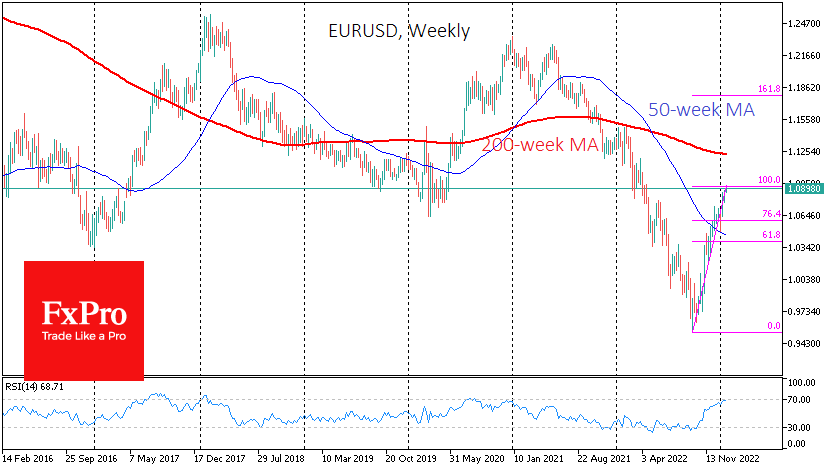
If we are right and a medium-term correction from 1.09 begins, it can take the pair below 1.06 (76.4% of the rally from the September lows). A deeper correction could take EURUSD back to 1.0400-1.0450.
The lower boundary of the range is the support line at 61.8% of this rally, and the upper edge is the 50-week moving average. Breaking this line has been an essential part of the pair’s long-term reversals in the history of the euro. And only a consolidation below it would call into question that the euro entered a long-term bull market in the last quarter of last year – when the news background was especially dramatic.
A Big Week of Earnings
Not the most eventful start to the week but that's unlikely to last with earnings being a particular focus in the coming days.
This is likely to be one of the busier earnings weeks with some major names scheduled to report. It hasn't been a great start and disappointing results last week, particularly in financials, took the wind out of the sails of the new year rally. There's a more downbeat tone to earnings season now, with a particular focus on layoff announcements.
There's been a significant reluctance by firms to let staff go after the struggles of the last couple of years in re-hiring those released during the pandemic. But the number of firms doing so is rising and it's not just contained to the tech sector, which in itself has let staff go in the tens of thousands.
As the number of firms releasing staff grows, so does the risk of those that were reluctant becoming less so, and before you know it, it becomes something of a doom loop. Perhaps that's extreme but there is a risk that a growing and more widespread list of firms take similar measures and the unemployment rate, after staying stubbornly low for so long, pops higher quite suddenly and sharply.
For this reason, central banks need to tread carefully now as economies have had to quickly absorb a large number of interest rate hikes and the potential for unintended consequences has risen. I expect that will be the case with most drawing the tightening cycle to a close in the current quarter.
Difficult decisions for BoJ
The Bank of Japan is obviously one of the outliers in all of this, with policymakers clearly of the view that no tightening cycle is warranted. There is a growing debate around this and the minutes from the December meeting highlighted to some degree the extent to which the conversation has become more troubling. I don't expect that will get any easier now that they've begun tweaking the yield curve control tool - the beginning of the end in all likelihood - inflation has risen, wages are expected to follow and a new Governor will soon be in place.
Oil edges higher on China reopening
Oil prices are a little higher at the start of the week, continuing to trade around the peaks from earlier this month and late December. The Chinese reopening on the back of much more relaxed Covid curbs has boosted demand expectations, lifting the price of crude in the process.
While the reopening itself will no doubt prove to be complicated, particularly over the holiday season, early indications suggest there has been a rise in activity meaning the economy could perform better during the transition as well as the recovery. That could see Brent move back into the $90-$100 range as the oil market tightens.
Rally stalling
Gold is trading a little higher today but the new year rally appears to have stalled, with momentum indicators trending lower. This happened towards the back end of the year as well but rather than triggering a correction, a shift in broader market sentiment saw momentum pick up once more and gold rally, which could easily happen again. If not, we could see a correction building, with gold now almost 20% off its November lows and a little over 6% from all-time highs.
Choppy but holding gains
It's been a fantastic start to the year for bitcoin after a frankly woeful 2022, which traders will have been delighted to see the back of. It's been a choppy few days, with bitcoin trading between roughly $22,300 and $23,300. That's a range many would have only dreamed about a few weeks ago and it will be interesting to see what that does for interest after such a turbulent period. Will traders be keen to get back in or are they still fearful of more negative headlines ahead? Early signs are promising but then, this is crypto and volatility comes with the territory.
Japanese Falls Below 130, BOJ Core CPI Next
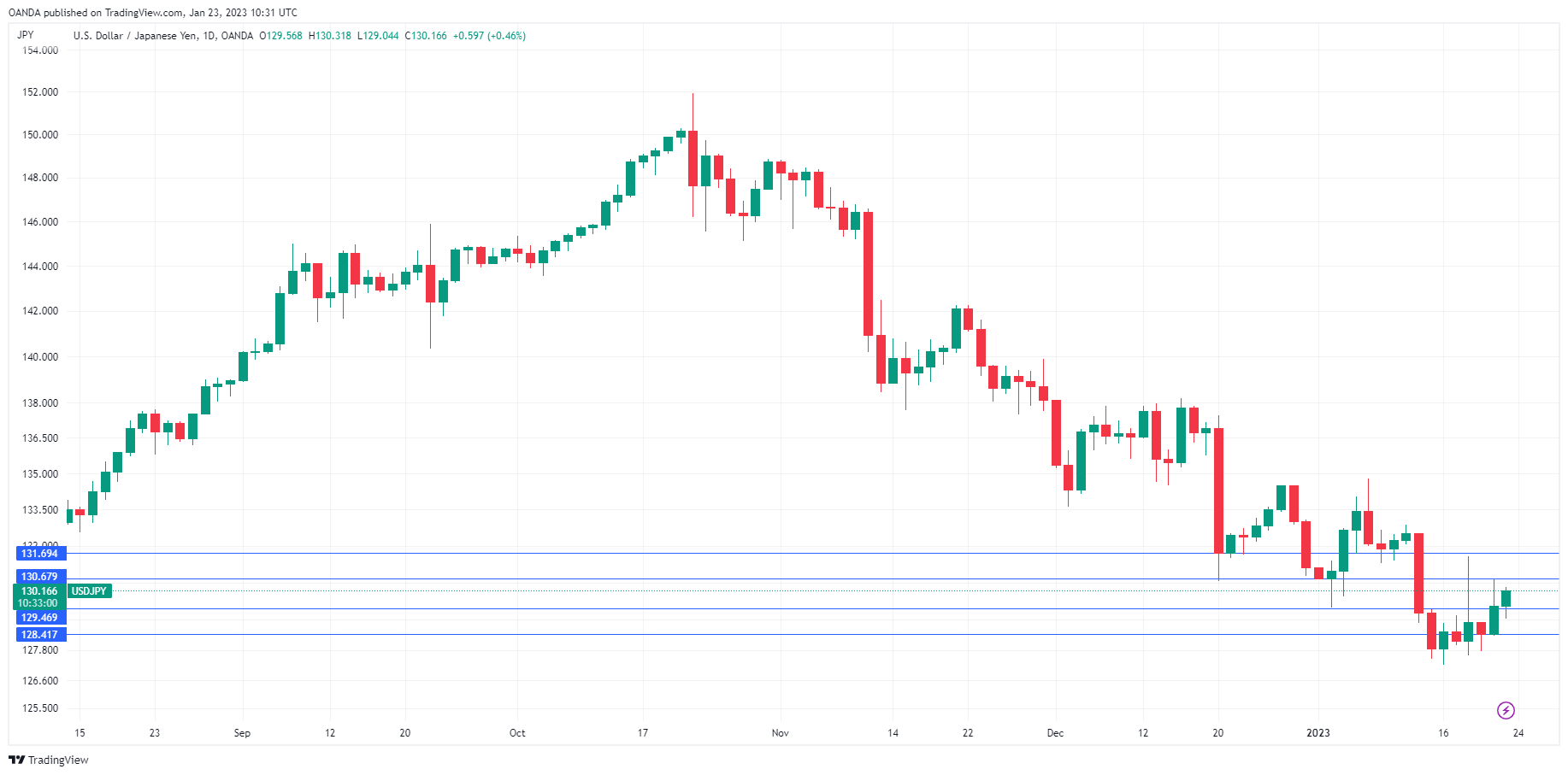
The Japanese yen has edged lower on Monday. In the European session, USD/JPY is trading at 130.15, up 0.45%. The yen slipped 1.3% against the dollar last week, falling as low as 131.57 before recovering.
Inflation heads higher
Core CPI jumped 4.0% y/y in December, its highest level since 1981. This matched the forecast and followed a 3.7% gain in November. The usual suspects were at play, as food and energy prices rose sharply. Energy prices climbed 15.2%, while food prices were up 7.4%, the fastest pace since 1977. Core CPI has exceeded the BoJ’s 2 percent inflation target for nine straight months, as the central bank’s argument that inflation is transitory has become increasingly hard to defend. The BoJ is projecting that inflation will peak at 3% in March, but it’s unclear why inflation will start to fall, barring a complete turnaround in energy and food prices. With wage growth lagging behind inflation, the cost of living is squeezing consumers, who are likely to cut back on consumption which will hamper economic growth.
We’ll get another look at inflation on Tuesday, with the release of the central bank’s preferred inflation gauge, BoJ Core CPI. The index rose steadily in 2022, from just 0.8% in January to 2.9% in November. The consensus for December is unchanged but a reading of 3.0% or higher will put pressure on the BoJ to tighten policy, which would be bullish for the yen.
The BoJ surprised the markets last week when it maintained policy settings at its monthly meeting. The non-move may have been primarily aimed as an ambush on speculators who bought yen in anticipation of the BOJ tightening policy. Still, the markets are expecting a shift in the BoJ’s ultra-loose policy, although it could occur after the new governor takes over in April. What is clear is that the BoJ will continue to command the attention of traders. The BoJ’s next meeting is on March 8th.
USD/JPY Technical
- There is resistance at 130.67 and 131.69
- 129.46 and 128.41 are providing support
Bundesbank: Germany GDP likely to have roughly stagnated in Q4
Bundesbank said in the monthly report that real GDP was "likely to have roughly stagnated in the final quarter of 2022, exceeding earlier expectations". Real GDP grew 1.9% in 2022 as a whole, comparing to 2021. "It thus slightly exceeded the pre-pandemic level again."
Consumer price momentum "continued to weaken" in December, due to "significantly lower energy prices". However, "non-energy components such as food, industrial goods and services continued to rise sharply".
EURUSD Hits 9-month High; Set for its Next Bullish Cycle
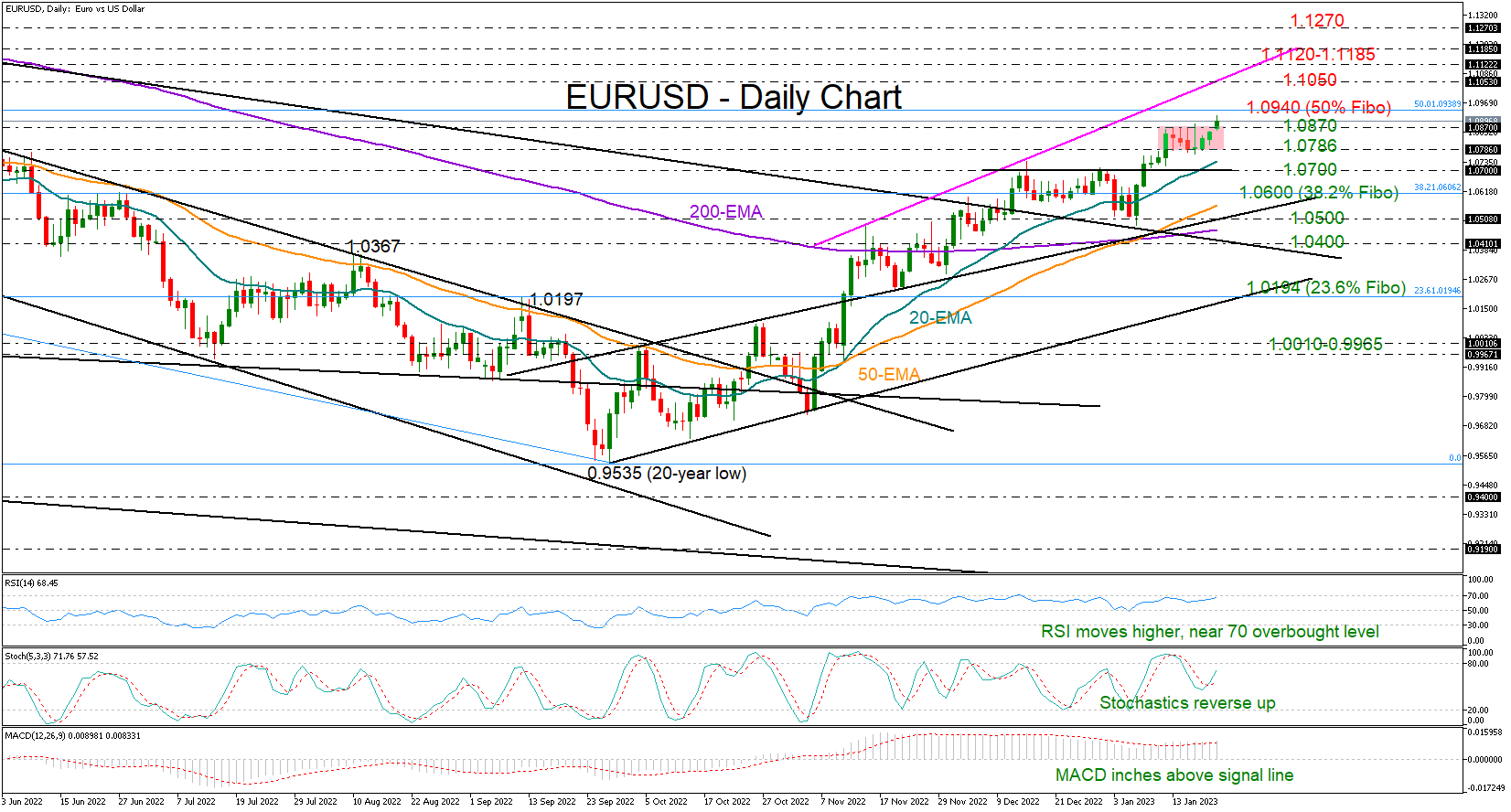
EURUSD is looking to start a new bullish cycle after gently breaking out of its weekly range to print a new nine-month high of 1.0919 earlier today.
The odds are favoring the bulls according to the technical indicators. The exponential moving averages (EMAs) are all sloping upwards, with the 50- and 200-day EMAs having recently registered a clear golden cross for the first time since June 2020. This is a solid positive sign that the four-month-old uptrend could experience further improvement. In momentum indicators, the MACD is also sending positive vibes, while the RSI and the stochastic, although near their overbought levels, have yet to show any signs of weakness.
Unless the 50% Fibonacci retracement of the 1.2348-0.9535 downleg blocks the way higher at 1.0940, the rise could continue towards the key resistance line seen around 1.1050. Slightly higher, some congestion could emerge within the 1.1120-1.1185 constraining zone taken from Q1 2022. If this proves easy to overcome, the next stop could be around the 1.1270 barrier.
In the event the pair pulls below 1.0870 and back into the weekly range, the focus will shift to the 1.0786 base. Note that the 20-day EMA is approaching that area. Hence, failure to rebound here and a decisive close below the 1.0700 psychological mark, which acted as resistance at the end of December, may spark a quick decline towards the 38.2% Fibonacci of 1.0600. Then, the spotlight will fall on the 50-day EMA and the broken upward-sloping line at 1.0500, while not far below, the broken long-term resistance trendline from May 2021 near 1.0400 could be another important area to watch.
Summing up, buying pressures are expected to persist in EURUSD in the short-term, though some consolidation around 1.0940 cannot be ruled out before the important bar at 1.1050 comes on the radar.
Gold Price Started a Fresh Increase from $1,900
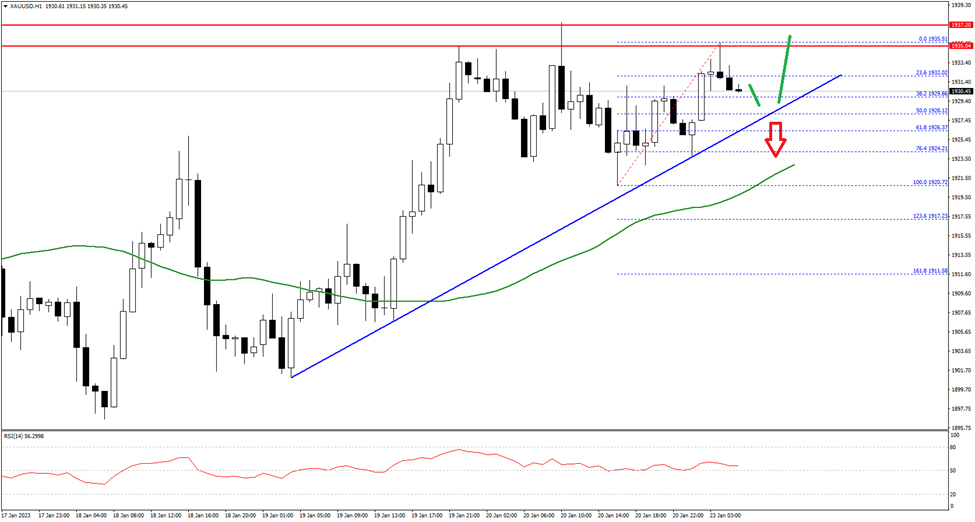
Gold price started a fresh increase from the $1,900 zone against the US Dollar. The price was able to settle above the $1,915 level to move further into a positive zone.
The pair even climbed above the $1,920 level and the 50 hourly simple moving average. The price is now trading above the $1,925 level and is showing positive signs. An immediate resistance on the upside is near the $1,935 level.
The first major resistance is near $1,938 on FXOpen. The next main resistance could be near the $1,945 level, above which the price could start a steady increase towards the $1,955 level.
On the downside, an immediate support is near the $1,927 level and a connecting bullish trend line. The next major support is near the $1,922 level, below which the price might decline towards the $1,905 support level in the near term. Any more losses might call for a test of $1,900.
USD/JPY: Bearish Trend Likely to Complete Near 127.55
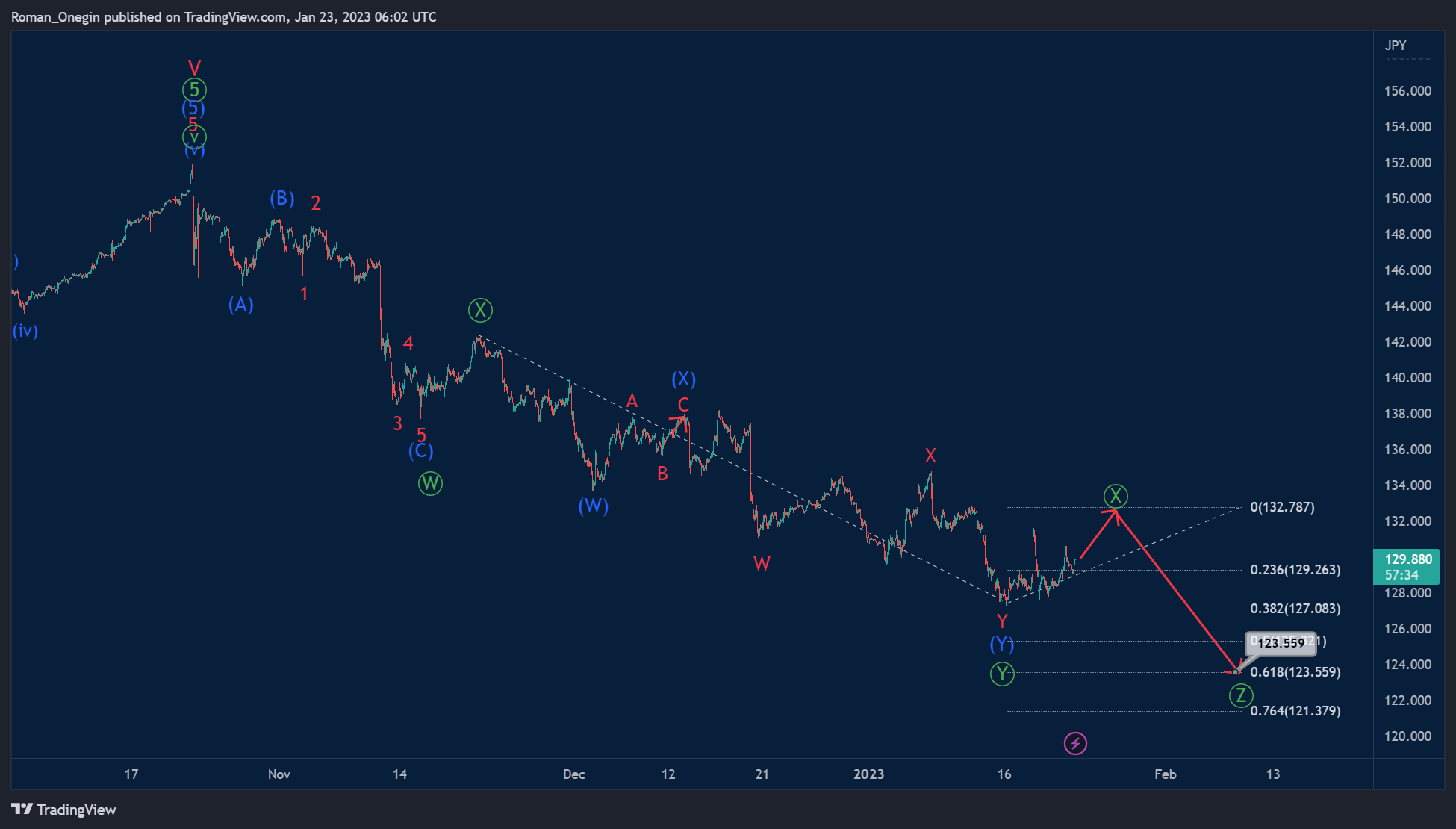
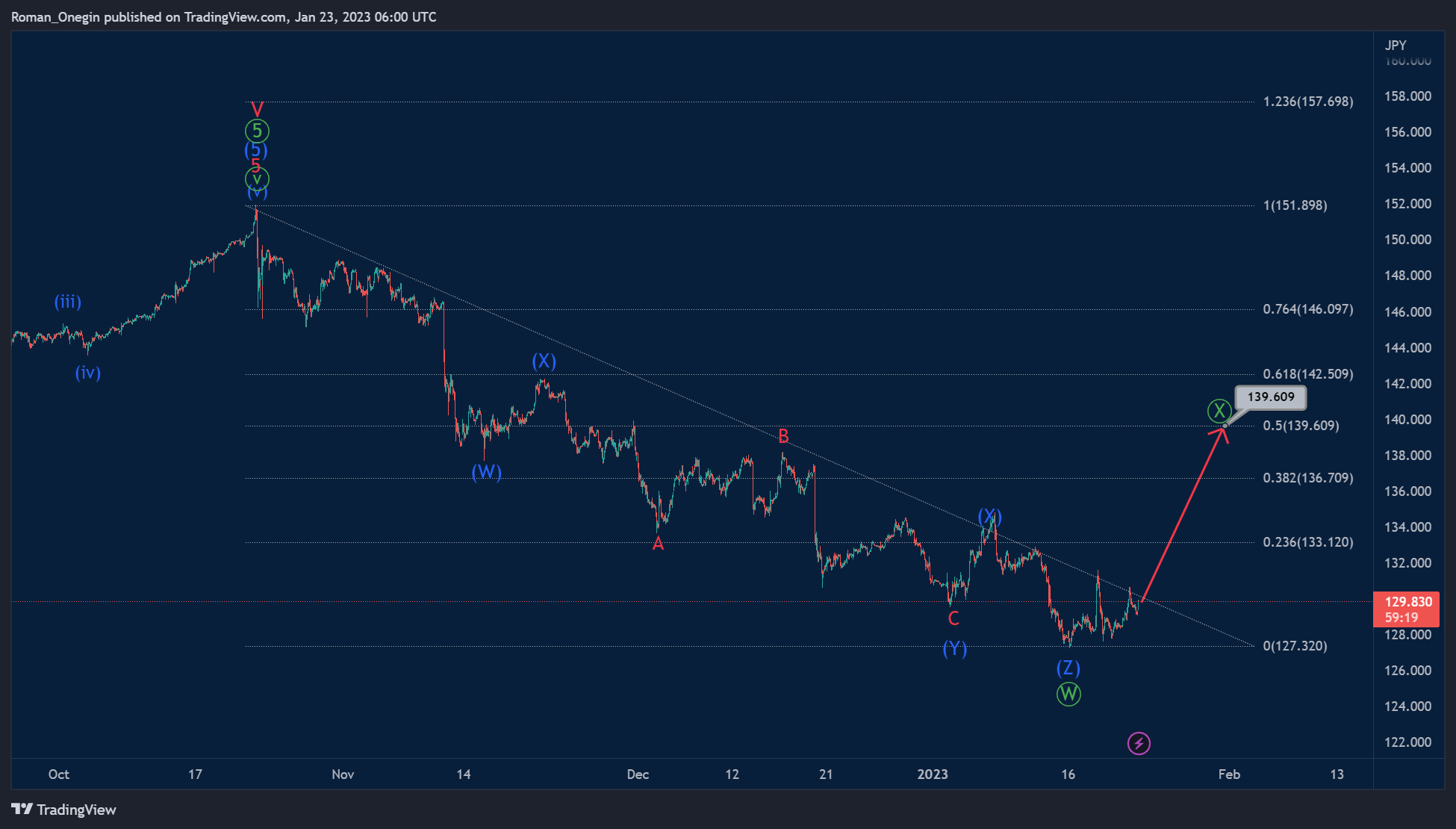
USDJPY suggests that the formation of a global cycle impulse could have been completed not so long ago. Then the fall of the exchange rate and the construction of a new bearish trend began.
Perhaps the market is developing a bearish triple zigzag of the primary degree Ⓦ-Ⓧ-Ⓨ-Ⓧ-Ⓩ. It is possible that the sub-waves Ⓦ-Ⓧ-Ⓨ have been completed to date.
Thus, in the near future we can expect the completion of the second intervening wave Ⓧ, after which it is possible to fall in the wave Ⓩ to 123.559. At that level, wave Ⓩ will be at 61.8% of wave Ⓨ.
Alternatively, it is assumed that in the bearish double zigzag, only the first actionary wave Ⓦ is completed, and the intervening wave Ⓧ is still under development.
It is possible that in the near future the price growth may continue in the wave Ⓧ to the level of 139.60.
At that level, wave Ⓧ will be at 50% along the Fibonacci lines of wave Ⓦ.
GBP/JPY Daily Outlook
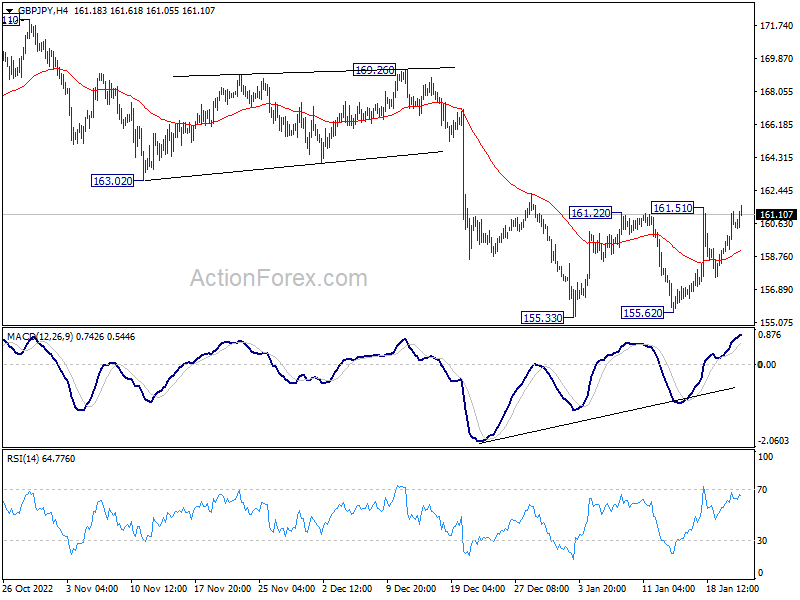
Daily Pivots: (S1) 159.36; (P) 160.33; (R1) 161.61; More...
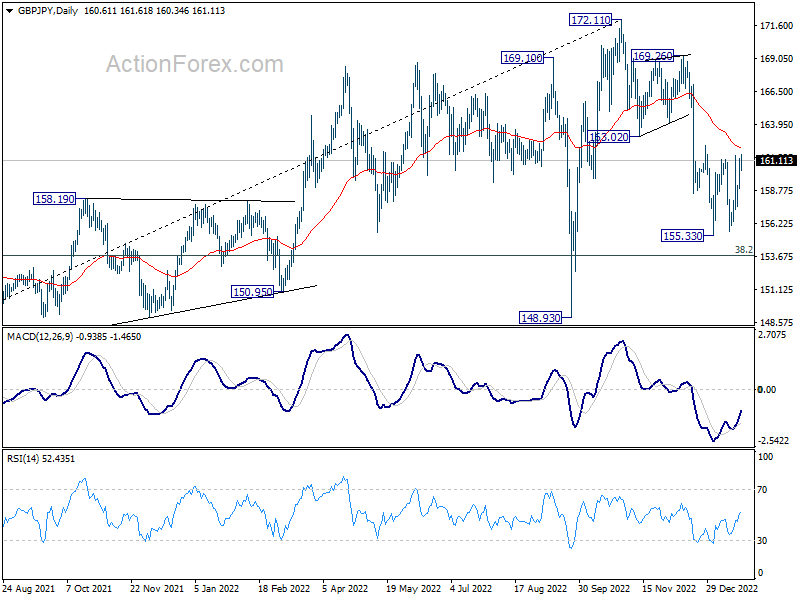
Intraday bias in GBP/JPY stays neutral for the moment. On the upside, above 161.51 will bring further rise to 55 day EMA (now at 162.32). Sustained trading above there will pave the way to retest 172.11 high. Nevertheless, on the downside, break of 155.33 will resume the whole decline from 172.11 to 153.70 fibonacci level.
In the bigger picture, as long as 163.02 support turned resistance holds, decline from 172.11 medium term top is expected to continue to 38.2% retracement of 123.94 to 172.11 at 153.70. Sustained break there will raise the change of trend reversal and target 61.8% retracement at 142.34. Nevertheless, break of 163.02 support turned resistance will argue that the decline has completed, and retain medium term bullishness.
EUR/JPY Daily Outlook
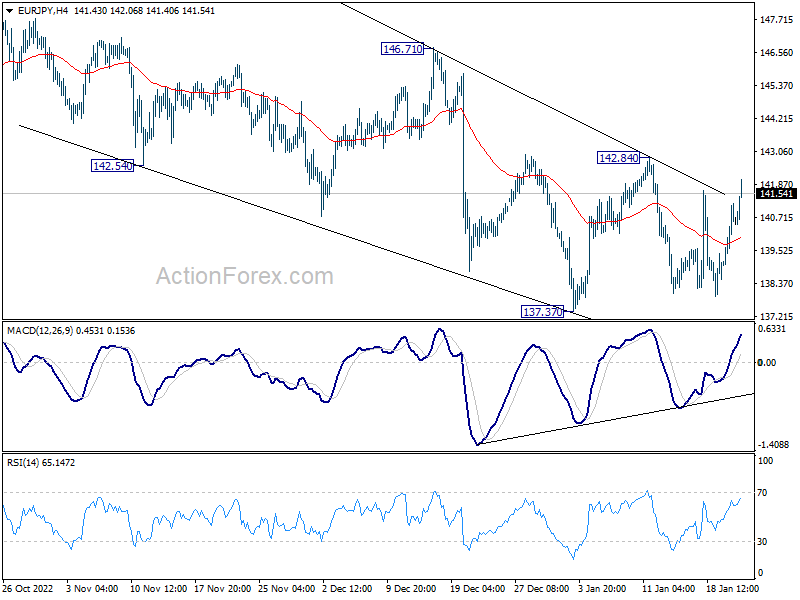
Daily Pivots: (S1) 139.37; (P) 140.29; (R1) 141.58; More....
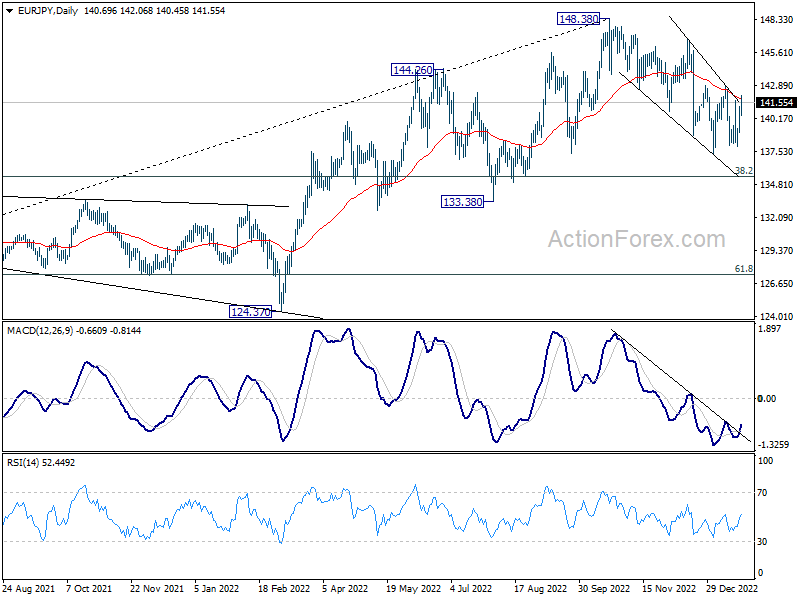
EUR/JPY is still bounded in range of 137.37/142.84 and intraday bias remains neutral. On the downside, break of 137.37 will resume the whole decline from 148.38 to 135.40 fibonacci level next. However, firm break of 142.84 will argue that the correction from 148.38 has completed, and bring stronger rise back to 146.71 resistance.
In the bigger picture, as long as 55 week EMA (now at 138.62) holds, larger up trend from 114.42 (2020 low) is still in progress for 149.76 long term resistance. However, firm break of 55 week EMA will bring deeper fall to 38.2% retracement of 114.42 to 148.38 at 135.40. Sustained break there will raise the chance of trend reversal, and target 61.8% retracement at 127.39.