Sample Category Title
Will Aussie Get a Boost from Labour Market?
Australia’s employment report for August is scheduled to be released on Thursday at 01:30 GMT, and it is believed that these data will attract some interest. Ahead of the data, the Australian dollar fell near $0.6900 after a significant pullback off the five-month high around $0.7000. While the domestic economy is robust, the country's heavy exposure to China is giving investors another reason to be bullish on the currency after China’s reopening.
Stable unemployment rate is expected
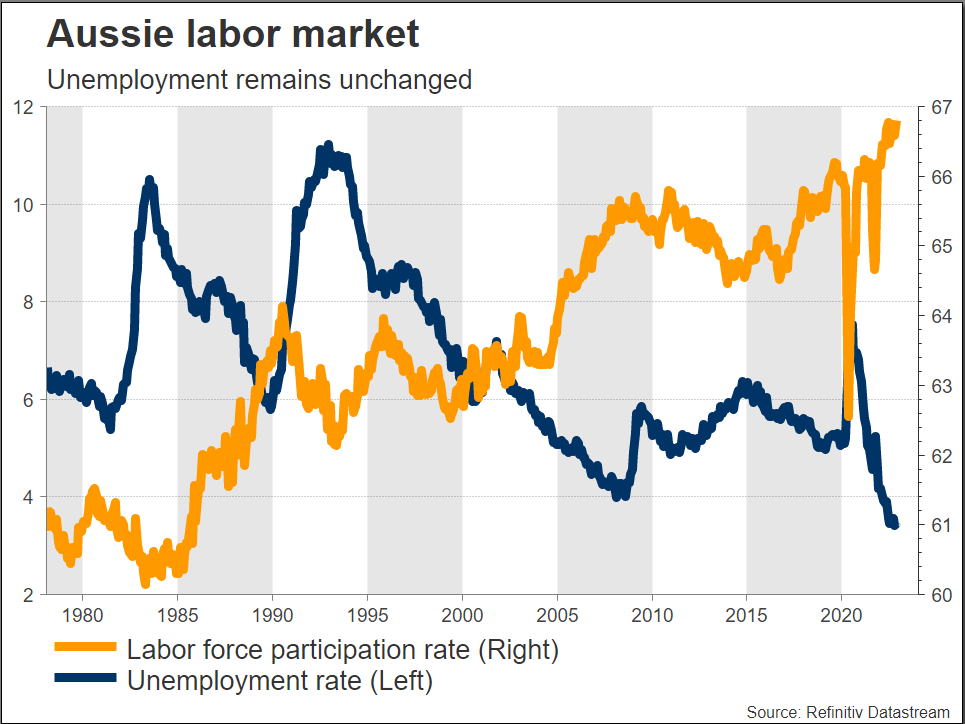
A solid labor market is partially responsible for the present surge in consumer confidence, robust household spending, and high earnings and inflation, all of which have contributed to the RBA's current cycle of rate hikes.
The number of people with jobs climbed by 64k in November, which contributed to the unemployment rate being at a 50-year low of 3.4%. In keeping with a softening in previous polls, it is anticipated that employment growth will drop to 22.5k in December. Furthermore, job vacancies fell by 4.9% over the three months leading up to November. It is anticipated that the unemployment rate will not move from its current level of 3.4%.
Interest rate futures are pricing in a probability of approximately 65% for a rate increase of 25 basis points (bps) at the RBA's board meeting in February. This would bring the cash rate up from 3.10% to 3.35%. Further along the rates curve, the market anticipates one more rate hike of 25 bps in the first half of this year. This would bring the cash rate to 3.60%, which is predicted to be at or near the RBA's estimate of the terminal level.
The Australian dollar, which is very sensitive to developments in China, has been the best performing major currency so far this year, as concerns about a worldwide recession have been fueled by disappointing economic data from China as a result of strict Covid-19 controls, so its strong performance is unlikely to continue. A combination of positive sentiment toward risk assets, anticipation of China's reopening, and the recent announcement that China will lift its embargo on some Australian exports has sent the Australian dollar higher.
Aussie shows signs for bull-market
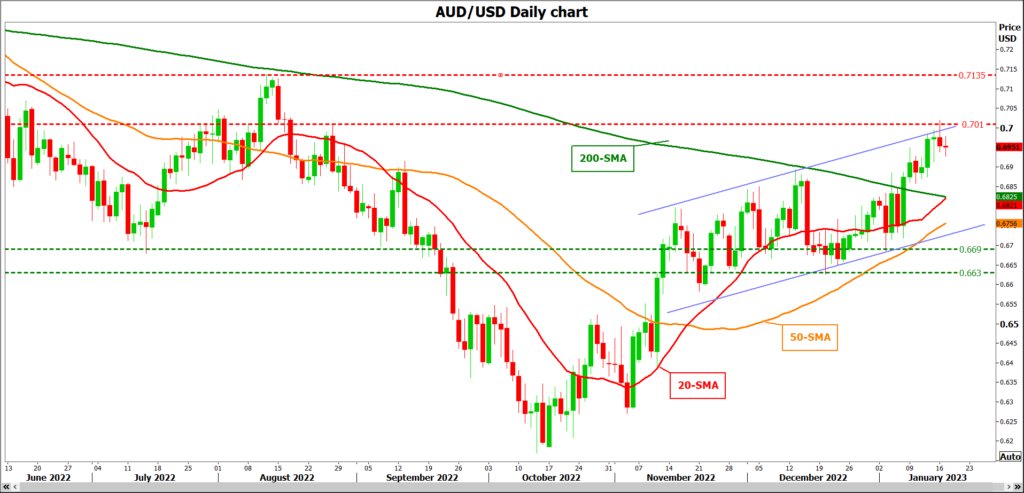
Aussie/dollar is showing some positive signs after the bounce off the 30-month low of $0.6170 on October 13. The pair has been developing within an ascending channel since mid-November and the 50- and the 200-day simple moving averages (SMA) are ready for a golden cross.
The pair could move higher if the employment report surprises on the strong side and unemployment declines further. The price is likely to test the $0.7010 resistance level, taken from the latest highs ahead of the $0.7135 barrier.
On the other hand, if the unemployment rate rises, the bears may sell the pair, visiting the bullish crossover within the SMAs near $0.6820. Steeper downside pressures may lead to the lower boundary of the channel and the 50-day SMA at $0.6750. Any moves lower could open the way for a bearish market.
Gold Price Remains In Strong Uptrend Above $1,880
Key Highlights
- Gold price started a fresh increase above the $1,900 resistance.
- A key bullish trend line is forming with support near $1,875 on the 4-hours chart.
- EUR/USD is consolidating gains above the 1.0780 support.
- GBP/USD might continue to rise above the 1.2300 resistance zone.
Gold Price Technical Analysis
Gold price formed a base above the $1,850 level against the US Dollar. The price started a steady increase above the $1,870 and $1,880 levels.
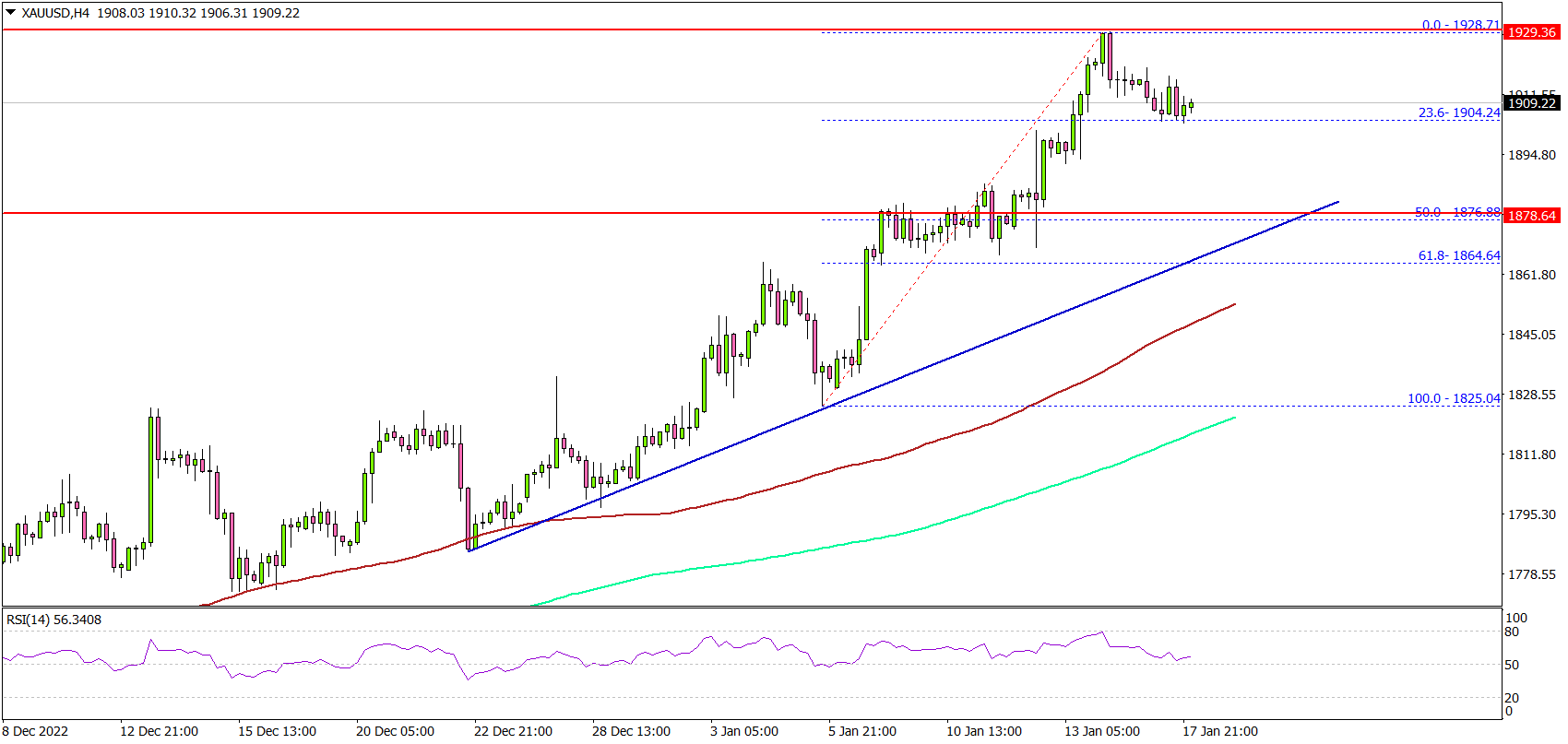
The 4-hours chart of XAU/USD indicates that the price gained pace above the $1,892 resistance zone. The price even moved above the $1,900 level and settled well above the 100 simple moving average (red, 4-hours) plus the 200 simple moving average (green, 4-hours).
The price tested the $1,930 and started a consolidation phase. On the upside, the price might face sellers near the $1,925 level.
The next major resistance is near the $1,930 level. Any more gains might send the price towards the $1,950 resistance level, above which gold price might visit the $2,000 resistance.
On the downside, an initial support is near the $1,900 level. The next major support is near the $1,880 level. There is also a key bullish trend line forming with support near $1,875 on the same chart.
The main support is near $1,865, below which gold price might struggle to stay above the $1,850 zone. In the stated case, gold price could slide towards the $1,820 support.
Looking at EUR/USD, the pair could attempt a fresh increase if it clears the 1.092 resistance zone in the coming sessions.
Economic Releases to Watch Today
- UK Consumer Price Index for Dec 2022 (YoY) – Forecast +10.6%, versus +10.7% previous.
- UK Core Consumer Price Index for Dec 2022 (YoY) – Forecast +6.6%, versus +6.3% previous.
- Euro Zone CPI for Dec 2022 (YoY) - Forecast +9.2%, versus +9.2% previous.
- Euro Zone CPI for Dec 2022 (MoM) - Forecast -0.3%, versus -0.3% previous.
- US Industrial Production for Dec 2022 (MoM) – Forecast -0.1%, versus -0.2% previous.
Silver Wave Analysis
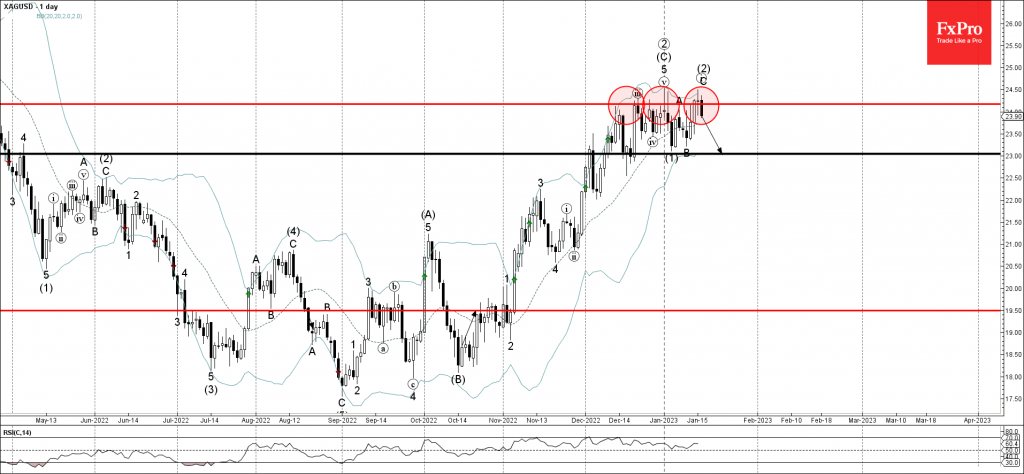
- Silver reversed from resistance level 24.15
- Likely to fall to support level 23.00
Silver recently reversed down from the key resistance level 24.15 (which has been reversing the pair from the start of December), intersecting with the upper daily Bollinger Band.
The downward reversal from the resistance level 24.15 stopped the previous intermediate ABC correction (2) from the start of January.
Silver can be expected to fall further toward the next support level 23.00 (low of the previous impulse wave (1)).
EURCAD Wave Analysis
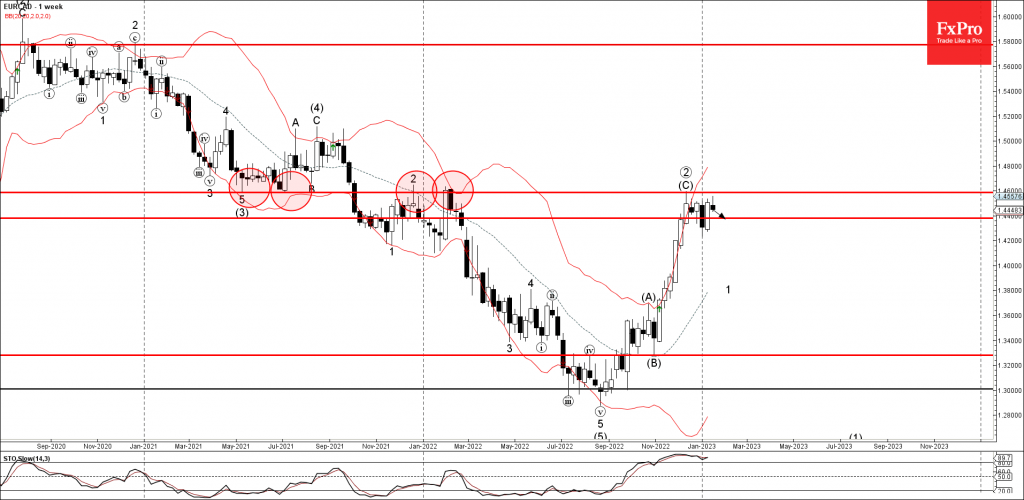
- EURCAD reversed from key resistance level 1.4585
- Likely to fall to support level 1.4400
EURCAD recently reversed down from the key resistance level 1.4585 (which has been repeatedly reversing the pair from the end of 2021 as can be seen below).
The downward reversal from the resistance level 1.4585 continues the active weekly downtrend from the start of 2020.
Given the overbought reading on both the daily and the weekly Stochastic indicators, EURCAD can be expected to fall further toward the next support level 1.4400.
An Improving Outlook for the Eurozone Economy and Currency
Summary
- Recent developments hint at some improvement in the outlook for what will still be a challenging 2023 for the Eurozone economy. A sharp drop in energy prices is driving a slowdown in headline inflation. Against this backdrop, real household incomes and consumer spending could be more resilient than previously expected and, indeed, Eurozone PMI surveys have already improved in recent months.
- Many Eurozone governments have also announced fiscal measures to shield European households and businesses from higher energy prices, suggesting fiscal policy could be modestly expansionary this year. Together, lower inflation and fiscal stimulus mean the risks are tilted towards a smaller 2023 Eurozone GDP decline than our current forecast for a 0.6% contraction.
- Meanwhile, Eurozone policymakers have made it clear that inflation remains much too high, and remain concerned at the persistence of core inflation pressures. The European Central Bank's policy outlook has turned notably more hawkish since December (we now forecast a policy rate peak of 3.25%), at a time when the Fed's policy monetary policy outlook has started to shift in a less hawkish direction.
- From a currency perspective, a more resilient Eurozone economy and more hawkish European Central Bank clearly offers a more supportive mix for the euro. With respect to our base case forecast, it is quite possible that some of the weakness we had anticipated in the EUR/USD exchange rate in early 2023 may in fact not eventuate. In addition, the risks to our Q1-2024 target for the EUR/USD exchange rate of $1.13 are clearly tilted to the upside.
Eurozone Growth Outlook Becoming Somewhat Less Dim
The momentum of the Eurozone's economic expansion slowed as 2022 progressed and, given historically elevated energy prices, rapid inflation and rising interest rates, we have long believed the region would fall into recession, beginning around the turn of this year. To be sure, we still expect the Eurozone economy to experience contraction. That said, recent developments hint at some improvement in the outlook for what will still be a challenging 2023.
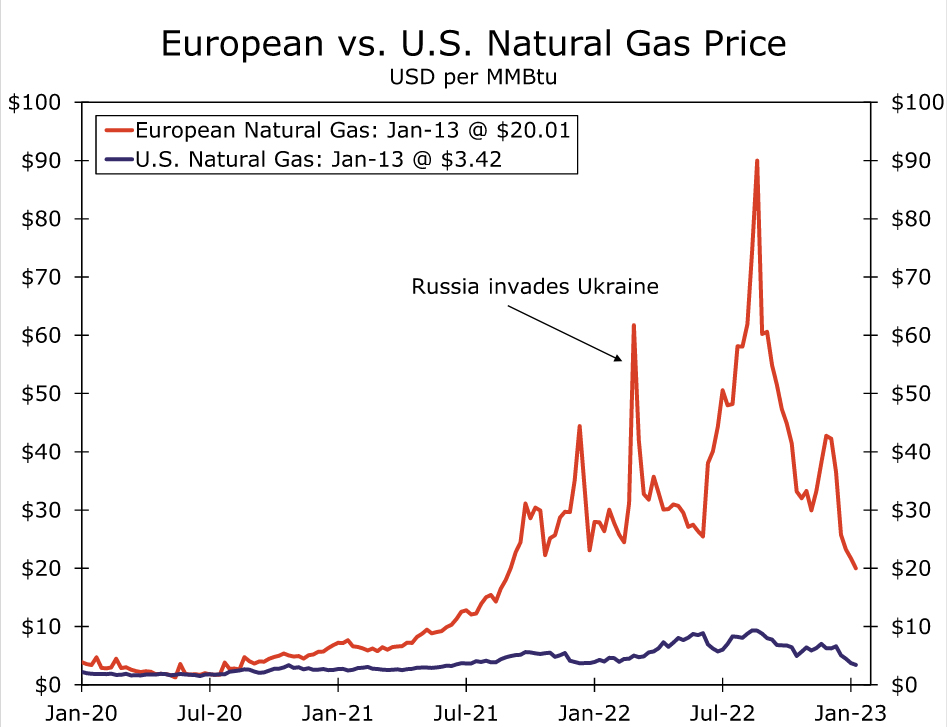
Most importantly, a sharp fall in energy prices offers potential relief for households, and could help the consumer sector to remain more resilient than previously forecast. European natural gas prices are down more than 75% from their August 2022 peak, while Brent crude prices have also fallen almost 35% from their March 2022 peak. To be sure, there remains some concern about a renewed rise in energy prices given the disruption of supply from Russia. By Q3-2022, the European Union sourced 15% of its natural gas imports from Russia (down from 39% for all of 2021), while the European Union sourced 14% of its oil imports from Russia (down from 25% for 2021). But for now at least, falling energy prices also offer the prospect of significant inflation relief for Eurozone households, a trend that is already underway. In December, the Eurozone headline CPI slowed to 9.2% year-over-year, down from a peak of 10.6% in October. Importantly however, there has not yet been any easing in broader underlying prices pressures, with core CPI inflation quickening further to 5.2% year-over-year in December.
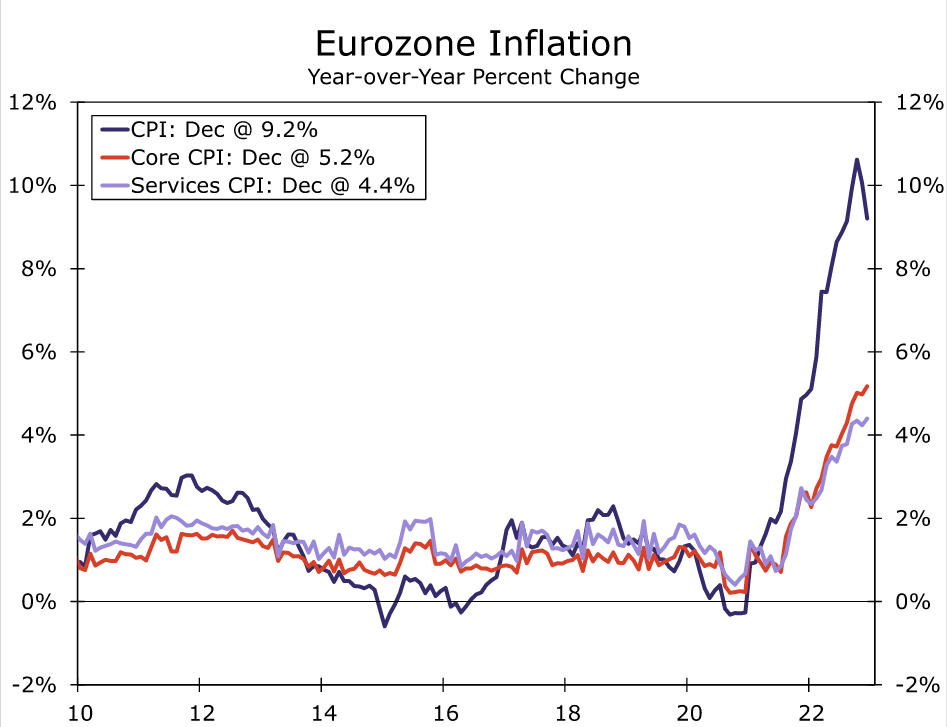
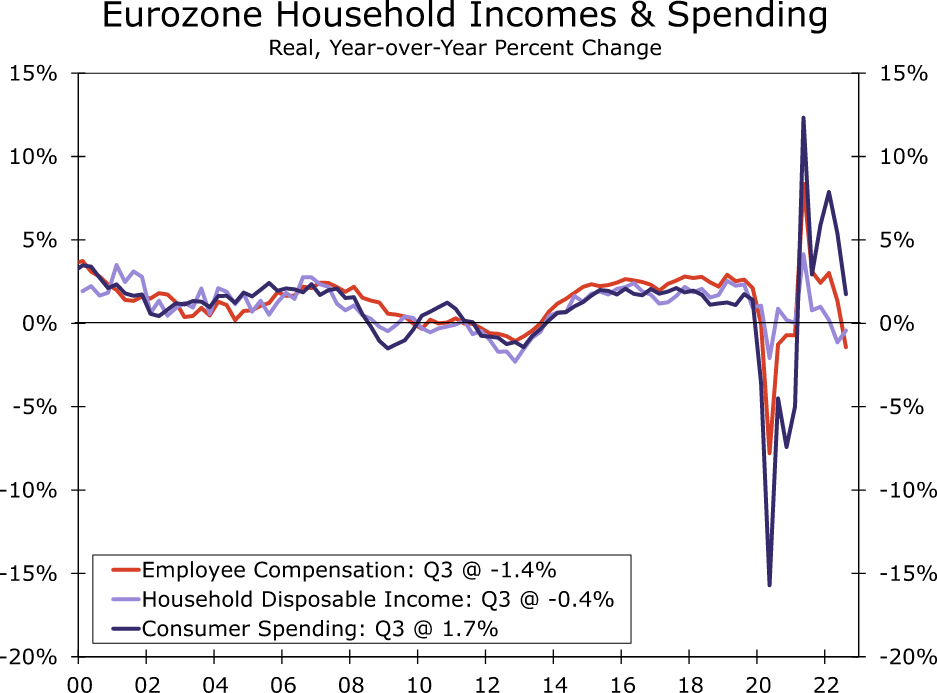
That said, the slowing in headline inflation is potentially very significant for the consumer spending outlook. Although Eurozone household disposable incomes have risen in nominal terms for seven quarters in a row, they have not kept up with the pace of inflation, meaning that adjusting for price increases, real income growth turned negative around the middle of 2022. Still, there are already hints in the latest available data that the drag on Eurozone real incomes may be waning. Based on preliminary figures from Eurostat, we estimate that Eurozone real household disposable income fell 0.4% year-over-year in Q3-2022, less than the 1.1% decline seen in Q2. While Q4 might be too early to see further inflation relief (average Eurozone inflation was actually higher in Q4 than Q3), it is possible that growth in real incomes could turn less negative, or even positive, by early 2023. The preliminary Eurostat figures also indicate the Eurozone household saving rate fell only slightly to 13.2% in Q3-2022, and is broadly in line with levels that prevailed prior to the pandemic. Overall, considering trends in real incomes and household savings, consumer spending may prove to be more resilient in 2023 than previously anticipated.
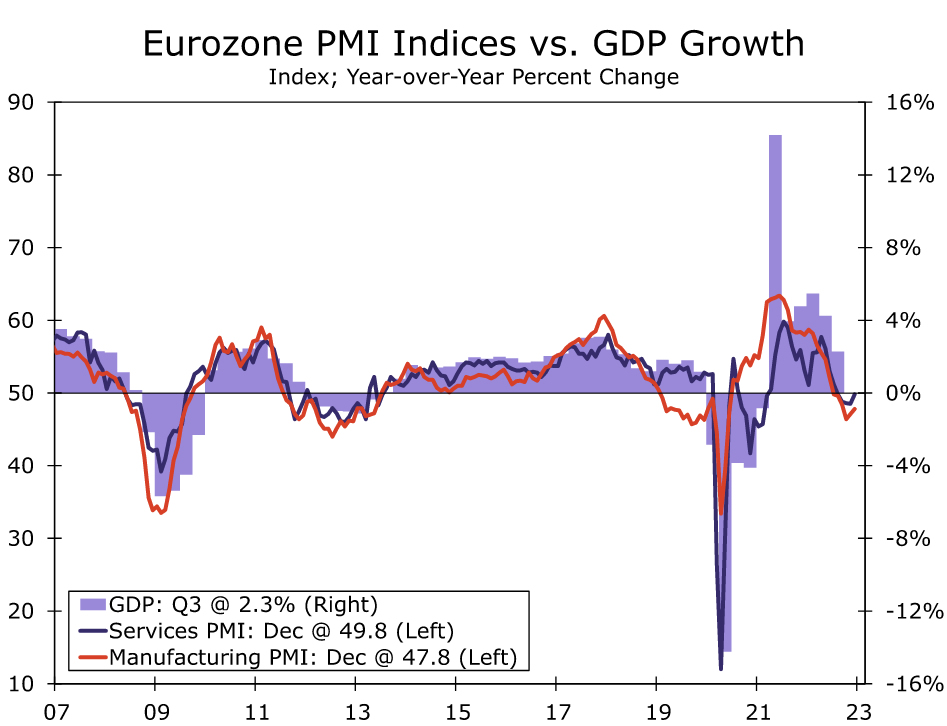
These improving (or at least less negative) economic prospects are also reflected in recent confidence surveys, as Eurozone PMI indices have gained in recent months. Notably, the services PMI rose to 49.8 in December from its recent low of 48.5 in November. The manufacturing PMI also rose to 47.8 in December, from its recent low of 46.4 in October. Those readings are historically consistent with a contracting Eurozone economy, though at the same time consistent with only a moderate contraction. For now, we maintain our forecast for Eurozone GDP to contract by a 0.6% for calendar year 2023, but taking into account developments in inflation, activity data and confidence surveys, we believe the outlook is potentially moving in the direction of a smaller 2023 GDP decline.
The Push and Pull of Eurozone Fiscal Policy
Much has also been made of Europe's fiscal policy response to the region's energy crisis, and measures that have been put in place to shield European households and businesses from higher energy prices. In late November 2022, Bruegel (a Brussels based economic think-tank) offered estimates for the European Union (of which Eurozone countries comprise the dominant majority) of funds that have been earmarked or allocated by governments to address the energy crisis between September 2021 and November 2022. These measures, among other things, include reduced energy taxation, retail price regulations, transfers to vulnerable groups, and business support. Those funds amounted to €600B, of which €264B has been allocated by Germany alone. To put those numbers in context, that equates to around 3.9% of European Union GDP and 7.0% of German GDP, respectively. In isolation, the estimates suggest European fiscal policy could be somewhat supportive of economic activity.
Recent estimates of the broader fiscal position also indicate the fiscal policy stance could be modestly supportive of economic activity in 2023. In the European Central Bank's (ECB) staff macroeconomic projections for December 2022, the ECB also sees total fiscal stimulus for the Eurozone related to the energy crisis and war in Ukraine at around 2% of GDP for 2022-23, with some of that fiscal stimulus projected to continue having a budget impact in 2024. Keeping in mind the energy related stimulus measures will be partly offset by withdrawal of previous COVID related fiscal support, the ECB projects the structural budget balance to narrow from 3.4% of GDP in 2021 to 3.0% in 2022, before widening to 3.3% of GDP in 2023. That is, the fiscal stance is seen tightening modestly in 2022, before loosening modestly in 2022. Overall, its appears the Eurozone fiscal policy stance should be mildly supportive of economic activity in 2023, reinforcing the outlook for Eurozone 2023 GDP to move in the direction of a smaller decline.
Eurozone Monetary Policy Turning More Hawkish
In addition to the outlook for Eurozone economic activity, ECB policymakers have made it clear over the past several weeks that their flight against inflation is far from over, and that Eurozone inflation remains much too high for comfort. The fact that core inflation pressures have not shown any lessening across the Eurozone is another reason we believe ECB policymakers are hesitant to let up on their inflation fight at this point. At its December announcement, the ECB raised its Deposit rate 50 basis points to 2.00%, and perhaps more importantly said that “interest rates will still have to rise significantly at a steady pace to reach levels that are sufficiently restrictive to ensure a timely return of inflation to the 2% medium-term target.” ECB President Lagarde also said we should expect the ECB to raise rates at a 50 basis point pace for a period of time, and that the ECB needs to do more on interest rates than what was implied by market pricing at the time.
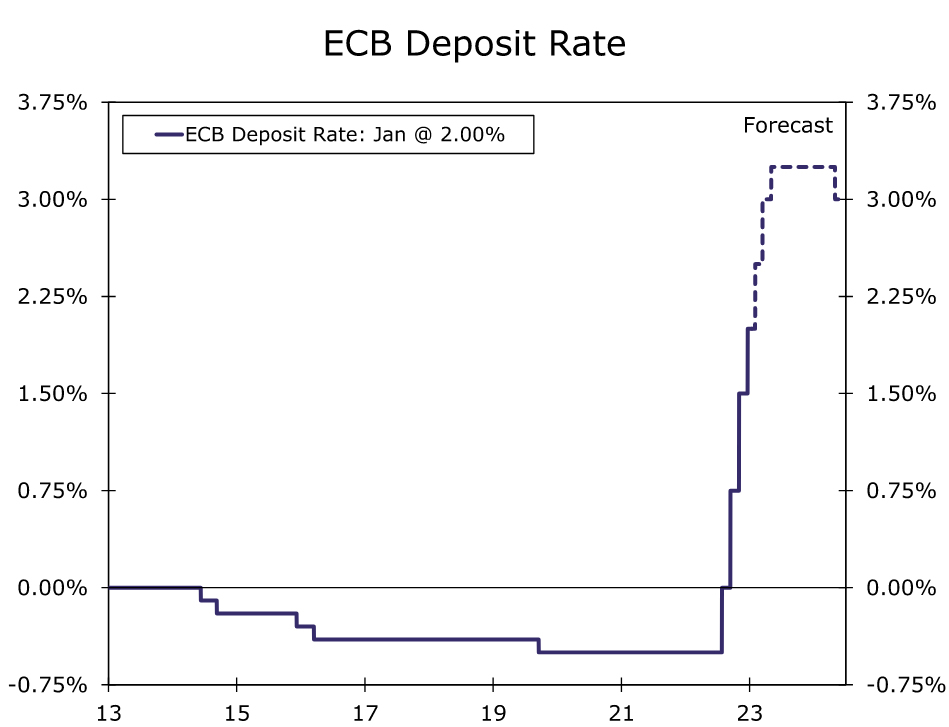
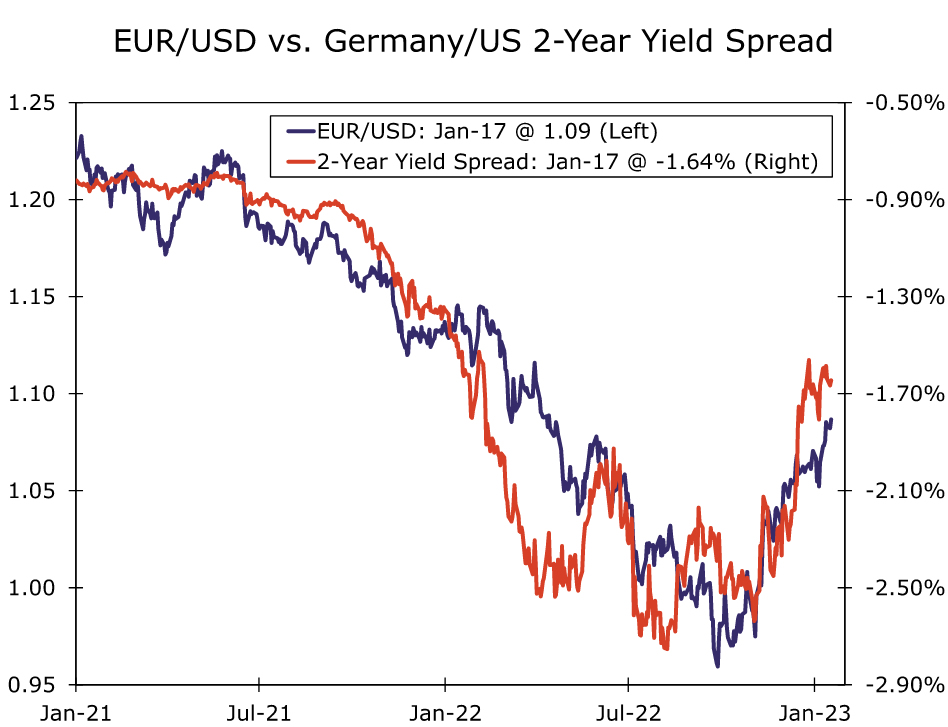
In response, we raised our forecast for the ECB's peak policy rate during the current cycle to 3.25%, and ECB policymaker comments in subsequent weeks have generally continued to highlight the need for steady and sustained rate increases. In contrast, with U.S. inflation slowing and based on evolving hints from some Fed policymakers, we now expect the Fed to raise rates by an even smaller 25 basis points at its early February meeting. Indeed, from current levels we expect a further 125 basis points of ECB rate hikes compared to just a further 75 basis points of rate hikes from the Fed. In effect, the ECB is turning more hawkish at a time when the Fed is starting to turn less hawkish. These dynamics have led to a meaningful narrowing in the large negative yield gap that previously existed between the Eurozone and the U.S. The two-year government yield spread between Germany and the U.S. has narrowed to -159 basis points, from as wide as -264 basis points as recently as early November.
From a currency perspective, a more resilient (albeit still subdued) Eurozone economic outlook and a more hawkish European Central Bank monetary policy outlook clearly offers a more supportive mix for the euro exchange rate against the U.S. dollar. With respect to our base case forecast, it is quite possible that some of the weakness we had anticipated in the EUR/USD exchange rate in early 2023 may in fact not materialize. In addition, the risks to our Q1-2024 target for the EUR/USD exchange rate of $1.13 are clearly tilted to the upside. In the context of recent developments, our outlook for the euro versus the U.S. dollar is shifting appreciably in the direction of a more constructive medium-term trend.
Euro tumbles on report that ECB considering smaller hike in Mar
Euro tumbles broadly after Bloomberg reported, quoting unnamed source, that ECB is pondering slower rate hike after 50bps in February. It noted that "the prospect of a smaller 25-point increase at the following meeting in March is gaining support".
EUR/CHF's break of 0.9953 resistance turned support now raising the chance of at least a deeper correction. For now, 38.2% retracement of 0.9407 to 1.0095 at 0.9832. Reaction from there would reveal whether EUR/CHF could defend its near term bullishness.
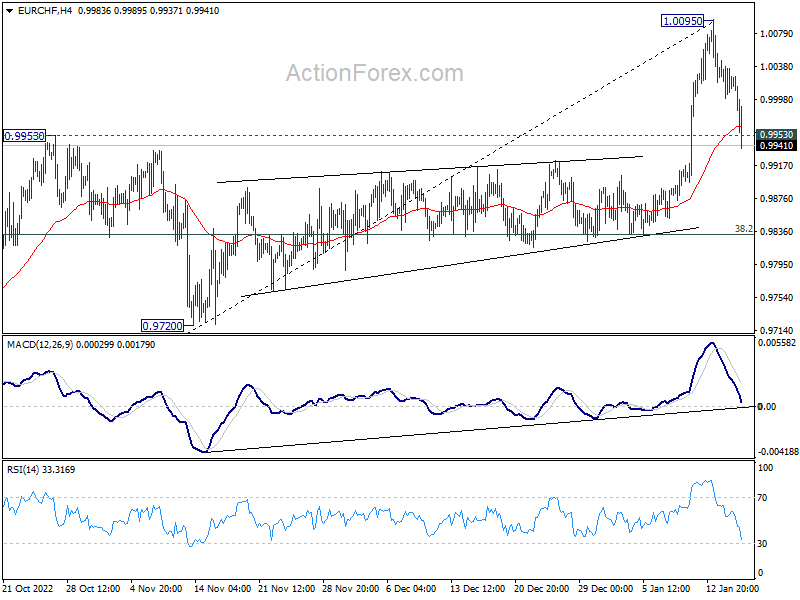
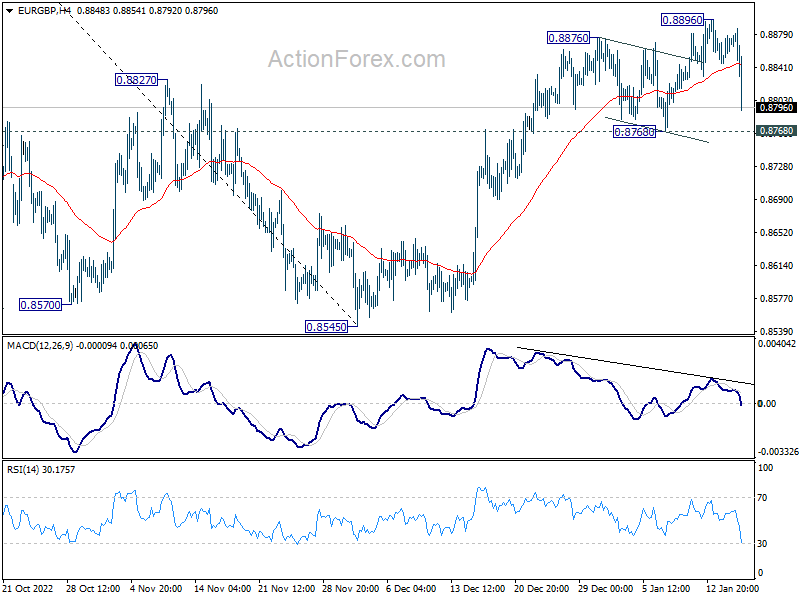
Meanwhile, EUR/GBP is heading back to 0.8768 support. Reaction from there will also reveal whether rebound from 0.8545 has completed at 0.8896 already.
UK Earnings Rise Alongside Employment Drop
The UK market is showing further signs of a reversal in the labour market towards a fall in employment, but the increased pace of wage growth is keeping a close eye on the Bank of England’s actions and comments.
Jobless claims rose by 19.7K in December after climbing by 16.1K a month earlier, a logical development after a smooth stop to the decline earlier last year.
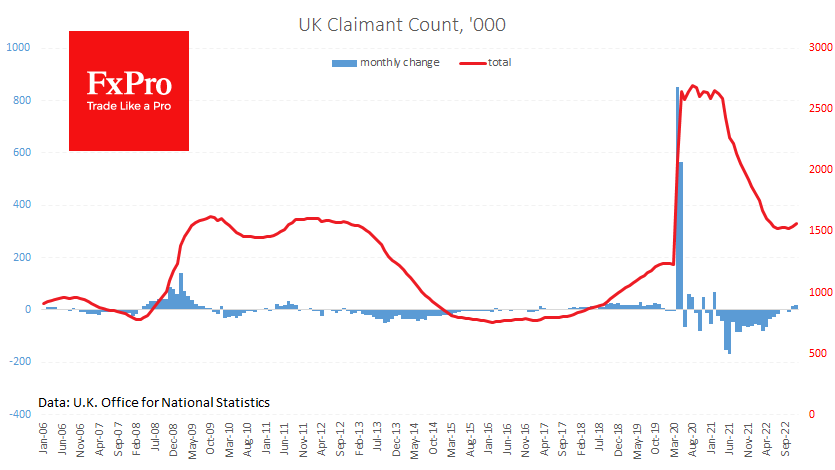
The unemployment rate remained at 3.7%. Here there is a 0.2 percentage point increase from the August lows, but these levels remain very low by historical standards. Unfortunately for policymakers, the low unemployment rate reflects a shrinking active workforce, which has forced the government to launch a programme of tax incentives for those back to work in the ages over 50.
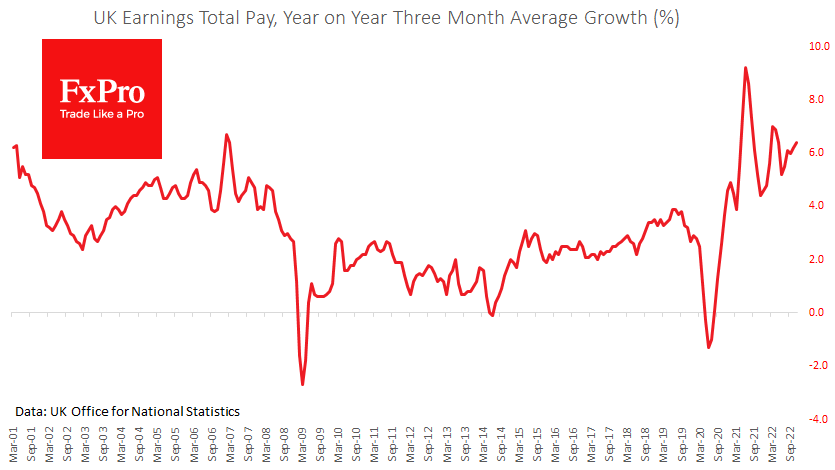
In theory, this should increase supply and curb wage growth, which now looks like the most dangerous part of the inflationary spiral. Wages in the last three months to November were 6.4% higher than in the same period a year earlier. This is below current inflation. However, this high rate of wage growth risks is the most significant factor in anchoring inflation expectations and overall inflationary pressure.
A fresh set of inflation data is published tomorrow morning, where a sharp fall in prices is not forecast on average. The combination of high consumer inflation and rising wages could force the Bank of England to push the economy harder into recession to suppress consumption and bring price growth under control, which would be positive for the pound.
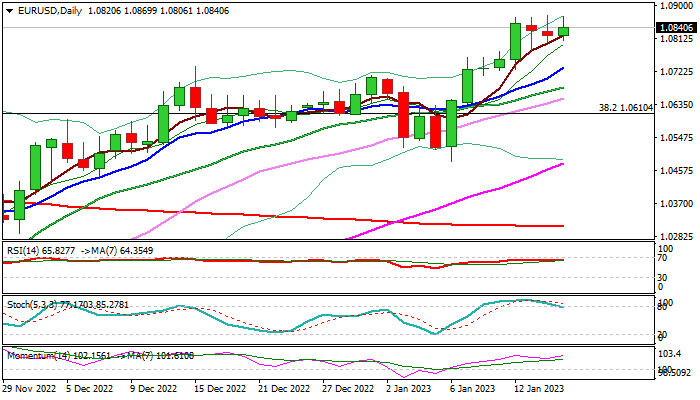
EUR/USD: Bulls Hold Grip But Overbought Conditions Warn of Prolonged Consolidation
The Euro regained traction on Tuesday but remains within a consolidation range, signaling that larger bulls remain in play, as the pair is in steep rally for the fourth consecutive month and the action is underpinned by last week’s large bullish candle.
Near-term action received boost from upbeat German/EU ZEW economic sentiment data, drop in German inflation and weaker dollar.
Technical studies are in full bullish setup on daily chart, though overbought conditions warn of stronger headwinds on approach to targets at 1.0930 (weekly cloud top) and 1.0942 (50% retracement of 1.2349/0.9535 downtrend).
A healthy correction should be contained by converged daily Tenkan/Kijun-sen (1.0678) to offer better buying opportunities attack at 1.0930;42 targets, violation of which would expose psychological 1.10 level and 100WMA (1.1094) in extension.
Caution on dip below weekly cloud base/weekly Tenkan-sen (1.0548) which would weaken near-term structure and allow for deeper pullback.
Res: 1.0874; 1.0900; 1.0942; 1.1000.
Sup: 1.0780; 1.0732; 1.0678; 1.0610.
Canadian Dollar Shrugs as CPI Declines
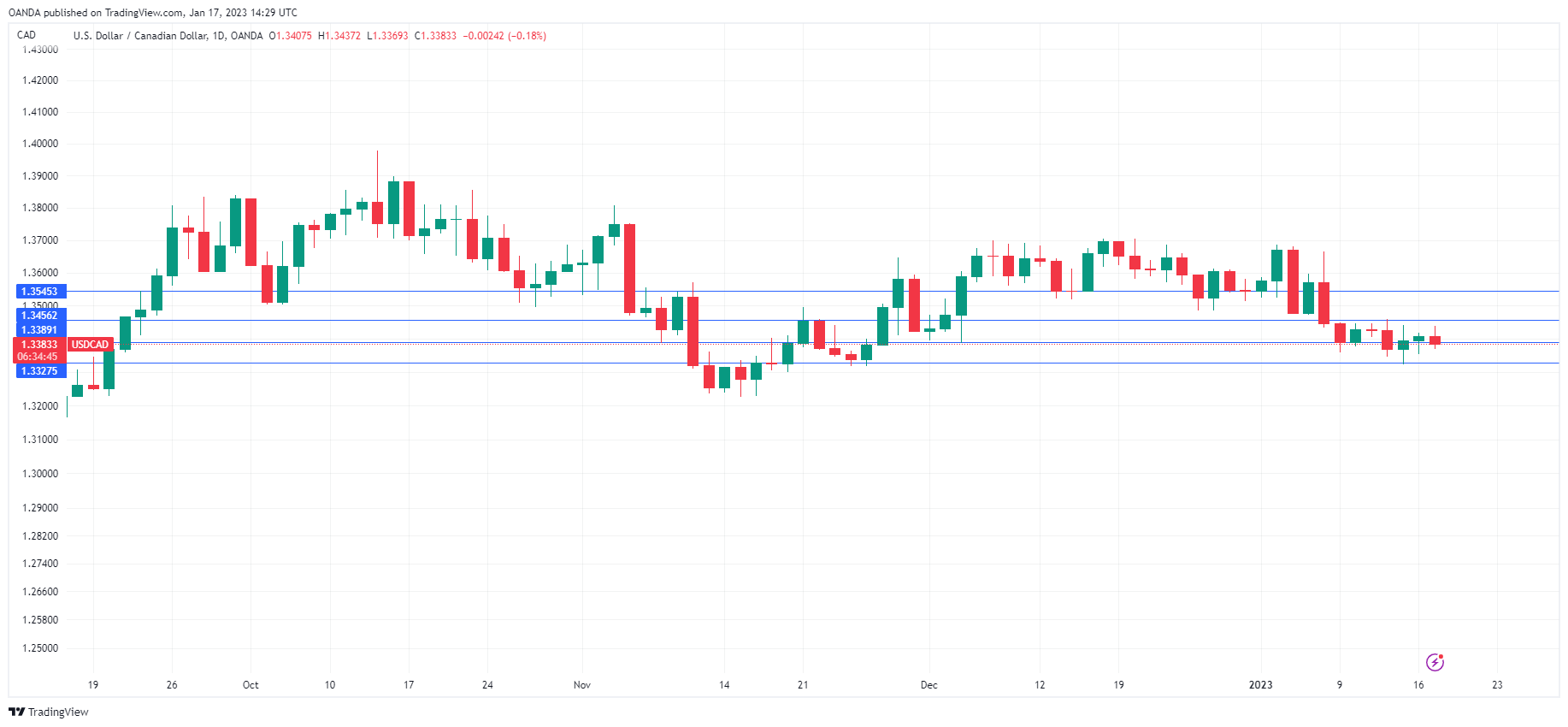
It has been a quiet day in the currency markets, and the Canadian dollar has followed suit. In the North American session, USD/CAD is trading at 1.3386, down 0.15%.
Canada’s inflation heads lower
Inflation in Canada slowed to 6.3% y/y in December, down from 6.8% a month earlier and matching the consensus. On monthly basis, the decline was noticeable at -0.6%, compared to 0.0% in November and the forecast of -0.1%. Core CPI fell to 5.4% y/y, down from 5.8% in November and below the forecast of 6.1%. The driver of the drop in inflation was a sharp decline in gasoline prices. Food prices, however, remain high and rose by 11% in December, a slight improvement over the November read of 11.4%. The Canadian dollar shrugged off the drop in inflation and remains close to the 1.34 round-figure mark.
The drop in inflation suggests that the Bank of Canada’s aggressive rate cycle is having the desired effect, although inflation remains much higher than the BoC’s target of 2%. The BoC holds its rate meeting next week, and the markets have priced in a 25- basis point hike, which would bring the cash rate to 4.50%. If inflation continues to downtrend, the expected hike next week could signal the end of the current rate-tightening cycle.
The BoC has said that future hikes would be determined by economic data, and there are signs of economic strength despite the rate hikes. GDP is expected to rise 1.2% y/y in Q4 and job growth sparkled in December, with over 100,000 new jobs. The markets are expecting a 25-bp hike next week, but it’s uncertain what the central bank has planned after that. The markets will be looking for clues about future rate policy from the rate statement and BoC Governor Macklem post-meeting comments.
USD/CAD Technical
- USD/CAD is testing support at 1.3389. Below, there is support at 1.3328
- 1.3455 and 1.3546 are the next resistance lines