

Sample Category Title
US 100 Cash Index Trades Sideways Following Strong Start to New Trading Year
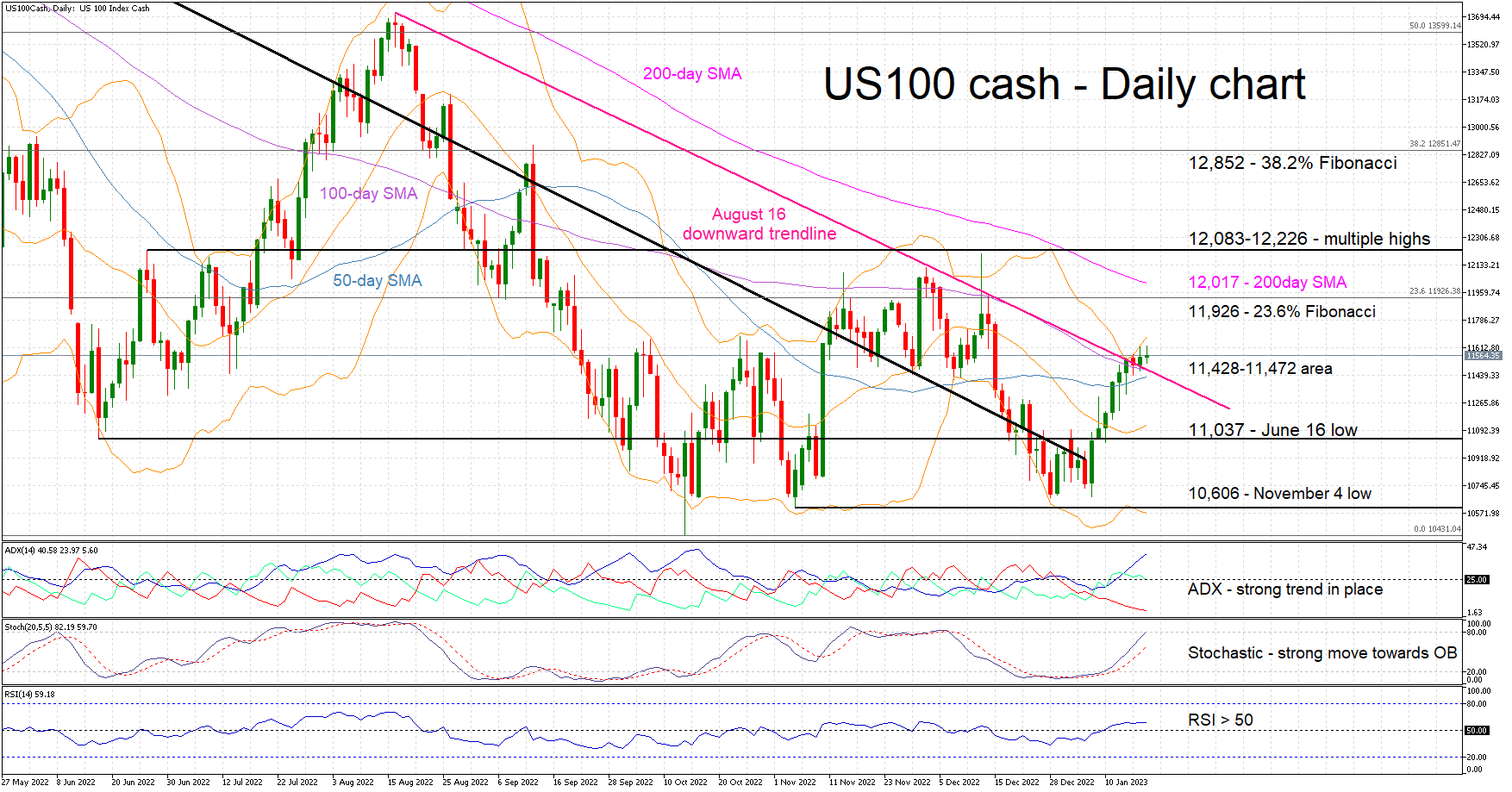
The US 100 cash index is trading sideways following a climb of 900 points since December 28. This upward move appears to enjoy the universal support of the momentum indicators. The Average Directional Movement Index (ADX) is moving aggressively higher, and the stochastic oscillator is just below its overbought territory. Even the usually conservative RSI is hovering comfortably above the 50-midpoint.
The recent move higher has pushed the US 100 index above both the 50- and 100-day simple moving averages (SMAs) and the August 16 downward sloping trendline, potentially confirming the bulls’ determination. However, when the market is sending such a homogenous message, chances are that something could break soon, signaling a potential trend change.
Should the bulls continue to push the market higher, the first resistance could come at the 23.6% Fibonacci retracement level of the November 22, 2021 – October 13 downtrend of 11,926. The 200-day SMA at 12,017 and the 12,083-12,226 range could potentially trouble the bulls then.
On the other hand, the bears' first move could be to push the US 100 index below the 11,428-11,472 area, populated by SMAs and the August 16 downward trendline. Upon successfully breaking this area, they could aim for the June 16 low of 11,037.
To sum up, the move higher enjoys the universal support of the market indicators, but the bears could try to reassert their position in the market by pushing the index below 11,428.
NZDUSD Bulls Face Big Challenge Around 0.6500
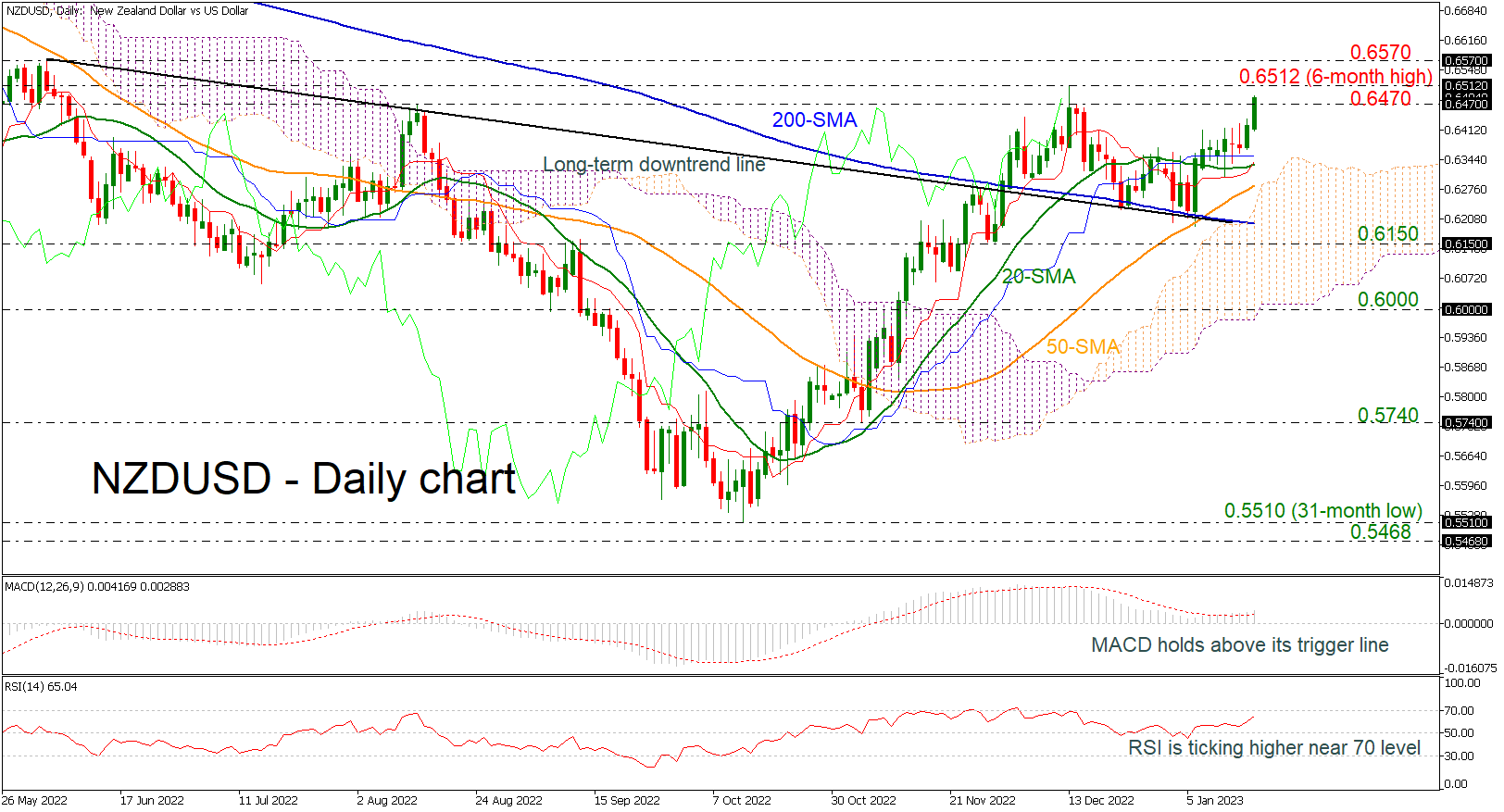
NZDUSD continues to rise above the Ichimoku cloud and the short-term simple moving averages (SMAs), remaining above the long-term downtrend line. According to the MACD, positive momentum could push for further gains as the indicator picks up steam above its red signal line. The RSI is also advancing, though, it is relatively close to the 70 overbought threshold.
More increases could drive the market towards the six-month high of 0.6512 ahead of the 0.6570 barrier, registered on May 29. Even higher, the price could challenge the 0.7170 resistance, taken from the peak in August 2021.
A reversal to the downside could stall at the 20- and the 40-day SMAs at 0.6330 and 0.6285 respectively before entering into the Ichimoku cloud and testing the crucial 200-day SMA at 0.6200. Further below, the 0.6150 support could also provide support, shifting the outlook back to bearish.
Regarding the long-term picture, the bullish outlook has built up as the pair continues to hold above the descending trend line.
USDJPY Remains Suppressed by Restrictive Trendline
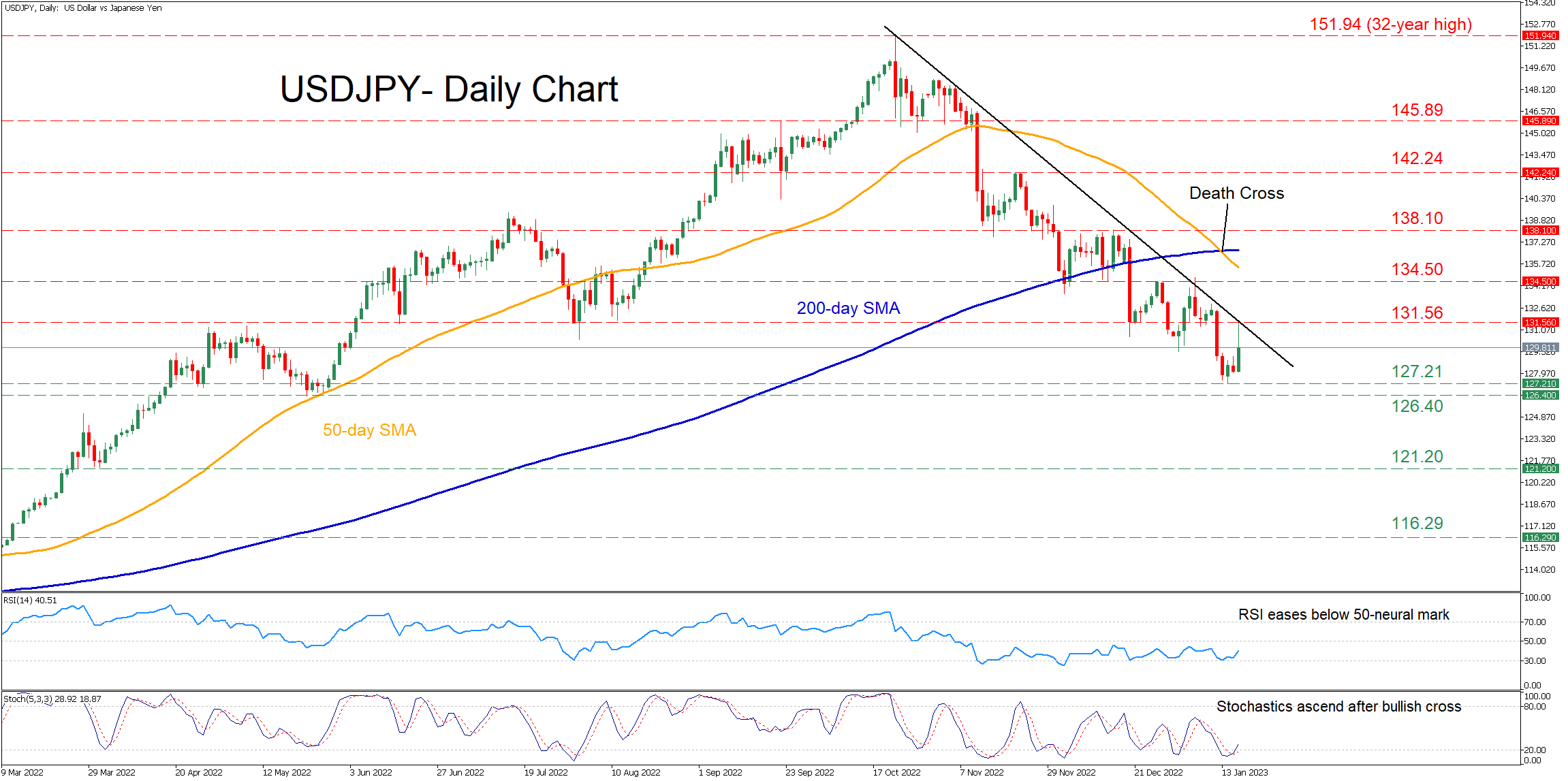
USDJPY realized massive gains in the past year, marching to a 32-year high of 151.94 in mid-October. Nevertheless, the pair has been experiencing a prolonged pullback since then, with the price hitting a fresh seven-month low of 127.21 before recouping some losses.
The momentum indicators currently suggest that bearish pressures are subsiding. Specifically, the RSI is ascending steeply but remains below the 50-neutral mark, while the stochastic oscillator is edging higher after posting a bullish cross in the oversold zone.
Should buying pressures intensify, the price could test the recent peak of 131.56, which overlaps with the descending trendline formed from the pair’s recent downside correction. Breaking above that zone, the bulls could aim for 134.50 before the spotlight turns to the December resistance region of 138.10. Even higher, the 142.24 hurdle could prove to be a tough one for the price to overcome.
On the flipside, if the price extends its retreat, the seven-month low of 127.21 might act as the first line of defense. Sliding beneath that floor, the pair could descend to challenge the May low of 126.40. Failing to halt there, the March support of 121.20 may provide downside protection.
In brief, USDJPY appears to be regaining some lost ground despite the completion of a death cross between the 50- and 200-day simple moving averages (SMAs). Hence, downside pressures could intensify in case the descending trendline rejects this latest bounce.
ECB Villeroy: Lagarde’s 50bps guidance still valid
ECB Governing Council member Francois Villeroy de Galhau said "we will have good news on headline inflation because energy prices are going down,"
But on interest rates, he said President Christine Lagarde's earlier 50bps guidance is "still valid". He added that it's too early to speculate on the size of March rate hike.
Also, Villeroy emphasized, "we must stay the course in battle against inflation", adding, he "cannot say where the terminal rate will be but should be there by the summer."
GBP/USD Pair Now Consolidating Near 1.2280
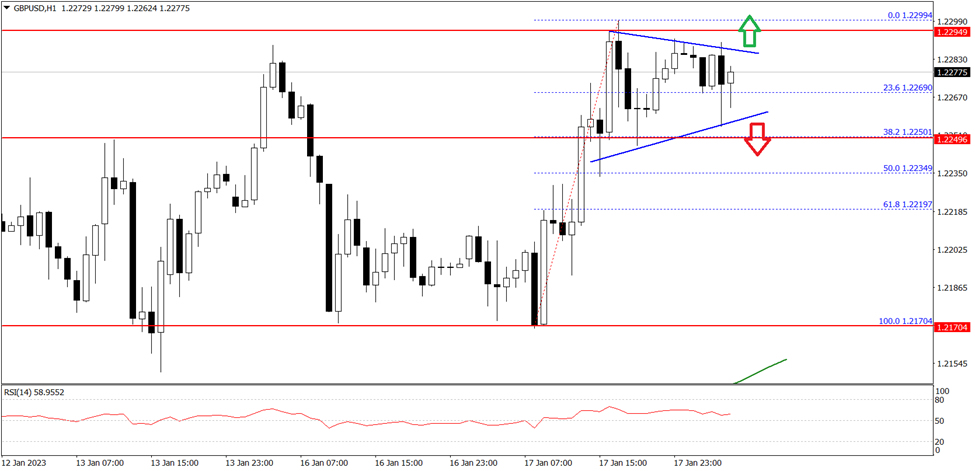
The British Pound started a fresh increase above the 1.2220 resistance zone against the US Dollar. The GBP/USD pair climbed above the 1.2250 resistance zone to move into a positive zone.
The pair even settled above the 1.2250 level and the 50 hourly simple moving average. It is now consolidating near the 1.2280 level, with an immediate resistance at 1.2290.
The first major resistance is near the 1.2300 level. If there is a clear upside break above the 1.2300 resistance, the pair could rise steadily towards the 1.2350 level in the near term. The next major resistance sits near 1.2420 on FXOpen.
On the downside, the first major support is near the 1.2265 level. The main support is forming near the 1.2250 level. A break below the 1.2250 support could push the pair towards the 1.2200 support.
FTSE 100 Keeps High Ground
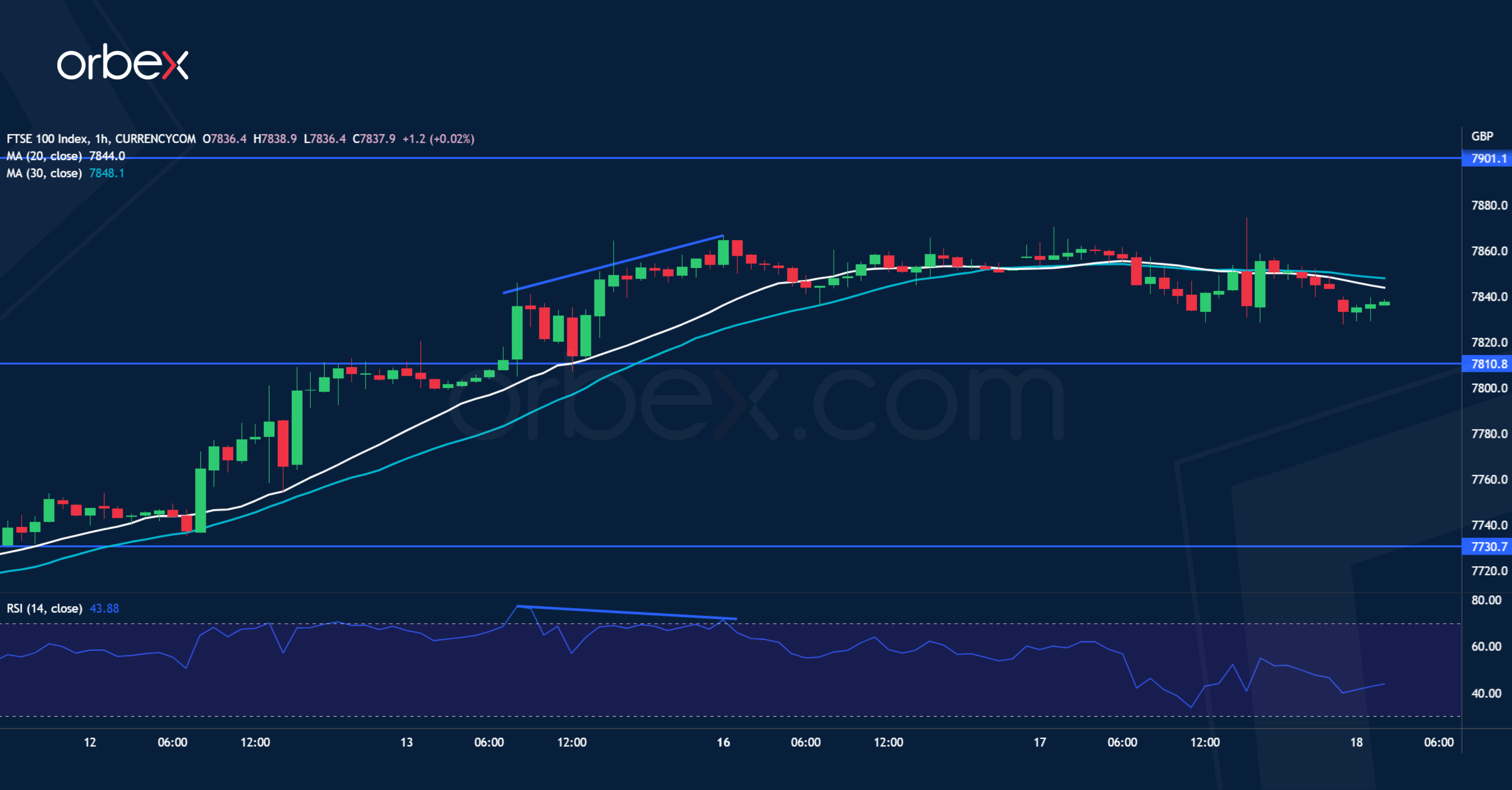
The FTSE 100 pushes higher as financial stocks roar. On the daily chart, the index has gone parabolic after breaking last year’s top of 7670. The RSI’s double top in the overbought area may lead to a slowdown in the momentum. The bearish RSI divergence on the hourly chart corroborates the possibility of exhaustion. 7810 is the first support to see whether the bulls can sustain their bids at these fresh high levels and push to 7900. A bearish breakout could trigger broader profit-taking and possibly mean reversion towards 7730.
NZD/USD Tests Resistance
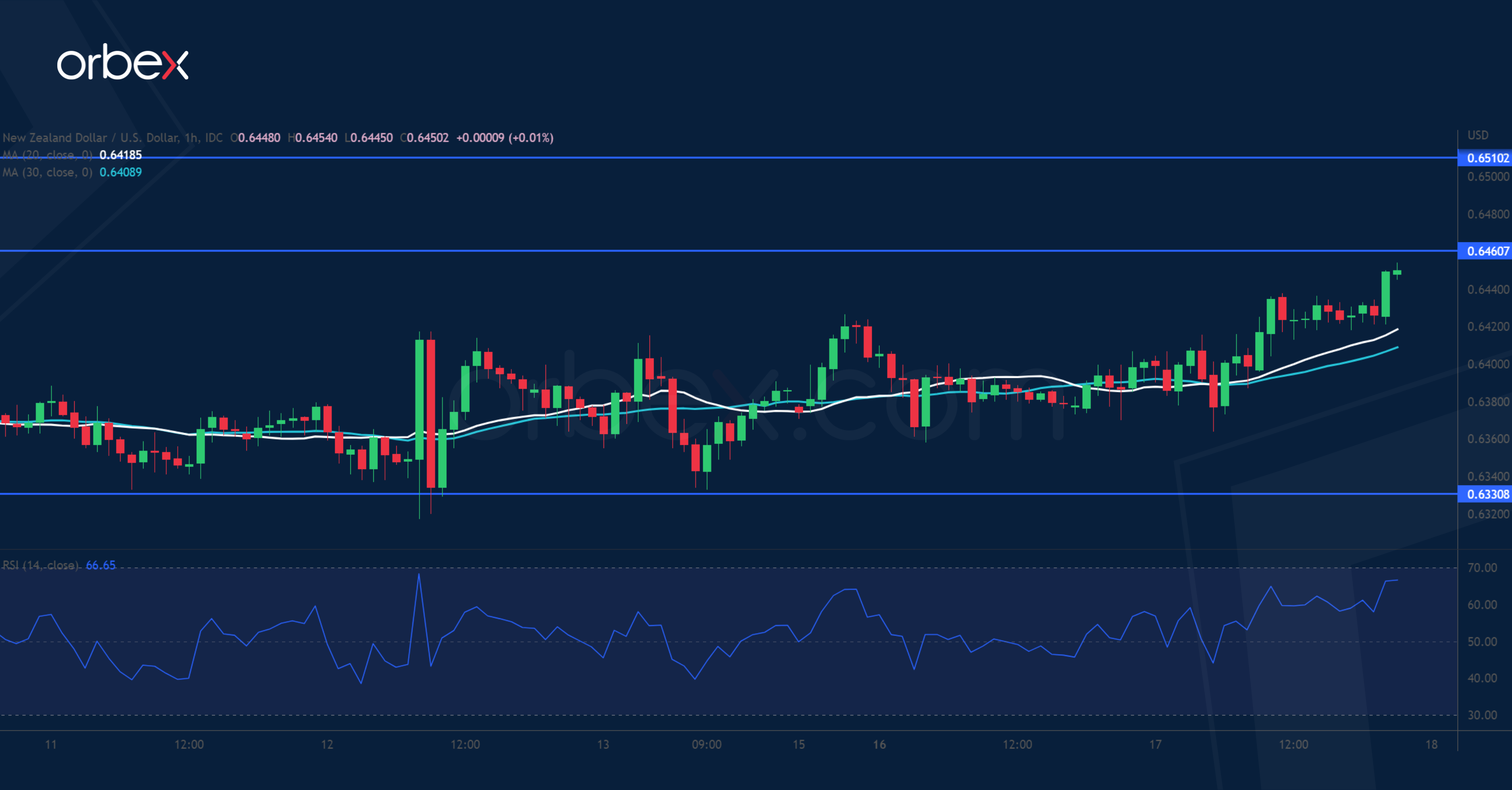
The New Zealand dollar rallies as overall risk appetite grows. The pair has consolidated its recent gains above the former resistance at 0.6350. The choppy rise reveals a lack of momentum as the price inches towards the supply zone around 0.6460. Its breach could pave the way for a bullish continuation above 0.6510. Otherwise, the bears may take over in the near term. 0.6330 is an area of congestion and its break would shake some buyers out and send the kiwi to the latest daily low at 0.6190.
USD/CAD Builds Base
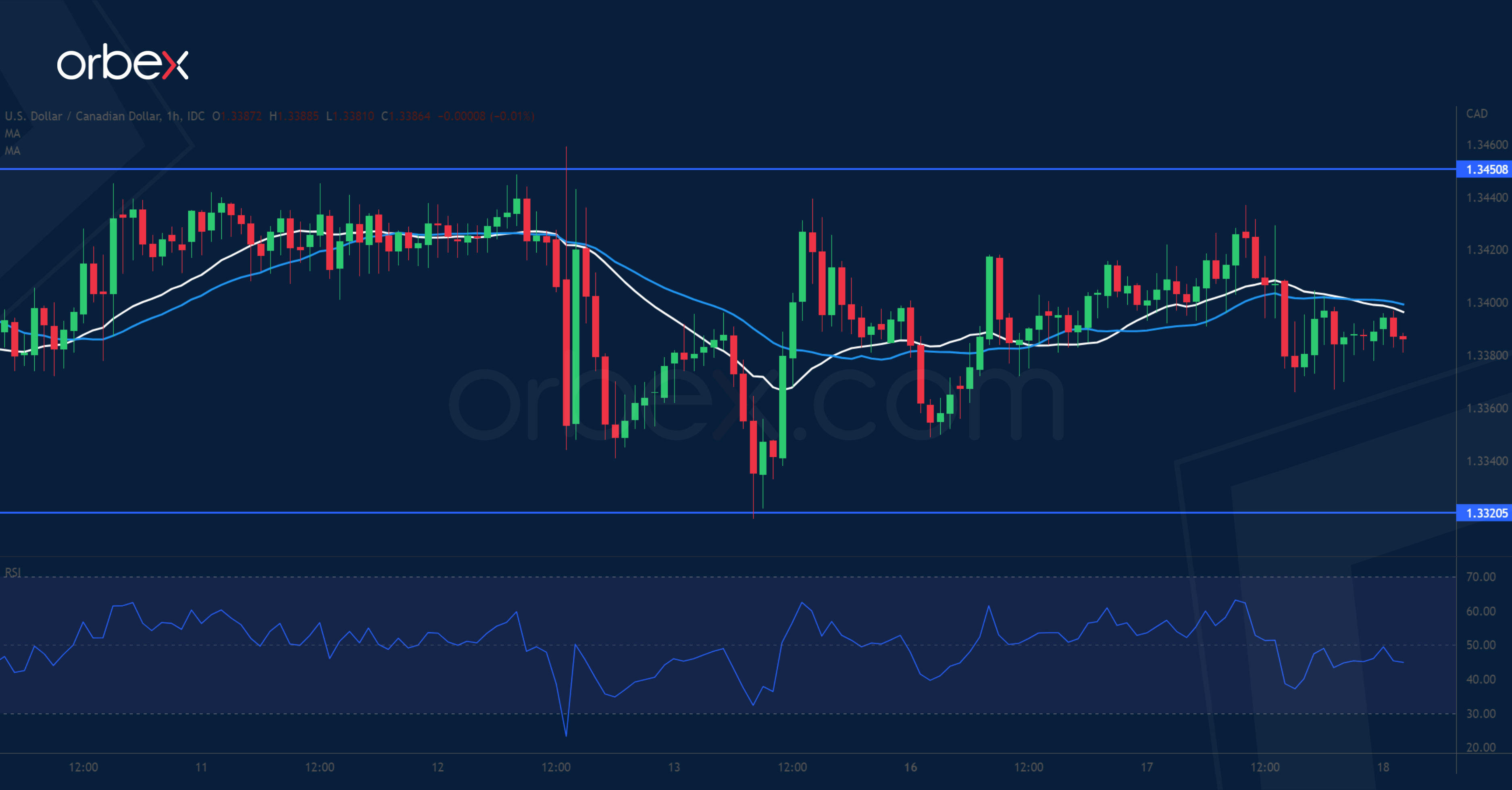
The Canadian dollar steadied after inflation eased more than expected in December. From the daily chart’s perspective, the pair is still in a prolonged consolidation between 1.3230 and 1.3800. A bounce off the daily support at 1.3320 may lead to a narrower range. A close above the immediate hurdle at 1.3450 would attract more intraday interests and carry the price to the support-turned-resistance at 1.3560. Stiff selling could be expected from there to the previous swing high of 1.3660 as range trading lives on.
EUR/USD’s Upside Turned More Limited
Markets
Bond yields on both sides of the Atlantic rose a few basis points before separate news reports killed off the advance abruptly. The culprit in the US was an awful Empire manufacturing, plunging to the lowest level since mid-2020 on slumping new orders and stalled hiring. US short-term yields ended the day 2-2.8 bps lower. Yields at the long end of the curve revisited intraday lows after the release but closed about 4 to 5 bps higher still eventually. On European soil, a Bloomberg story was responsible for German yields declining between 5.6 bps (30y) and 10.9 bps (2y), outperforming vs swaps by a 1 to 2 bps. Sources to the news agency said ECB policymakers are considering a slower pace of rate hikes from the March meeting on. A 50 bps move in February is still seen as most likely. They added a slowdown in the tightening shouldn’t be viewed as the ECB going soft on its mandate. Nevertheless, if that’s the case it is a less hawkish approach than president Lagarde outlined at the December meeting. The euro paid in cash. EUR/USD aborted its attack on recent highs around 1.087 and dropped to 1.078 even as the dollar himself again traded unconvincingly. DXY’s (trade-weighted dollar) bottoming out continued but no more than that. EUR/GBP tanked below 0.88 with a pinch of sterling strength present too. It followed a solid labour market report with near-record wage growth keeping the pressure on the BoE.
The Bank of Japan held a closely watched meeting this morning but the mountain brought forth a mouse. It kept rates steady at -0.1% and stuck to its YCC program to keep the 10y fixed at 0% with a 50 bps range. Some expected the BoJ to further widen the allowed deviation given the ongoing inflationary and, even more so, market pressures. The BoJ raised inflation forecasts to 1.8% at the end of the horizon with risks tilted to the upside but clearly considered it insufficient for further policy tweaks. The yen takes a heavy beating as bets on a hawkish twist unwind. USD/JPY surges from 128.12 to 130.75. Japanese equities are the star performer though, adding up to 2.5%. Bond yields in the area tumble 4-11.1 bps with the 10y taking the lead in the decline. Moves spill over to US Treasuries. Cash yields drop 2.7-6.6 bps.
US retail sales are due later today. They are expected to have further declined m/m in December. There’s probably more scope for a US/core bond yield reaction in case of a negative surprise given yesterday’s disappointing Empire manufacturing and general sentiment vs central banks following the ECB and BoJ news. The dollar in such a case could stay under pressure but with yesterday’s Bloomberg story, EUR/USD’s upside turned more limited. 1.0942 strengthened as a resistance. Sterling extends gains this morning following a CPI-beat. Headline inflation eased from 10.7% to 10.5% as expected but monthly dynamics were stronger than consensus (0.4% m/m vs 0.3%). Moreover, core price growth stabilized at 6.3%, defying expectations for a decline to 6.2%. EUR/GBP falls towards 0.8769. First meaningful support kicks in at 0.8721.
News Headlines
IMF deputy managing director Gopinath subtly changed the organization’s rather pessimistic view at the World Economic Forum in Davos. Recall that IMF managing director Georgieva in a NY address warned that a third of the global economy will be hit by recession this year, calling 2023 a “tougher” year than 2022. Gopinath still referred to the “tough” year with inflation still too high and central banks staying on course with interest rates to tackle the problem, but she also stressed an expected improvement in the second half of the year, stretching into 2024. Lower energy prices and the Chinese economic reopening triggered an extremely bullish start to the year with markets disagreeing on the central bank part of the story. German Chancellor Scholz in an interview with Bloomberg also spread optimism by vowing that Germany will go into a recession.
Slovakia’s interim PM Heger in a statement announced that snap elections in the fall appear to be the most realistic scenario at the moment. Regular elections were scheduled for February 2024. Heger’s administration collapsed in December. Attempts to gain a majority since losing that no-confidence vote, failed: “With today, I consider all attempts to establish a new 76 (majority) to be closed,” he said. To trigger snap elections, parliament needs to shorten their term which may happen at next week’s opening session (Jan 24).
BoJ Kuroda: We don’t need to further expand the band around yield target
At the post meeting press conference, BoJ Governor Haruhiko Kuroda said, "We don't need to further expand the band around our yield target.... It's been not long since we decided on our measures in December. It will likely take some more time for the measures to start having an effect in fixing market function. With our flexible market operations, however, we expect market function to improve ahead... YCC is, therefore, likely to be sustainable."
"Uncertainty regarding Japan's economy is very high. It's necessary to support the economy with our stimulus policy, to ensure companies can raise wages. By maintaining ultra-easy policy, we will strive to achieve our price target stably and sustainably accompanied by wage hikes," he noted.
"Unlike in the past, we expect wages to rise quite a bit, when listening to comments from the business and labour union executives," Kuroda said. "The pace of wage hikes is accelerating. But this is something we haven't seen in the past... So we're not 100% sure (whether) wages will indeed rise."