Sample Category Title
Fed Mester: We’re not at 5% yet, we need to keep going
Cleveland Fed President Loretta Mester, said in an AP interview, "We're beginning to see the kind of actions that we need to see... Good signs that things are moving in the right direction ... That's important input into how we're thinking about where policy needs to go."
"We're starting to see our policy actions do what they're intended to do," she said. "But I do believe we have to continue raising ... and then hold for a while so that we get back to price stability in a timely way."
"We're not at 5% yet, we're not above 5%, which I think is going to be needed given where my projections are for the economy," she said. "I just think we need to keep going, and we'll discuss at the meeting how much to do."
GBP/AUD Moving into Support
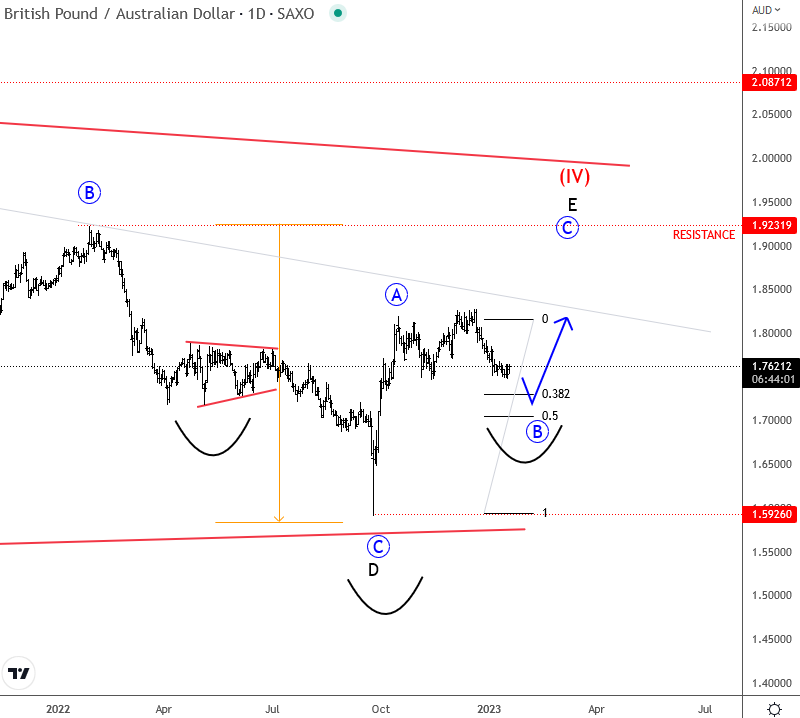
GBPAUD may have a completed three-wave A-B-C decline for a higher degree wave D on a daily chart because of a strong rebound in September, so new recovery can be now in pla, possibly even back to 1.90 resistance area. Notice that rebound from latest low was sharp; its seen as wave A, followed by a wave B pullback that can be making a flat formation, now at the support so be aware of a new turn into the upside. Wave C projections are near 1.85 than 1.9. H&S pattern can also be completing the right shoulder.
Fed Bullard: Rates almost restrictive, but not quite there yet
St. Louis Fed President James Bullard said in an online WSJ interview, "we're almost into a zone that we could call restrictive - we're not quite there yet."
Fed will wants to make sure that inflation will fall back to 2% target. "We don't want to waiver on that," he said.
"Policy has to stay on the tighter side during 2023" as the disinflationary process unfolds, he added.
He still sees rates at 5.25-5.50% range at the end of the year.
Is the ECB Done With the Hikes?
The Euro was underperforming yesterday after press reports that the ECB was planning to hike by 25bps in March. That's quite a long time away, and it's just a rumor. But it could have an outsized impact on the shared currency for a couple of reasons. We could see a shift in tone ahead of the next ECB meeting, as well.
The first thing is that press reports like this are fairly common, and typically the ECB doesn't make a point of denying them. Without a formal dismissal by the Governing Council - which takes quite a bit of logistics - then the rumor will stay in the back of the mind of most traders. That could, by itself, incline the psychology towards a weaker Euro as well.
It's good news
The other aspect is the reasoning given: The recent improvements in the inflation have lowered the inflation outlook. That's a logical analysis, and is in line with previous comments by most members of the ECB. After all, the central bank is trying to get inflation down by raising rates, so a significant drop in inflation would imply the ECB won't have to hike as much.
The problem is that the ECB was much slower to join the rate hiking club. The BOE was the first and has pushed rates up to 3.5%. The Fed has been even harsher, pushing rates up to 4.5%. Meanwhile, the ECB is less than half of that at 2.0%. And some officials are even calling that the "ballpark" of neutral rate.
The drivers of the currency pair
The gap in interest rates between the Eurozone and the US is what pushed the Euro below parity last year. It has subsequently climbed back up as traders figure the ECB will hike longer, catching up with the Fed through the course of this year. Inflation in the shared economy is higher than in the US, so it stands to reason that rates would continue to rise.
As inflation came down in the US, the Fed has slowed the pace of its hiking. Current expectations are for a 50bps hike in February, followed by a 25bps in March. Which could be the last hike for the Fed this cycle. The latest press reports suggest that the ECB will do the same. In other words, the interest rate gap between the two economies would remain consistent through at least the first quarter. That doesn't allow much upside for the EURUSD.
What about the downside?
ECB policy matching the Fed's has a significant problem though. US core inflation has been declining for a few months now, while the same measure in the share economy has continued to rise. Energy prices have been the largest contributor to the lowering of headline inflation - but that's not thanks to ECB policy.
The ECB cares much more about the core rate, and that is still, apparently, not under control. Which makes planning to halt hiking at this juncture a little premature. Of course there is one additional element, which is that the ECB plans to reduce its balance sheet in March, which counts as additional tightening. But it's a relatively small amount; just €15B/month, while the ECB averages maturities of about €30B a month. And the Fed is running off $95B a month.
The press report for the moment remains a rumor, but if it turns out that's what the ECB will announce in due course, it could keep the Euro under pressure.
Sunset Market Commentary
Markets
The Bank of Japan stuck to its ultra-easy monetary policy this morning, pushing back against heavy market speculation that the central bank would take or at least announce further steps towards policy normalization. Japanese yields fell off a cliff, particularly in the BoJ-capped 10y maturity. This immediately spilled over into core bond markets. Yesterday’s Bloomberg report citing sources that ECB policymakers are contemplating slowing down the tightening pace from March - contrasting with official December guidance - lingered still as well. Markets brushed aside ECB governor Villeroy’s early morning intervention. He said that the December narrative (50 bps on the next couple of meetings) is still valid. European swap yields decline 3.5-12.2 bps with losses deepening after US numbers were released. Hard economic data in the US now seem to follow the roll-over in sentiment indicators (eg. yesterday’s Empire manufacturing). Retail sales in December undershot expectations across the board (headline: -1.1%, a private consumption proxy: -0.7%) and came on top of a downward revision to the November figures. Ten out of the 13 categories printed declines last month with sales value at gasoline stations slumping 4.6%. PPI inflation eased further to 6.2% (headline) and 4.6% (ex food, energy and trade) in December, fueling the UST rally. US yields shed 9.9-14.9 bps with the belly of the curve outperforming. Markets aren’t so much lowering the expected (yet still-too low) terminal rate (4.75-5%) but they do increasingly discount rate cuts further out. US equities eke out a small advance with the prospect of a recession offset against lower core bond/US yields. The EuroStoxx50 rose to the highest level since February last year. The index is now just 5% below its post-pandemic high seen in November 2021.
EUR/USD on the foreign exchange market revisited the Villeroy-driven intraday highs after the US data release caused renewed dollar weakness. The pair is testing recent highs around 1.0867. A breach looks ever more plausible. The trade-weighted DXY approaches next support at 101.297 (May 2022 correction low). The USD is barely a match for the Japanese yen. USD/JPY stabilizes near 128.11. This compares to an intraday high of 131.58 seen immediately after the BoJ announced the status quo. The British pound holds up well. After a solid labour report, December CPI this morning showed that price pressures are still extremely strong (10.5%) with the underlying gauge even topping estimates (6.3%). The numbers keep the Bank of England on a tightening path, despite some in the MPC having second thoughts because of slowing growth. EUR/GBP dips to 0.875 and is closing in on first support at 0.8721. GBP/USD (1.243) is nearing the 6-month high seen last December around critical resistance of 1.2451.
News Headlines
December headline inflation in South Africa printed at 0.4% M/M and 7.2% Y/Y, compared to 7.4% in November. Core CPI was reported at 5.1%, unchanged from November. Higher food prices (12.4%) still were an important factor of higher global prices. This put average inflation for 2022 at 6.9%, the highest level since 2009. The Reserve Bank of South Africa has a target range of 3-6%. The SARB raised its policy rate from 3.50% end 2021 to 7.0% (last step of 75 bps in November). The first policy meeting for this year is January 26, with new economic forecasts available. A limited further hike might be on the cards. A separate report today showed stronger than expected November retail sales at 0.4% M/M and 1.1% Y/Y. The rand is already on gradual appreciation trend against the dollar since end October but this mostly mirrors USD weakness. The rand gains slightly with USD/ZAR trading just below 17.
According the January oil market report released by the International Energy Agency global oil markets might see a bigger than expected surplus in the first half of 2023. According to the agency, ‘a slow demand recovery expected in 1H23 suggests continued inventory builds like those that started to emerge in 3Q22’ According to IEA, supply outpaced demand by over 1 mb/d in Q4 of last year. However, the agency indicates that the well-supplied balance at the start of 2023 could quickly tighten as sanctions will impact Russian exports and China consumption might accelerate. Bent oil today rebounds further rising to $87.3 p/b.
Pound Jumps as Inflation Eases
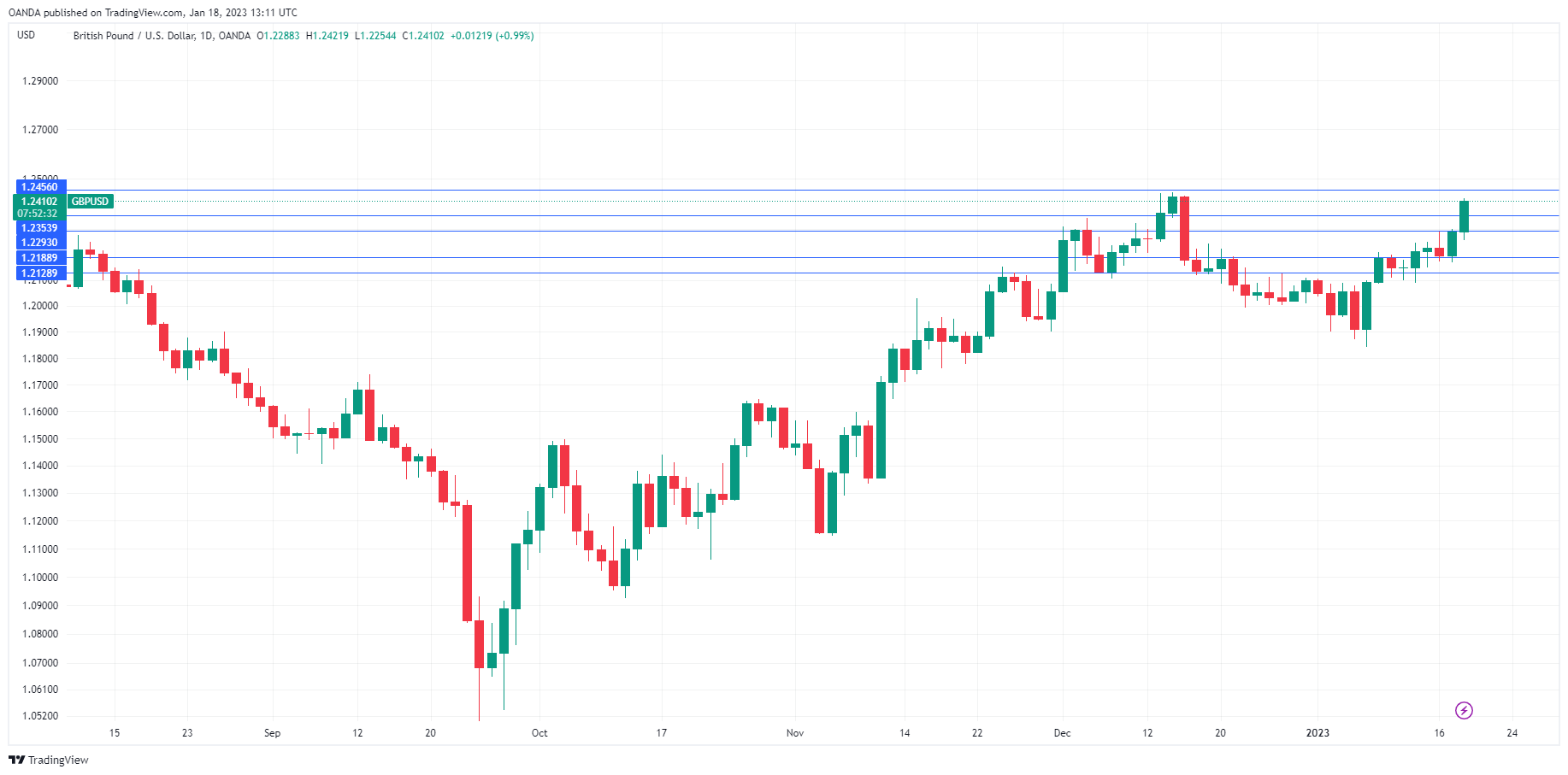
The British pound is in full flight on Wednesday. In the North American session, GBP/USD is trading at 1.2393, up 0.86%.
UK inflation slows
UK inflation eased for a second straight month in December. Headline CPI dipped to 10.5%, down from 10.7% in November and just below the forecast of 10.6%. Core CPI, however, did not show an improvement as it remained unchanged at 6.3%.
The downtrend is welcome news, but inflation still remains stubbornly high after hitting 11.1% in October, a 41-year high. The Bank of England has raised rates to 3.50% but clearly, more work needs to be done. The labour market remains robust, with wage growth climbing to 6.4% in December, up from 6.2% in November and brushing past the forecast of 6.1%. This is well below inflation levels, much to the chagrin of workers, but it is much too high for the BoE, which is focussed on curbing inflation. The BoE meets next on February 2nd and the markets have priced in a second-straight 50-bp increase. The BoE will also release updated economic forecasts, which could play a key role in the central bank’s rate policy over the next several months.
US consumers cut back on spending in December for a second consecutive month. Retail sales fell 1.1%, driven lower by a decline in vehicle sales due to rising interest rates for vehicle loans, as well as lower gas prices. This was lower than the November reading of -1.0% and the consensus of -0.8%. Core retail sales also declined by -1.1%, compared to -0.6% in November and the forecast of -0.8%. The disappointing numbers have sent the US dollar lower against the majors, as speculation rises that the Fed may have to ease up on the pace of rate hikes due to a weakening economy.
GBP/USD Technical
- GBP/USD has pushed above resistance at 1.2292 and 1.2352. The next resistance line is at 1.2455
- There is support at 1.2189 and 1.2129
US: Retail Sales Come in Softer than Expected in December
Retail sales fell by 1.1% in December from a downwardly revised decline of 1.0% in November – below the consensus forecast for a -0.9% pullback.
Motor vehicle & parts dealers reported a 1.2% m/m decline in December. Gasoline station receipts were also down 4.6%, though this was largely attributed to lower gas prices. We might see a reversal of this in January as gas prices have turned higher this month.
Excluding autos and gas, sales were down 0.7% m/m – below consensus expectations for a loss of 0.5% m/m.
Sales at building materials and garden equipment stores - another volatile category - were up 0.3% m/m.
Excluding volatile categories, retail sales in the "control group," used in estimating personal consumption expenditures (PCE), declined by 0.3% m/m from a downwardly revised 0.5% m/m increase in November. This was below the consensus forecast for a 0.3% decline.
The biggest drag came from sales at furniture stores (-2.5% m/m), as well as electronics & appliance stores, non-store retailers, and miscellaneous stores retailers – all three of which declined by 1.1% on the month.
Sales at food services & drinking places – the only gauge for the services sector in today's reading – was down 0.9% m/m, following four months of gains.
The only category with positive growth was sales at sporting goods & music stores, which gained a 0.1% m/m in December, while sales at food & beverage stores were flat.
Key Implications
This morning's spending figures show that 2022 ended on a softer note. Consumers are becoming increasingly more cautious in allocating their income and pandemic savings. Excluding volatile items such as auto, gas and food, growth in real core retail sales has been slowing since May and was 5.2% lower in December. Looking at the year ahead, we could expect a further deceleration in spending on material things, with consumption of goods expected to decline 0.4% (annualized) in Q1 2023.
Next on the agenda is the question of how much demand for services holds up. The sudden dive of the ISM services survey into the contractionary territory may be indicative of an inflection point. While soft and hard data often diverge, today's report also points to weaker services consumption as restaurant sales decline. If confirmed, real consumer spending will come in a bit weaker than previously expected at 2.7% (annualized) in Q4, building a stronger case for the Fed not to go beyond a 25-basis point hike in February.
AUD/USD Mid-Day Report
Daily Pivots: (S1) 0.6945; (P) 0.6971; (R1) 0.7013; More...
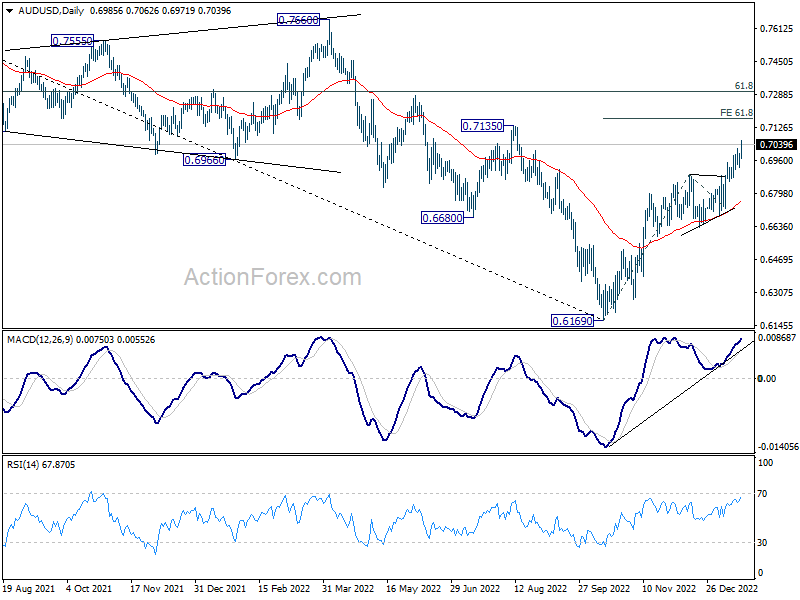
AUD/USD's rally resumed after brief consolidations and intraday bias is back on the upside. Current rally from 0.6169 should target 61.8% projection of 0.6169 to 0.6892 from 0.6721 at 0.7168 next. On the downside, below 0.6928 minor support will turn intraday bias neutral again. But outlook will stay bullish as long as 0.6721 support holds, in case of retreat.
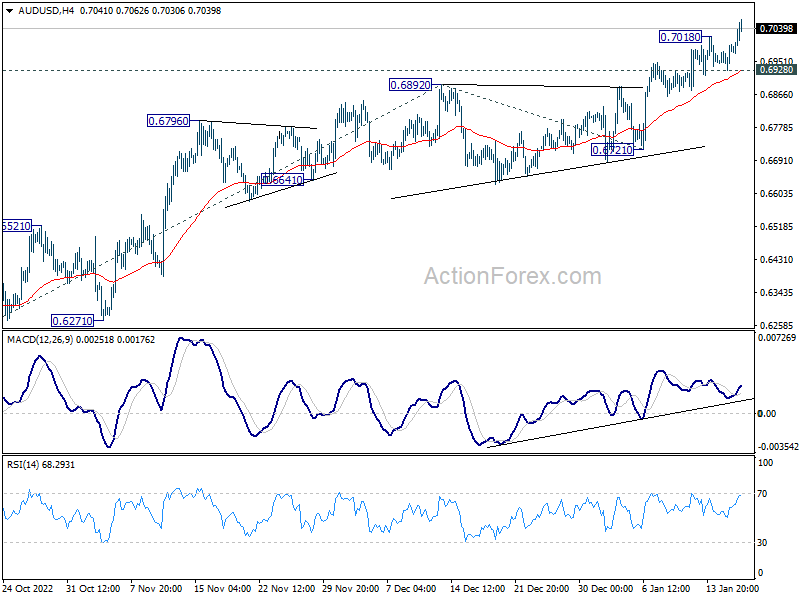
In the bigger picture, corrective decline from 0.8006 (2021 high) should have completed with three waves down to 0.6169 (2022 low). Further rally should be seen to 61.8% retracement of 0.8006 to 0.6169 at 0.7304. Sustained break there will pave the way to retest 0.8006. This will now remain the favored case as long as 0.6721 support holds.
EUR/GBP Mid-Day Outlook
Daily Pivots: (S1) 0.8743; (P) 0.8815; (R1) 0.8852; More...
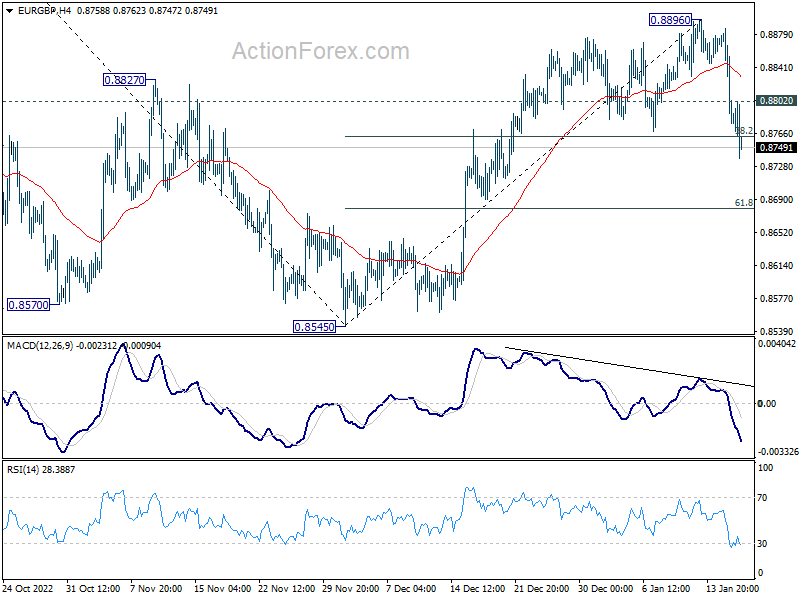
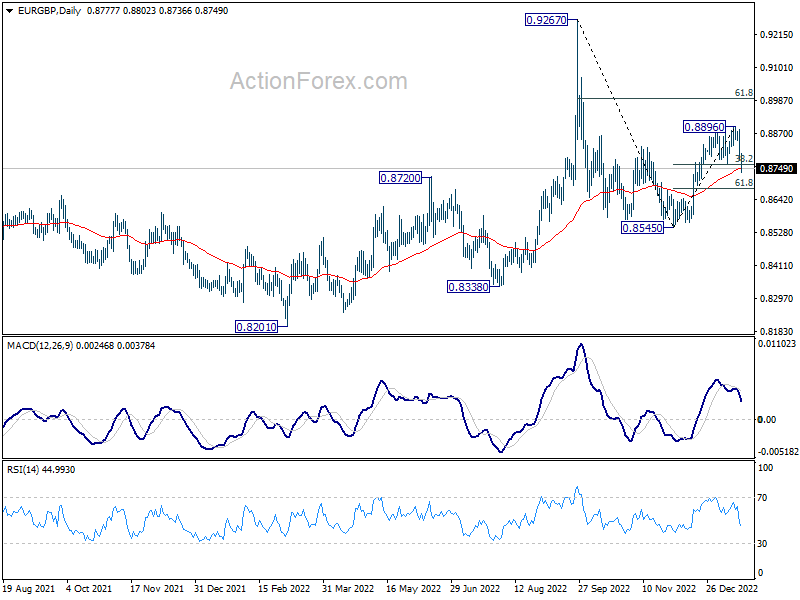
EUR/GBP's break of 0.8768 support and 38.2% retracement of 0.8545 to 0.8896 at 0.8762 now argues that whole rebound form 0.8545 has completed at 0.8996. Intraday bias is back on the downside for 61.8% retracement at 0.8679. Sustained break there will pave the way back to retest 0.8545 low. On the upside, above 0.8802 minor resistance will turn intraday bias neutral first. But risk will stay on the downside as long as 0.8896 resistance holds.
In the bigger picture, current development argues that rebound from 0.8545 is merely a correction to fall from 0.9267. Sustained trading below 55 day EMA (now at 0.8748) will affirm this bearish case and target 0.8545 and below. Nevertheless, strong rebound from current level will retain near term bullishness for another rise through 0.8896 later.
USD/CHF Mid-Day Outlook
Daily Pivots: (S1) 0.9181; (P) 0.9228; (R1) 0.9269; More...
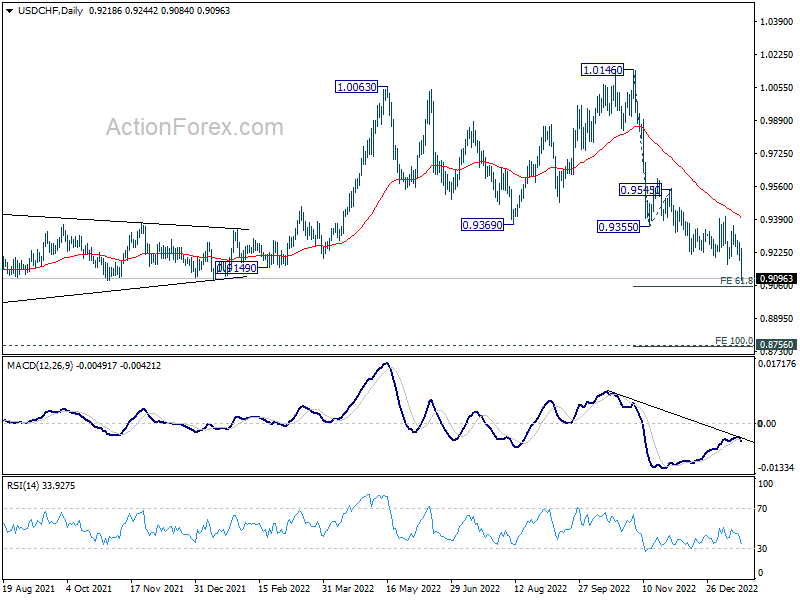
USD/CHF's decline resumed by breaking through 0.9165 today and intraday bias is back on the downside. Next target is 61.8% projection of 1.0146 to 0.9355 from 0.9545 at 0.9056. Sustained break there will pave the way to 100% projection at 0.8754, which is close to 0.8756 long term support. On the upside, above 0.9165 minor resistance will turn intraday bias neutral first, before staging another decline.
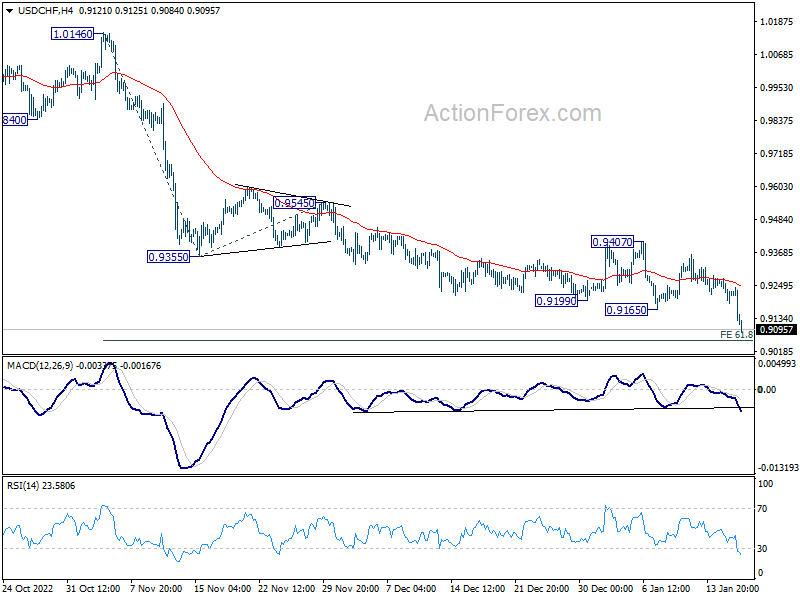
In the bigger picture, rise from 0.8756 (2021 low) has completed at 1.0146, well ahead of 1.0342 long term resistance (2016 high). Based on current downside momentum, fall from 1.0146 should be a medium term down trend itself. Next target is a test on 0.8756 low. Strong support should be seen there to bring rebound. Still, further decline will now be expected as long as 0.9407 resistance holds, in any case.