

Sample Category Title
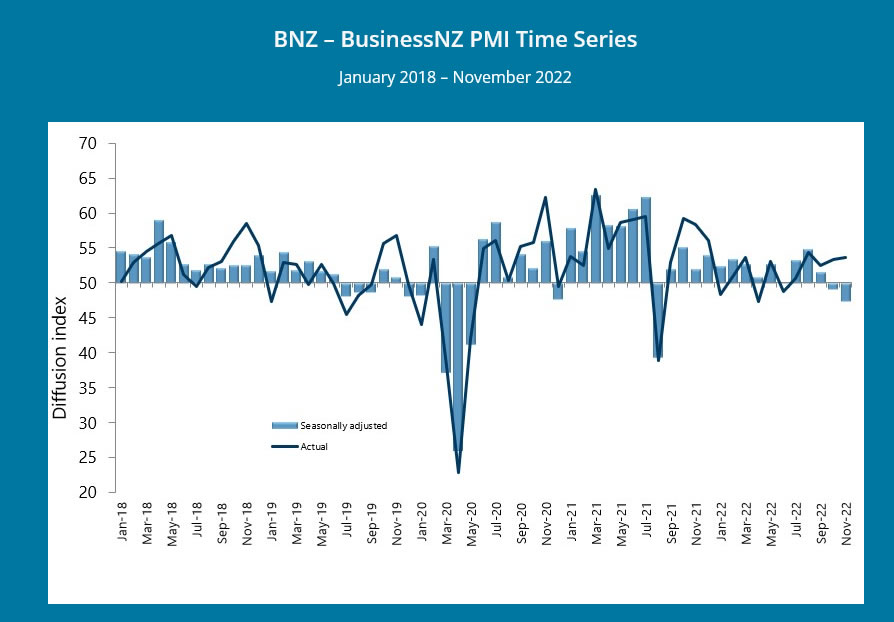
NZ BusinessNZ manufacturing dropped to 47.4, negative dynamic at play
New Zealand BusinessNZ Performance of Manufacturing Index dropped from 49.3 to 47.4 in November. That is the first time the PMI has shown consecutive months of contraction since the first nationwide lockdown in 2020.
Looking at some details, production fell slightly from 49.9 to 49.6. Employment fell from 48.7 to 46.7. New orders dropped further from 44.4 to 41.8. Finished stocks rose from 55.0 to 56.1. Deliveries dropped from 55.4 to 50.7.
BNZ Senior Economist, Craig Ebert stated "it's been quite the sag in the PMI, compared to just three months ago when everything appeared positive. Of course, the PMI can dive down to the 40-zone when things get recessionary. And November's result wasn't that awful. That said, it also had componentry showing a negative dynamic at play".
BoJ Could Keep Policy and Guidance Untouched
The Bank of Japan has remained an outlier compared to the other major central banks which have been raising interest rates at a fast pace throughout 2022 in a synchronized attempt to bring inflation to heel. This resulted in a tumbling yen and forced Japanese authorities to intervene in the currency market in September and October. But, after hitting a 32-year low against the US dollar, the yen staged a comeback, with the BoJ coming under the microscope as investors try to figure out whether a policy tweak is on the cards sooner rather than later. The Bank meets early on Tuesday, but no policy action is expected.
Kuroda wants to see wages at 3%
At its latest gathering, the BoJ kept its ultra-loose policy untouched and maintained its dovish guidance that interest rates will remain at “present or lower levels”.
After that gathering, Governor Kuroda has been adamant on the need to maintain ultra-low interest rates and pushed back against calls for reviewing the policy framework. He has been also repeating that the rise in core consumer prices is driven mostly by surging import costs and that inflation would return back to 2% during the next fiscal year. In a semi-annual testimony before parliament, he noted that the Bank needs to focus on supporting growth until wages increase more, adding that they need to rise by around 3%.
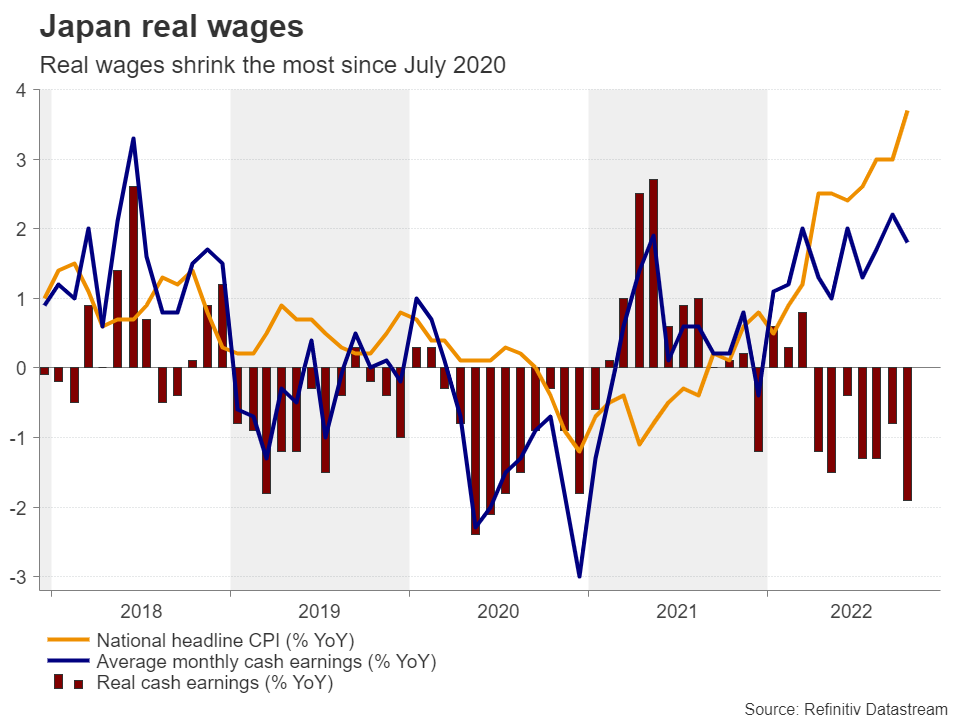
With average monthly cash earnings slowing to 1.8% y/y in October from 2.2% in September, and headline inflation accelerating to 3.7% y/y from 3.0%, real wages shrank the most since July 2020. Combined with the GDP data revealing a small contraction during Q3, this makes the case for any change in policy or language at Tuesday’s meeting unlikely.
Officials unlikely to pull a rabbit out of a hat
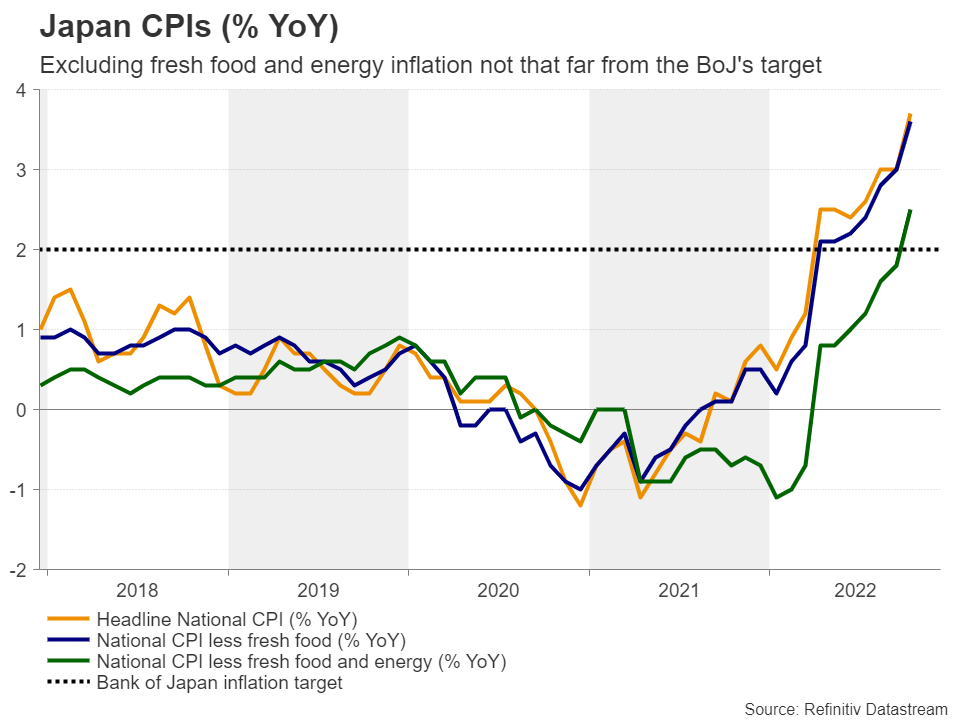
What adds to that hypothesis is that this meeting will be one of the smaller ones that are not accompanied by updated economic projections. Moreover, inflation excluding fresh food and energy rose to 2.5% y/y in October, not far above the BoJ’s target and well below the core metrics of other major nations, whose central banks have already started slowing their tightening crusades.
Yes, the spotlight is likely to fall on Kuroda’s post-meeting briefing, but he might decide to not pull a rabbit out of his hat and perhaps wait for the January gathering, the last that offers an economic outlook and updated projections before he steps down on April 8. And yet, if data allows them, officials could wait a bit longer, perhaps after the “shunto” spring wage talks in March, when blue-chip firms meet with unions to discuss salaries for the upcoming fiscal year.
Yen unlikely to react at the decision, recovery may continue
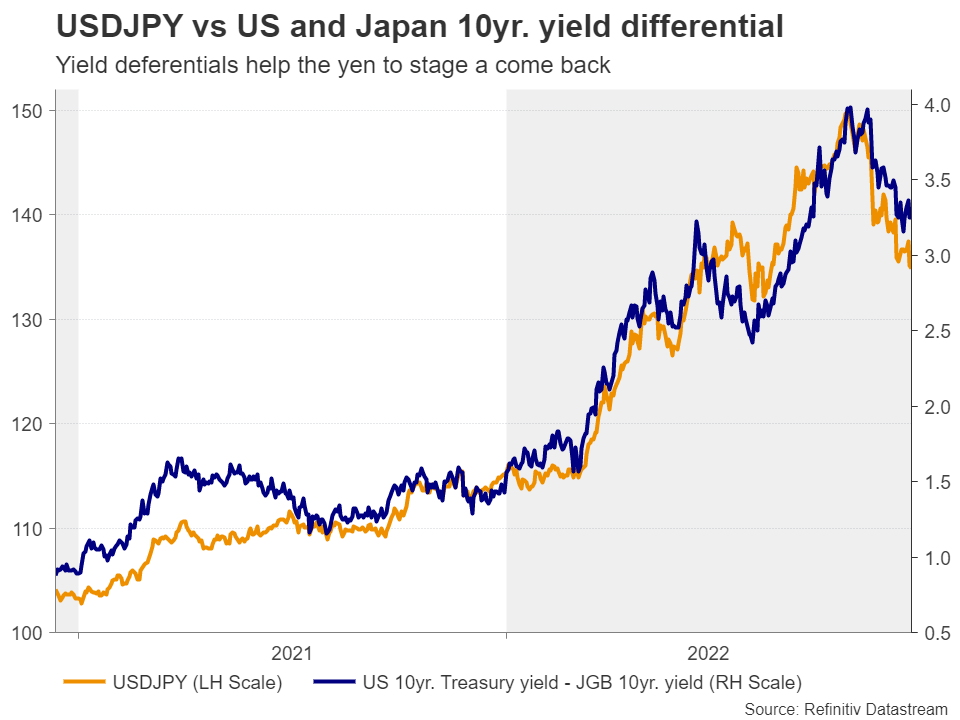
Putting everything together, the yen is unlikely to be affected much by Tuesday’s decision. With dollar traders not touched by the Fed’s last hawkish play for 2022, narrowing yield differentials between the US and Japan could continue working in favor of the yen. The currency might also reclaim its safe-haven status in case concerns about the performance of the global economy resurface. Should market participants continue pricing in 50bps worth of Fed rate cuts by the end 2023, the yielding dollar could lose the title of the “ultimate safe haven”, and dollar/yen may continue to slide.
From a technical standpoint, dollar/yen continues to trade below the prior uptrend line taken from the low of March 30 and below the newly drawn downtrend line taken from the high of October 21. This paints a negative picture, but with the pair receiving support from the 200-day and the 134.00 zone, a break lower may be needed to reaffirm the bearish case.
Such a dip could pave the way towards the 130.50 barrier, marked by the low of August 2, and if there are no buyers to be found there either, then the downtrend may extend towards the 126.50 territory, defined as a support by the low of May 25.
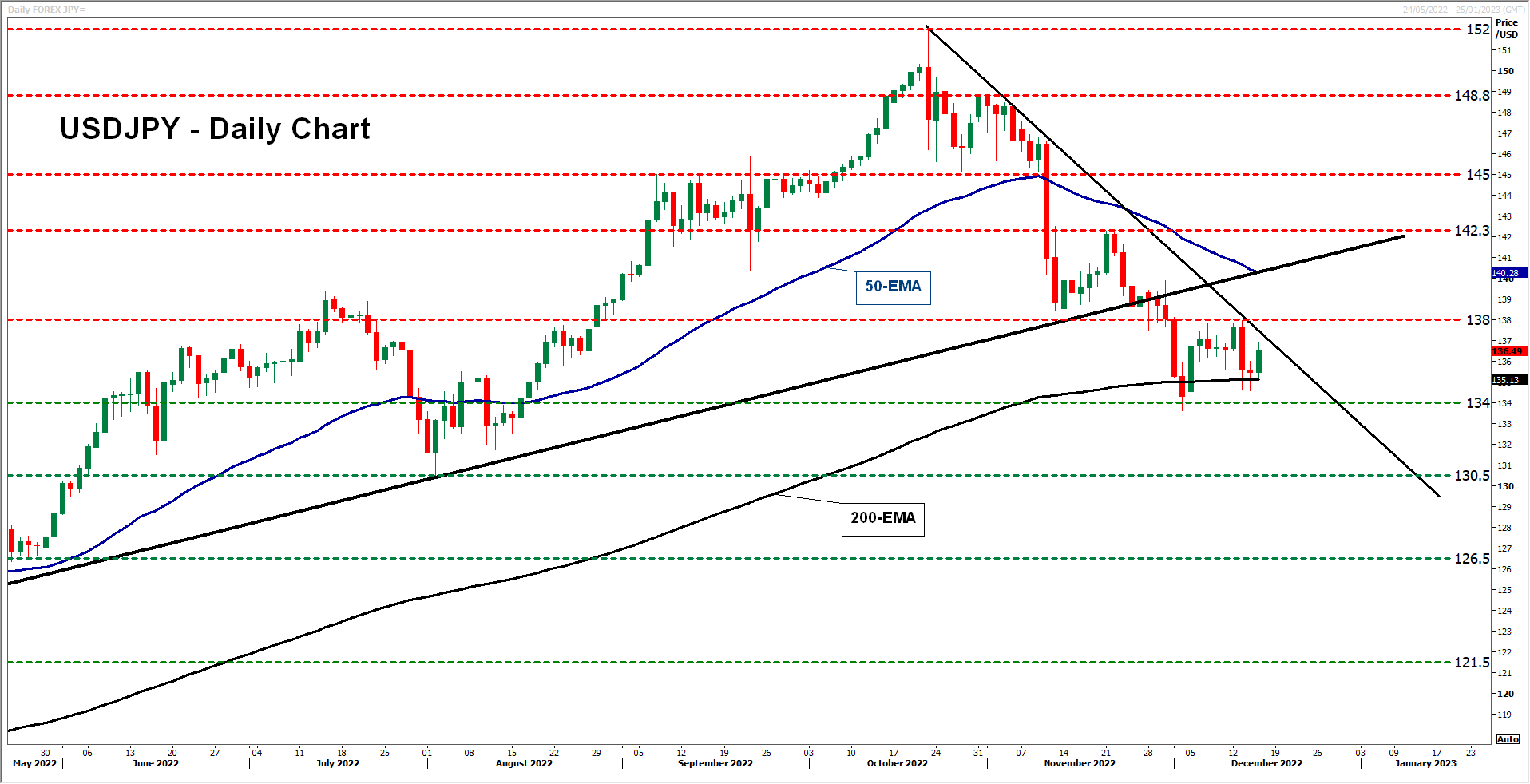
For the bearish outlook to be dismissed, a break above the high of November 22 at 142.30 may be required. This would signal the pair’s return above both the moving averages and the two aforementioned trendlines, and may encourage the bulls to climb towards the psychological zone of 145.00 marked by the inside swing low of October 27. That zone was also proven a strong resistance between September 7 and October 4, but if it fails to stop the advance this time, the rally could stretch towards the 148.80 territory, marked by the highs of October 30 and November 1.
Cliff Notes: Markets End the Year Mired in Uncertainty
Key insights from the week that was.
This week, we received updates on consumer and business confidence and the labour market for Australia. Offshore, a string of 50bp rate hikes were seen across the US, Europe and the UK.
The December Westpac-MI survey reported a welcome 3% lift in consumer sentiment; although at 80, confidence amongst households remains comparable to the low points seen during the pandemic and the GFC. Inflation remained the primary concern of households, though ‘budget and taxation’, ‘economic conditions’ and ‘interest rates’ were also prominent. All of these factors are likely contributing to the weak state of family finances which, versus a year ago and for the year ahead, are respectively 25% and 19% below long-run average levels despite a strong labour market (see below) and favourable expectations for employment. In turn, households’ financial concerns are restricting their plans for major purchases, with ‘time to buy a major household item’ 33% below average.
The November labour force survey provided the largest domestic surprise this week. Against the market consensus for a 19k gain in employment, a striking 64k jobs were created in the month. Additionally, the 71k increase in the size of the labour force saw the participation rate return to a historic 66.8%; the employment-to-population ratio print a fresh record high of 64.5%; and the underemployment rate – which has lagged the broader recovery to date – fall 0.2ppts to 5.8%. Clearly, Australia’s labour market is a resounding source of strength for households as the year draws to a close, echoed by favourable expectations for employment in the Westpac-MI survey. Note though, with the unemployment rate holding firm at 3.4% in November, Westpac’s forecast for a quarter-average unemployment rate of 3.3% will be harder to achieve given the unexpected strength in participation.
It is promising to see the continued recovery in immigration flows and growth in the working age population consequently rise well above pre-pandemic levels to 2.0%yr. Being derived from estimates of Australia’s overseas arrivals and departures, the solid recovery in migrant flows is resulting in significant upward revisions to the size of the Australian labour force. It is worth mentioning that net arrivals are holding at very high levels among temporary workers (+13.5k/mth average) and students (+17.7k/mth average) after many months of significant net outflows due to the pandemic. Should the strength in net visa arrivals be sustained, the severe labour constraints facing businesses can be alleviated in time, thereby facilitating the longer-term recovery of the Australian economy.
In terms of the outlook, Chief Economist Bill Evans discussed the key implications from the consumer sentiment survey for consumption and housing in his video update this week. The evolution of both consumer demand and business conditions in 2023 was also the primary focus of our December Market Outlook in conversation podcast. For a full view of our forecasts for 2023 and 2024, see the December 2022 & January 2023 Market Outlook.
Moving offshore, first to New Zealand. GDP grew by a very strong 2% in Q3, more than twice the market and RBNZ expectation. As detailed by our New Zealand Economics team, GDP is now 8% above its end-2019 level, prior to the pandemic, with half of this gain coming in the last two quarters as international tourism returned. In Q3, solid-to-strong gains in activity were also seen outside of tourism-related sectors, highlighting the strength of current momentum in New Zealand’s economy. With supply still constrained, this result supports the view that the RBNZ will open 2023 with another large increase in the cash rate (75bps at the February meeting) even as other major central banks slow their pace of tightening and begin to consider drawing their hiking cycles to a close.
Over in the US, debate over the peak for fed funds and how quickly rate cuts will follow rages on. The updated economic forecasts of the FOMC make clear that the Committee remains resolute in their determination to fight inflation (a peak of 5.1% for fed funds now seen in 2023, to be followed by only modest cuts in 2024) as their assessment of price risks remains tilted to the upside. Still, in the press conference, Chair Powell made clear that their decisions would be data dependent and materially reduced the duration of his comments regarding financial conditions.
On the latter, whereas getting term interest rates well into contractionary territory has been his focus for the past year, in this press conference Chair Powell’s response to a question on financial conditions was focused on fed funds, the overnight policy rate. Arguably, this points to a recognition that, late in the tightening cycle, the market inevitably will price in the timing and scale of the rate cuts to come. Managing these expectations is critical to getting inflation back to target and doing so without a lasting hit to activity. Regarding activity growth, it is clear that both the FOMC and the market is becoming more concerned. The FOMC now only see cumulative growth through 2022 and 2023 of 1.0%; though, highlighting the downside risks present, that is still twice Westpac’s expectation. The data released this week also spoke to these downside risks. Of particular significance, control group retail sales fell 0.2% in November and October’s gain was revised down.
In Europe, the ECB delivered a 50bp rate hike across all policy rates as widely anticipated, slowing from the 75bp pace of the prior two meetings. However, a clear hawkish shift was adopted within the accompanying statement and the following press conference, with President Lagarde advocating for large, sustained increases in interest rates over the period ahead. Indeed, the Governing Council’s updated macroeconomic projections continue to paint a bleak picture for the outlook. That inflation is not expected to return to the medium-term target of 2% over the forecast horizon (6.3% in 2023; 3.4% in 2024 and 2.3% in 2025) suggests a growing concern over the structure and pace of core inflation, which itself held firm at 5.0% in November. Reinforced with plans to reduce the APP portfolio from March 2023, the ECB’s tightening cycle will likely run further into 2023, but this will depend crucially on the flow of data over the next few months as the Governing Council gauges the evolution of inflation pressures and resilience of the economy over winter.
The Bank of England meanwhile provided relatively fewer surprises, also slowing the pace of tightening to 50bps in December. The decision statement was very similar to that of last month, the Committee stating that the economy is evolving broadly in line with the projections laid out in the November report. The dovish shift in the voting profile (6-3 for 50bps in December; 7-2 for 75bps in November) had little market impact, with any signal of a shift of sentiment within the Committee being overshadowed by the still formidable inflation outlook that warrants further increases in interest rates over coming months.
A final note on China. This week we have continued to see further progress away from COVID-zero, with broad-based regular testing for the virus resigned to the past. Authorities are also making a concerted effort to hold up then stoke confidence in the outlook as COVID-19 spreads across the country, inevitably causing health consequences for at-risk groups. For our growth expectations to be met for 2023, confidence amongst households must be robust, else they continue to choose to stay home and not spend. How consumption responds a month or two after the removal of restrictions will determine the skew of risks for household demand in 2023. That in turn will give a guide on the likelihood of an upturn in domestically-focused investment, across the business sector and for housing. As outlined in Market Outlook, the global green transition and Asia’s structural development are creating broad-based and long-lasting export opportunities for China. But the initial wave of investment could prove bumpy given both domestic and global uncertainties, even with the policy stance highly accommodative and China’s competitiveness improving ahead of anticipated FX appreciation.
This is the last edition of Cliff Notes until late January 2023. Merry Christmas and best wishes for 2023.
USD/JPY At Risk of More Losses, PMI’s Up Next
Key Highlights
- USD/JPY started a consolidation phase above the 134.50 level.
- A key bearish trend line is forming with resistance near 137.15 on the 4-hours chart.
- EUR/USD extended its increase above the 1.0680 resistance zone.
- The Bank of England raised interest rates from 3% to 3.5%.
USD/JPY Technical Analysis
The US Dollar saw a bearish moves after it settled below the 142.00 level. USD/JPY even declined below the 140.00 support level to move into a bearish zone.
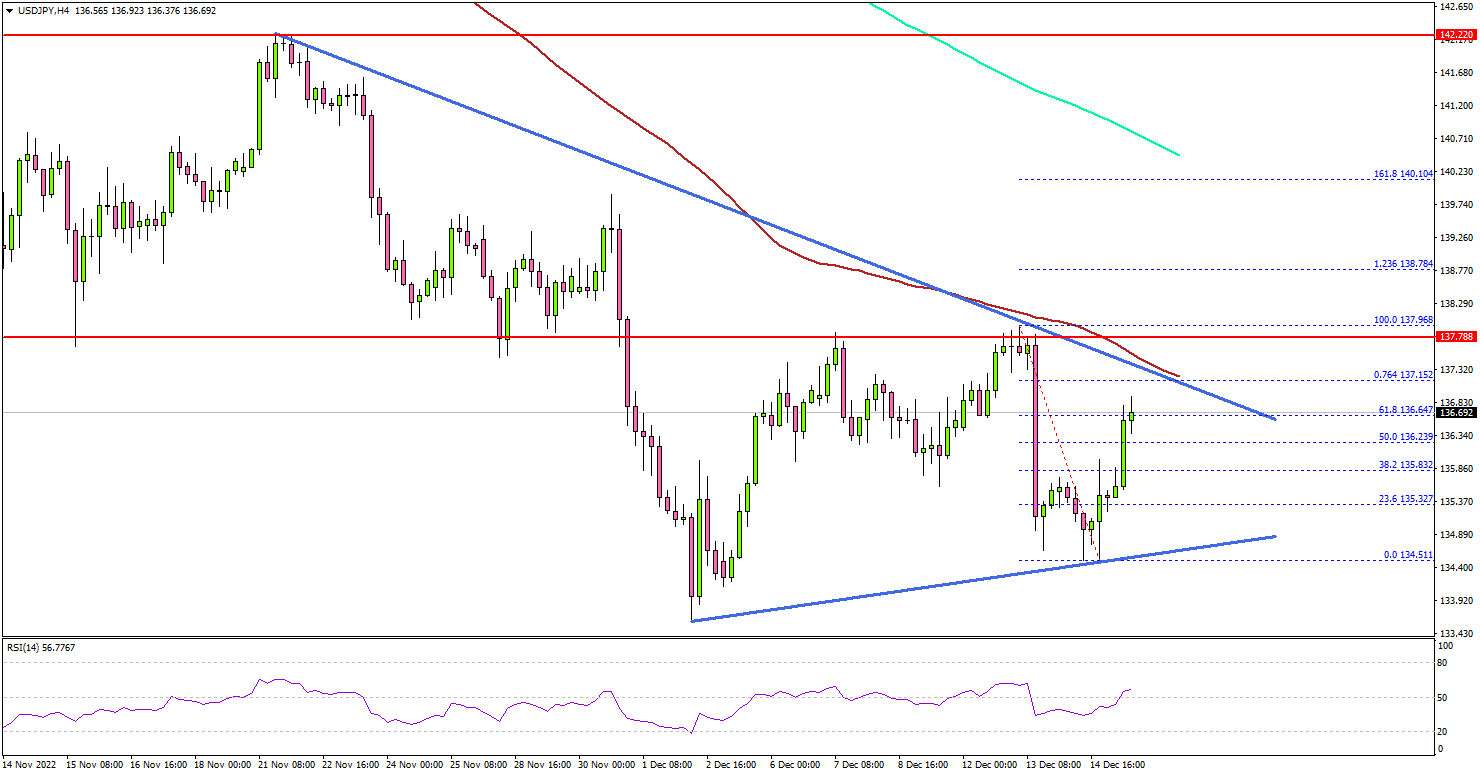
Looking at the 4-hours chart, the pair settled well below the 140.00 level, the 100 simple moving average (red, 4-hours), and the 200 simple moving average (green, 4-hours).
There was also a drop below the 136.50 support level. The recent low was formed near 134.51 before there was an upside correction. The pair corrected above the 135.80 resistance zone. However, the bears are active near the 137.20 zone.
There is also a key bearish trend line forming with resistance near 137.15 on the same chart. The next major resistance may perhaps be near 137.50. A clear move above the 137.50 resistance might start a steady increase.
In the stated case, USD/JPY may perhaps rise towards the 138.50 level. Any more gains could lead the pair towards the 140.00 resistance zone.
If not, there is a risk of a fresh decline below the 135.50 support. The next major support is near the 134.50 zone. Any more losses might send the pair towards the 133.80 support zone.
Looking at EUR/USD, the pair extended its increase above the 1.0680 resistance and there are chances of more upsides.
Economic Releases
- Germany’s Manufacturing PMI for Nov 2022 (Preliminary) - Forecast 48.2, versus 48.3 previous.
- Germany’s Services PMI for Nov 2022 (Preliminary) - Forecast 46.3, versus 46.1 previous.
- Euro Zone Manufacturing PMI for Nov 2022 (Preliminary) – Forecast 47.1, versus 47.1 previous.
- Euro Zone Services PMI for Nov 2022 (Preliminary) – Forecast 48.5, versus 48.5 previous.
- UK Manufacturing PMI for Nov 2022 (Preliminary) – Forecast 46.3, versus 46.5 previous.
- UK Services PMI for Nov 2022 (Preliminary) – Forecast 48.5, versus 48.8 previous.
- US Manufacturing PMI for Nov 2022 (Preliminary) – Forecast 47.7, versus 47.7 previous.
- US Services PMI for Nov 2022 (Preliminary) – Forecast 46.8, versus 46.2 previous.
CHFJPY Wave Analysis
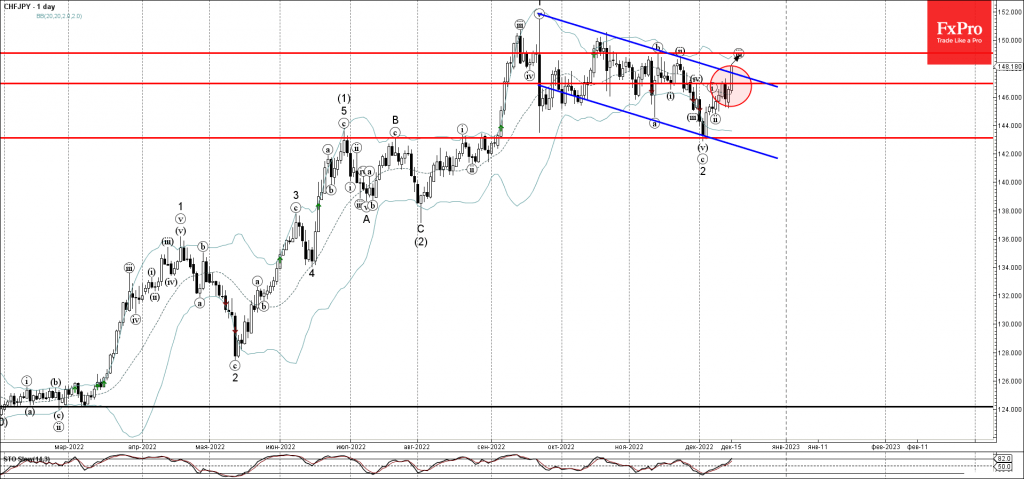
- CHFJPY rising inside short-term impulse wave 3
- Likely to rise to resistance level 149.0
CHFJPY continues to rise inside the short-term impulse wave 3, which previously broke the
resistance level 147.00 standing near the resistance trendline of the daily down channel from September.
The breakout of the resistance level 147.00 continues the clear multi-month uptrend inside which the pair has been moving from the start of this year.
CHFJPY can be expected to rise further toward the next resistance level 149.0 (top of the previous waves (b) and (ii) and the target for the completion of the active wave (iii)).
Gold Wave Analysis
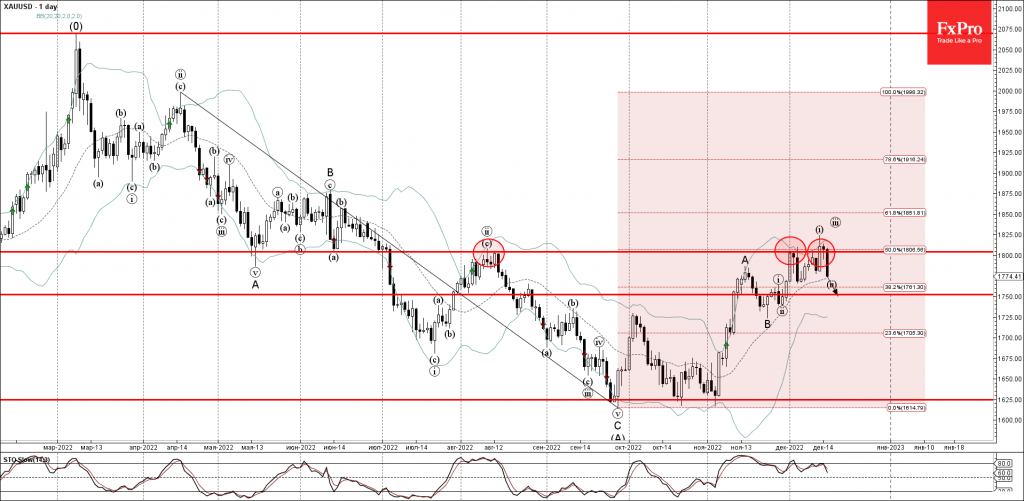
- Gold formed daily Evening Star
- Likely to fall to support level 1750.00
Gold earlier reversed down strongly from the pivotal resistance level 1805.00 (which has been reversing the price from the middle of May).
The downward reversal from the resistance level 1805.00 created the daily candlesticks reversal pattern Evening Star.
Gold can be expected to fall further toward the next support level 1750.00 (forecast price for the completion of the active wave (ii)).
ECB Review – Hawkish 50bp – More Hikes to Come
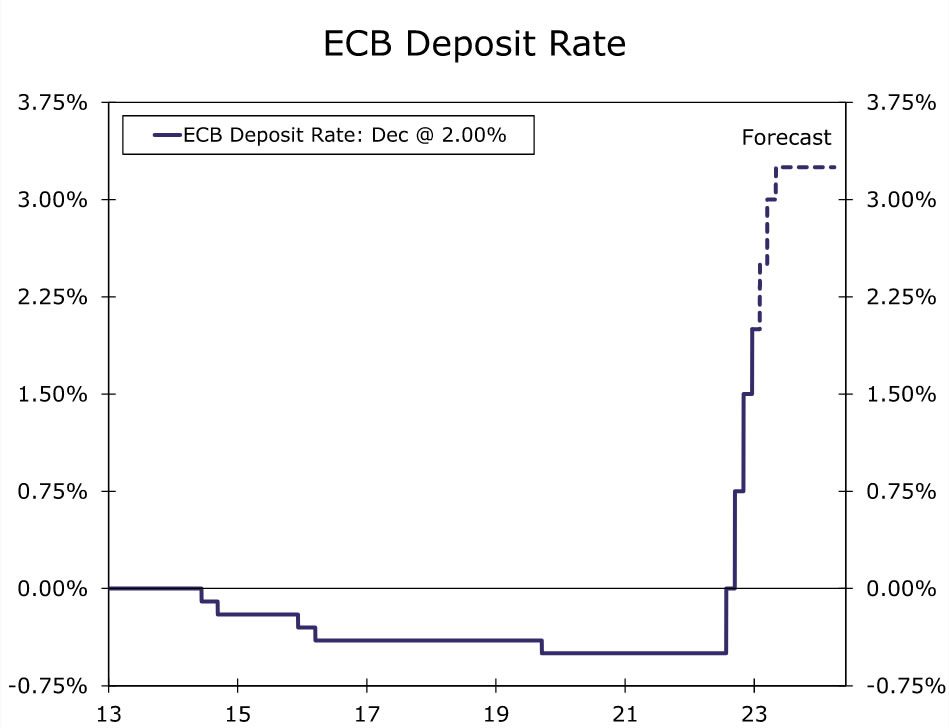
At today's ECB meeting, the ECB delivered a 50bp rate hike in all three policy rates as widely anticipated, so now the ECB deposit rate is at 2%. The ECB also announced that the end to full APP reinvestments would start in March 2023, which was more specific than the presentation of key principles expected. The ECB guided that from March 2023 to June 2023, its securities holdings will decline by EUR15bn per month on average. The pace beyond that is still to be determined.
Lagarde highlighted the data dependent and meeting by meeting approach, but at the same time also gave a firm guidance that today's 50bp rate hike will not be a single 50bp rate hike and that more will follow.
While we expected an open-ended wording of more rate hikes to come, we were surprised by the significant hawkish guidance Lagarde gave today. In our preview, we had already pointed to the risk to our forecast for longer/more than our baseline and as a result of today's meeting we revise our ECB call and add another 50bp to the peak cycle rate to 3.25%, so our new call is for 50bp in February (unchanged), 50bp in March (+25bp) and 25bp in May (new). We remain open to further rate hikes in June next year.
Here A Hike, There A Hike, Everywhere a Rate Hike
Summary
- The European Central Bank (ECB) delivered a 50 basis point hike, taking its Deposit Rate to 2.00% at today's monetary policy meeting, while also announcing plans to begin quantitative tightening from March.
- The ECB's accompanying commentary and press conference were also hawkish in tone. The ECB forecasts above target inflation over the medium term, while ECB President Lagarde signaled that interest rates would keep rising at a rapid pace for now, and perhaps by more than market participants expect. Accordingly, we now forecast another 125 basis points of rate hikes during the first half of 2023, which would see the Deposit Rate peak at 3.25%.
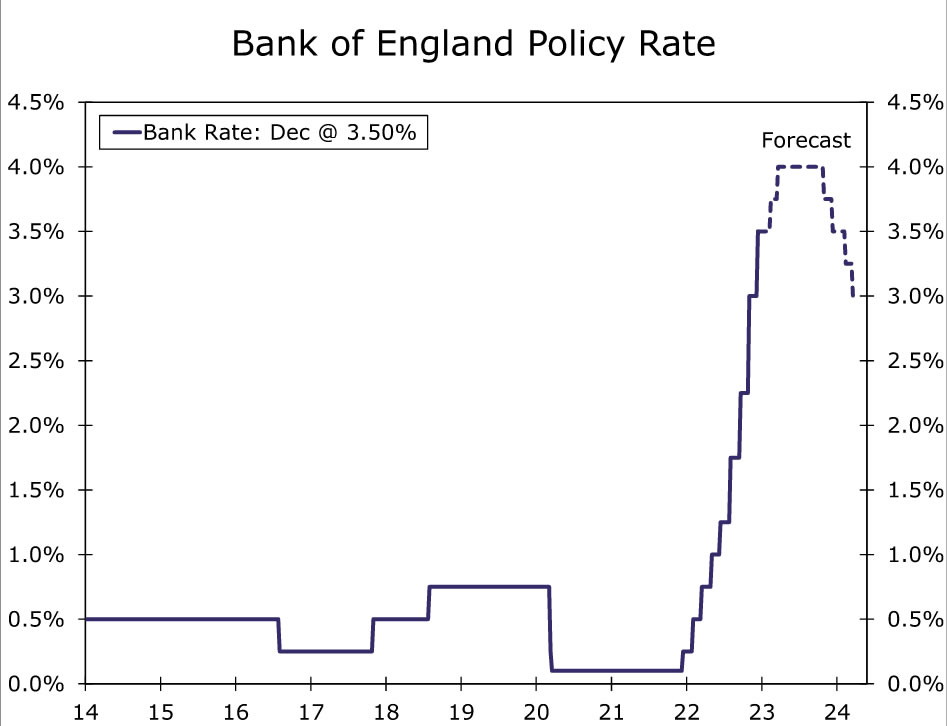
- The Bank of England (BoE) also raised its policy rate by 50 basis points to 3.50%, although the tone of its accompanying comments were more balanced. Still, the BoE said the labor market remains tight, wage growth is elevated, and that it will act forcefully as needed. That does not sound like a central bank that views an end to monetary tightening as imminent. We now forecast two more 25 basis point rate hikes from the BoE, which would see the policy rate peak at 4.00%.
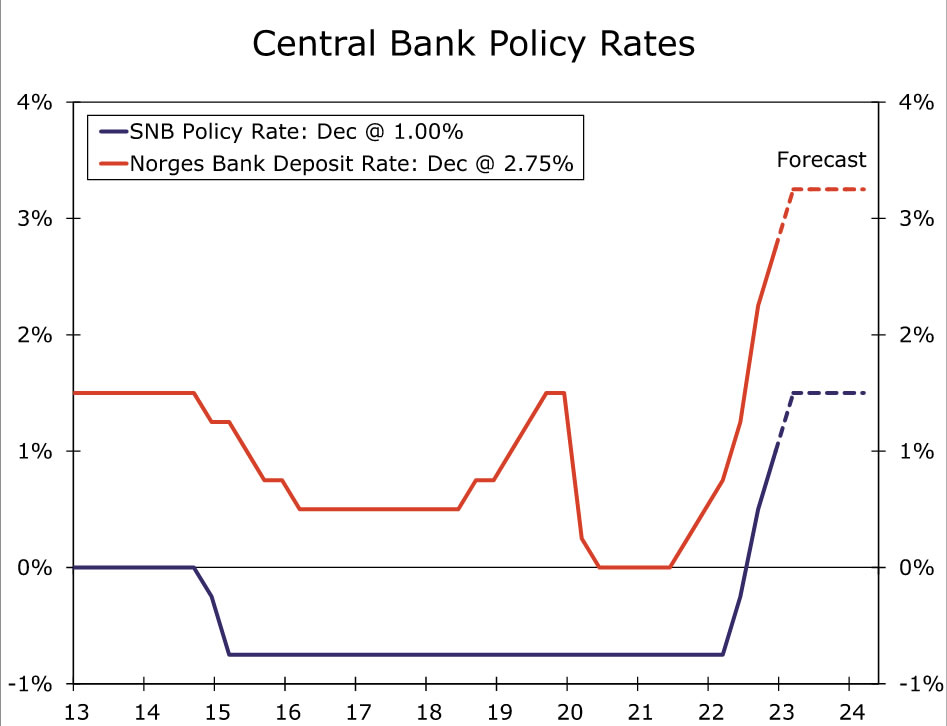
- The Swiss National Bank raised its policy rate 50 basis points to 1.00%. It's accompanying comments leaned hawkish, and the central bank forecasts CPI inflation creeping back above the 2% inflation target by 2025. Against the backdrop, we expect a final 50 basis point rate hike from the Swiss National Bank in Q1-2023.
- Norway's central bank raised its policy rate 25 basis points to 2.75%, while adding that inflation has been a bit higher than expected, the labor market has been sturdier than expected, and the outlook for mainland GDP growth is less pessimistic than previously. We remain comfortable with our forecast for two more 25 basis point hikes from the Norges Bank in January and March, which would see Norway's policy rate peak at 3.25%.
ECB Hikes Again and Announces Quantitative Tightening
In what was a particularly busy day for central banks across Europe, the most significant announcement came from the European Central Bank (ECB). The ECB announced policy shifts on two fronts:
- Policymakers raised key policy interest rates by 50 basis points, including a hike in the Deposit Rate from 1.50% to 2.00%. The increase in interest rates was in line with the consensus forecast.
- It also announced plans to begin quantitative tightening, starting in March. The ECB's holdings under its Asset Purchase Program (APP) will be allowed to decline at a measured and predictable pace, as the ECB will not fully reinvest principal payments from maturing securities. The decline in holdings will average €15B per month until the end of Q2-2023, with the subsequent pace to be determined over time. The pace of decline in the ECB's balance sheet was at the more conservative end of market expectations.
With respect to the accompanying comments and projections, the ECB's announcement was hawkish in tone. The ECB said that based on a substantial upward revision to the inflation outlook, it expects to raise interest rates further, adding:
“In particular, the Governing Council judges that interest rates will still have to rise significantly at a steady pace to reach levels that are sufficiently restrictive to ensure a timely return of inflation to the 2% medium-term target.”
In fact, in the post-meeting press conference ECB President Lagarde went further, saying we should expect the ECB to raise rates at a 50 basis point pace for a period of time, and that the ECB needs to do more on interest rates than what is currently implied by market pricing (note that as of yesterday, interest rate futures suggested a peak ECB Deposit Rate of just over 2.75%).
With respect to its economic projections, the ECB raised its CPI forecasts to 6.3% for 2023, 3.4% for 2024 and 2.3% for 2025. In addition, the ECB also sees CPI inflation excluding food and energy at 4.2% in 2023, 2.8% in 2024 and 2.4% in 2025. Notably, the outlook for inflation in 2025 is still above the ECB's 2% inflation target. Finally, with respect to growth, the ECB projects a short and shallow recession beginning late this year, and sees overall Eurozone GDP growth at 0.5% in 2023, before rebounding to 1.9% in 2024 and 1.8% in 2025.
Overall, the tone of the ECB's announcement along with the above-target inflation projections suggest the European Central Bank should raise interest rates further than we had previously expected. We still anticipate a 50 basis point policy rate increase in February, but now also expect a 50 basis point rate increase in March, and a final 25 basis point increase in May, which would see the ECB's Deposit Rate peak at 3.25%. Considering the likelihood that the Eurozone economic downturn will be intensifying during the early part of 2023 and inflation should be receding, we expect the removal of policy accommodation to transition away from interest rate increases and towards balance sheet reduction beyond May next year.
Bank of England Raises Interest Rates and Strikes a Balanced Tone
Another central bank announcement that attracted plenty of attention today was that of the Bank of England (BoE). The BoE delivered, as expected in terms of its policy action, raising its Bank Rate by 50 basis points to 3.50%. However, there was a mildly dovish tilt around that rate increase action. While six policymakers voted to raise interest rates by 50 basis points, two policymakers voted for no change, and only one policymaker voted for a larger 75 basis point rate hike.
To be fair, some of the BoE's other comments were supportive of further monetary tightening. The central bank said:
- The labor market remains tight, and domestic wage and price pressures are elevated. Wage growth has been around 0.5 percentage points stronger than projected as recently as November.
- It now forecasts a smaller 0.1% quarter-over-quarter decline in Q4 GDP.
- The fiscal consolidation announced by the government in the Autumn Statement will have little effect on U.K. GDP in the near-term, and instead a more restraining effect on U.K. GDP over the medium-term.
Overall the BoE's Monetary Policy Committee said:
“Should the economy evolve broadly in line with the November Monetary Policy Report projections, further increases in Bank Rate may be required for a sustainable return of inflation to target. There are considerable uncertainties around the outlook. The Committee continues to judge that, if the outlook suggests more persistent inflationary pressures, it will respond forcefully, as necessary.”
To us, that does not sound like a central bank that believes an end to monetary tightening is imminent. As a result, we now see a slightly higher peak in Bank of England interest rates than previously. We expect that BoE to raise its policy interest rate by 25 basis points at both its February and March meetings next year, which would see the BoE's policy rate peak at 4.00% by March next year, before the BoE embarks on rate cuts by the end of 2023.
Swiss National Bank Delivers a 50 Basis Point Hike, While Norway's Central Bank Delivers 25 Basis Points
The rate hike action continued elsewhere today as well, with the Swiss National Bank raising its policy rate by 50 basis points to 1.00%. The increase was in line with the consensus forecast, but a bit less than the 75 basis point increase we had expected. The SNB's accompanying comments leaned hawkish, as SNB President Jordan said:
- “It was pretty clear that 50 basis points is the right decision, If you look at our inflation forecasts over the medium term, inflation is still slightly above our 2% threshold.”
- “There is a danger that inflation could remain elevated in Switzerland in the medium term owing to second-round effects” and “The renewed tightening of our monetary policy is therefore necessary.”
The SNB projects inflation of 2.4% in 2023, slowing to 1.8% in 2024. However, by the middle of 2025 the SNB sees CPI inflation creeping back up above 2%. That's in contrast to the central bank's inflation target, which defines price stability as inflation below 2%. With respect to Swiss GDP growth, the central bank forecasts GDP growth of 0.5% in 2023, down from around 2% in 2022.
As in previous announcements, the SNB said “it cannot be ruled out that additional rises in the SNB policy rate will be necessary to ensure price stability over the medium term.” With concerns that inflation could otherwise remain elevated for longer, we forecast a final 50 basis point rate hike to the SNB policy rate, which would see a peak at 1.50% in Q1-2023.
Finally, Norway's central bank (the Norges Bank), in what was a unanimous decision, raised its policy rate 25 basis points to 2.75% and signaled that rates will most likely be raised further in Q1-2023. The Norges Bank said that since its last Monetary Policy Report, inflation has been higher that it had forecast and is now expected to remain higher for longer. The central bank also observed that labor market trends have been sturdier than expected.
Thus, even with an outlook for an eventual slowing in Norway's economy, the Norges Bank has become slightly less pessimistic on the prospects for economic activity. The Norges Bank now see a 0.2% decline in Norway's mainland GDP in 2023, compared to a previously forecast fall of 0.3%. While Norges Bank Governor Ida Woldan Bache said the policy rate will be around 3% next year, given only modest (and mildly hawkish) changes in comments from the central bank in today's announcement, we remain comfortable with our call for two more 25 basis point hikes from the Norges Bank in January and March, which would see Norway's policy rate peak at 3.25%.
Swiss National Bank Raises Rate Slower than Others
The Swiss National Bank raised its rate by 50 points to 1.0% after two hikes of 50 and 75 points at the previous two meetings. In an accompanying commentary, the NBS said it was countering rising inflationary pressures.
In the commentary, the central bank says that “further rate hikes are not ruled out”. This is a milder formulation than other G10 central banks without Japan. However, the exact phrase was in the two previous decision comments, so we cannot speak of a softening tone in this case.
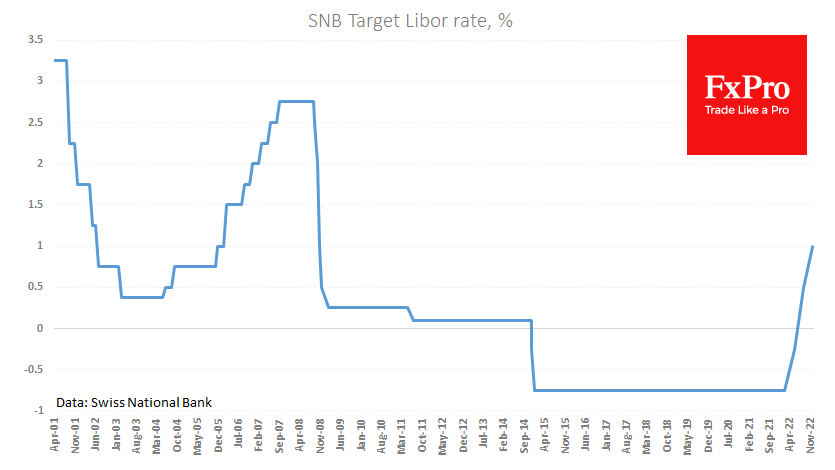
At the recent and previous meetings, the step-up was the same as for our colleagues from the Fed and the ECB: now by 0.5 percentage points, in September by 0.75. However, remember that SNB meetings are twice as rare, so Swiss policy tightening is less drastic. For the year Swiss central bank raised the rate by 175 points against 250 points for the ECB (including the expected +50 today), 340 (also including the forthcoming decision) for the Bank of England and 425 for the Fed.
On the other hand, inflation is not as acute here, having retreated from a peak of 3.5% y/y to 3.0% in the last three months. The producer and import price index retreated to 3.8% y/y in November from 6.9% in June.
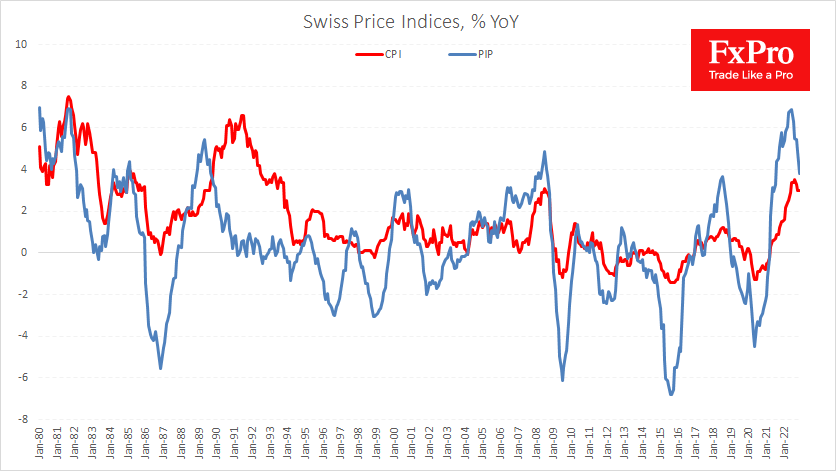
Historically, Switzerland has comparatively lower inflation which is the reason for the lower key rate. Therefore, the current slower pace of monetary policy tightening is not likely to fundamentally undermine the Swiss franc. By playing up the divergence in the speed of rate hikes, the USDCHF could develop a rebound without encountering significant resistance to 0.9400, which looks like a very modest pullback after a more than 9% decline since November 3.