

Sample Category Title
EURCHF Completes Symmetrical Triangle
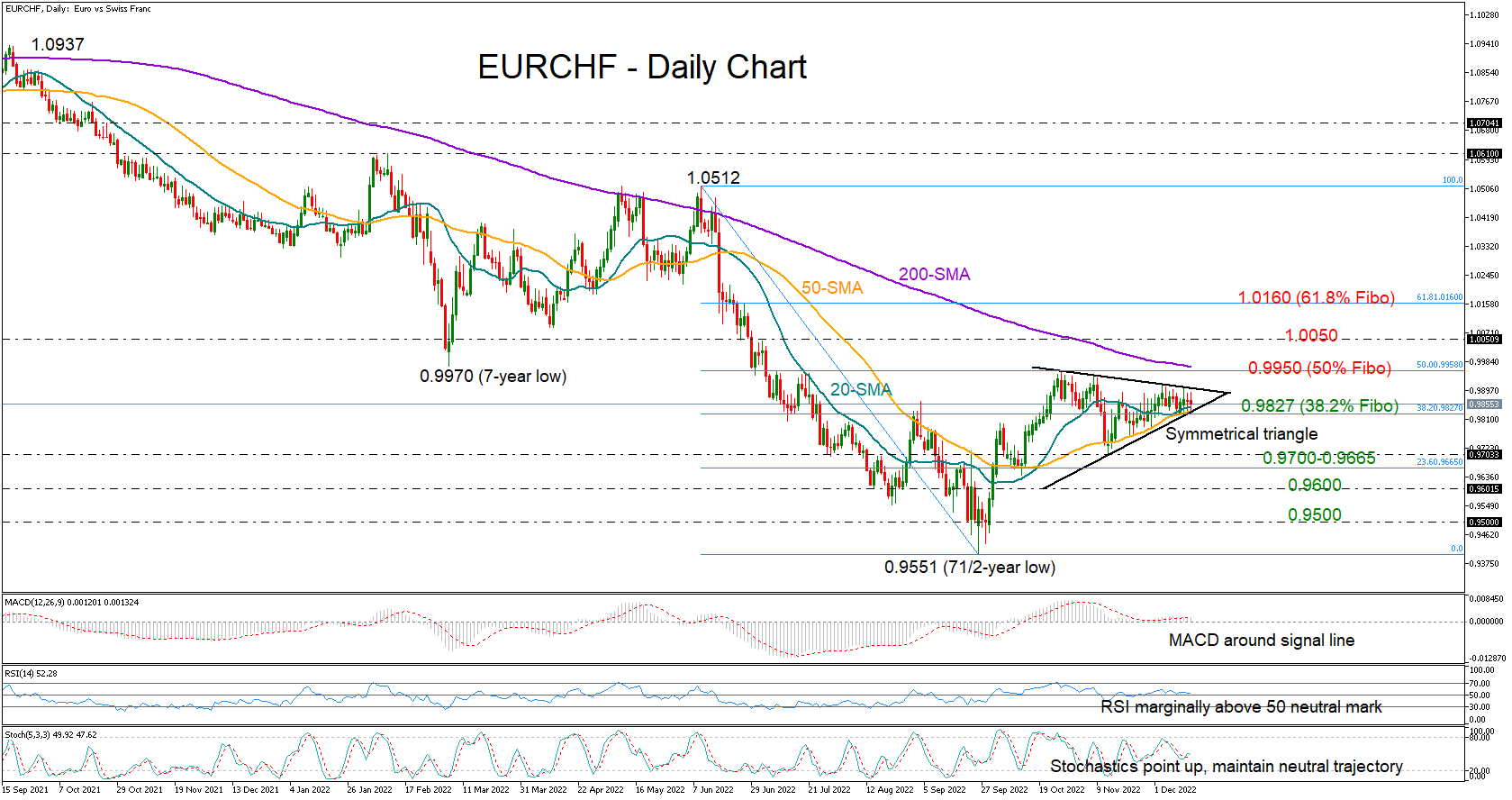
EURCHF remained on the sidelines on Thursday following the ECB policy announcement, completing a symmetrical triangle below the 200-day simple moving average (SMA) at 0.9868.
The formation occurred within a short distance above the 7½-year low of 0.9551, with the momentum indicators currently flagging a neutral-to-bullish bias. The RSI is moving horizontally marginally above its 50 neutral mark, the stochastics – although pointing upwards – maintain a neutral trajectory between their 20 and 80 levels, while the MACD is stable around its red signal line.
For the bulls to get full control, the pair will need an advance above the triangle and beyond the 200-day SMA, which is currently lying around the 50% Fibonacci retracement of the June-September downfall at 0.9958. If the recovery extends above the 1.00500 constraining zone, the next target will be the 61.8% Fibonacci of 1.0160.
A step beneath the triangle’s lower trendline, where the 38.2% Fibonacci of 0.9827 and the shorter-term SMAs reside, may initiate a new bearish wave towards the 0.9700-0.9655 territory. Some consolidation could follow around the 0.9600 and 0.9500 numbers before the 2022 low of 0.9551 shows up on the radar.
Summarizing, EURCHF could become volatile in the coming sessions as a symmetrical triangle nears a completion. A sustainable rally above 0.9950 could give the lead to the bulls.
EUR/JPY Mid-Day Outlook
Daily Pivots: (S1) 143.90; (P) 144.32; (R1) 145.17; More....
EUR/JPY's rebound from 140.75 resumed after brief retreat and intraday bias is back on the upside. Outlook is unchanged that correction from 148.38 could have completed at 140.75. Break of 146.12 resistance will target a retest on 148.38 high. For now, further rise will remain in favor as long as 143.48 support holds, in case of retreat.
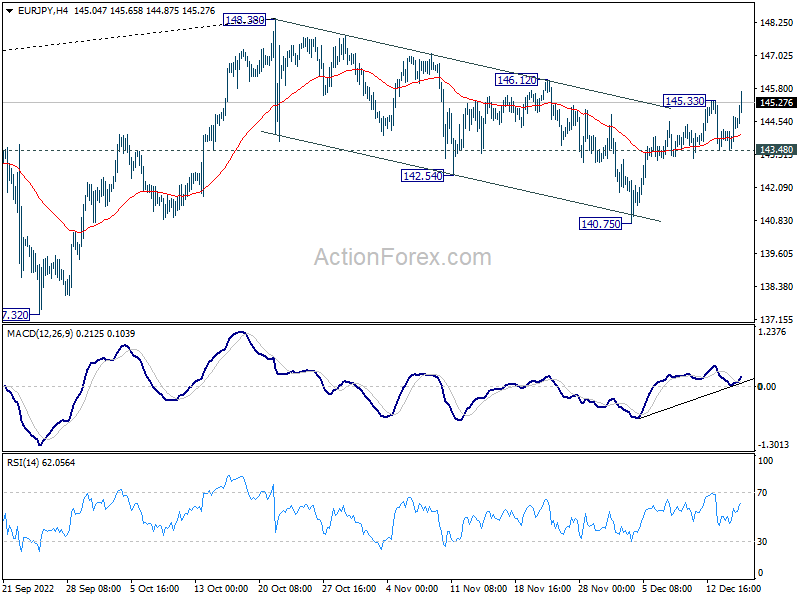
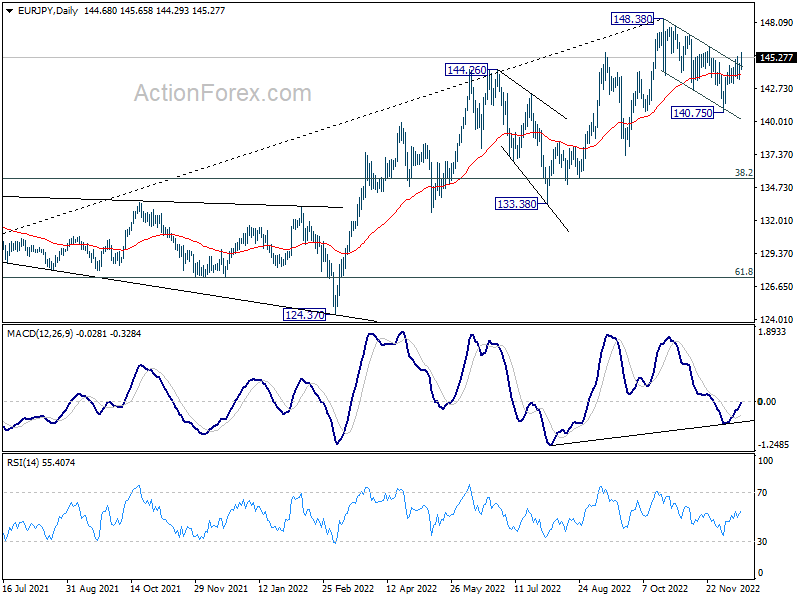
In the bigger picture, considering bearish divergence condition in weekly MACD, 148.38 could be a medium term top already. Fall from there is probably correcting whole up trend from 114.42 (2020 low). Deeper decline would be seen to 55 week EMA (now at 138.08), or further to 38.2% retracement of 114.42 to 148.38 at 135.40 before completion.
Euro Jumps after Hawkish ECB Hike, Dollar Rebounds on Risk-Off Sentiment
Dollar rebounds broadly following risk-off sentiment as delayed reaction to Fed's hawkish projections overnight. SNB, BoE and ECB met expectations with 50bps rate hike. Euro is strong as ECB maintains hawkish bias, with upward revision in inflation projections. Swiss Franc is the third strongest after SNB indicates the possibility of more tightening. Meanwhile, Sterling is notably weaker after somewhat dovish MPC voting. But Aussie and Kiwi are even worse on overall sentiment.
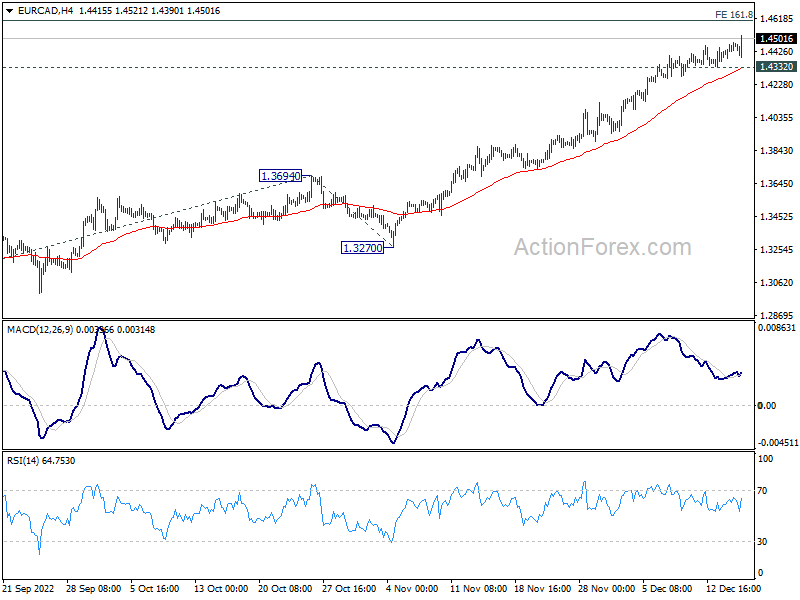
Technically, Euro is making progresses in some crosses with EUR/JPY breaking through 145.33 temporary top. EUR/AUD is on the verge of breaking 1.5747 resistance. EUR/CAD is also extending near term rally. A question now is when EUR/GBP would break through 0.8674 minor resistance to confirm short term bottoming at 0.8545. Euro's strength in crosses will keep EUR/USD in range.
In Europe, at the time of writing, FTSE is down -0.66%. DAX is down -1.98%. CAC is down -1.87%. Germany 10-year yield is up 0.970 at 2.038. Earlier in Asia, Nikkei dropped -0.37%. Hong Kong HSI dropped -1.55%. China Shanghai SSE dropped -0.25%. Singapore Strait Times dropped -0.15%. Japan 10-year JGB yield dropped -0.0002 at 0.258.
US retail sales down -0.6% mom in Nov, ex-auto sales down -0.2% mom
US retail sales dropped -0.6% mom to USD 689.4B in November, worse than expectation of -0.1% mom. Ex-auto sales dropped -0.2% mom to USD 562.9B, worse than expectation of 0.2% mom rise. Ex-gasoline sales dropped -0.6% mom to USD 625.1B. Ex-auto, ex-gasoline sales dropped -0.2% to USD 498.6B. Total sales for September through November were up 7.7% yoy from the same period a year ago.
Initial jobless claims dropped -20k to 211k in the week ending December 10, smaller than expectation of 230k. Four-week moving average of initial claims dropped -3k to 227k. Continuing claims rose 1k to 1671k in the week ending December 3. Four-week moving average of continuing claims rose 43k to 1625k.
ECB hikes 50bps, expects to raise rates further
ECB raises the three key interest rates by 50bps today as expected. The main refinancing, marginal lending, and deposit rates are 2.50%, 2.75% and 2.00% respectively. The Governing Council expects to "raise them further" based on "substantial upward revision to the inflation outlook".
Also ECB noted that "keeping interest rates at restrictive levels will over time reduce inflation by dampening demand and will also guard against the risk of a persistent upward shift in inflation expectations." Future policy decisions will continue to be "data-dependent", following a "meeting-by-meeting approach".
Reinvestment under the APP purchases will continue until the end of February 2023. The portfolio will then decline at a "measured and predictable pace" subsequently, amount to EUR 15B per month on average until Q2 2023. Reinvestment under PEPP will continue at least until the end of 2024.
Based on new economic projections, inflation is expected to reach 8.4% in 2022, then fall to 6.3% in 2023, and then 3.4% in 2024, and 2.3% in 2025. Core inflation, excluding energy and food, is projected to be at 3.9% in 2022, 4.2% in 2023, 2.8% in 2024, and then 2.4% in 2025. The economy is projected to grow 3.4% in 2022, 0.5% in 2023, 1.9% in 2024, and then 1.8% in 2025.
BoE hikes 50bps, majority expects further increases
BoE raises Bank Rate by 50bps to 3.50% as expected, by 6-3 vote. Two members, Swati Dhingra and Silvana Tenreyro voted for no change. On the other hand, Catherine Mann voted for 75bps hike.
The "majority" of the MPC judged that "should the economy evolve broadly in line with the November Monetary Policy Report projections, further increases in Bank Rate may be required".
It's also reiterated that "The Committee continues to judge that, if the outlook suggests more persistent inflationary pressures, it will respond forcefully, as necessary."
SNB hikes 50bps to 100%, cannot rule out more
SNB raises the policy rate by 50bps to 1.00% as widely expected, to "countering increased inflation pressure and a further spread of inflation". The central added that additional rate hikes "cannot be ruled out". It also maintained the willingness to be "active in the foreign exchange markets as necessary".
In the new conditional inflation forecast based on 1.0% policy rate, inflation forecasts was lowered from 3.0% to 2.9% in 2022, left unchanged at 2.4% in 2023, and raised from 1.7% to 1.8% in 2024. Inflation forecast was indeed raised from Q3 2023 through Q4 2024.
The highest inflation forecasts was "attributable to stronger inflationary pressure from abroad and the fact that price increases are spreading across the various categories of goods and services in the consumer price index."
Regarding GDP growth, SNB expects its to be at around 2.0% this year. But weaker overseas demand and higher energy prices are likely to "curb economic activity marked in the coming year". SNB expects GDP growth to slow to 0.5% in 2023.
SNB Jordan: We will continue to sell foreign currency if appropriate
In the post meeting press conference, SNB Chairman Thomas Jordan said that this year's 4% appreciation in Swiss Franc exchange rate "has helped ensure that less inflation has been imported from abroad, thus curbing the rise in inflation."
He said that the central bank sold "foreign currency in recent months" to ensure appropriate monetary conditions. He added, "We will also sell foreign currency in the future if this is appropriate from the monetary policy perspective. Conversely, we remain willing to buy foreign currency again if necessary, i.e. if there were to be excessive appreciation pressure."
Australia employment grew 64k in Nov, participation rate back at record high
Australia employment grew 64.0k in November, much better than expectation of 19.4k. Unemployment rate was unchanged at 3.4%, matched expectations. Participation rate rose 0.2% to 66.8%. Monthly hours worked dropped -0.4% mom.
Bjorn Jarvis, head of labour statistics at the ABS, said: "The participation rate increased by 0.2 percentage points to 66.8 per cent in November, returning to the record high we saw in June 2022. It was 1.0 percentage point higher than before the pandemic."
"The record high participation rate continues to show that it is a tight labour market, especially when coupled with very low unemployment."
Japan continues trade deficit streak for the 16th month
Japan export rose 20.0% yoy to JPY 8838B in November, a record high, led by cars autos and mining machinery shipment to the US. Imports rose 30.3% yoy to JPY 10865B, also a record high, as led by imports of crude oil, coal and LNG.
Trade deficit came in at JPY -2.03T. That the 16th straight month of trade deficit, and the fourth month in a row at the JPY 2T level.
In seasonally adjusted term, exports dropped -1.4% mom to JPY 8787B. Imports dropped -5.3%mom to JPY 10520B. Trade deficit narrowed to JPY -1.73T, versus expectation of JPY -1.24T.
China retail sales down -5.9% yoy in Nov, industrial production up 2.2% yoy
China retail sales contracted -5.9% yoy in November, much worse than expectation of -3.9% mom. Industrial production grew 2.2% yoy, below expectation of 3.4% yoy. Fixed asset investment rose 5.3% ytd yoy, below expectation of 5.6%.
"The consumption market was under pressure in November due to the impact of Covid and other factors, and the decline in market sales widened," said NBS statistician Fu Jiaqi.
"However, online consumption grew faster, retail sales of basic living goods increased relatively well, some upgraded consumption was higher than overall, and retail businesses such as supermarkets and convenience shops increased steadily."
EUR/JPY Mid-Day Outlook
Daily Pivots: (S1) 143.90; (P) 144.32; (R1) 145.17; More....
EUR/JPY's rebound from 140.75 resumed after brief retreat and intraday bias is back on the upside. Outlook is unchanged that correction from 148.38 could have completed at 140.75. Break of 146.12 resistance will target a retest on 148.38 high. For now, further rise will remain in favor as long as 143.48 support holds, in case of retreat.
In the bigger picture, considering bearish divergence condition in weekly MACD, 148.38 could be a medium term top already. Fall from there is probably correcting whole up trend from 114.42 (2020 low). Deeper decline would be seen to 55 week EMA (now at 138.08), or further to 38.2% retracement of 114.42 to 148.38 at 135.40 before completion.
Economic Indicators Update
| GMT | Ccy | Events | Actual | Forecast | Previous | Revised |
|---|---|---|---|---|---|---|
| 21:45 | NZD | GDP Q/Q Q3 | 2.00% | 0.80% | 1.70% | 1.90% |
| 23:50 | JPY | Trade Balance (JPY) Nov | -1.73T | -1.24T | -2.30T | -2.21T |
| 00:00 | AUD | Consumer Inflation Expectations Dec | 5.20% | 6.00% | ||
| 00:30 | AUD | Employment Change Nov | 64.0K | 19.4K | 32.2K | 43.1K |
| 00:30 | AUD | Unemployment Rate Nov | 3.40% | 3.40% | 3.40% | |
| 02:00 | CNY | Industrial Production Y/Y Nov | 2.20% | 3.40% | 5.00% | |
| 02:00 | CNY | Retail Sales Y/Y Nov | -5.90% | -3.90% | -0.50% | |
| 02:00 | CNY | Fixed Asset Investment YTD Y/Y Nov | 5.30% | 5.60% | 5.80% | |
| 04:30 | JPY | Tertiary Industry Index M/M Oct | 0.20% | 0.40% | -0.40% | |
| 08:30 | CHF | SNB Interest Rate Decision | 1.00% | 1.00% | 0.50% | |
| 09:00 | CHF | SNB Press Conference | ||||
| 12:00 | GBP | BoE Interest Rate Decision | 3.50% | 3.50% | 3.00% | |
| 12:00 | GBP | MPC Official Bank Rate Votes | 7--0--2 | 9--0--0 | 9--0--0 | |
| 13:15 | CAD | Housing Starts Nov | 264K | 255K | 267K | 265K |
| 13:15 | EUR | ECB Main Refinancing Rate | 2.50% | 2.50% | 2.00% | |
| 13:30 | USD | Initial Jobless Claims (Dec 9) | 211K | 230K | 230K | 231K |
| 13:30 | USD | Retail Sales M/M Nov | -0.60% | -0.10% | 1.30% | |
| 13:30 | USD | Retail Sales ex Autos M/M Nov | -0.20% | 0.20% | 1.30% | |
| 13:30 | USD | Empire State Manufacturing Index Dec | -11.2 | -0.2 | 4.5 | |
| 13:30 | USD | Philadelphia Fed Manufacturing Survey Dec | -13.8 | -11.3 | -19.4 | |
| 13:45 | EUR | ECB Press Conference | ||||
| 14:15 | USD | Industrial Production M/M Nov | 0.10% | -0.10% | ||
| 14:15 | USD | Capacity Utilization Nov | 79.80% | 79.90% | ||
| 15:00 | USD | Business Inventories Oct | 0.40% | 0.40% | ||
| 15:30 | USD | Natural Gas Storage | -39B | -21B |
US retail sales down -0.6% mom in Nov, ex-auto sales down -0.2% mom
US retail sales dropped -0.6% mom to USD 689.4B in November, worse than expectation of -0.1% mom. Ex-auto sales dropped -0.2% mom to USD 562.9B, worse than expectation of 0.2% mom rise. Ex-gasoline sales dropped -0.6% mom to USD 625.1B. Ex-auto, ex-gasoline sales dropped -0.2% to USD 498.6B. Total sales for September through November were up 7.7% yoy from the same period a year ago.
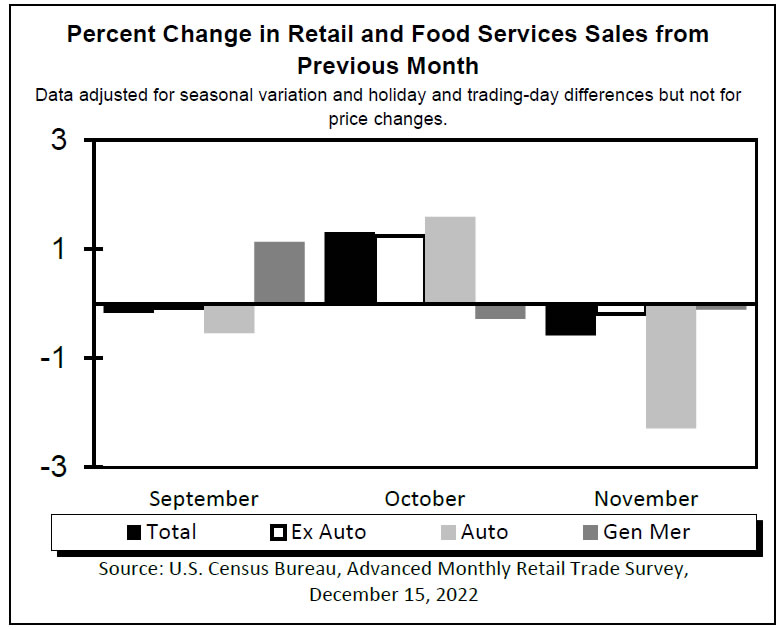
Full retail sales release here.
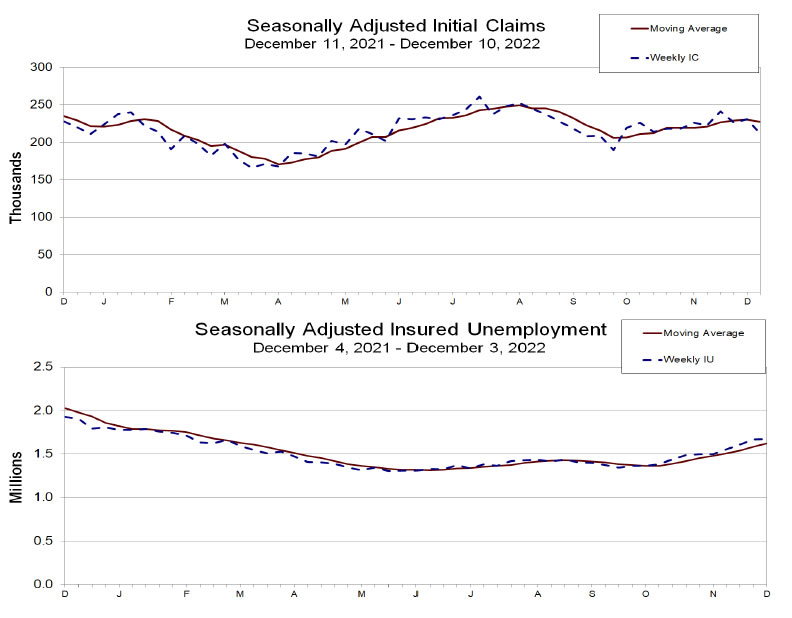
Initial jobless claims dropped -20k to 211k in the week ending December 10, smaller than expectation of 230k. Four-week moving average of initial claims dropped -3k to 227k. Continuing claims rose 1k to 1671k in the week ending December 3. Four-week moving average of continuing claims rose 43k to 1625k.
ECB hikes 50bps, expects to raise rates further
ECB raises the three key interest rates by 50bps today as expected. The main refinancing, marginal lending, and deposit rates are 2.50%, 2.75% and 2.00% respectively. The Governing Council expects to "raise them further" based on "substantial upward revision to the inflation outlook".
Also ECB noted that "keeping interest rates at restrictive levels will over time reduce inflation by dampening demand and will also guard against the risk of a persistent upward shift in inflation expectations." Future policy decisions will continue to be "data-dependent", following a "meeting-by-meeting approach".
Reinvestment under the APP purchases will continue until the end of February 2023. The portfolio will then decline at a "measured and predictable pace" subsequently, amount to EUR 15B per month on average until Q2 2023. Reinvestment under PEPP will continue at least until the end of 2024.
Based on new economic projections, inflation is expected to reach 8.4% in 2022, then fall to 6.3% in 2023, and then 3.4% in 2024, and 2.3% in 2025. Core inflation, excluding energy and food, is projected to be at 3.9% in 2022, 4.2% in 2023, 2.8% in 2024, and then 2.4% in 2025. The economy is projected to grow 3.4% in 2022, 0.5% in 2023, 1.9% in 2024, and then 1.8% in 2025.
(ECB) Monetary policy decisions
The Governing Council today decided to raise the three key ECB interest rates by 50 basis points and, based on the substantial upward revision to the inflation outlook, expects to raise them further. In particular, the Governing Council judges that interest rates will still have to rise significantly at a steady pace to reach levels that are sufficiently restrictiveto ensure a timely return of inflation to the 2% medium-term target. Keeping interest rates at restrictive levels will over time reduce inflation by dampening demand and will also guard against the risk of a persistent upward shift in inflation expectations. The Governing Council's future policy rate decisions will continue to be data-dependent and follow a meeting-by-meeting approach.
The key ECB interest rates are the Governing Council's primary tool for setting the monetary policy stance. The Governing Council today also discussed principles for normalising the Eurosystem's monetary policy securities holdings. From the beginning of March 2023 onwards, the asset purchase programme (APP) portfolio will decline at a measured and predictable pace, as the Eurosystem will not reinvest all of the principal payments from maturing securities. The decline will amount to €15 billion per month on average until the end of the second quarter of 2023 and its subsequent pace will be determined over time.
At its February meeting the Governing Council will announce the detailed parameters for reducing the APP holdings. The Governing Council will regularly reassess the pace of the APP portfolio reduction to ensure it remains consistent with the overall monetary policy strategy and stance, to preserve market functioning, and to maintain firm control over short-term money market conditions. By the end of 2023, the Governing Council will also review its operational framework for steering short-term interest rates, which will provide information regarding the endpoint of the balance sheet normalisation process.
The Governing Council decided to raise interest rates today, and expects to raise them significantly further, because inflation remains far too high and is projected to stay above the target for too long. According to Eurostat's flash estimate, inflation was 10.0% in November, slightly lower than the 10.6% recorded in October. The decline resulted mainly from lower energy price inflation. Food price inflation and underlying price pressures across the economy have strengthened and will persist for some time. Amid exceptional uncertainty, Eurosystem staff have significantly revised up their inflation projections. They now see average inflation reaching 8.4% in 2022 before decreasing to 6.3% in 2023, with inflation expected to decline markedly over the course of the year. Inflation is then projected to average 3.4% in 2024 and 2.3% in 2025. Inflation excluding energy and food is projected to be 3.9% on average in 2022 and to rise to 4.2% in 2023, before falling to 2.8% in 2024 and 2.4% in 2025.
The euro area economy may contract in the current quarter and the next quarter, owing to the energy crisis, high uncertainty, weakening global economic activity and tighter financing conditions. According to the latest Eurosystem staff projections, a recession would be relatively short-lived and shallow. Growth is nonetheless expected to be subdued next year and has been revised down significantly compared with the previous projections. Beyond the near term, growth is projected to recover as the current headwinds fade. Overall, the Eurosystem staff projections now see the economy growing by 3.4% in 2022, 0.5% in 2023, 1.9% in 2024 and 1.8% in 2025.
Key ECB interest rates
The Governing Council decided to raise the three key ECB interest rates by 50 basis points. Accordingly, the interest rate on the main refinancing operations and the interest rates on the marginal lending facility and the deposit facility will be increased to 2.50%, 2.75% and 2.00% respectively, with effect from 21 December 2022.
Asset purchase programme (APP) and pandemic emergency purchase programme (PEPP)
The Governing Council intends to continue reinvesting, in full, the principal payments from maturing securities purchased under the APP until the end of February 2023. Subsequently, the APP portfolio will decline at a measured and predictable pace, as the Eurosystem will not reinvest all of the principal payments from maturing securities. The decline will amount to €15 billion per month on average until the end of the second quarter of 2023 and its subsequent pace will be determined over time.
As concerns the PEPP, the Governing Council intends to reinvest the principal payments from maturing securities purchased under the programme until at least the end of 2024. In any case, the future roll-off of the PEPP portfolio will be managed to avoid interference with the appropriate monetary policy stance.
The Governing Council will continue applying flexibility in reinvesting redemptions coming due in the PEPP portfolio, with a view to countering risks to the monetary policy transmission mechanism related to the pandemic.
Refinancing operations
As banks are repaying the amounts borrowed under the targeted longer-term refinancing operations, the Governing Council will regularly assess how targeted lending operations are contributing to its monetary policy stance.
***
The Governing Council stands ready to adjust all of its instruments within its mandate to ensure that inflation returns to its 2% target over the medium term. The Transmission Protection Instrument is available to counter unwarranted, disorderly market dynamics that pose a serious threat to the transmission of monetary policy across all euro area countries, thus allowing the Governing Council to more effectively deliver on its price stability mandate.
The President of the ECB will comment on the considerations underlying these decisions at a press conference starting at 14:45 CET today.
NZDJPY Found Support At The Equal Legs Area & Reacted Higher
In this technical blog, we will look at the past performance of the 1-hour Elliott Wave Charts of NZDJPY. In which, the rally from 11 November 2022 low is unfolding as an ending diagonal structure and showed a higher high sequence. Therefore, we knew that the structure in NZDJPY is incomplete to the upside & should see more upside. So, we advised members not to sell it but to buy the dip in 3, 7, or 11 swings at the extreme areas. We will explain the structure & forecast below:
NZDJPY 1-Hour Elliott Wave Chart
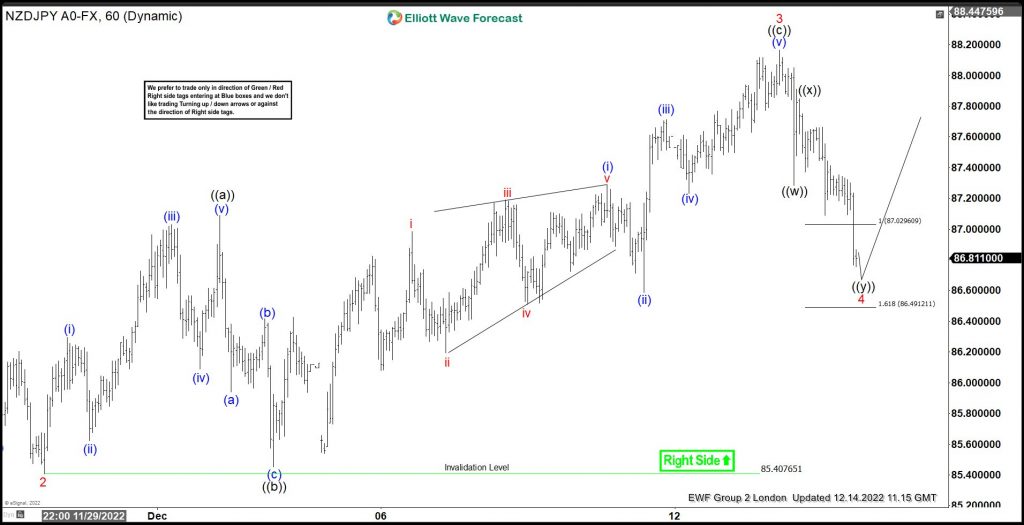
Here’s the Elliott wave Chart from the 12/14/2022 London update. In which, the rally to 88.16 high ended the cycle from the 29 November 2022 low as a diagonal wave 3 & made a pullback in wave 4. The internals of that pullback unfolded as Elliott wave double three structure where wave ((w)) ended at 87.28 low. Then a bounce to 87.91 high ended wave ((x)) & started the next leg lower in wave ((y)) towards 87.02- 86.49 equal legs area. From there, buyers were expected to appear looking for new highs ideally or for a 3 wave bounce minimum.
NZDJPY Latest 1-Hour Elliott Wave Chart
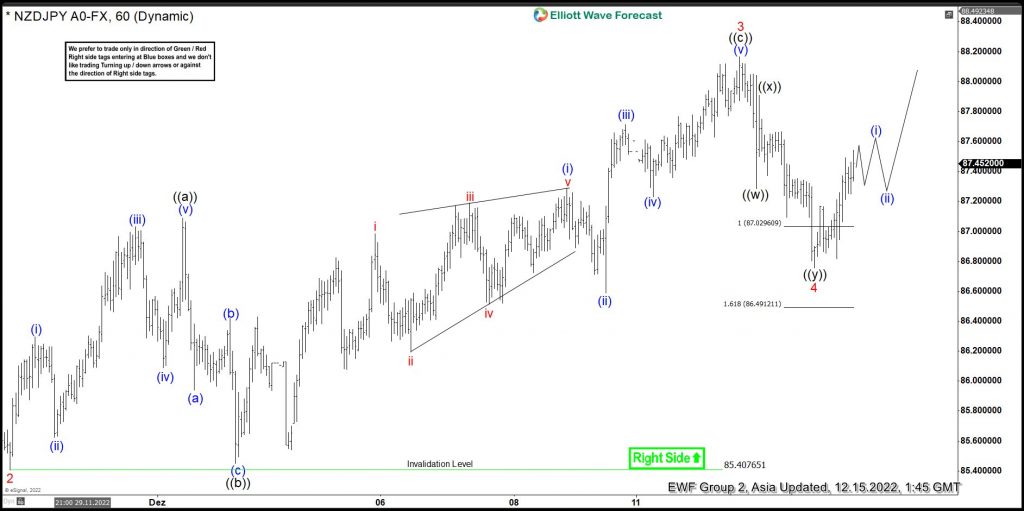
Above is the latest Elliott wave Chart from the 12/15/2022 London update. In which the pair is showing a reaction higher taking place from the equal legs area. Right after ending the double correction. Allowed members to create a risk-free position with the minimum reaction higher towards 50%- 61.8% Fibonacci retracement from the peak at 87.46- 87.63 area. However, a break above 88.16 high is still needed to confirm the next extension higher & avoid a double correction lower.
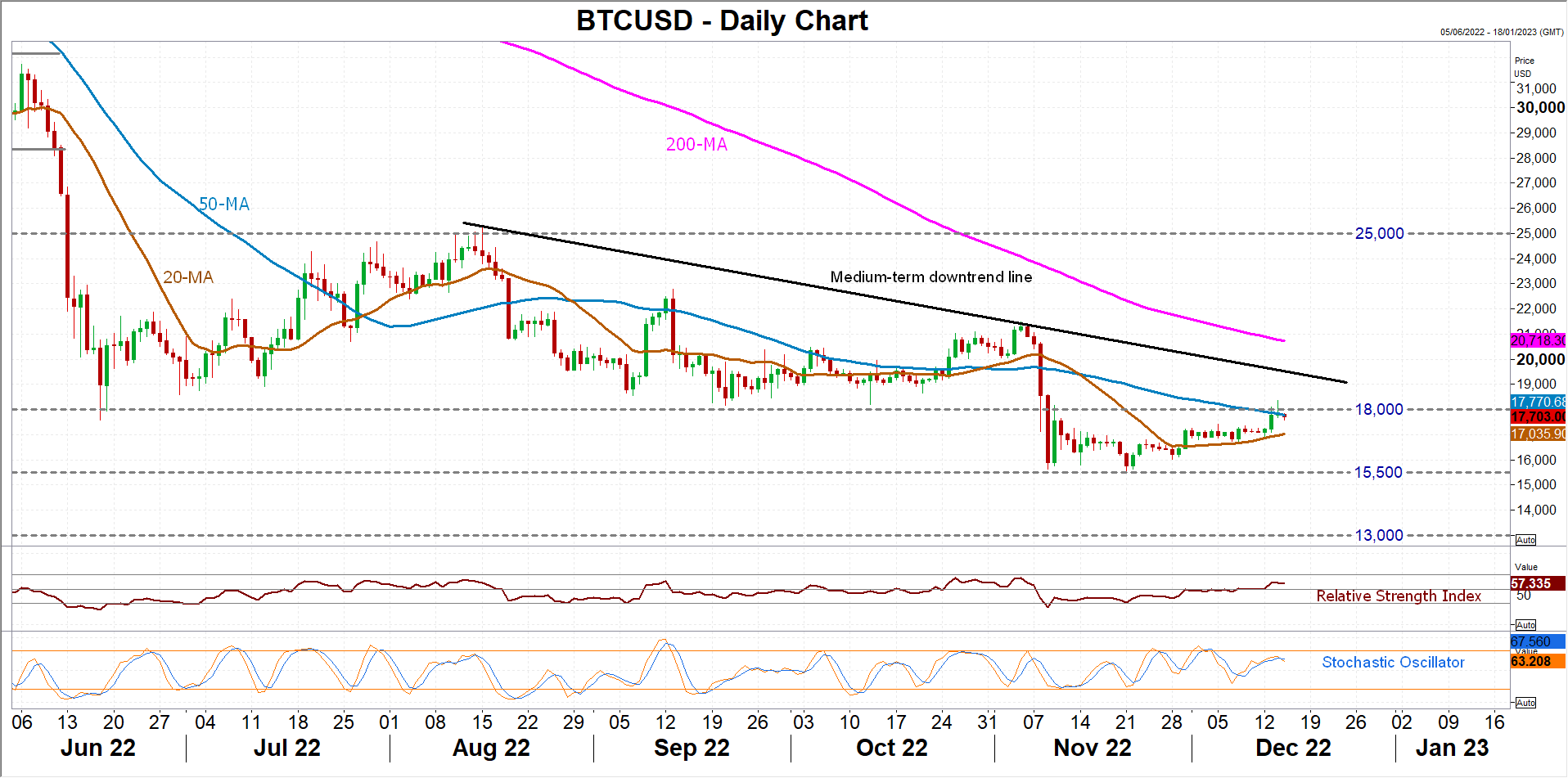
BTCUSD Tests Upper Range of Sideways Channel
BTCUSD has been trading in a new lower sideways channel since November but a gradual pickup of positive momentum over the last couple of weeks has raised the price close to the range ceiling at 18,000. However, the 18,000 resistance is proving to be a tough obstacle as the technical indicators are pointing to a weakening of the bullish bias.
The RSI has started to gently dip lower even before reaching the 70 overbought level, while the %K line of the stochastic oscillator has crossed below the %D line, although both remain comfortably above their respective neutral marks.
If the price manages to overcome the range top, which is additionally being defended by the 50-day simple moving average (SMA), the next stop for the bulls could be the medium-term descending trend line. A successful break above it would bring into scope the 200-day SMA, currently residing in the 20,700 region. A climb above the 200-day SMA would turn attention to the previous ceiling of 25,000.
However, if the upside bias continues to fade in the coming sessions and the 20-day SMA slightly above the 17,000 level is unable to prop up the price, the bears are likely to target the range floor at 15,500. A drop below of the 15,500 floor would clear the way until the 13,000 region that last acted as support in October 2020.
Summing up, the positive momentum may yet strengthen again in the short term, though the medium-term picture is unlikely to switch to a more bullish one until BTCUSD has reached the 25,000 level. Alternatively, a plunge below 15,500 would underscore the bearish medium- and long-term outlooks.
BoE hikes 50bps, majority expects further increases
BoE raises Bank Rate by 50bps to 3.50% as expected, by 6-3 vote. Two members, Swati Dhingra and Silvana Tenreyro voted for no change. On the other hand, Catherine Mann voted for 75bps hike.
The "majority" of the MPC judged that "should the economy evolve broadly in line with the November Monetary Policy Report projections, further increases in Bank Rate may be required".
It's also reiterated that "The Committee continues to judge that, if the outlook suggests more persistent inflationary pressures, it will respond forcefully, as necessary."