

Sample Category Title
Another U.S. Interest Rate Hike Looms Next Week
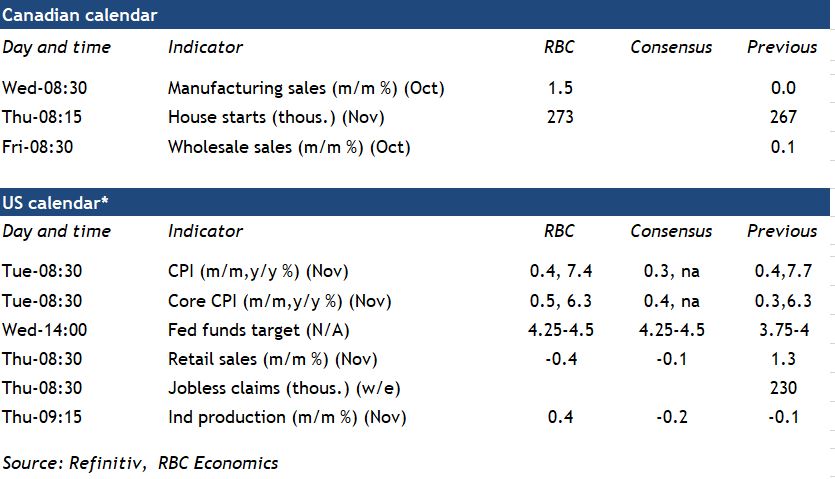
A drop in gasoline prices in November has likely sent U.S. inflation growth lower. We expect next week’s U.S. CPI reading to come in at 7.4%. That’s down from 7.7% in October and a 9.0% peak in June. Food inflation was still likely running almost 11% year-over-year. But a decline in commodity prices means that measure has finally started to turn a corner. Excluding more volatile food and energy products, we expect core CPI held flat on a year on year basis at 6.3% while accelerating on a month over month basis following a surprise decrease in October. A 0.5% rise in November core prices from October will match the average monthly change this year. But that’s still double the average pre-pandemic pace. Much of that strength continues to reflect surging rent prices from a year ago as higher market asking rents flow through to the CPI rent index. An easing in current market rent prices means those CPI increases will slow in the year ahead.
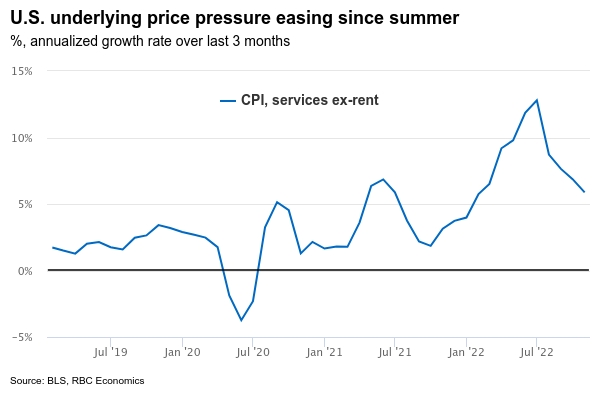
We expect the Fed to hike the fed funds target range by another 50 points at next week’s policy decision (the day after the November CPI data), a step down from 75 bps at each of the past four meetings. Fed Chair Powell said in earlier press conference that services CPI ex-rent “may be the most important category for understanding the future evolution of core inflation.” And growth in that measure has shown signs of slowing—to an annualized 5.9% on average over the last three months from a peak of 12.8% in June. But that pace is still well above the Fed’s target. And the central bank‘s latest rate announcement cautioned against reading too much into softening inflation pressures. What’s more, recent data showed too much momentum in labour markets and consumer spending to avoid additional rate hikes.
Still, some early signs of easing in price pressures could mean interest rates are nearing sufficient levels to bring inflation back towards the Fed’s 2% inflation objective. As focus shifts from the pace of rate hikes to a possible landing spot, updated economic projections from the Federal Open Market Committee will be closely watched for changes in the expected terminal level of the fed funds target. Overall, we still think the Fed will hike by another 50 basis points in the first quarter of 2023 before pausing at the 4.75% to 5% range.
Week ahead data watch
- We expect a 1.5% increase in Canadian manufacturing sales, slightly less than the 2% early estimate from Statistics Canada. A surge in petroleum, and coal prices boosted nominal sales. Sale volumes likely edged lower.
- Canadian Housing starts likely ticked higher to 273,000 units in November, up from 267,055 units in October. Residential building permit issuance slowed to 241,000 units in October, but that’s still strong and higher earlier issuance means there’s still substantial building activity in the pipeline.
- Declines in unit auto sales and gas prices likely led to a 0.4 percent drop in U.S. retail sales in November. We expect U.S. industrial production increased by 0.4% in November thanks to a jump in utilities output while manufacturing output held flat.
Week Ahead – Blockbuster End to the Year
Two blockbuster events will have Wall Street on edge as the disinflation trade may have gotten ahead of itself. The last major piece of economic news before the Fed meets will be the November inflation report which is expected to show pricing pressures are decelerating. The headline reading from a month ago is expected to rise 0.3%, a tick lower from the pace in October. On a year-over-year basis, inflation is expected to decline from 7.7% to 7.3%. There is still a lot more work that needs to be done with bringing inflation down, but for now, it seems the trend is headed in the right direction.
The FOMC decision will be “Must See TV” as the Fed is expected to downshift to a half-point rate-hiking pace and yet still reiterate that they are not done raising rates. The Fed will likely show that rates could rise anywhere from 4.75-5.25%, which will be very restrictive and should lead to a quicker cooling of the labor market.
The ECB meeting next week promises to be a defining moment in the bloc’s fight against inflation. It was late to the party, very late in fact, but once it arrived it quickly started playing catch up culminating in a 75 basis point rate hike last week. The belief is that it won’t have to go as far as others in raising rates, with the terminal rate currently believed to be around 3%. That means the central bank is expected to already slow the pace of tightening on Thursday, with a 50 basis point hike, followed by another 100 over the first three meetings in the new year.
It’s not just the decision that investors will be focused on. The press conference and new macroeconomic projections will tell us everything we need to know about where the central bank sees itself in the tightening cycle and whether it is aligned with the markets.
It’s all going on in the UK next week. The third week of the month brings a variety of major economic indicators including inflation, employment, retail sales, GDP and PMIs. This month has the added spice of the BoE meeting, the central bank that is arguably most stuck between a rock and a hard place among its peers.
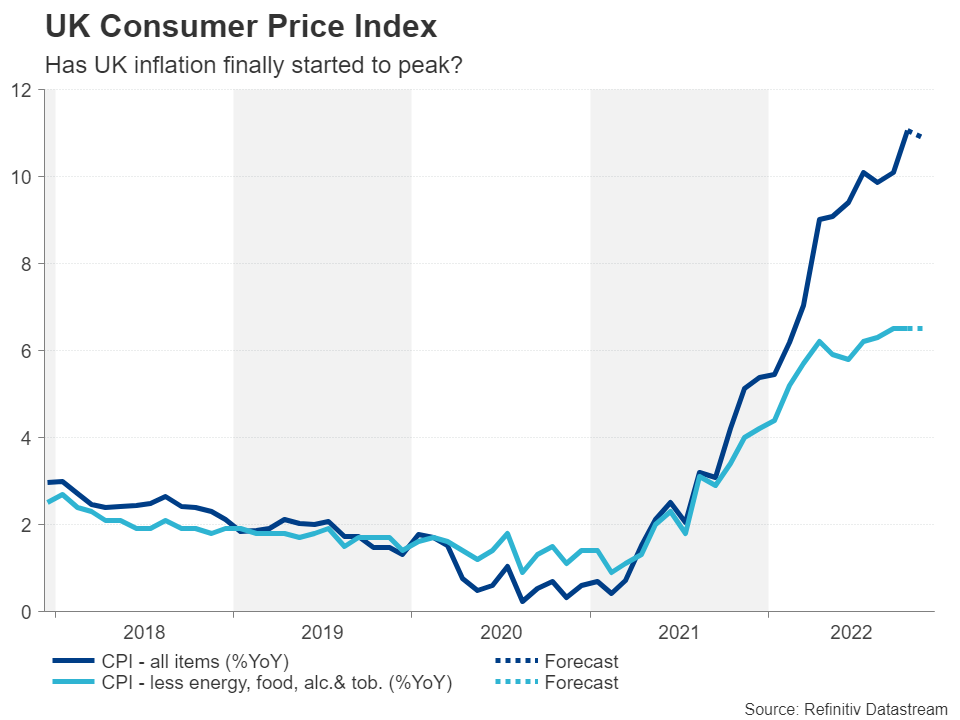
The economy is suffering and probably already in recession, inflation is 11.1% – although that is expected to drop slightly ahead of the meeting – and the cost-of-living crisis in squeezing those households least able to cope with it most. And yet the BoE is of the belief that the only policy response is to keep hiking rates. Markets expect another 50 basis points on Thursday and a further 100-125 in the first half of next year. The central bank has previously pushed back against market positioning and we may see language to the same effect in the statement, not to mention more dovish dissent.
Russia
A week of no change is on the cards, it would appear. The CBR is expected to leave the Key Rate unchanged at 7.5% on Friday, the second consecutive hold after many months of hikes and then cuts following the invasion of Ukraine. On Wednesday, the third quarter GDP reading is also expected to be unchanged at -4% annualized.
South Africa
The political environment appears to have cooled a little but President Ramaphosa isn’t necessarily safe yet. The focus will remain on this but there’s also inflation and retail sales data in the middle of the week that will be of interest.
Turkey
A few notable data releases next week although maybe not anything that will move the needle under the circumstances. Unemployment and industrial production stand out.
Switzerland
The SNB is expected to raise its policy rate by 50 basis points to 1% next week as it attempts to get a grip of inflation. It’s currently running at 3%, above its target of below 2% and the SNB has been clear in its determination to bring it down.
China
China is facing a potential surge in cases as COVID rules are loosened. Following the protests over the zero-Covid policy in several Chinese cities last week, the Chinese government is pivoting its policy. The elimination of key tenets of its virus elimination plan suggests they will try to learn to live with the virus.
It will be a busy and not-so-good week of Chinese economic data. At some point this week we will see the release of aggregate financing, new yuan loans, and money supply data. On Thursday, industrial production, retail sales, fixed assets, and the surveyed jobless rate will be released, with most expecting a softer print. The PBOC is also expected to hold its 1-year medium-term lending facility rate at 2.75% as volumes (CNY) could decline from 850 billion to 500 billion.
India
All eyes will be on the November inflation report which could show a deceleration in pricing pressures coming closer to the upper boundaries of the RBI’s 2-6% target. Given the growth slowdown that is forming, inflation could continue its decline next quarter which should help finish the job of bringing it back to target. India is also expected to see industrial production drop from 3.1% to -0.6%.
Australia & New Zealand
Following the recent RBA rate decision, investors expect the bank to be nearing the end of its tightening cycle. The focus for Australia now shifts to business conditions/confidence and the labor market. The Australian economy is expected to add 15,000 jobs, a slower gain than the 32,000 seen in the prior month.
New Zealand’s GDP growth will quickly cool as the latest tourist boom eases. Third quarter GDP on a quarterly basis is expected to soften from 1.7% to 0.8%.
Japan
Investors will have to be patient until the spring when the new leadership team has been created. The BOJ policy review could lead to the end of a decade-long ultra-loose monetary policy. The upcoming week is filled with economic data releases. The main highlights include the BOJ’s Tankan report which will show big manufacturers are struggling and non-manufacturing activity got a boost on easing covid rules. The November PPI report will show minimal pricing relief, while the trade deficit is expected to narrow. The preliminary PMIs could show both manufacturing and service activity are weakening.
Singapore
It could be mostly a quiet week for Singapore with the exception of the release of non-oil domestic exports.
Economic Calendar
Saturday, Dec. 10
Economic Events
- The annual Bund Summit continues in Shanghai
- The International Coffee Organization conference takes place in Vietnam
Sunday, Dec. 11
- China FDI, Aggregate Financing, Money Supply, and New Yuan loans expected this week
Monday, Dec. 12
Economic Data/Events
- India CPI, industrial production
- Japan PPI, machine tool orders
- Kenya GDP
- New Zealand net migration
- Mexico industrial production
- Turkey current account
- UK industrial production
- Brazil’s presidential election is expected to be certified
Tuesday, Dec. 13
Economic Data/Events
- US November CPI M/M: 0.3%e v 0.4% prior; Y/Y: 7.3%e v 7.7% prior
- Australia consumer confidence, household spending
- Germany CPI, ZEW survey expectations
- Hong Kong industrial production, PPI
- Israel trade
- Italy industrial production
- Japan Bloomberg economic survey
- New Zealand home sales, food prices
- Philippines trade
- South Korea money supply
- Turkey industrial production
- UK jobless claims, unemployment
- The Bank of England releases its financial stability report
- US House Financial Services Committee holds an initial hearing on FTX’s collapse
- US President Joe Biden hosts the US-Africa Leaders Summit
- New Zealand’s government releases its half-year economic and fiscal update
Wednesday, Dec. 14
Economic Data/Events
- FOMC Decision: Expected to raise the target range by 50bps to 4.25-4.50%
- Eurozone industrial production
- India trade, wholesale prices
- Japan machinery orders, industrial production
- Mexico international reserves
- New Zealand current account GDP ratio, BoP
- Russia GDP
- South Africa CPI, retail sales
- South Korea jobless rate
- Spain CPI
- UK CPI
- EIA crude oil inventory report
- The European Union and the Association of Southeast Asian Nations will celebrate the 45th anniversary of their partnership at a summit in Brussels
- US Senate Banking Committee holds a hearing on FTX’s collapse
- The US-Africa Leaders Summit continues with keynote remarks from Biden
- The Bank of Japan will announce the outright purchase amount of Japanese government securities
- RBA Gov Lowe delivers an address at the 2022 AusPayNet Annual Summit
Thursday, Dec. 15
Economic Data/Events
- US Retail Sales, cross-border investment, business inventories, empire manufacturing, initial jobless claims, industrial production
- ECB Rate Decision: Expected to raise Main Refinancing rate by 50bps to 2.50%
- BOE Rate Decision: Expected to raise rates by 50bps to 3.50%
- Switzerland rate decision: Expected to raise rates by 50bps to 1.00%
- Norway rate decision: Expected to raise rates by 25bps to 2.75%
- Mexico rate decision: Expected to raise rates by 50bps to 10.50%
- Australia unemployment, consumer inflation expectation
- Canada existing home sales, housing starts
- China medium-term lending, property prices, retail sales, industrial production, surveyed jobless
- Eurozone new car registrations
- France CPI
- Japan tertiary index, trade
- New Zealand GDP
- Nigeria CPI
- Poland CPI
- Spain trade
Friday, Dec. 16
Economic Data/Events
- US deadline for a new funding deal to avert a federal government shutdown
- US markets observe “Triple witching”, which is the quarterly event where the expiry of stock and index options occur with those of index futures
- US preliminary PMIs
- Australia preliminary PMI readings
- European flash PMIs: Eurozone, Germany, UK, and France
- Hong Kong jobless rate
- Italy CPI, trade
- Japan PMIs, department store sales
- New Zealand PMI
- Russia rate decision: Expected to keep rates steady at 7.50%
- Singapore trade
- Thailand foreign reserves, forward contracts, car sales
- Bank of Finland Governor Rehn speaks on the Nordic nation’s economy
- South Africa’s governing party begins its five-yearly elective conference in Johannesburg
Sovereign Rating Updates
- Luxembourg (Moody’s)
Fed Decision and US Inflation Stats to Decide Dollar’s Fate
A decisive week lies ahead for the dollar, featuring the latest US inflation and retail sales reports, alongside a critical Fed decision. Business surveys suggest inflationary forces continued to abate, although elevated rents might offset some of that. Meanwhile, a half-point rate increase by the Fed is already locked in, putting the emphasis mostly on the updated ‘dot plot’ projections.
Managing risks
The US economy finds itself at a crossroads. Most leading indicators suggest a storm will hit next year. New business orders are contracting, the housing market has started to crack, consumer morale is low, retailers are swimming in inventory they cannot unload, and the yield curve inversion continues to deepen. All these are classic recession warnings.
However, this weakness in leading indicators hasn’t been reflected in the ‘official’ data yet. The labor market is still in good shape, consumer spending remains resilient, and inflation is sizzling hot. Economic momentum hasn’t evaporated yet despite the barrage of rate increases, mostly because monetary policy works with long lags.
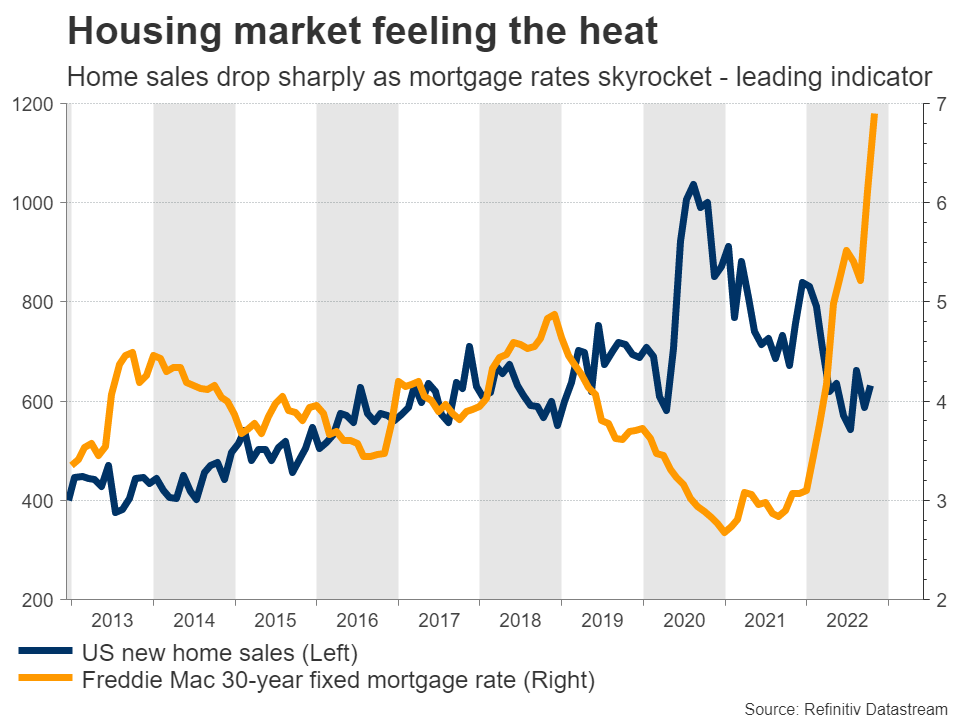
Still, this dichotomy between backward and forward-looking indicators is a headache for Fed officials. Since the full impact of the rate increases they’ve already rolled out hasn’t been felt yet, there’s a danger they will inflict unnecessary economic damage if they keep pressing ahead. As such, the Fed chief changed tune last week, stressing that they don’t want to overtighten.
Inflation and rate decision
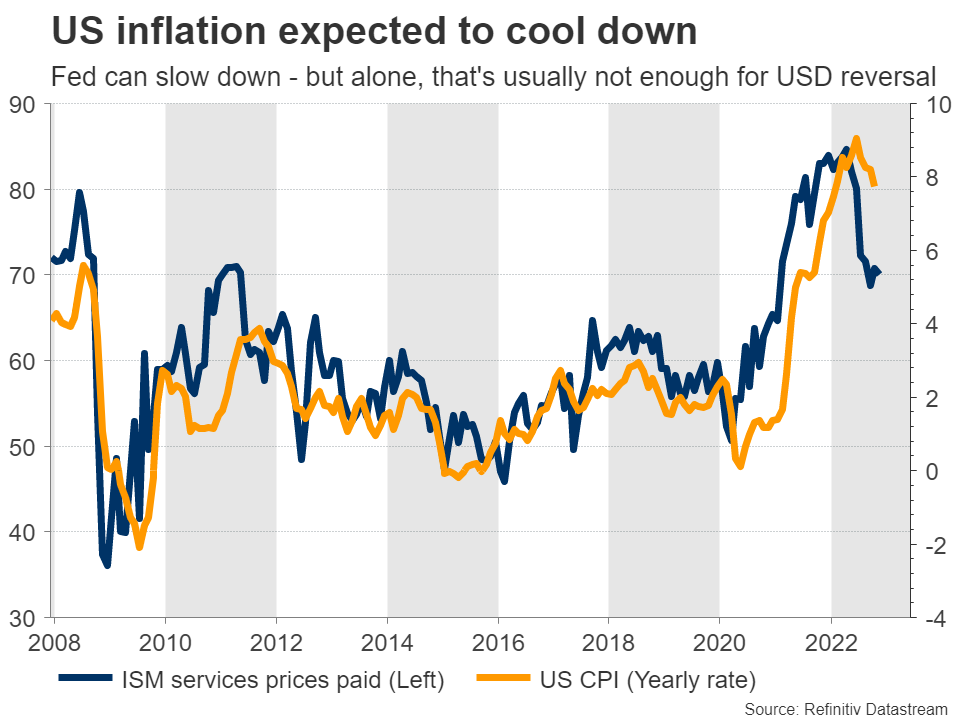
The show will kick off with the latest CPI inflation data on Tuesday. Forecasts suggest inflation cooled further in November, with the headline CPI rate projected to decline to 7.5%, from 7.7% in the previous month. It’s a similar story for the core number.
Business surveys add credence to these forecasts. The S&P Global services PMI revealed that companies raised their selling prices at the softest pace in two years, offering steep discounts to stimulate sales as demand weakened. Hence, inflation appears to be retrenching, something corroborated by persistent declines in used car prices and shipping costs.
The uncertainty revolves around rents, which account for one-third of the CPI index. Since rents follow trends in house prices but after several quarters, they’ve been heating up lately, playing catch-up with the surge in house prices last year. If this pattern persists, it could negate some of the improvement in other categories.
As for the Fed, the baseline scenario is for a 50bps rate increase on Wednesday, which the market currently assigns a 90% probability to. There’s also a 10% chance for a 75bps move, which is highly unlikely based on Fed communications but not impossible if the upcoming inflation numbers are shockingly hot.
Assuming no surprises on rates, investors will turn to the updated rate projections in the ‘dot plot’ and Chairman Powell’s press conference. Financial conditions have been loosening for two months now with the dollar and US yields retreating while stock markets rallied, which is counterproductive for Fed officials in their inflation battle.
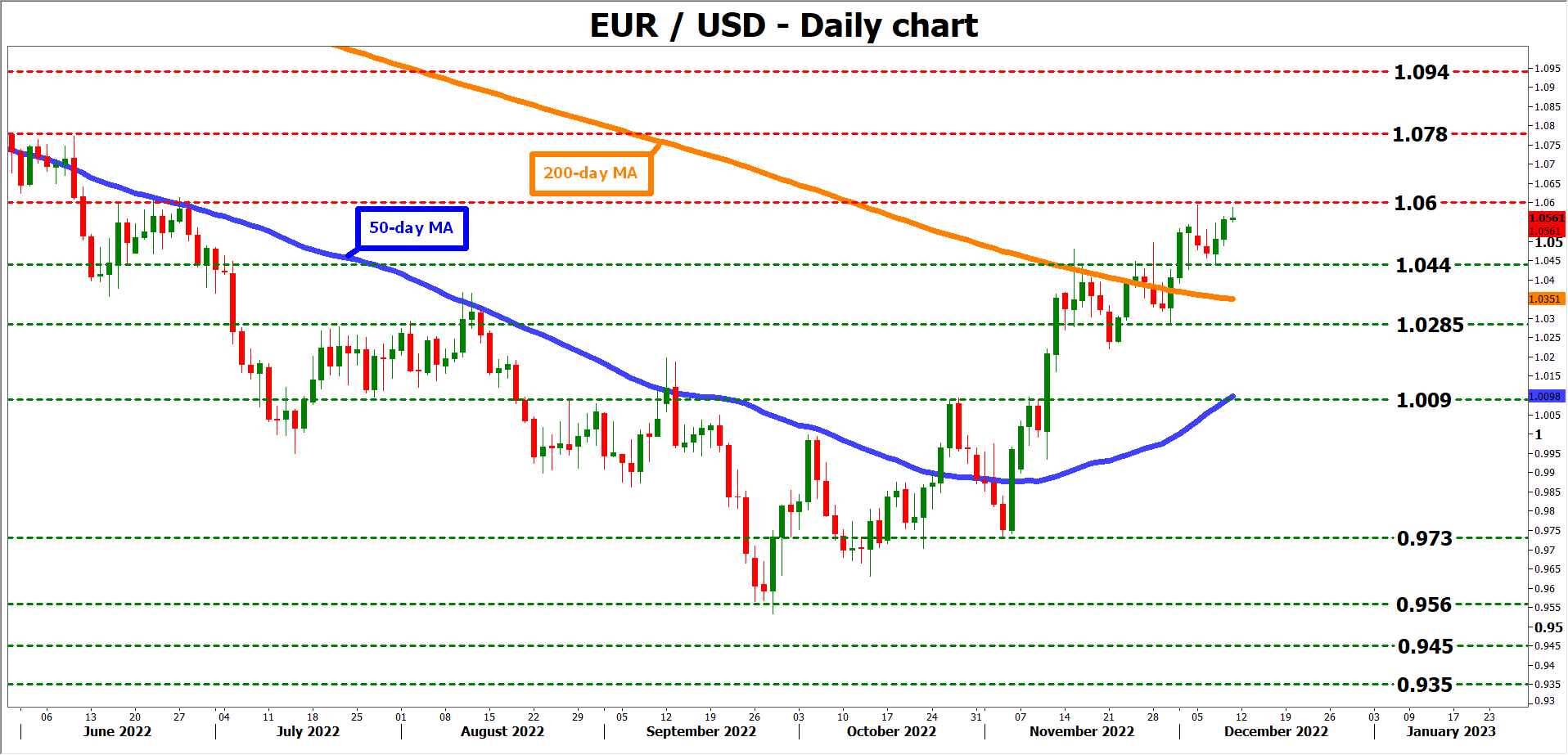
A resolute tone by Powell or a dot plot that shows rates rising to 5%, higher than current market estimates of 4.9%, could breathe life back into the dollar. From a technical perspective, a pullback in euro/dollar could initially challenge the 1.0440 support region.
On the flipside, if the rate projections aren’t quite so high or if Powell adopts a softer tone, euro/dollar could extend its latest advance and spike above 1.0600.
Retail sales stats for November will follow on Thursday, providing insights into how consumption is holding up.
Neutral dollar?
Overall, the outlook for the dollar seems neutral, as it is difficult to envision massive gains or massive losses from here. Some of the elements that fueled this rally seem to be losing their kick, with inflation powering down and the Fed adopting a softer profile, but the storm clouds gathering over foreign economies suggest it’s too early for a bearish reversal.
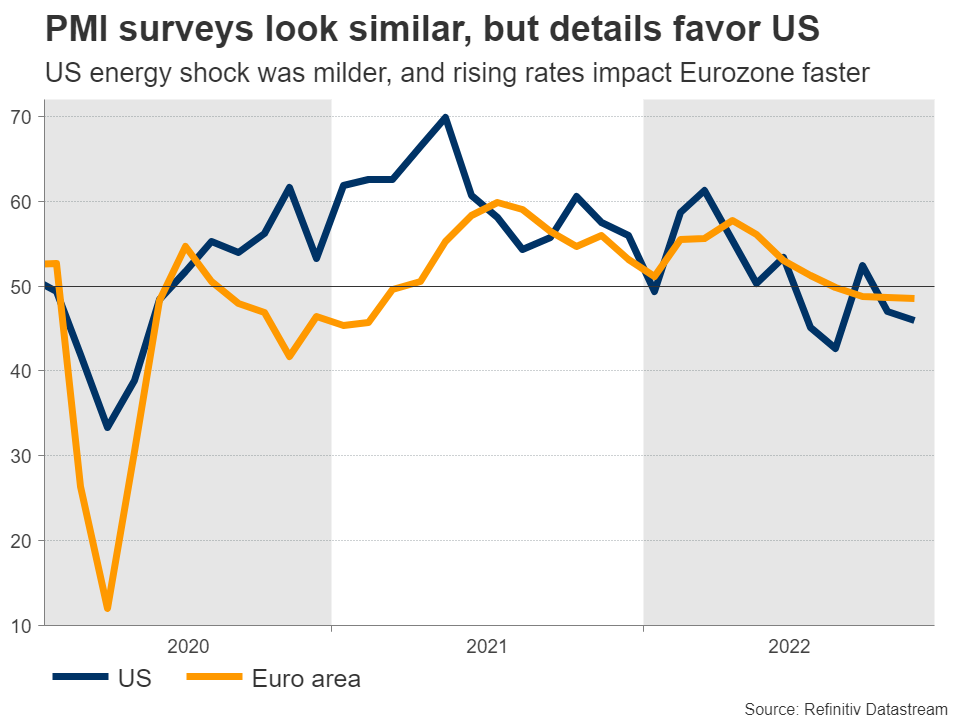
Most major economies are in worse shape than America. The Eurozone and the UK are likely to sink into recession sooner because they faced a severe energy shock in addition to rising rates, whereas China has its real estate crisis to deal with.
The dollar is unlikely to break down in such a gloomy global environment, thanks to its reserve currency status. Therefore, even though the two-year rally is probably on its final legs, the reversal might be a story for late next year.
Could the UK Data Releases Change the BoE’s Thinking?
Pound followers are preparing for an action-packed week ahead of the festive lull. With the Bank of England MPC meeting held on December 15, the market will be updated on the underlying economic trends that could be critical for the size of the expected rate move. Could the data releases tempt Bailey et al to announce a bigger rate hike and potentially boost the pound?
Weakness in economic data recently
Labour market, average earnings and inflation data releases set the scene for an exciting start to the week as the market is focused on the final gatherings of the major central banks for 2022. Naturally, central bankers attach extra importance to these data, especially the inflation prints, to avoid a potential policy mistake amidst a traditionally lower liquidity period. Since the November 3 meeting, when the MPC raised rates by 75bps, the UK data has been on the weak side. The upside surprise at the third quarter GDP was overshadowed by record-high inflation, as the October CPI print reached 11.1% year-on-year. Similarly, the PMIs showed some marginal improvement for November, but the October retail sales YoY remained firmly in negative territory, with hopes for a recovery pinned on the festive shop offers. Additionally, the weakness in the housing sector is becoming more widespread, as evident from the various house price indicators.
Busy data calendar, CPI stands out
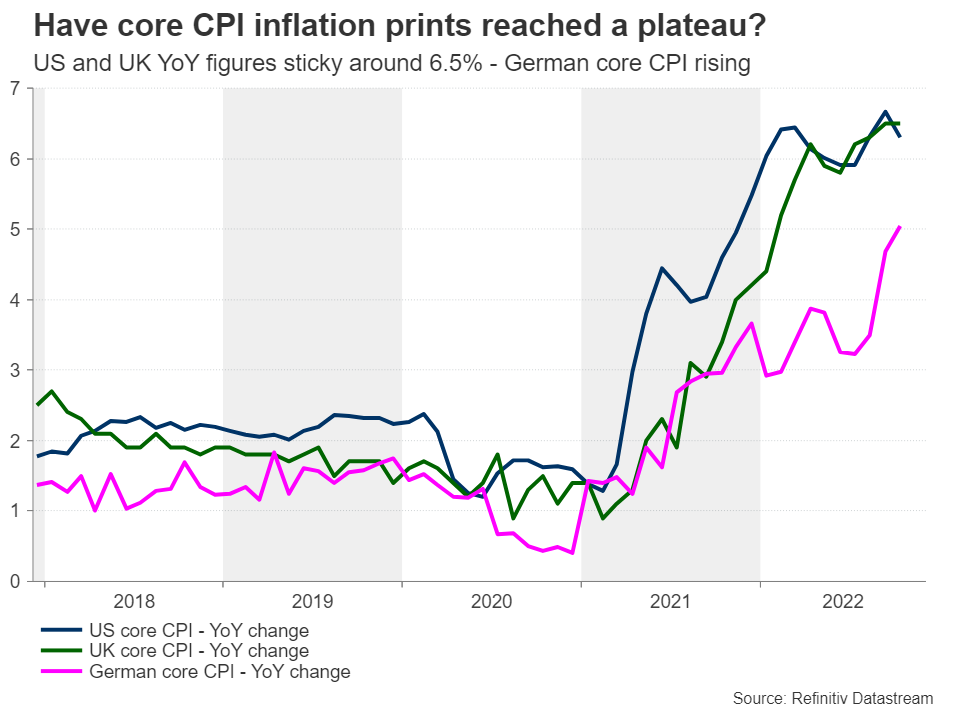
On December 13, October average earnings excluding bonuses is forecast at 5.5% YoY while the October unemployment rate should print at 3.5%, remaining at record low levels. The following day, the November CPI is seen easing to 10.9% YoY with the core CPI expected to come at 6.5% YoY. These forecasts seem in line with the November inflation prints in other regions, providing a very small breathing space to central bankers globally. Nevertheless, Governor Bailey will be forced to write another letter to the Chancellor of the Exchequer detailing the reasons for the current high inflation rate and, particularly, the stickiness seen at the core CPI indicator.
Could the data tilt the BoE market pricing?
The MPC prepares for the December 15 meeting, a day after the Fed meeting. The current market pricing leaves a small window for surprises as the probability of a 50bps rate hike is 90%, with the remaining 10% pointing to another 75bps hike. In the meantime, the rhetoric from the various MPC members remains hawkish, but a particular comment from the Chief Economist Pill on November 30 stands out. He mentioned that inflation is expected to rapidly fall in the second half of 2023. This means that should inflation instead continue to surprise on the upside, the MPC could be ready to hike more aggressively than currently envisaged.
Will the pound react to the data releases?
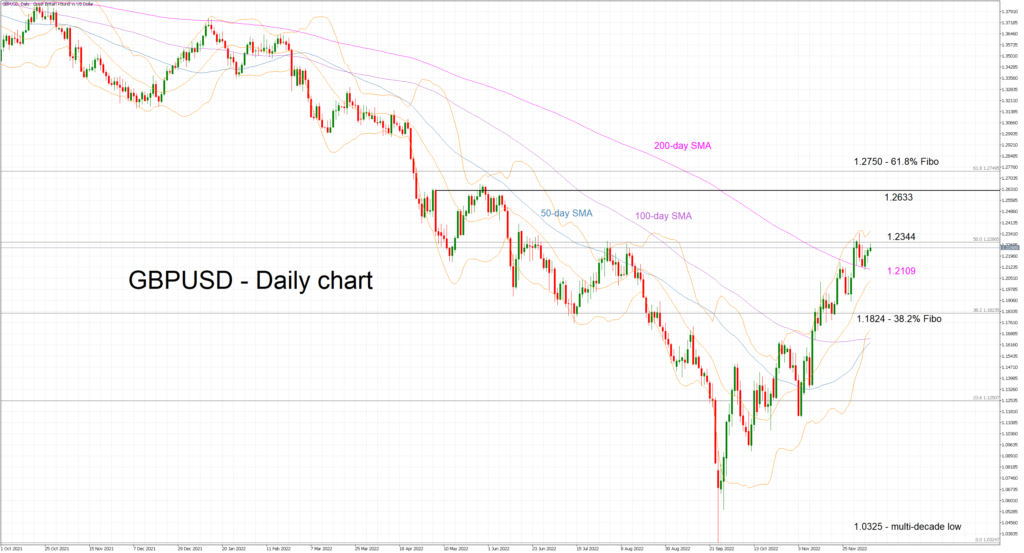
It has been a one-way street since September 26 when pound/dollar printed 1.0325, a multi-decade low. Since then, the pound bulls have pushed the pair higher, recovering a good part of the 2022 depreciation of the pound against the dollar. The pair currently trades at the 1.2200 area. An upside surprise in the aforementioned data could push pound/dollar above the December high of 1.2344 towards the 1.2633-1.2750 area, where the May 5 high and the 61.8% Fibonacci retracement level of the June 1 – September 26 downtrend reside respectively. On the other hand, the pound bears would aim for the 200-day simple moving average at 1.2109, followed by the 38.2% Fibonacci level of 1.1824.
Week Ahead – Slower Rate Hikes Eyed as Fed, ECB, BoE and SNB Clash
A turbulent year is fast drawing to a close and the most crucial week for central banks is upon us. The Federal Reserve will be headlining the last rate-setting decisions of 2022 that will also cover those of the European Central Bank, Bank of England and Swiss National Bank. But it’s not just central bank meetings cramming up the schedule. There will be a flurry of economic data too, led by the latest US CPI report and the flash PMI releases for December. As such, the US dollar, euro and pound will be fighting for the limelight.
The elusive wait for the Fed pivot
The Federal Open Market Committee (FOMC) will conclude its last meeting of the year on Wednesday and once again, markets seem to have fallen into the usual trap of expecting some kind of a dovish pivot in the run up to the event. To be fair, there is slightly more realism among equity traders this time round and it is FX and bond markets that appear at most odds with the Fed’s messaging.
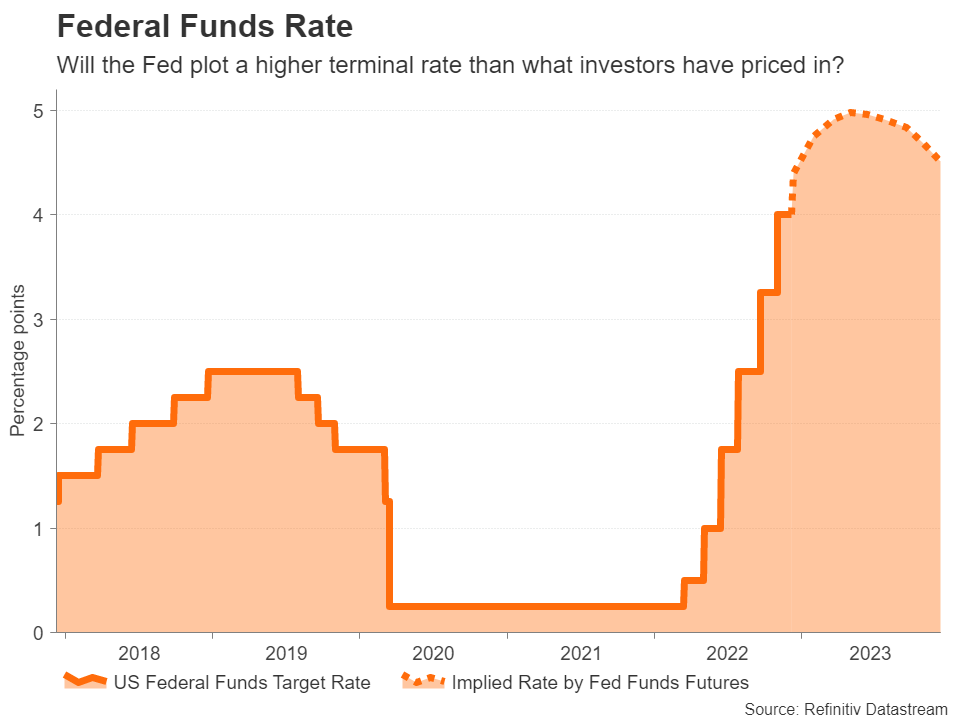
If there was going to be a pivot, that happened on November 30 when Chair Powell gave his blessing to a slower pace of rate increases, flagging a 50-basis-point hike for December. For now, that’s as dovish as the Fed will get as both inflation and the labour market remain too hot for policymakers’ comfort. With many officials clearly signalling that the December dot plot will pencil in a terminal rate of at least 5%, investors are heading towards another reality check as futures markets see the Fed funds rate peaking just below that level.
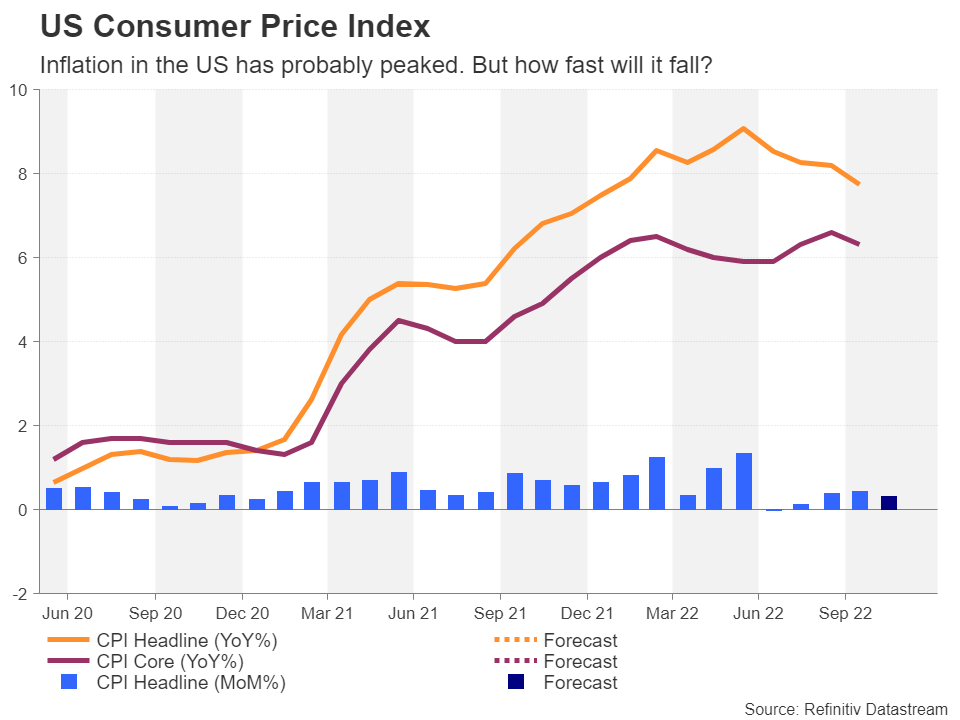
While there is no denying that the US economy is edging closer and closer to a recession and there is more certainty that price pressures are subsiding, the job is far from done from a monetary policy viewpoint. Tuesday sees the release of the November CPI report, which is expected to reveal a slight moderation in the month-on-month rate.
Should Powell see the need to emphasise in his press briefing that restrictive policy is here to stay and suggests that rates may have to rise substantially above 5% to contain inflation, bond markets could be hit with the most volatility since the UK mini-budget crisis in September.
Long-dated Treasury yields have been sliding for the past month, which although this is a reflection that markets believe the Fed’s resolve to tame inflation, the Fed probably thinks this is a premature sense of confidence on the part of investors. Any attempt by Powell to ‘re-direct’ the markets could trigger a massive jump in Treasury yields, spurring the dollar higher.
However, not long after the Fed decision, markets will be put to the test again as November retail sales data are out on Thursday along with industrial production numbers, while S&P Global’s flash PMI readings will be watched on Friday for fresh clues about an impending recession.
ECB meeting: too early to slow down?
As the biggest risk from the Fed meeting is how out of lockstep markets have become, the main uncertainty about the ECB gathering is the incoherent communication, amid signs of a split among Governing Council members between those favouring a 75-bps hike on Thursday and those preferring 50 bps.
Investors have made up their minds, pricing in a 75% probability of a 50-bps increase. That leaves some scope for disappointment should the ECB not hike rates by 75 bps. There’s also a downside risk for the euro from the Bank’s latest macroeconomic projections should they point to a recession in 2023 or if President Christine Lagarde suggests an inflation peak is just around the corner.
However, markets may be underestimating the ECB’s determination to get a grip on inflation, particularly as the Bank’s own survey shows consumer inflation expectations creeping higher in the Eurozone.
Moreover, even if the ECB were to raise rates by only 50 bps or signal a slower pace at its next meeting, Lagarde could still surprise with a hawkish tone. That, combined with the Fed not sounding as hawkish, and the euro might just be able to stretch its recent gains and have a crack at the $1.06 level.
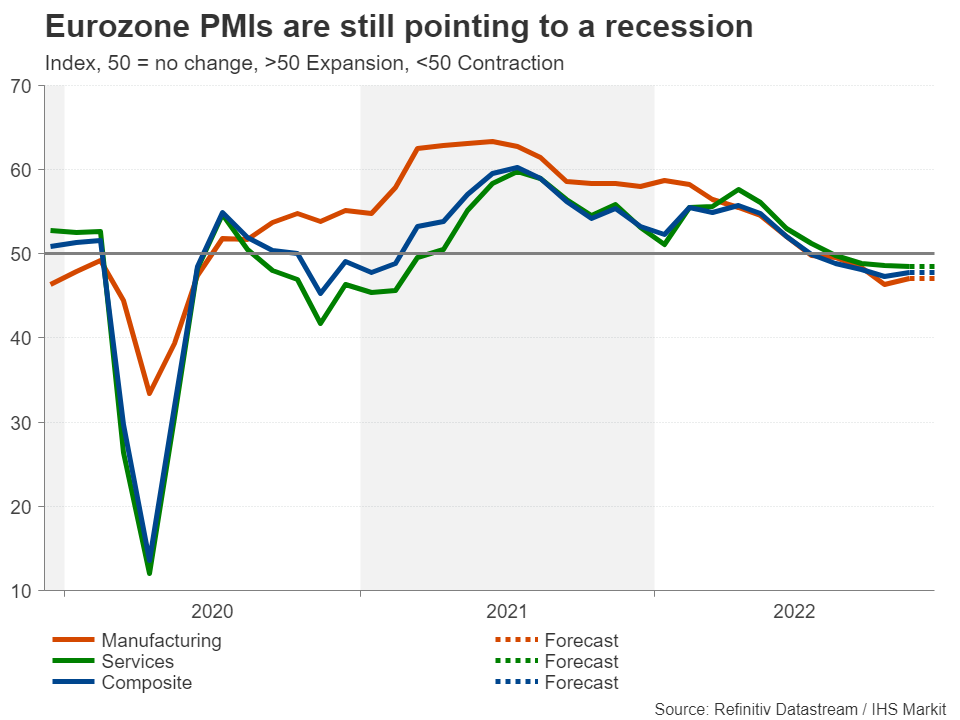
The final hurdle for the single currency next week will come on Friday when the flash PMIs for December are due. Analysts are forecasting no change in the manufacturing and services PMIs compared to November, with both readings expected to remain in contraction territory below 50.
SNB might make a leap down to 25bps
Another central bank that could ease its foot off the brakes is the Swiss National Bank. After a 75-bps increase at its last meeting in September when the SNB lifted its policy rate out of negative territory, it may be time to proceed more cautiously. After all, annual inflation in Switzerland has flatlined at 3% and the clouds over the global economy are darkening.
The question is, will the SNB make a drastic shift and raise rates by 25 bps, or will it opt not to stir things up and go with the market consensus of a 50-bps hike? The latter is more likely given that the SNB meets just four times a year and this could provide the Swiss franc with a bit of boost.
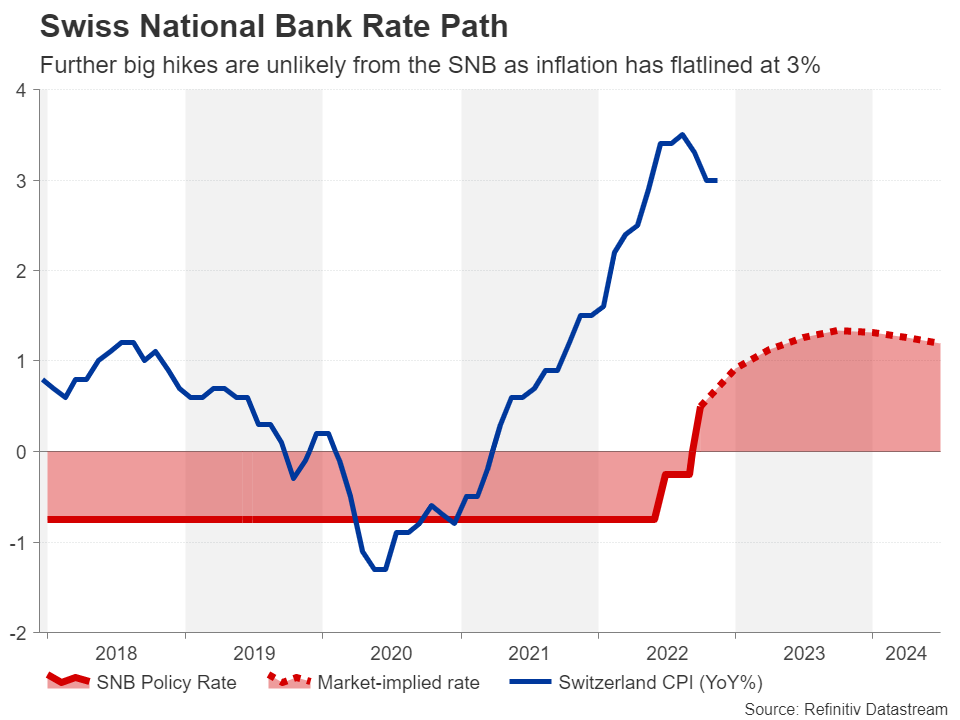
Having said that, even in the event of a bigger dovish tilt, the safe-haven franc would likely remain in demand over the coming year, especially versus the euro and pound, as recession risks mount for Europe and America.
Big week for sterling
The Bank of England is widely anticipated to raise rates for the ninth consecutive meeting on Thursday, with a 50-bps move being almost fully priced in. There are no new projections nor a press conference by Governor Bailey at the December meeting so any hints about the tightening path will come from the statement.
According to money markets, the Bank of England has the most hikes left to go in this tightening cycle among all the major central banks, and thus, there is less speculation about an imminent policy pivot. However, Britain also happens to be at highest risk of a recession and so next week’s barrage of UK indicators might steal the spotlight away from the BoE.
Monthly GDP figures will kick off the busy week on Monday and on Tuesday, the latest labour market report will be monitored for any signs of further job losses in October as well as an acceleration in wage growth. All eyes on Wednesday will be on the November inflation stats.
The consumer price index jumped to a fresh four-decade high of 11.1% in October. Any surprises in November could shape expectations ahead of the BoE’s decision the day after. Finally, retail sales numbers and the flash PMIs will wrap things up on Friday.
With the pound having established a floor at the $1.21 mark over the past week, that support may come under attack if the incoming data underscore the pessimism surrounding the UK outlook. However, as long as the dollar stays on the backfoot, the pound might still be able to maintain its uptrend. This would even more so be the case if next week’s policy announcements put the Fed and BoE on diverging paths.
An overload of major data
Elsewhere, Australian employment figures will be important for the aussie on Thursday, while the kiwi will be hoping for some direction from New Zealand’s third quarter GDP print the same day.
In Japan, it’s a packed week of economic releases, with the Bank of Japan’s quarterly Tankan business survey likely attracting the most attention on Wednesday, although the flash PMIs on Friday will be vital too. Whilst none of the data may be very market moving, they will help form an overall picture of the Japanese economy as the BoJ considers whether to start preparations for an eventual exit out of ultra-accommodative policy.
But in the meantime, the yen will be taking its cues from Fed policy as well as broader risk sentiment, which Chinese monthly indicators due Thursday will be contributing to.
Weekly Focus – Central Banks Take Centre Stage
Easing pandemic curbs and global recession fears continued to drive markets. Despite rising cases, China stepped up its easing of Covid-19 restrictions on a nationwide basis. Health authorities allowed the use of home quarantine for some Covid patients and test requirements will be scrapped for most public venues. A clear shift is taking place in official communication, with emphasis on economic recovery and the decreased severity of the Omicron variant. Chinese equities cheered on the news, however, sour risk sentiment and 'rate fears' weighed on US stocks. US yield curves inverted further and the 2s10s curve inversion is now at 84bp, a level only exceeded in 1978 and 1982, when Fed Chairman Volcker hiked policy rates aggressively to counter double-digit inflation, but also triggered two deep and long-lasting recessions. Despite the G7 Russian oil price cap and EU Russian oil ban coming into effect, oil prices continued to decline, reaching USD/bbl 77, the lowest level since December 2021. Bank of Canada hiked policy rates by 50bp, but signalled that this may have been the final rate hike for now. Canada is an interesting case, as it has been one of the frontrunners of the global rate hiking cycle in 2022, and we see a similar case for Norges Bank delivering its last 25bp hike at the meeting next Thursday.
Russian President Putin warned that his war is likely to become a long one. In a televised address, he said his invasion has already yielded 'significant' results and that he would not mobilise more troops. He also acknowledged that the risk of a nuclear war was growing, but insisted that Russia would only ever use nuclear weapons in response to an attack. Russia continued its attacks on Ukrainian critical infrastructure this week and European gas prices rose further, with the market not expecting any meaningful price drops in 2023, even outside heating periods, see twitter. A worrisome development for Europe's industry, as cracks in economic resilience have already started to appear in Q4 (see also Euro Area Macro Monitor - Chilling prospects, 6 December).
A busy week awaits, with central bank meetings in focus. The stabilization in euro area core inflation in November, paired with the weakening growth outlook and stable inflation expectations probably gives ECB enough arguments to slow the hiking pace to 50bp at the meeting on Thursday. However, we expect it to continue guiding for further rate hikes ahead, paired with a reduction of the balance sheet (QT), as 'stickily' high core inflation could remain a concern for ECB for some time yet (see ECB Preview - A hawkish 50bp, 8 December). US CPI figures will set the tone for the Fed meeting on Wednesday. Despite signs of peak inflation, economic data continues to paint a strong picture of services activity and the US labour market, with high wage inflation. From the guidance of Fed officials, a 50bp hike seems a done deal, but with the recent easing of financial conditions, further rate hikes might be needed in 2023 (see Fed Preview - Tightening pressure persists into 2023, 8 December). We also expect Bank of England to revert to a more dovish stance and join the club of 50bp hikes. December flash PMI figures are also on the agenda for the euro area, UK and US on Friday and we expect them to bring further evidence of the rising recession risks ahead, while focus will also be on the strength of the labour market and further signs of easing input cost pressures. EU leaders will gather on Thursday to discuss a ninth Russian sanction package, funding for Ukraine and the contentious gas price cap.
BTCUSD Crawls Above 17,000; Bullish Action Limited
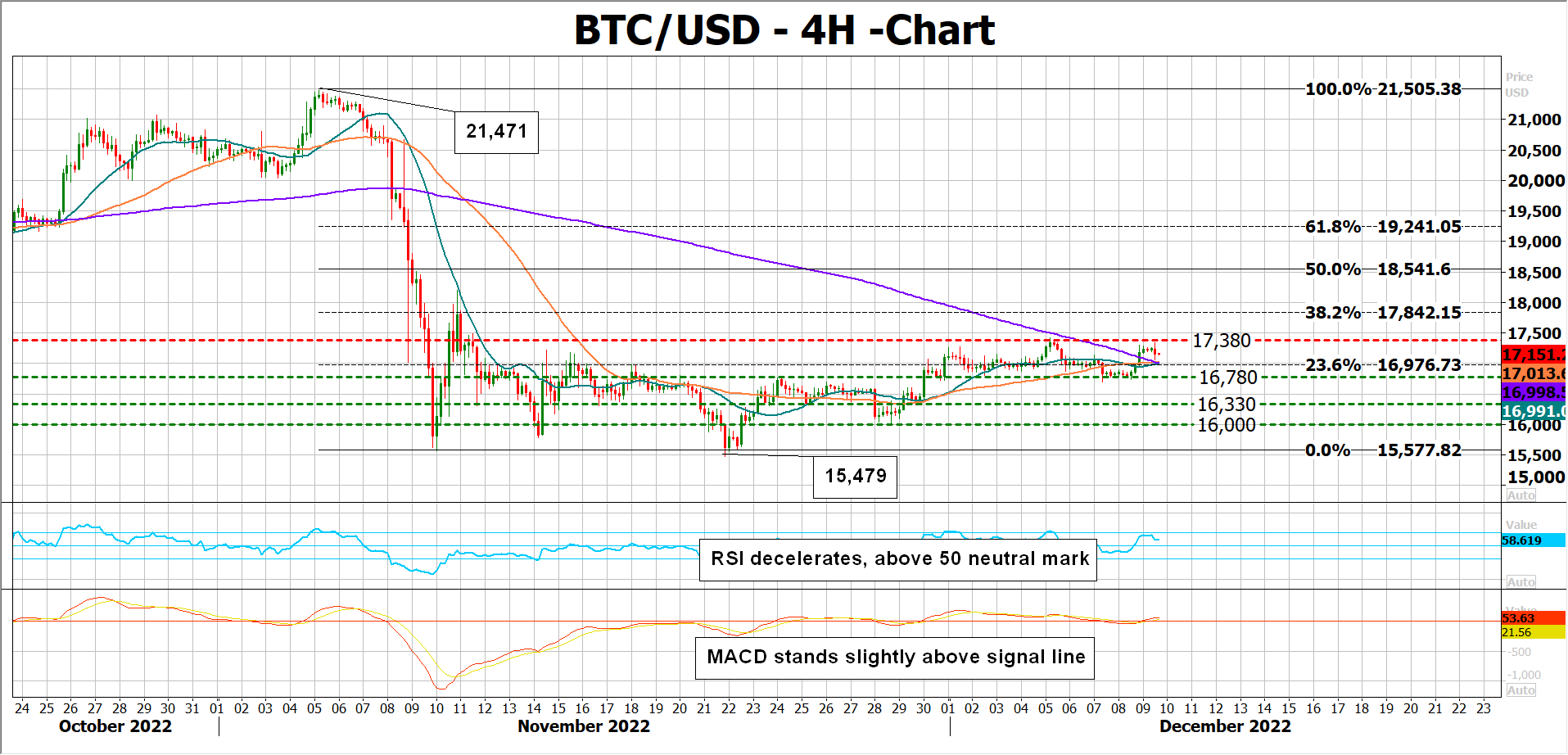
BTCUSD (Bitcoin) pierced through its simple moving averages (SMAs) for the first time since the start of November to crawl back above the 17,000 round level.
While the weekly resistance of 17,380 seems to be a hurdle at the moment, and some weakness is evident in the RSI and the MACD, the indicators keep hanging within the bullish area, promoting a continuation higher. If that proves to be the case, the spotlight will shift towards the 38.2% Fibonacci retracement of November’s fall, seen at 17,842. Additional gains may flirt with the 50% and 61.8% Fibonacci levels at 18,540 and 19,240 respectively. Yet, whether the bulls have enough fuel to trim the collapse from 21,470 remains to be seen.
Should the bears retake control, squeezing the price beneath the 17,000–16,780 support region, some congestion could initially develop somewhere between 16,330 and 16,000 before the door opens again for the 15,749 low.
In short, BTCUSD is facing renewed downside pressures around 17,380. A successful close higher would strengthen the bull case.
Trade Idea: Gold Breakdown
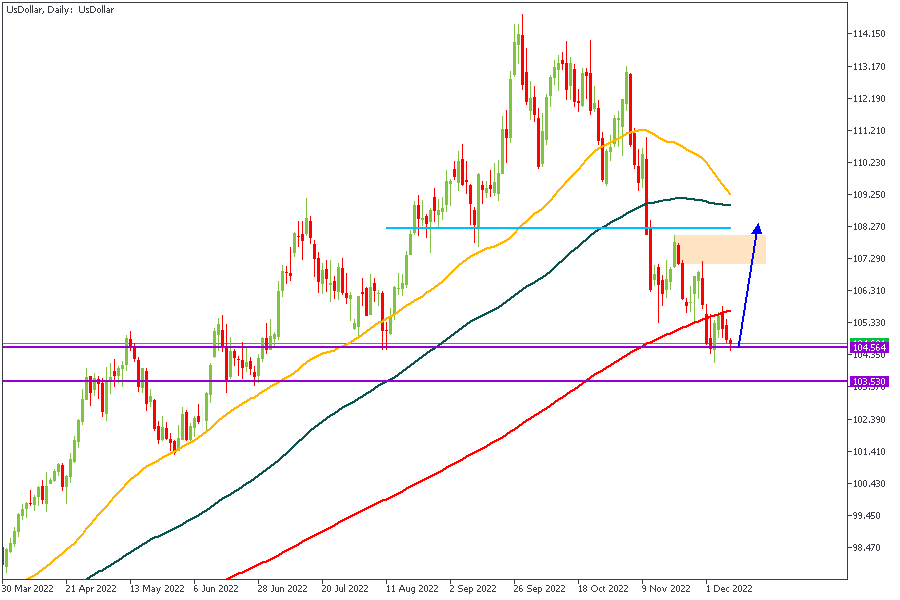
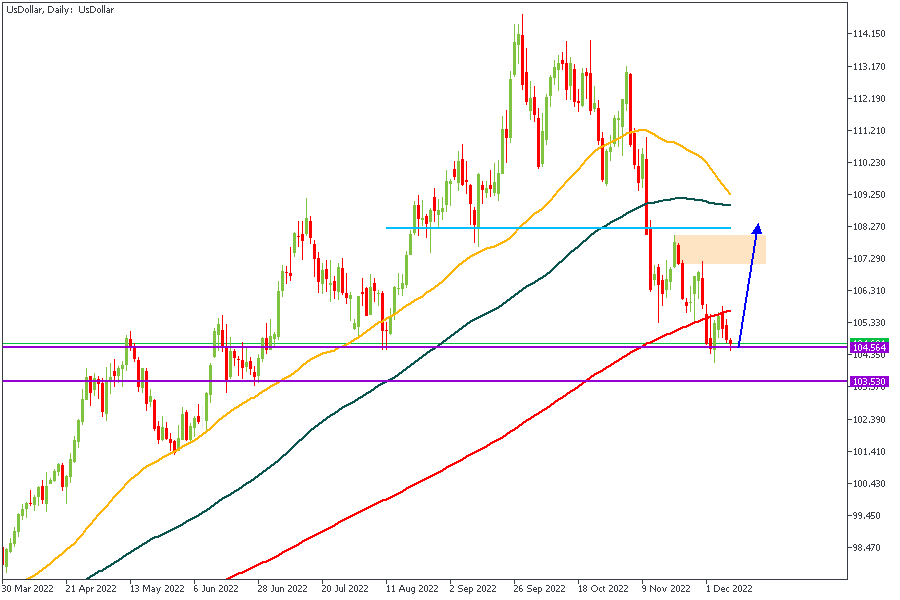
A comparative examination of the strength of the US-Dollar often gives tangible insight into the direction of Gold (XAUUSD). The chart above indicates the expectation of a bullish price reaction from the demand zone. Increased strength for the Dollar simply implies possible bearish reactions for Gold. With this in mind, let's take a look at the Gold (XauUsd) chart.
XAUUSD - DAILY
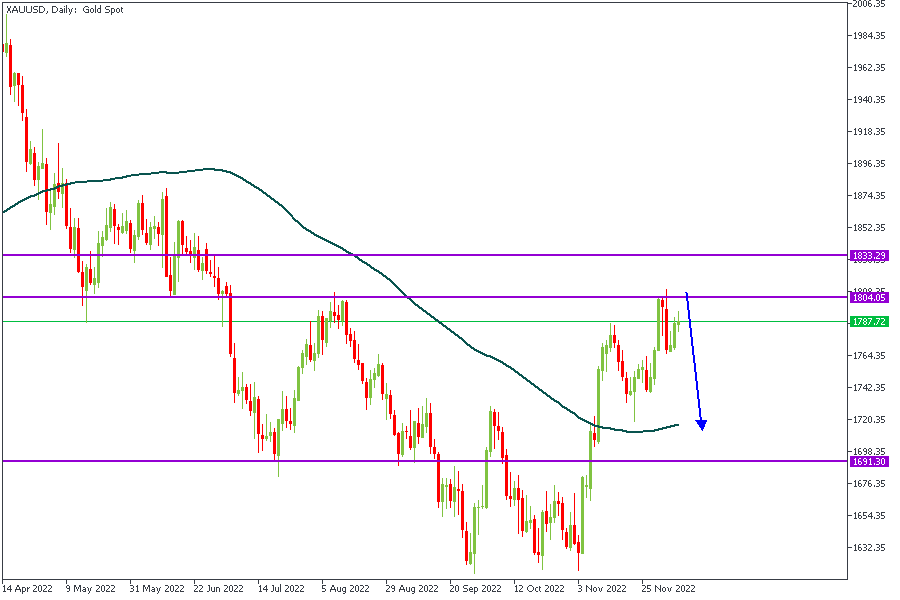
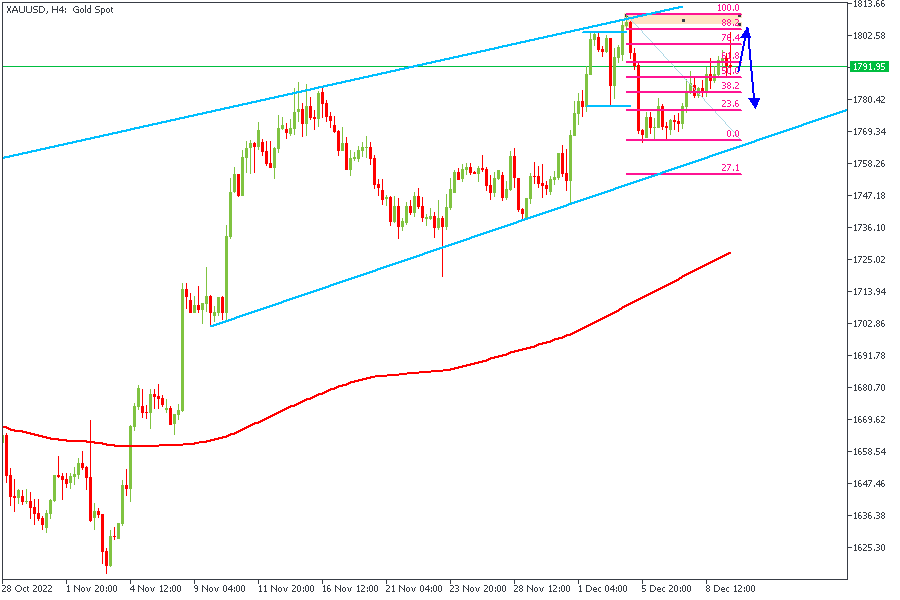
The daily timeframe presents an interesting scenario with the joint confluence of the Pivot zone and the drop-base-drop supply zone - not to forget the 200-Day Moving Average too. These factors line up perfectly in favour of a bearish reversal from the marked zone. Let's take a deeper dive into the lower timeframe price action though.
H4 TIMEFRAME
The 4-Hour timeframe shows price wedged between two trendlines but a lower timeframe view makes an even clearer impression.
H1 TIMEFRAME
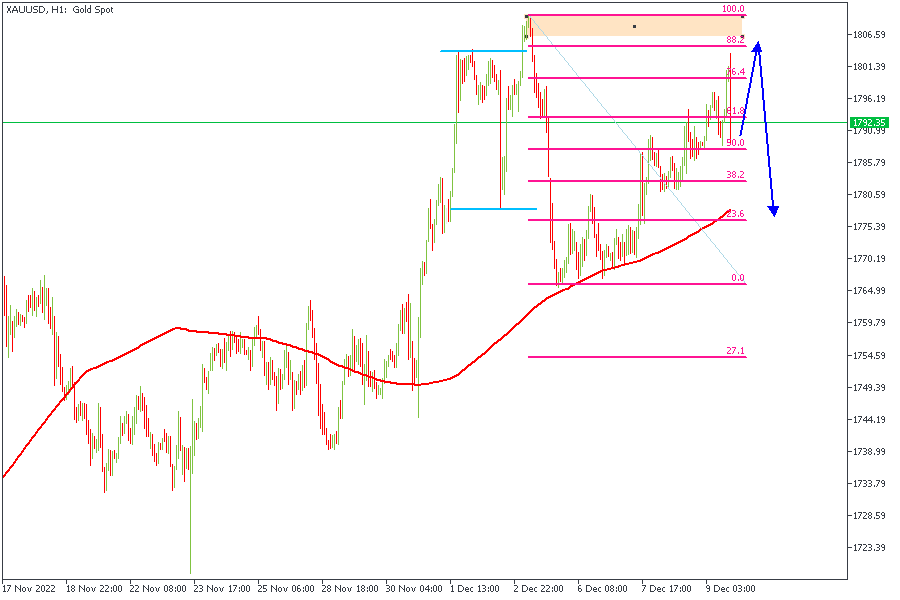
Here on the H1, price seems to be creating an AMD (Accumulation-Manipulation-Distribution) pattern over here which also serves as a bearish confirmation. Profit targets are; 1785, 1765, and 1755.
CONCLUSION
It is important to understand that the trading of CFDs comes at risk; if not properly managed, you may lose all of your trading capital. To avoid costly mistakes while you look to trade these opportunities, be sure to do your own due diligence and manage your risk appropriately.
Sunset Market Commentary
Markets
With no eco data with market moving potential scheduled for release in the EMU, European fixed income traders kept a close eye on how much TLTRO funding banks had returned at the second early repayment window since the ECB changed conditions on the loans at the October meeting. After repaying a rather modest €296 bln in November banks this week returned € 447.5 bln of loans out of an outstanding amount surpassing €1.8 tn. Together with a smaller tranche maturing this month, the outstanding amount of TLTRO’s will decline to €1.32 tn. A reduction in excess liquidity and the repayment freeing collateral in theory should reduce demand for high-grade collateral. German Bonds today indeed underperformed both US Treasuries and EMU swaps. German yields traded 5/6 bps higher across the curve at the start of the US trading session. EMU swap yields at that time gained about 2/2.5 bps across the curve. Aside from this (admittedly important) technical ‘intermezzo’, one could expect US PPI data to be more important for the directional trend on global bond markets. US traders apparently anticipated a soft figure with yields easing a few bps in the run-up to the release. However, the soft bias this time didn’t pay off. US producer prices slowed less than expected with final demand PPI rising 0.3% M/M and 7.4% Y/Y (from 8.1% but 7.2% expected). The reaction was far from impressive, but the report at least prevented a further rally in US Treasuries. US yields currently vary between +1.5 bp (2-y) and + 7 bps (30-y). The US 10-y (3.52%) moves a bit further away from the 3.42% key support. German yields are gaining between 8/9 bps across the curve. The German 10-y yield (1.90%) will avoid a weekly close below the 1.77% neckline. Equities/US futures had to return earlier gains post-PPI. The EuroStoxx50 returned gains of 0.5% to currently trade little changed. US indices opened up to 0.75% lower (Nasdaq). Oil (Brent $76.6 p/b) continues to fight an uphill battle, losing more than 10% compared to last week’s close. After finishing this report the U. of Michigan consumer confidence (including measures in inflation expectations) still might change the course of events.
On FX markets, post-PPI USD gains, if any, remain modest. USD/JPY, despite a brief uptick even declines in a daily perspective (136.20 vs open at 136.67). EUR/USD is ceding a few ticks (1.0540 vs 1.0556 open). Surprisingly, sterling outperforms, both against the dollar (cable 1.2275) and the euro, with EUR/GBP revisiting the 0.86 big figure. The 0.8647/60 support area isn’t out of reach yet.
News Headlines
Norwegian headline inflation eased more than expected in November. The multi-decade high of 7.5% Y/Y eased to 6.5% on the back of a monthly price drop of 0.3% (+0.3% expected). Core inflation, critical for the Norges Bank in setting monetary policy, unexpectedly fell too, from 5.9% to 5.7%. While both measures missed estimates, they remain well below the Norges Bank’s own 5.4% and 5% forecasts respectively due to a series of earlier upside surprises. The central bank remains on track for a 25 bps rate hike at the policy meeting next week. It will also publishes new forecasts at that December meeting. Back in September, Oslo penciled in a 3% terminal rate to be reached in the winter. After a string of topside inflation surprises, markets raised their own expectations to 3.50% only to pare them back recently to 3.25%. The fall-out on the Norwegian krone is limited with EUR/NOK hovering around 10.54. Still, the krone already lost quite some ground over the past few days, in lockstep with oil prices.
China held its annual “1+6” dialogue, involving talks with heads of the IMF, World Bank, OECD, WTO and others. Speaking after the meeting, IMF’s Georgieva said economic indicators suggest further downgrades to global growth are likely. She added that China’s recalibration of its Covid policies would help growth both domestically and elsewhere, echoing comments made by OECD’s Cormann. Malpass from the World Bank expressed concerns of a world at risk of a global recession, with a long-term crisis looming especially in developing countries. He said more needs to be done to lift the world out of stagflation and that China will have to reduce its excess stocks of food and fertilizer to alleviate shortages elsewhere. Okonjo-Iweala (World Trade Organisation) said global trade was losing momentum, expecting it to only grow 1% next year from 3.5% this year.
Trade Idea: Is the US Dollar’s Struggle Over Yet?
The US Dollar has been remarkably sluggish for the past few weeks despite being within a distinct Demand zone. My expectation of a springing rebound off the demand zone has not exactly played out yet, however, the zone remains unbroken. This means I can still uphold my bias for as long as the demand zone remains intact.
GBPUSD
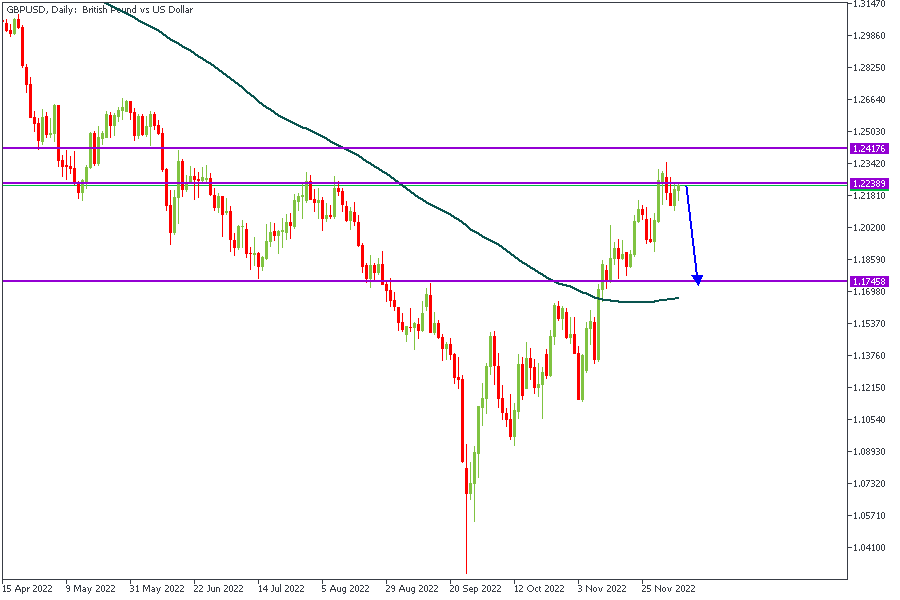
GBPUSD is still cycling around the rally-base-drop supply zone. My expectation is that price pushes down at least to the 1.20200 area - the final target being the marked line at 1.17458. It is also crucial to note that the marked supply zone doubles also as a PIVOT zone (or flip zone).
EURUSD
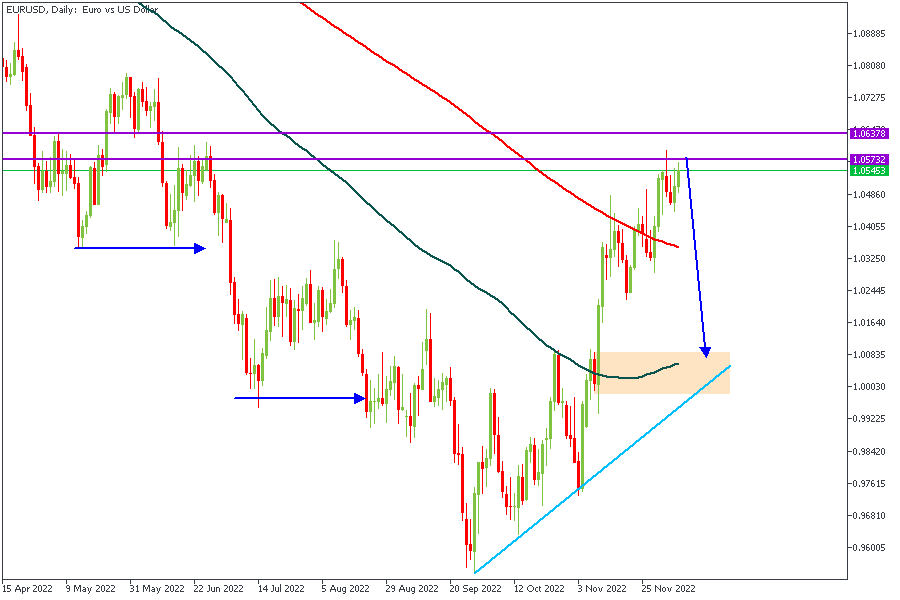
The marked zone between 1.06378 and 1.05732 constitutes the preferred point of entry. There is a visible PIVOT zone that also overlaps with the rally-base-drop supply zone from the first BoS (Break of Structure). As a result, we can expect price to drop from the area of entry with profit targets at; 1.04055, 1.03250, and finally 1.00835.
USDCAD
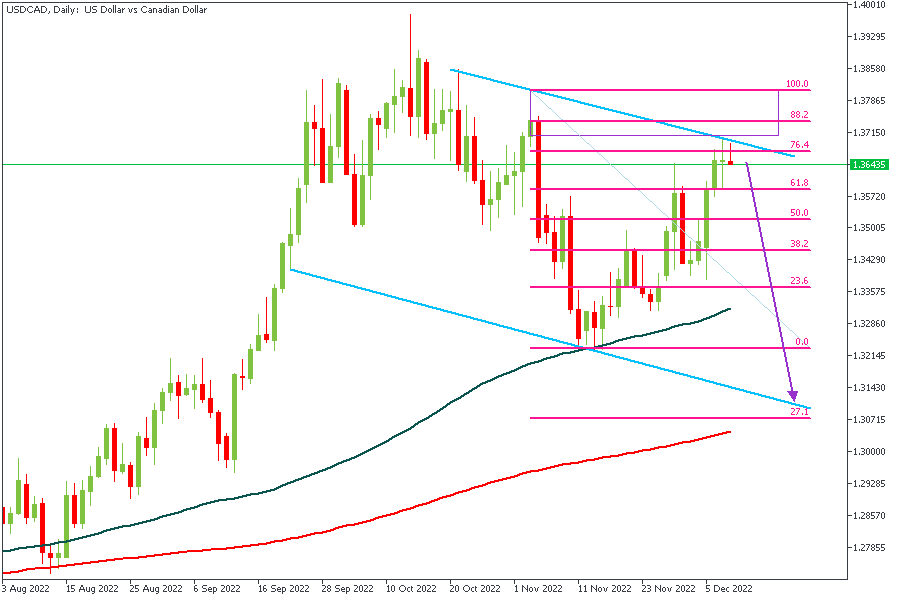
USDCAD is trading inside a descending channel on the Daily timeframe. The Fibonacci retracement level can also be seen aligning perfectly with the rally-base-drop supply zone which intersects with the trendline resistance of the descending channel. These confirmations indicate a high chance of a bearish rejection from the marked zone with targets at; 1.33650, 1.32500, and 1.30900
USDJPY
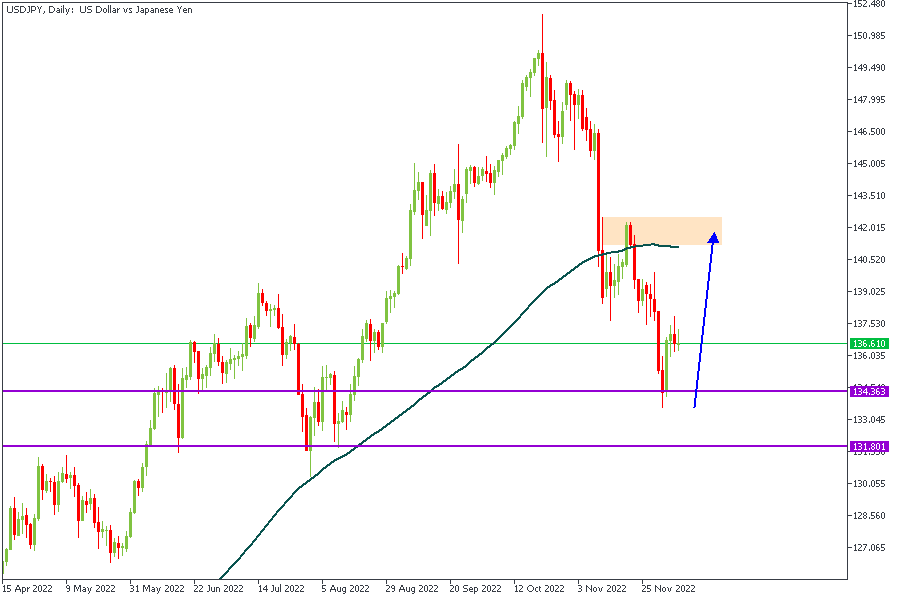
Personally, I expect to see USDJPY make a run for the highlighted zone around the 142 price area, however, the journey may not begin as plainly as it ought. Price could initially stagger back toward the demand zone before finally yielding the bull run.
USDCHF
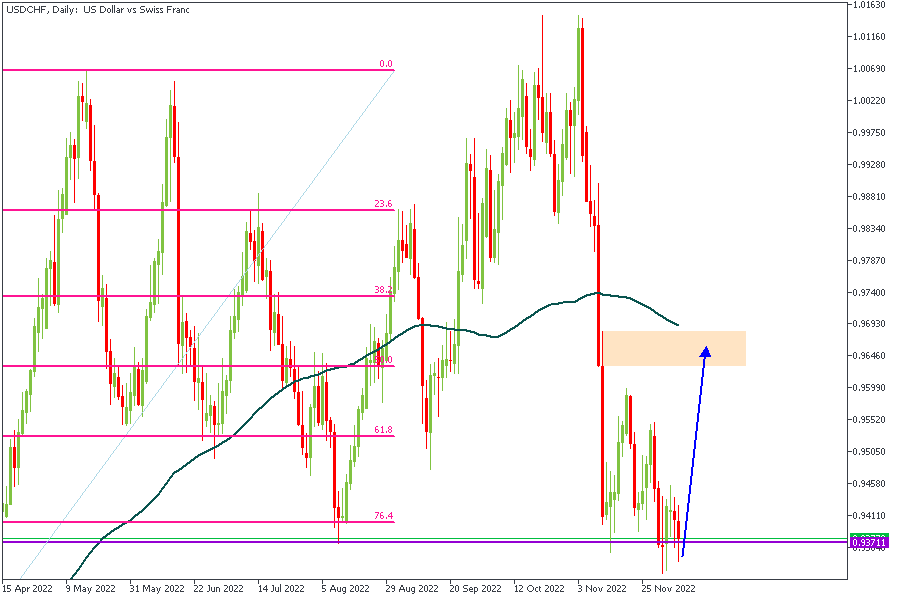
The arrow indicates my bias and expectation based on the daily timeframe price reaction from the demand zone. The major target is 0.96460.
NZDUSD
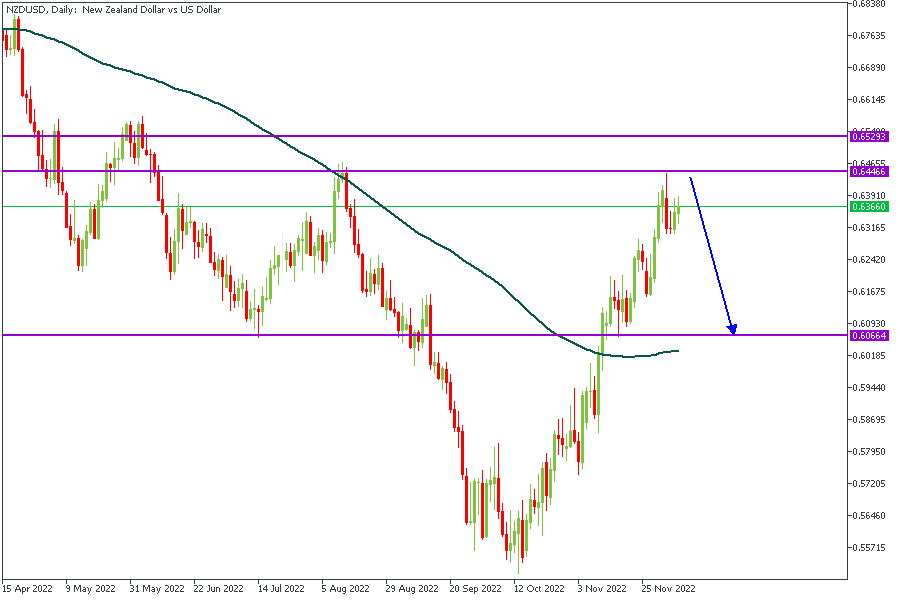
NZDUSD has reached a flip zone and is expected to dip lower toward the 100-Day Moving Average. It should also be noted that the marked supply zone is right within the vicinity of the 200-Day Moving Average.
CONCLUSION
It is important to understand that the trading of CFDs comes at risk; if not properly managed, you may lose all of your trading capital. To avoid costly mistakes while you look to trade these opportunities, be sure to do your own due diligence and manage your risk appropriately.