Sat, Apr 25, 2026 20:05 GMT
More

    Sample Category Title

    GBP/JPY Daily Outlook

    ActionForex

    Daily Pivots: (S1) 204.98; (P) 205.49; (R1) 205.98; More...

    GBP/JPY is staying in consolidations below 206.84 and intraday bias remains neutral. Deeper retreat cannot be ruled out, but downside be contained by 202.31 support to bring another rise. Break of 206..84 will target 208.09 high. Decisive break there will confirm long term up trend resumption.

    In the bigger picture, price actions from 208.09 (2024 high) are seen as a corrective pattern which might have completed at 184.35. Firm break of 208.09 high will resume the up trend from 123.94 (2020 low). Next target is 61.8% projection of 148.93 to 208.09 from 184.35 at 220.90. However, decisive break of 199.04 support will dampen this view and extend the corrective pattern with another fall.

    AI Season Two: Clash of the Giants

    There is some decent drama unfolding among the Big Tech bros this week — and Google and Nvidia are right in the middle of it. The former victim in the AI race, Google, which only months ago looked like it could be eaten alive by OpenAI’s next-gen AI chatbot, is suddenly storming back and, in a twist, pushing Nvidia dangerously close to the cliff as it takes the lead in a way few saw coming.

    To put things rapidly into context: the past two years haven’t been rosy for Google. Gemini took time to lift off, hallucinated and became a punchline in its early days. The model quietly improved its way through end users until Gemini 3 hit hard last week. Google eventually got its AI model right and moved aggressively into 3D reasoning, agentic coding and “vibe coding” — the kinds of end-products that could mint billions in revenue.

    But that’s not where the story ends.

    It’s where it begins.

    As AI chatbots seep into everyday life, demand for inference is exploding. Inference is when AI takes your request and figures out an answer. And with it, the cost of inference — the cost of running a trained model every time someone queries it — is exploding too. For OpenAI, that bill for 2024 is projected to hit around $2.3 billion, roughly 15× its training costs.

    And here comes the plot twist: Meta and OpenAI are reportedly moving toward Google’s TPUs — Google’s homegrown chips — to run their own models because they are cheaper to operate while offering comparable performance. Both Meta and OpenAI are said to be seeking up to 4× better performance-per-dollar on inference workloads.

    And inference is the next big thing because it never stops: every time you chat with a bot, the cost accumulates. Inference costs are projected to make up almost three-quarters of total AI computing costs by 2030.

    So the world’s biggest AI players could be shifting toward Google’s TPUs — cheaper, more tailored to AI workloads — and potentially replacing Nvidia.
    Read that again.

    That’s a real risk for Nvidia, whose client base is nearly half made up of these same Big Tech giants. This is why — on top of the accounting drama that hit the company last week — the stock shed another 2.60% yesterday, while Google rallied to a fresh ATH.

    In the meantime, Meta boosted its ad revenue thanks to AI, but its long-term business model is unclear. Meta is spending billions to transform its social media platforms into AI-content platform — a direction that risks disengaging users. Its Llama model is rarely mentioned in enterprise-grade discussions, and its oversized compute spending could backfire. Unlike Google, which can simply rent excess compute through its existing cloud offering, Meta must actually build that business from scratch.

    Outside the US, Alibaba’s AI efforts may be paying off. The company announced a stronger-than-expected 34% growth in its cloud business, that helped counterweigh their spending on consumer subsidies and AI investments. But the numbers couldn’t bring investors on board. The share price is struggling to a reverse October – November softness.

    In summary, Nvidia is being broadly questioned, Meta may be hitting its potential, while Amazon is the one Big Tech name that could benefit meaningfully from robotics when the time is right.

    But right now, Google suddenly seems to have it all: the data, the data centres, the chips, the AI model and the interface. It might well be the next $5 trillion beast. And if you think about it, Alibaba also has many of these assets. It’s got the data, the data centres, its own chips, its AI model, its e-commerce empire, and incredible reach within China and beyond. So if you believe the future is “everything under one roof,” Alibaba is - has always been - a strong candidate.

    What about Nvidia? Nvidia has been struggling since its latest earnings blew up in its hands as investors focused on swelling inventories and deferred payments. The company has been compared to Enron, booed because of the Google-TPU news, and are now defending themselves by saying “we’re not Enron” and “we are happy for Google.” Their main argument is that Google’s TPUs are designed for one specific function, whereas Nvidia’s GPUs are compatible with every AI model. But will that matter if companies simply want chips that do the job cheaply and efficiently?

    So, the moment has come ladies and gentlemen: competition for Nvidia is arriving from an unexpected direction. That could eat into its revenue potential and market share. Everyone is waiting to see how Nvidia will respond — by expanding customers beyond Big Tech, rolling out more inference-friendly GPUs, or pushing deeper into cost-competitive partnerships. We’ll soon find out.

    Meanwhile, US consumer sentiment is waning. More than half of the strong US GDP this year came from massive AI investment. Yesterday’s retail sales and PPI came in soft — softer than expected — although major retailers upgraded their annual forecasts and said the holiday season should look fine.

    And if not, the Fed will be there to save the day. The probability of a 25bp cut rose to around 85% after the latest data. The US dollar slipped below its 200-DMA, helping the EURUSD break above the September–November bearish consolidation trend.

    Cable also extended gains into today’s Budget announcement— an announcement that might bite. There have been plenty of leaks about where Rachel Reeves will squeeze out £30bn to get the numbers right and keep both markets and households happy. Ultimately, no one will be fully satisfied.

    The good news is that stress in gilt markets has been contained over the past few days. The bad news is that yields are near the levels reached during the Liz Truss mini-budget crisis three years ago, and Reeves has the smallest fiscal headroom on record — giving her zero margin for error. After today’s Budget, we’ll have a clearer view on whether the measures will be enough to keep gilt markets tidy and whether they are deflationary enough to convince the Bank of England to cut rates in December — which I think they will be. If so, current levels look appetizing for GBP sellers.

    Will UK Autumn Budget Calm Fiscal Concerns?

    In focus today

    The UK Autumn budget will be released in the afternoon. Expectations for an ambitious plan to cut costs and boost productivity have declined after the plans to raise income taxes were abandoned, although a less ambitious approach will also do for investors for now. Gilt and GBP investors will zoom in on the headroom, which will serve as a buffer against future debt issuance. Chancellor Reeves will likely have to increase it from the previous modest GBP 10bn closer to GBP 30bn.

    In the morning, Norwegian mainland GDP growth is released, which we expect will have slowed to 0.2% in Q3, somewhat lower than Norges Bank's forecast from the September MPR (0.4%). However, monthly figures indicate that employment grew around 0.1% in Q3, which may suggest some upside risk to our estimate.

    Overnight China releases its industrial profit growth for October. It recovered in late summer to reach 21.6% in September but likely did not sustain that level in October, when US tariff threats hit exports. We look for a decline to around 10% y/y, but it could go lower.

    Economic and market news

    What happened overnight

    In the Ukraine war, Moskov signalled it could reject the 19-point peace plan developed by Ukraine and the US earlier this week, citing the significant changes from the plan developed in Alaska. US President Trump announced that there was no deadline on reaching an agreement and that he would meet with the two other Presidents only when the "deal to end this War is FINAL or, in its final stages". US envoy Steve Witkoff is set to meet President Putin next week to further the peace plan.

    What happened yesterday

    In the US, the delayed September producer price index (PPI) for final demand came in at 0.3% m/m and 2.7% y/y SA, matching low consensus expectations. The core measure (excluding food and energy) was lower at 0.1% SA y/y. US retail sales growth slowed in September, with sales increasing by a modest 0.2% m/m and the Conference Board's consumer confidence index saw a decline in November to 88.7 from 95.5 in October. It was the second lowest reading in five years. Overall, the data prints from the US added fuel to the fire of worries surrounding the US economy and markets are currently pricing about an 80% chance of an interest rate cut at the FOMC December meeting.

    According to Bloomberg News, White House economic advisor Kevin Hassett is the frontrunner to be the next Fed chair. Prediction markets are telling the same story, with his nomination sitting just above 50%.

    In Sweden, the October PPI came in at 0.4% y/y and 0.4% m/m. The numbers were nothing dramatic and were primarily driven by a rise in electricity prices.

    Equities: Equities were sharply higher again on Tuesday, for a third straight day, with S&P 500 and Stoxx 600 eventually closing up 0.9%. This means that equities are only some 1-2% off previous highs. This session was much more like Friday's markets; investors were selectively buying the company outside the obvious AI plays. Russell 2000 gained 3% and sectors like healthcare, consumer discretionary and materials sector led the gains, ~2% higher. All in all, risk appetite was solid evident in a wide breadth (426 of the S&P 500 closed higher) and VIX falling below 20. Tech did okay, but with a lot of company specific news driving the sector in opposite directions (Nvidia down sharply on competition concerns, Alphabet and Meta higher on rumours that Meta will buy Google's chips). Similarly, heavy tech-indices in Asia are rebounding 1-2% higher this morning.

    FI and FX: The money market is increasingly convinced that there will be a December cut from the Fed with futures now indicating 21bp. The longer end is lower as well with US10y at 4,00%. The UST 5y auction met strong demand. Equities like what they see. Broad US equity indexes closed higher for the third consecutive day, and futures are in green. The USD took a hit yesterday on the news that Russia's war in Ukraine might come to an end. EUR/USD moved from 1.1520 to 1.1590 and USD/SEK fell 10 figures. EUR/SEK and EUR/NOK trade just above 11.00 and 11.80.

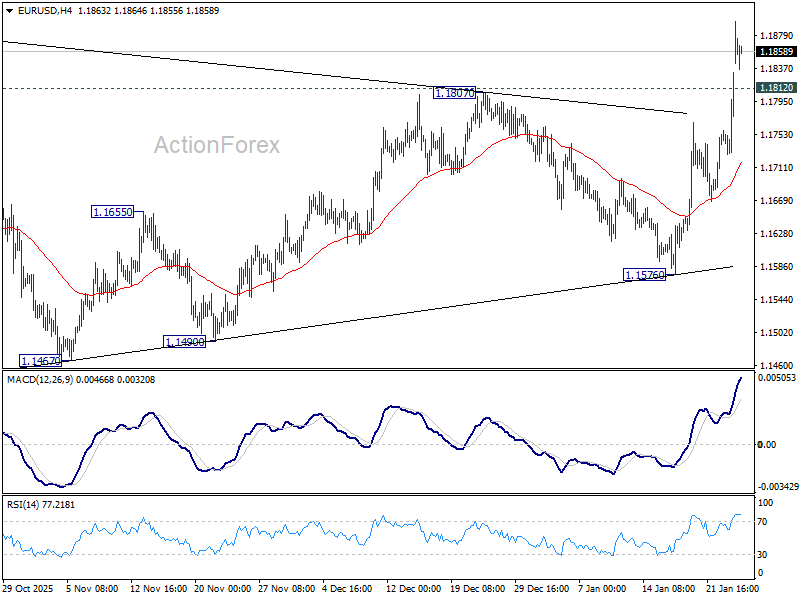
    EUR/USD Daily Outlook

    Daily Pivots: (S1) 1.1526; (P) 1.1556; (R1) 1.1600; More

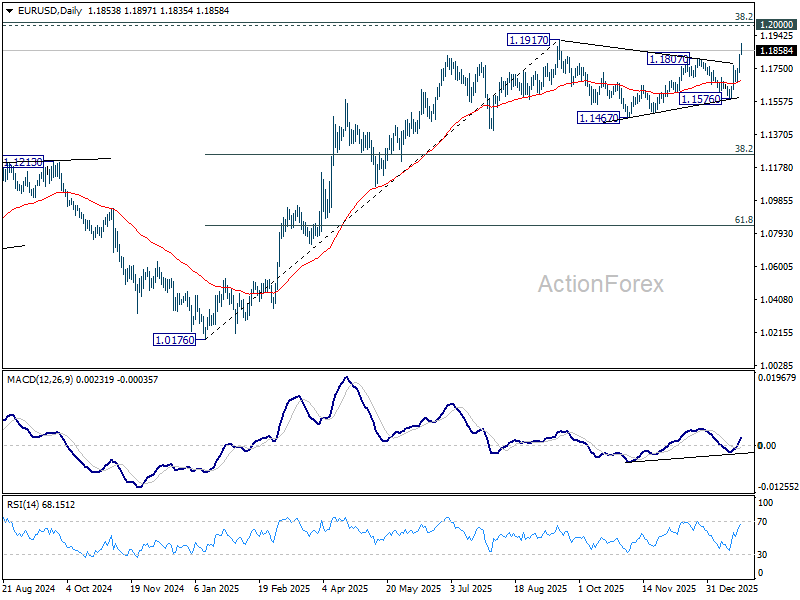
    Intraday bias in EUR/USD remains neutral and more consolidations could be seen. Further decline is expected with 1.1655 resistance intact. On the downside, below 1.1490 and 1.1467 will resume the whole decline from 1.1917 high. Next targets are 1.1390, and then 38.2% retracement of 1.0176 to 1.1917 at 1.1252.

    In the bigger picture, considering bearish divergence condition in D MACD, a medium term top is likely in place at 1.1917, just ahead of 1.2 key psychological level. As long as 55 W EMA (now at 1.1328) holds, the up trend from 0.9534 (2022 low) is still in favor to continue. Decisive break of 1.2000 will carry larger bullish implications. However, sustained trading below 55 W EMA will argue that rise from 0.9534 has completed as a three wave corrective bounce, and keep long term outlook bearish.
    USD/JPY Daily Outlook

    Daily Pivots: (S1) 155.59; (P) 156.29; (R1) 156.77; More...

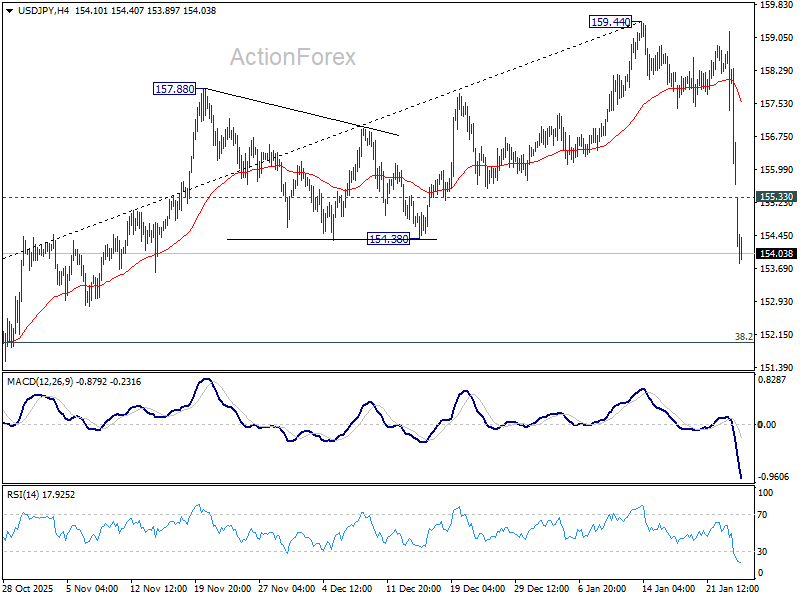
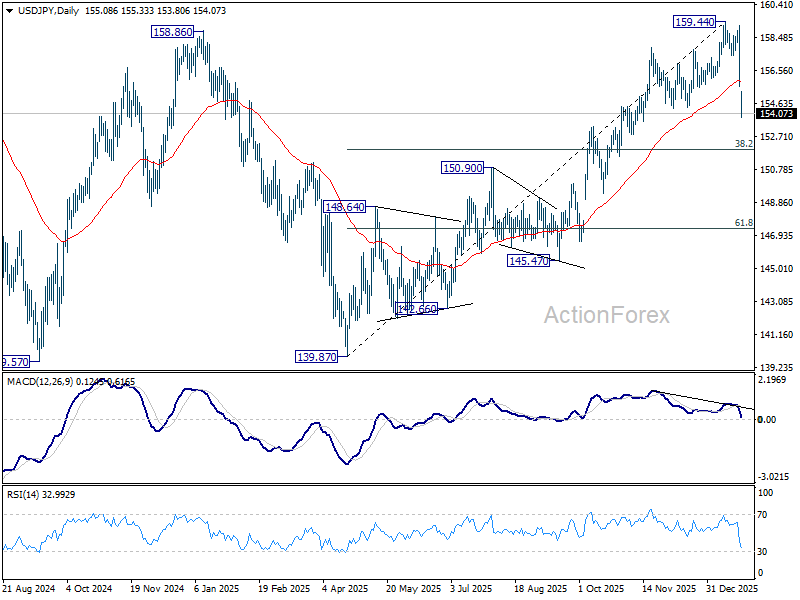
    Intraday bias in USD/JPY stays neutral and more consolidations could be seen below 157.88. Downside should be contained by 154.47 resistance turned support. On the upside, break of 157.88 will resume the whole rally from 139.87. Next target is 158.86 structural resistance, and then 161.94 high.

    In the bigger picture, current development suggests that corrective pattern from 161.94 (2024 high) has completed with three waves at 139.87. Larger up trend from 102.58 (2021 low) could be ready to resume through 161.94 high. Decisive break of 158.85 structural resistance will solidify this bullish case and target 161.94 for confirmation. On the downside, break of 150.90 resistance turned support will dampen this bullish view and extend the corrective range pattern with another falling leg.

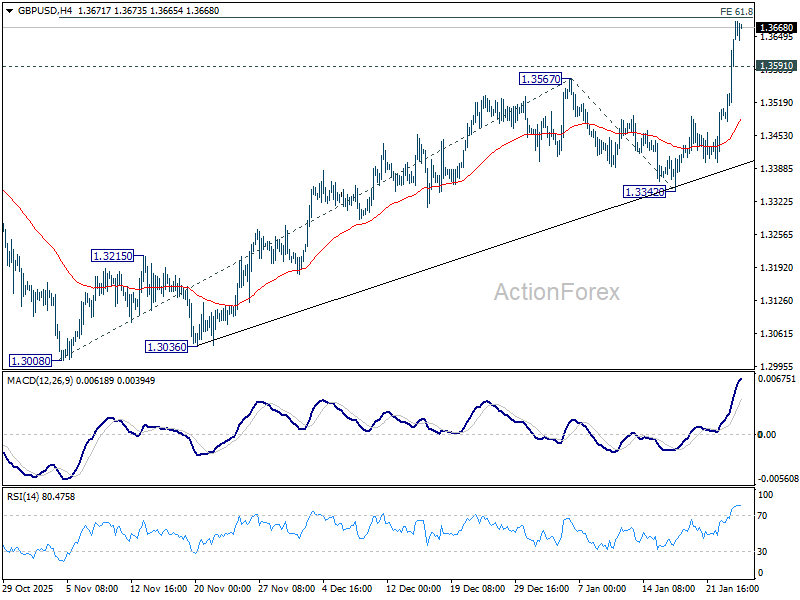
    GBP/USD Daily Outlook

    Daily Pivots: (S1) 1.3103; (P) 1.3158; (R1) 1.3221; More...

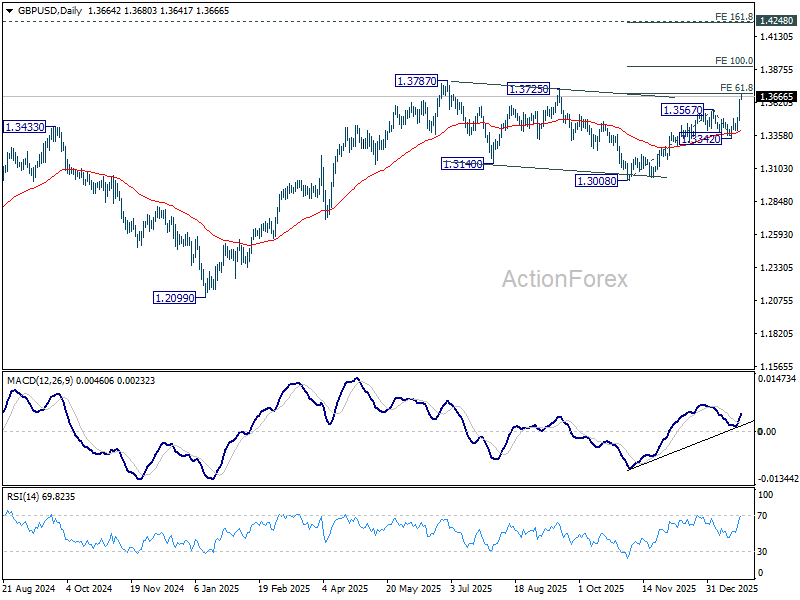
    Intraday bias in GBP/USD remains neutral as consolidations continue in range of 1.3008/3247. With 1.3247 support turned resistance intact, further decline is expected. On the downside, break of 1.3008 will resume the fall from 1.3725 to 138.2% projection of 1.3787 to 1.3140 from 1.3725 at 1.2831. Nevertheless, firm break of 1.3247 will suggest that fall from 1.3787 has completed as a corrective move already.

    In the bigger picture, the break of 55 W EMA (now at 1.3184) is taken as the first sign that corrective rise from 1.0351 (2022 low) has completed. Decisive break of trend line support (now at 1.2760) will solidify this case and target 38.2% retracement of 1.0351 to 1.3787 at 1.2474 next. Meanwhile, in case of another rise, strong resistance should emerge below 1.4248 (2021 high) to cap upside to preserve the long term down trend.

    USD/CHF Daily Outlook

    Daily Pivots: (S1) 0.8057; (P) 0.8079; (R1) 0.8101; More

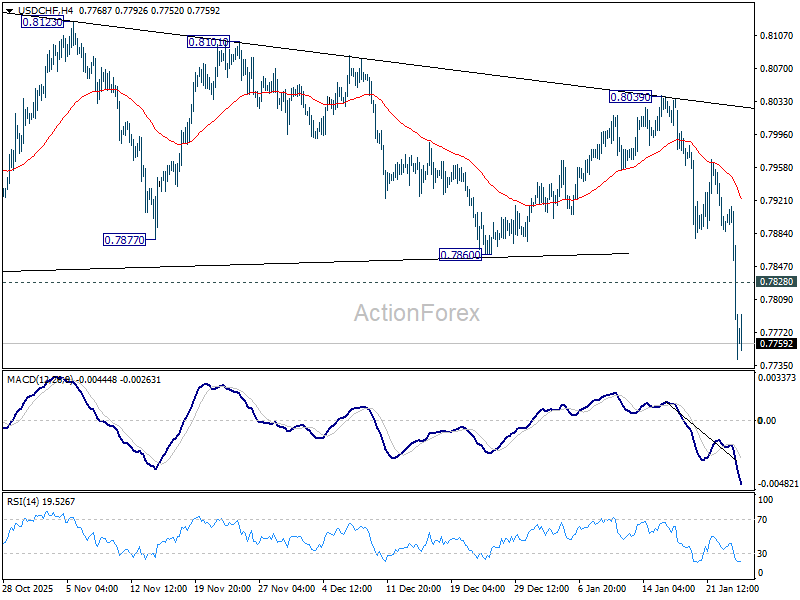
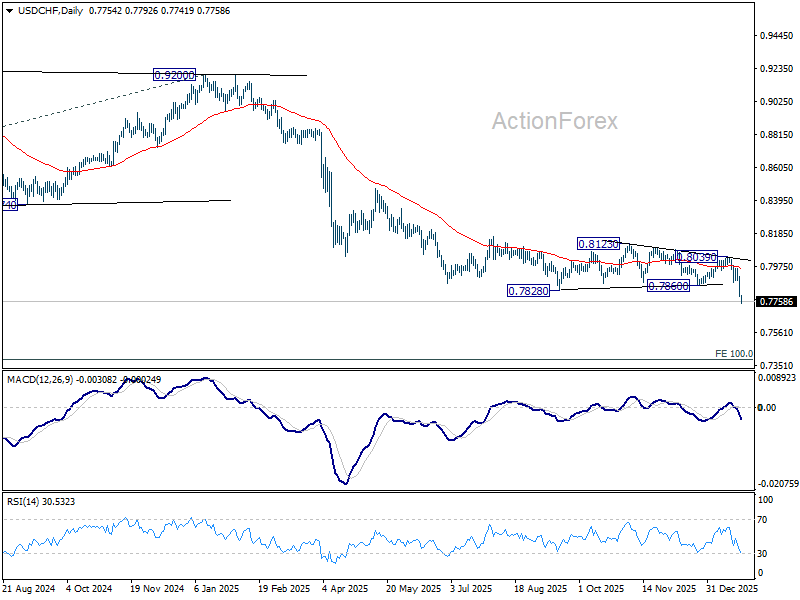
    Intraday bias in USD/CHF stays neutral and more consolidations could be seen below 0.8101 temporary top. No change in the outlook that current rise from 0.7877 is still seen as the third leg of the corrective pattern from 0.7828 low. Above 0.8101 will target 0.8123 resistance, and then 138.2% projection of 0.7828 to 0.8075 from 0.7877 at 0.8218. However, sustained break of 55 D EMA (now at 0.8011) will bring deeper fall back to 0.7877 support instead.

    In the bigger picture, long term down trend from 1.0342 (2017 high) is still in progress. Next target is 100% projection of 1.0146 (2022 high) to 0.8332 from 0.9200 at 0.7382. In any case, outlook will stay bearish as long as 0.8332 support turned resistance holds (2023 low).

    USD/CAD Daily Outlook

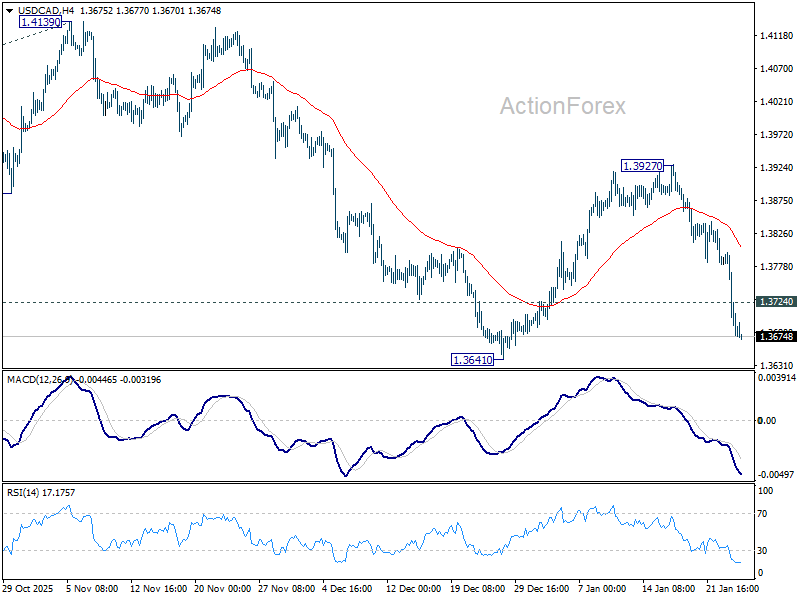
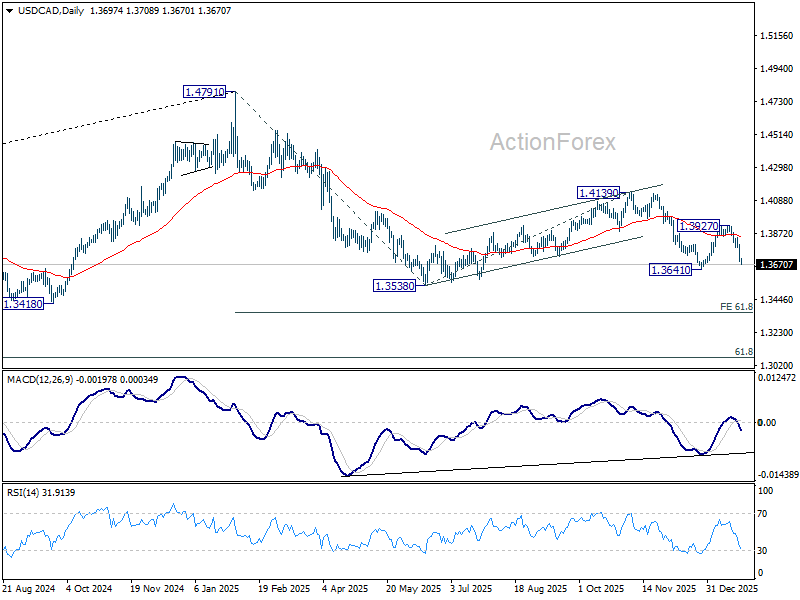
    Daily Pivots: (S1) 1.4084; (P) 1.4105; (R1) 1.4119; More...

    USD/CAD failed to break through 1.4139 resistance and retreated. Intraday bias remains neutral and more consolidations could be seen. Further rally is expected with 1.3970 support intact. On the upside, decisive break of 1.4139 resistance will resume whole rally from 1.3538. Next target is 61.8% retracement of 1.4791 to 1.3538 at 1.4312.

    In the bigger picture, price actions from 1.4791 medium term top is likely just unfolding as a correction to up trend from 1.2005 (2021 low), with rise from 1.3538 as the second leg. A third leg should follow before up trend resumption. That is, range trading is set to extend for the medium term. For now, this will remain the favored case as long as 1.3886 support holds. However, firm break of 1.3886 will revive the case that fall from 1.4791 is indeed a larger scale correction.

    AUD/USD Daily Report

    Daily Pivots: (S1) 0.6445; (P) 0.6461; (R1) 0.6485; More...

    AUD/USD's extended rebound and break of 0.6501 resistance suggests short term bottoming at 0.6420. Intraday bias is back on the upside for 06579 resistance. Firm break there should confirm that whole fall from 0.6706 has completed as a three wave correction. Stronger rally should then be seen back to retest 0.6706. On the downside, sustained break of 0.6413 cluster (38.2% retracement of 0.5913 to 0.6706 at 0.6403) should confirm near term bearish reversal.

    In the bigger picture, there is no clear sign that down trend from 0.8006 (2021 high) has completed. Rebound from 0.5913 is seen as a corrective move. Outlook will remain bearish as long as 38.2% retracement of 0.8006 to 0.5913 at 0.6713 holds. Break of 0.6413 support will suggest rejection by 0.6713 and solidify this bearish case. Nevertheless, considering bullish convergence condition in W MACD, sustained break of 0.6713 will be a strong sign of bullish trend reversal, and pave the way to 0.6941 structural resistance for confirmation.

    Kiwi, Aussie Dominate; Sterling Awaits for High-Stakes Budget

    Risk-on sentiment extended through Asian session, from intensifying bets on December Fed rate cut. The shift in sentiment sent US stocks higher overnight, and pushed 10-year yield briefly below 4% handle. Kiwi and Aussie are the biggest beneficiary of this backdrop, with both additionally supported by domestic developments.

    Kiwi is the standout performer as markets digested RBNZ’s hawkishly framed rate cut. By signaling that the OCR is likely already at its trough and projecting only a modest lift through 2027, the central bank effectively pushed back against earlier expectations of a deeper easing cycle. Aussie also attracted buyers after Australia’s inflation data showed sharper acceleration than expected. Any RBA rate cut is pushed further into 2026.

    Yen, however, remained soft despite renewed chatter around a December BoJ hike. Reuters reported that the central bank is preparing markets for a possible move as early as next month, following a key meeting between Prime Minister Sanae Takaichi and Governor Kazuo Ueda that appeared to remove political hurdles. Even so, sources suggested a close call between a December hike and a delay to January, with the Fed decision a week earlier likely to influence the decision. But for now, Yen traders appear e unconvinced.

    Attention turns next to the UK Autumn Budget, which carries unusually high uncertainty after contradictory messaging from Chancellor Rachel Reeves on tax measures. Markets have little guidance on the scope or direction of fiscal changes, leaving room for large surprises. Gilt reaction will be the clearest test of investor confidence in the government’s fiscal stance. Sterling will trade off Gilt yields, but inversely—this is a confidence story, not a yield-seeking one.

    For the week so far, Kiwi leads the performance board, followed by Aussie and Sterling. Dollar sits at the bottom, with Loonie and Yen also heavy, while Euro and Swiss Franc hover around the middle of the pack.

    In Asia, at the time of writing, Nikkei is up 1.98%. Hong Kong HSI is up 0.44%. China Shanghai SSE is up 0.14%. Singapore Strait Times is up 0.56%. Japan 10-year JGB yield is up 0.015 at 1.819. Overnight, DOW rose 1.43%. S&P 500 rose 0.91%. NASDAQ rose 0.67%. 10-year yield fell -0.036 to 4.002.

    RBNZ delivers 25bps cut but signals little room for further easing

    RBNZ cut the OCR by 25bps to 2.25% as widely expected, but the tone of the announcement was more hawkish than markets had anticipated.

    Policymakers revealed they had debated holding rates at 2.50% versus cutting to 2.25%, and the final decision was reached by a 5–1 vote. The lone dissenter in favour of holding highlights pockets of concern about easing too deeply and reflects a more cautious internal balance than many had assumed.

    More importantly for markets, RBNZ’s updated forward guidance showed a notably firmer policy path. The Bank now expects the OCR to bottom at just 2.2% through 2026 before gradually rising to 2.7% by the end of 2027. That trajectory implies minimal scope for further cuts next year if the economic outlook holds, effectively signaling that today’s move may mark the end of the easing cycle.

    The accompanying statement reinforced that message. RBNZ said economic activity was weak through mid-2025 but is now improving, with lower interest rates supporting household spending and the labor market stabilizing. The fall in the exchange rate is also lifting exporters’ incomes, reducing the need for more aggressive stimulus from here. Risks to the inflation outlook are now viewed as “balanced”.

    Australia CPI surges to 3.8% in October, goods and services prices accelerate

    Australia’s CPI accelerated more than expected in October, rising from 3.5% yoy to 3.8%, beating expectations of 3.6%. Underlying pressure also firmed, with trimmed mean CPI moving up from 3.2% to 3.3%.

    Both goods and services inflation picked up, with annual goods inflation at 3.8% (up from 3.7%) and services inflation at 3.9% (up from 3.5), signaling renewed price momentum. The combination will keep the RBA wary of easing again too soon.

    The details showed broad-based increases. Housing costs was the largest contributor at 5.9%, followed by food and non-alcoholic beverages at 3.2%, and recreation and culture at 3.2%.

    The release is also notable as the first in which Monthly CPI replaces the quarterly gauge as Australia’s primary headline measure.

    AUD/NZD drops as hawkish RBNZ cut overpowers hot Australia CPI

    AUD/NZD tumbled sharply today as markets digested two major releases: RBNZ’s widely expected 25bps cut and Australia’s stronger-than-forecast CPI print. Despite the upside surprise on inflation, AUD buying was no match for the hawkish tone embedded in RBNZ’s announcement, which effectively signaled that the easing cycle is now complete.

    That distinction proved decisive. With RBNZ projecting the OCR to bottom near current levels and rise gradually into 2027, the case for deeper easing has evaporated. Although the RBA is also expected to stay on hold through early 2026, the interest-rate differential is now set to remain stable rather than widening. Investors who previously bet on wider divergence, a trend accelerated by New Zealand’s sharp Q2 economic contraction, are now unwinding positions.

    Technically, AUD/NZD's break of 1.1452 support confirms resumption of the decline from 1.1634 short term top. Considering bearish divergence condition in D MACD, fall from 1.1634 is likely correcting rise from 1.0724. Deeper fall should be seen to 55 D EMA (now at 1.1367) and possibly below.

    But strong support is expected from 1.1275 cluster (38.2% retracement of 1.0724 to 1.1634 at 1.1286) to bring rebound and set the range for sideway trading.

    Rise from 1.0649 is still expected to have another rising leg through 1.1634 to complete a five-wave impulsive pattern. But that's unlikely to happen soon. The move may only come when the markets start to bet that RBA would hike interest rate earlier than RBNZ, which won't be in the near future.

    That next leg, however, would require a significant shift in rate expectations—specifically, a scenario where markets begin to see the RBA tightening earlier than RBNZ, which is not on the horizon at present.

    AUD/USD Daily Report

    Daily Pivots: (S1) 0.6445; (P) 0.6461; (R1) 0.6485; More...

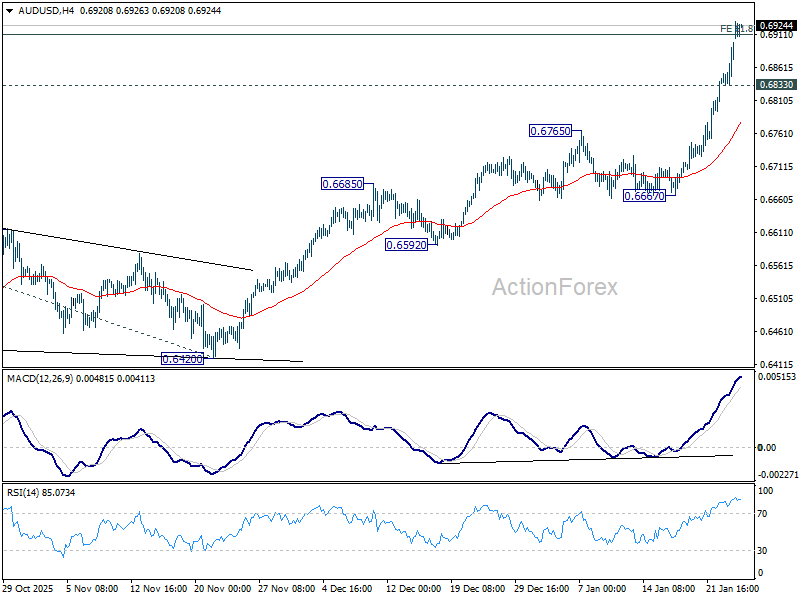
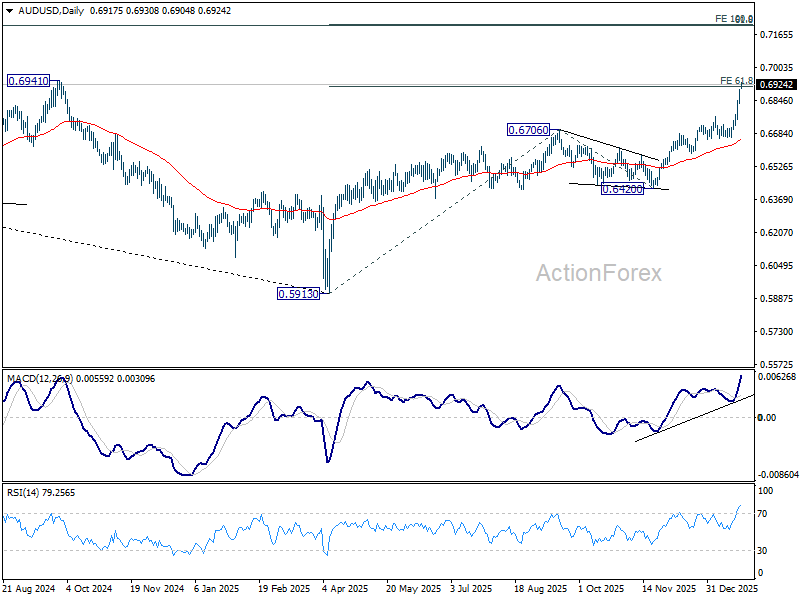
    AUD/USD's extended rebound and break of 0.6501 resistance suggests short term bottoming at 0.6420. Intraday bias is back on the upside for 06579 resistance. Firm break there should confirm that whole fall from 0.6706 has completed as a three wave correction. Stronger rally should then be seen back to retest 0.6706. On the downside, sustained break of 0.6413 cluster (38.2% retracement of 0.5913 to 0.6706 at 0.6403) should confirm near term bearish reversal.

    In the bigger picture, there is no clear sign that down trend from 0.8006 (2021 high) has completed. Rebound from 0.5913 is seen as a corrective move. Outlook will remain bearish as long as 38.2% retracement of 0.8006 to 0.5913 at 0.6713 holds. Break of 0.6413 support will suggest rejection by 0.6713 and solidify this bearish case. Nevertheless, considering bullish convergence condition in W MACD, sustained break of 0.6713 will be a strong sign of bullish trend reversal, and pave the way to 0.6941 structural resistance for confirmation.


    Economic Indicators Update

    GMT CCY EVENTS ACT F/C PP REV
    07:00 EUR Germany GDP Q/Q Q3 F 0.00% 0.00% 0.00%
    13:30 USD Retail Sales M/M Sep 0.20% 0.40% 0.60%
    13:30 USD Retail Sales ex Autos M/M Sep 0.30% 0.30% 0.70%
    13:30 USD PPI M/M Sep 0.30% 0.30% -0.10%
    13:30 USD PPI Y/Y Sep 2.70% 2.70% 2.60%
    13:30 USD PPI Core M/M Sep 0.10% 0.30% -0.10%
    13:30 USD PPI Core Y/Y Sep 2.90% 2.70% 2.80%
    14:00 USD S&P/CS Composite-20 HPI Y/Y Sep 1.40% 1.40% 1.60%
    14:00 USD Housing Price Index M/M Sep 0.00% 0.20% 0.40%
    15:00 USD Consumer Confidence Nov 93.4 94.6
    15:00 USD Pending Homeles M/M Oct 0.50% 0.00%
    15:00 USD Business Inventories Aug 0.10% 0.20%