

Sample Category Title
Dollar Pares Gain ahead of NFP, Canadian Employment also Featured
Asian markets are very mixed today, with Nikkei trading lower, following US stocks overnight. But strong rebound is seen in Hong Kong and China. As a result, Dollar is paring some of the post-FOMC gains while commodity currencies recover. It's also possible that traders are lighting up their positions ahead of non-farm payroll data form the US. In any case, much volatility is anticipated before the week comes to a close.
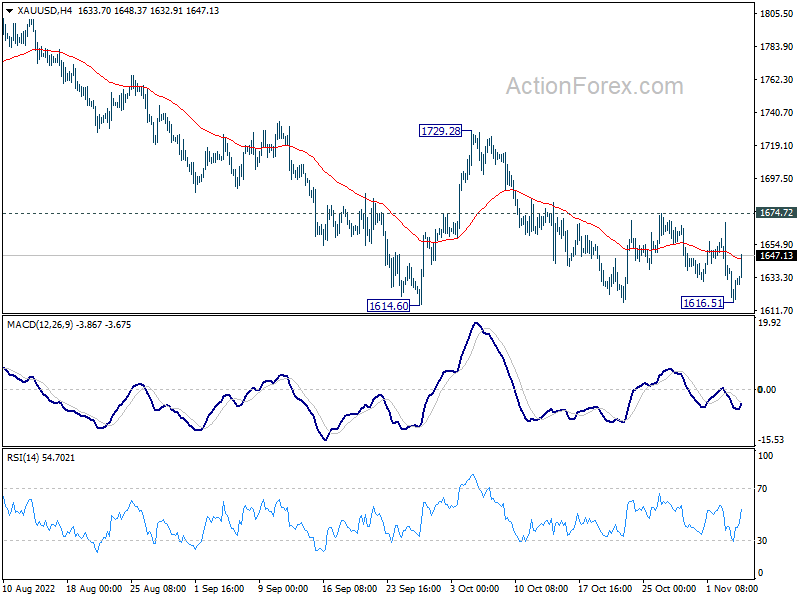
Technically, Gold recovered notably after dipping to 1616.51, ahead of 1614.60 low. On the downside, firm break of 1614.60 will confirm larger down trend resumption. On the upside, break of 1674.72 resistance will delay the bearish case, and extend the consolidation pattern from 1614.60 with another rising leg. Upside should be capped below 1729.28 resistance. Today's move could be used to confirm the near term direction in Dollar.
In Asia, at the time of writing, Nikkei is down -1.78%. Hong Kong HSI is up 6.78%. China Shanghai SSE is up 2.47%. Singapore Strait Times is up 0.83%. Japan 10-year JGB yield is up 0.0070 at 0.254. Overnight, DOW dropped -0.46%. S&P 500 dropped -1.06%. NASDAQ dropped -1.73%. 10-year yield rose 0.065 to 4.124.
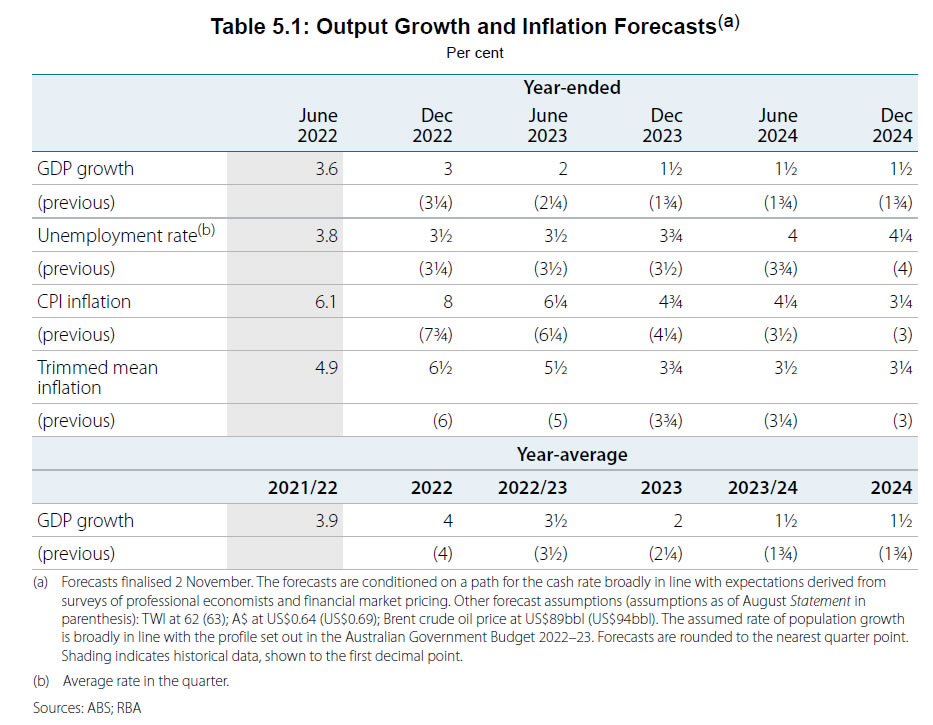
RBA downgrades 2023, 2024 growth forecast, raised inflation
In the Statement on Monetary Policy, RBA noted that after a sequence of 50bps and 24bps rate hikes, "the Board recognised that interest rates had already been increased significantly in a short period of time".
"In an uncertain environment, slowing the adjustment of policy allows time to assess the effects of the increases to date and the evolving economic outlook," it added.
The Board expects that "interest rates will need to increase further", but "monetary policy is not on a pre-set path". The size and timing of future interest rate hikes will be determined by incoming data and assessment of the outlook of inflation and labor market.
In the new economic projections, year-average GDP growth forecast for:
- 2022 was left unchanged at 4%.
- 2023 was downgraded from 2.25% to 2.00%.
- 2024 was downgraded from 1.75% to 1.50%.
Year-end forecasts for headline CPI for:
- 2022 was revised up from 7.75% to 8.00%.
- 2023 was revised up from 4.25% to 4.75%.
- 2024 was revised up from 3.00% to 3.25%.
Year-end forecasts for trimmed mean CPI for:
- 2022 was revised up from 6.00% to 6.25%.
- 2023 was left unchanged at 3.75%.
- 2024 was revised up from 3.00% to 3.25%.
Year-end forecasts for unemployment rate for:
- 2022 was revised up from 3.25% to 3.50%.
- 2023 was revised up from 3.50% to 3.75%.
- 2024 was revised up from 4.00% to 4.25%.
NFP in focus, USD/CAD forming head and shoulder top?
US non-farm payroll employment data is the major focus of the day. Markets are expecting the job market to grow 200k in October. Unemployment rate is expected to tick up from 3.5% to 3.6%.
Looking at related data, ADP report showed solid 239k growth in private employment. ISM manufacturing employment also improved from 48.7 to 50.0. However, ISM services employment dropped notably from 53.0 to contractionary reading of 49.1. Four-week moving average of initial jobless claims rose slightly from 207k to 219k. The set of data overall suggests that job market should remain tight.
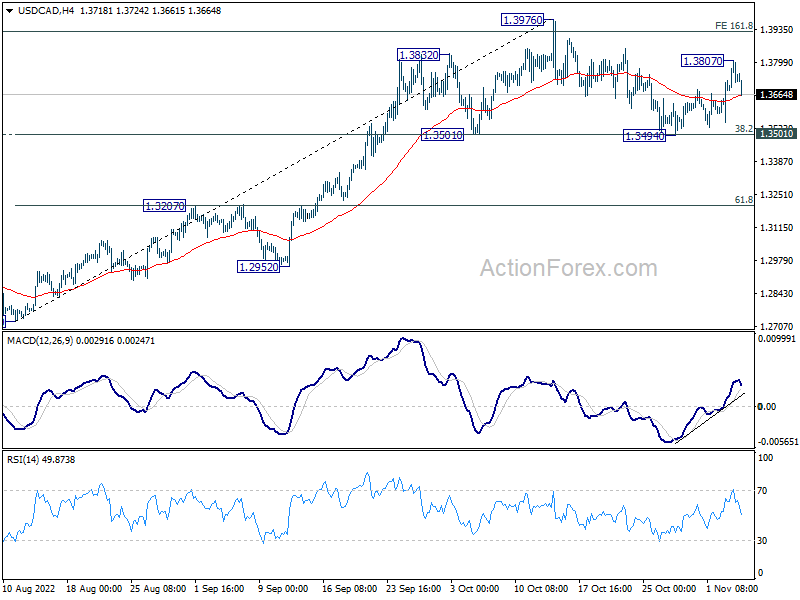
As per market reaction, USD/CAD would be an interesting one to watch considering that Canada will also release job data. For now, near term outlook stays bullish for another rise through 1.3976 to resume larger up trend. However, break of 1.3494/3501 support will complete a head and should top pattern (ls: 1.3832; h:1.3976; rs: 1.3807). In the case, deeper correction would likely be seen back to 1.3207 resistance turned support, before USD/CAD find renewed buying.
Elsewhere
Eurozone will release PMI services final and PPI. UK will release construction PMI. Canada will also release job data and Ivey PMI.
USD/CHF Daily Outlook
Daily Pivots: (S1) 1.0044; (P) 1.0095; (R1) 1.0187; More...
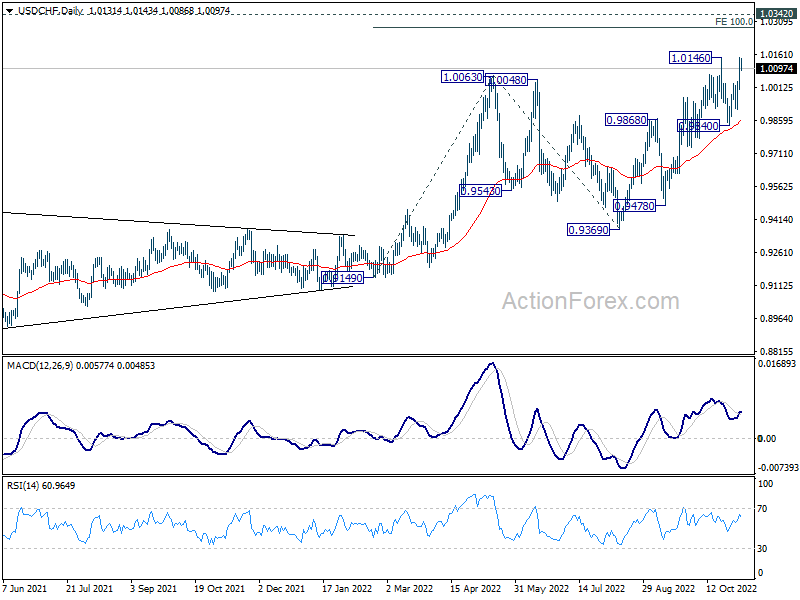
USD/CHF retreats mildly ahead of 1.0146 resistance, but intraday bias stays neutral first. On the upside, firm break of 1.0146 will resume larger up trend. Next target is 1.0283 projection level. On the downside, below 1.0031 minor support will turn intraday bias neutral first. But outlook will stay bullish as long as 0.9840 support holds, in case of retreat.
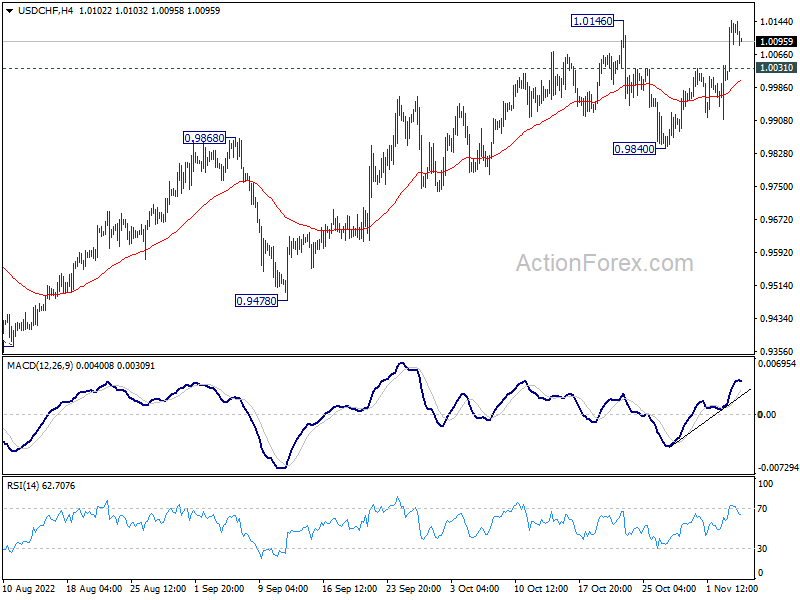
In the bigger picture, current development suggests that up trend from 0.8756 (2021 low) is still in progress. Next target is 100% projection of 0.9149 to 1.0063 from 0.9369 at 1.0283, and then 1.0342 (2016 high). For now, this will remain the favored case as long as 0.9779 support holds, even in case of deep pull back.
Economic Indicators Update
| GMT | Ccy | Events | Actual | Forecast | Previous | Revised |
|---|---|---|---|---|---|---|
| 21:30 | AUD | AiG Performance of Construction Index Oct | 43.3 | 46.5 | ||
| 07:00 | EUR | Germany Factory Orders M/M Sep | -0.60% | -2.40% | ||
| 07:45 | EUR | France Industrial Output M/M Sep | -1.00% | 2.40% | ||
| 08:45 | EUR | Italy Services PMI Oct | 48.5 | 48.8 | ||
| 08:50 | EUR | France Services PMI Oct F | 51.3 | 51.3 | ||
| 08:55 | EUR | Germany Services PMI Oct F | 44.9 | 44.9 | ||
| 09:00 | EUR | Eurozone Services PMI Oct F | 48.2 | 48.2 | ||
| 09:30 | GBP | Construction PMI Oct | 52.1 | 52.3 | ||
| 10:00 | EUR | Eurozone PPI M/M Sep | 1.70% | 5.00% | ||
| 10:00 | EUR | Eurozone PPI Y/Y Sep | 42.00% | 43.30% | ||
| 12:30 | USD | Nonfarm Payrolls Oct | 200K | 263K | ||
| 12:30 | USD | Unemployment Rate Oct | 3.60% | 3.50% | ||
| 12:30 | USD | Average Hourly Earnings M/M Oct | 0.30% | 0.30% | ||
| 12:30 | CAD | Net Change in Employment Oct | 11.0K | 21.1K | ||
| 12:30 | CAD | Unemployment Rate Oct | 5.30% | 5.20% | ||
| 14:00 | CAD | Ivey PMI Oct | 60.2 | 59.5 |
NFP in focus, USD/CAD forming head and shoulder top?
US non-farm payroll employment data is the major focus of the day. Markets are expecting the job market to grow 200k in October. Unemployment rate is expected to tick up from 3.5% to 3.6%.
Looking at related data, ADP report showed solid 239k growth in private employment. ISM manufacturing employment also improved from 48.7 to 50.0. However, ISM services employment dropped notably from 53.0 to contractionary reading of 49.1. Four-week moving average of initial jobless claims rose slightly from 207k to 219k. The set of data overall suggests that job market should remain tight.
As per market reaction, USD/CAD would be an interesting one to watch considering that Canada will also release job data. For now, near term outlook stays bullish for another rise through 1.3976 to resume larger up trend. However, break of 1.3494/3501 support will complete a head and should top pattern (ls: 1.3832; h:1.3976; rs: 1.3807). In the case, deeper correction would likely be seen back to 1.3207 resistance turned support, before USD/CAD find renewed buying.
RBA downgrades 2023, 2024 growth forecast, raised inflation
In the Statement on Monetary Policy, RBA noted that after a sequence of 50bps and 24bps rate hikes, "the Board recognised that interest rates had already been increased significantly in a short period of time".
"In an uncertain environment, slowing the adjustment of policy allows time to assess the effects of the increases to date and the evolving economic outlook," it added.
The Board expects that "interest rates will need to increase further", but "monetary policy is not on a pre-set path". The size and timing of future interest rate hikes will be determined by incoming data and assessment of the outlook of inflation and labor market.
In the new economic projections, year-average GDP growth forecast for:
- 2022 was left unchanged at 4%.
- 2023 was downgraded from 2.25% to 2.00%.
- 2024 was downgraded from 1.75% to 1.50%.
Year-end forecasts for headline CPI for:
- 2022 was revised up from 7.75% to 8.00%.
- 2023 was revised up from 4.25% to 4.75%.
- 2024 was revised up from 3.00% to 3.25%.
Year-end forecasts for trimmed mean CPI for:
- 2022 was revised up from 6.00% to 6.25%.
- 2023 was left unchanged at 3.75%.
- 2024 was revised up from 3.00% to 3.25%.
Year-end forecasts for unemployment rate for:
- 2022 was revised up from 3.25% to 3.50%.
- 2023 was revised up from 3.50% to 3.75%.
- 2024 was revised up from 4.00% to 4.25%.
USD/JPY Faces Hurdles Ahead of The US NFP Release
Key Highlights
- USD/JPY is facing resistance near 148.50 and 149.00.
- A major bearish trend line is forming with resistance near 148.40 on the 4-hours chart.
- EUR/USD and GBP/USD gained bearish momentum below 0.9850 and 1.1320 respectively.
- The US nonfarm payrolls could increase 200K in Oct 2022, down from 263K.
USD/JPY Technical Analysis
The US Dollar attempted a fresh increase from the 145.50 support zone against the Japanese Yen. USD/JPY climbed above 146.50, but it faced a lot of hurdles.
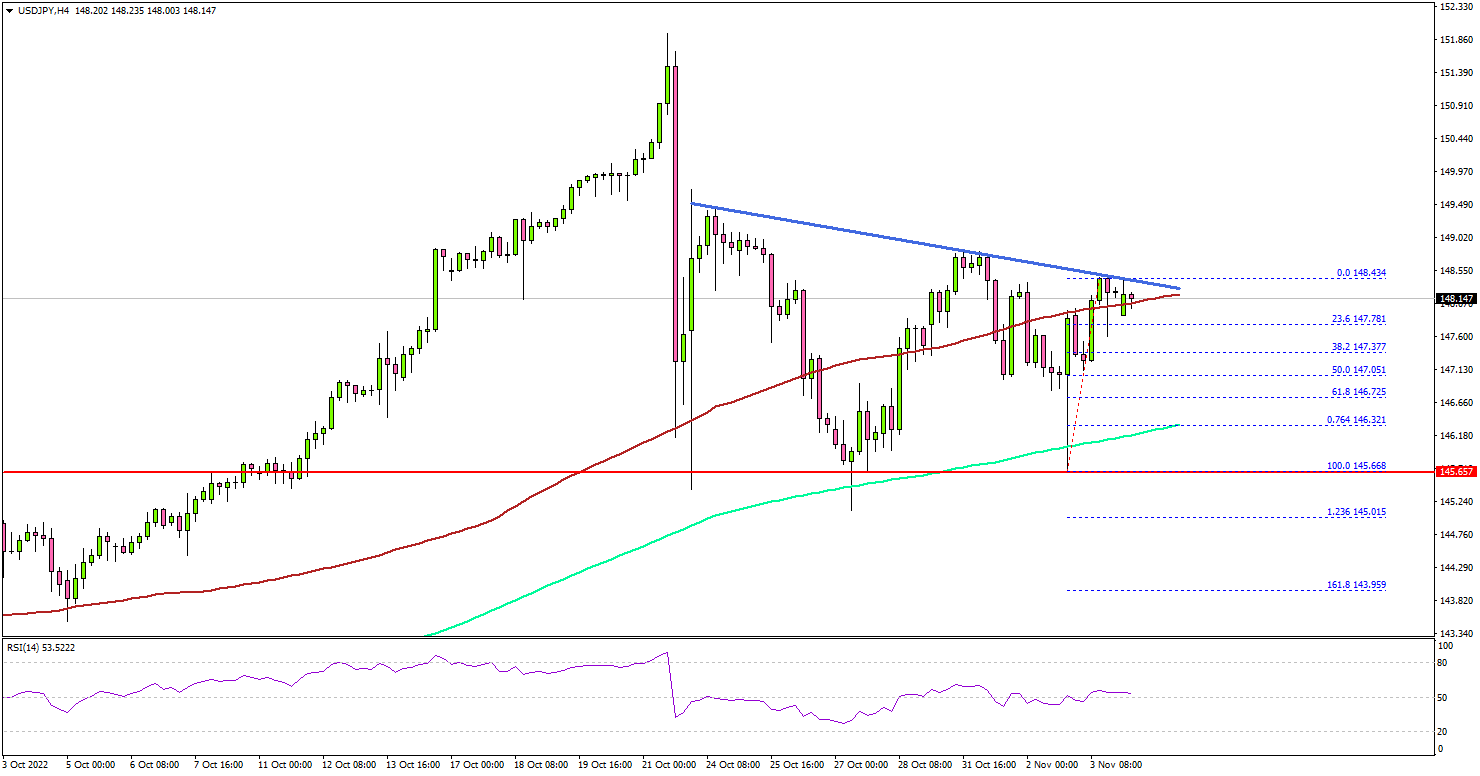
Looking at the 4-hours chart, the pair climbed above the 147.00 level, the 100 simple moving average (red, 4-hours) plus the 200 simple moving average (green, 4-hours).
However, the bears were active near the 148.50 zone. There is also a major bearish trend line forming with resistance near 148.40 on the same chart. A clear move above the trend line resistance could open the doors for more upsides.
The next major resistance may perhaps be near 149.50. Any more gains could set the pace for a move towards the 151.20 level, above which it could even test 152.00.
An initial support is near the 147.00 level. The next major support is near the 146.50 zone. The main support sits at 145.50 zone or the 200 simple moving average (green, 4-hours).
The stated 145.50 support acted as a strong barrier and prevented downsides on three occasions. Therefore, a close below the 145.50 level and the 200 simple moving average (green, 4-hours) could increase selling pressure. In the stated case, it could decline towards the 142.00 support.
Looking at EUR/USD, the pair gained bearish momentum below the 0.9850 support. Similarly, GBP/USD declined below the 1.1320 support.
Economic Releases
- US nonfarm payrolls for Oct 2022 – Forecast 200K, versus 263K previous.
- US Unemployment Rate for Oct 2022 - Forecast 3.6%, versus 3.5% previous.
- Canada’s employment Change payrolls for Oct 2022 – Forecast 10K, versus 21.1K previous.
- Canada’s Unemployment Rate for Oct 2022 - Forecast 5.3%, versus 5.2% previous.
Cliff Notes: Policy Makers’ Views on Risks Begin to Diverge
Key insights from the week that was.
The past week has seen a flurry of central bank communications as the RBA, FOMC and BoE all met to deliberate on policy. Evident In their decisions and commentary is a growing divergence in expectations around inflation and the risks to the policy outlook.
Despite the much stronger than expected Q3 CPI report, the RBA delivered only a 25bp hike at its November meeting. However, their revised forecasts for inflation in 2022 and 2023 (from 7.8% to 8.0% for 2022 and 4.3% to 4.75% for 2023) highlight the current strength of price pressures in Australia and their expected persistence. Consequently, we remain confident in our peak of 3.85%, with 25bp increases to be delivered in December, February, March and May.
Following the RBA’s decision, Chief Economist Bill Evans provided a detailed analysis of the outcome as well as the implications and risks. Note, as we go to press, the RBA’s latest Statement on Monetary Policy has also just been released, giving full detail on their own expectations regarding the outlook and risks.
This week’s Australian data flow meanwhile largely focused on housing. CoreLogic’s 8 capital city measure reported a 1.1% fall for October, leaving prices 6.6% below their peak level. The pace of price declines slowed in Sydney and Melbourne, but accelerated in Brisbane. Adelaide and Perth continue to show resilience, although prices are also beginning to slip there. Dwelling approvals meanwhile saw a material 5.8% decline in September following a number of upside surprises, with the weakness broad based. Ahead, further significant declines are expected, with affordability; the cost and availability of inputs; and general economic uncertainty all set to weigh on activity. This deterioration in new activity will feed through to GDP as well as the demand for housing credit. Note, at September, housing finance approvals were 26% below their peak of early 2022.
This week we also received an update on Australia’s trade position. September’s report was a positive surprise for exports which gained 7% on resilience in commodities and another strong showing for services. However, imports also faired better than expected. While the Q3 surplus of $30bn is another strong result, it is down from $44bn in Q2. Factoring in our expectations for price changes, this points to net exports’ contribution to GDP growth swinging from +1.0ppts in Q2 to -0.75ppts in Q3.
Before moving further afield, it is also worth highlighting that New Zealand’s labour market showed resounding strength this week, with the unemployment rate remaining near its record low in Q3 as employment grew rapidly. Wages also showed strong momentum, the labour cost index gaining 1.1% in Q3 to be 3.7% higher over the year. These results argue for an outsized 75bp increase in the cash rate at the RBNZ’s November review, in line with Westpac’s existing expectation. A peak of 5.0% is seen for the cash rate in 2023.
Turning to the UK. After a few tumultuous weeks in politics and markets, the Bank of England delivered a 75bp rate hike in November, raising the bank rate to 3.0%. While this represents strong progress towards tackling inflation, the Committee’s rhetoric and projections surrounding the economic and policy outlook has clearly shifted into more ‘dovish’ territory. Indeed, based on the market-implied path for the bank rate, the UK economy is expected to remain in a deep and prolonged recession through to H1 2024, coinciding with still elevated consumer inflation and a material weakening in the labour market, with the unemployment rate expected to almost reach 6%.
Reflecting on this, Governor Bailey emphasised in the press conference that market pricing has gone too far. A subsequent scenario analysis involving fixed policy at the current rate of 3.0%, albeit still bleak, produced a shallower recession and an inflation rate closer to the 2% target. On balance, inflation is still far too high and interest rates must rise further, but a slowing in the pace of rate hikes is very likely. Hence, we expect only 100bps of tightening remains in the cycle, bringing the bank rate to a peak of 4.0% by March 2023.
Finally then to the US. Already fully priced, the FOMC’s decision to raise by 75bps in November was looked through, with participants instead focused on the detail and tone of the Committee’s guidance. The take home point from the statement and press conference is that, while the FOMC is close to throttling back on the pace of rate hikes (our baseline expectation is for a 50bp hike in December and 25bps in January), with inflation risks still skewed upward, the FOMC believe they have more work to do before the hiking cycle concludes.
While we believe inflation will continue to decelerate through 2023, there is a question as to how patient the FOMC is willing to be in assessing the cumulative economic effect of policy tightening. Also critical will be how market participants price expectations for growth and inflation into nominal and real yields.
Clear from Chair Powell’s remarks is that the Committee is intent on maintaining tight financial conditions until the risks around inflation subside. This requires real yields to remain materially above zero. Implicit here is that, if real yields decline in the months ahead, the FOMC may look to continue tightening towards mid-2023 beyond our current peak of 4.625% at January/February 2023. Rate cuts are expected to remain off the FOMC’s agenda until 2024.
The risk for the US is clearly that this tight stance of policy leads to recession and/or a prolonged period of sub-trend growth, even after rates begin to decline in 2024. Our growth forecasts and expectations are laid out for the US and the world in our just released November Market Outlook on Westpac IQ.
RBA’s SoMP Lowers Growth Outlook, But Inflation Forecasts are Troubling
The Reserve Bank has released its November Statement on Monetary Policy (SoMP).
The highlight of these Statements is the Bank's revised forecasts for growth, unemployment and inflation.
These forecasts are based on a path for the cash rate broadly in line with expectations derived from surveys of professional economists and financial market pricing (most likely a straight arithmetic average). Exchange rates and oil prices are also assumed to be unchanged through the forecast period.
This approach to cash rate assumptions can lead to some tensions. The forecasts are based on what the market and analysts expect for the policy instrument rather than what the Bank expects it needs to do. The risk with such an approach is that the Bank's forecasts are consistent with market pricing but may not be consistent with the Bank's own objectives. There is some evidence of this conundrum in the revised inflation outlook.
Forecasts are provided out to December 2024.
Due to the surprise lift in inflation in the September quarter inflation report, the Bank has raised its forecast for headline inflation in 2022 from 7.8% in the August SoMP to 8%. The forecast for inflation in 2023 has been lifted from 4.3% to 4.7% while 2024 has been lifted from 3% to 3.2%.
That means that the Bank is now forecasting inflation in 2023 to be much nearer 5% than the 4% we saw in August while it is clearly making the statement that it expects inflation will remain outside the 2-3% target range for three years. It is very rare for the RBA's 'out year' inflation forecast to be above its target range – the only other instances being when major tax changes were set to boost the CPI (the carbon tax in 2011 and the GST in 2000).
Psychologically, a 'near 5%' forecast rise for 2023 may lift expectations for both business and households, particularly with wage negotiations that are currently taking place. Negotiations may also be influenced by further progress in the proposed changes, which the government is now close to legislating, that would allow for industry-wide bargaining.
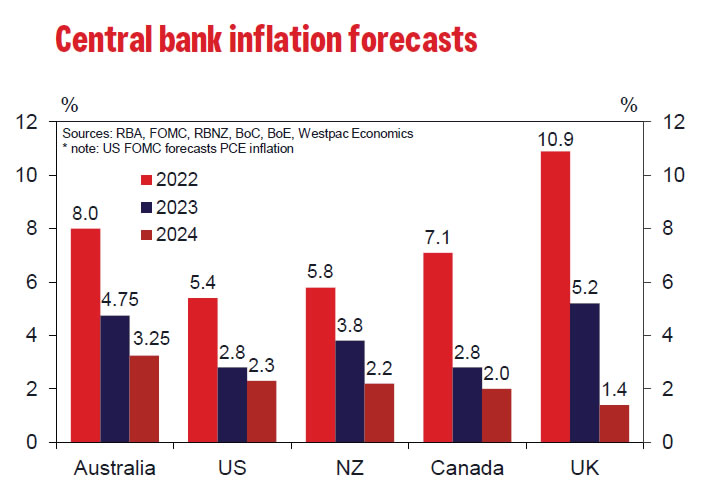
It is worth comparing the RBA's forecasts with those of its central bank peers. The 4.7% for 2023 is well above the RBA's 2-3% target. And while central banks in other developed economies are also expecting to miss their targets in 2023, they are plotting a clearer return to target in 2024.
The figure above shows the most recent inflation forecasts from other central banks in developed economies (noting that the RBNZ is likely to lift its forecast for 2022 and 2023 by around 0.2ppts when it updates its forecasts later this month due to a sharper than expected increase in September quarter inflation rise).
The figure clearly demonstrates that – at least in eyes of central banks – Australia's inflation picture is not more benign than in other developed economies. Inflation is also still rising in Australia (up from 7.3% in the September quarter), whereas most other developed economies are forecasting lower inflation by end 2022.
Other central banks are taking a more aggressive approach to rate rises. Markets and central bank guidance indicate that even for economies like Canada, New Zealand and the UK, which have higher household debt exposures to short term interest rates, the terminal policy rate is likely to settle at least 1ppt above the RBA's likely terminal rate.
The inflation forecasts for 2024 are particularly interesting: Canada (2.0%); New Zealand (2.2%); the UK (1.4%); and the US (2.3%).
These central banks are forecasting a much more emphatic return to target in 2024 than the RBA's forecast.
The more cautious approach from the RBA raises the prospect of a further entrenching a 'high inflation' psychology as businesses and households may doubt the RBA's commitment to returning inflation to the target zone. The Governor's statement that the Bank is aiming to return inflation to the target band "while keeping the economy on an even keel" contrasts with other central banks who accept the economic slowdown as the cost of containing inflation.
The Bank's growth forecasts are more in line with the likely economic cost of containing inflation.
The forecast growth rates have been lowered from the August numbers, particularly for 2023. Growth is forecast at 2.9% in 2022 (down from 3.2% in August); 1.4% in 2023 (down from 1.8%); and 1.6% in 2024 (down from 1.7%).
The major source of the downward revisions is household spending which was revised down from 2.4% growth in 2023 to 1.3% – in line with our forecast of 1.2% growth.
These overall growth numbers are getting closer to Westpac's forecasts in the out years (1.0% in 2023 and 2.0% in 2024). Our faster growth rate in 2024 relies on the RBA being in a position to cut rates by 100bps in 2024. If the RBA's inflation forecasts prove to be correct, it will be difficult to justify rate cuts as inflation will still be outside the target zone and the unemployment rate steady.
We expect the RBA will need to lift the cash rate to 3.85% in 2023 in the face of strong inflation with the last cut likely during the first half of the year (May).
Despite lower growth, the forecasts maintain that the unemployment rate will only rise from 3.5% (revised up from 3.4%) to 4.3% by end 2024 (lifted from the August forecasts of 4.0%). With slower growth in 2023 we expect that the unemployment rate will lift to 5.2% by end 2024.
Forecast wages growth in 2023 has been lifted from 3.6% to 3.9%, still benign but more in line with our own forecast of 4.5% reflecting the tight labour markets which are likely to persist through 2023.
The Overview section of the Statement does not provide any further insights into the decision process at the November Board meeting. It reiterates the points: that interest rates had already been increased significantly in a short period of time; that the effect is yet to be seen; that slowing the pace of tightening would allow more time to assess; that drawing out policy adjustments also helps to keep public attention focused for a longer period on the Board's resolve; and that the more frequent meeting schedule allows for smaller incremental changes. Going forward, all options are options on the table including moving in larger steps if necessary or even pausing for a period – the emphasis clearly being that policy is not on a pre-set path.
Conclusion
The revised forecasts in the Statement on Monetary Policy highlight the RBA Board's current expectation that it will not return inflation to the target zone until 2025 at the earliest. This contrasts with the more aggressive approaches of other central banks. The risk is that a 'high inflation' psychology emerges and is allowed to be sustained for longer, potentially making the challenge of bringing inflation back to target more difficult than necessary.
We agree with the downward revisions in the growth outlook for 2023, particularly with respect to household spending, but we expect the unemployment rate to increase further than indicated in the RBA's forecasts.
We remain comfortable with our call that the cash rate will increase to 3.85% by May next year, relying on steady 25bp moves.
The rate cuts we expect for 2024 are consistent with the very weak growth outlook for 2023 and 2024, which the Bank is close to franking, but the Bank's inflation forecasts would make it very difficult to deliver given inflation would be expected to hold outside the target zone.
Elliott Wave View: Dollar Index (DXY) Has Resumed Higher
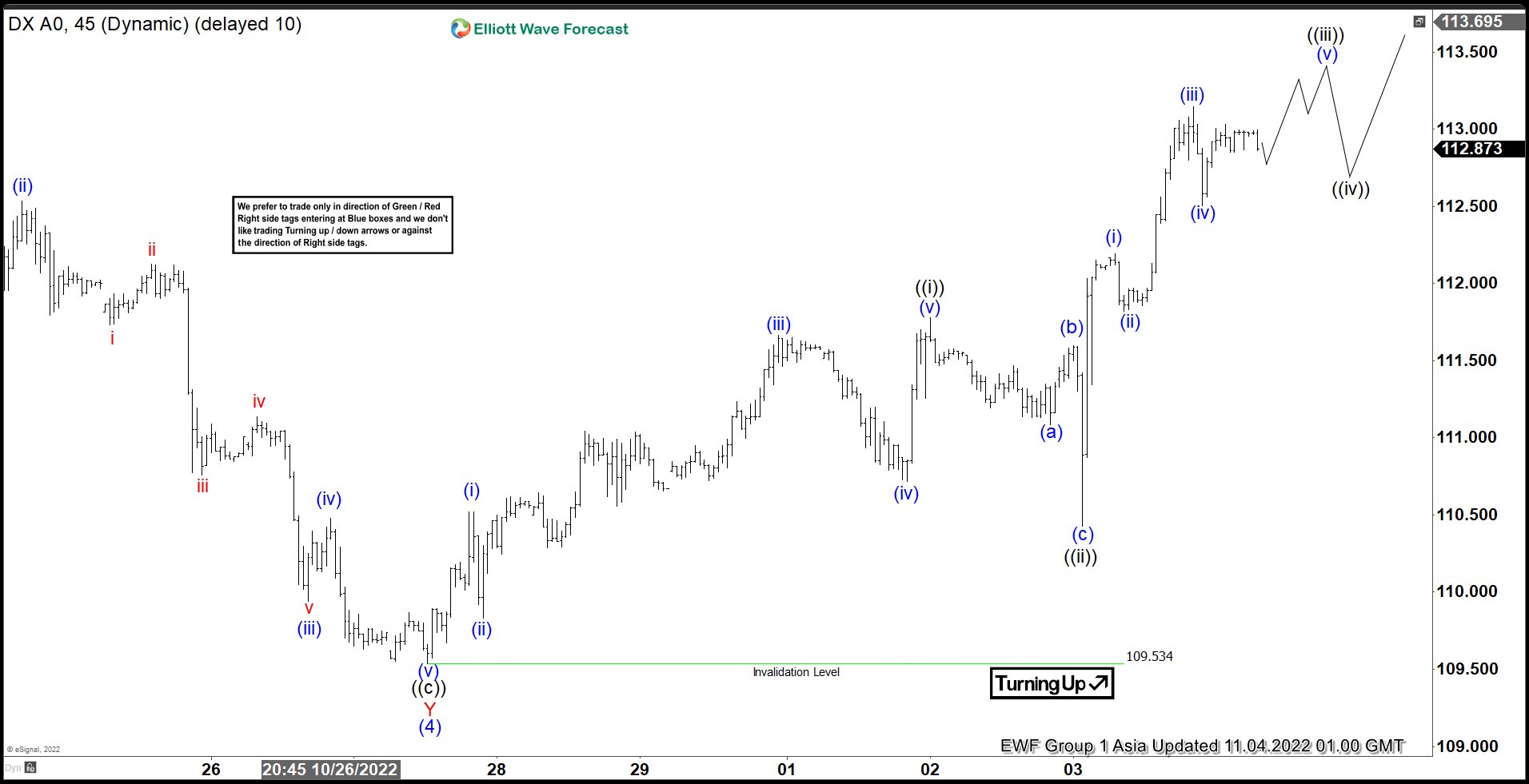
Short term Elliott Wave view suggests correction from 9.28.2022 high ended at 109.53 as wave (4). Internal subdivision of wave (4) unfolded as a double three Elliott Wave structure. Down from 9.28.2022 high, wave W ended at 110.055 and wave X ended at 113.942. Index then resumes lower in wave Y to 109.53 and this completed wave (4) in higher degree. Dollar Index has turned higher in wave (5) but it still needs to break above previous peak on 9.28.2022 at 114.78 to rule out a double correction.
Up from wave (4), wave ((i)) ended at 111.78 and pullback in wave ((ii)) ended at 110.42. Index then resumes higher again and wave ((iii)) should end soon after a few more highs. Afterwards, it should pullback in wave ((iv)) to correct cycle from 11.3.2022 low before the rally resumes in wave ((v)). After wave ((v)) ends, the Index should complete wave 1 of (5). It should then pullback in wave 2 to correct cycle from 10.27.2022 low in larger degree 3, 7, or 11 swing before the rally resumes again. Near term, as far as pivot at 109.53 low stays intact, expect dips to find support in 3, 7, or 11 swing for further upside. Potential target for wave (5) higher is 123.6 inverse retracement of wave (4) at 114.78.
DXY 45 Minutes Elliott Wave Chart
Bank of England Review: A One-off 75bp Hike
Bank of England Review: A One-off 75bp Hike
-
- In line with our expectation, the BoE today hiked policy rates by 75bp, bringing the Bank Rate to 3.00%.
- We expect fiscal tightening and recession to weigh on the economy, which in our view, supports a slower hiking pace going forward.
- We maintain our call for a 50bp hike in December and 25bp in February with risks to our call skewed towards additional hikes in 2023.
In line with our expectation, the Bank of England (BoE) hiked the Bank Rate by 75bp to 3.00% with 7 members voting for a 75bp hike, one member voting for 50bp and one member voting for 25bp. As expected, there was no news in regards to QT-communication as outright selling of government bonds commenced on 1 November.
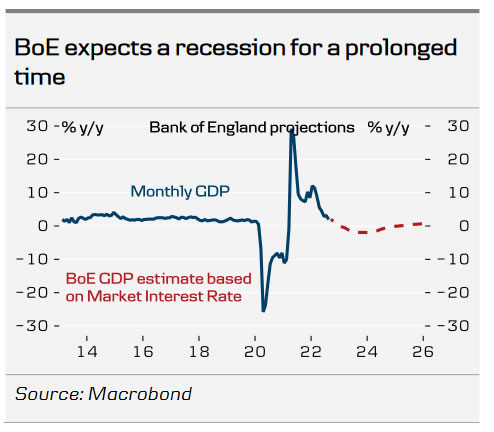
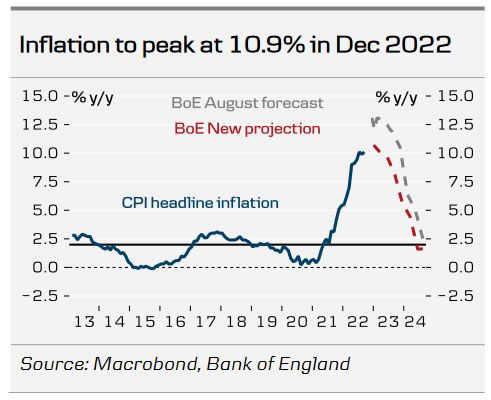
Inflation forecasts were revised downwards across the line since the August meeting, as the Government's Energy Price Guarantee is set to lower and bring forward the expected peak of CPI inflation. The Bank now expects inflation to peak around 11% in Q4 2022 as "CPI inflation remains elevated at over 10% in the near term." On growth, the MPC's latest projections describe a very challenging outlook for the UK economy, where it now expects the UK "to be in a recession for a prolonged period." This supports our expectation of the Bank returning to a slower hiking pace as tighter financial conditions and the recession tear on the economy leaving a worsening growth outlook ahead. We thus keep the rest of our forecast unchanged, expecting a 50bp hike in December followed by a final 25bp hike in February 2023.
In terms of fiscal policy, we see an increased focus on closing the fiscal gap with the new government led by PM Rishi Sunak. We thus see fiscal policy as being less inflationary as expected under former PM Liz Truss. In turn, this could result in inflation becoming less persistent, which in our view makes a less aggressive rate path more likely. We receive further details in the governments Autumn Statement on 17 November.
Rates: Longer gilts ticked slightly higher on the announcement while the peak rate was pushed 10bp lower to 4.65% in June next year. Investors' took note of Governor Bailey comments that rates are to increase less than markets are currently pricing in noting that "best guess is closer to constant rate curve (3.0%) than market (5.25%)". Our base case remains that of a peak in the Bank Rate of 3.75%.
FX. EUR/GBP initially moved higher upon announcement to 0.8700 from 0.8650 and continued its move higher to 0.8730 during the press conference, as expected. We see a case for EUR/GBP to remain elevated in the near-term, but in the longer-term expect the cross to move lower as a global growth slowdown and the relative appeal of UK assets to investors are a positive for GBP relative to EUR.
Our call. We still expect BoE to deliver more rates hikes. We pencil in another 50bp rate hike in December and finally a 25bp hike in February. Our expectations fall below current market pricing (currently 245bps until June 2023) as we expect BoE to eventually turn less hawkish amid a weakening growth backdrop.
Sunset Market Commentary
Markets
After the Fed, the spotlights redirected to the Bank of England. The central bank voted in a 7-2 decision to raise rates by 75 bps to 3%. The two defectors voted either for a 50 bps or 25 bps move. Its new forecasts are not yet calibrated to the formal medium-term fiscal statement (due Nov 17) but do take into account all government announcements up to and including October 17, amongst others the shortened period of the Energy Price Guarantee (EPG) to six months. The projections are conditioned on market expectations (through Oct 25) that see the policy rate go to 5.25% next year. If that were to happen, the UK economy would be in a recession for almost two years, the unemployment rate would surge to 6.5% and CPI, after peaking at 11% in Q4 this year (lower than projected in August thanks to the EPG), would drop to 1.5% in 2024 and 0% the year thereafter. In the alternative scenario of policy rates steadying at the current 3% rate, economic activity would be stronger but would still be falling at the end of 2023. CPI inflation is then projected to be a little above the target at the end of 2024 before falling more than a percentage point below the target in 2025. In the latter scenario, some more tightening is necessary while the former shows the BoE thinks markets were getting ahead of themselves. In unusually explicit wording, the policy statement says that further increases in Bank Rate may be required for a sustainable return of inflation to target, albeit to a peak lower than priced into financial markets. Governor Bailey repeated that later during the press conference, citing even “current” market pricing of 4.75%. UK money markets don’t buy Bailey’s guidance though and stick to a terminal rate between 4.5-4.75%. UK yields drop 3.5 bps at the front. The 10y yield rises 6.7 bps and the 30y even jumped >20 bps before cutting gains in half currently. Sterling loses out. The timing of the BoE’s dovish hike of course unfortunate, one day after uberhawk Powell. Dire growth prospects obviously don’t help sterling either. EUR/GBP advances from 0.86 to a test of the 0.872 resistance level. Cable (GBP/USD) drops from 1.1422 to 1.118.
Moves on other markets are still inspired by Powell. European stocks lose a percent while bourses in the US fall up to 1.2% (Nasdaq). Core bond yields add several more bps with Germany slightly underperforming the US. German yield changes vary between +7 bps (2y) to +9.1 bps (10y). Europe’s 2y swap yield is back at testing the 3% barrier. US yields add another 7.5 bps at the front (2y new cycle high) with more modest gains further out (1.9/4.8 bps 30y/10y). King dollar is unleashed. EUR/USD (0.977) risks losing its recently created upward trend channel already. The trade-weighted DXY steams higher to 112.9. The Japanese yen is surprisingly resilient.
In more central bank news today, the Czech National Bank kept rates steady at 7%. The move was expected. The CNB also decided that it will continue to prevent excessive fluctuations of the koruna exchange rate. This seemed to have squeezed out some who thought otherwise with EUR/CZK abruptly easing to 24.46 shortly after the announcement. A press conference is due later today. The Norges Bank lifted rates by a smaller-than-expected 25 bps move today. The policy rate now stands at 2.5%. In a very short policy statement, the NB pitted higher-than-expected inflation (6.9% in September) and a tight labour market against some areas in the economy cooling down and easing energy prices that may curb inflation ahead. Further tightening in December is likely though policy rate setting will be more gradual. The Norwegian krone loses in a kneejerk reaction. EUR/NOK headed to 10.33
News Headlines
Turkish inflation shows no signs of abating whatsoever. Prices went up by 3.54% m/m in October – another acceleration from the 3.08% the month before. Inflation soared from 83.45% to 85.51% y/y. Core inflation (ex food and energy) also accelerated from 68.09% to 70.45%. Of the main categories, transportation costs rose the most (117.2% y/y), followed by food and non-alcoholic beverages (99.1%). The October CPI reading is seen as the peak because of base effects kicking from this month on. With the central bank’s unorthodox policy – cutting rates despite skyrocketing inflation – real yields will remain deeply negative for a considerable amount of time still. The CBRT is expected to lower the policy rate (now 10.5%) one more time at the next meeting, to bring it into single-digit territory. The Turkish lira marginally strengthened following the release, which was slightly below analyst estimates overall. EUR/TRY is trading around 18.19.