Sample Category Title
Can Nonfarm Payrolls Add Momentum to the US Dollar?
With the Fed meeting out of the way, investors will turn to the latest US employment report that is out at 12:30 GMT Friday. Economists expect another solid nonfarm payrolls print, although there is some scope for disappointment according to business surveys. As for the dollar, while the outlook remains positive, we seem to be entering the ‘final act’ of this stunning rally.
Fed vs economy
Despite a series of rapid-fire Fed rate increases this year, the US economy has not absorbed any serious damage yet. Many companies are struggling to access capital and demand is clearly losing steam as consumers get squeezed by the cost-of-living crisis, yet there have been no signs of mass bankruptcies or worker layoffs.
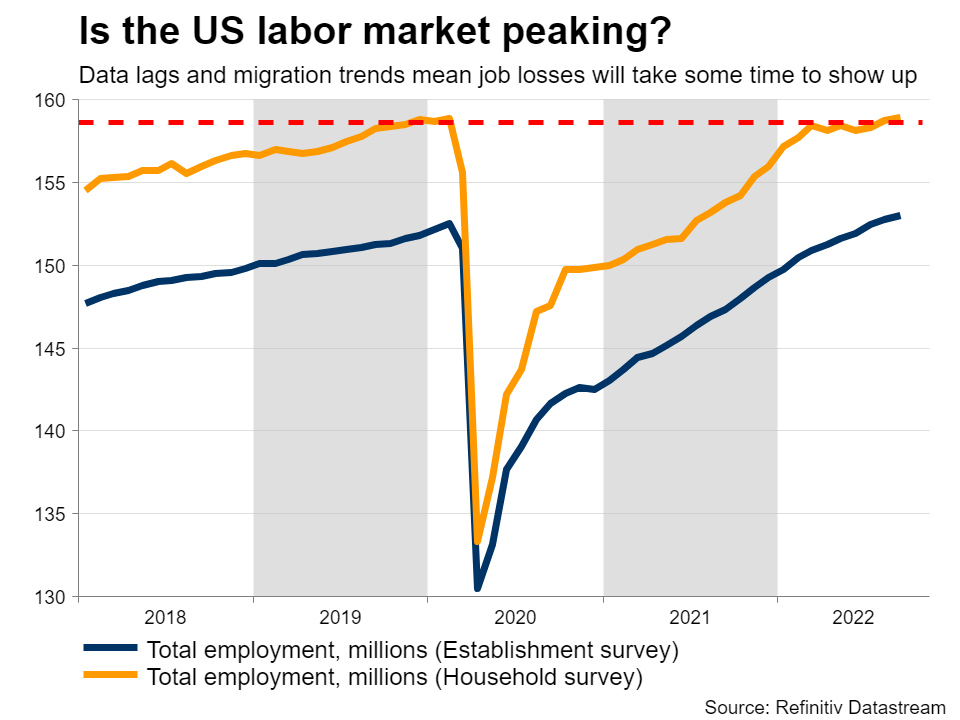
In the jobs market, this resilience is a story of policy lags and demographics. Historically, it takes several months before higher borrowing costs translate into job losses - employment is a lagging indicator. In this cycle, the lag has been exacerbated by migration trends. Net migration essentially came to a halt after the pandemic, so the US has experienced a huge shortage of workers that’s made businesses reluctant to fire staff.
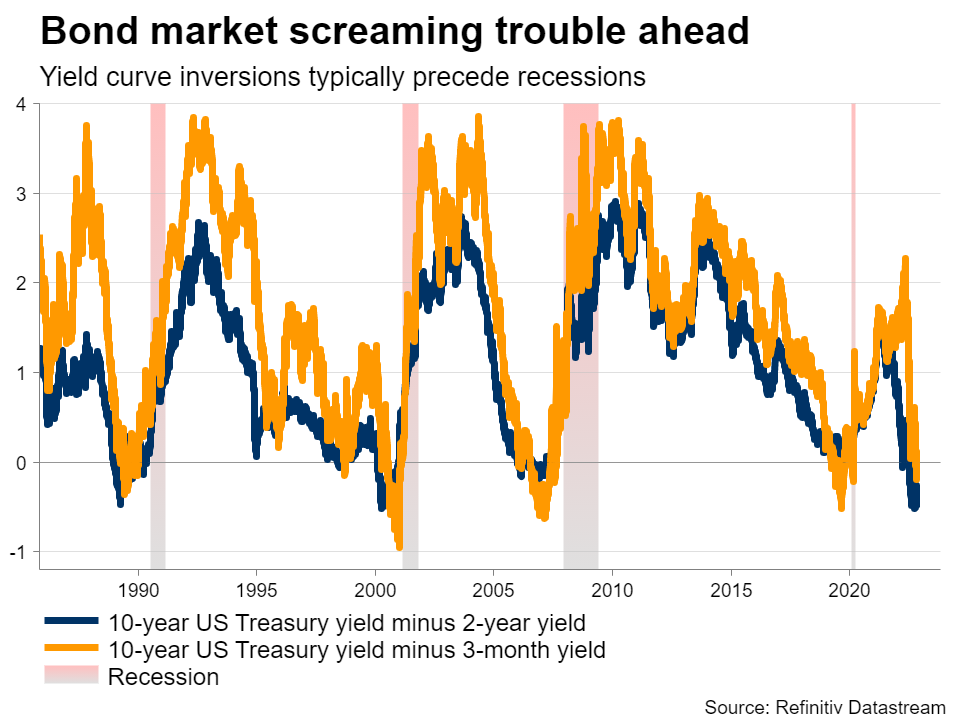
Nonetheless, every leading indicator is warning of trouble ahead. Business surveys, inventory levels, consumer confidence metrics, and the inverted yield curve are all saying that a recession is imminent. The question is, when will all this be reflected in inflation and employment data? Those are the two areas where the Fed needs to see improvement before it backs off.
Markets are currently pricing in a peak rate of just above 5% after Chairman Powell stressed that he won’t reverse course at the first sign of trouble. He was adamant the Fed prefers a short period of economic pain, rather than several years of high inflation or stagflation.
Simmering down
Turning to the upcoming dataset, economists expect another decent report, with nonfarm payrolls set to clock in at 200k in October. While the unemployment rate is anticipated to tick up to 3.6%, this is still an extremely low number consistent with full employment. Wage growth is projected to lose some steam in yearly terms.
As for any surprises, the risks seem tilted towards a slight disappointment considering the signals from business surveys. Specifically, the S&P Global composite PMI revealed the first contraction in employment in two years, as companies started to play defense with workforce numbers.
That said, the ADP jobs print was solid at 239k, so the labor market is not falling apart either. It might take a few more months before any real weakness shows up.
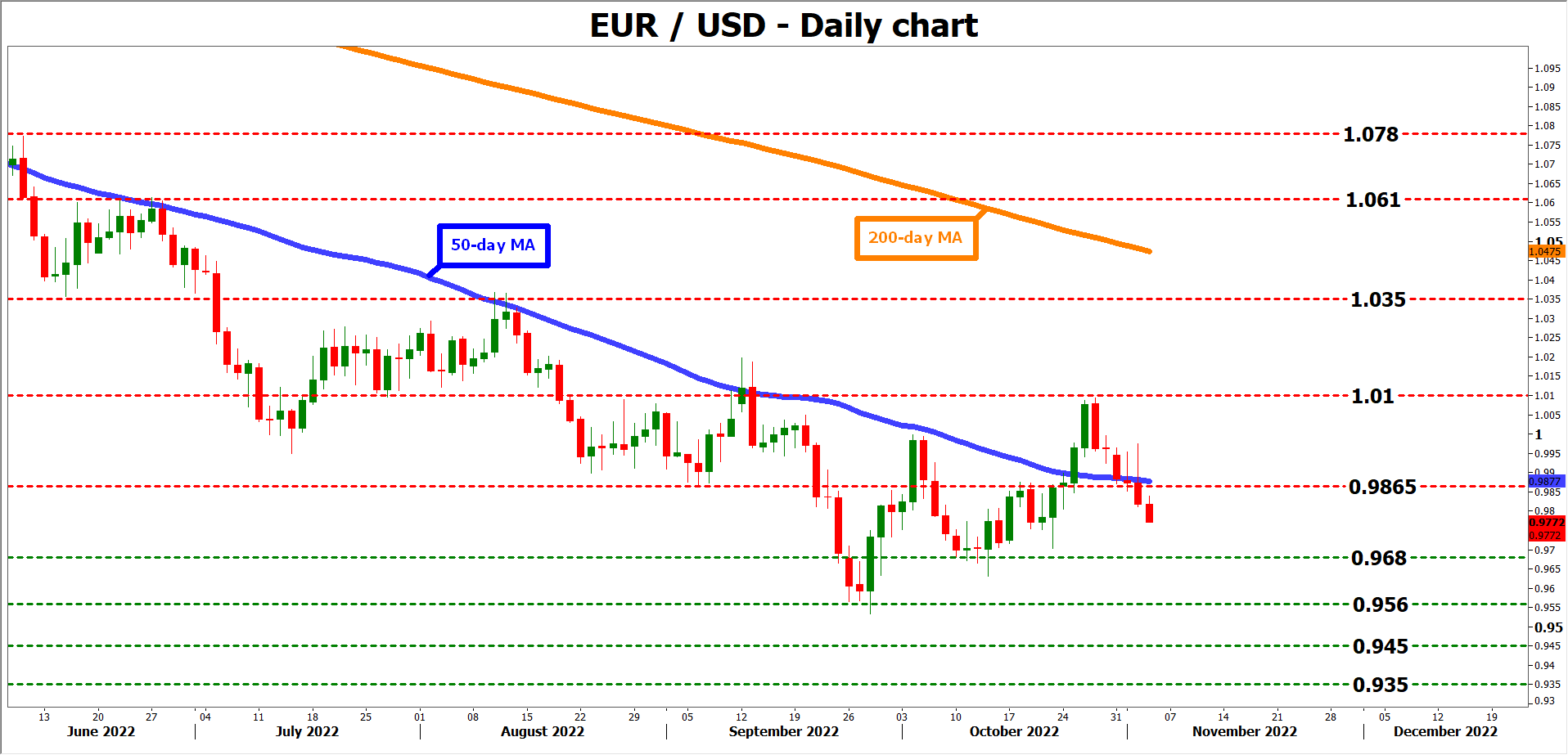
In the markets, a relatively soft report could spark a round of profit-taking in the dollar. In this case, euro/dollar might edge higher towards the 0.9865 zone, which overlaps with the 50-day moving average.
On the flipside, another surprisingly strong dataset might add fuel to the latest move, pushing euro/dollar down for another test of the 0.9680 region.
Big picture
Overall, the outlook for the dollar remains positive, but we might be entering the final phase of this ferocious rally. The Fed has opened the door for smaller rate increases moving forward, ‘long dollar’ is already a very crowded trade, and the fundamentals of other major currencies have started to improve.
In Europe, the dramatic decline in energy prices means the winter might not be Armageddon after all, and any recession might be mild. In the UK, stability has returned with the entrance of the new government, while the Bank of Japan just signaled it might start normalizing policy.
The dollar could still hit new highs, especially in case a global recession hits, but the scope for further gains seems relatively limited. In other words, although the fundamentals still favor a stronger greenback, the risk-to-reward profile of chasing further gains from here is not attractive.
US Oct NFP To Give Fed Plenty of Room To Hike
The US labor market has taken a bit of a back seat as the Fed focuses everything on getting inflation down. But, that might be about to change. There are some signs that traders need to be aware of for when the Fed might suddenly return to worrying about its second mandate. This is particularly relevant in the context where there is increasing speculation around when the Fed will start slowing its rate hikes.
As inflation was rising, the concern was that a price-wage spiral would develop. But for over a year now, wages have not even kept up with inflation, let alone pushing it forward. As higher interest rates bite, and more and more companies report that they will slow hiring, the next concern is when will the labor market flip. That is, more people seeking work than there are jobs for them.
Looking into the details
The latest BLS survey shows that there were 10.7M job openings in September. But there were only 6.1M seeking work. Despite there being over 4.6M jobs than there are jobseekers, there still hasn't been a major increase in average wages. But, over the last couple of months, that gap has started to close. The ratio, on the other hand, has not, with the number of jobseekers to offers matching multi-decade lows. This reflects a trend where the number of job offers has been falling, and so has the number of people looking for work.
One of the assumptions over the last few months has been that as inflation rises, more people would be prompted to seek work. But the participation rate has remained stubbornly just above 62%, and is forecast to remain there in the latest data release. As long as the number of job openings remains above the number of unemployed, and the participation rate remains low, the jobs market is likely to remain off the Fed's radar.
What to look out for
Before the pandemic started, an NFP number of around 200K job adds was considered normal, and would be expected to keep the Fed happy. This time around, NFP are forecast to come in at 200K, down from 288K as last reported. The unemployment rate is expected to tick up to 3.6% from 3.5%, which could give some people deja vu from 2019.
But a deeper dive into the figures shows some worrying signs. The ADP jobs survey was released yesterday, and is still not considered predictive of NFP despite the new methodology. However, it does prove some interesting understanding of the jobs market, and what we might see in some of this month's NFP components.
The bottom line
ADP showed that the bulk of job creation was in the leisure and hospitality sectors, which is to be expected in the middle of summer. However, those jobs tend to be lower paid, and that likely contributes to the expected slowing growth in average hourly wages. That was also reflected in BLS data, showing that job openings increased in accommodation and food services, but declined in manufacturing.
In other words, the jobs market continues to be tight in the areas of lower skilled, lower pay. But people who wish to switch to higher paying jobs are starting to struggle. That doesn't mean the labor market is loose, but it could be soon.
Bank of England Delivers Jumbo Hike, Hints at Smaller Moves Ahead
Summary
- The Bank of England (BoE) raised its policy rate aggressively at today monetary policy announcement, raising its Bank rate by 75 basis points to 3.00%.
- However, there were also signals from the BoE that the pace of tightening will likely slow going forward. First, while all policymakers voted to raise interest rates, the size of the rate hike was not unanimous. The Bank of England also said policy interest rates could peak at a lower level than was priced into financial markets as of late October (albeit at the time that peak rate was expected to be around 5.25%).
- The central bank's updated economic projections offer a clear indication as to why interest rates could rise at a less rapid pace than previously. The central scenario based off market interest rates sees a protracted recession and inflation undershooting its target over the medium term. Even in a scenario where interest rates hold steady at 3.00%, CPI inflation is forecasted to be only slightly above target in two years time.
- With the prospect of further fiscal consolidation also potentially weighing on the growth outlook, we now forecast slightly less tightening from the Bank of England than previously. We expect a 50 basis point rate increase in December and a final 25 basis point increase in February next year. That would see the policy rate peak at 3.75%.
- The combination of a protracted economic recession and a central bank that under delivers versus the market's rate hike expectations are key factors behind our view of renewed sterling weakness into early 2023, with a targeted GBP/USD exchange rate of $1.0600 by the end of the first quarter next year.
Bank of England Delivers Jumbo Hike, Hints at Smaller Moves Ahead
The Bank of England (BoE) raised its policy rate aggressively at today's monetary policy announcement, raising its Bank Rate by 75 basis points to 3.00%. The increase matched the consensus forecast. However, there were also signals from the BoE that the pace of tightening will likely slow going forward. First, while all policymakers voted to raise interest rates, the size of the rate hike was not unanimous. Seven policymakers voted for the 75 basis point increase, while one voted for 50 basis points and one voted for 25 basis points. Second, the BoE offered updated economic projections conditioned on the market's interest rate expectations as of late October, which at the time saw a peak policy rate of around 5.25% by Q3-2023. In addition to raising interest rates and specifically referring to that 5.25% peak rate, the BoE said:
“Should the economy evolve broadly in line with the latest Monetary Policy Report projections, further increases in Bank Rate may be required for a sustainable return of inflation to target, albeit to a peak lower than priced into financial markets.”
The central bank's updated economic projections do not make pleasant reading, and offer a clear indication as to why the BoE believes interest rates could rise at a less rapid pace than previously. Higher mortgage rates and tighter financial conditions are expected to weigh on economic activity. And even though the energy price cap means inflation should peak at a lower rate than previously, elevated inflation is still expected to weigh on incomes and growth for an extended period. Against this backdrop, the BoE's central projections anticipate U.K. GDP declining for eight consecutive quarters, with a peak-to-trough decline of almost 3%. The BoE forecasts full-year 2023 GDP growth at -1.6%, and full year 2024 GDP growth at -0.9%. With respect to inflation, the BoE sees CPI inflation peaking at 10.9% year-over-year in Q4-2022, before slowing to 5.2% by Q4-2023 and 1.4% by Q4-2024.
The BoE's alternative economic projections, based on a constant policy rate of 3.00%, are also quite illuminating. Under that scenario, U.K. GDP is forecast to fall by a smaller 0.9% in 2023 and 0.2% in 2024. Meanwhile, CPI inflation is forecast to slow to 5.6% in Q4-2023 and 2.2% in Q4-2024. With inflation only slightly above target in 2024, even under an assumption of constant interest rates, it's possible interest rates may not need to rise too much further from current levels.
Softening Household Finances and Tightening Fiscal Policy to Weigh on the Economy
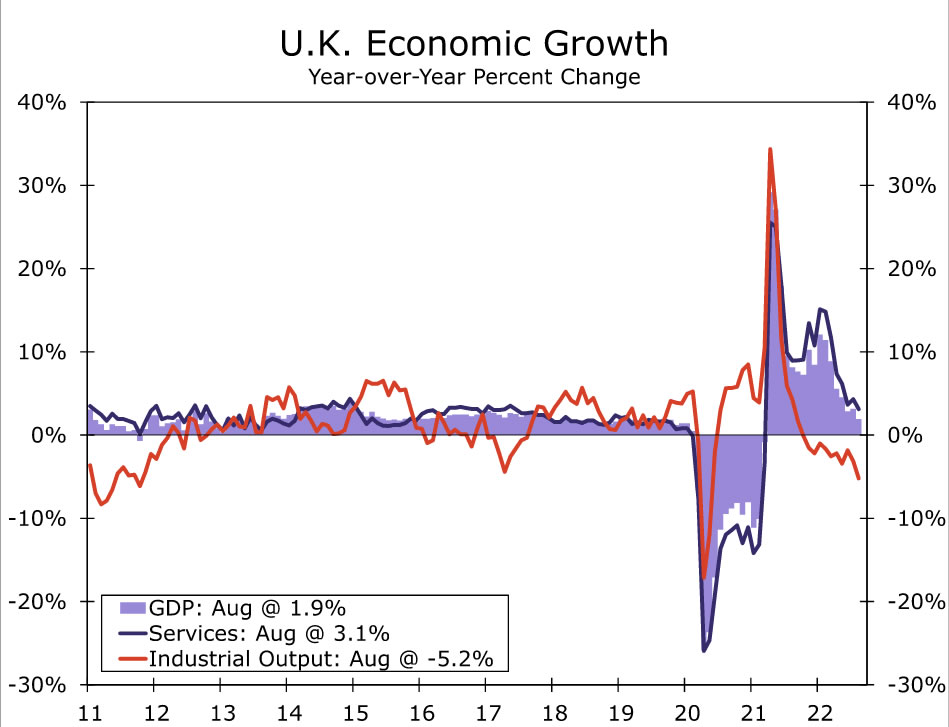
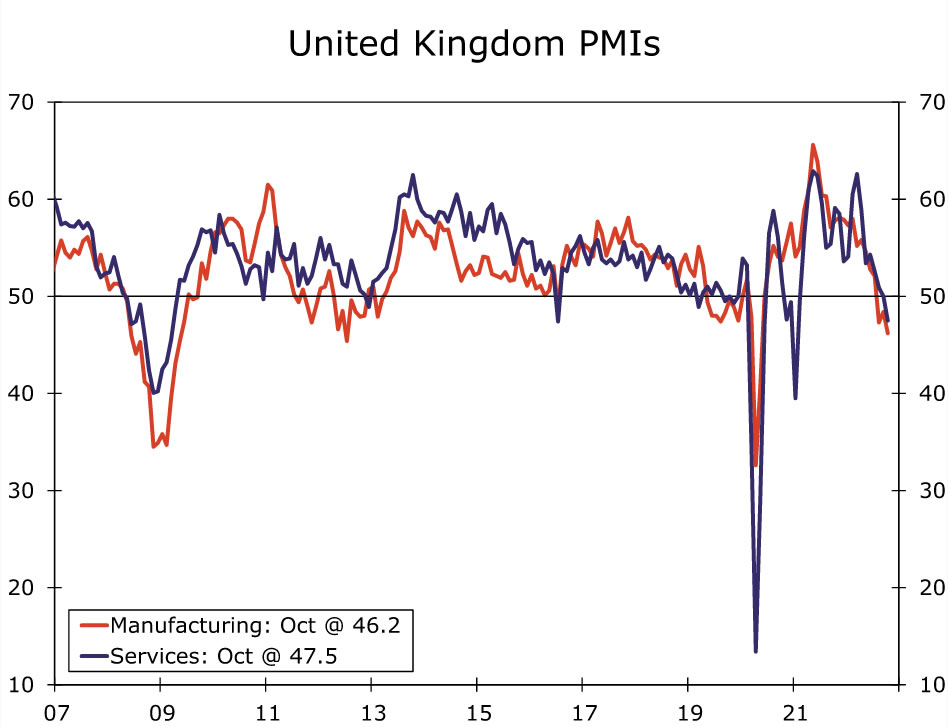
Recent indicators are consistent with the central bank's underwhelming growth outlook. The economy has already shown a clear loss of momentum during the third quarter, as a small 0.1% month-over-month increase in July GDP was more than offset by a 0.3% decline in August GDP. While the August weakness was concentrated in manufacturing, with industrial output down 1.8%, services activity also dipped by 0.1%. In addition, the economy appears to have continued softening into the fourth quarter. The October services PMI fell sharply to 47.5, the first sub-50 reading since February 2021, while the manufacturing PMI also declined to 46.2.
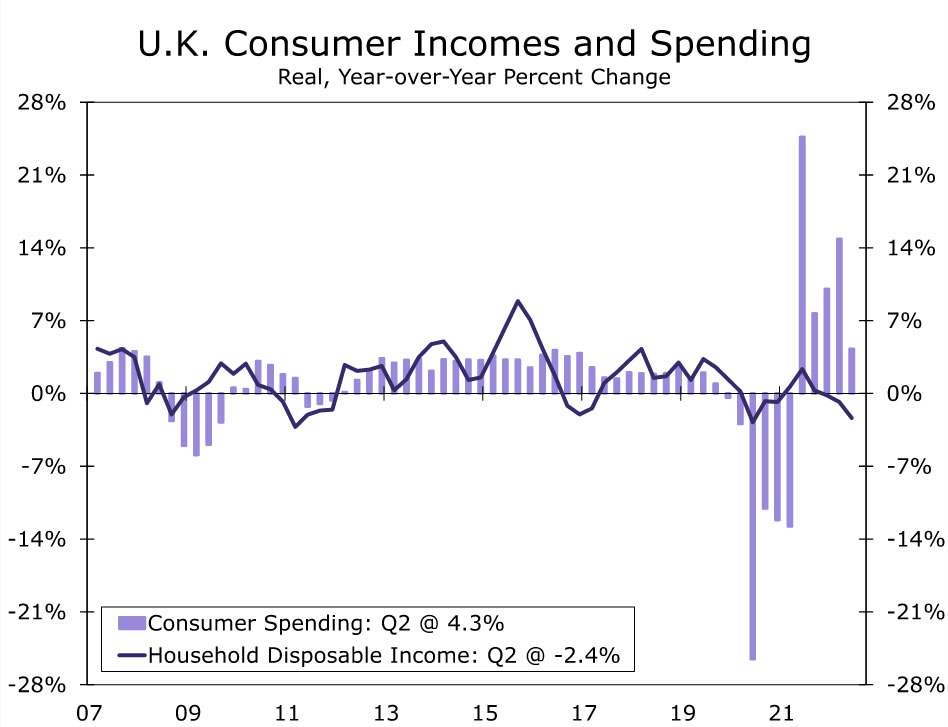
More generally, and as the Bank of England itself highlighted, softening household finances are likely to weigh on the consumer for an extended period. With price increases now outstripping income gains, growth in real household disposable incomes has turned negative for the past several quarters. Indeed, real household incomes fell 1.2% quarter-over-quarter in Q2, the fourth decline in a row, and are down 2.4% year-over-year. With CPI inflation having quickened further since, and given signs of slowing job growth (employment fell by 109,000 in the three months through August), further declines in real household incomes appear more likely than not.
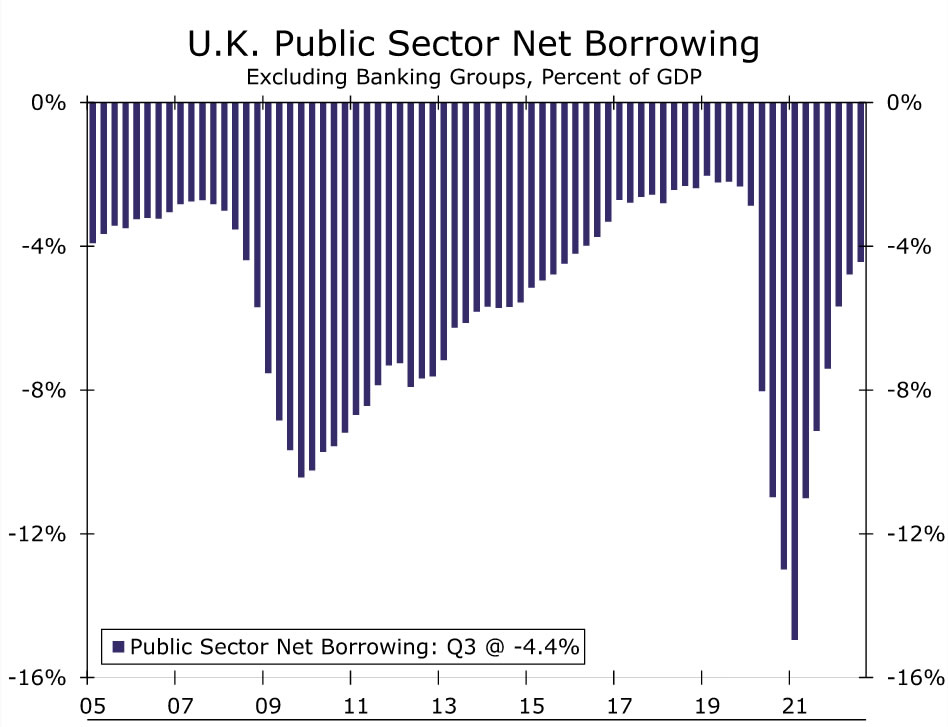
Finally, the potential for fiscal consolidation could add to downside pressures on the economy and reinforce the downturn. The BoE's forecast incorporate the government's publicly announced fiscal initiatives as of October 17. These include a reversal of most of the proposals that were outlined in the Growth Plan in late September, as well as scaling back plans to cap energy prices for households. Previously the government said that energy prices would be capped for households for up to two years beginning from October 2022. However, new Chancellor Hunt subsequently said those plans would now only apply for six months through April 2023, with the intention to transition to a more targeted energy support package after that. However, media reports suggest the government will likely announce further fiscal consolidation measures at the Autumn Statement scheduled for November 17. Indeed, Prime Minister Sunak and Chancellor Hunt said it's inevitable all Britons will pay more in tax. Analysts have suggested the government will announce a further £40B-£50B (1.75%-2.00% of GDP) of annual savings in the Autumn Statement, initiatives that would pose downside risks to growth.
Thus, while the BoE remains concerned about inflation, we ultimately believe a sharp economic downturn will be the key factor that brings the central bank's policy rate increases to an early end, likely during the initial months of 2023. That would particularly be the case if CPI inflation shows signs of having peaked, or if there is a significant and sustained decline in wholesale energy prices. And with the prospect of further fiscal consolidation to be announced shortly, that could also rein in the extent of Bank of England tightening. In fact, following today's announcement we now forecast slightly less tightening from the Bank of England than previously. We expect a 50 basis point rate increase in December, and a final 25 basis point increase in February next year. That would see the policy rate peak at 3.75%, which is still well below the peak of around 4.65% forecast by market participants. The combination of a protracted economic recession and a central bank that under delivers versus the market's rate hike expectations are key factors behind our view of renewed sterling weakness into early 2023, with a targeted GBP/USD exchange rate of $1.0600 by the end of the first quarter next year.
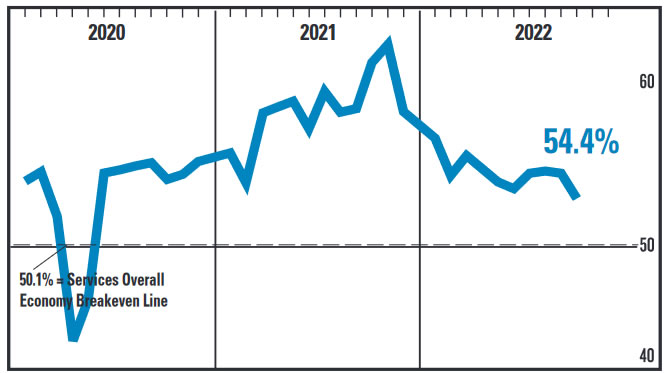
US ISM services fell to 54.4 in Oct, lowest since May 2020
US ISM Services PMI dropped from 56.7 to 54.4 in October, below expectation of 55.2. That's also the lowest reading since May 2020. Looking at some details, business activity/production dropped from 59.1 to 55.7. New orders dropped from 60.6 to 56.5. Employment dropped from -3.9 to 53.0. Prices rose from 68.7 to 70.7.
ISM said: "Growth continues at a slower rate for the services sector, which has expanded for all but two of the last 153 months. The sector had a pullback in growth for the second consecutive month in October due to decreases in business activity, new orders and employment."
"The past relationship between the Services PMI and the overall economy indicates that the Services PMI for October (54.4 percent) corresponds to a 1.5-percent increase in real gross domestic product (GDP) on an annualized basis."
GBP/USD Plunges on Powell, BOE Warning
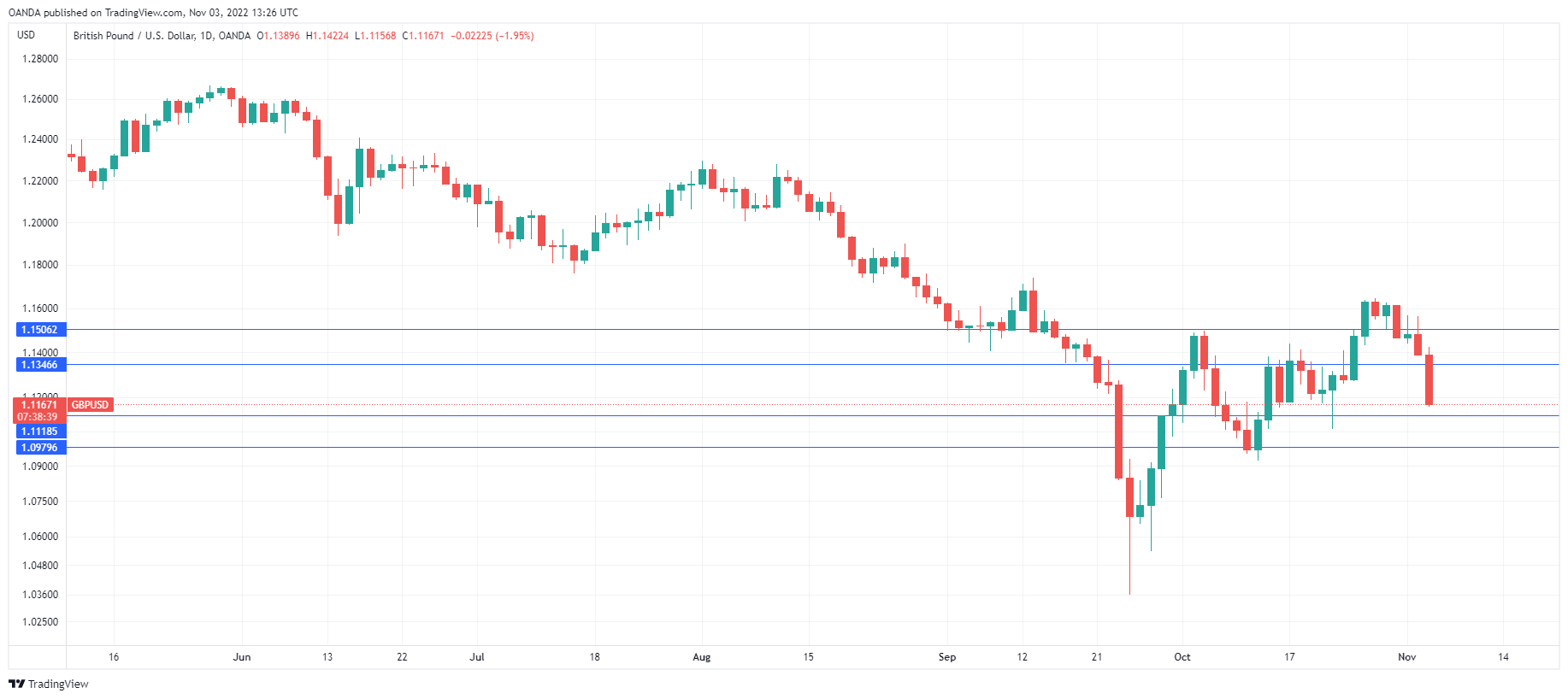
The British pound is sharply lower today. In the European session, GBP/USD is trading at 1.179, down 1.83%. It has been a dreadful week for the pound, which has declined by 3.7%.
Bank of England delivers 75 bp hike
The Bank of England delivered as advertised, raising rates by a super-size 75 basis points today in a 7-2 vote. This was the sharpest rate hike since 1989 and brings the cash rate to 3.0%.
The jumbo rate hike comes at a delicate time, with the BoE warning that the UK is in a “prolonged recession”. The BoE is projecting inflation will hit 11% before the end of the year and estimates that the recession could last two years. The Bank said that further rate hikes would be needed, but the terminal rate would be lower than what the markets have priced in, which is 5.2%.
The BoE has not only witnessed a tumultuous period since the last meeting in September, but had to make its rate decision and forecasts without knowing government policy. A budget was supposed to be released last week but has been delayed until November 17th. Former Prime Minister Liz Truss’ ill-fated mini-budget led to a near financial crisis and forced the BoE to buy massive amounts of bonds. Thankfully, stability has returned and the BoE began selling bonds earlier this week.
The BoE’s message to lower expectations about future rate hikes runs contrary to what Fed Chair Powell said at the Fed meeting on Wednesday. Powell warned that there were no signs that inflation had peaked and said that rates will peak at a higher level than previously expected. This hawkish message sent equity markets sharply lower and boosted the US dollar against all the major currencies. The double-barreled punch of a hawkish Fed and grim warnings from the BoE have sent the pound reeling close to 2% today.
GBP/USD Technical
- There is resistance at 1.1346 and 1.1506
- 1.1118 and 1.1045 and providing support
EURUSD Slips Back Below Downtrend Line
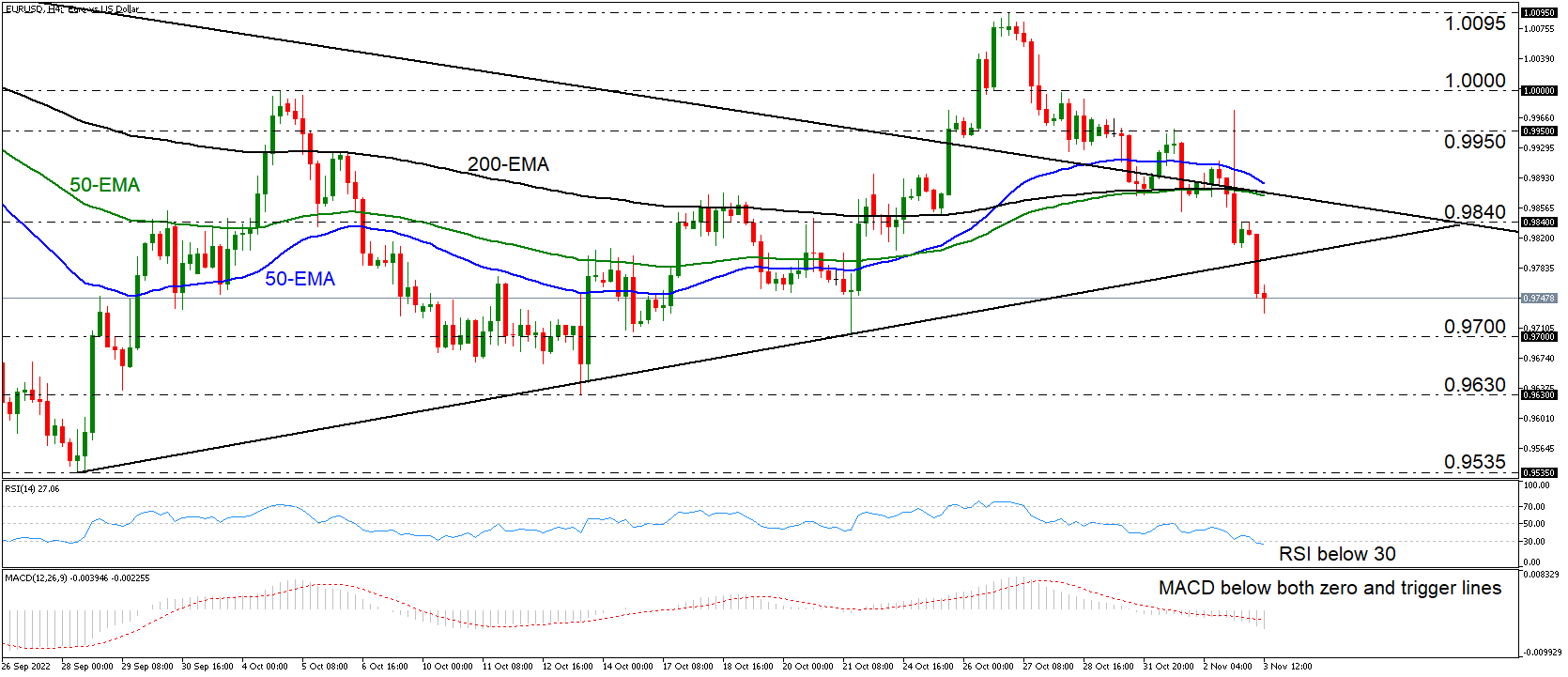
EURUSD came under strong selling pressure yesterday following Fed Chair Powell’s hawkish remarks, breaking back below the medium-term downtrend line drawn from the high of February 10. The pair extended its slide today, breaking a short-term upward sloping support line taken from the low of September 28. These technical signs suggest that the bears are back in the driver’s seat.
Our short-term oscillators are detecting strong downside speed, which adds more credence to that notion. The RSI is lying below 30 and still pointing down, while the MACD is running below both its zero and trigger line, pointing south as well.
The bears could challenge the 0.9700 territory soon, marked by the low of October 21, and if they prove strong enough to overcome it, they may put the 0.9630 zone on their radars. If they are not willing to quit around there either, the slide may extend towards the 20-year low of 0.9535, hit on September 28.
On the upside, a break back above the medium-term downtrend line could invite some more bulls into the action, who could get encouraged to climb towards the 0.9950 barrier, or even try another test at parity. Should they manage to breach parity as well, the door towards the high of October 27 at 1.0095 could be opened.
To recap, EURUSD has been under strong pressure since yesterday, returning below the medium-term downtrend line and breaking a short-term upward sloping support line. This suggests that the bearish bias has intensified.
USD/JPY Mid-Day Outlook
Daily Pivots: (S1) 146.27; (P) 147.32; (R1) 148.97; More...
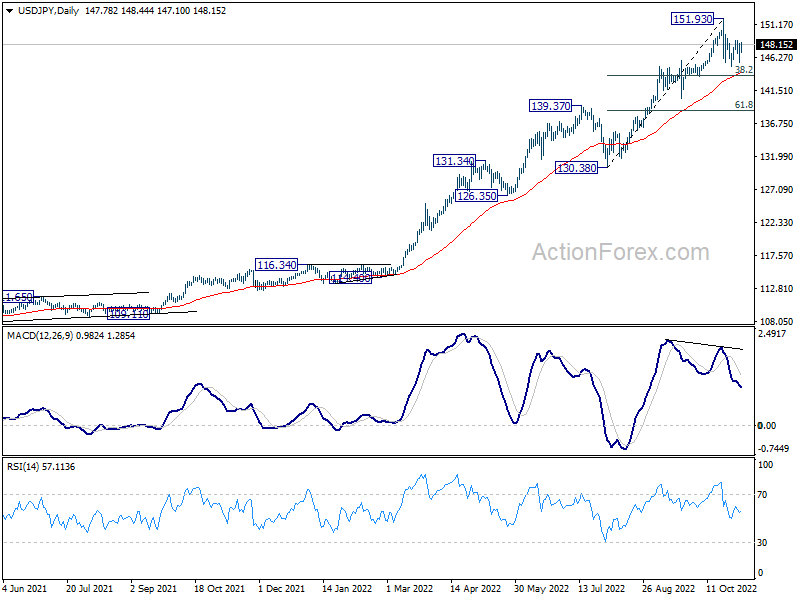
Outlook in USD/JPY is unchanged as consolidation from 151.39 is continuing. Intraday bias stays neutral for the moment. Deeper decline cannot be ruled out, but downside should be contained by 38.2% retracement of 130.38 to 151.93 at 143.69 to bring rebound. On the upside, above 149.69 minor resistance will bring stronger rebound back towards 151.93 high. But upside should be limited there to continue the corrective pattern.
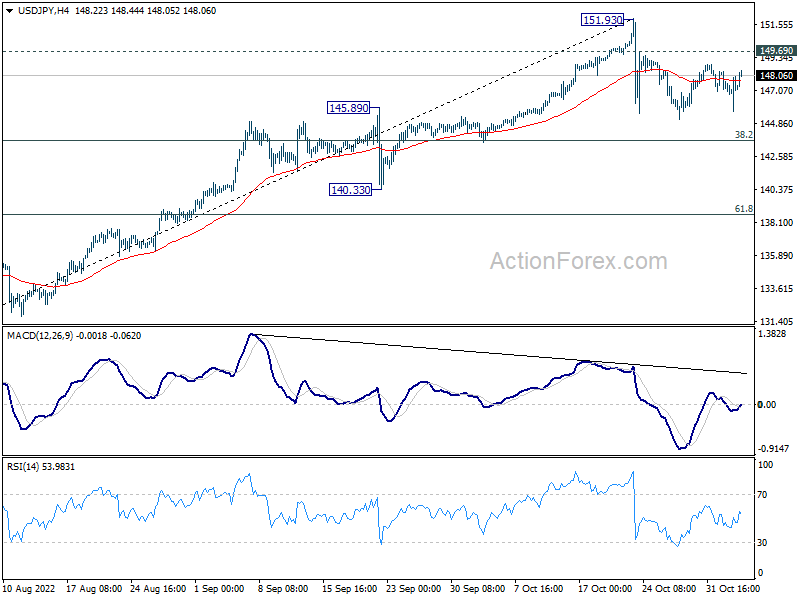
In the bigger picture, up trend from 101.18 is still in progress, as part of the whole up trend from 75.56 (2011 low). 147.68 (1998 high) was already met and there is no clearly sign of topping yet. In any case, break of 140.33 support is needed to be the first sign of medium term topping. Otherwise, further rise is in favor to next target at 160.16 (1990 high).
USD/CHF Mid-Day Outlook
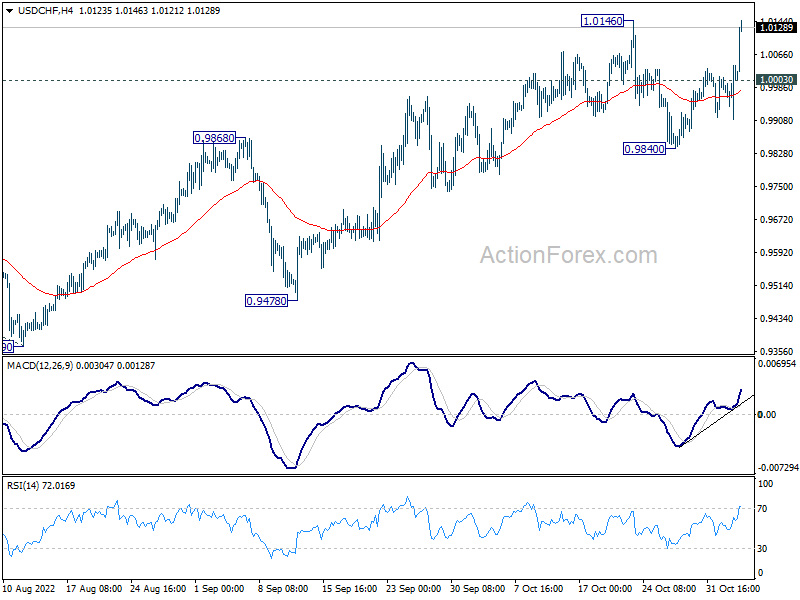
Daily Pivots: (S1) 0.9949; (P) 0.9995; (R1) 1.0079; More...
Intraday bias in USD/CHF stays on the upside at this point. Firm break of 1.0146 will resume larger up trend. Next target is 1.0283 projection level. On the downside, below 1.0003 minor support will turn intraday bias neutral first. But outlook will stay bullish as long as 0.9840 support holds, in case of retreat.
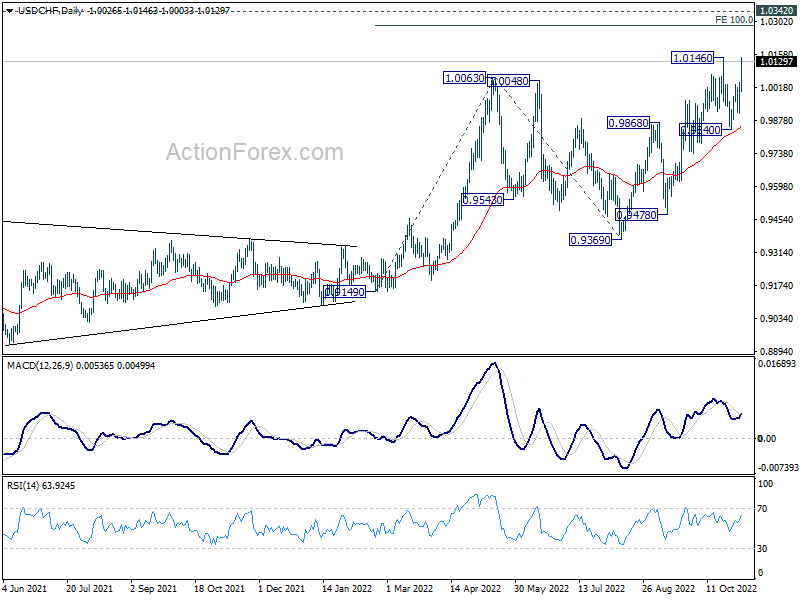
In the bigger picture, current development suggests that up trend from 0.8756 (2021 low) is still in progress. Next target is 100% projection of 0.9149 to 1.0063 from 0.9369 at 1.0283, and then 1.0342 (2016 high). For now, this will remain the favored case as long as 0.9779 support holds, even in case of deep pull back.
EUR/USD Mid-Day Outlook
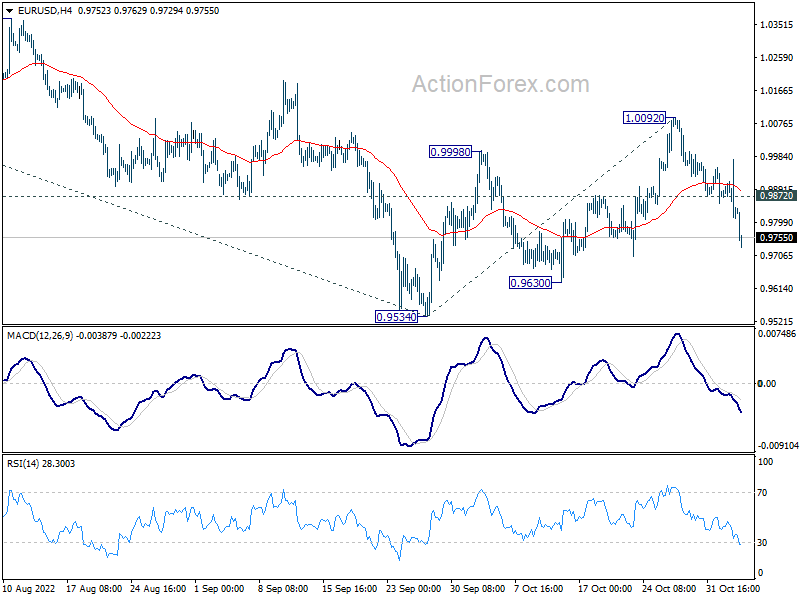
Daily Pivots: (S1) 0.9761; (P) 0.9868; (R1) 0.9924; More...
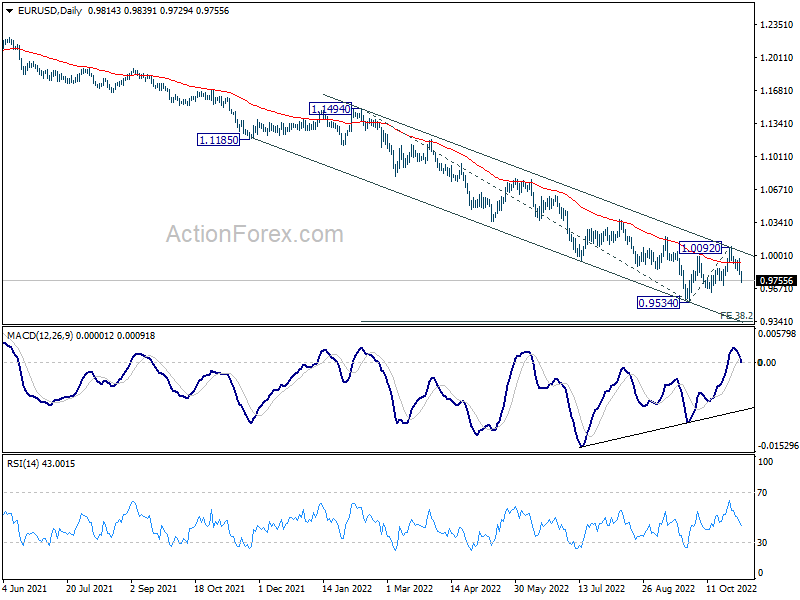
Intraday bias in EUR/USD remains on the downside at this point. Corrective pattern from 0.9534 should have completed with three waves up to 1.0092. Deeper decline would be seen to 0.9534/9630 support zone. On the upside, above 0.9872 minor resistance will turn intraday bias neutral again first.
In the bigger picture, medium term term bearishness is retained with failure to sustain above 55 day EMA (now at 0.9930). That is, larger down trend from 1.2348 (2021 high) is still in progress. Firm break of 0.9534 low will confirm this bearish case. For now, risk will stay on the downside as long as 1.0092 resistance holds, in case of recovery.
GBP/USD Mid-Day Outlook
Daily Pivots: (S1) 1.1330; (P) 1.1447; (R1) 1.1507; More...
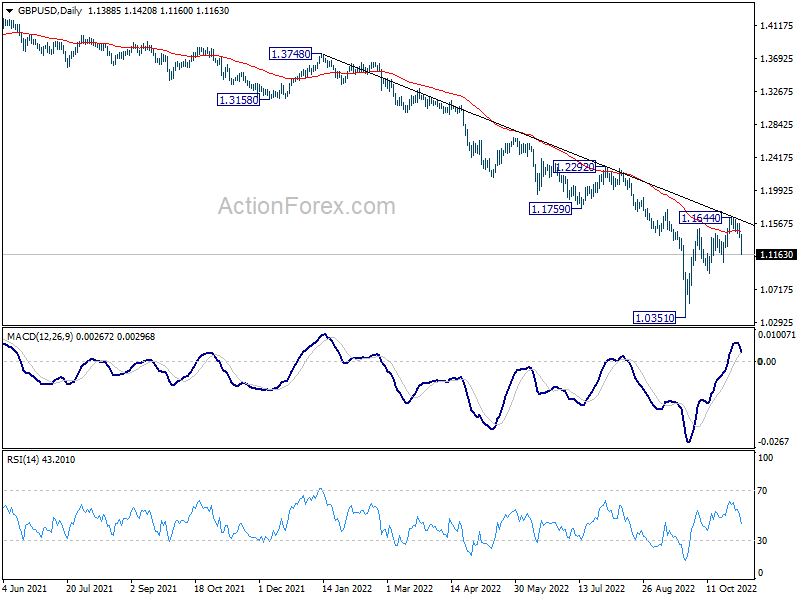
GBP/USD's break of 1.1256 suggests that rebound from 1.0351 has completed with three waves up to 1.1644, ahead of 1.1759 support turned resistance. The development retains larger bearishness. Intraday bias is back on the downside for 1.0922 support first. Break there will target a retest on 1.0351 low. For now, risk will stay on the downside as long as 1.1644 resistance holds, in case of recovery.
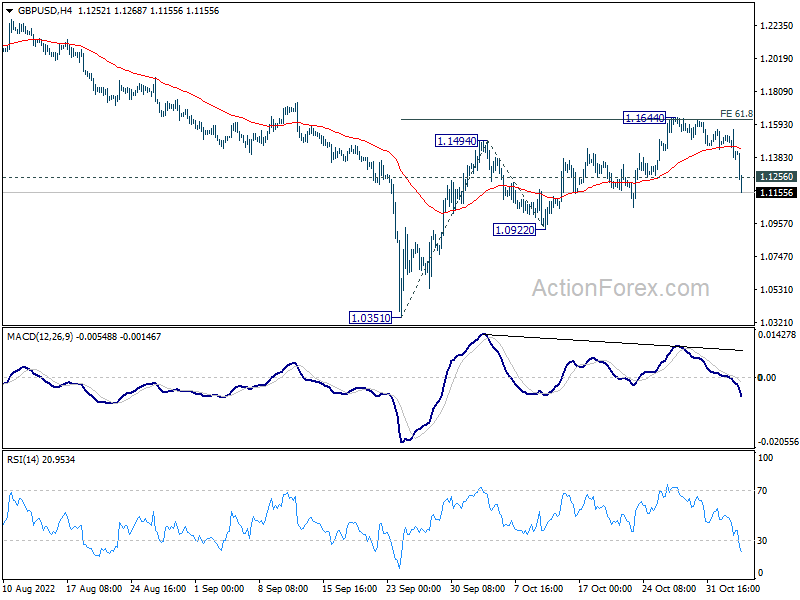
In the bigger picture, fall from 1.4248 (2018 high) is part of the long term down trend from 2.1161 (2007 high). Outlook will stay bearish as long as 1.1759 support turned resistance holds. Parity would be the next target on resumption. Nevertheless, firm break of 1.1759 will confirm medium term bottoming, and open up stronger rise back to 55 week EMA (now at 1.2392).