

Sample Category Title
BoE to Contain Gilt Crash and Save Sterling
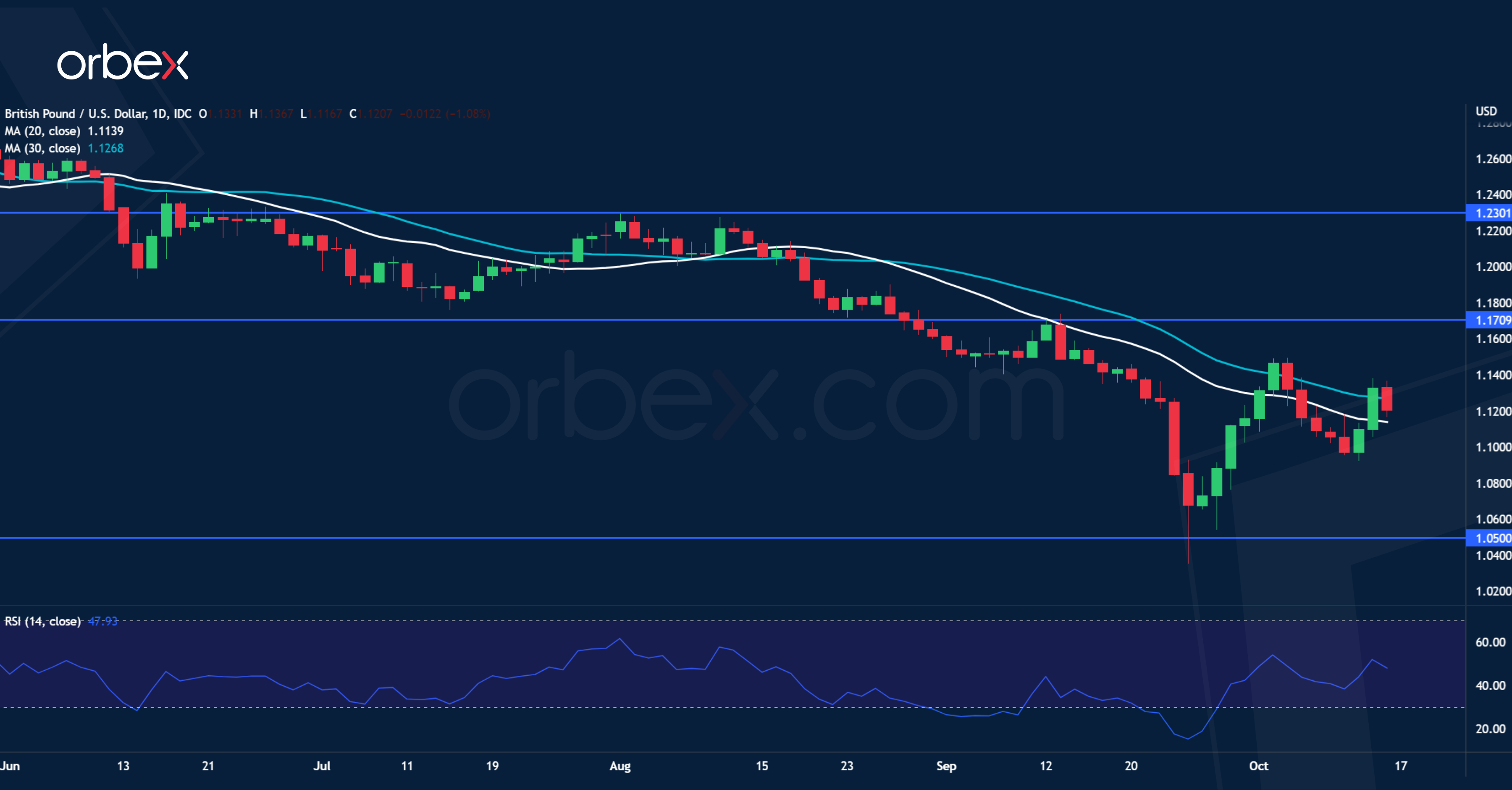
GBP/USD slides amid gilts firesale
Sterling drifts lower amid a liquidity crunch in the UK’s gilt market. In an attempt to prevent the market’s collapse, the Bank of England has been forced to step in to buy back bonds owned by the country's major pension funds. The systemic risk is yet to dissipate and investors would rather cut their pound exposure. Reduced liquidity and headline catalysts mean that extreme volatility could be expected ahead. Governor Andrew Bailey has called for an end to the emergency support. But traders hope the central bank will extend the lifeline or another market rout may push the pound below 1.0500. 1.1700 is the first resistance.
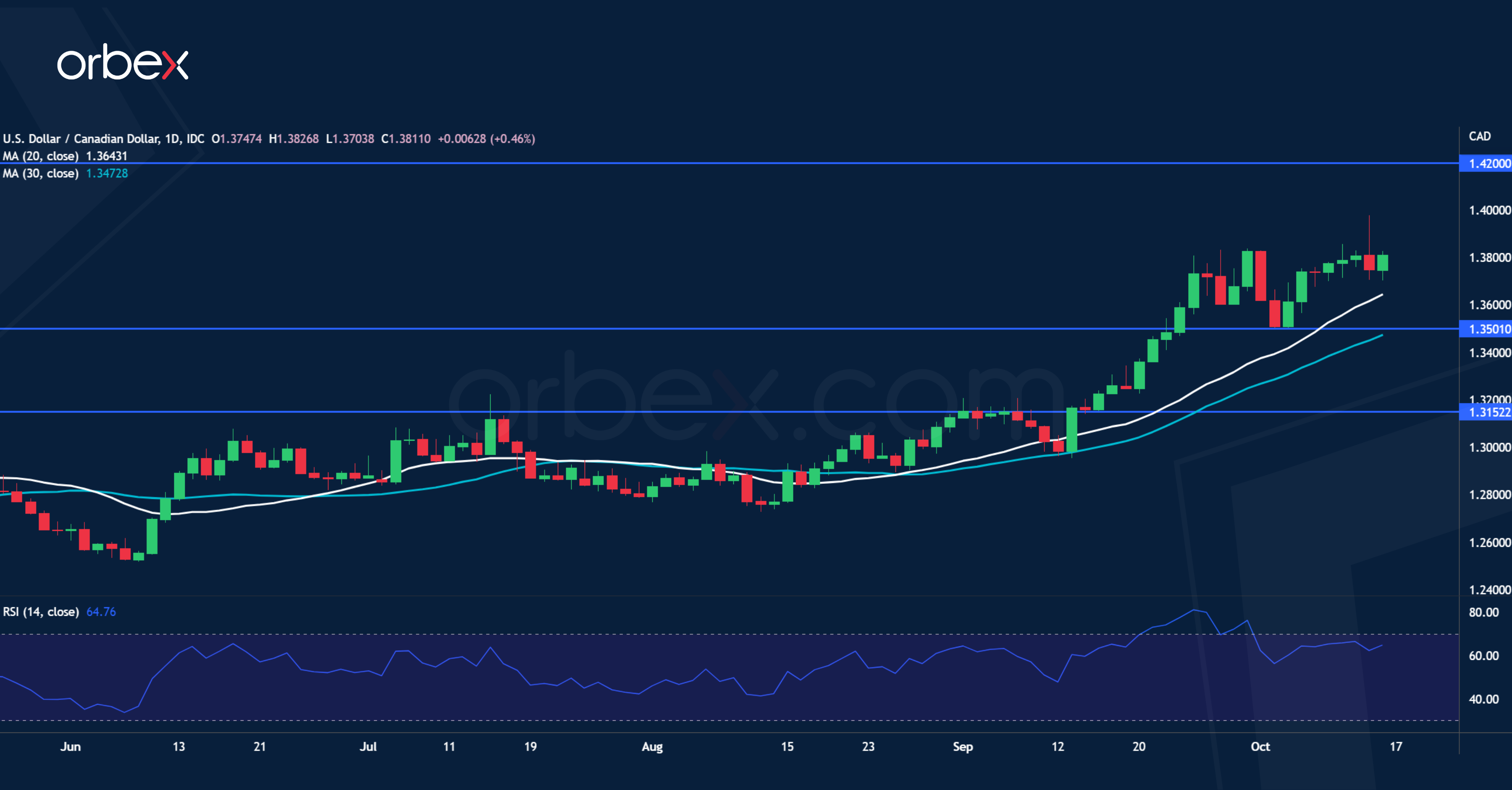
USD/CAD rises on safe-haven demand
The Canadian dollar slips as markets’ pessimism takes a toll on risk-sensitive currencies. Canada's falling unemployment rate would encourage the BoC to ramp up interest rate increases. Another hot inflation reading this week may offer some support to the loonie. However, Canada is a major producer of oil, and its currency highly depends on the global economic outlook. Worries of a widespread recession engineered by central banks would dampen the prospect of a swift recovery. The risk-off environment would continue to favour the safe-haven greenback which is heading towards 1.4200. 1.3500 is a fresh support.
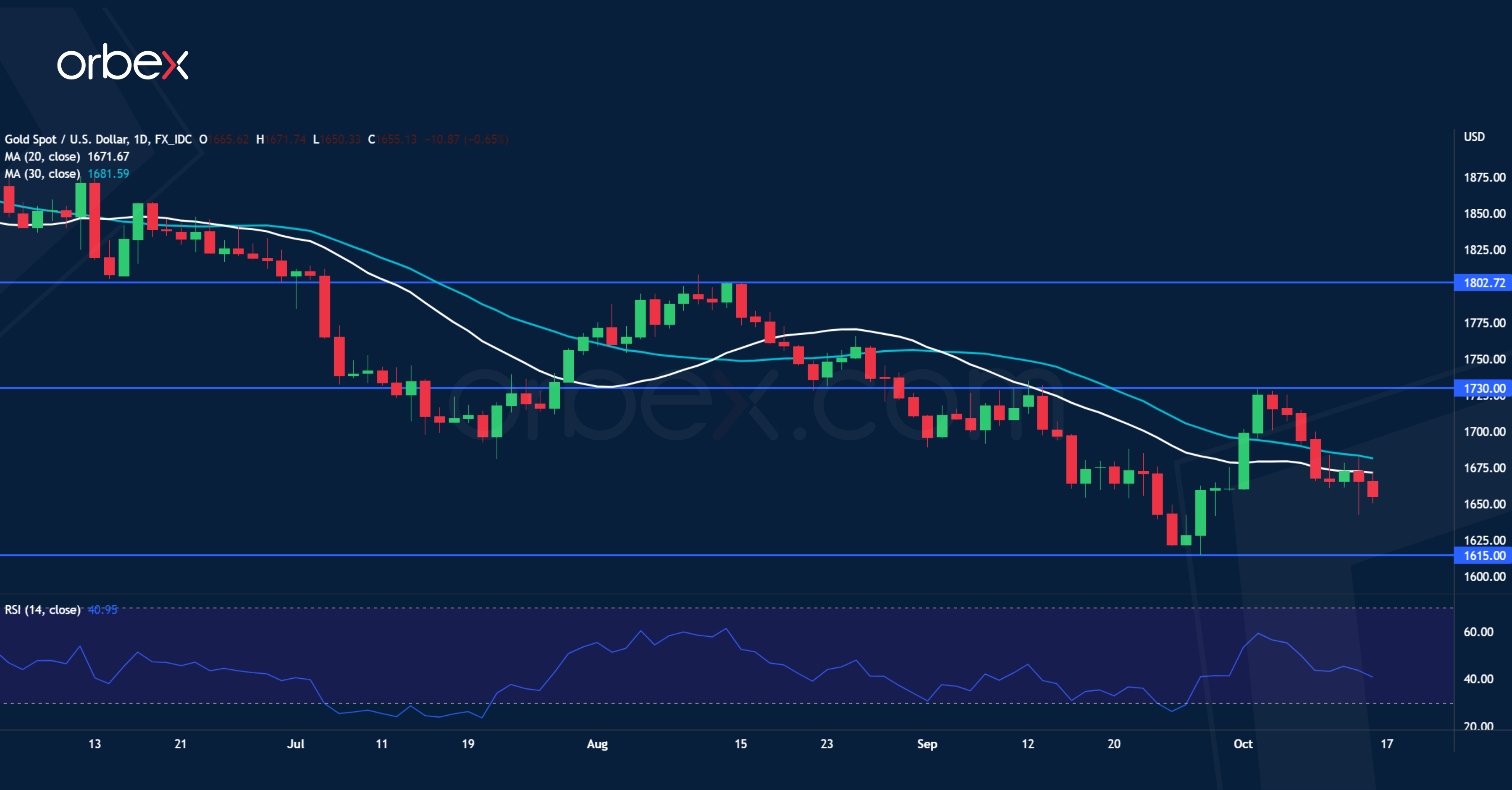
XAU/USD weakens as cash yield soars
Bullion struggles as the US dollar hits a 20-year high. The precious metal has definitely failed its traditional role as an inflation hedge which ironically has been fulfilled by cash these days. Investors have rotated into cash to capture soaring interest rates. As US inflation remained near 40-year highs, there is no sign of a slowdown in the tightening. Calling a top in the dollar would be tantamount to standing in front of a train. Repeated statements from Fed officials to maintain the course of action would keep casting a cloud over anything commodity-related. The bounce off 1615 might be short-lived and 1730 is the closest resistance.
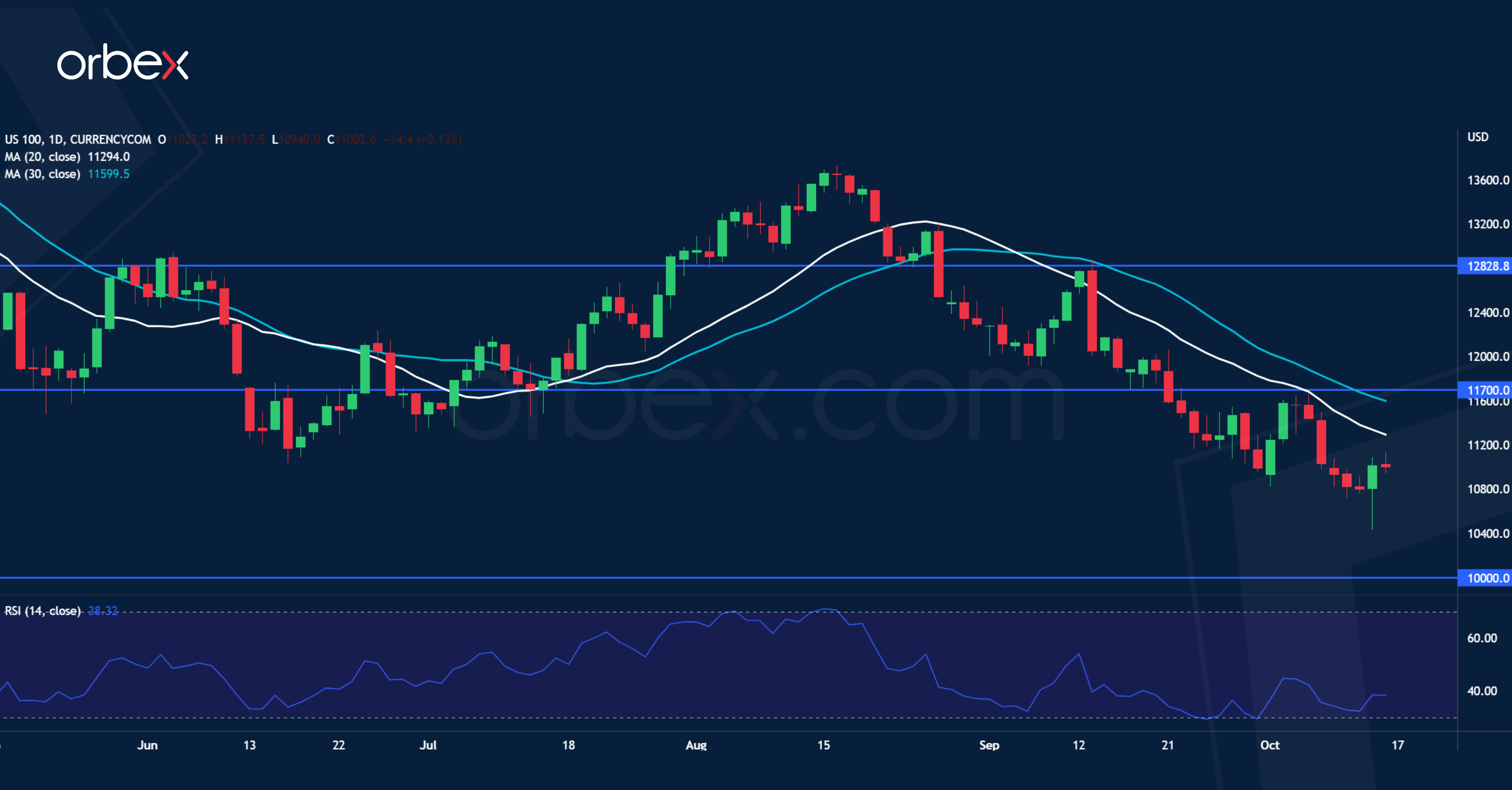
NAS 100 slips as uncertainties compound
The Nasdaq 100 stays under pressure as the Fed would not yield. In a textbook ‘buy the rumour, sell the news' equity markets clawed back some losses following higher-than-expected US CPI. Another 75bp rate hike seems to be a done deal. The negativity already had been priced in, triggering short-covering instead. More volatility could be expected ahead as the market's grim fundamentals remain unchanged. The IMF has warned that compounding pressures from inflation, geopolitical instability and high interest rates could cause a global recession. Uncertainties may drive the index to 10000 and 11700 is the first resistance.
Why UK Bond Crisis Spooked Other Central Bankers
The sudden drop in the pound and the emergency intervention by the BOE is largely attributed to the release of Chancellor Kwarteng's "mini-budget", at least in the media. That gives the impression that the issue is exclusively a UK problem, derived from fiscal policy. But, that doesn't explain why other central banks, such as the RBA and, most recently, members of the ECB's governing council, would consider modifying their policy because of what is going on in the UK.
Although the precipitating event was the uncertainty in UK finances brought to light by the "mini-budget", it brought to light another significant problem: Lack of liquidity. And that goes beyond the UK. With the BOE facing down hedge funds backed up by the Chancellor, the risk of a "black swan" event that could trigger a broader global financial crisis has become elevated.
The surprising remarks
At its last meeting, the RBA didn't raise rates as much as expected, citing several reasons. Among them was the situation in the UK bond market. It didn't really cause much alteration in the market, as the consensus at the time was that the BOE would handle the situation.
Earlier today, however, a prominent ECB hawk came out to downplay the aggressiveness of future rate hikes in the EuroZone. He suggested that a neutral rate could be around 2.0% for the ECB, well below rates already achieved by the peers. Although he didn't comment on the UK situation directly, he echoed words by Spain's de Cos yesterday, who warned that shocks for the downside scenario had materialized. What are those?
Where's the money
European financial markets have already been facing a major issue that has necessitated bailouts: The energy crisis. Energy firms had hedged future contracts to maintain steady supply by collateralizing their holdings. The sudden spike in energy prices drained substantial amounts of liquidity as energy firms were forced to increase collateral to avoid margin calls.
A similar situation happened with the pension funds, which were forced to put up more liquidity to defend their hedges that were collateralized by UK debt. However, the sudden spike in interest rates suggested that there was very little interest in buying bonds. The combination of global uncertainty and high inflation makes holding debt paying relatively low rates for extended periods of time a bad investment.
The potential crisis
"Liquidity" is what keeps the markets going. It means that if someone needs to sell an asset, there is someone who wants to buy it. That maintains stability. Because, if there isn't anyone to buy an asset that's for sale, then the price gets lowered until someone is willing to buy.
Rising interest rates drain liquidity, because it encourages people to not hold cash. If there is a crisis of liquidity, it means that markets could suddenly fall, as the lack of buyers triggers stops, forcing the market down.
Typically, talk of lack of liquidity precedes a major market collapse, and the need for central banks to step in. That might not be the situation at the moment, but given concerns over liquidity, central bankers might be more hesitant to continue tightening. Even if the data (such as inflation) indicate that rates should keep rising.
US: Retail Sales Remained Flat in September
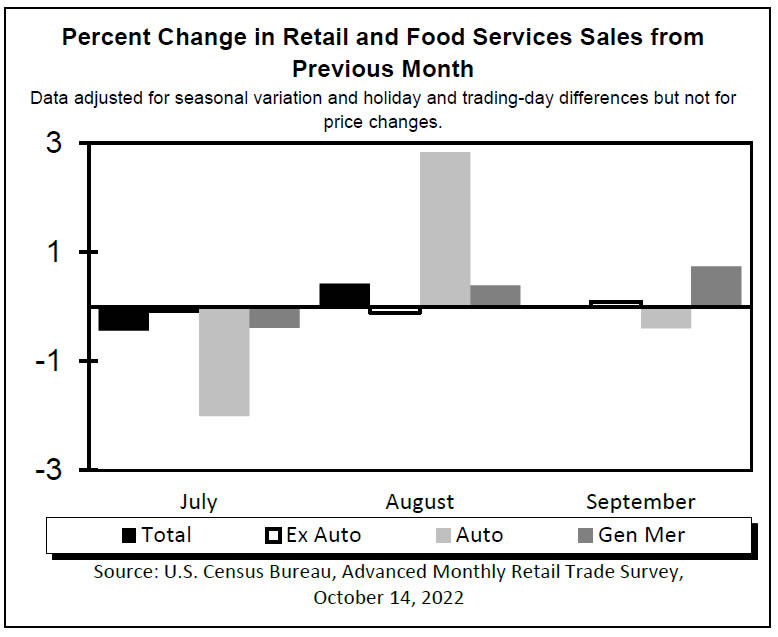
Retail sales were flat in September month-on-month (m/m), below market expectations for a modest gain of 0.2% m/m. The level of sales was revised 0.4% higher in August (vs. 0.3% reported earlier).
Sales at autos & parts dealers declined by 0.4% m/m after growing 2.8% m/m in August.
Gasoline station receipts were the major drag in today's report, down 1.4% m/m. Sales at building materials and garden equipment were down 0.4% m/m.
Retail sales in the "control group," which exclude autos, gas stations and building materials and are used in estimating personal consumption expenditures, rose a healthy 0.4% m/m.
- Sales were solid at department stores (+0.7% m/m), while health stores, clothing stores and non-store retailers all registered a 0.5% m/m gain. Food & beverage stores were right behind them with a 0.4% m/m gain.
- Food services and drinking places – the only services category in today's report – made a relatively strong gain of 0.5% m/m in September
- Two categories that reported losses in September were miscellaneous stores retailers (-2.5% m/m) and furniture & electronics/appliance stores (-0.7% m/m).
Key Implications
With the final month's sales, the third quarter gained 2.6% (annualized) – higher than we expected. However, removing price effects, this translates into 2.0% quarter-on-quarter annualized loss. As a result, we now expect personal consumer expenditures to come in just below 1% (annualized) in Q3.
More headwinds are on tap for consumers as they are entering a holiday sales. Over the coming months, several forces will weigh on retail sales. First, elevated inflation will force consumers to avoid more expensive and discretionary items. Second, the cumulative effect of tighter financial conditions will become a more prominent restraining force. Lastly, annual revisions to National Accounts reported on September 29th suggest that consumers have around 25% less spending power in the form of excess savings than we estimated in our recent report. Together, these factors tilt demand risks to the downside, suggesting that the fourth quarter rebound in real durables spending will be half of what we forecast in September.
EUR/USD Mid-Day Outlook
Daily Pivots: (S1) 0.9671; (P) 0.9739; (R1) 0.9845; More...
Intraday bias in EUR/USD stays neutral for the moment. For now, outlook will remain bearish as long as 0.9998 resistance holds. Below 0.9630 will bring retest of 0.9534 low first. Firm break there will resume larger down trend.

In the bigger picture, down trend from 1.6039 (2008 high) is still in progress. Next target is 100% projection of 1.3993 to 1.0339 from 1.2348 at 0.8694. In any case, break of 0.9998 resistance is needed to be the first sign of medium term bottoming. Otherwise, outlook will stay bearish even with strong rebound.

GBP/USD Mid-Day Outlook
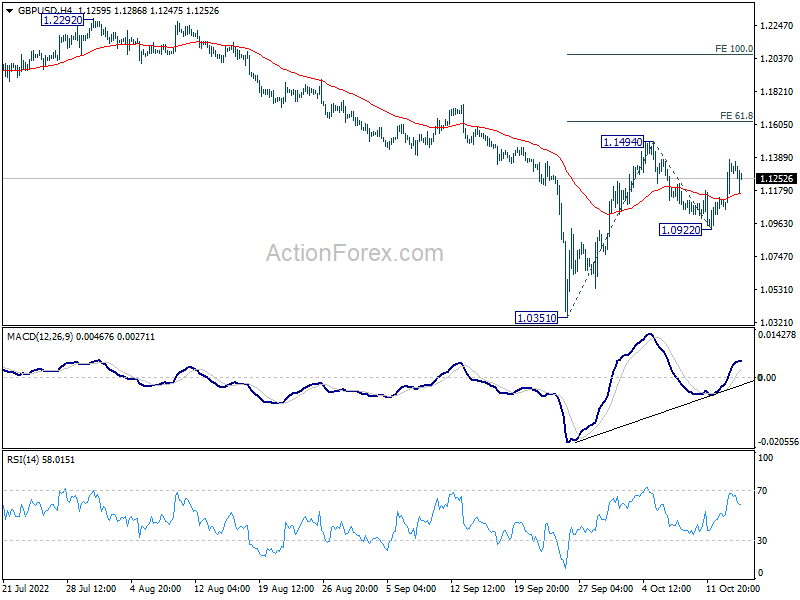
Daily Pivots: (S1) 1.1133; (P) 1.1257; (R1) 1.1455; More...
Outlook is GBP/USD remains unchanged. Intraday bias stays mildly on the upside for 1.1494 resistance. Firm break there will confirm resumption of whole rebound from 1.0351. Next target is 61.8% projection of 1.0351 to 1.1494 from 1.0922 at 1.1628. On the downside, below 1.0922 will turn bias back to the downside for 1.0351 low instead.
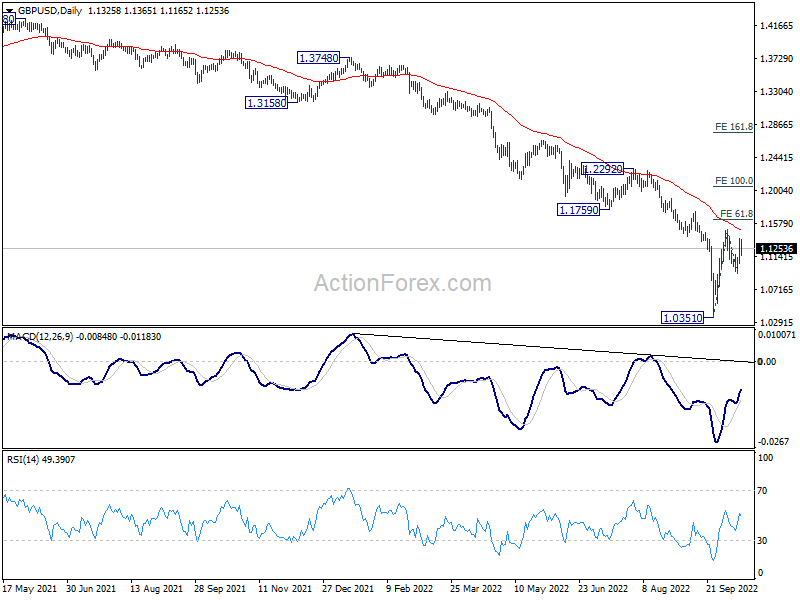
In the bigger picture, fall from 1.4248 (2018 high) is resuming long term down trend from 2.1161 (2007 high). Next target is 100% projection of 2.1161 to 1.3503 from 1.7190 at 0.9532. There is no scope of a medium term rebound as long as 1.1759 support turned resistance holds.
USD/CHF Mid-Day Outlook
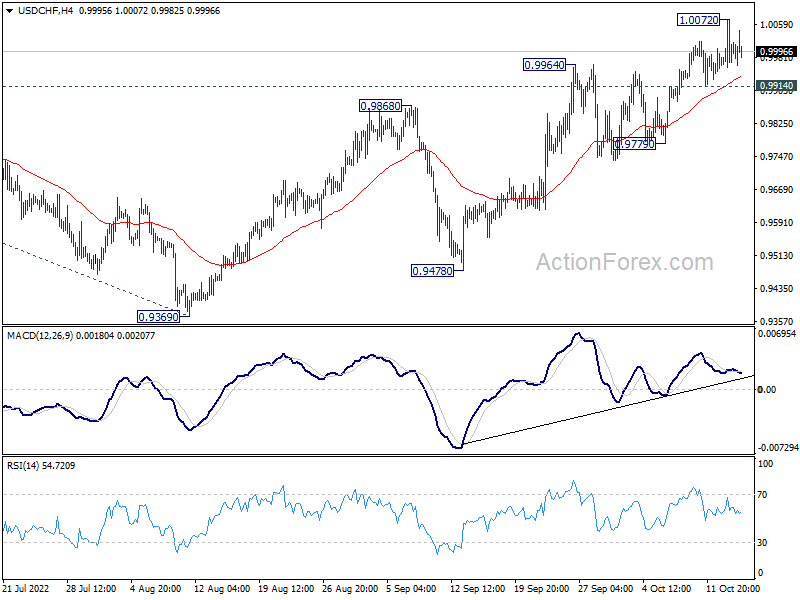
Daily Pivots: (S1) 0.9958; (P) 1.0016; (R1) 1.0072; More...
Intraday bias in USD/CHF remains neutral for consolidation below 1.0072. On the upside, break of 1.0072, and sustained trading above 1.0063, will confirm larger up trend resumption. Next target is 1.0283 projection level. However, break of 0.9914 support will indicate rejection by 1.0063, and turn bias back to the downside for 0.9779 support first.
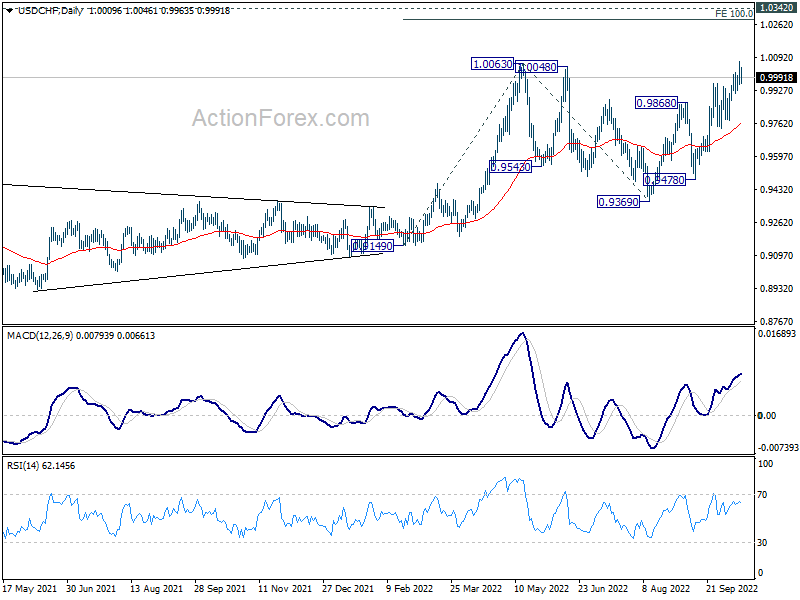
In the bigger picture, current development suggests that up trend from 0.8756 (2021 low) is still in progress. Sustained break of 1.0063 will target 100% projection of 0.9149 to 1.0063 from 0.9369 at 1.0283, and then 1.0342 (2016 high). For now, this will remain the favored case as long as 0.9369 support holds, even in case of deep pull back.
USD/JPY Mid-Day Outlook
Daily Pivots: (S1) 146.58; (P) 147.12; (R1) 147.78; More...
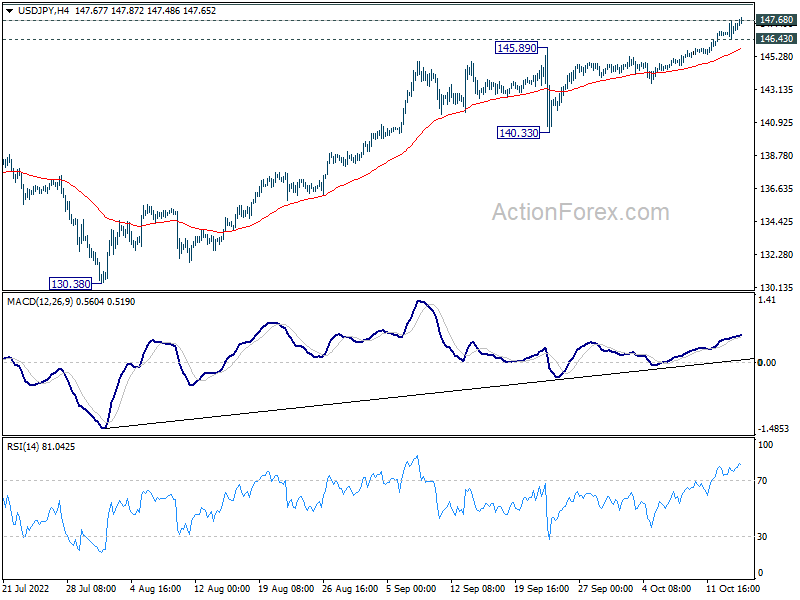
USD/JPY's rally continues and breaks 147.68 long term resistance. Intraday bias stays on the upside for 149.25 projection level, and possibly to 150 psychological level. On the downside, break of 146.43 minor support will now suggest short term topping, and turn bias back to the downside for deeper pull back.
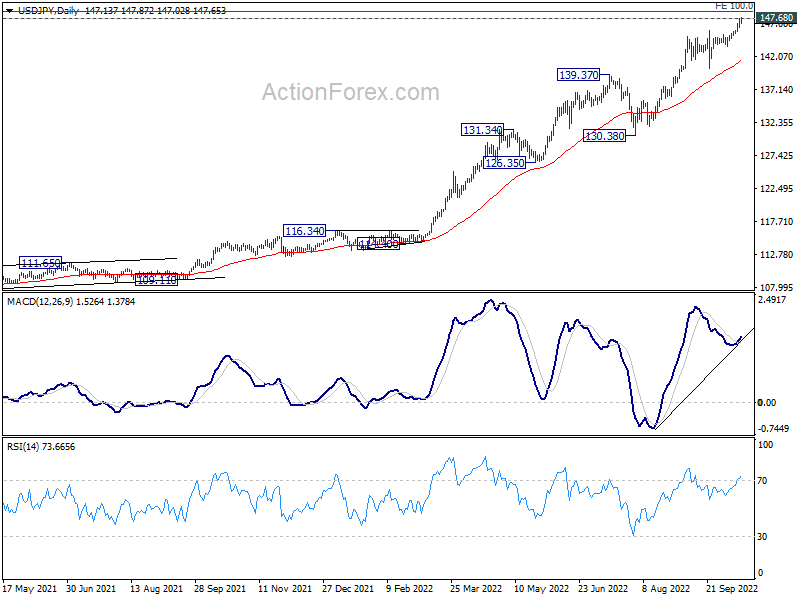
In the bigger picture, up trend from 101.18 is still in progress, as part of the whole up trend from 75.56 (2011 low). Further rise should be seen to 147.68 (1998 high), and possibly to 100% projection of 75.56 (2011 low) to 125.85 (2015 high) from 98.97 at 149.26, For now, break of 130.38 support is needed to be the first indication of medium term topping. Otherwise, outlook will stay bullish even in case of deep pull back.
Dollar Makes New 32-yr High Against Yen, Will Japan Intervene?
Dollar regains some growth today, and even rises to new 32-year high against Yen. Momentum is somewhat weak, however, as traders are guarding against intervention by Japan. Meanwhile, markets are mixed elsewhere. Sterling dips after UK Finance Minister Kwasi Kwarteng announced his resignation ahead of Prime Minister Liz Truss's press conference later in the day. For now, the Pound is still the strongest for the week, followed by Kiwi and the Dollar. Yen is worst, followed by Aussie and the Swiss Franc. But there is scope for some changes in position in the final hours.
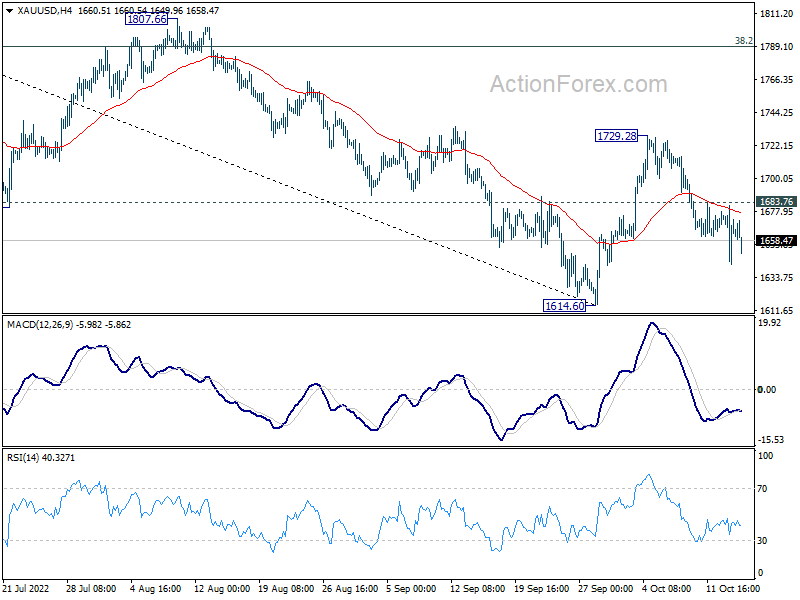
Technically, while Dollar retreated quite notably yesterday, the recovery in gold was so far very weak. Current development suggests that rebound from 1614.60 has completed at 1729.28 already. Further decline is now in favor as long as 1683.76 minor resistance holds, to retest 1614.60 low. Firm break there will resume larger decline.
In Europe, at the time of writing, FTSE is up 1.04%. DAX is up 1.16%. CAC is up 1.64%. Germany 10-year yield is down -0.108 at 2.173. Earlier in Asia, Nikkei rose 3.25%. Hong Kong HSI rose 1.21%. China Shanghai SSE rose 1.84%. Japan 10-year JGB yield rose 0.0028 to 0.254.
US retail sales growth flat in Sep, ex-auto sales up 0.1% mom
US retail sales growth was flat at 0.0% mom in September, at USD 684.0B. Ex-auto sales rose 0.1% mom, better than expectation of -0.1% mom. Ex-gasoline sales rose 0.1% mom. Ex-auto and gasoline sales rose 0.3% mom. Total sales for July through September period were up 9.2% from the same period a year ago.
Also released, import price index dropped -1.2% mom in September, below expectation of -1.1% mom.
From Canada, manufacturing sales dropped -2.0% mom in August, versus expectation of -1.1% mom. Wholesale sales rose 1.4% mom, above expectation of 0.1% mom.
ECB Lagarde: Valuations vulnerable to a range of possible negative surprises
ECB President Christine Lagarde said the financial markets may be overly optimistic about the economic outlook. "This makes valuations vulnerable to a range of possible negative surprises, whether from growth, inflation, monetary policy or corporate profitability," she said.
Vice President Luis de Guindos said, "what we considered as our downside scenario in September, is coming closer to the baseline scenario... I think we are going to face a very difficult combination of low economic growth, including the possibility of a technical recession, and high inflation,"
Governing Council member Bostjan Vasle said, "We won't stop at the neutral rate, we need to keep powering through... I'm of the opinion that we will have to go above the neutral level in order to calm inflation pressures, which are currently in the pipeline.
Eurozone exports rose 24.0% yoy in Aug, imports rose 53.6% yoy
Eurozone exports of goods rose 24.0% yoy to EUR 231.1B in August. Imports rose 53.6% yoy to EUR 282.1B. Trade deficit came in at EUR -50.9B. Intra-Eurozone trade rose 34.8% yoy to EUR 210.5B.
In seasonally adjusted term, exports rose 3.5% mom to EUR 245.5B. Imports rose 5.5% mom to EUR 292.8B. Trade deficit widened from EUR -40.5B to EUR -47.3B, much larger than expectation of EUR -40.0B. Intra-Eurozone trade rose from EUR 230.9B to EUR 239.2B.
NZ BNZ manufacturing dropped to 52.0, positive trend with ongoing volatility
New Zealand BusinessNZ Performance of Manufacturing Index dropped back from 54.8 to 52.0 in September, comparing to July's 53.5 and June's 50.2. Looking at some details, production dropped from 54.5 to 52.0. Employment dropped from 53.6 to 51.9. New orders tumbled sharply from 59.7 to 48.4. Finished stocks rose from 52.0 to 55.0. Deliveries edged down from 55.0 to 54.5.
BNZ Senior Economist, Doug Steel stated "the overall trend remains positive, but with ongoing volatility around it. On the positive side, the PMI's 3-month moving average has continued to edge higher this month but, not so good, the 52.0 monthly reading is now back below the PMI's longer-term norm".
USD/JPY Mid-Day Outlook
Daily Pivots: (S1) 146.58; (P) 147.12; (R1) 147.78; More...
USD/JPY's rally continues and breaks 147.68 long term resistance. Intraday bias stays on the upside for 149.25 projection level, and possibly to 150 psychological level. On the downside, break of 146.43 minor support will now suggest short term topping, and turn bias back to the downside for deeper pull back.
In the bigger picture, up trend from 101.18 is still in progress, as part of the whole up trend from 75.56 (2011 low). Further rise should be seen to 147.68 (1998 high), and possibly to 100% projection of 75.56 (2011 low) to 125.85 (2015 high) from 98.97 at 149.26, For now, break of 130.38 support is needed to be the first indication of medium term topping. Otherwise, outlook will stay bullish even in case of deep pull back.
Economic Indicators Update
| GMT | Ccy | Events | Actual | Forecast | Previous | Revised |
|---|---|---|---|---|---|---|
| 21:30 | NZD | Business NZ PMI Sep | 52 | 54.9 | 54.8 | |
| 23:50 | JPY | Money Supply M2+CD Y/Y Sep | 3.30% | 3.40% | 3.40% | |
| 01:30 | CNY | CPI Y/Y Sep | 2.80% | 2.80% | 2.50% | |
| 01:30 | CNY | PPI Y/Y Sep | 0.90% | 1.10% | 2.30% | |
| 09:00 | EUR | Eurozone Trade Balance (EUR) Aug | -47.3B | -40.0B | -40.3B | |
| 12:30 | CAD | Manufacturing Sales M/M Aug | -2.00% | -1.10% | -0.90% | -0.60% |
| 12:30 | CAD | Wholesale Sales M/M Aug | 1.40% | 0.10% | -0.60% | |
| 12:30 | USD | Retail Sales M/M Sep | 0.00% | 0.20% | 0.30% | 0.40% |
| 12:30 | USD | Retail Sales ex Autos M/M Sep | 0.10% | -0.10% | -0.30% | -0.10% |
| 12:30 | USD | Import Price Index M/M Sep | -1.20% | -1.10% | -1.00% | -1.10% |
| 14:00 | USD | Michigan Consumer Sentiment Index Oct P | 58.8 | 58.6 | ||
| 14:00 | USD | Business Inventories Aug | 0.90% | 0.60% |
US retail sales growth flat in Sep, ex-auto sales up 0.1% mom
US retail sales growth was flat at 0.0% mom in September, at USD 684.0B. Ex-auto sales rose 0.1% mom, better than expectation of -0.1% mom. Ex-gasoline sales rose 0.1% mom. Ex-auto and gasoline sales rose 0.3% mom.
Total sales for July through September period were up 9.2% from the same period a year ago.
ECB Lagarde: Valuations vulnerable to a range of possible negative surprises
ECB President Christine Lagarde said the financial markets may be overly optimistic about the economic outlook. "This makes valuations vulnerable to a range of possible negative surprises, whether from growth, inflation, monetary policy or corporate profitability," she said.
Vice President Luis de Guindos said, "what we considered as our downside scenario in September, is coming closer to the baseline scenario... I think we are going to face a very difficult combination of low economic growth, including the possibility of a technical recession, and high inflation,"
Governing Council member Bostjan Vasle said, "We won't stop at the neutral rate, we need to keep powering through... I'm of the opinion that we will have to go above the neutral level in order to calm inflation pressures, which are currently in the pipeline.