Sample Category Title
AUD/USD Weekly Outlook
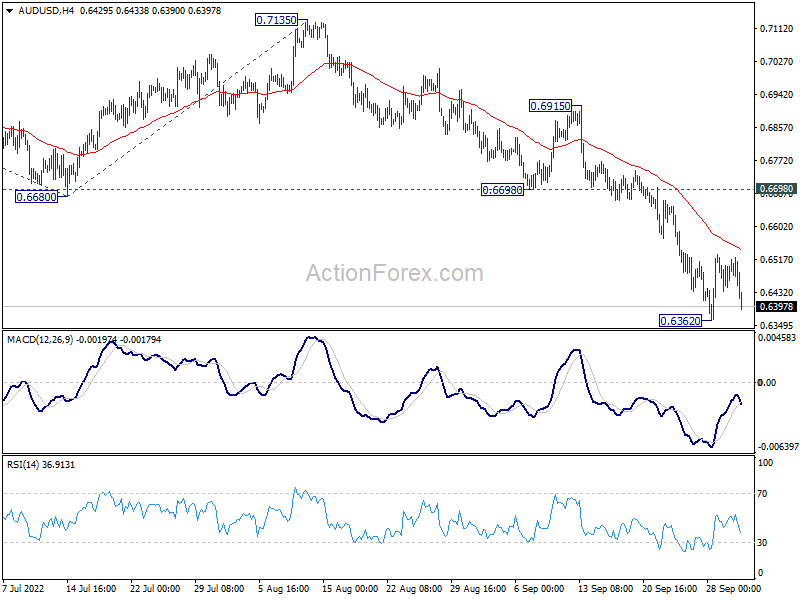
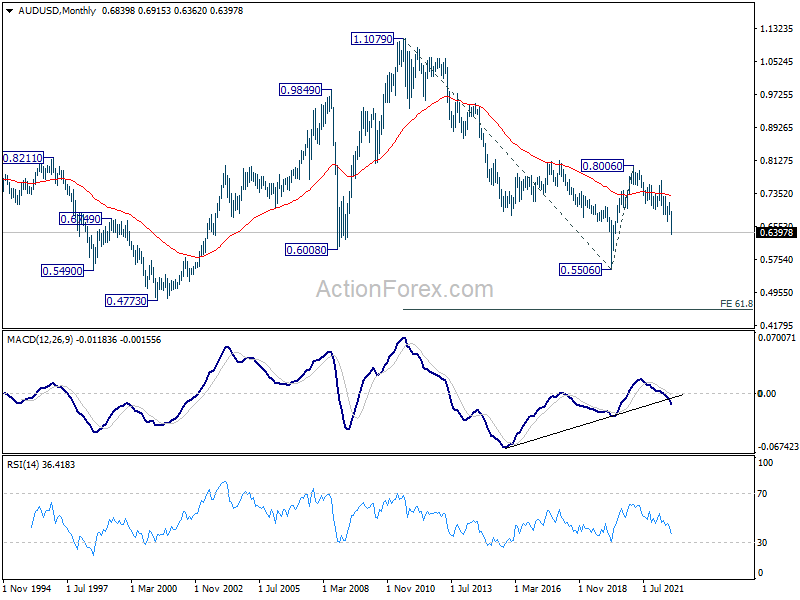
AUD/USD's down trend continued last week and fell to 0.6362, then recovered. Initial bias stays neutral this week first. In case of another recovery, upside should be limited well below 0.6698 support turned resistance. Break of 0.6362 will resume larger down trend to 100% projection of 0.7660 to 0.6680 from 0.7135 at 0.6155.
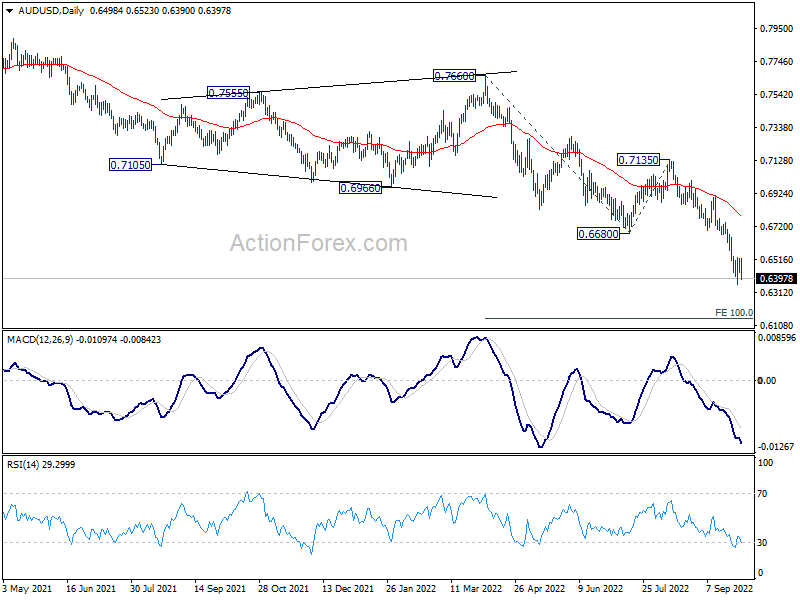
In the bigger picture, down trend form 0.8006 (2021 high) is expected to continue as long as 0.7135 resistance holds. With 61.8% retracement of 0.5506 (2020 low) to 0.8006 at 0.6461 firmly taken out, next target is 0.5506 low. Medium term momentum will now be closely monitored to gauge the chance of break of 0.5506.
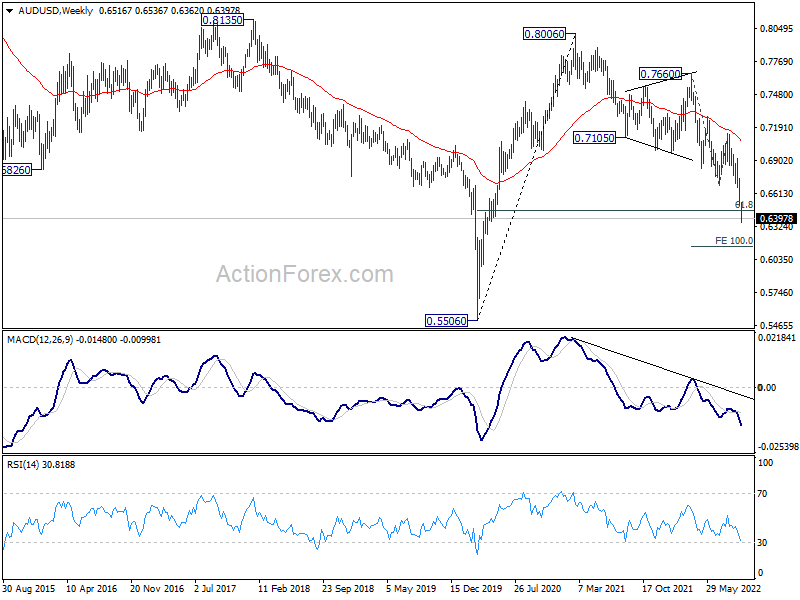
In the long term picture, current medium term downside momentum raises the chance of resumption of long term down trend from 1.1079 (2011 high). It's still a it early to judge the chance. But break of 0.5506 will target 0.4773 (2001 low).
USD/CAD Weekly Outlook
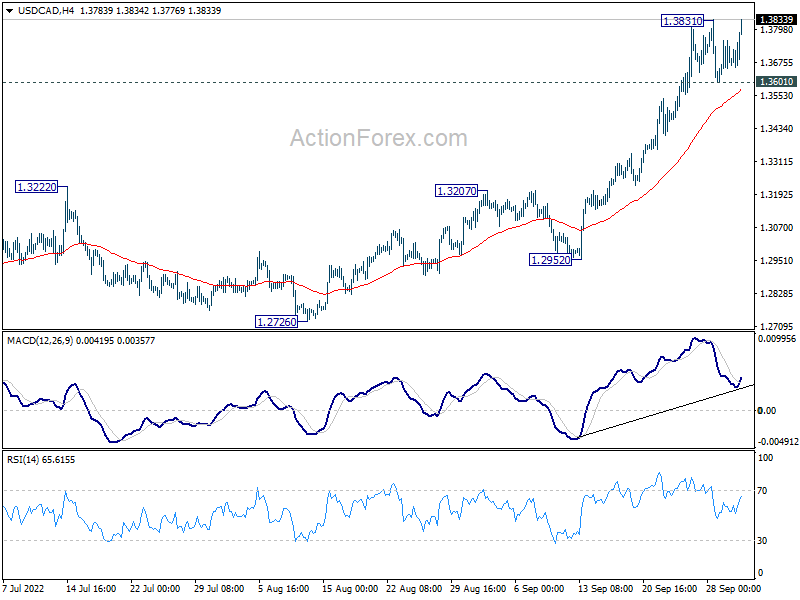
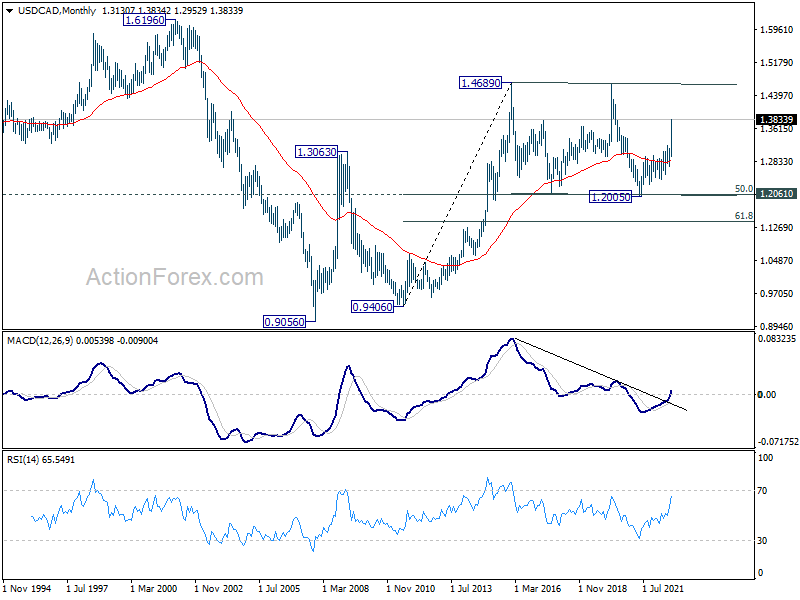
USD/CAD's up trend extended higher last week and resumed after brief retreat. Initial bias is back on the upside this week. next target is 161.8% projection of 1.2005 to 1.2947 from 1.2401 at 1.3925. Firm break there will target 200% projection at 1.4285. On the downside, break of 1.3601 minor support is needed to indicate short term topping. Otherwise, outlook will stay bullish in case of retreat.
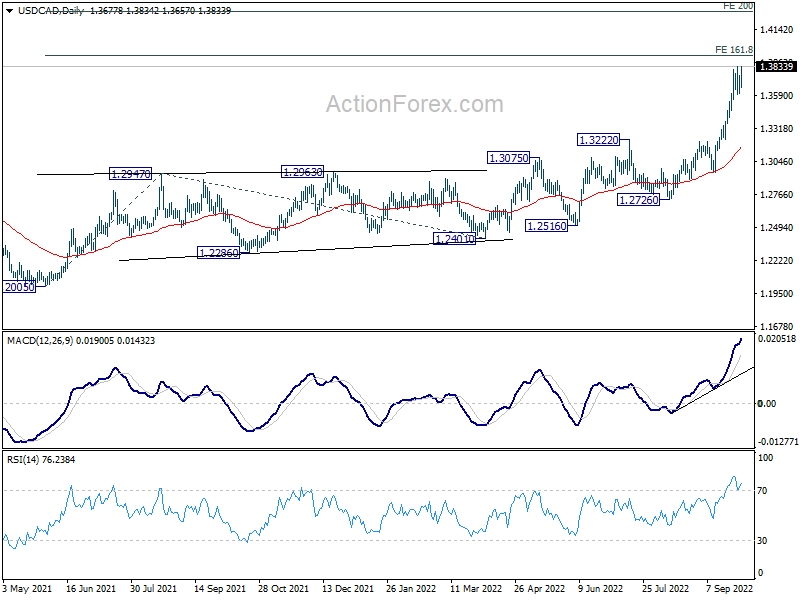
In the bigger picture, up trend from 1.2005 (2021 low) is still in progress. Based on current impulsive momentum, it could be resuming long term up trend from 0.9056 (2007 low). Whether it is or it isn't, retest of 1.4689 (2016 high) should be seen next. This will now remain the favored case as long as 1.3222 resistance turned support holds.
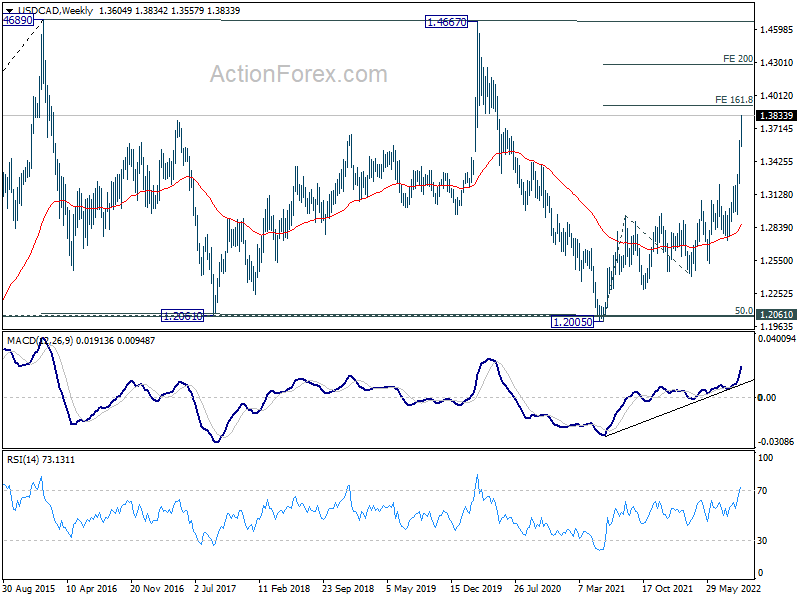
In the longer term picture, price actions from 1.4689 (2016 high) are seen as a consolidation pattern only, which might have completed at 1.2005. That is, up trend from 0.9506 (2007 low) is expected to resume at a later stage. This will remain the favored case as long as 1.2061 support holds, which is close to 50% retracement of 0.9406 to 1.4689 at 1.2048.
GBP/JPY Weekly Outlook
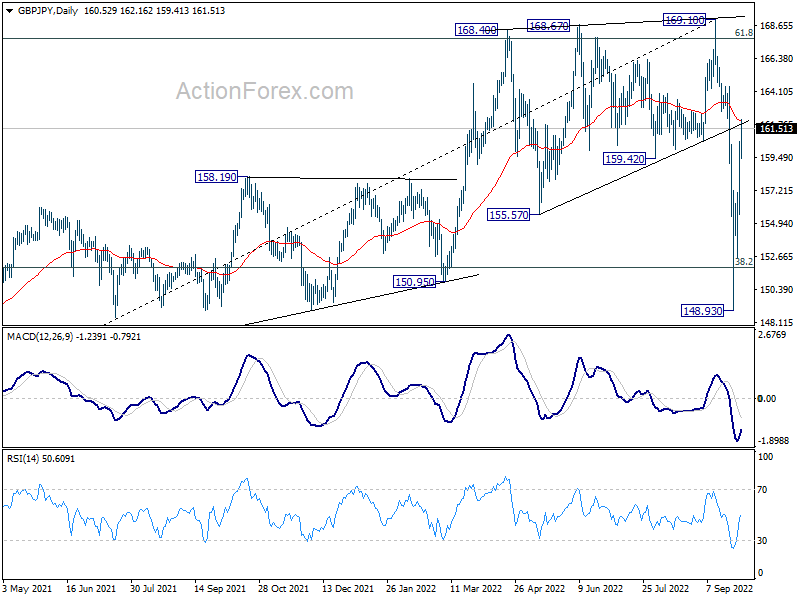
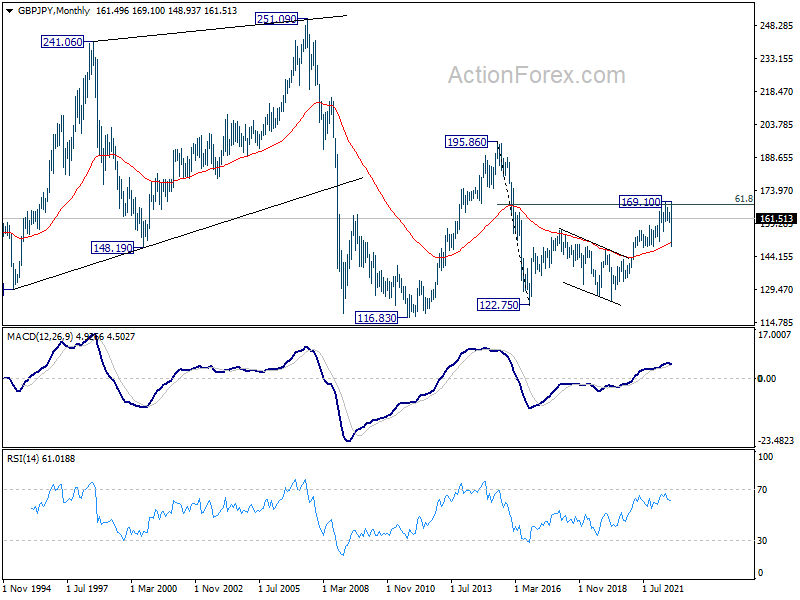
GBP/JPY dived to as low as 148.93 last week but rebounded strongly since then. The development suggest that corrective fall from 169.10 has completed after drawing support from 151.84 long term fibonacci level. Initial bias stays on the upside this week for retesting 169.10 high. On the downside, though, break of 155.63 minor support will turn bias back to the downside for 148.93 low again.
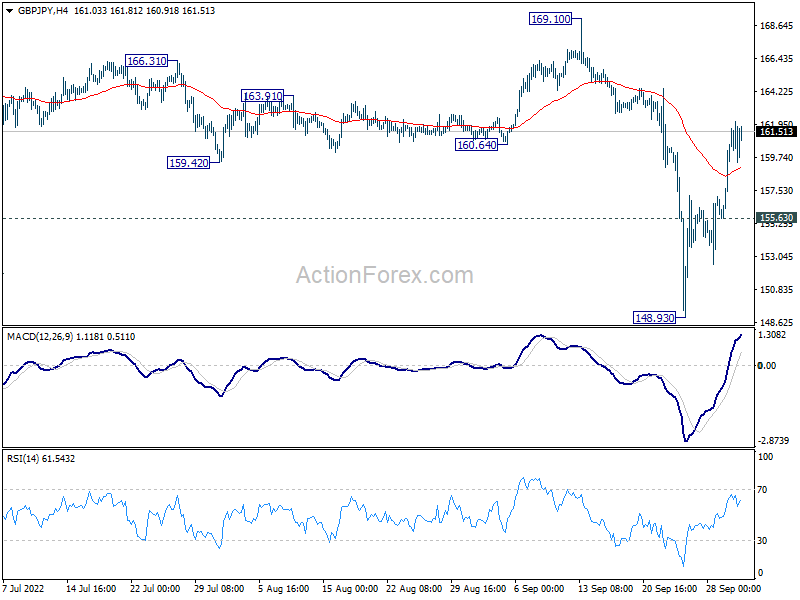
In the bigger picture, strong support from 38.2% retracement of 123.94 to 169.10 at 151.84 suggests that price actions from 169.10 are developing into a corrective pattern only. That is, rise from 123.94 (2020 low) should resume at a later stage. This will now remain the favored case as long as 148.93 support holds.
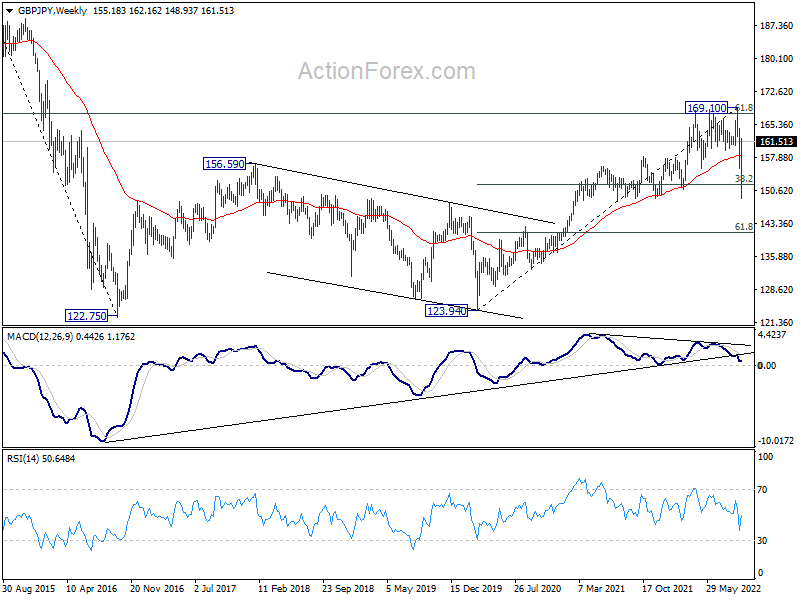
In the longer term picture, as long as 55 month EMA (now at 150.40) holds, rise from 122.75 could still extend higher at a later stage. However, sustained break of 55 month EMA will ague that whole rise has completed, and open up deeper fall back to 116.83/122.75 support zone.
EUR/JPY Weekly Outlook
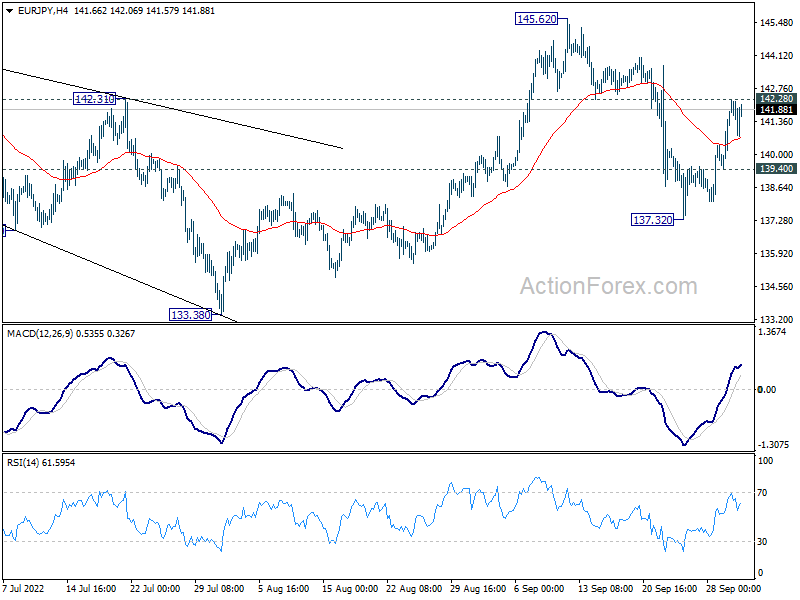
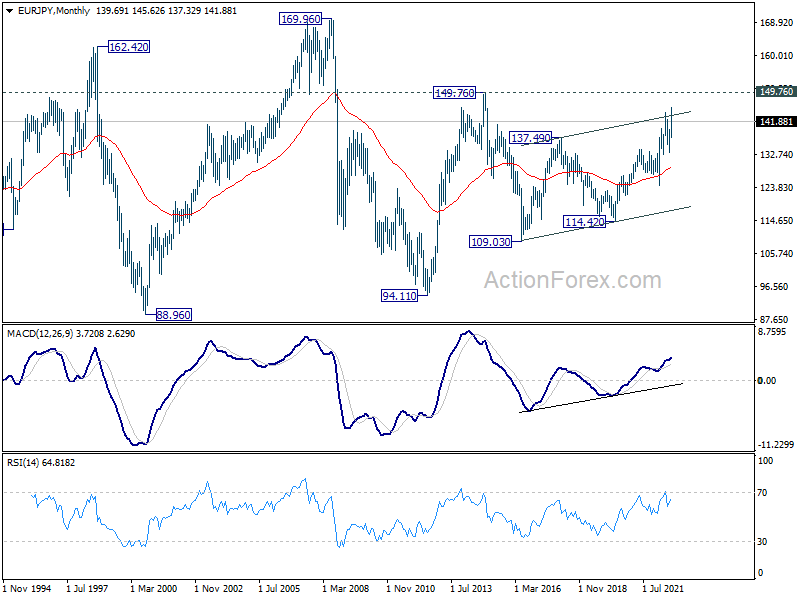
EUR/JPY rebounded strongly after dipping to 137.32 last week, but stays below 142.28 resistance. Initial bias remains neutral this week first. On the upside, break of 142.28 will indicate that the pull back from 145.62 has completed, and bring stronger rally to retest this high. On the downside, though, break of 139.40 minor support will turn bias back to the downside, to resume the fall from 145.62 through 137.32 support.
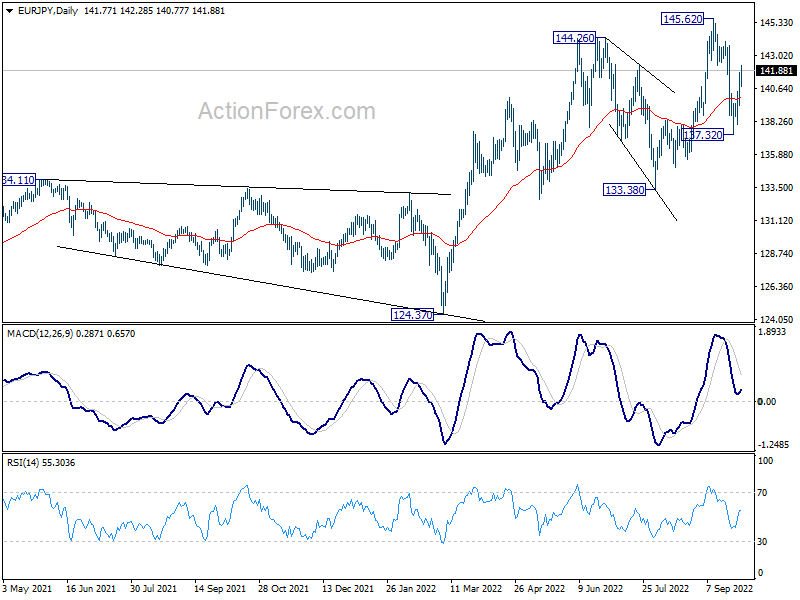
In the bigger picture, as long as 133.38 support holds, the up trend from 114.42 (2020 low) could still extend through 145.62 high. In that case, next target is 149.76 (2015 high). However, sustained break of 133.38 will be a sign of medium term bearish reversal and bring deeper fall to 124.37 support first.
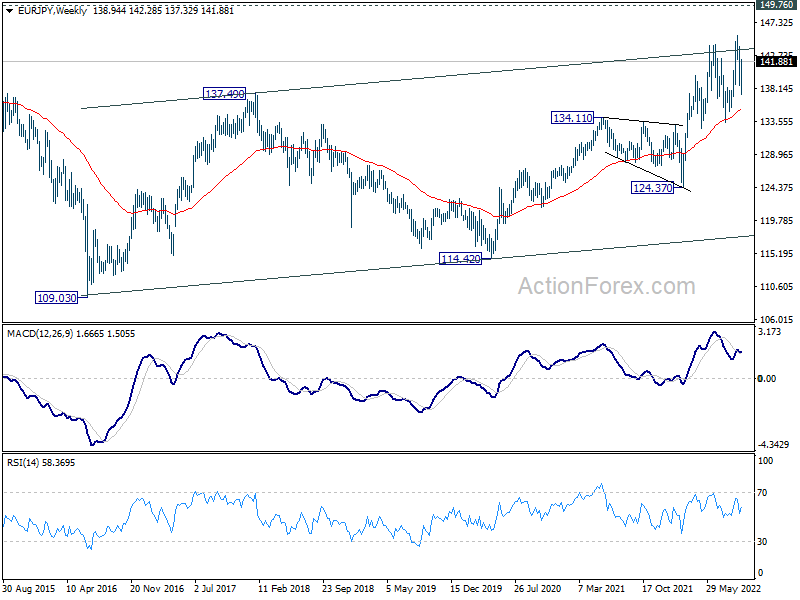
In the long term picture, as long as 55 month EMA (now at 129.41) holds, up trend 109.03 should still extend higher to 149.76 resistance (2014 high). However, sustained break of 55 month EMA will argue that the three wave pattern has completed, and bring deeper fall back to 109.03/114.42 support zone.
EUR/GBP Weekly Outlook
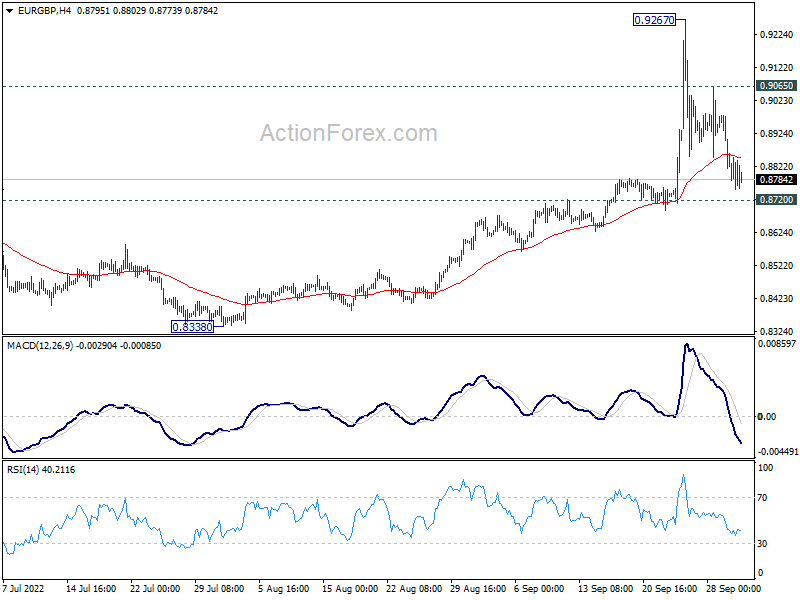
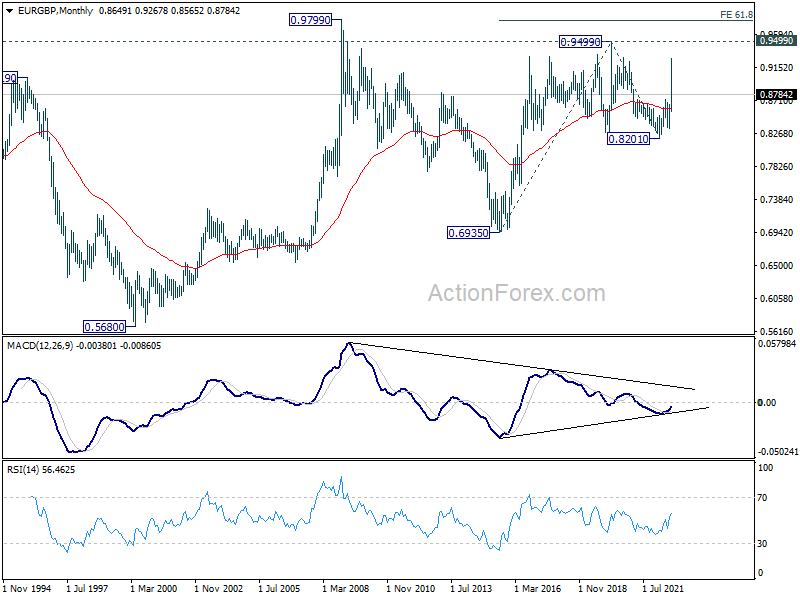
EUR/GBP spiked higher to 0.9267 last week but dropped sharply from there. As downside is contained above 0.8720 resistance turned support, there is no confirmation of reversal yet. Initial bias stays neutral this week. Break of 0.9065 minor resistance will bring retest of 0.9267. However, firm break of 0.8720 will argue that whole rise from 0.8201 has completed, and target 55 day EMA (now at 0.8631) first.
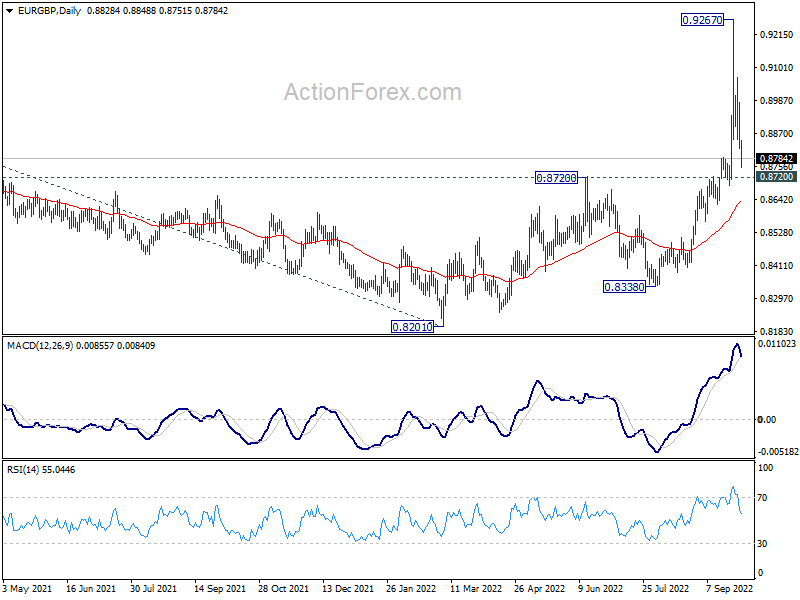
In the bigger picture, as long as 0.8720 resistance turned support holds, rise from 0.8201 is seen as resuming larger up trend from 0.6935 (2015 low). Break of 0.9499 (2020 high) should be seen at a later stage. However, firm break of 0.8720 will argue that sideway pattern from 0.9499 is extending with another falling leg instead.
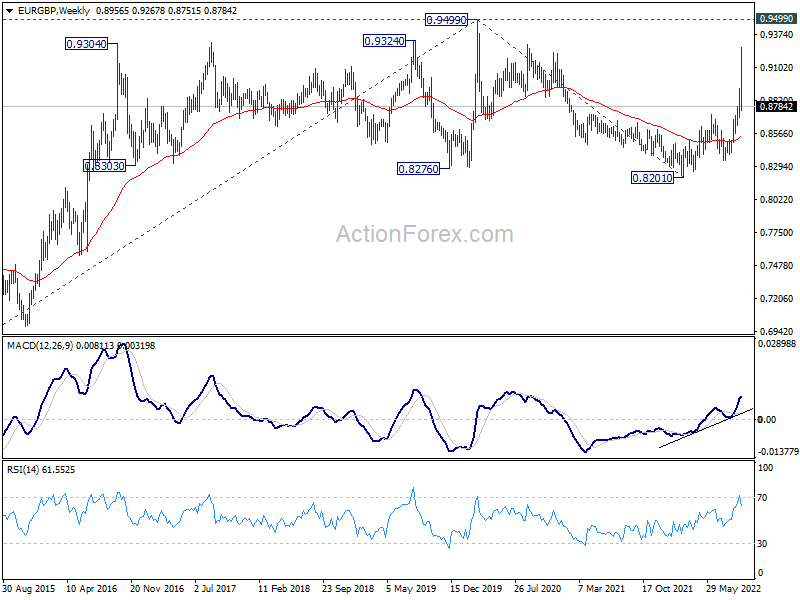
In the long term picture, the fall form 0.9499 (2020 high), as a correction to rise from 0.6935 (2015 low), could have completed 0.8201. It's still early to judge that up trend is ready to resume. But in that case, further rise would be seen to 0.9499 first, and then 0.9799 (2009 high).
EUR/AUD Weekly Outlook
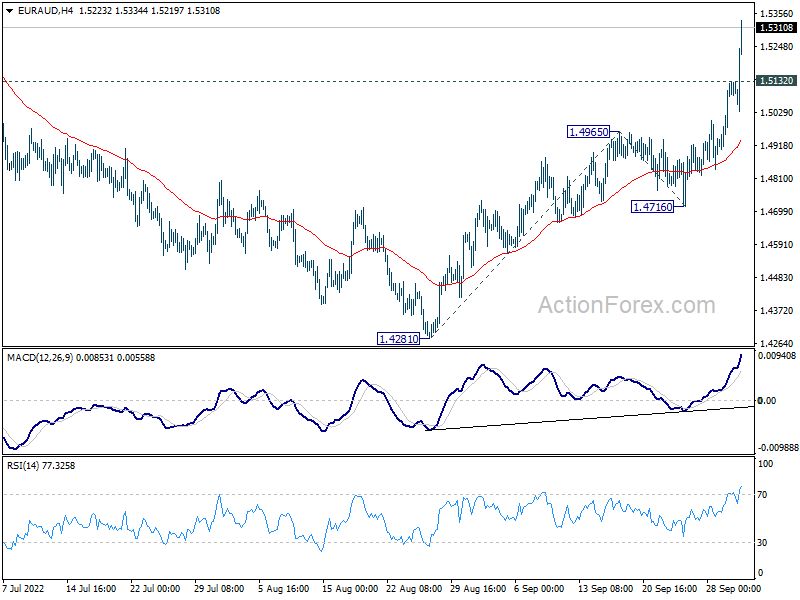
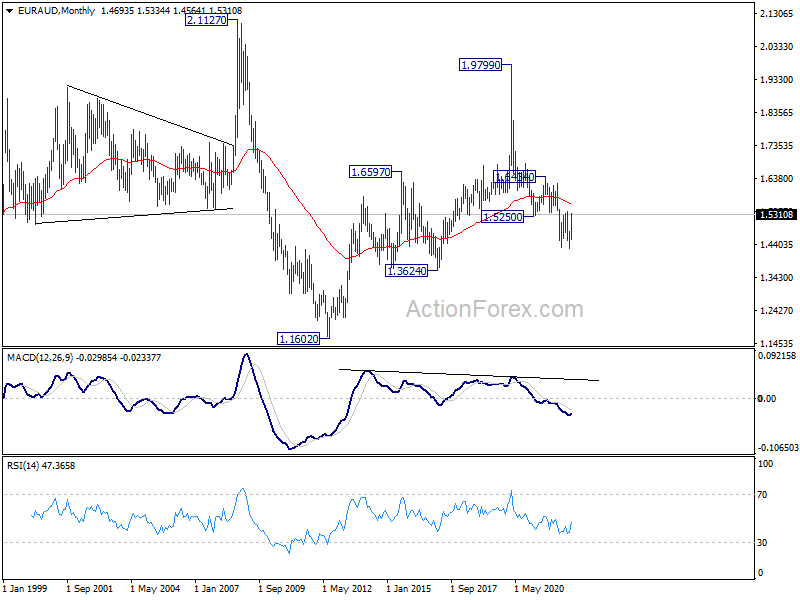
EUR/AUD's rebound from 1.4281 resumed last week and accelerated to close strongly at 1.5310. Initial bias stays on the upside this week for 100% projection of 1.4281 to 1.4965 from 1.4716 at 1.5400, which is close to 1.5396 key resistance. Firm break there will carry larger bullish implication. Next target is 161.8% projection at 1.5823. On the downside, below 1.5132 minor support will turn intraday bias neutral first.
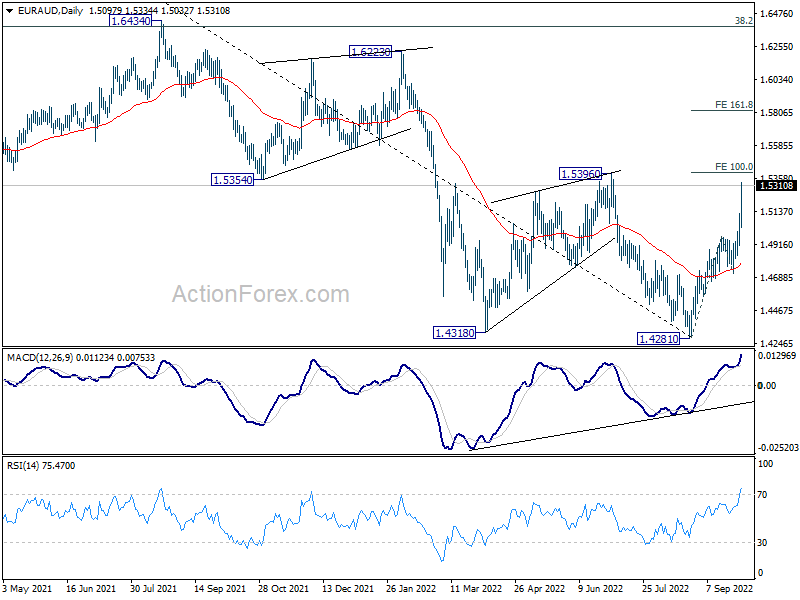
In the bigger picture, current development raises the chance of medium term bottoming at at 1.4281, on bullish convergence condition in daily MACD. Firm break of 1.5396 will bring stronger rally back to 1.6434 key resistance next. Nevertheless, rejection by 1.5396 will maintain medium term bearishness for another fall through 1.4281 at a later stage.
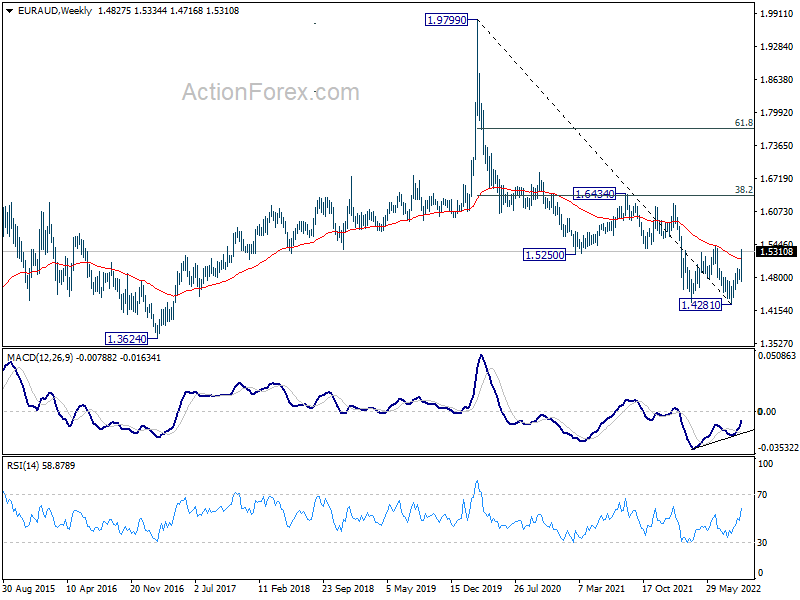
In the longer term picture, as long as 55 month EMA (now at 1.5610) holds, the down trend from 1.9799 (2020 high) could still extend to 1.3624 long term support, and below. However, sustained trading above 55 month EMA will raise the chance that this down trend was over. Further break of 1.6434 resistance should confirm medium term bullish reversal.
EUR/CHF Weekly Outlook
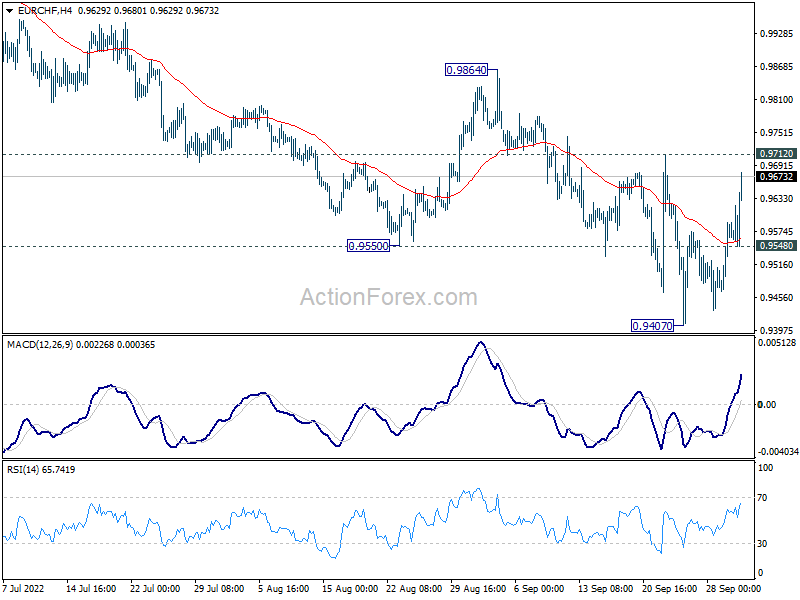
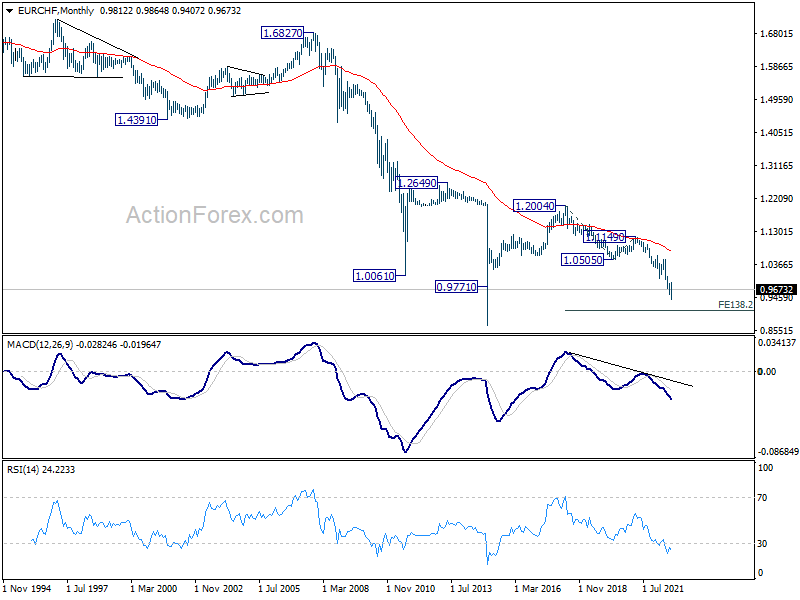
EUR/CHF rebounded strongly after edging lower to 0.9407 last week. But upside is limited below 0.9712 resistance so far. Initial bias stays neutral this week first. On the upside, break of 0.9712 will argue that fall from 0.9864 has completed totally at 0.9407, and bring stronger rally back to this résistance. Further break there will carry larger bullish implication. Nevertheless, break of 0.9548 minor support will retain near term bearishness, and bring retest of 0.9407 low first.
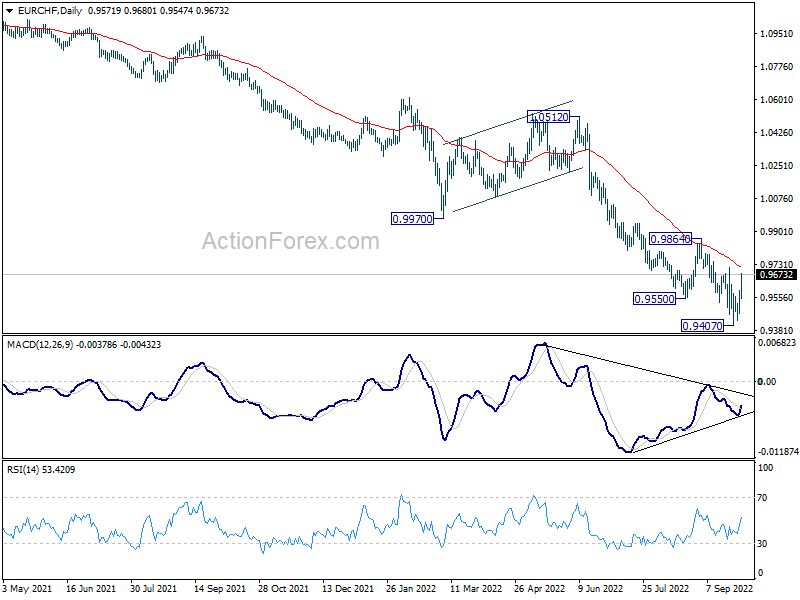
In the bigger picture, as long as 0.9864 resistance holds, long term down trend from 1.2004 (2008 high) is expected to continue. Next target is 138.2% projection of 1.2004 to 1.0505 to 1.1149 at 0.9033. However, firm break of 0.9864 will indicate medium term bottoming, on bullish convergence condition in daily MACD. Stronger rally would then be seen back to 55 week EMA (now at 1.0188).
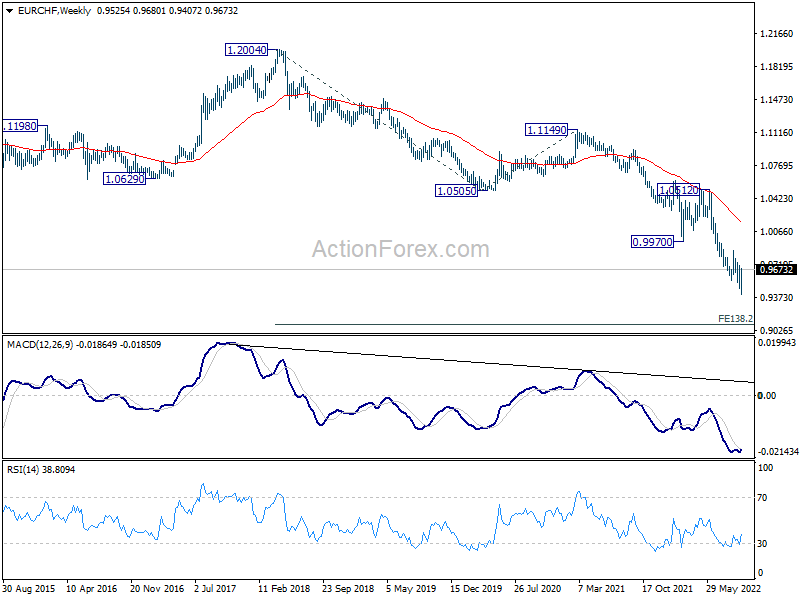
In the long term picture, capped below 55 month EMA, EUR/CHF is seen as extending the multi-decade down trend. There is no prospect of a bullish reversal until firm break of 1.0505 support turned resistance (2020 low).
Summary 10/3 – 10/7
Monday, Oct 3, 2022
[php_everywhere instance="1"]
Tuesday, Oct 4, 2022
[php_everywhere instance="2"]
Wednesday, Oct 5, 2022
[php_everywhere instance="3"]
Thursday, Oct 6, 2022
[php_everywhere instance="4"]
Friday, Oct 7, 2022
[php_everywhere instance="5"]
Weekly Economic & Financial Commentary – Easy on the Gas: Germany Institutes Energy Price Cap
Summary
United States: Going to Take More to Break This Consumer
- Incoming data indicate a slowing yet resilient economy. Recent strength makes it less likely in our view that a recession will start by the beginning of next year and also means more monetary tightening will be necessary to slow growth sufficiently to quell elevated inflation. We still forecast a modest recession next year, but now are expecting it to begin a bit later.
- Next week: ISM Manufacturing Index (Mon), ISM Services Index (Wed), Employment (Fri)
International: Bank of England Intervenes to Calm Markets; Eurozone Inflation Hits Double Digits
- After the U.K.'s mini budget fueled concerns about inflation, the BoE committed to temporarily buying unlimited long-dated gilts to soothe markets, and will make a full assessment at its next policy meeting on November 3, where we expect a 100 bps rate hike. In other news, Eurozone September CPI reached 10% year-over-year. With the natural gas supply relationship between Russia and Europe deteriorating, there are concerns that energy prices will climb even higher.
- Next week: Japan Tankan Survey (Mon), RBA Decision (Tue), RBNZ Decision (Wed)
Interest Rate Watch: Update to Our Fed Funds Forecast
- The continued resiliency of the U.S. economy and the FOMC's apparent willingness to do "whatever it takes" to rein in inflation has led us to upwardly revise our forecast. We now see the Committee taking its target range for the fed funds rate to 4.75%-5.00% by Q1-2023.
Credit Market Insights: Five Trillion Down, Still 26 Trillion Up
- The Fed's updated Distributional Financial Accounts indicated declining household wealth over Q2 of this year. Since its peak in the Q4-2021, household wealth is down over $5 trillion, from $141.9T to $135.8T, and all but a quarter trillion of this decline occurred in Q2. Even with the recent hit to wealth, household wealth is still almost 24% above pre-pandemic levels.
Topic of the Week: Easy on the Gas: Germany Institutes Energy Price Cap
- On Thursday, the German government announced plans to institute a $194B package aimed at curtailing crippling energy costs. This announcement came on the same day that Germany’s September CPI report revealed inflation surging to a scorching hot 10.9% year-over-year.
RBNZ to Stick to its Guns, Eyes on Guidance
The month of October will mark a year since the Reserve Bank of New Zealand (RBNZ) launched its tightening campaign. Despite the nonstop rate increases, the central bank will not abandon its mission against inflation as the impact has been negligible so far, with traders largely expecting another half percentage point rate hike on Wednesday at 02:30 GMT.
RBNZ to raise rates by 50bps
A delayed lift of travel restrictions, China’s zero-covid policy, and a darkening global economic outlook overshadowed the impact of the RBNZ’ stimulus reduction, squeezing the risk-sensitive kiwi by more than 10% over the past year.
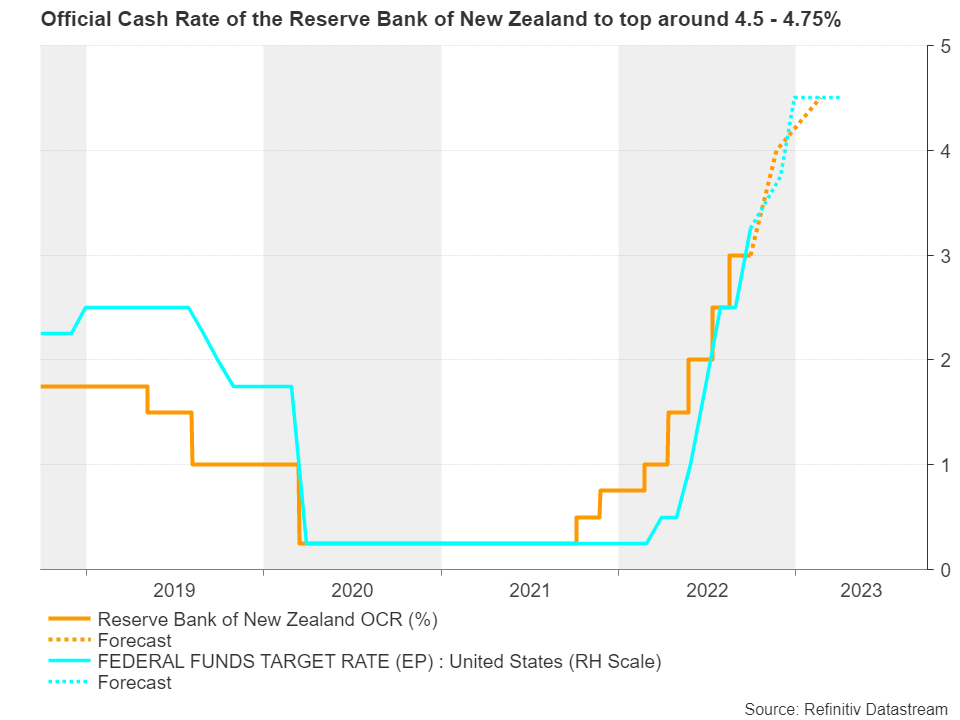
What is worse is that a plummeting domestic currency is making imports more expensive, adding more fuel to inflation that is already hot. Although the RBNZ was the first among the major central banks to enter the tightening era, increasing its benchmark rate abruptly from 0.25% to 3.0%, inflation continued to accelerate dangerously like elsewhere in the world. The latest quarterly CPI report for the three months to June showed consumer prices rising at the fastest pace in 32 years at 7.3% y/y and far above the central bank’s 1-3% target.
The next inflation update will be on October 18 but given evidence from abroad, there is not much room for doubt that consumer prices kept growing at an unacceptable pace, or at least eased at a snail pace during the third quarter. Hence, as investors have largely priced in, the RBNZ will probably stay on its hawkish path this week, announcing its fifth 50 bps rate hike in a row. Such an action would put interest rates above the Fed funds rate.
FX intervention
The depreciation in the currency has come under the spotlight after Japan’s FX intervention. However, a similar response in New Zealand is less likely. Firstly, the RBNZ has a far smaller share of foreign reserves than its US, Asian and European peers. Secondly, other major currencies have been falling aggressively too, but the kiwi is still relatively cheaper against the greenback, the euro and the pound, keeping exports and tourism competitive in international markets.
Rate guidance in focus
Monetary divergence with the Fed, and hence the spread between the US and New Zealand 10-year government bond yields, is narrow. Therefore, unless a sudden change in global risks, and particularly in the slowing Chinese economy, happens, the central bank’s policy guidance could be the only factor to set the mood in kiwi/dollar in the shor term.
Futures markets are currently foreseeing three more 50bps rate increases to be delivered by February 2023 and expect the central bank to gear down to normal 25bps rate hikes afterwards. Strikingly, the RBNZ chief Adrian Orr admitted that although some work still needs to be done, the “tightening cycle is very mature”, increasing speculation that the central bank could soon change course.
On the other hand, a majority of economists including the Westpac Banking corporation, have recently revised their 2023 rate forecasts upwards to 4.5-4.75% and higher than the RBNZ’s projected terminal rate of 4.10%, citing the resilience in the economy and the potential secondary inflation pressures that may subsequently emerge. Indeed, the surprisingly strong Q2 GDP growth numbers, the robust labor market, and the improvement in profit expectations and business activities suggest that the economy can still afford higher-debt service costs.
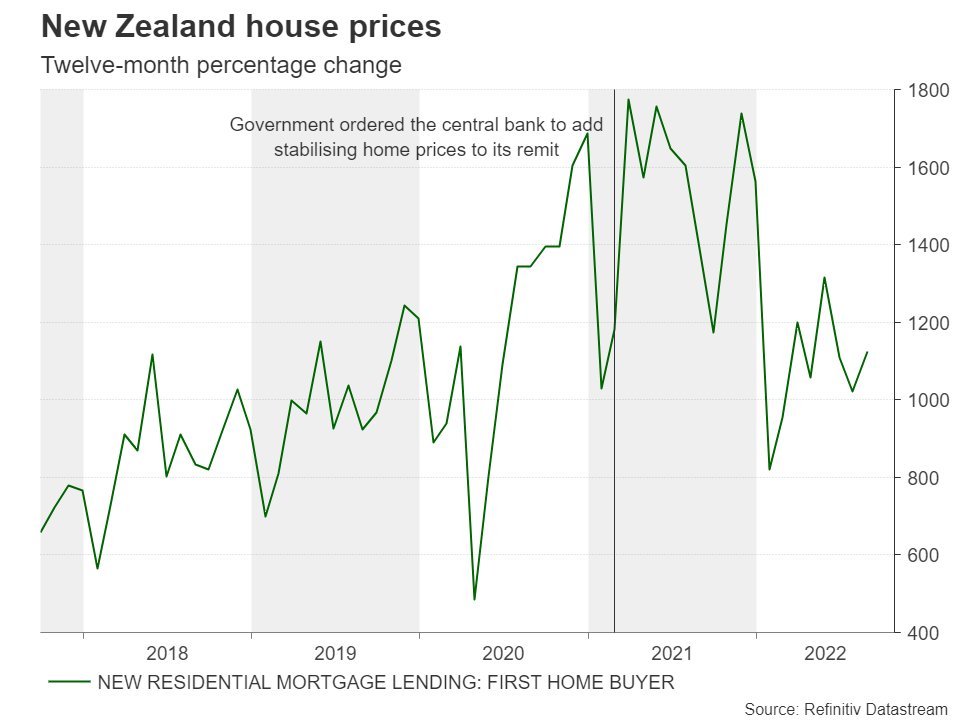
However, sectors such as the property market will need careful monitoring given the high household debt to income if rates keep spiraling higher. According to Westpac, nationwide housing prices dropped by 9.0% since last November. and the flattening trajectory in retail spending is already signaling more softness ahead. Note wage growth is still sluggish when compared to inflation.
NZD/USD
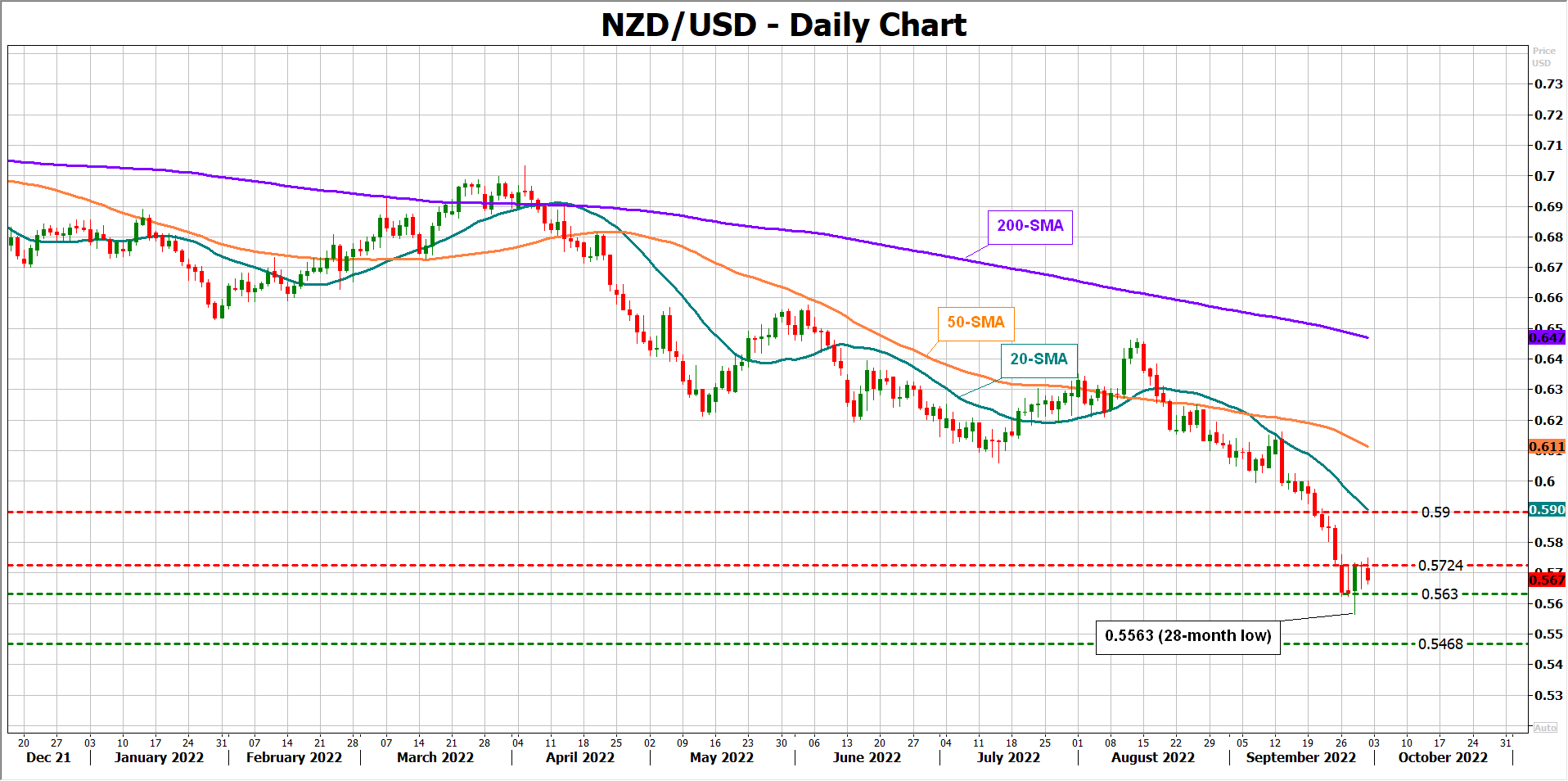
Hence, with investors getting conflicting signals about the path of monetary tightening in 2023, the kiwi might appear vulnerable to any tweaks in the RBNZ’s language. If the central bank sees the terminal rate peak higher than previously thought and plays down the risk of a cooling housing market, kiwi/dollar could extend its recovery above the nearby resistance of 0.5724 and towards the 20-day simple moving average (SMA) at 0.5900. Higher, traders will look for a break above the 0.6000 mark.
Alternatively, if policymakers show concerns about the global economic conditions, judging that monetary tightening has done enough for inflation to stabilize over the next year, the pair will push for a close below the crucial support of 0.5627. The 2020 trough of 0.5468 may come on the radar in the event of steeper declines.