Sample Category Title
EUR/AUD Daily Outlook
Daily Pivots: (S1) 1.4759; (P) 1.4854; (R1) 1.4935; More...
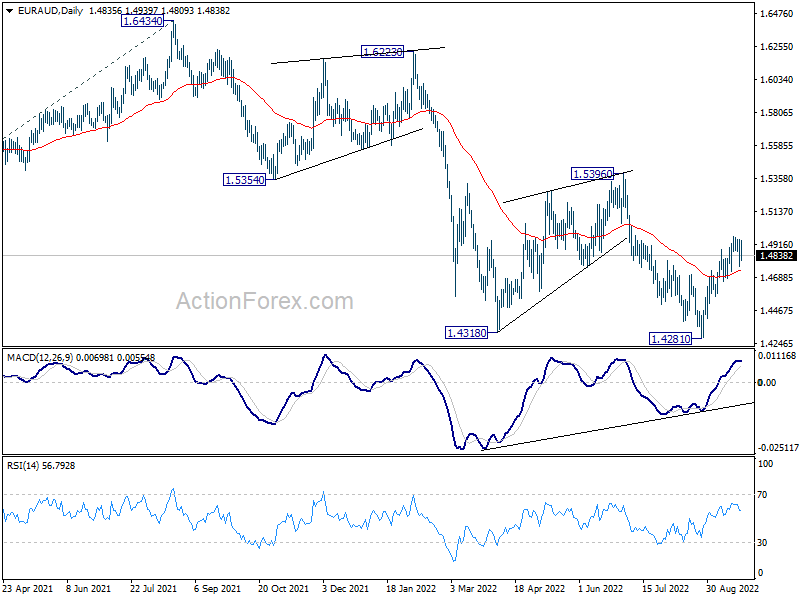
Intraday bias in EUR/AUD stays neutral for the moment, and further rise is in favor as long as 1.4663 minor support holds. On the upside, break of 1.4965 will resume the rise from 1.4281 towards 1.5396 resistance. On the downside, however, break of 1.4663 minor support will turn bias back to the downside for retesting 1.4281 low.
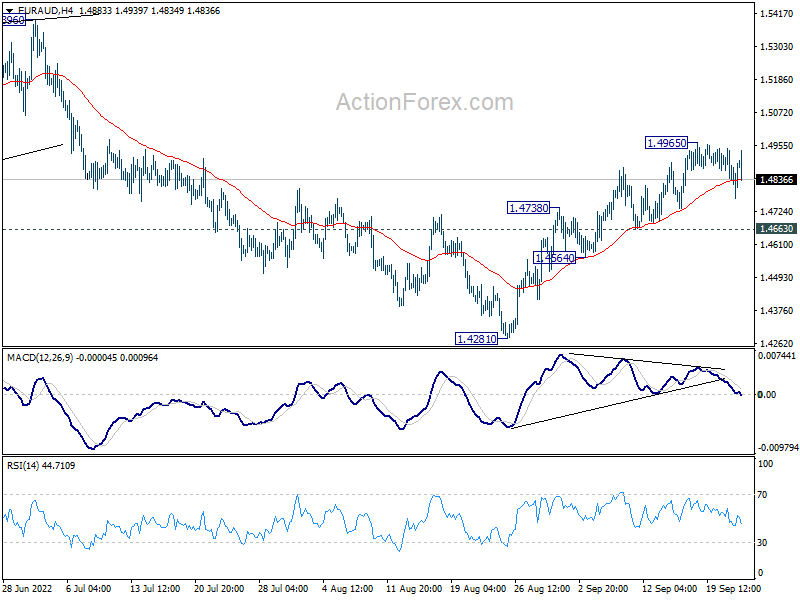
In the bigger picture, down trend from 1.9799 is still in progress. Break of 1.4318 low will target 61.8% projection of 1.9799 to 1.5250 from 1.6434 at 1.3623, which is close to 1.3624 long term support (2017 low). This will remain the favored case now as long as 1.5396 resistance holds.
EUR/CHF Daily Outlook
Daily Pivots: (S1) 0.9471; (P) 0.9548; (R1) 0.9588; More....
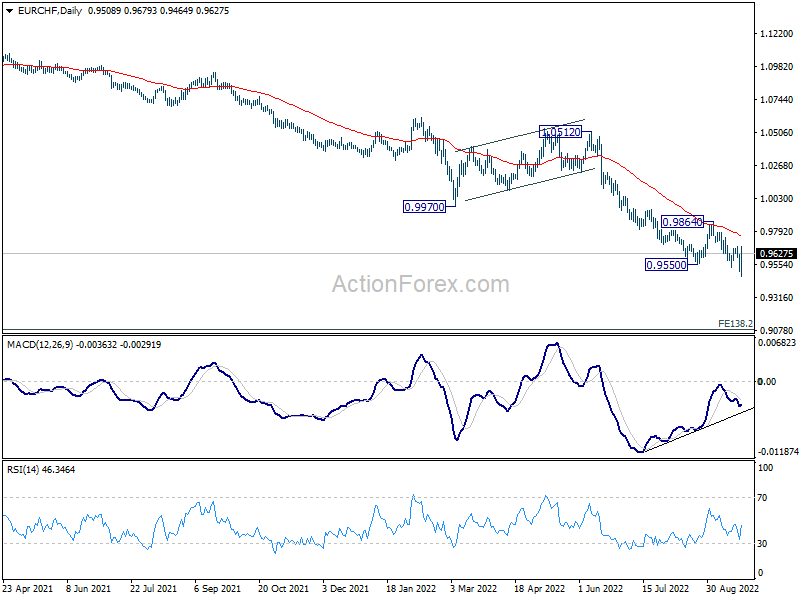
Intraday bias in EUR/CHF is turned neutral first as it rebounded strongly after dipping to 0.9464. On the upside, break of 0.94680 will bring stronger rise back to 0.9864 resistance. Decisive break there will indicate near term reversal. On the downside, below 0.9464 will resume larger down trend.
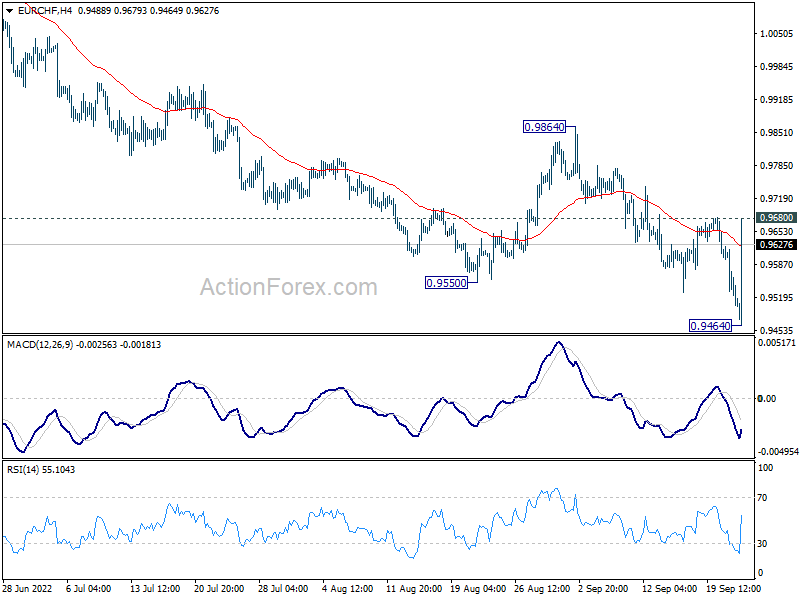
In the bigger picture, long term down trend from 1.2004 (2018 high) is still in progress. Next target is 138.2% projection of 1.2004 to 1.0505 to 1.1149 at 0.9033. On the upside, break of 0.9864 resistance is needed to be the first sign of medium term bottoming. Otherwise, outlook will stay bearish in case of strong rebound.
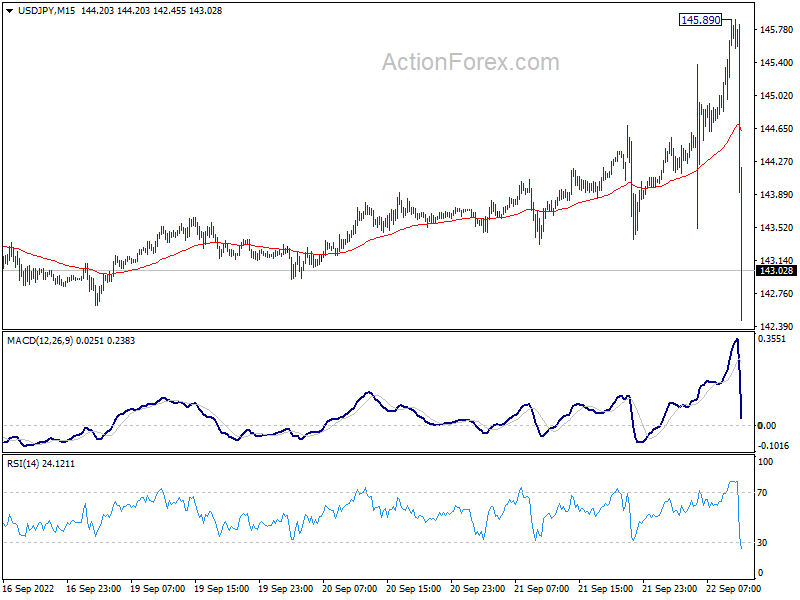
Yen rebounds as Japan confirmed decisive intervention action taken
Yen reverses earlier decline and rebounds strongly, after a top currency diplomat confirmed that the government have intervened in the foreign exchange market for the first time since 1998. Masato Kanda , vice finance minister for international affairs, told reporters, "we have taken decisive action" on in the markets.
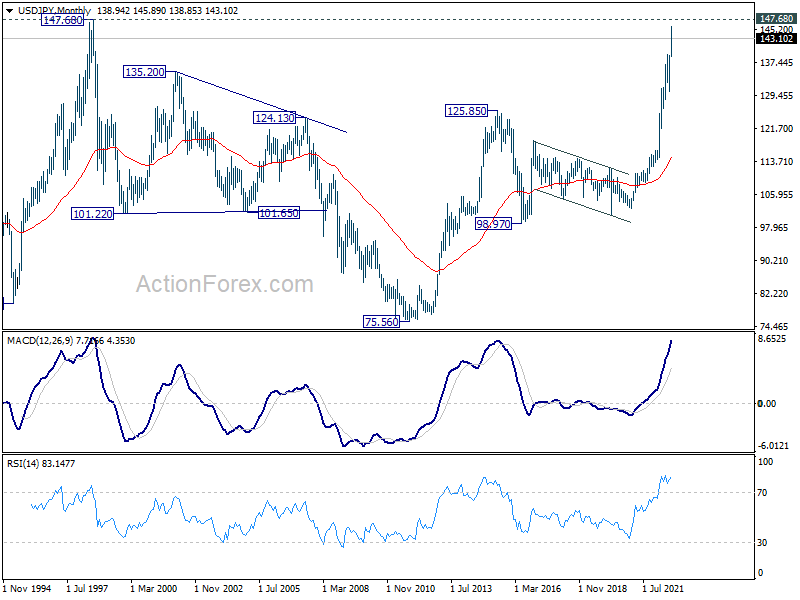
USD/JPY is hammed down after jumping to 145.89 earlier today, on hawkish Fed. It now seems that Japan could become more active when USD/JPY get close to 1998 high at 147.68.
USD/CAD Daily Outlook
Daily Pivots: (S1) 1.3394; (P) 1.3432; (R1) 1.3505; More...
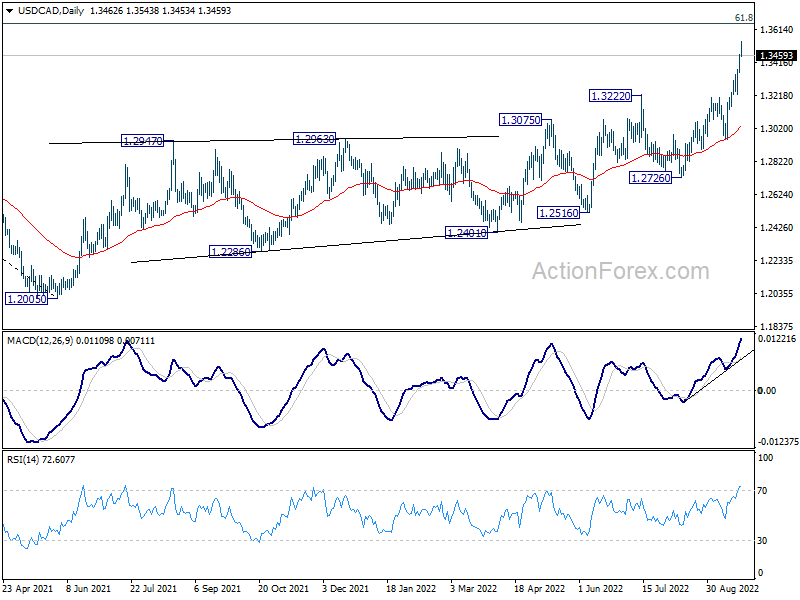
Intraday bias in USD/CAD remains on the upside for the moment. Current up trend should target medium term fibonacci level at 1.3650. On the downside,below 1.3343 minor support will turn intraday bias neutral and bring consolidations first, before staging another rally.
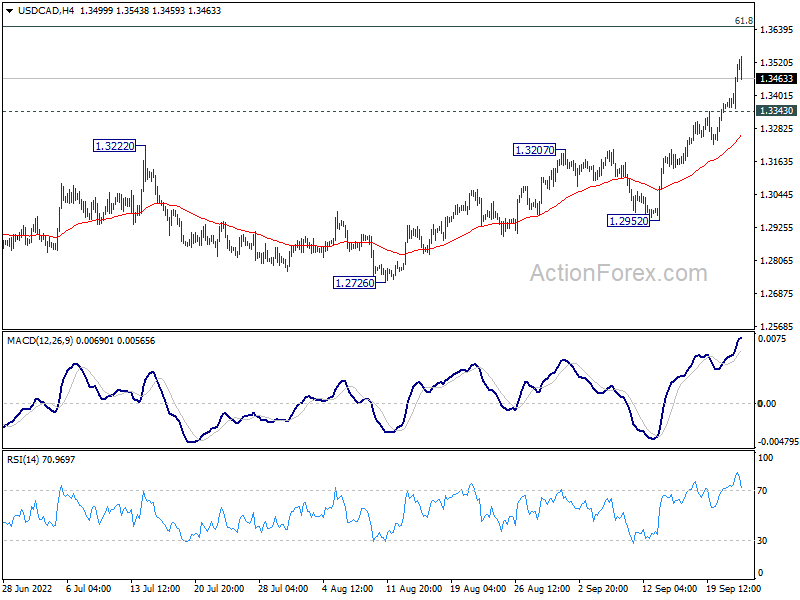
In the bigger picture, down trend from 1.4667 (2020 high) should have completed at 1.2005, after defending 1.2061 long term cluster support. Rise from there should target 61.8% retracement of 1.4667 to 1.2005 (2021 low) at 1.3650. This will remain the favored case now as long as 1.2716 support holds.
AUD/USD Daily Report
Daily Pivots: (S1) 0.6601; (P) 0.6653; (R1) 0.6684; More...
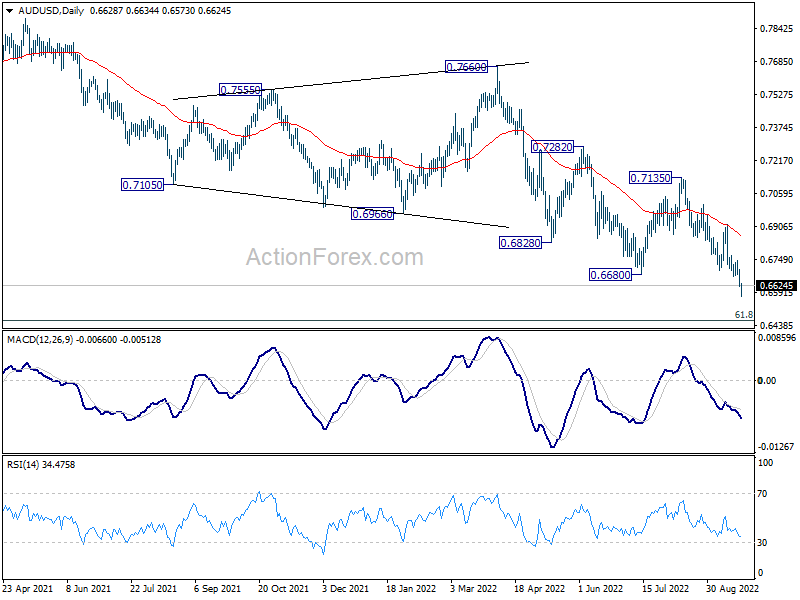
Intraday bias in AUD/USD stays on the downside at this point. Current down trend should target 0.6461 long term fibonacci level. On the upside, above 0.6698 support turned resistance will turn intraday bias neutral and bring consolidations. But outlook will now remain bearish as long as 0.6915 resistance holds, in case of recovery.
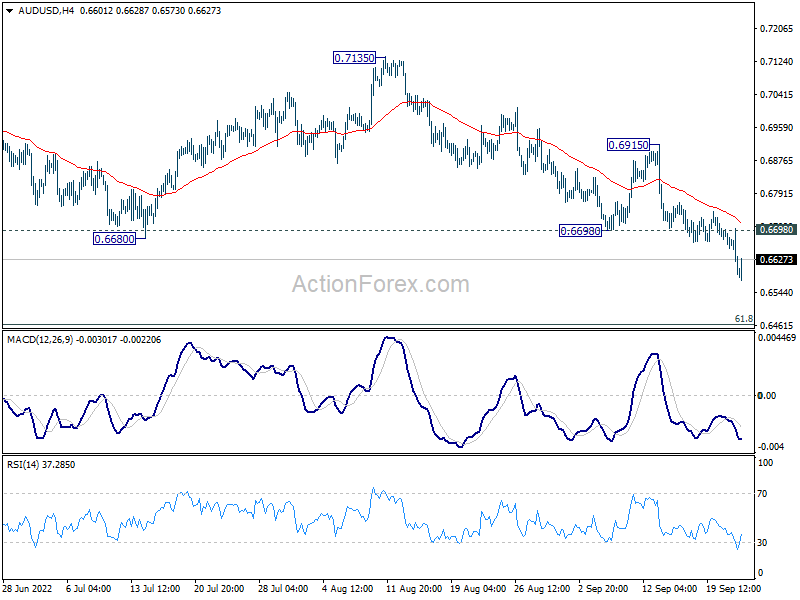
In the bigger picture, price actions from 0.8006 (2021 high) is seen more as a corrective pattern to rise from 0.5506 (2020 low). Or it could also be a bearish impulsive move. In either case, outlook will remain bearish as long as 0.7135 resistance holds. Next target is 61.8% retracement of 0.5506 to 0.8006 at 0.6461.
USD/JPY Daily Outlook
Daily Pivots: (S1) 143.39; (P) 144.05; (R1) 144.74; More...
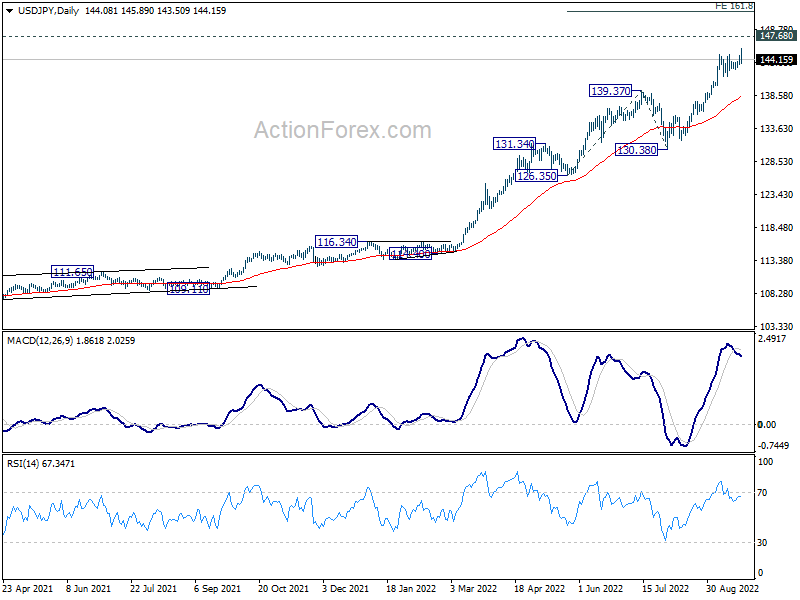
USD/JPY's rally resumes by breaking 114.98 and intraday bias is back on the upside. Current up trend should target 147.68 long term resistance. Break there will target 161.8% projection of 126.35 to 139.37 from 130.38 at 151.44 next. On the downside, break of 142.63 minor support will turn intraday bias neutral again first.
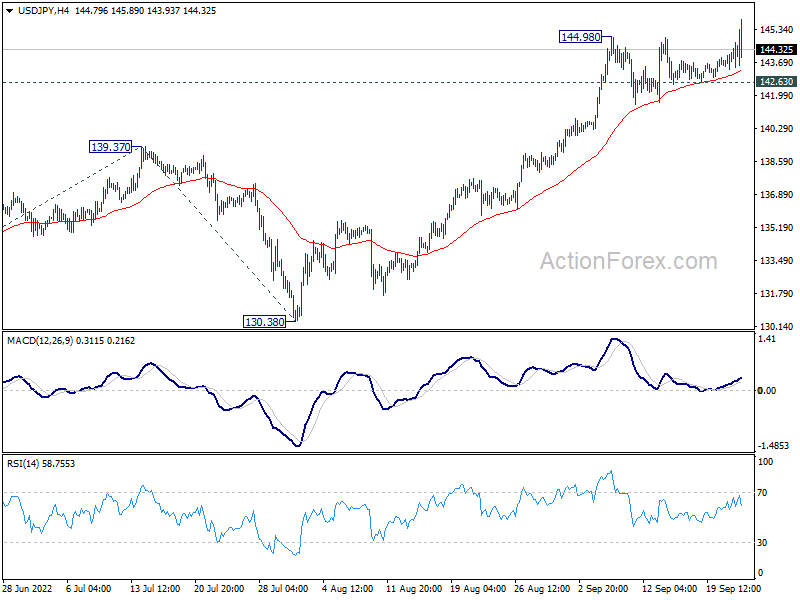
In the bigger picture, up trend from 101.18 is still in progress, as part of the whole up trend from 75.56 (2011 low). Further rise should be seen to 147.68 (1998 high). For now, break of 130.38 support is needed to be the first indication of medium term topping. Otherwise, outlook will stay bullish even in case of deep pull back.
USD/CHF Daily Outlook
Daily Pivots: (S1) 0.9623; (P) 0.9662; (R1) 0.9702; More
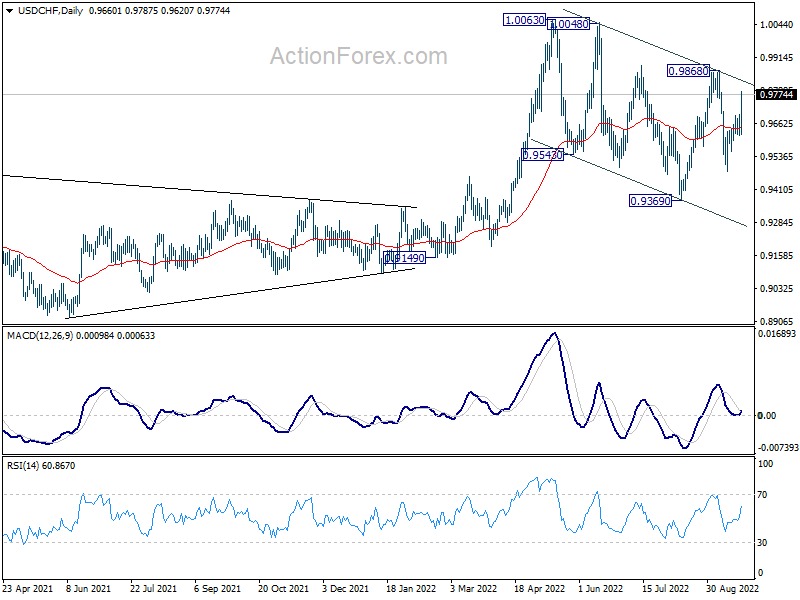
USD/CHF's rally resumed after brief consolidations and intraday bias is back on the upside for 0.9868 resistance first. Break there will argue that larger up trend is ready to resume through 1.0063. Overall, the corrective pattern from 1.0063 high could still extend. Below 0.9619 minor support will turn bias back to the downside for 0.9478 and below.
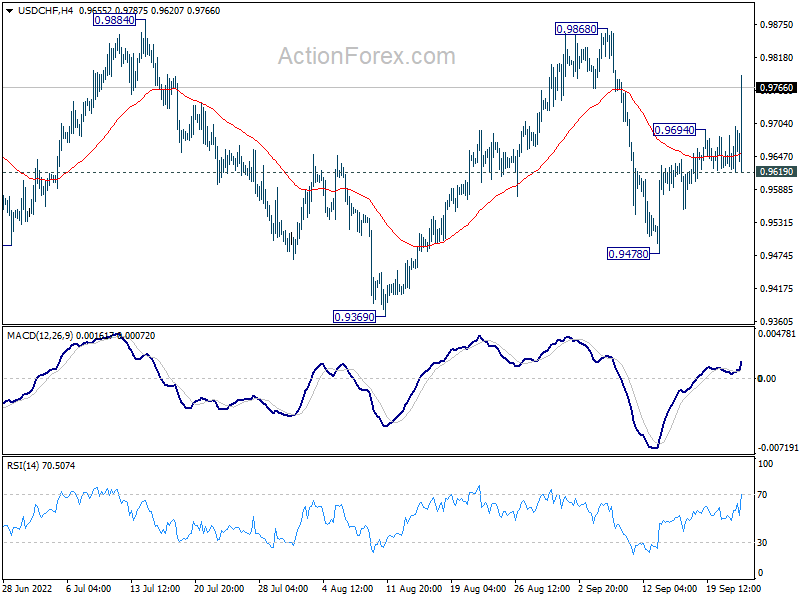
In the bigger picture, current development suggests that up trend from 0.8756 (2021 low) is still in progress. Sustained break of 1.0063 will target 100% projection of 0.9149 to 1.0063 from 0.9369 at 1.0283, and then 1.0342 (2016 high). For now, this will remain the favored case as long as 0.9369 support holds, even in case of deep pull back.
GBP/USD Daily Outlook
Daily Pivots: (S1) 1.1209; (P) 1.1297; (R1) 1.1357; More...
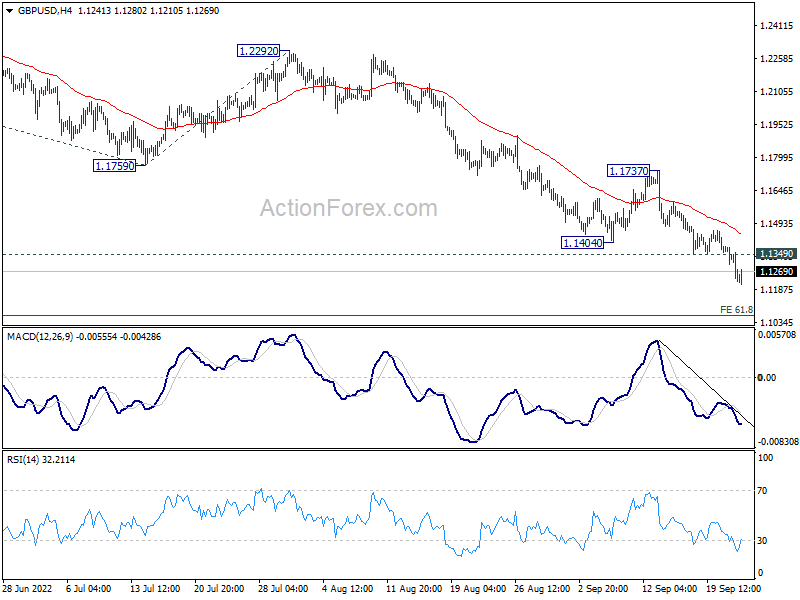
GBP/USD's decline is still in progress and intraday bias stays on the downside. Current down trend should target 61.8% projection of 1.3748 to 1.1759 from 1.2292 at 1.1063 next. On the upside, above 1.1349 minor resistance will turn intraday bias neutral first. But outlook will stay bearish as long as 1.1737 resistance holds, in case of recovery.
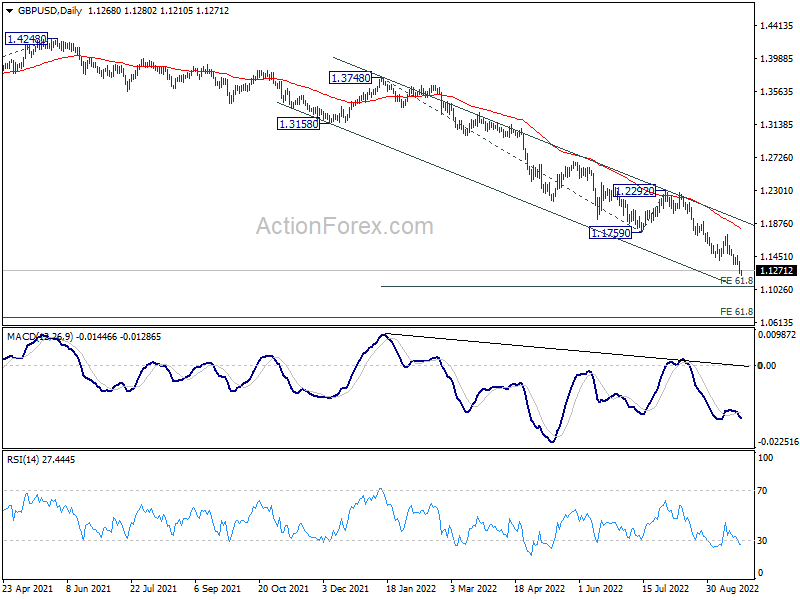
In the bigger picture, based on current momentum, fall from 1.4248 (2018 high) is probably resuming long term down trend from 2.1161 (2007 high). Sustained break of 1.1409 will target 61.8% projection of 1.7190 (2014 high) to 1.1409 (2020 low) from 1.4248 (2021 high) at 1.0675. This will remain the favored case for now as long as 1.2292 resistance holds.
SNB hikes 75bps, signalling possibility of a pause
SNB raises policy rate by 75bps to 0.50% as widely expected, to counter "renewed rise in inflation pressure". It "cannot be ruled out" that further rate hikes will be "necessary". The reference to the timeframe of "in the foreseeable future" was dropped. The statement suggests that it's probably a pause for SNB now.
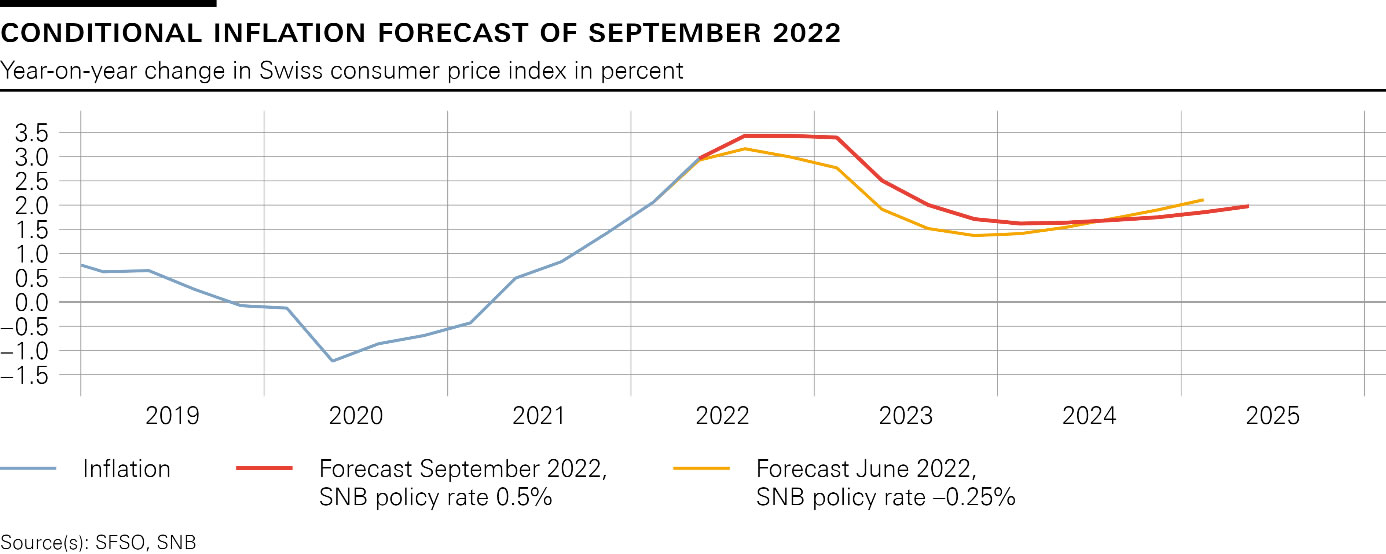
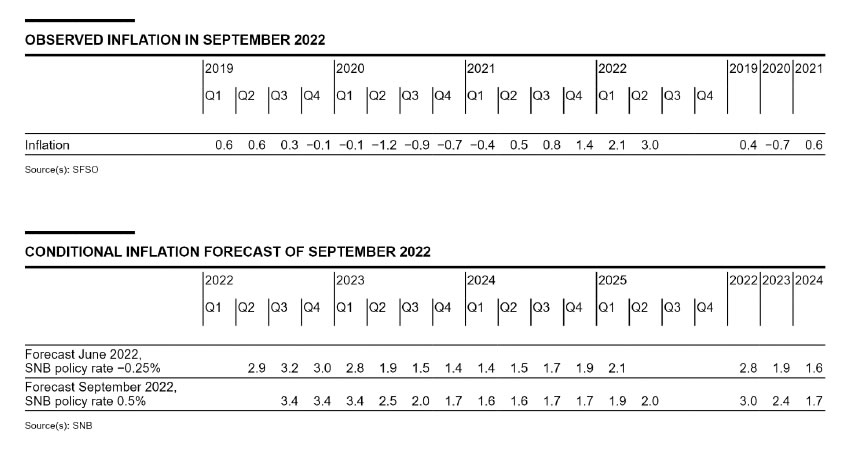
SNB expects that inflation is "likely to remain at an elevated level for the time being". Based on the assumption that policy stays at 0.50% over the entire forecast horizon, inflation will peak at 3.4% in Q3, and stay slowing from Q2 2023 to 1.6% in Q2 2024. Inflation will average 3.0% in 2022, 2.4% in 2023, and then 1.7% in 2024.
Regarding the economy, SNB expects GDP growth of around 2% this year, roughly 0.5% lower than the last monetary policy assessment. Uncertainty remains high and the biggest risks are a "a global economic downturn, a worsening of the gas shortage in Europe and a power shortage in Switzerland".
(SNB) Swiss National Bank tightens monetary policy further and raises SNB policy rate to 0.5%
The SNB is tightening its monetary policy further and is raising the SNB policy rate by 0.75 percentage points to 0.5%. In doing so, it is countering the renewed rise in inflationary pressure and the spread of inflation to goods and services that have so far been less affected. It cannot be ruled out that further increases in the SNB policy rate will be necessary to ensure price stability over the medium term. To provide appropriate monetary conditions, the SNB is also willing to be active in the foreign exchange market as necessary.
The SNB policy rate change applies from tomorrow, 23 September 2022. Moreover, the SNB is adjusting the implementation of its monetary policy to the positive interest rate environment. This ensures that the secured short-term Swiss franc money market rates remain close to the SNB policy rate. Banks' sight deposits held at the SNB are remunerated at the SNB policy rate up to a certain threshold. Sight deposits above this threshold are remunerated at an interest rate of zero percent. The SNB will also use liquidity-absorbing measures.
Inflation rose to 3.5% in August and is likely to remain at an elevated level for the time being. The latest rise in inflation is principally due to higher prices for goods, especially energy and food. The SNB's new conditional inflation forecast is based on the assumption that the SNB policy rate is 0.5% over the entire forecast horizon (cf. chart 1). Up to mid-2024, the forecast is above that of June. After that, it is lower due to the now tighter monetary policy. At the end of the forecast horizon, inflation stands at 2%. The new forecast puts average annual inflation at 3% for 2022, 2.4% for 2023 and 1.7% for 2024 (cf. table 1). Without today's SNB policy rate increase, the inflation forecast would be significantly higher.
Global economic growth has slowed considerably in recent months. At the same time, inflation in many countries is markedly above central banks' targets. In response, numerous central banks have further tightened their monetary policy.
In its baseline scenario for the global economy, the SNB expects only weak economic growth. In particular, the energy situation in Europe, the loss of purchasing power due to inflation, and tighter financing conditions are having a dampening effect. Inflation will remain elevated for the time being. However, the importance of temporary factors such as supply bottlenecks is likely to diminish over the medium term. The increasingly tighter monetary policy in many countries should also help inflation gradually return to more moderate levels.
This scenario for the global economy is subject to significant risks. For example, the energy situation could worsen again. At the same time, high inflation could become embedded and require stronger monetary policy responses abroad. Finally, the course of the coronavirus pandemic remains an important source of risk.
In Switzerland, GDP growth in the second quarter was lower than expected, at 1.1%. This was mainly due to weaker performance in manufacturing. The short-term outlook has deteriorated. By contrast, the situation on the labour market has remained positive.
The further development of the economy is likely to be shaped by the economic slowdown abroad and the availability of energy in Switzerland. To date, the prices of natural gas and electricity in particular have risen sharply.
For this year, the SNB anticipates GDP growth of around 2%. This is roughly half a percentage point lower than at the last monetary policy assessment. The level of uncertainty associated with the forecast remains high. The biggest risks are a global economic downturn, a worsening of the gas shortage in Europe and a power shortage in Switzerland. Furthermore, a resurgence of the coronavirus pandemic cannot be ruled out.
Both mortgage lending and prices for single-family houses and privately owned apartments have continued to rise in recent quarters, while the latest data show signs of a slowdown in the residential investment property segment. The SNB will continue to monitor developments on the mortgage and real estate markets closely.