

Sample Category Title
AUDUSD Tumbles to New 28-Month Low
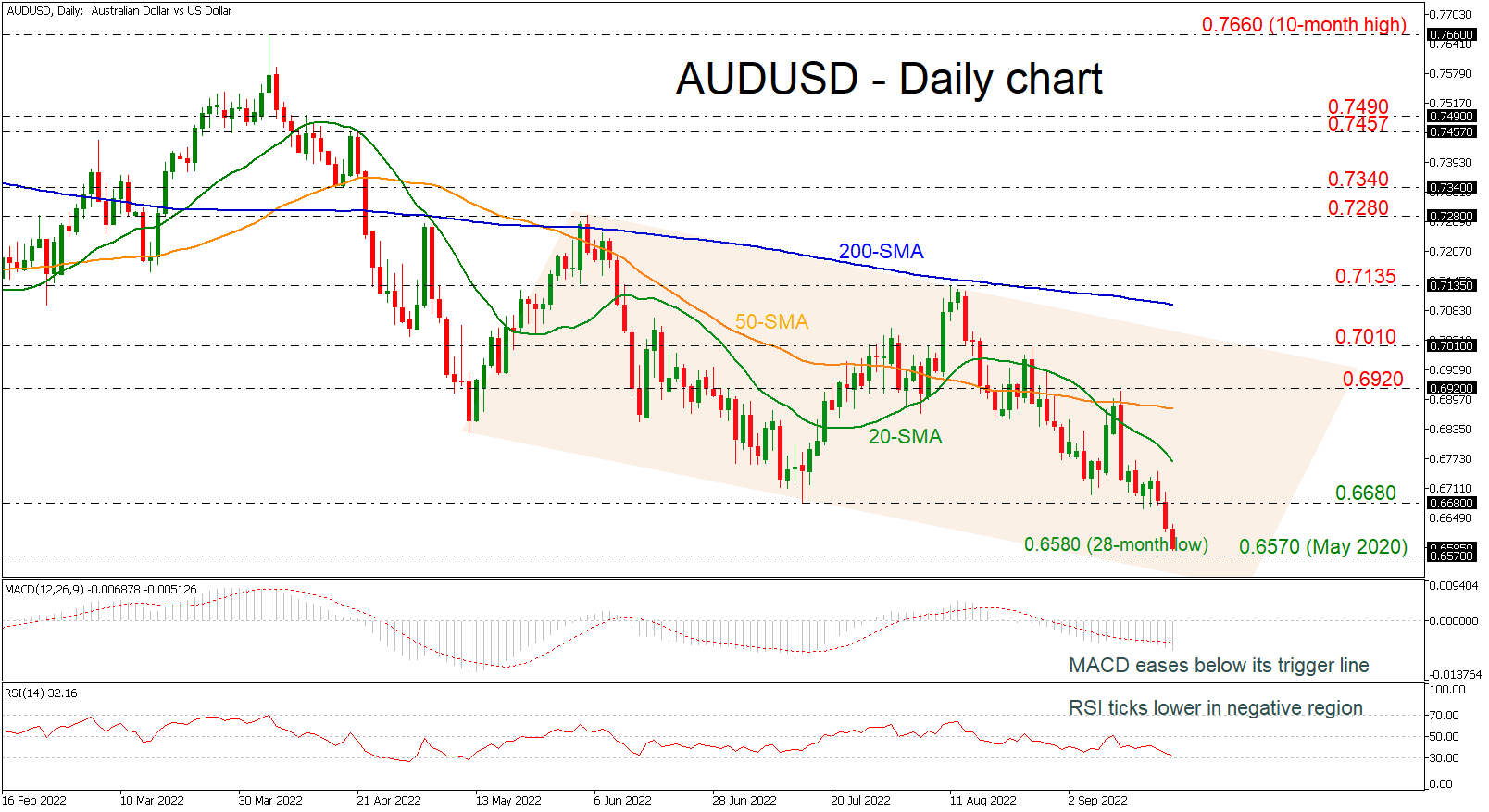
AUDUSD is plummeting for the third straight day towards a fresh 28-month low of 0.6580, remaining within a downward sloping channel since the beginning of June. The price had a pullback from the bearish cross within the 20- and 50-day simple moving averages (SMAs), keeping the medium-term outlook bearish.
Technically, the MACD is strengthening its negative momentum below its trigger and zero lines, while the RSI is approaching the 30 level.
Should weakness extend below the multi-month low of 0.6580 and the trough from May 2020 at 0.6570, support to downside movements could initially be detected from the April 2020 low at 0.6250.
Alternatively, the pair needs to overcome the 0.6680 resistance to meet a key barrier between the 20- and 50-day SMA at 0.6765-0.6875. The 0.6920 mark could also act as resistance too before a more important battle starts near the 0.7010 level and downtrend line.
In the medium-term picture, the sentiment turned bearish after the price dropped beneath the 0.7135 number. The negative slope in the 20-day SMA, which moves lower from the 50-day SMA, also adds bearish pressure.
USD/JPY: Hawkish Fed and Dovish BOJ Lift USD/JPY
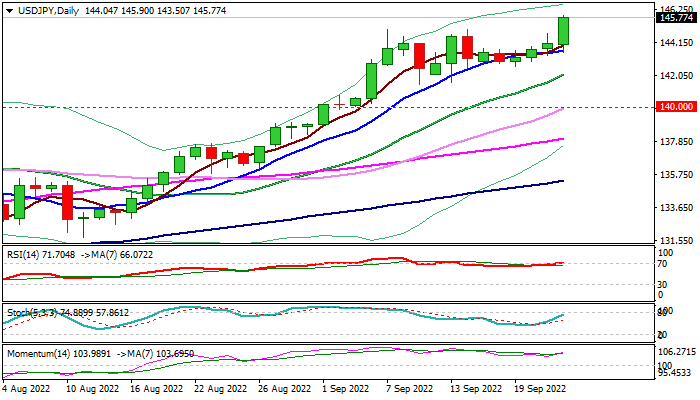
The USDJPY surges through 145 barrier in early Thursday’s trading and posts new 24-year high, inflated by hawkish Fed and repeatedly dovish stance from BOJ, which kept its ultra-easy policy and sent quite mild signals about possible intervention to support its weakening currency.
Fresh bullish acceleration (the pair was up nearly 1.3% since Asian opening on Thursday) approaches round-figure 146 barrier ahead of Fibo projections at 146.32 and 147.14, with focus on Aug 1998 peak at 147.68.
Former strong barrier at 145.00 reverted to support which should ideally contain, with deeper dips to find ground above rising 10DMA (143.62) to keep bulls intact.
Res: 146.32; 146.61; 147.14; 148.00.
Sup: 145.00; 143.95; 143.62; 142.64.
EUR/USD: The Euro Falls to New 20-year Low after Fed, Risks Deeper Drop
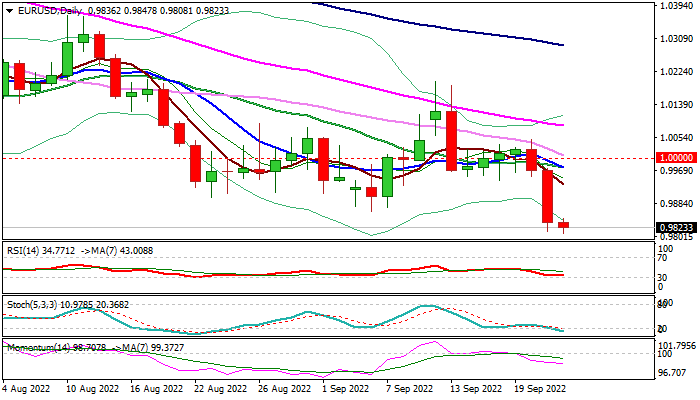
The Euro remains heavy in early Thursday’s trading and hit new marginally lower 20-year low, following 1.3% drop on Wednesday.
The sentiment was soured by growing geopolitical tensions, with hawkish Fed adding pressure on the single currency.
The US central bank raised rate by 0.75%, in line with wide expectations and signaled further strong hikes to push interest rate to 4.4% by the end of 2022 and to 4.6% in 2023 that is seen as continuous pressure on Euro.
Bears pressure psychological 0.9800 support, eyeing Fibo projections at 0.9736 and 0.9657, ahead of target at 0.9601 (Sep 2002 low).
Technical studies show overall bearish structure, with near-term action weighed by Wednesday’s large bearish candle (the second big daily drop this month).
Limited adjustments on oversold conditions are expected to offer better selling opportunities, with former low at 0.9864 (Sep 6) offering initial resistance and extended upticks to stay below broken Fibo 76.4% at 0.9942.
Res: 0.9847; 0.9864; 0.9900; 0.9942.
Sup: 0.9800; 0.9736; 0.9700; 0.9657.
US Oil Awaits Breakout
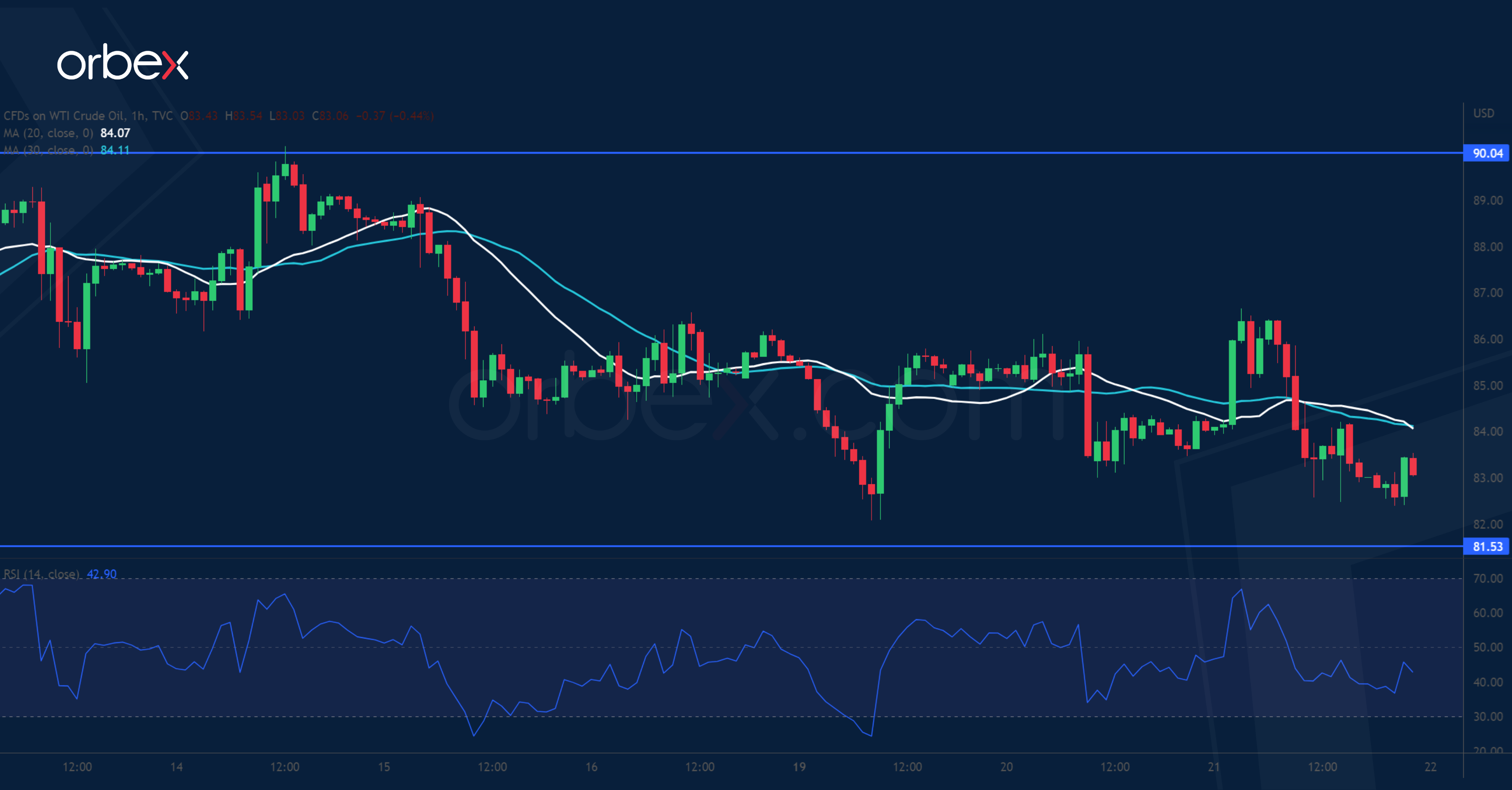
WTI crude weakens over a gloomy economic prospect amid tighter financial conditions. Sentiment has remained fragile after the psychological level of 90.00 proved to be a tough level to crack for now. The current consolidation above 81.50 is temporary, and a breakout on either side would dictate the direction in the days to come. Only a rally above 90.00 could turn the mood around in the short-term. The bearish bias might take over and a breakout would resume the downtrend and send WTI to 78.00.
S&P 500 Tests Critical Support
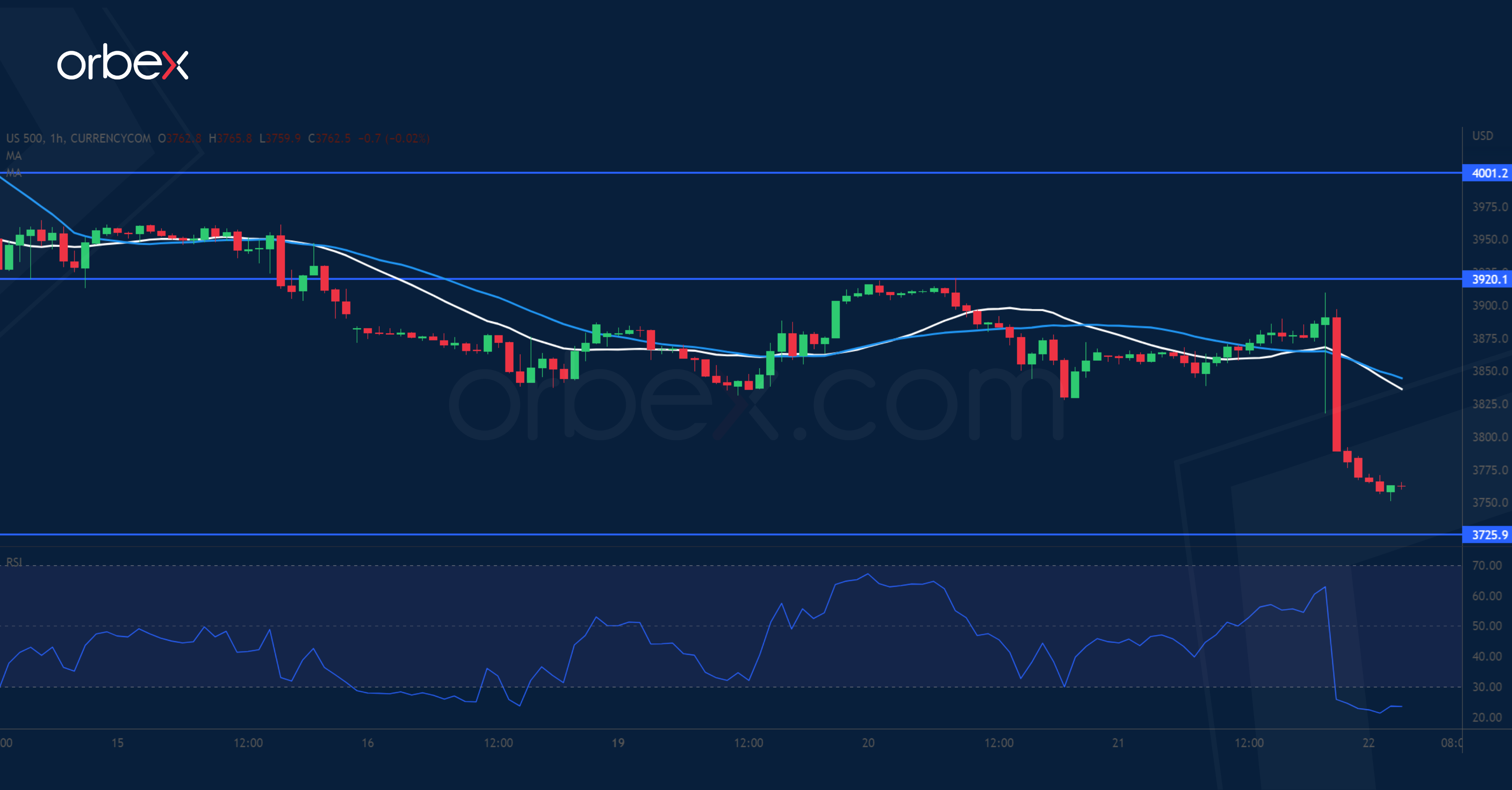
The S&P 500 plunged after another super-sized US rate hike. The break below 3900 has invalidated the recent bounce and put the buy side on the defensive. As sentiment deteriorates, strong selling pressure may continue to prevail. A fall below 3820 at the origin of a bullish breakout last July shows little buying interest left, and the index could continue to sink to the daily support at 3725 which is a critical floor to prevent a bearish reversal. The support-turned-resistance at 3920 is the first hurdle in case of a rebound.
XAU/USD Struggles to Bounce Back
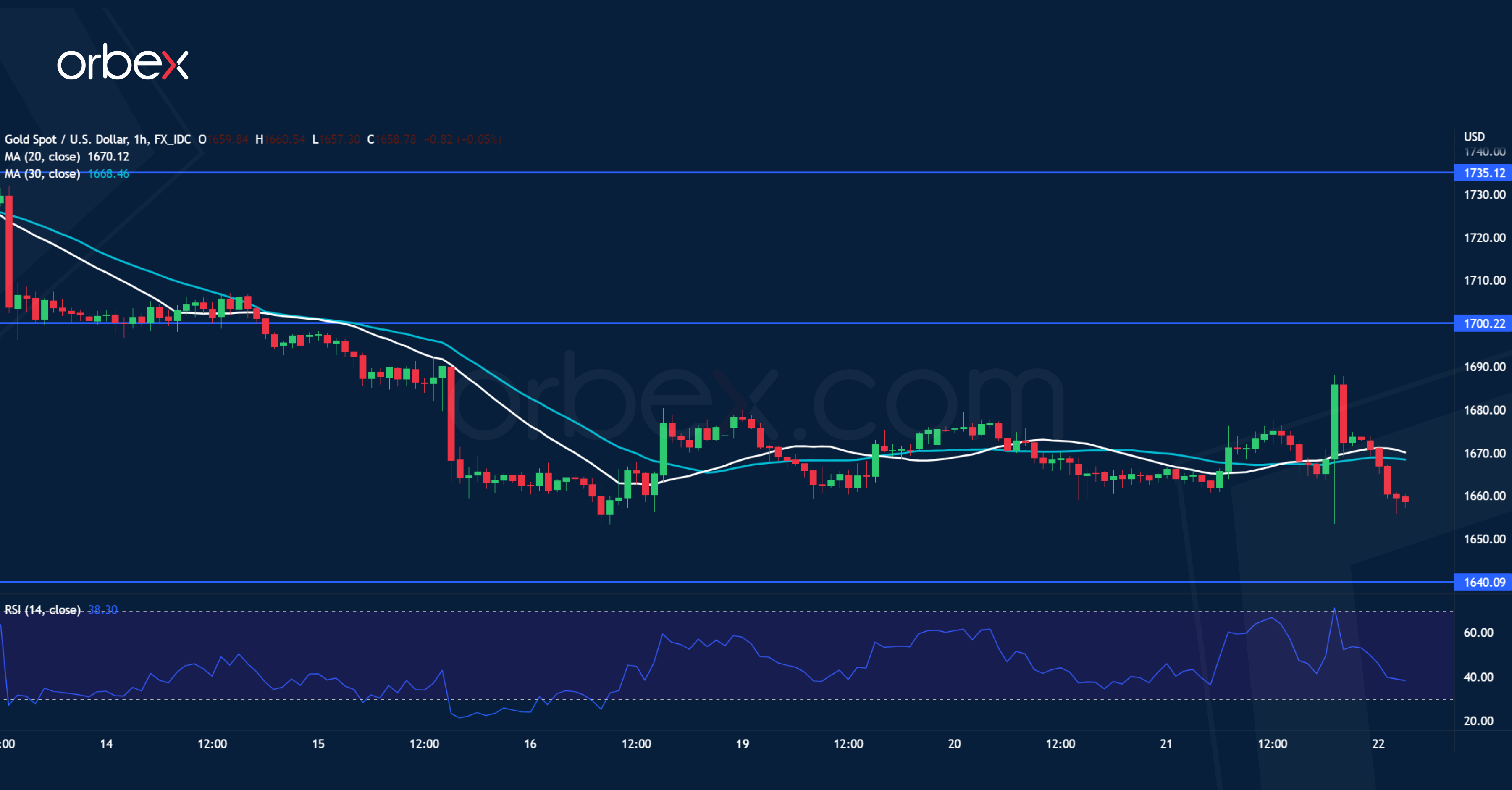
Bullion whipsawed after the Fed's rate hike came out in line with expectations. The price’s failure to hold above the critical level at 1680 may have triggered a long journey to the south. The RSI’s oversold condition led to some profit-taking by intraday traders. But stiff selling could be expected in the former demand zone around 1700. The bulls, if there is any left must lift 1735 before a bounce could materialise. Otherwise, the precious metal may drift towards 1640 from the base of a bullish breakout back in April 2020.
FOMC, BoJ Done; SNB, BoE and CBT Next
We thought that the Federal Reserve (Fed) decision would be the highlight of yesterday but news from Russia came to eclipse the FOMC.
Vladimir Putin declared partially mobilization yesterday morning. Russia is preparing to mobilize 300’000 reservists. It’s a major escalation of the war, because so far, the Russians deployed around 150-200’000 soldiers. So, sending 300’000 more men is a big deal.
But, many experts think that 300’000 extra men would unlikely be sufficient to reverse Ukraine’s momentum. Some also point that the problem for Russia is not necessarily ‘the capacity of soldiers but the capacity of supply them with weapons’. At this point, no one knows how the things will turn out. But tensions in Ukraine are escalating, and nuclear threat is the cherry on top.
Putin’s announcement, which fell like a bomb on investors who were already stressed out due to the Fed decision, sent capital to safe haven assets yesterday. The safest of all safe havens, the US dollar, spiked to 111.80. Gold made an attempt to $1688 per ounce, but gains remained short-lived as the dollar’s strength outweighed, and gold is back to the levels it was trading at yesterday morning.
Powell, the joykiller
The Fed delivered the third 75bp hike yesterday, as expected. Markets cheered the decision, as a 75bp hike is better than a 100bp hike.
The S&P500 was even trading 1.3% up when the decision fell but then, Jerome Powell came to kill joy. He said ‘we have got to get inflation behind us. I wish there were a painless way to do that. There isn’t.’
So? The US economy must slow, and jobs must be lost to get inflation down.
The dot plot revealed that the officials’ rate projections went well above the market expectations. Most of them favour sending the rates above 4.25% by the end of the year; that means that there must be at least another 75bp hike on the pipeline.
Then, if we are lucky, we could end the year with a 50bp hike, which could be followed by a couple of 25bp hikes before the Fed stops and takes a breather.
It's needless to say that equity traders didn’t like what they heard. The S&P500 closed the session 1.70% lower and is again more than 20% down compared with its January peak and Nasdaq tanked 1.80%.
‘Ugly’ is a good word to describe the market mood this morning. The selloff will likely continue.
What’s cooking in others’ kitchen?
The Bank of Japan (BoJ) maintained its policy unchanged, and is not unpleased seeing inflation rise to around 3%. BoJ head Kuroda believes that it will be transitory. (Wait, transitory? We already watched that film, haven’t we?!)¨
Anyway, if the Japanese are not uncomfy with rising inflation, they sure are with the free-falling yen. This is why, if the dollar extends rally, we will probably see the BoJ step in to give some relief to the yen. The USDJPY is again flirting with the 145 level, but betting against yen could be risky due to the intervention threat.
Another place where inflation is also around 3%, 3.5% to be precise, is Switzerland. But I can tell you that the Swiss don’t like inflation and they will do their best to tame it. The SNB is expected to hike by 75bp today. Some even bet that the SNB could surprise with a 100bp to bolster the franc, and neutralize the impact if strong USD on inflation.
Elsewhere, the Bank of England (BoE) could opt for a 50bp hike, instead of 75bp at today’s meeting.
Yes, increased spending from Liz Truss government is no good for inflation, BUT, because the £40 billion energy package aims to tame inflation – and it certainly will, the BoE could take it easy on the rate front.
The BoE is also expected to announce quantitative tightening, but the effect of QT will certainly remain under the shadow of huge sums that Truss government is preparing to spend. On top of the energy spending, there could be a £30 billion tax cuts, and also a stamp duty cut. It is said that the Chancellor of Exchequer will certainly need a bigger box to finance all that.
What does it mean for the markets? It means that the UK gilts will probably further dive, and the sterling will end up hitting parity against the US dollar.
And finally, Turkey will also announce its policy decision today. Well, you know what I think about the Turkish policy rates right? They are at meaningless levels.
Official inflation in Turkey is above 80%, unofficial inflation is above 180%, while the policy rate is at… 13%. The Central Bank of Turkey (CBT) cut its rates by 100bp at last meeting - a shocker. The dollar-try pushes steadily toward the 20 mark, as the central bank puts all its weight to keep the exchange rate as steady as possible. It burns money, it is time bomb, but you can’t really trade it, as the lira doesn’t depreciate fast enough to cover the cost of being short the lira.
What’s worrying however is the fact that the Turkish stocks have come under a decent selling pressure recently. So far, the Borsa Istanbul has been rising despite the falling lira, as the Turkish companies keep their valuation somehow stable in terms of US dollars. But of course, the spiking inflation, the spiking energy prices, and looming global recession weigh on sentiment, and the selloff last week triggered margin calls, which resulted in a sharp decline in Borsa Istanbul stocks.
Turkish banks, which got a big hit last week, are now buying back stocks to calm down the selling pressure.
Could the recent downturn be reversed? I believe yes, as Turkish investors don’t have many options to fight the soaring inflation, as the dollar is kept steady, and the bank fiduciary rates are abnormally low.
Hawkish 75bp from the Fed, BoJ remains the dovish outlier
Market movers today
We expect the Swiss National Bank (SNB) to raise the policy rate by 75bp to curb underlying inflation pressures. This will bring the policy rate to 0.50%, thus leaving negative territory for the first time since 2014.
We expect Norges Bank to raise its policy rate by 50bp, but to deliver a rate path that is below market pricing (for more details see the Nordic section).
In our view, Bank of England will raise its policy rate by "only" 50bp, as they weigh in a looming recession against still high inflation pressures. However, we recognise that it is a close call between 50bp and 75bp as the market also thinks.
ECB's Isabell Schnabel speaks today, which will provide an important gauge about ECB plans for the October meeting, given that she is currently a very influential member of the ECB's monetary policy committee.
Regarding economic releases, we get consumer confidence in the euro area, which is expected to deteriorate further, while in the US, the Conference Board leading index for the US economy is likely show a small uptick due to lower gasoline prices. In addition, new unemployment claims will be scrutinized to see if the US labour market is starting to show signs of weakness.
The war in Ukraine is also becoming a market theme after Russian President Putin yesterday announced a partial mobilisation of Russian forces and threatened to use nuclear weapons.
The 60 second overview
Fed: The Federal Reserve hiked rates by 75bp at their meeting last night, in line with our expectations. While Fed Chairman Powell provided little news in terms of concrete policy signals, the updated economic projections were clearly more hawkish than markets had anticipated. The FOMC median 'dot' sees the Fed Funds rate rising to levels around 4.5% next year. Powell highlighted that Fed will continue hiking until it sees clear signs of growth moderating below potential and labour markets cooling. In contrast, we think the US economy is likely to perform relatively well in the near-term, and look for a rebound in the Q3 GDP figures. Consequently, we also think Fed will prefer to continue frontloading the upcoming rates hikes, and now expect Fed to hike by 75bp at both November and December meetings. Looking further into 2023, we continue to see risks tilted towards rates staying at restrictive levels for longer. Read our full take in Research US - Fed review: Hawkish 75bp - Fast hikes to continue, 21 September.
Bank of Japan: No changes from the Bank of Japan (BoJ) this morning, which kept its QQE with yield curve control in place. The dovish guidance also remains in place, as short- and long-term policy interest rates will remain at their present or lower levels. Thus, BoJ remains an outlier among major global central banks, keeping the pressure on Japanese yields and the yen intact. USD/JPY briefly traded above 145 on the decision and then returned lower.
Market sentiment: Risk sentiment weakened late in yesterday's session after a rollercoaster ride during the FOMC meeting. The initial hawkish reaction to the monetary policy statement eased during Powell's speech, but S&P500 ended the day 1.7% lower and US yield curve inverted further with the 2y UST yield reaching new highs above 4.10%. EUR/USD moved sharply lower near 0.98, and in line with our expectation of further rate hike frontloading, we also continue to look for further EUR/USD weakness.
War in Ukraine: Yesterday, Putin announced the first partial mobilisation of Russian army reserves since the World War 2. The move includes calling up 300.000 reservists and indefinite extensions to the professional troops' contracts. We continue to think that the mobilisation will be difficult to implement, because as illustrated by protests in Russia after yesterday's announcement, it is a highly unpopular move among the general public compared to what the Russian officials have called 'a special military operation' in the past. Putin also threatened with the use of tactical nuclear weapons, which was broadly condemned by the western leaders. EU foreign ministers agreed on providing more weapons for Ukraine and further sanctions against Russia, which could be announced around mid-October (see Reuters). In the markets, especially HUF and PLN were under pressure yesterday,
FI: The Federal Reserve raised rates by 75bp yesterday and more is to come as they expect another 125bp hike before year-end. This was more hawkish than expected and Fed Chairman Powell and the Federal Reserve also cut their growth forecast but they are not expecting a recession like the Bank of England.
FX: USD was generally stronger as US yields continued to climb ahead of the Fed even though risk sentiment rebounded. USD/SEK breached 11.03, a previous ATH from June 2001. EUR/USD fell immediately after the decision and fully erased losses during the press conference such that the net effect was fairly contained. USD/JPY dropped as the US yield curve bull flattened. The 0-1.5h response in EUR/Scandies was muted and within the range of four figures.
Credit: Credit markets continued the cautious sentiment ahead of the US rate decision, leaving iTraxx main slightly wider by 1.9bp at 122.4bp, while Xover widened 4.6bp, closing the session at 601.4bp.
Nordic macro
Norway: We expect Norges Bank (NB) to raise its policy rate by 50bp today and signal that it will "most likely" go up again in November, without saying how much. The policy rate path in the accompanying monetary policy report will therefore be slightly higher for the next couple of quarters, because the bank has accelerated its hiking cycle. From summer 2023, however, we expect the path to be slightly lower than in the June report, largely because we expect NB to have to revise down the growth outlook for both the domestic and the global economy. We expect it to show a further 50bp increase in Q4 and some chance of a "normal" hike of 25bp in Q1. It will probably also indicate the possibility of a rate cut towards the end of next year. Admittedly, the risk is tilted to the upside as NB could be even more determined to fight inflation.
EUR/USD Daily Outlook
Daily Pivots: (S1) 0.9774; (P) 0.9876; (R1) 0.9940; More...
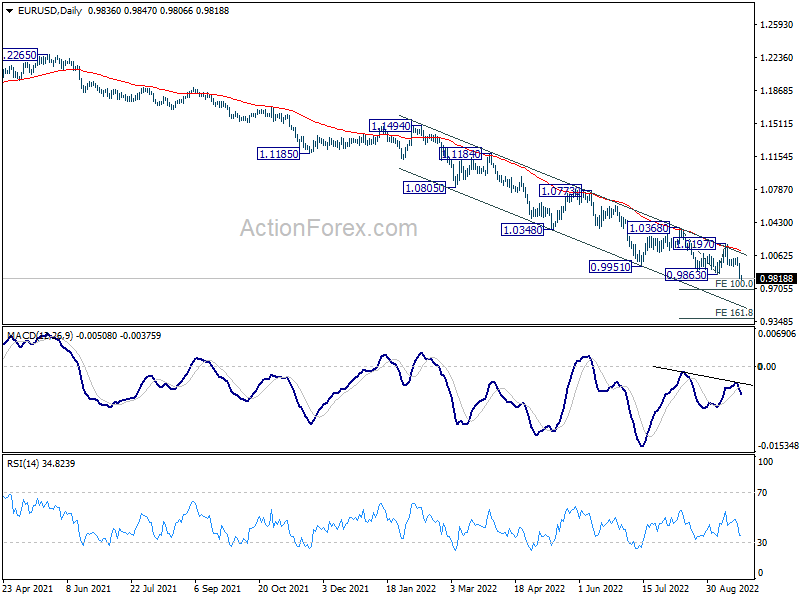
EUR/USD's break of 0.9863 support confirms down trend resumption. Intraday bias is back on the downside for 100% projection of 1.0368 to 0.9863 from 1.0197 at 0.9692. Firm break there could prompt downside acceleration and target 161.8% projection at 0.9380. On the upside, above 0.9943 minor resistance will turn intraday bias neutral first. But outlook will stay bearish as long as 1.0197 resistance holds, in case of recovery.
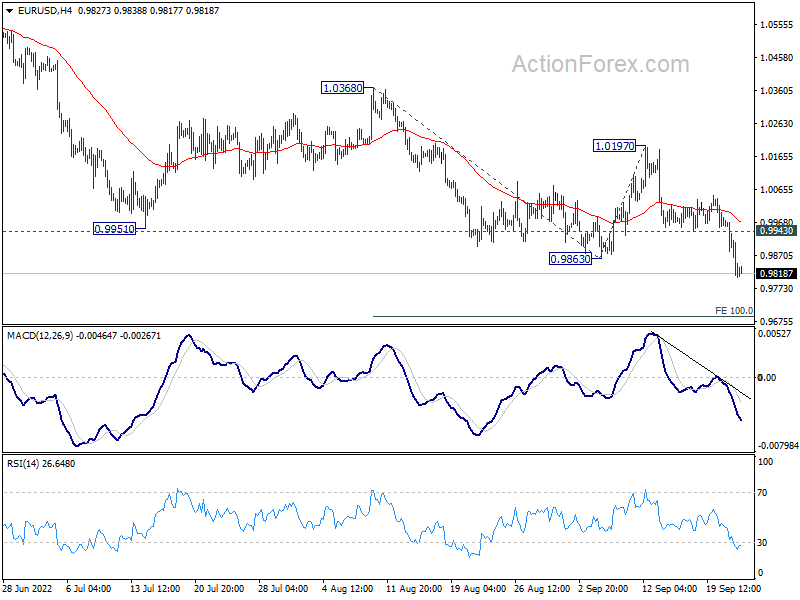
In the bigger picture, down trend from 1.6039 (2008 high) is still in progress. Next target is 100% projection of 1.3993 to 1.0339 from 1.2348 at 0.8694. In any case, break of 1.0197 resistance is needed to be the first sign of medium term bottoming. Otherwise, outlook will stay bearish even with strong rebound.
Dollar Upside Breakout after Hawkish Fed, SNB and BoE Next
Dollar broke out to the upside overnight following hawkish Fed hike. At the same time, it's closely trailed by Swiss Franc for now, on geopolitical risks. Risk aversion is also keeping Yen afloat in crosses, despite strong rally in treasury yields. For now, Kiwi is the worst performer for the performer among the weak commodity currencies. But Euro is not too far behind as Ukraine war could drag on further with Russian's military mobilization.
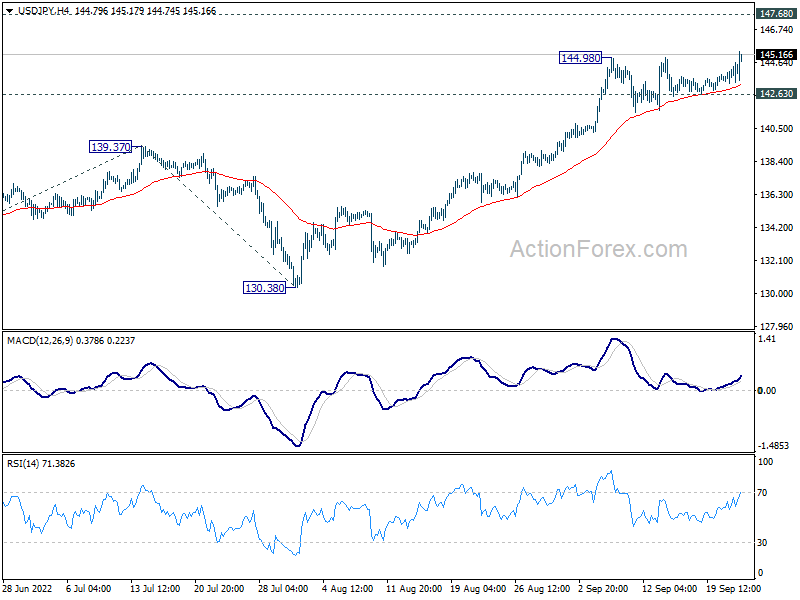
Technically, USD/JPY is resuming recent up trend with a break of 144.98 resistance today, follow BoJ rate decision. Near term outlook will stays bullish as long as 142.63 support holds. Next target is 1998 high at 147.68. Momentum towards the level, and reactions from there are worth a watch, on hint on whether Japan is ready for taking actual actions on intervention.
In Asia, Nikkei closed down -0.53%. Hong Kong HSI is down -1.93%. China Shanghai SSE is down -0.34%. Singapore Strait Times is down -0.25%. Japan 10-year JGB yield is down notably by -0.0256 at 0.236. Overnight, DOW dropped -1.70%. S&P 500 dropped -1.71%. NASDAQ dropped -1.79%. 10-year yield rose dropped -0.061 to 3.510.
Fed hikes 75bps, rate to reach 4.4% by year end
Fed raised interest rate by 75bps to 3.00-3.25% as widely expected, by unanimous vote. In the accompanying statement, Fed said job gains have been "robust" with unemployment rate "remained low". Inflation remains "elevated". FOMC would be " prepared to adjust the stance of monetary policy as appropriate if risks emerge that could impede the attainment of the Committee's goals."
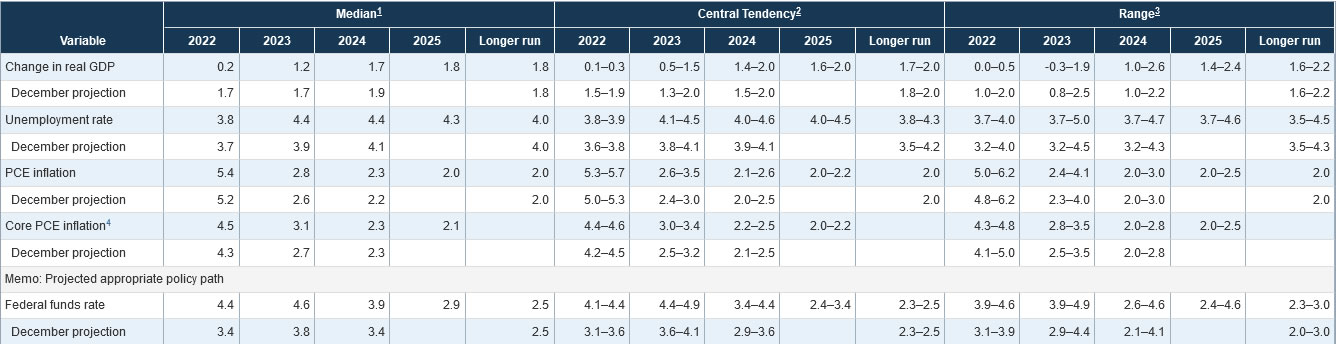
In the new economic projections, Fed projects (median) interest rates to reach 4.4% in 2022, 4.6% in 2023, before falling back to 3.9% in 2024, and then 2.9% in 2025. GDP growth is projected to be at 0.2% in 2022, 1.2% in 2023, 1.7% in 2024, and then 1.8% in 2025. Unemployment rate is projected to be at 3.8% in 2022, 4.4% in 2023, 4.4% in 2024, and then 4.3% in 2025. Core PCE inflation is projected to be at 4.5% in 2022, 3.1% in 2023, 2.3% in 2024, and then 2.1% in 2025.
More on FOMC:
- FOMC as Expected; Markets Extremely Volatile During Presser
- The Fed Fights On
- FOMC Hikes Policy Rate by 75 Basis Points, Signals Many More to Come
- FOMC press conference live stream
- (FED) Federal Reserve Issues FOMC Statement
DOW to break 30k soon on hawkish Fed
US stocks tumbled broadly after Fed raised interest rate by 75bps overnight, and indicated that rate could reach 4.4% by year end. Chair Jerome Powell reiterated that pledge that "the FOMC is strongly resolved to bring inflation down to 2%, and we will keep at it until the job is done." Meanwhile, against members' expectations, "we have seen some supply side healing but inflation has not really come down," he noted.
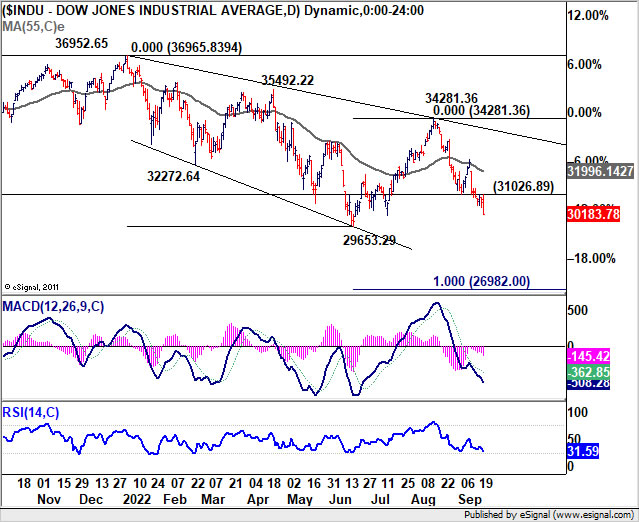
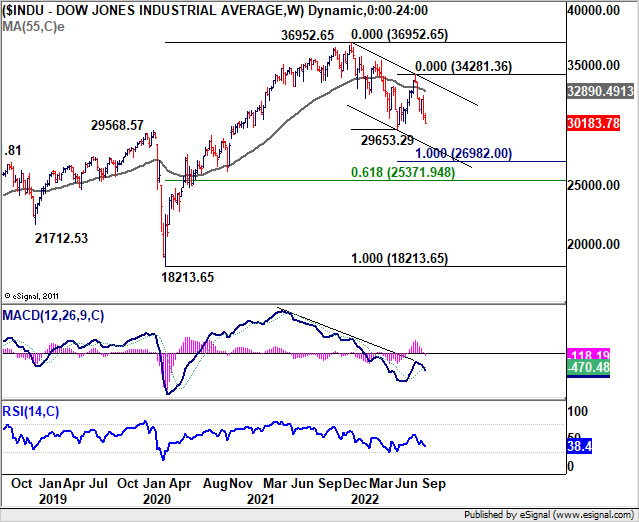
DOW's -1.70% decline indicates that fall from 34281.36 is extending and break of 30k handle would be seen soon. Such fall is seen as part of the whole medium term corrective pattern from 36952.65. Near term outlook will stay bearish as long as 31026.89 resistance holds. Next target is a retest of 29653.29 low. Firm break there will target 100% projection of 36952.65 to 29653.29 from 34281.36 at 26982.00. There's where the correction would probably end.
BoJ stands part, interest rate to remain at present or lower levels
BoJ kept monetary policy unchanged as widely expected. Under the yield curve control framework, short-term policy interest rate is held at -0.10%. BoJ will continue to purchase Japanese government bonds, without setting an upper limit, to keep 10-year JGB yield at around 0%. Also, BoJ will offer to purchase 10-year JGBs at 0.25% every business day through fixed -rate purchase operations, to cap the upside. These decisions were made by unanimous vote.
BoJ also pledge to continue with Quantitative and Qualitative Monetary Easing (QQE) with Yield Curve Control to achieve 2% price target, "as long as it is necessary for maintaining that target in a stable manner". The bank will not hesitate to take additional easing measures if necessary". It expects short- and long-term policy interest rates to "remain at their present or lower levels".
SNB and BoE next, GBP/CHF accelerating down
SNB and BoE rate decisions are the remaining focuses of the day. SNB is widely expected to rise interest rate by 75bps to 0.50%, back in positive region. There are some speculations of a larger hike, but it's unlikely. The central would also repeat that appreciation of the Swiss Franc is welcome for now, as it helps curb imported inflation.
Meanwhile, BoE is expected to deliver another 50bps hike to 2.25%. The UK economy is stuck between a rock and a hard place. While inflation appeared to be slowing, "slightly", it remained close to multi-decade high. On the other hand, weakness has been seen in spending while the economy is already in recession. The voting of today's decision could contain some surprises.
Some previews on SNB and BoE:
- SNB Could Surprise (Again) with a Larger than Expected Hike
- Will the SNB Rock the Swissie with a Huge 100 bps Rate Hike?
- BoE Preview: Pressure Mounts for a Jumbo Hike
- BoE Decision a Close Call to Speed Up Rate Hikes as Worries Mount
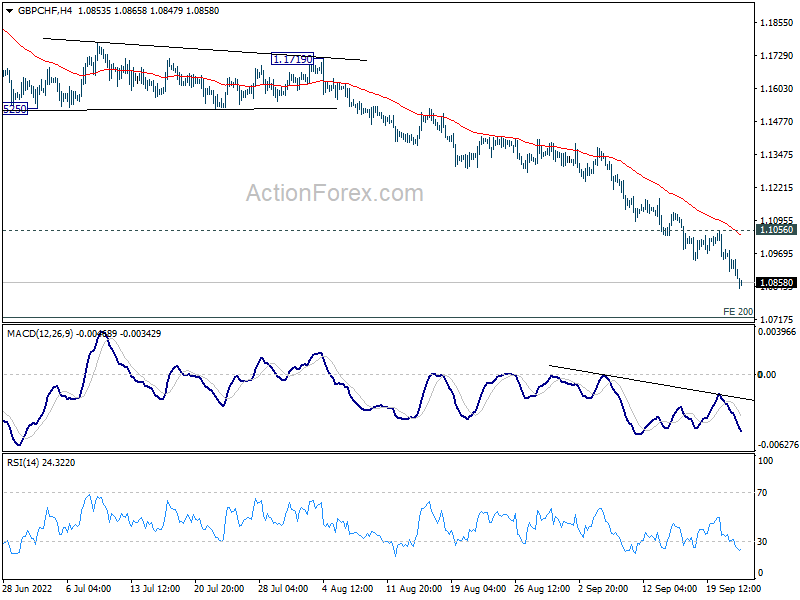
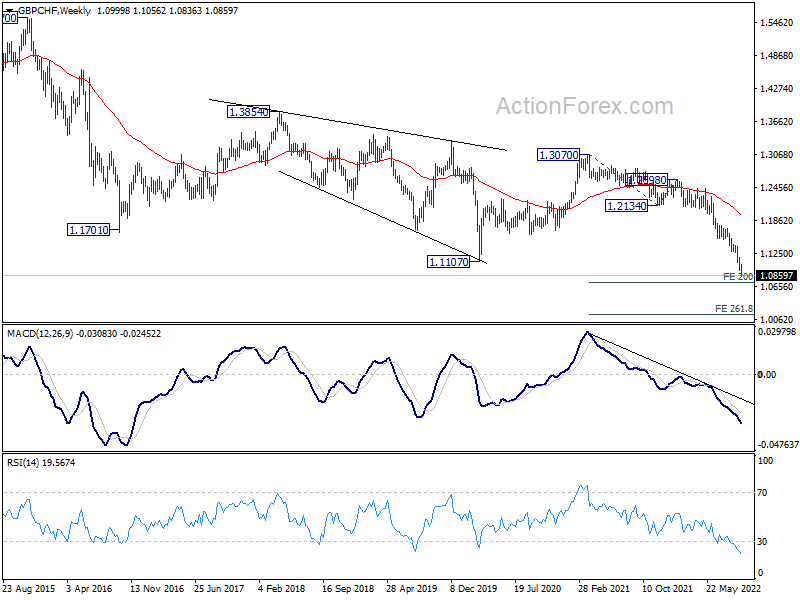
GBP/CHF broke through pandemic low at 1.1107 earlier this month, and the down trend is still in acceleration mode. Near term outlook will stay bearish as long as 1.1056 resistance holds. Next target is 200% projection of 1.3070 to 1.2134 from 1.2598 at 1.0726.
There is risk of further downside acceleration, either on dovish BoE or deterioration in geopolitical risks. In that case, break of 1.0726 could pave the way to 1.0148.
EUR/USD Daily Outlook
Daily Pivots: (S1) 0.9774; (P) 0.9876; (R1) 0.9940; More...
EUR/USD's break of 0.9863 support confirms down trend resumption. Intraday bias is back on the downside for 100% projection of 1.0368 to 0.9863 from 1.0197 at 0.9692. Firm break there could prompt downside acceleration and target 161.8% projection at 0.9380. On the upside, above 0.9943 minor resistance will turn intraday bias neutral first. But outlook will stay bearish as long as 1.0197 resistance holds, in case of recovery.
In the bigger picture, down trend from 1.6039 (2008 high) is still in progress. Next target is 100% projection of 1.3993 to 1.0339 from 1.2348 at 0.8694. In any case, break of 1.0197 resistance is needed to be the first sign of medium term bottoming. Otherwise, outlook will stay bearish even with strong rebound.
Economic Indicators Update
| GMT | Ccy | Events | Actual | Forecast | Previous | Revised |
|---|---|---|---|---|---|---|
| 22:45 | NZD | Trade Balance (NZD) Aug | -2447M | -500M | -1092M | |
| 03:00 | JPY | BoJ Interest Rate Decision | -0.10% | -0.10% | -0.10% | |
| 07:30 | CHF | SNB Interest Rate Decision | 0.50% | -0.25% | ||
| 08:00 | ECB | Eurozone Economic Bulletin | ||||
| 11:00 | GBP | BoE Interest Rate Decision | 2.25% | 1.75% | ||
| 11:00 | GBP | MPC Official Bank Rate Votes | 9--0--0 | 9--0--0 | ||
| 12:30 | USD | Initial Jobless Claims (Sep 16) | 220K | 213K | ||
| 12:30 | USD | Current Account (USD) Q2 | -258B | -291B | ||
| 12:30 | CAD | New Housing Price Index M/M Aug | 0.10% | 0.10% | ||
| 14:00 | EUR | Eurozone Consumer Confidence Sep P | -26 | -24.9 | ||
| 14:30 | USD | Natural Gas Storage | 97B | 77B |