Sample Category Title
Sunset Market Commentary
Markets:
The presumed calm of the countdown to this evening’s Fed decision was abruptly unsettled by a speech of Russian president Vladimir Putin around the start of European dealings. Putin announced a ‘partial mobilization’ of reservists. He also said that ‘If the territorial integrity of our country is threatened, we will use all available means to protect our people’ which only can be seen as an escalation of the military rhetoric. The headlines (temporary) caused a different risk-off compared to what happened of late. The Dutch reference gas contract returned north of € 200 Mwh. Brent oil also jumped from the $90/b area to $93/b. German Bunds temporary enjoyed a safe haven bid with yields easing up to 10 bps. However, yield declines in the swap market were much more limited and both German and European yields gradually reversed a big part of the initial losses. Currently, the German 2-y yield even trades higher again (+3.5 bps). Bonds at longer maturities still preserve some safe haven gains (30-y -6 bps). With the 2-y swap setting a new cycle top at 2.75% (+7 bps), markets concluded that this escalation doesn’t ease the inflationary risks the ECB has to cope with. The dollar again was the main beneficiary from growing geopolitical and economic uncertainty in Europe. EUR/USD (currently 0.991) slipped (temporary?) below 0.99, but the 0.9864 correction low for now survived. DXY set a minor correction top (110.86). USD/JPY (144.05) nears the key 145 reference. For US investors/markets, the focus remains on this evening’s Fed meeting. Contrary to the previous days, US bond markets shifted into wait-and-see modus. Yields are easing marginally (2-y -1bp, 30-y -3 bps). US equities gain marginal ground after the open (S&P +0.50%), but this for sure isn’t a short-covering move of a market that feels pressured to reduce established bearish bets. Sterling is in slightly better shape. The UK government announcing a new fiscal package to cap energy costs for businesses (cf infra), apparently makes markets tilt to a growing chance of the BoE joining the club of 75 bps hikes tomorrow. Sterling slightly outperforms the euro (EUR/GBP 0.8735). Still, the UK currency touched a new 37-year low against the dollar (currently 1.134). Rising tensions on Ukraine understandably also weighed in CE currencies with the Czech krona (EUR/CZK 24.64), the forint (EUR/HUF 404.5) and the zloty (EUR/PLN 4.75) all fighting an uphill battle. • At 20:00 CET the Fed will announce its policy decision with Powell’s press address at 20:30 CET. A 75 basis points rate hike is fully discounted with markets seeing about a 1 in 4 chance for a 1.0% step. The new dot plot summarizing expectations from the individual governors probably is at least as important as the size rate move. Quid on the governors’ expected inflation path? Quid on the new anticipated rate path? Quid on the long term neutral policy rate? At the June dots, Fed governors on average saw the Fed fund rate at 3.4% end this year and peaking near 3.8% next year. Markets currently already discount a rate peak near 4.5% in Q1 next year. Will Fed governors even exceed market pricing? A reassessment of the neutral rate ( 2.5% in June), also could change the reference on how tight policy is. Markets expect a hawkish Fed. Powell and Co probably will bring a hawkish message. Even so, for now we don’t expect a sustained buy-on the rumour, sell-the-fact profit taking move on the recent yield rally.
News Headlines:
The UK government unveiled its Energy Bill Relief Scheme, aimed to help businesses and other non-domestic customers. The government will cap electricity prices at 21.1 pence/Kwh and at 7.5 pence for gas. That’s around 50% discount for the coming six months. Afterwards, a review will decide whether additional support is needed and for which sectors. The package is estimated to cost £40bn. Businesses that have signed fixed energy contracts since April 1 will have their rates retroactively discounted. The EBRS is different from the government’s Energy Price Guarantee for households which could costs as much as £130bn.
EUR/USD Mid-Day Outlook
Daily Pivots: (S1) 0.9933; (P) 0.9992; (R1) 1.0029; More...
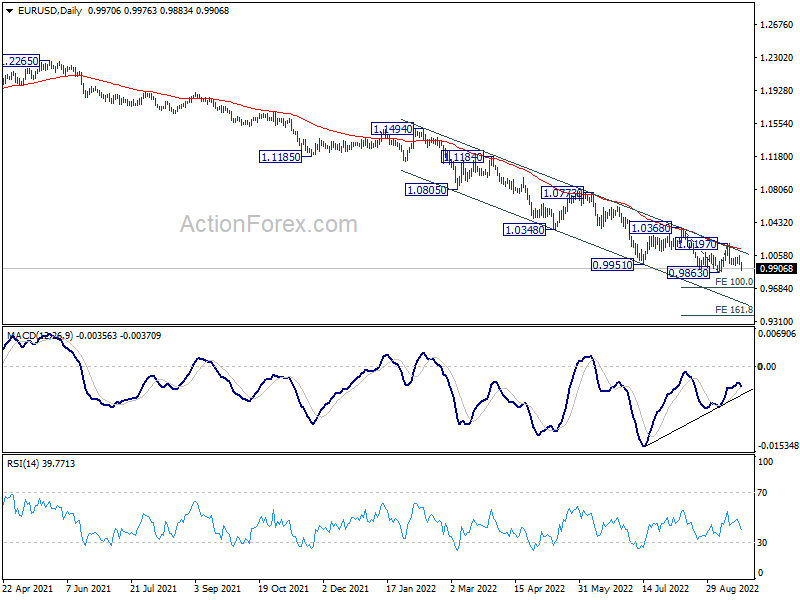
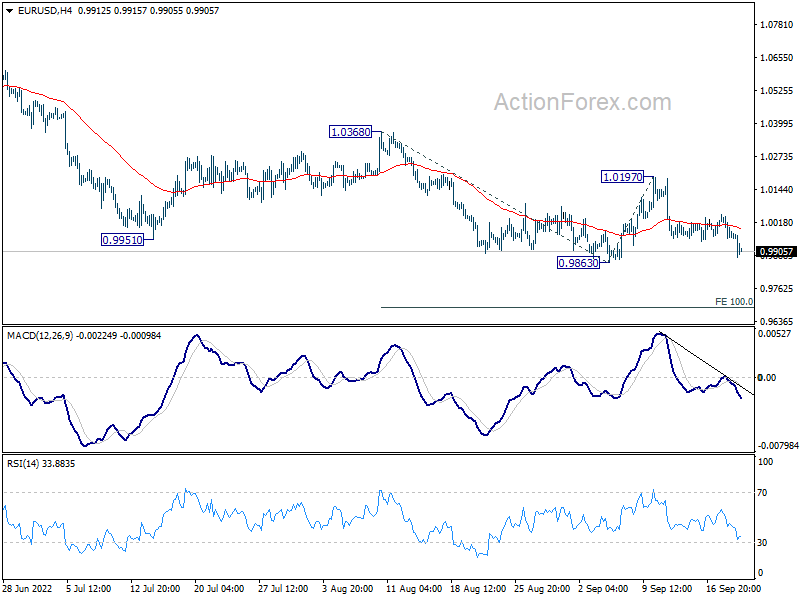
Intraday bias in EUR/USD remains neutral first and outlook stays bearish. On the downside, firm break of 0.9863 support will resume larger down trend. Next target is 100% projection of 1.0368 to 0.9863 from 1.0197 at 0.9296. On the upside, break of 1.0197 resistance will now raise the chance of larger trend reversal, and target 1.0368 resistance.
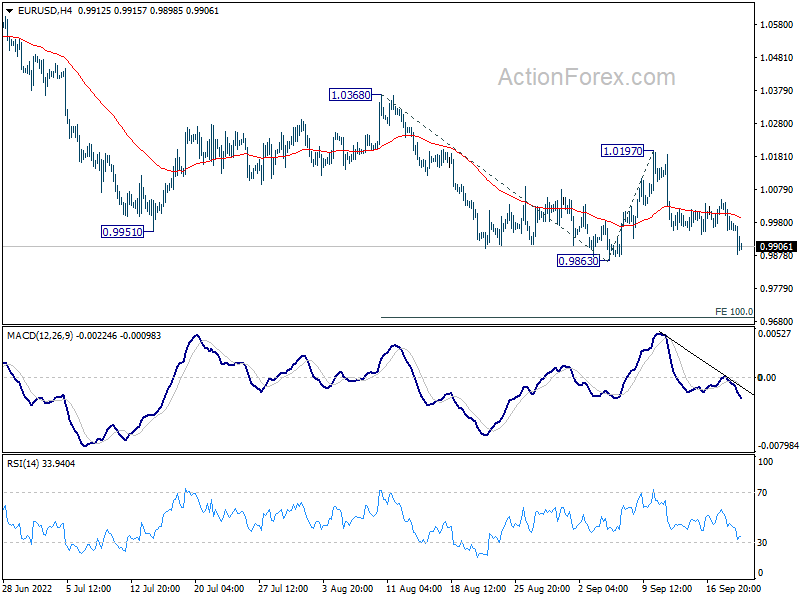
In the bigger picture, down trend from 1.6039 (2008 high) is still in progress. Next target is 100% projection of 1.3993 to 1.0339 from 1.2348 at 0.8694. In any case, outlook will stay bearish as long as 1.0368 resistance holds, in case of strong rebound.
GBP/USD Mid-Day Outlook
Daily Pivots: (S1) 1.1338; (P) 1.1400; (R1) 1.1442; More...
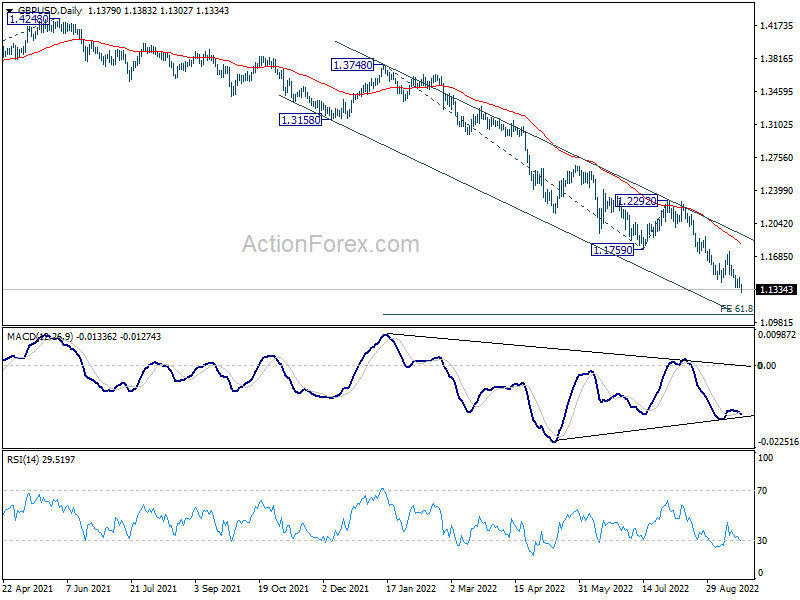
Intraday bias in GBP/USD remains on the downside for the moment. Current fall should now target 61.8% projection of 1.3748 to 1.1759 from 1.2292 at 1.1063 next. On the upside, above 1.1459 minor resistance will turn intraday bias neutral first. But outlook will stay bearish as long as 1.1737 resistance holds, in case of recovery.
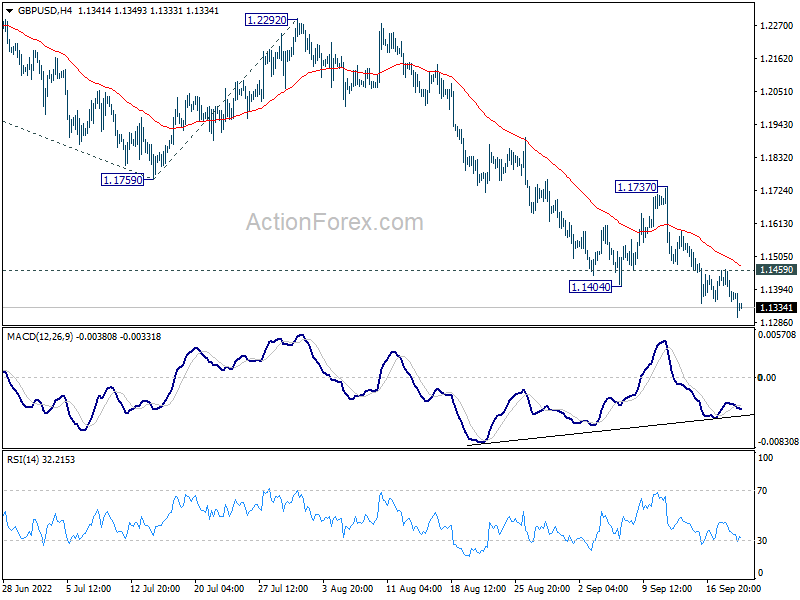
In the bigger picture, based on current momentum, fall from 1.4248 (2018 high) is probably resuming long term down trend from 2.1161 (2007 high). Sustained break of 1.1409 will target 61.8% projection of 1.7190 (2014 high) to 1.1409 (2020 low) from 1.4248 (2021 high) at 1.0675. This will remain the favored case for now as long as 1.2292 resistance holds.
USD/CHF Mid-Day Outlook
Daily Pivots: (S1) 0.9616; (P) 0.9649; (R1) 0.9675; More
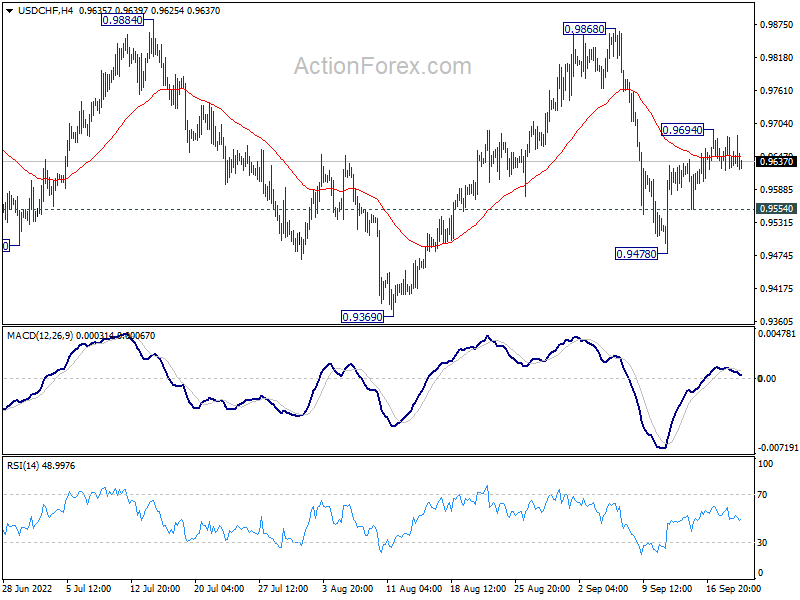
Intraday bias in USD/CHF is turned neutral first. But rebound from 0.9478 is in favor to continue with 0.9554 minor support intact. Above 0.9694 will target 0.9868 resistance. Break there will argue that larger up trend is ready to resume through 1.0063. Overall, the corrective pattern from 1.0063 high could still extend. Below 0.9554 minor support will turn bias back to the downside for 0.9478 and below.
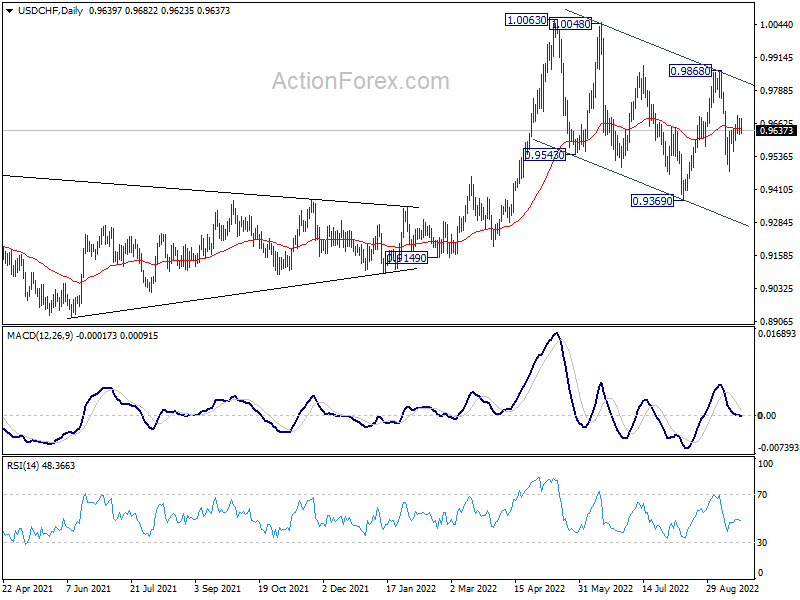
In the bigger picture, current development suggests that up trend from 0.8756 (2021 low) is still in progress. Sustained break of 1.0063 will target 100% projection of 0.9149 to 1.0063 from 0.9369 at 1.0283, and then 1.0342 (2016 high). For now, this will remain the favored case as long as 0.9369 support holds, even in case of deep pull back.
USD/JPY Mid-Day Outlook
Daily Pivots: (S1) 143.13; (P) 143.53; (R1) 144.11; More...
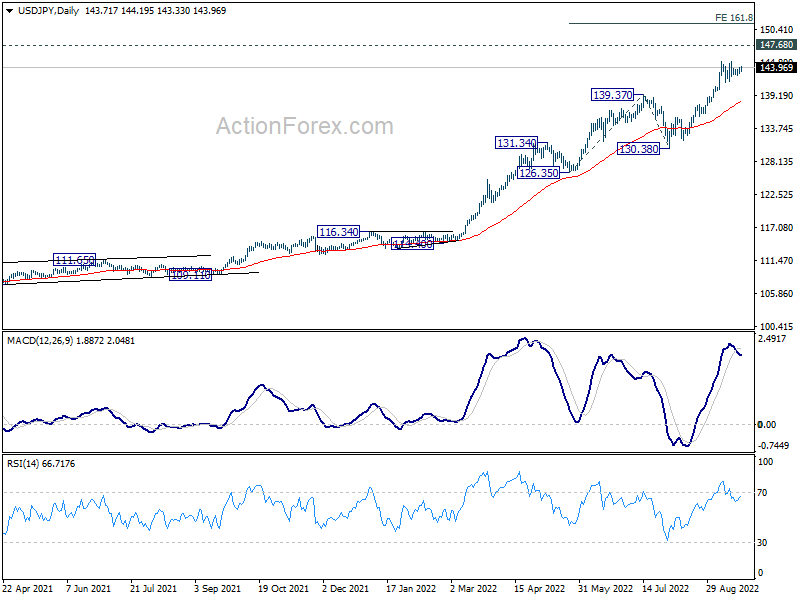
Intraday bias in USD/JPY remains neutral as sideway consolidations continues. Deeper retreat cannot be ruled out, but downside should be contained by 139.37 resistance turned support. On the upside, break of 144.98 will resume larger up trend to 147.68 long term resistance. Break there will target 161.8% projection of 126.35 to 139.37 from 130.38 at 151.44 next.
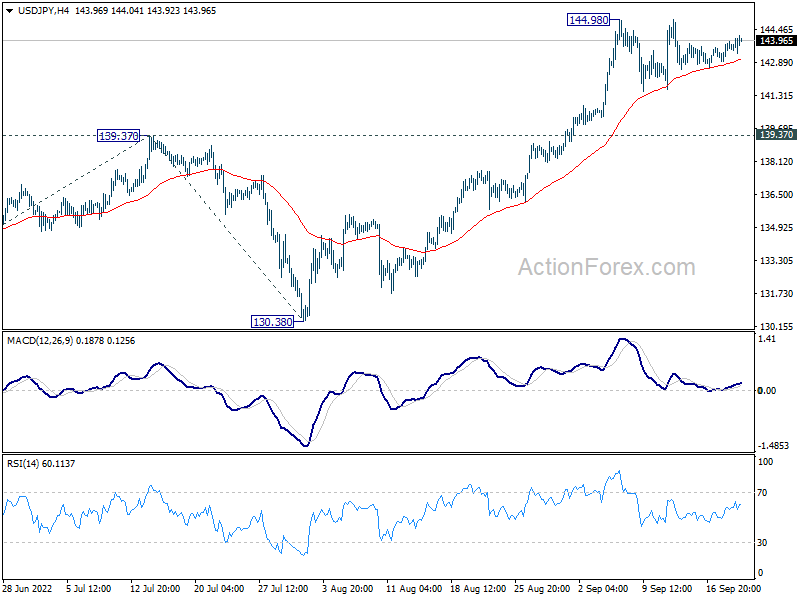
In the bigger picture, up trend from 101.18 is still in progress, as part of the whole up trend from 75.56 (2011 low). Further rise should be seen to 147.68 (1998 high). For now, break of 130.38 support is needed to be the first indication of medium term topping. Otherwise, outlook will stay bullish even in case of deep pull back.
Euro Down on Russian Military Mobilization, Dollar and Swiss Franc Gain
Euro is sold off broadly, together with Sterling, after Russia announced partial military mobilization. Reactions in European stock markets are muted, nevertheless. For now, Swiss Franc is the strongest one for today, followed by Dollar, Canadian and Yen. Aussie and Kiwi are mixed. Focuses will now turn to FOMC rate decision first, followed by BoJ, SNB and BoE tomorrow.
Technically, EURUSD is looking vulnerable for further selloff. Firm break of 0.9863 will resume larger down trend to 100% projection of 1.0368 to 0.9863 from 1.0197 at 0.9296 next. Such development, if happens, could also help push EUR/CHF through 0.9530 temporary low.
In Europe, at the time of writing, FTSE is up 0.58%. DAX is up 0.14%. CAC is up 0.29%. Germany 10-year yield is down -0.039 at 1.899. Earlier in Asia, Nikkei dropped -1.36%. Hong Kong HSI dropped -1.79%. China Shanghai SSE dropped -0.17%. Singapore Strait Times dropped -0.16%. Japan 10-year JGB yield rose 0.0015 to 0.261.
EUR/CHF holding above 0.9530 temp low after selloff
Euro drops broadly today, in particular against Swiss Franc. The selloff came after Russian President Vladimir Putin announced partial military mobilization for the invasion of Ukraine. That's the first such mobilization since World War II, and would call up 300k reservists. Putin also warned that Russia has "various means of destruction". "If the territorial integrity of our country is threatened, we will certainly use all the means at our disposal to protect" he said, adding that "this is not a bluff!".
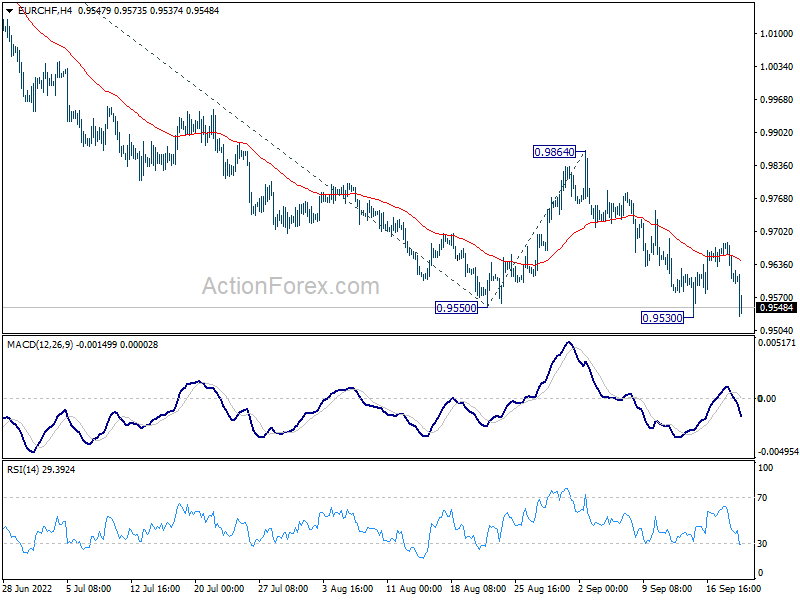
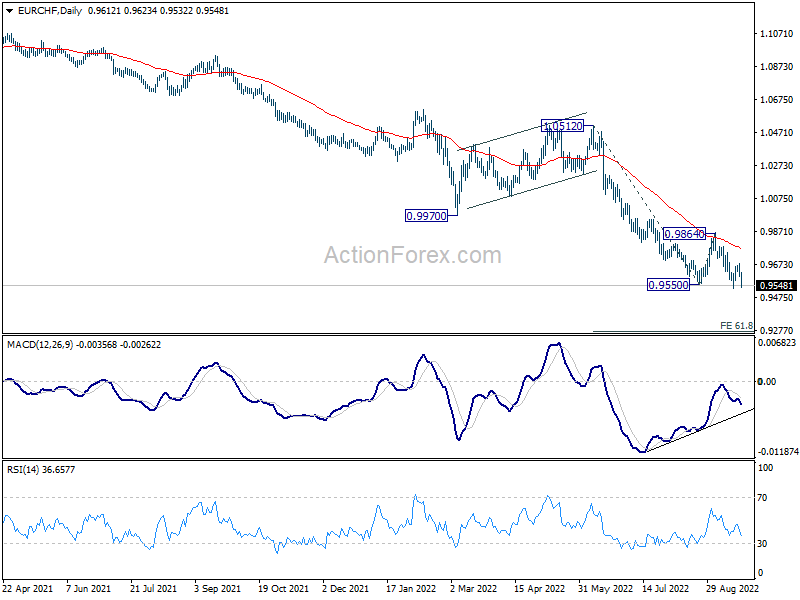
For now, EUR/CHF is still holding above 0.9530 temporary low, and down trend resumption is not confirmed yet. On break of 0.9530, EUR/CHF should target 61.8% projection of 1.0512 to 0.9550 from 0.9864 at 0.9269.
Fed to hike 75bps as 10-year yield resumed up trend
FOMC rate decision is the main focus of the day and another jumbo rate hike is expected. Based on current market pricing, there is 82% chance of a 75bps hike to 3.00-3.25%, and just 18% chance of a 100bps hike to 3.25-3.50%. Thus, there is little chance for Fed to upset the markets.
Overall rhetoric should be unchanged that tightening is set to continue while Fed is committed to bring inflation down to target. The bigger questions are on the new economic projections and the dot plot. Some hawkish surprise could be seen there, which indicates higher terminal rate for current cycle, and a longer period to stay there.
Here are some previews:
- FOMC Meeting Preview: 100bps Unlikely, But Longer Rate Hike Path in Play
- Another Fed Hike is Coming; Mind the Dots
- Is the Fed Preparing to Crash the Markets, Or Will it Give Them a Helping Hand?
- Fed Preview: Fast Pace Hiking Cycle Continues
- September Flashlight for the FOMC Blackout Period
RBA Bullock: Interest rate not yet restrictive
RBA Deputy Governor Michele Bullock said interest rate at 2.35% is not yet restrictive. But the central was already looking for opportunities to slow the pace of tightening at some point. The monthly inflation data to be released next week would have a lot of statistical noises, and would unlikely be having much impact of the deliberations at the October meeting.
Regarding the asset purchased during the pandemic bond buying program, Bullock said RBA had taken a mark-to-market valuation loss of AUD 33.9B in 2021/22. That would let the central bank in a negative net equity position of AUD 12.4B. But she added, since it has the ability to create money, the Bank can continue to meet its obligations as they become due and so it is not insolvent... The negative equity position will, therefore, not affect the ability of the Reserve Bank to do its job."
ADB slashes developing Asia growth forecast to 4.3%, China to 3.3%
The Asian Development Bank slashed growth forecasts for developing Asia from 5.2% (April forecast) to 4.3% in 2022, and 5.3% to 4.9% in 2023. It said, "The revised outlook is shaped by a slowing global economy, the fallout from Russia's protracted invasion of Ukraine, more aggressive monetary tightening in advanced economies, and lockdowns resulting from the People's Republic of China's zero-COVID policy."
As for China, growth forecasts was downgraded sharply from 5.0% to 3.3% in 2022, and from 4.8% to 4.5% in 2023. India's growth forecast was also cut from 7.5% to 7.0% in 2022, and from 8.0% to 7.2% in 2023.
On the other hand, inflation forecast was raised from 3.7% to 4.5% in 2022, and from 3.1% to 4.0% in 2023, "due to higher energy and food prices".
USD/JPY Mid-Day Outlook
Daily Pivots: (S1) 143.13; (P) 143.53; (R1) 144.11; More...
Intraday bias in USD/JPY remains neutral as sideway consolidations continues. Deeper retreat cannot be ruled out, but downside should be contained by 139.37 resistance turned support. On the upside, break of 144.98 will resume larger up trend to 147.68 long term resistance. Break there will target 161.8% projection of 126.35 to 139.37 from 130.38 at 151.44 next.
In the bigger picture, up trend from 101.18 is still in progress, as part of the whole up trend from 75.56 (2011 low). Further rise should be seen to 147.68 (1998 high). For now, break of 130.38 support is needed to be the first indication of medium term topping. Otherwise, outlook will stay bullish even in case of deep pull back.
Economic Indicators Update
| GMT | Ccy | Events | Actual | Forecast | Previous | Revised |
|---|---|---|---|---|---|---|
| 00:30 | AUD | Westpac Leading Index M/M Aug | -0.10% | -0.15% | ||
| 06:00 | GBP | Public Sector Net Borrowing (GBP) Aug | 11.1B | 7.5B | 4.2B | 2.1B |
| 14:00 | USD | Existing Home Sales Aug | 4.70M | 4.81M | ||
| 14:30 | USD | Crude Oil Inventories | 2.0M | 2.4M | ||
| 18:00 | USD | Fed Interest Rate Decision | 3.25% | 2.50% | ||
| 18:30 | USD | FOMC Press Conference |
Will the Fed Push the Market or Hold it at the Edge?
The markets are preparing for the next Fed decision, the publication of which and subsequent Chairman Powell’s comments have the potential to trigger sharp market moves and set the tone for the days or even weeks ahead.
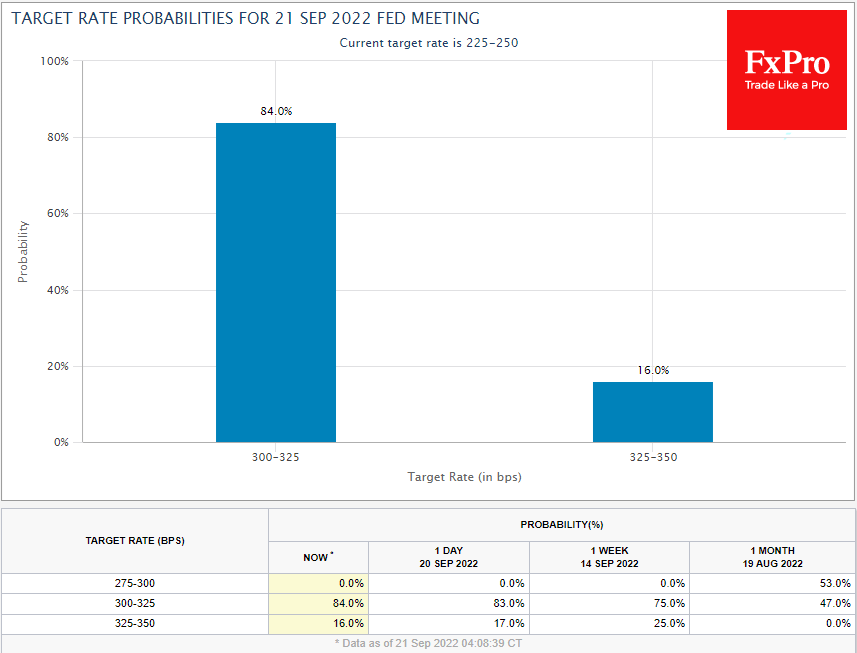
The rate futures market is laying down an 84% chance of a 75-point increase, leaving a 16% chance of a 100-point hike today. This is a very hawkish expectation that the market has been putting into prices since last Tuesday, causing a pull into defensive assets.
The money market has been renewing extremes in previous days, laying higher rates in prices for the longer term.
In the currency market, the dollar index has come close to the extremes set at the beginning of the month, trading now at 110.35, while GBPUSD, EURUSD and USDJPY have rewritten or come close to their multi-year extremums. All it takes is a slight nudge from this point to trigger an avalanche-like move in either direction. Everything will depend on the market’s perception of the Fed’s monetary policy plans.
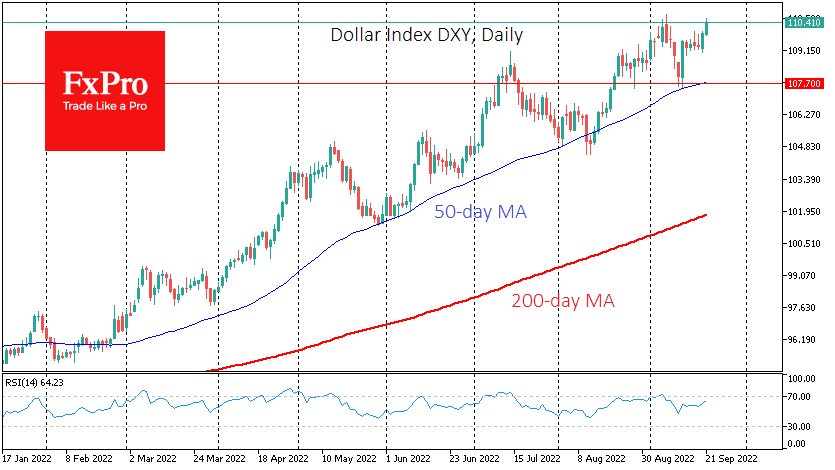
In the week after the surprising US inflation report for August, the markets seem to have given up entirely on the idea that the Fed would lower the rate hikes. On the contrary, the market now appears to be going from one extreme to the other, expecting a 200-point rate hike before the end of the year. This creates the potential for “positive” surprises.
In our case, this could manifest in corrective sentiment on the dollar and a rebound in the equity market from local lows. For the equity market, a break of the downtrend may not come before a sure return of the S&P500 above 4150. The DXY ascent will not be called into question before a plunge below 107.70.
On the other hand, if the Fed remains adamant about tightening financial conditions despite market turbulence, a further push down in equities and a rise in the dollar could trigger an uncontrollable sell-off like the one we saw in March 2020, a near-freefall.
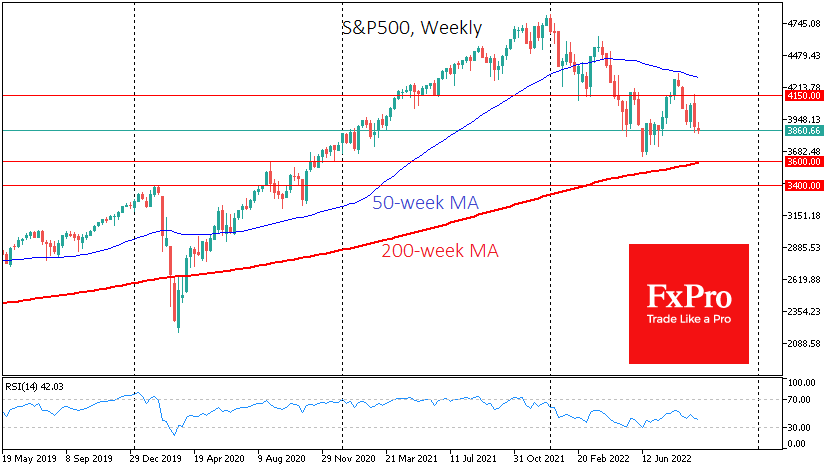
Such market stress could reverse Fed policy, as it did in 2020, 2018, 2015 and 2011. However, before the Fed makes such a reversal, the S&P500 could lose 7 to 12% from current levels near 3600 (200-week average) and 3400 (pre-pandemic peak).
It is challenging to find meaningful technical levels for the dollar index down to the 120 area, which could take up to five months if the momentum gained since the beginning of the year is maintained.
Japanese Yen Steady ahead of Fed, BoJ
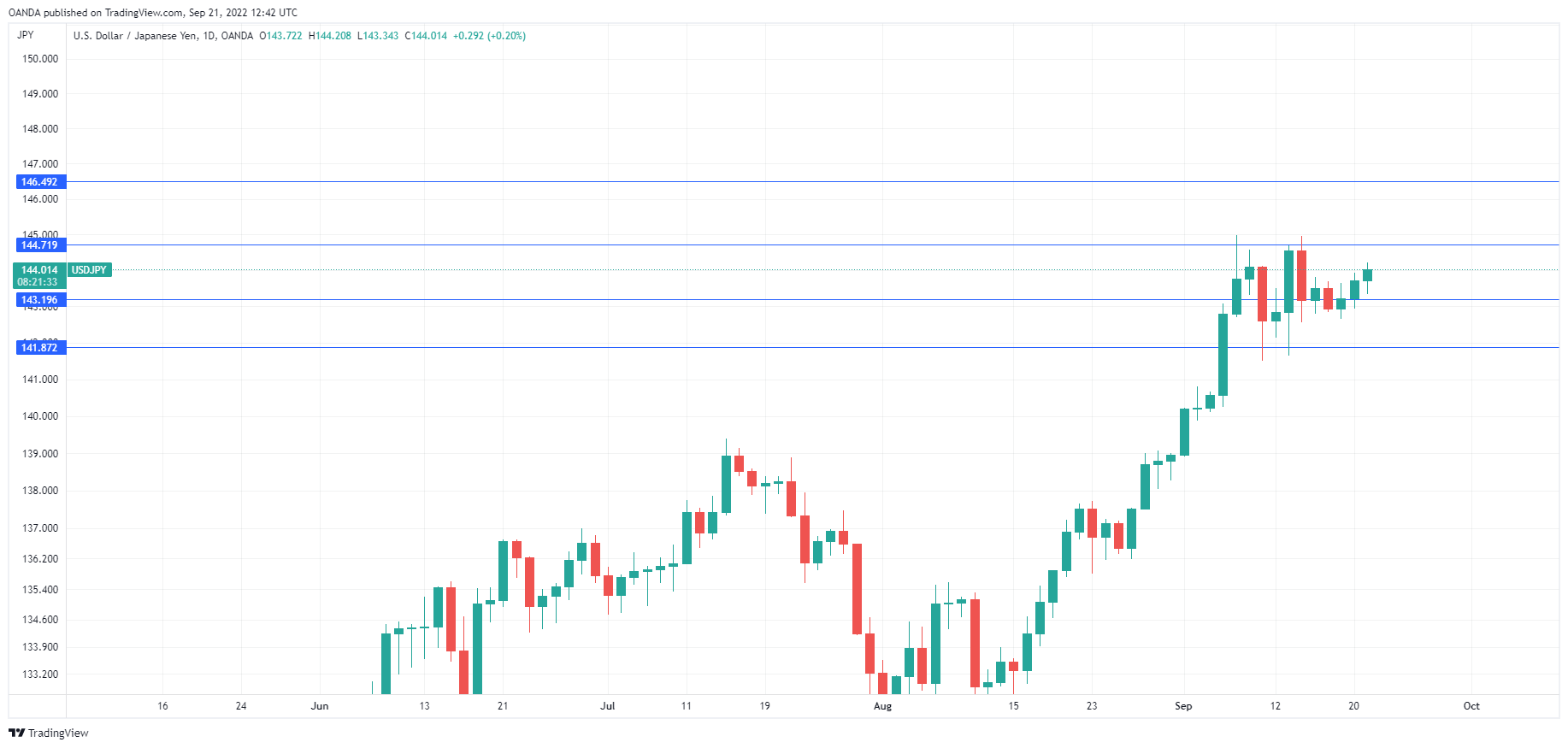
USD/JPY continues to show limited movement this week. In the North American session, USD/JPY is trading at 144.10, up 0.27%.
BoJ unlikely to change policy
The Japanese yen has depreciated by over 20% this year, and the yen’s slide will be high on the agenda at the Bank of Japan’s meeting on Thursday. We could see some strong rhetoric expressing deep concern about the yen, but the central bank has stayed on the sidelines during the yen’s long slide and I don’t expect that to change. The BoJ is committed to its ultra-accommodative policy, in order to boost Japan’s weak economy. Inflation has been rising, but Governor Kuroda has said he won’t tighten policy until it’s clear that inflation is sustainable, which would mean solid wage growth.
There have been some rumblings about currency intervention by Tokyo, and the yen received a short boost in the arm earlier in September, after a report that the BoJ had conducted a rate check, which could have been a prelude to intervention. Japan hasn’t taken such a drastic move since 2011 and would require the consent of the G-20 to do so. As part of its loose policy, the BOJ has been very firm with its yield curve control, and the yen has borne the brunt of this policy, as the US/Japan rate differential continues to widen. With the Federal Reserve poised to raise rates by 75 or even 100 basis points later today, the outlook for the yen appears grim.
The markets are anxiously awaiting the Fed’s rate announcement, as well as the Fed’s quarterly economic forecast. This will include projections for unemployment, inflation and interest rate levels. If Fed Chair Powell’s message is ‘higher for longer’ with regard to rate levels, investors could respond by sending the US dollar higher.
USD/JPY Technical
- There is resistance at 144.71 and 146.49
- USD/JPY has support at 143.19, followed by 141.88
EUR/CHF holding above 0.9530 temp low after selloff
Euro drops broadly today, in particular against Swiss Franc. The selloff came after Russian President Vladimir Putin announced partial military mobilization for the invasion of Ukraine. That's the first such mobilization since World War II, and would call up 300k reservists. Putin also warned that Russia has "various means of destruction". "If the territorial integrity of our country is threatened, we will certainly use all the means at our disposal to protect" he said, adding that "this is not a bluff!".
Last week, Putin had the first face-to-face meeting with Chinese President Xi Jinping since the pandemic, in Uzbekistan. China's official news agency reported that Xi told Putin China will work with Russia to deepen practical cooperation in trade, agriculture, connectivity and other areas.
For now, EUR/CHF is still holding above 0.9530 temporary low, and down trend resumption is not confirmed yet. On break of 0.9530, EUR/CHF should target 61.8% projection of 1.0512 to 0.9550 from 0.9864 at 0.9269.
Australian Dollar Extends Losses
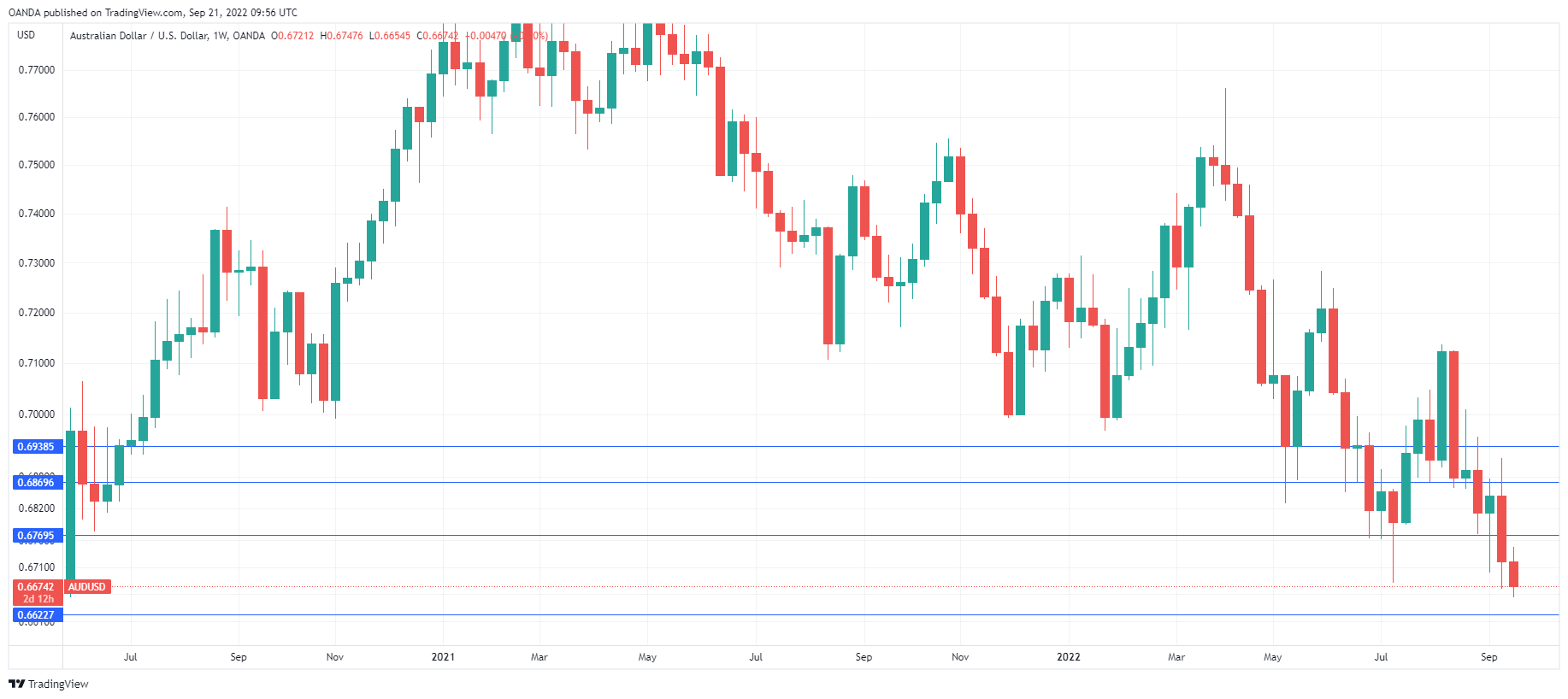
The Australian dollar has edged lower today. Earlier, AUD/USD dropped to 0.6654, its lowest level since May 2020.
Risk sentiment has soured after Russia announced that it is moving quickly to annex territories that it has captured in Ukraine. European leaders quickly denounced the move as a “sham”. An annexation would seriously escalate the conflict in Ukraine, as Russia could argue that any fighting in the annexed territory was an attack on sovereign Russian land. President Putin also ordered the mobilization of 300,000 reservists, an indication of how badly the campaign is going for Moscow.
Fed poised to deliver 75bp increase
All eyes are on the Federal Reserve which wraps up its policy meeting later today. The Fed is expected to hike by 0.75%, which would bring the benchmark rate to 3.25%. This move would be significant as rates would move above the neutral rate level of 2.5%, into restrictive territory. There is an outside chance that the Fed will raise rates by a full point, which would unnerve the markets and likely send the US dollar sharply higher.
Aside from the rate hike, investors will be keenly monitoring the Fed’s latest quarterly forecasts for the economy. This will include projections for unemployment and interest rate levels. The Fed is expected to remain hawkish and argue that the price of higher unemployment and a further rise in rates is the painful but necessary price to rein in inflation.
RBA says rates to increase
The RBA minutes of the September meeting didn’t contain any surprises. The minutes reiterated the message that further rate hikes are coming, but the size of the hikes will be data-dependent. At the meeting, members argued over whether to raise rates by 25bp or 50bp – in the end, the Bank went for the latter option, bringing the cash rate to 2.35%. With no inflation or employment data prior to the October meeting, RBA members may again be split over how much to tighten. This should make for an interesting meeting that could trigger volatility from the Australian dollar.
AUD/USD Technical
- AUD/USD has support at 0.6623 and 0.6523
- There is resistance at 0.6769 and 0.6869