Sample Category Title
Fed hikes 75bps, rate to reach 4.4% by year end
Fed raises interest rate by 75bps to 3.00-3.25% as widely expected, by unanimous vote. In the accompanying statement, Fed said job gains have been "robust" with unemployment rate "remained low". Inflation remains "elevated". FOMC would be " prepared to adjust the stance of monetary policy as appropriate if risks emerge that could impede the attainment of the Committee's goals."
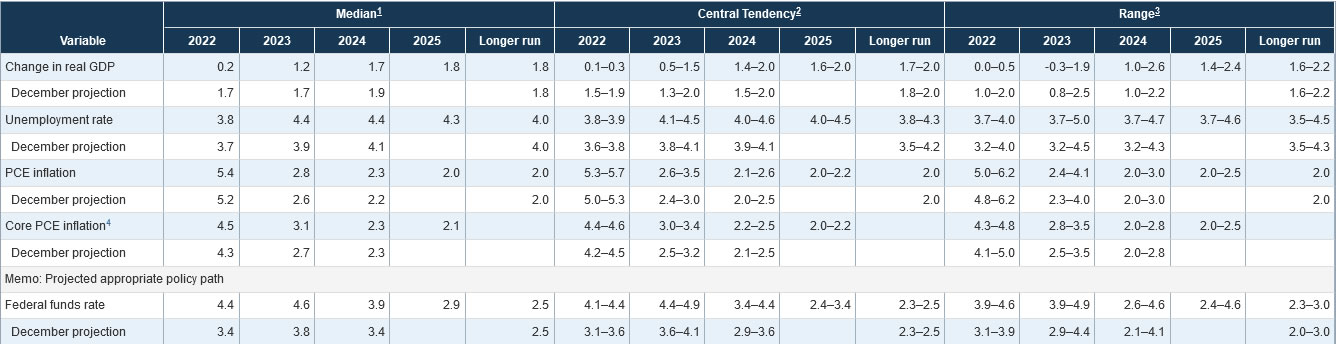
In the new economic projections, Fed projects (median) interest rates to reach 4.4% in 2022, 4.6% in 2023, before falling back to 3.9% in 2024, and then 2.9% in 2025. GDP growth is projected to be at 0.2% in 2022, 1.2% in 2023, 1.7% in 2024, and then 1.8% in 2025. Unemployment rate is projected to be at 3.8% in 2022, 4.4% in 2023, 4.4% in 2024, and then 4.3% in 2025. Core PCE inflation is projected to be at 4.5% in 2022, 3.1% in 2023, 2.3% in 2024, and then 2.1% in 2025.
(FED) Federal Reserve Issues FOMC Statement
Recent indicators point to modest growth in spending and production. Job gains have been robust in recent months, and the unemployment rate has remained low. Inflation remains elevated, reflecting supply and demand imbalances related to the pandemic, higher food and energy prices, and broader price pressures.
Russia's war against Ukraine is causing tremendous human and economic hardship. The war and related events are creating additional upward pressure on inflation and are weighing on global economic activity. The Committee is highly attentive to inflation risks.
The Committee seeks to achieve maximum employment and inflation at the rate of 2 percent over the longer run. In support of these goals, the Committee decided to raise the target range for the federal funds rate to 3 to 3-1/4 percent and anticipates that ongoing increases in the target range will be appropriate. In addition, the Committee will continue reducing its holdings of Treasury securities and agency debt and agency mortgage-backed securities, as described in the Plans for Reducing the Size of the Federal Reserve's Balance Sheet that were issued in May. The Committee is strongly committed to returning inflation to its 2 percent objective.
In assessing the appropriate stance of monetary policy, the Committee will continue to monitor the implications of incoming information for the economic outlook. The Committee would be prepared to adjust the stance of monetary policy as appropriate if risks emerge that could impede the attainment of the Committee's goals. The Committee's assessments will take into account a wide range of information, including readings on public health, labor market conditions, inflation pressures and inflation expectations, and financial and international developments.
Voting for the monetary policy action were Jerome H. Powell, Chair; John C. Williams, Vice Chair; Michael S. Barr; Michelle W. Bowman; Lael Brainard; James Bullard; Susan M. Collins; Lisa D. Cook; Esther L. George; Philip N. Jefferson; Loretta J. Mester; and Christopher J. Waller.
USDJPY Wave Analysis
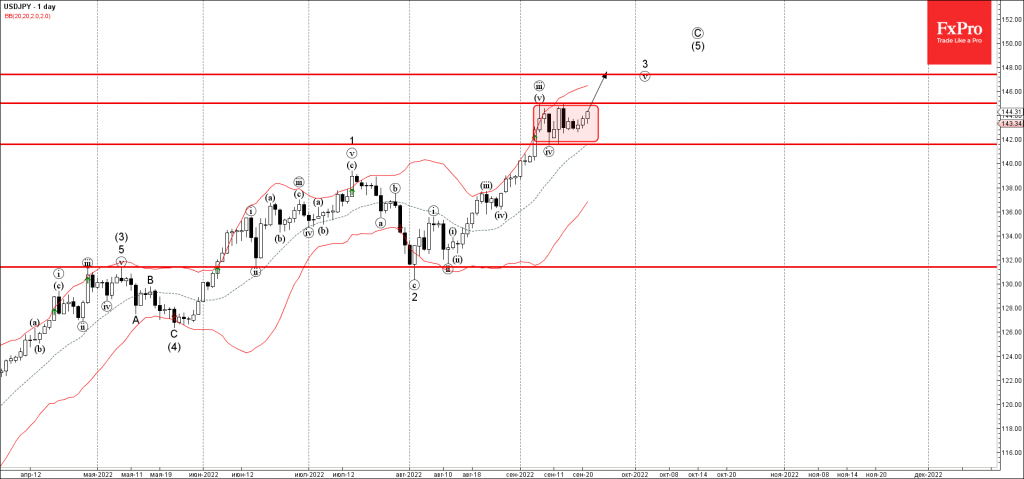
- USDJPY rising inside impulse waves (v) and 3
- Likely to test resistance level 148.00
USDJPY currency pair continues to rise in the direction of the resistance level 145.00 (top boundary of the narrow sideways price range inside which the pair has been moving from the start fop September).
The lower boundary of this price range stands at the support level 142.00, which started the active short-term impulse wave (v).
Given the strong daily uptrend, USDJPY can be expected to rise further toward the next resistance level 148.00 (forecast price for the completion of the active impulse waves (v) and 3).
AUDUSD Wave Analysis
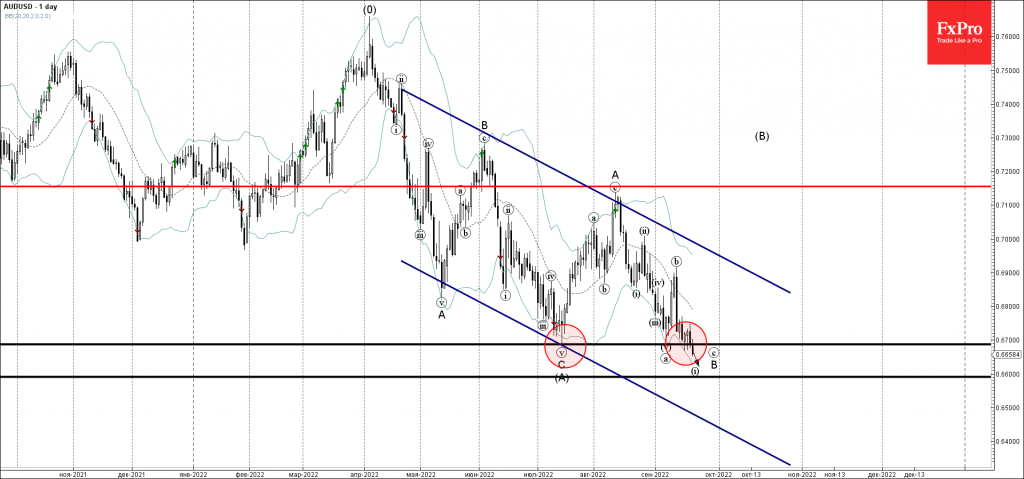
- AUDUSD broke key support level 0.6700
- Likely to fall to support level 0.6600
AUDUSD currency pair recently broke the key support level 0.6700 (previous monthly low from July, which also reversed the pair earlier this month).
The breakout of the support level 0.6700 continues the (c)-wave of the intermediate B-wave from the start of last month.
Given the clear daily downtrend, AUDUSD can be expected to fall further toward the next support level 0.6600 (target for the completion of the active sub-impulse wave (i)).
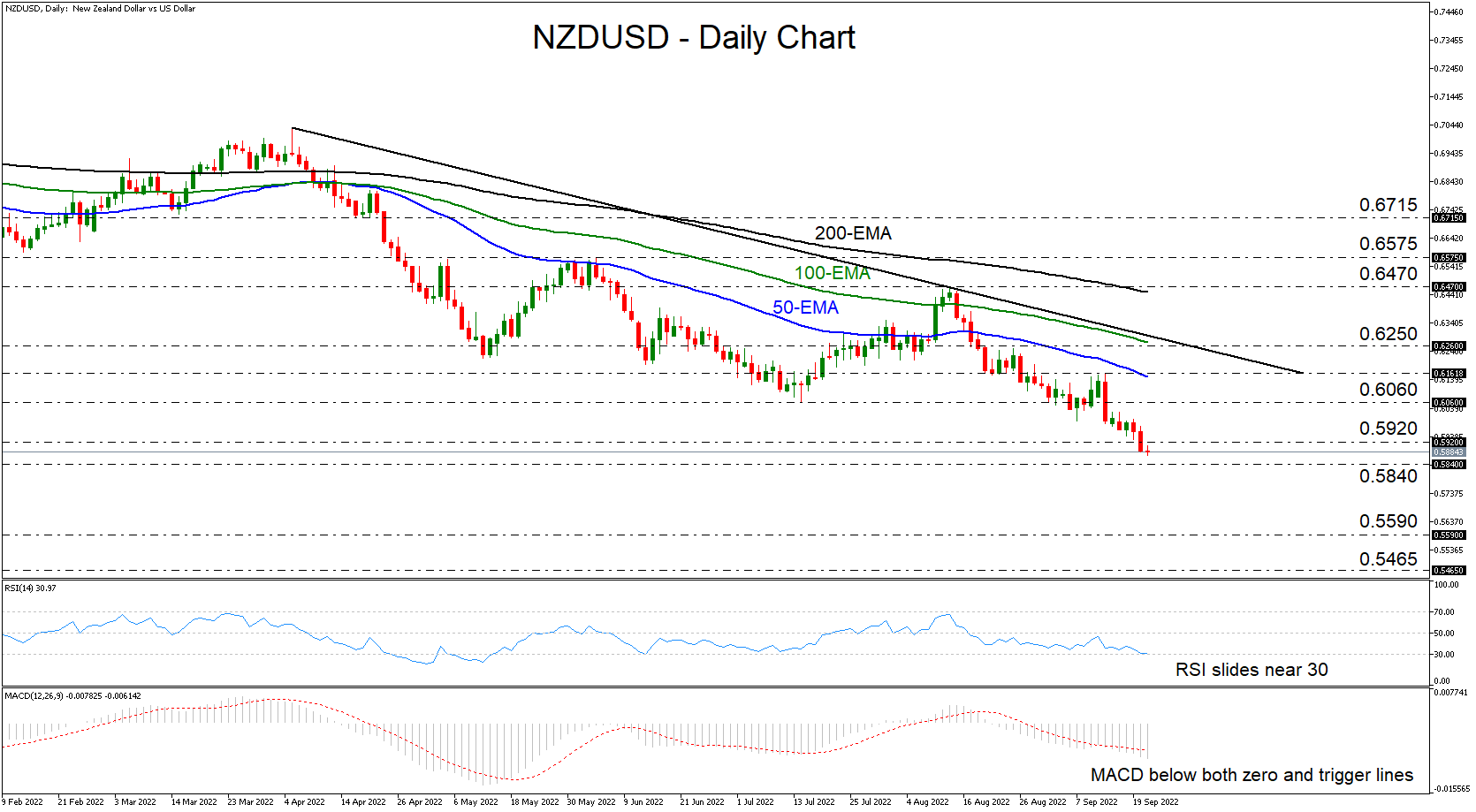
NZDUSD Slides Below 0.5920 as Bears Stay in Charge
NZDUSD slipped below 0.5920 yesterday, a level marked as a support by the low of May 15, 2020. Overall, the pair continues to trade below a tentative downside resistance line drawn from the high of April 5, as well as below all the plotted moving averages. Therefore, the support breach in the direction of the prevailing trend implies that more declines may be in the works for the foreseeable future.
The RSI and the MACD add credence to the narrative, with the former sliding and touching its 30 line, and the latter running below both its zero and trigger lines. Both are detecting strong downside speed.
With the bears in the driver’s seat, the next level to be challenged may be at 0.5840, marked by the low of April 3, 2020. A break lower could darken the picture even more and perhaps pave the way towards the low of March 23, 2020. If the bears are not willing to surrender there either, then they could dive towards the low of March 19 of that year, at around 0.5465.
The bulls could start feeling confident upon a break above 0.6250 as such a move may verify the break above the aforementioned downside line. If indeed this happens, they may climb towards the 200-exponential moving average or the 0.6470 obstacle, marked by the high of August 12. Slightly higher lies another resistance at 0.6575, the break of which may extend the advance towards the 0.6715 area, defined by the inside swing lows of April 18, 19, and 20.
Recapitulating, NZDUSD extended its bearish trend yesterday, by breaking below the support of 0.5920. With all the technical signs and indicators pointing to a downtrend, it seems that lower levels could be met very soon.
ETHUSD Plummets Despite Successful Merge
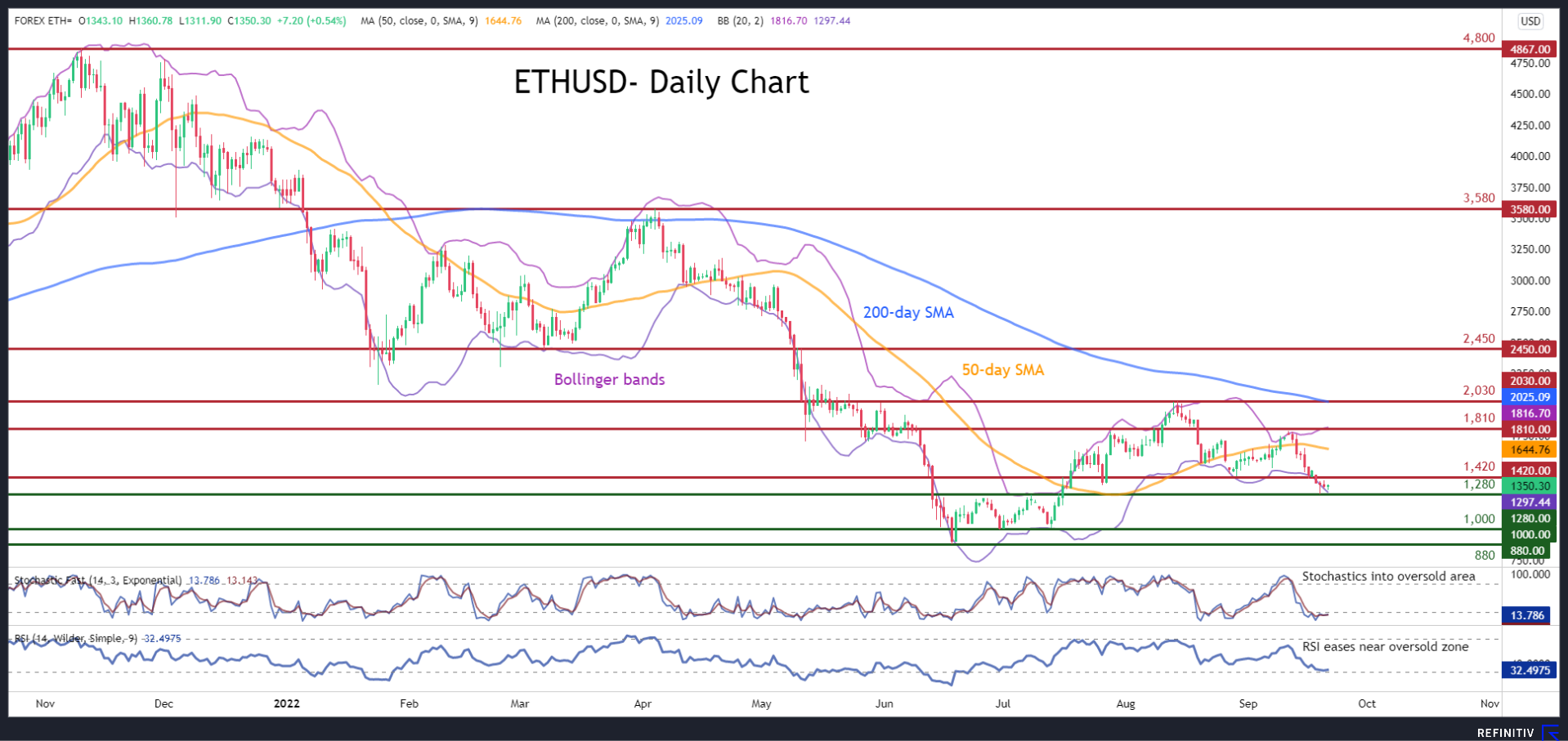
ETHUSD (Ethereum) has been trending upwards since mid-June when its long-term decline ceased at the 2022 low of 880. Nevertheless, the cryptocurrency is experiencing a pullback in the last few daily sessions, even if its latest upgrade called ‘Merge’ was completed without any software downtime or complications last Wednesday.
The momentum indicators have reached their oversold levels, endorsing the likelihood of a rebound. Specifically, the stochastic oscillator is flatlining within the 20- oversold area, while the RSI has hugged the 30-oversold mark.
Should selling pressures persist, the price could decline towards its recent low of 1,280, which overlaps with the lower Bollinger band. If that floor collapses, the spotlight may turn to the crucial 1,000 psychological mark. Even lower, any further retreats could come to a halt at the 2022 low of 880.
On the flipside, if negative momentum fades and the price drifts higher, the recent support zone of 1,420 could act as the first line of defence. Conquering this barricade, the bulls might aim for the recent peak of 1,810 before the trend reversal point of 2,030 comes under examination. A break above the latter may open the door for the 2,450 resistance region.
In brief, despite its latest positive developments Ethereum is exhibiting signs of broader weakness in the near-term. For that bearish sentiment to change, the price needs to initially jump above the 1,810 ceiling.
Pound Falls to New 37-year Low, Fed Looms
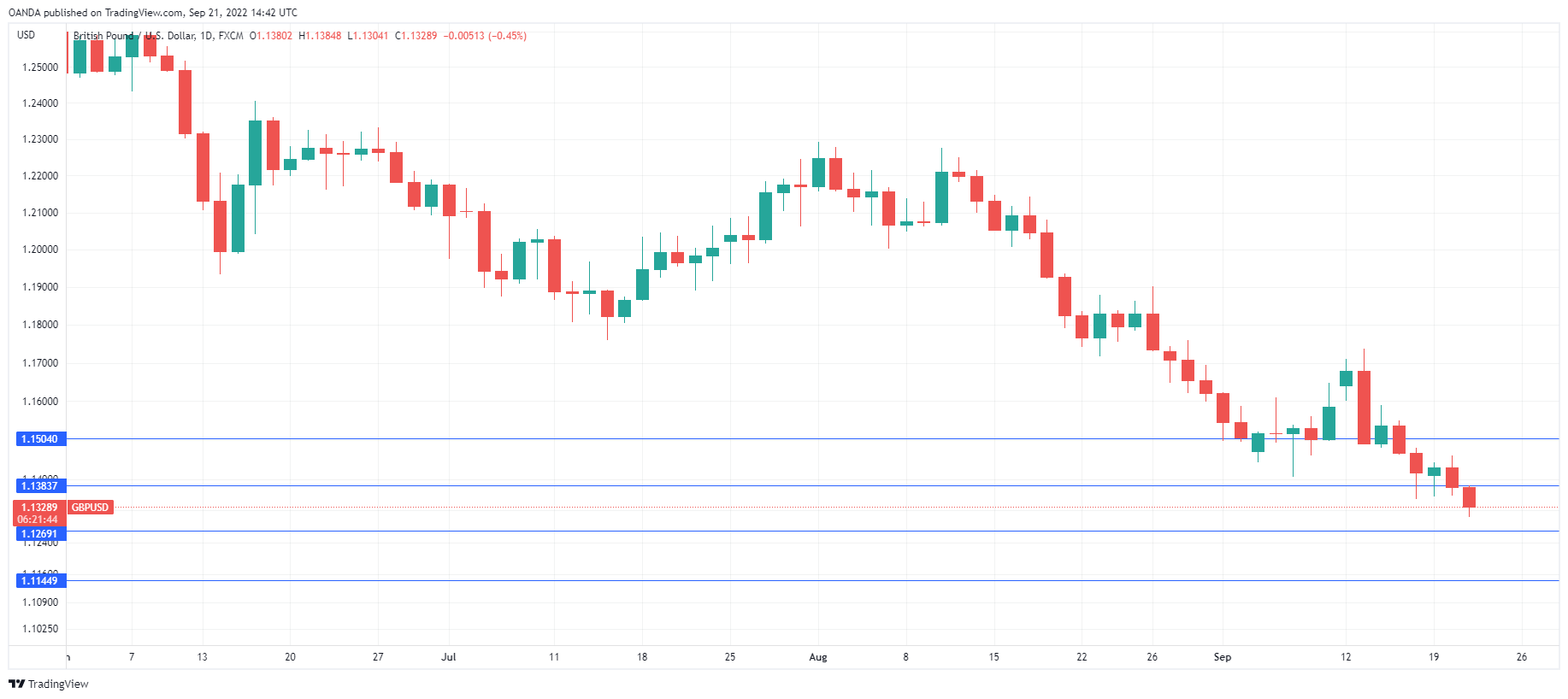
The British pound continues to lose ground. GBP/USD is trading at 1.3436. down 0.33%. Earlier in the day, the pound fell to 1.1304, its lowest level since 1985.
Fed expected to hike by 0.75%
The Federal Reserve holds its policy meeting later today, and is expected to deliver a third straight rate hike of 0.75%, which would bring the benchmark rate to 3.25%. Such a move would have added significance as it would raise the benchmark rate into restrictive territory, above the neutral rate level of 2.5%. This means that the Fed would have to be especially careful with future rate hikes. The markets have priced in a 0.75% increase, but there is a 15% chance of a massive full-point hike, which underscores that the markets have internalized that the Fed remains very hawkish.
Today’s FOMC meeting is about more than the size of the next rate hike. Investors will be keenly monitoring the Fed’s most recent forecasts for inflation, unemployment and interest rate levels. The Fed has designated inflation as public enemy number one, and views increases in unemployment and interest rates as painful but necessary in order to curb inflation.
The BoE will meet on Thursday, after its meeting was delayed to the mourning period for Queen Elizabeth. The markets have priced in a 50bp increase, although a 75bp hike, which last occurred in 1989, is also a possibility. Inflation remains red-hot at 9.9%, and a 75bp move would not only help in the battle against inflation, but will restore the BoE’s credibility, as the Bank has been widely criticised for its handling of inflation.
GBP/USD Technical
- GBP/USD faces resistance at 1.1384 and 1.1504
- There is support at 1.1269 and 1.144
GBP/USD: Cable Hits New 37-year Low, as Russia Rattles the Markets, Focus Turns to Fed
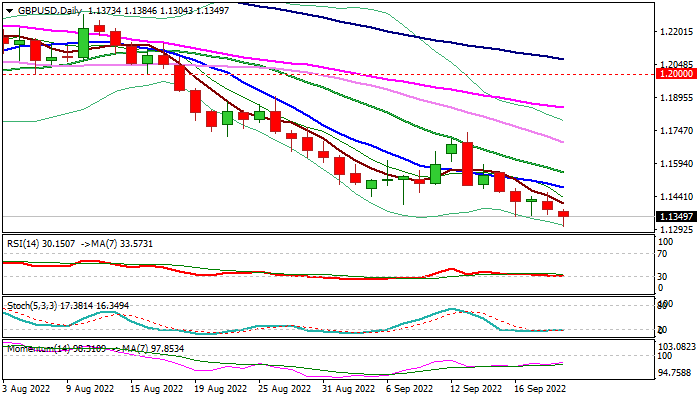
Cable hit new 37-year low on Wednesday after an announcement from Russia and tough rhetoric threatened of further escalation and send a shockwaves through the markets.
Fresh exodus into safety lifted dollar and added to pound’s existing bearish stance, with strong bearish signal generating on break through pandemic low (1.1410), though confirmation still needs weekly close below this level, while monthly close below will reinforce the signal.
Technical studies are bearish on daily and weekly chart but oversold on both timeframes, suggesting that bears may face headwinds.
Wide expectations for Fed’s 0.75% hike would add pressure to pound, while markets look for more details about the central bank’s next steps, regarding the size and pace of further rate hikes that would strongly influence the sentiment.
Fibonacci projections at 1.1278 and 1.1200 mark next targets which guard psychological 1.1000 level.
Former lows at 1.1405 (Sep 7 and 1.1410 (Mar 2020) reverted to immediate resistance, with falling 10DMA (1.1483) expected to cap and keep bears intact.
Res: 1.1410; 1.1460; 1.1483; 1.1532.
Sup: 1.1304; 1.1278; 1.1200; 1.1150.
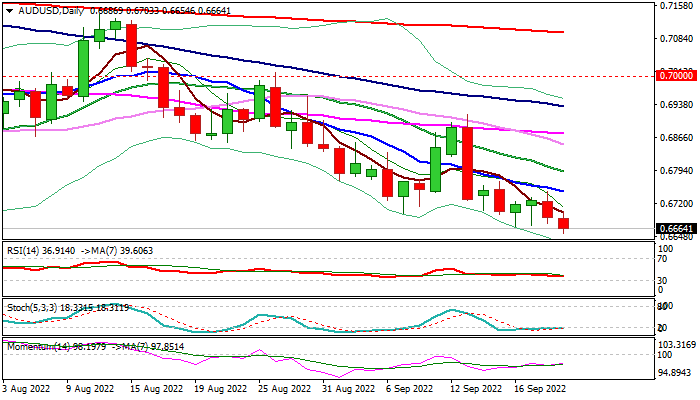
AUD/USD: Aussie Stands at the Back Foot on Risk Aversion and Expectations for Aggressive Fed
Aussie stands at the back foot on risk aversion and expectations for aggressive Fed Aussies falls to the lowest since June 2020 on Wednesday, under fresh pressure from stronger dollar as geopolitical situation is worsening and traders migrate into safety and lower prices of commodities.
Daily techs maintain negative momentum and moving averages are if full bearish setup, underpinning negative stance.
All eyes are on Fed, with widely expected 75 basis points hike to maintain dollar’s strength, but more hawkish than expected central bank’s stance would accelerate larger bears through June 2020 low at 0.6647 and risk extension towards 0.6463 (Fibo 61.8% of 0.5509/0.8007 rally).
Res: 0.6700; 0.6746; 0.6770; 0.6790.
Sup: 0.6654; 0.6616; 0.6465; 0.6463.