Sample Category Title
Week Ahead – Trouble Spews for Yen as Fed, BoE and SNB to Hike, Put Spotlight on BoJ
A crucial week is coming up for the markets as no less than four central banks are scheduled to announce their latest monetary policy decisions. There is a strong possibility of a 75-basis-point rate hike from the Federal Reserve, Bank of England, as well as the Swiss National Bank. The Bank of Japan, though, is expected to buck the trend, leaving the yen at the mercy of its rivals. However, the flash PMI estimates for September will be important too amid ongoing worries about a recession.
Fed meets: another big rate hike on the way
Many were hoping that the August CPI report would bring further relief on the inflation front, solidifying a downward trend in consumer price growth in the United States. But whilst the headline figure did indeed moderate for a second straight month, the drop wasn’t as big as had been expected and core inflation heated up on both the monthly and yearly measures.
That has left investors in no doubt that the Federal Reserve will pull the trigger on another three-quarter point hike on Wednesday when the Federal Open Market Committee concludes its two-day meeting. However, some traders have priced in about a 25% chance of a full percentage point increase. This is probably a bit too aggressive for the Fed, but it does raise the possibility of a relief rally on Wall Street should it ‘disappoint’.
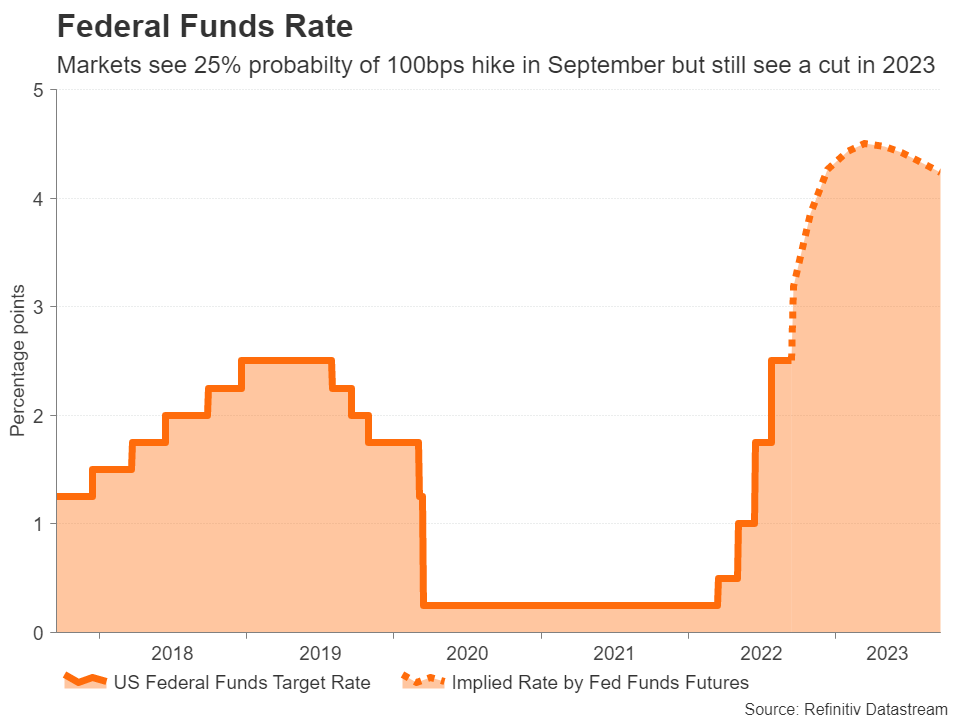
But even then, any spikes up in stocks and spike down in the dollar may not last long if Chair Jerome Powell does not rule out a further 75-bps rate rise at the next meeting in November. Investors will also be scrutinizing the latest dot plot chart to see if policymakers have revised up their projections of the terminal rate.
Excluding the FOMC decision, the US calendar is looking rather light, with only some housing data (building permits and housing starts on Tuesday, and existing home sales on Wednesday), as well as S&P Global’s flash PMIs on Friday potentially stirring the greenback.
Yen weakness to dominate BoJ policy debate
The barrage of central bank decisions will start to gather pace a few hours after the Fed’s when the Bank of Japan announces the outcome of its meeting. Pressure is mounting on the BoJ to provide some hint of an end to years of ultra-accommodative monetary policy as the yen continues to get hammered in forex exchange markets due to widening yield spreads with other countries, most notably with the US.
Although inflation in Japan is on the rise, it is still comparatively low at just 2.6%. The core CPI rate targeted by the Bank stood slightly lower at 2.4% in July. Both are forecast to rise again when the August numbers are released on Tuesday. However, as far as the BoJ is concerned, it is yet to see any evidence of a sustained and broad-based build-up of price pressures, thus it is not in any hurry to tighten policy.
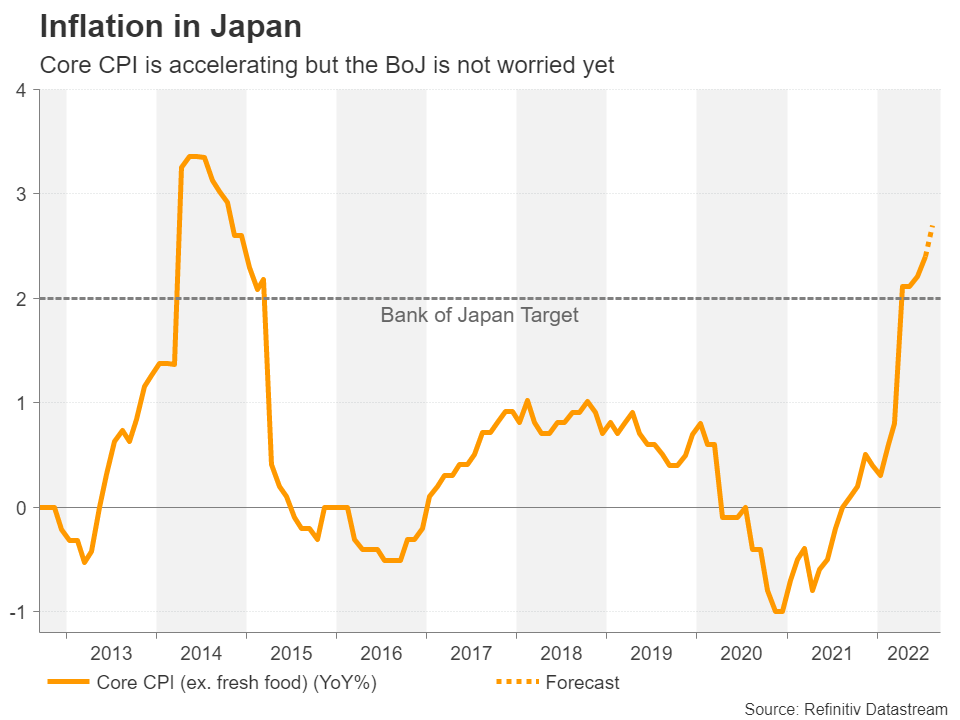
Nonetheless, with the Japanese government becoming more and more uncomfortable with the yen’s depreciation, Governor Kuroda will likely use stronger language to describe the yen’s latest slump, expressing concern about the “rapid” fall.
He may also flag an eventual exit out of stimulus but a change in the yield curve control policy is not on the cards next week. If both policy and guidance are kept unchanged, this would strongly imply that FX intervention is the Bank’s preferred option for putting a floor under the yen.
SNB: era of negative rates to come to an end
Next up after the BoJ on Thursday is the Swiss National Bank’s decision. The SNB avoided going down the BoJ route by delivering a shock 50-bps rate hike in June. Markets have fully priced in a 75-bps increase in September, with slightly less than even odds of a one percentage point move. Either way, the September decision will mark the end of negative interest rates in Switzerland.
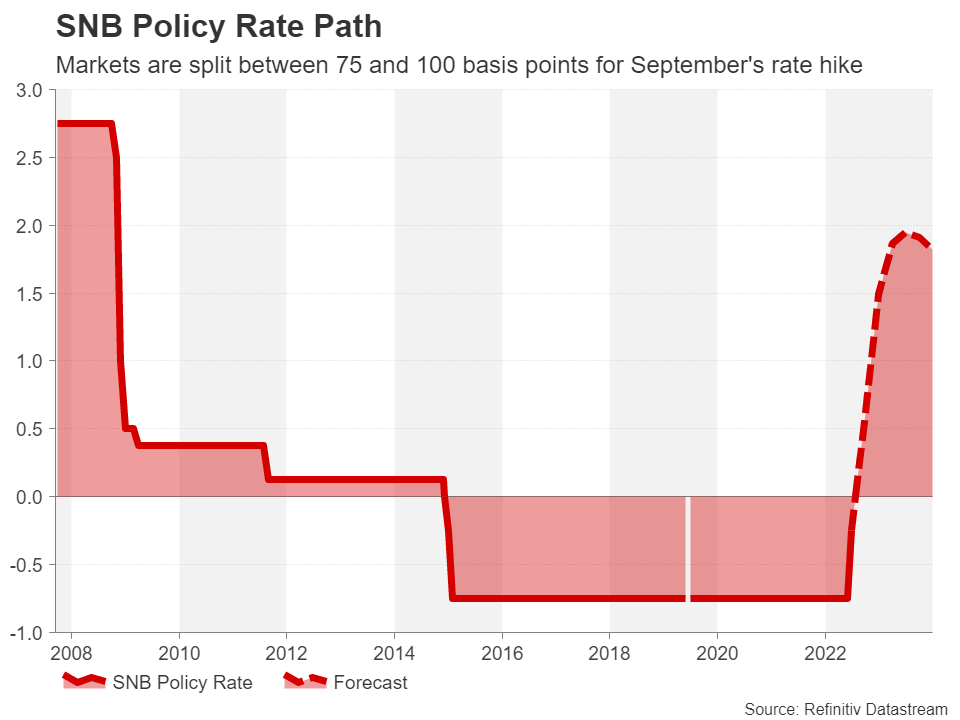
Inflation in the Alpine nation is at a somewhat manageable rate of 3.5% at the moment so the SNB may not see the urgency to get too aggressive just yet. If that turns out to be the case, the Swiss franc could come under pressure versus the US dollar, but probably less so against the likes of the euro.
Pound eyes BoE rate hike and emergency budget
Wrapping up the central bank bonanza on Thursday is the Bank of England. The week will get off to a sombre start in the UK as Monday has been declared a Bank Holiday to mark the funeral of the late Queen Elisabeth II. However, the economy looks set to come back under the limelight soon after that as new Chancellor Kwasi Kwarteng is expected to announce a mini-budget next Friday to provide further details on the government’s fiscal plans to support households and businesses through the energy crisis.
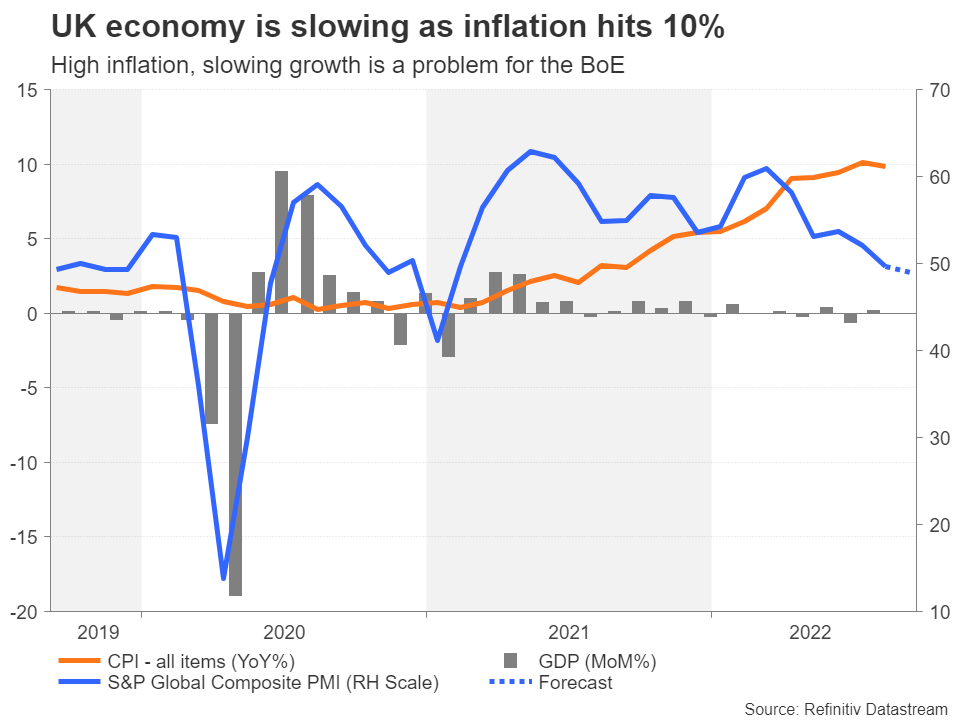
But before that, all eyes will be on the Bank of England and whether it will repeat August’s 50-bps hike or follow in the footsteps of the Fed and ECB and raise by 75 bps. Neither option is desirable for the Bank as the UK economy is losing steam fast. On the other hand, although inflation unexpectedly moderated slightly in August, it’s likely to jump again in the coming months and the BoE’s more cautious approach hasn’t succeeded in reining in inflationary pressures.
A hawkish surprise, either in the form of a 75-bps rise in the Bank Rate or by signalling the need of further tightening in the statement could provide some support to sterling in the face of renewed dollar strength.
However, the flash PMIs for August due on Friday and how good a job Kwarteng does in shoring up investor confidence in the government’s economic policies might be more vital for defending the pound.
Flash PMIs may spell more gloom for the euro
For the euro, the focal point will be Friday’s flash PMIs as the Eurozone economy likely slowed further in September. The composite PMI is projected to have declined below 50 for the third straight month to 48.1, indicating a full quarter of contracting economic activity.
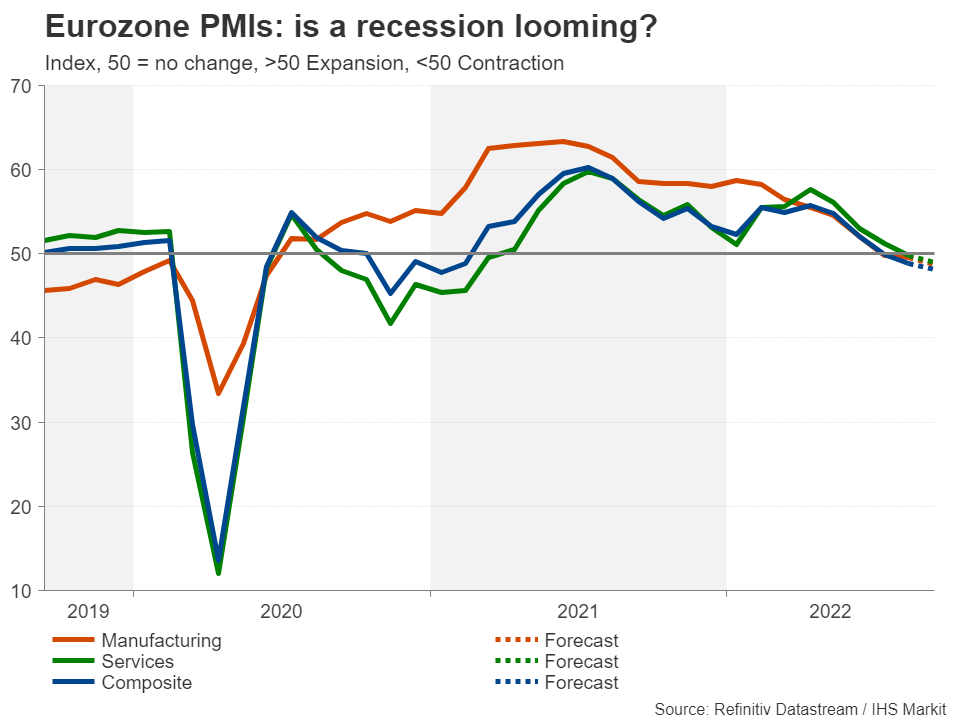
That probably won’t stop the European Central Bank from pressing ahead with further big rate hikes in the remaining meetings of 2022 and early next year. However, for investors to turn more bullish about the euro, they would first need to see light at the end of the energy crisis tunnel.
Although European gas futures have stabilized lately well off from the highs scaled at the end of August, uncertainty about supply during the winter months is expected to weigh on the euro for some time, offsetting any potential narrowing of yield differentials between the US and Eurozone.
Too early to slow down?
Elsewhere, Canada’s CPI data for August will attract the loonie’s attention on Tuesday. The Bank of Canada maintained its very hawkish stance at its last gathering despite boasting the highest policy rate amongst the major advanced economies. But some slowing down in the pace of tightening is likely after lifting borrowing costs by a massive 175 basis points in the last two meetings alone. Next week’s inflation figures should provide some clues as to whether the BoC will opt for 50- or 25-bps increments at its next meeting in October.
Markets are anticipating shallower rate increases by the Reserve Bank of Australia too going forward. The minutes of the RBA’s September meeting are due on Tuesday and may shed some light on how worried policymakers are about overtightening, while Friday’s flash PMI readings will also be watched by aussie traders.
Weekly Focus – High US Inflation Number Shocks the Market
The energy crisis in Europe and inflation developments continue to be a key market focus. The EU commission this week introduced a number of proposals to mitigate the impact of the energy crisis. The commission proposed to limit electricity demands by 5% in peak hours and introduce a windfall tax that to help fund shielding of consumers by raising EUR140bn for the member states. The cap is set at EUR 180 MWh of realized revenue. See full EU plan here. Finally, European Commission President Ursula von der Leyen said that a tax force will be set up with Norway to look at the high gas prices. Many EU countries are now coming up with proposals on how to help consumers. France announced that it will limit gas and electricity price hikes next year to 15% and in Denmark the government proposed a government guaranteed loan scheme allowing consumers to postpone the extra bill for up to five years. The budgetary impact in Denmark is small and in France the government says that a major part of the costs will be covered by the introduction of windfall taxes. While the measures will help hold a hand under economies, it may prolong inflation pressures and hence demand more tightening from the ECB.
Higher than expected US inflation numbers shocked markets this week as they dented hopes for a "softer" Fed. The US August CPI surprised clearly to the upside, as headline CPI rose only 0.1% m/m due to the lower gasoline prices, but core inflation clearly outpaced expectations at 0.6% m/m (July +0.3%, consensus +0.3%). Importantly, inflation pressures remain broad-based with both core goods and services inflation picking up. The inflation release underscored that the Fed cannot take the "foot off the brake" anytime soon. The Fed cannot afford to signal a 'pivot' anytime soon, which is also underlying our belief that it will hike by 75bp next week, while financial markets are even pricing a 30% chance of a 100bp hike. The fear of a more aggressive Fed led to a large sell-off in equity markets, especially in the interest rate sensitive tech sector, where the NASDAQ fell by the most in two years as yields moved higher, while the EUR/USD dropped below parity again.
Ukraine made important advances in the Eastern part of the country, raising the hope the war can come to an end. While we keep our scenario of a frozen conflict in the short term, the odds for Ukraine winning the war have increased. We do not expect sanctions relief but instead highlight that businesses should start to envision opportunities arising from Ukraine reconstruction and recovery. For more details and our updated scenarios see Research Russia-Ukraine: The underdog has the upper hand now - what's next?, 12 sept.
Apart from the FED on Wednesday next week, we have a long list of other central banks that meet. On Tuesday, we expect the Riksbanken to hike its policy rate by 75bp, while on Thursday, we expect the BoJ to confirm its commitment to the yield curve control, while the market expects Norges Bank to deliver another 50bp hike. Also on Thursday, we expect the Bank of England to hike by 50bp and the Swiss National Bank to hike by 75bp. In Europe, announcement on fiscal help packages relating to the energy crisis is a key focus area. On the data front, we get consumer confidence in the euro area on Thursday, while the PMIs on both side of Atlantic on Friday could be another gloomy report for Europe, while the outlook is more uncertain for the US given the ISM continues to lie at a much higher level.
No Signs of Bottom Yet for Risk Assets
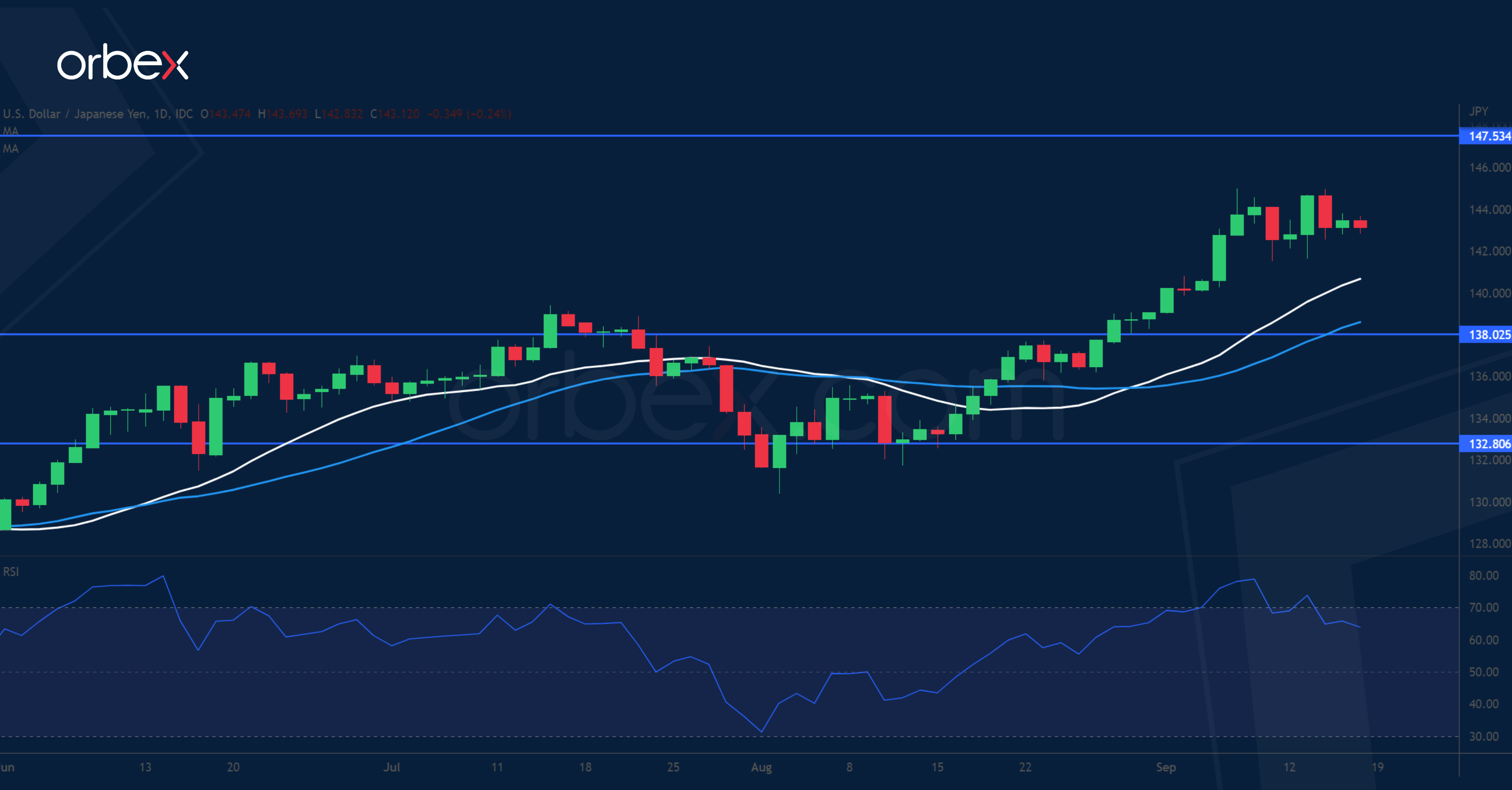
USD/JPY hovers under 24-year high
The Japanese yen steadies as the government signals a market intervention. A rapid rise in interest rates across the globe has cut investors’ appetite for Japanese assets. Japanese officials have expressed their concerns over the currency's steep decline lately. The Finance Minister remarked that options are open to stop the yen’s bleeding as imported inflation may dampen consumer and business sentiment. A recent rate check with dealers by the BoJ shows that policymakers are closely watching the market, fueling speculations of a potential intervention. The pair is closing in on the 24-year high at 147.50. 138.00 is a fresh support.
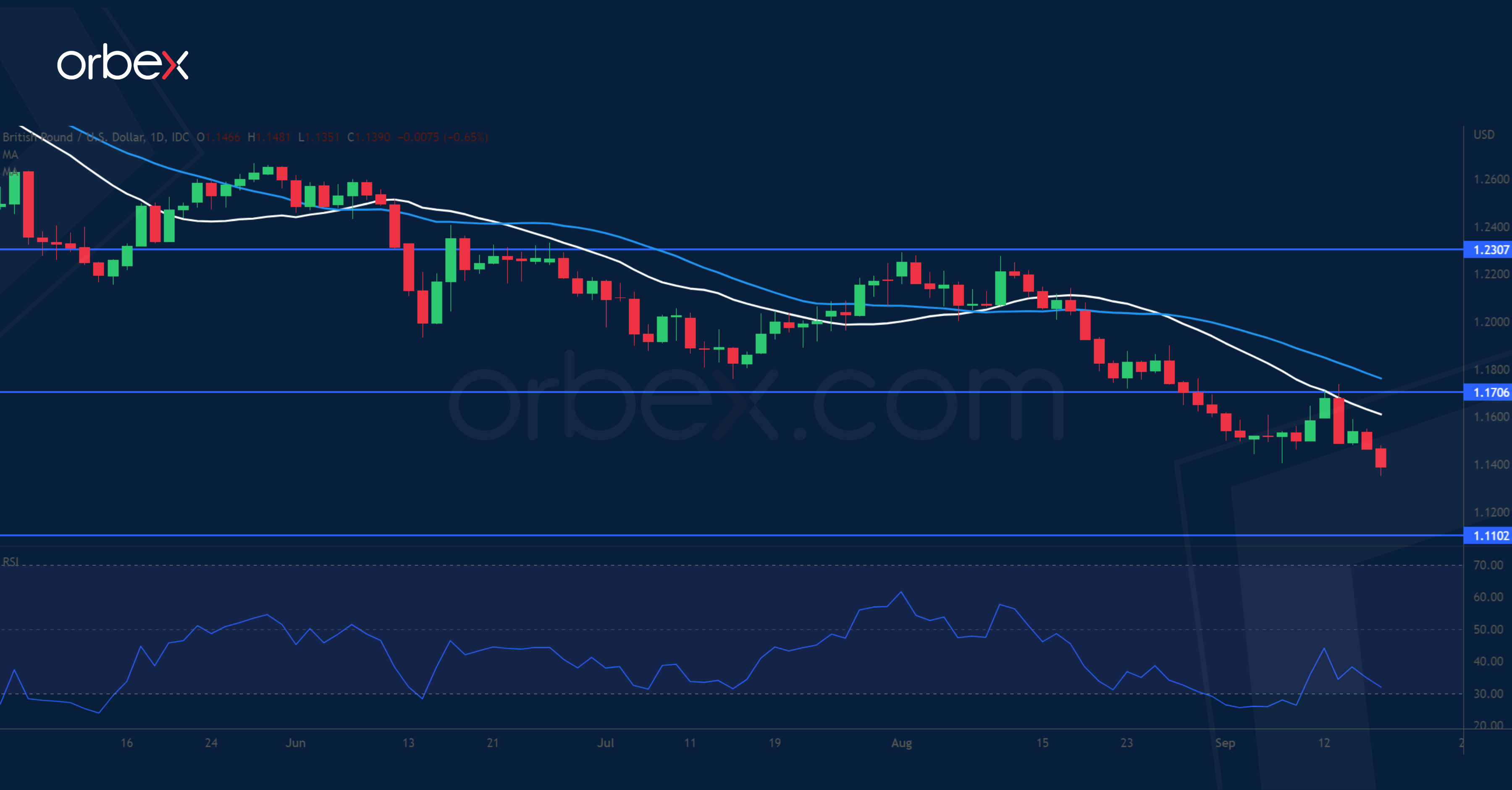
GBP/USD slides on stagflation worries
The pound weakens over the rising cost of debt. Markets are expecting the Bank of England to raise its interest rate by at least 50bps. The latest data showed consumer prices slowed down for the first time in a year. This may lead the central bank to double down on tightening to stifle inflation. However, even if the BoE joins the 75 basis point club, the currency may find little relief as the fear of stagflation gains ground. Debt burdens from the UK government’s energy support package could weigh on investors’ demand for Sterling-denominated assets. The pair has been capped by 1.1700 and is heading towards 1.1100.
XAU/USD struggles over robust US dollar
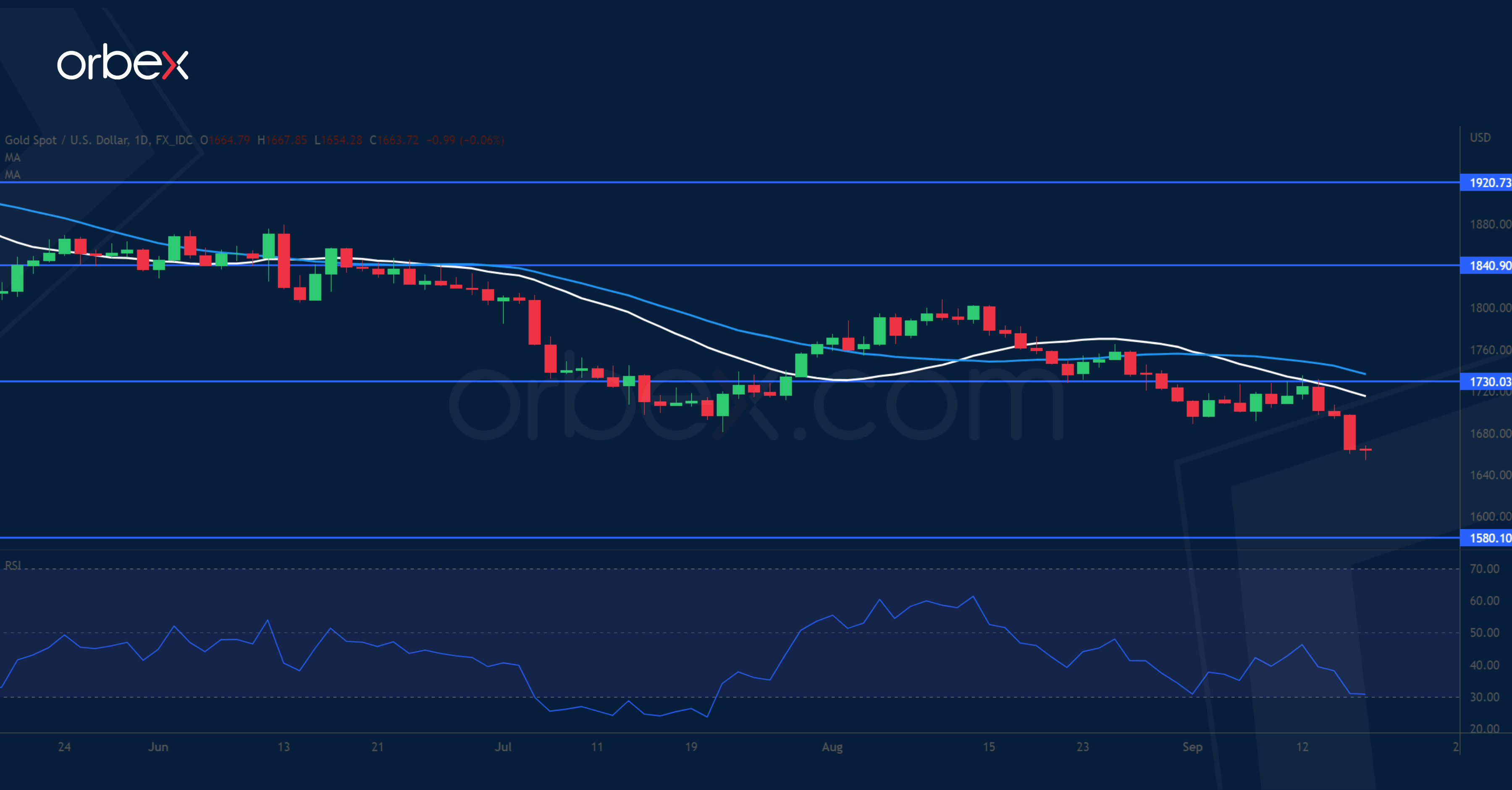
Gold loses its shine as it feels the weight of a firm US dollar. Following hotter-than-expected US inflation traders may reckon that the Federal Reserve would carry on with its shock therapy to bring prices under control. Talks of a 100-basis-point have made their way back among market participants, sending the dollar index back to its two-decade peak. Amid a fast-paced rise in Treasury yields, the appeal of the non-yielding metal would continue to diminish. A hawkish FOMC this week would confirm the recent rally as a dead cat bounce. Bullion has entered bearish territory below 1680. 1580 is next with 1730 as the first resistance.
US 500 slips over economic headwinds
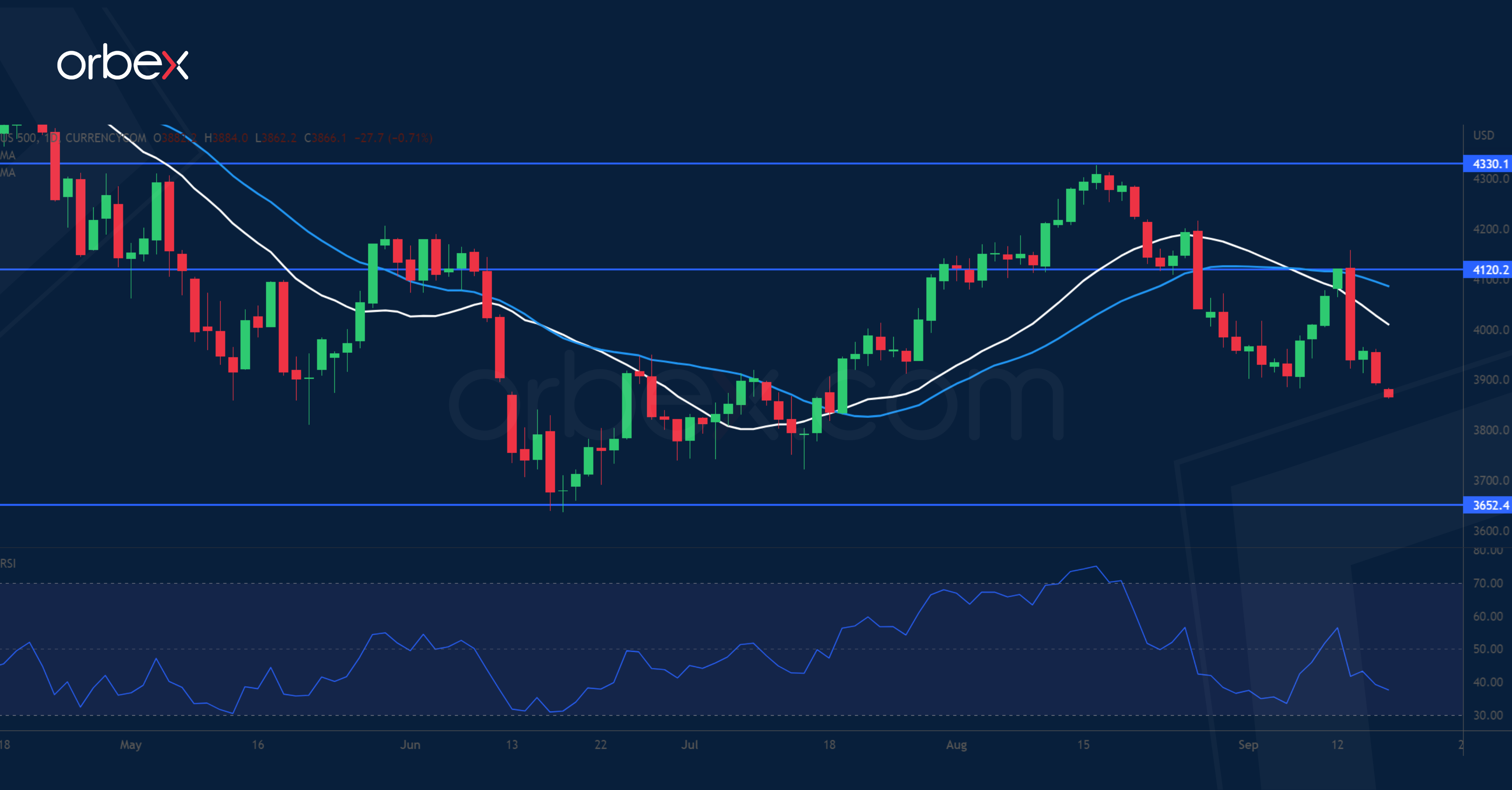
The S&P 500 reverses its course as investors brace for a super-sized US rate hike. The market must have realised that recent inflation and retail data gave the Fed no reason to hit the brakes on the tightening. There is little good news to soothe the jittery mood either. Warnings about a global slowdown from both the World Bank and the International Monetary Fund may continue to push investors away from risk assets. Meanwhile, contraction in China’s property sector, which accounts for a quarter of the country's GDP, fans fears of a protracted downturn. The index is drifting to June’s low at 3650 and 4120 is a fresh resistance.
RIP Cable
Markets
RIP cable. GBP/USD in early European trading slipped below the 1.1412 support (2020 low). At 1.138, the currency pair is trading at its weakest level since 1985. It’s a long way still, but from a technical point of view there’s little to prevent cable from revisiting the all-time low at 1.052. Sterling faced selling pressures for some time already but this morning’s ugly August retail sales (-1.6% m/m, -5.4% y/y) were the straw that broke the camel’s back. It’s basically the cost-of-living crisis in numbers. The pound also loses out vs an otherwise lackluster euro. EUR/GBP broke above the 0.8721/31 resistance levels (previous 2022 high/2021 correction high). Momentum faded a bit after hitting an intraday day peak of 0.877 but the pair is still changing hands at 0.875 at the time of writing. The neckline of the 2020 triple top formation at 0.886 marks the next reference on the technical charts. Next week’s delayed Bank of England meeting will be an interesting once. Markets have more or less abandoned the idea of a 75 bps hike and instead assume a second consecutive 50 bps hike. That’s reasonable given the abysmal eco data this week but still very high inflation. Whether that’ll support the pound, especially against the USD, is debatable. UK financial markets are closed on Monday for Mourning Day. For the Queen and, perhaps, sterling.
Other data today included final European HICP, which was adjusted upwards in the monthly figure (0.6% m/m). Following the release of this report, US consumer confidence (U. of Michigan) is still due. ECB’s Lagarde in a speech said they “absolutely want to avoid second-round effects” while Finnish governor Rehn saw a case for frontloading the tightening cycle. Core bond yields continue their trip north. The 2y European swap yield adds 4 bps, extending yesterday’s break above the 2011 peak. Today’s move means that the 2y and 10y segment now have also inverted. German yields jump 1.2 bps (30y) to 6.4 bps (2y). Yields in the US gain up to 6.2 at the very long end. The 2y rises 3.9 bps to 3.9% and is closing in on the psychological 4%. The dollar remains in the driver’s seat amid ongoing equity risk off (up to -1.6% on WS). The S&P500 extends losses after losing support from the upward sloping trendline yesterday. DXY rips above 110 again. EUR/USD gently drifts south to 0.996. The Japanese yen is the only G10 currency able to stand up against the USD. USD/JPY eases slightly to 143.15. EUR/JPY falls to 142.67. Maybe next week’s BoJ meeting looming made investors wary of a sneaky move to close some shorts. Earlier this week the central bank performed a rate check, usually the last warning shot before actual (but not certain) FX interventions.
News Headlines
Core inflation (net of food and energy prices) in Poland as published by the National Bank of Poland today accelerated further by 0.8% M/M and 9.9% in August (was 0.6% M/ and 9.3% in July). All other core CPI measures (net of administered prices, 15% trimmed mean, net of most volatile prices) were higher than in July both in M/M and Y/Y terms. Earlier this month the statistical office already reported headline inflation at 0.8% M/M and 16.1% Y/Y. Within the national bank of Poland, MPC members are still divided whether inflation is close to the peak, allowing the NBP bring the rate hike cycle to an end or whether some additional further hikes are needed. Polish short-term yields are easing slightly today (2-y swap -10 bps) but most of this move already occurred before the release. The zloty today strengthened slightly to EUR/PLN 4.715.
The central Bank of Russia today as expected further reduced its policy rate from 8.0% to 7.5%. Comments from the central bank after the decision suggest that rate cuts might be coming to an end. Amongst others even some tightening might be needed to bring inflation back to the 4.0% target in 2024 if the fiscal deficit continues to widen. Inflation in August stood at 14.3% and the central bank expects it to finish the year in between 11-13%. The ruble today continued to trade in within a tight consolidation pattern (currently USD/RUB 60.45 area).
Gold Isn’t Saving Investors from Inflation
On Thursday, September 15, XAUUSD lost its major support, which used to limit the downside since April 2020. The decline happened amid expectations of more aggressive Federal Reserve interest rate hikes due to higher-than-expected US inflation.
Why is gold falling?
Investors treat gold as a hedge against inflation. A rise in inflation or inflationary expectations increases investors’ interest in purchasing gold and drives up its price. In contrast, disinflation or a drop in inflationary expectations does the opposite.
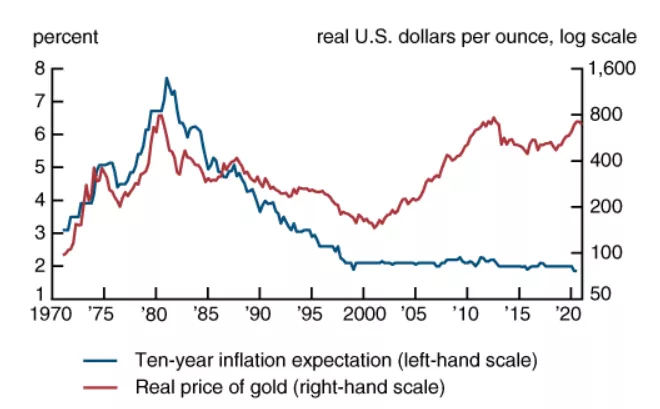
Gold and inflation expectation. Source: Chicagofed
However, we can notice that since the 2000s, the gold price has been rising while the inflation expectations were steadily low. It was caused by the Fed monetary policy, according to which the Federal Reserve has been printing USDs to support the economy. As a result, the amount of USD in circulation increased parabolically, pushing gold prices to new highs.
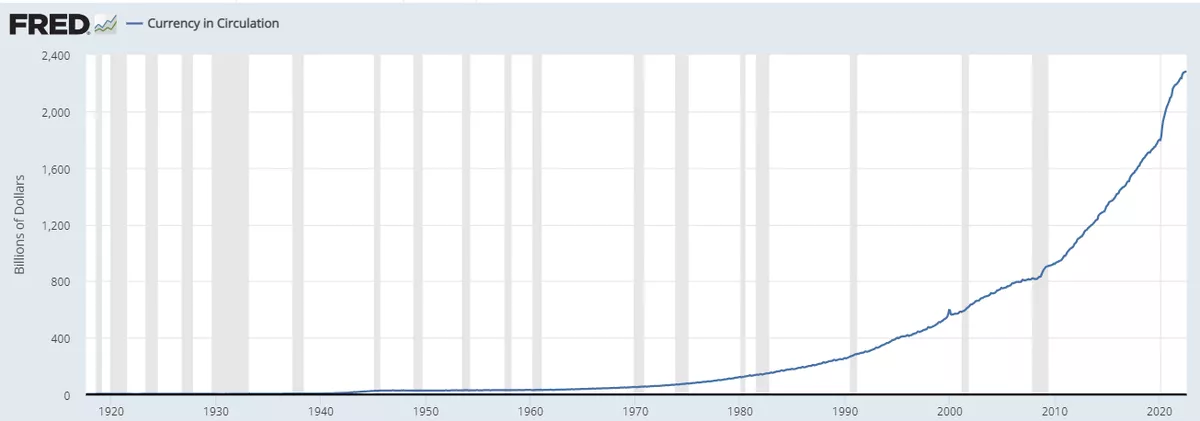
USD in circulation. Source: FRED
Moreover, gold is sensitive to expected long-term real interest rates. Since metal is a long-duration durable asset, its price has a strong inverse relationship with the long-term real interest rate. A rise in expected real rates should drive down the price of gold.
Therefore, central banks' rate hikes and the Fed's quantitative tightening (QT) monetary policy make gold one of the most unpopular assets among big investors. Holding the metal doesn't provide any dividends or payouts, while big hedge funds have to show a profit to investors. Therefore, smart money prefers short-term government bonds to gold, as yields skyrocketed to 15-year highs.
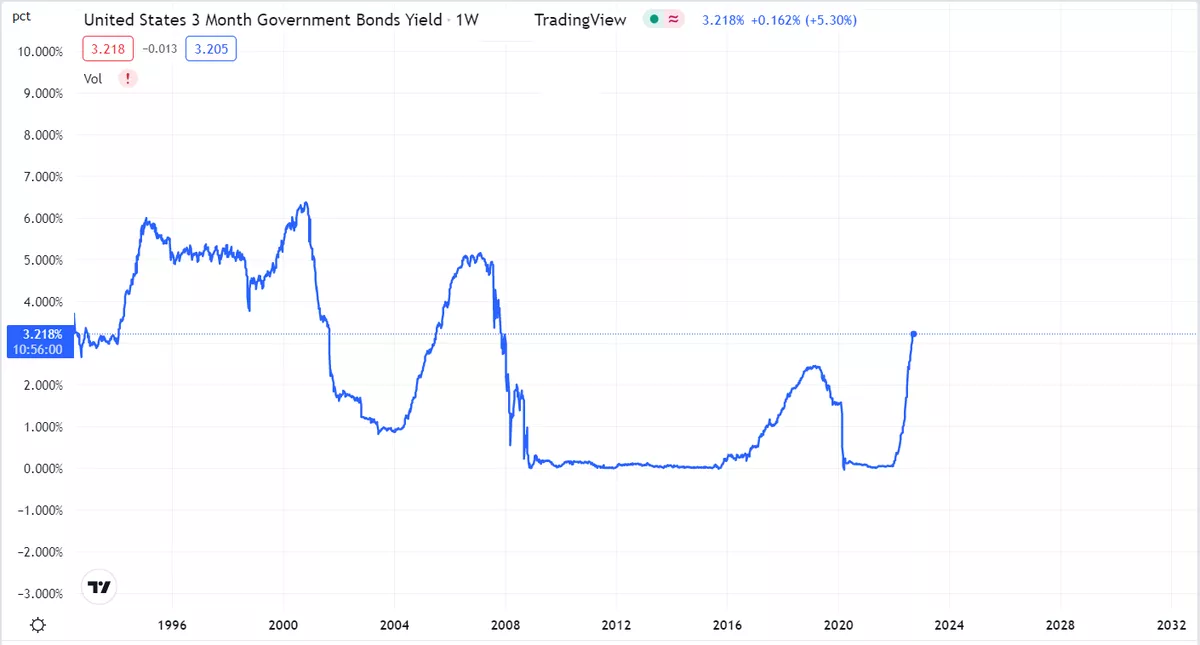
US 3-month Government Bond Yield. Source: Tradingview
What to expect?
While the consensus is a 75-basis-point hike on September 21, some Fed members call for a 100-basis-point increase. The gold market reflects such a prospect. As a result, an actual rate hike by 75 bps may be a positive surprise for the yellow metal.
XAUUSD, weekly chart
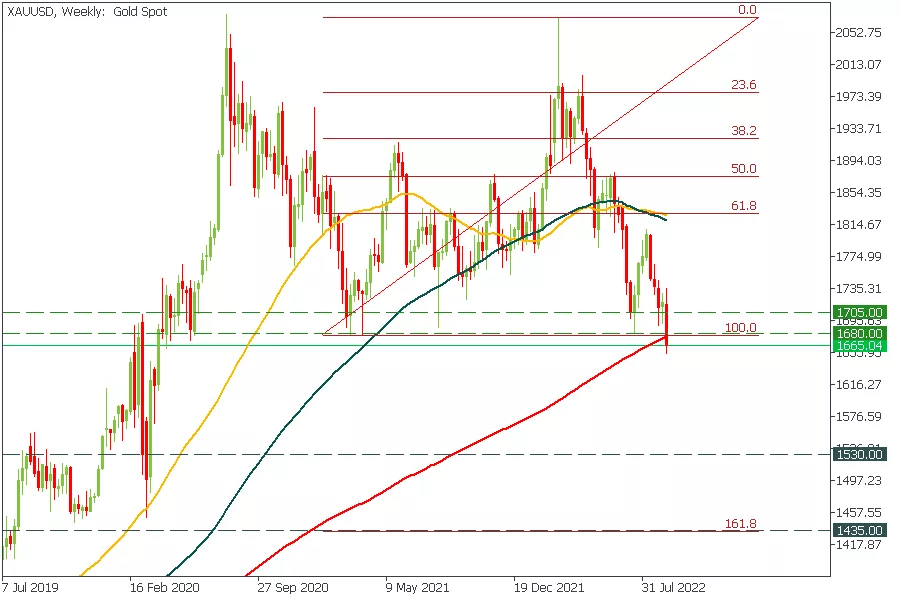
After the breakout, primary support levels for XAUUSD are 1530.00, the horizontal level from May 2012, and 1435.00, 161.80 Fibonacci level. The range between 1680 and 1705 acts as the massive resistance for the price since the breakout.
In the short term, the price might increase inside the resistance range to confirm the breakout. However, I expect a massive decline towards the support levels in the middle term.
New Zealand Dollar Extends Losses
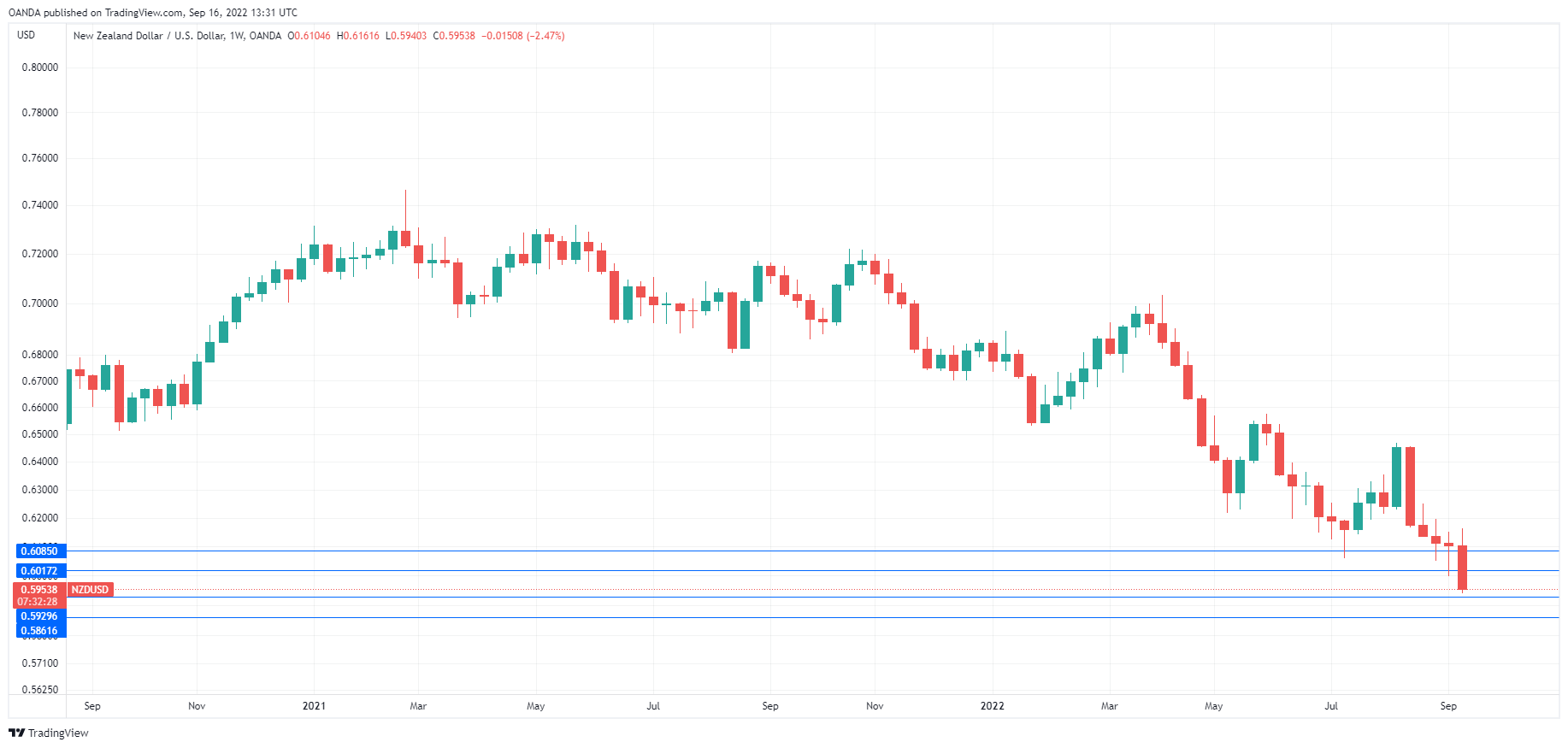
The New Zealand dollar remains under pressure, as NZD/USD is having a dreadful week, down 2.47%. In the North American session, NZD/USD is trading at 0.5950, down 0.27%.
NZ Manufacturing PMI surprises to the upside
It has been a solid week for New Zealand data, but that hasn’t helped the New Zealand dollar, which has fallen to its lowest level since May 2020. Earlier today, New Zealand’s manufacturing PMI for August improved to 54.9, up from 53.5 in July and above the consensus of 52.5. This marked the highest level since July 2021 and manufacturing has now expanded for a fifth month running, with readings above the neutral 50.0 level. This is in contrast to global manufacturing, which has been struggling and slowed to 50.3 in August, down from 51.1 in July.
Earlier in the week, New Zealand posted a stronger-than-expected GDP report for Q2. The economy climbed 1.7%, reversing the 0.2% decline in the first quarter. The upswing in growth was driven by the government’s easing of Covid restrictions. The gain in GDP removed any fear of a technical recession, which is defined as two consecutive quarters of negative growth.
Now that New Zealand’s economy is flexing its muscles, what does that mean for the Reserve Bank of New Zealand? The central bank was almost spot on with its GDP forecast at the August meeting, predicting a gain of 1.8%. At the meeting, the Bank projected that the cash rate would peak at 4.1% in mid-2023. The GDP release is not expected to change that stance, with the Bank likely to raise rates by 50bp in the October and November meetings, which would bring the cash rate to an even 4.0%.
With central banks raising interest rates in order to combat inflation, the World Bank has warned that the global economy may tip into a recession. The World Bank report noted that the three largest economies, the US, China and the eurozone were all slowing sharply, and even a “moderate hit to the global economy” could result in a global recession.
NZD/USD Technical
- NZD/USD is testing resistance at 0.6017. Next, there is resistance at 0.6085
- There is support at 0.5929 and 0.5861
USD/JPY Mid-Day Outlook
Daily Pivots: (S1) 142.94; (P) 143.37; (R1) 143.94; More...
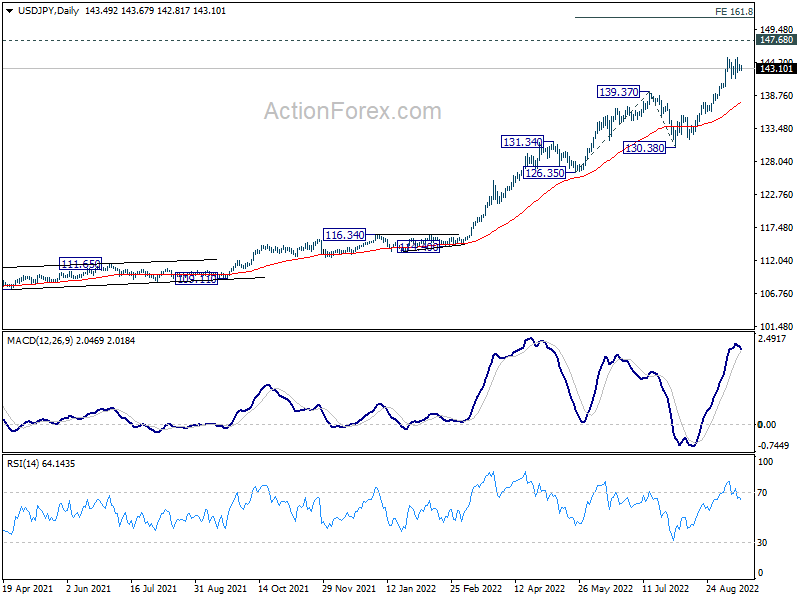
Intraday bias in USD/JPY stays neural as consolidation from 144.98 is still extending. . On the upside, break of 144.98 will resume larger up trend to 147.68 long term resistance. Break there will target 161.8% projection of 126.35 to 139.37 from 130.38 at 151.44 next. While deeper retreat cannot be ruled out, downside should be contained by 139.37 resistance turned support.
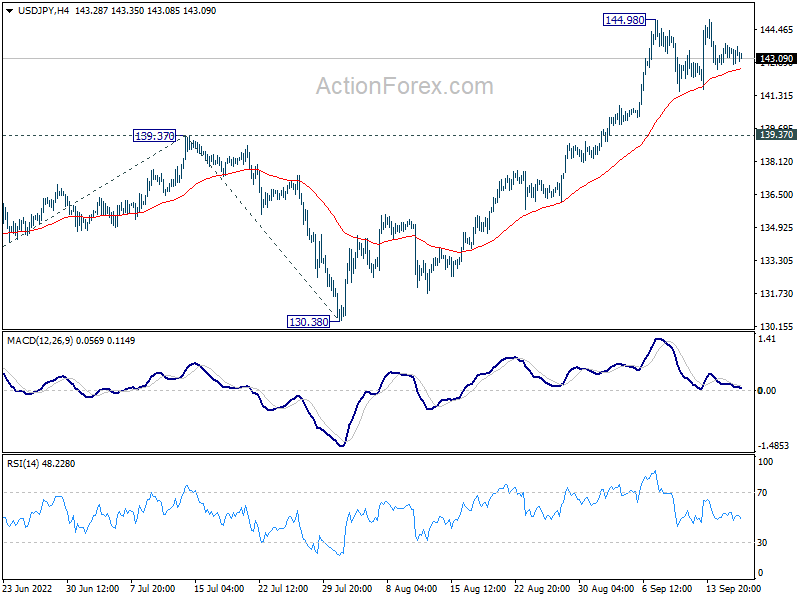
In the bigger picture, up trend from 101.18 is still in progress, as part of the whole up trend from 75.56 (2011 low). Further rise should be seen to 147.68 (1998 high). For now, break of 130.38 support is needed to be the first indication of medium term topping. Otherwise, outlook will stay bullish even in case of deep pull back.
USD/CHF Mid-Day Outlook
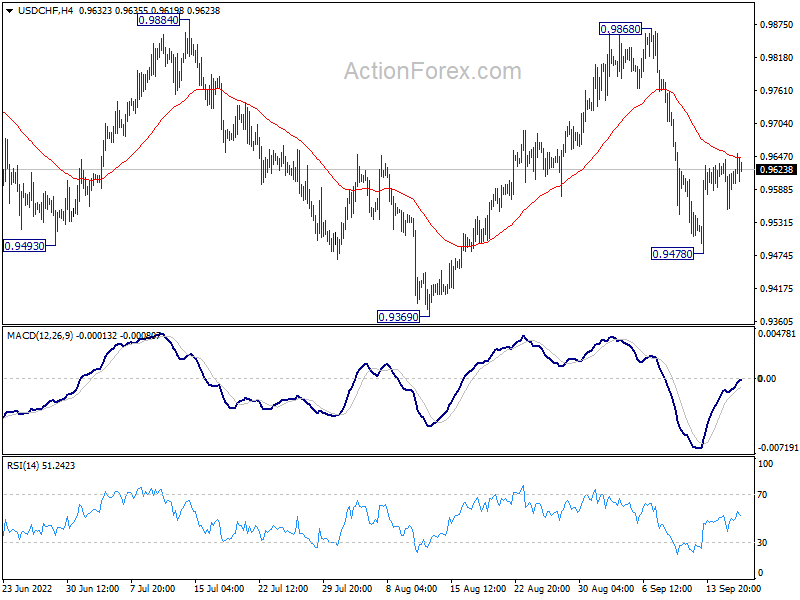
Daily Pivots: (S1) 0.9568; (P) 0.9605; (R1) 0.9654; More
Intraday bias in USD/CHF stays neutral for the moment. On the upside, firm break of 4 hour 55 EMA (now at 0.9644) will target 0.9868 resistance first. Further break there will argue that larger up trend is ready to resume through 1.0063. On the downside, below 0.9478 will extend the fall from 0.9868 towards 0.9369 support. Overall, corrective pattern from 1.0063 could extend further as long as 0.9868 resistance holds.
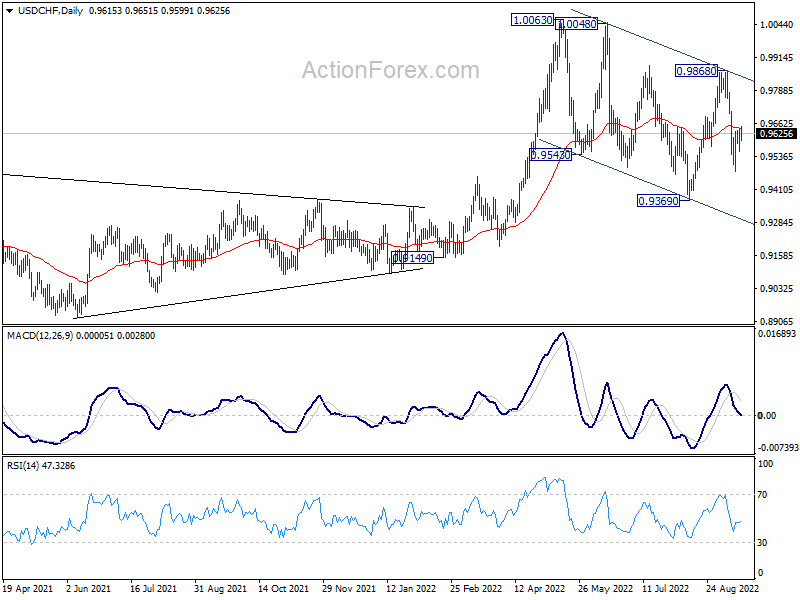
In the bigger picture, current development suggests that up trend from 0.8756 (2021 low) is still in progress. Sustained break of 1.0063 will target 100% projection of 0.9149 to 1.0063 from 0.9369 at 1.0283, and then 1.0342 (2016 high). For now, this will remain the favored case as long as 0.9369 support holds, even in case of deep pull back.
EUR/USD Mid-Day Outlook
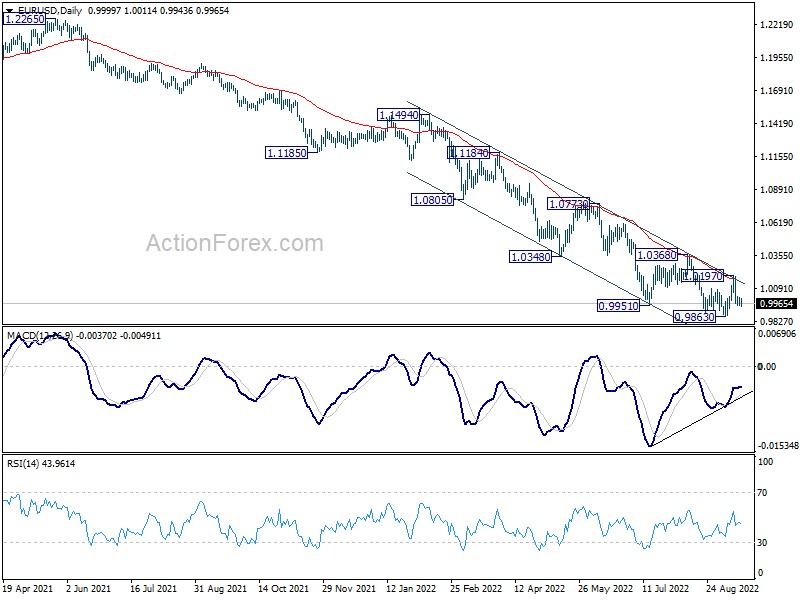
Daily Pivots: (S1) 0.9963; (P) 0.9991; (R1) 1.0025; More...
No change in EUR/USD's outlook and intraday bias stays mildly mildly on the downside for retesting 0.9863 low. Firm break there will resume larger down trend. On the upside, break of 1.0197 resistance will now raise the chance of larger trend reversal, and target 1.0368 resistance.
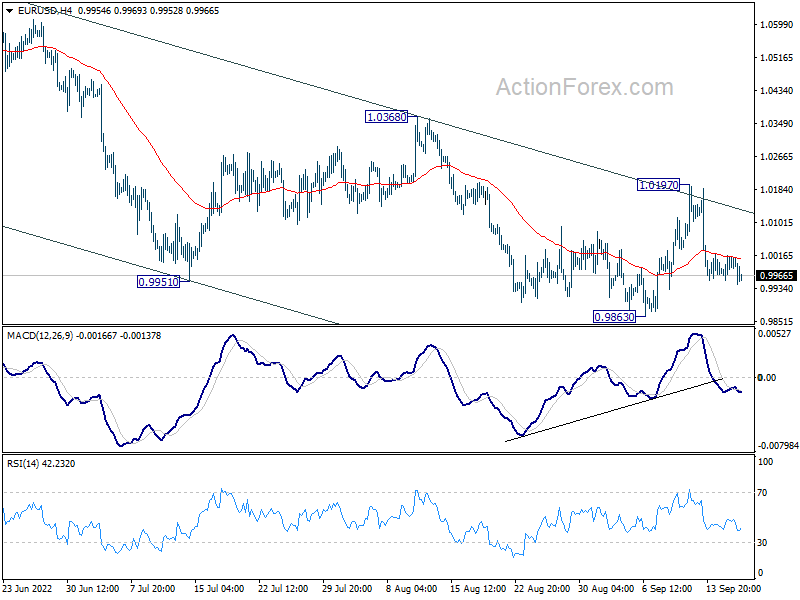
In the bigger picture, down trend from 1.6039 (2008 high) is still in progress. Next target is 100% projection of 1.3993 to 1.0339 from 1.2348 at 0.8694. In any case, outlook will stay bearish as long as 1.0368 resistance holds, in case of strong rebound. However, firm break of 1.0368 will confirm medium term bottom at 0.9863 already.
GBP/USD Mid-Day Outlook
Daily Pivots: (S1) 1.1434; (P) 1.1495; (R1) 1.1529; More...
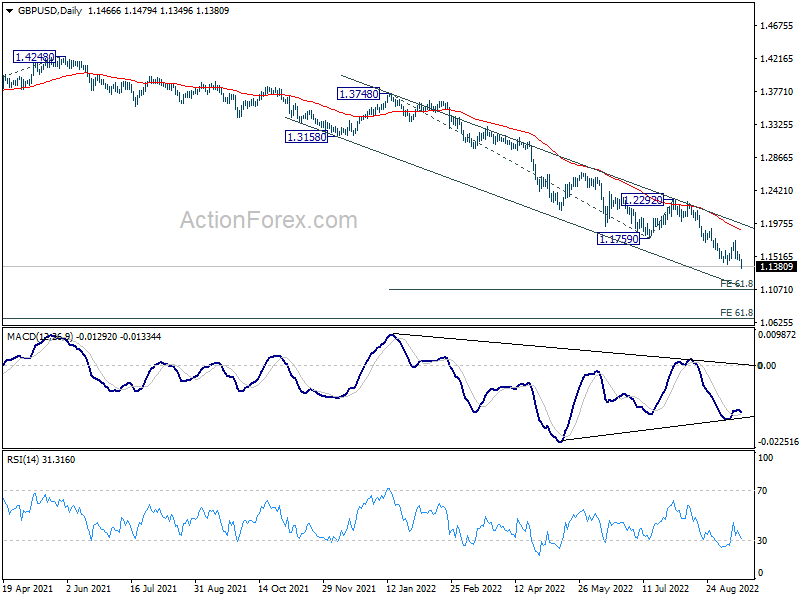
Break of 1.1404/9 support zone indicates down trend resumption in GBP/USD. Intraday bias is back on the downside for 61.8% projection of 1.3748 to 1.1759 from 1.2292 at 1.1063. On the upside, break of 1.1737 resistance is needed to indicate short term bottoming. Otherwise, outlook will remain bearish in case of recovery.
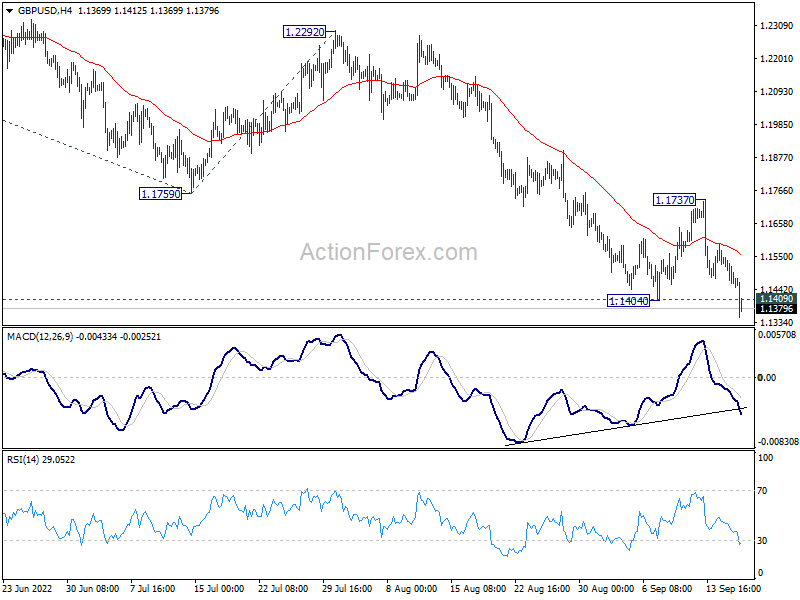
In the bigger picture, based on current momentum, fall from 1.4248 (2018 high) is probably resuming long term down trend from 2.1161 (2007 high). Sustained break of 1.1409 will target 61.8% projection of 1.7190 (2014 high) to 1.1409 (2020 low) from 1.4248 (2021 high) at 1.0675. This will remain the favored case for now as long as 1.2292 resistance holds.