Sample Category Title
EUR/JPY Weekly Outlook
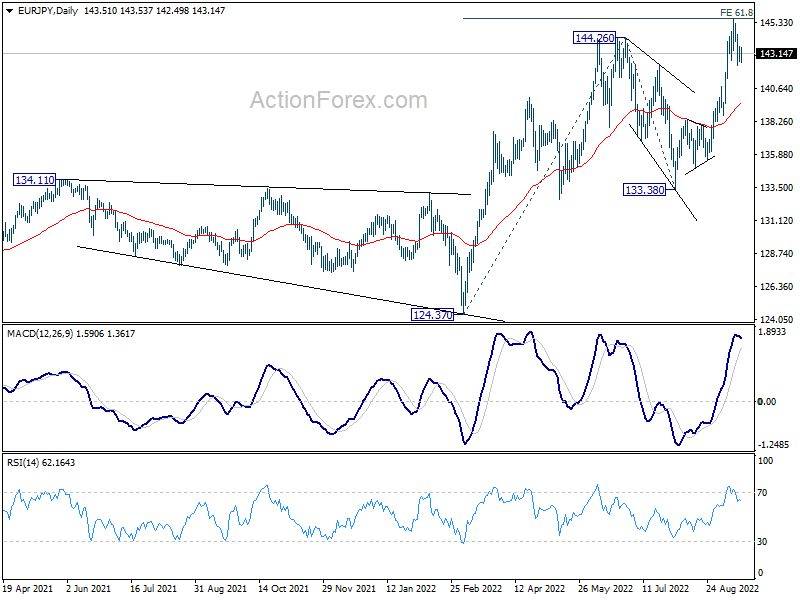
EUR/JPY's up trend continued to 145.62 last week, just inch below 61.8% projection of 124.37 to 144.26 from 133.38 at 145.67. But the cross then turned into consolidations, and initial bias is neutral this week first. Deeper pull back cannot be ruled out. But downside should be contained above 138.38 resistance turned support bring another rally. On the upside, decisive break of 145.67 will pave the way to 149.76 long term resistance, and then 100% projection at 153.27.
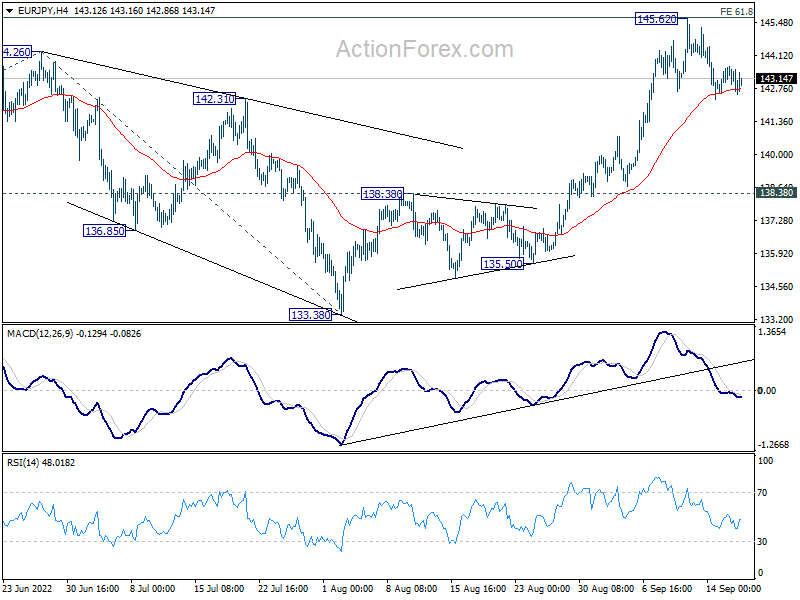
In the bigger picture, up trend from 114.42 (2020 low) is seen as the third leg of the pattern from 109.30 (2016 low). Further rally is in favor as long as 133.38 support holds. Next target is 149.76 (2015 high). However, sustained break of 133.38 will be a sign of medium term bearish reversal and turn focus to 124.37 support for confirmation.
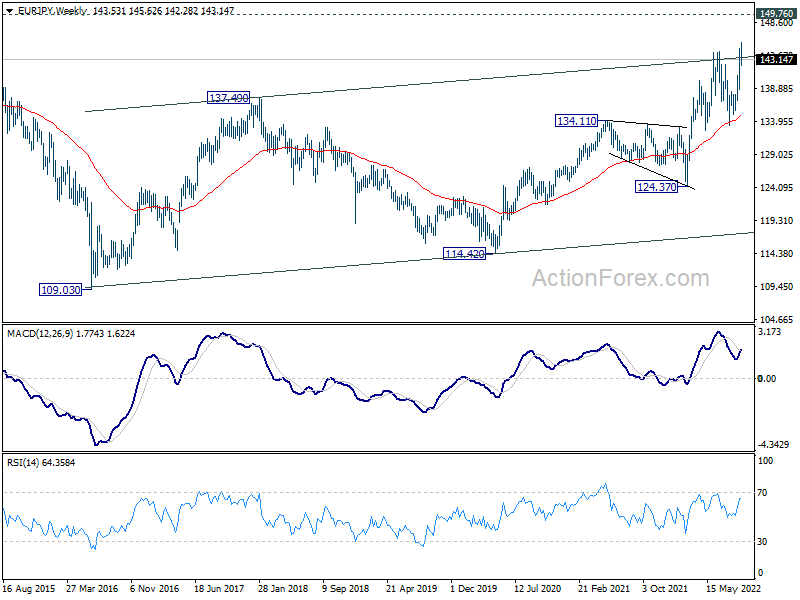
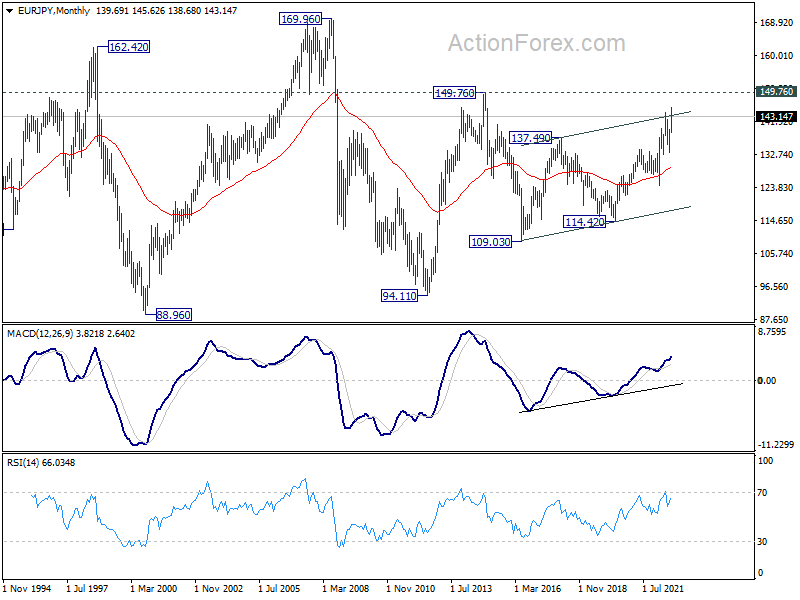
In the long term picture, up trend from 94.11 (2012 low) is seen as in the third leg. Further rally would be seen to 149.76 resistance (2014 high) and above. This will remain the favored case as long as 55 month EMA (now at 129.46) holds.
EUR/GBP Weekly Outlook
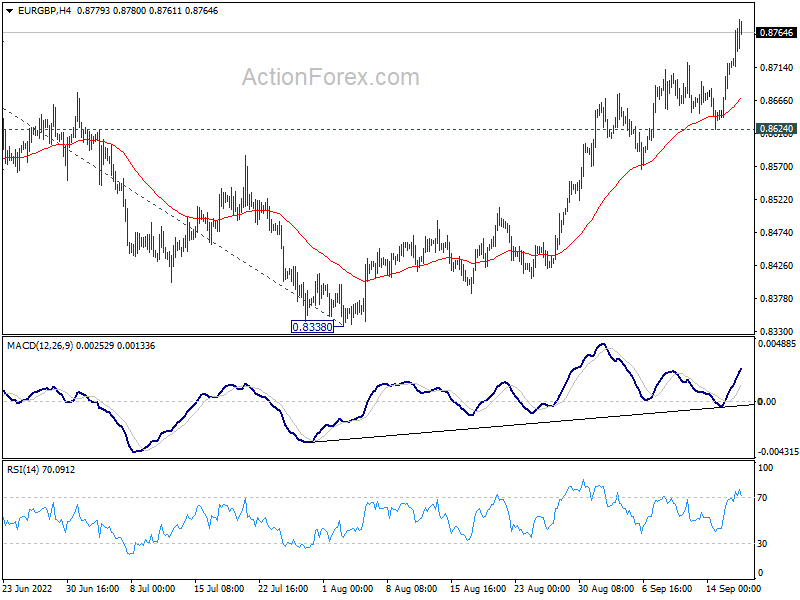
EUR/GBP surged to as high as 0.8783 last week, as rise from 0.8201 resumed through 0.8722 resistance. Initial bias stays on the upside this week for 100% projection of 0.8201 to 0.8720 from 0.8338 at 0.8857. On the downside, break of 0.8624 support is needed to indicate short term topping. Otherwise, outlook will stay bullish in case of retreat.
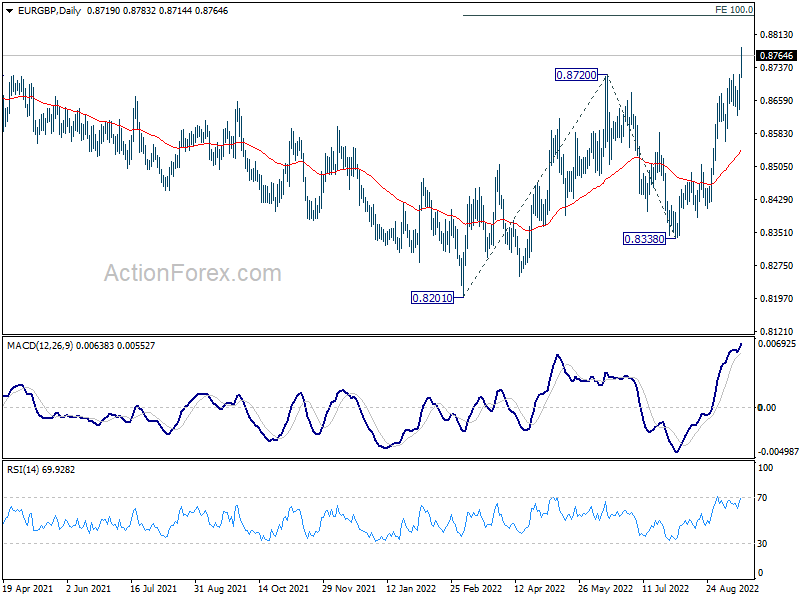
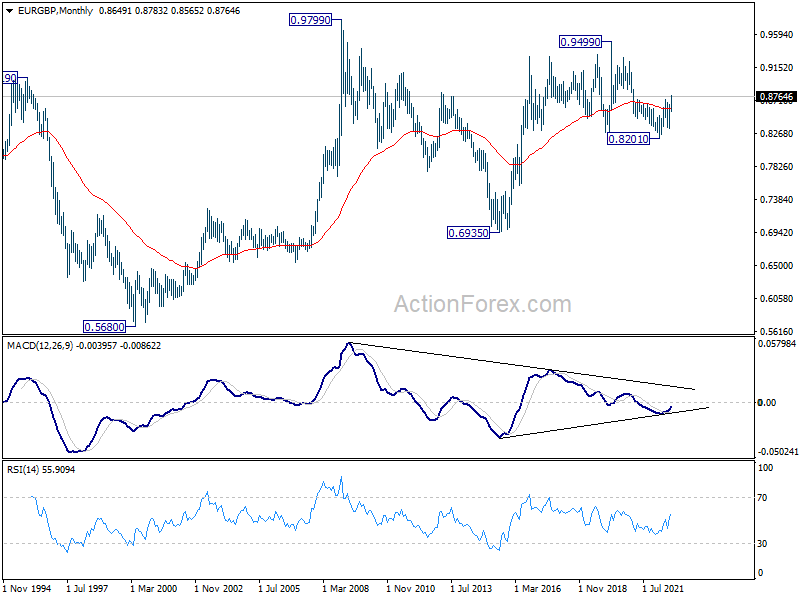
In the bigger picture, current development suggests that the down trend from 0.9499 has (2020 high) has completed at 0.8201. Rise from there is developing into a medium term up trend. Further rally would be seen to 61.8% retracement of 0.9499 to 0.8201 at 0.9003 next. This will now remain the favored case as long as 55 day EMA (now at 0.8545) holds.
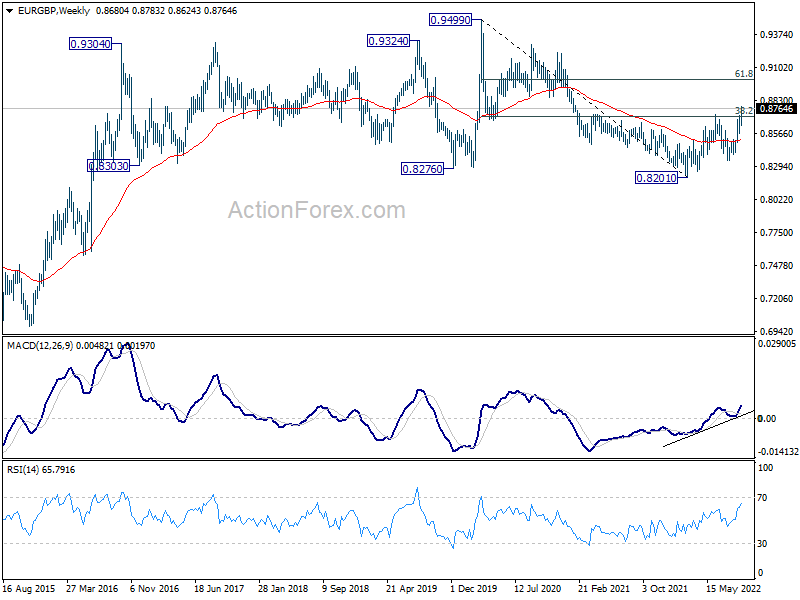
In the long term picture, the fall form 0.9499 (2020 high), as a correction to rise from 0.6935 (2015 low), could have completed 0.8201. It's still early to judge that up trend is ready to resume. But in that case, further rise would be seen to 0.9499 first, and then 0.9799 (2009 high).
EUR/AUD Weekly Outlook
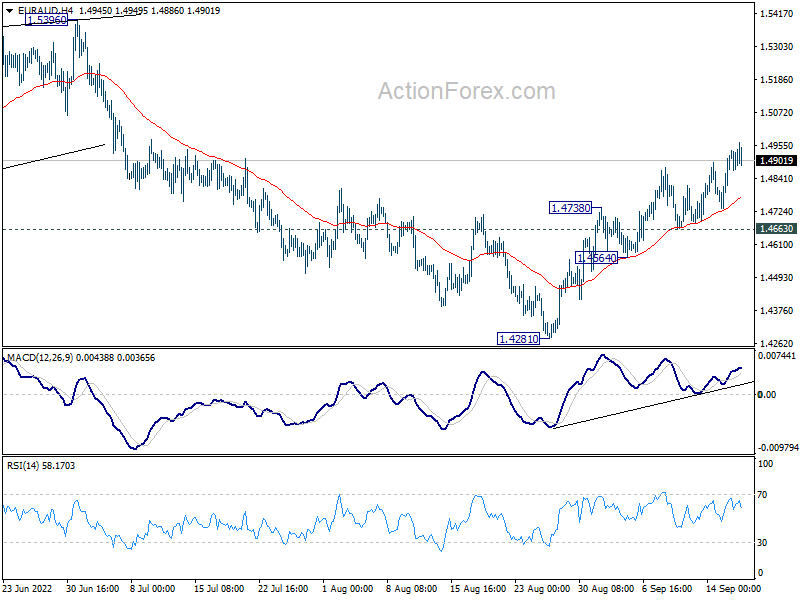
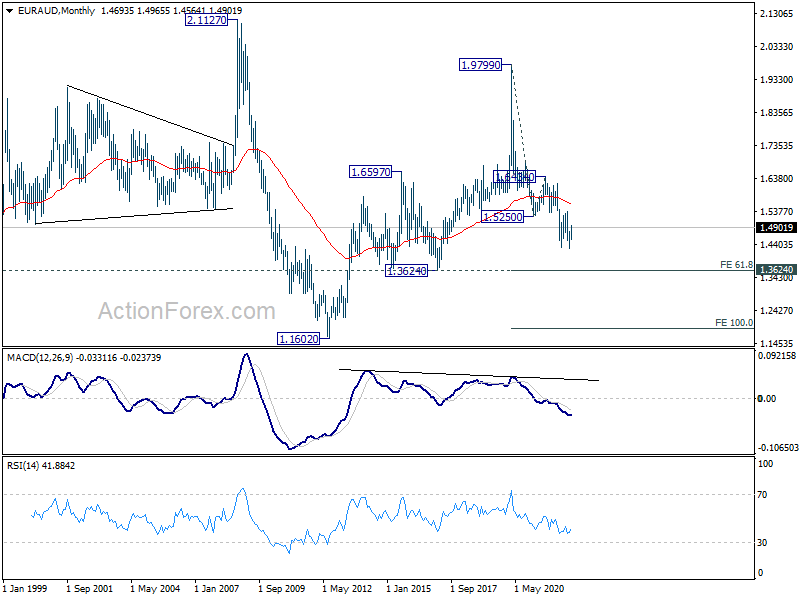
EUR/AUD gyrated higher last week and rebound from 1.4281 short term bottom extended. Initial bias stays on the upside this week and further rise would be seen towards 1.5396 resistance. On the downside, however, break of 1.4663 minor support will turn bias back to the downside for retesting 1.4281 low.
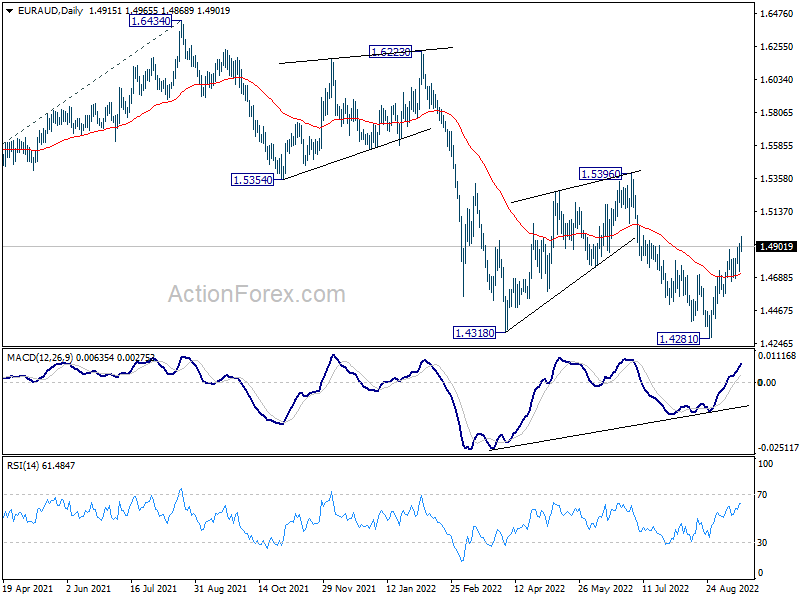
In the bigger picture, down trend from 1.9799 is still in progress. Break of 1.4318 low will target 61.8% projection of 1.9799 to 1.5250 from 1.6434 at 1.3623, which is close to 1.3624 long term support (2017 low). This will remain the favored case now as long as 1.5396 resistance holds.
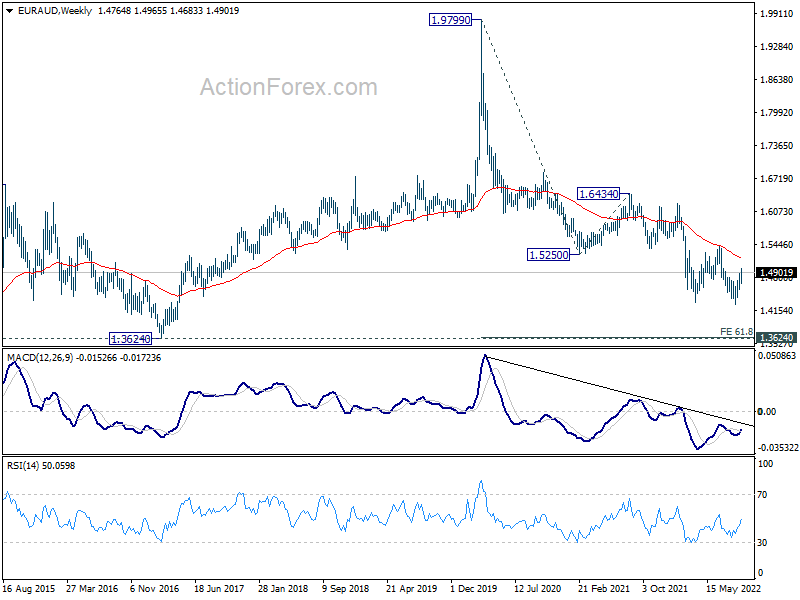
In the longer term picture, fall from 1.9799 (2020 high) is seen as the third leg of the pattern from 2.1127 (2008 high). Deeper fall should be seen to 1.3624 support. Decisive break there would pave the way back to 1.1602 (2012 low). This will remain the favored case as long as 55 month EMA (now at 1.5588) holds.
EUR/CHF Weekly Outlook
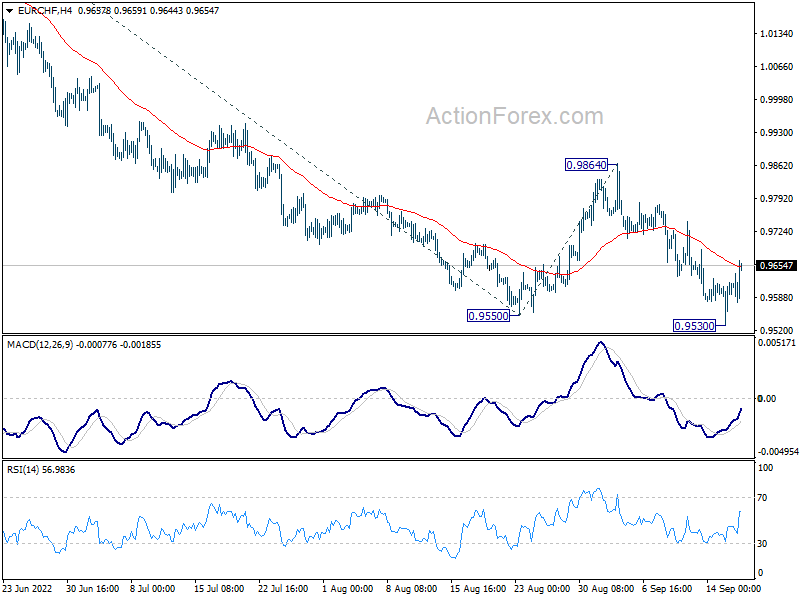
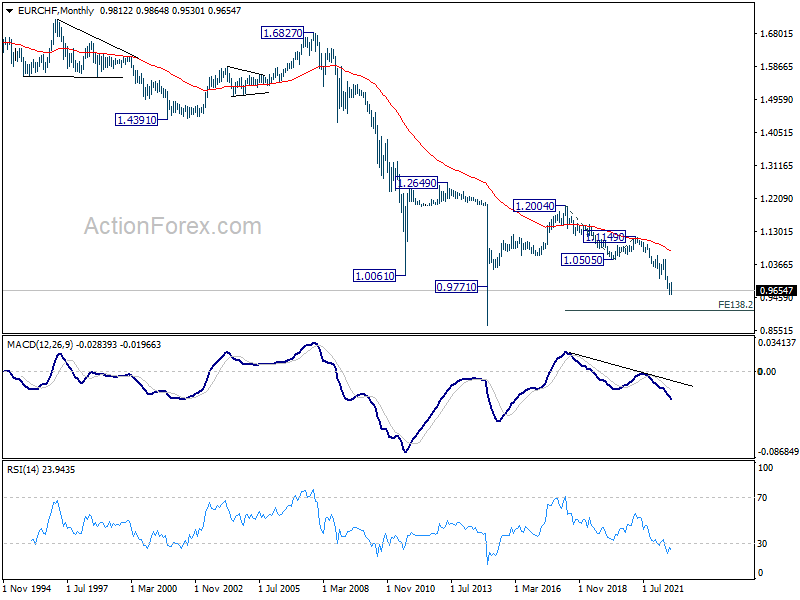
EUR/CHF attempted to resume down trend last week and dipped to 0.9530, but recovered since then. Initial bias stays neutral this week first. Outlook will remain bearish as long as 0.9864 resistance holds. Break of 0.9530 will extend larger down trend to 61.8% projection of 1.0512 to 0.9550 from 0.9864 at 0.9269.
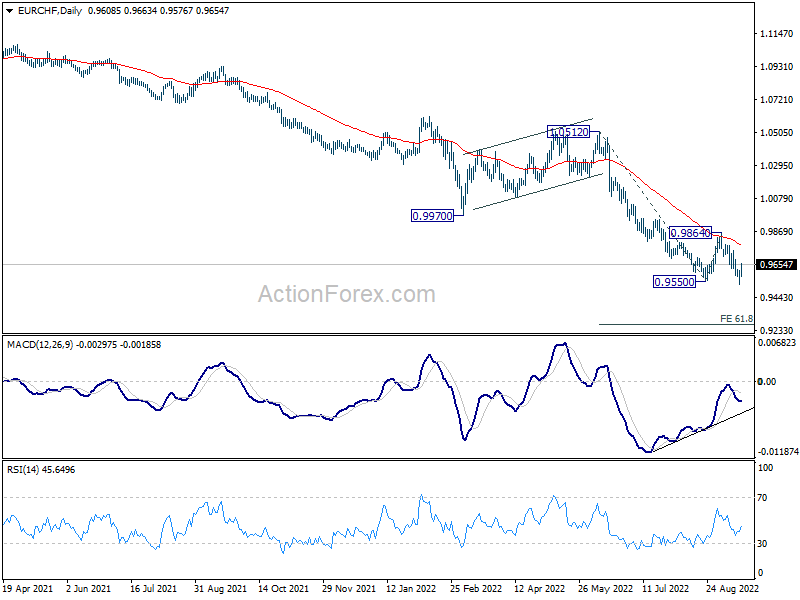
In the bigger picture, long term down trend from 1.2004 (2018 high) is still in progress. Next target is 138.2% projection of 1.2004 to 1.0505 to 1.1149 at 0.9033. On the upside, break of 0.9864 resistance is needed to be the first sign of medium term bottoming. Otherwise, outlook will stay bearish in case of strong rebound.
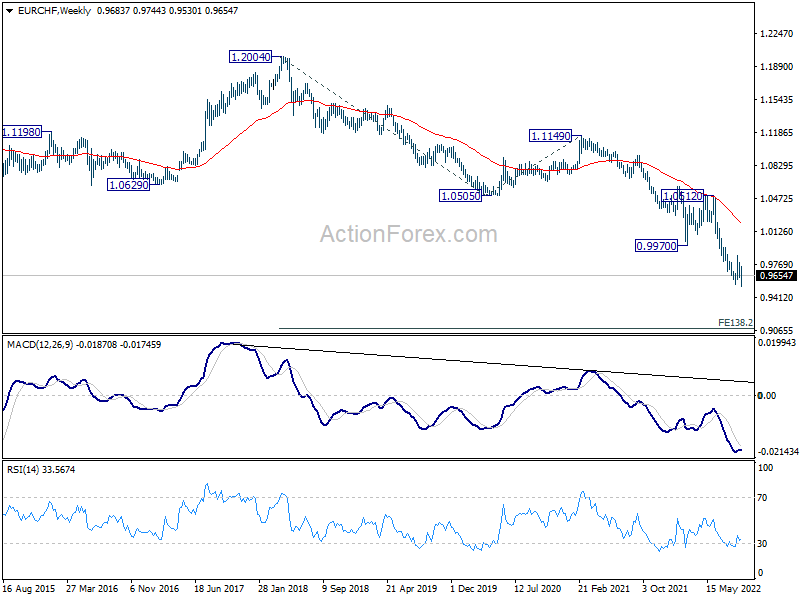
In the long term picture, capped below 55 month EMA, EUR/CHF is seen as extending the multi-decade down trend. There is no prospect of a bullish reversal until firm break of 1.0505 support turned resistance (2020 low).
Summary 9/19 – 9/23
Monday, Sep 19, 2022
[php_everywhere instance="1"]
Tuesday, Sep 20, 2022
[php_everywhere instance="2"]
Wednesday, Sep 21, 2022
[php_everywhere instance="3"]
Thursday, Sep 22, 2022
[php_everywhere instance="4"]
Friday, Sep 23, 2022
[php_everywhere instance="5"]
The Weekly Bottom Line: Full Steam Ahead for the FOMC
U.S. Highlights
- CPI inflation surprised to the upside in August, rising 0.1% m/m. The core measure also recorded a sizeable 0.6% m/m gain, as both goods and service categories accelerated on the month.
- Financial markets have now fully priced a 75-basis point hike from the Fed next week and are anticipating the Fed funds rate reaches 4% by year-end.
- A tentative agreement between U.S. rail companies and the unions representing rail workers was reached on Thursday, avoiding what could have been another crippling blow to U.S. supply chains.
Canadian Highlights
- A volatile week for financial markets saw steep equity market declines on the back of rising odds of another super-sized rate hike by the Bank of Canada.
- Rising yields reflect expectations that next week’s Canadian CPI data will show that core measures of inflation will remain at uncomfortably high levels.
- The impact of higher rates is still being felt in the Canadian housing market, where sales have dropped again, while prices sent mixed messages.
U.S. - Full Steam Ahead for the FOMC
Hopes that the Federal Reserve can still engineer a soft landing were tested again this week. Consumer Price Index (CPI) data for August showed inflation was far hotter than expected, leading to a sharp repricing of market expectations on the future path of rate hikes. Following the release, market participants were quick to fully price a 75-basis point move from the Federal Reserve next week, and now expect the Fed funds rate to reach 4% by year-end. The pull forward in rate hike expectations triggered a sharp sell-off in U.S. equities, with the S&P 500 suffering its worst day of the year – falling by over 4%. Equities dipped a bit further through the remainder of the week and are down 5.5% at the time of writing.
In terms of the actual CPI figures, headline inflation rose 0.1% month-on-month (m/m), a few ticks above the consensus forecast. More worrying, was the 0.6% m/m increase in core inflation – a sharp acceleration from July’s 0.3% m/m gain. While some persistence in price growth across service categories such as shelter and healthcare was expected, the August data showed far more breadth and strength across nearly all goods and service categories.
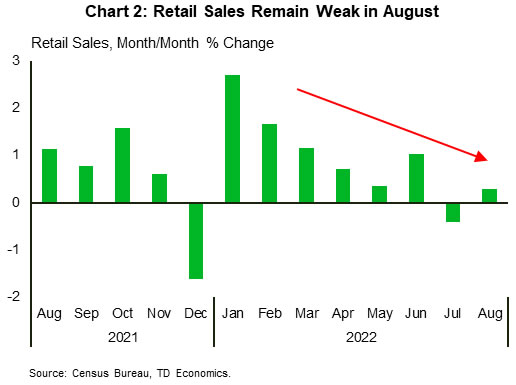
While we’re hesitant to put too much stock in one month of data, the re-acceleration in goods prices is somewhat concerning. Despite demand for consumer goods cooling more recently, goods inflation has shown considerable staying power. This was reaffirmed later in the week where August retail sales data showed only a modest gain of 0.3% m/m (Chart 1). The control group of sales was even weaker, recording a flat reading on the month.
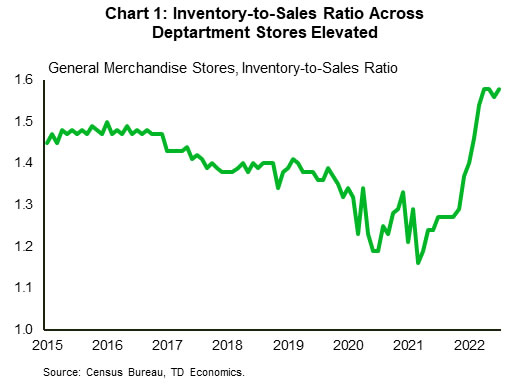
The continued gains in goods prices are even more perplexing when we consider the fact that not only is demand weakening, but inventory levels are also starting to look toppish. Inventory-to-sales ratios across department stores are now well above pre-pandemic levels – suggesting we should be seeing some disinflationary pressure (Chart 2). Other oddities are also starting to emerge across used vehicle prices. The Manheim Used Vehicle Price Index – a measure that captures dealer purchase prices – has fallen by over 10% this year, yet the CPI measure of used vehicle prices has declined by only 1.5%. This suggests that lower costs are not being passed onto consumers, and retailers are instead maintaining wider margins. Over the near-term, this is not necessarily problematic. But if left unchecked, it can start to sow the seeds of more engrained inflationary pressures. Fortunately, that hasn’t happened yet. According to data released by the New York Federal Reserve, both one-and-three-year inflation expectations have continued to move lower, with August readings falling to 5.8% (from 6.2%) and 2.8% (from 3.2%), respectively.
One piece of good news emerged this week, with a tentative agreement reached between U.S. rail companies and the unions representing the rail workers. The labor deal averts what would have been another crippling blow to U.S. supply chains, and almost certainly lead to more near-term pressures on inflation. FOMC officials will likely breathe a sigh of relief, as the focus can remain squarely on what will still be a challenging task; threading the needle of lowering inflation while trying to avoid a recession.
Canada - Yields Jump on Higher BoC Bets
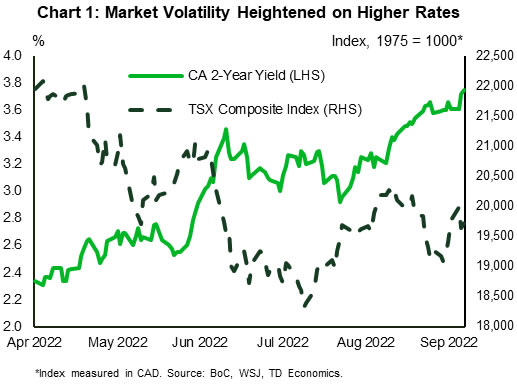
It was a volatile week for financial markets, with the risk-off move causing the TSX to drop approximately 2%, while the S&P 500 declined nearly 5%. Clearly the U.S. CPI data release, which showed an uptick in core inflation, raised expectations that Canadian CPI will show a similar move next week. This raised market pricing that the Bank of Canada (BoC) will have to hike its policy rate even more than previously expected, lifting the Canada 2-year yield by a whopping 25 basis points – to a 15 year high of 3.87% (Chart 1).
It is our view that the BoC will need to raise rates to a very restrictive level of 4% to decisively break this high inflation cycle. Though it will take time for interest rates to work through the economy, the BoC is closely watching the incoming data. This means that there will be a lot of eyes on next week's Canadian CPI release. With gas prices having fallen in August on slowing global growth fears, we expect to see further deceleration in the headline CPI print. This is good news, but the BoC will be more interested in the core inflation numbers, which strip out volatile items like food and energy.
If the U.S. CPI data are any indication, we will likely see the impact of high food and fuel prices having spilled into to other inflation components. One area where this is likely to show up is in the rise of services inflation. This is an important category, as services inflation tends to be much more 'sticky' than the goods inflation that led this cycle. This means that even if goods (food and fuel) prices ease on global demand fears, rising services prices could keep inflation uncomfortably high for much longer than the BoC would like.
Though inflation will be impacted by higher rates with a lag, the same cannot be said for Canadian real estate. New data on housing this week showed existing homes sales dropped another 1% in August (Chart 2). That brings the level of housing market activity down an astonishing 17% below pre-pandemic levels. The sales decline was apparent in every province, save Ontario, which benefitted from a surprising flurry of transactions in Toronto. This bounce in the higher priced Toronto market helped push the national average home price up nearly 2% on the month. Though it may look encouraging, we believe this improvement in average home prices is only temporary.
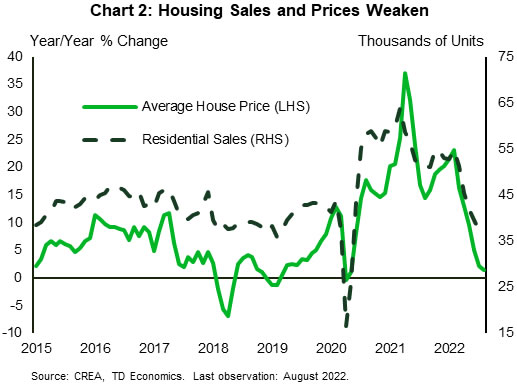
In fact, the more 'like-for-like' MLS home price index, which removes some of the compositional effects of the Toronto market, showed another notable decline of 1.6% in August. This weakness more closely mirrors the current market dynamics, where total sales have continued to slide. Given our view that the BoC will continue to hike rates through this year, we are expecting further declines in housing prices, with average home prices dropping by around 20% on a quarterly peak-to-trough basis.
Week Ahead – Aggressive Tightening
US
Many on Wall Street are watching the Fed’s rate hiking cycle and are getting nervous they will tip the economy into a recession. With scorching inflation, the FOMC may consider a full-point rate hike but will likely settle on delivering its third consecutive 75 basis-point increase. At Wednesday’s policy meeting, Fed Chair Jerome Powell will likely acknowledge downside risks to growth are here and unrelenting inflation is forcing them to maintain an aggressive pace of tightening. Inflation risks are still tilted to the upside and will likely keep the Fed from providing any hints that a “Fed put” is coming.
EU
The ECB appears to be one of the few major central banks not holding a monetary policy meeting next week but that won’t keep them out of the headlines. Policymakers are scheduled to make regular appearances including Philip Lane on Saturday which may present some weekend risk.
On Friday, the flash PMIs could give an idea of how the economy is coping and whether it is heading for a recession in the fourth quarter, as some fear.
Monday is a bank holiday in the UK as the country pays its respects to Queen Elizabeth II on the day of her funeral.
After being pushed back a week due to the 10-day period of national mourning, the BoE will meet on Thursday and it has a big decision to make. Inflation is running extremely hot – although it did drop back below 10% last month – and while it has likely not yet peaked, the high should be much lower now that the new government has announced a cap on energy bills.
That may come as a relief to many but it could mean higher core inflation and interest rates further down the road. How the BoE responds to all of this without the aid of new economic projections is what will interest investors.
The week draws to a close with PMIs on Friday.
Russia
Markets continue to monitor the situation in Ukraine amid a strong counteroffensive that saw Russia concede a lot of ground while raising the prospect of defeat and waning support for Vladimir Putin.
The only economic release next week is PPI inflation on Wednesday.
South Africa
The SARB is expected to hike rates by another 75 basis points to 6.25% on Thursday as inflation continues to rise. The CPI is currently well above the 3-6% target range at 7.8% and the central bank will get an update on this the day before their decision, which could play a role in just how aggressive they’ll be this month.
Turkey
One central bank that almost certainly won’t be raising interest rates next week is the CBRT. Last month, it unexpectedly cut rates by another 100 basis points to 13% despite inflation running at almost 80%. That has risen further since but the central bank will not be deterred. No change is expected from the CBRT next week but clearly, another rate cut should not be ruled out.
Switzerland
Inflation continues to run hot which makes a large rate hike on Thursday from the SNB highly likely. Markets are pricing in at least 75 basis points, maybe even 100, taking the policy rate out of negative territory for the first time since early 2015. The central bank loves to spring a surprise though, the biggest recently perhaps being that it’s waited until a scheduled meeting to act. We’ll see how bold it’s prepared to be on Thursday.
China
China is expected to keep rates unchanged at 3.65%, as the 1-year LPR (Loan Prime Rate) was just recently adjusted down from 3.7%. If the Chinese central bank unexpectedly adjusts rates to a lower level again, it may be detrimental to the yuan.
The PBOC’s fixings are must-watch events now that the yuan has weakened beyond the key 7 against the dollar.
India
Traders will pay close attention to the second quarter current account data. Expectations are for the current account deficit to widen from $13.4 billion to $30.36 billion. India has been weakening as trade balances balloon and foreign investment takes a big hit.
Australia & New Zealand
Traders are awaiting the release of the minutes of the RBA meeting next Tuesday and upcoming speeches by RBA’s Kearns and Bullock. The RBA seems poised to move forward with smaller rate hike moves, but traders will look to see if the latest round of RBA speak confirms the downward shift discussed by central bank chief Lowe.
It will be a busy week in New Zealand as a steady flow of economic data is accompanied by a couple of RBNZ speeches by Governor Orr and Deputy Governor Hawkesby. The big economic releases of the week are Wednesday’s credit card spending data and Thursday’s trade data.
The FX world is closely watching everything out of Japan. Traders are waiting to see if policymakers will intervene to provide some relief for the Japanese yen. What could complicate their decision is that Japan has a holiday on Monday.
The divergence between the Fed’s tightening cycle and the Bank of Japan’s steady approach continues to support the dollar against the yen. The BOJ is widely expected to keep rates on hold even as core inflation extends above the BOJ’s 2% target.
Singapore
The focus for Singapore will be the August inflation report that should show pricing pressures remain intense. The year-over-year reading is expected to rise from 7.0% to 7.2%.
Economic Calendar
Saturday, Sept. 17
Economic Data/Events
- Thousands pay their respects to Queen Elizabeth II at Westminster
- European Central Bank chief economist Lane speaks at the Dublin Economics Workshop in Wexford, Ireland
Monday, Sept. 19
Economic Data/Events
- World leaders attend Queen Elizabeth II’s funeral in Westminster Abbey in London
- UK Bank Holiday
- Japan Bank Holiday
- New Zealand performance services index
- RBA’s head of domestic markets Kearns delivers the keynote address at the Australian Financial Review Property Summit in Sydney
- ECB’s de Guindos speaks at the annual Consejos Consultivos meeting
Tuesday, Sept. 20
Economic Data/Events
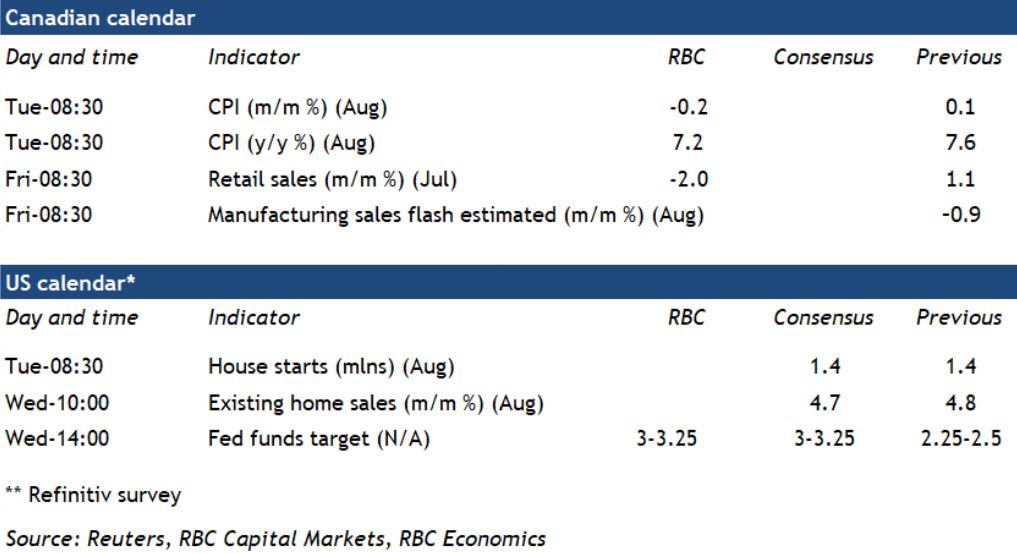
- US housing Starts
- Canada CPI
- China loan prime rates
- Japan CPI
- Mexico international reserves
- Spain trade
- Sweden rate decision: Expected to raise rates by 75bp to 1.500%
- UK Parliament in session
- Annual UN General Assembly in New York
- Dockworkers at the UK’s Port of Liverpool are expected to begin a two-week strike
- Norges deputy central bank Governor Borsum speaks
- German Economy Minister Habeck speaks at the congress of municipal energy suppliers
- RBA releases minutes from its September policy meeting.
- BOC Deputy Governor Beaudry delivers a lecture on “pandemic macroeconomics” at the University of Waterloo in Ontario
Wednesday, Sept. 21
Economic Data/Events
- FOMC Policy Decision: Fed expected to raise rates by 75bps
- US existing home sales
- Argentina unemployment, trade
- Australia leading index
- New Zealand credit-card spending
- South Africa CPI
- Big-bank CEOs testify before the US House Financial Services Committee at a hearing titled, “Holding Megabanks Accountable.”
- RBA Deputy Governor Michele Bullock speaks at a Bloomberg event in Sydney
- ECB’s de Guindos to speak at Insurance Summit 2022 organized by Altamar CAM in Cologne, Germany
- EIA crude oil inventory report
Thursday, Sept. 22
Economic Data/Events
- US Conference Board leading index, initial jobless claims
- China Swift global payments
- Eurozone consumer confidence
- BOJ rate decision: No changes expected with rates and 10-year yield target
- Japan department store sales
- New Zealand trade, consumer confidence
- Norway rate decision: Expected to raise rates by 50bps to 2.25%
- South Africa rate decision: Expected to raise rates by 75bps to 6.25%
- Switzerland rate decision: Expected to raise rates by 75bps to 0.50%
- Taiwan jobless rate, rate decision, money supply
- Thailand trade
- Turkey rate decision: Expected to cut rates by 100bps to 12.00%
- UK BOE rate decision: Markets remain split between expectations for a half-point or a three-quarter-point hike.
- US Treasury Secretary Janet Yellen addresses the Atlantic Festival in Washington.
- The UN Security Council holds a meeting on Ukraine
- BOE’s Tenreyro speaks at a seminar at the San Francisco Fed on “climate-change pledges, actions and outcomes.”
Friday, Sept. 23
Economic Data/Events
- US Flash PMIs
- Australia prelim PMI
- Canada retail sales
- European Flash PMIs: Eurozone, Germany, France, and the UK
- Singapore CPI
- Spain GDP
- Taiwan industrial production
- Thailand foreign reserves, forward contracts
- Norway Central Bank Governor Wolden speaks
Sovereign Rating Updates
- Germany (S&P)
- Hungary (Moody’s)
- Sweden (Moody’s)
- European Union (DBRS)
- Finland (DBRS)
Weekly Economic & Financial Commentary: Yields Push Higher Ahead of Next Week’s FOMC Meeting
Summary
United States: Good Grief
- Financial markets reacted in a zig-zag pattern to this week's economic data. Consumer prices surprised to the upside, led by core goods inflation showing little signs of slowing. At the same time, consumers have yet to meaningfully pull back on goods spending. This week's data reaffirm our view that the FOMC will press ahead with another 75 bps rate hike at its meeting next week.
- Next week: Housing Starts (Tues.), Existing Home Sales (Wed.), FOMC Rate Decision (Wed.), Leading Economic Index (Thur.)
International: U.K. Inflation Slows, but BoE to Stay Hawkish / China's Move Through 7.00
- Higher natural gas and oil prices have pushed inflation well above the Bank of England's (BoE) target range, and induced one of the more hawkish stances on monetary policy in the G10. In an effort to support economic activity, the People's Bank of China has eased monetary policy and lowered interest rates, moving against the grain of global monetary policy trends.
- Next week: Brazilian Central Bank (Wed.), Bank of Japan (Thur.), Eurozone PMIs (Fri.)
Interest Rate Watch: Yields Push Higher Ahead of Next Week's FOMC Meeting
- Treasury yields climbed to fresh highs this week as markets digested unexpectedly strong inflation data and its potential impact on next week's FOMC meeting.
Topic of the Week: Risk of Rail Shutdowns Is Avoided, Economic Fragility Remains
- A nationwide shutdown of the freight rail system was avoided by less than a day this week, after negotiators came to an agreement under pressure from the White House. A short-term spike in inflation caused from supply disruptions was avoided by the deal, but longer-term inflationary pressures remain due to rising employee compensation.
Fed Preview: Fast Pace Hiking Cycle Continues
- We expect Fed to hike 75bp next week - the market is more upbeat and see a possibility of a 100bp hike.
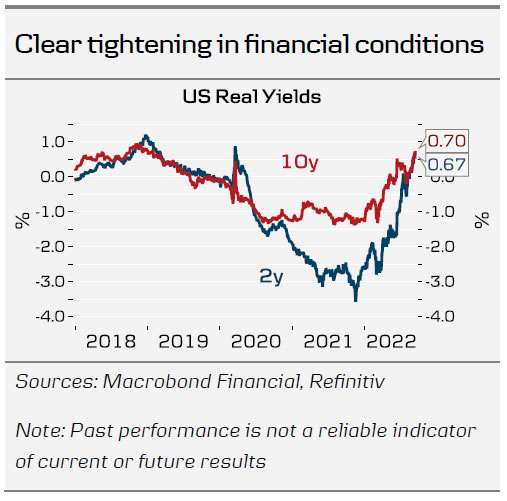
- Real yields are rising and financial conditions have tightened, which means Fed's hawkish post-Jackson Hole communication works as intended.
- The market now discounts a terminal rate close to 4.5% next spring. We look to review our forecast after next week's FOMC meeting.
Two big questions lingers before next week's FOMC meeting after core-CPI inflation was higher than expected in August. Could Fed hike 100bp next week and could the streak of large rate hikes (of 75bp or higher) continue after the September meeting?
We doubt Fed hikes 100bp next week. In our view, recent inflation data does not warrant an even higher rate hike, but we will watch out for any last minute media leaks to correct market expectations. We find the chance of a fourth hike of 75bp in November, a potentially a fifth 75bp hike in December and a terminal rate next year well above 4% more likely.
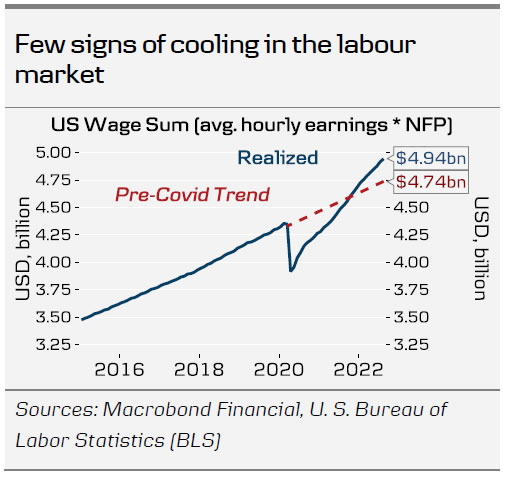
Going forward, Fed will increasingly focus on growth momentum in the economy and labour markets. As we argued in Research US - Fed continues to guide US economy towards a recession, 1 September, Fed needs to force a modest recession, or at least a lengthy period of below-trend growth in order to bring aggregate demand back into equilibrium with supply. However, the recovery in purchasing power indicates a rebound in GDP during Q3, strengthening the case that Fed is not about to 'pivot' in the near future.
Short-term market based inflation expectations have picked up the past week and while the NY Fed survey of inflation expectations 1Y ahead eased in August, it remains at a very high level close to 6%. Fed needs to close the gap to short-term inflation expectations to achieve a positive real interest rate and make monetary policy contractionary and that could very well mean a terminal rate of up to 5% next year.
At the same time, Fed has to balance the lagging effect from the tightening in financial conditions we have already seen. The hawkish communication since Jackson Hole has driven an uptick in longer real yields, which will weigh on growth towards 2023, and the turn in order-inventory cycle suggests that downside risks to growth are already increasing.
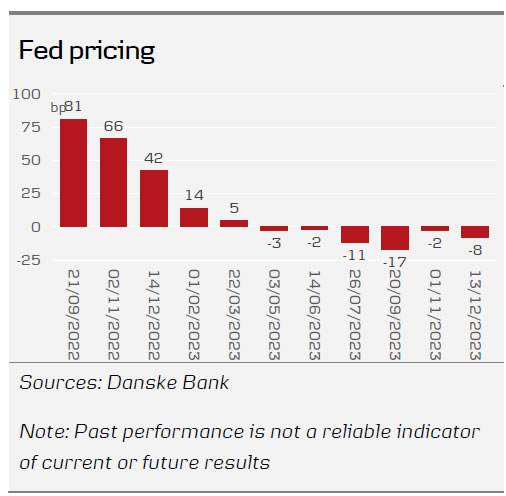
We currently forecast 125bp of hikes the rest of the year, the market discounts about 210bp of hikes by the end of Q1 next year. We plan to review our forecast after next week's FOMC meeting, but on balance, we have likely underestimated how high interest rates would go.
We do not expect Fed to move market pricing on 1Y horizon at the meeting, i.e. maintain a terminal rate of close to 4.5% next spring, but the market will likely reassess the distribution of hikes at the following meetings. The market discounts about 80bp of hikes next week. That is 5bp too much in our view and the market will move the excess basis points to the November and December pricing instead and discount a high probability of a 75bp hike in November and 50bp hike in December.
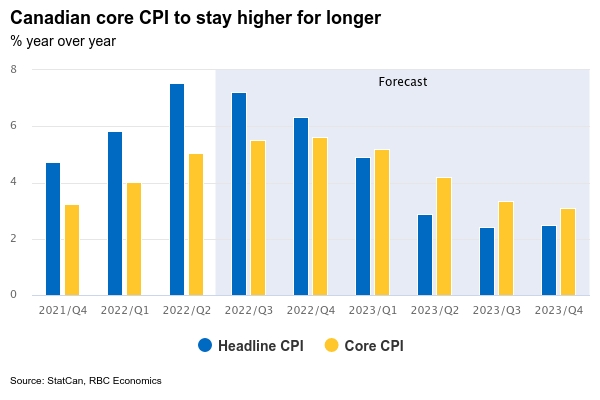
Forward Guidance: Canadian Core Inflation Will Stay Higher for Longer
New Canadian inflation data will set the stage for more hikes from the Bank of Canada. Next week’s report lands just after a surprisingly firm U.S. inflation reading for August (which likely cemented at least another outsized 75 bps increase in the Federal Reserve’s fed funds target range in September.) Here in Canada, headline annual CPI growth likely cooled for a second consecutive month on lower gasoline prices. We look for a dip from 7.6% in July to 7.2% in August—down from a recent peak of 8.1% in June. But beneath the weakening headline number, some prices are still powering up. Food price growth likely accelerated again. And we look for the rate excluding food and energy products to hold steady at 5.5%. Alongside this, the Bank of Canada’s preferred core inflation measures also likely remained elevated.
We continue to believe the headline inflation rate has hit its peak as lower commodity prices and easing global supply chain pressures lower growth in goods prices. But we don’t expect ‘core’ measures to peak until later this year when higher interest rates start to cut deeply into consumer demand.
The Bank of Canada recently raised its overnight rate by another outsized 75 bps earlier this month, bringing the total increases to 300 bps since the current hiking cycle began in March. The housing market was first to be hit, and with August resale units down almost a quarter from a year ago, it continues to feel the pinch. But even outside housing, cracks are beginning to show. StatCan’s advance estimate was for a 0.1% contraction in real GDP in July and a 2% decline in retail sales. July’s manufacturing sales ticked higher (excluding price impacts), though we are looking for some slowing in next week’s flash August estimate. Overall, the bank’s ongoing commitment to keep tightening monetary policy in the face of stubbornly high inflation pressures should further stall consumer demand and inflation pressures—but not without pushing the economy into a moderate recession.
Week ahead data watch:
We expect Canadian retail sales to have declined 2% in July, in line with StatCan’s preliminary estimate. That’s due to lower sales at gasoline stations. Sales for other goods have stayed mostly flat through the month, according to our own tracking of RBC spending data.