Sample Category Title
AUD/USD Mid-Day Report
Daily Pivots: (S1) 0.6809; (P) 0.6842; (R1) 0.6891; More...
AUD/USD's down trend resumes by breaking through 0.6762 temporary low and intraday bias is back on the downside. Sustained trading below 0.6756/60 will carry larger bearish implication. Next target will be 0.6461 fibonacci level. On the upside, though, break of 0.6873 resistance will indicate short term bottoming, and turn bias back to the upside for stronger rebound.
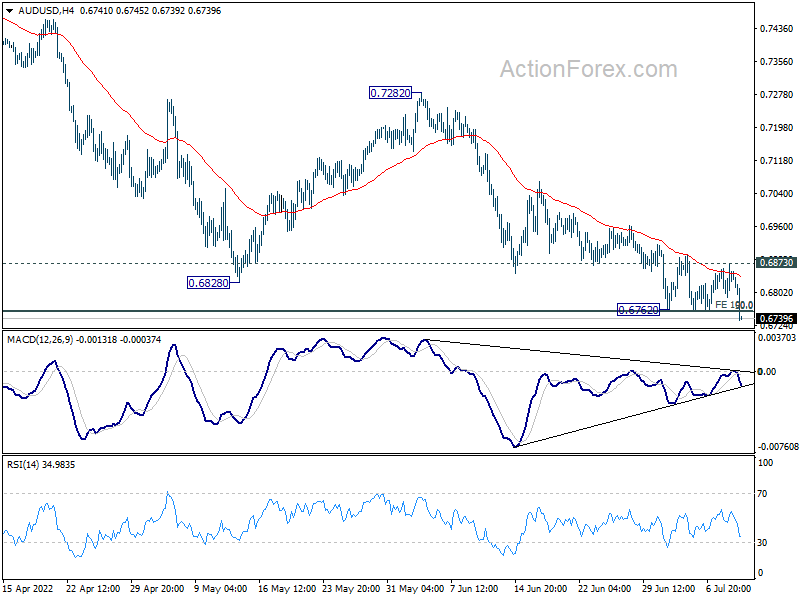
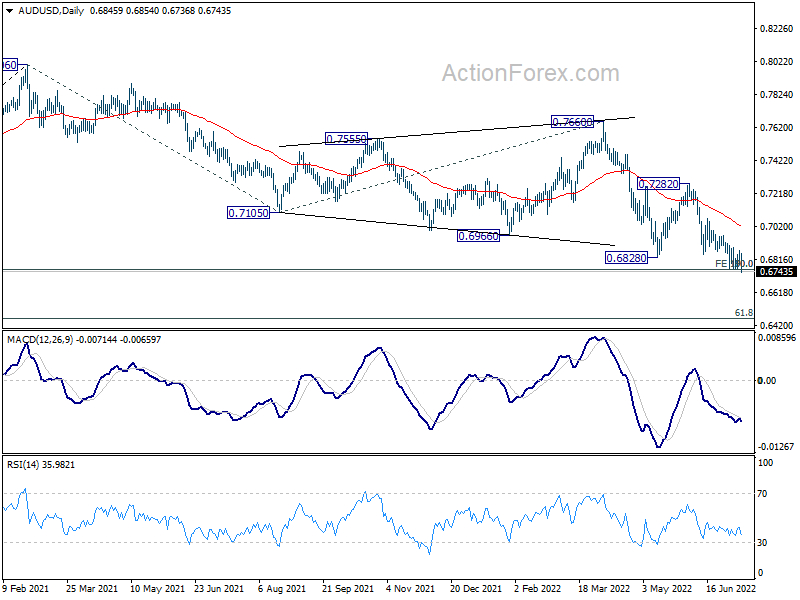
In the bigger picture, price actions from 0.8006 could still be a corrective pattern to rise from 0.5506 (2020 low). But current downside acceleration is raising the chance that it's a bearish impulsive move. Sustained trading below 0.6756/60 ( 50% retracement of 0.5506 to 0.8006 at 0.6756, 100% projection of 0.8006 to 0.7105 from 0.7660 at 0.6760), will pave the way to 61.8% retracement at 0.6461). For now, outlook will remain bearish as long as 0.7282 resistance holds, even in case of strong rebound.
Dollar Rally Accelerating, More Upside Breakouts?
Dollar's rally is accelerating as markets enter into US session. Swiss Franc and Canadian are following the greenback. But Australian Dollar is the worst, together with New Zealand Dollar. But Yen is also weak, with little help from risk off sentiment. Euro is mixed even though a market inflation gauge, the five-year, five-year forward inflation swap, fell below 2% target of ECB for the first time since March.
Technically, following upside break out in USD/JPY earlier today, AUD/USD also breaks through 0.6762 low. Attention will now be on other Dollar pairs to confirm buying. Levels to watch include 1.0700 in EUR/USD, 1.1874 in GBP/USD and 1.3082 in USD/CAD. Break of these levels will confirm underlying momentum in the greenback.
In Europe, at the time of writing, FTSE is down -0.40%. DAX is down -0.98%. CAC is down -0.78%. Germany 10-year yield is down -0.0764 at 1.270. Earlier in Asia, Nikkei rose 1.1%. Hong Kong HSI dropped -2.77%. China Shanghai SSE dropped -1.27%. Singapore Strait Times rose 0.06%. Japan 10-year JGB yield dropped -0.0011 to 0.250.
No rebound in Gold and Silver, risks heavily on the downside
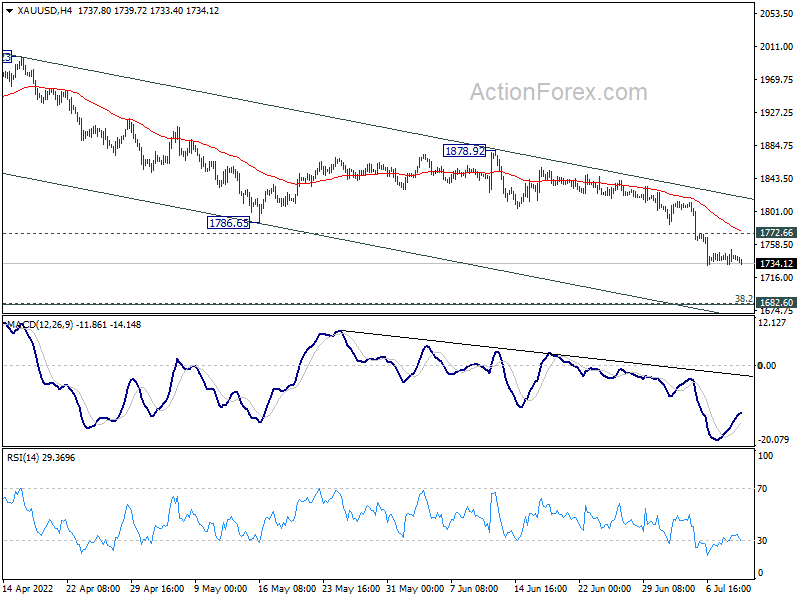
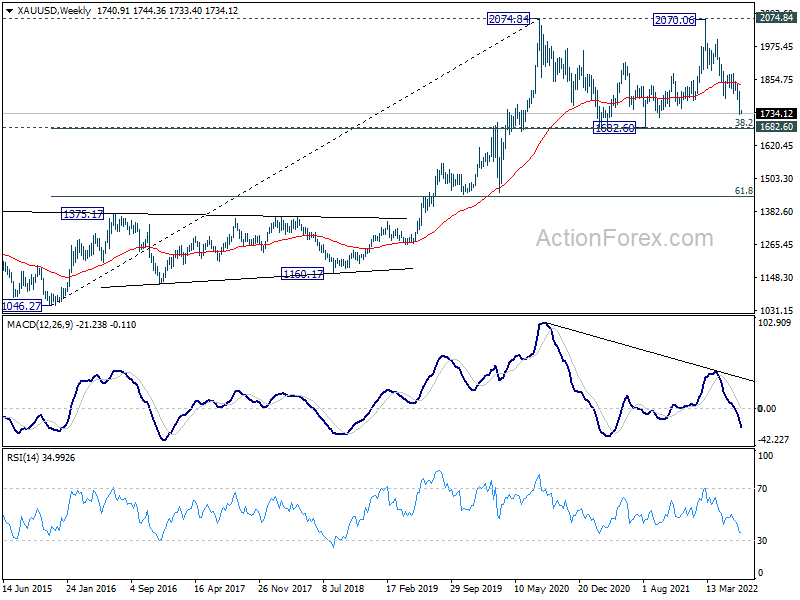
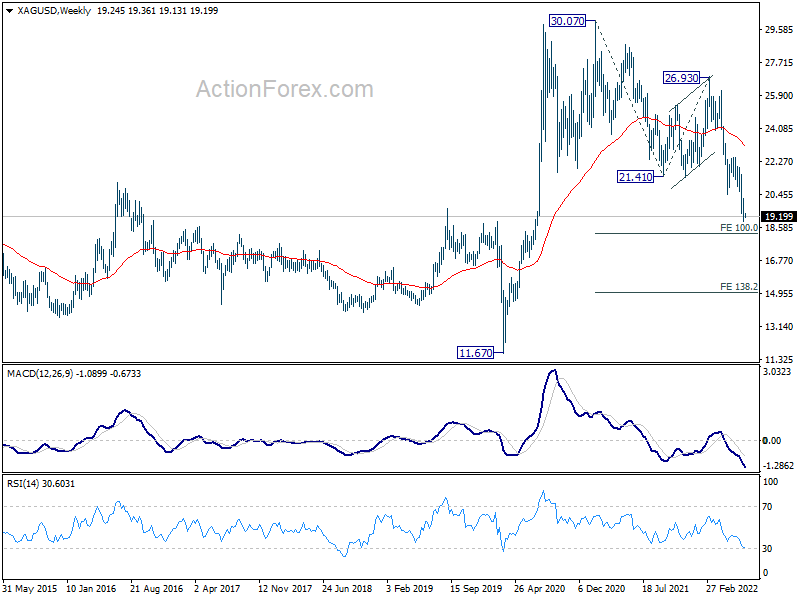
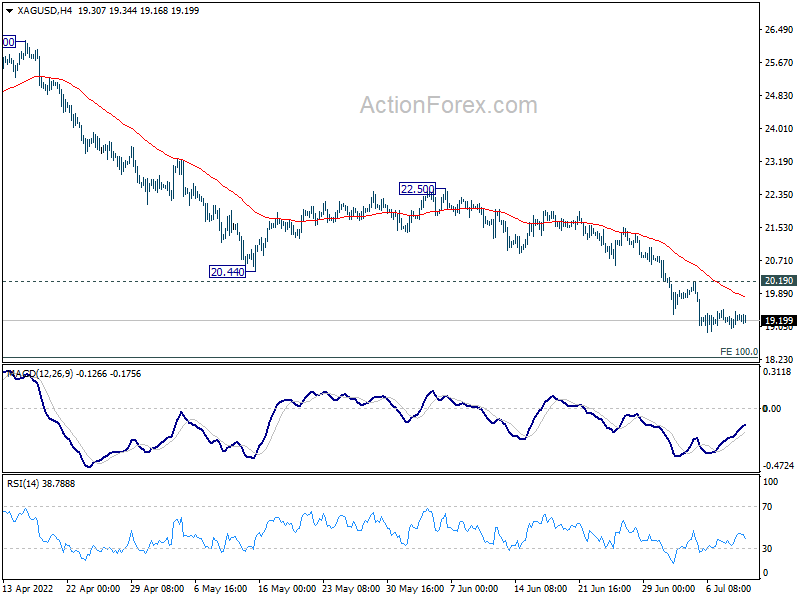
Both Gold and Silver turned into sideway trading after steep selloff last week, on the back on stronger Dollar and weak commodity prices in general. There is no sign of a sustainable bounce in both and they're vulnerable to another selloff soon.
For gold, risk will stay heavily on the downside as long as 1772.66 minor resistance holds. Current decline from 2070.06 is seen as the third leg of the sideway pattern from 2074.84 (2020 high). Further fall is likely towards 1682.60 support, which is close to 38.2% retracement of 1046.27 (2015 low) to 2074.84 at 1681.92. Strong support should be seen there to bring rebound.
 Similarly, risk stays heavily on the downside in Silver as long as 20.19 minor resistance holds. Current down trend from 30.07 (2021 high) should target 100% projection of 30.07 to 21.41 from 26.93 at 18.27. Some support could be seen there to bring rebound. But sustained break there will pave the way to 138.2% projection at 14.96.
BoJ Kuroda: We won't hesitate to take additional monetary easing steps as necessary
BoJ Governor Haruhiko Kuroda warned of the "very high uncertainty" on economic outlook due to surging commodity prices. While the economy is showing some signs of weakness, overall it's still picking up as a trend.
"We won't hesitate to take additional monetary easing steps as necessary," he added, repeating that short- and long-term interest rate targets to "move at current or lower levels."
Released from Japan, M2 rose 3.3% yoy in June versus expectation of 3.4% yoy. Machine orders dropped -5.6% mom in May, versus expectation of -5.5% mom.
AUD/USD Mid-Day Report
Daily Pivots: (S1) 0.6809; (P) 0.6842; (R1) 0.6891; More...
AUD/USD's down trend resumes by breaking through 0.6762 temporary low and intraday bias is back on the downside. Sustained trading below 0.6756/60 will carry larger bearish implication. Next target will be 0.6461 fibonacci level. On the upside, though, break of 0.6873 resistance will indicate short term bottoming, and turn bias back to the upside for stronger rebound.
In the bigger picture, price actions from 0.8006 could still be a corrective pattern to rise from 0.5506 (2020 low). But current downside acceleration is raising the chance that it's a bearish impulsive move. Sustained trading below 0.6756/60 ( 50% retracement of 0.5506 to 0.8006 at 0.6756, 100% projection of 0.8006 to 0.7105 from 0.7660 at 0.6760), will pave the way to 61.8% retracement at 0.6461). For now, outlook will remain bearish as long as 0.7282 resistance holds, even in case of strong rebound.
Economic Indicators Update
| GMT | Ccy | Events | Actual | Forecast | Previous | Revised |
|---|---|---|---|---|---|---|
| 23:50 | JPY | Money Supply M2+CD Y/Y Jun | 3.30% | 3.40% | 3.20% | 3.10% |
| 23:50 | JPY | Machinery Orders M/M May | -5.60% | -5.50% | 10.80% | |
| 06:00 | JPY | Machine Tool Orders Y/Y Jun P | 17.10% | 23.70% | ||
| 08:00 | EUR | Italy Retail Sales M/M May | 1.90% | 0.70% | 0.00% |
No rebound in Gold and Silver, risks heavily on the downside
Both Gold and Silver turned into sideway trading after steep selloff last week, on the back on stronger Dollar and weak commodity prices in general. There is no sign of a sustainable bounce in both and they're vulnerable to another selloff soon.
For gold, risk will stay heavily on the downside as long as 1772.66 minor resistance holds. Current decline from 2070.06 is seen as the third leg of the sideway pattern from 2074.84 (2020 high). Further fall is likely towards 1682.60 support, which is close to 38.2% retracement of 1046.27 (2015 low) to 2074.84 at 1681.92. Strong support should be seen there to bring rebound.
Similarly, risk stays heavily on the downside in Silver as long as 20.19 minor resistance holds. Current down trend from 30.07 (2021 high) should target 100% projection of 30.07 to 21.41 from 26.93 at 18.27. Some support could be seen there to bring rebound. But sustained break there will pave the way to 138.2% projection at 14.96.
EURUSD Aims for Parity as Oversold Signals Not Convincing
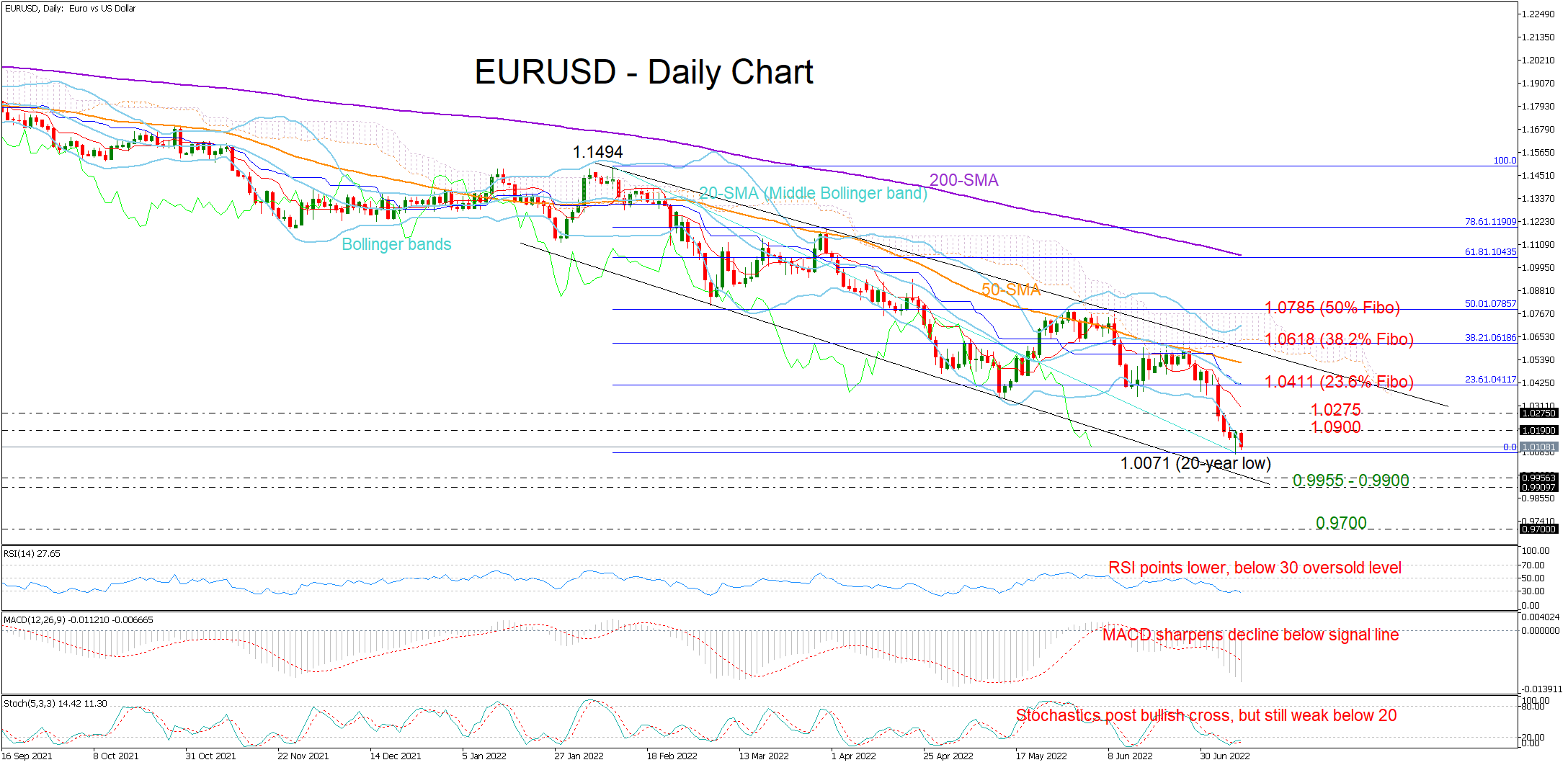
EURUSD bears returned on Monday to fight for parity after taking a quick break on Friday, which helped the price close mildly positive. The pair has also charted a bullish hammer candlestick around its 20-year low of 1.0071 in the same day, though the encouraging formation is currently getting under scrutiny.
Oversold conditions are evident as the price has been testing the lower Bollinger band for a couple of sessions now. The RSI and the Stochastics are also reflecting an overstretched decline, as they keep fluctuating below their 30 and 20 levels accordingly. That said, neither of those indicators is showing any convincing signs for a bullish reversal, suggesting that a rebound in the price could take place somewhere lower.
Given the above discouraging signals and the negative trajectory in the simple moving average (SMAs), parity will be in sight in the short term if downside forces persist below the 1999 – 2002 constraining zone of 1.0133. Failure to rotate here could bring the tentative support line seen at 0.9955 and the 0.9900 psychological mark next on the radar, while even lower, the bears may push towards the 0.9700 base last seen during the second half of 2002.
On the upside, the bulls will need to reclaim the area between 1.0190 and 1.0275, where the constraining red Tenkan-sen line is also converging, to reach the 20-day simple moving average (SMA) and the 23.6% Fibonacci retracement of the 1.1494 – 1.0071 downleg at 1.0411. Above that, the spotlight will fall on the tough resistance trendline seen at 1.0585 and the 38.2% Fibonacci of 1.0618. Notably, the price will also meet the lower boundary of the Ichimoku cloud within the same region, which has been stubbornly blocking the way higher since the end of May. Beyond that, the recovery could stabilize around the surface of the cloud and the 50% Fibonacci of 1.0785.
All in all, the technical picture foresees more weakness for EURUSD in the short term, which is expected to result in parity, especially if the price fails to bounce above 1.01900 and closes below 1.0133 instead.
NZ Dollar Slides, RBNZ in Spotlight
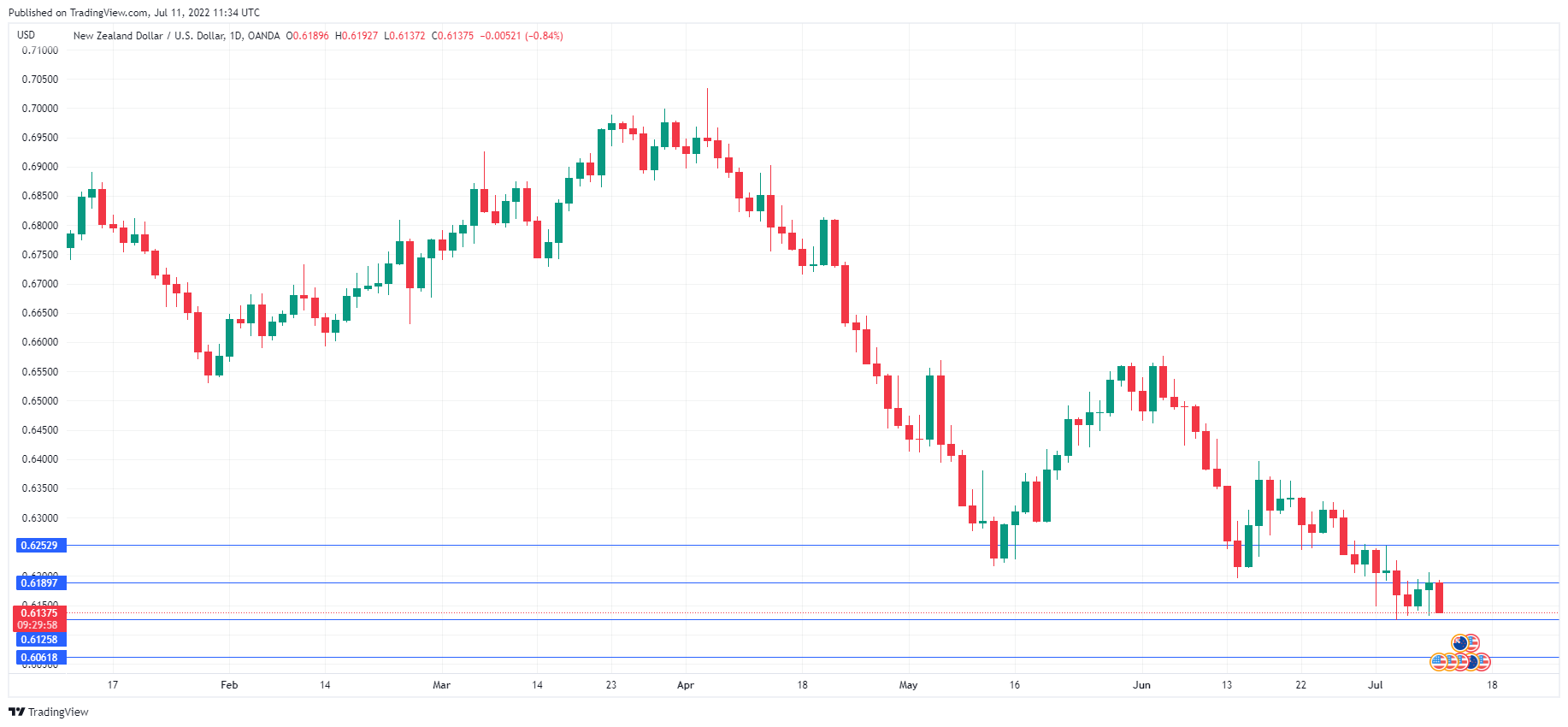
The New Zealand dollar is seeing red on Monday, as the US dollar has started the week with gains against the major currencies after a solid non-farm payrolls release on Friday. In the European session, NZD/USD is trading at 0.6142, down 0.76%.
RBNZ expected to deliver 50bp hike
The Reserve Bank of New Zealand will be in the spotlight this week. On Tuesday, the central bank is expected to release a Statement of Intent. The report will outline the central bank’s objectives over the next three years, and investors will be looking for insights regarding future monetary policy.
After the Statement of Intent, the RBNZ sets interest rates on Wednesday at its policy meeting. The RBNZ has pressed the pedal to the floor and is widely expected to deliver a third successive 50bp increase, which would bring the cash rate to 2.50%. As with the Fed and RBA, there are concerns that the aggressive rate-hike tightening will slow the economy to such an extent that the result will be a recession. The Bank has been in an aggressive mode in order in order to curb soaring inflation, which has climbed to 6.9%.
The central bank has set as its number one priority the curbing of inflation and inflation expectations, and while it would of course prefer to avoid a recession, it is unlikely to change course even if this is the price to pay. With a peak in inflation nowhere in sight, the RBNZ can be expected to remain hawkish until inflation is contained. Interest rates could hit 3% in August and rise as high as 4% if inflation does not ease lower.
Confidence indicators have been heading southward, raising concerns about the health of the economy. The NIEZR Business Confidence index fell ever deeper into negative territory last week, with a reading of -65 for Q2. Business confidence is currently at its lowest level since Q1 2020, at the start of the corona pandemic. Economic activity has been curtailed due to the acceleration of Covid cases, and businesses continue to struggle with cost pressures and higher interest rates. Earlier in July, ANZ Business Confidence in June, which fell to -62.6, down from -55.6 in May, marking a 12th straight decline and a near-record low.
Consumers are also feeling the bite of the cost of living crisis and higher interest rates have meant higher mortgage payments, leaving consumers with less disposable income and less confidence about their economic situation. The Westpac Consumer Confidence fell sharply to 78.7 in Q1, down from 92.1 in Q4 2021. If major economic indicators point to a slowdown in growth, the RBNZ may have to ease up on its aggressive rate hiking.
NZD/USD Technical
- 0.6125 is under strong pressure in support. Below, there is support at 0.6062
- There is resistance at 0.6189 and 0.6252
AUDUSD Wave Analysis
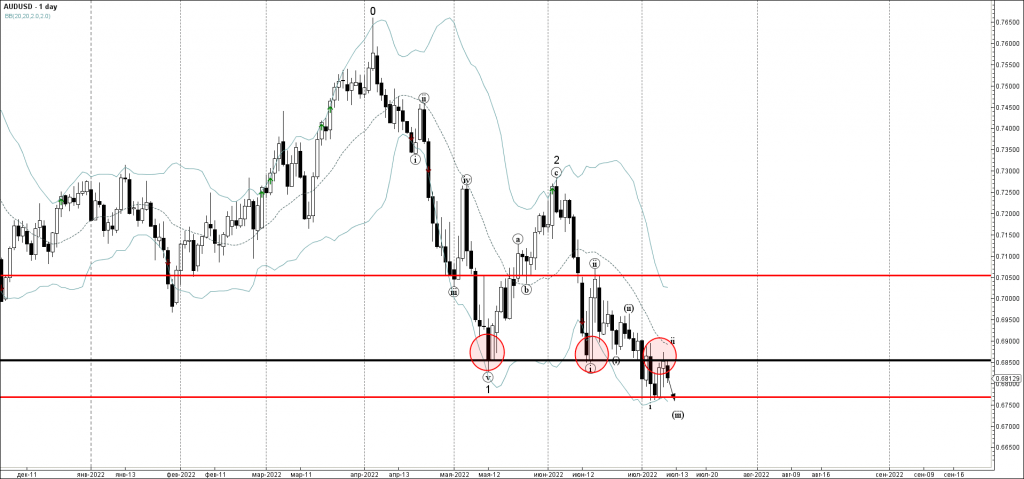
- AUDUSD reversed from resistance level 0.6850
- Likely to fall to support level 0.9870
AUDUSD currency pair recently reversed down from the key resistance level 0.6850 (former strong support which reversed the pair sharply in May and June).
The downward reversal from the resistance level 0.6850 stopped the earlier minor ABC correction (ii).
Given the clear daily downtrend, AUDUSD can be expected to fall further toward the next support level 0.9870 (low of the previous minor impulse wave i).
EURCHF Wave Analysis
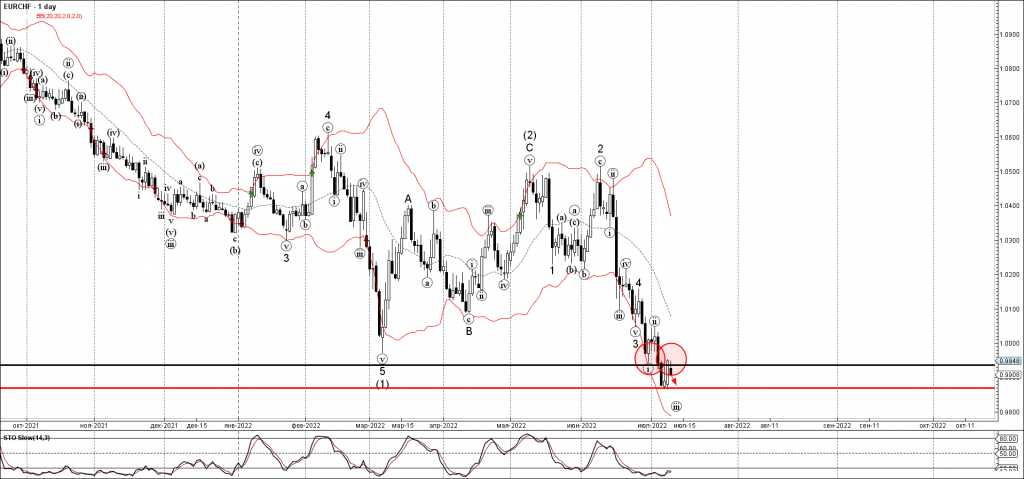
- EURCHF reversed from key resistance level 0.9950
- Likely to fall to support level 0.9870
EURCHF currency pair recently reversed down from the key resistance level 0.9950 (low of the previous minor impulse wave (i) from the end of June).
The downward reversal from the resistance level 0.9950 is aligned with the active impulse waves (iii), 3 and (3).
Given the predominant weekly downtrend, EURCHF can be expected to fall further toward the next support level 0.9870 (low of the earlier Morning Star from the start of this month).
Awaiting the Last Bitcoin Mile
Bitcoin rose 12.6% last week to near $21,600 but is bouncing back from gains to the $20,500 area at the start of the day, recording a 3.9% decline in the last 24 hours. Ethereum essentially copies the dynamics of the first cryptocurrency, losing 3.8% in 24 hours to $1150. Altcoins from the top 10 are losing between 2.4% (BNB) and 5.5% (Solana).
Total crypto market capitalisation, according to CoinMarketCap, rose 5.8% over the week to $916bn. Bitcoin’s dominance index climbed 0.6 to 42.8% over the same period.
The Cryptocurrency Fear and Greed Index rose 13 points for the week to 24 but lost 2 points by Monday and remains in ‘extreme fear’.
BTC’s rise last week was halted by the 200-week moving average, now passing near $22,500. Bitcoin has continued to move sideways for three weeks near the critical $20,000 level, the high of the previous cycle.
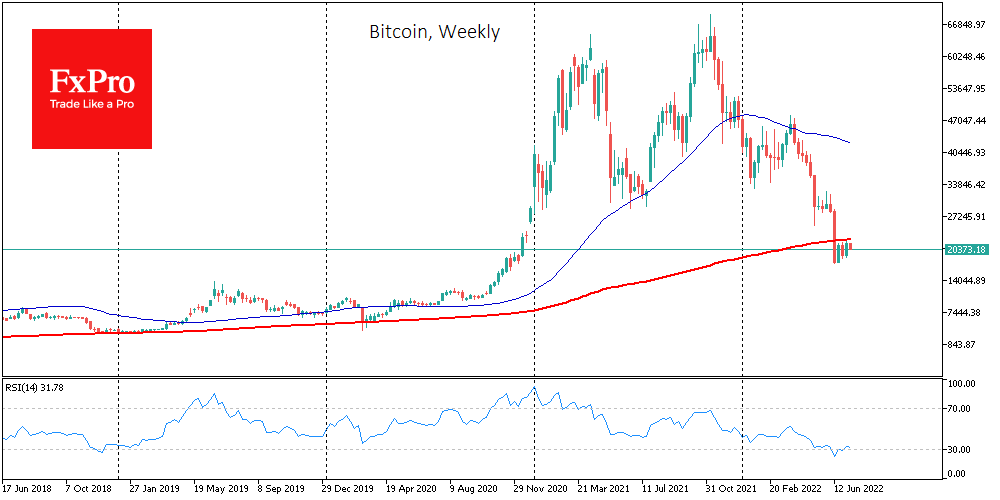
BTC has never previously fallen below such marks, so it is now getting support from buyers confident in the first cryptocurrency’s long-term growth. Another supportive factor was the rebound in financial markets, where the new half-year was met with increased buying.
However, as always in recent months, there are many questions about the sustainability of the rebound amid the Fed’s sharp interest rate rise and a slowing economy.
Rockefeller International managing director Ruchir Sharma believes the deleveraging process is not over, and BTC could still fall in the next six months as the stock market declines.
Galaxy Digital CEO Michael Novogratz said that the decline of the cryptocurrency market is close to being over. However, there could be a final “tug” from the bears shortly. He stressed that he does not believe BTC will fall to $13,000.
Cryptocurrency lending service Celsius has transferred 25,000 wBTC tokens worth $528m to the FTX exchange. The market fears Celsius will sell the tokens and crash the bitcoin exchange rate. According to Arkham, Celsius has lost $390m of client funds on investments in DeFi and NFT.
Nobuaki Kobayashi, the trustee of the bankrupt Mt.Gox exchange, has begun preparations to reimburse creditors. The situation on the market could worsen if 150,000 BTC were distributed among MtGox users and immediately flooded the market.
The US Federal Deposit Insurance Corporation (FDIC) is investigating Voyager Digital. According to the agency, the cryptocurrency broker deceived users by claiming their assets were protected by the agency’s program.
USD Pulls Back as Investors Price in a More Aggressive Fed
The US dollar pulled back slightly on Monday morning as investors reacted to strong jobs data from the United States. The numbers revealed that the country added over 372k jobs in June, higher than analysts were expecting. The unemployment rate remained unchanged at 3.6% while wages rose by over 5% again. Now, investors are waiting for the upcoming American inflation data scheduled for Wednesday this week. Still, analysts believe that these numbers will not change the Fed’s decision on interest rates. Analysts expect that the bank will press on with a 0.75% rate hike followed by a 0.50% increase in September.
American stock futures moved sideways as investors positioned themselves for higher interest rates and the upcoming earnings season. Some of the biggest American banks will start publishing their earnings this week. Some of the banks expected to publish this week are Wells Fargo, Citigroup, and JP Morgan. Companies in other industries will also publish their results. Some of them are Delta Air Lines, PepsiCo, and UnitedHealth. Analysts expect the results to show that companies had a difficult quarter as demand waned and as the strong dollar hurt their overseas results.
The economic calendar will not have major events today. Earlier, New Zealand published relatively weak electronic retail sales, signaling that inflation was having an impact on shopping behaviours. The data came two days ahead of the upcoming interest rate decision by the Reserve Bank of New Zealand (RBNZ). The other important event to watch will be the upcoming statements by Bank of England’s Andrew Bailey and Federal Reserve’s John Williams. Williams’ speech will come two days after he said that the Fed was fully committed to a 2% inflation.
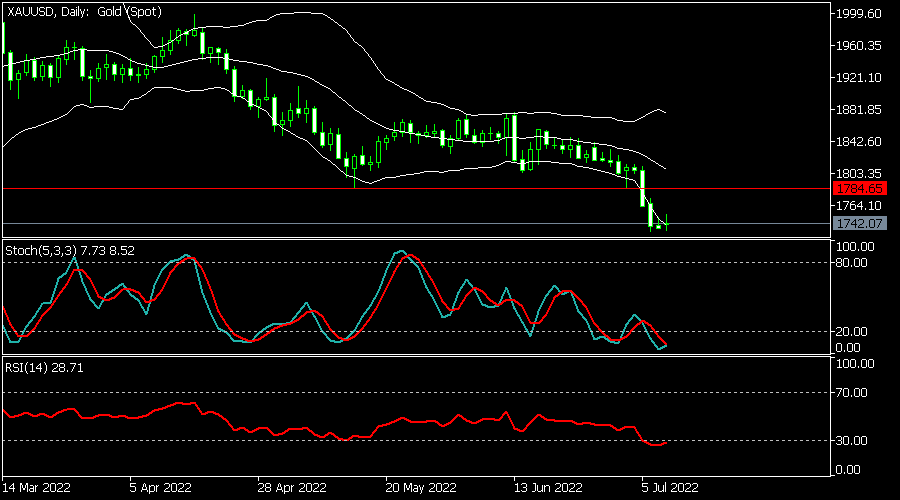
XAUUSD
The XAUUSD pair continued its bearish trend after the latest strong US jobs data. It dropped to a low of 1,742, which was the lowest level in months. The pair retreated below the important support at 1,784 and all moving averages. Similarly, oscillators like the Relative Strength Index (RSI) and the MACD have moved below the oversold level. Therefore, the pair will likely keep falling as sellers target the support at 1,700.
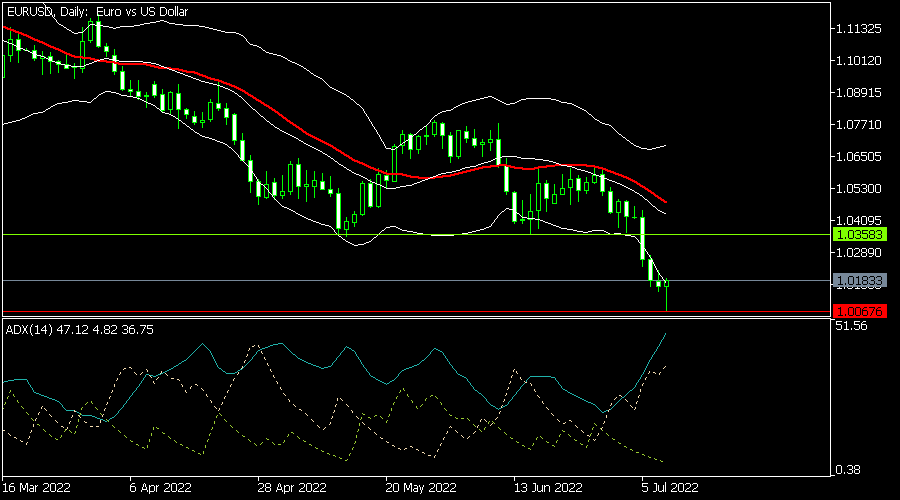
EURUSD
The EURUSD pair has been in a strong sell-off in the past few days as investors priced in a more hawkish Federal Reserve. It dropped to a low of 1.0067, which was the lowest level in decades. On the daily chart, the pair remains below all moving averages. It has also moved below the important resistance point at 1.0358 while the Average Directional Index (ADX) has risen to its highest point in months. The pair will likely have a pullback on Monday since it has formed a hammer pattern on the daily chart.
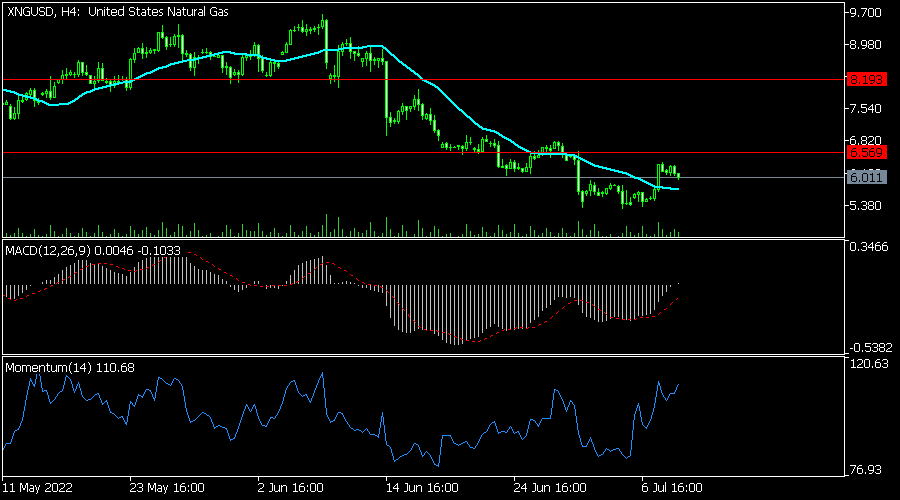
XNGUSD
The XNGUSD pair pulled back as repairs for the Nord Stream 1 project continued. The pair rose to a high of 6.011, which was the highest point since July 4. It has moved slightly above the 25-day moving average while the MACD and the momentum oscillators have continued rallying. Therefore, the pair will likely continue rising as bulls target the key resistance at 6.60.
Australian Dollar Slides Below 68 Line
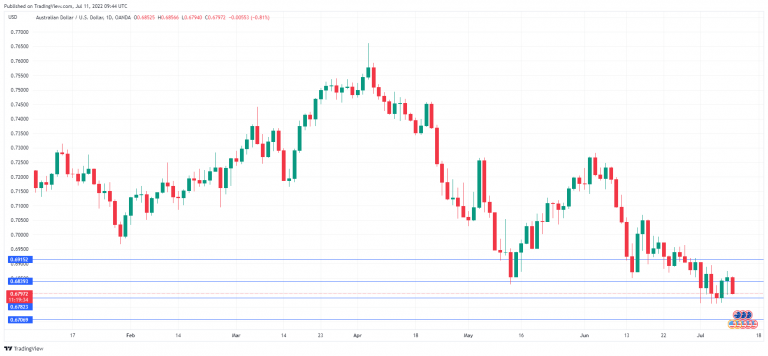
The Australian dollar has started the week in negative territory, after a brief rally late last week. In the European session, AUD/USD is trading at 0.6796, down 0.82%.
Can Australia avoid a recession?
The RBA is playing catch-up with the inflation curve, but the central bank can’t be faulted for being aggressive. Last week, the RBA raised rates by 0.50% for a second straight month, bringing the cash rate to 1.35%. That won’t be sufficient to rein inflation, which hit 5.1% in the first quarter and could top 7%, according to the RBA. The cash rate will almost certainly rise above 2% this year and could reach as high as 2.5% by mid-2023. Lowe has admitted that there is a “narrow path” between tightening enough to curb inflation or being too aggressive and causing a recession, but it seems clear that the RBA will choose a recession over rampant inflation.
Governor Lowe has predictably downplayed concerns about a recession, and one could make the argument that the economy is resilient enough to withstand a sharp increase in rates. Employment is at a low rate of 3.9%, job vacancies are at record highs and consumer demand remains robust.
The weak link, however, could be the housing sector, as mortgage costs keep rising, which will likely dampen household spending in the coming months. If first-time buyers decide to sit on the fence, housing prices could take a bath, which would be bad news for the economy. Consumer confidence has been waning, and Tuesday’s Westpac Consumer Confidence index for July could bring more bad news. The index has been mired in negative territory since November 2021 and posted a sharp 4.5% decline in June. We’ll also get a look on Tuesday at NAB Business Confidence for June, which slowed to 6 in May, down from 10 previously. If the confidence indicators underperform, I wouldn’t be surprised to see the Australian dollar respond with losses.
AUD/USD Technical
- AUD/USD is putting pressure on support at 0.6782, followed by support at 0.6706.
- There is resistance at 0.6839 and 0.6915