Sample Category Title
Gold Wave Analysis
- Gold broke pivotal support level 1790.00
- Likely to fall to support level 1755.00
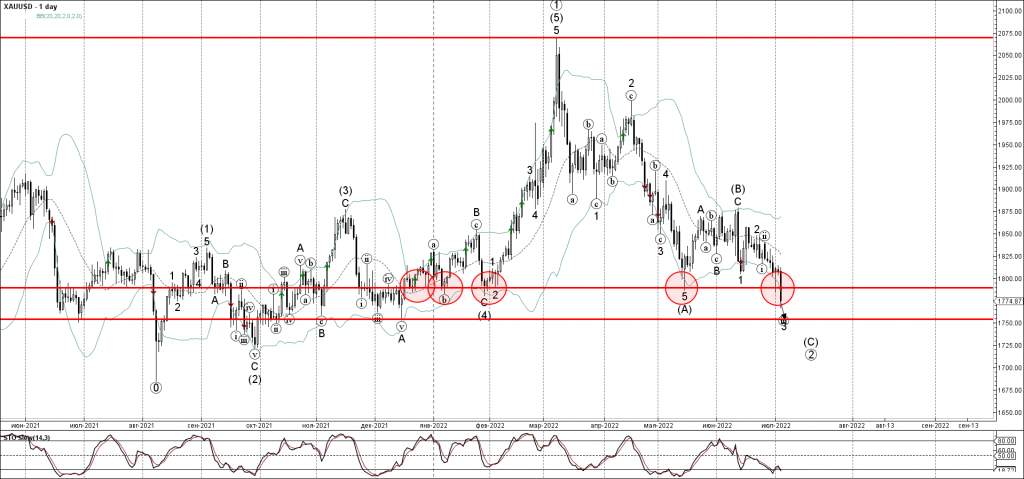
Gold is under strong bearish pressure after the price broke the pivotal support level 1790.00 (which has been repeatedly reversing the price from last December).
The breakout of the support level 1790.00 accelerated the active impulse waves (iii) and 3 – which belong to the higher-order impulse wave (C) from last month.
Gold can be expected to fall further toward the next support level 1755.00 (former monthly low from November and December, target for the completion of the active impulse wave 3).
EURUSD Wave Analysis
- EURUSD broke multi-year support level 1.034
- Likely to fall to support level 1.020
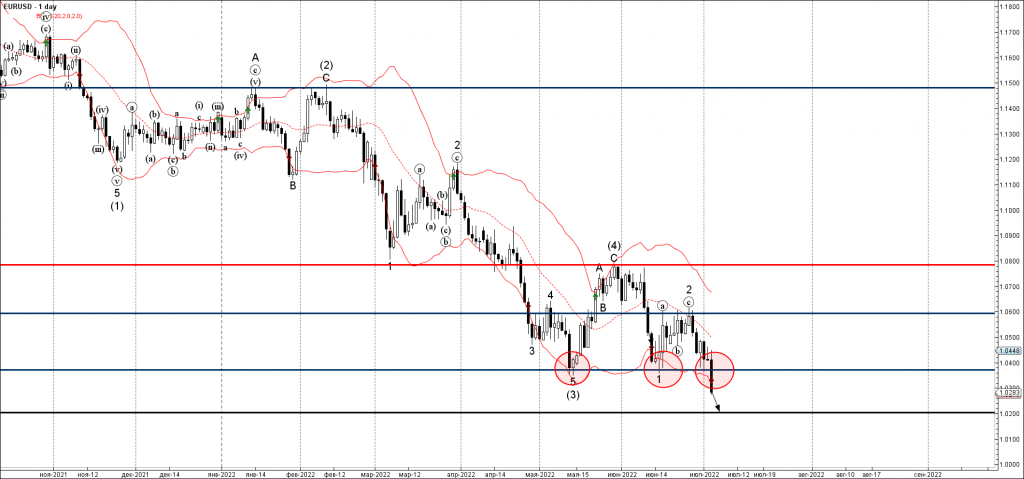
EURUSD recently broke through the key support level 1.037 (which stopped the previous impulse waves (3) and 1, as can be seen below).
The breakout of the support level 1.037 led to the breakout of the major multi-year support level 1.034 from 2017.
Given the strong weekly and daily downtrend, EURUSD can be expected to fall further toward the next support level 1.020.
EUR/USD: Euro Slumps to 20-Year Low on Growing Recession Fears
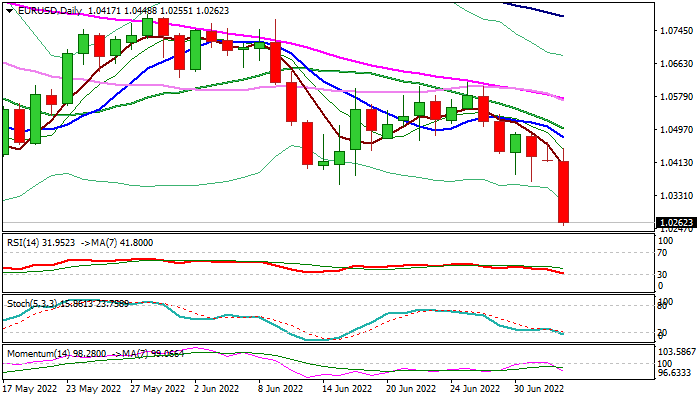
The Euro collapsed through key support zone on Tuesday and hit the lowest in almost two decades, in the biggest daily fall since Jun 16, 2021.
Fresh weakness was sparked by renewed risk aversion on rising gas prices that fueled fears of recession, with data released today, showed that Eurozone business growth slowed significantly in June, adding to negative signals.
Strong demand for US dollar also contributed to Euro’s weakness.
Technical picture on all larger timeframes is firmly bearish and supports the price action, with close below key supports at 1.0358/49/40 (Jun 15/May 13/2017 lows) to generate strong bearish signal of continuation of larger downtrend from 1.6039 (2008 peak).
Bears eye next targets and pivotal supports at 1.0069/1.00 (Fibo 76.4% of 0.8225/1.6039/psychological, violation of which would risk sub-parity level extension and unmask Sep 2002 low (0.9607).
Price adjustments on profit-taking are expected to be limited and to provide better selling opportunities, with former key supports (1.0340/58 zone) reverting to strong resistances which should ideally cap, but extended upticks should not exceed falling daily Tenkan-sen (1.0435) to keep bears intact.
Res: 1.0298; 1.0340; 1.0358; 1.0435.
Sup: 1.0200; 1.0182; 1.0100; 1.0069.
Euro Has Lost its Latest Deep-Pocketed Buyer
The single currency collapsed below 1.03 for the first time since December 2002. The 1.0350 area euro buyers have managed to defend three times in the last month and a half and at the end of 2016.
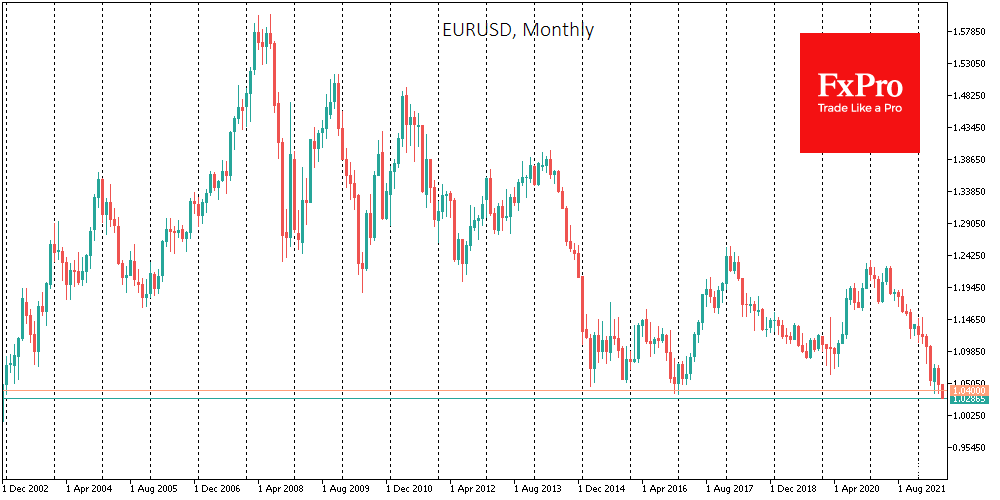
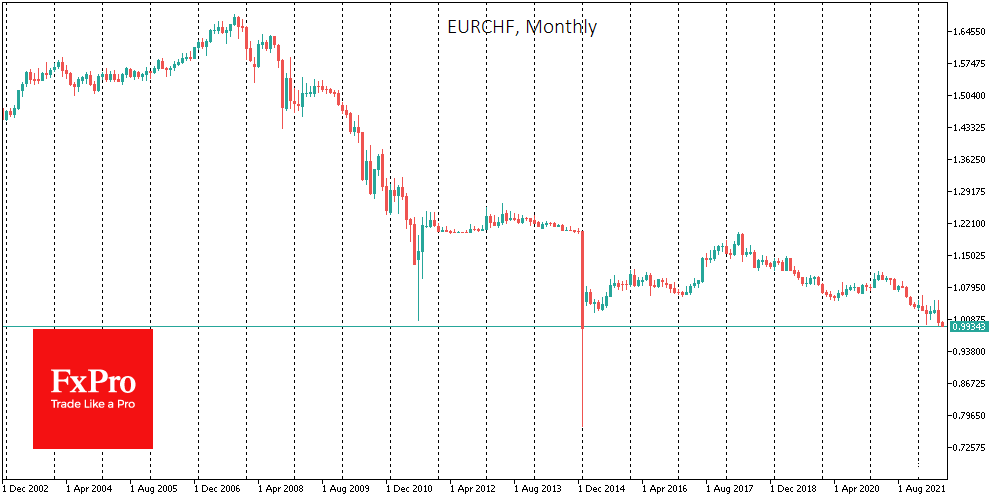
In our view, we should look for traces of the changed approach of the Swiss National Bank in that the euro has broken the dam. For the past seven years, the SNB has been active in the forex market as soon as the EURCHF weakening trend became sustained.
The SNB did not disclose any details, but in late February, it probably stopped the euro from falling below parity against the franc, at the end of last year, reversed it near 1.0370, and in March 2020, hedged it from declining below 1.05.
The rate hike last month was a public step in the fight against inflation, while the revision of the FX interventions policy was another covert turnaround by the SNB. Indeed, it would be naive to assume that the central bank would raise rates to fight inflation without abandoning the interventions that have protected Switzerland from deflation in previous years.
The SNB is thus no longer the last line of defence for the euro, leaving it alone with a melting trade balance and a widening gap between real and nominal interest rates.
And in this situation, euro buyers have nothing to cling to now other than expectations of weak US labour market data. The currency market may avoid a further sell-off in the euro until Friday’s statistics release. However, if it comes without unpleasant surprises, the next big stop for EURUSD could be around 0.99.
Sunset Market Commentary
Markets
GEURONIMOOO! The euro is sliding to new multiyear lows against a range of currencies. EUR/CHF revisited sub-parity territory after recovering over the past few days from a similar adventure last week. The currency pair is currently changing hands at 0.993, the lowest since 2015. Excluding for this volatile period (after the SNB ditched the 1.20 peg), EUR/CHF trades at the lowest since the creation of the monetary union. EUR/USD is on the ropes. The combination tested the mid-May multiyear low around 1.035 a few times recently. It started again with a test today but one could see (based on moves in other crosses) how this time would be different. That key support level broke and EUR/USD slid further south below 1.03 (1.027 at the time of writing). From a technical point of view, there’s little in the way for a return to parity (76.4% dollar recovery in the 2000-2008 EUR/USD rally). After that, there’s a gaping hole to be bridged all the way down to 0.823 in a throwback to the Duisenberg era, the ECB’s first president. Even sterling was able to capitalize, temporarily at least, on euro weakness despite overall risk-off. EUR/GBP for a second time in less than a week tumbled out of the upward sloping trend channel. It then staged an intraday comeback to around 0.86 to keep the technical picture intact still. This balancing act makes sense considering what is driving the moves today. Recession fear is taking hostage of the euro with ever-higher (energy and food) inflation weighing on disposable income, corporate margins and soon (if not already) the European economy. But this is at least equally the case for the UK (see headline below). Sticking to currencies, EUR/JPY is the widow-maker now. The 140 support level (April interim high and neckline of the June double top formation) is being heavily tested. A confirmed break spells more trouble ahead for other euro crosses. It’s all hands on deck in Central-Europe. EUR/HUF is hitting new record lows at 408+. The MNB’s 185 bps super hike hasn’t convinced the forint at all. The Polish zloty is depreciating to the lowest level since end March. EUR/PLN is filling offers around 4.76. The CNB in Czechia is busy putting its large pile of FX reserves at work to prevent the CZK to weaken beyond EUR/CZK 24.75.
As said, fears for a recession are responsible. This results in sharp gains for core bonds as markets question the central banks tightening intentions. Bunds outperform US Treasuries. German yields tumble between 13 and 16 bps across the curve. The 10y yield (1.20%) is edging closer to critical support at 1.15%. US yields ease a more moderate 3-8.1 bps but missed out on yesterday’s European yield jump. But here too, important technical levels are nearing fast (US10y 2.81% vs 2.72% support). European equities raise the alarm. The EuroStoxx50 loses 2.4% to new YtD lows of 3370. Next support is located at 3109 before returning to 3000. Wall Street opens with losses between 1.7-1.9%. News Headlines
In its financial stability report, the Bank of England sees the global outlook deteriorating markedly due to the war in Ukraine and downside risks could further adversely affect financial stability. Still, the bank assesses UK banks have considerable capacity to support lending to households and business even if the economic outlook worsens. Aggregate household debt relative to income has remained broadly flat and debt servicing costs for UK business are assessed to remain affordable even as higher yields, rising (living)costs, weaker growth and other issues are putting pressure on household finances and corporate balance sheets. The BoE confirmed it will raise the contra-cyclical capital buffer to the pre-pandemic level of 2.0% by June next year. The BoE will also start annual stress tests in September 2022, testing the banks resilience to deep simultaneous recessions in the UK and global economies, real income shocks, large falls in asset prices and higher global interest rates. The BoE will also conduct an in-depth analysis of the functioning of the commodities market as the Russian invasion in Ukraine illustrated the risk of these markets to amplify economic shocks.
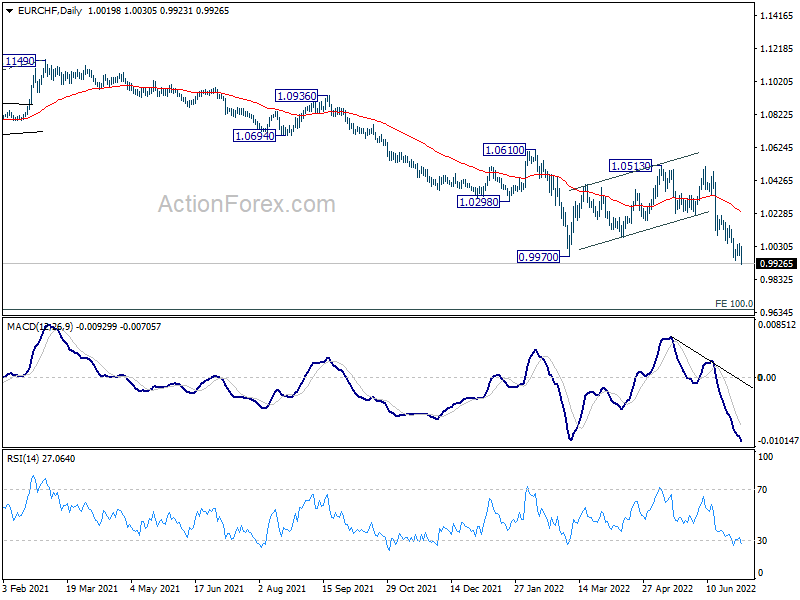
EUR/CHF Mid-Day Outlook
Daily Pivots: (S1) 0.9982; (P) 1.0014; (R1) 1.0052; More....
EUR/CHF's down trend resumes by breaking 0.9943 temporary low. Intraday bias is back on the downside. Next target if 0.9650 long term projection level. On the upside, break of 1.0044 minor resistance will turn intraday bias neutral and bring consolidations, before staging another decline.
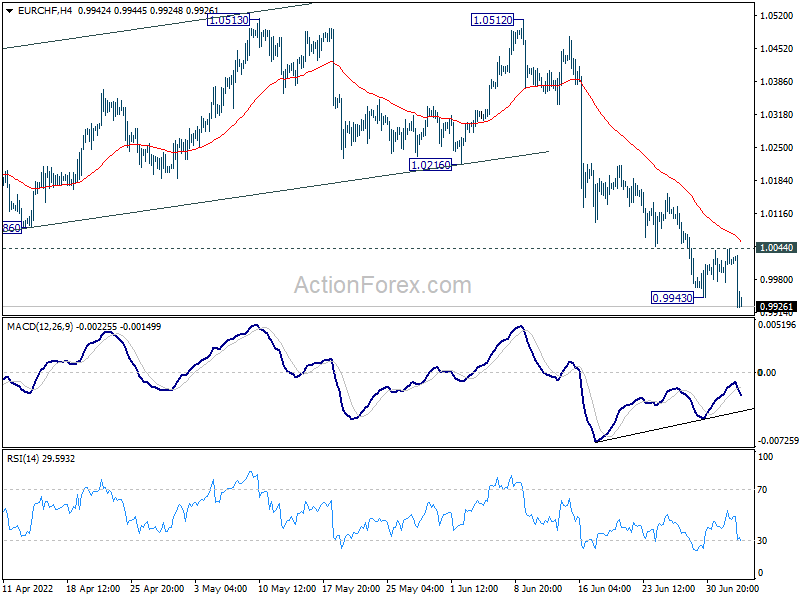
In the bigger picture, as long as 1.0505 support turned resistance (2020 low) holds, long term down trend from 1.2004 (2018 high) is expected to continue. Next target is 100% projection of 1.2004 to 1.0505 to 1.1149 at 0.9650. However, firm break of 1.0505 will suggest medium term bottoming, and bring stronger rebound towards 1.1149 structural resistance.
USD/JPY Mid-Day Outlook
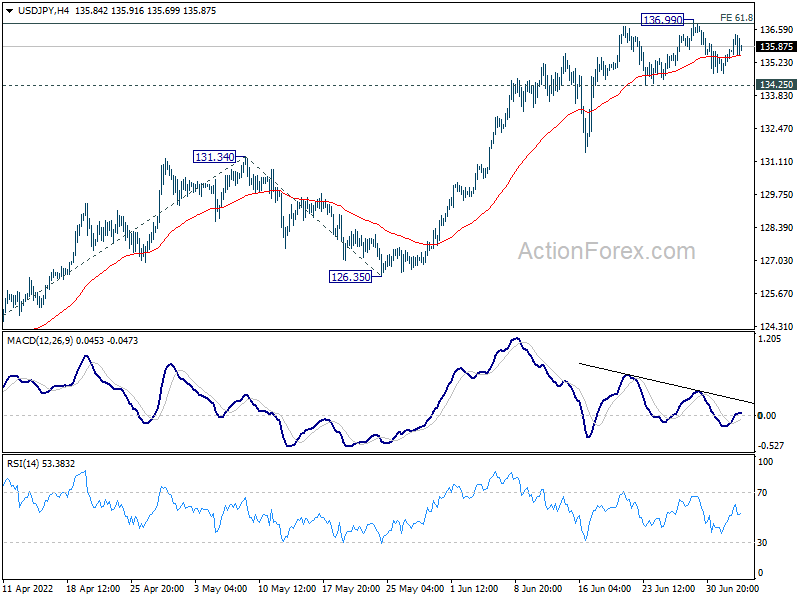
Daily Pivots: (S1) 135.07; (P) 135.42; (R1) 136.06; More...
Intraday bias in USD/JPY stays neutral as sideway consolidation continues. On the downside, break of 134.25 support will indicate short term topping at 136.99. Intraday bias will be back on the downside for 131.34 support resistance turned support. Nevertheless, firm break of 136.99 will resume larger up trend to 100% projection of 114.40 to 131.34 from 126.35 at 143.29.
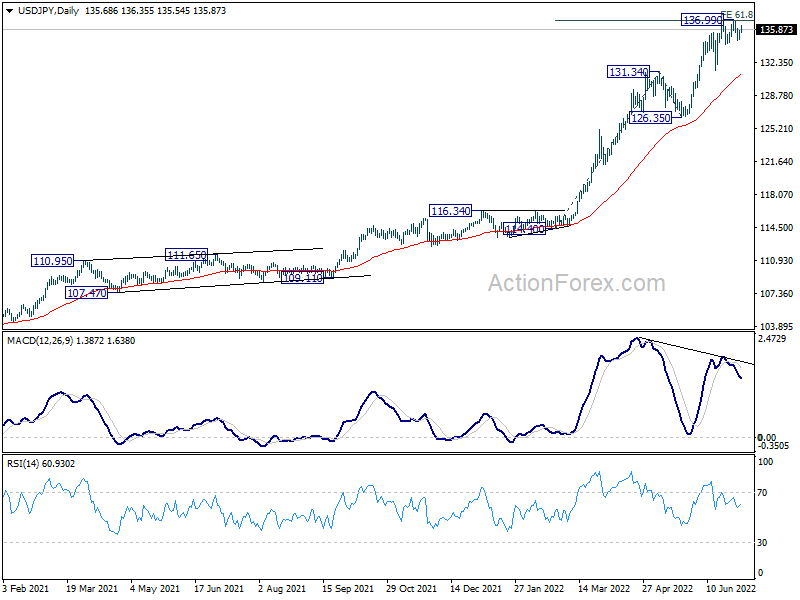
In the bigger picture, current rally is seen as part of the long term up trend from 75.56 (2011 low). Next target is 100% projection of 75.56 (2011 low) to 125.85 (2015 high) from 98.97 at 149.26, which is close to 147.68 (1998 high). This will remain the favored case as long as 126.35 support holds.
USD/CHF Mid-Day Outlook
Daily Pivots: (S1) 0.9584; (P) 0.9601; (R1) 0.9630; More...
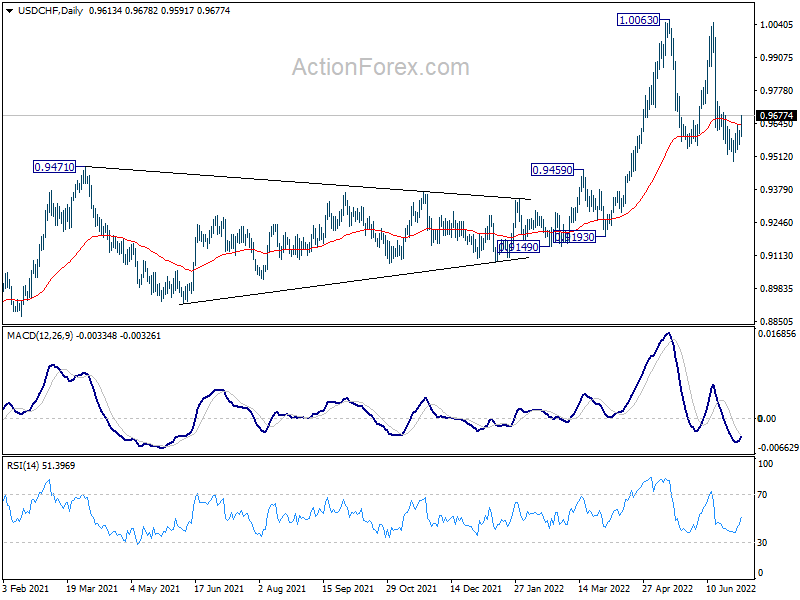
USD/CHF's recovery from 0.9493 continues today but stays below 0.9731 minor resistance. Intraday bias remains neutral first. On the upside, break of 0.9731 will argue that the consolidation from 1.0063 has completed and bring stronger rally back to retest 1.0063 high. However, another fall below 0.9493 will dampen this view and target 0.9459 resistance turned support.
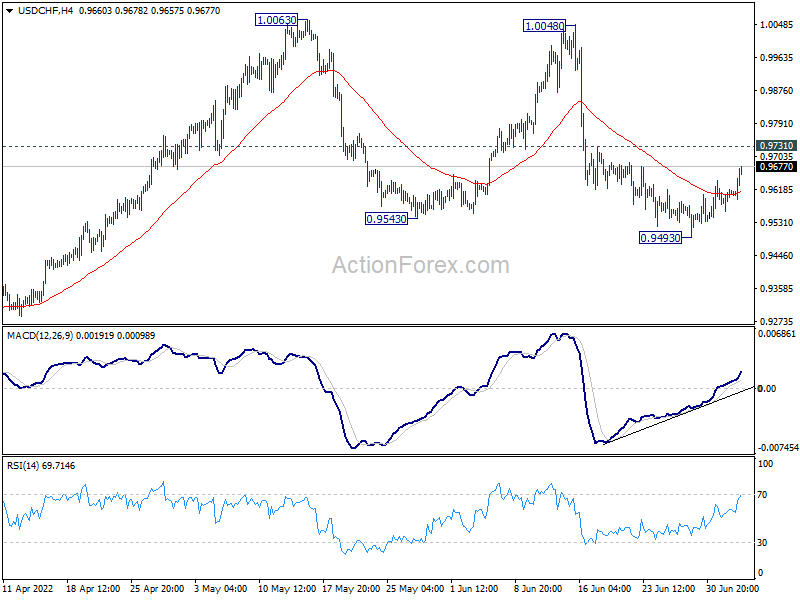
In the bigger picture, down trend from 1.0342 (2016 high) should have completed with three waves down to 0.8756 (2021 low) already. Rise from 0.8756 is likely a medium term up trend of its own. Next target is 1.0237/0342 resistance zone. This will remain the favored case as long as 0.9471 resistance turned support holds. However, sustained break of 0.9471 will extend long term range trading with another falling leg.
GBP/USD Mid-Day Outlook
Daily Pivots: (S1) 1.2070; (P) 1.2118; (R1) 1.2150; More...
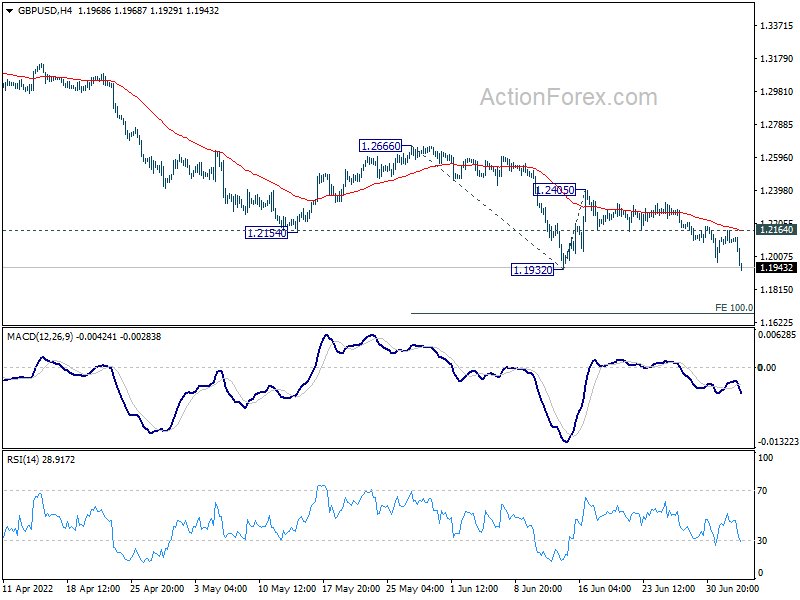
GBP/USD's breach of 1.1932 support indicates down trend resumption. Intraday bias is back on the downside. Next near term target is 100% projection of 1.2666 to 1.1932 from 1.2405 at 1.1671. Break will accelerate further to 161.8% projection at 1.1217. On the upside, break of 1.2164 minor resistance will delay the bearish case and turn intraday bias neutral first.
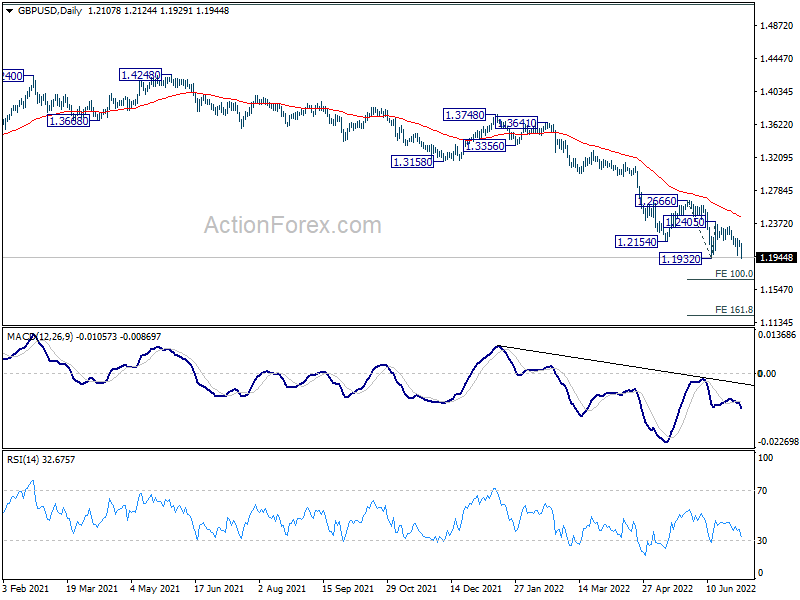
In the bigger picture, fall from 1.4248 (2018 high) could be a leg inside the pattern from 1.1409 (2020 low), or resuming the longer term down trend. Deeper decline is expected as long as 1.2666 resistance holds. Next target is 1.1409 low. However, firm break of 1.2666 will bring stronger rise back to 55 week EMA (now at 1.31403).
EUR/USD Mid-Day Outlook
Daily Pivots: (S1) 1.0406; (P) 1.0435 (R1) 1.0452; More...
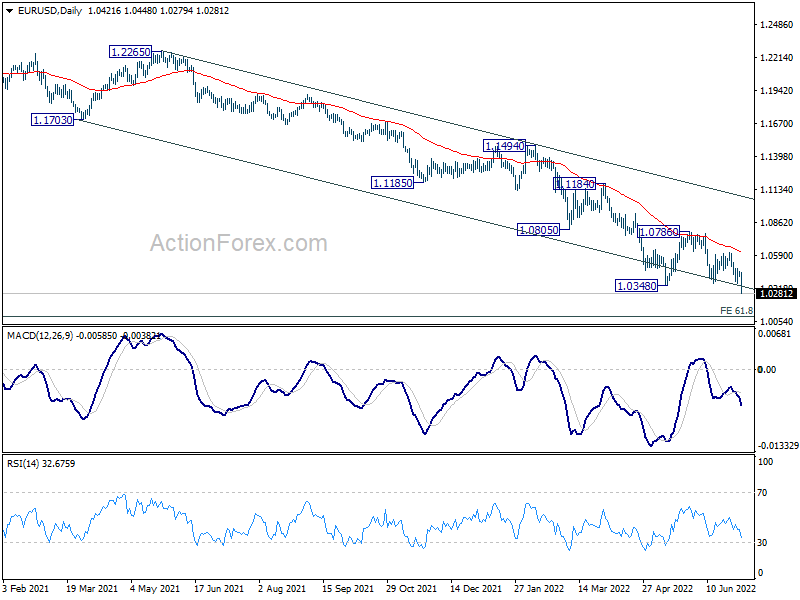
EUR/USD's down trend finally resumes and intraday bias is back on the downside. Next target is 1.0090 long term projection level. On the upside, above 1.0448 minor resistance will delay the bearish case and turn intraday bias neutral again.
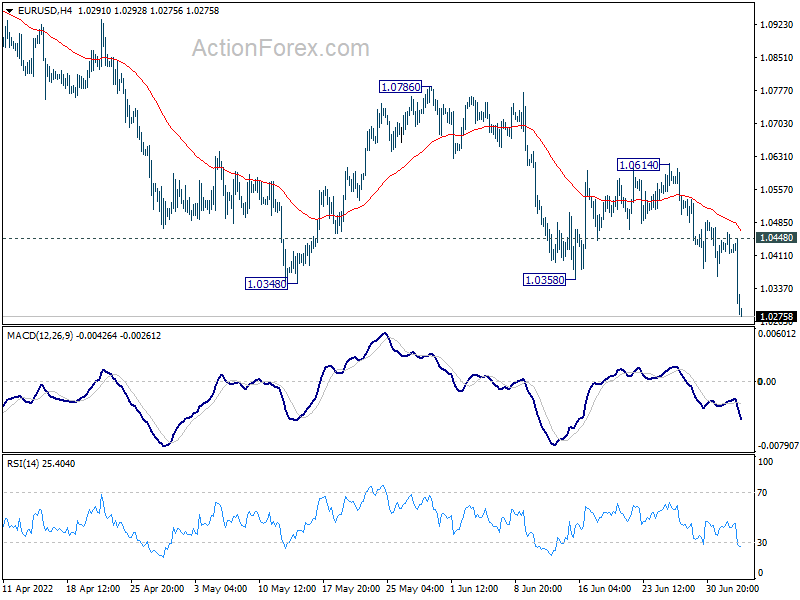
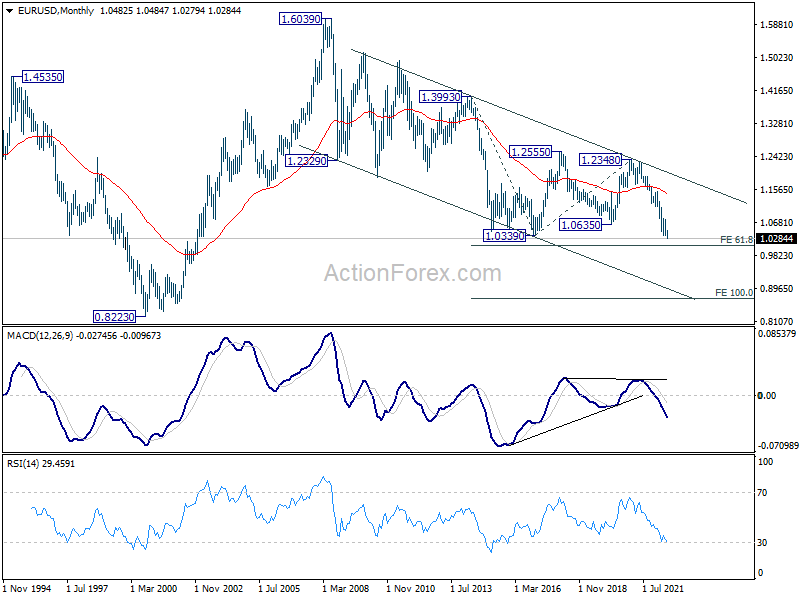
In the bigger picture, the break of 1.0339 long term support (2017 low) indicates resumption of whole down trend from 1.6039 (2008 high). Next target is 61.8% projection of 1.3993 to 1.0339 from 1.2348 at 1.0090. Sustained break there will pave the way to 100% projection at 0.8694. IN any case, outlook will stay bearish as long as 1.0786 resistance holds, in case of recovery.