Sample Category Title
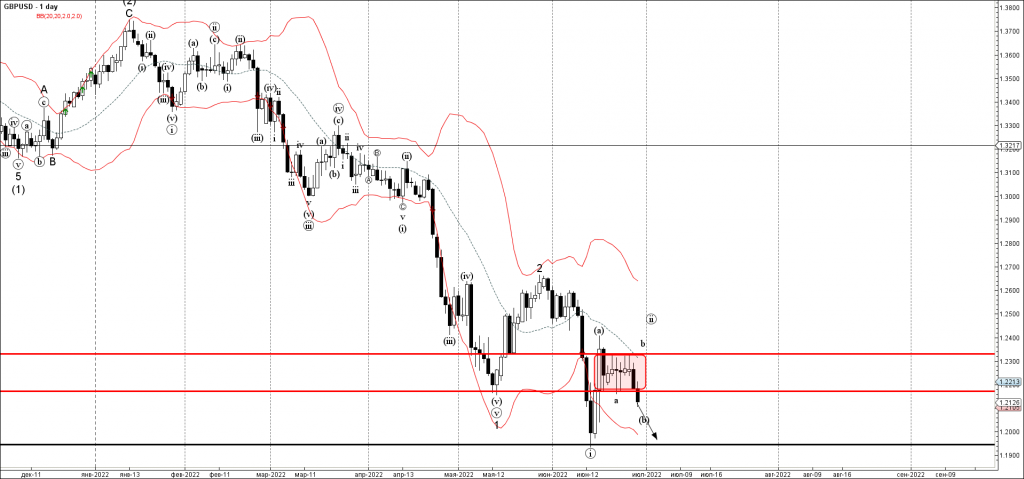
GBP/USD Wave Analysis
- Sterling broke support level 1.2170
- Likely to fall to support level 1.1945
Sterling continues to fall after the earlier breakout of the support level 1.2170 (lower boundary of the narrow sideways price range inside which the pair has been trading from the middle of June).
The breakout of the support level 1.2170 continues the active minor wave (b) of wave (ii) from the start of this month.
Given the clear daily downtrend, the Sterling can be expected to fall further toward the next support level 1.1945 (low of the previous minor wave (i)).
BoE Bailey: Acting forcefully is not the only thing on the table
BoE Governor Andrew Bailey said the central bank has options to act "forcefully" to tackle inflation if needed. "There will be circumstances in which we will have to do more. We're not there yet in terms of the next meeting. We're still a month away, but that's on the table," Bailey said. "But, you shouldn't assume its the only thing on the table."
Bailey also noted that the UK economy was "very clear" at a turning point and starting to slow. As inflation is shifting from goods and into energy and food prices, BoE would watch the development "very, very carefully".
Fed Powell: US economy well positioned to withstand tighter monetary policy
Fed Chair Jerome Powell said in a panel discussion at the ECB forum that the "the clock is kind of running on how long will you remain in a low-inflation regime … The risk is that because of the multiplicity of shocks you start to transition into a higher inflation regime and our job is to literally prevent that from happening and we will prevent that from happening,"
Fed's "aim" now is to raise interest rates without trigger a recession. And, " we believe there are pathways to achieve that".
"We hope that growth will remain positive," Powell. "Overall the US economy is well positioned to withstand tighter monetary policy."
Eurozone CPI Inflation Likely to Roar Again
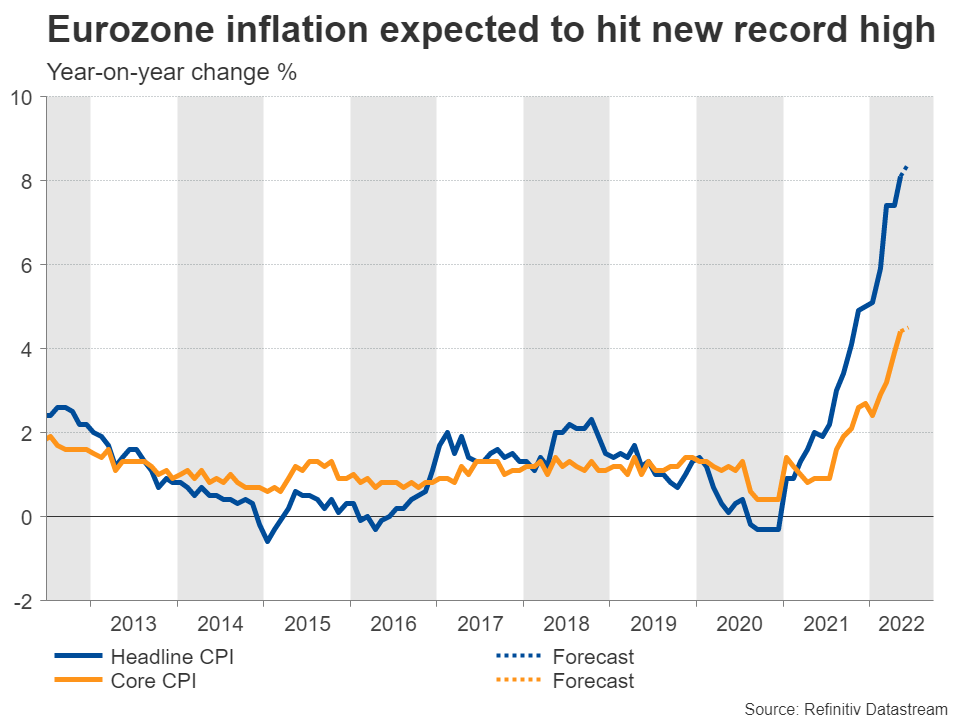
The era of subzero interest rates will conclude in the eurozone next month after a decade, but what is less certain is how fast the monetary tightening phase will develop in the year ahead as recession risks build up in investors’ mind. Flash CPI inflation figures will provide some clues on Friday at 10:00 GMT, with forecasts pointing to a new record high.
Inflation to hit a new all-time high
The headline CPI inflation figure is expected to unlock a new record high at 8.4% y/y in June compared to 8.1% in the previous month, while the core measure, which excludes volatile food and energy prices, could see a moderate increase to 4.5% y/y from 4.4% previously. Growth in consumer prices is already quadruple the central bank’s 2.0% symmetrical target and twice as high the level when the euro currency was first launched in 1999. Therefore, policymakers have no other choice than to catch up with other major central banks and rush to raise interest rates after the regular asset purchase program (APP) ends on July 1.
Perhaps, accumulated inventories due to retailers' overspending to restock shelves during the pandemic period, may motivate some discounting in prices, though that may not be enough to cool inflation metrics towards the target in the near term. Hence, even though consumer confidence has plummeted to the all-time low reached in April 2020, the ECB will likely listen to market expectations and gear up its rate hike cycle by delivering two aggressive 50-bps rate increases in September and October; something Lagarde could not exclude during her latest speech in Portugal.
Soft landing in doubt
However, the problem that arises at this point is that eurozone member states all have a different economic background and the unavoidable path of higher borrowing costs may raise fresh sovereign risk in indebted economies such as Italy, which is the third largest economy in the bloc.
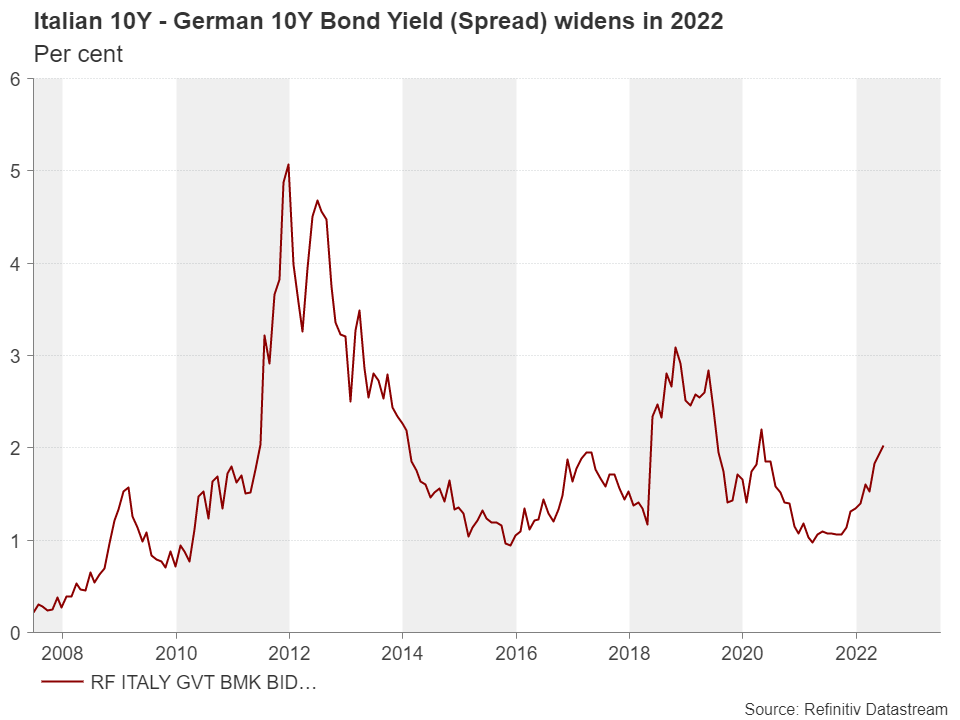
The spread between the Italian and German 10-year bond yields that is considered a measure of financial stress in the euro area, has widened to the largest since the start of the pandemic, forcing the central bank to start studies on a new bond-buying anti-fragmentation tool. Investors anticipate a compromise to be reached on July 21, though the program may require participation in the European Stability Mechanism conditionality, which some member states may not be willing to undertake. The old issue of how fiscal policy is implemented across the union might be another challenge, while the Italian national election on June 1, 2023 could also cause some delay.
EUR/USD
The eurozone’s uncertain economic outlook explains the short-lived upside reversals in euro/dollar and this may remain a headwind in the near term. New peaks in inflation may barely move the euro unless the data calls for even aggressive rate hikes beyond July. In this case, it would be interesting to see whether recession fears can offset any inflation-driven bullish corrections in the euro.
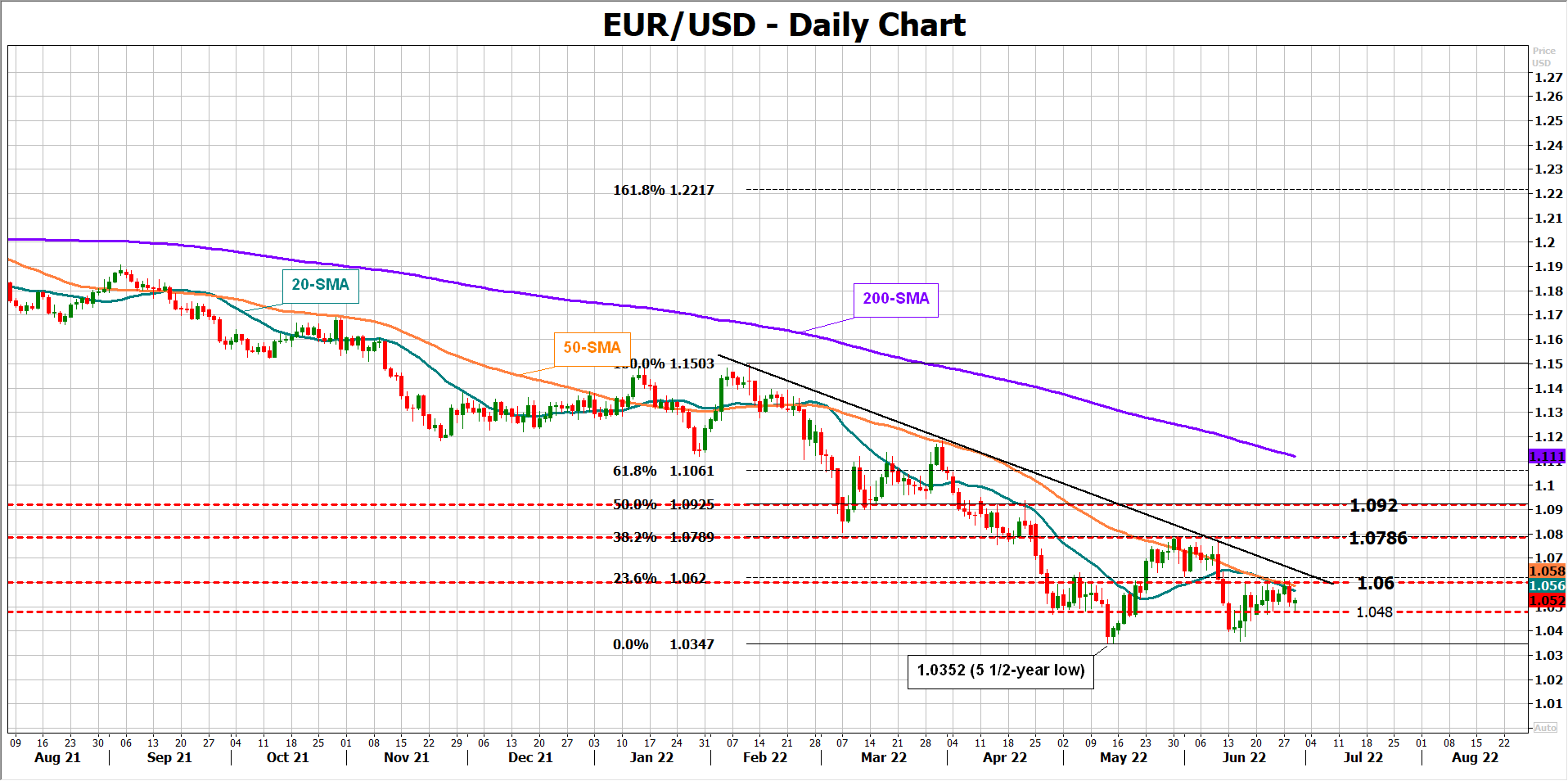
Technically, a step below the nearby support of 1.0480 could squeeze the price directly towards the double bottom area of 1.0352. Alternatively, a close above the descending trendline and the shorter-term simple moving averages (SMAs) seen around 1.0600 are required to bring the previous high at 1.0786 back under examination.
Sunset Market Commentary
Markets
The first German regional CPI number immediately grabbed investors’ attention this morning. North Rhine Westphalia CPI fell by 0.1% M/M to moderate from 8.1% Y/Y to 7.5% Y/Y. The euro fell with EU yields as this suggested that expectations for Friday’s EMU print (final input before July ECB meeting) are too aggressive (0.7% M/M & 8.5% Y/Y) while simultaneously confirming that the ECB won’t have to step it up compared to current policy normalization guidance. Other German regional numbers and eventually the national reading confirmed the North Rhine Westphalia dynamic. However, the devil is in the details. Most of the moderation comes from a one-off discount on train tickets. Spanish and Belgian inflation data soon dashed easing inflation hopes. Spanish inflation accelerated by 1.8% M/M to double digit figures (from 8.5%) with the underlying core measure surging to 5.5% Y/Y. Belgian inflation rose by 0.85% M/M to 9.65% Y/Y (from 8.97%). June EC confidence numbers stabilized, avoiding a further decline. Those data capped the strong opening start of European bonds. German yields at the time of writing cede 2.5 bps (30-yr) to 5.1 bps (5-yr) with the belly of the curve outperforming the wings. US yields are practically unmoved. The focal point for US investors follow tomorrow with (outdated) PCE deflators and especially Friday’s manufacturing ISM. The euro failed to really overcome opening weakness with fragile risk sentiment (European stocks -1%) and relative yield dynamics playing in favour of the dollar. EUR/USD currently loses the 1.05 handle. Sterling remains on a slippery slope with EUR/GBP slowly but steadily moving in the direction of the 0.8721 YTD high. At the ECB conference in Sintra, ECB Lagarde, Fed Powell, BoE Bailey and BIS Carstens are currently in a panel discussion. Powell reiterated that the US economy is well positioned to handle a tighter policy, though getting to a soft landing will be a quite challenging. He thinks that markets are by and large aligned with the Fed’s intentions. Money markets currently discount a policy rate of 3.5% around the turn of the year which is seen as the cycle peak. We continue to believe that risks are tilted to the upside of those expectations. Lagarde’s comments obviously are a copy-paste from yesterday’s speech where she indicated to switch from a gradual approach to a more decisive one in case of for example the treat of de-anchoring inflation expectations. News Headlines
Germany plans to bring its finances back in line with its constitutional limits, also known as the debt brake after having spent extraordinary amounts in the period 2020-2022. Finance minister Lindner is targeting a little more than €17bn in additional borrowing next year, a significant cut from the almost €140bn this year. Additional borrowing in the years thereafter should be somewhere between €12.3bn and €13.8bn. The debt brake caps new debt at 0.35% of GDP. The borrowing plans assume German GDP growth of 2.2% this year and 2.5% in the next.
Russia is looking at spending extra revenue from oil and gas to buy “friendly” currencies as a way to ease a scorching rally in the Russian ruble. There is a strong influx of FX because of high demand for and prices of energy. At the same time, FX demand/ruble supply has all but evaporated due to capital controls and import declines. “In order to influence the exchange rate, we are ready to invest in the currencies of friendly countries and through cross-rates with the dollar and euro, we will regulate the value of the ruble in dollars and euro,” Russian finance minister Siluanov said. The ruble erased a 4% gain on the report to trade at USD/RUB 53.15 – still the strongest level in 7 years. Russian central bank governor Nabiullina earlier said there is still room for further reductions in the key rate. After having lifted the policy rate to 20% shortly after the invasion, the central bank in the meantime lowered them back to pre-war level of 9.5%.
USD/JPY Mid-Day Outlook
Daily Pivots: (S1) 135.39; (P) 135.89; (R1) 136.66; More...
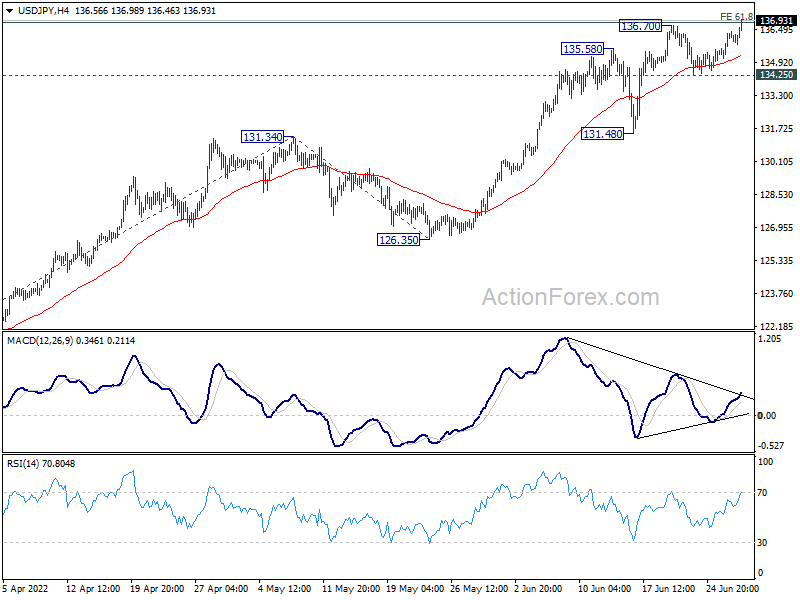
USD/JPY's break of 136.70 resistance indicates up trend resumption. Intraday bias is back on the upside. Next target will be 100% projection of 114.40 to 131.34 from 126.35 at 143.29. For now, outlook will remain bullish as long as 134.25 support holds, in case of retreat.
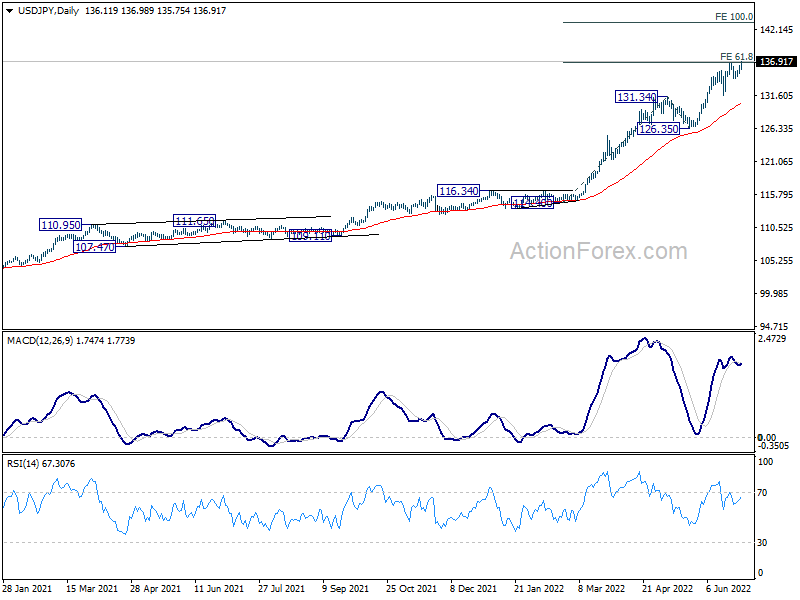
In the bigger picture, current rally is seen as part of the long term up trend from 75.56 (2011 low). Next target is 100% projection of 75.56 (2011 low) to 125.85 (2015 high) from 98.97 at 149.26, which is close to 147.68 (1998 high). This will remain the favored case as long as 126.35 support holds.
GBP/USD Mid-Day Outlook
Daily Pivots: (S1) 1.2146; (P) 1.2219; (R1) 1.2257; More...
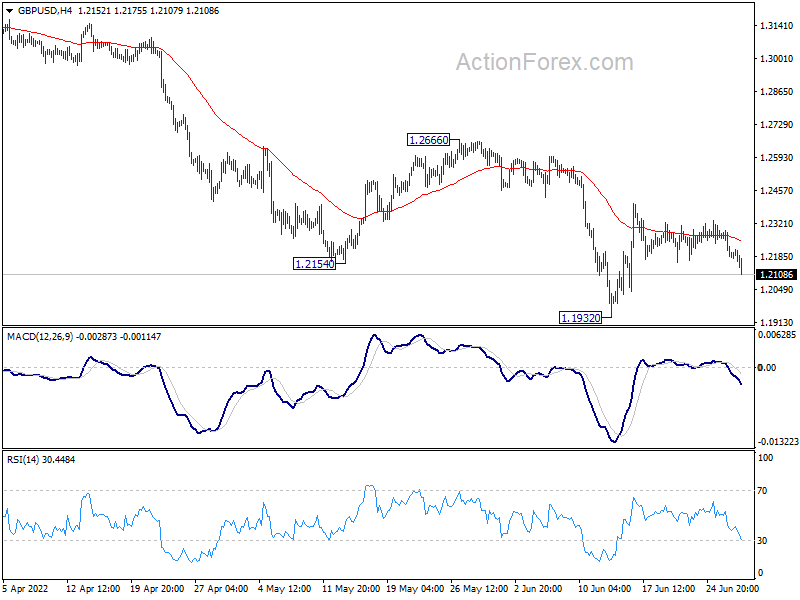
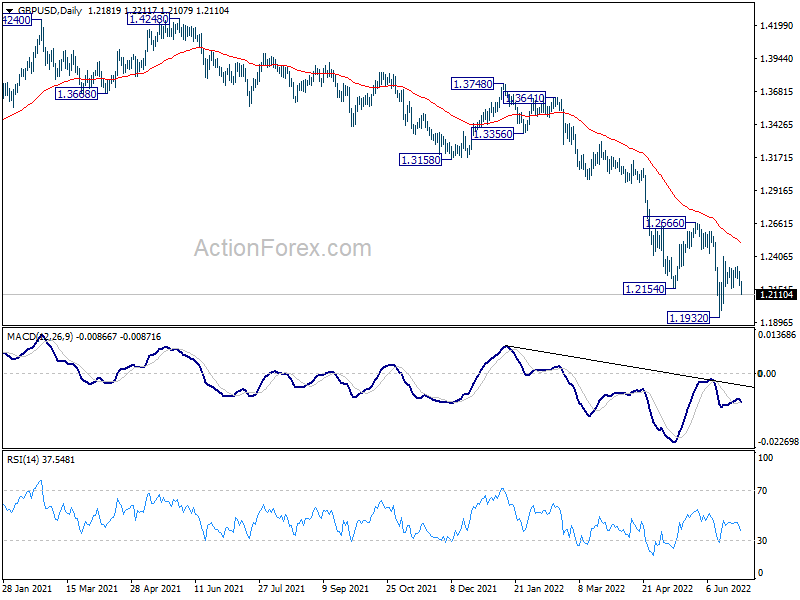
Outlook in GBP/USD remains unchanged as range trading continues. Intraday bias stays neutral. Outlook stays bearish as long as 1.2666 resistance holds. On the downside, break of 1.1932 will resume larger down trend from 1.4248. However, firm break of 1.2666 will suggest medium term bottoming and bring stronger rebound back towards 1.3158 support turned resistance.
In the bigger picture, fall from 1.4248 (2018 high) could be a leg inside the pattern from 1.1409 (2020 low), or resuming the longer term down trend. Deeper decline is expected as long as 1.2666 resistance holds. Next target is 1.1409 low. However, firm break of 1.2666 will bring stronger rise back to 55 week EMA (now at 1.3140).
EUR/USD Mid-Day Outlook
Daily Pivots: (S1) 1.0481; (P) 1.0543 (R1) 1.0584; More...
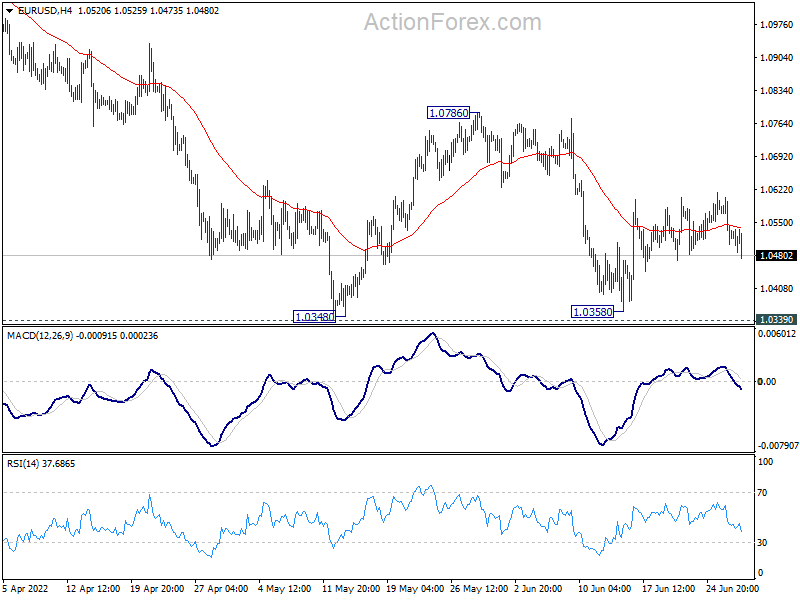
No change in EUR/USD's outlook as range trading continues. Intraday bias remains neutral. Further fall is in favor with 1.0786 resistance intact. On the downside, sustained break of 1.0339/48 will resume larger down trend. Next target is long term projection level at 1.0090.
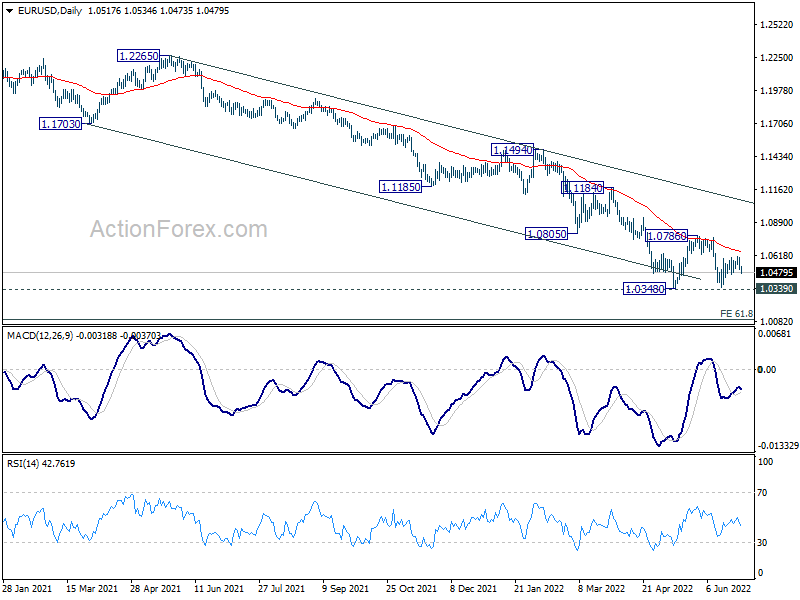
In the bigger picture, focus stays on 1.0339 long term support (2017 low). Decisive break there will resume whole down trend from 1.6039 (2008 high). Next target is 61.8% projection of 1.3993 to 1.0339 from 1.2348 at 1.0090. However, firm break of 1.0805 support turned resistance will delay this bearish case, and bring stronger rebound first.
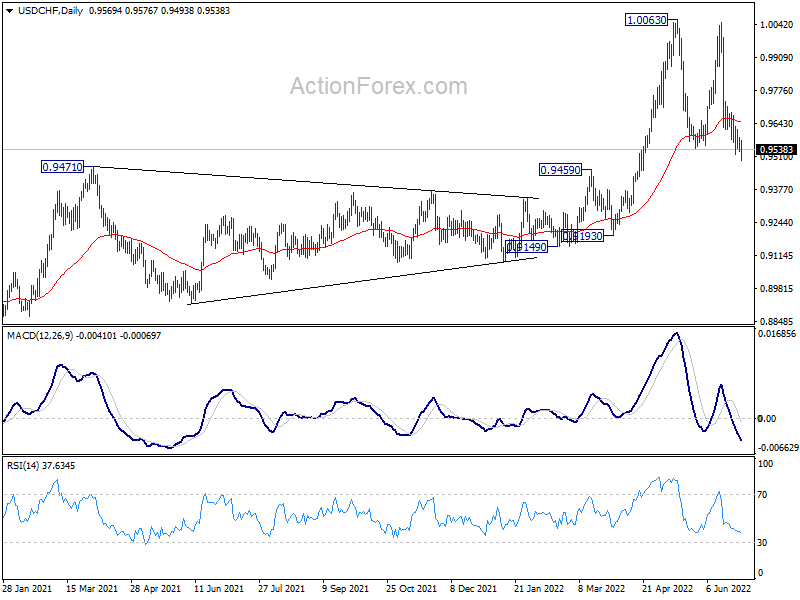
USD/CHF Mid-Day Outlook
Daily Pivots: (S1) 0.9544; (P) 0.9565; (R1) 0.9597; More...
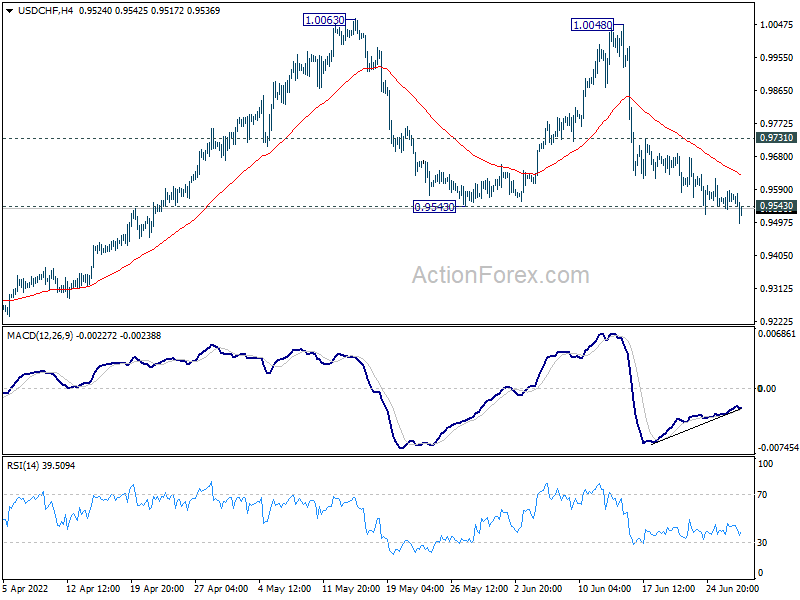
Intraday bias in USD/CHF stays neutral as it continues to lose downside momentum as seen in 4 hour MACD. Fall from 1.0048 is still seen as the third leg of the consolidation pattern from 1.0063. Strong support should be seen around 0.9543 to bring rebound. On the upside, above 0.9731 minor resistance will turn bias back to the upside for retesting 1.0063 resistance. However, sustained break of 0.9543 will bring deeper fall back to 0.9459 resistance turned support.
In the bigger picture, down trend from 1.0342 (2016 high) should have completed with three waves down to 0.8756 (2021 low) already. Rise from 0.8756 is likely a medium term up trend of its own. Next target is 1.0237/0342 resistance zone. This will remain the favored case as long as 0.9471 resistance turned support holds. However, sustained break of 0.9471 will extend long term range trading with another falling leg.