

Sample Category Title
EUR/CHF Mid-Day Outlook
Daily Pivots: (S1) 1.0042; (P) 1.0086; (R1) 1.0117; More....
EUR/CHF's fall continues today and breaches parity to as low as 0.9990 so far. Intraday bias stays on the downside for retesting 0.9970 low. Decisive break there will resume larger down trend. Next target is 0.9650 long term projection level. On the upside, however, above 1.0214 minor resistance will delay the bearish case, and turn bias back to the upside for stronger rebound.
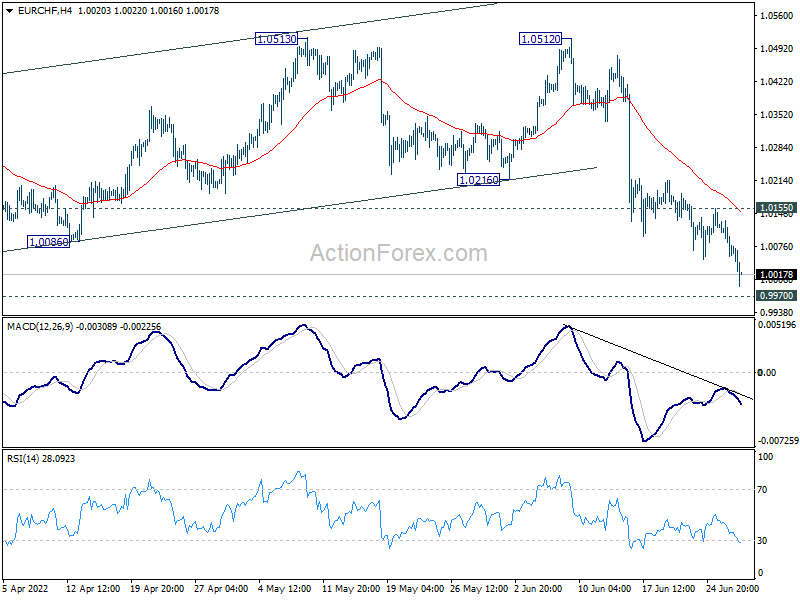
In the bigger picture, as long as 1.0505 support turned resistance (2020 low) holds, long term down trend from 1.2004 (2018 high) is expected to continue. Next target is 100% projection of 1.2004 to 1.0505 to 1.1149 at 0.9650. However, firm break of 1.0505 will suggest medium term bottoming, and bring stronger rebound towards 1.1149 structural resistance.
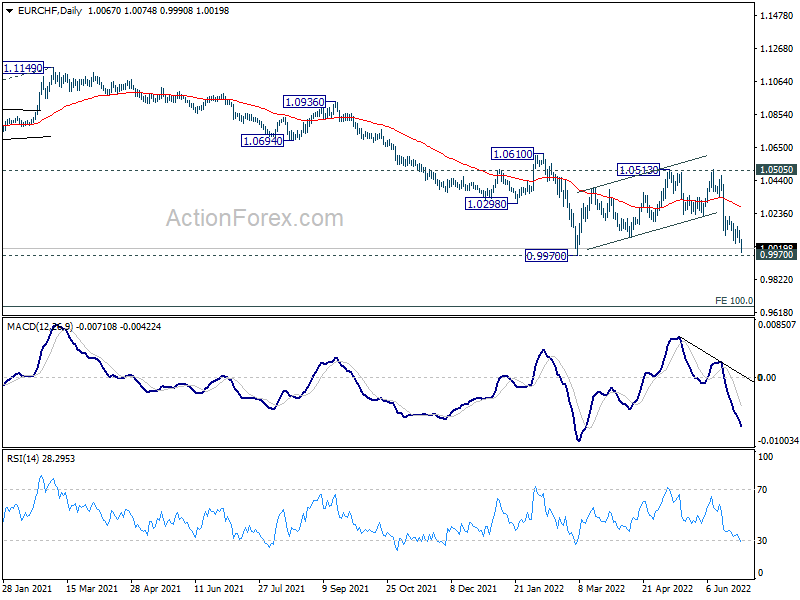
Swiss Franc Power Continues, EUR/CHF Breaks Parity
Swiss Franc continues to rise broadly today, with additional help from selloff in Euro. The common currency is weighed down by Germany CPI, which unexpectedly slowed in June. But for now, Aussie, Sterling and Yen are even weaker than Euro. On the other hand, Canadian Dollar is second strongest as supported by rebound in oil prices, while Dollar is third.
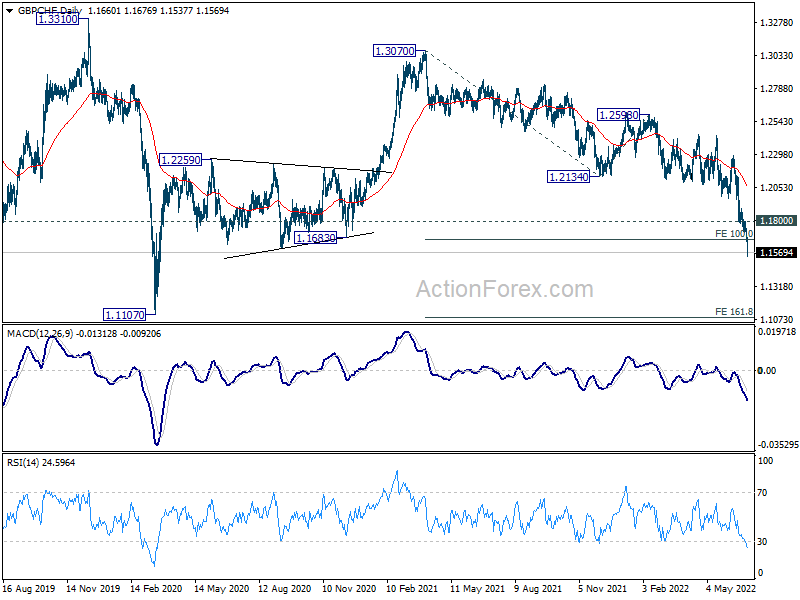
Technically, GBP/CHF's falls through 100% projection 1.3070 to 1.2134 from 1.2598 at 1662 and there is no sign of bottoming yet. Outlook will remain bearish as long as 1.1800 resistance holds, for 161.8% projection at 1.1084, which is close to 202 low at 1.1107. The decline in GBP/CHF could accelerate further if EUR/CHF takes out 0.9970 low with some power.
In Europe, at the time of writing, FTSE is down -0.15%. DAX is down -1.58%. CAC is down -1.08%. Germany 10-year yield is down -0.0039 at 1.590. Earlier in Asia, Nikkei dropped -0.91%. Hong Kong HSI dropped -1.88%. China Shanghai SSE dropped -1.40%. Singapore Strait Times dropped -0.17%. Japan 10-year JGB yield dropped -0.0016 to 0.232.
Fed Mester: Getting interest rates up to 3-3.5% expeditiously is really important
Cleveland Fed President Loretta Mester told CNBC today, "if conditions were exactly the way they were today going into that meeting (in July) — if the meeting were today — I would be advocating for 75 because I haven't seen the kind of numbers on the inflation side that I need to see in order to think that we can go back to a 50 increase."
"I think getting interest rates up to that 3-3.5%, it's really important that we do that, and do it expeditiously and do it consistently as we go forward, so it's after that point where I think there is more uncertainty about how far we'll need to go in order to rein in inflation," she said.
"At the Fed, we're on a path now to bring our interest rates up to a more normal level and then probably a little bit higher into restrictive territory, so that we can get those inflation rates down so that we can sustain a good economy going forward," she said. "Job one for us now is to get inflation rates under control, and I think right now that's coloring how consumers are feeling about the economy and where it's going."
Released from the US, Q1 GDP contraction was finalized at -1.6%.
ECB Simkus: We should move decisively toward monetary-policy normalization
ECB Governing Council member Gediminas Simkus said that by July meeting, "should see some change in the data, some change in relation to what we have seen at the beginning of June". He added, "if we see this change in data that points to the persistence of inflation, to its acceleration, 50 basis points should be a policy option for July."
"With these levels of inflation and inflation being more and more broad-based, with wages growing in the euro area, we should move decisively toward monetary-policy normalization," said Simkus,
ECB has pre-committed to a 25bps rate hike in July. Another hike is also pre-committed for September, but the size would be dependent on incoming data.
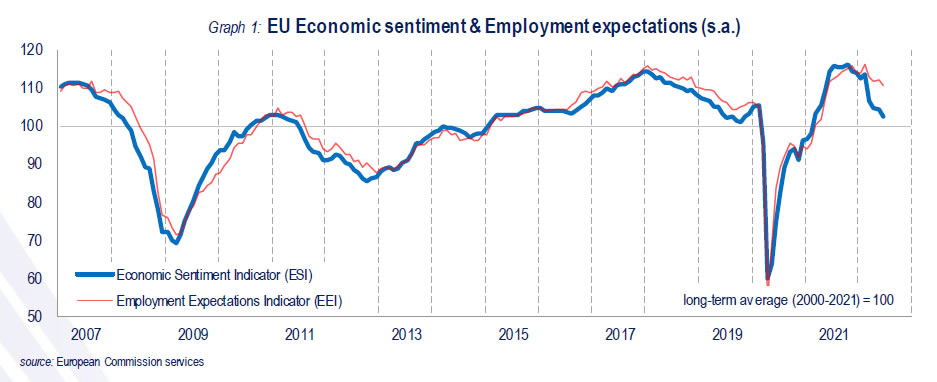
Eurozone economic sentiment dropped to 104 in Jun, EU down to 102.5
Eurozone Economic Sentiment Indicator dropped from 105.0 to 104.0 in June. Employment Expectation Indicator dropped from 112.6 to 110.9. Economic Uncertainty Indicator rose from 23.4 to 24.8. Industry confidence rose from 6.5 to 7.4. Services confidence rose from 14.1 to 14.8. Consumer confidence dropped from -21.2 to -23.6. Retail trade confidence dropped from -4.2 to -5.1. Construction confidence dropped from 6.3 to 3.7.
EU Economic Sentiment Indicator dropped from 104.2 to 102.5. Employment Expectation Indicator dropped from 112.2 to 110.6. Economic Uncertainty Indicator rose from 22.6 to 23.9. The ESI fell across the six largest EU economies: confidence dropped most markedly in the Netherlands (-3.6), but also in Germany (-1.9), Spain (-1.9), Poland (-1.5), France (-1.0) and Italy (-1.0).
From Germany, CPI slowed from 7.9% yoy to 7.6% yoy in June, below expectation of 7.9% yoy.
BoJ Kuroda: Japan not much affected by global inflationary trend
BoJ Governor Haruhiko Kuroda said, "Unlike other economies, the Japanese economy has not been much affected by the global inflationary trend, so monetary policy will continue to be accommodative," according to the recording released by the Bank for International Settlements (BIS).
After 15 years of deflation that lasted through 2013, businesses have be "very cautious" in raising prices and wages. "The economy recovered and companies recorded high profits. The labour market became quite tight. But wages didn't increase much and prices didn't increase much," he added.
Also released, Japan retail sales rose 3.6% yoy in May, below expectation of 4.0% yoy. On seasonally adjusted basis, sales rose 0.6% mom.
Australia retail sales rose 0.9% mom in May, higher prices added to growth
Australia retail sales rose 0.9% mom in May, above expectation of 0.4% mom. That's the fifth consecutive monthly growth.
Ben Dorber, Director of Quarterly Economy Wide Statistics said, "There was growth across five of the six retail industries in May as spending remained resilient. Higher prices added to the growth in retail turnover in May. This was most evident in cafes, restaurants and takeaway food services and food retailing."
EUR/CHF Mid-Day Outlook
Daily Pivots: (S1) 1.0042; (P) 1.0086; (R1) 1.0117; More....
EUR/CHF's fall continues today and breaches parity to as low as 0.9990 so far. Intraday bias stays on the downside for retesting 0.9970 low. Decisive break there will resume larger down trend. Next target is 0.9650 long term projection level. On the upside, however, above 1.0214 minor resistance will delay the bearish case, and turn bias back to the upside for stronger rebound.
In the bigger picture, as long as 1.0505 support turned resistance (2020 low) holds, long term down trend from 1.2004 (2018 high) is expected to continue. Next target is 100% projection of 1.2004 to 1.0505 to 1.1149 at 0.9650. However, firm break of 1.0505 will suggest medium term bottoming, and bring stronger rebound towards 1.1149 structural resistance.
Economic Indicators Update
| GMT | Ccy | Events | Actual | Forecast | Previous | Revised |
|---|---|---|---|---|---|---|
| 23:50 | JPY | Retail Trade Y/Y May | 3.60% | 4.00% | 3.10% | |
| 01:30 | AUD | Retail Sales M/M May | 0.90% | 0.40% | 0.90% | |
| 08:00 | CHF | Credit Suisse Economic Expectations Jun | -72.7 | -52.6 | ||
| 08:00 | EUR | Eurozone M3 Money Supply Y/Y May | 5.60% | 6.10% | 6.00% | 6.10% |
| 09:00 | EUR | Eurozone Economic Sentiment Indicator Jun | 104 | 103 | 105 | |
| 09:00 | EUR | Eurozone Services Sentiment Jun | 14.8 | 12.7 | 14 | 14.1 |
| 09:00 | EUR | Eurozone Industrial Confidence Jun | 7.4 | 4.7 | 6.3 | 6.5 |
| 09:00 | EUR | Eurozone Consumer Confidence Jun F | -23.6 | -23.6 | -23.6 | |
| 12:00 | EUR | Germany CPI M/M Jun P | 0.10% | 0.30% | 0.90% | |
| 12:00 | EUR | Germany CPI Y/Y Jun P | 7.60% | 7.90% | 7.90% | |
| 12:30 | USD | GDP Annualized Q1 F | -1.60% | -1.50% | -1.50% | |
| 12:30 | USD | GDP Price Index Q1 F | 8.20% | 8.10% | 8.10% | |
| 14:30 | USD | Crude Oil Inventories |
Bears Prepare for a New Attack on Bitcoin
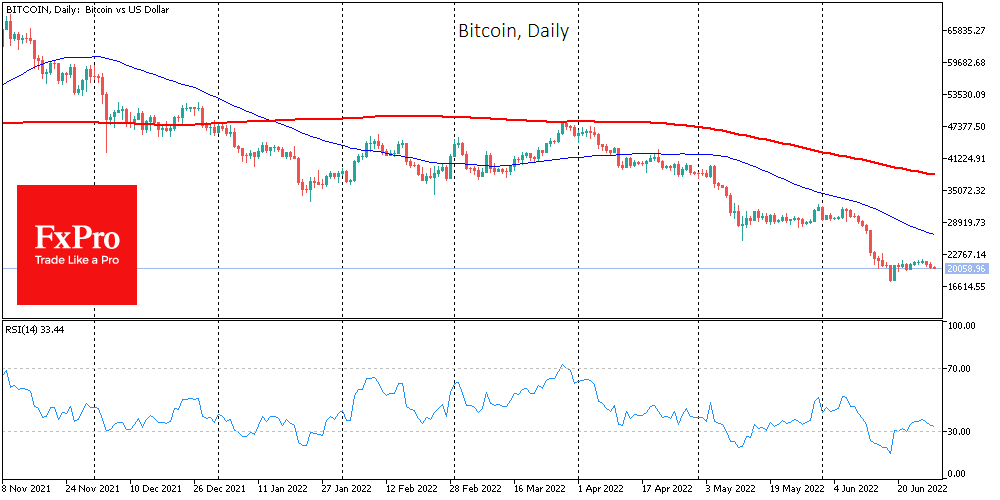
Bitcoin declined on Tuesday following the US market, where the bears reigned the upper hand again, taking more than 3% from the Nasdaq index.
The local technical picture is rather worrying. The recent bounce might have been enough to consolidate the bearish forces before a new attack. Traders should be ready for the new test of lows at 18K before the end of this week if moods on financial markets don’t reverse.
According to CoinShares, capital outflows from crypto funds last week amounted to the all-time high at $423 million, with almost all funds withdrawn coming from bitcoin-based products. The driver was the launch of ProShares’ first US bitcoin inverse ETF, which allowed investors to open short positions in the cryptocurrency.
Simply put, the institutions that have been such a significant driver of Bitcoin and Ether’s growth in the previous couple of years are now selling off these assets, putting additional pressure on the entire market. What the crypto market lacks currently is long-term institutional HODLers.
Bank of America said concerns about the crypto winter had not cooled investor interest in the industry.
SEC chairman Gary Gensler clarified his stance on bitcoin in an interview with CNBC, calling it a commodity. MicroStrategy CEO Michael Saylor said it would allow politicians and governments to support bitcoin as a technology and digital asset.
According to a Mastercard survey, in Latin America, 51% of the payment system’s card users have bought cryptocurrencies. About a third of respondents invested in stable coins. Investments in NFT and DeFi projects are pretty popular.
USDJPY Aims for an Uptrend Resumption; Caution Detected
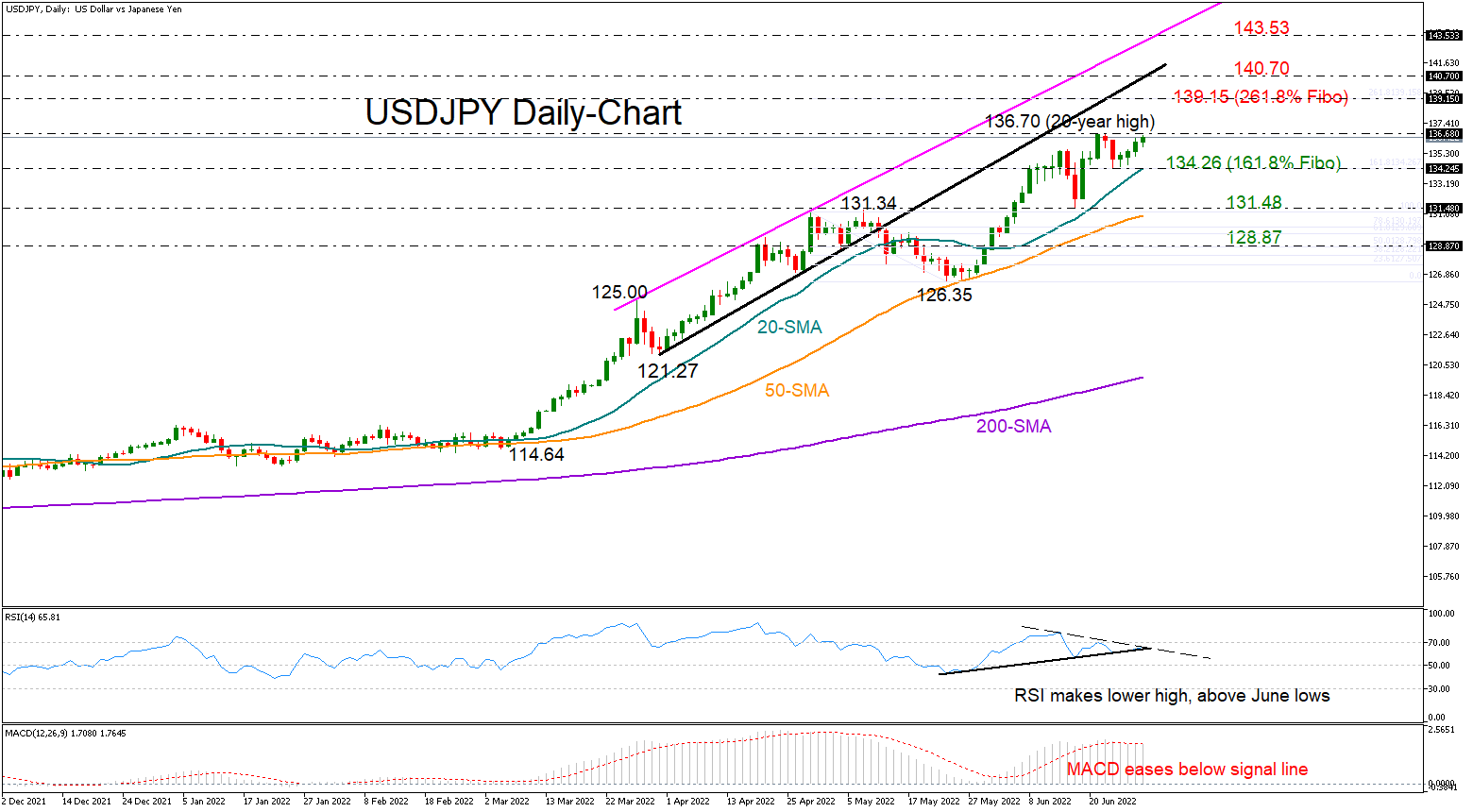
USDJPY managed to gain fresh buying traction around the resistance-turned-support area of 134.42 last week, with the price currently looking to extend its broad uptrend above the 20-year high of 136.70.
Although the clear positive slope in the simple moving averages (SMAs) is still backing the bullish direction in the market, the momentum indicators warrant some caution over the strength in the market. The RSI, although above its June lows, has marked a new lower high after peaking in an overbought area. Similarly, the MACD is gradually losing momentum below its red signal line despite remaining elevated in the positive area.
Should the bulls snap the top of 136.70, the next obstacle could be the 261.8% Fibonacci extension of the 131.34 – 126.35 downleg at 139.15, while the broken support line could immediately cap the rally near 140.70, preventing a spike towards the tentative resistance line seen around 143.53.
On the downside, the 20-day SMA and the 134.26 base, which is also the 161.8% Fibonacci extension, may buffer a potential negative reversal. If not, the decline could sharpen towards the 131.48 low, where the 50-day SMA is currently converging. Failure to bounce here may produce another important bearish correction towards the 128.87 constraining zone.
All in all, although USDJPY is trading in bullish territory, technical signals reflect some weakness in buying appetite. Traders could wisely wait for a durable move above 135.45 before becoming more confident on the latest upturn.
Gold Storms to Fresh Lows as Negative Momentum Strengthens
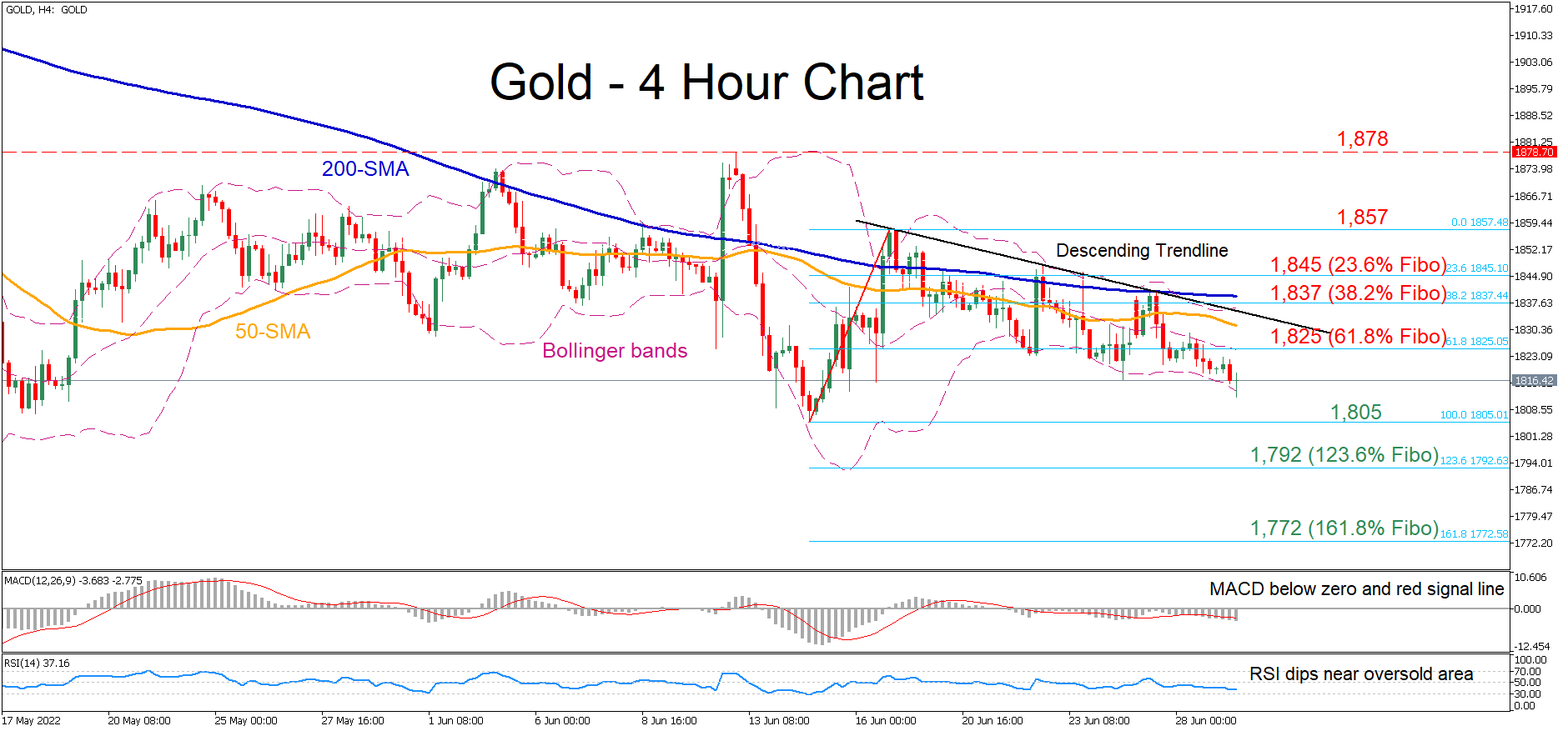
Gold has been in a sustained downtrend after it failed to cross beyond the 1,857 region. Moreover, in the past few four-hour sessions, the price has dived beneath both 50- and 200-period simple moving averages (SMAs) and is currently battling with its lower Bollinger band, painting a gloomy short-term technical picture for bullion.
The momentum indicators are endorsing a bearish near-term bias. Specifically, the stochastic oscillator is descending in the oversold zone, while the MACD histogram is currently below both zero and its red signal line.
Should selling interest intensify further, the 1,805 crucial support could act as the first line of defence. Dipping beneath that region, the price may descend towards 1,792, which is the 123.6% Fibonacci extension of the 1,805-1,857 upleg. A violation of the latter could pave the way for the 161.8% Fibo of 1,772.
On the flipside, bullish actions might encounter initial resistance at the 61.8% Fibo of 1,825. Piercing through that ceiling, the bulls could then aim for the 38.2% Fibo of 1,837 before the 23.6% Fibo of 1,845 appears on the radar. Higher, the 1,857 peak could prove a tough obstacle for the price to overcome.
In brief, gold’s short-term picture appears to be deteriorating as the precious metal is trading below both its SMAs, while continuously marking fresh lower lows. For that tone to reverse, the price needs to profoundly jump beyond the 1,857 ceiling.
Research Global – Natural Rates – Regime Change or Low for Longer?
Despite high inflation and rapidly increasing interest rates right now, we in this paper argue that many of the structural factors that explain the decline in natural interest rates since the 1970s are still in place.
The natural rate is a theoretical concept and is defined as the real interest rate consistent with maintaining economic growth at its trend rate/full employment with stable inflation.
Key structural factors that have pushed down the natural interest are: Increasing life expectancy, slowly growing or decreasing working age population, lower productivity growth, higher mark-ups and risk premia, a shock from the financial crisis and higher inequality.
These structural drivers have led to a situation where an increase in savings and a decrease in investments have been driving lower natural rates for a long time now, also leading to lower trend growth.
The Nordics are mainly natural rate takers; what constitutes a natural real rate in the Nordics is primarily driven by international factors.
What could change the natural rate? Increased fiscal spending and investments in defence, the green transition and digitalisation could raise potential growth and exert upward pressure on neutral rates going forward.
In net, we expect the desire to save still to dominate the desire to invest going forward. We do not see any of the significant structural drivers reverting during the coming years, but think that higher and increasing public debt and possibly higher productivity growth could add some upwards pressure on natural rates.
If we are right, this would imply that rates decline again after the current period of high inflation ends, although not all the way back to pre-pandemic levels.
EURAUD Remains Below 200-Day SMA and Within Ascending Channel
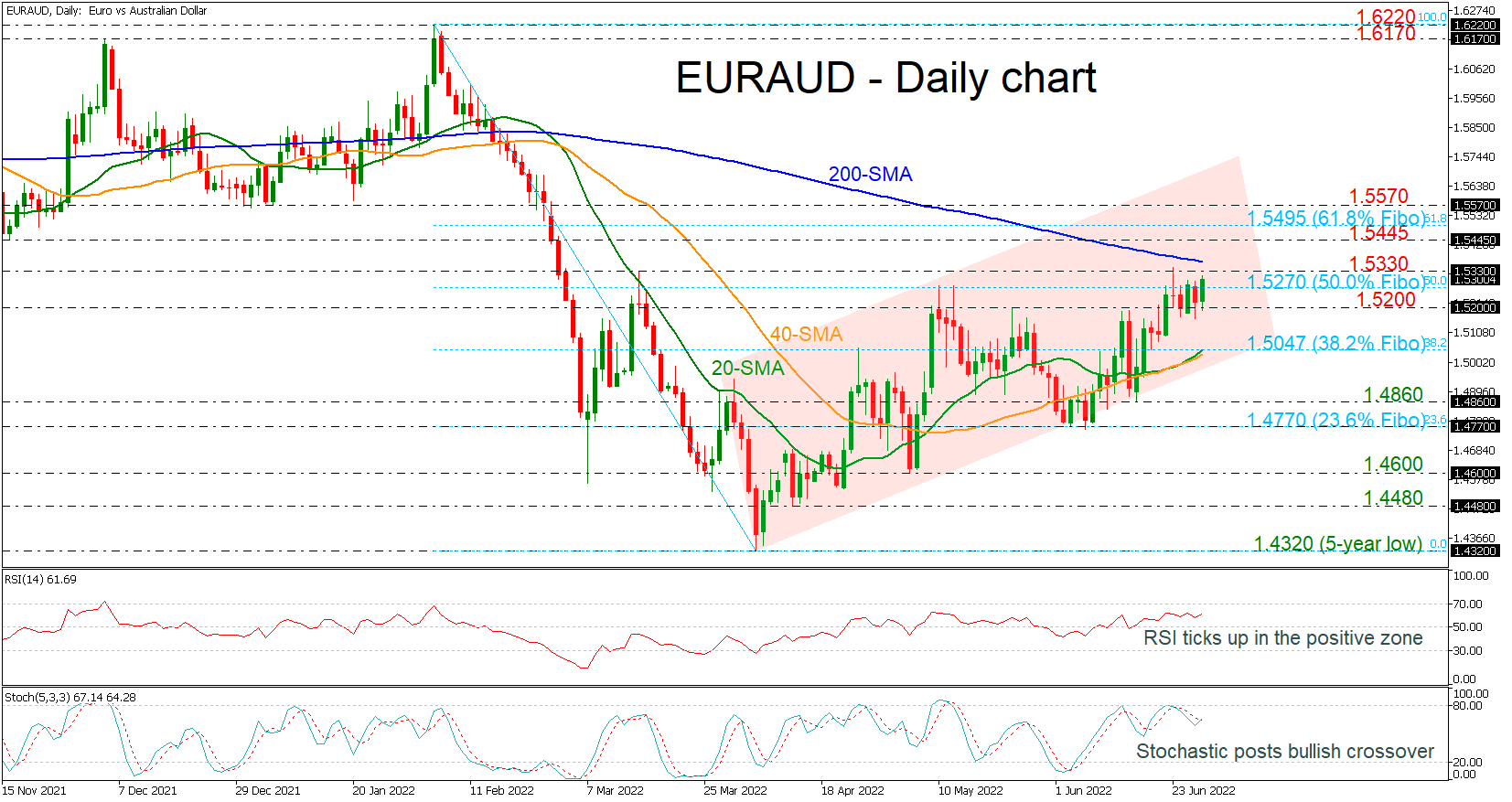
EURAUD is trying to overcome the 50.0% Fibonacci retracement level of the down leg from 1.6220 to 1.4320 at 1.5270 which halted the bullish movement several times in the preceding sessions. The RSI indicators is heading north above the 50 level, while the stochastic oscillator posted a bullish crossover within its %K and %D lines. In trend indicators, the 20- and 40-day simple moving averages (SMAs) are pointing upwards around the 38.2% Fibonacci.
If the price overcomes the 1.5330 resistance, one immediate barrier could come from the 200-day SMA at 1.5370 ahead of the 1.5445 level. Slightly higher, the 61.8% Fibonacci of 1.5495 and 1.5570 could add optimism for more bullish actions, while a climb above the return line of the ascending channel could endorse the short-term positive bias.
On the other hand, a drop back below the 1.5200 round number would take the market until the short-term SMAs at the 38.2% Fibonacci of 1.5047. More declines could open the way for a bearish correction at 1.5860 and the 23.6% Fibonacci of 1.4770.
All in all, EURAUD is showing positive sings but a jump above the 200-day SMA is expected to confirm the current view.
EUR/USD: Bears Start to Regain Control after Repeated Upside Rejections But Still Need a Confirmation
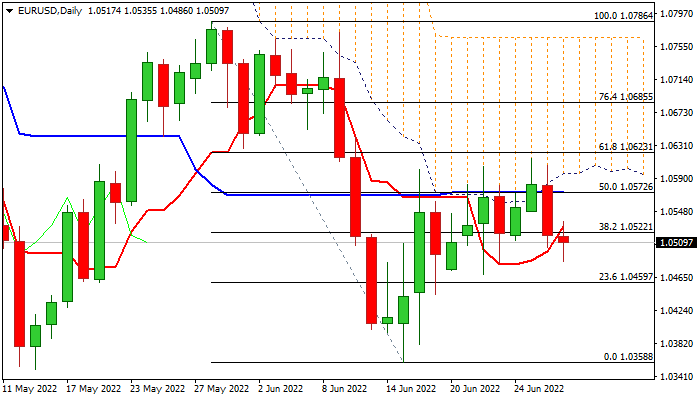
Repeated failure at the base of a daily cloud and subsequent drop on Tuesday (0.6%) that registered a marginal close below 10DMA (1.0537) generated initial signal of recovery stall, though the action on Wednesday is again without direction.
Fresh bears were partially offset by mixed, but with prevailing optimism EU member countries data that kept the single currency afloat for now, though the downside is expected to remain at risk if the pair makes another daily close below 10DMA.
The Euro is additionally weighed by increased month-end demand for dollar, while negative daily studies add to bearishly aligned near-term outlook.
Repeated close below 10DMA would require extension and close below 1.0486 (50% retracement of 1.0358/1.0614) to confirm negative signal and open way for further easing.
Conversely, bounce above 10DMA would ease immediate downside risk, however the action is to remain directionless while below 1.0596 (the base of narrowing daily cloud.
Res: 1.0537; 1.0554; 1.0565; 1.0596
Sup: 1.0486; 1.0456; 1.0419; 1.0358
Eurozone economic sentiment dropped to 104 in Jun, EU down to 102.5
Eurozone Economic Sentiment Indicator dropped from 105.0 to 104.0 in June. Employment Expectation Indicator dropped from 112.6 to 110.9. Economic Uncertainty Indicator rose from 23.4 to 24.8. Industry confidence rose from 6.5 to 7.4. Services confidence rose from 14.1 to 14.8. Consumer confidence dropped from -21.2 to -23.6. Retail trade confidence dropped from -4.2 to -5.1. Construction confidence dropped from 6.3 to 3.7.
EU Economic Sentiment Indicator dropped from 104.2 to 102.5. Employment Expectation Indicator dropped from 112.2 to 110.6. Economic Uncertainty Indicator rose from 22.6 to 23.9. The ESI fell across the six largest EU economies: confidence dropped most markedly in the Netherlands (-3.6), but also in Germany (-1.9), Spain (-1.9), Poland (-1.5), France (-1.0) and Italy (-1.0).
Fed Mester: Getting interest rates up to 3-3.5% expeditiously is really important
Cleveland Fed President Loretta Mester told CNBC today, "if conditions were exactly the way they were today going into that meeting (in July) — if the meeting were today — I would be advocating for 75 because I haven't seen the kind of numbers on the inflation side that I need to see in order to think that we can go back to a 50 increase."
"I think getting interest rates up to that 3-3.5%, it's really important that we do that, and do it expeditiously and do it consistently as we go forward, so it's after that point where I think there is more uncertainty about how far we'll need to go in order to rein in inflation," she said.
"At the Fed, we're on a path now to bring our interest rates up to a more normal level and then probably a little bit higher into restrictive territory, so that we can get those inflation rates down so that we can sustain a good economy going forward," she said. "Job one for us now is to get inflation rates under control, and I think right now that's coloring how consumers are feeling about the economy and where it's going."