

Sample Category Title
AUD/USD Daily Report
Daily Pivots: (S1) 0.6985; (P) 0.7013; (R1) 0.7059; More...
Intraday bias in AUD/USD remains neutral and outlook is unchanged. On the upside, firm break of 0.7029 support turned resistance will indicate short term bottoming, and bring stronger rebound back to 0.7265 resistance. Rejection by 0.7029 will retain near term bearishness. Break of 0.6828 will resume larger fall from 0.8006, and target 0.6756/60 medium term fibonacci level next.
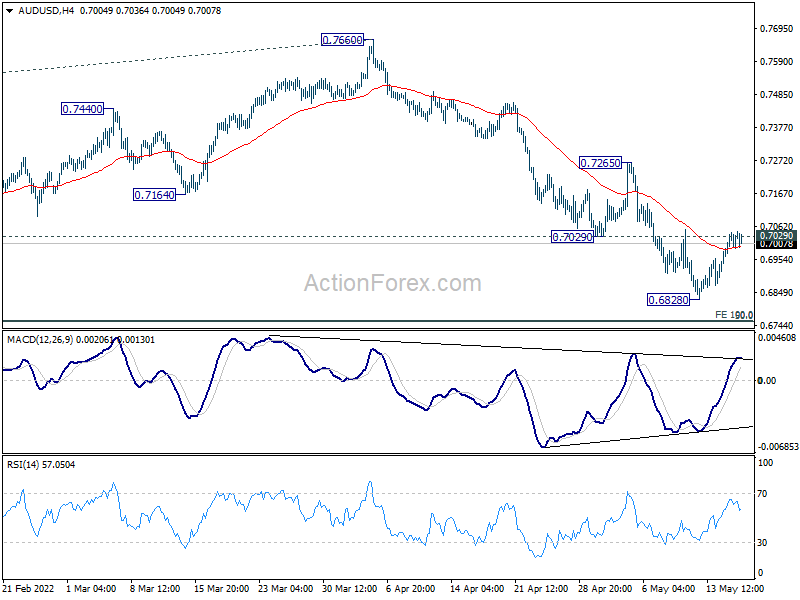
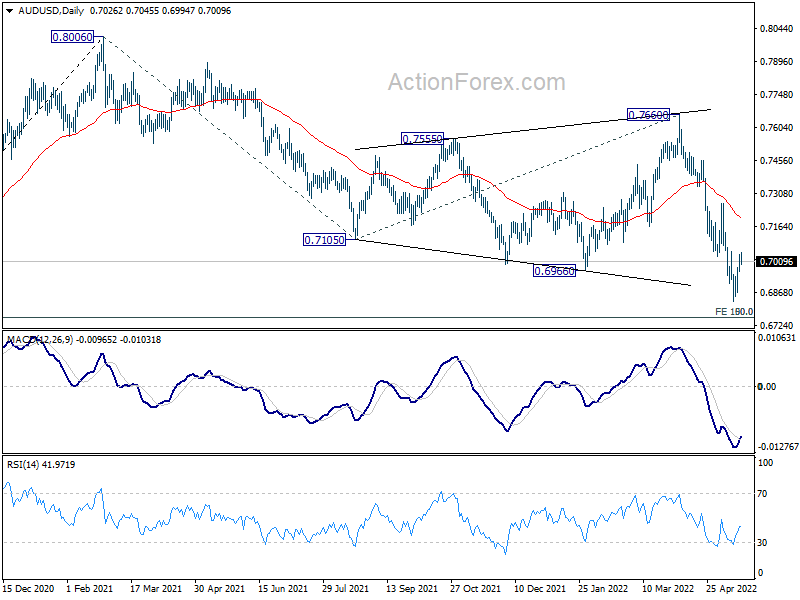
In the bigger picture, price actions from 0.8006 are seen as a corrective pattern to rise from 0.5506 (2020 low). Deeper fall should be seen to 50% retracement of 0.5506 to 0.8006 at 0.6756. This coincides with 100% projection of 0.8006 to 0.7105 from 0.7660 at 0.6760. Strong support is expected from 0.6756/60 cluster to contain downside to complete the correction. However, sustained break of 0.6756/60 would argue that AUD/USD is indeed already in a medium term down trend.
The Dollar Threw the Towel on FX Markets
Markets
Yesterday’s trading session turned out to be an interesting one. As on Monday, it started with a better risk mood in Europe with core bonds returning to sell-off mode after last week’s correction. UK Gilts initially underperformed following up on BoE governor Bailey’s testimony for a Commons Committee. He sounded much more combative against inflation than suggested by the May policy meeting. Around noon, ECB Knot raised the stakes in the central bank’s calling for >25 bps rate hikes if warranted by the data. His comments prompted a reaction in short term European money markets as well as on bonds markets (start new intraday downleg).
FOMC Chair Powell ended the 24 hour hawkish central bank tour by stressing the unconditional tightening plans. “Restoring price stability is an unconditional need. It is something we have to do.” Even as “there could be some (economic) pain involved”. If needed, the Fed won’t shy away to make monetary policy restrictive. Powell’s comments dealt the final intraday blow to US Treasuries. In between the rhetoric, we had strong UK labour market data, an upward revision to EMU Q1 GDP and decent US retail sales all helping to put last week’s growth worries to bed. At least for now.
The US yield curve bear flattened with yields rising by 14.3 bps (3-yr) to 7.9 bps (30-yr). German yields rose by 7.3 bps (30-yr) to 12.7 bps (5-yr). The UK yield curve bear flattened as well with yields ending 20.8 bps (2-yr) to 11.5 bps (30-yr) higher. The hawkish rhetoric and fierce bond sell-off didn’t translate into a new sell-off on stock markets, suggesting that bourses could be heading for a period of some consolidation. Technical pictures for now don’t confirm a sustained improvement yet.
The dollar threw the towel on FX markets following last week’s intense test of key resistance levels (eg EUR/USD 1.0341). There was an element of euro strength as well in the rebound to EUR/USD 1.0535. EUR/GBP initially dived from a 0.8468 open to 0.84 before rebounding towards the 0.8435 area. Brexit worries for now play second fiddle. UK April inflation accelerated as expected from 7% Y/Y to 9% Y/Y for the headline reading and from 5.7% Y/Y to 6.2% Y/Y for the underlying core measure. Today’s eco calendar is fairly uneventful. US housing data and final EMU inflation numbers won’t stir trading. Central bank comments remain a wildcard. The pace of yesterday’s bond sell-off is unlikely to be repeated in these conditions. EUR/USD’s rebound was a good one, but the pair still has to take out first minor resistance at 1.0642. The bearish picture only turns morning neutral beyond 1.08.
News Headlines
Japanese first quarter GDP contracted less than feared, declining 0.2% q/q (-1% annualized) vs 0.4% expected. This was mainly because of private consumption, which held up better during Covid curbs than foreseen (flatlining vs consensus for a -0.5% fall). Business spending rose 0.5%. Exports rose 4.7% but imports soared with double digits, resulting in a negative net-export contribution. Inventories were built up during the previous quarter and may be drawn down during the current one. Pent-up consumer demand is expected to support growth this quarter, pushing the other way. But high energy prices and its effect on spending poses downside risks to the outlook. The Japanese yen is little affected by the data. USD/JPY trades stable in the low 129 area. Australian wage growth in the first three months of the year rose by 0.7% q/q to be up 2.4% year-over-year. Both were slightly below expectations of 0.8% and 2.5% respectively but it’s still the biggest annual growth since 2018. The sectors posting the biggest gains were rental/property (3.1% q/q), manufacturing (2.7% q/q) and arts & recreation services (2.7% q/q). It serves as important input to the Reserve Bank of Australia, who tied sufficient wage growth to the start of the tightening cycle. However, with inflation already having accelerated above target, the RBA didn’t want to await today’s reading when it met earlier this month (+25 bps to 0.35%). The Australian dollar temporarily lost a few ticks this morning. AUD/USD tested the 0.70 figure.
UK CPI rose to 9% yoy in Apr, core CPI up to 6.2% yoy
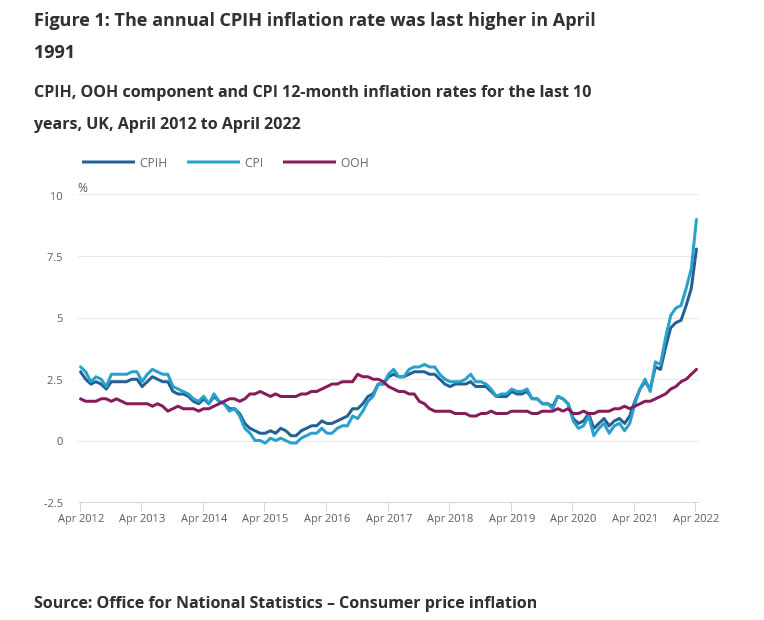
UK CPI accelerated sharply from 7.0% yoy to 9.0% yoy in April, but missed expectation of 9.1% yoy. CPI core rose from 5.7% yoy to 6.2% yoy, matched expectations. RPI accelerated form 9.0% to 11.1% yoy, matched expectations.
Headline CPI was another record high since the National Statistics series began in 1997. It's also the highest record rate in the constructed historical series which began in 1989.
Based on the recently published modelled consumer price inflation data by the ONS, CPI was last higher sometime around 1982, where estimates range between approximately 6.5 % in December to nearly 11% in January.
In response to the release, Chancellor of the Exchequer Rishi Sunak said: "Today's inflation numbers are driven by the energy price cap rise in April, which in turn is driven by higher global energy prices.
"We cannot protect people completely from these global challenges but are providing significant support where we can, and stand ready to take further action."
Also released, PPI input came in at 1.1% mom, 18.6%, versus expectation of 2.6% mom, 20.7% yoy. PPI output was at 2.3% mom, 14.0% yoy, versus expectation of 1.6% mom, 12.5% yoy. PPI output core was at 1.6% mom, 13.0% yoy, versus expectation of 1.6% mom, 12.6% yoy.
A Wobbly Rebound
The US equity markets rallied yesterday after taking over a positive session from the Europeans. However, the US retail sales data didn’t necessarily hint at slowing spending, and Jerome Powell didn’t say things that investors would normally like to hear.
Resilient spending is no good news for the Fed’s inflation battle
US retail sales grew more than 8% on yearly basis in April, more than around 7.30% printed a month earlier, meaning that Americans continue spending despite tighter economic conditions.
Unfortunately, the resilience of spending means that the Federal Reserve’s (Fed) actions don’t result in desired cooling effect on inflation.
Inflation mostly comes from the supply side, especially from the soaring energy and food prices as a result of pandemic-hit supply chains and the war in Ukraine. Whereas, the monetary tools are intended to control the demand side - and bring inflation by cooling down demand. If demand doesn’t ease fast enough, the Fed must tighten faster.
So, it’s no surprise Jerome Powell said that the Fed is resolved to curb inflation even if it means pushing the rates into restrictive territory. If that ‘involves moving past broadly understood levels of neutral we won’t hesitate to do that’, he said.
Powell’s words didn’t hit the investor appetite immediately. Nasdaq rallied more than 2.50% yesterday, as the S&P500 rebounded 2%. But mixed activity in US futures hint that appetite may not remain as strong in the coming sessions.
In the FX
The US dollar eased from two-decade highs. Prospects of higher US rates, and the positive divergence between the Fed and other central banks should prevent the dollar from falling significantly, as other central banks are also tightening their purses’ strings, but they sound timider when it comes to the timing and the intended sizes of the eventual moves.
The EURUSD rebounded past the 1.05 level yesterday on the back of a broad-based softening in the US dollar. But the US 10-year yield remains steady around the 3% mark, and poised to move higher, parallel to the expectations of solid rate hikes in the US in the coming months.
Eurozone’s final inflation data is due today, and should confirm a rise to 7.5% in April, an eye-watering number which should keep the European Central Bank (ECB) hawks and the euro bulls alert, and help the single currency consolidate its latest gains against the US dollar.
Gold trades around the $1800 mark. In one hand, the positive pressure on the US yields weighs on appetite for the non-interest-bearing gold. On the other hand, the high volatility and the looming uncertainties support safe haven inflows toward the safe haven metal. Yet, the long-term risks remain tilted to the downside. The yellow metal is below its 200-DMA - which now acts as resistance to any positive attempt, and is preparing to test the long-term triangle base - if broken should confirm a further negative outlook.
Crude oil spiked above the $115 per barrel, but bumped into top sellers above this level. Solid support approaching the $120 mark will likely be hard to clear, as the rising energy prices have a curbing effect on demand at the actual levels, and automatically cool down the rally.
Powell: Fed Will Hike Rates Until Inflation is Under Control
Market movers today
Finland and Sweden are due to submit their official applications to join NATO in Brussels at 8:00 CET today. The accession process will kick off with consultations between NATO experts and Finnish and Swedish delegations to ensure both countries are able to meet the obligations and commitments of a NATO membership. Assuming no obstacles there, NATO then prepares accession protocol to the Washington Treaty for each invitee country. These amendments will then need to be verified and signed in each member state. We expect the whole process to take at least weeks but depending on opposition from current member states, such as Turkey, it could also take longer.
Another quiet day on data front, but Euro Area final HICP data from April is out. Details should give a more accurate picture of how the core price pressures are developing. UK CPI is also out.
Also, ECB's Müller and Fed's Evans and Harker on the wires.
The 60 second overview
Fed chair Jerome Powell: Powell did not say anything new yesterday, at least not of significance, although the tone remained hawkish. Powell mentioned that the Fed will continue to hike interest rates until inflation is under control (probably the most hawkish comment yet) and that 50bp is on the table at the next meetings. Powell also mentioned that the Fed will not hesitate moving rates beyond neutral if needed. A new thing was that Powell said that markets are processing Fed policy thinking pretty well. Overall, forward guidance seems to be clear and so far the Fed is not talking up expectations of an even larger 75bp rate hike. Other FOMC members also spoke yesterday and there seems to be broad-based support for this approach.
US data: US retail sales for April were decent and March was revised significantly higher as well. Retail sales are nominal but the increases were overall larger than price increases based on CPI and hence real private consumption seemingly had a strong start to Q2. Industrial and manufacturing production in April were strong as well. This supports the case for further Fed tightening despite rising recession risks associated with rapid tightening of financial conditions.
Positive risk sentiment: Yesterday was a good day for risky assets (equities up, USD lower and a steeping of the US yield curve) but signals are more mixed this morning. This more volatile investment environment is likely to continue, in our view.
Russian default?: The Biden administration is likely to block Russia's ability to pay US bondholders starting from next week, increasing the risk of a (technical) default. The default is technical in nature, as it would not be because of lack of money.
Equities: Risk on yesterday, with equities generally higher and cyclicals beating the tape. In the new equity strategy we argued that equities will move higher on peak monetary repricing and overdone recession fears. Yesterday was an example of both, with macro data and an uneventful interview with Powell boosting sentiment. Implied volatility moved lower too, yet still close to 30 which opens up for a long relief rebound in equities. Dow 1.3%, S&P 500 2%, Nasdaq 2.8%, Russell 2000 3.2% but futures lower this morning.
FI: The hawkish statements from central bankers continue and rates are being pushed higher again. Yesterday, Fed Chairman Powell stated that the Federal Reserve will raise rates until there is "clear and convincing signs" that inflation is coming down and if they need to go to neutral rate then that was acceptable. This is seen as the Federal Reserve being ready to move in terms of 50bp steps rather than just one 50bp hike followed by 25bp steps. This was probably the most hawkish statement from Powell so far. Furthermore, ECB's Knot was opening the possibility of a 50bp move even though the base case was still a 25bp.
FX: EUR/USD rallied yesterday rising from 1.045 to 1.055. EUR/GBP briefly declined back below 0.84 on a strong jobs report but moved back to the mid 0.84's, as EUR appreciated and negative Brexit headlines hit the wires. GBP/USD is trading closer to 1.25. NOK price action remains volatile although importantly spot seems to have settled over the last week.
Credit: Credit indices went into slight risk on mode yesterday following some relief to equities as well. Itrax main tightened by 1.3 Bp to close at 90.5bp while Xover tightened 5.7bp to close at 445bp.
Nordic macro
In Sweden, the agenda today is very thin awaiting Riksbank's Flodén's speech tomorrow. Riksbank buys SEK 270 mln corporate bonds in 2023-2027 maturities. Kommuninvest potentially issues muni bonds in 2024-2027 maturities.
USD/CAD Daily Outlook
Daily Pivots: (S1) 1.2791; (P) 1.2825; (R1) 1.2843; More...
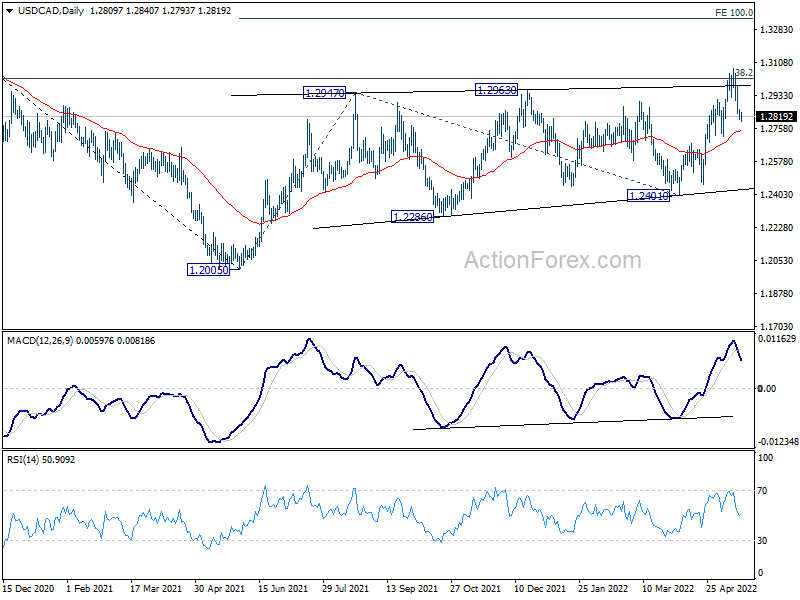
Intraday bias in USD/CAD stays neutral and outlook is unchanged. Pull back from 1.3075 could extend lower, but further rise is in favor with 1.2712 support intact. On the upside, break of 1.3075 will resume the rise from 1.2401. Sustained trading above 1.3022 fibonacci level will carry larger bullish implications. Next target will be 100% projection of 1.2005 to 1.2947 from 1.2401 at 1.3343. On the downside, however, break of 1.2712 support will indicate rejection by 1.3022 key fibonacci resistance, and bring deeper decline back to 1.2401 support.
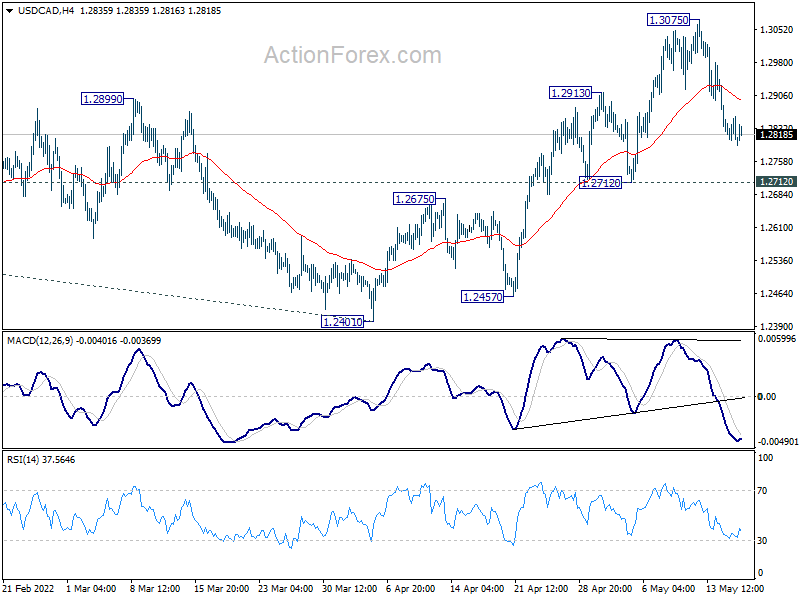
In the bigger picture, focus stays on 38.2% retracement of 1.4667 (2020 high) to 1.2005 (2021 low) at 1.3022. Sustained break there should confirm that the down trend from 1.4667 has completed after defending 1.2061 long term cluster support. Further rise would then be seen towards 61.8% retracement at 1.3650. However, rejection by 1.3022 will maintain medium term bearishness. Break of 1.2005 will resume the down trend from 1.4667 and that carries larger bearish implications too.
Dollar Holding On to Near Term Support, UK and CA CPI Featured
The forex markets are engaging in sideway trading in very tight range in Asian session. Dollar and Yen remain the weaker ones for the week. But so far, there is not following selling to push them through near term support level yet. Overall risk sentiment is crucial in determining the next move. While US stocks staged a strong rebound overnight, Asian markets are just mixed, with softness seen in Hong Kong and China. The lack of committed risk buying also drags down Aussie and Kiwi a little bit.
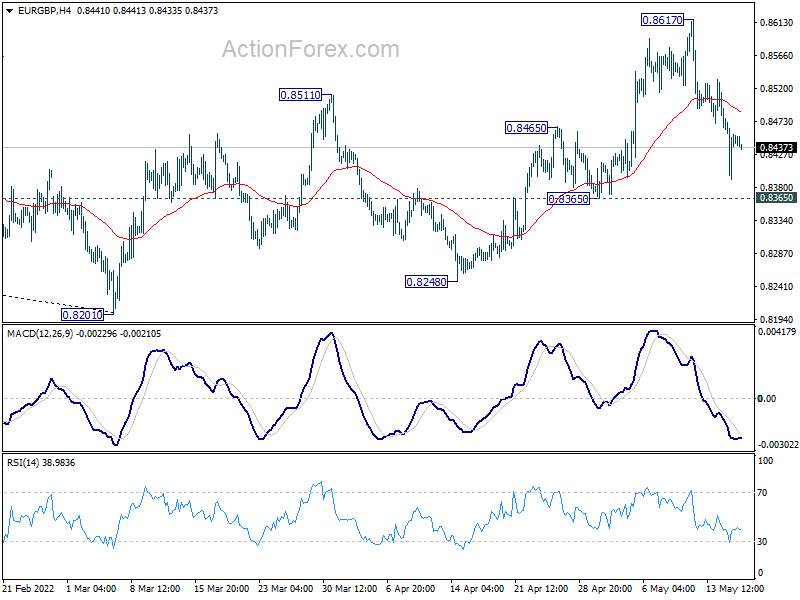
Technically, firstly, focus will stay on some near term levels in Dollar pairs, including 1.0641 resistance in EUR/USD, 1.2637 resistance in GBP/USD and 0.9871 support in USD/CHF. Firm break of these level will confirm short term topping in the greenback, and turn it into a "longer-lasting" near term correction phase. At the same time, attention will also be on some sterling pairs, including 0.8365 support in EUR/GBP and 162.16 resistance in GBP/JPY. Break of these two levels (in reaction to CPI data?) will push the Pound for a stronger near term rebound at least.
In Asia, at the time of writing, Nikkei is up 0.66%. Hong Kong HSI is down -0.32%. China Shanghai SSE is down -0.21%. Singapore Strait Times is up 0.89%. Japan 10-year JGB yield is up 0.0031 at 0.248. Overnight, DOW rose 1.34%. S&P 500 rose 2.02%. NASDAQ rose 2.76%. 10-year yield rose 0.091 to 2.968.
Fed Powell wont' hesitate to move past neutral rate to tame inflation
Fed Chair Jerome Powell said yesterday, "this is a time for us to be tightly focused on the time ahead and getting inflation back down to 2%.... What we need to see is inflation coming down in a clear and convincing way... If we don't see that, we will have to consider moving more aggressively".
"If that involves moving past broadly understood levels of 'neutral' we won't hesitate to do that," he added. "We will go until we feel we are at a place where we can say 'yes, financial conditions are at an appropriate place, we see inflation coming down.'"
"We'll go to that point. There won't be any hesitation about that," he said.
Fed Kashkari: What I don't know is how much are we going to need to do
Minneapolis Fed President Neel Kashkari said yesterday, "my colleagues and I are going to do what we need to do to bring the economy back into balance... What I don't know is how much are we going to need to do ... if we get some help on the supply side, then we won't have to do as much; if we don't get any help on the supply side, we are going to have to do more."
But he also cautioned, "if the recession is effective in bringing inflation down, but then you're pushing the unemployment rate way up, now all of a sudden you might be moving from one type of imbalance to the opposite type of imbalance. Like any kind of system, you want to avoid over-correcting if you can."
Fed Evans expects completing any 50bps, plus some 25bps this year
Chicago Fed President Charles Evans said, "front-loading is important to speed up the necessary tightening of financial conditions, as well as for demonstrating our commitment to restrain inflation, thus helping to keep inflationary expectations in check."
As for the pace of tightening, he said, "I'm expecting that before December, we will have completed in any 50s and have put in place at least a few 25s."
"If we need to, we will be well positioned to respond more aggressively if inflation conditions do not improve sufficiently or, alternatively, to scale back planned adjustments if economic conditions soften in a way that threatens our employment mandate," Evans explained.
BoE Cunliffe: There's no intrinsic value around crypto assets
BoE Deputy Governor Jon Cunliffe said at a web event, "There's a long tail of retail investors who have invested in cryptoassets. Do they all understand what they've invested in? I think not. For that long tail of retail investors, I'm not sure they do understand. They don't really see this as a financial investment."
"There's no intrinsic value around crypto assets," Cunliffe said. "They move with sentiment. They're being moved mainly as a risky asset, and prices have been going down pretty consistently."
"If you have that as a proportion of your portfolio, you have to realize it is highly speculative," Cunliffe said. "You could lose all your money. You could make a sizable capital gain. It's important for investors to understand the characteristics of this investment."
Japan GDP contracted -0.2% qoq, -1.0% annualized in Q1
Japan GDP contracted -0.2% qoq in Q1, better than expectation of -0.4% qoq. In annualized term, GDP contracted -1.0%, first negative growth in two quarters, but better than expectation of -1.8%. GDP deflator dropped -0.4% yoy, also better than expectation of -1.2% yoy.
Economy minister Daishiro Yamagiwa said the economy has not returned to pre-pandemic levels but that further downside would likely be limited. He also expected the economy to pick up even though uncertainty remains due to Ukraine situation. Also, China's zero-covid policy is having a significant impact on supply chains.
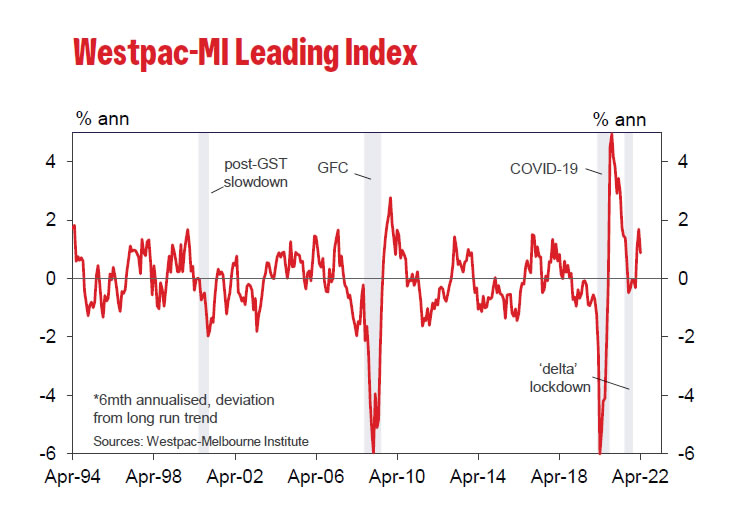
Australia Westpac leading index dropped to 0.88%, expects 40bps RBA hike in Jun
Australia Westpac-MI leading index dropped from 1.69% to 0.88% in April. Westpac recently revised down growth forecast for 2022 from 5.5% to 4.5%, reflecting the sharp increase in cost of living, and an earlier and more rapid RBA tightening policy.
As for RBA meeting on June 7, Westpac expects the central bank to hike by a further 40bps to 0.75%, even though most analysts favored a cautious move of 25bps. Westpac said, "It is also much more prudent to front load the increases where at a stage in the cycle when rates are clearly below what might be considered a 'neutral' level.
Looking ahead
Inflation data are the main focuses of the day. UK will release CPI and PPI. Eurozone will release CPI final. Canada will also release CPI. US will publish building permits and housing starts.
USD/CAD Daily Outlook
Daily Pivots: (S1) 1.2791; (P) 1.2825; (R1) 1.2843; More...
Intraday bias in USD/CAD stays neutral and outlook is unchanged. Pull back from 1.3075 could extend lower, but further rise is in favor with 1.2712 support intact. On the upside, break of 1.3075 will resume the rise from 1.2401. Sustained trading above 1.3022 fibonacci level will carry larger bullish implications. Next target will be 100% projection of 1.2005 to 1.2947 from 1.2401 at 1.3343. On the downside, however, break of 1.2712 support will indicate rejection by 1.3022 key fibonacci resistance, and bring deeper decline back to 1.2401 support.
In the bigger picture, focus stays on 38.2% retracement of 1.4667 (2020 high) to 1.2005 (2021 low) at 1.3022. Sustained break there should confirm that the down trend from 1.4667 has completed after defending 1.2061 long term cluster support. Further rise would then be seen towards 61.8% retracement at 1.3650. However, rejection by 1.3022 will maintain medium term bearishness. Break of 1.2005 will resume the down trend from 1.4667 and that carries larger bearish implications too.
Economic Indicators Update
| GMT | Ccy | Events | Actual | Forecast | Previous | Revised |
|---|---|---|---|---|---|---|
| 23:50 | JPY | GDP Q/Q Q1 P | -0.20% | -0.40% | 1.10% | |
| 23:50 | JPY | GDP Deflator Y/Y Q1 P | -0.40% | -1.20% | -1.30% | 1.10% |
| 00:30 | AUD | Westpac Leading Index M/M Apr | -0.20% | 0.30% | ||
| 00:30 | AUD | Wage Price Index Q/Q Q1 | 0.70% | 0.80% | 0.70% | |
| 04:30 | JPY | Industrial Production M/M Mar F | 0.30% | 0.30% | 0.30% | |
| 06:00 | GBP | CPI M/M Apr | 2.60% | 1.10% | ||
| 06:00 | GBP | CPI Y/Y Apr | 9.10% | 7.00% | ||
| 06:00 | GBP | Core CPI Y/Y Apr | 6.20% | 5.70% | ||
| 06:00 | GBP | RPI M/M Apr | 0.90% | 1.00% | ||
| 06:00 | GBP | RPI Y/Y Apr | 11.10% | 9.00% | ||
| 06:00 | GBP | PPI Input M/M Apr | 2.60% | 5.20% | ||
| 06:00 | GBP | PPI Input Y/Y Apr | 20.70% | 19.20% | ||
| 06:00 | GBP | PPI Output M/M Apr | 1.60% | 2.00% | ||
| 06:00 | GBP | PPI Output Y/Y Apr | 12.50% | 11.90% | ||
| 06:00 | GBP | PPI Core Output M/M Apr | 1.60% | 2.00% | ||
| 06:00 | GBP | PPI Core Output Y/Y Apr | 12.70% | 12.00% | ||
| 09:00 | EUR | Eurozone CPI Y/Y Apr F | 7.50% | 7.50% | ||
| 09:00 | EUR | Eurozone Core CPI Y/Y Apr F | 3.50% | 3.50% | ||
| 12:30 | CAD | CPI M/M Apr | 0.70% | 1.40% | ||
| 12:30 | CAD | CPI Y/Y Apr | 6.30% | 6.70% | ||
| 12:30 | CAD | CPI Common Y/Y Apr | 2.90% | 2.80% | ||
| 12:30 | CAD | CPI Median Y/Y Apr | 3.90% | 3.80% | ||
| 12:30 | CAD | CPI Trimmed Y/Y Apr | 4.70% | 4.70% | ||
| 12:30 | USD | Building Permits Apr | 1.83M | 1.87M | ||
| 12:30 | USD | Housing Starts Apr | 1.77M | 1.79M | ||
| 14:30 | USD | Crude Oil Inventories | 2.1M | 8.5M |
Australia Westpac leading index dropped to 0.88%, expects 40bps RBA hike in Jun
Australia Westpac-MI leading index dropped from 1.69% to 0.88% in April. Westpac recently revised down growth forecast for 2022 from 5.5% to 4.5%, reflecting the sharp increase in cost of living, and an earlier and more rapid RBA tightening policy.
As for RBA meeting on June 7, Westpac expects the central bank to hike by a further 40bps to 0.75%, even though most analysts favored a cautious move of 25bps. Westpac said, "It is also much more prudent to front load the increases where at a stage in the cycle when rates are clearly below what might be considered a 'neutral' level.
Japan GDP contracted -0.2% qoq, -1.0% annualized in Q1
Japan GDP contracted -0.2% qoq in Q1, better than expectation of -0.4% qoq. In annualized term, GDP contracted -1.0%, first negative growth in two quarters, but better than expectation of -1.8%. GDP deflator dropped -0.4% yoy, also better than expectation of -1.2% yoy.
Economy minister Daishiro Yamagiwa said the economy has not returned to pre-pandemic levels but that further downside would likely be limited. He also expected the economy to pick up even though uncertainty remains due to Ukraine situation. Also, China's zero-covid policy is having a significant impact on supply chains.
Fed Evans expects completing any 50bps, plus some 25bps this year
Chicago Fed President Charles Evans said, "front-loading is important to speed up the necessary tightening of financial conditions, as well as for demonstrating our commitment to restrain inflation, thus helping to keep inflationary expectations in check."
As for the pace of tightening, he said, "I'm expecting that before December, we will have completed in any 50s and have put in place at least a few 25s."
"If we need to, we will be well positioned to respond more aggressively if inflation conditions do not improve sufficiently or, alternatively, to scale back planned adjustments if economic conditions soften in a way that threatens our employment mandate," Evans explained.