

Sample Category Title
GBP/USD Mid-Day Outlook
Daily Pivots: (S1) 1.2374; (P) 1.2436; (R1) 1.2557; More..
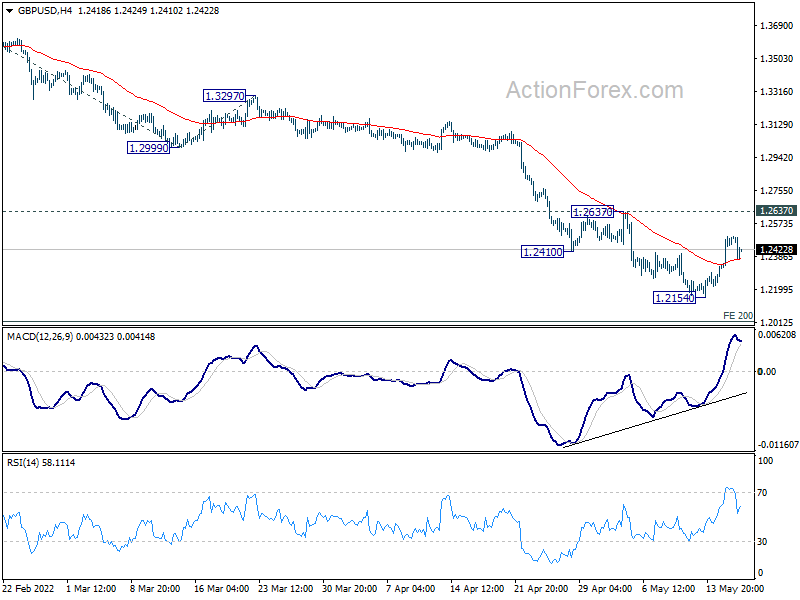
GBP/USD dips mildly today but overall, it's staying in consolidation from 1.2154. Intraday bias remains neutral at this point and further decline will remain in favor as long as 1.2637 resistance holds. On the downside, break of 1.2154 will resume the down trend from 1.4248 to 200% projection of 1.3641 to 1.2999 from 1.3297 at 1.2013. However, considering bullish convergence condition in 4 hour MACD, break of 1.2637 will confirm short term bottoming at 1.2154. Intraday bias will be turned back to the upside for 55 day EMA (now at 1.2816).
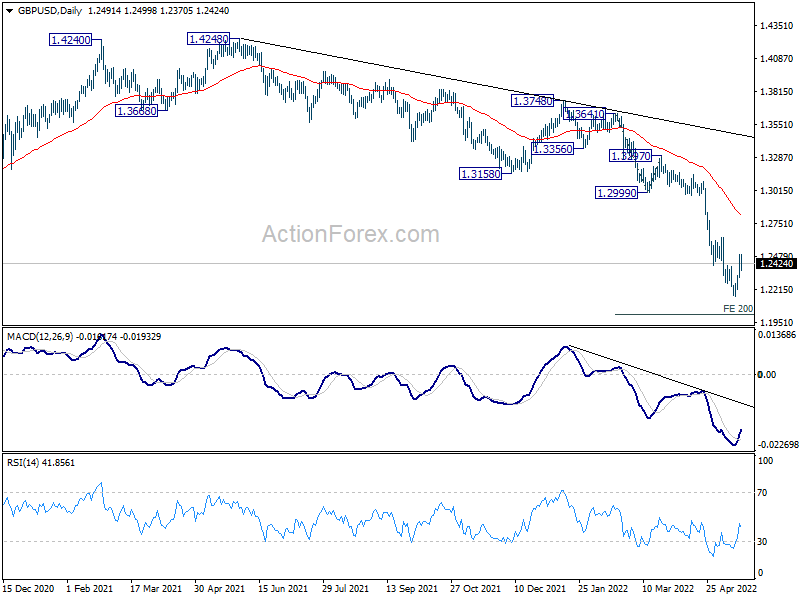
In the bigger picture, based on current momentum, fall from 1.4248 (2018 high) at least at the same degree as the rise from 1.1409 (2020 low). That is, fall from 1.4248 could be a leg inside the pattern from 1.1409, or resuming the longer term down trend. In either case, deeper decline is expected as long as 1.2999 support turned resistance holds. Next target is 1.1409 low.
Dollar Recovers in Tight Range, Sterling Down after CPI
Dollar and Yen are recovering mildly today but overall major pairs and crosses are stuck in very tight range. European majors are the weaker ones, with Sterling having a lower handle. Commodity currencies are mixed. Trading is also quiet in other markets with Gold continuing to hover slightly above 1800 handle. WTI crude oil is gyrating in tight range below 115. Bitcoin is flip-flopping around 30k. A surprise could be found in US 10-year yield ahead, which might reclaim 3% handle. That could help give Dollar a lift against Yen.
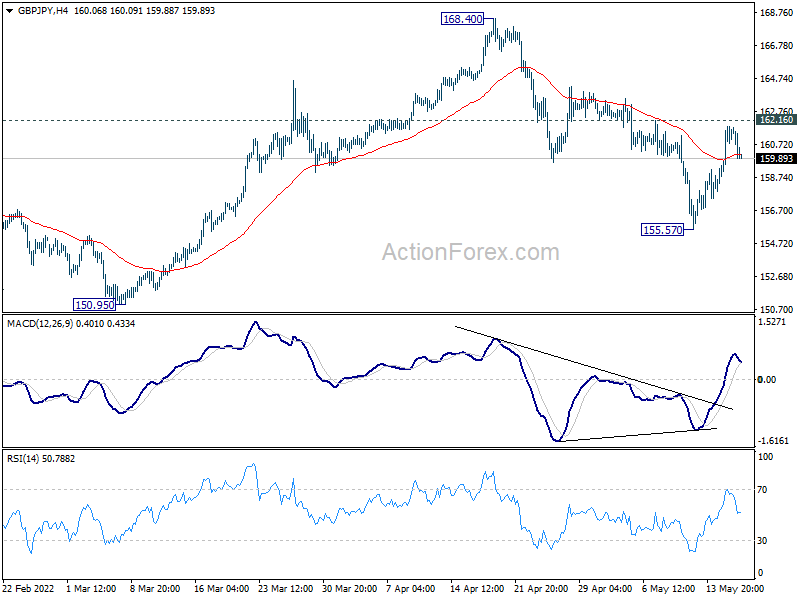
Technically, it looks like Sterling has already failed near term resistance level, after today's CPI data provided no fuel for further rally. GBP/USD retreated well ahead of 1.2637 resistance, and GBP/JPY ahead of 161.16 minor resistance. EUR/GBP also recovered ahead of 0.8365 support. There is slightly more prospect of more downside in the pound.
In Europe, at the time of writing, FTSE is down -0.47%. DAX is down -0.50%. CAC is down -0.51%. Germany 10-year yield is up 0.0235 at 1.076. Earlier in Asia, Nikkei rose 0.94%. Hong Kong HSI rose 0.20%. China Shanghai SSE dropped -0.25%. Singapore Strait Times rose 0.73%. Japan 10-year JGB yield rose 0.0016 to 0.246.
Canada CPI ticked up to 6.8% yoy in Apr, driven by food and shelter prices
Canada CPI ticked up further to 6.8% yoy in April, up from March's 6.7% yoy, above expectation of 6.7% yoy. CPI ex-gasoline accelerated to 5.8%, up from 5.5% yoy, fastest since the series was introduced in 1999. Statics Canada added that the year-over-year increase in April was largely driven by food and shelter prices. Gas prices increased at a slower pace.
Looking at the preferred measures of core inflation by BoC, CPI common rose from 3.0% yoy to 3.2% yoy, above expectation of 2.9% yoy. CPI median rose from 4.0% yoy to 4.4% yoy, above expectation of 3.9% yoy. CPI trimmed rose from 4.8% yoy to 5.1% yoy, above expectation of 4.7% yoy.
ECB de Cos: Further rate hikes could be made in coming quarters
ECB Governing Council member Pablo Hernandez de Cos said today, "in the coming quarters, further (rate) increases could be made to reach levels in line with the natural rate of interest if the medium-term inflation outlook remains around our target."
But de Cos also emphasized that the process of policy normalization would be gradual. "For this gradual approach to be adopted, it is essential that inflation expectations remain anchored and that no second-round and indirect effects of a magnitude that could jeopardise this anchoring materialise," he said.
Another Governing Council member Olli Rehn said, "It seems necessary that in our policy rates we move relatively quickly out of negative territory and continue our gradual process of monetary policy normalization."
Eurozone CPI finalized at 7.4% yoy in Apr, core CPI at 3.5% yoy
Eurozone CPI was finalized at 7.4% yoy in April, unchanged from March's reading. Core CPI was finalized at 3.5% yoy, up from March's 3.0% yoy. The highest contribution to the annual Eurozone inflation rate came from energy (+3.70%), followed by services (+1.38%), food, alcohol & tobacco (+1.35%) and non-energy industrial goods (+1.02%).
EU CPI was finalized at 8.1% yoy, up from March's 7.8% yoy. The lowest annual rates were registered in France, Malta (both 5.4%) and Finland (5.8%). The highest annual rates were recorded in Estonia (19.1%), Lithuania (16.6%) and Czechia (13.2%). Compared with March, annual inflation fell in three Member States, remained stable in two and rose in twenty-two.
UK CPI rose to 9% yoy in Apr, core CPI up to 6.2% yoy
UK CPI accelerated sharply from 7.0% yoy to 9.0% yoy in April, but missed expectation of 9.1% yoy. CPI core rose from 5.7% yoy to 6.2% yoy, matched expectations. RPI accelerated form 9.0% to 11.1% yoy, matched expectations.
Headline CPI was another record high since the National Statistics series began in 1997. It's also the highest record rate in the constructed historical series which began in 1989.
Based on the recently published modelled consumer price inflation data by the ONS, CPI was last higher sometime around 1982, where estimates range between approximately 6.5 % in December to nearly 11% in January.
In response to the release, Chancellor of the Exchequer Rishi Sunak said: "Today's inflation numbers are driven by the energy price cap rise in April, which in turn is driven by higher global energy prices.
"We cannot protect people completely from these global challenges but are providing significant support where we can, and stand ready to take further action."
Also released, PPI input came in at 1.1% mom, 18.6%, versus expectation of 2.6% mom, 20.7% yoy. PPI output was at 2.3% mom, 14.0% yoy, versus expectation of 1.6% mom, 12.5% yoy. PPI output core was at 1.6% mom, 13.0% yoy, versus expectation of 1.6% mom, 12.6% yoy.
Japan GDP contracted -0.2% qoq, -1.0% annualized in Q1
Japan GDP contracted -0.2% qoq in Q1, better than expectation of -0.4% qoq. In annualized term, GDP contracted -1.0%, first negative growth in two quarters, but better than expectation of -1.8%. GDP deflator dropped -0.4% yoy, also better than expectation of -1.2% yoy.
Economy minister Daishiro Yamagiwa said the economy has not returned to pre-pandemic levels but that further downside would likely be limited. He also expected the economy to pick up even though uncertainty remains due to Ukraine situation. Also, China's zero-covid policy is having a significant impact on supply chains.
Australia Westpac leading index dropped to 0.88%, expects 40bps RBA hike in Jun
Australia Westpac-MI leading index dropped from 1.69% to 0.88% in April. Westpac recently revised down growth forecast for 2022 from 5.5% to 4.5%, reflecting the sharp increase in cost of living, and an earlier and more rapid RBA tightening policy.
As for RBA meeting on June 7, Westpac expects the central bank to hike by a further 40bps to 0.75%, even though most analysts favored a cautious move of 25bps. Westpac said, "It is also much more prudent to front load the increases where at a stage in the cycle when rates are clearly below what might be considered a 'neutral' level.
GBP/USD Mid-Day Outlook
Daily Pivots: (S1) 1.2374; (P) 1.2436; (R1) 1.2557; More..
GBP/USD dips mildly today but overall, it's staying in consolidation from 1.2154. Intraday bias remains neutral at this point and further decline will remain in favor as long as 1.2637 resistance holds. On the downside, break of 1.2154 will resume the down trend from 1.4248 to 200% projection of 1.3641 to 1.2999 from 1.3297 at 1.2013. However, considering bullish convergence condition in 4 hour MACD, break of 1.2637 will confirm short term bottoming at 1.2154. Intraday bias will be turned back to the upside for 55 day EMA (now at 1.2816).
In the bigger picture, based on current momentum, fall from 1.4248 (2018 high) at least at the same degree as the rise from 1.1409 (2020 low). That is, fall from 1.4248 could be a leg inside the pattern from 1.1409, or resuming the longer term down trend. In either case, deeper decline is expected as long as 1.2999 support turned resistance holds. Next target is 1.1409 low.
Economic Indicators Update
| GMT | Ccy | Events | Actual | Forecast | Previous | Revised |
|---|---|---|---|---|---|---|
| 23:50 | JPY | GDP Q/Q Q1 P | -0.20% | -0.40% | 1.10% | |
| 23:50 | JPY | GDP Deflator Y/Y Q1 P | -0.40% | -1.20% | -1.30% | 1.10% |
| 00:30 | AUD | Westpac Leading Index M/M Apr | -0.20% | 0.30% | ||
| 00:30 | AUD | Wage Price Index Q/Q Q1 | 0.70% | 0.80% | 0.70% | |
| 04:30 | JPY | Industrial Production M/M Mar F | 0.30% | 0.30% | 0.30% | |
| 06:00 | GBP | CPI M/M Apr | 2.50% | 2.60% | 1.10% | |
| 06:00 | GBP | CPI Y/Y Apr | 9.00% | 9.10% | 7.00% | |
| 06:00 | GBP | Core CPI Y/Y Apr | 6.20% | 6.20% | 5.70% | |
| 06:00 | GBP | RPI M/M Apr | 3.40% | 3.40% | 1.00% | |
| 06:00 | GBP | RPI Y/Y Apr | 11.10% | 11.10% | 9.00% | |
| 06:00 | GBP | PPI Input M/M Apr | 1.10% | 2.60% | 5.20% | 4.60% |
| 06:00 | GBP | PPI Input Y/Y Apr | 18.60% | 20.70% | 19.20% | 18.60% |
| 06:00 | GBP | PPI Output M/M Apr | 2.30% | 1.60% | 2.00% | 1.90% |
| 06:00 | GBP | PPI Output Y/Y Apr | 14.00% | 12.50% | 11.90% | |
| 06:00 | GBP | PPI Core Output M/M Apr | 1.60% | 1.60% | 2.00% | 1.80% |
| 06:00 | GBP | PPI Core Output Y/Y Apr | 13.00% | 12.70% | 12.00% | 11.80% |
| 09:00 | EUR | Eurozone CPI Y/Y Apr F | 7.40% | 7.50% | 7.50% | |
| 09:00 | EUR | Eurozone Core CPI Y/Y Apr F | 3.50% | 3.50% | 3.50% | |
| 12:30 | CAD | CPI M/M Apr | 0.60% | 0.70% | 1.40% | |
| 12:30 | CAD | CPI Y/Y Apr | 6.80% | 6.70% | 6.70% | |
| 12:30 | CAD | CPI Common Y/Y Apr | 3.20% | 2.90% | 2.80% | 3.00% |
| 12:30 | CAD | CPI Median Y/Y Apr | 4.40% | 3.90% | 3.80% | 4.00% |
| 12:30 | CAD | CPI Trimmed Y/Y Apr | 5.10% | 4.70% | 4.70% | 4.80% |
| 12:30 | USD | Building Permits Apr | 1.82M | 1.83M | 1.87M | 1.88M |
| 12:30 | USD | Housing Starts Apr | 1.72M | 1.77M | 1.79M | 1.73M |
| 14:30 | USD | Crude Oil Inventories | 2.1M | 8.5M |
Gold Remains in Red Despite Inflation Concerns but Break of Key $1800 Support Zone to Confirm Bearish Stance
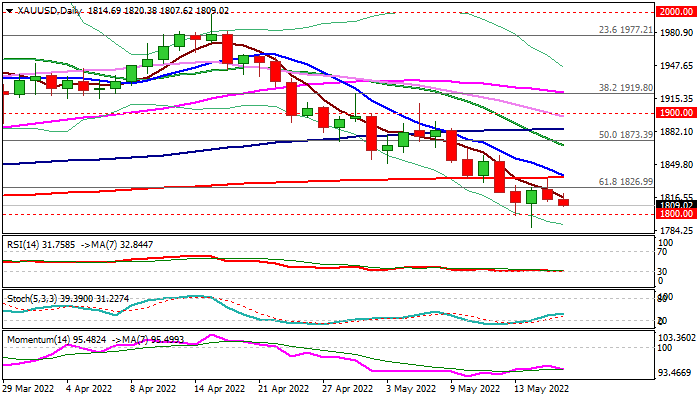
Spot gold remains at the back foot on Wednesday and extends fresh weakness, after brief recovery from new 4 ½ month low ($1786) was capped by 200DMA ($1836).
Today’s reaction on strong rise of UK inflation in April was mild, despite the yellow metal is used as a hedge against inflation, with strong pressure on gold price being maintained by a robust dollar, supported by global geopolitical and economic uncertainty and expectations for further rate hikes, as the US central bank tries to bring raging inflation under control.
Technical studies on daily chart remain in full bearish setup, as bearish momentum continues to rise, moving averages are in full bearish setup and 10/200DMA’s are converging and on track to form a death cross pattern that would add to negative signals.
Bears face immediate support at psychological $1800 level (also the base of thin daily cloud), followed by Monday’s spike low at $1786, break of which would signal bearish continuation and expose supports at $1769 (Fibo 76.4% of $1676/$2070) and $1753 (15 Dec 2021 low).
Broken Fibo 61.8% of $1676/$2070 ($1826) marks solid resistance which should cap and maintain bearish bias.
Only sustained break above 200DMA would sideline bears.
Res: 1820; 1826; 1836; 1850
Sup: 1800; 1786; 1780; 1769
Australian Dollar Dips after WPI
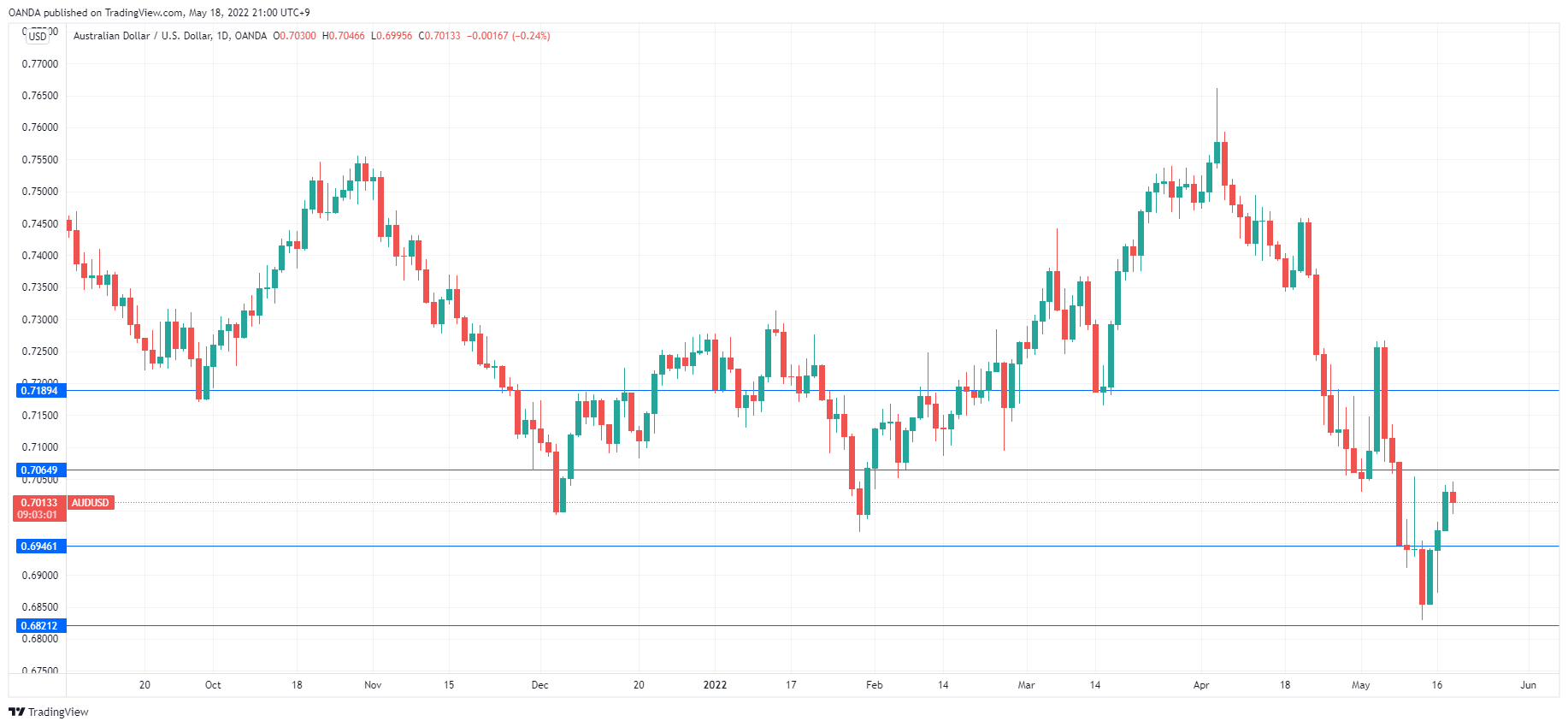
After three successive winning sessions, the Australian dollar has reversed directions on Wednesday. In the European session, AUD/USD is trading slightly above the symbolic 70 level.
Wage growth ticks higher
It wasn’t all that long ago that RBA Governor Lowe would reiterate that there would be no rate hikes until wage growth hit 3%. The rationale was that strong wage growth would indicate that higher inflation was not transient. Well, the “T” word has gone out of fashion, after being unceremoniously retired by Fed Chair Powell. The RBA finds itself facing spiralling inflation, and raised rates for the first time in a decade, even though wage growth remained below 3%. Lowe has been forced to adjust his stance and is now focusing on the fact that wage inflation is moving higher.
The wage price index release for Q1 ticked up to 2.4% YoY, up marginally from 2.3%. This is less than half of CPI, which stands at 5.1%. Still, this won’t stand in the way of an RBA hike at the June meeting, as the central bank is determined to stamp out soaring inflation. The RBA will likely deliver a 0.25% hike, barring spectacular employment data on Thursday. If that occurs, the likelihood of a 40-bps hike would increase.
The Australian dollar’s impressive upswing has paused after some hawkish rhetoric from the US Fed overnight. Jerome Powell said that interest rates could rise above the terminal rate of about 3.50% in order to contain inflation. Former Fed Chair Bernanke said in an interview that the Fed erred in waiting too long in responding to inflation. Bernanke warned that he expected to see stagflation in the next year or two, with lower growth, high inflation and an increase in unemployment.
AUD/USD Technical
- There is resistance at 0.7064 and 0.7189
- There is support at 0.6946 and 0.6821
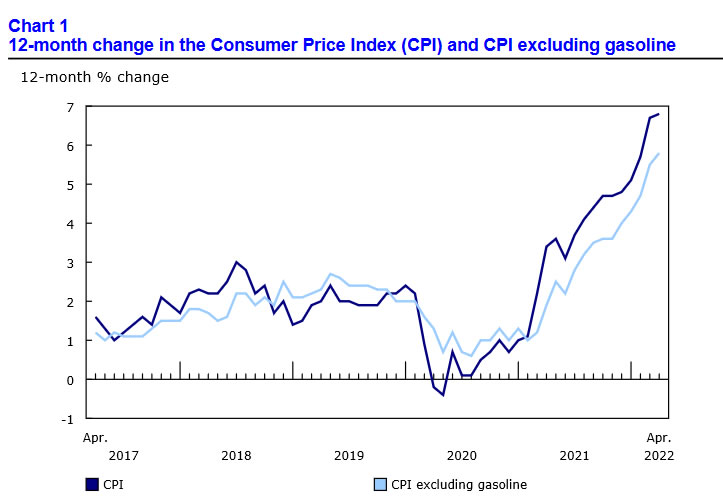
Canada CPI ticked up to 6.8% yoy in Apr, driven by food and shelter prices
Canada CPI ticked up further to 6.8% yoy in April, up from March's 6.7% yoy, above expectation of 6.7% yoy. CPI ex-gasoline accelerated to 5.8%, up from 5.5% yoy, fastest since the series was introduced in 1999. Statics Canada added that the year-over-year increase in April was largely driven by food and shelter prices. Gas prices increased at a slower pace.
Looking at the preferred measures of core inflation by BoC, CPI common rose from 3.0% yoy to 3.2% yoy, above expectation of 2.9% yoy. CPI median rose from 4.0% yoy to 4.4% yoy, above expectation of 3.9% yoy. CPI trimmed rose from 4.8% yoy to 5.1% yoy, above expectation of 4.7% yoy.
ECB de Cos: Further rate hikes could be made in coming quarters
ECB Governing Council member Pablo Hernandez de Cos said today, "in the coming quarters, further (rate) increases could be made to reach levels in line with the natural rate of interest if the medium-term inflation outlook remains around our target."
But de Cos also emphasized that the process of policy normalization would be gradual. "For this gradual approach to be adopted, it is essential that inflation expectations remain anchored and that no second-round and indirect effects of a magnitude that could jeopardise this anchoring materialise," he said.
Another Governing Council member Olli Rehn said, "It seems necessary that in our policy rates we move relatively quickly out of negative territory and continue our gradual process of monetary policy normalization."
Canadian Dollar Eyes CPI
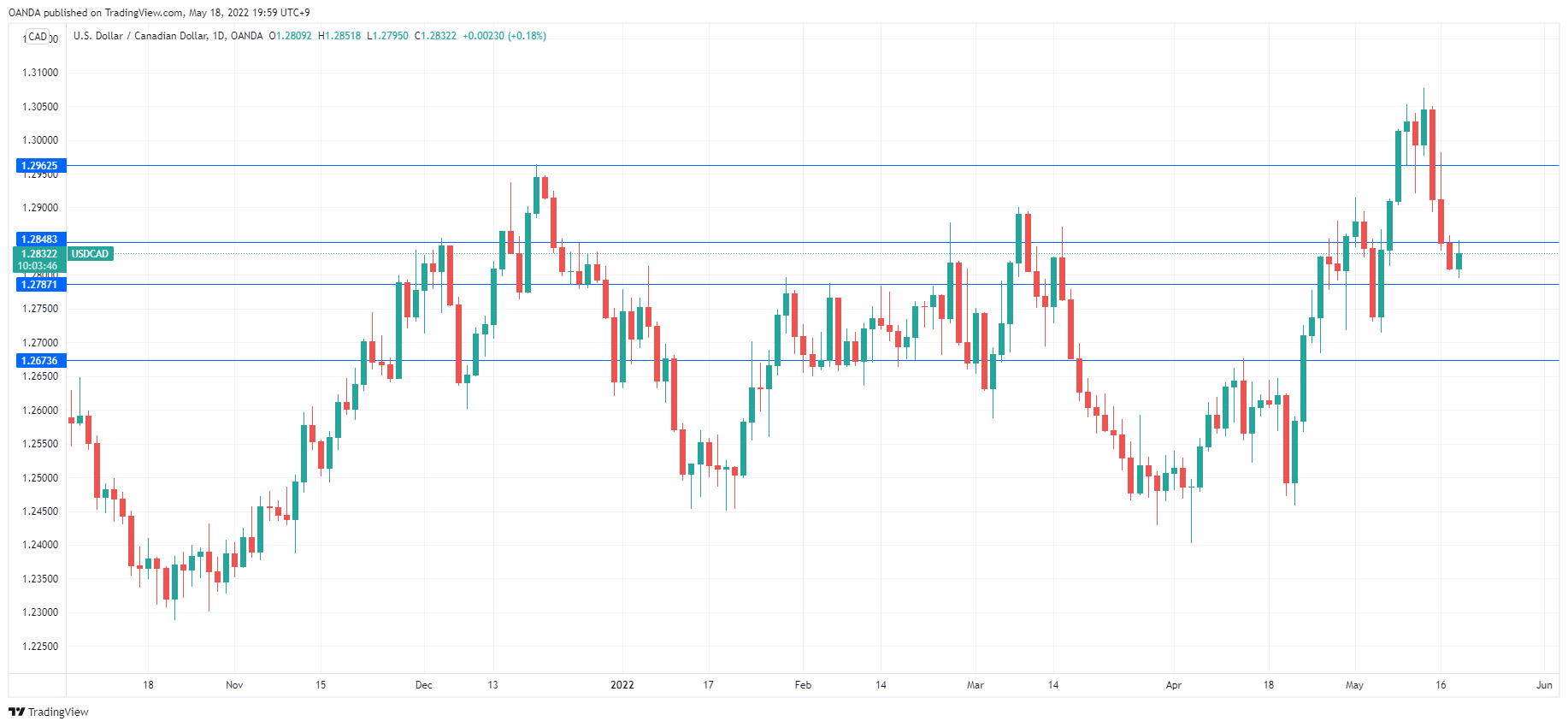
The Canadian dollar has looked sharp, taking advantage of recent US dollar weakness. USD/CAD barrelled past the 1.30 line on Thursday, but the Canadian dollar has rallied and is currently trading at 1.2830.
Has Canada’s inflation peaked?
Investors are keeping both eyes on Canada’s April inflation report, which will be released later today. On a monthly basis, the markets are expecting a significant drop – headline CPI is expected at 0.5% (1.4% prior) and core CPI is projected at 0.4% (1.0% prior). If the readings are within expectations, we can expect some headlines trumpeting that inflation has peaked. I would argue that it would be premature to declare that inflation is easing based on a single reading.
Still, the CPI release could be a market-mover. If inflation is weak, the markets may expect the BoC to be less aggressive in its rate hiking stance and that could send the Canadian dollar lower. Conversely, a stronger than expected CPI would likely send the Canadian currency higher. The BoC raised rates by 0.50% in April, and there is strong pressure to deliver another 0.50% hike at the June 1st meeting, especially if inflation is higher than expected.
The US dollar lost ground overnight, even though US Treasury yields moved higher and Fed Chair Powell said rates could rise above the terminal rate (around 3.50%) in order to contain inflation. Former Fed Chair Ben Bernanke weighed in on Fed policy, saying that the central bank waited too long to respond to inflation. Bernanke warned that he expected to see stagflation in the next year or two.
Despite the talk of recession and stagflation, the US posted strong numbers on Tuesday, led by retail sales. The headline reading came in at 0.9% and core retail sales at 1.0%, as both beat the estimates. Consumers are in a spending mood, despite a weakening in consumer confidence. If inflation doesn’t show signs of easing in the next few months, consumers might reduce spending, which could dampen economic growth.
USD/CAD Technical
- USD/CAD is testing resistance at 1.2848. Above, there is resistance at 1.2962
- There is support at 1.2787 and 1.2673
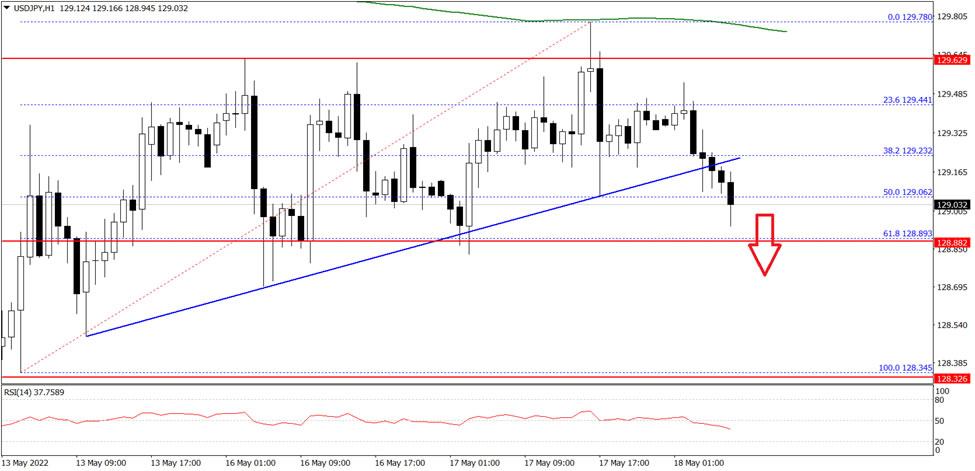
USD/JPY Pair Moved into a Bearish Zone Below $129.20
The US Dollar started a downside correction from well above 130.00 against the Japanese Yen. The USD/JPY pair traded below the 129.50 support zone to move into a bearish zone.
There was a break below a key bullish trend line with support near 129.15 on the hourly chart. It is now trading well below 129.20 and the 50 hourly simple moving average.
On the downside, an initial support is 128.80. The next major support sits near the 128.50 level, below which there is a risk of more downsides. In the stated case, the pair could even trade below the 128.20 support zone in the near term.
On the upside, an immediate resistance is near the 129.40 level. A clear break above the 129.40 resistance could push the price towards 130.00. The next major resistance is near the 130.50 level or 131.20 on FXOpen.
Record-Breaking But Near-Peak inflation in Britain
UK consumer prices rose by 2.5% in April, the second-biggest monthly gain in the indicator’s history since 1988. Annual inflation jumped from 7% to 9%, unseen in the indicator’s history.
The longer-established retail price index last saw a high annual growth rate (11.1% y/y in April) in 1982, while such big monthly jump (3.4% m/m) was last observed in 1980.
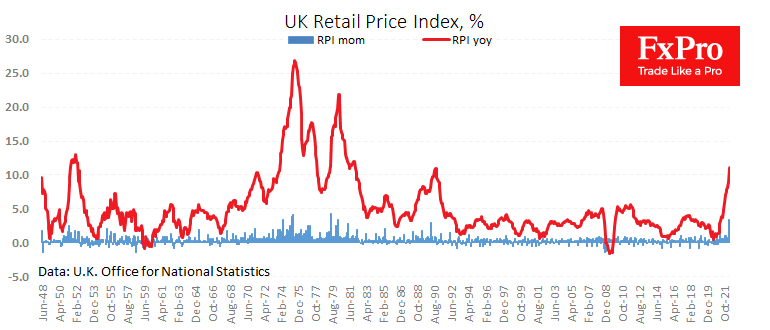
However, despite the horror that these figures represent, there are still indications that the UK’s peak annual rate of inflation will be much lower than in the 1980s (22%) or 1970s (27%).
While Output Producer Prices are showing an acceleration in the annual growth rate, rising to 14%, Input PPI has slowed from 19.2% to 18.6%. Although remaining volatile in recent weeks, oil and gas have regularly retreated from highs, limiting upward pressure on prices. Metals have withdrawn from the highs.
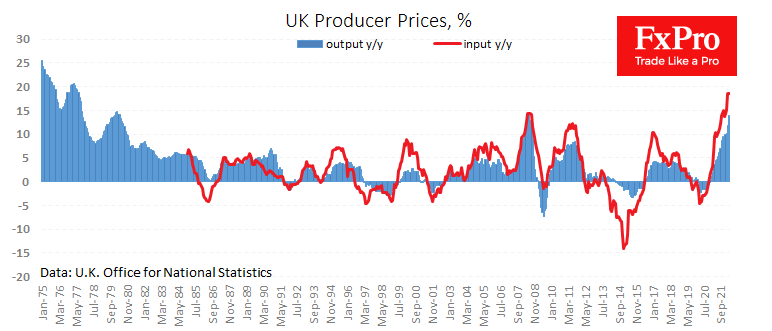
At the same time, there are growing questions about final global demand, which will constrain producers in shifting costs to consumers.
Early hints that UK inflation may be slowing in the coming months may allow the Bank of England to raise the rate by 25 points at its next meeting in mid-June and not copy the Fed’s 50-point move.
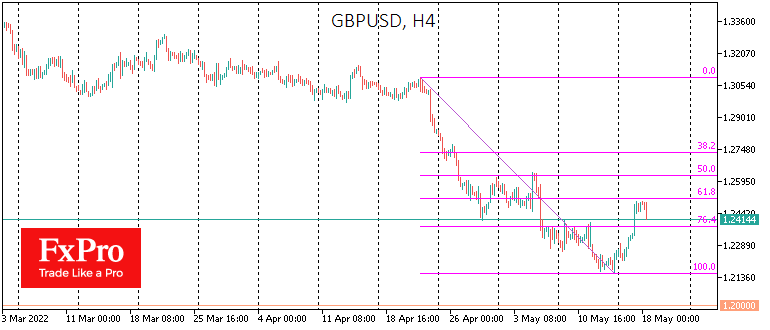
This is moderately negative news for the British currency, which started to retreat from the $1.25 area on the data after a 2.9% rally from last Friday’s lows. Short-term traders should pay particular attention to the 1.2350 area.
A dip lower already this week would suggest that the brief period of recharging dollar bulls has ended. In this case, GBPUSD could quickly fall below 1.2000, making the 1.1500 area a potential ultimate target for this attack.
Bitcoin May Finish Brief Rebound But Unlikely to Go Below $10K
Bitcoin has been hovering around the 30K mark for a second day, forcing the rest of the crypto market to balance declines and gains. Ethereum has lost 1.2% in 24 hours but remains near 2,000. Altcoins from the top ten are mostly declining, losing between 0.7% (DogeCoin) and 3.8% (Polkadot). Tron is gaining 1.7% but has been little changed since the end of last week.
Total crypto market capitalisation, according to CoinMarketCap, declined 1.1% overnight to $1.29 trillion. Bitcoin’s dominance index remained unchanged at 44.3%.
The Cryptocurrency Fear and Greed Index was up 4 points to 12 by Wednesday and remains in “extreme fear”. The index’s recovery from lows since 2019 is due to a waning selloff but not a market reversal to growth.
Bitcoin has stalled at the psychologically significant 30K level and has also lost the momentum of the rebound at the 76.4% Fibonacci line from the downward move from late March to last Thursday’s lows. This is a typical shallow counter-trend correction.
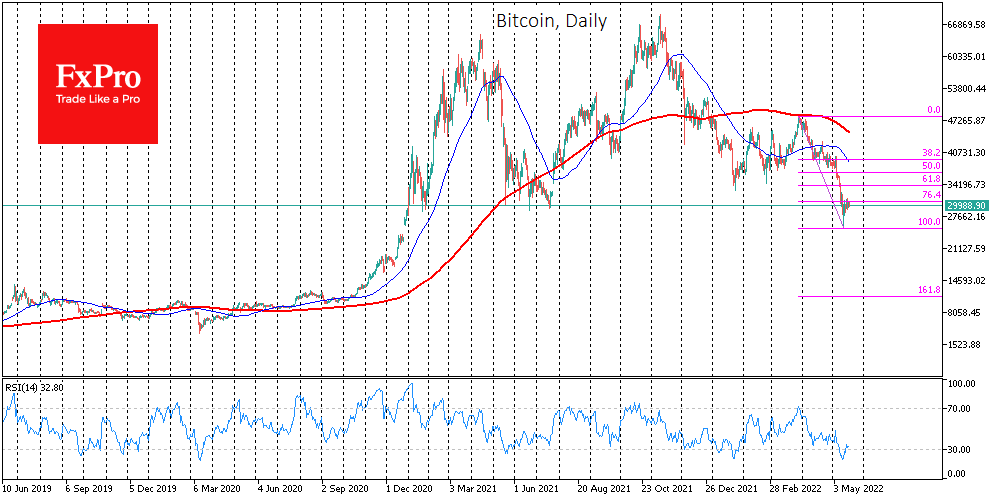
The inability of the market to develop the offensive from the current levels would raise the question that the final target for the downtrend would be the 161.8% area of that move, which is near $11.3K. Such a setback would cancel out all upside momentum from October 2020. So far, this scenario looks exceptionally pessimistic and needs to converge the disappointment of crypto neophytes on top of an actual collapse of the global economy and stock market.
Such a dip would leave Bitcoin’s price at only 16% of its peak, which has happened several times in its history. However, a significant drop below previous cyclical highs ($20K) would be unusual, although Bitcoin was previously repurchased on similar drawdowns.
Perhaps a more cautious scenario would be a dip into the $20-23K area to close the gap at the end of 2020 or a return to the 2017 highs.
The realist-optimistic scenario points to the possibility of cautious buying by long-term investors from current levels. However, it does not suggest a new wave of explosive growth, as financial conditions, and a return to the area at the start of 2021 are disappointing for those investors who have been buying cryptocurrencies to make a quick buck. Moreover, inflation has weaned 10% off the dollar’s purchasing power over this period.
Among the news that caught our eye were:
According to CoinShares, institutional investors invested $274 million in crypto funds last week, a record since the start of the year.
Following TerraUSD, another stable coin – DEI – lost its peg to the US dollar. According to the Congressional Research Service (CRS), the stable coin market needs strict regulation.
Because of the speculative nature of cryptocurrencies, investors need more protection, or they could lose confidence in the markets, SEC chief Gary Gensler said.
The Portuguese authorities are considering introducing a tax on income earned from investments in digital assets.
Dogecoin co-founder Billy Marcus called 95% of crypto assets “trash” and suggested that 70% of investors don’t even understand the fundamentals of the crypto market.