Sample Category Title
Currency Markets are Ranging
Currency markets had another choppy session on Friday, but ultimately, remained content to continue range trading. The US dollar rallied somewhat, despite US yields falling. I suspect that pre-weekend caution was the driver of moves in both asset classes. The dollar index rose 0.22% to 98.22, edging higher to 98.26 in Asia. A Japanese holiday today is muting volumes and volatility in the region.
EUR/USD gave back some of its gains above 1.1100, falling 0.36% to 1.1050, where it remains in Asia. A European oil embargo on Russia would be another headwind for the single currency, although a Ukraine agreement or progress will likely spark a sharp relief rally. Levels to watch for now are 1.1000 and 1.1200. Sterling edged higher to 1.3175 before falling to 1.3160 this morning. It looks to have traced out a major low at 1.3000 and its medium-term technical outlook is now constructive above that level. 1.3200 is initial resistance. USD/JPY rose sharply on Friday by 0.46% to 119.15 as oil prices continued to rally. Today’s rises will keep the pressure on the yen which seems to be tracking oil more closely than US yields for now. It remains on track to test 120.00.
AUD/USD and NZD/USD booked gains on Friday, rising 0.50% and 0.40% respectively to 0.7415 and 0.6905. The antipodeans continue to ride the rebound in risk sentiment in US markets and until that changes, the technical picture suggests more gains lie ahead. The next technical resistances are at 0.7440 and 0.6925.
Asian currencies are steady after the PBOC left its Loan Prime Rates unchanged and set a neutral USD/CNY fixing. The rise in oil prices this morning had seen Asian currencies retreat modestly and imported inflation, particularly energy, remain their Achilles heel. Regional central banks have little to no interest in tightening monetary policy in response to the Fed, concentrating on maintaining growth. With commodity prices to remain elevated even if the Ukraine war ended tomorrow, any material gains by Asian currencies are likely to be temporary in H1 2022. If China is indeed weakening the yuan in response to a slowing economy, that will be another headwind for regional currencies.
Bitcoin: Local Positive, But Potentially Sideways for the Year
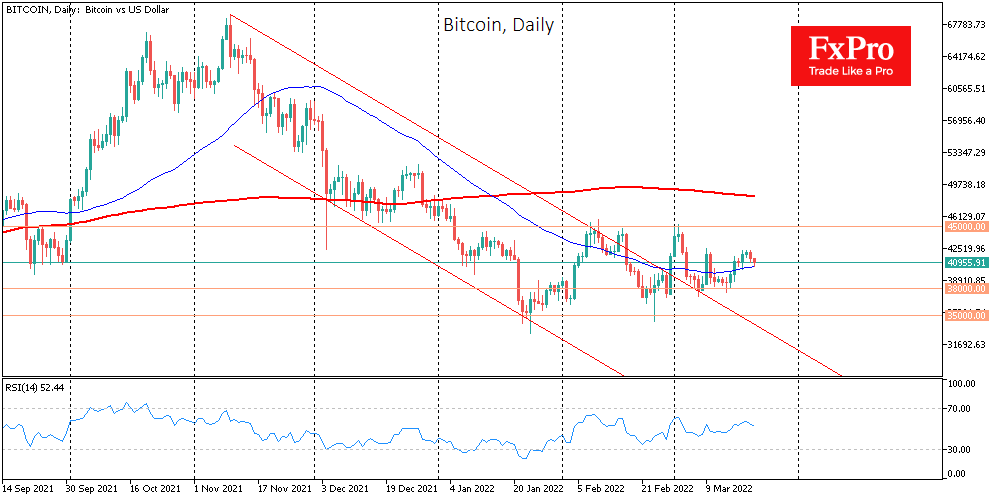
Bitcoin gained 6.3% over the past week, finishing near $41.3K. The price retreated slightly to $41.0K on Monday morning, losing 2.1% over the last 24 hours. Ethereum has corrected by 2% over the same period but still added 11.6% to the price seven days ago. Other leading altcoins in the top 10 have gained between 7.3% (Polkadot) and 24.8% (Avalanche) over the past week.
Total cryptocurrency market capitalisation, according to CoinMarketCap, rose 7.5% for the week to $1.86 trillion. The Bitcoin Dominance Index fell 0.6 points to 41.9% due to outperforming altcoins.
The Cryptocurrency Fear and Greed Index rose 7 points for the week to 30 and moved into “fear” from “extreme fear”.
Last week turned out to be a good one for the crypto market, with bitcoin rising the most in six weeks. Last Wednesday, the US Federal Reserve meeting weakened the dollar and boosted stocks, which benefited all risky assets, including cryptocurrencies.
Meanwhile, bitcoin has continued to trade in a sideways range of $38-45K for the second month, with a closer look marked by a sequence of declining local highs with bullish momentum fading near 42 in the last two weeks. The positive sentiment is supported by the 50-day moving average reversing upwards. BTCUSD broke it in a relatively strong move on March 16th, and it has been acting as local support ever since.
The external environment in the financial markets remains mixed. Traders have tighter financial conditions due to higher rates and waning economic growth on one side of the scale. On the other side is the demand for purchasing power insurance for capital due to the highest inflation in two generations. Weighing these factors, Galaxy Digital head Mike Novogratz said bitcoin would continue to trade in a sideways range this year. He said BTC will resume growth and reach $500K by 2025 as inflation curbing measures are too weak.
Piyush Gupta, chief executive of Singapore’s largest bank, DBS, said cryptocurrencies could be an alternative to gold but would not be able to fit into the traditional financial system due to excessive volatility.
ECB de Guindos: No stagflation but inflation to remain higher for longer
In an interview with Handelsblatt, ECB Vice President Luis de Guindos said Eurozone is not heading towards stagflatoin. "In the most recent projections, even in our most adverse scenario for the current year, we still foresee growth of more than 2%, so no stagflation," he said. "Inflation, however, is likely to remain higher for a longer period than expected before the war."
De Guindos also said what matters for the central bank now is the extent to which wages respond. "If wage increases are too high, they can push prices up even more and contribute to persistently higher inflation." But he added, "We have not seen any signs of that yet".
He added last week's statement "delink the potential interest rate hikes from the asset purchase programme". The timing of rate hike "all depends on the data". "The price shock in energy and commodities that we're currently experiencing is making many firms and workers worse off. Fiscal policy should provide temporary, targeted support to help reduce the burden. This would also reduce the danger of a wage-price spiral," he said.
AUD/USD Pair Moved into a Positive Zone Above $0.7300
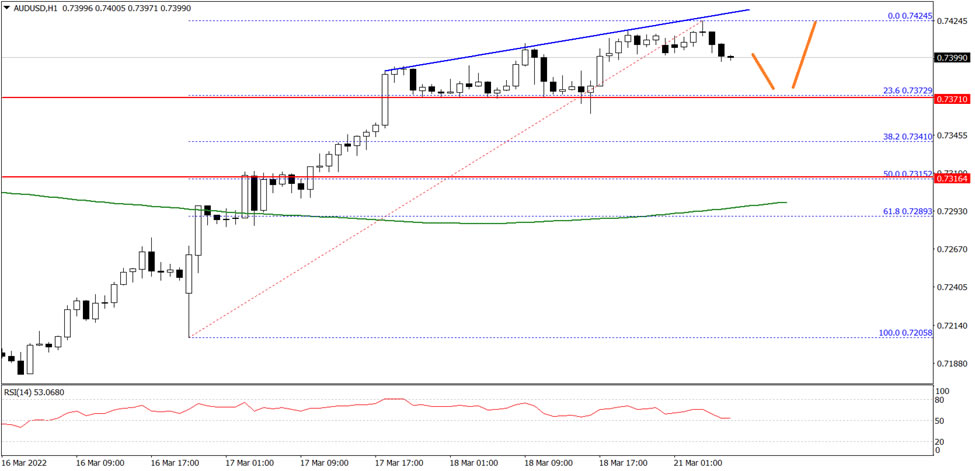
The Aussie Dollar started a fresh increase from the 0.7200 support zone against the US Dollar. The AUD/USD pair traded above the 0.7300 level to move into a positive zone.
The pair even traded above the 0.7350 level and the 50 hourly simple moving average. It is now facing hurdle near a connecting trend line at 0.7425 on the hourly chart. The next key resistance on the upside is near the 0.7430 level.
If there is an upside break above the 0.7430 level, the pair could rise steadily towards the 0.7450 level in the near term. Any more gains could send the pair towards 0.7480 on FXOpen.
An immediate support on the downside is near the 0.7380 level. The next key support is near the 0.7350 level. A clear break below the 0.7350 support could lead the pair towards the 0.7300 support.
Germany PPI up 1.4% mom, 25.9% yoy in Feb, Russia invasion impact not yet included
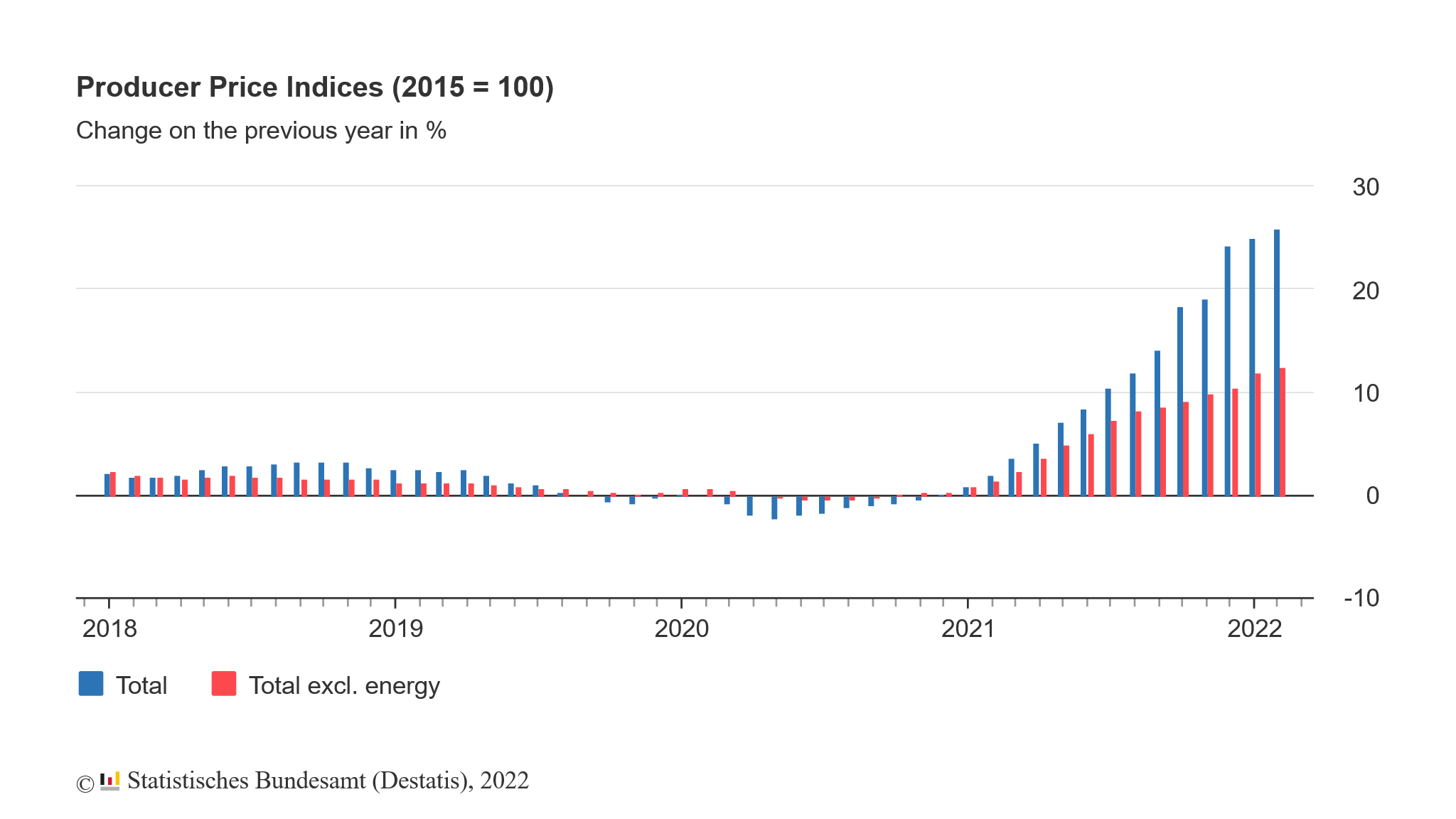
Germany PPI rose 1.4% mom, 25.9% yoy in February, below expectation of 1.7% mom, 26.1% yoy, comparing to January's 2.2% mom, 25.0% yoy.
Destatis said, "the recent price development in the context of Russia's attack on Ukraine are not yet included in the results... Mainly responsible for the increase of producer prices compared to February 2021 still was the price increase of energy."
Energy prices as a whole rose 68.0% yoy. Price of intermediate goods rose 21.0% yoy. Prices of non-durable consumer goods rose 7.4% yoy. Prices of durable consumer goods rose 6.7% yoy. Capital goods prices rose 5.5% yoy.
Market Will be Flooded With Comments from Fed and ECB Policy Makers
Markets
With still only mixed signals on any progress in the negotiations between Ukraine and Russia, European investors on Friday initially took some chips off the table after last week’s rally. US investors were less worried on the impact on their economy. US indices gained 0.80% (Dow) to 2.05% (Nasdaq). European equities also reversed losses (EuroStoxx +0.44%).
In the wake of last week’s policy meeting, Fed hawks Waller and Bullard were the first speakers to defend/reinforce their view. Waller openly voiced support for a 50 bps hike at one of the coming meetings. Bullard already dissented for such a step last week and sees a good reason for a 3%+ policy rate end this year. These comments don’t express the Fed consensus but are signs the FOMC is prioritizing inflation.
The US yield curve flattened with the 2-year rising 2.25 bps while the very long end declined 4.9 bps (30-y). Changes in European yields were limited with German yields finishing unchanged (2-y/30-y) to 1.2/1.3 bps lower for the 5/10 y sector.
The dollar rebounded after a rather dismal post-Fed performance. Gains were modest still given growing interest rate support at the short end of the curve. DXY closed at 98.23, off the intraday top near 98.62. The euro lost traction with EUR/USD finishing at 1.1051 (from 1.1091). Sterling regained most of Thursday’s post-BoE losses (cable close 1.3878; EUR/GBP declined to 0.8386 from 0.8435) even as UK yields decline further (2-y -8.9 bps).
This morning, Chinese markets are turning to a wait-and-see approach as they look for more concrete action from authorities to support growth as signaled last week. Chinese banks kept their 1 and 5 year prime loans rates unchanged.
A rebound in crude oil (Brent $ 111.25) illustrates that geopolitical tensions keep their grip on markets with ongoing mixed headlines on any progress to solve to crisis in Ukraine and tensions in the Middle East (Houti attacks on Saudi installations). This might set the stage for a mild risk-off start in Europe this morning.
The US eco calendar is thin this week. The EMU PMI’s will be published on Thursday. Aside from geopolitical headlines, the market will be flooded with comments from Fed and ECB policy makers. Today’s speakers already include ECB’s Lagarde, Makhlouf and Nagel. On the Fed side Bostic and Powell will speak at the NABE conference.
Even as, especially Fed, speakers will reiterate their priority on reining in inflation, especially yields at longer term maturities might be heading for some short-term consolidation/pause with resistance at 2.24% for the US 10-y yield. The German 10-y yield also shows signs of a pause near the 0.40/0.41% area.
Recently, a cautious risk sentiment combined with higher oil/commodity prices favoured the dollar over the likes of the yen, but also over the euro. EUR/USD 1.1121/37 looks like a rather solid resistance short-term.
The UK calendar this week contains CPI data, PMI’s and retail sales. Markets will also look out whether UK Fin Min Sunak will use any budgetary room to alleviate the sharp decline in citizens disposable income (budget statement Wednesday). A post BoE setback of sterling last week was short-lived even as short-term rates declined. EUR/GBP 0.8458/78 remains a high profile resistance for further EUR/GBP gains. In Belgium, the debt agency today sells 2032, 2040 and 2029 bonds in a regular auction.
News Headlines
The Australian government announced an alumina export ban to Russia. The country relies on Australia for nearly 20% of its alumina needs. The move will limit Russia capacity to produce aluminum, which is a critical export for Russia. In a statement, the government added that it will work closely with exporters and peak bodies that will be affected by the ban to find new and expand existing markets. Aluminum prices spike around 5% higher this morning.
Rating agency S&P raised the outlook on the Spanish A rating from negative to stable. The medium term outlook for Spanish growth is favourable, with tourism positioned for a strong 2022-2023 recovery and €150bn (11.5% of GDP) in Next Generation and EU budgetary grants to be disbursed from 2022-2027. Fiscal performance is improving, but continues to lag peers. External surpluses and benefits from E(M)U membership are other long term positives. S&P uses the best credit rating for Spain amongst majors, with Fitch (A-) and Moody’s (Baa1) rating the country respectively one and 2 notches lower.
Daily Technical Analysis
EUR/USD
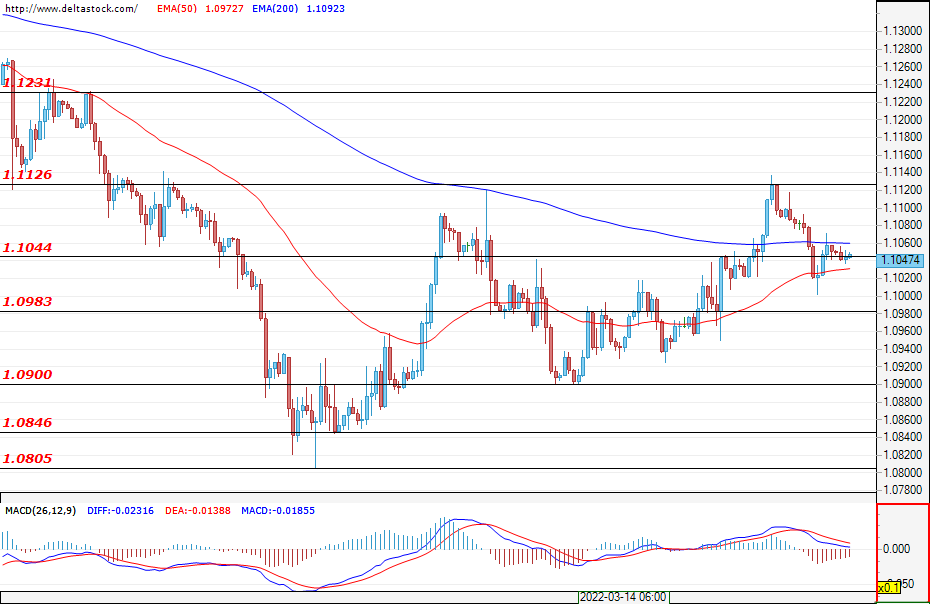
Last week, the pair managed to finish in green territory and broke a streak of five consecutive losing weeks. The bulls managed to test the resistance at around 1.1125 and the response of the bears was not late. In the early hours of today, prices gravitate around the 1.1044 support, however expectations are for a second test of 1.1125. The first support for buyers is the area at around 1.0980 – 1.1000. The area at around 1.0900 is the weekly support and it is expected to hold off a possible bearish pressure. The market is trying to move upwards and the lower time frames already reveal new peaks and successive higher lows. In order for the transition to be completed, however, prices would first need to overcome the barrier at 1.1360. The zone to watch is 1.1125 as it will signal for the development of this scenario. In case the bulls fail their attack, then the correction should continue and the main support will remain in the zone between 1.0900 and 1.0850.
USD/JPY
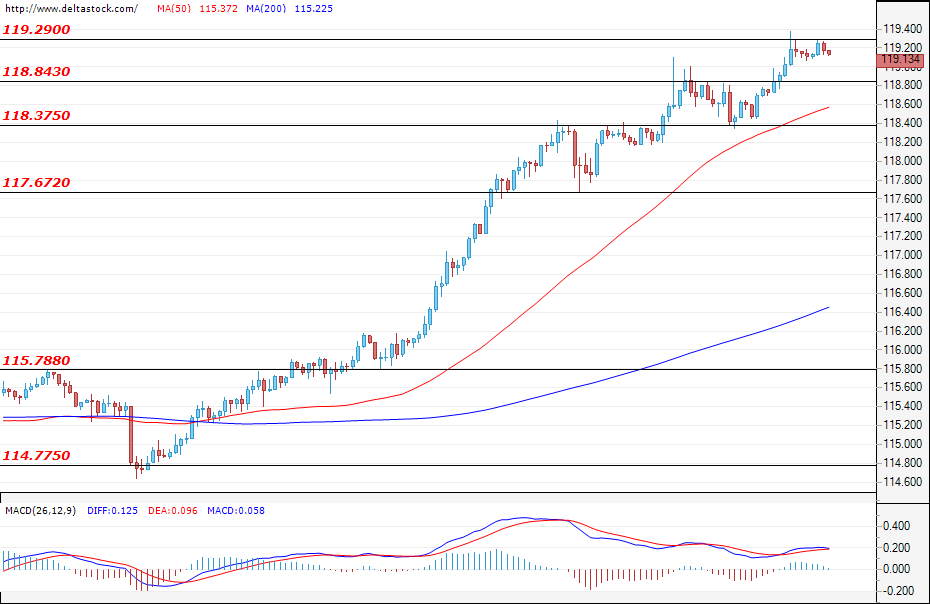
The uptrend for the Ninja remains strong and the market managed to form several supports over the past week. Pullbacks in the trend are shallow and are caused by realised profits rather than the bears entering the market. The support at 118.84 has not yet been tested and confirmed and 118.37 can be noted as the main one, followed by the weekly level of 117.67. If the rally continues, then the next target may be 121.20, but should the market enter a corrective phase, then it is expected to be limited by the support at 117.67.
GBP/USD
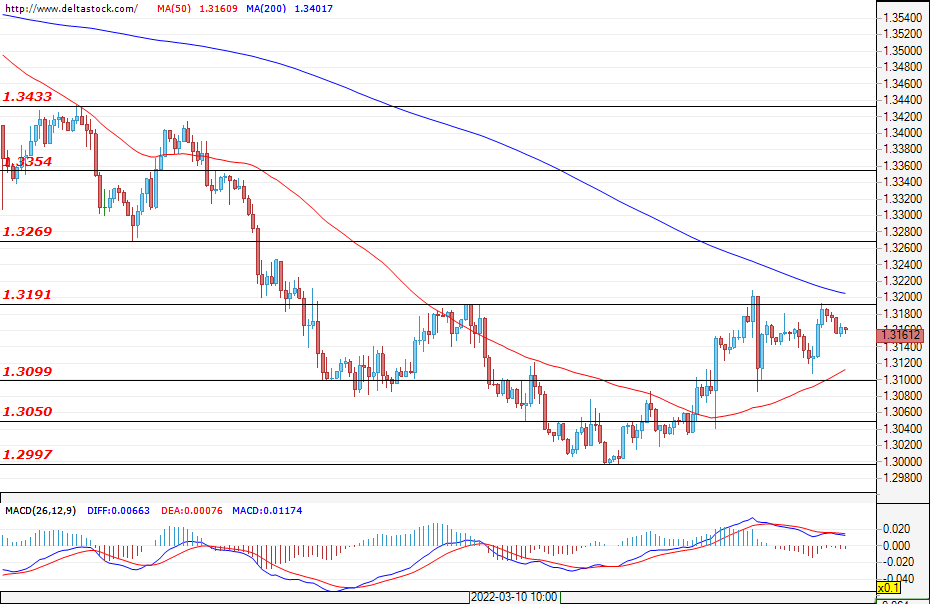
The British pound also performed well last week as the bulls are trying to reverse the downtrend. The market managed to form support at around 1.3100 and it will be the first support for today. The current price structure can be interpreted as an inverted "head and shoulders" figure, which is a formation signalling a trend reversal. A confirmation of this formation would be a breach of 1.3191, followed by corrective movement and a successful test of the figure’s “neck” zone. Upon completion of the formation, a subsequent rally with the potential to reach the resistance at around 1.3400 can be expected.
EUGERMANY40
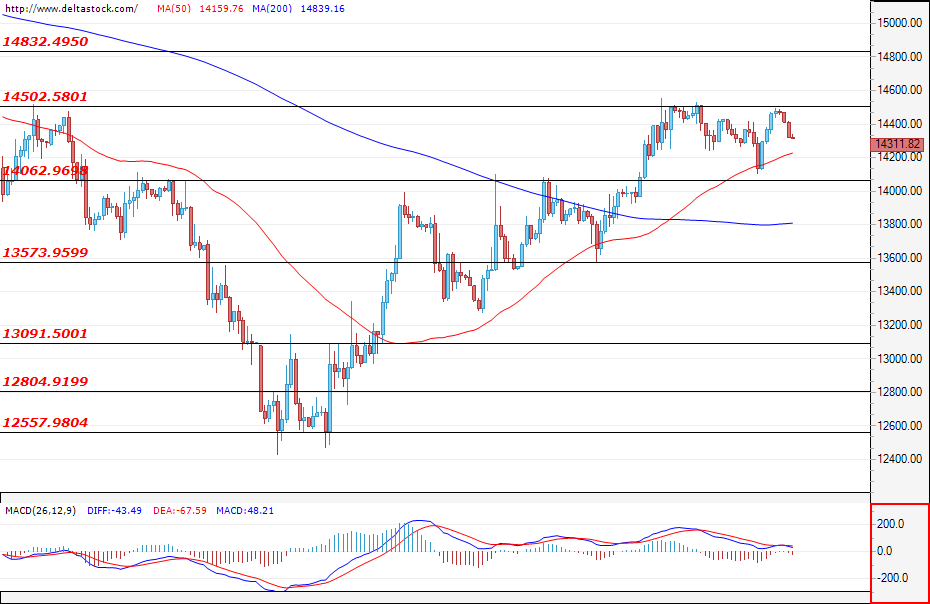
The German index continued its recovery throughout last week and is currently limited by the resistance zone at 14500. There is no significant change in the fundamental factors and the recovery may be purely mechanical. With a new impulse move and a breach of 14500, a test of 14830 can be expected. This zone comes from the higher time frames and has been supporting the market since April 2021. Even if it is reached, however, expectations are for a follow-up aggressive bearish pressure around this level. Their first support for today the bulls can expect at about 14060, while the main weekly one sits at 13570.
US30
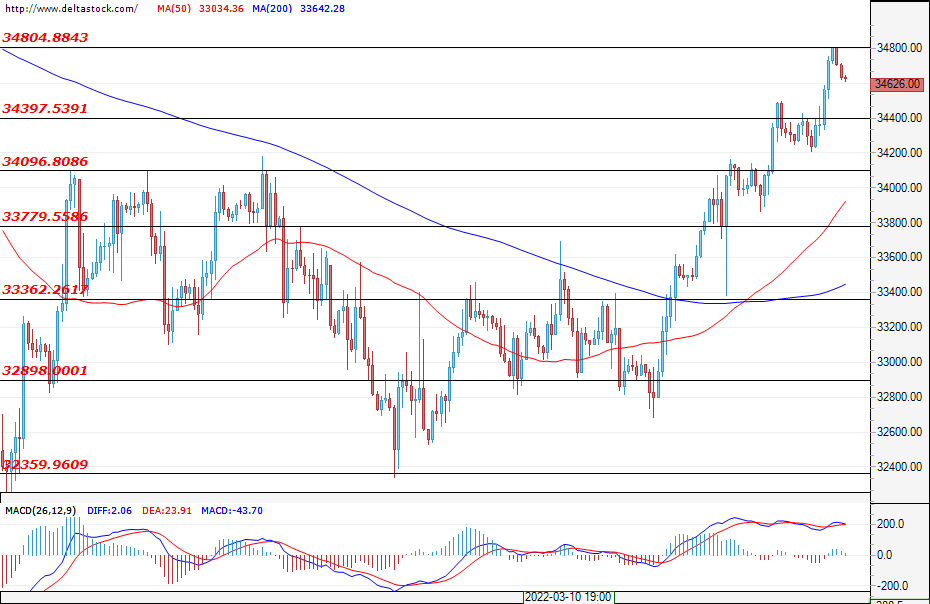
The U.S. blue chips marked a stunning recovery last week. The index managed to overcome the key resistance at 34100 and this should contribute towards improved sentiment. The first local support is 34400 and significant support buyers can expect at around 34100. The market is likely to reverse part of its gains, and given the higher volatility, the cycle may deepen towards 33780. The months of April and May are traditionally favourable for the U.S. markets and so the recovery may still have some fuel left in its tank. With a breach of 34800, the next targets for the bulls could be the levels of 35050 and 35690.
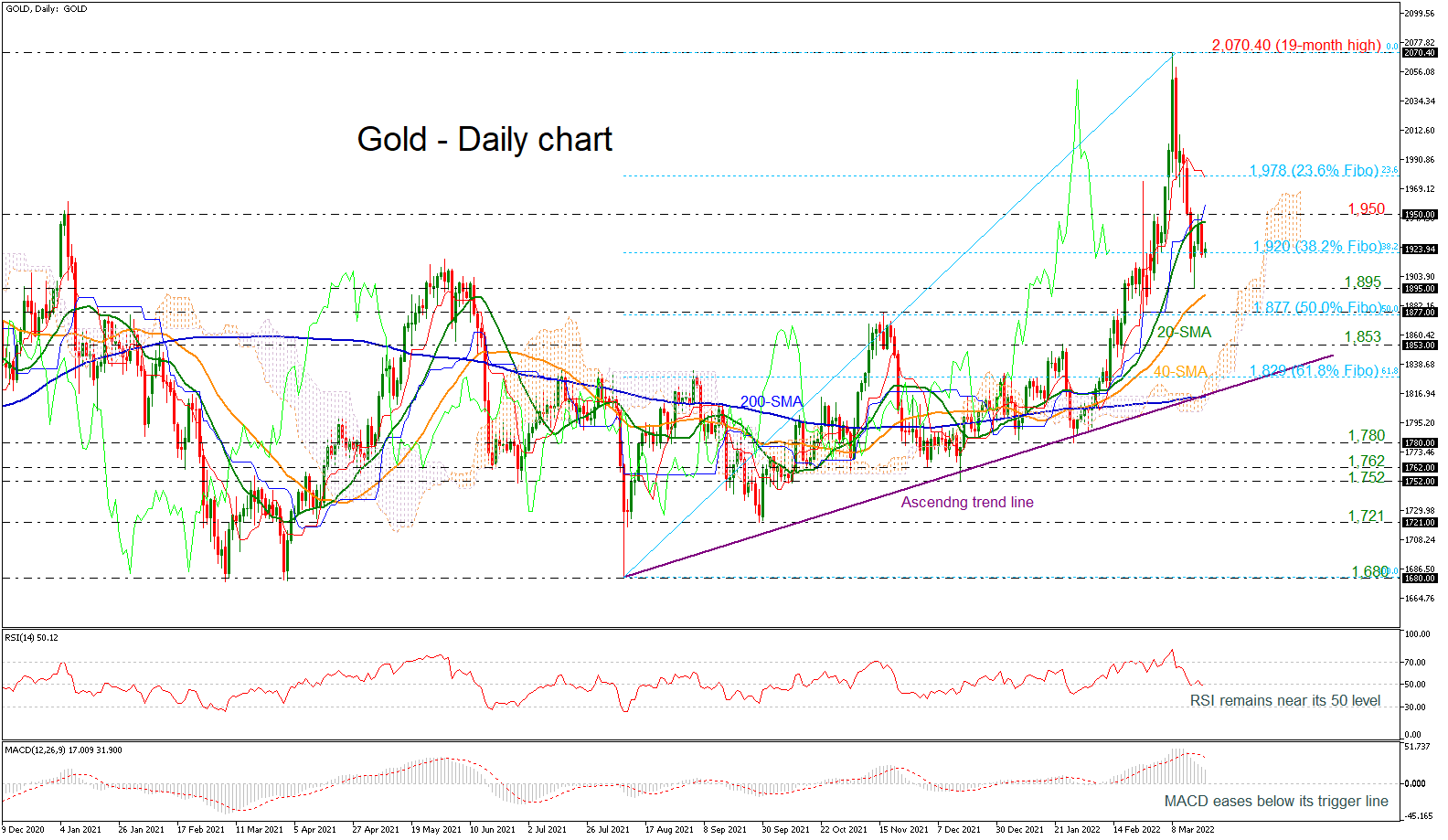
Gold Struggles to Extend Declines after Hitting a Floor at 1,920
Gold prices are continuing last week’s move around the key level of 1,920, which is the 38.2% Fibonacci retracement level of the up leg from 1.680 to 2,070.40 and at the same time is confirming the pullback from the 1,950 resistance and the 20-day simple moving average (SMA).
The short-term bias looks negative as the MACD keeps losing ground below its red signal line, while the RSI seems to be making its way near its 50-neutral mark, though a further decline is needed from both indicators to confirm the negative momentum.
The 1,895 support and the 40-day SMA currently at 1,890 could be a trigger point for steeper bearish action if the pair manages to break the 38.2% Fibonacci. Lower, support could come towards from the 50.0% Fibonacci at 1,877, a strong barrier last year, though more sellers could take the price until the 1,853 key level, which stands slightly above the uptrend line.
However, if the pair reverses back to the upside, investors could watch first the 1,950 resistance and then the 23.6% Fibonacci of 1,978, which overlaps with the red Tenkan-sen line of the Ichimoku indicator. If the price continues to rise, resistance could next come somewhere near the 19-month high of 2,070.40.
In the short-term picture, the pullback off the multi-month high turned the strongly bullish outlook to negative.
However, in the bigger picture, chances for another bullish move are still rising as the yellow metal is still holding above the ascending trend line and the 200-day SMA.
EUR/CHF Daily Outlook
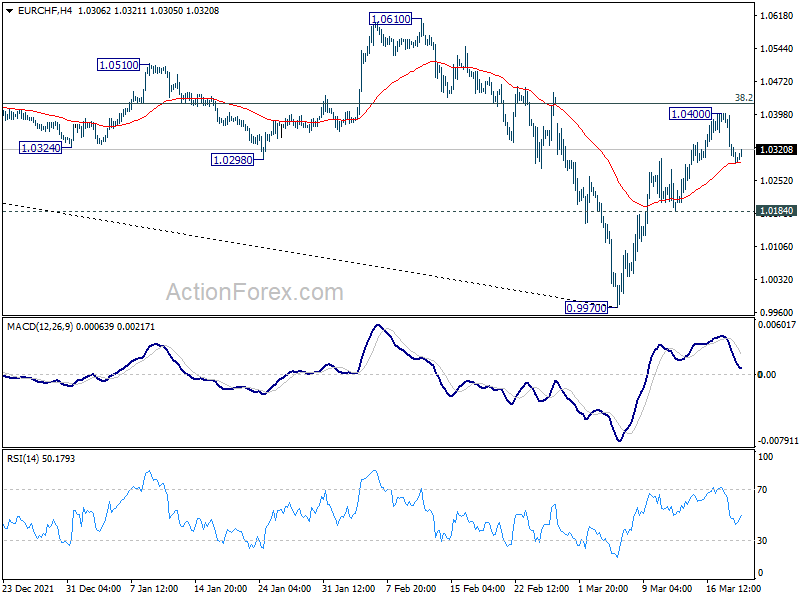
Daily Pivots: (S1) 1.0259; (P) 1.0330; (R1) 1.0368; More....
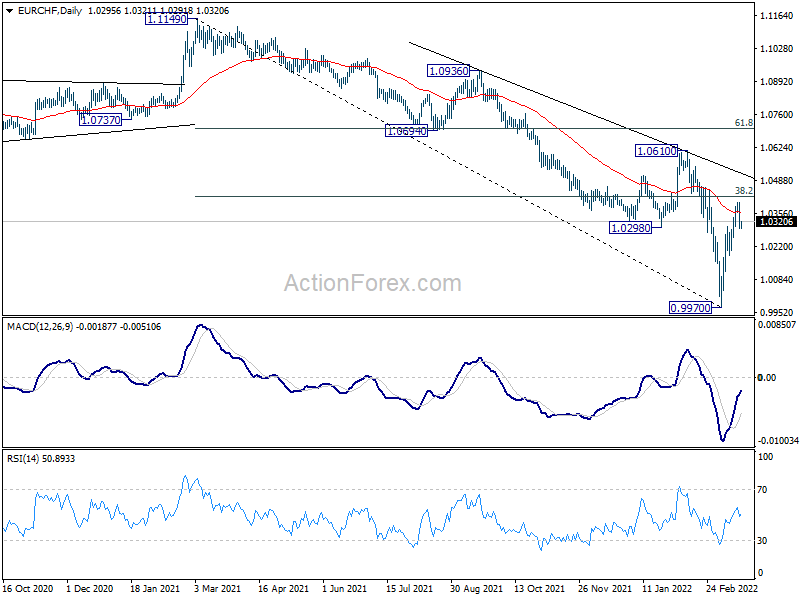
Intraday bias in EUR/CHF remains neutral first. On the upside, break of 1.0400 would resume the rebound to 1.0610 key structural resistance. However, break of 1.0184 minor support will argue that the rebound is finished, ahead of 38.2% retracement of 1.1149 to 0.9970 at 1.0420. In this case, intraday bias will be turned back to the downside for retesting 0.9970 low.
In the bigger picture, long term down trend from 1.2004 (2018 high) is still in progress. Next target is 100% projection of 1.2004 to 1.0505 to 1.1149 at 0.9650. In any case, sustained break of 1.0505 support turned resistance is needed to be the first sign of medium term bottoming. Otherwise, outlook will remain bearish.
EUR/AUD Daily Outlook
Daily Pivots: (S1) 1.4850; (P) 1.4950; (R1) 1.5007; More...
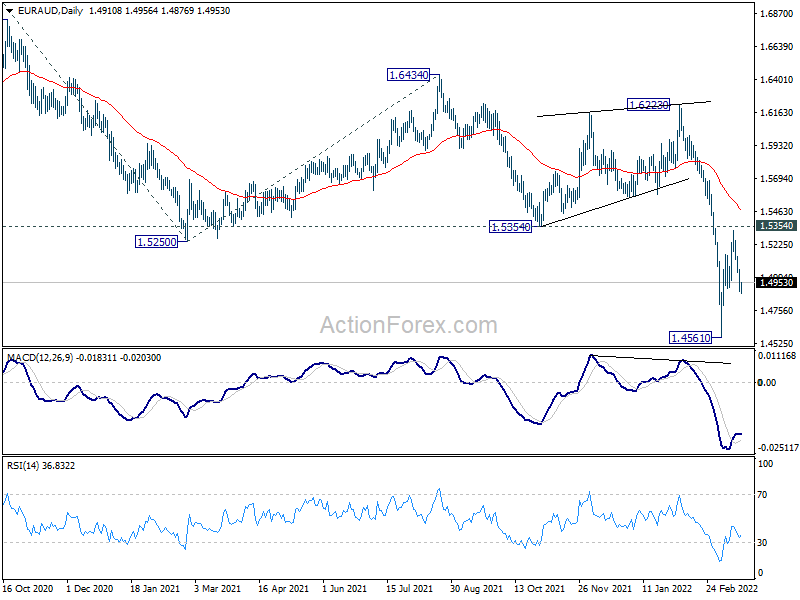
Intraday bias in EUR/AUD is mildly on the downside for the moment. Rebound from 1.4561 could have completed at 1.5327, ahead of 1.5354 support turned resistance. Deeper fall would be seen back to retest 1.4561 low. However, break of 1.5085 minor resistance will turn bias back to the upside for 1.5237, and possibly another take on 1.5354.
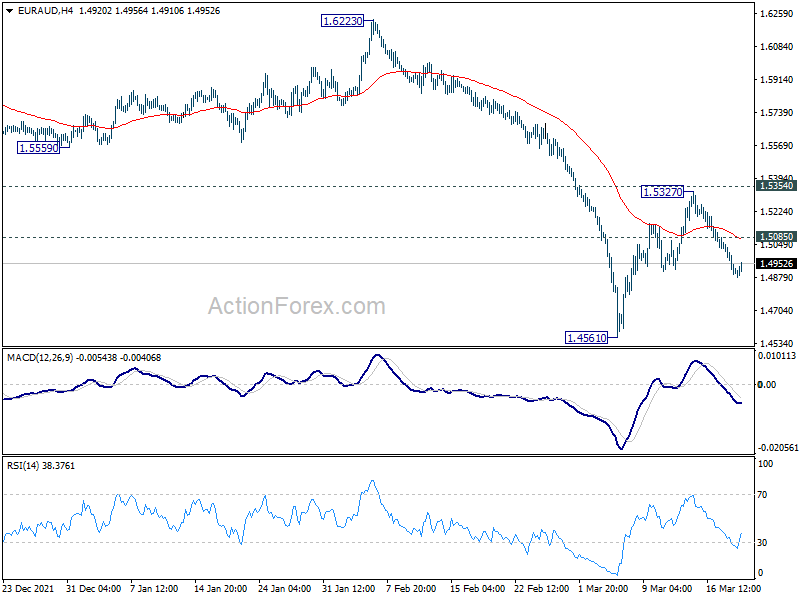
In the bigger picture, fall from 1.9799 is seen as a long term impulsive move. Next target is 61.8% projection of 1.9799 to 61.8% projection of 1.9799 to 1.5250 from 1.6434 at 1.3623, which is close to 1.3624 long term support (2017 low). Some support could be seen there to bring interim rebound. But overall, break of 1.5354 support turned resistance is needed to be the first sign of medium term bottoming. Otherwise, outlook will stay bearish in case of recovery.