Sample Category Title
USD/JPY Eyes Upside Break As Russia-Ukraine Tension Escalates
Key Highlights
- Russia-Ukraine crisis sparked sharp moves in the market.
- Gold and oil prices rallied and broke many important hurdles.
- EUR/USD declined heavily below 1.1280, and GBP/USD tumbled below 1.3450.
- The US GDP increased 7% in Q4 2021 (Preliminary), up from 6.9%.
USD/JPY Technical Analysis
The US Dollar failed to surpass 116.40 against the Japanese Yen. USD/JPY corrected lower, but it remained stable above the 114.40 support.
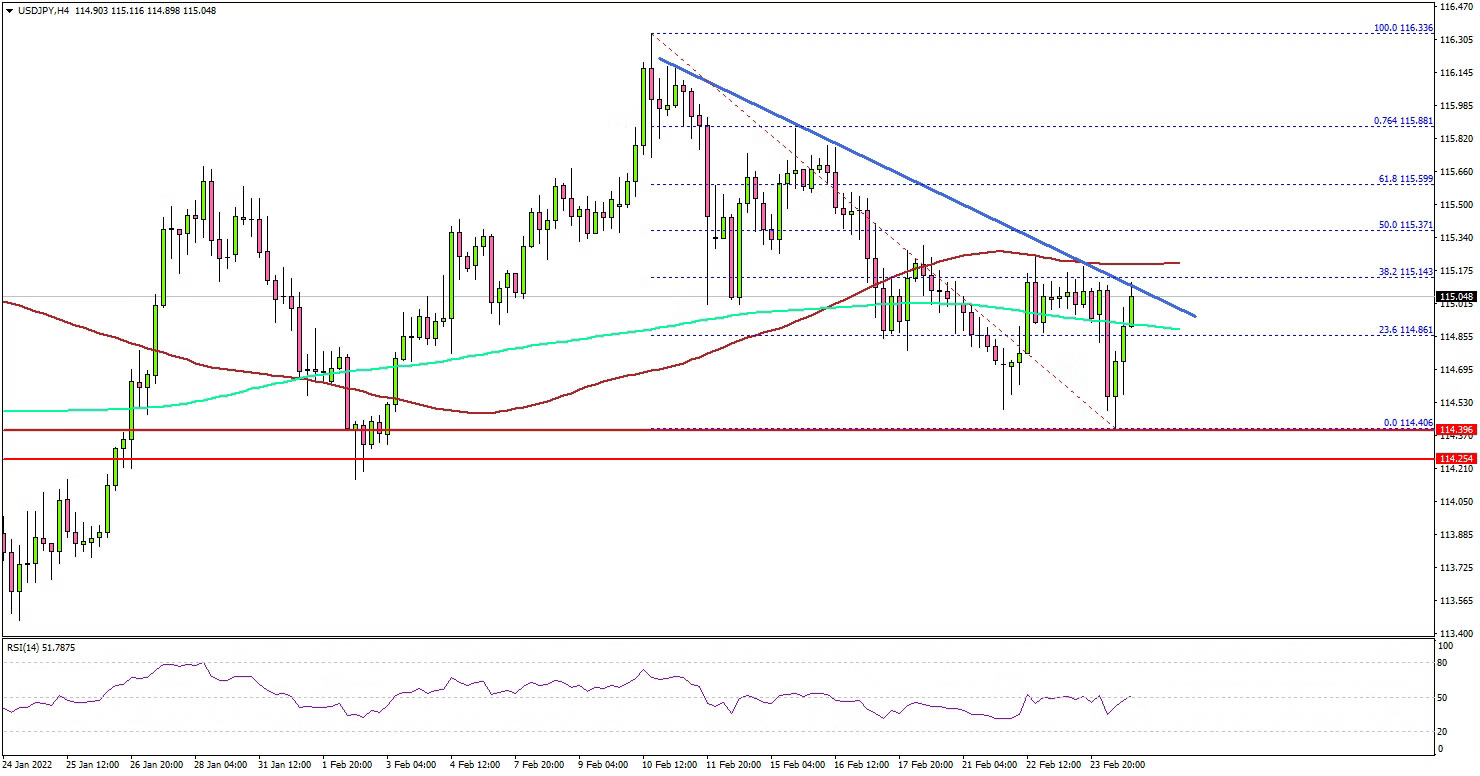
Looking at the 4-hours chart, the pair traded as low as 114.40 and recently corrected higher. There was a move above the 23.6% Fib retracement level of the downward move from the 116.33 swing high to 114.40 low.
It is now attempting an upside break above the 115.20 resistance and the 100 simple moving average (red, 4-hours). There is also a major bearish trend line forming with resistance near 115.20 on the same chart.
The next major resistance is near the 115.50 level. Any more gains might send the pair towards the 116.20 level. If there is no upside break, the pair could decline below the 114.65 level. The next key support is near 114.40.
If there is a downside break, the pair could decline towards the 114.25 level. Any more losses might send the pair towards the 113.50 level.
Fundamentally, the US Gross Domestic Product for Q4 2021 (Prelim) was released yesterday by the US Bureau of Economic Analysis. The market was looking for a 7% growth.
The actual result was similar to the market forecast, as the US Gross Domestic Product grew 7% in Q4 2021. Besides, the GDP Price Index climbed 7.3%, up from the last 7%.
Looking at EUR/USD, the pair declined heavily after Russia’s attack on Ukraine. Similarly, GBP/USD declined over 200 pips.
Economic Releases
- German GDP for Q4 2021 (YoY) (Preliminary) – Forecast 1.4%, versus 1.4% previous.
- German GDP for Q4 2021 (QoQ) (Preliminary) – Forecast -0.7%, versus -0.7% previous.
- Euro Zone Consumer Confidence for Feb 2022 – Forecast -8.8, versus -8.8 previous.
- US Durable Goods Orders for Jan 2022 – Forecast +0.8% versus -0.7% previous.
Fed Bostic: Events today in the Ukraine are on all of our minds
Atlanta Fed bank President Raphael Bostic said, "events today in the Ukraine are on all of our minds. We'll be watching this closely here in Atlanta and across the Federal Reserve system to assess the economic and financial impacts,"
He still thinks may need to hikes four or more times this year if high inflation persists. However, "I am really open to adjusting this as we get more clarity on how the economy is evolving...the data may come in perhaps more pessimistic in terms of how well we are doing on inflation and if it does I'm going to move my view, maybe 4 (hikes), and depending on how things go it may be more than that."
Euro in a Free Fall on Strong Risk Aversion; Key Levels Under Pressure
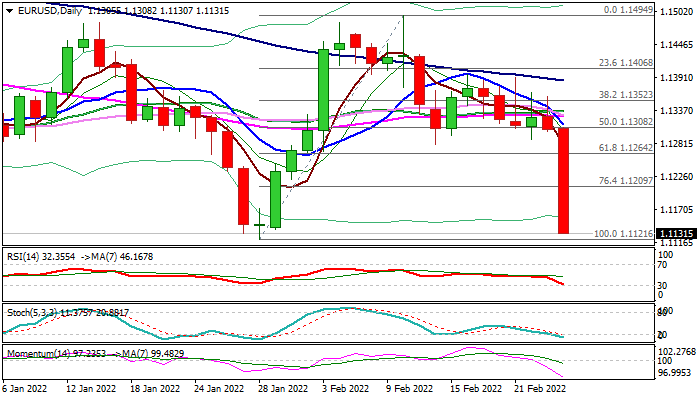
The Euro fell sharply on Thursday, losing 1.5% and hitting the lowest in more than three weeks against the dollar, as global uncertainty over Russian invasion on Ukraine dampened risk sentiment and prompted investors into safer assets.
Strong acceleration lower is on track to fully retrace 1.1121/1.1494 upleg that would signal A continuation of larger fall from 1.2349 (Jan 2021 peak).
Strong bearish signal was generated on break of pivotal Fibo support at 1.1186 (61.8% of 1.0340, 2017 low/1.2555, 2018 high) which looks for a confirmation on close below this level.
Bears eye next targets at 1.1040/1.1000 (Fibo 76.4% of 1.0635/1.2349 / psychological) violation of which would risk fresh bearish acceleration and open way towards 1.0635 (2020 low).
Bears may take a breather on strongly oversold daily studies but upticks are likely to be limited and to offer better levels to re-enter firmly bearish market.
Res: 1.1186; 1.1209; 1.1280; 1.1308
Sup: 1.1121; 1.1040; 1.1000; 1.0979
ECB Schnabel: Shock of war has clouded the global outlook
ECB Executive Board member Isabel Schnabel said in a speech, "how today's attack on Ukraine changes the euro area outlook is highly uncertain at this stage. We are monitoring the situation closely and will carefully evaluate the consequences for our policies."
But "predating the war", however, inflationary pressures will likely prove stronger and more persistent over both the near and the medium term". "policy optionality" is there fore needed.
The "calibration and the time of adjustment of our policy instruments are data-dependent", but the "sequence... is not". The forward guidance has provided the conditions for policy rates to be raised. Net purchases under the APP will stop "shortly before" rate hikes. Reinvestment will continue for an "extended period of time" past rate hikes.
Balance sheet adjustments may not be well-suited as the main instrument for controlling the overall stance. Hence "policy lift-off will predate with some distance a reduction of our balance sheet."
Overall, she concluded, the "shock of war hanging over Europe has clouded the global outlook". The "uncertainty speaks in favour of a gradual and data-dependent normalisation that respects the sequence that we have communicated, with a view to reducing uncertainty about our actions and intentions."
Research Russia: The SWIFT Sanction Option
- Due to the situation in Ukraine there are speculations about a possible blocking of Russia on the SWIFT network.
- This note explains briefly what SWIFT is and what blocking of Russia would mean.
In the wake of the Russian invasion of the Ukraine, western governments are contemplating a response toward Russia. Among the options being considered is excluding Russia from the SWIFT system and imposing sanctions on big Russian banks. We see a high likelihood that such actions will be adopted as they will be one of the most effective ways to hit the Russian economy.
SWIFT (Society for Worldwide Interbank Financial Telecommunication) is an industry owned organisation based in Belgium that offers software and a secure resilient network for exchanging financial messages.
SWIFT was founded in 1973 and today more than 11.000 financial institutions in over 200 countries are reachable on the SWIFT network. Also large corporate customers, central banks and financial market infrastructures such as clearing houses, central counter parties securities exchanges etc. are connected to the SWIFT network.
The SWIFT network supports a wide range of financial messages such as customer payments, financial institution transfers, treasury markets, collection and cash letters, securities markets, trade-finance and cash management. In short, all types of financial transaction messages.
SWIFT as a company does not have the authority to make sanction decisions. These decisions rest solely with government bodies and applicable legislators.
Today there are already sanctions on two Russian banks and a number of individuals, these sanctions are not specific to SWIFT but SWIFT messages to/from these banks or banks where the sanctioned individuals are customers are stopped by the relevant banks.
In case the relevant authorities impose additional sanctions on Russia (i.e. blocking Russia from SWIFT) it would mean that all messages transported by the SWIFT network sent/received directly from a Russian entity would be blocked. This means that customers will not be able to receive funds or send funds to Russian banks and companies.
This morning we published Research Russia – Russia launches a full attack on Ukraine, 24 February, in which we go into more details on markets movements and what to follow from here.
Japanese Yen Rises as Russia Launches Invasion
Hopes that diplomatic moves could avert a Russian invasion of Ukraine were shattered early Thursday, as Russia launched a full-scale attack. The move was not all that surprising, given the massive Russian buildup on the border with Ukraine during the past few weeks. Still, the fighting in the heart of Europe has weighed heavily on the financial markets, as risk appetite has fallen sharply. The safe-haven Japanese yen has gained ground and is trading at 3-week highs.
Western leaders have strongly condemned the Russian military operation, with NATO’s secretary-general calling it ‘a brutal act of war’. There will clearly be more sanctions headed Moscow’s way, but it’s doubtful that this will dissuade Russian President Putin from his aim to force Ukraine back into the Russian orbit. Western Europe is dependent on Russian natural gas and with the US showing no appetite for military intervention, things are looking extremely bleak for pro-Western Ukrainian President Zelensky.
Japan’s CPI expected to rise
On the economic calendar, Japan releases Tokyo Core CPI for February later today. CPI is expected to rise to 0.4%, up from 0.2% in January. Earlier in the week, BoJ Core CPI, the central bank’s preferred inflation gauge, rose 0.8%, lower than the 0.9% gain beforehand. Japan’s inflation has been moving higher, although nowhere near the clip we’ve seen in the US and the UK. Still, with the Russian invasion in Ukraine likely to push energy prices even higher, inflation in Japan should continue on an upswing.
Brent crude pushed above USD 100 for the first time since 2014, as the Ukraine conflict threatens to disrupt oil deliveries from Russia, a major producer. The timing couldn’t be worse for the central banks of the major economies, which are struggling to contain red-hot inflation. The Fed is still expected to hike rates in March, but it may have to put a pause on additional hikes if economic conditions deteriorate.
USD/JPY Technical
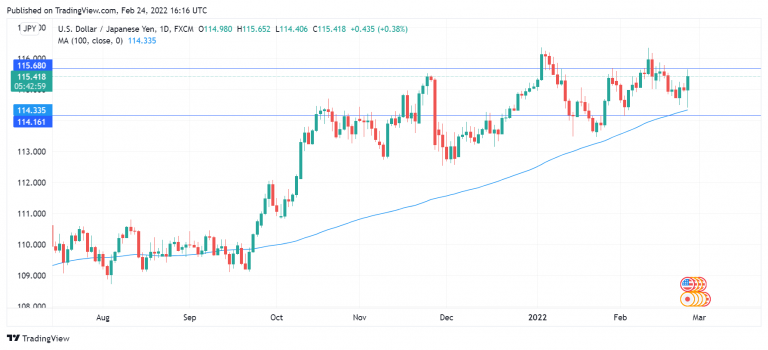
- The 100-DMA at 114.35 is a major support level. Close by, there is support at 114.16
- 115.68 is under pressure as resistance. Above, there is resistance at 116.30
Sunset market Commentary
Markets
Financial markets were more or less prepared for Russian military presence in the Donbas region earlier this week, but not so much for the current demilitarization on the rest of Ukrainian soil, probably with the aim of quickly installing a pro-Russian regime in Kyiv. The main moves occurred during Asian trading, but persisted during European hours. The jury remains out on the direction during the US session, but early indications suggest temporary relief at best. We start the market wrap-up on stock markets. Since the start of the year, they’ve experienced a bumpy road. First and foremost because of global monetary policy normalization. Second as geopolitics came into play. Apart from energy markets and Russian assets, stock markets so far proved to be most vulnerable to the conflict. Main European benchmarks currently lose 3% to 5%. The EuroStoxx 50 dropped below the 3867 pre-Covid high. A confirmed break in this week’s close suggests a return to 3608 (38% retracement on 2020-2021 rally). US stock markets open around 2% weaker. The S&P 500 extends a sell-on-upticks pattern while also dropping below the neckline of a bearish head-and-shoulders formation (<4140). Turning to commodity markets, Brent crude rallies impressively from $97/b to nearly $106/b, the highest level since August 2014. European gas prices rise nearly 50% intraday. The Dutch TTF Natural gas future trades around €125/Mwh from around €75 at the start of the week. Soft commodities like corn or wheat add around 5%. Both will aggravate the European/global inflation spiral and toughen policy dilemma’s for central banks. Metal prices add 3%-5%. The gold price surges from $1912/ounce to $1965/ounce. The 2020 top stands at $2063. Core bonds remained rather weak overall despite this year’s fragile risk climate. It tells a lot about the strength of the underlying trend. Also today, we think that gains actually could have been bigger. US Treasuries outperform German Bunds. European assets face some additional risk premium today. The US yield curve bull steepens with yields sliding 8.1 bps (30-yr) to 10.9 bps (2-yr). The US 10-yr yield tested this week’s low at 1.84%, but a break lower didn’t occur. German yields lose 3.6 bps (2-yr) to 6.4 (10-yr) in more of a bull flattening move. Bunds outperform swaps. Yield declines on the European swap curve are limited between 2.3 bps and 4 bps with the belly of the curve doing better than the wings. Peripheral yield spreads widen by up to 4 bps vs Germany with Greece (+8 bps) underperforming. The US dollar and Japanese yen keep a fine balance on FX markets after an early attempt of JPY to outperform. USD/JPY currently changes hands around the 115 big figure. EUR/USD dives from the 1.13 area to 1.1150 currently. The YTD-low at 1.1121 remains the line in the sand. EUR/GBP initially followed EUR/USD lower, but eventually the safe haven logic prevailed. EUR/GBP couldn’t force a test of EUR/GBP 0.8282 support and rebounded higher in the direction of 0.8360. EUR/CHF trades below 1.03 for the first time since the Summer of 2015.
Central European markets evidently facing the largest economic and monetary consequences of the conflict between Russia and Ukraine. They will sharply feel the dilemma between negative growth risks and the risk of a further acceleration of inflation that central banks are fiercely fighting since H2 2021. Since the start of the year, it looked that the Czech central bank, but also the Hungarian central bank and the Polish central bank finally could enjoy support from a strengthening currency as their policy tightening gained market credibility. This help from the FX-channel evaporated in no time with the Czech koruna this week losing 3.5% (against the euro), the Polish zloty ceding 3.5% and the Hungarian forint even declining 4.75%. Looking at pricing in short-term interest rate contracts, markets apparently conclude that especially the MNB and the NBP will come under pressure to raise rates even further to avoid the spiral of a weaking currency and rising inflation to reaccelerate. Hungarian and polish money market rates are rising about 35 bps and 20 bps respectively. The rise in Czech rates is much more limited even as markets again take into account a rise of the policy rate to the 4.75% or even 5.0% area. Markets are in the eye of the storm and will look for a new equilibrium in the next days. Even so, especially for the MNB and the NBP which finally gained some market credence in the anti-inflation crusade today’s developments are an ‘unwelcome reset’.
USD/CAD Mid-Day Outlook
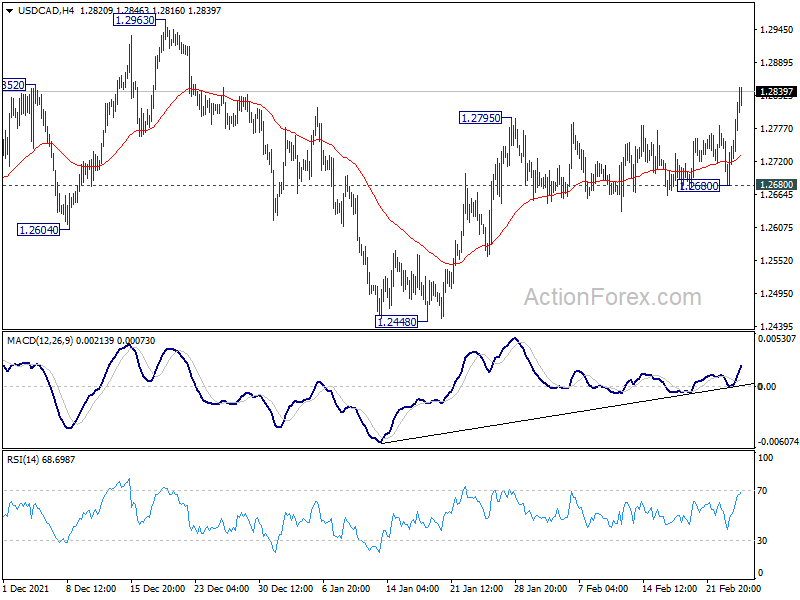
Daily Pivots: (S1) 1.2688; (P) 1.2729; (R1) 1.2777; More...
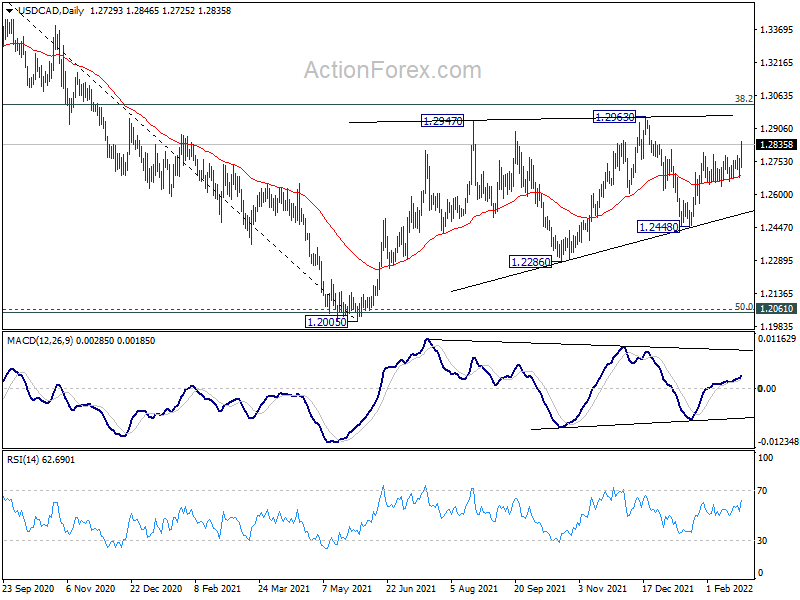
USD/CAD's rise from 1.2448 resumed by breaking 1.2795 resistance. Intraday bias is back on the upside for 1.2963 resistance first. Break there will target 1.3022 long term fibonacci level next. For now, outlook will remain bullish as long as 1.2680 support holds, in case of retreat.
In the bigger picture, focus stays on 38.2% retracement of 1.4667 (2020 high) to 1.2005 (2021 low) at 1.3022. Sustained break there should confirm that the down trend from 1.4667 has completed after defending 1.2061 long term cluster support. Further rise would then be seen towards 61.8% retracement at 1.3650. However, rejection by 1.3022 will maintain medium term bearishness. Break of 1.2005 will resume the down trend from 1.4667 and that carries larger bearish implications too.
USD/JPY Mid-Day Outlook
Daily Pivots: (S1) 114.91; (P) 115.05; (R1) 115.18; More...
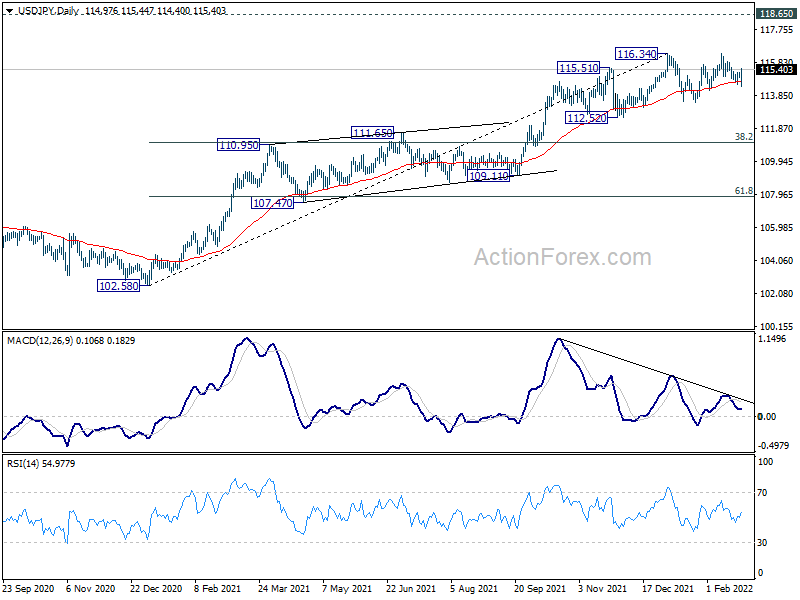
USD/JPY's break of 115.23 minor resistance mixes up the near term outlook. Intraday bias is turned neutral first. On the upside, firm break of 116.34 will resume larger up trend from 102.58 to 118.65 long term resistance next. On the downside, though, break of 114.40 will continue the corrective pattern from 116.34 with another fall to 113.46 support.
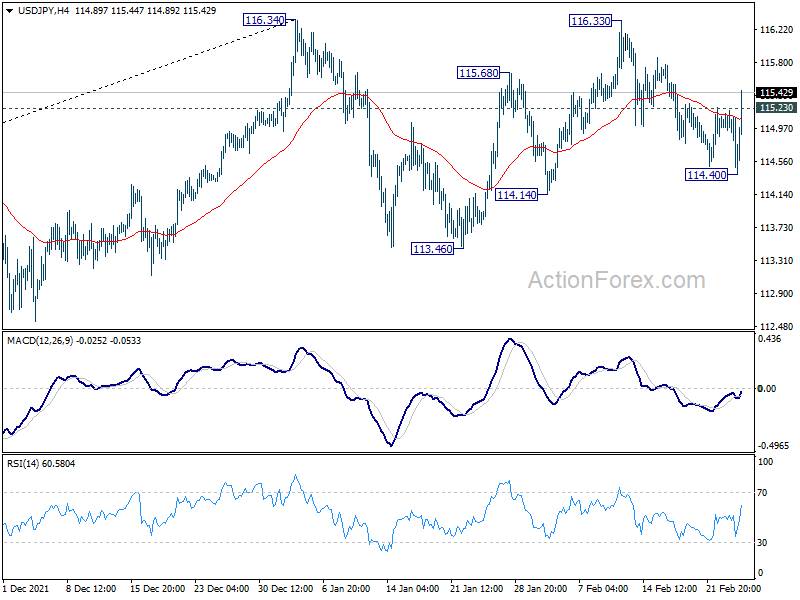
In the bigger picture, no change in the view that rise from 102.58 is the third leg of the up trend from 101.18 (2020 low). Such rally should target a test on 118.65 (2016 high). Sustained break there will pave the way to 120.85 (2015 high) and raise the chance of long term up trend resumption. This will remain the favored case as long as 55 week EMA (now at 111.61) holds.