Sample Category Title
The Crypto market lost 10% today on the Russia-Ukraine crisis
The cryptocurrency market has lost 11% in the past 24 hours, and as the situation develops and investors from Europe and America join the trading, the focus of the decline shifts from Bitcoin to altcoins. At the time of writing, losses of the former cryptocurrency are close to 10%, while ETH, XRP are down 13-14%. Cardano, Avalanche, Dogecoin have even bigger losses, with declines of more than 17%.
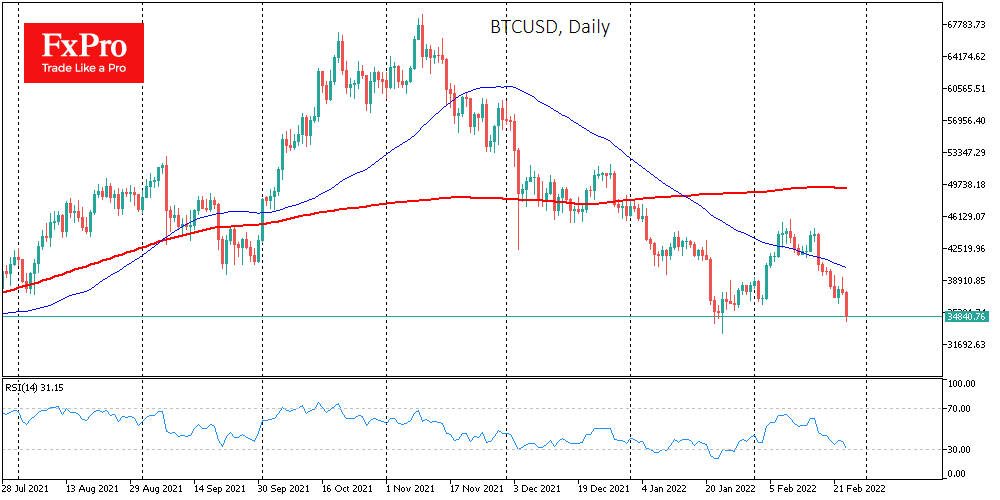
Right now, the markets have the highest demand for liquid instruments, making Bitcoin slightly less of a risk than altcoins. It is likely that a further deterioration in the financial situation could benefit the first cryptocurrency as a means of capital savings for investors from Ukraine, Russia, and some nearby countries, mainly CIS.
At the same time, the continued flight from risky assets, including equities, could temporarily destabilise altcoins, so it is possible that we will see double-digit losses in altcoins more than once in the coming days. When the dust settles, prices may prove attractive for long-term investments, but for now, the risks are excessive.
According to Glassnode, the wallets of long-term investors (hodlers) hold record volumes of BTC (76.5%). The volume of bitcoins, which have been without movement for more than 10 years, is also growing (12.6%). Thus, almost 90% of all currently available coins are out of the market.
Now another country besides El Salvador may accept bitcoin as a means of payment. Senator Indira Kempis is developing a bill on cryptocurrencies and intends to convince the Mexican government to follow the “Salvadorian scenario” by recognizing BTC as a means of payment.
Former SEC official Joseph Hall called the department’s chances of losing the lawsuit against Ripple high. The regulator accuses the company of selling unregistered securities under the guise of XRP tokens.
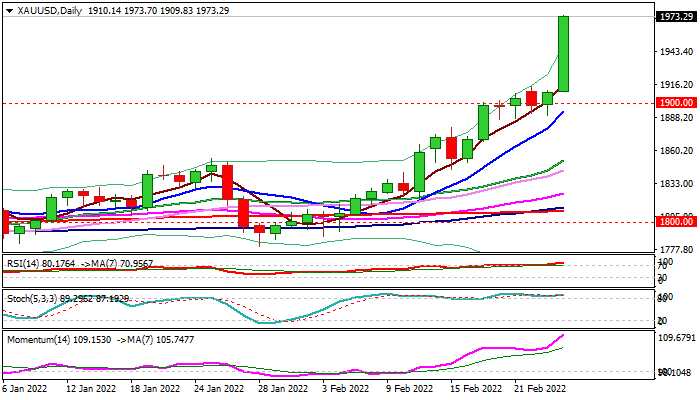
XAU/USD outlook: Gold Surges Towards $2000 on Safe-Haven Buying as War in Ukraine Starts
Spot gold advanced over 3% this morning, hitting the highest since September 2020, as traders massively run into safety after Russia launched military action against Ukraine.
Strong bullish acceleration rose well above $1950, with Fibo barrier at $1980 (76.4% of $2074/$1676) to likely easily surrender and open way for renewed test of psychological $2000 level, which was dented in August 2020, during coronavirus pandemic, but break proved to be false and followed by strong pullback to $1676.
Rising uncertainty on fears that current conflict, which is still limited, could escalate, strongly inflates gold price, which is on track for a record monthly gains in February.
Renewed probe through $2000 level looks very likely now, with break higher to face targets at $2015 and $2049, ahead of a record high at $2074, posted on August 2020.
The metal’s performance will directly depend on the development of the situation in Ukraine, with dips so far seen as good buying opportunities.
Supports lay at $1950 (round-figure/upper 20-d Bollinger band); $1914 (former high of Feb 22) and psychological $1900 level.
Res: 1980; 2000; 2015; 2049.
Sup: 1950; 1924; 1914; 1900.
EURUSD Plunges Below 1.1200, Posting 3-Week Low
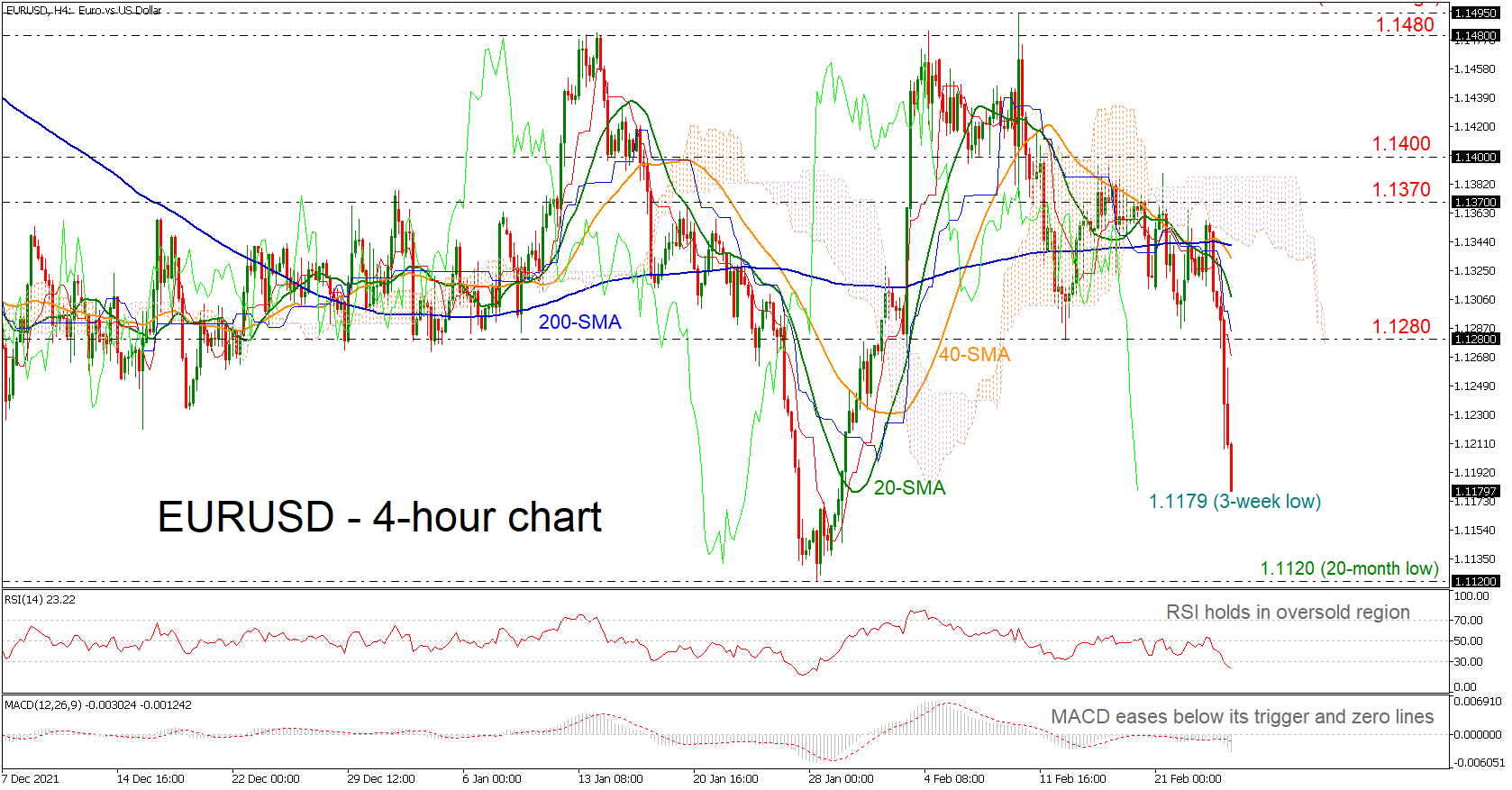
EURUSD is tumbling below the 1.1200 psychological level, reaching a new three-week low. The price pulled back off the simple moving averages (SMAs) creating a strong selling interest. The RSI indicator is reaching the oversold territory, while the MACD is strengthening its negative momentum below its trigger and zero lines.
If the price plunges further, the next stop could be around the 20-month low of 1.1120. Steeper decreases in the market could meet the inside swing high of April 2020 at 1.1016.
On the other side, a recovery to the upside could hit the 1.1280 resistance ahead of the 20-period SMA at 1.1308. More bullish actions could find the next barrier at the 40- and 200-period SMAs at 1.1333 and 1.1343 correspondingly.
All in all, EURUSD is posting a strong negative move in the short-term and this outlook may change only if there is a significant jump above the 200-period SMA.
WTI Futures Surge Past 100 Mark Sparked by Russia’s Attacks on Ukraine
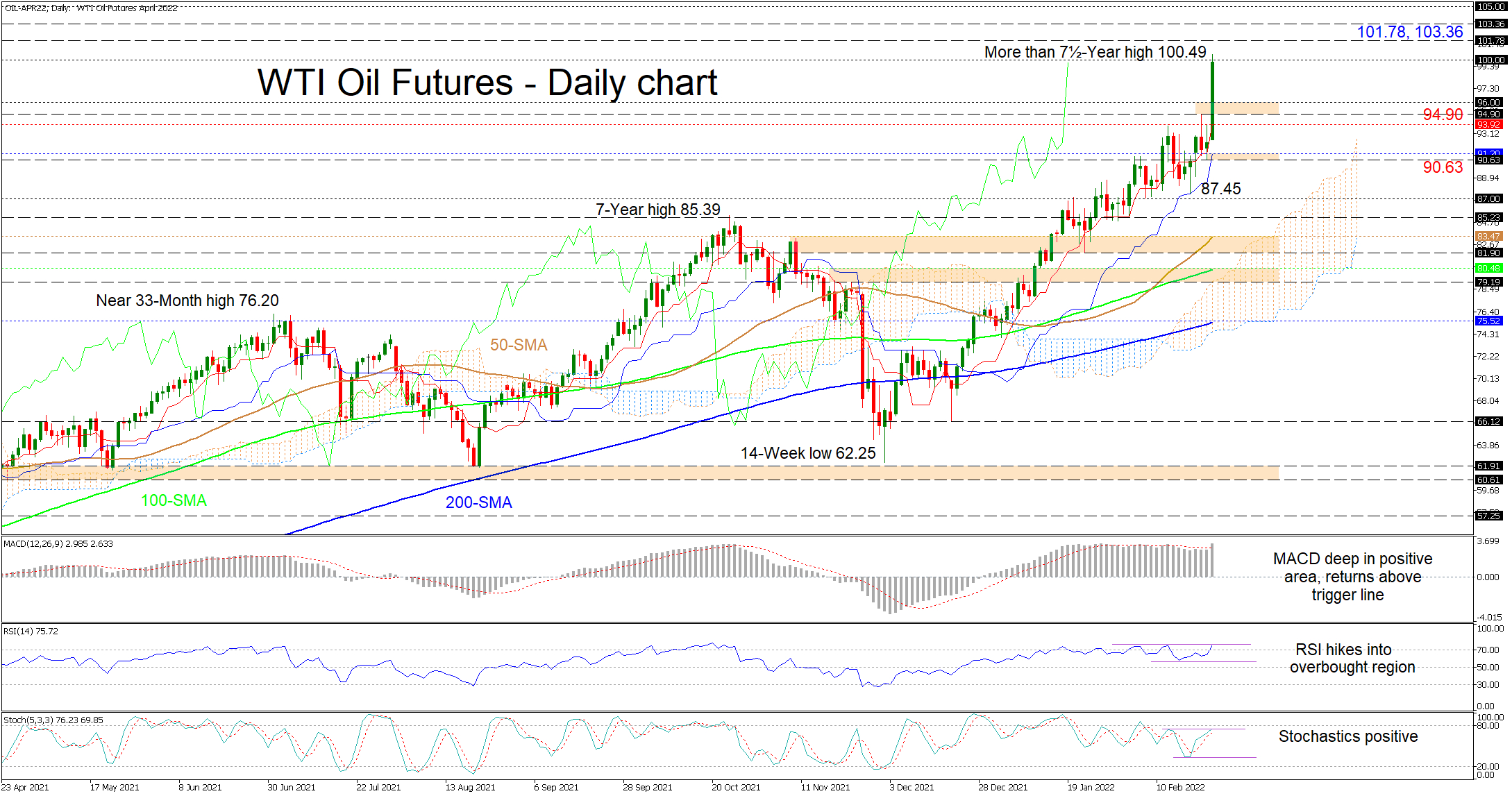
WTI oil futures have pierced above the 100 dollar per parrel mark after starting the day with a quarter of a dollar gap higher, before rocketing past the previous multi-year high of 95.00. The ascending simple moving averages (SMAs) are endorsing the uptrend from the 14-week low of 62.25, reinforcing the broader positive structure.
The soaring Ichimoku lines are indicating that bullish forces continue to remain fired up, while the short-term oscillators reveal no signs of vulnerability in positive momentum. The MACD is some distance north of the zero mark and has thrusted back above its flattened red trigger line, while the RSI is improving above the 80 level. The positively charged stochastic oscillator is promoting additional gains in the black liquid.
If buying pressures persist, the 100.00 psychological mark, even though having been slightly breached, could somewhat weigh on the price. In the event this critical border is clearly overthrown, the price of the commodity may then aim for the 101.78 obstacle and the 103.36 high, identified back in the later part of July 2014. Surpassing these barriers could then open the door for the bulls to pursue the 105.00 level.
In the event upside pressures subside and the price retreats below the 100.00 mark, a more profound withdrawal beneath would be needed to reveal where the next support currently stands, which is at 94.90-96.00. If a deeper correction develops, the red Tenkan-sen at 93.92 may provide some downside friction ahead of the 90.63-91.20 support band, existing between the latest trough and the blue Kijun-sen line respectively. Sinking further, the 87.45 low and the 87.00 handle could provide some footing for the commodity.
Summarizing, WTI oil futures are exhibiting a powerful bullish bias above the 90.63 trough and the SMAs. For negative forces to gain an advantage, the price would need to sink below the 87.45 trough.
Gold to target 2074 high on upside acceleration
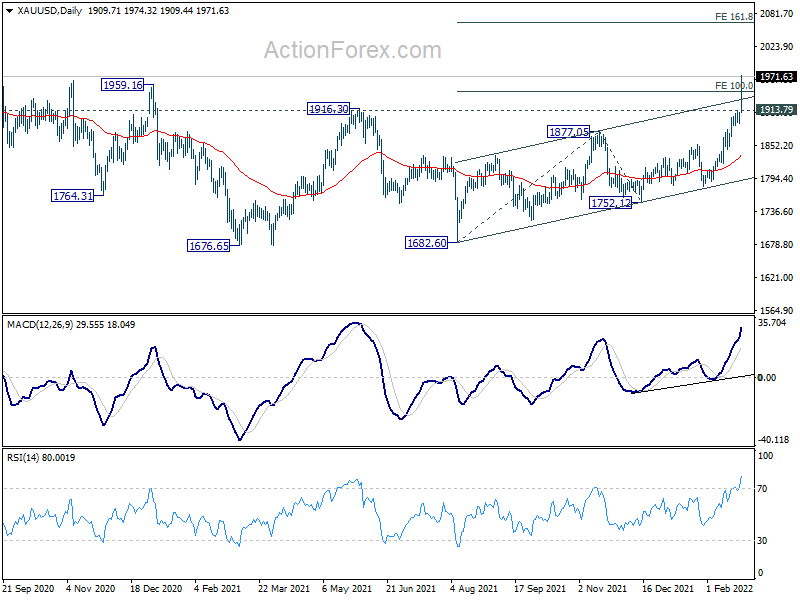
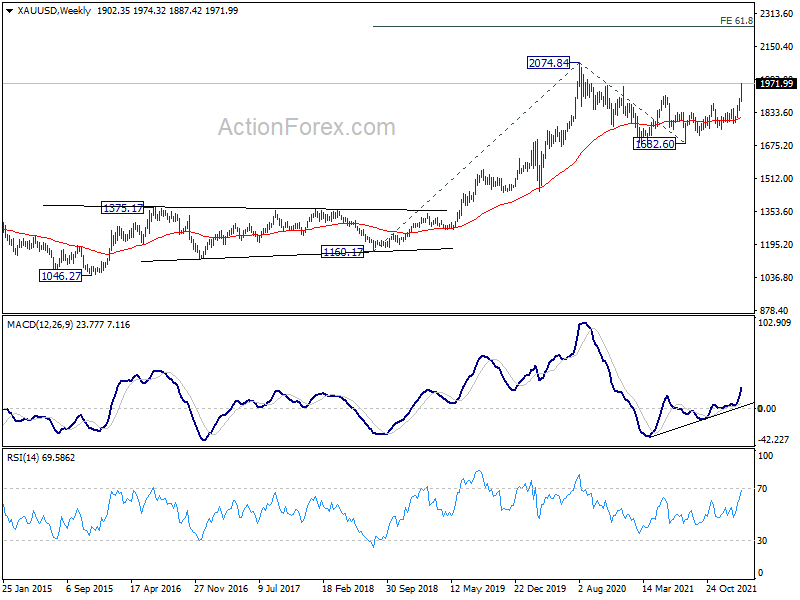
Gold's rally continues further today and powers through, 100% projection of 1682.60 to 1877.05 from 1752.12 at 1946.57. This is a clear sign of upside acceleration. In any case, outlook will stay bullish as long as 1913.79 resistance turned support holds. Next target is 161.8% projection at 2066.74, which is close to 2074.84 high.
Also, the chance of long term up trend resumption is increasing with current rally. On break of 2074.84, next medium term target will be 61.8% projection of 1160.17 to 2074.84 from 1682.60 at 2247.86.
WTI oil breaks 100 with upside acceleration, 107.4 next
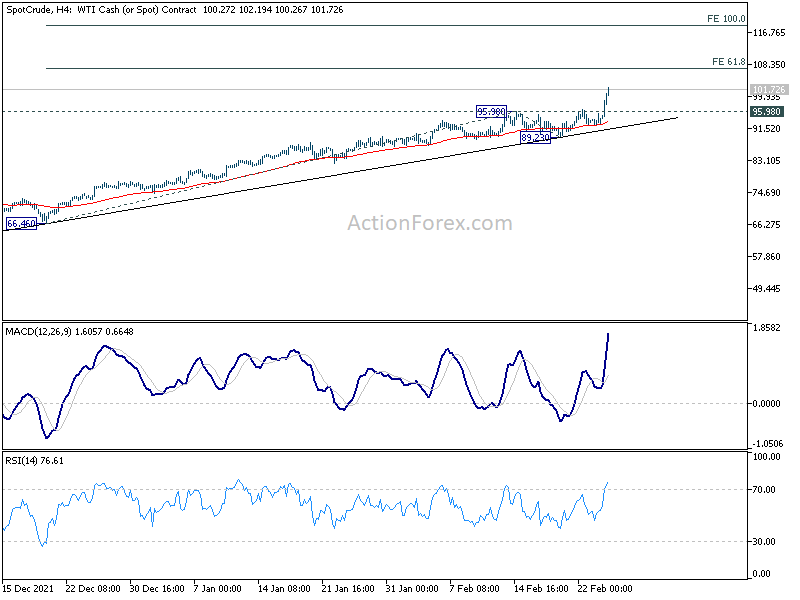
WTI crude oil surges sharply as Russia started invading Ukraine, and it's now above 100 handle. For the near term, outlook will stay bullish as long as 95.98 resistance turned support holds. Next target is 61.8% projection of 66.46 to 95.98 from 89.23 at 107.43.
Note that 4 hour MACD clearly indicates that it's in upside acceleration. Firm break of 107.43 could prompt further acceleration to 100% projection at 118.75.
Stocks Crash, Oil Surges as Russia Attacks Ukraine
- Markets in turmoil after Putin launches military assault on Ukraine
- Stocks tank, rouble plummets, while gold, oil and gas futures jump
- Dollar, yen and franc only gainers in FX sphere
Fears of full-scale invasion as Ukraine crisis deepens
Traders in Europe and around the world woke up to a dark day on Thursday after Russia’s latest actions confirmed the West’s worst fears about Ukraine. Russian President Vladimir Putin has ordered a “special military operation”, targeting military infrastructure in the east of Ukraine, prompting Kyiv to impose martial law.
Although Putin has indicated his aim is not to “occupy” Ukraine, further and more severe sanctions against Russia are likely to follow from the United States and its allies. Even if Russia’s main intention is to demilitarise Ukraine and halt NATO’s expansion into Eastern Europe and the West doesn’t intervene militarily, things could still get very bloody on the ground. This then begs the question of how far the US and Europe would go in punishing Russia.
Commodities rally amid supply fears
Markets are already anticipating a greater risk of disruption to Russia’s energy exports, either directly or indirectly from Western sanctions. Oil prices have shot up more than 7% today, with Brent crude futures breaking above $100 a barrel for the first time since August 2014. WTI futures, meanwhile, have crossed above $99 a barrel and could soon hit the $100 mark too.
Natural gas futures also soared, raising alarm in Europe, which is already struggling with skyrocketing fuel bills. But the ripples of war didn’t end there as grain prices also jumped. Russia and Ukraine are major exporters of grains such as wheat and corn and the escalating conflict poses a threat to the world supply of those commodities.
Concerns about tighter supply from the Ukraine fallout also pushed up the price of some base metals like aluminium and nickel, while in precious metals, gold and silver were more than 3% higher in European trading today.
Gold’s rally briefly lost steam before reaching the significant resistance area around $1,960/oz but the bulls are now in a clear battle to overcome it.
Stocks tumble as investors flee to safety
It was an entirely different picture in equity markets as stocks around the world plunged. European bourses tracked Asian markets to fall deep into the red at the open. Germany’s Xetra DAX briefly crashed below the 14,000 level and the Paris CAC 40 was last quoted 3.4% lower on the day. Energy stocks supported London’s FTSE 100, however, which slipped by a more moderate 2.4%.
US stock futures remained in negative territory following steep losses on Wall Street on Wednesday. The Nasdaq Composite is dangerously close to entering a bear market as tech stocks continue to bear the brunt of the selloff.
In bond markets, sovereign yields dipped across the board, with the 10-year US Treasury yield hitting a low of 1.86%. Nevertheless, although yields are off their peaks from earlier this month, the pullback is modest given the scale of the flight to safety in recent days, as expectations of tighter monetary policy is maintaining upwards pressure.
Dollar and yen in demand, kiwi and euro sink the most
Other than gold, the Japanese yen has been the main winner from the worsening Ukraine crisis, though the US dollar and Swiss franc have seen increased safe-haven traction over the last 24 hours too.
In contrast, the euro’s post-ECB gains have been wiped out. It’s just fallen below the $1.12 level as worries mount about the economic impact of a war in Ukraine on Eurozone members.
There’s been growing hawkish soundbites coming out of the ECB lately, with chief economist Philip Lane being the latest to signal that bond purchases might be wound down sooner than expected.
Fed Governor Mary Daly also appeared to be turning more hawkish in overnight remarks. Investors have been slightly paring back their expectations of rate hikes by the major central banks as the events in Ukraine unfold. However, there is a risk that policymakers might need to act even more decisively than before if the geopolitical tensions exacerbate the surge in energy prices.
But it remains to be seen how much the US dollar would be able to capitalize on Fed rate hike bets getting revived. The dollar index was last up 0.7% as the riskier currencies slumped.
The New Zealand dollar was the day’s worst performer, followed by the euro, aussie and sterling. The loonie’s losses were somewhat kept in check by higher oil prices. But the Russian rouble nosedived to an all-time low of 89.99 to the dollar.
AUD/USD Seeks Support
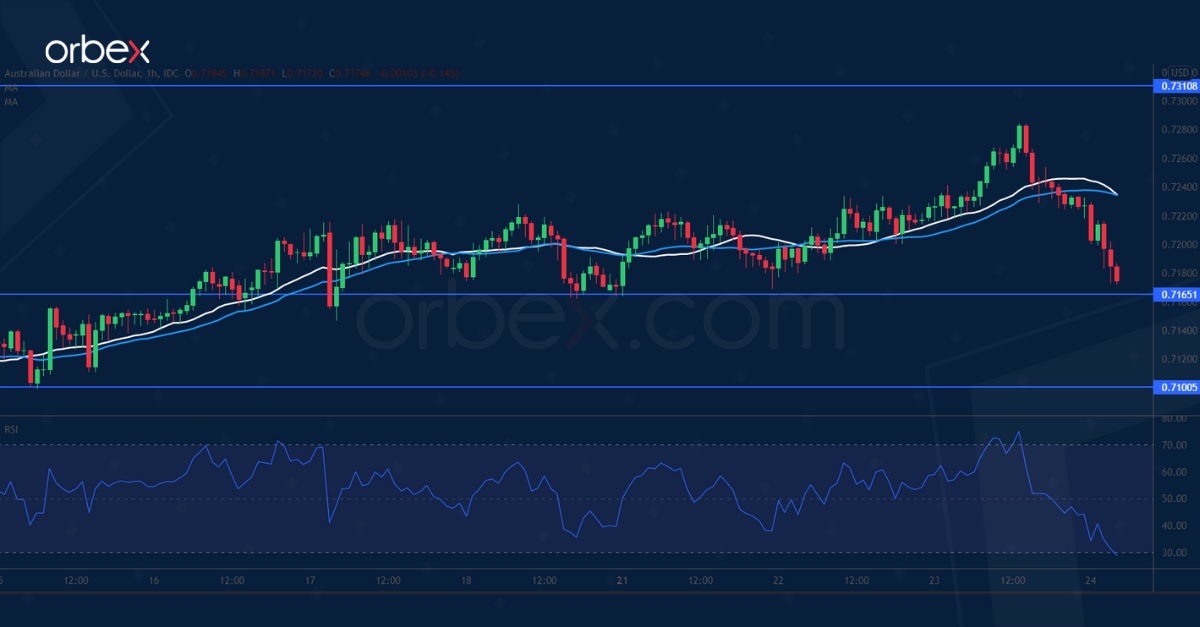
The Australian dollar retreats amid cautious market sentiment. A break above the recent peak at 0.7245 suggests a strong bullish commitment.
The pair is heading towards January’s high at 0.7310. A bullish breakout could turn things around in the medium term. After the RSI ventured into the overbought area, the bullish impetus stalled as intraday buyers took profit.
0.7165 is the next support as the RSI swings into the oversold area. Further down, 0.7100 is a key floor to keep the rebound intact.
NZD/USD Hits Resistance
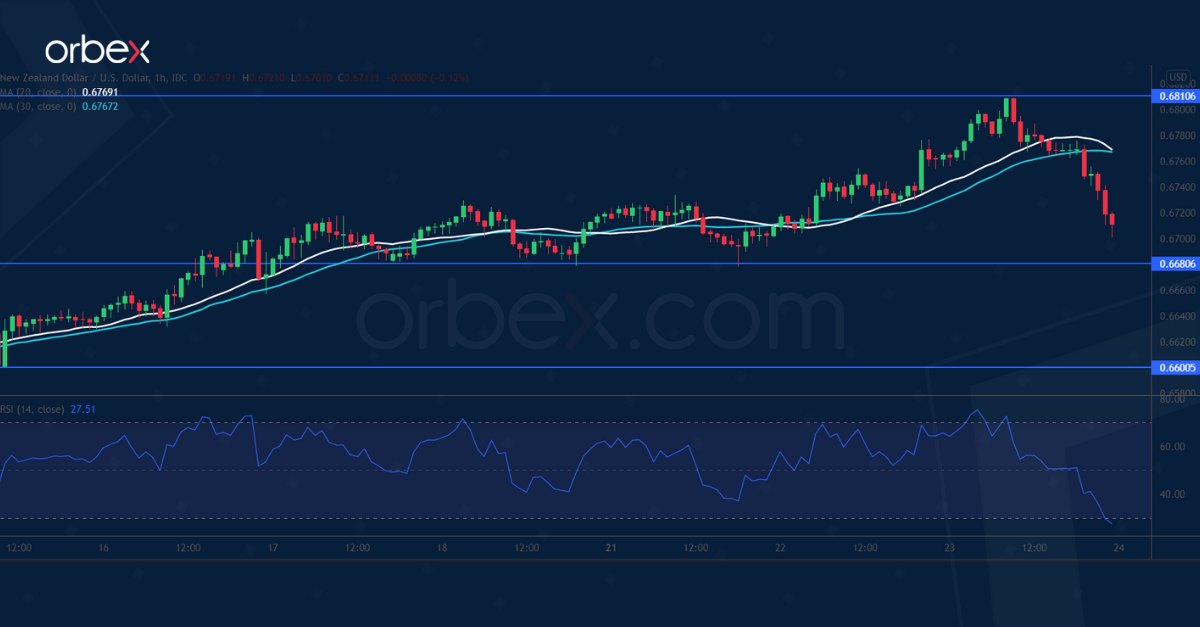
The New Zealand dollar jumped after the RBNZ raised rates for the third time in a row. The pair met selling pressure in the supply zone (0.6810) from the sell-off in late January.
An overextended RSI led short-term bulls to take profit in that congestion area. However, the rebound trajectory may attract buying interest with the current pullback seen as an opportunity.
0.6680 is the next support after a drop below 0.6730. A deeper correction may test 0.6600, which is important support from the daily chart.
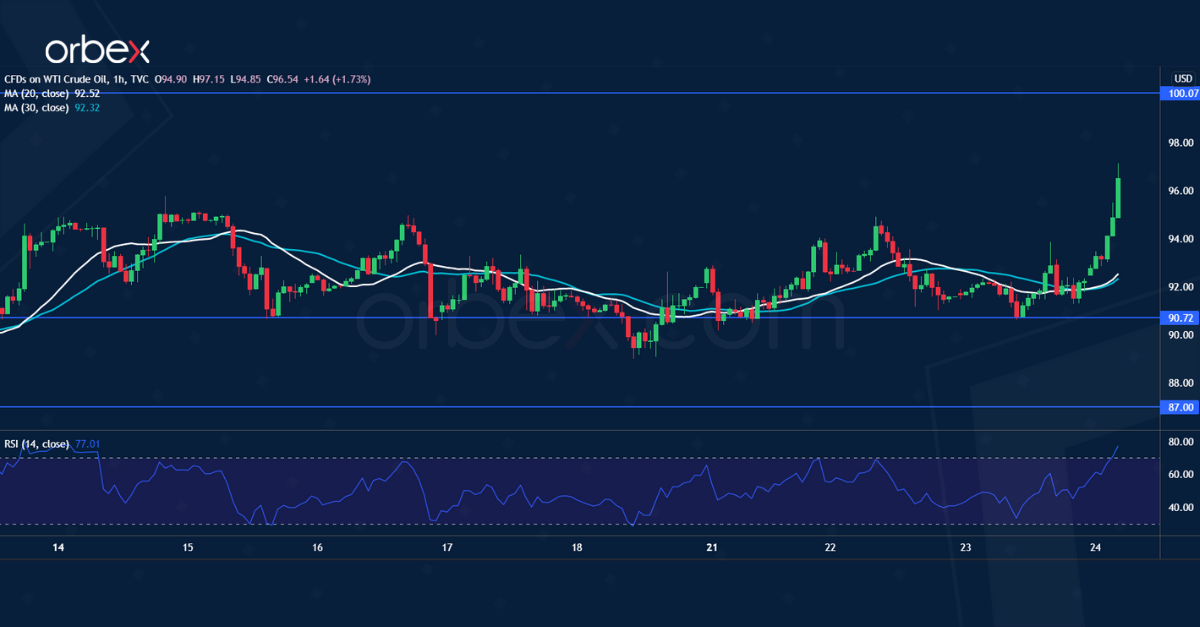
US Oil Continues to Climb
WTI crude surged after Russia launched a military operation in eastern Ukraine. The latest market jitters met support over 90.70 which sits next to the 20-day moving average.
Sentiment would stay optimistic as long as price action is above this demand zone. A previous horizontal consolidation allowed the bulls to catch their breath and accumulate for the current push.
A close above 95.50 would send the price towards the landmark 100.00. An overbought RSI may cause a brief pause if momentum traders take profit.