Sample Category Title
Pound Steady as Retail Sales Rebound
UK retail sales bounce back
UK retail sales rebounded in January, with a gain Uof 1.9% m/m, its highest monthly gain since April 2021. The increase followed a decline of 4.0% in December and beat the consensus of 1.0%. The Omicron variant of corona continues to have a significant impact on consumer spending. The December drop was a result of consumers doing their Christmas shopping in October and November, while the January rise reflected the easing of health restrictions. With Covid regulations set to expire due to falling infection rates, we should see consumer spending continue to accelerate.
The Bank of England remains under strong pressure to raise rates at its meeting in March. The markets have priced in a quarter-point hike in March at 100%, and the BoE will likely follow up with more hikes until inflation, which is at a 30-year high, is brought down. We can expect the BoE to deliver a more gradual pace of rate hikes than what has been priced by the markets.
The Russia/Ukraine border remains extremely tense, although a feared invasion on Wednesday did not materialize. Tensions heightened on Thursday after a skirmish in a border region which the West feared was a pretext for a full-scale invasion. This sent the financial markets tumbling as risk sentiment dissipated. The US has disputed Russia’s claim that it has reduced its forces on the border and says an invasion could occur at any time. Still, there is a ray of light for a diplomatic solution, as the US and Russian foreign ministers will meet next week, so an invasion appears to be on ice, at least for now. It’s a safe bet that market direction next week will be largely set by developments in the Ukraine crisis and market participants should be prepared for volatility.
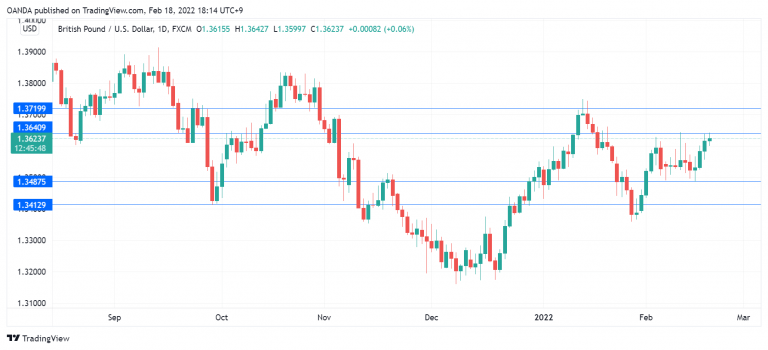
GBP/USD Outlook: Cable Establishes Above 1.36 Pivot, Additionally Supported by Upbeat UK Retail Sales
Cable maintains firm tone and stays above broken 1.3600 barrier in early Friday, extending advance into fourth straight day and on track for the third consecutive bullish weekly close.
Pound remains underpinned by expectations of BoE rate hike, while better than expected UK retail sales data showed strong recovery from the knock of latest wave of Omicron variant in December, when many shops were closed and provided fresh boost to sterling.
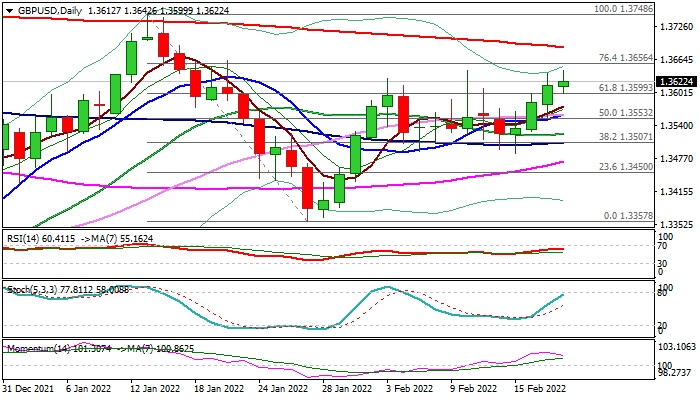
Thursday’s eventual close above pivotal 1.3600 resistance (Fibo 61.8% of 1.3748/1.3357 descend, where rallies were repeatedly capped in past one month) generated strong bullish signal which will be confirmed on a weekly close above this level.
Technical studies on daily chart remain in full bullish setup and support the action, however, fading bullish momentum and north-heading stochastic approaching the border of overbought zone, warn that bulls may pause for consolidation before resuming.
Broken 1.3600 level reverted to solid support, with extended dips to find ground above daily Tenkan-sen (1.3565) and keep bulls in play.
Res: 1.3656; 1.3687; 1.3700; 1.3748.
Sup: 1.3600; 1.3565; 1.3524; 1.3507.
GBPJPY Could Still Reap Benefits Despite Sideways Move
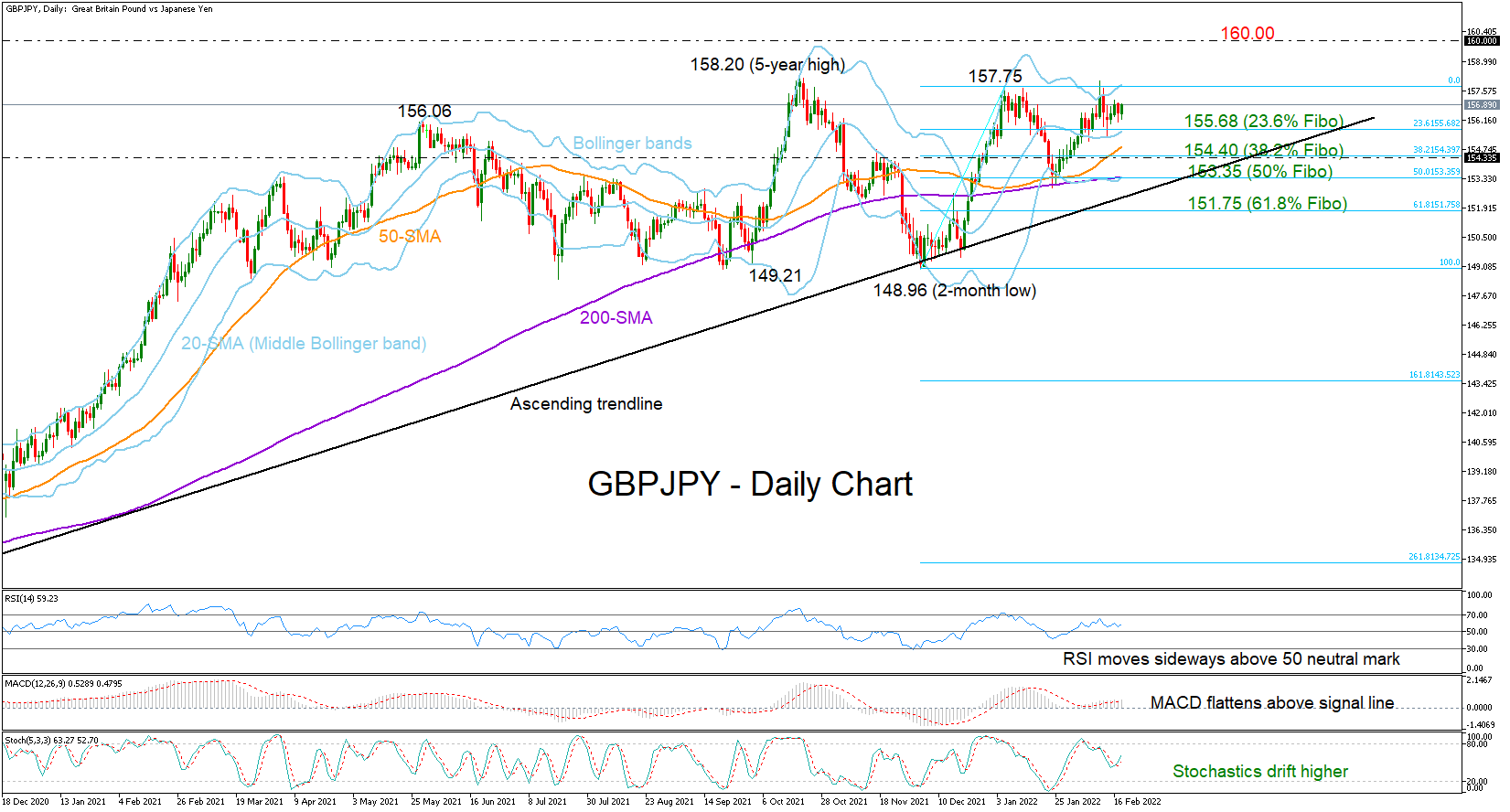
GBPJPY has been quite neutral this week, tiptoeing sideways, below the 157 level, but the market action continues to take place above the 20-day simple moving average (SMA) and the upper bullish Bollinger area, suggesting buyers are still eager to move.
Although lacking direction, the RSI is fluctuating above its 50 neutral mark and the MACD is flattening above its red signal line, while the green %K Stochastic line has drifted back above the red %D line, all keeping the bias tilted to the upside.
A decisive close above the 157.75 – 158.20 ceiling is now required to attract new buyers into the market, and hence clear the way towards the 160 psychological level. Running higher, the price could hit a wall around the early 2016 limitations at 163.85.If that proves an easy obstacle, the ascent could stretch towards the next resistance of 166.00.
On the downside, a step below the nearby support of 155.68, which coincides with the 23.6% Fibonacci retracement of the 148.96 – 157.75 upleg, could send the price towards the 38.2% Fibonacci of 154.40 unless the 50-day SMA rejects the bears beforehand. Should downside pressures intensify, the 200-day SMA and the 50% Fibonacci of 153.35 may attempt to catch the fall ahead of the crucial ascending trendine drawn from the 2020 lows, currently sitting at 152.40. Otherwise, the spotlight will turn to the 61.8% Fibonacci of 151.74, where any violation may navigate the pair straight to the 148.96 low.
In brief, GBPJPY has the potential to revive its bullish momentum after a period of consolidation, though only a sustainable extension above the 157.75 – 158.20 boundary could add fresh bullish fuel to the market.
SPX 500 Consolidates
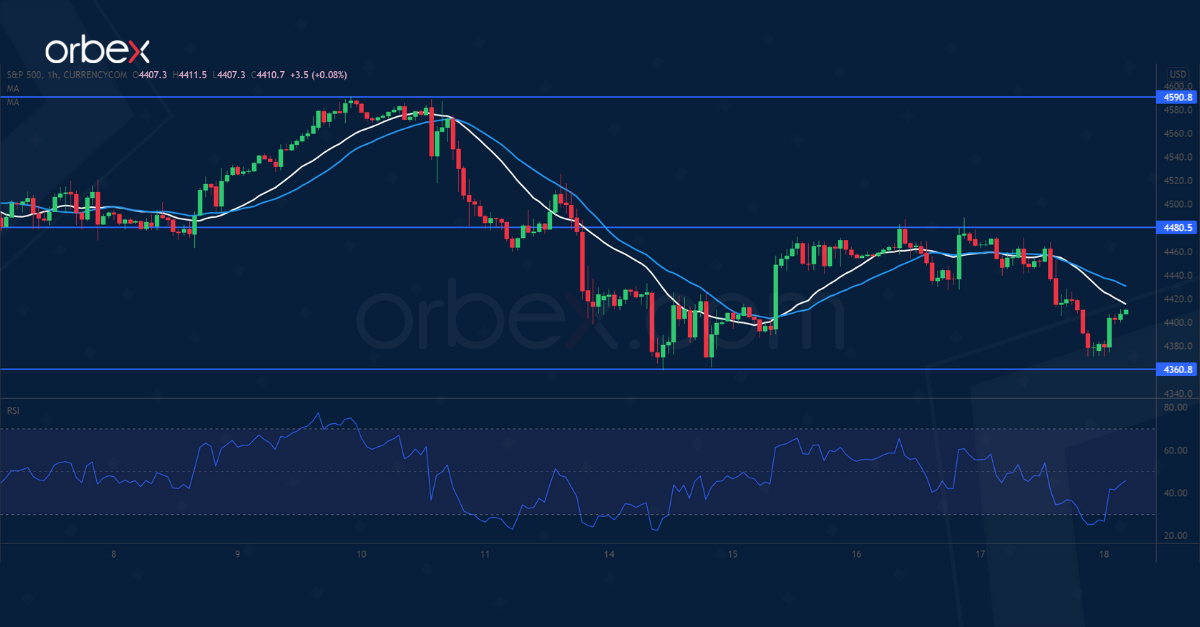
The S&P 500 struggles as the Russia-Ukraine crisis persists. The previous rebound has met stiff selling pressure over the 30-day moving average (4590).
A pullback has sent the RSI into the oversold territory, triggering some buyers’ interest in racking up the bargain. The rebound is still valid as long as the index stays above the critical area of 4280.
A break above 4480 may extend gains to the double top at 4590 which is an important resistance. 4360 is the immediate support if the sideways action lingers.
NZD/USD Tests Resistance
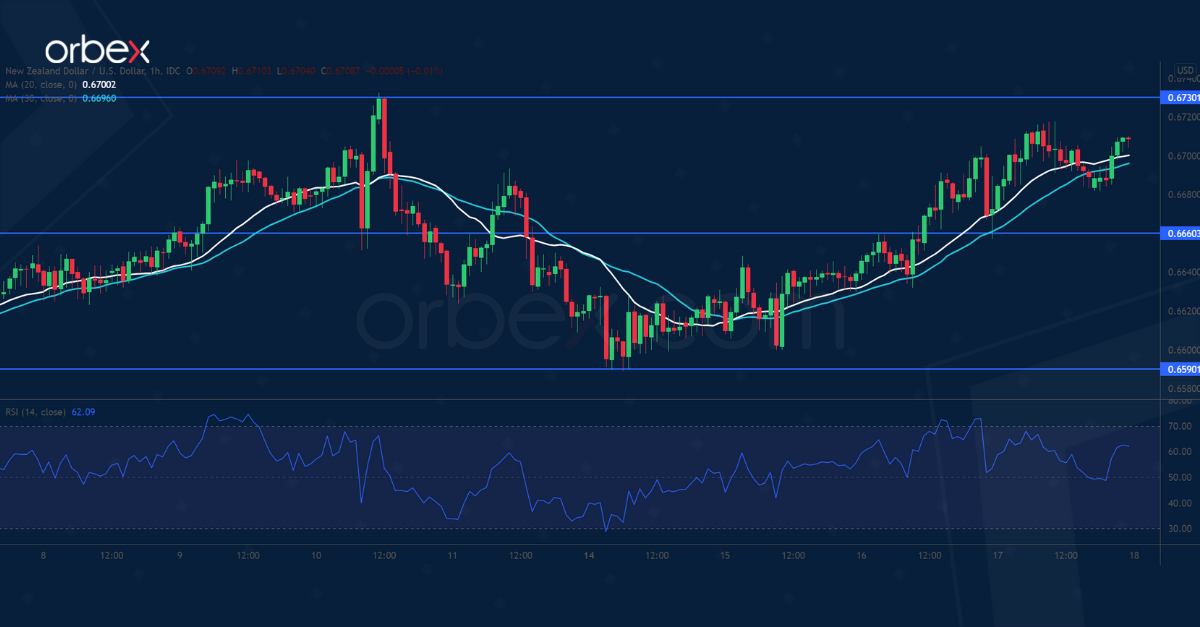
The New Zealand dollar climbed higher as the RBNZ can lift its cash rates next week.
Price action came under pressure on the 30-day moving average (0.6730). However, strong support at 0.6590 builds a case for a potential reversal.
A break above 0.6690 is an encouraging sign leaving 0.6730 as the last obstacle before a bullish extension. A broader rally would bring the kiwi back to January’s high at 0.6890.
In the meantime, an overbought RSI caused a brief pullback towards 0.6660.
AUD/USD Attempts to Break Out
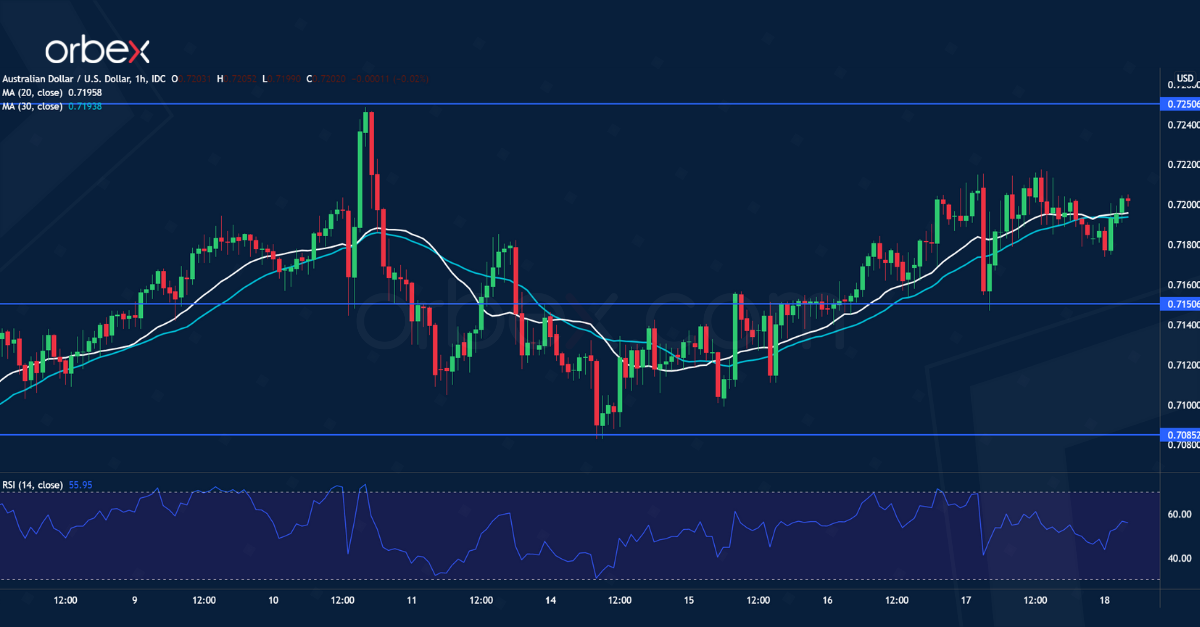
The Australian dollar finds support from a low jobless rate in January.
The pair has previously hit resistance in the supply zone around 0.7250. This is a daily resistance from the sell-off in late January. Then a recovery above 0.7180 suggests solid buying pressure before a bearish mood could take hold again.
A break above the key hurdle could initiate a bullish reversal above this year’s peak (0.7310). Otherwise, a prolonged consolidation may test the demand area between 0.7100 and 0.7150.
Daily Technical Analysis
EUR/USD
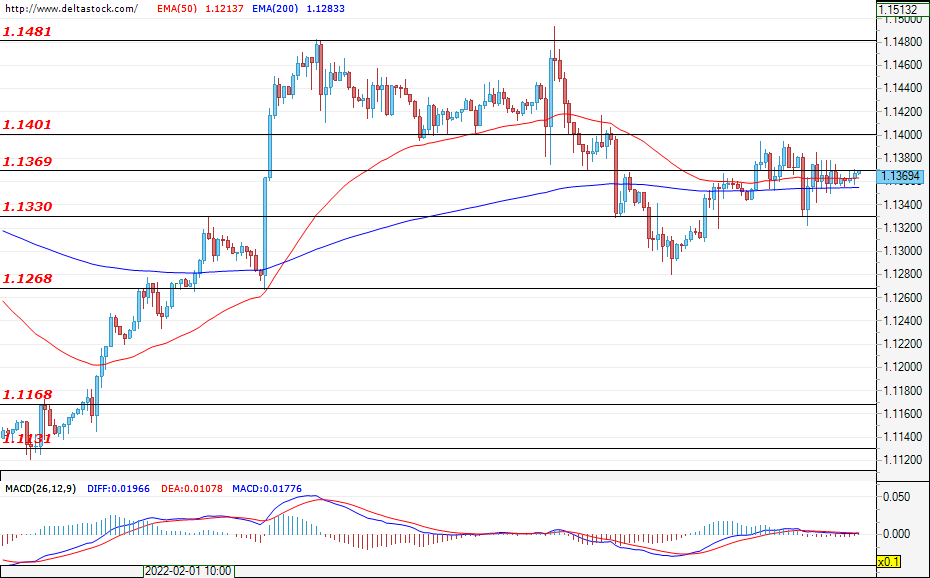
During yesterday's trading session, the currency pair consolidated just below the resistance zone at 1.1370, and at the time of writing, it is headed towards a test of this resistance. A confirmed breach of 1.1370 would encourage the bulls to re-test the psychological level of 1.1400. In case the bears return to the market, then we could witness a test of the first support levels, found respectively at 1.1330 and at 1.1268. During today's trading session, the most important economic news that would be of interest to the market participants will be the U.S. existing home sales data (15:00 GMT).
USD/JPY
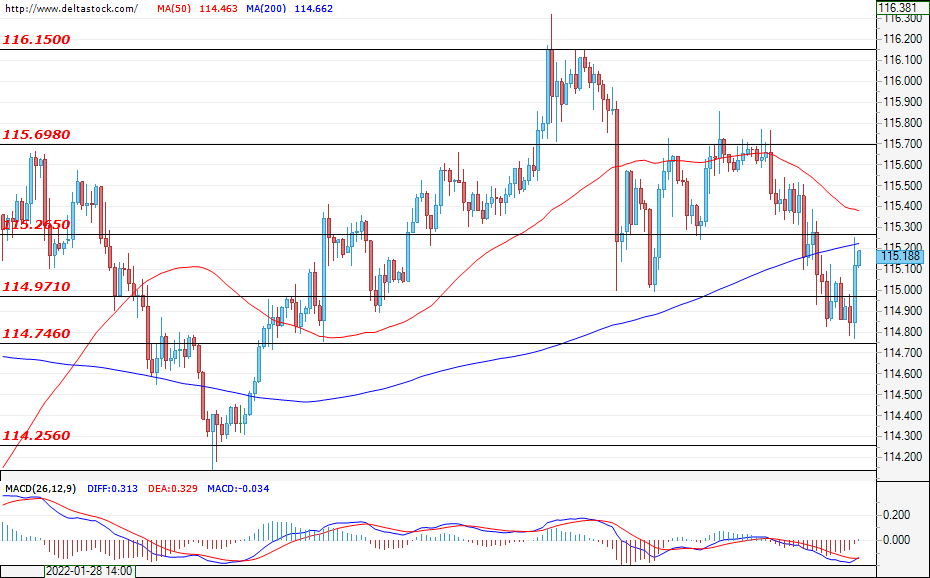
During the second half of yesterday's trading session, the Ninja violated the support level of 114.75, but in the early hours of today, the dollar managed to partially regain its losses against the yen. At the time of writing, the pair is headed towards a test of the resistance at 115.26. In case the USD/JPY manages to breach this resistance, then it would re-enter the range of 115.26 – 115.70, in which it had been trading until yesterday. In the negative direction, the first support lies at 114.97.
GBP/USD
During the second half of yesterday's trading session, the Ninja violated the support level of 114.75, but in the early hours of today, the dollar managed to partially regain its losses against the yen. At the time of writing, the pair is headed towards a test of the resistance at 115.26. In case the USD/JPY manages to breach this resistance, then it would re-enter the range of 115.26 – 115.70, in which it had been trading until yesterday. In the negative direction, the first support lies at 114.97.
EUGERMANY40
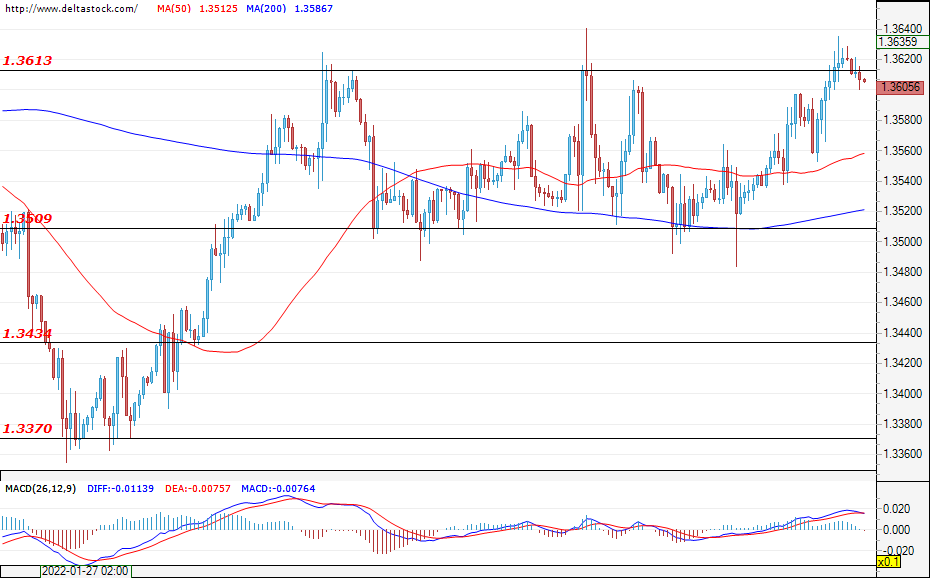
The German index plunged yesterday, but the sell-off was limited slightly above the support at 15075. In the early hours of today, the index gradually recovered its losses and, at the time of writing, is headed towards a test of the resistance level of 15300. The forecast is for the index to breach 15300 and re-test the next resistance of 15460. The uneasy situation in Ukraine continues to weigh on the market, and sharp moves in either direction can be expected today.
US30
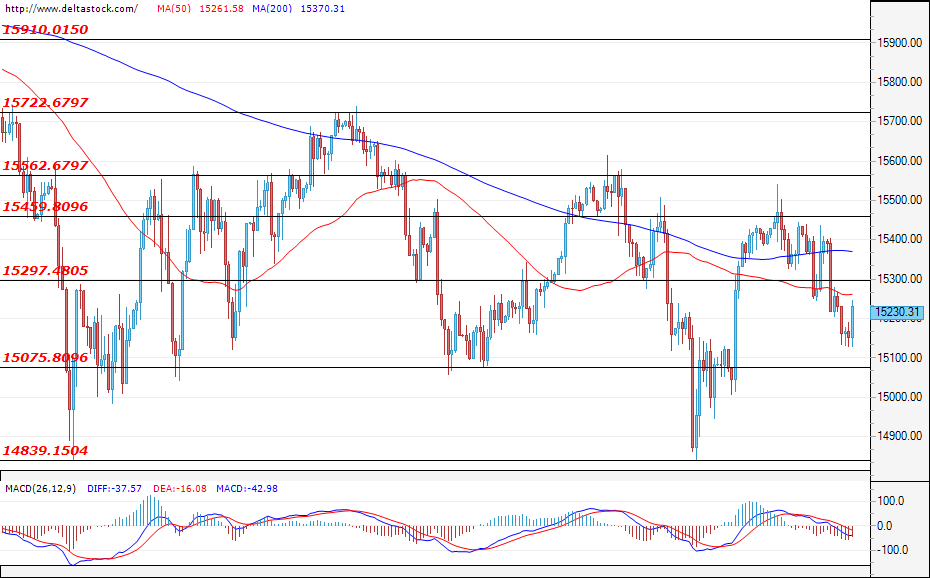
In the early hours of today's trading session, the U.S. blue-chip index breached the resistance level of 34420 and the forecast is for the index to rise and test the resistance levels of 34785 and 35065. In the negative direction, the mentioned level of 34420 is now acting as support for the index. During today's trading session, the most important economic news that would be of interest to the market participants will be the U.S. existing home sales data (15:00 GMT).
Gold and US Equities Diverge as Global Risks Rise
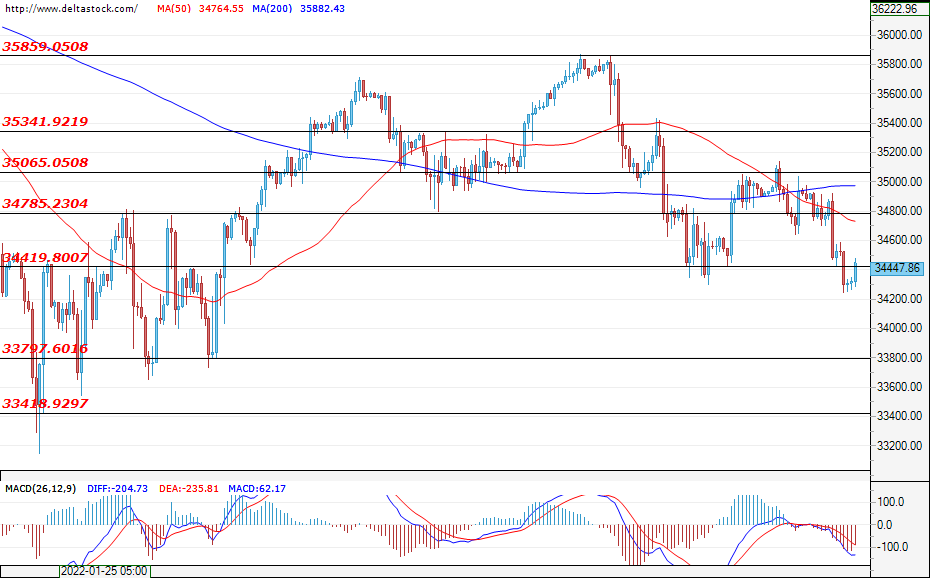
American stocks declined sharply after Joe Biden delivered a major warning about the crisis in Ukraine. In a press conference, he warned that Russia was on the brink of attacking Ukraine. He claims Russia is engaged in a false flag operation as an excuse to go in. The statement came as the two countries blamed each other for clashes that started on Thursday. The Dow Jones and Nasdaq 100 declined sharply while gold and the US dollar rose.
The US dollar rose after a slew of mixed economic data from the US. on Thursday, data by the Bureau of Labor Statistics (BLS) showed that the number of initial jobless claims rose to 248k last week. They have risen in the past few weeks. Further data showed that housing starts declined from 1.7 million to 1.63 million in January/ Building permits, which is important data, also declined from 1.61 million to1.63 million. These numbers came a few hours after the Fed published hawkish FOMC minutes.
The economic calendar will have some important economic data today. In the morning session, the UK will publish the latest retail sales data. Analysts expect the data to show that sales held steady in January, with the headline figure rising by 8.7%. Core sales are expected to have risen by 7.9% in January. Sweden will publish the latest inflation data while the Fed will publish its monetary policy report. Canada will also deliver its retail sales data.
XAUUSD
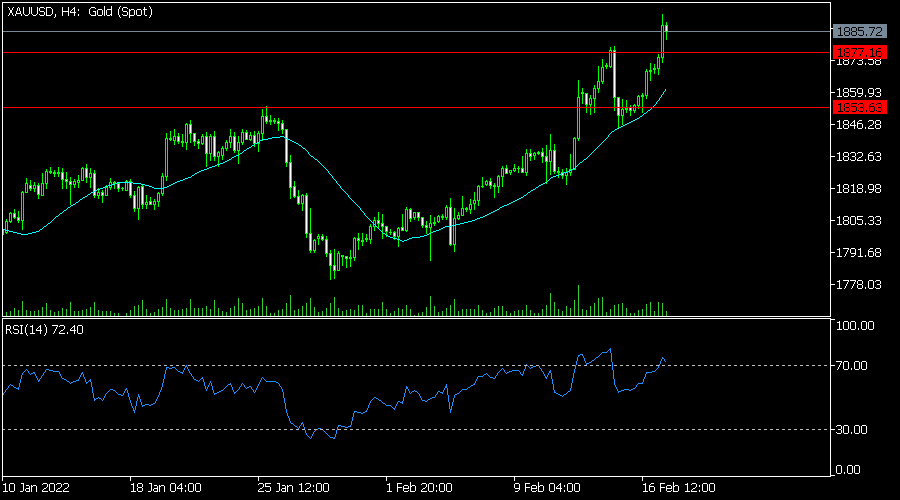
The XAUUSD pair jumped sharply as investors rushed to safe assets. It rose to a high of 1895, which is significantly higher than this month's low of 1,820. It moved above the 25 and 50-day moving averages while oscillators like the Relative Strength Index and MACD also kept rising. Therefore, the pair will likely continue rising as the crisis escalates.
EURUSD
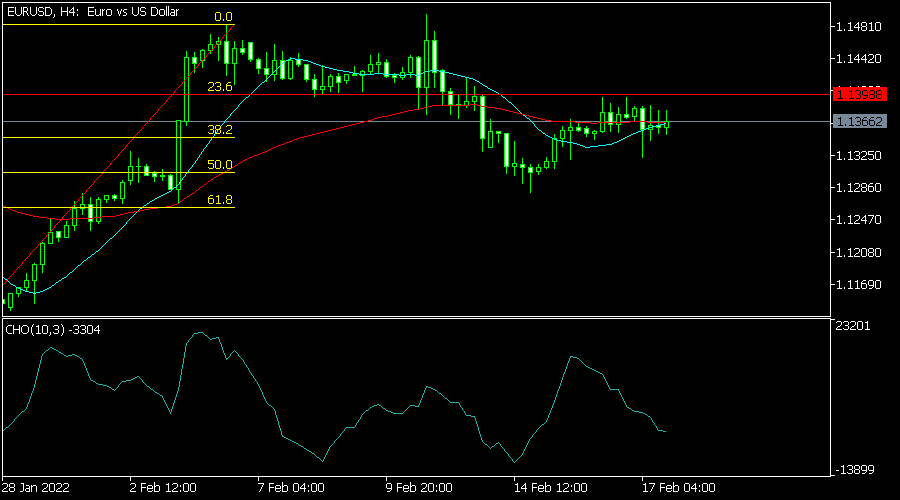
The EURUSD pair moved sideways in the overnight session after mixed economic data from the United States. It is trading at 1.1367, where it has been in the past few days. On the four-hour chart, the pair is trading at the same level as the 25-day and 50-day moving averages. It is also trading between the 38.2% and 23.6% retracement levels. Therefore, the pair will likely remain in this range today.
USDCAD
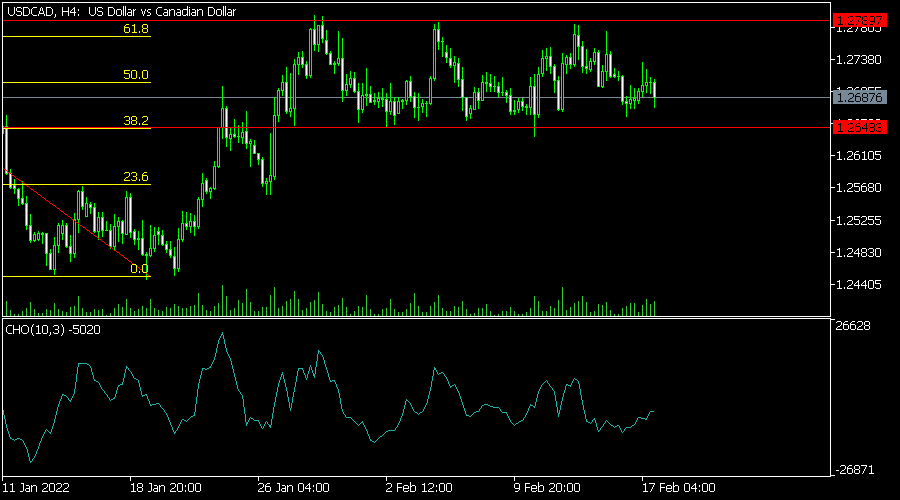
The USDCAD was in a tight range ahead of the upcoming Canada retail sales numbers. The pair is trading at 1.2692, which is between the support and resistance levels shown in red. It is also slightly below the 50% Fibonacci retracement level. The Chaikin oscillator has pointed upwards. Therefore, the pair will likely remain in this range later today.
ECB in Full Swing Towards Policy Normalization
Markets
In case you haven’t noticed it yet, the ECB is in full swing towards policy normalization. ECB President Lagarde acknowledged upward inflation risks at the previous ECB meeting. Executive board member Schnabel made a plea to take higher costs of home ownership into consideration when assessing inflation. For Q3 2021, she calculated that it would have added 0.6 ppt to core inflation (1.4%). Banque de France governor Villeroy doesn’t want Frankfurt’s hands to be tied for too long and calls net asset purchases to end in Q3.
ECB chief economist Lane completed the U-turn on inflation at an MNI Market News webcast yesterday. He said that it is unlikely that inflation will drop below 2% in the next two years. That’s a big head’s up to the new March inflation projections which will thus show an upgrade of the 1.8% figure for 2023 and that way warrant a different path going forward in terms of asset purchases. Lane did try to make a little nuance. He thinks that inflation will settle around the 2% target in the medium-term, which permits a gradual normalization of policy, i.e. winding down net asset purchases and getting rid of negative policy rates. For the ECB to really engage on a tightening cycle, Lane argues that there needs to be a threat that inflation will persist significantly above 2% over the medium term.
Money markets currently discount the latter scenario with a return to zero by the end of the year and a projected policy rate peak between 0.75% and 1% by the end of 2024. Our own scenario currently takes into account a 0.75% policy rate by the end of 2023.
Markets didn’t react to the symbolic Lane comments. General trends remained at play. Simply put: a fragile risk sentiment on stock markets, correcting core bonds and numbed FX markets. Main European equity indices lost up to 1% yesterday with US losses reaching up to 2.9% for Nasdaq.
US yields lost 5.2 bps to 8.4 bps with the belly of the curve outperforming the wings. The German yield curve bull steepened with yields sliding by 3.3 bps (30-yr) to 6.6 bps (2-yr). 10-yr yield spread changes vs Germany narrowed by up to 3 bps.
EUR/USD closed at 1.1361 from an 1.1373 open. Sterling continued its recent outperformance ending below EUR/GBP 0.84 for the first time since the ECB/BoE February policy meetings.
January UK retail sales this morning beat consensus. They grew by 1.9% M/M for the headline number and by 1.7% M/M for the core retail sales. The increase was driven by a pickup in spending on household goods and at garden centres. UK markets don’t react. Earlier this week, we’ve had a good labour market report and higher inflation numbers. The combination of these data keeps the BoE clearly on the normalisation path.
News Headlines
Contrary to price developments in many other countries, price rises in Japan in January remained subdued. Japan’s headline CPI eased from 0.8% Y/Y in December to 0.5% Y/Y. The closely watched measure excluding fresh food eased to 0.2% Y/Y, from 0.5%. Ex-fresh food and energy, prices even declined 1.1% Y/Y. All measures were lower than expected. Even so, Japanese inflation is expected to rise later this year as a base effect of a cut in mobile fees last year will drop out of the data. Energy prices rose 17.9% Y/Y. Even so today’s data suggest that Japanese firms remain reluctant to pass through higher input prices to end consumers. The yen eases slightly this morning. USD/JPY (115.25) regains the 115 handle after a risk-off driven setback yesterday/early this morning.
According to Reuters, a proposal to revive the 2015 nuclear deal with Iran is to work out subsequent steps that parties have to fulfil. A 20 page draft is said to include that Iran needs to halt enrichment of uranium above 5% purity. Other steps are said to include unfreezing of $7bn in Iran funds blocked at South Korean banks and the release of Western prisoners in Iran. The lifting of restrictions on the country’s oil sector would only come later in the process. As was the case in the original deal, the US would grant Iran waivers on sanctions rather than removing them all-together. The implementation of this whole process, assuming an agreement will be reached, can still take a few months. Brent oil this week eased from a top near $96.75 p/b to $92.75 currently.
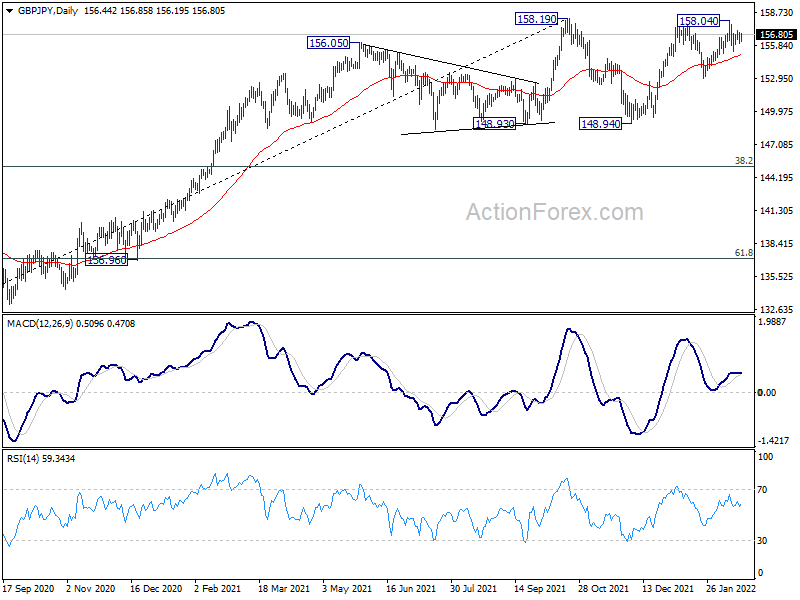
GBP/JPY Daily Outlook
Daily Pivots: (S1) 156.04; (P) 156.52; (R1) 156.96; More...
Intraday bias in GBP/JPY remains neutral for the moment. On the downside, break of 155.11 resistance should confirm rejection by 158.19 resistance. Intraday bias will be turned to the downside for 152.88 support, to extend the corrective pattern from 158.19 with another falling leg. However, on the upside, sustained break of 158.19 will resume larger up trend.
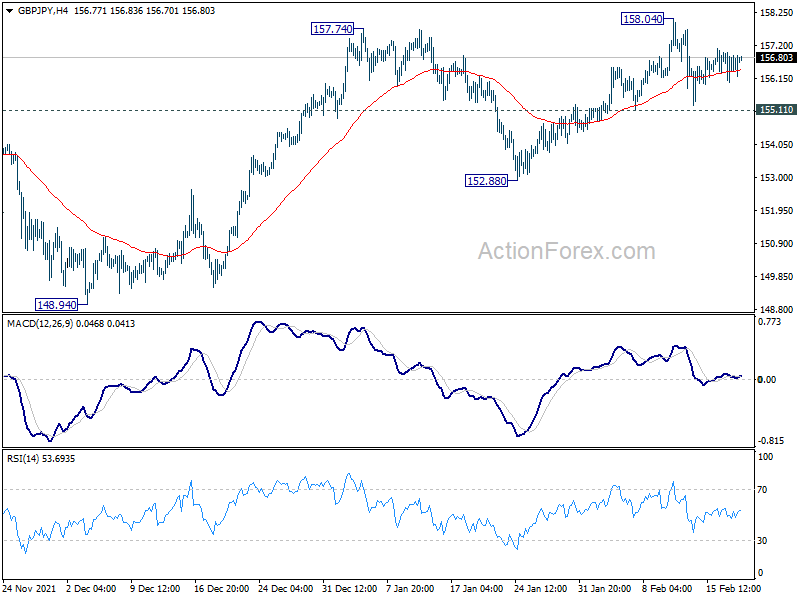
In the bigger picture, price actions from 158.19 are seen as developing into a consolidation pattern to up trend from 123.94 (2020 low). Downside should be contained by 123.94 to 158.19 at 145.10 to bring rebound. Firm break of 158.19 will resume the up trend to long term fibonacci level at 167.93. However, sustained break of 145.10 will raise the chance of trend reversal and target 61.8% retracement at 137.02.